CREATING OPPORTUNITIES TO LEARN THROUGH RESOURCING LEARNER ERRORS ON SIMPLIFYING ALGEBRAIC EXPRESSIONS IN GRADE 8
Name: Olinah Matuku
Student number: 729629
Protocol number: 2016ECE061M
Date: 5 June 2017
SUPERVISOR: DR JUDAH P. MAKONYE
A Research Report submitted to the Wits School of Education, Faculty of Science, University of Witwatersrand, Johannesburg, in partial fulfilment of the requirements for the degree of Master of Science in Education.
i Declaration
I declare that a Research Report hereby handed in for the qualification for the degree of Master of Science in Mathematics Education at the University of Witwatersrand, South Africa is my own unaided work and that all the sources I have used and quoted are indicated and acknowledged by means of complete references.
Olinah Matuku 24 March 2017
ii Abstract
This research problematised the teaching and learning of the grade 8 topic of simplifying algebraic expressions via the errors and misconceptions learners’ show on that topic. The study conducted at a secondary school in Johannesburg identified the nature of grade 8 learners’ errors and misconceptions on simplifying algebraic expressions. A teaching intervention through using those errors as resource to help learners reduce them was undertaken. There was an implementation of discovery learning as an intervention strategy to help learners to explore algebraic concepts with the minimum involvement of the researcher. The researcher used constructivism, sociocultural learning and variation theories since these theories affect the learners learning of algebra. The researcher used an interpretive paradigm which is concerned about the individuals’ interpretation of the world around them. Purposive and convenience sampling were used in the study. Data was collected using a sample of thirty grade 8 learners. The learners wrote a test as one of the assessment task in the study. The purpose of the pre-test was to identify learners’ errors on simplifying algebraic expressions. After the learners’ errors were identified and analysed, the researcher conducted a semi-structured, focus group interview with six learners in the study. The selection of the interviewees depended on the type and frequency of errors they have displayed in their pre-test scripts. The purpose of the interview was to investigate the reasons behind the learners’ errors as identified in the pre-test. An intervention strategy which implemented guided discovery learning was employed to learners with the use of the identified errors as a resource to help learners reduce them. After the intervention, the learners wrote a post-test to check if there was an improvement in learners’ performance after the intervention. Pre- and post-tests results were analysed for errors revealed by learners. The teaching intervention periods were introduced to create learning opportunities for learners. The findings of the study revealed that before intervention learners encountered a lot of difficulties when simplifying algebraic expressions but the learners’ performance improved after the intervention. The recommendations of the study are, teachers should welcome learners’ errors in teaching and learning of mathematics and use them as a resource to help learners reduce them in solving mathematical problems
iii
iii Acknowledgements
My God, the Almighty, I thank you for your protection, guidance, blessings and strength which you bestowed upon me to finish my research study.
My deepest gratitude goes to the following people:
My supervisor Dr Makonye for his patience, irreplaceable advices and suggestions. Dr Makonye you never gave up on me during those difficult times when there seemed to be no progress in my research journey. Your help, support, motivation and inspiration for successful compilation of this research study are greatly appreciated.
The Gauteng Department of Basic Education for permitting me to conduct my research in one of its urban schools in Johannesburg.
My Family; husband Victor and children Anotida, Anesu and Anashe for their endless love and untiring moral support and encouragement for me to do the best throughout the research study. My dear husband Victor your unconditional love will always be remembered, you stood by me in everything, most of the family responsibilities were yours and you afforded me an opportunity to concentrate on my research. My beloved family all your efforts are valued.
My parents the late Pheneus and Tereiza Rusinga for their unconditional love, advices, perseverance and sacrifices towards my education.
My friend Tsitsi Mugwagwa who stood by me through thick and thin and offered me unwavering support and motivation throughout the research study.
Professor Marrisa, for her financial assistance for me to complete my studies.
Finally, I would like to thank my principal and my grade 8 mathematics class. These people were amazing, understanding, cooperating and offered unwavering support throughout the study.
CONTENTS
Declaration ... i
Abstract ... ii
Acknowledgements ... iii
LIST OF FIGURES ... viii
LIST OF TABLES ... viii
LIST OF ABBREVIATIONS ... ix
CHAPTER 1: BACKGROUND OF THE STUDY ... 1
1.1 Introduction ... 1
1.2 Problem statement ... 5
1.3 Purpose of the study ... 6
1.4 Research questions ... 6
1.5 Significance of the study ... 6
1.6 The research methods ... 8
1.7 Outline of the chapters in the study ... 9
1.8 Conclusion ... 9
CHAPTER 2: THEORETICAL FRAMEWORK AND LITERATURE REVIEW ... 10
2.1 Introduction ... 10
2.2 THEORETICAL FRAMEWORK ... 10
2.2.1 Constructivism ... 10
2.2.2 Socio-cultural learning ... 14
2.2.3 Concept image and concept definition ... 17
2.2.4 Variation Theory ... 18 2.2.5 Conceptual framework ... 21 2.3 LITERATURE REVIEW ... 25 2.3.1 Errors ... 26 2.3.1.1 Careless errors ... 26 2.3.2 Misconceptions ... 27
iv
2.3.3 Reasons for learners’ errors ... 28
2.3.4 Resourcing learners’ errors ... 31
CHAPTER 3: METHODOLOGY ... 32
3.1 Introduction ... 32
3.2 Research Design ... 32
3.3 Case Study ... 33
3.4 Quantitative and qualitative research ... 33
3.5 Mixed methods research ... 34
3.6 Sample and the sampling methods ... 35
3.7 Data collection methods ... 35
3.7.1 Pre and post-test ... 35
3.7.2 Interviews ... 36
3.7.3 Procedure of the study ... 37
3.8 Data analysis ... 37
3.8.1 Methods of data analysis ... 37
3.9 Intervention ... 38 3.10 Rigour ... 40 3.10.1 Validity ... 41 3.10.2 Reliability ... 41 3.10.3 Ethical considerations ... 41 3.10.5 Informed Consent ... 42 3.10.6 Voluntary participation ... 42
3.10.7 Violation of privacy and anonymity ... 42
3.10.8 Confidentiality ... Error! Bookmark not defined. 3.10.9 Publication of findings ... 43
3.11 Conclusion ... 43
CHAPTER 4: DATA ANALYSIS ... 44
4.1Introduction ... 44
4.3 Type of errors and error analysis ... 45
4.5 Quantitative analysis of the learners’ performance in the pre-test ... 46
4.6 Qualitative analysis of the learners’ errors in the pre-test ... 49
4.7 Qualitative analysis of the pre-test using scanned vignettes ... 54
v
4.7.2 A summary of learners’ errors in item 1.2 of the pre-test ... 59
4.7.3 Summary of learners’ errors in item 1.3 of the pre-test... 63
4.7.4 Summary of learners’ errors in item 1.4 of the pre-test... 66
4.7.5 Summary of learners’ performance in item 1.5 of the pre-test ... 69
4.7.6 Summary of learners’ errors in item 1.6 of the pre-test... 72
4.7.7 Summary of learners’ errors in item 1.7 of the pre-test... 75
4.8 Learners’ interview ... 75
4.8.1 Summary of learners’ interview responses in item 1.1 ... 77
4.8.2 Summary of learners’ interview responses in item 1.2 ... 78
4.8.3 Summary of learners’ interview responses in item 1.3 ... 80
4.8.4 Summary of learners’ interview responses in item 1.4 ... 81
4.8.5 Summary of learners’ interview responses in item 1.5 ... 84
4.8.6 Summary of learners’ interview responses in item 1.6 ... 86
4.8.7 Summary of learners’ interview responses in item 1.7 ... 87
4.9 Analysis of the intervention ... 87
4.10 Quantitative analysis of the learners’ performance in the post-test ... 88
4.10.1 Summary of learners’ performance in the post-test ... 91
4.11 Quantitative analysis of the learners’ errors in the post-test ... 92
4.12 Analysis of both the pre and post-test items ... 96
4.13 Qualitative analysis of the post-test using scanned vignettes ... 98
4.13.1 A summary of learners’ errors in item 1.1 of the post-test ... 100
4.13.2 Summary of learner’s errors in item 1.2 of the post-test ... 102
4.13.3 Summary of learners’ errors in item 1.3 of the post-test ... 106
4.13.4 Summary of learners’ errors in item 1.4 of the post-test ... 108
4.13.5 Summary of learners’ errors in item 1.5 ... 109
4.13.6 Summary of learners’ errors in item 1.6 of the post-test ... 113
4.13.7 Summary of learners’ errors in the post-test item ... 115
4.14 Discussions ... 115
4.15 Conclusion ... 122
CHAPTER 5: FINDINGS, RECOMMENDATIONS AND CONCLUSIONS ... 123
5.1 Introduction ... 123
5.2 Research findings ... 124
5.3 What are the types of errors and misconceptions grade 8 learners display in simplifying algebraic expressions? ... 124
vi
5.3.1 Incorrect addition and subtraction of algebraic terms ... 124
5.3.3 Removing of variables from algebraic expressions ... 125
5.3.4 Incomplete/incorrect distribution of terms ... 125
5.3.5 Changing of operational signs ... 125
5.3.6 Changing algebraic expression to equations ... 125
5.3.7 Omission of algebraic terms ... 125
5.3.8 Creation of learners’ own rules... 125
5.3.9 Inappropriate application of rules ... 126
5.3.10 Slips ... 126
5.4 What are the possible reasons for these errors? ... 126
5.4.1 Separation of coefficients from variables ... 126
5.4.2 Lack of concentration/ forgetfulness ... 126
5.4.3 Production of a single answer ... 126
5.4.4 Answers to be whole numbers ... 126
5.4.5 Misconceptions from previous learnt concepts ... 127
5.4.6 Miscalculation ... 127
5.4.7 Manipulation of first operational sign ... 127
5.4.8 Partially remembering of concepts ... 127
5.4.9 Incomplete multiplication of terms ... 127
5.4.10 Avoiding repetition of terms ... 127
5.4.11 Integers difficult to work with ... 127
5.5 To what extent do resourcing learners’ errors and misconceptions through the discovery method in teaching help learners to diminish them? ... 127
5.6 Limitations of the study ... 128
5.7 Recommendations ... 128
5.7.1 Practice... 128
5.7.2 Policy ... 129
The policy makers must encourage the use of learners’ errors in teaching and learning of ... 129
5.7.3 Theory ... 129
References ... 130
Appendix 1:Pre-test ... 140
Appendix 2: Memorandum for the pre-test ... 141
Appendix 3: Interview guide ... 142
vii
Appendix 6: Memorandum for the pre-test ... 147
Appendix 7: GDE Approval letter ... 149
... 149
Appendix 8: Human Research Ethics Council clearance letter ... 150
Appendix 9: Letter for the Principal ... 152
viii
LIST OF FIGURES
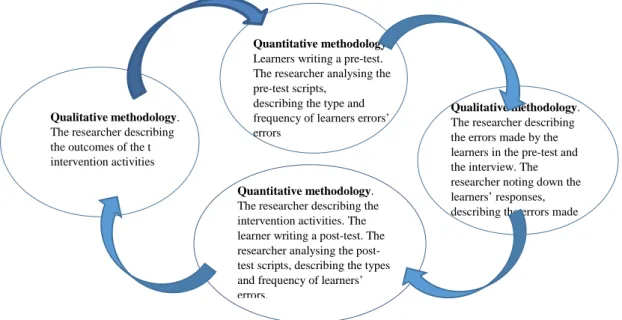
Figure 1: Summary of how the mixed method works... 34
Figure 2: Frequency of learners with 0 to 3 marks in the pre-test items 1.1 to 1.7 ... 47
Figure 3: Showing the types and frequency of learners’ errors in the pre-test ... 52
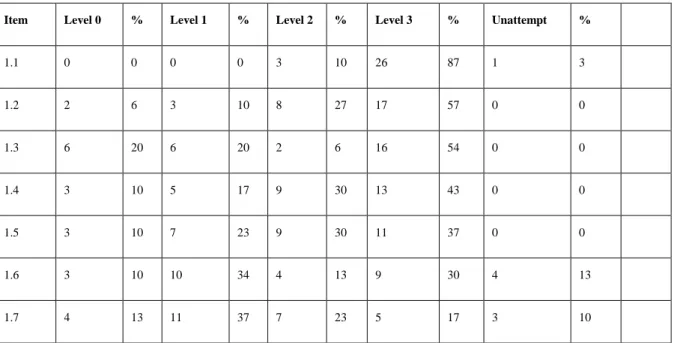
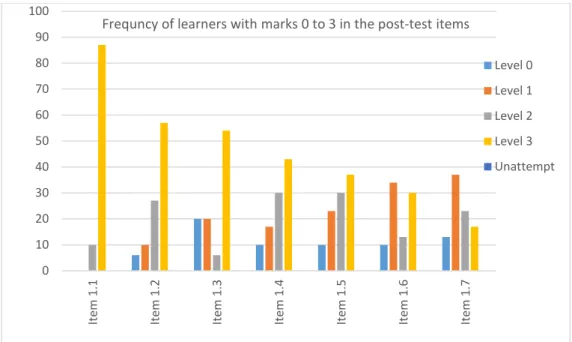
Figure 4: Frequency of learners with 0 to 3 marks in the post-test items 1.1 to 1.7 ... 90
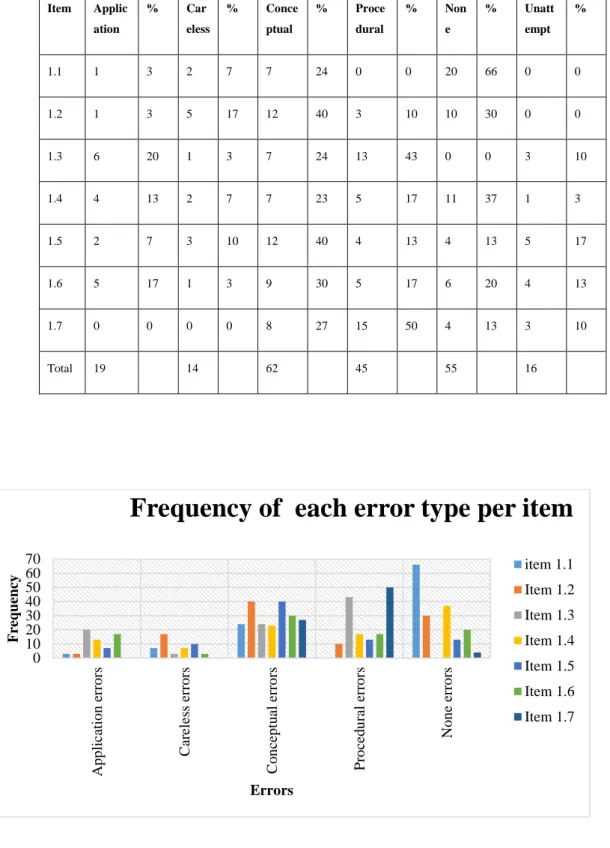
Figure 5: Frequency of each type of error per item in the post-test ... 94
LIST OF TABLES Table 1: Showing a sequence of algebraic terms ... 20
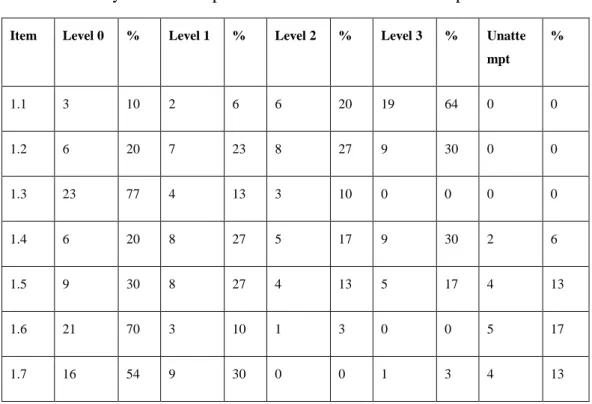
Table 2: Summary of learners’ performance levels in each of the pre-test items ... 47
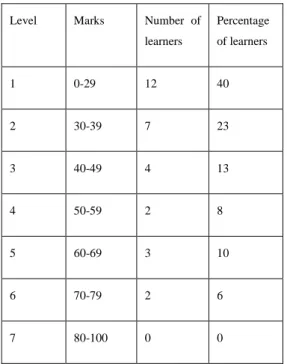
Table 3: Summary of learners’ marks as a percentage in the pre-test ... 48
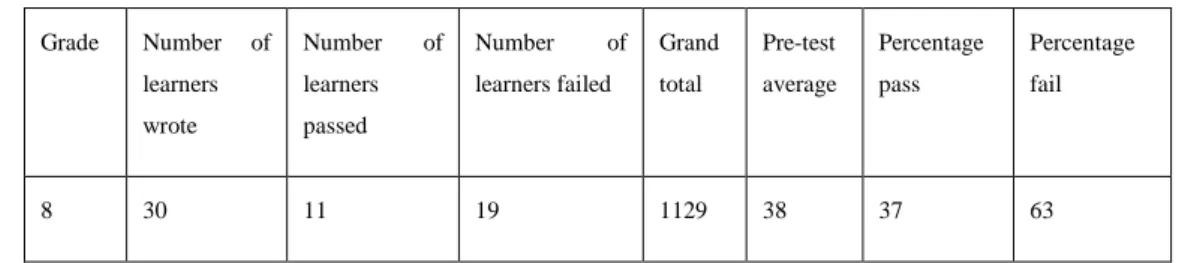
Table 4: Summary of grade 8 learners’ results of the pre-test ... 49
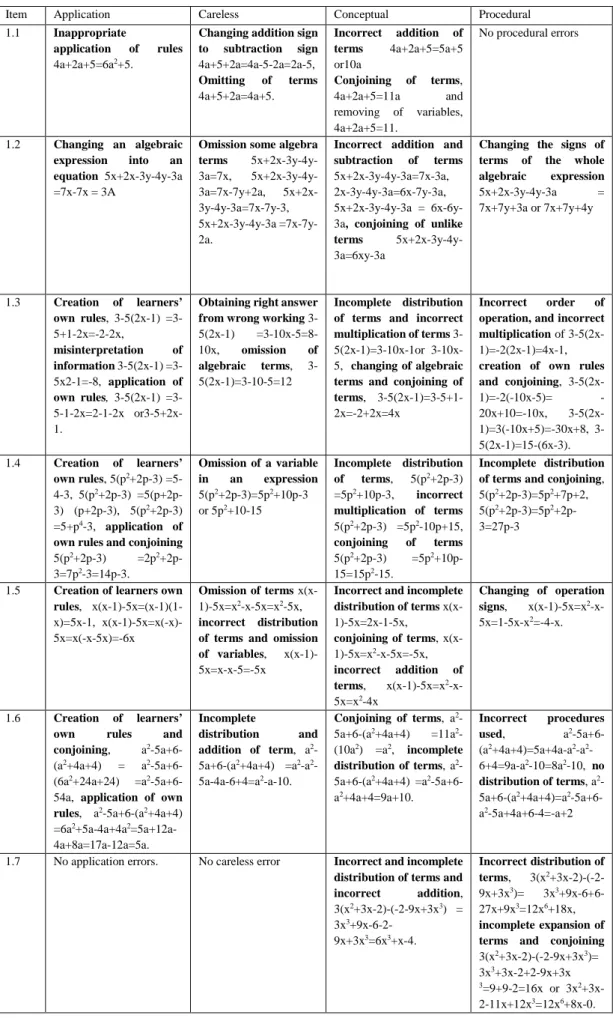
Table 5: Shows the type of learners’ errors on the pre-test scripts from item 1.1 to item 1.7 ... Error! Bookmark not defined. Table 6: Shows the frequency of each type of error per item ... 51
Table 7: Showing the percentage of learners with errors in each pre-test item ... 54
Table 8: Summary of learners’ performance level in each of the post-test items ... 89
Table 9: Summary of learners’ marks as a percentage in the post-test ... 91
Table 10: Summary of grade 8 learners’ results in the post-test ... 91
Table 11: Summary of learners’ errors in each of the post-test items ... 92
Table 12: Showing the percentage of learners with errors in each post-test item ... 93
Table 13: Showing the combined learners’ performance in both the pre and post-test items ... 96
Table 14: Showing combined statistics for the pre and post-test ... 97
Table 15: Showing combined errors from item 1.1 to item 1.7 from the pre and post test ... 97
ix
LIST OF ABBREVIATIONS
EFRM Examination Feedback Resource Material
CAPS Curriculum and Assessment Policy Statement
DBE Department of Basic Education
NRC National Research Council
NSC National Senior Certificate
1 CHAPTER 1: BACKGROUND OF THE STUDY 1.1 Introduction
In South Africa, the Curriculum and Assessment Policy Statement (CAPS) is a National Curriculum Strategy document which has replaced the Subject and Learning Area statement implemented in schools in 2012. CAPS under the Department of Basic Education (DBE) defined algebra as the language for exploring and collaborating Mathematics which can be extended to the study of functions and other associations between variables (DBE, 2011). Algebra is used as a tool for expressing some associations between variables; it is generalised arithmetic which can be referred to in a given situation to solve mathematical problems. Learners start doing pre-algebraic skills in primary school. The formal algebra is introduced in grade 7, this includes algebraic expressions. Learners need to have a strong basic foundation in arithmetic for them to learn algebra with less difficulties because these two topics connect with each other. In preparing for algebraic expression in grade 8, learners are expected to solve problems in context, this involves the addition, subtraction, multiplication and division of directed numbers.
In Senior Phase, CAPS aims at developing learners in grade 7, 8 and 9 to attain mathematical skills in algebra where learners’ algebraic skills are improved. According to the DBE (2011) in the mathematics guidelines for grade 8 and 9, learners are expected to recognise and interpret rules, recognise and distinguish symbols for writing algebraic terms, exponents and coefficients to represent and describe situations, interpret and manipulate algebraic expressions (DBE, 2011). Learners are also expected to use commutative, associative and distributive laws for rational numbers to add, subtract, multiply and divide terms in simplifying algebraic expressions (DBE, 2011).
Amerom (2002) distinguishes algebra in four basic perspectives as follows; algebra as comprehensive arithmetic, a problem-solving instrument, a study of relations and constructions. Algebra is a branch of mathematics which deals with symbols and letters to represent relationships between numbers and quantities through the use of some mathematical rules. Kieran (1992) states that algebra is a shift from a reliance on knowledge of numbers and arithmetic operations to a reliance on algebraic operations, rules, and numerical structure. Algebraic terms are general terms/formula representing some mathematical connections between variables, while arithmetic terms are specific numeric values. In algebra learners must
2
be able to differentiate between specific and general situations when solving problems in mathematics.
Algebra is one of the most critical topics in mathematics that develop learners’ problem solving and reasoning skills (Schoenfeld, 2007). This is so because algebraic concepts offer learners a very strong foundation in problem solving skills. Learners who are good in algebra are liable to perform well in other areas of mathematics or in other subjects. Learners who understand algebra well possess strong reasoning and analysing skills which they can use in any other mathematics topics including other problem solving situations which are non-mathematical. Algebra takes a great portion of the schools’ curriculum since it is an important subject in the learning of mathematics.
Algebra is often described as a doorway to advanced mathematics, it offers the language in which mathematics is taught (Stacey & Chick, 2004). It is vital that learners have a strong elementary understanding of algebraic concepts for them to prosper in any topics/courses in mathematics through the application of strong analysing, justifying and reasoning abilities. Algebra lays a concrete foundation for learners to understand some high order mathematics courses like actuarial science, engineering and medicine in tertiary education. Proficiency in algebra remains vital for understanding any mathematics. Algebra is the cornerstone for mathematical proficiency. By so doing teachers need to do their utmost best to help learners understand algebraic concepts for the learners to do well in other mathematics topics.
Algebra is a significant section of mathematics and yet, “often the first mathematics subject that requires wide-ranging intellectual thinking, a provocative new skill for many students, (Star, Pollack, Durkin, Rittle-Johnson, Lynch, Newton & Gogolen, 2015:1). From my two decades teaching experience and from other researchers done, I have realised that most of the grade 8 and 9 learners in South Africa struggle with algebra, when simplifying algebraic expression. This is the topic the researcher is concerned about in the study. Herscovics and Linchevski (1994) state that learning to operate algebraically is a difficult process that relies on a broad understanding of arithmetic and pre algebraic principles. Understanding of algebra depends on the learners’ understanding of arithmetic since these concepts are interrelated. Learners must be able to note some similarities and differences between the new approach of simplifying algebraic expressions and their old approach of simplifying arithmetic expressions. This is important for the new algebraic information to be accommodated into the pre-existing conceptual framework of arithmetic concepts.
3
Many students at the fundamental level are challenged when moving from arithmetic world to an algebraic world since they cannot understand the construction and outlines of arithmetic (Warren & Cooper, 2003). Some learners in secondary schools struggle with algebra due to lack of basic pre-algebraic (arithmetic) skills. These learners have a very weak knowledge base in algebra; their conceptual and procedural understanding of algebraic concepts is very low and insufficient for them to be able to simplify algebraic expressions. This was supported by Witzel, Mercer and Miller (2003) who state that many students find algebra to be abstract and difficult to comprehend despite its importance in school mathematics curricula. Algebra is a double-edged topic since teachers find it hard to impart to learners and learners find it hard to apprehend. Algebra is a difficult topic to understand because of its complex nature which is sometimes difficult to apply in real life situations.
The difficulty of students’ learning of algebra is accredited to the intellectual gap between arithmetic and algebra; students hold misconceptions as they changeover from arithmetic to algebra thinking, (Herscovics &Linchevski, 1994). Arithmetic deals with the manipulation of numbers and algebra deals with symbols and variables and focuses on relationships between terms. The difficult in transition from arithmetic to algebra is supported by Filloy and Rojano (1989) who state that changing from arithmetic thinking to algebraic thinking requires students to understand the concepts of variables. The complexity of algebra is due to the use of symbols which are not specified but generalised and representing unknown relations. For instance learners struggle to simplify expressions like 5x-4y-3y-3z+2x because all variables x, y and z are representations of unknown quantities. . Mathematics literacy learners have a better understanding of the topics involving some representations and relationships because their variables are specified unlike in algebra.
Amerom (2002) states that students struggle to obtain an operational idea of algebra which is basically different from an arithmetic viewpoint. In the transition from arithmetic to algebra learners need to change their mind set since the two concepts are not exactly the same. If learners do not change their way of thinking and handle algebraic concepts in the same way they did in arithmetic this can be misleading when it comes to the manipulation of algebraic expressions. For instance in arithmetic 6+5 = 11 but 6a+5 ≠ 11a, this is so because 6a and 5 are unlike terms which cannot be combined to a single term. Learners who move with incomplete knowledge or misconceptions from arithmetic can definitely pass on these misconceptions in simplification of algebraic terms. These misconceptions hinder the learners’ performance in simplifying algebraic expressions. This is supported by Linchevski and Livneh (1999) who
4
state that students who make errors in arithmetic expressions repeat some of these errors when dealing with algebraic expressions. Learners who lack basic arithmetic skills find it difficult to simplify algebraic expressions.
The main reason for this struggle according Sfard (1991) is due to learners failing to understand the double existence of algebraic expressions as a process which put in place both working instructions as well as represent a number which is a result of these operations. According to Kieran (1992), students’ learning difficulties are centralised on the meaning of letters, the change from arithmetic to algebraic symbols and the acknowledgment and use of structures. The researcher as an educator has realised that learners from grade 8 to 12 perceive algebra as a topic of the classroom, not applicable anywhere else because of the existence of the variables x, y and z. They fail to understand the meaning of expressions like 2x-3y +3z because the variables are generalised. In simplifying algebraic expressions learners will end up with errors because what they are simplifying is unspecified unlike in arithmetic.
Working with negative numbers is naturally difficult for students who are moving from arithmetic to algebraic thinking due to the abstract nature of algebra (Linchevski & Williams, 1999). These difficulties are related to addition, subtraction, multiplication and division of directed numbers and this includes the expansion of brackets. Learners encounter some problems in algebra when they enter high school because they cannot interpret and comprehend the meaning of letters in algebraic statements. This occurs because in primary school learners manipulate specific numerical values in arithmetic unlike in high school where learners are exposed to symbolised terms in algebra. For learners to have a sound knowledge in simplifying algebraic expressions these learners must have strong arithmetic skills which are the basic skills needed for them to understand algebra.
Teachers need to handle the transition from arithmetic to algebra with great care so as to reinforce correct mathematical concepts to minimise some occurrence of learners’ errors and misconceptions. Demana and Leitzel (1988) argue that students have insufficient ideas of some algebraic values. There is a need for primary school teachers to reinforce some arithmetic principles within learners to reduce learners’ cognitive difficulties in algebra. The learners need to be thoroughly and adequately taught in addition, subtraction, multiplication and division of directed numbers since these concepts are necessary in simplifying of algebraic expressions. The manipulation of integers is very crucial since it equip learners with pre-algebraic skills and prepare learners with some representations and operations of algebra.
5 1.2 Problem statement
I am a mathematics educator who has been teaching grade 8-12 for the past 19 years in 5 different government schools with different school settings. From all these teaching years, I have realised that the majority of mathematics learners struggle with algebra no matter how resourceful the school is. In South Africa there are challenges related to the teaching and learning of mathematics causing learners to perform badly in mathematics (Reddy, 2006; Luneta & Makonye, 2010). Algebra is one of the topics which is a stumbling-block that hinders learners to perform well in mathematics. Most of the learners find it very hard to manipulate algebraic problems using accepted rules, procedures, or algorithms because algebra is abstract (Mamba, 2012). Learners encounter some problems when simplifying algebraic expressions because the concepts are nonconcrete, the variables used are unspecified and most of the times learners find it difficult to apply them in real life situations.
Greens and Rubenstein (2008) state that in grade 8, 9 and 10 learners find it difficult to understand some elementary algebraic concepts and skills. Most learners at my school and other schools in South Africa are not performing well in algebra in general and algebraic expressions to be specific. Overall this contributes to poor learners’ performance in mathematics in South Africa and this is a national problem. The Umalusi (2015) under the Department of Basic Education and Gabriel et al. (2013) indicate that the widely held errors and misconceptions shown by learners in their National Senior Certificate mathematics examination (NSC) scripts are due to deficiency in basic algebra. This is so because algebra covers more than half of the concepts examined in the NSC examinations. One reason why learners struggle with algebra in grade 12 is lack of basic algebraic skills in earlier grades. This is supported by the DBE (2016) which reports that candidates’ showed poor algebraic skills which is an indication of lack of basic pre-algebraic skills which could not allow learners to effectively understand mathematical concepts in the examinations.
The government through the Department of Education need to find ways of helping learners to minimise their errors one way could be resourcing of the learners’ errors. The low learners’ attainment in mathematics is linked to errors and misconceptions (Makonye, 2010). One of the reasons why grade 8 learners fail to simplify algebraic expressions is due to misapplication of arithmetic rules to algebra or its incomplete knowledge gaps between arithmetic and algebra. Most learners struggle with algebra, and end up failing mathematics examinations since algebra
6
contributes to a lot of marks in these examinations. The researcher as an educator is very worried about this low achievement in mathematics in algebra. That is why it was of great importance for the researcher to investigate learners’ misunderstandings on simplifying algebraic terms and investigate the probable cause for errors in order to help learners reduce them.
1.3 Purpose of the study
One way of examining why algebra is problematic is to find the kinds of errors learners usually make in the topic and explore the likely reasons for the errors (Booth, 1988).The study aimed at investigating the nature of errors and misconceptions grade 8 learners have in simplifying algebraic expressions and get a deep understanding of the possible reasons for these errors. The study sought to investigate if a learning opportunity can be created through resourcing learners’ errors to help learners reduce them on simplifying algebraic expressions. The researcher allowed learners to explore the concepts surrounding the simplification of algebraic expressions before the teacher demonstrated how to simplify the expressions in the pre-test. Also the researcher introduced variation theory during the intervention where the researcher contrasted a correct answer with a wrong answer for learners to note the differences between the two. If learners know their misconceptions in any mathematical topics, they can easily avoid them when solving mathematical problems. During intervention the researcher incorporated the concepts of integers as revision to fill up the gap between arithmetic and algebra.
1.4 Research questions
1. What are the types of errors and misconceptions grade 8 learners reflect on simplifying algebraic expressions?
2. What are the possible reasons for these errors?
3. To what extent doresourcing learners’ errors and misconceptions through the discovery method in teaching help learnersto diminish them?
1.5 Significance of the study
Graeber (1999) highly motivated me when he states that an appreciative approach to common student misconceptions, and active plans to help students avoid them, is an important aspect of educational content information. I felt like its high time now for me and other teachers to
7
understand learners’ errors and misconceptions in algebra in order to implement meaningful intervention strategies which can help learners diminish the errors. I enthusiastically wanted to know how best I could create opportunities for learners to learn through using their errors as correctional devices in the teaching and learning of mathematics. My intentions were greatly supported by Nesher (1987) who stated that misconceptions can be used as a response mechanism for real learning on the basis of the actual presentation. Khazanov (2008) gave me hope of succeeding in my study when he highlighted that teachers must know learners’ errors and misconceptions so as to cautiously and systematically prepare lessons to sufficiently address them. Teachers who know and use learners’ errors and misconceptions successfully escalate in their teaching methods and achieve long-lasting results in their goals (Riccomini, 2005). I needed to understand learners’ thinking which ended up as errors and misconceptions when simplifying algebraic expressions in the pre-test. These errors were used as a resource to remediate learners in simplifying algebraic expressions.
Nesher (1987) argues that the students’ errors should not be looked down upon, since they disclose the learners’ imperfect and inadequate knowledge (misconceptions) and encourage teachers to find ways to improve on their intervention strategies. Teachers need to understand and appreciate learners’ errors and use them as correctional devices in the teaching and learning of algebra. In my entire teaching career I have never used errors as a resource to improve my teaching. I eagerly want to use learners’ errors as a resource and I hope this intervention strategy is going to help learners overcome their problems in simplifying algebraic expressions and will improve their performance in this regard. The knowledge about learners’ errors and misconceptions can be a useful asset to the teachers, subject advisors, curriculum planners, policy makers and the entire field of mathematics education, since it proposes improvement for teaching. I hope that all the stake holders will gain some useful information from the research findings.
Teachers must be mindful of learners’ errors and misconceptions in algebra for them to come up with some significant intervention approaches to help the learners to minimise their productions of errors when solving algebraic tasks. These errors and misconceptions can be used as a resource tool for correcting erroneous learning in order to improve performance. Khazanov (2008) states that teachers who are attentive to their learners’ errors and misconceptions in a specific topic cautiously and systematically prepare their lessons in order
8
to sufficiently address the errors and misconceptions. Knowing learners’ errors in algebra is an important aspect of teaching which can encourages teachers to attentively prepare their lesson with an aim of helping learners to avoid the errors if it’s possible or reduce them. It’s difficult for doctors to treat patients if they do not know what each patient is suffering from. This also applies to learners in the classroom; teachers can only work for an improvement in assisting learners if they know the learners’ shortfalls in simplifying algebraic expressions. The researcher hopes that the findings from this study might lead to the improvement of teaching strategies in this topic for the benefit of the learners.
Teachers can exploit learners’ errors as a resource that helps them to understand learners’ thinking to the advantage of the learner (Makonye &Luneta, 2013; Nesher, 1987). An understanding of learners’ reasoning which can result in errors and misconceptions can be used as a resource to improve one’s teaching methods. This research can be useful and effective to teachers and all other education professionals since it spearhead for quality and improved teaching and learning through remediation in the classroom. Nesher (1987) has argued that the students’ errors should be considered as useful in teaching and learning since they reveal the incompleteness of learners’ knowledge. This enables the teacher to reteach the concept or contribute additional knowledge to learners for them to correct their errors. The knowledge about learners’ errors and misconceptions in algebraic expressions can motivate the researcher and other teachers to strategically improve their teaching styles. This helps learners to minimise their errors and misconceptions in the topic thereby improving learners’ performance in mathematics. If teachers become competent in their teaching, learners will benefit from this improved teaching which can result in better learning and improved learner performance in mathematics. The study can help the researchers to learn more about learners’ errors and misconceptions in algebra and to inform policy and curriculum makers to emphasise what needs to be done in order to improve in the learning and teaching of algebra.
1.6 The research methods
The research study used a mixed methods research approach. This method was employed mainly because of its strengths since the merits of the qualitative and quantitative approaches complement each other resulting in a strong research study that yields more valid and reliable findings (Opie, 2004). The combined evidence from the two different research methods will provide strong arguments about the research. The data was collected from 30 grade 8 learners
9
through the use of a pre-test, interview and post-test. Data from the pre and post-test was quantitatively analysed and the data from the interview was qualitatively analysed. The researcher assumed that collecting diverse types of data could provide better understanding of the research problem which is; creating opportunities to learn through resourcing learner errors on simplifying algebraic expressions.
1.7 Outline of the chapters in the study
In chapter 1 the researcher gave an overview of the expectations of the study through discussing the problem that gave rise to the study, the research questions and significance of the study. In chapter 2 the researcher focused on the theoretical framework that guided the study and the literature-based on a conceptual framework that helped the researcher to understand the data in the study. The literature brought different pieces of research into relationships with each other and included some discussions on learner errors on simplifying algebraic expressions. Chapter 3 represented the methodology that was used in the study. This included some discussions on research design, research instruments, target population, sampling, data collection methods/procedures, data analyses and ethical considerations in the study. Chapter 4 focused on data analysis, data representations, data interpretations from the pre and post-test and the interview. In chapter 5 a summary of the research findings was presented. This includes the insights obtained and the problems encountered during the study and changes to be done if given another opportunity to do the study. Recommendations were made from the findings which included some suggestions for further investigations in ways of helping learners to reduce errors on simplifying algebraic expressions.
1.8 Conclusion
In this chapter, the background of the study was established. The problem that led to the study was discussed and the purpose and rationale of the study were briefly stated. The three research questions which the study intends to answer were asked. The outline of the chapters in the study was presented. The investigation was about identifying learners’ errors and misconceptions on simplifying algebraic expressions and to find possible reasons for these errors. The other focus of the study was to find out if an intervention strategy of resourcing the learners identified could help learners to reduce them.
10
CHAPTER 2: THEORETICAL FRAMEWORK AND LITERATURE REVIEW 2.1 Introduction
A theoretical framework is the researcher’s choice of theories to be used as lens that guide and explain the study in order to answer the research questions. The study was informed by cognitive constructivism Piaget (1968) and von Glasersfeld (1990) and social constructivism Vygotsky (1978). Variation theory by Marton and Booth (1997) and the concept image and concept definitions by Tall and Vinner (1981) were used as bridging theories to support the major theories stated above. These theories directed the study and helped in interpreting the data on learners’ errors and misconceptions.
2.2 THEORETICAL FRAMEWORK 2.2.1 Constructivism
Constructivism is a cognitive learning theory which focuses on the human mind which constructs knowledge (Piaget, 1968; von Glasersfeld, 1990). This theory is useful in the study, as it helps the researcher to understand learners’ thinking which leads to learners’ errors and misconceptions on simplifying algebraic expressions. Learning is a thinking process. In this process the mind can conceive misconceptions which hinders learners to successfully solve problems. In problem solving situations, the mind reasons within some conceptual structures called schemas. According to Marshall (1995), schemas are mechanism in human memory that allow for the storage, synthesis, generalization and recovery of similarities of experiences. The schema is the most crucial area of learning, a conceptual arrangement stored in the learner’s memory that combines previous experience with current information and retrieve some resemblances in both information and use it to solve problem at hand. In algebra, learners need to identify some similarities in concepts between algebra and integers (directed numbers) and use them to simplify algebraic expressions.
Piaget (1968) states that learning occurs in three stages namely; assimilation, the placing of new information into schemas, accommodation, the transforming of existing schemas to new information and equilibration, attaining a balance between oneself and the environment. During learning, learners usual simplify and rearrange new information to fit into their existing schemas (assimilation and accommodation). If this fails, misconceptions can occur due to overgeneralization (Piaget, 1968). In this study overgeneralisation can occur in a situation where learners fail to link algebraic concepts to already existing arithmetic concepts. For
11
instance learners can incorrectly simplify the expression 6a+5 to 11a using knowledge of arithmetic where 6+5=11 (misapplication of arithmetic rules to algebra). This erroneous answer 6a+5=11a is as a result of learners failing to rearrange their thinking mechanism in arithmetic in order to accommodate the algebraic concepts to fit in their schema. Generally learners’ errors in mathematics are as a result of learners failing to retrieve the correct methods from their long term memory and consequently apply incorrect schemas in problem solving situations. To avoid misconceptions, the learners’ schemas need to be fitting and suitable to assimilate and accommodate new information into the schema which is already pre-occupied with previous experiences.
Another source of learners’ errors and misconceptions is due to misunderstanding of mathematical information as the teacher teaches or when discussing with other learners or when reading from mathematics textbooks. This can force learners to learn concepts through memorisation, a key cause of many mistakes in mathematics as pupils try to recall partially remembered and distorted rules (Olivier, 1989). Memorisation is short lived, since it hinders learners to recap previous learnt concepts in order for them to connect the concepts to the new information at hand in mathematical problem situations. Learners who learn by memorisation have high chances of producing inaccurate information when solving mathematical problems. Learners can produce errors when solving mathematical problems if they fail to remember concepts involved in the problem solving situation. Teachers need to understand the learners’ mental processes which acquire knowledge to understand how learners conceive concepts including misconceptions. This can be done by regular check-ups of the learners’ learning progress in class, homework, tests activities and the like. If learners’ errors and misconceptions are noted teachers must find ways to help learners to reduce them.
Learning depends on the prior knowledge of the learner which serves as a schema in which a new schema is fitted (Smith, DiSessa & Roschelle, 1993). Learners with rich previous learnt concepts for instance in arithmetic will easily understand concepts in algebra since the two topics relate to each other. The learner’s new understandings are dependent on the prior knowledge a learner retrieves from the earlier learnt concepts (Piaget, 1968) and students without this prior knowledge are disadvantaged as far as learning is concerned (Booth, 2008). Whatever information a learner brings to the class influences what that learner will benefit from the experience. This is supported by Piaget (1972) who argues that concepts are not taken directly from experience but the person’s ability to learn from an experience depends on the quality of ideas that he/she brings to that experience. Learning is cumulative; whatever
12
knowledge learners have from the previous lessons influences what he/she will learn in future. Learners with misconceptions from previous learnt concepts will apply them when they encounter new information related to the previous information. For instance learners can transit from arithmetic to algebra with misconceptions like failing to manipulate directed numbers which can negatively affect the learners’ performance in simplification of algebraic expressions. The researcher revisited the concepts of arithmetic as part of the intervention plan in order to help learners clear their misconceptions in this topic. This was done through the teachers’ clarification of concepts and differentiation of rules applicable and inapplicable in arithmetic and algebra.
Equilibration as stated by Piaget (1968) can only occur if and only if the learners’ current knowledge correlates with the learners’ previous knowledge. If this happens the mind will be satisfied with this experience and will maintain a state of balance. Disequilibrium usual comes in when a child experiences a new event until a time when the learner is able to assimilate and accommodate new information (Piaget, 1968). A state of disequilibrium which is a challenge to the learner occurs when the former knowledge fails to connect with the current knowledge. This result in a state of perturbation referred as mental disequilibrium where the mind anxious and seriously wants to solve a mathematical problem (Piaget, 1968) but the concepts presented are unfamiliar to the mind. This happens when learners are exposed to new information too isolated to fit into their current understanding but at the same time the learners eagerly want to solve the problem at hand. For instance learners can simplify an algebraic expression 2x + 3x to 5x using the concepts of like terms. This same learner can struggle with simplifying 2x2 +
3x because of confusion of not knowing whether 2x2 and 3x are like or unlike terms since both
terms have the same variable x. To clear up this state of disequilibrium, the learner can forcibly conjoin the two unlike terms to a single term 5x2. This distortion of rules results in errors and misconceptions.
Robinson, Eve & Tirosh (1994) state that students often make sense of the subject matter in their own ways which do not correlate with the structure of the subject matter. In constructivist classrooms learners create their own understanding and interpret it according to their own experience. During teaching and learning each individual learner uses his/her mental framework to constructs his/her own conceptions sensible to him/her (von Glasersfeld, 1990). Some learners strongly believe in their wrong knowledge constructions because they are sensible to them even though they do not relate with the subject matter. The constructed knowledge can be a correct conception of concepts or it can be a misconception when
13
interpreted mathematically. Piaget (1970) and Bruner (1996) state that every person has a different interpretation and construction of knowledge since knowledge acquisition and schemata are personal depending on one’s past experiences and cultural factors. The construction of knowledge is personal because mental structures of individual learners are different and assimilate and accommodate information differently. Learners arrange their experiences in their own personal ways which can be meaningful or meaningless to the mathematics community. Constructivism acknowledges that each learner has a unique background and unique needs and the knowledge he/she brings to the classroom is distinctive depending on what type of prior knowledge he/she had been exposed to. In the study there was need for the researcher to understand each and every learner’s understandings and knowledge gaps in algebra in order to help them. The researcher appreciated every learner’s contributions in the tests and interview since these unique answers led to an improved strategy of teaching and learning (intervention) in simplifying algebraic expressions
The best way to overcome a misconception is by engineering a cognitive conflict which allows learners to realise that their misconceptions are not mathematical as compared to the concepts of experts or mathematical textbooks (Makonye, 2013; Luneta and Makonye, 2013). Learners need to accept that their solutions are incorrect (cognitive conflict to be felt) for them to be helped by the teacher or mathematics textbook to clear their misconceptions. However in teaching and learning of mathematics there are some learners who are so attached to their misconceptions and believe that their constructions are correct. These learners hardly reject their misconceptions; they fail to experience the state of cognitive conflict and hence cannot learn from the experience. According to Nesher (1987) errors are difficult to eradicate from learners because these errors are valuable and meaningful to them since it’s their own creation. This is one of the reasons why some learners keep on repeating the same errors in mathematical topics like algebra irrespective of how many times these errors and misconceptions are rectified.
The curriculum should allow the learners to continually build upon what they have already learned (Bruner, 1996). On top of the curriculum efforts to relate topics, the teachers need to do a regular recap of concepts when new concepts are introduced to fill up the gap between previous information with current information. In the study there was a need for a researcher to revisit the concepts of directed numbers (integers) before algebraic expressions were tackled. Teachers must teach learners according to the learners’ educational level so that the information fits in the learners current cognitive schemas. Tasks which do not meet the learners’ cognitive
14
level can discourage or demotivate the learners to work. Any mathematical concept which is too isolated from the learners’ prior knowledge is meaningless to the learners because they cannot understand it.
Learners’ errors and misconceptions can be minimised if learners are provided with appropriate intervention strategies which enable them to attain a high level of development in learning of algebra. The researcher’s main aim in the study was to find the root cause of learners’ errors and misconceptions in simplifying algebraic expressions. This was done through a thorough scrutiny of learners’ written work in the pre- and post-test and through learners’ responses in the interview. Thereafter, the teacher uses the errors as a resource to help learners minimize the errors. Any errors or misconceptions which arise from learners’ work shows learners’ incomplete knowledge and it’s a witness of learners’ misunderstandings which results in inefficiency to solve the mathematical problems (Nesher, 1987). It is very important for teachers to check learners’ understanding during learning. This can be done through giving learners some class activities and tests and check their progress in these tasks. By so doing, no learners are left behind since their misconceptions would have been corrected.
This constructivist’s theory of learning is useful in explaining how learners conceive mathematical ideas including their misconceptions (Piaget, 1968; Von Glasersfeld, 1990, Hatano, 1996; Smith, Disessa, & Roschelle, 1993). Teachers need to understand learners’ thinking which results in misconceptions and errors when solving mathematical problems. Pupils’ erroneous thinking is an important part of teaching (Olivier, 1992). Errors contribute to the learning process because they allow one to think deeply about his/her answers in order to reduce errors which can arise from solving a mathematical problem. If learners’ errors and misconceptions are identified they must be rectified immediately to avoid recurring misconceptions in the next coming concepts. Piaget (1970) states that constructivism guides teachers to intervene with learners through questioning and discussions and skilfully responding to the learners’ ideas and allowing learners to discuss relationships between concepts and predict future events. Teachers need to create an environment in which they and their learners are encouraged to think and explore. Errors are an indication of learners’ thinking which caused misconceptions and teachers need to help learners to rectify this problem 2.2.2 Socio-cultural learning
Vygotsky (1986), states that social interaction and interdependence of social and individual processes in the construction of knowledge give rise to learning opportunities. The theory
15
believes that learners can learn through assisted discovery from knowledgeable persons. Learning involves learner-learner interaction, learner- teacher interaction and sharing of information to improve the learners’ understanding of mathematics. In social constructivism, learners construct their own knowledge through social and cultural interaction, sometimes receiving misconceptions from their teachers and other learners through misinterpretations of concepts. The theory emphasise that children will always learn when motivated by an adult who is always there to assist the children. Teachers must always expose learners to some mathematical concepts like algebraic expressions before giving learners such tasks to do. The teacher’s lesson plans need to be up to date so that whatever the teacher assess the learners on must go hand in hand with what was covered. A thoroughly prepared lesson plan can help the teacher to impact correct information to learners and avoid giving learners wrong information which can results in errors and misconceptions.
The Zone of Proximal Development (ZPD) is one of the most crucial principles in Vygotsky’s theory of social cultural learning. The ZPD is the distance between the actual developmental level as determined by independent problem solving and the level of potential development as determined through problem solving under adult guidance or in collaboration with more knowledgeable peers (Vygotsky, 1978, p.86). In this zone learners cannot solve problems on their own but require guidance and support from the teacher for them to be capable of solving mathematical problems. Mediation is the assistance given to learners if they fail to solve the mathematical problems by themselves referred to as the Zone of Proximal Development (Vygotsky, 1978). Here the teacher will assist a learner to solve mathematical problems during a time of incompetence. The ZPD helps the teachers to identify the gap in understanding of concepts by learners and this will help the researcher to understand the learners’ struggles in simplifying algebraic expressions. The ZPD enlightens the teacher about the extent of assistance learners need for them to solve mathematical problems by themselves. The zone of proximal development must be approached with careful thought instructions to avoid instilling misconceptions in learners’ mind. This higher level of development which results from the assistance given to the child enables the child to independently solve problems at a new level (Osei, 2000). Teachers need to assist learners to a certain point and leave them to proceed with the solution. By so doing the learners will learn something from that and will reach a higher level of understanding.
Learning is a social activity where learners and the teacher cooperatively solve mathematical problems. Teachers need to encourage learners to share ideas and the teacher needs to be fully
16
prepared to help any learner at any time. The development of conceptual thinking does not come naturally through experience but is dependent on specific types of social interactions (Vygotsky and Luria, 1994).
The interactions in the classrooms must be well organised, manageable, and beneficial to all participants in the learning process. Learners must be aware of some concepts and procedures involved in the learning of algebra before being afforded some opportunities to construct their own knowledge. Teachers need to do the recapping of previous learnt concepts so that learners connect them to the new concepts. In social interactions in and outside the classrooms misconceptions can be passed from learners to other learners or teachers to learners. Teachers need to be alert of the class discussions, to clarify concepts to minimise learners’ errors and misconceptions.
Vygotsky (1962) argues that language is a very powerful tool for the development of thought and helps learners to understand concepts cognitively. In cognitive development, language enables people to master and understand concepts established in their culture and be able to realise what’s going on in their environment. Learners who have acquired the language of mathematics like symbols, variables and constants in algebra can master and understand algebraic concepts fairly well. They will be in a position to correctly apply rules applicable to algebra and effectively simplify algebraic expressions; their schemas can easily assimilate this mathematical information. Children learn language in a social-interaction, then think in terms of that language which the most important tool or symbol in life of an individual to move to a higher level of cognitive awareness (Vygotsky and Luria, 1994). Learners derive their mathematical language from the classroom or society they are exposed to. If learners understand a language which relates to a mathematical problem, it will be easier for them to solve the problem since learners will have a clear understanding of what they are expected of. The grade 8 learners in an algebraic lesson ought to understand the language of that particular topic in that culture for them to successfully simplify algebraic expressions. According to Mamba (2012) learner errors and misconceptions can arise if learners do not understand the medium of communication such as language and symbols used in the teaching and learning of mathematics. In teaching and learning, sometimes learners fail to solve some given mathematical tasks due to lack of understanding of mathematical language involved. Teachers and learners need to use correct mathematical language in the classrooms to reduce learner errors and misconceptions.
17 2.2.3 Concept image and concept definition
The concept image and concept definition by Tall and Vinner (1981) is another suitable theory that gave more meaning to learners’ errors and misconceptions in algebra in the study. Tall and Vinner (1981) referred to concept image as a cognitive amount of ideas that a learner has formed in his/her mind regarding all aspects of specific concept. The concept images are all mental representations together with a set of properties associated with a certain concept (Vinner, 1983). Learners thoughtfully create their imaginary pictures which represent certain concepts and retrieve these representations in solving mathematical problems. The concept image is associated to Piaget’s schema; it is a model of the learners’ inner thoughts of reality constructed by learners as a result of experience with a particular concept. The concept images can be correct, partially correct or erroneous and they are a function of maturity and experience with the concept, (Luneta & Makonye, 2014). If a learner’s concept images are faulty and incorrectly formed this results in learner’s errors and misconceptions on solving mathematical problems.
Vinner (1983) highlights that a concept definition is a verbal definition that accurately explains the concept in a more understandable way. A concept definition is a precise description in words of a concept as is agreed by mathematicians. If learners’ concept images do not correlate with the learners’ concept definition misconceptions do arise in the learners’ minds which results in learners’ errors. For instance, a teacher can define like terms in algebra as algebraic expressions with the same variables. So learners can take 2x and3x2as like terms since they
have the same variable x without noticing that the two terms have different exponents so they are unlike terms. Here learners are trying to integrate the new concepts of like terms in a corrupted concept image which views x and x2 as the same quantities with the same variables
x. Learners always refer back to their incorrect concept images instead of focusing on the correct concepts presented to them by the knowledgeable teachers and the resourceful mathematics textbooks. That’s the reason why learners always have misconceptions in their minds and produce errors in mathematical solutions.
Learners’ errors are therefore as a result of naive concept images that do not measure up to the concept definition (Tall & Vinner, 1981). The learners can construct concept images differently from what they are taught because of confusion due to lack of understanding or misinterpreting of concepts. The learners’ constructed images can be mathematically incorrect (misconceptions) as a result of learners failing to link the concept image to the correct concept
18
definitions. In teaching and learning, learners are not taught misconceptions but they sensibly construct them using the structure of the current knowledge they possess. The misconceptions reveal that learners did not understand the concepts taught or were unable to connect the current knowledge to their previous learnt concepts. Teachers need to understand that concept images and concepts definitions work hand in hand. It’s not very easy for learners to understand concepts through definitions but understand concepts better if some representations or pictures or diagrams are involved. Also, presenting learners with concept images without explaining what they mean does not make sense. For instance the learners can understand better the concept of a right angled triangle if a diagram is presented and the properties of the triangle are defined or explained. Teachers need to give learners some examples that build up the desired concept image regularly when defining concepts or vice versa.
2.2.4 Variation Theory
Variation is about what changes, what stays constant and the underlying rule that is discerned by learners in the process. From a variation theory, learning is defined as a change in the way something is seen or understood. Teachers must provide learners with the means to experience variation through strategically designed activities. In the study the researcher employed variation theory through using errors as a resource to help learners reduce them. Learners need to know the difference between correct and wrong answers to avoid or reduce errors. If 2x + 4x = 6x then 2x + 4y ≠ 6xy since these are unlike terms. In this study, the researcher made the learners to write a pre-test. The purpose of the pre-test was to identify learners’ errors in simplifying algebraic expressions. Thereafter, an intervention strategy was done, where the concept of variation was applied. By exposing learners’ errors, teachers will enable learners to see what is wrong and what is right (variation) in the simplification of algebraic expressions. 2.2.4.1 Critical features
During teaching and learning, learners must be able to detect the very important concepts to remember for them to solve a mathematical problem. These crucial concepts are called critical features that help learners to have a better understanding of any mathematical problem given in the classroom. Learners can only recognize a particular critical aspect in a mathematical concept, if they experience variation in the dimension of that aspect. Learners must experience variation in the critical aspects of a concept, within limited space and time, for the concept to be learnable (Marton & Tsui, 2004; Marton & Pang 2006). In the study learners recognised critical features in the pre-test, post-test and interview they attended to. In these tasks errors and misconceptions are also revealed. Marton and Tsui (2004) state that teachers need to
19
effectively engage their students to grasp variations in understandings and knowledge so they can take account of this diversity in structuring the learning activities in a lesson. In the study the researcher used errors as an intervention tool. Learners need to know the difference between right solution and wrong solution through discernment of critical features. This can help learners to effectively solve mathematical problems.
2.2.4.2 Contrast
Marton (2009) describes the awareness brought about by experiencing the variation between two values as contrast. Concepts are learned only when they have been grasped through variation/contrast. In the classroom most teachers demonstrate concepts to learners by giving them a lot of similar examples without letting learners know dissimilarity between concepts. Errors are prominent in the learners’ work because the learners are not aware of them. If a phenomenon is combined with contrast, this allows us to separate the essential features of the phenomenon from irrelevant features”, (Akerlind, 2008, p.638). Learners can easily understand the correctness of a concept if they also know its misconception. For instance learners need to be clarified that the expression y x y = y2 but the expressions y x y ≠ 2y, this is a common
misconception in learners’ minds. Learners need to be exposed to variety of concepts which seem to be the same but different for the learners to understand and appreciate the difference. For example, 2+3+4=9 is an arithmetic expression but 2x+3x+ 4=5x+4 not 9x is an algebraic expression. Errors and misconceptions arise if learners fail to discern the differences between the two concepts. In algebraic expressions there is a need for collecting like terms and simplify whereas in integers, learners only deal with numbers which can be simplified to one term. 2.2.4.3 Separation
Leung (2012) states that separation is an awareness awakened by a systematic refined contrast obtained by purposely varying or not varying certain aspects in an attempt to differentiate the invariant parts from the whole. Separation is based on the view that everything is multifaceted and this gives rise to different understanding of that thing. Separation is a refined contrast which focuses on the uniqueness of individual concepts but have similarities with other concepts. For instance 3x, 3x2 and 3x3have something common, they are all algebraic expressions with 3 as
their coefficient. But we can vary them by looking at the exponent of x, 3x is a linear, 3x2 is
20 2.2.4.4 Generalisations
Generalisation is a variation and conjecture-making activity enabling learners to check the general validity of a separated pattern which is often a goal of mathematics exploration, (Chick & Marton, 2012). Generalisation of concepts comes about when there are similarities between the concepts. For instance we can treat the algebraic expressions3x, 3x2 and 3x3as a sequence; as shown on the table below;
Table 1: Showing a sequence of algebraic terms
Term 1 = (T1) Term 2 = (T2) Term 3 = T3 Term n = Tn
3x 3x2 3x3 3xn
The sequence will generalise to formula which is Tn = 3xn. This formula is applicable to all, for
instance we can calculate T10, T50, and T1000 by just substituting in the formula. Learners must
be provided with some generalisations for them to be able to tackle mathematical problems in different ways. Generalisations help grade 8 learners to simplify exponents by applying exponential rules (general terms) in adding, subtracting, multiplying and dividing exponents. 2.2.4.5 Fusion
Fusion takes place when the learner’s attention is focused on several aspects of a concept that vary at the same time. Fusion incorporates critical features or dimensions of variation into a whole under simultaneous co-variation. Ling (2012) states that if the learners can only discern individual critical features but fail to achieve the simultaneous discernment of all of the critical features and the relationships amongst them (fusion) possibly they will not thoroughly understand the object of learning and unable to apply such knowledge to solve new problems (Ling, 2012). In any given scenario learners need to identify all the critical features in solving mathematical problems and combines them and solve the problem. For instance in simplifying algebraic expressions learners need to note what is critical in each question for them to be able to simplify them.
2(x + 3) = 2x + 6 2(x – 3) = 2x – 6 -2 (x + 3) = -2x – 6 2(x – 3) = -2x + 6
Here learners need to know the critical concepts of multiplication of integers and combine it with the simplification of algebraic expression (fusion) to come up with different answers
21
representing the linear graph or equation differently. All the above solutions represent one linear graph which has been transformed in different ways like reflection, translation. In fusion there is synchronic simultaneity when learners focus on different aspects of an object of learning at the same time and diachronic simultaneity which connects variation experiences gained in previous and present interactions (Leung, 2012). This follows the view that learners always bring what they have met before (previous knowledge) to bear on what they are learning now; hence, simultaneous co-variation can be explained in terms of both synchronic and diachronic simultaneity.
2.2.5 Conceptual framework
The conceptual framework is a visual or written product that explains the concepts or variables and the relationships among them to be studied (Miles, & Huberman, 1994). This involves the bringing together of a number of related concepts to have a better understanding of the research problem. The conceptual framework includes the actual ideas and beliefs including some concepts in the theoretical framework, the researcher will follow to understand learners’ errors and misconceptions on simplifying algebraic expressions.
2.2.5.1 Conceptual knowledge and procedural knowledge
Conceptual knowledge is the understanding of mathematical concepts or ideas, operations and relations. Learners with conceptual understanding know the usefulness and applicability of a mathematical idea depending on its context. Conceptual understanding involves building relationships between existing bits of knowledge; there is significant cognitive recognition when previously independent networks are related, (Skemp, 1976and Davis, 1984). Teachers should help pupils to connect new knowledge to previous knowledge. Learners must be able to make connection between incoming information and existing knowledge. According to Schifter and Fosnot1 (993), the creation of conceptual algebraic understanding calls for the teacher to give learners constructive and interpretive activities. Teachers need to carefully prepare their lessons with meaningful tasks which motivate learners to construct their own knowledge. Conceptual understanding supports retention and helps learners to avoid many critical errors in solving algebraic problems.
Hiebet and Leferve (1986) argue that procedural understanding is mastery of computational skills where procedures (rules) and algorithms are carried flexibly, appropriately, accurately and efficiently in solving mathematical problems. Learners who use mathematical procedures without understanding cannot solve more complex problems independently (Nesher, 1987).
22
Learners, who lack procedural knowledge, learn concepts without understanding ending up failing to solve mathematical problems. Errors and misconceptions come about if learners memorise facts and formulas from previous learnt concepts which they cannot apply properly when challenged by a mathematical problem. Conceptual and procedural knowledge are inseparable since they depend on each other. A learner who is able to execute the procedures correctly displays a good grasp of conceptual knowledge (Siegler, 2003). Possession of both conceptual and procedural knowledge allows a learner to solve mathematics of advanced or difficult form.
2.2.5.2 Relational learning
Skemp (1976) defines relational understanding as knowing how to apply mathematical rules and be able to justify why the rule applies in that particular mathematical problem. This involves knowing both what to do and how to do it, this involves mathematical reasoning and meaning. In relational learning, learners know methods to use and why using them and relate the methods to new problems and there is much less memory work involved. The learners would also find their learning naturally pleasurable and many would continue it willingly. Learners who get satisfaction from relational understanding always try to understand relationally new material which is put before them, but also seek out new material and explore new areas.
2.2.5.3 Instrumental learning
Kilpatrick, Swafford and Findell (2001) state that instrumental understanding is using rules without reasons and there is no conceptual understanding. It provides learners with more quick and easy solutions; learners immediately come up with solutions and this boost the learners’ confidence in the subjects. Instrumental learning does not take learners far as long as simplifying algebraic expressions is concerned because this type of learning is short lived and results in memorisation of concepts. Premature teaching serves only to inculcate empty procedures-instrumental understanding (Skemp, 1976). Instrumental learning promotes learners to memorise concepts without a clear idea of steps involved in solving mathematical problems like in algebraic tasks. Here learners will have problems with accommodating new concepts in the learners’ existing schemas which will result in errors and misconception. Both relational and instrumental understanding should be used during learning. Teachers can teach for instrumental understanding if relational understanding would take too long to achieve or too difficult to be understood for examination purposes.