Boise State University
ScholarWorks
Materials Science and Engineering Faculty
Publications and Presentations Department of Materials Science and Engineering
6-24-2017
Vertically Integrated Projects (VIP) Programs:
Multidisciplinary Projects with Homes in Any
Discipline
Jocelyn B.S. Cullers
Boise State University
William L. Hughes
Boise State University
Donna C. Llewellyn
Boise State University
Paper ID #19405
Vertically Integrated Projects (VIP) Programs: Multidisciplinary Projects
with Homes in Any Discipline
Prof. Behnaam Aazhang, Rice University
Behnaam Aazhang received his B.S. (with highest honors), M.S., and Ph.D. degrees in Electrical and Computer Engineering from University of Illinois at Urbana-Champaign in 1981, 1983, and 1986, re-spectively.
From 1981 to 1985, he was a Research Assistant in the Coordinated Science Laboratory, University of Illinois. In August 1985, he joined the faculty of Rice University, Houston, Texas, where he is now the J.S. Abercrombie Professor in the Department of Electrical and Computer Engineering Professor and Director of Center on Neuro-Engineering, a multi-university research center in Houston, Texas. In addition, he holds an Academy of Finland Distinguished Visiting Professorship appointment (FiDiPro) at the Center for Wireless Communication (CWC) in the University of Oulu, Oulu, Finland. He has served as the founding director of Rice’s Center for Multimedia Communications from 1998 till 2006. He has been a Visiting Professor at IBM Federal Systems Company, Houston, Texas, the Laboratory for Communication Technology at Swiss Federal Institute of Technology (ETH), Zurich, Switzerland, the U.S. Air Force Phillips Laboratory, Albuquerque, New Mexico, and at Nokia Mobile Phones in Irving, Texas.
His research interests are signal processing, information theory, and their applications to neuroengineer-ing and wireless communication and networks. Particular focus is on the interplay of communication systems and networks; including network coding, user cooperation, spectrum sharing, opportunistic ac-cess, and scheduling with different delay constraints as well as millimeter wave communications. In neuro-engineering, his interests are on modeling neuronal circuits connectivity and the impact of learning on connectivity, on real-time closed-loop stabilization of neuronal systems to mitigate disorders such as epilepsy, Parkinson, depression, and obesity, on developing an understanding of cortical representation and fine-grained connectivity in the human language system, and on building microelectronics with large data analysis techniques to develop a fine-grained recording and modulation system to remediate language disorders.
Dr. Aazhang is a Fellow of IEEE and AAAS, a distinguished lecturer of IEEE Communication Society, a recipient of 2004 IEEE Communication Society’s Stephen O. Rice best paper award for a paper with A. Sendonaris and E. Erkip. In addition, Sendonaris, Erkip, and Aazhang received IEEE Communication Society’s 2013 Advances in Communication Award for the same paper. He received the 2016 IEEE ComSoc CTTC Outstanding Service Award ”for innovative leadership that elevated the success of the Communication Theory Workshop”. In 2017, he received Honorary Doctorate degree from the University of Oulu, Finland (the highest honor that the university can bestow).
He has been listed in the Thomson-ISI Highly Cited Researchers and has been keynote and plenary speaker of several conferences. Dr. Aazhang is a recipient of the Alcoa Foundation Award 1993, the NSF Engineering Initiation Award 1987-1989, and the IBM Graduate Fellowship 1984-1985, and is a member of Tau Beta Pi and Eta Kappa Nu.
He has served on Houston Mayor’s Commission on Cellular Towers 1998-2004, as the Editor for IEEE Transactions on Molecular, Biological, and Multi-Scale Communications since 2015 and for Spread Spec-trum Networks of IEEE Transactions on Communications 1993-1998, the Treasurer of IEEE Information Theory Society 1995-1998, the Secretary of the Information Theory Society 1990-1993, the Publica-tions Chairman of the 1993 IEEE International Symposium on Information Theory, San Antonio, Texas, the co-chair of the Technical Program Committee of 2001 Multi-Dimensional and Mobile Communi-cation (MDMC) Conference in Pori, Finland, the chair of the Technical Program Committee for 2005 Asilomar Conference, Monterey, CA, the co-chair of the Technical Program Committee of International Workshop on Convergent Technologies (IWCT), Oulu, Finland, June 6-10, 2005, guest editor for IEEE Journal on Selected Areas of Communication special issue on relay and cooperative communication in
c
Paper ID #19405
2006 and for KICS Journal of Communication and Network (JCN) special issue on cooperative commu-nication in 2007, the general chair of the 2006 Commucommu-nication Theory Workshop, Dorado, Puerto Rico, the co-technical program chair of 2008 WPMC in Lapland, Finland, and the co-general chair of 2010 International Symposium on Information Theory (ISIT), in Austin, Texas.
Dr. Randal T. Abler, Georgia Institute of Technology
Dr. Jan P. Allebach, Purdue University, West Lafayette (College of Engineering)
Jan P. Allebach is Hewlett-Packard Distinguished Professor of Electrical and Computer Engineering at Purdue University. Allebach is a Fellow of the IEEE, the National Academy of Inventors, the Society for Imaging Science and Technology (IS&T), and SPIE. He was named Electronic Imaging Scientist of the Year by IS&T and SPIE, and was named Honorary Member of IS&T, the highest award that IS&T bestows. He has received the IEEE Daniel E. Noble Award, and is a member of the National Academy of Engineering. He currently serves as an IEEE Signal Processing Society Distinguished Lecturer (2016-2017).
Prof. L. Franklin Bost, Virginia Commonwealth University
L. Franklin Bost is an experienced executive in the medical device industry and in academic instruction as a professor in biomedical engineering. His industry experience includes medical product development, marketing and sales, international business development, strategic and business planning, and senior man-agement with P&L responsibility.
Currently, Bost is the Executive Associate Dean in the School of Engineering at Virginia Commonwealth University. He oversees development of innovation and outreach programs along with the School’s mar-keting and communications, human resources, information technology, and student career service activ-ities. Bost is also Director of the VCU Institute of Engineering and Medicine located in the Virginia Biotechnology Park. In addition, he is currently CEO of SpherIngenics Inc. an early stage company focused on enhancing stem cell therapies for therapeutic and reconstructive procedures. Previously in academia, Bost was at the Georgia Institute of Technology where he developed the Master of Biomedi-cal Innovation and Development (BioID) Program. For six years, he was also director of the biomediBiomedi-cal engineering capstone design courses and sophomore introductory course for medical engineering design. During this time, over 200 BME capstone teams worked on projects with clinicians, surgeons, non-profit medical organizations, and medical industry companies to create unique solutions for improved patient care.
Prior to academia, he was Chief Operating Officer of CeloNova Bioscience, a start-up company develop-ing products for interventional radiology. Earlier as president of Porex Surgical Inc., he led the rapid USA and international growth of this reconstructive biomaterial products company. Direct surgeon contact in-cluded specialties in craniofacial, plastic-reconstructive, oculoplastic, otolaryngology, oral-maxillofacial and neurosurgery. Bost has also served in senior management positions with Porex Corporation, a med-ical, consumer and industrial products company, with Becton Dickinson & Co. in the development and commercialization of hemodialysis products, and with American Hospital Supply in new products for nursing and patient services.
Prof. Joseph R. Cavallaro, Rice University
Joseph R. Cavallaro received the B.S. degree from the University of Pennsylvania, Philadelphia, Pa, in 1981, the M.S. degree from Princeton University, Princeton, NJ, in 1982, and the Ph.D. degree from Cor-nell University, Ithaca, NY, in 1988, all in electrical engineering. From 1981 to 1983, he was with AT&T Bell Laboratories, Holmdel, NJ. In 1988, he joined the faculty of Rice University, Houston, TX, where he is currently a Professor of Electrical and Computer Engineering and Director of the Center for Multimedia Communication. His research interests include computer arithmetic, and DSP, GPU, FPGA, and VLSI ar-chitectures for applications in wireless communications. During the 1996–1997 academic year, he served at the National Science Foundation as Director of the Prototyping Tools and Methodology Program. He was a Nokia Foundation Fellow and a Visiting Professor at the University of Oulu, Finland in 2005 and
c
Paper ID #19405
continues his affiliation there as an Adjunct Professor. He is an Associate Editor of the IEEE Transactions on Signal Processing, the IEEE Signal Processing Letters, and the Journal of Signal Processing Systems. He is Chair-Elect of the IEEE CASS TC on Circuits and Systems for Communications and a Fellow of the IEEE.
Prof. Edwin K. P. Chong Ph.D., Colorado State University
See edwinchong.us
Prof. Edward J. Coyle, Georgia Institute of Technology
Edward J. Coyle is the John B. Peatman Distinguished Professor of Electrical and Computer Engineer-ing, directs the Arbutus Center for the Integration of Research and Education, and is the founder of the Vertically-Integrated Projects (VIP) Program. He is a Georgia Research Alliance Eminent Scholar and was a co-recipient of the National Academy of Engineering’s 2005 Bernard M. Gordon Award for Inno-vation in Engineering and Technology Education. Dr. Coyle is a Fellow of the IEEE and his research interests include engineering education, wireless networks, and digital signal processing.
Ms. Jocelyn B. S. Cullers, Boise State University
Jocelyn B. S. Cullers is a Data Analyst at the Institute for STEM & Diversity Initiatives at Boise State University.
Dr. Sonya M. Dennis, Morehouse College Dr. Yingfei Dong, University of Hawai’i at Mnoa
Dr. Yingfei Dong received his B.S. degree and M.S. degree in computer science at Harbin Institute of Technology, P.R. China, in 1989 and 1992, his Doctor degree in engineering at Tsinghua University in 1996, and his Ph.D. degree in computer and information science at the University of Minnesota in 2003. He is an Associated Professor at the Department of Electrical Engineering at the University of Hawaii at Manoa, and an IEEE Senior member. His research mostly focuses on computer and network security and privacy, especially in security and privacy issues in network design and protocols, cloud computing, smart grid, unmanned aerial vehicles, real-time networks, distributed systems and applications. He has published about 90 refereed research papers in various international journals and conferences. He has also served as associated editors for three international journals, and as organizer and program committee member for many IEEE/ACM/IFIP conferences.
Prof. Prasad N. Enjeti, Texas A&M University
Prasad Enjeti ([email protected]) is a member of Texas A&M University faculty since 1988 and is widely acknowledged to be a distinguished teacher, scholar and researcher. He currently holds the TI-Professorship in Analog Engineering and Associate Dean for Academic Affairs in the College of Engineering. His re-search emphasis on industry-based issues, solved within an academic context, has attracted significant external funding. Up until now, he has graduated 31 PhD students and 11 of them hold academic posi-tions in leading Universities in the world. He along with his students have received numerous best paper awards from the IEEE Industry Applications and Power Electronics Society. His primary research inter-ests are in advancing power electronic converter designs to address complex power management issues such as: active harmonic filtering, adjustable speed motor drives, wind and solar energy systems and de-signing high temperature power conversion systems with wide band-gap semiconductor devices. In 2000 he was named an IEEE Fellow and in May 2004 received a distinguished achievement award for teach-ing from Texas A&M University. He is the recipient of IEEE PELS R. David Middlebrook Technical Achievement Award from the IEEE Power Electronics Society. 2012.
Dr. Afroditi V. Filippas, Virginia Commonwealth University
Dr. Filippas received her B.S. in Electrical Engineering from the University of Patras, Greece. After earn-ing her M. S. and Ph. D. from the University of Texas at Austin, she completed post-doctoral research
c
Paper ID #19405
with the Institute of Accelerating Systems and Applications in Athens, Greece. Post-academically, she worked for Ansoft Corporation as a research scientist spearheading the development of the next genera-tion code for Ansoft DesignerTM. Dr. Filippas joined Virginia Commonwealth University as an Assistant Professor in the School of Engineering in 2004. She went on to achieve the position of Associate Profes-sor and Associate Chair of Electrical and Computer Engineering in 2008. In 2010, Dr. Filippas agreed to serve as interim associate dean of undergraduate studies in the School of Engineering. Dr. Filippas was appointed to the position of associate dean of Undergraduate Studies in 2015, and was promoted to Pro-fessor in August, 2016. In this role, she is responsible for all aspects of the undergraduate program. She provides vision and leadership in achieving the School’s objectives for substantial growth in the size and quality of its undergraduate enrollment while maintaining its commitment to excellence in undergraduate engineering education. Focus areas include contemporary teaching and learning technologies, capstone, VIP, special degree programs with partnering academic institutions, and K-12 outreach. Dr. Filippas is especially proud of her collaboration with NSBE at VCU, an organization that embodies excellence in academics as well as community service, leadership and diversity. In addition, Dr. Filippas was instru-mental in establishing oSTEM on the campus as well as reaching out to other underrepresented minority groups to further the university’s commitment to student success and inclusive excellence.
Dr. Jeffrey E. Froyd, Texas A&M University
Dr. Jeffrey E. Froyd is a TEES Research Professor in the Office of Engineering Academic and Student Affairs at Texas A&M University, College Station. He received the B.S. degree in mathematics from Rose-Hulman Institute of Technology and the M.S. and Ph.D. degrees in electrical engineering from the University of Minnesota, Minneapolis. He was an Assistant Professor, Associate Professor, and Professor of Electrical and Computer Engineering at Rose-Hulman Institute of Technology. At Rose-Hulman, he co-created the Integrated, First-Year Curriculum in Science, Engineering and Mathematics, which was recognized in 1997 with a Hesburgh Award Certificate of Excellence. He served as Project Director a Na-tional Science Foundation (NSF) Engineering Education Coalition in which six institutions systematically renewed, assessed, and institutionalized innovative undergraduate engineering curricula. He has authored over 70 papers and offered over 30 workshops on faculty development, curricular change processes, cur-riculum redesign, and assessment. He has served as a program co-chair for three Frontiers in Education Conferences and the general chair for the 2009 conference. Prof. Froyd is a Fellow of the IEEE, a Fellow of the American Society for Engineering Education (ASEE), an ABET Program Evaluator, the Editor-in-Chief for the IEEE Transactions on Education, a Senior Associate Editor for the Journal of Engineering Education, and an Associate Editor for the International Journal of STEM Education.
Dr. David Garmire, University of Hawai’i at Mnoa
David Garmire received B.S. degrees at Carnegie Mellon University, and the Ph.D. at UC Berkeley in 2007 with a certificate in Management of Technology from the Haas School of Business. He won the 2008 Ross N Tucker Award for advancing semiconductor technology and the 2007 Sevin Rosen Funds Award for Innovation. He is currently an Associate Professor in the department of Electrical Engineering at the University of Hawaii at Manoa, where he develops microsensors, microactuators, and technologies for rapid prototyping, visualization, renewable energies and sustainability. He received the 2016 UH Re-gents Award for Excellence in Teaching and 2014 Frances Davis Award for Excellence in Undergraduate Teaching.
Dr. Jay George
Prof. Brian E. Gilchrist, University of Michigan
Faculty Co-Director, Multidisciplinary Design Programs (MDP), College of Engineering; Director, XTRM Labs/Space Physics Research Laboratory, College of Engineering; Professor, Electrical Engineering and Computer Science Dept; Professor, Atmospheric, Oceanic, and Space Sciences Dept; University of Michi-gan –
MDP seeks to deepen student disciplinary knowledge and help develop systems-thinking through enabling significant, real-world, experiential multidisciplinary design opportunities.
c
Paper ID #19405
Gail S. Hohner, University of Michigan
Gail Hohner is the Managing Director of the Multidisciplinary Design Program in the College of Engi-neering at the University of Michigan Ann Arbor, where she develops multidisciplinary engaged learning experiences in the engineering design process. She teaches the seminar in Leadership/Mentorship in Multidisciplinary Engineering Design and her research focuses on the improvements in the pedagogy of engineering design process instruction. She was the 2016 program chair of the DEED division of ASEE. She has a background of 17 years of industrial experience and holds B.S.E in Chemical Engineering and a M.S. in Food Science/Chemical Engineering from Cornell.
Prof. William L. Hughes, Boise State University
Will Hughes is a founding faculty member and Associate Professor of the Micron School of Materials Science & Engineering at Boise State University. He also serves as the co-founder and Associate Dean of the College of Innovation + Design (CID), as well as the Head of the Vertically Integrated Projects (VIP) program at Boise State. He received his B.S. and Ph.D. in Materials Science & Engineering from Virginia Tech and Georgia Tech. His technical expertise is in the area of molecular self-assembly where his re-search team programs DNA to perform chemical, physical, and biological work for a host of medical and semiconductor applications that include molecular computing for diagnostics, nucleic acid memory for archival storage, and lithography for sub-10 nm fabrication. Prior to his current appointments, Will served as a National Academy of Engineering (NAE), Center for the Advancement of Scholarship on Engineer-ing Education (CASEE) Postdoctoral Fellow, as well as an Assistant Professor of Materials EngineerEngineer-ing at the California Polytechnic State University, San Luis Obispo. While at Cal Poly, Will incorporated multiple intelligence theory, service-learning, and inquiry into the Materials Engineering Department’s Triple bottom line Awareness in Design (TriAD) curricular approach. In conjunction with his Ph.D., Will was also sponsored by the National Science Foundation to partner with and teach at TECH High, a metro-Atlanta charter high school. While at Tech High, Will catalyzed organizational changes that promoted a more student-centered organization. His experience provided a comprehensive understanding and appre-ciation for the complexity/severity of problems within urban education, as well as the unique opportunity to sequentially observe, assess, and address fractures within the said learning environment. For his con-tributions to teaching, research, and service, Will is the recipient of multiple awards such as: (1) Boise State’s Professor of the Year Award in 2015, (2) Boise State’s Golden Apple Award in 2011, (3) National Effective Teaching Institute Fellow in 2011, (4) ASEE New Engineering Educators Award in 2011, (5) W.M. Keck Foundation Award in 2011, (6) National Institutes of Health Career Award in 2011, and (7) Cal Poly President’s Community Service Award in 2008.
Dr. Amos Johnson, Morehouse College
Amos Johnson is a graduate of Morehouse College and Georgia Institute of Technology, where he re-ceived dual degrees in general science (Morehouse) and electrical engineering (Georgia Institute of Tech-nology).Later, he earned a M.S. degree in electrical and computer engineering from Georgia Institute of Technology, and finally a Ph.D. in electrical engineering from Georgia Institute of Technology.
Dr. Charles Kim, Howard University
Charles Kim is a professor in Electrical Engineering and Computer Science at Howard University. He received a Ph.D. degree in Electrical Engineering from Texas A&M University in 1989, and worked as a researcher at Texas A&M University before he took an assistant professor position at the University of Suwon in 1994. Since 1999, he is with Howard University. Dr. Kim’s research interests include energy systems, fault detection and anticipation, embedded computing, safety-critical computer systems, and intelligent systems application. Dr. Kim is active in practicing experiential learning in engineering education with personal instrumentation such as mobile studio.
Prof. Hale Kim, INHA University
c
Paper ID #19405
Dr. Kim received BS degree in Control & Instrumentation Engineering from Seoul National University, Korea, in 1983, and MS and PhD degrees in Electrical and Computer Engineering from Purdue University at West Lafayette, IN, US, in 1985 and 1990, respectively. He is currently a professor of Department of Information & Communication Engineering at Inha University, Incheon, Korea. In 2016, he was awarded Achievement in Engineering Education from Ministry of Education, Korea as recognition of his educa-tional innovation activities as the head of Innovation Center for Engineering Education and the director of Academy of Convergence Education at Inha University.
Dr. Robert H. Klenke, Virginia Commonwealth University
Dr. Robert Klenke is a Professor of Electrical and Computer Engineering at the Virginia Commonwealth University in Richmond, VA. He is also the Director of the Vertically Integrated Projects (VIP) program at VCU.
Ms. Magdalini Z. Lagoudas, Texas A&M University
Magda Lagoudas, Executive Director for Industry and Nonprofit Partnerships, Dwight Look College of Engineering, Texas A&M University. Mrs. Lagoudas holds a BS and MS in Mechanical Engineering. She worked for the State of New York and industry before joining Texas A&M University in 1993. Since then, she developed and taught courses in the Departments of Mechanical Engineering and Engineering Technology. In 2001, she joined the Spacecraft Technology Center as an Assistant Director where she was responsible for the structural and thermal analysis of payloads. She served as Director of the Space Engi-neering Institute and in 2010 she accepted a position with the Academic Affairs office of the Dwight Look College of Engineering where she oversaw outreach, recruiting, retention and enrichment programs for the college. Since 2013, she serves as the Executive Director for Industry and Nonprofit Partnerships with responsibilities to increase opportunities for undergraduates engineering students to engage in experiential learning multidisciplinary team projects. These include promoting capstone design projects sponsored by industry, developing the teaching the Engineering Projects in Community Service course, and developing curricular and co-curricular programs at the Engineering Innovation Center which promote innovation and entrepreneurship among engineering students and in collaborations with other colleges on campus and partnering with other institutions across the country.
Dr. Donna C. Llewellyn, Boise State University
Donna Crystal Llewellyn received her BA (major in Mathematics and minor in Economics) with High Honors from Swarthmore College in 1980. She went on to earn an MS in Operations Research from Stanford University in 1981 and a Ph.D. in Operations Research from Cornell University in 1984. After 30 years at Georgia Tech in a variety of roles, Donna became the Executive Director of the new Institute for STEM and Diversity Initiatives at Boise State University in January 2015. Donna’s current interests center around education issues in general, and in particular on increasing access and success of those traditionally under-represented and/or under-served in STEM higher education.
Dr. Yung-Hsiang Lu, Purdue University, West Lafayette (College of Engineering)
Yung-Hsiang Lu is an associate professor in the School of Electrical and Computer Engineering and (by courtesy) the Department of Computer Science of Purdue University. He is an ACM distinguished scientist and ACM distinguished speaker. He is a member in the organizing committee of the IEEE Rebooting Computing Initiative. He is the lead organizer of the first Low-Power Image Recognition Challenge in 2015, the chair (2014-2016) of the Multimedia Communication Systems Interest Group in IEEE Multimedia Communications Technical Committee. He obtained the Ph.D. from the Department of Electrical Engineering at Stanford University.
Mr. Kevin James Lybarger, University of Washington Prof. Stephen Marshall P.E., University of Strathclyde
c
Paper ID #19405
Stephen Marshall obtained his BSc in Electrical and Electronic Engineering from University of Notting-ham, England and his PhD in Image Processing from University of Strathclyde in Glasgow, Scotland. He has previously worked for Plessey Office Systems in Nottingham and University of West of Scotland in Paisley. He is currently a Professor in Department of Electronic and Electrical Engineering at University of Strathclyde and Director of the Centre for excellence in Signal and Image Processing.
He is the VIP Champion at the University of Strathclyde with responsibilities for introducing the VIP Program and increasing undergraduate engagement with reseach and industry.
Dr. Subra Muralidharan, University of California, Davis
Subra Muralidharan obtained his B.S. and M.S. in chemistry from Loyola College, Chennai, India and his Ph.D. in chemistry form the University of Notre Dame. He has was a postdoctoral fellow at the Radiation Laboratory, University of Notre Dame and at the Ames Laboratory, Iowa State University. He has held faculty appointments in the Departments of Chemistry at the University of Arizona and Western Michigan University, and in the School of Molecular Biosciences at Washington State University. He is currently a visiting professor in the Department of Molecular and Cellular Biology at the University of California Davis and co-director of the Vertically Integrated Projects (VIP) program at UC Davis. His current research is the study of efficacies and mechanisms of nanoscale drugs for the treatment of glioblasoma.
Dr. Aaron T. Ohta, University of Hawai’i at Mnoa
Dr. Aaron Ohta received a B.S. from the University of Hawaii at Manoa in 2003, an M.S. from the University of California, Los Angeles in 2004, and a Ph.D. from the University of California, Berkeley in 2008, all in the field of electrical engineering. He is currently an Associate Professor of Electrical Engineering at the University of Hawaii at Manoa, where he has been since 2009. Dr. Ohta’s research interests include microelectromechanical systems (MEMS) and microfluidics. He has published two book chapters and over 100 peer-reviewed journal and conference papers, and is co-inventor on 2 U.S. patents.
Dr. Francisco Raul Ortega, Florida International University
Dr. Francisco R. Ortega ([email protected]), Visiting Assistant Professor, received his Ph.D. in Com-puter Science from Florida International University (FIU) in 2014, co-advised by Dr. Naphtali Rishe and Dr. Armando Barreto. He received outstanding graduate student 2014 from Computer Science. His dissertation was one of five nominated for best dissertation award for the college of engineering. Dr. Ortega received his bachelor’s degree in Computer Science, cum laude, in December 2008 from FIU and a master’s degree in Computer Science from FIU in December 2009. Dr. Ortega has over 17 years of experience in software development and systems integration.
His area of expertise are in 3D User Interfaces, Input Interfaces, Human-Computer Interaction, 3D naviga-tion, input modeling, multi-threaded programming for 3D User Interfaces, and framework development, among others. Dr. Ortega has various publications, with many of them as first author. He is the also the first author of the upcoming book Interaction Design for 3D User Interfaces to be published by CRC Press/Taylor and Francis Group in December, 2015, the editor of the upcoming handbook titled Hand-book of Input and 3D User Interaction: Theory and Practice (CRC Press), and a tentative series of 3D User Interfaces and Interaction Design Gems series (CRC Press) for 2017.
Prof. Eve A. Riskin, University of Washington
Eve Riskin received her BS degree in Electrical Engineering from M.I.T. and her graduate degrees in EE from Stanford. Since 1990, she has been in the EE Department at the University of Washington where she is now Associate Dean of Diversity and Access in the College of Engineering, Professor of Electri-cal Engineering and Director of the ADVANCE Center for Institutional Change. With ADVANCE, she works on mentoring and leadership development programs for women faculty in SEM. Her research in-terests include image compression and image processing, with a focus on developing video compression algorithms to allow for cell-phone transmission of American Sign Language. She was awarded a National
c
Paper ID #19405
Science Foundation Young Investigator Award, a Sloan Research Fellowship, the 2006 WEPAN Univer-sity Change Agent award, the 2006 Hewlett-Packard Harriett B. Rigas Award, and the 2007 UniverUniver-sity of Washington David B. Thorud Leadership Award. She is a Fellow of the IEEE.
Dr. David M. Rizzo
Candace Renee Ryder, Colorado State Univerisity Dr. Wayne A. Shiroma, University of Hawai’i at Mnoa
Wayne Shiroma is Professor and Chair of Electrical Engineering at the University of Hawaii at Manoa.
Dr. Thomas J. Siller, Colorado State University
Tom Siller is an Associate Professor of Civil and Environmental Engineering at Colorado State University. He has been a faculty member at CSU for 29 years.
J. Sonnenberg-Klein, Georgia Institute of Technology
Academic Program Manager, Vertically Integrated Projects (VIP) Program, Georgia Institute of Technol-ogy; Bachelor of Science in Engineering Physics, University of Illinois at Urbana Champaign; Master of Education in Education Organization and Leadership, University of Illinois at Urbana Champaign.
Prof. Seyed Masoud Sadjadi, Florida International University
Masoud Sadjadi received the B.S. degree in Hardware Engineering in 1995, the M.S. degree in Software Engineering in 1999, and the Ph.D. degree in Computer Science from Michigan State University in 2004. Dr. Sadjadi is currently an Associate Professor in the School of Computing and Information Sciences at Florida International University (FIU), where he has been on the faculty since 2004. He is the Director of Master of Science in Information Technology (MSIT) program at FIU. He is also the Director of the Autonomic Cloud Research Laboratory (ACRL) and leads several projects under the Latin American Grid initiative. He has extensive experience in software development and leading large scale software engineering projects both in industry and in academia. Currently, he is collaborating with top researchers in 8 countries and is leading several international collaborative research projects. In the past, Dr. Sadjadi directed the Center of Partnership for International Research & Education (PIRE) funded by the National Science Foundation for $2.3 million, served as a General Chair of SEKE 2012, served as the Program Chair, Co-Chair, and Committee Member of several top-tier international conferences and workshops of his field, and was a referee for several IEEE and SP&E journals and as a referee and panelist for several funding agencies including National Science Foundation (NSF), Luxembourg National Research Fund (FNR), and Florida Sea Grant. His current research interests include Agile Software Development, Autonomic Computing, and Cloud Computing. He has more than 80 refereed publications and is PI or Co-PI of 17 grants from NSF, IBM, Kaseya, TeraGrid, and FIU for a total of about $6 million. He is a member of the IEEE and can be reached at [email protected] and http://www.cs.fiu.edu/˜sadjadi/.
Dr. Scott Munro Strachan, University of Strathclyde Mr. Mohsen Taheri, Florida International University
Gary L. Woods, Rice University Department of Electrical & Computer Engineering Dr. Carla B. Zoltowski, Purdue University, West Lafayette (College of Engineering)
Carla B. Zoltowski is an assistant professor of engineering practice in the Schools of Electrical and Com-puter Engineering and (by courtesy) Engineering Education at Purdue University. She holds a B.S.E.E., M.S.E.E., and Ph.D. in Engineering Education, all from Purdue. Prior to this she was Co-Director of the EPICS Program at Purdue where she was responsible for developing curriculum and assessment tools and overseeing the research efforts within EPICS. Her academic and research interests include the profes-sional formation of engineers, diversity and inclusion in engineering, human-centered design, engineering ethics, leadership, service-learning, and accessibility and assistive-technology.
Prof. Brian C. Fabien, University of Washington
c
Paper ID #19405
Professor Fabien joined the University of Washington in 1993 and is currently the Associate Dean for Academic Affairs in the College of Engineering. His research interests include the kinematics of mecha-nisms, dynamic system analysis and optimization, as well as control system design. Professor Fabien is the Director of the Dynamic Systems Modeling and Controls Laboratory. He also directs the University of Washington EcoCAR program. Professor Fabien has received several awards including: the UW College of Engineering Faculty Award for Teaching (2015); the Valerie Logan Leadership in Science Education Award (2014); the NSF Outstanding Faculty Advisor for EcoCAR (2012), and the NSF Presidential Fac-ulty Fellowship Award (1993).
Dr. Phiilp Johnson, University of Hawaii at Manoa Robert Collins, Univesrity of Strathclyde at Georgia Tech Paul Murray
c
Vertically Integrated Projects (VIP) Programs:
Multidisciplinary Projects with Homes in Any Discipline
Abstract
A survey of papers in the ASEE Multidisciplinary Engineering Division over the last three years shows three main areas of emphasis: individual courses; profiles of specific projects; and
capstone design courses. However, propagating multidisciplinary education across the vast majority of disciplines offered at educational institutions with varying missions requires models that are independent of the disciplines, programs, and institutions in which they were originally conceived. Further, models that can propagate must be cost effective, scalable, and engage and benefit participating faculty. Since 2015, a consortium of twenty-four institutions has come together around one such model, the Vertically Integrated Projects (VIP) Program. VIP unites undergraduate education and faculty research in a team-based context, with students earning academic credits toward their degrees, and faculty and graduate students benefitting from the design/discovery efforts of their multidisciplinary teams. VIP integrates rich student learning experiences with faculty research, transforming both contexts for undergraduate learning and concepts of faculty research as isolated from undergraduate teaching. It provides a rich, cost-effective, scalable, and sustainable model for multidisciplinary project-based learning. (1) It is rich because students participate multiple years as they progress through their curriculum; (2) It is cost-effective since students earn academic credit instead of stipends; (3) It is scalable because faculty can work with teams of students instead of individual undergraduate research fellows, and typical teams consist of fifteen or more students from different disciplines; (4) It is sustainable because faculty benefit from the research and design efforts of their teams, with teams becoming integral parts of their research. While VIP programs share key elements,
approaches and implementations vary by institution. This paper shows how the VIP model works across sixteen different institutions with different missions, sizes, and student profiles. The sixteen institutions represent new and long-established VIP programs, varying levels of research activity, two Historically Black Colleges and Universities (HBCUs), a Hispanic-Serving
Institution (HSI), and two international universities1. Theses sixteen profiles illustrate
adaptability of the VIP model across different academic settings. Introduction
While ABET Engineering Criteria 3-g calls for, “an ability to function on multidisciplinary teams [1],” rich multidisciplinary experiences have yet to become the norm. A multidisciplinary division has been featured at ASEE Annual Conferences since 2006 [2]. The primary focus over the last three years has been on specific projects, individual courses, and capstone design courses [2], but no specific model has proven compelling and/or resilient enough for wide-spread
adoption. If institutions of higher education are to offer rich multidisciplinary learning
experiences on a large scale across the vast majority of disciplines, and if this is to be achieved at a wide variety of colleges and universities, a new model is required. The model must be
1 This paper has a companion paper at the ASEE International Forum that discusses VIP implementations outside of
the U.S. The overview of the fundamentals of VIP at the beginning of both papers is similar, but the curricular organization and operation of the different VIP sites often vary substantially. Together, these papers show that VIP works in a wide variety of environments.
independent of discipline and institution; it must be scalable enough to serve all students; it must be cost effective; and to maintain long-term sustainability, it must benefit both faculty and students. To test the viability for widespread adoption, the model must be implemented in a variety of settings. The Vertically Integrated Projects (VIP) Program offers such a model. A central tenant of the VIP model is that undergraduates’ work supports the faculty mentor’s research, yielding deep long-term faculty engagement. The VIP program grew out of the Engineering Projects in Community Service (EPICS) Program [3-8], established at Purdue University in 1995. EPICS pioneered vertically integrated, large-scale, long-term undergraduate design teams. It was shown to meet nearly all of the ABET 2000 criteria [4, 9], and it provided the time and context required for teams to solve the technology-based problems confronting local non-profit organizations [7, 8] . EPICS received the Gordon Prize from the NAE in 2005 [8], and it is still operating at Purdue and thirty U.S. universities [7, 10-12]. A limiting factor in EPICS scalability was the disconnect between faculty reward structures and the community focus of the projects they were advising. Unless faculty efforts on these projects are recognized within institutional rewards structures, instructor interest can wane over time [13]. This waning interest can be overcome with financial incentives, but this expense limits scalability. VIP kept the vertically integrated, large-scale, long-term structure of the student teams developed in EPICS, but shifted the focus of projects from community service to faculty research [13-18]. Homing VIP projects in faculty research enabled VIP teams to make meaningful contributions to their instructors’ research, thus becoming integral parts of their instructors’ funded research activities. The activities and support of the team could then be included as the education, broader outreach, and workforce development elements in proposals and sponsored projects. Together, these benefits establish deep, long-term faculty engagement, making the VIP model sustainable. The VIP model shifted the focus of projects from community service in EPICS to faculty research in VIP, yielding a model that is scalable, sustainable, cost-effective, and provides rich multidisciplinary learning experiences. With grants from the National Science Foundation and The Helmsley Charitable Trust, the VIP Consortium was established to further develop VIP and test its adoption at other universities. There are now 19 U.S. and five international institutions in the VIP Consortium. Continued consortium growth illustrates that VIP works at a wide variety of institutions: large, small, public, private, Historically Black Colleges and Universities (HBCUs), Hispanic-Serving Institutions, undergraduate-only, and R1/2/3 institutions. In this this paper, we present a detailed overview of the VIP model, an overview of the VIP Consortium, and profiles of sixteen institutions and their implementations of the model. The profiled institutions represent new and long-established VIP programs, varying levels of research activity, two HBCUs, an HSI, and two international universities, illustrating the adaptability of the model in different academic settings. Of particular note in all of these profiles is the way that VIP typically starts in one discipline but then spreads rapidly around the entire campus. This process is driven entirely by faculty and students. Faculty in any discipline quickly see how a VIP team can be a valuable partner in their research efforts, and each student browsing the list of VIP Projects can find one about which he or she is passionate.
The VIP Model
The VIP model is novel because it provides rich multidisciplinary learning experiences, and it is cost effective, scalable, and sustainable. In VIP, faculty lead student teams on projects that contribute to their research, and teams last for many years, if not indefinitely. Students earn academic credit and can participate for multiple quarters/semesters and years. Projects last longer than any individual student, so teams maintain detailed documentation, allowing returning
students to onboard new students, and lower level students to replace upper level students as they graduate.
Rich Learning Experiences
In VIP programs across the consortium, learning outcomes focus on the development of both disciplinary and professional skills. VIP students apply skills from their respective disciplines to advance their projects. At the same time, they learn and apply professional skills in planning, teamwork, communication, and conflict resolution. The large-scale, long-term projects mirror situations students will encounter in the workforce. As they join large ongoing projects, they will be onboarded by peers, but will also take responsibility for their own learning as they get up to speed. They will deal with decisions made in previous years and with documentation developed by others; conversely, their own documentation will become a reference for the team in the future. They also learn and apply professional communication skills, communicating problems to the appropriate individuals and navigating conflict. These skills are addressed in peer
evaluations, with instructors providing feedback midway through and at the end of each term. This feedback loop allows students to address areas in need of improvement prior to the end of the quarter/semester and prior to the beginning of their next term on the team.
VIP teams include a mix of lower and upper level students, even in a team’s first quarter or semester, and each student can participate for at least two years. With this model for team composition, experienced students help onboard new students through student-developed tutorials, modules, and peer mentoring. This lessens the burden on faculty in getting new students up to speed, creates rich experiences for both new and experienced students, and parallels the work students will do in the workplace as they join existing projects and onboard new colleagues. Maintaining a mix of under and upper level students is important in this cycle, so lower level students can take the place of upper level students as they graduate. To support transitions between quarters or semesters, students maintain rigorous documentation of their efforts, typically in the form of VIP notebooks or institution-approved electronic portfolios. VIP programs also involve peer evaluations, reflecting the team-based nature of the course. Georgia Tech has developed a web-based peer evaluation tailored to VIP, which will soon be piloted with a handful of consortium members.
Cost Effective
Although VIP projects are not limited by quarters or semesters, the VIP program is curricular, with all students participating for a letter grade. This differentiates VIP from paid research experiences, as students do not receive stipends or hourly wages. This makes the program cost-effective, allowing faculty to take on the number of students needed, as opposed to the number of
students they can support. The status of VIP as a curricular program also differentiates it from clubs and extracurricular activities. VIP students earn credits toward their degree requirements, engaging students who might not otherwise have time for extracurricular activities. The grading aspect holds students accountable for their performance, with letter grades maintaining a higher level of engagement than do pass/fail grades.
VIP is also cost effective at the faculty level, because the program operates at a new intersection between education and research, with teams integrated into faculty research. In some cases, teams contribute to ongoing research projects; in other cases, faculty use their VIP teams to test new ideas or delve into new areas in a low-risk setting. Because the teams contribute to faculty research, instructors do not receive teaching credit for leading teams. Some departments provide release time in the first year of running a team equivalent to one course, because it takes effort to get a team up and running. After the first year however, returning students assist in onboarding new students, and further release time is not provided. Operating VIP courses outside of
departmental course offerings creates new capacity for undergraduate research in a cost effective way. Courses are offered and students earn credit, but the faculty continue to carry the same teaching load outside of VIP.
Scalable
Contributing to the scalability of the model is the long-term, large-scale nature of VIP projects. Education is typically limited by quarter or semester, with learning confined to
narrowly defined academic terms and years. VIP moves beyond the academic year model. While students join and leave teams at quarter or semester marks, projects last many years, even
decades. Projects are also large-scale, with ten to twenty students per VIP team. This ensures that enough students will return each term to maintain the continuity of the project. Beyond being functionally important in team management, large team size creates student-to-faculty ratios that make the VIP model scalable in terms of students-served. With an average team size of 16 at Georgia Tech, it appears possible for every student on a campus to be involved in a VIP team. As VIP grows at each campus and as the VIP Consortium grows, we look forward to determining if this possible. The fact that this can even be considered makes the VIP Program unique in terms of its potential for systemic reform.
Also contributing to scalability is the fact that VIP works in any discipline. While early programs were established in departments of electrical and computer engineering, the program has
consistently spread to other disciplines. More recent sites have been initiated in the sciences (Table C-1), and there exist VIP teams across the entire academic spectrum, including business, philosophy, and the arts. It is possible to assemble uniquely capable teams for a faculty
member’s project, regardless of the field. Furthermore, many of the institutions and disciplines that are home to these teams have created meaningful ways for VIP credits to count within their disciplines. These precedents make it ease the establishment of VIP sites, both in getting started and in establishing academic credit policies.
Sustainable
The key to VIP sustainability is long-term faculty engagement. Faculty stay engaged because: VIP gives them access to students both within and outside of their departments; teams make significant contributions to their research effort; and having a VIP team opens up new funding possibilities via the education, broader impact, and workforce development elements that are now required in many proposals. Annual release from teaching a regular course is not required to incent faculty to create teams – the additional capabilities that a team brings to faculty research efforts is sufficient. The exceptions to this policy implemented at some institutions include: (1) Release from one course for the first year that a team is in operation because that is when the burden of educating the team falls entirely on the faculty mentor. After year one, returning students take over the task of bringing new students up to speed. (2) In departments where VIP can be used to satisfy senior design requirements, a VIP adviser receives the same fractional-course teaching credit as regular senior design faculty for each senior design project homed within the team.
Logistical Considerations
Because VIP teams function more like research enterprises than courses, VIP teams need dedicated, scheduled meeting spaces. Team meetings for teams of 15 or more students, or subteams of five to eight students, are better suited to conference-style rooms that encourage face-to-face exchanges, as opposed to lecture-style classrooms. Dedicated meeting spaces allow VIP programs to schedule team meetings internally to accommodate instructor schedules, without having to deal with the campus-level scheduling system. The dedicated rooms support subteam meetings outside of regularly scheduled full-team meetings, which gives teams a home-base from which to work. Alternatively, some VIP teams meet in their faculty mentor’s labs or departmental conference rooms.
Also logistically related, the Consortium decided that multidisciplinary teams are encouraged but not required. Any large-scale, long-term project is by nature multidisciplinary, but the decision to not require multidisciplinary teams was based on two main factors. First, as a faculty-driven program, VIP sites typically begin as pilot programs led by one or two faculty members within a single discipline/department. The Consortium wanted to ensure that small, single-department pilot programs would still be recognized as VIP programs. Second, graduation requirements vary by institution, with some programs leaving little room for electives, either free or technical. It is after seeing how well-functioning VIP teams benefit their faculty and their students that departments typically adopt credit-use policies that allow VIP credits to count in meaningful ways toward degree requirements. Thus, the initial set of VIP teams in a new discipline must often be formed with students who are willing to participate even if their department’s initial policies only allow VIP credits to count only as free-electives. From the experiences of many VIP sites, a fraction of faculty and students will participate in VIP regardless of incentives. These early adopters then drive changes in their departments. Indeed, while one of the founding Consortium institutions anticipated being limited to a single
department, the program at that institution has become multidisciplinary, attracting both students and instructors from other departments.
VIP Consortium
The VIP Consortium [18, 19] was established in 2015 with a three-year, $5M grant from the Helmsley Charitable Trust. Its goals are to expand VIP to all STEM fields and to a wide variety of institutions, to further evaluate its impact on students and faculty, and to organize an annual meeting for the Directors of all VIP sites. The Consortium initially included five institutions with existing VIP programs, or programs very similar to VIP. These included: Georgia Tech (Lead), Purdue Univ., Texas A&M, Univ. of Michigan, and the Univ. of Strathclyde in Scotland. The programs at Georgia Tech, Purdue, and Strathclyde were similar in structure. The Program at Michigan was part of their large Multidisciplinary Design Program (MDP) which also organizes industry sponsored projects. The VIP Program at Texas A&M, called the Aggie Challenge Program [20], was created to support their implementation of the National Academy of Engineering’s Grand Challenge Scholars Program (NAE GCSP). Thus, the most significant difference between the original sites was whether VIP projects were created at the request of faculty (the standard VIP model) or at the request of an organization (a variation on the model), such as a company or the NAE GCSP.
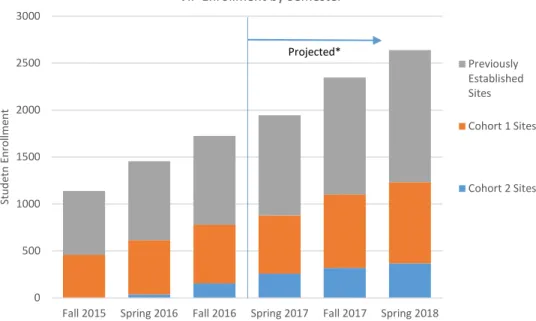
The Consortium has grown to twenty-four institutions in just three years, with 19 in the U.S. and five international. Six of the new institutions are establishing VIP programs with their own resources. Institutions have been brought on in three cohorts, with the first cohort being existing programs, the second being programs initiated in 2015, and the third being programs initiated in 2016. Enrollment across each of the cohorts continues to grow, as illustrated in figure C-1. In all cases, new sites have implemented the approach of creating projects at the request of faculty.
Figure C-1: VIP Consortium Total Student Enrollment by Term
* Projections based on numbers provided by sites. For sites that did not provide projections, the most recent enrollment numbers were carried forward at the same value. Values for Spring 2017 are listed as projections, because they were reported in December and January, when enrollments were still in flux.
0 500 1000 1500 2000 2500 3000
Fall 2015 Spring 2016 Fall 2016 Spring 2017 Fall 2017 Spring 2018
St ud et n En ro llm en t
VIP Enrollment by Semester
Previously Established Sites Cohort 1 Sites Cohort 2 Sites Projected*
Table C-1: January 2017 Snapshot of VIP Consortium Institutions (U.S.)
Institution Undergraduate Enrollment Hisp Blck Wht Am. Ind Asian Haw. Nat. Housing Campus Transfer-in Rate
Arizona State University-Tempe 42,477 20 4 51 1 7 0 22 higher
Boise State Universityǂ 20,186 12 2 74 0 2 0 17 higher
Colorado State University-Fort Collins* 25,688 12 2 72 1 3 0 29 higher
Florida International University 45,813 67 12 9 0 3 0 8 higher
Georgia Tech 15,489 7 7 50 0 20 0 53 lower
Howard University 6,883 0 90 2 1 1 0 56 lower
Morehouse College 2,108 1 95 0 0 0 0 74 lower
New York University 24,985 11 5 36 0 19 0 47 lower
Purdue University-Main Campus 30,043 5 3 63 0 7 0 41 lower
Rice University 3,893 14 7 37 0 24 0 72 lower
Texas A&M University-College Station+ 57,358 20 4 59 0 6 0 23 lower
University of California Riverside*Sci 19,799 41 4 12 0 34 0 34 higher
University of California-DavisSci 28,384 19 2 28 0 32 0 25 higher
University of Delaware 18,322 7 5 75 0 5 0 43 lower
University of Georgia*Sci 27,951 6 8 70 0 10 0 32 higher
University of Hawaii at Manoa 13,132 2 2 20 0 41 17 25 higher
University of Michigan-Ann Arbor 28,983 5 4 61 0 14 0 32 lower
University of Washington-Seattle Campus 30,933 8 3 41 0 25 0 27 higher
Virginia Commonwealth University 31,212+ 9 19 48 0 13 0 - higher
The 19 U.S. institutions in the VIP Consortium and their undergraduate student populations [21, 22]. * Institutions establishing VIP Programs in Fall 2017; the rest already have teams underway.
Sci VIP Programs started/starting in the sciences, but planning to expand to other disciplines. At most sites, VIP was
first established in engineering, and it then spreads to other disciplines.
% Percentages rounded to nearest whole number percent.
ǂ Fall 2016 numbers, provided by institution(s).
+ Spring 2017 numbers, provided by institutuion(s).
The Consortium includes a wide variety of institutions, including two HBCUs, two HSIs; an institution with significant Native Hawaiian enrollment; ten institutions with higher transfer-in rates; institutions with and without heavy STEM focuses; as well as residential and
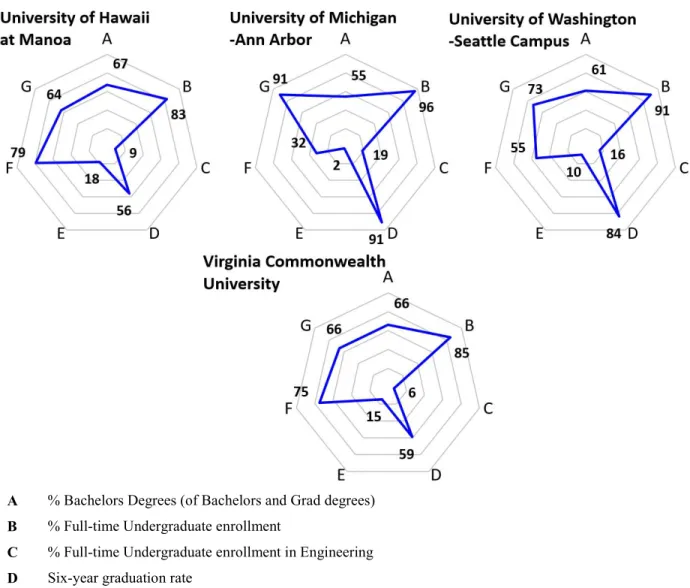
non-residential campuses. Table C-1 presents data on undergraduate enrollment, demographics and transfer-in rates for U.S. Institutions. The “spider diagrams” in Figure C-2 provide a
visualization of additional campus data points across the Consortium:
Percent of degrees at the Bachelor’s Degree level (of Bachelor’s and Graduate degrees)
Percent full-time Undergraduate enrollment
Percent full-time Undergraduate enrollment in Engineering
Six-year graduation rate
Percent of undergraduate adult learners
Percent admitted (total)
A % Bachelors Degrees (of Bachelors and Grad degrees) B % Full-time Undergraduate enrollment
C % Full-time Undergraduate enrollment in Engineering D Six-year graduation rate
E % Undergraduate adult learners F Percent admitted (total)
G 2 Published out-of-state tuition and fees (normalized; 100 = maximum among VIP Consortium institutions, $46,170 at New York University )
Figure C-2: “Spider Diagrams” illustrating campus data points across the Consortium.
1 Data only includes VIP institutions with active programs in Spring 2016.
2 Element G, "Published out-of-state tuition and fees," is a relative comparison among the VIP institutions
as of April 2016. The maximum value of $46,170 is set as 100 and used as the denominator in calculating values for the institutions. All other elements are actual values for the respective institutions.
While many schools share similar data profiles, others standout in particular elements. For example, Morehouse College is a solely undergraduate serving institution, (100% along axis A); Rice University is nearly half undergraduate and half graduate (51% along axis A); Boise State University and Florida International University serve more adult learners (31% and 26% along axis E) and have lower full-time undergraduate student enrollment (both at 63% along axis B). The diversity of institutions allows the consortium to implement, evaluate and learn from VIP sites in a variety of settings, and learn from effective practices at other institutions.
VIP Program Profiles
In the following sections, individual VIP sites provide overviews of their VIP Programs. The goal is to illustrate unique aspects of VIP Programs at each institution.
Boise State University VIP Program
About the Institution: Historically a community college and traditionally a commuter campus, Boise State has primarily served nontraditional undergraduate and homegrown graduate students, while also recruiting the non-research active faculty member. Boise State was classified a
doctoral research institution in 2016 by the Carnegie Classification of Institutions of Higher Education. Since our last evaluation review in 2008-2009, research expenditures have more than doubled, doctoral graduates have more than tripled, and the number of doctoral students enrolled has increased from 82 to 188 — a 129 percent increase. As a consequence, Boise State is 1 of the 3 fastest growing graduate programs in the United States today. In support of progressive
growth, Boise State launched the Institute for STEM and Diversity Initiatives (ISDI) in January 2015 and the College of Innovation + Design (CID) in August 2015. The mission of ISDI is to create a culture of inclusive excellence in science, technology, engineering, and mathematics (STEM) – increasing the number of women and other underrepresented groups in these fields and facilitating the success of those already pursuing that pathway. It does this by serving as a central coordinating and support structure for STEM-related activities and as a vigilant advocate for the underserved and underrepresented. The mission of CID is to pilot new models of
research, development, and education (RD&E) – without needing to subscribe to the
bureaucracies of a state institution. Unlike other colleges, CID creates RD&E programs and then develops a roadmap to integrate viable programs into the university structure. It does this to experiment with how value and relevancy are retained amidst a variety of internal and external pressures facing higher education today.
Initiating Department: College of Innovation + Design (CID)
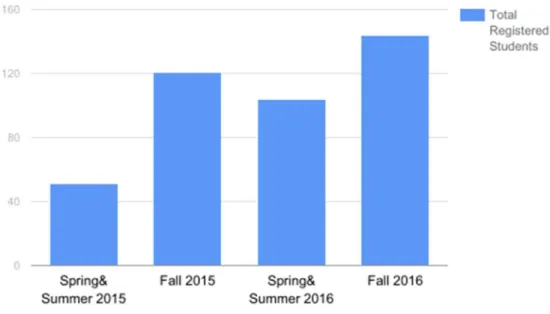
About the Implementation: As a cornerstone of the College of Innovation + Design, VIP has the potential to seed innovation within our current university, innovate our future university, and innovate workforce and community connections with our university. Serving as institutional glue, VIP was initially added to the strategic plan in 2016 to minimize potential polarization between teaching and research. Summarized in Table BSU-1, Boise State has committed to increasing VIP enrollment from 60 students in FY16 to 180 students in FY18. In preparation for this growth, the curriculum committee approved VIP course numbers at the 200, 300, 400, and 500 levels. To motivate faculty to adopt these course numbers over their departmental course options, an incentive-based budget model was created. Briefly described, the incentive-based budget model allots $177 per credit to the College of Innovation + Design for every student participating in the VIP program. This is significant because 60% of a student’s tuition and fees will be directly reinvested into their VIP project starting Fall 2016. Conservatively assuming 10 VIP teams with an average load of 15 students per semester and 2 credits per student, CID will generate $106,000 of allocated income each year. From this total, 85% ($90,100) will be passed along to the VIP teams to: (a) motivate faculty participation, (b) provide gap funding, (c)
community, the remaining 15% ( $15,900) will be used for annual retreats, workshops, and coaching sessions for new VIP faculty. Current size and projected growth are outlined in Table BSU-1
Table BSU-1: Boise State’s institutional commitment to VIP.
Performance Metric FY 16 FY 17 FY 18 Number of VIP Students 60 120 180 Number of VIP Teams 6 12 18
Unique to this Program: For the first year support is being provided by a federal grant entitled,
Aligning Stakeholders and Structures to Enable Risk Taking (ASSERT).The goal of ASSERT is toexpand VIP from a stakeholder alignment initiative at Boise State to an ASSERTive
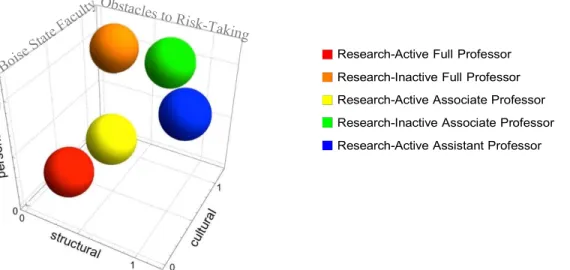
community for Boise State. Grant objectives include: (a) creating a learning framework for a cohort of VIP faculty who are at various stages of their careers and who are in danger of not taking risks in their research strategies for a spectrum of reasons (Fig. BSU-1); (b) address the structural and cultural issues at the university in order to create a more nurturing environment that encourages faculty to take strategic intellectual risks in their research, attacking global imperatives; and (c) work on a sustainability plan within Boise State that expands our program to other VIP teams while also creating guides for other universities in the VIP consortium so that they can adapt our approach on their campuses. There are several advantages to this approach. One particularly attractive feature of the VIP program is that it engages the full university – undergraduate students, graduate students, postdoctoral fellows, and faculty of all ranks. By
Figure BSU-1: One possible visualization of the relative importance of the structural, cultural, and personal obstacles facing faculty at Boise State that prevent them from tackling high-risk societal problems of global importance and integrating their teaching and research. Importance is normalized to a value of one, where zero and one represent low and high impact, respectively.
using a curricular model, risk is spread across a team and organization – undergraduates will learn a great deal even if their project never turns into a grant for their advisor, graduate students can work on manageable pieces that can be more effectively turned into publications, and faculty can either expand on their current research interests or start to explore new ones. A second attractive feature of VIP is that it is being institutionalized at 20+ other institutions that range
Research-Active Full Professor Research-Inactive Full Professor Research-Active Associate Professor Research-Inactive Associate Professor Research-Active Assistant Professor
from Morehouse College to the University of Michigan – providing a diverse national network to explore the broader impacts of Aligning Stakeholders and Structures to Enable Risk Taking. Change @ Boise State – The high volume of institutional experiments being conducted at Boise State often creates deep emotions among our stakeholders that include: nervous excitement, optimistic hope, and fear of failure. Stakeholder emotions have been intentionally managed by
throttling the number and size ofVIP teams, while also messaging from the bottom and to the top of the organization that program growth, while possible, is negligent in the absence of real institutional support. Albeit non-traditional, our implementation model has promoted positive tension between Boise State’s history – as a teaching-based community college – and its recent mission to become a metropolitan research university of distinction. This tension has also generated growing curiosity among our faculty, who often ask: What is VIP and how is it
different from what I already do? What are the incentives to participate? How will it help me, my students, and my department succeed? The work described above gives us confidence that we can answer these questions by pointing to working examples of funding, infrastructure redesign, and strategic commitments.
Colorado State University VIP Program
About the Institution: Colorado State University is a growing, middle-sized public university, with total enrollments of approximately 32,000 students. Almost 4,600 students are either in graduate or professional programs. Research expenditures for fiscal year 2016 reached $331.8 million. At Colorado State University we have used the VIP program to engage both existing projects on campus and encourage new projects.
Initiating Department: Department of Electrical and Computer Engineering
Program Implementation: The Department of Electrical and Computer Engineering
implemented changes to satisfy the VIP goal of students receiving credit for their participation. Prior to the VIP program, there was limited freedom to select elective credits for students in this department –a limited group of courses was available. Now students at any stage in the program have a new independent study path, “Open Option Projects,” which allows students to work on projects to earn credit for their technical elective credit requirements. This allows VIP students to accumulate credits for their VIP-related efforts over their multiple years of participating on the project. This benefit also now extends to all of the students in the department, extending the impact of VIP beyond the program and to the department curriculum.
Program Composition: There are currently six VIP projects led by faculty from multiple colleges and departments, including:
Walter Scott, Jr. College of Engineering
o Chemical and Biological Engineering
o Electrical and Computer Engineering
o Mechanical Engineering
College of Health and Human Sciences
o Occupational Therapy
o Ecosystem Science and Sustainability
College of Veterinary Medicine and Biological Sciences
Additionally, students from other colleges, e.g. Computer Science students in the College of Natural Sciences are also engaged in our VIP projects.
Unique to this Program: The topics for the VIP projects at Colorado State University are briefly described below.
Snow Varies: Goals are to quantify spatial and temporal variability of snow and related properties.
EcoCar: EcoCar is part of a three-year collegiate engineering competition, reduce the
environmental impact of a Chevrolet Camaro without compromising performance, safety, and consumer acceptability.
Advanced Driver Assistance System (ADAS): Goals are to design an advanced driver assistance system (ADAS) for automobiles to enhance driver safety, e.g., by tracking lane markers to keep the driver in the correct lane and alerting the driver to other cars and pedestrians. While image processing algorithms exist to track lanes, cars, and pedestrians, the challenge in this project is to implement these algorithms on an embedded board (with CPUs and GPUs) and a very limited power budget.
Games and Assistive Technologies fOr Rehabilitation (GATOR): Goals are todesign games and activities with cutting edge virtual reality and motion tracking technology including Occulus Rift, Leap Motion Controller, and Kinect 2 for low cost and in-home rehabilitation of patients with stroke, cerebral palsy, and traumatic brain injury. The games and activities will be designed to improve hand-eye coordination, motor control, endurance, shoulder strength, range-of-motion, grasp strength, and coordination of grasp and reach.
Variational Analysis and Reliability Modeling Algorithms (VARMA): With the ever increasing complexity of engineering systems, parametric uncertainty arising due to manufacturing process variations, variations in operating environment, and from simplifying assumptions made during the design process have become crucial in determining the performance, reliability, and life-span of such systems. Modeling the propagation of this uncertainty from the system parameters to the system behavior requires a completely novel and stochastic approach towards characterization of engineering systems. Thus, the objective of this program is to develop new cutting edge
mathematical knowledge and computational tools for rapid and accurate uncertainty quantification and reliability analysis of complex engineering systems.
iGems: The CSU iGEM (International Genetically Engineered Machine competition) team gives undergraduate students a chance to participate in student-driven research in the area of synthetic biology. Synthetic biology is an emerging field that spans many different disciplines. The iGEM team historically has attracted sophomores and juniors to participate in undergraduate research. The students have significant input into selecting the project that they pursue. The projects are viewed as a two-year project where at the end of the project the students get to present their work