Continuity of Care: Is the Personal Doctor
Still Important? A Survey of General
Practitioners and Family Physicians in
England and Wales, the United States,
and the Netherlands
ABSTRACT
PURPOSE We determined the reported value general practitioners/family physicians in 3 different health care systems place on the various types of continuity of care.
METHODS We conducted a postal questionnaire survey in England and Wales, the United States, and the Netherlands. The participants were 1,523 general practitio-ners/family physicians (568 from England and Wales, 453 from the United States and 502 from the Netherlands). Our main outcome measures were the perceived importance of the types of continuity of care and doctor or practice characteristics that may infl uence attitudes toward personal continuity of care.
RESULTS The response rates were England and Wales 60% (568/946), United States 47% (453/963) and Netherlands 76% (502/660). The doctors in all 3 coun-tries felt strongly that personal continuity remained an important aspect of good-quality care to their patients. Within a given health care system, doctors’ personal and practice characteristics explained only a small part of the variance in attitudes toward the provision of personal continuity of care (England and Wales and the Netherlands r2 = 0.04, United States r2 = 0.01). The doctors in all 3 countries felt that they were currently able to provide all 3 types of continuity of care, although doctors in England and Wales were least positive about the provision of informa-tional and management continuity across the primary-secondary care divide.
CONCLUSIONS General practitioners/family physicians from 3 differing health care systems all place high value on being able to provide personal continuity of care to patients. Personal continuity of care remains a core value of general practice/ family medicine and should be taken account of by policy makers when redesign-ing health care systems.
Ann Fam Med 2005;3:353-359. DOI: 10.1370/afm.351.
INTRODUCTION
C
ontinuity of care is an important element of the delivery and orga-nization of primary health care.1 It has consistently been shown tobe associated with increased patient and doctor satisfaction and may positively affect other health outcomes, such as adherence to treat-ment, uptake of preventive services, and decreased hospitalizations.2,3
Continuity can be understood as the degree to which a series of discrete encounters with health care clinicians is experienced as coherent, nected, and consistent with the patient’s medical needs and personal con-text.4 Three distinct means of providing continuity have been identifi ed:
personal continuity (provision of care through an ongoing clinician-patient
Tim Stokes,
PhD, MPH, MBChB1Carolyn Tarrant,
BSc1Arch G. Mainous III,
PhD2Henk Schers,
MSc, MD3George Freeman,
MD4Richard Baker,
MD11Department of Health Sciences,
University of Leicester, Leicester, UK
2Department of Family Medicine,Medical
University of South Carolina, Charleston, SC
3Department of General Practice,University
Medical Centre St Radboud, Nijmegen, The Netherlands
4Centre for Primary Care and Social
Medicine, Imperial College, London, UK
Confl icts of interest: none reported
CORRESPONDING AUTHOR
Tim Stokes, PhD
Clinical Governance Research and Development Unit Department of Health Sciences Division of General Practice and Primary Health Care University of Leicester Leicester General Hospital Leicester LE5 4PW [email protected]
relationship), continuity of information (the use of information on past events and personal circumstances to make current care appropriate), and management continuity (a consistent and coherent approach to the management of a health problem).2,4
There has, however, been increasing concern in many countries that the changing nature of general practice/family medicine in the last 30 years has led to a reduction in the extent to which physicians can offer personal continuity despite recent research that shows patients want personal continuity from their physi-cians, particularly for serious conditions.5-8 Physicians
have tended to reorganize themselves into large-group practices where care is delivered by members of the primary health care team; patients may themselves pre-fer fast access to any physician rather than wait to see a physician of their choice.9-11 In England and Wales,
these changes have been refl ected in recent health care policy, notably the new General Medical Services con-tract, with its proposal that in future patients are regis-tered with practices rather than a particular physician.11
Although personal continuity in general practice appears to be threatened, there have been no recent national or international surveys of general practitio-ners (GPs) about their views on and attitudes toward the provision of continuity of care in general practice. We therefore surveyed GPs in 3 different health care systems. In England and Wales and the Netherlands, GPs deliver fi rst-contact care and act as gatekeepers to secondary care; in the United States family physicians deliver fi rst contact care but patients can refer them-selves to specialists.12,13 In this article the term GP is used to cover both GPs in the United Kingdom and the Netherlands and family physicians in the United States. The aim of the study was to explore (1) the value GPs in the 3 countries place on the various types of continuity of care, (2) whether different groups of GPs within each country differed in the value they placed on personal continuity of care, and (3) the extent to which GPs believed that personal continuity could be substituted for by other means of providing continuity of care.
METHODS
A random sample of GPs was drawn from 3 national databases in England and Wales (Organisation Codes Service of the NHS Information Authority), the Netherlands (Netherlands Institute for Primary Care Research), and the United States (active members of the American Academy of Family Physicians). The sample size (1,000 for England and Wales and United States; 700 for the Netherlands) was calculated to allow esti-mation of the proportion of GPs in each country
agree-ing with any given statement to within plus or minus 3%, assuming that about 50% of GPs agree (95% confi -dence interval [CI]). The questionnaire design and sam-pling strategy were designed to maximize the response rate.14 The questionnaire was pilot tested on a sample of
GPs from the 3 study countries, which resulted in mod-ifi cations that refl ected the differences in the delivery and organization of primary care in England and Wales, the Netherlands, and the United States.12,13
Question-naires were posted in spring 2003 (England and Wales, and United States) and summer 2003 (Netherlands). Those not responding were sent the questionnaire up to 2 more times at intervals of 4 weeks.
The self-administered structured questionnaire (as displayed in the Supplemental Appendix, available online-only at http://www.annfammed.org/cgi/ content/full/3/4/353/DC1) was developed from previous survey instruments,15,16 and included
state-ments covering 3 main areas: the importance of dif-ferent types of continuity of care; the extent to which GPs believed they were able to provide the different types of continuity in their day-to-day practice; and GPs’ attitudes toward continuity, including whether personal continuity could be substituted by informa-tional and management continuity. Responders indi-cated the extent to which they agreed with each of the statements using a 5-point Likert-type scale, where 1 = strongly disagree and 5 = strongly agree. Scores on 5 of the attitude statements were combined to produce a single score refl ecting how much GPs val-ued personal continuity of care (the 5 statements are shown in Table 1). Factor analysis indicated that these statements formed a unidimensional scale, with good internal consistency (α = 0.78). The scale score cor-related highly with the overall rating of the importance of personal continuity (P <.001).
Data were analyzed using SPSS 11.0 for Win-dows. Descriptive and simple summary statistics were
Table 1. Statements Combined to Form a Scale of Attitude Toward Personal Continuity 1. Being able to see the same patients over time is one of the most
rewarding aspects of general practice
2. Being able to see the same patients over time contributes to the development of my professional knowledge
3. If recording and transfer of patient information is good, there is no need for most patients to see the same GP consistently (reverse coded)
4. If different health professionals work together to provide coordi-nated and consistent care, there is no need for most patients to see the same GP consistently (reverse coded)
5. Ideally patients should have most of their care provided by the same GP
GP = general practitioners in the United Kingdom and Netherlands and family physicians in the United States.
calculated. We hypothesized that attitudes toward personal continuity of care in each health care system would be infl uenced by the follow-ing demographic variables: practice list size, whether practice has a per-sonal list system, GP working full- or part-time, GP age, and GP sex.17
Multiple linear regression was used to explore this hypothesis. Differ-ences between countries in attitudes toward, and provision of, continuity were tested using 1-way analysis of variance (ANOVA) and the Tukey test. Participants were asked 1 open question about continuity of care in modern general practice. These responses were inductively grouped into categories by TS and CT.
RESULTS
The response rates were England and Wales 60% (568 of 946), Netherlands 76% (502 of 660), and United States 47% (453 of 963). The representativeness of the samples was determined for age and sex. The samples were representative of the populations from which they were drawn for age (all 3 countries) and sex (England and Wales and United States only; the Netherlands sample had signifi cantly more female GPs respond, 30.5% vs 26% in the study population, P = .022). Table 2 shows the demographic characteristics of the responders.
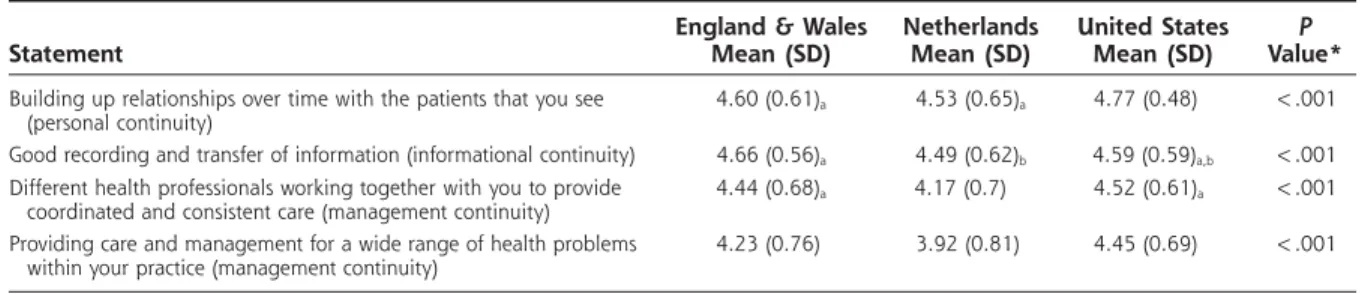
The GPs in all 3 countries
believed strongly that personal continuity of care remained an important aspect of good-quality care to their patients (Table 3). In their free-text comments, GPs from all 3 countries emphasized the importance of being able to provide personal continuity of care. It was believed to be preferred by both patient and GP and a source of satisfaction for both parties:
• “People prefer to visit the same dentist and hair-dresser, why should they be maneuvered into seeing any doctor? Medicine is personal. Patients do not want to be examined by a series of endless strangers” (GP 787, England and Wales).
• “The loss of continuity relationships and the loss of time to tend to them is one of the major reasons for discontent between doctors and patients” (GP 179, US).
The GPs in all 3 countries believed that they were currently able to provide all 3 types of continuity of care, although GPs in England and Wales were least positive about the provision of informational and management continuity across the primary-secondary care divide (Table 4). This lack of continuity was high-lighted in the free-text comments, where GPs in Eng-land and Wales emphasized the need to improve on the current poor transfer of information and patient man-agement across the primary-secondary care interface: • “Lack of communication between secondary care and primary care continues (as always) to be an out-standing problem” (GP 48, UK).
The GPs were asked whether personal continu-ity of care could be substituted for by informational
Table 2. Characteristics of General Practitioners and Practices
Characteristics
England & Wales (n = 568) No. (%) Netherlands (n = 502) No. (%) United States (n = 453) No. (%) General practitioners Age, years <35 65 (11.4) 35 (7) 62 (13.7) 35-50 310 (54.6) 261 (52) 250 (55.2) >50 190 (33.5) 205 (40.8) 141 (31.1) Sex Male 366 (64.4) 349 (69.5) 295 (65.1) Female 198 (34.9) 153 (30.5) 157 (34.7) Physician, principal Yes 532 (93.7) NA NA No (England and Wales only) 32 (5.6) NA NA Board certifi ed Yes NA NA 427 (94.3) No (US only) NA NA 26 (5.7) Working hours Full time 400 (70.4) 271 (54) 343 (75.7) Part-time (½ time or more) 146 (25.7) 220 (43.8) 78 (17.2) Part-time (<½ time) 17 (3) 10 (2) 30 (6.6) Practices Mean (SD) number of physicianss in practice 5.33 (2.70) 2.54 (1.59) 5.94 (7.89) Range 1-12 1-9 1-75 Proportion of single-handed practitioners % 6.7 23.2 24.5 List size <6,000 194 (34.2) 390 (77.7) 225 (49.7) >6,000 369 (65.0) 107 (21.3) 217 (47.9) Training practice Yes 245 (43.4) 180 (35.9) 74 (16.3) No 319 (56.2) 321 (63.9) 378 (83.4)
Personal list system
Yes 163 (28.7) 309 (61.6) NA
No 389 (68.5) 189 (37.6)
and management continuity (Table 5). Most GPs in each country did not agree with the idea that personal continuity was not required if informational and man-agement continuity of care were in place, especially the US GPs. The variance around this attitude was relatively wide, however particularly in the United Kingdom and the Netherlands, suggesting a range of views on this issue.
Overall, the quantitative data indicated that US GPs held the strongest views on the value of personal continuity. Free-text comments from US GPs high-lighted the fact that the health insurance market in some cases required patients to change their physician every year, which was detrimental to providing per-sonal continuity:
• “Patients are frustrated when their insurance dic-tates they seek care elsewhere. I have heard comments
many times— ‘I just fi nd a doctor I like and who lis-tens, and they [insurance company] make me change’” (GP 565, US).
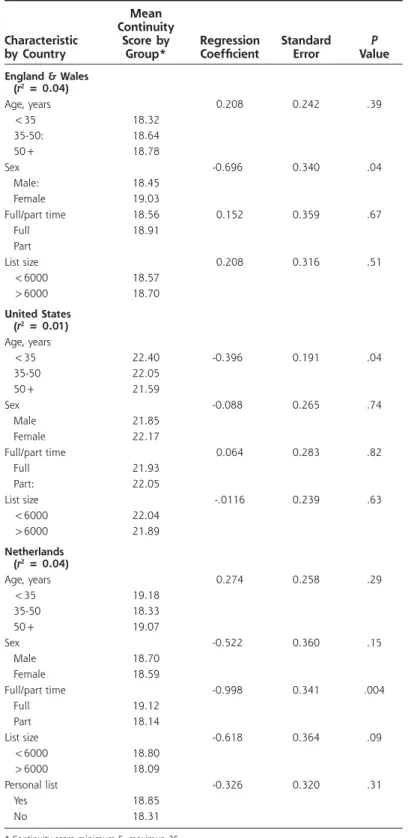
Multiple linear regression was used to explore the hypothesis that attitudes toward personal continuity within each health care system, as measured by the personal continuity attitude scale, would be related to the following demographic variables: practice list size, whether practice has personal list system, GP work-ing full- or part-time, GP age, and GP sex (Table 6). In England and Wales, GP sex and personal list were signifi cant predictors of attitude to personal continuity, with female GPs and GPs from practices with personal list systems placing a higher value on personal continu-ity compared with male GPs and those who did not operate personal lists. In the United States, age of GP was a signifi cant predictor, with GPs younger than 35
Table 3. Perceived Importance of the Types of Continuity of Care in Relation to Quality of Patient Care Statement
England & Wales Mean (SD) Netherlands Mean (SD) United States Mean (SD) P Value* Building up relationships over time with the patients that you see
(personal continuity)
4.60 (0.61)a 4.53 (0.65)a 4.77 (0.48) <.001
Good recording and transfer of information (informational continuity) 4.66 (0.56)a 4.49 (0.62)b 4.59 (0.59)a,b <.001
Different health professionals working together with you to provide coordinated and consistent care (management continuity)
4.44 (0.68)a 4.17 (0.7) 4.52 (0.61)a <.001
Providing care and management for a wide range of health problems within your practice (management continuity)
4.23 (0.76) 3.92 (0.81) 4.45 (0.69) <.001
Score: 1 = not at all important; 5 = extremely important.
* Signifi cance of differences between scores by country (1-way analysis of variance).
a, b = Scores on the same row that share the same subscript do not differ signifi cantly. All other differences between scores on the same row are statistically signifi cant at
P <.001 according to the Tukey test comparison.
Table 4. Extent to Which GPs Felt Able to Provide Different Types of Continuity of Care to Their Patients in Their Day-to-Day Practice
Statement
England & Wales Mean (SD) Netherlands Mean (SD) United States Mean (SD) P Value* I have the opportunity to build up relationships over time with
many of the patients I see
4.31 (0.78)a 4.33 (0.63)a 4.32 (0.88)a .89
There is very good recording and transfer of patient information within my practice
4.03 (0.75)a,b 4.14 (0.69)a 3.87 (0.85)b <.001
There is very good recording and transfer of patient information from health professionals/service providers outside the practice, to my practice
2.89 (0.95) 3.37 (0.8)a 3.21 (0.89)a <.001
The physicians, nurses and other health professionals in my practice (employed and attached staff) work to-gether to provide coordinated and consistent care
4.14 (0.73)a 4.23 (0.66)a 4.13 (0.77)a .08
Health professionals/service providersoutside the practice (eg, hospitals) work with my practice to provide coordinated and consistent care
2.98 (0.90)a 3.06 (0.85)a 3.41 (0.85) <.001
The patients I see can have a wide range of health problems managed within my practice
4.34 (0.69)a 4.19 (0.65)a 4.50 (0.70) <.001
Score: 1 = strongly disagree; 5 = strongly agree.
* Signifi cance of differences between scores by country (1-way analysis of variance).
a, b = Scores on the same row that share the same subscript do not differ signifi cantly. All other differences between scores on the same row are statistically signifi cant at
years indicating a more positive attitude than those older than 50 years. In the Netherlands, full-time and part-time status was a signifi cant predictor, with full-time GPs having more positive attitudes to personal continuity. Even so, physicians’ personal and practice characteristics explained only a small part of the vari-ance in attitudes toward the provision of personal con-tinuity of care (England and Wales r2 = 0.04, United
States r2 = 0.01, Netherlands r2 = 0.04).
DISCUSSION
This international survey shows that GPs from 3 dif-ferent health care systems view the provision of per-sonal, informational, and management continuity of care as important aspects of primary medical care. Its fi ndings are consistent with and update earlier national surveys of GPs.15,16
The response rate compared favorably with other recent national surveys of GPs,14 and respondents were
representative of the populations from which they were drawn. The variable response rate between countries, however, meant that it was diffi cult to interpret the importance of differences in intercountry scores on the various types of continuity of care. A further limitation is that the results on the contribution of continuity to quality of care are highly skewed positively, as is the extent to which GPs perceive they provide personal continuity in their practice, which raises the possibil-ity of a social desirabilpossibil-ity bias in the responses. This bias may have partly obscured any true associations between GP characteristics and views on the impor-tance of continuity.
Personal continuity of care, defi ned as an ongoing therapeutic relationship between a patient and 1 or more health care providers,3 was rated as highly
impor-tant by GPs from all 3 health systems. GPs believed that personal continuity was a key aspect of their work and that personal continuity could not be compensated for by better informational or management
continu-ity. These fi ndings are consistent with those of recent surveys of both GPs and GPs in training, which also emphasize the value GPs place on personal continu-ity of care.18 Interestingly, personal continuity of care
was valued most by US GPs, even though this group of physicians noted, in their qualitative comments, the diffi culties forced discontinuity of care (health care insurer changing patient’s physician every year) places on the provision of personal continuity in the United States.19 Patients also value personal continuity. Except
for patients with chronic diseases, however patients appear to be unwilling, in the United States at least, to either spend more time or money to maintain continu-ity with an individual physician.6,20 In addition, health
care policy makers place a relatively low priority on personal continuity when compared with other fea-tures of primary health care provision, such as access to health care.21 There is a very real risk that personal
continuity of care between patients and physicians may be soon be a thing of the past9,10 unless policy makers
take account of the preferences of patients and physi-cians when redesigning health care systems.
The demographic characteristics of physicians that infl uence attitudes toward the provision of personal continuity of care have hitherto been the subject of limited research. Our fi ndings for England and Wales that female sex of GP and presence of a personal list were predictors of more positive attitudes to personal continuity are consistent with research identifying factors that infl uence whether patients see their usual GP.17 Although we were able to identify characteristics
that infl uence attitudes within a given health care sys-tem, physicians’ personal and practice characteristics explained only a small part of the overall variance in personal continuity scores. GPs appear to value per-sonal continuity of care, irrespective of health care set-ting or demographic characteristics.
Even in strikingly different health care systems with different patient expectations and cultural infl u-ences, GPs place a high value on maintaining the
Table 5. Extent to Which GPs Agree That the Provision of Personal Continuity of Care to Their Patients Can Be Substituted for by Other Types of Continuity
Statement
England & Wales Mean (SD) Netherlands Mean (SD) United States Mean (SD) P Value* If recording and transfer of patient information is good, there is no
need for most patients to consistently see the same physician
2.79 (1.14)a 2.93 (1.14)a 1.77 (0.82) <.001
If different health professionals work together to provide coordinated and consistent care, there is no need for most patients to consis-tently see the same physician
2.82 (1.10)a 2.88 (1.08)a 1.80 (0.82) <.001
Score: 1 = strongly disagree; 5 = strongly agree.
* Signifi cance of differences between scores by country (1-way analysis of variance).
a, b: Scores on the same row that share the same subscript do not differ signifi cantly. All other differences between scores on the same row are statistically signifi cant at
patient-physician relationship through the provision of personal continuity. Further international qualitative research is needed to explore the reported differences
in the value GPs place on the 3 types of continuity of care and to explain the fi ndings in terms of the fi nan-cial, organizational, and cultural aspects of different
health care systems. Controlled before and after studies that determine the true impact of health care system reorganiza-tions on measures of continuity of care are also required.
To read or post commentaries in response to this article, see it online at http://www.annfammed. org/cgi/content/full/3/4/353.
Key words: Continuity of care; physician-patient relations
Submitted October 12, 2004; submitted, revised, Janu-ary 17, 2005; accepted FebruJanu-ary 23, 2005.
A version of this paper, “Continuity of care—is the per-sonal doctor still important? An international survey of general practitioners in England and Wales, Netherlands and United States,” was presented at the SAPC 33rd Annual Scientifi c Meeting, Glasgow, UK 15th July 2004. Funding support: The England and Wales survey was supported by a small project grant from the former Department of General Practice and Primary Health Care, University of Leicester.
Acknowledgments: We thank the general practitio-ners/family physicians from England and Wales, United States and the Netherlands who participated in this research. We thank the Organisation Codes Service of the NHS Information Authority for permission to use their database.
References
1. Freeman GK, Olesen F, Hjortdahl P. Continuity of care: an essential element of modern general prac-tice? Fam Pract. 2003;20:623-627.
2. National Coordinating Centre for Service Delivery and Organisation. Continuity of Care: Report of a Scoping Exercise for the National Coordinating Centre for Service Delivery and Organisation. 2000. Available at: http://www.sdo.lshtm.ac.uk/continuityof-care.htm.
3. Gray DP, Evans P, Sweeney K, et al. Towards a theory of continuity of care. J R Soc Med. 2003;96:160-166. 4. Haggerty JL, Reid RJ, Freeman GK, et al.
Con-tinuity of care: a multidisciplinary review. BMJ. 2003;327:1219-1221.
5. Kearley KE, Freeman GK, Heath A. An exploration of the value of the personal doctor-patient relationship in general practice. Br J Gen Pract. 2001;51:712-718. 6. Pereira AG, Pearson SD. Patient attitudes toward con-tinuity of care. Arch Intern Med. 2003;163:909-912. 7. Nutting PA, Goodwin MA, Flocke SA, Zyzanski SJ,
Stange KC. Continuity of primary care: to whom does it matter and when? Ann Fam Med. 2003;1:149-155. Table 6. Regression of Attitude Toward Personal Continuity
on Physicians’ Personal and Practice Characteristics
Characteristic by Country Mean Continuity Score by Group* Regression Coeffi cient Standard Error P Value England & Wales
(r2 = 0.04) Age, years <35 35-50: 50+ 18.32 18.64 18.78 0.208 0.242 .39 Sex Male: Female 18.45 19.03 -0.696 0.340 .04 Full/part time Full Part 18.56 18.91 0.152 0.359 .67 List size <6000 >6000 18.57 18.70 0.208 0.316 .51 United States (r2 = 0.01) Age, years <35 35-50 50+ 22.40 22.05 21.59 -0.396 0.191 .04 Sex Male Female 21.85 22.17 -0.088 0.265 .74 Full/part time Full Part: 21.93 22.05 0.064 0.283 .82 List size <6000 >6000 22.04 21.89 -.0116 0.239 .63 Netherlands (r2 = 0.04) Age, years <35 35-50 50+ 19.18 18.33 19.07 0.274 0.258 .29 Sex Male Female 18.70 18.59 -0.522 0.360 .15 Full/part time Full Part 19.12 18.14 -0.998 0.341 .004 List size <6000 >6000 18.80 18.09 -0.618 0.364 .09 Personal list Yes No 18.85 18.31 -0.326 0.320 .31
8. Schers H, Webster S, van den Hoogen H, et al. Continuity of care in general practice: a survey of patients’ views. Br J Gen Pract. 2002;52:459-462.
9. Hjortdahl P. Continuity of care—going out of style? Br J Gen Pract. 2001;51:699-700.
10. Baker R. Will the future GP remain a personal doctor? Br J Gen Pract. 1997;47:831-833.
11. General Practitioners Committee and the NHS Confederation. Invest-ing in General Practice: The New General Medical Services Contract. Lon-don: British Medical Association; 2003.
12. Campbell JL, Mendive J, Timmermans A. Primary care and general practice in Europe: West and south. In: Oxford Textbook of Primary Medical Care. Jones R, Britten N, Culpepper L, et al, eds. Oxford, UK: Oxford University Press; 2004:65-70.
13. Ostergaard DJ KN, Henderson D. Primary care and general practice in North America. In: Oxford Textbook of Primary Medical Care. Jones R, Britten N, Culpepper L, et al, eds. Oxford, UK: Oxford University Press; 2004:84-88.
14. Barclay S, Todd C, Finlay I, Grande G, Wyatt P. Not another question-naire! Maximizing the response rate, predicting non-response and assessing non-response bias in postal questionnaire studies of GPs. Fam Pract. 2002;19:105-111.
15. Freeman G. Priority given by doctors to continuity of care. J R Coll Gen Pract. 1985;35:423-426.
16. Hjortdahl P. Ideology and reality of continuity of care. Fam Med. 1990;22:361-364.
17. Guthrie B. Continuity in UK general practice: a multilevel model of patient, doctor and practice factors associated with patients seeing their usual doctor. Fam Pract. 2002;19:496-499.
18. Schers H, van de Ven C, van den Hoogen H, Grol R, van den Bosch W. Family medicine trainees still value continuity of care. Fam Med. 2004;36:51-54.
19. Flocke SA, Stange KC, Zyzanski SJ. The impact of insurance type and forced discontinuity on the delivery of primary care. J Fam Pract. 1997;45:129-135.
20. Love MM, Mainous AG, 3rd, Talbert JC, Hager GL. Continuity of care and the physician-patient relationship: the importance of continuity for adult patients with asthma. J Fam Pract. 2000;49:998-1004. 21. Salisbury C. Does advanced access work for patients and practices? Br