176
-7 International CALIBER 2009 Drupal: The Open Source Content Management System ...
Drupal: The Open Source Content Management System Software Suit For
Library With Library 2.0 Features
M R Rawtani S Siva Chidambaram
Abstract
The purpose of this paper to inform LIS professionals about the benefits of using Open Source Content Management System Software DRUPAL. This article will discuss about the importance of Content Management System for organizing and facilitating, collaborative, creation of electronic documents. “Drupal a hammer that strikes many mails in the Content Management System” with in the context of Web 2.0 or Library 2.0 environment. It is ten years old mature open source project developed by Dries Buytart with Dutch word “Dorpje” in English it means “little village”. Being a social publishing system, it has been adopted by large number of webmasters and library and information professionals. This paper will highlights the silent features of Drupal with special reference to Library 2.0. Content Management System. Blogs, RSS and Social Networking Site. Brief description of Drupal used library websites DrupalLib and etc., finally this paper will focus in detail with conclusion of “Drupal is multifaceted Content Management System which includes weblogs forums, tagging and social networks”.
Keywords: Drupal, Web 2.0, Content Management Systems
1. Introduction
Content is a king, Library is his Palace and Librarian is a Governor to regulate and govern the content management. Being in the digital world at hybrid library movement in web environment, content is granular information it would be text, graphics, pictures, sounds videos and data etc., Greater challenge of library and information science professionals is how to manage this granular information in the dynamic web environment. Traditional content management software does like old proverb “garbage in – garbage out”. The way in which content is managed with in the overall content management life-cycle from creation to dissemination is the content management system. It is a tool that enables a variety of (centralized) technical and (de-centralized) non technical staff
to create, edit, manage and finally publish (in a number of formats) a variety of content (such as text, graphics, video and document etc), which being constrained by a centralized set of rules, process and workflows that ensure coherent, electr on ic con ten t. Implemen tin g con ten t management system in Library, Library web site environment needs the content management strategy. The elements of content management strategy has figured by Martin White in his book entitle “The Content Management Handbook” is a road map to frame the strategy.
Choosing content management software with Library 2.0 feature is important task in the fast development of information format containers. While searching the literature for the CMS the open sour ce Con ten t Softwar e Dr upal h as been implemented in large number of academic libraries. The major benefit of open source software is community of users that supports the product. The
7th International CALIBER-2009,
Pondicherry University, Puducherry, February 25-27, 2009 © INFLIBNET Centre, Ahmedabad
Drupal: The Open Source Content Management System ... 7 International CALIBER 2009
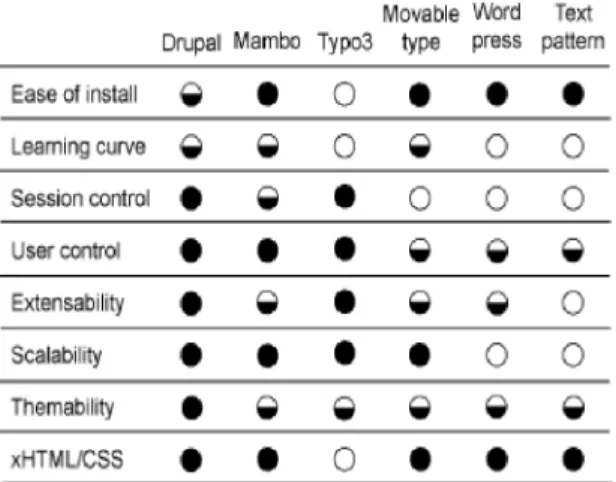
founder of Drupal and many contributors or Drupal have Masters or PhD degrees in computer science or other programming related fields. Other key contributor of decade old software is developer through their development experience while cooking in Drupal. According to this handbook the growth of developer’s code contributions is doubled in last two releases (Drupal version release 5 & 6). The indicator of the collaborative participation of the growth and development of the Drupal project highlights are as follows. Financial award been given by Google’s summer of code program year 2007 and 2008 was over $100,000 per year. Knight foundation, Knight Challenge which awards $5 million a year. In 2008 the Knight foundation established the “Knight Drupal Initiative”. In July 2006, IBM chooses Drupal out of all other CMS to be a con ten t system in th eir open sour ce developmen t suit. (See –Figur e 1: CMS Requirements Matrix)
(IBM Engineers Says “We also felt that Drupal provided the right combination of framework and flexibility to break out of the framework when needed to get the job don e. With all thin gs considered, we decided to use Drupal.”)
Figure 1: CMS Requirements Matrix (source : http://www-128.ibm.com/developerworks/ibm/library/i-osource1/#fig3)
Packt publishing has judged in 2007 Drupal is the best CMS and score its first place. In early 2008, Drupal won a CNET Web ware 100 courses in the publishing category. Such patronage helps Drupal stand out among the dozens of other choice of content management systems.
This article highlights the basic building blocks of the Drupal software. It will be a useful primer on Drupal growth and development, silent feature of the open source content management system with in the context of Library 2.0. Emphasis and concentrate on the easiness of the using Drupal as the CMS package in Library environment, what are all the Web 2.0 characters that Drupal has? As many other best CMS packages are there in fee and free based, why library choose the Drupal software will be explained in detail. As said by Austin and Harris (2008) while ch oice is nice the prospect of downloading and installing multiple systems to test them probably sounds a bit daunting. Do not despair: open source CMS has collected dozens of systems and provides full administrative access to each so that you try out all of them in one place i.e. Drupal.
2. What is Drupal?
In Dutch Druppel means drop in English and it is pronounces Drupal. Dries Buytaert, Belgium student wants to create message board for sharing information at Local Area Network then it’s become web board on the internet environment. Drop.org web site has developed and distributed open source web platfor m. Sin ce, gr aduation Dr ies h as developed along with his higher studies. Drupal is software that allows an individual or a community of users to easily publish, manage and organize a great variety of content on a Web site. Tens of thousands of people and organizations have used
178
-7 International CALIBER 2009 Drupal: The Open Source Content Management System ...
Drupal to set up scores of different kinds of Web sites, including:
Community Web portals and discussion sites
Corporate Web sites/intranet portals
Personal Web sites
E-commerce applications
Resource directories
Dr upal in cludes featur es to en able con ten t man agemen t systems, blogs, collabor ative authoring environments, forums, newsletters, picture galleries, file uploads and download, and much more. Drupal is open source software licensed under the GPL and is maintained and developed by a community of thousands of users and developers. Drupal is free to download and use.” He got financial support from Acquia. Drupal 6.0 version has come up. It is an open-source platform and content management system for building dynamic web sites offering a broad range of features and services including user administration, publishing wor kflow, discussion capabilities, n ews aggregation , metadata function alities usin g controlled vocabularies and XML publishing for content sharing purposes. Equipped with a powerful blend of features and configurability, Drupal can support a diverse range of web projects ranging from personal weblogs to large community-driven sites. It is developed in PHP and Supports MySQL and PostgreSQL databases.
January 15, 2009 is the eighth (8th) year Happy
Birthday for Drupal. Drupal 1.0 was released on these days only. Now the big release of Drupal 6 with a lot of awards Jeff Robbins says “Drupal will save the world” for Howard Dean campaign used Drupal to create DeanSpace, later named CitySpace.
Why Drupal is as best CMS? 1. Learning Curve
After basic installation is over Drupal can be used as content management system. Then it can be develop as a website with their applications. Further in out box it can produce a dynamic website. From CMS to website and to website and then dynamic website is the development through learning and further if you interested one can start writing your own code. It provides you a powerful set of internal application protocol interface to streamline your coding.
2. Content Management Framework
Drupal has already used in different tasks like public web site, extranet, shared electronic purchasing system, shared department calendars, project management, book marks, and blogs. Hence the Drupal community often refers to Drupal as a content management framework. It shows that Drupal is not a fixed system but a framework on which you can build your own Library 2.0 services.
3. Abstraction
Drupal’s power comes from it’s more abstracted approach to handling web content and functionality.
Drupal: The Open Source Content Management System ... 7 International CALIBER 2009
People often think of a website as a collection of pages, with some functions (like a blog, or a news engine) thrown in to round it out. When they go to manage their site, they are thinking in terms of a tree-like hierarchy of pages that they will go in and edit. Drupal, on the other hand, treats most content types as variations on the same concept: a node (more on these in a moment). Pages, blog posts, & news items (some possible node types) are all stored in a common pool, and the sitemap (its information ar ch itecture) is an overlay th at is design ed separately by managing and editing navigation menus. It’s a lot like the separation you find in stan dards-compliant page coding – XHTML pr ovides th e mean in gful str uctur e of th e information, while CSS arranges it for presentation. In Drupal, nodes hold the structured information per tain in g to a blog post (such as title, content, author, date) or a news item (title, content,
go-live date, take-down date), while the mending system creates the sitemap as a separate layer. Other elements (node layout themes and modules like Views and Panels) provide the onscreen display of node contents. This principle of manageable abstraction is important to understand, because it is a central concept to all things Drupal. When you understand why a measured amount of abstraction is valuable, you’ll begin to understand why this approach is such a strong argument for using Drupal.
4. Library Portal
Drupal will be next generation web 2.0 Library portal. There are some prominent screenshot of the latest and famous library portal constructed through Drupal. Fish4Info is a library catalog builds in Drupal along with book review, pathfinders and much more. It is based on the MARC module.
SOPAC – Social OPAC
Social OPAC (http://www.blyberg.net/2007/01/21/ aadlorg-goes-social/), it’s basically a set of social networ kin g tools integr ated in to th e AADL catalogue. It gives users the ability to rate, review, comment-on, and tag items. The “front door” to the SOPAC is, of course, the main catalogue search screen. Drupal’s API made development of this code relatively painless.
Catalogue building through Drupal:
http://chicagolibrarian.com/node/262 : Screencast: Creating a Library Database Page with Drupal by Leo Klein, an American librarian, who started the Dr upal4lib discussion list, has pr oduced an impressive screen-cast showing how to combine different modules to quickly set up a database catalogue on the Website of a library.
180
-7 International CALIBER 2009 Drupal: The Open Source Content Management System ...
Creating collaborative documentation
Biblioscape (http://support.biblioscape.com) this is a set of node hierarchically organized with a table of content. Drupal handles rights management and may store the different versions of a node. An interesting example is the support site of In this case; the edition is limited to a specific group of editors.
Biblioscape (http://support.biblioscape.com)
Collaborative support for Drupal Developer
Silent features of Drupal with the context CMS and Library 2.0
Librarians are not on ly content creators or contributors, but also facilitators who disseminate information. At the same time, users have the ability to find out about the library virtually, have a place where they can interact with the librarian, learn what they need when there is a need, and contribute and participate accordingly. Drupal, users and librarians unite through virtual channels where they are interacting, communicating, sharing, and contributing via Web 2.0 applications. Michael C. Habib (2006) proposed Library 2.0 describes a subset of library services designed to meet user needs caused by the direct and peripheral effects of Web 2.0 services leveraging concepts of the Read/ Write Web, the Web as Platform, The Long Tail, harnessing collective intelligence, network effects, cor e datasets fr om user con tr ibution s, an d lightweight programming models.
Drupal: The Open Source Content Management System ... 7 International CALIBER 2009
Accor ding to Drupal web site technical and functional definition of “Drupal is a web-based content management system. Text and pointers to other kinds of content are stored in a database, dynamically retrieved and composed, and presented to a user in response to a request sent via a web-browser.” Drupal is also a blogging engine, which allows items to be posted and commented on, on a regular basis (almost like a conversation). They can be extremely useful for internal as well as external communication between people and organizations. (Wikipedia)
Basically Drupal has Modular architecture the benefits are enlisted as bullet point that are follows;
Intranet Home Page
URL – Friendly URL (user & Search Engine) Web based administration, Browser based User desktop
WYSIWYG and client-side document editing Schedule Publishing
Calendar management (events, tasks and journals)
Forums (threaded message areas) Contact management
Search engine
Project artifacts management Collaborative workflow Document/ asset library
Repository and Metadata Management Online help
Conversion and re-purposing Developing and extending
application server
page templates
event subsystem
schema-based developmentEnd user personalization System administration
Security (SSL login)
platform portability
user authentication
user authorization
External system integration.Infrastructure for Drupal Implementation:
Drupal is open-source software distributed under the GPL (“GNU General Public License”). Drupal 6.9 is the latest version. It is ready to go from the moment you download it. It even has an easy-to-use web installer! The built-in functionality, combined with dozens of freely available add-on modules. If you like what Drupal promises for you, please work with us to expand and refine Drupal to suit your specific needs. http://drupal.org/ website boasts more than 80,000 registered users. Since it is open-source software, it relies heavily on contributions from its users, and it incorporates and builds upon numerous other open-source projects. Users contribute to the software in two primary ways: 1) by creating “modules” that enhance or add to Drupal’s features, or 2) by creating “themes” that alter the visual appearance of Drupal-powered websites. The Drupal website offers hundreds of user-contributed modules and themes, all of which can be customized to meet the needs of individual users.
Drupal is written in PHP and stores its data in an SQL database. Drupal runs on Windows/MAC and Linux servers. To try Drupal on windows computer, you can download and install XAMPP, Single windows program that provides an easy to usage package of Apache, MySQL, and PHP, XAMPP is a free download.
To install Drupal, users download the software package from the Drupal website, and then upload the files to a web server. After creating an SQL database run an installation script in their browser
182
-7 International CALIBER 2009 Drupal: The Open Source Content Management System ...
that configures the database and creates the default site. Users then create the first account on the system, which becomes the default administrator account. The user of this account has access to all levels of the site and can create other users, assign privileges to new users, restrict access to certain parts of the site, and so on. Because this first user account has unlimited power, users who are new to running server-based applications may wants to create a second account for everyday use, reserving the first account for upgrading the website and performing administrative functions. Once the software is running, customizing Drupal for educational use is a fairly simple process. Users can give the website a name. Logo, a mission statement, and even a logo, if desired. Several types of “content” can then be added to the site, from weblog entries to course policy documents to forum posts. Each type of content can be customized (or disabled altogether) to meet the needs of a particular course. By default, the home page of a Drupal site contains the most recently added content, listed in reverse-chronological order. This organizational scheme is ideal for educational settings, as students visiting the website will always see the most recent updates and announcements at the top of the page.
Drupal Architecture
Three main building blocks of Drupal are: Nodes, Core Modules and Themes. Its architecture is modular. It has core modules which have functions for content and user management. Node is the basic information element. A node is constituted of a title, a teaser and a content bloc. It
has also some properties like the place published (first page or not), the comments options, the classifications, etc. Theme describes the look and feel of the website. Drupal comes with a set of default themes which can be used to change the
layout of the website. These themes are written in the PHP.
Building Blocks of Drupal
1. At the core of the system is the big bucket of nodes – the data pool. Before anything can be displayed on the site, it must be input as data.
2. The next layer out from the center is where modules live. Modules are functional plug-ins that is either part of the Drupal core (they ship with Drupal) or they are contributed items that have been created by members of the Drupal commun ity. Modules pr ovide var ious functionality to expand your site’s capabilities to include things like the creation of custom data points (fields) for your nodes; event calendars; e-commerce; programmatic sorting and display of content (custom output keyed off of any number of configurable parameters that interrelate your content); and more. There are hundreds of different options within the fast growing repository of contributed Drupal modules. They represent the work of everyone from individuals to large corporations like Sony who use and rely on Drupal and are working to extend its power and usefulness.
3. At the next layer, we find blocks & menus. Blocks often provide the output from a module, and can be placed in various spots in your
Drupal: The Open Source Content Management System ... 7 International CALIBER 2009
template (theme) layout. Blocks can be configured to output in various ways, as well as only showing on certain defined pages, or only for certain defined users.
4. Next are user permissions. This is where
settings are configured to determine which things different user types have access to. Permissions are assigned to
various roles, and in turn, users are associated with those various roles in order to grant them the associated permissions.
5. On the surface layer is the site template. This is made up predominately of XHTML and CSS, with some PHP tokens sprinkled throughout to insert content from the system into the correct spots. Also included with each template is a set of functions that can be used to override standard functions in the modules in order to provide complete control over how the modules gen er ate th eir markup at output time. Templates can also be assigned on-the-fly based on user permissions.
Conclusion
Being over all view of Library 2.0 and the gap between Web Site , Repositories, Courseware Blogs, and RSS, Drupal is bridging software for Library 2.0 ser vices. Dr upal cer tain ly is suit for multifaceted Library 2.0 service module with Con ten t Man agemen t System in Libr ar ies. DrupalLib and Drupal4Lib are the Drupal group of Librarian forum and mailing list respectively interact and explore the knowledge form these Web 2.0 services. It is a decade old mature open source CMS package and social publish ing system particularly academic library management system. Large number of libraries using Drupal as a
courseware. It has very rich module with library tech n ical aspects like MARC module, an d Bibliography module etc.
References
1. Bramscher, Paul F. and Butler, John T.
LibData to LibCMS: One library’s evolutionary pathway to a content management system. Library Hi Tech (2006), Vol.24 (1), pp. 14-28
2. Chalon, Patrice. Drop in: Drupal for libraries. Journal of European Association for Health Information and Libraries (2008), Vol.4 (3), pp. 40-41
3. “Drupal.org,” http://drupal.org/ (accessed January 10, 2009).
4. Mooney, Sean D. and Baenziger, Peter H. Extensible open source content management
systems and frameworks: A solution for
many n eeds of a bioinfor matics group. Briefings in Bioinformatics (2007), Vol.9 (1), pp. 69-74
5. Secker, Jane. Social software and libraries: A literature review from the LASSIE project. Program: Electronic Library and Information Systems (2006), Vol.42 (3), pp. 215-231
About Authors
Dr. M R Rawtani, Associate Professor and Head, Department of Library & Information Science, University of Rajasthan, JAIPUR – 302004. E-mail: [email protected]
Mr. S Siva Chidambaram, Senior Library and Information Officer, National Institute of Public Finance and Policy (NIPFP), New Delhi.