Contents lists available atScienceDirect
Journal of Computational and Applied
Mathematics
journal homepage:www.elsevier.com/locate/cam
Pricing life insurance contracts with early exercise features
Anna Rita Bacinello
a, Enrico Biffis
b,∗, Pietro Millossovich
aaDepartment of Applied Mathematics, University of Trieste, Piazzale Europa 1, 34127 Trieste, Italy bTanaka Business School, Imperial College London, South Kensington Campus, SW7 2AZ, United Kingdom
a r t i c l e i n f o
Article history:
Received 1 December 2007
Received in revised form 10 April 2008
MSC: IE10 IE50 IB10 Keywords: Insurance contracts Surrender options
Least squares Monte Carlo method American contingent claims
a b s t r a c t
In this paper we describe an algorithm based on the Least Squares Monte Carlo method to price life insurance contracts embedding American options. We focus on equity-linked contracts with surrender options and terminal guarantees on benefits payable upon death, survival and surrender. The framework allows for randomness in mortality as well as stochastic volatility and jumps in financial risk factors. We provide numerical experiments demonstrating the performance of the algorithm in the context of multiple risk factors and exercise dates.
©2008 Elsevier B.V. All rights reserved.
1. Introduction
The main characteristic of life insurance contracts is to provide benefits contingent on survival or death of individuals. While the provision of protection against the risk of death is certainly important, the savings component plays a crucial role in many life policies. In the last decades, the competition with alternative investment vehicles offered by the financial industry has generated substantial innovation in the design of life products and in the range of benefits provided. In particu-lar, equity-linked policies have become more and more popuparticu-lar, offering policyholders exposure to financial indices as well as different ways to consolidate investment performance over time. While the introduction of more appealing (and exotic) guarantees has ensured a satisfactory take-up of insurance products, at the same time the management of life policies has become increasingly complex, requiring the proper understanding and analysis of integrated financial and insurance risks. One of the most common options available in policies with a considerable savings component1 is the possibility to exit (surrender) the contract before maturity and to receive a lump sum (surrender value) reflecting the insured’s past contributions to the policy, minus any costs incurred by the company and possibly some charges. The idea is to boost sales by ensuring that the policyholder does not perceive insurance securities as an illiquid investment. On the other hand, surrenders are not welcomed by insurers, as they imply a reduction in the assets under management and may generate imbalances in the exposure to the mortality risk of remaining insureds (selective surrenders). An additional layer of risk is introduced when surrender values allow for minimum guarantees. The objective of the present paper is to study products embedding this type of option and guarantees.
From the point of view of asset pricing theory, surrender options are nothing else than American claims with a knock-out feature represented by the occurrence of death. In other words, a surrender option is an American put option written
∗Corresponding author.
E-mail addresses:[email protected](A.R. Bacinello),[email protected](E. Biffis),[email protected](P. Millossovich). 1 An exception is represented by immediate annuities, because of high antiselection risk.
0377-0427/$ – see front matter©2008 Elsevier B.V. All rights reserved. doi:10.1016/j.cam.2008.05.036
on the residual value of the policy and canceled upon death, with a strike price given by the surrender value. A number of approaches to American option pricing have been proposed in the literature (see [13,15, and references therein]). The difficulty with insurance contracts is that realistic models pose formidable computational tasks for two main reasons. First, insurance contracts are usually very long term and offer great flexibility in early termination of the contract, meaning that we are faced with multiple exercise dates. Second, a realistic model should take into account at least the key drivers of rational surrender decisions, which in the equity-linked case may be quite involved. Incorporating irrational or exogenous factors as well as parameter uncertainty would make the task even more daunting.
Empirical evidence suggests that surrenders are driven by several factors including distribution channels, misselling, financial market conditions and deterioration/improvement of policyholders’ health. In this paper, we focus on financial and demographic drivers, namely interest rate risk, investment performance and mortality risk. High interest rates as well as poor investment performance are usually associated with policyholders exiting the contract to enter more rewarding investment opportunities. This generates outflows that reduce assets under management and increase per-policy costs associated with insurance business. With regard to demographic factors, policyholders surrender policies when they perceive there is no need for the protection offered by the policy. On the other hand, policyholders donot surrender policies when protection is perceived valuable, even if they should or if the level of mortality protection is marginal in the overall design of the policy. This generates antiselection risk (selective surrenders) and can lead to dramatic changes in the demographic profile of an insurance portfolio. Mortality risk and surrender risk compound when sums at risk (death benefits minus reserves) are large. This aspect may be relevant even for equity-linked products, for example when death benefits are nominally fixed or provide substantial minimum guarantees. Irrespective of the specific risk factor considered, it is usually difficult to analyze all these risks simultaneously, as some of the benefits may be linked, others nominally fixed, and all of them may have substantial minimum guarantees.
Several simulation methods for pricing American options are available (see [15]), but they are usually not very effective in the presence of multiple state variables and several exercise dates. Since our objective is to take into account the risk factors described above and to allow for a range of real-world markets features (stochastic volatility, jumps in asset prices, randomness in mortality rates, etc.), we focus on the powerful Least Squares Monte Carlo (LSMC) approach, which was proposed in [11,18,24] in the context of purely financial American claims.
Surrender options have attracted the interest of many researchers. Starting with the seminal papers in [1,16,17], a num-ber of studies have followed. Due to the high dimensionality of the problem, the vast majority of papers provide results in stylized situations. When moving to more realistic models, contributions become scarce. As an example, the introduction of mortality risk is carried out in only a few papers. For instance, we mention [3–5] in the context of binomial trees, [19,22] in the context of free boundary problems, [2,6] in the context of Monte Carlo simulation and the LSMC approach. We note that previous models typically use deterministic (or even constant) mortality rates. This is usually justified by adopting diver-sification arguments and invoking the law of large numbers for large enough insurance portfolios. However, the surrender decision is made by individual policyholders, who are faced with their own time of death only. This alone would justify the analysis of randomness in mortality rates. The issues of selective withdrawals and possibly large sums at risk make the case for random mortality even more compelling. Finally, we note that the application of the LSMC approach in the context of demographic risk requires care. This motivated the work in [6], which is further developed and extended in this paper.
The paper is structured as follows. Section2is devoted to the description of our valuation framework. In particular, we introduce the life insurance contracts of interest, define the dynamics of financial and demographic risk factors and finally present the valuation problem. In Section3, we briefly describe the LSMC methodology and present our valuation algorithm. Section4offers some numerical results, while Section5concludes.
2. Valuation of equity linked endowments
2.1. The contract
Consider an individual agedxat time 0 when entering an endowment contract, i.e. a life policy with maturityT
>
0 providing a lump sum benefitFTsat timeT upon survival or a benefitFdt at timet
∈
(
0,
T]
in casetcoincides with the individual’s time of death, denoted byτ
. IfFsT
=
0 the contract reduces to a term assurance policy, ifFτd=
0 the contract reduces to a pure endowment. We will focus in particular on equity-linked products, meaning that (some of) the benefits are linked to the performance of a reference fund. Besides providing death and survival benefits, these policies may allow policyholders to exit the contract before maturity. If no payment is provided upon withdrawal, the policy is said to be lapsed. If instead a lump sumFwt is paid upon withdrawal at timet, the policy is said to be surrendered against provision of the
surrender value Ftw. Endowments can usually be surrendered, given the substantial savings component of the contract. On the other hand, term assurances are usually lapsed, since premiums and reserves are small and meant to provide pure protection. Let us denote byS
=
.
(
St)
t≥0 the market value of the reference fund to which policy payments are linked. Benefitsprovided by equity-linked contracts typically embed minimum guarantees. A common example is represented byterminal guaranteesof the form
Fte
=
F0max St S0,
exp(κ
et)
,
(2.1)wheree
=
s,
d,
w, depending on whether we consider survival, death or surrender benefits. In the above expressionF0represents the initial value of the reference fund, which is financed by the policyholder’s initial premium (net of any charges), while
κ
erepresents the minimum interest guaranteed on the different benefit payments.In this paper, we limit our attention to the case of single premium policies. We refer the reader to [4] for considerations on multiple premium payments.
In expression(2.1)benefits depend only on the value of the reference fund at the relevant date. Some contracts are instead characterized by path-dependent guarantees. An example is represented by ‘cliquet’ guarantees, where guaranteed amounts are re-set regularly, possibly taking into account the performance of a reference fund at several past dates. For instance, we may consider payoffs defined by
Fte
=
F0 btcY
u=1 max 1+
η
u∧
y u∧yX
j=1 Su−j+1 Su−j−
1,
exp(κ
e)
!
,
(2.2)meaning that the policyholder is awarded a proportion
η
∈
(
0,
1]
of the fund’s performance smoothed over the lastyyears, subject to a minimum guaranteeκ
e. Guarantees such as(2.2)are very common inparticipating contracts, i.e. policies whereSrepresents the insurance company’s investment portfolio rather than some external reference fund.
In this paper we focus on benefits of the type given in(2.1), although the analysis of path-dependent surrender options would require minor modifications.
Denote now by
θ
the time at which the policyholder decides to terminate the contract. Early termination can clearly occur if the individual is still alive and the policy is still in force. This poses no problem ifθ < τ
∧
T, while we disregard surrender wheneverθ
≥
τ
∧
T. The timeθ
is in general a random variable whose law depends on the evolution of market and demographic conditions, which at any given time make the surrender value more or less attractive with respect to staying in the contract. We call thereforeθ
an exercisepolicy.For given
θ
and fixed timet, we define the cumulated benefits paid by the contract up to that time byGt
(θ) .
=
FTs1τ>T,T≤t∧θ+
Fτd1τ≤t∧T∧θ+
Fθw1θ≤t, θ<τ∧T,
(2.3) where the summands on the right hand side are contingent on the occurrence of three mutually exclusive events. Our objective is to introduce an arbitrage-free securities market and determine a surrender policyθ
∗that is optimal for a rationalpolicyholder.
2.2. Valuation framework
We take as given
(
Ω,
F,
F,
Q)
, a filtered probability space supporting all sources of financial and demographic randomness. The filtrationF=
.
(
Ft)
t≥0 (satisfying the usual conditions of right continuity and completeness, and suchthatF0
= {∅
,
Ω}
) represents the flow of information available to the insurer and the policyholder. It is natural to assumethat both
τ
andθ
areF-stopping times, meaning that at any timetthe information carried byFtallows us to tell whether death or surrender have occurred or not by timet. The probabilityQis a risk-neutral probability measure, meaning that underQthe market value of any security is given by the expected value of its cumulated dividends deflated at the risk-free rate. Under the assumption of frictionless securities markets, the existence of suchQis essentially guaranteed by the absence of arbitrage, a minimal requirement avoiding the availability of riskless gains at zero cost (see [13] for example).Before introducing a model for the relevant risk factors, we give more structure to the information flowF. We introduce the death indicator processNt
=
.
1τ≤t, which equals zero as long as the individual is alive and jumps to one at death. Denoting byHthe filtration generated by(
Nt)
t≥0, we assume thatF=
.
G∨
Hfor some filtrationGnot includingHand such thatG0istrivial. The intuition is thatGcarries all relevant information about demographic and financial factors (in particular, security prices and likelihood of death), but does not yield knowledge of occurrence of
τ
. A possible way of defining the arrival of death is by settingτ .
=
inf{
t:
Γt> ξ
}
,
(2.4)with
(
Γt)
t≥0aG-adapted nondecreasing process andξ
a random variable independent ofG∞and exponentially distributedwith parameter one. IfΓ can be expressed asΓt
=
R
t0
µ
sdsfor allt and someG-predictable nonnegative processµ
, thenconstruction(2.4)is equivalent to the so called conditionally Poisson setup. This means that, conditionally onG∞and under
the measureQ,
τ
is the first jump time of a Poisson inhomogeneous process with intensity(µ
t)
t≥0. This setup is appealingbecause it generalizes the usual formulas employed in demography, insurance or economics to a stochastic framework (e.g., [9]). The setting also ensures that anyG-martingale is anF-martingale,2yields considerable simplifications in pricing formulas, as will be explained in Section2.4.
2 To see this, note that construction(2.4)impliesQ(τ >t|G∞)=Q(τ >t|Gt)=exp(−Γt). In other words, for eacht≥0,HtandG∞are conditionally independent, givenGt. For anyG-martingale(Ms)s≥0andT≥t≥0 we can then writeEQ[MT|Ft] =EQ[MT|Ft] =Mt.
2.3. Financial and demographic risk factors
As explained in the introduction, empirical evidence on insurance markets suggests that surrender decisions are driven by several factors including distribution channels, misselling, financial market conditions and deterioration or improvement of policyholders’ health. Here, we focus on financial and demographic drivers of surrender decisions, in particular on interest rate risk, stock market performance and mortality risk.
We model the term structure of interest rates by a standard Cox–Ingersoll–Ross model, a square-root process featuring mean reverting and nonnegative rates. Its dynamics is given by
drt
=
ζ
r(δ
r−
rt)
dt+
σ
r√
rtdZtr
,
with
ζ
r, δ
r, σ
r>
0 andZra standard Brownian motion. For the market value of the reference fund, we consider the stochastic exponentialS=
exp(
Y)
, whereYevolves according todYt
=
rt−
1 2Kt−
λ
Yµ
Y dt+
p
Ktρ
SKdZtK+
ρ
SrdZtr+
q
1−
ρ
2SK−
ρ
Sr2dZtS+
dJtY.
The componentJY is a compound Poisson process with jump arrival rateλ
Y
>
0 and lognormally distributed jump sizes with meanµ
Yand standard deviationσ
Y>
0. The correlation coefficientsρ
SKandρ
Srsatisfyρ
SK2+
ρ
Sr2≤
1. The factorK generates stochastic volatility (indeed,Kis the square of the instantaneous non-jump volatility ofS) with mean-reverting dynamicsdKt
=
ζ
K(δ
K−
Kt)
dt+
σ
Kp
KtdZtK,
where
ζ
K, δ
K, σ
K>
0. We take the process(
Zr,
ZS,
ZK)
to be a three dimensional Brownian motion independent of the pure jump processJY. The above formulation is essentially the one studied by [8], who show that it is quite effective in reproducing the price behavior of equity derivatives.For the intensity of mortality, we take the left continuous version of the process d
µ
t=
ζ
µ(
m(
t)
−
µ
t)
dt+
σ
µ√
µ
tdZtµ+
dJtµ,
(2.5)wherem
(
·
), ζ
µ, σ
µ>
0,Zµis a standard Brownian motion andJµis a compound Poisson process independent ofZµ, with jump arrival rateλ
µ≥
0 and exponential jumps of meanγ
µ>
0. Finally, the couple(
Zµ,
Jµ)
is assumed to be independent of(
Zr,
ZS,
ZK,
JY)
, so that financial and demographic factors are independent.The choice of risk factors outlined in this section is aimed at providing a realistic setup to assess the performance of the LSMC methodology. Alternative dynamics could be analyzed, but we think that the current setup represents a valid test, given the number of factors and the presence of multiple exercise dates. To conclude, we setX
=
(
N, µ,
r,
Y,
K)
and denote byb
X=
(µ,
r,
Y,
K)
the ‘reduced’ state variable process. We then takeFto be the filtration generated byXandGthe one generated byb
X. We observe that bothXandb
Xare affine processes. As a result, when implementing the algorithm, we have at least a benchmark for the case of European guarantees, since they can be readily priced in the affine setting (see [10]). 2.4. ValuationOur financial market is characterized by the investment fundSintroduced in the previous section and a money market account yielding the instantaneous risk-free rate
(
rt)
t≥0. For eacht≥
0,Bt=
exp(
R
t0rsds
)
formalizes the proceeds frominvesting one unit of money at time 0 in risk-free deposits and rolling over the proceeds until timet. Consider now the insurance contract introduced in Section2.1, where we assume that the processFeisG-predictable fore
=
s,
d,
w: this always holds whenSis defined as in Section2.3and we consider the left-continuous versions of(2.1)or(2.2). In the present framework and consistently with the classical treatment of American options, it is natural to assume that any exercise policyθ
is anF-stopping time, meaning that the surrender decision is based on the entire information available over time.Suppose that the contract is terminated at the random time
θ
: under no arbitrage, the time-tvalueVt(θ)
of the contract is then given by the usual risk-neutral formulaVt
(θ)
=
BtEQZ
∞ t B−u1dGu(θ)
Ft,
(2.6)whereGu
(θ)
is given by(2.3)and represents the cumulated benefits provided by the contract up to timeu≥
tif the exercise policyθ
is adopted.Exploiting the structure of the filtrationF, in [21, p. 370] we know that everyF-stopping time
θ
coincides with aG -stopping timeθ
¯
up to timeτ
. Assuming thatτ
coincides with the first jump of a conditionally Poisson process with intensityµ
, expression(2.6)reduces to (e.g., [14])Vt
(θ)
=
1τ>tb
BtEQZ
∞ tb
B −1 u db
Gu(
θ)
¯
Gt,
(2.7)with
b
B.=
exp(
R
. 0(
rs+
µ
s)
ds)
andb
Gu(θ)
=
FTs1T≤u∧θ+
Z
u 0 Fsdµ
s1s≤T∧θds+
Fθw1θ≤u,θ<T.
As a result, everything works as in the absence of the random time of death, provided we replace both the money market account and the death benefit with their ‘mortality risk-adjusted counterparts’
(
b
Bs)
s≥tand(
Fsdµ
s)
s≥t.Let us now focus on the pricing of the contract at inception. Denoting byTF(TG) the set of finite valuedF-stopping times (G-stopping times), the initial price is given by the solution of the optimal stopping problem
V0∗
=
V0(θ
∗)
=
sup θ∈TF V0(θ)
=
sup ¯ θ∈TG V0(
θ)
¯
=
sup ¯ θ∈TG,θ¯≤τ V0(
θ),
¯
(2.8)where the last two equalities follow again by [21, p. 370] and the fact thatV0
(
θ)
¯
=
V0(
θ
¯
∧
τ)
. Sinceθ
andθ
¯
coincide upto
τ
, as seen from contract inception, from now on we simply use the notationθ
when dealing with(2.8). A solutionθ
∗toproblem(2.8)is called a rational exercise policy, in the sense that it maximizes the initial arbitrage-free value of the resulting claim. While(2.8)can be justified by replication arguments when markets are complete, the case of incomplete markets is more delicate (e.g., [13]). This is exactly our situation, even if we disregard mortality risk, because our financial market is incomplete and perfect replication is in general not possible. We do not expand on this here and simply employ(2.8)under our given fixed risk-neutral probability measureQ.
While expression(2.7)is extremely appealing from the point of view of interpretation, it can be computationally more intensive than(2.6), as explained in [7]. This is why for the pricing algorithm described in the next section we use the last equality in(2.8), but work directly with expression(2.6).
2.5. Extension to exogenous surrender factors
The model described so far can be extended to include exogenous surrender decisions, where by exogenous we mean that the decision to withdraw from the contract may be triggered by something different from continuation values falling below surrender benefits. A natural way of capturing this possibility is to introduce another stopping time
ν
withG-predictable intensity(φ
t)
t≥0, where we emphasize thatGcould be generated by non-financial and non-demographic factors. Inspection of expression(2.8)shows that the optimal stopping problem can be modified by simply replacingτ
withτ
∧
ν
. Sinceτ
andν
admit intensitiesµ
andφ
, the stopping timeτ
∧
ν
admits the intensityµ
+
φ
. Ifτ
∧
ν
, rather thanτ
, is assumed to satisfy the conditions described in Section2.2, then the valuation framework can be applied with no substantial changes, apart from replacingµ
withµ
+
φ
. Similarly, the algorithm described in the next section can be used with no substantial modification. 3. The algorithmThe LSMC approach is based on the joint use of Monte Carlo simulation and Least Squares regression in Markovian environments. The method first requires discretization of the time dimension, in order to replace the original optimal stopping problem(2.8)with its discretized version along a time gridT. Denoting bynthe number of periods in which we divide the interval
[
0,
T]
and settingti=
niTfori=
0, . . . ,
n, we obtain a time gridT= {
t0, . . . ,
tn}
and a discretized stopping problemsup
θ∈TF,T
EQ[g
θ]
,
(3.1)withTF,Tdenoting the family ofT-valuedF-stopping times and gt
=
.
Z
t0
B−01dGs
(θ),
whereGs
(θ)
is defined by(2.3). As is common when dealing with American options, one can introduce the Snell envelope of(
gt)
t≥0and apply the dynamic programming principle to develop a backward procedure involving a comparison, at each timestep, between the payoff provided by the surrender option and thecontinuation value(i.e., the reward from not exercising). The LSMC method looks at such procedure in terms of optimal stopping times, in the sense that an optimal policy
θ
∗=
θ
∗0
is computed according to the backward algorithm
θ
∗ n=
tn=
Tθ
∗ j=
tj1gtj>Uj+
θ
∗ j+11gtj≤Uj forj=
n−
1, . . . ,
0,
whereUj=
.
EQ[
gθj∗+1|
Ftj]
.Since we work in a Markovian environment, we can writeUj
=
EQ[
gθ∗j+1
|
Xtj] =
u(
tj,
Xtj)
, for some Borel functions u(
t,
·
)
,t∈
T. A second approximation involves replacing eachu(
tj,
Xtj)
with the orthogonal projection fromL2
(
Ω)
onto theH-dimensional vector space generated by a finite set of functions taken from a suitable basis
{
e1, . . . ,
eH, . . .
}
. For fixedH Please cite this article in press as: A.R. Bacinello, et al., Pricing life insurance contracts with early exercise features, Journal of Computational and Appliedand eachj, we define such projection by
e
u(
tj,
Xtj) .
=
β
∗ j·
e(
Xtj)
, wheree(
·
) .
=
(
e1(
·
), . . . ,
eH(
·
))
0andβ
∗ j=
.
(β
∗1 j, . . . , β
∗H j)
0is the optimal vector obtained by least squares regression. In particular, we simulate the state variable processXover the time gridT(or over a finer grid) and then set
β
∗ j=
arg min βj∈RH MX
m=1 gθm∗ j+1−
β
j·
e(
Xtm j)
2,
(3.2)whereMdenotes the number of simulations andXm tj
,
gm
tj denote the simulated values ofXtjandgtjin them-th simulation, form
=
1, . . . ,
M. Convergence results for the LSMC algorithm are provided in [12], while numerical results for several choices of basis functions are reported in [20,23]. We now show how to apply the LSMC method to the setup of Section2. 3.1. AlgorithmAssume thatMsimulated paths have been generated for the reduced state variables process
b
Xand a unit exponential random variable. For each simulationm(m=
1, . . . ,
M), we letξ
mdenote the simulated value of the exponential random variable and by(µ
mt)
t∈Ta simulated path of the stochastic intensity given in(2.5). According to(2.4), the simulated time of death is obtained by settingτ
m=
min{
t∈
T
:
Γtm> ξ
m}
,
whereΓtmrepresents the (approximated) value of the integral
R
0tµ
msds. If the insured survives at maturityT (the set above is empty), we setτ
m= +∞
by convention. Of course, here and in the sequel, one can simulate random processes over a grid finer thanTto improve the approximations. For eacht∈
Tsuch thatt≤
τ
m, we denote byrmt ,KtmandSmt the simulated values of the short rate, stochastic volatility and reference fund. We can then compute the simulated discount factors, denoted byvm
t,s
=
.
Bmt(
Bms)
−1(witht
<
sandt,
s∈
T) and the simulated benefits payable on death (Ftd,m), survival (Fts,m) and surrender (Ftw,m). The valuation algorithm requires execution of the following steps:
step 1. (Initialization)
Form
=
1, . . . ,
M, ifτ
m≤
Tsetθ
∗,m=
τ
mandPmθ∗,m
=
F d,mθ∗,m, otherwise set
θ
∗,m=
TandPθm∗,m=
F s,mθ∗,m. step 2. (Backward iteration)
Forj
=
n−
1,
n−
2, . . . ,
1:(1) (Continuation values) LetIj
= {
1≤
m≤
M:τ
m>
tj}
and, for eachm∈
Ij, setCtmj=
P mθ∗,mvmt j,θ∗,m (2) (Regression) Regress the continuation valuesCtj
=
(
Cm tj
)
m∈Ijagainst(
e(
X m tj))
m∈Ijto obtaine
Ctm j=
β
∗ j·
e(
Xtmj)
for each m∈
Ij. IfFtwj,m>
e
C m tj then setθ
∗,m=
t jandPtmj=
F w,m tj . step 3. (Initial value)Compute the single premium of the contract by V0∗
=
1 M MX
m=1 Pθm∗,m vm0,θ∗,m.
The introduction of exogenous factors in the surrender decision, as outlined in Section2.5, can be done as follows. We essentially need to focus on
ι .
=
(τ
∧
ν)
rather thanτ
, and replaceµ
withµ
+
φ
. For example, the simulated realizationι
m can be computed by using:ι
m=
min t∈
T:
Z
t 0(µ
m s+
φ
m s)
ds> ξ
m.
(3.3)For the initialization in Step 1, we need of course to distinguish between death and surrender in case
ι
m≤
T, unless death and surrender benefits coincide. This can be done by drawing a Bernoulli for the conditional death event, with probabilityQ
(τ
=
ι
|
ι
=
ι
m)
=
EQh
e−Rιm 0 (µs+φs)dsµ
ιmi
EQh
e−Rι m 0 (µs+φs)ds(µ
ιm+
φ
ιm)
i
,
(3.4)where we note that both numerator and denominator can be computed in closed form in the affine setting, or approximated numerically using the already available paths
µ
mandφ
m. Alternatively, one could draw two unit exponentialsξ
mτ and
ξ
νmand simulate
τ
andν
individually instead of using(3.3)and(3.4).The simplest way to obtain the initial value of the surrender option (rather than the entire contract) is to compute the initial valueV0of the European version of the contract, and then recover the surrender option price from the difference
V∗
0
−
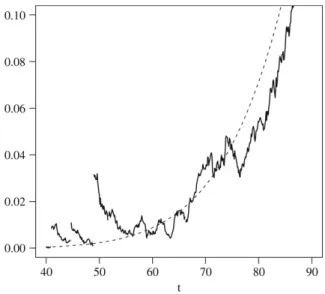
V0. WhenV0is not available in closed form, we can compute it by executing onlyStep 1andStep 3of our algorithm. The next section offers numerical results on the implementation of the above procedure.Fig. 1. Solid line: sample path ofµ. Dashed line: Weibull intensitym.
Table 1
Parameters used in the simulation
r K S µ BDS=1.00 r0=0.05 K0=0.04 S0=100.00 µ0=m(0) FDS=0.01 ζr=0.60 ζK=1.50 ρSK= −0.70 ζµ=0.50 δr=0.05 δK=0.04 ρSr=0.00 σµ=0.03 σr=0.03 σK=0.40 λY=0.50 λµ=0.10 µY=0.00 γµ=0.01 σY=0.07 c1=83.70 c2=8.30 x=40 Table 2
Value of the contract
κ(%) κw(%) 0 2 4 113.556 (0.031) 115.381 (0.033) 123.087 (0.033) 0 117.223 (0.031) 117.551 (0.031) 123.291 (0.033) 2 123.687 (0.031) 123.727 (0.031) 124.507 (0.032) 4 137.130 (0.031) 137.327 (0.030) 137.710 (0.030) 6 V0 107.185 (0.047) 112.675 (0.045) 122.901 (0.041) 4. Numerical examples
We consider the single premium equity-linked endowment described in Section2.1. The reference insured is a male aged x
=
40 at time 0. The contract has maturityT=
15 years and provides terminal guarantees on survival, death and surrender benefits, as defined in(2.1). We apply the valuation algorithm with polynomial basis functions of order 3, yieldingH=
34. To replace the American claim with a Bermudan claim, we discretize the time dimension by using a time step (in years) which we call Backward Discretization Step (BDS). To simulate the reduced state variable processb
X, we employ a time grid finer thanTand call Forward Discretization Step (FDS) the length in years of each time interval in the finer grid. All the relevant parameters used for our simulations are reported inTable 1.With regard to mortality dynamics, we note that the functionmin(2.5)is obtained by fitting a Weibull intensity, given bym
(
t)
=
c−c21 c2
(
x+
t)
c2−1(withc1>
0,
c2>
1), to the survival probabilities implied by table SIM2001, commonly usedin the Italian endowments market. A sample path of
µ
is reproduced inFig. 1.We have considered different values for the minimum rates guaranteed upon both death and survival (
κ .
=
κ
d=
κ
s), as well for the surrender guarantee (κ
w). Of course, the price of the European contract does not depend onκ
w. The case ofkw
≤
kis what one encounters in practice, for otherwise contract design would favor withdrawals. We consider the case ofkw
>
kfor numerical purposes only. We ran 19 000 simulations with 140 different seeds to obtain the results reported inTables 2and3. The last row ofTable 2reports the value of the European contract (V0), while the other rows report the values
Fig. 2. Value of the American contract.
Table 3
Surrender option value
κ(%) κw(%) 0 2 4 6.372 2.706 0.186 0 10.038 4.876 0.390 2 16.503 11.052 1.606 4 29.945 24.652 14.809 6 Table 4
Surrender option values and percentage changes of the higher mortality model with respect to the base case ofTable 3
κ(%) κw(%) 0 2 4 6.402 (+0.47%) 2.950 (+9.02%) 0.273 (+46.77%) 0 9.884 (−1.53%) 4.994 (+2.42%) 0.407 (+4.35%) 2 15.968 (−3.24%) 10.856 (−1.77%) 1.639 (+2.08%) 4 27.980 (−6.56%) 23.105 (−6.27%) 14.148 (−4.46%) 6
of the American contract with standard errors in parenthesis. Finally,Table 3reports the values for the surrender option, whileFig. 2depicts the value of the American contract against both
κ
andκ
w.As expected, the value of the European contract is increasing with the minimum interest rate guaranteed upon death or survival,
κ
. The value of the American contract is increasing with bothκ
and the minimum interest rate guaranteed upon surrender,κ
w. The value of the surrender option instead increases withκ
wand decreases withκ
. The option value is negligible whenκ
is large relative toκ
w, because stepping out of the contract is then less attractive. [7] propose an alternative algorithm that can be used as a benchmark for our case and indeed confirms the validity of our results.To understand the impact of mortality on our results, we compute surrender option values for a mortality model yielding a 9.67% decrease in expected lifetime (from 38.79 to 35.04 years). This is obtained by raising instantaneous volatility to
σ
µ=
0.
10 and mean jump size toγ
µ=
0.
04. We report the results inTable 4, together with the percentage changes with respect to the base case ofTable 3. We see that surrender options become more valuable in the higher mortality case as long asκ
≥
κ
w. To understand why, we note that while higher mortality involves a lower probability of receiving payments upon survival (i.e., surrender and maturity benefits), at the same time it can be shown to increase the overall value of our standard endowment contracts. As a result, there are two effects at play when considering the optimal stopping problem(3.1): on the one hand, higher mortality increases the argument of the supremum, on the other hand, it reduces the probability of being able to exercise before death. Whenκ < κ
w, surrender guarantees are more valuable relative to death and survival Please cite this article in press as: A.R. Bacinello, et al., Pricing life insurance contracts with early exercise features, Journal of Computational and Appliedguarantees, but the lower probability of exercising before death generates a decrease in option values. When instead
κ
≥
κ
w, surrender benefits are less valuable relative to death and survival benefits, but the increase in value for the stopped contract (induced by higher mortality) makes option values increase with respect to the base case.5. Conclusions
In this paper we have described an algorithm for the valuation of a life insurance contract embedding surrender options based on the Least Squares Monte Carlo method. The approach is effective in that we can avoid imposing rigid simplifying assumptions on the valuation model. We have then shown how to implement the model in the context of equity-linked endowment contracts with minimum guarantees on death, surrender and survival benefits. We have considered different sources of uncertainty, such as random interest rates, stochastic volatility and jumps in asset prices, as well as random mortality rates. Finally, we have performed numerical experiments demonstrating the performance of the approach. Objectives for future research are the detailed analysis of the implications of market incompleteness and the introduction of policyholders’ subjectivity in the surrender optimization problem.
Acknowledgements
The authors thank an anonymous referee for thoughtful comments and suggestions. The authors are solely responsible for any errors. The authors gratefully acknowledge financial support from the Italian Ministry of University and Research (MIUR) and the University of Trieste.
References
[1] M.-O. Albizzati, H. Geman, Interest rate risk management and valuation of the surrender option in life insurance policies, The Journal of Risk and Insurance 61 (4) (1994) 616–637.
[2] G. Andreatta, S. Corradin, Valuing the surrender option embedded in a portfolio of Italian life guaranteed participating policies: A least squares Monte Carlo approach, Tech. Rep., RAS Pianificazione redditività di Gruppo, 2003.
[3] A. Bacinello, Fair valuation of a guaranteed life insurance participating contract embedding a surrender option, The Journal of Risk and Insurance 70 (3) (2003) 461–487.
[4] A. Bacinello, Pricing guaranteed life insurance participating policies with annual premiums and surrender option, North American Actuarial Journal 7 (3) (2003) 1–17.
[5] A. Bacinello, Endogenous model of surrender conditions in equity-linked life insurance, Insurance: Mathematics & Economics 37 (2) (2005) 270–296. [6] A. Bacinello, A full Monte Carlo approach to the valuation of the surrender option embedded in life insurance contracts, in: C. Perna, M. Sibillo (Eds.),
Mathematical and Statistical Methods for Insurance and Finance, Springer, 2008, pp. 19–26.
[7] A. Bacinello, E. Biffis, P. Millossovich, Regression-based algorithms for life insurance contracts with surrender guarantees, Working paper, Tanaka Business School, Imperial College, London, 2007.
[8] G. Bakshi, C. Cao, Z. Chen, Empirical performance of alternative option pricing models, Journal of Finance 52 (5) (1997) 2003–2049. [9] E. Biffis, Affine processes for dynamic mortality and actuarial valuations, Insurance: Mathematics & Economics 37 (3) (2005) 443–468. [10] E. Biffis, P. Millossovich, The fair value of guaranteed annuity options, Scandinavian Actuarial Journal 2006 (1) (2006) 23–41.
[11] J.F. Carrière, Valuation of the early-exercise price for options using simulations and nonparametric regression, Insurance: Mathematics & Economics 19 (1) (1996) 19–30.
[12] E. Clément, D. Lamberton, P. Protter, An analysis of a least squares regression method for American option pricing, Finance and Stochastics 6 (2002) 449–471.
[13] D. Duffie, Dynamic Asset Pricing Theory, third edn., Princeton University Press, Princeton, 2001.
[14] D. Duffie, M. Schroder, C. Skiadas, Recursive valuation of defaultable securities and the timing of resolution of uncertainty, Annals of Applied Probability 6 (4) (1996) 1075–1090.
[15] P. Glasserman, Monte Carlo Methods in Financial Engineering, Springer, New York, 2004.
[16] A. Grosen, P.L. Jørgensen, Valuation of early exercisable interest rate guarantees, The Journal of Risk and Insurance 64 (3) (1997) 481–503. [17] A. Grosen, P.L. Jørgensen, Fair valuation of life insurance liabilities: The impact of interest rate guarantees, surrender options, and bonus policies,
Insurance: Mathematics & Economics 26 (1) (2000) 37–57.
[18] F.A. Longstaff, E.S. Schwartz, Valuing American options by simulation: A simple least-squares approach, The Review of Financial Studies 14 (1) (2001) 113–147.
[19] K.S. Moore, V.R. Young, Optimal design of a perpetual equity-indexed annuity, North American Actuarial Journal 9 (1) (2005) 57–72.
[20] M. Moreno, J.F. Navas, On the robustness of least-squares Monte–Carlo for pricing American derivatives, Review of Derivatives Research 6 (2) (2003) 107–128.
[21] P.E. Protter, Stochastic Integration and Differential Equations, second edn., Springer, Berlin, 2004.
[22] W. Shen, H. Xu, The valuation of unit-linked policies with or without surrender options, Insurance: Mathematics and Economics 36 (1) (2005) 79–92. [23] L. Stentoft, Assessing the least squares Monte–Carlo approach to American option valuation, Review of Derivatives Research 7 (2) (2004) 129–168. [24] J. Tsitsiklis, B. Van Roy, Regression methods for pricing complex American-style options, IEEE Transaction on Neural Networks 14 (4) (2001) 694–703.