Risk Management:
Implementation principles
and
Inventories for
Risk Management/Risk Assessment
methods and tools
(Parts of this report constitute the deliverable defined
in the ENISA Work Programme 2006 as:
“
Survey of existing Risk Management and
Risk Assessment
Methods
”)
Conducted by the
Technical Department of ENISA Section Risk Management
Legal Notice
Notice must be taken that this publication represents the views and interpretations of the authors and editors, unless it is stated otherwise. This publication should not be construed to be an action of ENISA or the ENISA bodies unless adopted pursuant to the ENISA Regulation (EC) No 460/2004. This publication does not necessarily represent state-of the-art and it might be updated from time to time.
Third party sources are quoted as appropriate. ENISA is not responsible for the content of the external sources including external web sites referenced in this publication.
This publication is intended for educational and information purposes only. Neither ENISA nor any person acting on its behalf is responsible for the use that might be made of the information contained in this publication.
All rights reserved. No part of this publication may be reproduced, stored in a retrieval system or transmitted in any form or by any means, electronic mechanical, photocopying, recording, or otherwise without the prior written permission of ENISA, or as expressly permitted by Law or under terms agreed with the appropriate rights organisations. Source must be acknowledged at all times. Enquiries for reproduction can be sent to the contact address quoted in this publication.
Executive Summary
This report is the first ENISA deliverable 2006 in the area of Risk Management / Risk Assessment. Parts of this report constitute the deliverable defined in the ENISA Work Programme 2006 as: “Survey of existing Risk Management and Risk Assessment Methods”.
The purpose of this document is to address identified open problems in the area of Risk Management and to provide a road-map for addressing further open issues at a European level.
This document contributes to solving the following problems:
1. low awareness of Risk Management activities within public and private sector organizations;
2. absence of a “common language” in the area of Risk Management to facilitate communication among stakeholders;
3. lack of surveys on existing methods, tools and good practices.
Further identified open issues/needs in the area of Risk Management / Risk Assessment, such as interoperability of methods and integration with corporate governance, are presented by means of a road-map describing and prioritizing possible future actions to be performed in that area.
Elements of work conducted within the ENISA ad hoc Working Group on technical and policy issues of Risk Assessment and Risk Management have been integrated into this document.
Contact details: ENISA Technical Department, Section Risk Management, Dr. L.
Marinos, Senior Expert Risk Management, Jani Arnell, Expert Risk Management, e-mail:
Table of Contents
1 INTRODUCTION... 1
2 STRUCTURE AND TARGET GROUPS OF THIS DOCUMENT ... 4
3 POSITIONING RISK MANAGEMENT AND RISK ASSESSMENT ... 6
3.1 RISK MANAGEMENT WITHIN AN INFORMATION SECURITY MANAGEMENT SYSTEM (ISMS)... 8
3.1.1 The need for ISMS ... 8
3.1.2 Critical success factors for ISMS... 9
3.1.3 The ISMS Framework... 9
4 RISK MANAGEMENT PROCESSES ... 12
4.1 OVERVIEW OF THE RISK MANAGEMENT PROCESSES... 12
5 THE CORPORATE RISK MANAGEMENT STRATEGY ... 15
5.1 RISK COMMUNICATION,RISK AWARENESS AND CONSULTING... 16
5.2 DEFINITION OF SCOPE AND FRAMEWORK... 16
5.2.1 Definition of external environment ... 17
5.2.2 Definition of internal environment ... 17
5.2.3 Generating the Risk Management context ... 18
5.2.4 Formulation of risk criteria ... 18
6 RISK ASSESSMENT ... 19
6.1 IDENTIFICATION OF RISKS... 19
6.2 ANALYSIS OF RELEVANT RISKS... 21
6.3 EVALUATION OF RISKS... 23
7 RISK TREATMENT ... 23
7.1 IDENTIFICATION OF OPTIONS... 24
7.2 DEVELOPMENT OF THE ACTION PLAN... 25
7.3 APPROVAL OF THE ACTION PLAN... 25
7.4 IMPLEMENTATION OF THE ACTION PLAN... 25
7.5 IDENTIFICATION OF RESIDUAL RISKS... 27
8 RISK ACCEPTANCE (OPTIONAL PROCESS)... 27
9 MONITOR AND REVIEW ... 28
10 INVENTORY OF RISK MANAGEMENT / RISK ASSESSMENT METHODS... 30
10.1 AUSTRIAN ITSECURITY HANDBOOK... 31
10.2 CRAMM... 31
10.3 DUTCH A&K ANALYSIS... 31
10.4 EBIOS ... 31
10.5 ISF METHODS FOR RISK ASSESSMENT AND RISK MANAGEMENT... 32
10.6 ISO/IECIS13335-2(ISO/IECIS27005) ... 34
10.7 ISO/IECIS17799:2005... 34
10.8 ISO/IECIS27001(BS7799-2:2002) ... 34
10.9 IT-GRUNDSCHUTZ (ITBASELINE PROTECTION MANUAL) ... 34
10.10 MARION... 35
10.11 MEHARI ... 36
10.12 OCTAVE V2.0(AND OCTAVE-S V1.0 FOR SMALL AND MEDIUM BUSINESSES)... 36
10.13 SP800-30(NIST)... 36
10.14 SYNTHETIC VIEW ON ASSESSED METHODS... 37
11.1 CALLIO... 39 11.2 CASIS: ... 39 11.3 COBRA: ... 40 11.4 COUNTERMEASURES: ... 40 11.5 CRAMM: ... 40 11.6 EBIOS: ... 40 11.7 GSTOOL: ... 41 11.8 ISAMM:... 41 11.9 OCTAVE: ... 41 11.10 PROTEUS: ... 41 11.11 RA2:... 41 11.12 RISKWATCH: ... 42
12 OPEN ISSUES – ROAD MAP FOR FURTHER ACTIVITIES IN RISK MANAGEMENT.... 43
12.1 COMPARABILITY/INTEROPERABILITY OF METHODS AND TOOLS... 44
12.2 IDENTIFICATION OF COMBINATIONS OF METHODS... 45
12.3 GENERATION OF DEMONSTRATORS AND AWARENESS MATERIAL... 46
12.4 CONTINUITY AND EMERGING RISKS... 46
12.5 GENERATION OF AN INSTALLED SOFTWARE BASE... 47
12.6 INTEGRATION OF RISK MANAGEMENT WITH OTHER PROCESSES/DISCIPLINES... 47
12.7 PRIORITIES... 48
BIBLIOGRAPHY ... 50
ANNEX I: GLOSSARY ... 53
ANNEX II: STRUCTURE OF TEMPLATE FOR METHOD DESCRIPTION ... 59
A:PRODUCT IDENTITY CARD... 59
B:SCOPE... 60
C:USERS VIEWPOINT... 61
ANNEX III: INVENTORY OF METHODS... 63
13 AUSTRIAN IT SECURITY HANDBOOK ... 63
A:PRODUCT IDENTITY CARD... 63
B:SCOPE... 64
C:USERS VIEWPOINT... 65
14 CRAMM ... 66
A:PRODUCT IDENTITY CARD... 66
B:SCOPE... 67
C:USERS VIEWPOINT... 67
15 DUTCH A&K ANALYSIS... 69
A:PRODUCT IDENTITY CARD... 69
B:SCOPE... 70
C:USERS VIEWPOINT... 70
16 EBIOS ... 72
A:PRODUCT IDENTITY CARD... 72
B:SCOPE... 74
C:USERS VIEWPOINT... 75
17 ISF METHODS FOR RISK ASSESSMENT AND RISK MANAGEMENT ... 77
A:PRODUCT IDENTITY CARD... 77
C:USERS VIEWPOINT... 80
18 ISO/IEC IS 13335-2 (ISO/IEC IS 27005) ... 82
A:PRODUCT IDENTITY CARD... 82
B:SCOPE... 83
C:USERS VIEWPOINT... 84
19 ISO/IEC IS 17799:2005 ... 86
A:PRODUCT IDENTITY CARD... 86
B:SCOPE... 87
C:USERS VIEWPOINT... 87
20 ISO/IEC IS 27001 (BS7799-2:2002)... 89
A:PRODUCT IDENTITY CARD... 89
B:SCOPE... 90
C:USERS VIEWPOINT... 91
21 IT-GRUNDSCHUTZ (IT BASELINE PROTECTION MANUAL) ... 93
A:PRODUCT IDENTITY CARD... 93
B:SCOPE... 95
C:USERS VIEWPOINT... 96
22 MARION ... 98
A:PRODUCT IDENTITY CARD... 98
B:SCOPE... 99
C:USERS VIEWPOINT... 100
23 MEHARI... 101
A:PRODUCT IDENTITY CARD... 101
B:SCOPE... 102
C:USERS VIEWPOINT... 103
24 OCTAVE V2.0 (AND OCTAVE-S V1.0 FOR SMALL AND MEDIUM BUSINESSES) ... 105
A:PRODUCT IDENTITY CARD... 105
B:SCOPE... 106
C:USERS VIEWPOINT... 107
25 SP800-30 (NIST)... 109
A:PRODUCT IDENTITY CARD... 109
B:SCOPE... 110
C:USERS VIEWPOINT... 110
ANNEX IV: STRUCTURE OF TEMPLATE FOR TOOL DESCRIPTION ... 112
25.1 A:PRODUCT IDENTITY CARD... 112
25.2 B:SCOPE... 113
25.3 C:USERS VIEWPOINT... 115
ANNEX V: INVENTORY OF TOOLS ... 116
26 CALLIO... 116
26.1 A:IDENTITY CARD... 116
26.2 B:SCOPE... 118
26.3 C:USERS VIEWPOINT... 119
27.1 A:IDENTITY CARD... 121 27.2 B:SCOPE... 123 27.3 C:USERS VIEWPOINT... 123 28 COBRA... 125 28.1 A:IDENTITY CARD... 125 28.2 B:SCOPE... 127 28.3 C:USERS VIEWPOINT... 127 29 COUNTERMEASURES ... 129 29.1 A:IDENTITY CARD... 129 29.2 B:SCOPE... 131 29.3 C:USERS VIEWPOINT... 131 30 CRAMM ... 133 30.1 A:IDENTITY CARD... 133 30.2 B:SCOPE... 134 30.3 C:USERS VIEWPOINT... 135 31 EBIOS ... 137 31.1 A:IDENTITY CARD... 137 31.2 B:SCOPE... 139 31.3 C:USERS VIEWPOINT... 140 32 GSTOOL... 142 32.1 A:IDENTITY CARD... 142 32.2 B:SCOPE... 144 32.3 C:USERS VIEWPOINT... 144 33 ISAMM ... 146 33.1 A:IDENTITY CARD... 146 33.2 B:SCOPE... 148 33.3 C:USERS VIEWPOINT... 149
34 OCTAVE AUTOMATED TOOL... 150
34.1 A:IDENTITY CARD... 150 34.2 B:SCOPE... 151 34.3 C:USERS VIEWPOINT... 152 35 PROTEUS... 154 35.1 A:IDENTITY CARD... 154 35.2 B:SCOPE... 156 35.3 C:USERS VIEWPOINT... 157 36 RA2... 158 36.1 A:IDENTITY CARD... 158 36.2 B:SCOPE... 160 36.3 C:USERS VIEWPOINT... 161 37 RISKWATCH ... 162 37.1 A:IDENTITY CARD... 162 37.2 B:SCOPE... 164 37.3 C:USERS VIEWPOINT... 165
Table of Figures
Figure 1: Structure of the present document... 4
Figure 2: The relationship between Risk Management and Risk Assessment ... 6
Figure 3: A possible ISMS Framework (based on ISO 17799) ... 10
Figure 4: Overall cycle of a Risk Management process ... 13
1 Introduction
Risk Management, in general, is a process aimed at an efficient balance between realizing opportunities for gains and minimizing vulnerabilities and losses. It is an integral part of management practice and an essential element of good corporate governance. Risk Management should be an endlessly recurring process consisting of phases which, when properly implemented, enable continuous improvement in decision-making and
performance improvement.
Information Security (IS) Risk Management can be a part of an organization’s wider Risk Management process or can be carried out separately. Given that Information Technology in general (and Information Security in particular), incorporates state of the art
technology that is continuously changing and expanding, it is recommended that IS Risk Management be established as a permanent process1 within the organization.
Both within the documented ENISA tasks (s. ENISA regulation [ENISA Regulation]) and various events in the area of Risk Management, several problem areas have been identified that are worth addressing at a European level:
1. Low awareness of Risk Management activities within public and private sector organizations: The issue here is that those organizations implementing Risk Management often tend to neglect Risk Assessment. Other organizations
rudimentarily implement Risk Management and Risk Assessment as part of their Information Security Management System. Finally, many small organizations do not implement them at all (e.g. SMEs, large organizations in the area of
commerce).
2. Absence of a “common language” in the area of Risk Management to facilitate communication of stakeholders: In the relevant literature (e.g. national or international standards, tools, good practices etc.) Risk Management terms are used with different meanings. Similarly, experts in the area of Risk Management and Risk Assessment use often different definitions for relevant terms. The use of differentiated terminology aggravates the comparability of the achieved results, used methods and tools.
3. Lack of surveys on existing methods, tools and good practices: Although many methods and tools are available in this domain, no inventories do exist that are structured according to a set of common properties (enabling thus comparability). Organizations tend to proceed with costly feasibility studies on the identification of characteristics of existing methods and tools in Risk Management and Risk Assessment.
1As such Risk Management is performed continuously, or at least on demand, e.g. when new security
incidents are registered or components (Hardware, Software) are going to be purchased, developed, deployed, etc.
4. Lack of interoperability of Risk Management solutions; difficulties in integration of Risk Management/Risk Assessment with corporate governance: In current time, Information Technology Risk Management and Risk Assessment cannot be considered in isolation. Both multiple methods and multiple application domains of Risk Management may co-exist (e.g. in the area of operational risks [BASEL II], [SOX]). This generates the need to integrate IT Risk Management and Risk Assessment both with existing methods/standards in the areas of Information Technology and operational risks and implement them as a whole within the organization.
The main purpose of this document is to contribute towards the points 1 and 2 mentioned above. In doing so it presents processes and operational cycles pertinent to Risk
Management and proposes guidelines that can improve the effectiveness of their implementation. Chapters 3 to 9 address these points by positioning Risk Management and by describing its underlying processes.
A further purpose of this document is to contribute to point 3 above, by providing an initial survey on existing approaches by means of inventories2 of existing methods and tools. These inventories will be maintained by ENISA in the future and they are presented in chapters 10 and 11. Detailed information on the inventories is provided in annexes attached to this document (s. annex III and annex V).
Finally, point 4 together with further emerging issues of Risk Management and Risk Assessment are addressed by means of a road map describing possible future actions in these areas. The road map is presented in chapter 12.
It is worth mentioning, that this report contains information delivered by an ad hoc Working Group established by ENISA in the area of Risk Management / Risk
Assessment [ENISA-WG]. When appropriate this information has been integrated into the present text, while some of it is included in the attached inventories (esp. in the inventory of methods in Annex II).
Since ENISA's focus is on information and network security, this document mainly concentrates on Information Security (IS) Risk Management. If not otherwise noted, the terms Information Security Risk Management and Risk Management will be used in this document interchangeably.
The exact structure and purpose of this document is presented in the following chapter (s. chapter 2).
2 The ENISA inventory is an open list with methods and tools. In its current version, the ENISA inventory
is not exhaustive. It rather contains methods and tools from an initial assessment performed by the ENISA Working Group composed of European experts in the related field. Methods and tools not included in the current inventories can be considered for later versions. ENISA works on a process that will allow
Note for the paper version of this document: This document is a static image of a dynamically evolving information base that in the near future will be implemented by means of a Web Site. The dynamic document will evolve over time and will include:
• additional methods/tools to be assessed later (expected by the end of 2006); • examples provided by ENISA for instantiations of various processes of Risk
Management (expected by the end of 2006);
• demonstrations of how to apply presented Risk Management processes in practice (expected by during 2007);
• examples on how to integrate Risk Management processes with other processes (expected by the middle of 2007);
• further aspects emerging from the elaboration on the open issues formulated in this document (continuously).
2
Structure and target groups of this document
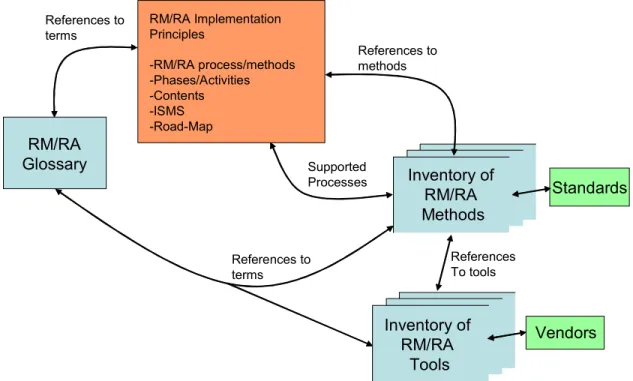
The structure of the present document is as presented in Figure 1. The main part (s. box tagged as “Risk Management/Risk Assessment Implementation Principles”) describes the main characteristics of processes and activities pertinent to Risk Management and Risk Assessment. Generally speaking, this box represents the present report. The annexes attached to this document constitute the inventory of methods and of tools, as well as a glossary of terms used within this document. Via references, the logical relationships have been implemented in this document (depicted in the figure by the yellow arrows).
RM/RA Implementation Principles -RM/RA process/methods -Phases/Activities -Contents -ISMS -Road-Map RM/RA Glossary Inventory of RM/RA Methods Inventory of RM/RA Tools Vendors Standards Supported Processes References to methods References to terms References To tools References to terms
Figure 1: Structure of the present document
The target group for this document is composed of security and IT experts but also interested individuals seeking for a reference to Risk Management processes, activities and terminology. For all target groups, this document can be considered as a resource for generating awareness in the areas of Risk Management and Risk Assessment (esp. chapters 3 to 9).
Furthermore, the attached inventories offer concise information on existing methods and tools that can facilitate rapid identification of their key characteristics (see chapters 10 and 11, as well as annex III, annex V). This can be a valuable aid in the process of selection of appropriate components for the implementation of a Risk Management process within an organization. To this extend, the attached inventories serve as resource for the promotion of existing methods and tools.
Finally, the ENISA road-map reveals current and future trends in the area of Risk Management, thus giving an idea of future demand and developments in that area (see chapter 12).
Detailed inventories (both for methods and tools), together with the description of the templates used and the glossary developed are attached as annexes to this document. An electronic version of this document will be available by means of a dedicated web-site. Further, this document can serve as:
• a generic description of processes and activities implementing Information Security Risk Management/Risk Assessment;
• a consolidated set of references to be used in future work. For this purpose, the glossary attached to this document will be continuously maintained. It is worth mentioning, that the developed glossary will comprise part of a wider glossary on security terms to be developed by ENISA;
• an initial document base to be possibly expanded in the future with aspects such: • process integration by means of examples of integrating Risk Management
with other operative or product processes;
• examples of organizational implementations of Risk Management processes and activities;
• comparability and interoperability issues among various methods; • material that can be used for demonstration or training purposes.
3
Positioning Risk Management and Risk
Assessment
Risk Management and Risk Assessment are major components of Information Security Management (ISM). Although they are widely known, a wide range of deviating
definitions of Risk Management and Risk Assessment are found in the relevant literature [ISO13335-2], [NIST], [ENISA Regulation]. In this chapter a consolidated view of Risk Management and Risk Assessment is presented. For the sake of this discussion, two approaches to presenting Risk Management and Risk Assessment, mainly based on OCTAVE [OCTAVE] and ISO 13335-2 [ISO13335-2] will be considered. Nevertheless, when necessary, structural elements that emanate from other perceptions of Risk
Management and Risk Assessment are also used (e.g. consideration of Risk Management and Risk Assessment as counterparts of Information Security Management System, as parts of wider operational processes, etc. [WG-Deliverable 3], [Ricciuto]).
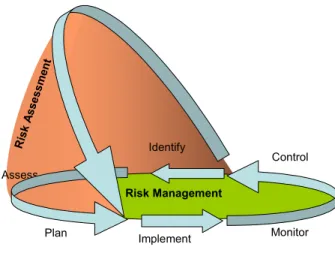
It seems to be generally accepted by Information Security experts, that Risk Assessment is part of the Risk Management process. After initialization, Risk Management is a recurrent activity that deals with the analysis, planning, implementation, control and monitoring of implemented measurements and the enforced security policy. On the contrary, Risk Assessment is executed at discrete time points (e.g. once a year, on demand, etc.) and – until the performance of the next assessment - provides a temporary view of assessed risks and while parameterizing the entire Risk Management process. This view of the relationship of Risk Management to Risk Assessment is depicted in Figure 2 as adopted from OCTAVE [OCTAVE].
Identify
Assess
Plan Implement Monitor Control Ris k A sses sm ent Risk Management
Figure 2: The relationship between Risk Management and Risk Assessment
It is worth mentioning, that in this figure both Risk Management and Risk Assessment are presented as processes, that is, as sequences of activities (s. arrows in Figure 2).
Various standards and good practices exist for the establishment of these processes (e.g. through structuring, adaptation, re-configuration etc.). In practice, organizations tend to generate their own instantiations of these methods, in a form most suitable for a given organizational structure, business area or sector. In doing so, national or international standards (or combination of those) are taken as a basis, whereas existing security
mechanisms, policies and/or infrastructure are adapted one-by-one. In this way, new good practices for a particular sector are created. Some representative examples of tailored methods/good practices are:
• a method based on a native national standard (e.g. [IT-Grund]);
• a method based on an native international standard (e.g. [ISO13335-2]); • a method based on a de facto standard (e.g. [OCTAVE]);
• a method based on a sector standard (e.g. [SIZ-DE]);
• a method based on an individual basic protection profile for the IT-systems of an organization (e.g. [SIZ-PP]);
• adoption of an already existing risk analysis of similar systems (e.g. based on an existing Protection Profiles according to Common Criteria [CC]).
In practice, combinations of the above examples are very common.
For the sake of the presentation within this document, the assumption is made, that the Risk Management life-cycle presented in Figure 2 (i.e. plan, implement, monitor, control, identify, assess), refers solely to risks. Similar activities that might be necessary within the Information Security Management process are considered to apply to operational aspects related to the implementation and control of security measurements (see also ISMS scope in chapter 3.1.3).
Even although organizations tend to use a single method for Risk Management, multiple methods are typically be used in parallel for Risk Assessment. This is because different Risk Assessment methods might be necessary, depending on the nature of the assessed system (e.g. structure, criticality, complexity, importance, etc.).
Through a series of activities, ENISA has established inventories of existing Risk Management and Risk Assessment methods and tools in Europe (also referred to as
products in this document). Any of these products can be used for the instantiation of both the Risk Management and Risk Assessment processes mentioned in Figure 2 above. The contents of these inventories are discussed in chapters 10 and 11 and the inventories themselves are attached to this document as annexes (s. annex III and annex V).
It should be noted that a more detailed representation of Risk Management and Risk Assessment is given in ISO 13335-2 [ISO13335-2]. In general, the contents of Risk Management and Risk Assessment processes as described in this document are compatible with ISO 13335. In the future, detailed examples of how to adapt the
given. The generation of such material will be part future work at ENISA in form of demonstrators (s. chapter 12.3).
A detailed discussion on the processes of Risk Management and Risk Assessment is presented in chapter 4 to 9).
3.1 Risk Management within an Information Security
Management System (ISMS)
Within this section the content and structure of Information Security Management Systems (ISMS) are explained and the position of Risk Management within such frameworks is shown. This will clarify the value of Risk Management within the ISMS. Further, an overview of existing interfaces with other security activities and results that provide/consume information to/from Risk Management will be presented.
3.1.1 The need for ISMS
Security experts say and statistics confirm that:
• information technology security administrators should expect to devote
approximately one-third of their time addressing technical aspects. The remaining two-thirds should be spent developing policies and procedures, performing security reviews and analyzing risk, addressing contingency planning and promoting security awareness;
• security depends on people more than on technology;
• employees are a far greater threat to information security than outsiders; • security is like a chain. It is as strong as its weakest link;
• the degree of security depends on three factors: the risk you are willing to take, the functionality of the system and the costs you are prepared to pay;
• security is not a status or a snapshot but a running process. These facts inevitably lead to the conclusion that:
Security administration is a management and NOT a purely technical issue Therefore the establishment, maintenance and continuous update of an ISMS provide a strong indication that a company is using a systematic approach for the identification, assessment and management of information security risks. Furthermore such a company will be capable of successfully addressing information confidentiality, integrity and availability requirements which in turn have implications for:
• business continuity;
• minimization of damages and losses; • competitive edge;
• profitability and cash-flow; • respected organization image;
• legal compliance.
3.1.2 Critical success factors for ISMS
To be effective, the ISMS must:
• have the continuous, unshakeable and visible support and commitment of the organization’s top management;
• be managed centrally, based on a common strategy and policy across the entire organization;
• be an integral part of the overall management of the organization related to and reflecting the organization’s approach to Risk Management, the control objectives and controls and the degree of assurance required;
• have security objectives and activities be based on business objectives and requirements and led by business management;
• undertake only necessary tasks and avoiding over-control and waste of valuable resources;
• fully comply with the organization philosophy and mindset by providing a system that instead of preventing people from doing what they are employed to do, it will enable them to do it in control and demonstrate their fulfilled accountabilities; • be based on continuous training and awareness of staff and avoid the use of
disciplinary measures and “police” or “military” practices; • be a never ending process;
Establishing an ISMS, involves:
• establishing the necessary Management Framework; • implementing selected controls;
• documenting the system;
• applying proper documentation control;
• maintaining records demonstrating compliance.
3.1.3 The ISMS Framework
Chief objective of Information Security Management is to implement the appropriate measurements in order to eliminate or minimize the impact that various security related threats and vulnerabilities might have on an organization. In doing so, Information Security Management will enable implementing the desirable qualitative characteristics of the services offered by the organization (i.e. availability of services, preservation of data confidentiality and integrity etc.).
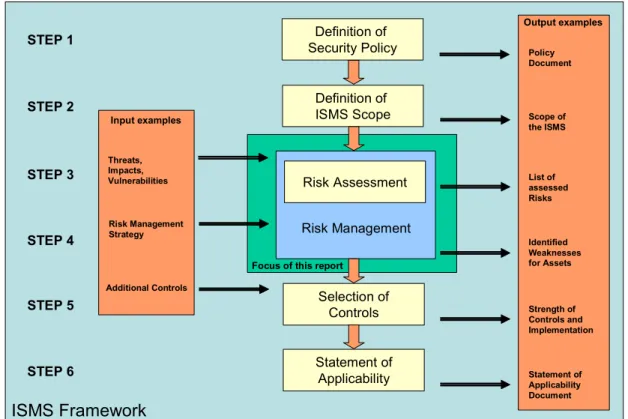
ISMS Framework Definition of Security Policy Definition of ISMS Scope Risk Assessment Selection of Controls Statement of Applicability Threats, Impacts, Vulnerabilities Risk Management Strategy Additional Controls Scope of the ISMS Policy Document Statement of Applicability Document List of assessed Risks Identified Weaknesses for Assets Strength of Controls and Implementation
Focus of this report
Output examples Input examples STEP 1 STEP 2 STEP 3 STEP 4 STEP 5 STEP 6 Risk Management
Figure 3: A possible ISMS Framework (based on ISO 17799)
It is not only size but in particular the specific business activities of an organization that dictate its security related requirements on a legal, regulatory and operational level. Small businesses with limited information systems infrastructure, whose operation does not demand handling, storage and processing of personal or confidential data, usually face minor risks or risks with lower likelihood or impact. These organizations are more likely not to maintain independent ISMS and usually deal with information security risks ad-hoc or as part of a wider Risk Management process.
Larger organizations and organizations such as banks and financial institutes,
telecommunication operators, hospital and health institutes and public or governmental bodies have many reasons for addressing information security very seriously. Legal and regulatory requirements which aim at protecting sensitive or personal data as well as general public security requirements impel them to devote the utmost attention and priority to information security risks.
Under these circumstances the development and implementation of a separate and independent management process namely an Information Security Management System is the one and only alternative.
As shown in Figure 3, the development of an ISMS framework entails the following 6 steps:
1. Definition of Security Policy, 2. Definition of ISMS Scope,
3. Risk Assessment (as part of Risk Management), 4. Risk Management,
5. Selection of Appropriate Controls and 6. Statement of Applicability
Steps 3 and 4, the Risk Assessment and Management process, comprise the heart of the ISMS and are the processes that “transform” on one hand the rules and guidelines of security policy and the targets; and on the other to transform objectives of ISMS into specific plans for the implementation of controls and mechanisms that aim at minimizing threats and vulnerabilities. It is worth mentioning, that steps 3 and 4 are considered as a single entity, namely Risk Management.
The processes and activities related to the steps 5 and 6 do not concern information risks. They are rather related to the operative actions required for the technical implementation, maintenance and control of security measurements.
Appropriate controls may either be derived from existing (exhaustive) sets of controls or mechanisms, usually included in information security standards (e.g. [ISO 17799]) and guidelines, or be the outcome of a combination or adaptation of proposed controls to the specific organizational requirements or operational characteristics.
In both cases, step 6 is the documented mapping of the identified risks, applied to the specific organization with the technical implementation of security mechanisms the organization has decided to deploy.
Finally it should be mentioned that although the ISMS is a recurring process as a whole, in most of the types of organizations mentioned above, steps 1 and 2 recur on a longer cycle than steps 3,4,5 and 6. This is mainly because the establishment of a security policy and the definition of the ISMS scope are more often management and (to a certain extent) strategic issues while the Risk Management process is in the end an “everyday”
4
Risk Management Processes
The effectiveness of Risk Management strongly depends on the degree to which it
succeeds in becoming a part of an organization's culture, i.e. its philosophy, practices and business processes. In this way, Risk Management is the responsibility of everyone in the organization.
The design and implementation of a Risk Management process in a particular organization is always influenced by:
• the organization mission and objectives; • its products and services;
• its management and operation processes; • specific practices employed;
• the local physical, environmental and regulatory conditions.
The impact that these factors have on the implementation of Risk Management, is presented in more detail in the following chapters.
As opposed to the evaluation of future risks, Risk Management as treated in this document refers to the management of current known risks. In this respect, Risk
Management (including methods and tools) is based on empirical and/or statistical values drawn form known attacks and incidents of the past.
The anticipation of future risks, also referred to as “Emerging Risks” [Emerging Risk ENISA], [Emerging Risk IPTS], will be addressed by ENISA at a later time. Mainly, Emerging Risks are addressed on the basis of virtual future scenarios. It is worth
mentioning, that the effectiveness and quality of assessments of Emerging Risks depends on the plausibility and practicability of the asserted future scenarios. At the time being, ENISA initializes work in the area of Emerging Risks and generates a road-map for the following years.
4.1 Overview of the Risk Management Processes
The presentation of Risk Management processes in this chapter is a consolidated
overview of relevant content found in the corresponding literature ([WG-Deliverable 3], [ISO 13335-2], [Ricciuto]). As mentioned above, the presented structure is compatible with the ISO Standard 13335.
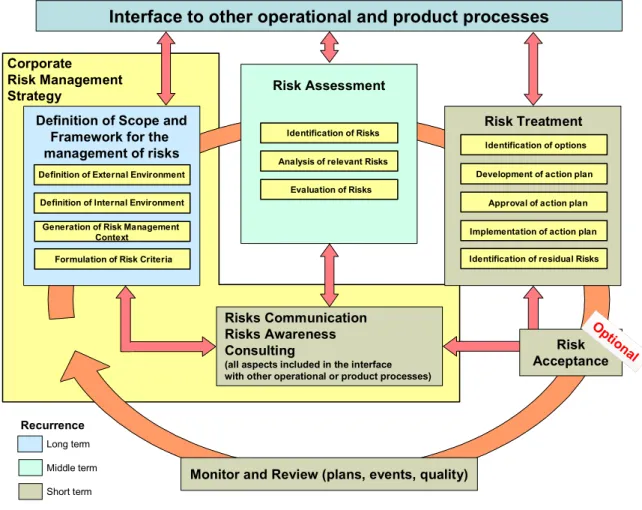
In the present document Risk Management is considered to be the umbrella under which several processes / activities concerning the identification, mitigation, management and control of risks take place. For the sake of the presentation, an integrated view of Risk Management is presented in terms of a “big picture”, i.e. the five processes and their activities (s. Figure 4). Furthermore, this figure shows possible interfaces among the processes presented.
In practice, any of the Risk Management processes can be used as an entry point to the Risk Management process or can be performed in isolation. Many organizations, for example, perform Risk Treatment without the performance of Risk Assessment or without the prior establishment of a Corporate Risk Management Strategy. Others might perform Risk Assessment and then proceed directly with other activities of ISMS. The ideal sequence for the performance of the processes of Risk Management is to start with the establishment of a Corporate Risk Management Strategy and proceed according to the orange cyclic arrow as indicated in the figure, whereas mutual interactions between the processes might also be performed (e.g. performance of Risk Assessment after a Risk Acceptance).
Definition of Scope and Framework for the management of risks
Definition of External Environment
Generation of Risk Management Context
Formulation of Risk Criteria
Risk Assessment
Identification of Risks
Analysis of relevant Risks Evaluation of Risks
Risk Treatment
Identification of options
Development of action plan
Approval of action plan
Implementation of action plan Identification of residual Risks
Monitor and Review (plans, events, quality) Risks Communication
Risks Awareness Consulting
(all aspects included in the interface with other operational or product processes)
Short term Middle term Long term
Recurrence
Interface to other operational and product processes
Corporate Risk Management Strategy Risk Acceptance Optio nal
Definition of Internal Environment
Figure 4: Overall cycle of a Risk Management process
It is worth mentioning, that no effective Risk Management system can be established in an organization, if it lacks such interfaces and especially to other relevant operational or product processes (s. box at the top of the figure). In its future work on Risk
Management, ENISA will elaborate examples to demonstrate ways to integrate Risk Management activities in important operational processes (e.g. procurement, software
development and test) as well as product processes (e.g. user help desks, incidents reporting).
In this chapter an overview Risk Management is presented. For the definition of Risk Management itself, the ENISA definition is adopted:
• Risk Management is the process, distinct from Risk Assessment, of weighing policy alternatives in consultation with interested parties, considering Risk
Assessment and other legitimate factors, and selecting appropriate prevention and control options.
(Definition provided in ENISA Regulation [ENISA Regulation])
Risk Management is considered as consisting of the five main processes shown in the figure above: Definition of Scope, Risk Assessment, Risk Treatment, Risk Communication
and Monitor and Review. It is worth mentioning, that the two processes Definition of Scope and Risk Communication are considered to make up the Risk Management Strategy (represented in Figure 4 by the yellow box).
For the above mentioned processes of Risk Management the following definitions3 are used:
• Definition of Scope: Process for the establishment of global parameters for the performance of Risk Management within an organization. Within the definition of scope for Risk Management, both internal and external factors have to be taken into account.
(ENISA)
• Risk Assessment: A scientific and technologically based process consisting of three steps, risk identification, risk analysis and risk evaluation.
(Definition adopted from ENISA Regulation with some adaptation concerning the name and number of the foreseen steps4)
• Risk Treatment: Process of selection and implementation of measures to modify risk.
• Risk treatment measures can include avoiding, optimizing, transferring or retaining risk
(Definition adopted from ISO/IEC Guide 73)
3 The definitions used within this document can be found in the attached glossary (s. page Glossary on 53).
These definitions have been adopted from different sources (including ISO/IEC Guide 73 [Guide 73], ENISA Regulation [ENISA Regulation], NIST [NIST] etc) and adapted accordingly.
4 The ENISA Regulation [ENISA Regulation] foresees four steps instead of three mentioned in the present
definition. In this document the names of the activities have been changed and the step “threat
• Risk Communication: A process to exchange or share information about risk between the decision-maker and other stakeholders inside and outside an organization (e.g. departments and outsourcers respectively).
• The information can relate to the existence, nature, form, probability, severity, acceptability, treatment or other aspects of risk.
(Definition adopted from ISO/IEC Guide 73)
• Monitor and Review: A process for measuring the efficiency and effectiveness of the organization’s Risk Management processes is the establishment of an ongoing monitor and review process. This process makes sure that the specified
management action plans remain relevant and updated. This process also
implements control activities including re-evaluation of the scope and compliance with decisions.
(ENISA)
In the relevant literature, a further process of Risk Management is often mentioned, namely Risk Acceptance. In this document Risk Acceptance is considered as being an
optional process, positioned between Risk Treatment and Risk Communication. This process is seen as an optional one, because it can be covered by both Risk Treatment and Risk Communication processes. This can be achieved by communicating the outcome of Risk Treatment to the management of the organization. A reason for deliberately
mentioning Risk Acceptance is to achieve the necessary management attention for this, otherwise purely communicative activity. Risk Acceptance can be defined as follows:
• Risk Acceptance: Decision to accept a risk by the responsible management of the organization.
• Risk acceptance depends on risk criteria defined within the process Definition of Scope
(Definition adopted from ISO/IEC Guide 73 with some modification)
These above mentioned processes are presented in the sections of this chapter in detail.
5
The Corporate Risk Management Strategy
Risk Management Strategy is an integrated business process that incorporates all of the Risk Management processes, activities, methodologies and policies adopted and carried out in an organization. The Risk Management strategy sets the parameters for the entire Risk Management and is usually released by the executive management of an
organization.
As depicted in Figure 4, Risk Management Strategy consists of two processes, one setting the framework for the entire Risk Management and the other setting the communication channels in the organization (see yellow box embracing Definition of Scope and Risk
Communication). In the forthcoming sections the components of Risk Management Strategy will be analyzed.
5.1 Risk Communication, Risk Awareness and Consulting
As mentioned above, it is essential for Risk Management to become part of the organization’s culture. Therefore communicating and creating awareness of relative issues across the organization at each step of the Risk Management process are very important.
Communication should by all means involve an open discussion with all stakeholders with efforts focused on consultation and development of common understanding, rather than on a one way flow of information from the decision maker to the other stakeholders. Risk Management can and will be enhanced by parties and individuals understand each other’s perspectives and who are consulted in a timely fashion, where appropriate. Stakeholders, like every human being, tend to make judgments about risk based on their perceptions. These can vary due to differences in values, needs, assumptions, concepts and concerns, as they relate to the risks or the issues under discussion. Since the views of stakeholders can have a significant impact on the decisions made, it is important that possible variations in their perceptions of risk be identified, recorded and addressed in the decision making process. In the long term, ENISA will contribute to the generation of qualitative criteria aiming at the creation of balanced estimations about assessed risks among various experts using various methods and tools.
External communication and consulting by specialized consultants, as well as exchange of information and cooperation with other organizations should also be planned and implemented on a regular basis. The exchange of this knowledge and experience can prove extremely helpful for addressing issues related to both the risks and the process to manage these risks, leading thus to a view on risks that is free from subjective
estimations. Furthermore, involving external personnel in such activities contributes towards the renewal of available know-how and risk perception5.
5.2 Definition of Scope and Framework
By establishing the framework for the management of risks, the basic parameters within which risks must be managed are defined. Consequently, the scope for the rest of the Risk Management process is also set. It includes the definition of basic assumptions for the organization’s external and internal environment and the overall objectives of the Risk Management process and activities. Although the definition of scope and framework are fundamental for the establishment of Risk Management, they are independent from
5 It is often the case that “established” practices lead to isolated or narrow observation of the status quo of
the security. External personnel contribute in bringing in “fresh air” by means of additional viewpoints in the evaluation of risks.
the particular structure of the management process, methods and tools to be used for the implementation.
In order to define an efficient framework it is important to:
• understand the background of the organization and its risks (e.g. its core processes, valuable assets, competitive areas etc.);
• evaluate the Risk Management activities being undertaken so far; • develop a structure for the Risk Management initiatives and controls
(countermeasures, security controls etc.) to follow. This approach is useful for:
• clarifying and gaining common understanding of the organizational objectives; • identifying the environment in which these objectives are set;
• specifying the main scope and objectives for Risk Management, applicable restrictions or specific conditions and the outcomes required;
• developing a set of criteria against which the risks will be measured;
• defining a set of key elements for structuring the risk identification and assessment process.
5.2.1 Definition of external environment
This step includes the specification of the external environment in which the organization operates and the definition of the relationship between this environment and the
organization itself.
The external environment typically includes:
• the local market, the business, competitive, financial and political environment; • the law and regulatory environment;
• social and cultural conditions; • external stakeholders.
It is also very important that both the perceptions and values of the various stakeholders and any externally generated threats and/or opportunities are properly evaluated and taken into consideration.
5.2.2 Definition of internal environment
As in every significant business process, the most critical prerequisite is to understand the organization itself.
Key areas that must be evaluated in order to provide a comprehensive view of the organization’s internal environment include:
• key business drivers (e.g. market indicators, competitive advances, product attractiveness, etc.);
• the organization’s strengths, weaknesses, opportunities and threats; • internal stakeholders;
• organization structure and culture;
• assets in terms of resources (such as people, systems, processes, capital etc); • goals and objectives and the strategies already in place to achieve them.
5.2.3 Generating the Risk Management context
In business terms, Risk Management as a process should provide a balance between (all kinds of) costs, benefits and opportunities. Therefore, it is necessary to draw the
appropriate framework and to correctly set the scope and boundaries of the Risk Management process.
Setting the Risk Management context involves defining the:
• organization, process, project or activity (to be assessed) and establishing its goals and objectives;
• duration of the project, activity or function;
• full scope of the Risk Management activities to be carried out specifying any including inclusions and exclusions;
• roles and responsibilities of various parts of the organization participating in the Risk Management process;
• dependencies between the project or activity and other projects or parts of the organization;
5.2.4 Formulation of risk criteria
The criteria by which risks will be evaluated have to be decided and agreed. Deciding whether risk treatment is required, is usually based on operational, technical, financial, regulatory, legal, social, or environmental, criteria or combinations of them. The criteria should be in line with the scope and framework defined above. Furthermore they should be closely related to the organization's internal policies and procedures and support its goals and objectives.
Important criteria, to be considered, are:
• impact criteria and the kinds of consequences that will be considered; • criteria of likelihood;
• the rules that will determine whether the risk level is such that further treatment activities are required.
It is very common, that criteria identified during these steps are further developed or even modified during later phases of the Risk Management process.
6 Risk
Assessment
Every organization is continuously exposed to an endless number of new or changing threats and vulnerabilities that may affect its operation or the fulfillment of its objectives. Identification, analysis and evaluation of these threats and vulnerabilities are the only way to understand and measure the impact of the risk involved and hence to decide on the appropriate measures and controls to manage them. It has to be noted, that Risk
Assessment is a process that in many cases is not (at least not adequately) performed, even if Risk Management is implemented. It is one of the main objectives of ENISA to generate awareness of this fact, but also to facilitate use of Risk Assessments by providing practical examples (see also chapter 12.3).
For insurance companies, the performance of Risk Assessments is in general of significant importance and in particular concerning IT risks for current and potential customers.
6.1 Identification of Risks
This is the phase where threats, vulnerabilities and the associated risks are identified. This process has to be systematic and comprehensive enough to ensure that no risk is unwittingly excluded. It is very important that during this stage all risks are identified and recorded, regardless of the fact that some of them may already be known and likely controlled by the organization.
The first step is to generate a comprehensive list of sources of threats, risks and events that might have an impact on the achievement of each of the objectives as identified in the Definition of Scope and Framework (s section 5.2). These events might prevent, degrade, delay or enhance the achievement of those objectives.
In general, a risk can be related to or characterized by (a) it’s origin
(e.g. threat agents like hostile employees or employees not properly trained, competitors, governments etc.)
(b) a certain activity, event or incident (i.e. threat)
(e.g. unauthorized dissemination of confidential data, competitor deploys a new marketing policy, new or revised data protection regulations, an extensive power failure)
(c) its consequences, results or impact
(e.g. service unavailability, loss or increase of market/profits, increase in regulation increase or decrease in competitiveness, penalties, etc.)
(d) a specific reason for its occurrence
(e.g. system design error, human intervention, prediction or failure to predict competitor activity)
(e) protective mechanisms and controls (together with their possible lack of effectiveness)
(e.g. access control and detection systems, policies, security training, market research and surveillance of market)
(f) time and place of occurrence
(e.g. during extreme environmental conditions there is a flood in the computer room) Good quality information and thorough knowledge of the organization and its internal and external environment are very important in identifying risks. Historical information about this or similar organizations (competitors or not) may also prove very useful as they can lead to safe predictions about current and evolving issues that have not yet faced by the organization.
Identifying what may happen is rarely sufficient. The fact that there are many ways an event can occur makes it important to study all possible and significant causes and scenarios. Methods and tools used to identify risks and their occurrence include checklists, judgments based on experience and records, flow charts, brainstorming, systems analysis, scenario analysis and systems engineering techniques.
In selecting a risk identification methodology, the following techniques should be considered:
• team-based brainstorming where workshops can prove effective in building commitment and making use of different experiences;
• structured techniques such as flow charting, system design review, systems analysis, Hazard and Operability studies,6 and operational modeling;
• for less clearly defined situations, such as the identification of strategic risks,
processes with a more general structure such as ‘what-if’ and scenario analysis could be used.
6 The HAZOP [HAZOP] process is based on the principle that a team approach to hazard analysis will
identify more problems than when individuals working separately combine results. The HAZOP team is made up of individuals with varying backgrounds and expertise. The expertise is brought together during HAZOP sessions and through a collective brainstorming effort that stimulates creativity and new ideas, a thorough review of the process under consideration is made.
6.2 Analysis of relevant Risks
Risk analysis is the phase where the level of the risk and its nature are assessed and understood. This information is the first input to decision makers on whether risks need to be treated or not and what is the most appropriate and cost-effective risk treatment methodology.
Risk analysis involves:
• thorough examination of the risk sources; • their positive and negative consequences;
• the likelihood that those consequences may occur and the factors that affect them; • assessment of any existing controls or processes that tend to minimize negative risks
or enhance positive risks (these controls may derive from a wider set of standards, controls or good practices selected according to a an applicability statement and may also come from previous risk treatment activities.)
The level of risk can be estimated by using statistical analysis and calculations combining impact and likelihood. Any formulas and methods for combining them must be consistent with the criteria defined when establishing the Risk Management context (s. section 5.2.3). This is because an event may have multiple consequences and affect different objectives, therefore consequences and likelihood need to be combined to calculate the level of risk. If no reliable or statistically reliable and relevant past data is available (kept for e.g. an incident database), other estimates may be made as long as they are
appropriately communicated and approved by the decision makers. Information used to estimate impact and likelihood usually comes from: • past experience or data and records (e.g. incident reporting),
• reliable practices, international standards or guidelines, • market research and analysis,
• experiments and prototypes,
• economic, engineering or other models, • specialist and expert advice.
Risk analysis techniques include
• interviews with experts in the area of interest and questionnaires, • use of existing models and simulations.
Risk analysis may vary in detail according to the risk, the purpose of the analysis, and the required protection level of the relevant information, data and resources. Analysis may be qualitative, semi-quantitative or quantitative or a combination of these. In any case, the
type of analysis performed should, as stated above, be consistent with the criteria developed as part of the definition of the Risk Management context (see section 5.2.3). A short description of the above-mentioned types of analysis types is as follows: • Qualitative analysis
In qualitative analysis, the magnitude and likelihood of potential consequences are presented and described in detail. The scales used can be formed or adjusted to suit the circumstances, and different descriptions may be used for different risks. Qualitative analysis may be used:
• as an initial assessment to identify risks which will be the subject of further, detailed analysis;
• where non-tangible aspects of risk are to be considered (e.g. reputation, culture, image etc.)
• where there is a lack of adequate information and numerical data or resources necessary for a statistically acceptable quantitative approach.
• Semi-quantitative analysis
In semi-quantitative analysis the objective is to try to assign some values to the scales used in the qualitative assessment. These values are usually indicative and not real, which is the prerequisite of the quantitative approach.
Therefore, as the value allocated to each scale is not an accurate representation of the actual magnitude of impact or likelihood, the numbers used must only be combined using a formula that recognizes the limitations or assumptions made in the description of the scales used.
It should be also mentioned that the use of semi-quantitative analysis may lead to various inconsistencies due to the fact that the numbers chosen may not properly reflect analogies between risks, particularly when either consequences or likelihood are extreme.
• Quantitative analysis
In quantitative analysis numerical values are assigned to both impact and likelihood. These values are derived from a variety of sources. The quality of the entire analysis depends on the accuracy of the assigned values and the validity of the statistical models used.
Impact can be determined by evaluating and processing the various results of an event or by extrapolation from experimental studies or past data. Consequences may be expressed in various terms of
• monetary • technical • operational • human impact criteria.
As it is made clear from the above analysis, the specification of the risk level is not unique. Impact and likelihood may be expressed or combined differently, according to the type of risk and the scope and objective of the Risk Management process.
6.3 Evaluation of Risks
During the risk evaluation phase decisions have to be made concerning which risks need treatment and which do not, as well as concerning on the treatment priorities. Analysts need to compare the level of risk determined during the analysis process with risk criteria established in the Risk Management context (i.e. in the risk criteria identification stage). It is important to note that in some cases the risk evaluation may lead to a decision to undertake further analysis.
The criteriaused by the Risk Management team have to also take into account the organization objectives, the stakeholder views and of course the scope and objective of the Risk Management process itself.
The decisions made are usually based on the level of risk but may also be related to thresholds specified in terms of:
• consequences (e.g. impacts), • the likelihood of events,
• the cumulative impact of a series of events that could occur simultaneously.
7 Risk
Treatment
According to its definition, Risk Treatment is the process of selecting and implementing of measures to modify risk. Risk treatment measures can include avoiding, optimizing, transferring or retaining risk. The measures (i.e. security measurements) can be selected out of sets of security measurements that are used within the Information Security
Management System (ISMS) of the organization. At this level, security measurements are verbal descriptions of various security functions that are implemented technically (e.g. Software or Hardware components) or organizationally (e.g. established procedures).
7.1 Identification of options
Having identified and evaluated the risks, the next step involves the identification of alternative appropriate actions for managing these risks, the evaluation and assessment of their results or impact and the specification and implementation of treatment plans. Since identified risks may have varying impact on the organization, not all risks carry the prospect of loss or damage. Opportunities may also arise from the risk identification process, as types of risk with positive impact or outcomes are identified.
Management or treatment options for risks expected to have positive outcome include: • starting or continuing an activity likely to create or maintain this positive outcome; • modifying the likelihood of the risk, to increase possible beneficial outcomes; • trying to manipulate possible consequences, to increase the expected gains; • sharing the risk with other parties that may contribute by providing additional
resources which could increase the likelihood of the opportunity or the expected gains;
• retaining the residual risk.
Management options for risks having negative outcomes look similar to those for risks with positive ones, although their interpretation and implications are completely different. Such options or alternatives might be:
• to avoid the risk by deciding to stop, postpone, cancel, divert or continue with an activity that may be the cause for that risk;
• to modify the likelihood of the risk trying to reduce or eliminate the likelihood of the negative outcomes;
• to try modifying the consequences in a way that will reduce losses;
• to share the risk with other parties facing the same risk (insurance arrangements and organizational structures such as partnerships and joint ventures can be used to spread responsibility and liability); (of course one should always keep in mind that if a risk is shared in whole or in part, the organization is acquiring a new risk, i.e. the risk that the organization to which the initial risk has been transferred may not manage this risk effectively.)
• to retain the risk or its residual risks;
In general, the cost of managing a risk needs to be compared with the benefits obtained or expected. During this process of cost-benefit judgments, the Risk Management context established in the first process (i.e. Definition of Scope and Framework, s. section 5.2) should be taken into consideration. It is important to consider all direct and indirect costs and benefits whether tangible or intangible and measured in financial or other terms. More than one option can be considered and adopted either separately or in combination. An example is the effective use of support contracts and specific risk treatments followed by appropriate insurance and other means of risk financing.
In the event that available resources (e.g. the budget) for risk treatment are not sufficient, the Risk Management action plan should set the necessary priorities and clearly identify the order in which individual risk treatment actions should be implemented.
7.2 Development of the action plan
Treatment plans are necessary in order to describe how the chosen options will be implemented. The treatment plans should be comprehensive and should provide all necessary information about:
• proposed actions, priorities or time plans, • resource requirements,
• roles and responsibilities of all parties involved in the proposed actions, • performance measures,
• reporting and monitoring requirements.
Action plans should be in line with the values and perceptions of all types of stakeholders (e.g. internal organizational units, outsourcing partner, customers etc.). The better the plans are communicated to the various stakeholders, the easier it will be to obtain the approval of the proposed plans and a commitment to their implementation.
7.3 Approval of the action plan
As with all relevant management processes, initial approval is not sufficient to ensure the effective implementation of the process. Top management support is critical throughout the entire life-cycle of the process. For this reason, it is the responsibility of the Risk Management Process Owner to keep the organization’s executive management continuously and properly informed and updated, through comprehensive and regular reporting.
7.4 Implementation of the action plan
The Risk Management plan should define how Risk Management is to be conducted throughout the organization. It must be developed in a way that will ensure that Risk Management is embedded in all the organization’s important practices and business processes so that it will become relevant, effective and efficient7.
More specifically, Risk Management should be embedded in the policy development process, in business and strategic planning, and in change management processes. It is also likely to be embedded in other plans and processes such as those for asset
7 The integration of the Risk Management process with other operational and product processes is
fundamental. ENISA plans to elaborate on this issue in the medium term based on examples with de facto process standards, such as example ITIL [ITIL].
management, audit, business continuity, environmental management, fraud control, human resources, investment and project management.
The Risk Management plan may include specific sections for particular functions, areas, projects, activities or processes. These sections may be separate plans but in all cases they should be consistent with the organization’s Risk Management strategy (which includes specific RM policies per risk area or risk category).
The necessary awareness of and commitment to Risk Management at senior management levels throughout the organization is mission critical and should receive close attention by:
• obtaining the active ongoing support of the organization’s directors and senior executives for Risk Management and for the development and implementation of the Risk Management policy and plan;
• appointing a senior manager to lead and sponsor the initiatives;
• obtaining the involvement of all senior managers in the execution of the Risk Management plan.
The organization’s board should define, document and approve its policy for managing risk, including objectives and a statement of commitment to Risk Management. The policy may include:
• the objectives and rationale for managing risk;
• the links between the policy and the organization’s strategic plans;
• the extent and types of risk the organization will take and the ways it will balance threats and opportunities;
• the processes to be used to manage risk; • accountabilities for managing particular risks;
• details of the support and expertise available to assist those involved in managing risks;
• a statement on how Risk Management performance will be measured and reported; • a commitment to the periodic review of the Risk Management system;
• a statement of commitment to the policy by directors and the organization’s executive.
Publishing and communicating a policy statement of this type demonstrates to the organization’s internal and external environment the commitment of the executive board to Risk Management and clearly specifies roles and accountability on a personal level. The directors and senior executives must be ultimately responsible for managing risk in the organization. All personnel are responsible for managing risks in their areas of control. This may be facilitated by:
• specifying those accountable for the management of particular risks, for implementing treatment strategies and for the maintenance of controls; • establishing performance measurement and reporting processes;
• ensuring appropriate levels of recognition, reward, approval and sanction. As it becomes apparent, the actual implementation of security measurements for the underlying IT platform is not part of this activity. Rather, the implementation of action plans is concerned with the actions to be performed to reduce the identified risks. The work necessary at the level of the technical implementation of security measures is conducted within the ISMS, that is, outside the Risk Management process.
Last but not least, an important responsibility of the top management is to identify
requirements and allocate necessary resources for Risk Management. This should include people and skills, processes and procedures, information systems and databases, money and other resources for specific risk treatment activities. The Risk Management plan should also specify how the Risk Management skills of managers and staff will be developed and maintained.
7.5 Identification of residual risks
Residual risk is a risk that remains after Risk Management options have been identified and action plans have been implemented. It also includes all initially unidentified risks as well as all risks previously identified and evaluated but not designated for treatment at that time.
It is important for the organizations management and all other decision makers to be well informed about the nature and extent of the residual risk. For this purpose, residual risks should always be documented and subjected to regular monitor-and-review procedures.
8
Risk Acceptance (optional process)
Acceptance of residual risks that result from with Risk Treatment has to take place at the level of the executive management of the organization (s. definitions in chapter 4.1). To this extent, Risk Acceptance concerns the communication of residual risks to the decision makers.
Once accepted, residual risks are considered as risks that the management of the
organization knowingly takes. The level and extent of accepted risks comprise one of the major parameters of the Risk Management process. In other words, the higher the
accepted residual risks, the less the work involved in managing risks (and inversely). This does not mean, however, that once accepted the risks will not change in forthcoming repetitions of the Risk Management life-cycle. Within the recurring phases and activities of the Risk Management processes (and in particular Risk Treatment as well as Monitor and Review) the severity of these risks will be measured over time. In the event that new
assertions are made or changing technical conditions identified, risks that have been accepted need to be reconsidered.
Risk Acceptance is considered as being an optional process, positioned between Risk Treatment and Risk Communication (s. chapter 4.1). This process is seen as an optional one, because it can be covered by both Risk Treatment and Risk Communication
processes. This can be achieved by communicating the outcome of Risk Treatment to the management of the organization. One reason for explicitly mentioning Risk Acceptance is the need to draw management's attention to this issue which would otherwise merely be a communicative activity.
In the attached inventories, Risk Acceptance has been included in the assessment of methods and tools, as it might be a decision criterion for certain kinds of organizations (e.g. in the financial and insurance sector, in critical infrastructure protection etc.).
9
Monitor and Review
One of the most critical factors affecting the efficiency and effectiveness of the
organization’s risk management process is the establishment of an ongoing monitor and re