Universidade de São Paulo
2015-08
FCA-Based Rule Generator: a framework for
the genetic generation of fuzzy classification
systems using formal concept analysis
IEEE International Conference on Fuzzy Systems, 2015, Istanbul.
http://www.producao.usp.br/handle/BDPI/50002
Downloaded from: Biblioteca Digital da Produção Intelectual - BDPI, Universidade de São Paulo
Biblioteca Digital da Produção Intelectual - BDPI
FeA-BASED RULE GENERATOR, a framework for
the genetic generation of fuzzy classification systems
using formal concept analysis
Marcos E. Cintra Maria C. Monard Heloisa A. Camargo
Computer Science Department Federal Uni. of Sao Carlos, Brazil
Email: [email protected] Natural and Exact Sciences Department
Federal Territorial Uni. of the Semi-Arid, Brazil {[email protected] }
Inst. of Math. and Computer Sciences Sao Paulo University, Brazil Email: [email protected]
Abstract-There is a number of frameworks for the general task of classification available for free usage on the Internet. However, software to generate fuzzy classification systems using the genetic approach is scarce. In this work, we present the FCA BASED RULE GENERATOR framework to automatically generate fuzzy classification systems based on a genetic rule selection process. Such rules are extracted from data using a formal concept analysis approach. The FCA-BASED RULE GENERATOR
framework includes modules for dataset preprocessing, automatic definition of fuzzy data bases from data, dataset optimization, a module based on formal concept analysis for rule extraction, a genetic algorithm module, as well as a rule base optimization module. The software is described and an example of use is presented.
I. INTRODUCTION
The task of classification has been widely researched by both, the machine learning and the soft computing commu nities. The classification methods proposed in the literature include different approaches, such as artificial neural networks [1], support vector machines [2], as well as rule-based ap proaches, including decision trees [3], [4] and Genetic Fuzzy Systems [5], [6], [7], [8]. Implementations of such proposals can be found in different frameworks for public use.
Fuzzy systems, the focus of this work, are composed of: i) a fuzzy rule base, which contains the knowledge of the domain; ii) a fuzzy data base, which contains the definition of the attributes in terms of fuzzy sets, and iii) an inference mechanism. Fuzzy systems can be defined by experts or automatically learned from data.
Genetic fuzzy systems, in turn, are fuzzy systems that combine the global search of Genetic Algorithms (GA) with the fuzzy set theory to provide accurate and interpretable rule-based systems. Genetic fuzzy systems can be classified according to the objective of the GA (learning or adjusting components), according to component(s) to be learned (the fuzzy rule base, fuzzy data base, or both) as well as by the strategy used by the GA (rule selection, rule extraction, multi-objective, among others). A classification of the various genetic fuzzy methods found in the literature according to a comprehensive taxonomy is presented in [9]. The work in [10] reviews the approaches that use Multi-objective genetic Algorithms to generate fuzzy rule based systems from data.
In [11], a method to automatically generate fuzzy rule based systems using the genetic approach with rule selec tion, namely the FCA-BASED RULE GENERATOR method, is proposed. A predefined fuzzy data base is used, allowing the GA to focus its search exclusively on the generation of suitable fuzzy rule bases. Also, by using a predefined fuzzy data base, it is possible to automatically build and extract rules,
i.e., a set of candidate rules that define the genetic search space. Such rules are extracted based on the Formal Concept Analysis (FCA) theory [12], [13]. Another advantage of the FCA-BASED RULE GENERATOR method is that, as the search space is defined before the GA search process, it is possible to use simple and efficient codifications for the chromosomes that improve the use of genetic operators and accelerate the whole genetic process.
As most of the methods required by FCA-BASED RULE GENERATOR are new proposals, a framework was developed to implement them using the Java language. The current version works as a command line application I The FCA-BASED
RULE GENERATOR method includes the following desirable characteristics for rule extraction:
• Rules are extracted directly from the data, avoiding the extraction of a potentially large number of unnec essary/useless rules;
• Unlike the exhaustive generation of rules, which has exponential complexity, by using FCA the complexity of the process is typically polynomial [14];
• The extracted rules present variable number of condi
tions in their antecedents, improving the interpretabil ity of the generated fuzzy rule bases;
In this paper, we present related frameworks and detail the FCA-BASED RULE GENERATOR method, discussing the modules that compose it, as well as their implementation and computational complexity. Notice that most of the proposal was previously described in [15] with a theoretical approach. This paper, on the other hand, aims at describing the imple mentation of the proposal and its technical details.
The remainder of this paper is organized as follows: Section II discusses related and publicly available software.
I Available at
Section III details the FCA-BASED RULE GENERATOR frame work and its modules. Section IV presents an example of us age, followed by the conclusions and future work in Section V.
II. RELATED WORK
In the literature, it is possible to find different types of software for the task of classification using fuzzy logic, the focus of the FCA-BASED RULE GENERATOR method. Next, we present some of the most relevant ones in regards to the supervised learning, specifically for soft computing.
A. KEEL
Regarding the genetic generation of fuzzy systems, the KEEL (Knowledge Extraction based on Evolutionary Learn ing) framework [16], [17] is one of the most well-known. KEEL includes several algorithms from the machine learning and soft computing areas. The methods and algorithms avail able in KEEL which are of interest to the FCA-BASED RULE GENERATOR framework are categorized into:
• Data preprocessing;
• Classification;
• Clustering algorithms;
• Association rules;
• Statistical Tests.
The KEEL framework2 contains several fuzzy and classic methods in each of the aforementioned categories. KEEL allows the definition of experiments using a graphical interface that is user-friendly and intuitive. Moreover, it allows the combination of multiple algorithms making it quite simple to organize massive experiments. It is developed using the Java language and licensed under the GNU General Public License (GPLv3)3. KEEL is distributed in English.
B. Xfuzzy
Xfuzzy [18]4 is a development environment for fuzzy inference-based systems. It is composed of several tools that cover the different stages of the fuzzy system design process, from their initial description to the final implementation. Its main features are the capability for developing complex systems and the flexibility of allowing the user to extend the set of available functions. Xfuzzy is developed in Java and licensed under the GNU General Public License. It is operating system independent.
Xfuzzy 3.0 is a complete environment for the design of fuzzy systems. Its tools, covering the different stages of the design process, share a common formal description language which allows the definition of complex systems by means of hierarchical rule bases and user-configurable membership functions, defuzzification methods, fuzzy connectives, linguis tic hedges and implication and aggregation operators.
The tools in Xfuzzy can be executed independently. It is distributed in English, with manuals available in Spanish and Portuguese as well.
2 Available at hup://keel.es/
3Details at hUp://www.gnu.orglIicenses/quick-guide-gplv3.html
4 Available at hup://www2.imse-cnm.csic.es/Xfuzzy/
C. GUAJE
GUAJE [19]5, Generating Understandable and Accurate fuzzy models in a Java Environment, implements a fuzzy modelling methodology named as Highly Interpretable Lin guistic Knowledge (HILK), which is aimed at yielding a good interpretability-accuracy trade-off by combining expert and induced knowledge in a common framework. It allows building interpretable and accurate fuzzy systems by means of combining several pre-existing open source tools, taking profit from the main advantages of each individual tool by analogy with the main idea underlying Soft Computing.
GUAGE is user-friendly, portable, and developed in order to make easier knowledge extraction and representation for fuzzy logic based systems. Its main goal is the generation or refinement of fuzzy knowledge bases with a particular interest of obtaining interpretable partitions and rules. GUAJE lets the user define expert variables and rules, but also provide learning capabilities for partitions and rules. Both types of knowledge, expert and induced, are integrated under the expert supervision, ensuring interpretability, simplicity and consistency of the knowledge base along the whole process.
The main algorithms available at GUAJE are:
• Data pre-processing;
• Feature selection; • Partition design; • Rule base definition;
• Knowledge base visualization, improvement, and val idation.
D. FuzzyStudio
FuzzyStudio [20]6, is an on-line tool for modelling and simulating fuzzy systems. The tool aims to facilitate the fuzzy systems building process focusing on the learning of fuzzy systems by undergraduate students.
As it is an on-line system, in order to be accessed, one has to register to the system. FuzzyStudio allows the definition of fuzzy classification systems, as well as their executions. Systems can be saved for later usage. It also allows Fuzzy Control Language standard code generation and Java code generation. Furthermore, the tool enables collaborative work, allowing more than one user to simultaneously work on the same project.
FuzzyStudio supports Mamdani-type fuzzy systems [21] and its implementation is exploited with the jFuzzyLogic library. FuzzyStudio is currently only available in Portuguese.
E. Considerations
KEEL is a robust framework that suits scientific exper iments due to the possibility of arranging experiments with different methods, covering the stages of preprocessing to comparisons of results using statistical tests, that can be remotely executed using command line controls. Xfuzzy and
5hUp://sourceforge.neUp/guajefuzzy/wikilHome/ 6hup://bsi.ceavi.udesc.br:8082IFuzzyStudio/
GUAJE focus on the definition and generation of fuzzy models. FuzzyStydio, on the other hand, is a didactic tool which suits best students of fuzzy systems, especially for tasks such as control.
Next, we present the FCA-BA SED RULE GENERATOR
method and framework.
III. THE FCA-BA SED RULE GENERATOR FRAMEWORK
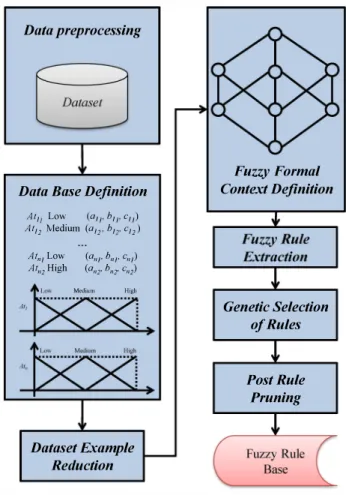
The FCA-BA SED RULE GENERATOR method is able to generate fuzzy knowledge bases, i.e., fuzzy data bases and fuzzy rule bases, from data. The FCA-BASED RULE GENER ATOR framework is composed of the following modules:
1) Data preprocessing; 2) Data base definition; 3) Dataset example reduction; 4) Fuzzy formal context definition; 5) Fuzzy rule extraction;
6) Genetic selection of rules; 7) Post rule pruning.
The flowchart in Figure 1 shows the operations of the FCA-BA SED RULE GENERATOR framework from the prepro cessing of a dataset to the definition of the final fuzzy rule base.
Data preprocessing
Data Base Definition
AI" Low (a'l" b'l" c,,)
AI'2 Medium (a'2' b", e,,)
AIIII Low
AI"2 High
Low
(a"l' bill' ell/) (aIl2, b1l2, e1l2) Medium High Dataset Example Reduction Fuu,y Formal Context Definition Genetic Selection of Rules Post Rule Pruning
Figure 1. The FCA-BASED RULE GENERATOR method.
For each dataset, FCA-BA SED RULE GENERATOR starts by creating n folds of train and test examples. Next, a fuzzy
data base is automatically defined. Once the fuzzy data base is generated, a process is applied to remove similar examples in order to improve the whole fuzzy rule base generation process. Using the FCA theory, the datasets are then used to generate fuzzy contexts in order to allow the extraction of fuzzy classification rules. A genetic rule selection process is performed in order to define the fuzzy rule base. Such fuzzy rule bases are then pruned to form the final fuzzy rule base.
FCA-BASED RULE GENERATOR is implemented using Java and distributed under the GNU GPL licence.
Algorithm 1 presents the FCA-BA SED RULE GENERA TOR method.
Algorithm 1: The FCA-BA SED RULE GENERATOR
method.
input: A given dataset
1 Define the fuzzy data base using the FuzzyDBD method; Remove similar examples [22];
Generate the formal context;
4 Extract the classification rules from the formal context (see Algorithm
2, page 4);
Using the Wang & Mendell method [23], define the values for the initial number of rules (BesCN R) and correct classification rate
(BesCCCR);
6 Create the initial population of the GA formed by k chromosomes, each with BesCN R genes;
for a = 1 to the maximum number of iterations do
l
Calculate and update the fitness value of the chromosomes (see Algorithm 5, page 6);Apply the elitism, mutation, and crossover genetic operators; 10 Peiform a rule pruning process.
Each of the modules forming the FCA-BA SED RULE GENERATOR framework is described next.
A. Data pre-processing module
The main task performed during the preprocessing stage is the generation of n folds for test and training with balanced
examples in regards to the classes of the datasets. Examples with missing values are removed. Outlier processing is not considered.
Regarding the technical issues of this module, as the pairs of train and test examples should be balanced in relation to the number of examples of each class, it is necessary to sort the examples and then split them into different sets.
B. Data Base Definition Module
The FCA-BA SED RULE GENERATOR framework has the Equalized Universe Method [24] implementation to define fuzzy data bases. The Equalized Universe Method splits the domains of the attributes of the data sets into even subspaces which are used to define the membership functions. FCA
BASED RULE GENERATOR uses triangular and trapezoidal shaped fuzzy sets.
FCA-BASED RULE GENERATOR also incorporates the FuzzyDBD method [25] to define fuzzy data bases. The FuzzyDBD method uses three distinct estimation functions
to individually estimate the number of fuzzy sets for each at tribute. Its implementation was designed based on the easiness of usage and speed by considering two reasonable simplifi cations for the process: the number of fuzzy sets for each attribute range from 2 to 9, and it is assumed independence among attributes. The process works similarly to a wrapper to estimate the number of fuzzy sets to each individual attribute. Both methods have linear complexity.
C. Dataset example reduction module
As the cost of extracting rules using FCA-BASED RULE GENERATOR is directly to the number of examples and attributes of the dataset used, an algorithm [22] is used to compare the examples and remove similar ones.
The comparison is performed based on the fuzzyfication of the examples of the dataset. In this sense, the examples have their continuous attribute values fuzzyfied using the fuzzy sets with highest membership degree with it and then each example is compared to all the others. When two or more identical examples are found, only one of them is kept. Experimental results show that the cost of such process is compensated with a substantial reduction in the cost to extract rules using the FCA-BASED RULE GENERATOR method.
D. FCA-ExTRACTION module
The method for rule extraction from data performed by FCA-BASED RULE GENERATOR is based on the Formal Con cept Analysis (FCA) [12], [13] theory. FCA is a mathematical technique for extracting concepts and structures from data introduced in the 1980s which, since then, is becoming increas ingly popular. The basic data structure in FCA is the formal context, which is normally represented in a table style where the columns represent the attributes and the rows represent the objects. In other words, a formal context is a representation of the relation between objects and their attributes. Notice that attributes in a formal context are binary. Thus, a table representing a formal context contains 1 (true) in cell
(i,
j)
if objecti
has attributej,
and 0 (false) otherwise.It is possible to generate a conceptual lattice from the formal context. A conceptual lattice is basically a graph whose vertices correspond to the formal concepts represented by sets of examples or attributes.
Formally, a context is a triple k =
(G, M,I),
whereG
is a set of objects,M
is a set of attributes, andI
is a binary relationI
�G
xM.
Given a set of objectsA
�G,
the sharedimage of
A
inM
is defined as:At:
={m
EMI (g,
m)
EI
Vg
EA}
(1)While the shared image of
B
inG,
given a set of attributes B�M, is:B+
:={g
EGI(g,
m)
EI
V m EB}
(2)The pair
(A, B)
constitutes a formal concept of(G, M,I)
if and only if
A
�G,
B
�M
andA
=B+, B
=At. A
iscalled the extent of the concept and
B
is called the intent of the concept [12]. Thus, Equation 1 defines the collection of all attributes shared by all objects inA,
while Equation 2 defines the collection of all objects sharing all the attributes inB.
In traditional FCA, relations are binary, although multi valued contexts are much more conunon than binary-valued ones. For attributes that can take a range of values, the idea of "conceptual scaling", which transforms a many-valued attribute (e.g. a number) into a symbolic attribute, can be used. For instance, attribute "height in centimetres", whose domain ranges from 0 and 200, can generate the following binary attributes "height-Iess-than-50", "height-from-50-to-l 00", and
"height-more-than-lOO". Since these derived attributes have true/false values, they can be treated within the FCA-BASED
RULE GENERATOR framework.
One of the applications of formal concept analysis is related to the extraction of association and classification rules. For the extraction of classification rules from a formal context, we first extract the formal concepts and use their intentions to form itemsets. In the sequel, the process selects the association rules with a class to define classification rules.
To illustrate the proposed method of extracting classifi cation rules from formal concepts, consider a formal context representing a dataset with three binary attributes,
Atl, At2,
and
At3,
two classes,Class A
andClassB,
and n examples(called objects in the FCA context),
Objl
toObjn.
Assume that the following formal concepts were extracted from this formal context:1)
{Atl,At2,ClassA}, {Objl,Obj2};
2)
{At2, At3, ClassB}, {Obj3, Obj4}'
By discarding the extensions (sets of objects) of these formal concepts, they can generate the following classification rules:
1) IF
Atl
is true ANDAt2
is true THEN Class is A;2) IF
At2
is true ANDAt3
is true THEN Class is B.Algorithm 2 describes the approach adopted by FCA-BASED RULE GENERATOR for extracting classification rules from data using a formal context, proposed in [11].
Algorithm 2: Extraction of Rules using FCA.
Input: A given dataset described by m attributes and n examples 1 Peiform a scaling process, i.e., define the continuous attributes of the
dataset in terms of fuzzy sets (see Algorithm 3);
2 Extract the formal concepts, or part of them, from the formal context using the modified version of the NextClosure algorithm (see Algorithm 4);
3 Discard the extension of the extracted formal concepts;
4 Store the formal concepts with a class, forming classification rules.
1) Fuzzy scaling process: The FCA-BASED RULE GEN ERATOR method contains a fuzzy scaling process, i.e., the transformation of continuous attributes into attributes defined by fuzzy sets. The fuzzy sets defining each attribute are used by the scaling process as binary values. Algorithm 3 details the scaling process.
To guide the scaling of real values, a predefined threshold
Amin
for the membership degrees is used. Whenever the membership degree of a certain input value for a fuzzy set is equal or higher thanAmin,
the corresponding attribute is set to true in the formal context, otherwise, the attribute is set to false.Algorithm 3: Scaling process used by FCA-BASED RULE GENERATOR.
Input: A given dataset described by m attributes and n examples
1 Define the FDB. i.e .• define the continuous attributes in terms of fuzzy
sets;
2 for a
=
1 to m dol
if AttributeAtta
is continuous then;create a binary attribute for each fuzzy set defining
Atta;
else create a binary attribute for each discrete value of
Atta;
6 Define
Amin
as the minimum membership degree to guide the fuzzy scaling process; 10 11 12 13 14 15 16 17 18 19 20 21 for e=
1 to n do for a=
1 to m doif
Atta
is a continuous attribute thenfor x = 1 to total number of binary attributes
generated from attribute
Atta
docalculate
AAtt
as the membership degree of the input value of ;;ttributeAtta
from example e in the fuzzy set defining the binary attribute x;if
AAttax ;::: Amin
thenL
set binary attributeAttax
as true;else
L
set binary attributeAttax
as false;else
Atta
is a discrete attributefor x
=
1 to total number of label values of attributeAtta
dol
if x=
the input value of attributeAtta
from example e thenL
set binary attributeAttax
as true;else
L
set binary attributeAttax
as false;Notice that as different algorithms extract exactly the same sets of formal concepts for a given formal context, step 2 can be performed by any extraction algorithm.
2) Formal concept extraction process: The algorithms available in the literature for the extraction of formal concepts include the Next Closure algorithm, which works by find ing neighbouring concepts [26], and the algorithm proposed in [27], which features a parallel search process. Next Closure
can be used to extract formal concepts by analysing the attributes or the objects of a formal context. When using the attributes, it is called Next Intent, while it is called Next Extent
when used with the objects. We adapted the Next Closure algo rithm to extract classification rules, as shown in Algorithm 4.
As the Next Closure algorithm looks for neighbouring con cepts, its modified version verifies whether a found concept has a class or not. If it does, then the formal concept can be stored in a data structure including all extracted concepts. Otherwise, the process discards the found formal concept and carries on looking for the next neighbouring concept. This modification is represented by lines 8 and 9 of Algorithm 4.
An important issue regarding the extraction of the formal concepts when using the binary fuzzyfication of the formal context is related to the increase in the number of attributes. The total number of attributes after the scaling of continuous and multi-valued attributes is equal to the sum of all fuzzy sets describing each original attribute, plus all the values of each discrete attribute, and the number of classes. This way, an increase in the number of fuzzy sets defining the attributes
Algorithm 4: Adaptation of the Next Closure Algorithm.
Input : A closure operator X ---+ X" on a finite set M. and a subset
A<;;;B.
Output:
A
is replaced by the lecticaUy next closed set.i :=
largest element of M; success:=
false;3 repeat
if
i
rtA
thenA := A
n {I, 2, . . ., (i
-In U{i};
B:=A";
if
(B -A)
contains no element <i
thenl
A:= B
(ConceptA
can be extracted to generate a classification rule);l
ifB
contains a class then IO success := true;II else
12
LA:=A-(iJ;
1314
i :=
pred(i)
;15 until success or
(i
> (number of elements in M -number of classesof the dataset));
leads to an exponential increase in the number of possible formal concepts.
The total number of formal concepts in a formal context can be estimated using the Metropolis-Hastings algorithm for sampling formal concepts, described in [28]. Nevertheless, it is important to notice that for our purpose, the total number of formal concepts is much larger than the number of formal concepts we are interested in extracting: as we want to extract classification rules, we are only interested in extracting formal concepts that have a class in their intention. This way, it is possible to reduce the number of extracted rules using different methods. Next, we describe the methods implemented to reduce the number of extracted rules by the FCA framework, as well as its parameters and default values.
• Restricting membership degree for scaling of attributes (see Algorithm 3) is set to more than 0.5, less binary attributes are activated, generating less formal con cepts. As this parameter is required by the method, it is implemented in the framework.
• Evaluating the support of concepts. The support of a
concept is the number of objects it shares divided by the number of all objects. Thus, a minimum support can be set to reduce the number of extracted formal concepts, while considering class distributions. This method is also implemented and available in the FCA
BASED RULE GENERATOR framework.
• Predefining a maximum number of rules. The default value is set to allow the extraction of all possible rules.
• Using probability to extract a percentage of the rules.
This option is also implemented using a random variable which is set whenever a rule is extracted. This way, the value of the random variable is compared to the percentage of rules desired in order to keep it or discard it.
Notice that a significant reduction in the time to extract the formal concepts is obtained as a result of the reduction in the examples of the training sets, performed in the Dataset Example Reduction module.
E. Genetic algorithm module
The main feature of the FCA-BASED RULE GENERATOR method is the extraction of rules using the FCA proposal. Once the rules forming the genetic search space are extracted in the rule extraction module, FCA-BASED RULE GENERATOR selects rules using a genetic algorithm to define fuzzy rule bases. This approach is referred to as rule generation by selection with an a priori rule extraction in [9]. Notice that the rules of the genetic search space are predefined and fixed,
i.e., the genetic process does not alter the existing rules. Thus, in this kind of approach, the predefined set of rules is usually called the set of candidate rules.
Next, we present the main methods of the genetic module of FCA-BASED RULE GENERATOR.
1) Chromosome Codification: FCA-BASED RULE GEN ERATOR uses an integer chromosome codification: each chro mosome represents a complete rule base. In the integer cod ification, each gene contains an index to a rule in the search space of candidate rules. The size of the chromosome, i.e., its number of genes, is defined as the number of rules found in the rule base produced by the Wang & Mendell (WM) method [21] applied to a given dataset. By using this reference value, it is possible to work with reasonably small chromosomes. In order to allow the generation of rule bases with less rules than the total number of rules in the Wang & Mendell rule base, a "-1"
value is used to indicate that a gene represents an inactive rule. The integer codification requires considerably less memory than the binary codification. Also, the use of the Wang &
Mendell method to define the size of the chromosomes allows an optimization of the chromosomes size and, thus, yields less computational effort and memory requirements.
2) Chromosome Initialization: The chromosomes of the initial populations are randomly generated. The existence of conflicting or redundant rules is verified in the initialization and when genetic operators are applied. To induce the reduc tion of the number of active rules in the chromosomes, we initialize the chromosomes with different percentages of active rules: 25% of the chromosomes are initialized with all rules activated, 25% with 80% of active rules, 25% with 60% of active rules, and the remaining 25% with 40% of active rules. By initializing 75% of the population with less rules than the maximum possible, we allow the generation of reduced rule bases. The percentages of active rules in the chromosomes were defined empirically.
The chromosome initialization requires a method to check for conflicting rules and redundant rules, as well as a method to create the data structures that define the chromosomes.
3) Fitness Calculation: The fitness value of each chro mosome is calculated using the Correct Classification Rate (CCR) and the Number of Rules (NR) in the fuzzy rule base represented by each chromosome, as proposed in [11]. This evaluation process uses a self-adaptive algorithm that updates referential values of ideal accuracy
(BesCCCR)
and number of rules(BesCN R).
The initial values of
Best_CCR
andBesCNR
are set with the corresponding values found in the fuzzy rule base generated by the Wang & Mendell method for the same datasetbefore the use of the GA, and using the same fuzzy data base. These values are updated after each generation when a better accuracy is obtained by a chromosome in the population. The number of rules is used in a penalization mechanism that decreases the fitness value of a chromosome when its number of rules is larger than the current reference number
(BesCN R).
Table I presents the penalization rates defined empirically.Table I. FITNESS PENALIZATION RATES - FCA-BASED RULE GENERATOR.
Nlunber of rules Penalization rate < Best N R no penalization < (Best N R x1.5) 10%
< (Best N R x2) 30% < (BesCN R x3) 40%
>(BesCN R x3) 50%
Algorithm 5 presents the fitness calculation procedure for the FCA-BASED RULE GENERATOR method. Aiming at avoiding a premature convergence of the GA, FCA-BASED RULE GENERATOR uses a Self-Adaptive Genetic Algorithm (SAGA) [29] that dynamically adjusts the crossover and mu tation rates at each new generation.
Algorithm 5: FCA-BASED RULE GENERATOR fitness calculation.
input: The population of the GA formed by k chromosomes
input: Initial number of rules (BesCN R)
input: Initial correct classification rate (BesCCCR)
1 for c = 1 to k do
Ie = C C R, the initial fitness of chromosome c; if Ie > BesCCCR then
l
BesCCCR = Ie;Best_N R = number of rules in chromosome c; if Ie = BesCCCR then
l
if number of rules in chromosome c < BesCN R thenL
BesCN R = number of rules in chromosome c;9 for c = 1 to k do
10
l
if Ie < BesCCCR then11
L
Apply a penalization to Ie according to Table I;The implementation of the methods that perform the fitness calculation is based on the optimization of the whole genetic process. In this sense, by allowing a variation in the rates of crossover and mutation, but, at the same time, penalizing the solutions based on the best ones found in the population, it is possible to speed up the genetic process while maintaining its global search characteristic.
F Post Rule P runing Module
In order to improve the interpretability of the final rule bases it generates, FCA-BASED RULE GENERATOR performs a post selection process. This rule selection process checks the ability of each individual rule to improve the classification power of the rule set.
In this sense, this method simply remove rules individually and calculates the accuracy rate of the fuzzy rule base. If the accuracy improves, the rule is removed permanently, other wise, it is kept in the fuzzy rule base and the process checks the next rule. Notice that this rule pruning strategy is sensitive
to the order rules are presented. Notice this method is sensitive to the order of the rules.
In terms of implementation, most of the computational cost of this procedure is taken by the classification. Nevertheless, as the number of rules is limited and optimized by the fitness procedure, the computational cost of this method is minimized.
G. Fuzzy Classification Module
Although the fuzzy classifier is not described as a module of the FCA-BASED RULE GENERATOR method, it is used in many parts of the FCA-BASED RULE GENERATOR method. For instance, the fuzzy classification module is used by the fuzzy data base definition module, it is also used by the genetic algorithm module to calculate the fitness of chromosomes during the genetic selection of rules, as well as by the rule pruning module.
The implemented classifier uses the Mamdani ap proach [21]. This way, the minimum t-norm is used for the conjunction of the antecedents and the maximum s-norm for the aggregation of the rules.
Regarding the inference mechanisms, the classic and the general fuzzy reasoning methods are implemented [30]. This way, an input example can be classified with the class of the rule with highest compatibility degree with it (classic reasoning) or with the class with the highest compatibility degree sum (general reasoning), considering all rules from the fuzzy rule base.
IV. EXAMPLE OF USAGE
FCA-BASED RULE GENERATOR receives an attribute re lation file format (.arff) 7 file as input and generates the
following files:
• A set of K rule base files, one for each fold (named
"dataset"Bes tRuleBaseTrainSetK . tx t);
• A data base file (named "dataset"DataBase.txt);
• A file with all rules extracted using the FCA approach (named "dataset" -FCAExtractedRules.txt);
The input parameters, and default values in brackets, for
FCA-BASED RULE GENERATOR are:
• Dataset name;
• Number of sets defining each attribute (3 sets);
• Inference method, classic or general (classic);
• Percentage of rules to be extracted using the FCA approach (lOO%);
• Number of chromosomes (lOO);
• Number of generations (200);
• Mutation rate (5%); • Crossover rate (70%); • Elitism rate (lO%);
7The specifications on ARFF files can be found in http://www.cs.waikato. ac.nz/ml/wekalarff.html
• Minimum support for the extraction of rules using the FCA approach (0);
• Number of folds (lO);
The dataset name is the only required parameter. If any of the other parameters is not defined, the default values are used. Next, we present some examples of execution of FCA
BASED RULE GENERATOR using the Iris dataset from the UCI Machine learning repository [31]:
• Using default parameters: - java -jar FuzzyF CA.jar iris • Using custom parameters:
- java -jar FuzzyF CA.jar iris 3 classic 100 50 100 0.05 0.70.1 0 10
(3 fuzzy sets, classic inference method, extracting lOO% of the rules using FCA, 50 chromosomes, 100 generations, 5% mutation rate, 70% crossover rate, lO% elitism rate, no minimum support for extracted rules, 10 folds);
- java -jar FuzzyF CA.jar iris 5 general 50 100 200 0.05 0.70.1 0 10
(5 fuzzy sets, general inference method, extracting 50% of the rules using FCA);
- java -jar FuzzyF CA.jar iris 7 classic 100 200 1000
(using default values for mutation, crossover, and elitism rates, no minimum support and lO folds); Next, we present two fuzzy rule bases generated by
FCA-BASED RULE GENERATOR for the well-known iris dataset [31] is, the first with three rules, and the second one with four rules. These rule bases were generated using default parameter values.
1) If SepalLenght is Small and SepalWidth is Small and PetalLenght
is Medium and PetalWidht is Medium then class is versicolor 2) If SepalLenght is Small and PetalLenght is Small and PetalWidht
is Small then class is setosa
3) If PetalLenght is Large and PetalWidht is Large then class is
virginica
1) If PetalLenght is Small and PetalWidht is Small then class is setosa 2) If SepalLenght is Medium and SepalWidth is Medium and Petal
Widht is Medium then class is virginica
3) If PetalLenght is Medium and PetalWidht is Medium then class is
versicolor
4) IfPetalLenght is Large and PetalWidht is Large then class is
virginica
V. FINAL CONSIDERATIONS AND FUTURE WORK
Genetic fuzzy systems for classification have been widely researched and many proposals are available. Such methods take advantage of the global search of genetic algorithms and the interpretability of the produced models due to the fuzzy logic.
In this work, we detail the FCA-BASED RULE GENERA TOR framework to automatically generate fuzzy classification systems using genetic algorithms and an approach to extract rules from data based on the formal concept analysis theory, namely, the FCA-ExTRACTION method.
FCA-ExTRACTION extracts rules directly from data in polynomial time, avoiding the extraction of rules with low
classification power. FCA-EXTRACTION extracts rules with different numbers of conditions in their antecedents, and does not require the definition of the number of rules to be extracted. FCA-ExTRACTION also allows the adjust of the number of extracted rules. Moreover, FCA-ExTRACTION can be used with any genetic approach that requires rule selection.
Although there are some free software for the generation of fuzzy systems available, as most of our proposal algorithms is new, the FCA-BA SED RULE GENERATOR framework was implemented, using the Java language, and it is available for download. FCA-BA SED RULE GENERATOR is distributed under the GNU GPL licence.
As future work, our main goal is to present the graphic interface of the FCA-BA SED RULE GENERATOR framework. We also intend to include a module with previously pro posed algorithms by the authors for feature selection and data base definition.
ACKNOWLEDGMENT S
This research was partially financed by the Sao Paulo state research agency, FAPESP, and the Coordination for the Improvement of Higher Education Personnel, CAPES, Brazil.
REFERENCES
[ 1] B. Kruse, M. Klawonn, and H. Steinbrecher, Computational Intelli gence: A Methodological Introduction. Springer, 20 13.
[2] S. Scherera, J. Kaneb, C. GobI, and F. Schwenker, "Investigating fuzzy input fuzzy-output support vector machines for robust voice quality classification," Computer Speech & Language, vol. 27, no. 1, pp. 263-287, 2013.
[3] J. R. Quinlan, "Bagging, Boosting and C4.5," in Proceedings of the 13th Conference on Artijicial Intelligence, 1996, pp. 725-730. [4] M. E. Cintra, M. C. Monard, and H. A. Camargo, On Rule Learning
Methods: A Comparative Analysis of Classic and Fuzzy Approaches.
Springer Berlin Heidelberg, 20 13, vol. 29 1.
[5] R. Alcahi, F. Herrera, and H. Ishibuchi, "Multiob. genetic fuzzy rule selection of single granularity-based fuzzy class. rules and its interaction with the lateral tuning of membership functions," Soft Computing,
vol. 15, pp. 2303-2318, 20 1 1.
[6] B. Dennis and S. Muthukrishnam, "AGFS: Adaptive Genetic Fuzzy Sys tem for medical data classification," Applied Soft Computing, vol. 25, pp. 242-252, 2014.
[7] E. K. Aydogan, I. Karaoglan, and P. M. Pardalos, " hGA: Hybrid genetic algorithm in fuzzy rule-based classification systems for high dimensional problems," Applied Soft Computing, vol. 12, pp. 800-806, 20 12.
[8] M. J. Gacto, M. Galende, R. Alcala, and F. Herrera, "METSK-HD: A multiobjective evolutionary algorithm to learn accurate tsk-fuzzy systems in high-dimensional and large-scale regression problems," In! Sciences, vol. 276, pp. 63-79, 2014.
[9] F. Herrera, "Genetic fuzzy systems: taxonomy, current research trends and prospects," Evolutionary Intelligence, vol. 1, no. 1, pp. 27-46, 2008. [ 10] M. Fazzolari, R. Alcala, Y. Nojima, H. Ishibuchi, and F. Herrera, "A review of the application of multiobjective evolutionary fuzzy systems: Current status and further directions," IEEE Transactions on Fuzzy
Systems, vol. 2 1, no. 1, pp. 45-65, 20 13.
[ 1 1] M. E. Cintra, "Genetic generation of fuzzy knowledge bases:new perspectives," Ph.D. dissertation, University of Sao Paulo, 20 12. [ 12] R. Wille, Formal Concept Analysis. Restructuring lattice theory: an
approach based on hierarchies of concepts., ser. Lecture Notes in Computer Science. Springer, 2009, vol. 5548.
[ 13] B. Ganter, G. Stumme, and R. Wille, Formal Concept Analysis, Foun dations and Applications, ser. Lecture Notes in Computer Sciences. Springer, 2005, vol. 3626.
[ 14] C. Lindig, "Concept-based component retrieval," in lJCAI Workshop: Formal Approaches to the Reuse of Plans, Proofs, and Programs,
F. J. Kohler, C. G. Giunchiglia, and C. Walther, Eds., 1995, pp. 2 1-25. [ 15] M. E. Cintra, M. C. Monard, H. A. Camargo, and T. P. Martin, "A hybrid approach for the automatic generation of fuzzy systems using fuzzy formal concepts," in 2012 IEEE International Conference on Fuzzy Systems (FUZZ-IEEE), vol. 1, 2012, pp. 1784- 179 1.
[ 16] J. Alcala-Fdez, L. Sanchez, S. Garcia, M. del Jesus, S. Ventura, J. Garrell, 1. Otero, C. Romero, 1. Bacardit, V. Rivas, 1. Fernandez, and F. Herrera, "Keel: a software tool to assess evolutionary algorithms for data mining problems," Soft Comput., vol. 13, no. 3, pp. 307-318, 2009.
[ 17] J. Alcala-Fdez, A. Fernandez, J. Luengo, J. Derrac, S. Garcia, L. Sanchez, and F. Herrera, "Keel data-mining software tool: Data set repository, integration of algorithms and experimental analysis framework." Journal of Multiple-Valued Logic and Soft Computing,
vol. 17, pp. 255-287, 20 1 1.
[ 18] D. Lopez, C. Jimenez, D. R. Lopez, C. 1. Jimenez, S. Sanchez-Solano,
l. Baturone, and A. Barriga, "Xfuzzy: A design environment for fuzzy systems," in Proc. seventh IEEE Int. Conf. on Fuzzy Systems, 1998, pp. 1060-1065.
[ 19] J. M. Alonso and L. Magdalena, "Generating understandable and accurate fuzzy rule-based systems in a java environment," Fuzzy Logic and Applications, Lecture Notes in Computer Science, vol. 6857, pp. 2 12-2 19, 20 1 1.
[20] M. Souza, F. Santos, A. R. Soto, and A. Vahldick, " Fuzzystudio: A web tool for modeling and simulation of fuzzy systems," in Intelligent Systems (BRAClS), 2014 Brazilian Conference on, 20 14, pp. 306-3 1 1. [2 1] E. H. Mamdani, "Application of fuzzy logic to approximate reasoning using linguistic systems," Fuzzy Sets and Systems, vol. 26, pp. 1 182-1 182-19 182-1, 182-1977.
[22] M. E. Cintra and K. R. Cardoso, "A proposal for the reduction of examples in datasets to optimize the extraction of classification rules in:;' in Proceedings of the II Brazilian Congress on Fuzzy Systems,
20 14.
[23] X. Z. Wang, Y. D. Wang, X. F. Xu, W. D. Ling, and D. S. Yeung, "A new approach to fuzzy rule generation: fuzzy extension matrix," Fuzzy Sets and Systems, vol. 123, pp. 291-306, 200 1.
[24] J. Chang, Y. Luo, and K. Su, "GPSM: a generalized probabilistic semantic model for ambiguity resolution," Proceedings of the 30th Annual Meeting on Association For Computational Linguistic, pp. 177-184, 1992, newark - EUA.
[25] M. E. Cintra, M. C. Monard, E. A. Cherman, and H. A. Camargo, " On the estimation of the number of fuzzy sets for fuzzy rule-based classification systems," in 11 th Int. Con! on Hybrid Intelligent Systems,
vol. 1, 20 1 1, pp. 2 1 1-2 16.
[26] B. Ganter, " Formal concept analysis: Algorithmic aspects," Technische Universitat Dresden, Tech. Rep., 2002.
[27] P. Krajca, J. Outrata, and V. V ychodil, " Parallel algorithm for computing fixpoints of galois connections," Annals of Mathematics and Artijicial Intelligence, vol. 59, pp. 257-272, June 20 10.
[28] M. Boley, " The efficient discovery of interesting closed pattern collec tions," Ph.D. dissertation, Bonn University, 20 1 1.
[29] M. Srinivas and L. M. Patnaik, "Adaptive probabilities of crossover and mutation in genetic algorithms," IEEE Transactions on Systems, Man and Cybernetics, pp. 656-667, 1994.
[30] O. Cordon, M. J. del Jesus, and F. Herrera, "A proposal on reason ing methods in fuzzy rule-based classification systems," International Journal of Approximate Reasoning, vol. 20(1), pp. 2 1-45, 1999. [3 1] K. Bache and M. Lichman, " UC1 machine learning repository," 20 13.