Hanna-Kaisa Ellonen
Researcher, Lappeenranta University of Technology, [email protected] Abstract — The purpose of this paper is to analyze the effect
of the Internet on the magazine publishing industry. By combining the views of industrial organization economics and the resource-based view, cross-level analysis is provided at industry and company levels. At the industry level, the Internet has not significantly changed the five forces that shape the nature and state of competition in the magazine publishing industry. At the company level, it is proposed that the Internet does not change the traditional core competencies of magazine publishers. However, dealing with the Internet also means dealing with change. As most media companies have cultures built on consistency, it is proposed that more dynamic capabilities are needed.
Keywords — Internet, magazine publishing industry, strategy
I. INTRODUCTION
Turbulent change, high competition, new forms of production and distribution, and entirely new types of products have characterized the situation in the media industry over the past few decades [1], [2]. It has been noted that digitalization is strongly influencing the industry: it is changing the existing market dynamics and requires new strategies [3]. According to Picard [4], the development of the Internet has brought significant changes to both audience and advertiser behavior that challenge the long-term survival of the newspaper, magazine and book industries.
Research on the impact of digitalization and the Internet on the media industry has emphasized the newspaper publishing [5]-[7] and broadcasting [8]-[10] sectors. Evidently, the effects of new digital forms of delivering content have had a dramatic impact on the above-mentioned news-focused media. However, magazine publishing seldom is the focus of research.
Nonetheless, as Picard [4] has noted, the Internet has also challenged the magazine publishing industry. No direct analogy to the newspaper industry can be made, as the media products and their business logics differ significantly [11]. Research on the magazine publishing industry and its
online activities is still in its infancy [12], [13]. It is also noted that often a multilevel analysis is called for (see Albarran [14] and Dimmick [15] for argumentation in the media industry), yet cross-level analysis is rare. It is the purpose of this paper to fill that gap by analyzing the strategic effect of the Internet on the magazine publishing industry at the industry and company levels.
The rest of this paper is structured as follows: First, two classic schools of strategy research will be reviewed focusing on the industry and company levels. Then the strategic concepts presented will be applied in the context of the magazine publishing industry and the impact of the Internet. The paper will be concluded by a discussion of the analysis and implications of the paper.
II. STRATEGYRESEARCHONMULTIPLELEVELS The reason why firms succeed or fail is the central question in strategy research [16], [17]. However, the field of strategy research has witnessed “swings of a pendulum” regarding the focus of the research, as Hoskinsson et al. [18] have noted. The dominant view until the early 1990s was the so-called industrial organization paradigm that emphasized industry structure and competitive positions in the industry [19], [20]. A dramatic change in strategy research happened in the beginning of the 1990s when several writers [21]-[23] suggested that instead of the industry, attention should be paid to the heterogenic resources and capabilities of a firm. This view has been called the resource-based view of the firm. Later, researchers [16], [24], [25] have also argued that these views do not need to be opposite, but rather complementary views of strategy, and they both are needed in search of the sustainable competitive advantage.
Strategy research in the media industry has mainly followed the industrial organization view [26]-[28]. Only a clear minority of the research applies the resource-based view [8], [29]. Lately, Chan-Olmsted [2] has argued for a need to incorporate these two views in media strategy
The Effect of the Internet on the Magazine
research. In this paper, the industrial organization paradigm will be combined with the resource-based view to analyze the impact of the Internet at industry and company levels.
1) Industry Level
So-called industrial organization economics (IO) has its roots in the work of Edward Mason and his colleagues in Harvard in the late 1930s and the influential book of Bain entitled ‘Industrial Organization’ published in 1959 [18], [30]. They presented the structure-conduct-performance (S-C-P) paradigm that implies that the structural characteristics of an industry, particularly the level of concentration and the height of entry barriers, have a significant influence on firms and thus can be expected to determine the performance of individual firms [31]. With the IO view, strategy research moved towards economics in terms of methodology and became more “scientific” [18]. According to McWilliams & Smart [31], the S-C-P paradigm became a dominant tool in the normative and theoretical aspects of strategy research. The S-C-P paradigm has been widely used in media strategy research [32]; Fu [32] also notes that contemporary IO theory holds that structure, conduct and performance are two-way interrelated.
The central tenets of IO economics were summarized by Porter [19], [20] who is acknowledged to be the most influential writer within the IO school [18], [33]. He presented a framework – the five forces model – that specifies the various aspects of industry structure and provides a tool to assess an industry’s attractiveness and facilitates competitive analysis. The five forces are the threat of potential entrants, the threat of substitutes, the bargaining power of the suppliers, the bargaining power of the buyers, and the rivalry among existing firms in the industry. Porter [19] argued that “knowledge of these underlying sources of competitive pressure highlights the critical strengths and weaknesses of a company, animates its positioning in its industry, clarifies the areas where strategic changes may yield payoff and highlights the areas where industry trends promise to hold the greatest significances as either opportunities or threats.” Porter also suggested generic strategies that can be used to build competitive advantage.
B. Company level
The central tenet of the resource-based view is that a firm is seen as a bundle of idiosyncratic resources and capabilities [21]-[23], [34]-[36]. According to Barney [23], a firm’s sustained competitive advantage is based on those resources that are valuable, rare, imperfectly imitable and
non-substitutable; these strategic resources are called VRIN
attributes.
Wernerfelt’s [21] definition of a resource was “anything which could be thought as a strength or weakness of a
given firm”. Barney [23], on the other hand, placed firm resources into three groups: physical capital, human capital and organizational. Chan-Olmsted [37] suggests dividing resources into property-based resources and knowledge-based resources when researching media companies. Knowledge-based resources refer to a firm’s intangible know-how and skills and thus are close to the discussion of capabilities.
According to Spanos & Liokas [38], there was no explicit distinction between resources and capabilities in the early contributions. Amit & Schoemaker [24] define resources as stocks of available factors that are owned or controlled by a firm; capabilities, in contrast, refer to a firm’s capacity to deploy resources. According to Grant [39], resources are the source of a firm’s capabilities and capabilities are the main source of its competitive advantage.
The evolutionary version of the resource-based view, the dynamic capabilities view (DCV) [40], [41] addresses the processes of future resource creation [42]. In the DCV, the firm’s ability to renew its resources in line with changes in the environment is the focus of attention. Dynamic capabilities include strategic processes like alliancing and product development, and are likely to be path dependent routines [41].
III. THEMAGAZINEPUBLISHINGINDUSTRYAND THEINTERNET
In the next sections, the impact of the Internet on the magazine publishing industry will be discussed using first the five forces framework, and then the resource-based view of the firm.
A. Industry level
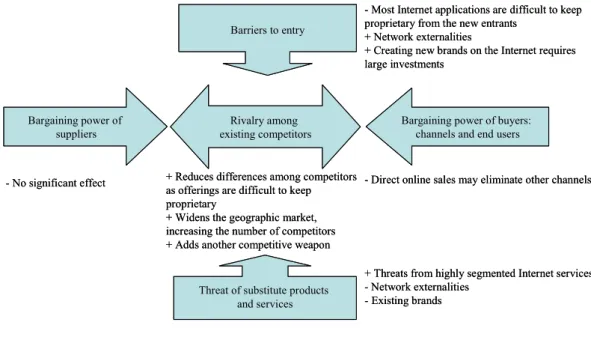
Within the IO and five forces framework, the magazine publishing industry exists in monopolistic competition [43] and is characterized by low barriers to entry and a moderate level of direct competition [44]. Also, magazine markets are mature with limited growth potential, and current trends with business process digitalization are leading towards a higher number of titles and a declining average circulation per title [3], [44]. Picard [44] also sees that the threats from new technologies are moderately high in the magazine publishing industry.
The main supplier groups for the magazine publishing industry are freelance journalists, printing houses, paper suppliers, distributors and telemarketing companies. While recent developments in digital technology have sped up the process of manufacturing magazines, the Internet as such has not changed the roles or powers of any supplier group. It remains to be seen if the diffusion of digital copies sold online will transform the role of printing houses and paper suppliers.
Magazines have two groups of customers: readers and advertisers. According to Picard [4], a particular concern for publishers is the rising use of the Internet and its impact on readership. Advertiser behavior, on the other hand, is not alarming, and increasing brand advertising has driven revenue to consumer magazines particularly. Magazines are sold either by subscriptions or single copy sales. In the future, it is possible that direct online sales would diminish the role of other channels. However, at this point, online sales are still marginal. Porter [45] has suggested that the Internet would make price competition more transparent and thus migrate competition to price. In the magazine publishing industry, this has not been the case. It is proposed here that this has to do with strong magazine brands that differentiate products (in contrast with e.g. the airline business, magazine products are not seen substitutive).
Porter [45] was skeptical about the network externalities online. However, a recent case study in the magazine publishing sector [46] has illustrated that a successful magazine website may well witness positive network externalities and result in higher customer loyalty. It is proposed here that while existing brands and network externalities may provide some barriers to entry and reduce the threat of substitute products, most Internet applications are difficult to keep proprietary of a single company [45]. Highly segmented Internet services pose a threat of substitutes to magazines [3].
It seems that most of the identified effects in turn affect the rivalry among existing competitors. E.g. magazines face new threats of substitute products from highly segmented
Internet services [3] which add pressure to the competition among existing competitors. The Internet also widens the geographic market [45] and thus increases the number ofcompetitors. Therefore, it seems that the Internet’s impact on the magazine publishing industry culminates in rivalry among existing competitors; the Internet adds another competitive weapon.
The discussion in summarized in Figure 1 above. Plusses and minuses in the figure refer to the proposed effect the Internet has on each force.
B. Company level
In this section, the resources and capabilities of a magazine publisher will be discussed.
Magazines as media products are concept driven. This means that they involve on-going creation of changing content provided within a package that exhibits continuity [11]. Therefore, according to Picard [11], the core competence of the producers of a magazine is not content creation per se, but rather the selection, processing and packaging of content and thus catching the look and feel of the concept. On the other hand, Hafstrand [29] has argued that the strategic capabilities of a magazine publisher can be located in human resource management, market knowledge and product development. Capabilities, knowledge and routines within these functions are accumulated over a long time and embedded in the organization, and, thus, cannot easily be replicated.
Chan-Olmsted [37] sees that of all media products, magazines are closest to the Internet in terms of customer
- Direct online sales may eliminate other channels - Most Internet applications are difficult to keep proprietary from the new entrants
+ Network externalities
+ Creating new brands on the Internet requires large investments
+ Threats from highly segmented Internet services - Network externalities
- Existing brands
Bargaining power of buyers: channels and end users Bargaining power of
suppliers
Barriers to entry
Threat of substitute products and services Rivalry among existing competitors
- No significant effect + Reduces differences among competitors
as offerings are difficult to keep proprietary
+ Widens the geographic market, increasing the number of competitors + Adds another competitive weapon
- Direct online sales may eliminate other channels - Most Internet applications are difficult to keep proprietary from the new entrants
+ Network externalities
+ Creating new brands on the Internet requires large investments
+ Threats from highly segmented Internet services - Network externalities
- Existing brands
Bargaining power of buyers: channels and end users Bargaining power of
suppliers
Barriers to entry
Threat of substitute products and services Rivalry among existing competitors
- No significant effect + Reduces differences among competitors
as offerings are difficult to keep proprietary
+ Widens the geographic market, increasing the number of competitors + Adds another competitive weapon
involvement and how much time and cost are required to consume the media product. In this regard, adding an Internet dimension to the magazine concept seems very natural, and it seems reasonable to believe that the same abilities mentioned by Hafstrand [29], namely the ability to understand and react to signals from the market, the ability to find, employ and stimulate the right kind of personnel, and the ability to coordinate resources to enhance continuous product development, are critical factors for success when dealing with the Internet, as well.
As discussed earlier, the Internet could be seen as a technological change in the competitive environment that affects both advertiser and consumer behavior. Following this logic, the Internet does not change the strategic capabilities of a magazine publisher, but rather demands more dynamic capabilities when dealing with constant development.
Dealing with change may, however, be problematic to magazine publishers. Most media companies have cultures built on consistency and limiting changes [4], [47]. Ellonen & Karhu [48] identified several attributes, such as little respect for digital innovations and fear of new technologies that hinder the development of digital products in media companies. Magazine publishers’ organizational cultures and routines, therefore, seem to emphasize the exploitation of old certainties rather than the exploration of new possibilities [49], and their traditional core capabilities seem to inhibit innovation and learning [50]. Thus, it is suggested here, capabilities for organizational learning and other dynamic capabilities [40] are critical for success.
To sum up, at the company level, dealing with the Internet and the changing preferences of consumers and advertisers demands more dynamic capabilities of the magazine publishers.
IV. DISCUSSIONANDCONCLUSIONS
The aim of this paper was to provide a multilevel analysis of the impact of the Internet on the magazine publishing industry. By combining the views of industrial organization economics and the resource-based view, cross-level analysis was provided on industry and company levels.
At the industry level, it seems that the Internet mainly affects the rivalry among existing companies. While the Internet and digitalization speed up processes and alter ways of communication, the Internet has not, at least not yet, significantly changed the five forces that shape the nature and state of competition in the magazine publishing industry. The Internet simply adds another competitive weapon to the arsenal.
At the company level, it is proposed that the Internet does not change the traditional core competencies of magazine publishers. Whether publishing in print or on the Internet, sensing the customer needs and packaging segmented content under the magazine brand concept are
still key. However, dealing with the Internet also means dealing with change as consumer preferences are constantly changing and the magazine publisher’s organization has to adapt to those changes. Therefore, it is proposed here that more dynamic capabilities are needed.
The Internet has been referred to as a potentially disruptive technology for publishing industries [4], [51]. Emerging or disruptive technologies are defined as ”science-based innovations that have the potential to create a new industry or transform an existing one” [52] or as “technologies that enable changes in a firm’s product characteristics, added value and product-market positions, destroys existing competencies and drives or enables changes in the value network” [53]. Thus they refer to new technologies that have the Schumpeterian potential to upset emerging markets and competitive positions within them.
Based on this conceptual analysis on the magazine publishing industry, the Internet does not appear as a disruptive technology. Instead, a recent case study [46] has illustrated that the Internet may add a new “closer-to-real-life” dimension to the magazine concept, yet supporting the core print product. Therefore, it is proposed here that, on the continuum from incremental to disruptive technologies, the Internet could be seen more as an incremental, non-disruptive technology [54], [55] that emerges from reinforced core concepts [56]. The Internet has the potential to complement rather than supplement print magazines.
It should be noted, however, that the effects of (potentially disruptive) technology on existing firms are not uniform, but depend on how firms respond to the changes [4], [57]. Following this logic, it seems that firm specific resources and capabilities will define how the Internet truly affects competitive positions in the magazine publishing industry.
It was noted earlier that most media companies have cultures built on consistency and limiting changes [4], [47], [48]; thus it may be that capabilities for organizational change will “sort the wheat from the chaff“ and provide a basis for the competitive advantages of a magazine publisher.
REFERENCES
[1] L. Küng, “What makes media firms tick? Exploring the hidden
drivers of firm performance,” In Strategic Responses to Media
Market Changes, R. G. Picard, (ed). JIBS Research Reports Series
No. 2004-2, 2004, pp. 65-82.
[2] S. M. Chan-Olmsted, Competitive Strategy for Media Firms.
Strategic and Brand Management in Changing Media Markets.
Mahwah, New Jersey: Lawrence Erlbaum Associates, Publishers, 2006.
[3] G. Doyle, Understanding Media Economics. London: Sage
Publications, 2002.
[4] R. G. Picard, “Cash cows or entrecôte: Publishing companies and
disruptive technologies,” Trends in Communication, 2003, vol. 11,
no. 2, pp. 127-136.
[5] H. I. Chyi & D. L. Lasorsa, “An explorative study on the market
relation between online and print newspapers,” Journal of Media
[6] S. Saksena & C. A. Hollifield, “U.S. newspapers and the development of online editions,” The International Journal on Media
Management, 2002, vol. 4, no. 2, pp. 75-84.
[7] J. Dimmick, Y. Chen & Z. Li, “Competition between the The Internet and traditional news media: The gratification-opportunities niche
dimension,” Journal of Media Economics, 2004, vol. 17, no. 1, pp.
19-33.
[8] F. Liu & S. M. Chan-Olmsted, “Partnerships between the old and the new: examining the strategic alliances between broadcast television networks and The Internet firms in the context of convergence,”
International Journal on Media Management, 2002, vol. 5, no. 1, pp.
47-56.
[9] S. M. Chan-Olmsted & J.-W. Kang, “Theorizing the strategic
architecture of a broadband television industry,” The Journal of
Media Economics, 2003, 16(1), pp. 3-21.
[10] E. P. Bucy, “Second generation net news: Interactivity and
information accessibility in the online environment,” International
Journal on Media Management, (2004) 6(1&2), 102-113.
[11] R. G. Picard, “Unique characteristics and business dynamics of
media products,” Journal of Media Business Studies, 2005, 2(2), pp. 61-69.
[12] J. Barsh, E. Kramer, D. Maue & N. Zuckerman, “Magazines´ home
companion,” The McKinsey Quarterly, (2001) Vol. 2, pp. 83-90.
[13] Q. Randle, “Gratification niches of monthly print magazines and the
World Wide Web among a group of special-interest magazine
subscribers,” Journal of Computer-Mediated Communication, 2003,
vol. 8, no. 4
[14] A. Albarran, “Historical trends and patterns in Media Management
Research”, in Handbook of Media Management and Economics A.
Albarran, S. M. Chan-Olmsted & M. O. Wirth, Eds. Mahwah, New Jersey: Lawrence Erlbaum Associates, 2006, pp. 3-22.
[15] J. Dimmick, “Media Competition and levels of analysis,” in
Handbook of Media Management and Economics A. Albarran, S. M.
Chan-Olmsted & M. O. Wirth, Eds. Mahwah, New Jersey: Lawrence Erlbaum Associates, 2006, pp. 345-362.
[16] M. E. Porter, “Towards a dynamic theory of strategy,” Strategic
Management Journal, 1991, vol. 12, pp. 95-117.
[17] R. P. Rumelt, D. Schendel & D. J. Teece, “Strategic management and economics,” Strategic Management Journal, 1991, vol. 12, pp. 5-29.
[18] R.E. Hoskinsson, M. A. Hitt, W. P. Wan & D. Yiu, “Theory and
research in strategic management: Swings of a pendulum,” Journal of
Management, 1999, vol. 25, no. 3, pp. 417-456.
[19] M. E. Porter, Competitive Strategy. New York: The Free Press, 1980.
[20] M. E. Porter, Competitive Advantage. Creating and sustaining
superior performance. New York: The Free Press, 1985.
[21] B. Wernerfelt, “A resource-based view of the firm,” Strategic
Management Journal, 1984, vol. 5, no. 2, pp. 171-180.
[22] C. K. Prahalad & G. Hamel, “The core competencies of the
corporation,” Harvard Business Review, 1990, May-June, pp. 79-86.
[23] J. Barney, “Firm Resources and Sustained Competitive Advantage”,
Journal of Management, 1991, vol. 17, no. 1, pp. 99-120.
[24] R. Amit & P. Schoemaker, “Strategic assets and organizational rent”,
Strategic Management Journal, 1993, vol. 14, no. 1, pp. 33-46.
[25] N. J. Foss, “Research in strategy, economics, and Michael Porter”,
Journal of Management Studies, 1996, vol. 33, no. 1, pp. 1-24.
[26] S. Shrikhaende, “Competitive strategies in the internalization of
television. CNNI and BBC World in Asia,” Journal of Media
Economics, 2001, vol. 14, no. 3, pp. 147-168.
[27] S. M. Chan-Olmsted & J. C. Li, “Strategic competition in the
multichannel video programming market: An intraindustry strategic
group study of cable programming networks,” Journal of Media
Economics, 2002, vol. 15, no. 3, pp. 153-174.
[28] R. Van der Wurff, “Structure, conduct and performance of the
agricultural trade journal market in the Netherlands,” Journal of
Media Economics, 2003, vol. 16, no. 2, pp. 121-138.
[29] H. Hafstrand, “Competitive advantage in the magazine publishing
business – a resource-based perspective,” paper presented at the 15th Nordic Conference on Media and Communication Research, Reykjavik, 2001.
[30] O. E. Williamson, Industrial Organization. Aldershot: Edward Elgar
Publishing Ltd., 1990.
[31] A. McWilliams & D. L. Smart, “Efficiency v.
structure-conduct-performance: Implications for strategy research and practice,”
Journal of Management, 1993, vol. 19, no. 1, pp. 63-78.
[32] W. Fu, “Applying the structure-conduct-performance framework in
the media industry analysis,” The International Journal on Media
Management, 2003, vol. 5, no. 4, pp. 275-284.
[33] R. M. Grant, Contemporary Strategy Analysis. Concepts,
Techniques, Applications. 4th edition. Malden, Massachusetts:
Blackwell Publishers, 2002.
[34] E. Penrose, The Theory of the Growth of the Firm. London: Basil
Blackwell, 1959.
[35] J. Barney, “Strategic factor markets: Expectations, luck, and business
strategy”, Management Science, 1986, vol. 32, no. 10, pp.
1231-1241.
[36] M. A. Peteraf, “The cornerstones of competitive advantage: a
resource-based perspective,” Strategic Management Journal, 1993,
vol. 14, no. 3, pp. 179-191.
[37] S. M. Chan-Olmsted, “Issues in Strategic Management,” in
Handbook of Media Management and Economics A. Albarran, S. M.
Chan-Olmsted & M. O. Wirth, Eds. Mahwah, New Jersey: Lawrence Erlbaum Associates, 2006, pp. 161-180.
[38] Y. E. Spanos & S. Liokas, “An examination into the causal logic of rent generation: contrasting Porter’s competitive strategy framework and the resource-based perspective,” Strategic Management Journal, 2001, vol. 22, pp. 907-934.
[39] R. M. Grant, “The Resource-based theory of competitive advantage:
Implications for strategy formulation,” California Management
Review, 1991, vol. 33, no. 3, pp. 114-135.
[40] D. J. Teece, G. Pisano & A. Shuen, “Dynamic capabilities and
strategic management,” Strategic Management Journal, 1997, vol.
18, no. 7, pp. 509-533.
[41] K. M. Eisenhardt & J. A. Martin, “Dynamic capabilities: What are
they?,” Strategic Management Journal, 2000, vol. 21, pp.
1105-1121.
[42] C. Bowman & V. Ambrosini, “How the resource-based and the
dynamic capability views of the firm inform corporate level
strategy,” British Journal of Management, 2003, vol. 14, pp.
289-303.
[43] D. Ferguson, “Industry-specific management issues,” in Handbook of
Media Management and Economics A. Albarran, S. M.
Chan-Olmsted & M. O. Wirth, Eds. Mahwah, New Jersey: Lawrence Erlbaum Associates, 2006, pp. 297-324.
[44] R. G. Picard, The Economics and Financing of Media Companies.
New York: Fordham University Press, 2002.
[45] M. E. Porter, “Strategy and the The Internet,” Harvard Business
Review, 2001, March, pp. 63-78.
[46] H.-K. Ellonen & O. Kuivalainen, “The development of an online
success story. A case from the magazine publishing industry”,
Procedings of the 6th IBIMA conference, 19-21 June 2006, Bonn
Germany.
[47] L. Küng, “Exploring the link between culture and strategy in media
organizations: The cases of the BBC and CNN”, International
Journal on Media Management, 2000, vol. 2, no. 2, pp. 100-109.
[48] H.-K. Ellonen & P. Karhu, “Always the little brother?
Digital-product innovation in the media sector,” International Journal of
Innovation and Technology Management, 2006, vol. 3, no. 1, pp.
83-105.
[49] J. G. Marsh, “Exploration and exploitation in organizational
learning,” Organization Science, 1991, vol. 2, no. 1, pp. 71-87.
[50] D. Leonard-Barton, “Core capabilities and core rigidities: a paradox
in making new product development,” Strategic Management
Journal, 1992, vol. 13, pp. 111-126.
[51] B. I. Mierzjewska & C. A. Hollifield, “Theoretical approaches in
media management research,” in Handbook of Media Management
and Economics A. Albarran, S. M. Chan-Olmsted & M. O. Wirth,
Eds. Mahwah, New Jersey: Lawrence Erlbaum Associates, 2006, pp. 37-66.
[52] G. S. Day & P. J. H. Schoemaker, Wharton on managing emerging
technologies. New York: Wiley, 2000.
[53] L.-M. Sainio, The effect of potentially disruptive technology on
business model – a case study of new technologies in ICT industry.
[54] L. Frank, E.-M. Karine, J. Lindqvist, K. Puumalainen, S. Sundqvist & S. Taalikka, Innovaatioiden diffuusio tietoliikennealalla: Kuinka
innovaatiot omaksutaan ja kuinka ne yleistyvät? (Innovation
diffusion in the telecommunication sector: how innovations are adapted and how they diffuse?) Studies in Economics and Business Administration, Lappeenranta University of Technology, Finland, 2003.
[55] M. Assink, “Inhibitors of disruptive innovation capability: a
conceptual model,” European Journal of Innovation Management,
2006, vol. 9, no. 2, pp. 215-233.
[56] R. M. Henderson & K. B. Clark, “Architectural innovation: the
reconfiguration of existing product technologies and the failure of existing firms,” Administrative Science Quarterly, 1990, vol. 35, pp. 9-30.
[57] P. Evans & T. S. Wurster, Blown to bits: How new economics of
information transform strategy. Boston: Harvard Business School