molecules
ISSN 1420-3049 www.mdpi.com/journal/moleculesArticle
Preparation of Benzothiazole-Substituted Carbosilane
Dendrimers up to the 7
thGeneration
Chungkyun Kim * and Hyojeong Kim
Department of Chemistry, Dong-A University, Busan 604-714, Korea; E mail: [email protected] (H.K.)
* Author to whom correspondence should be addressed; E-mail: [email protected].
Received: 18 March 2009; in revised form: 13 April 2009 / Accepted: 20 April 2009 / Published: 21 April 2009
Abstract: Carbosilane dendrimers with 2-(2-phenyloxy)benzothiazole groups on the
periphery were prepared from the 1st to the 7th generation. All dendrimers were
characterized by 1H- and 13C-NMR, elemental analysis, MALDI TOF MS, GPC, and PL
(photoluminescence) spectroscopy. Characteristic PDI (Polydisperse Index) values of the peaks corresponding to the respective dendrimers in the GPC data is in very narrow range
of 1.00~1.04. All PL spectra show a blue-shift increasing with generation from the 1st to the
7th.
Keywords: Dendrimer; Carbosilane; PL; GPC; Silicone.
1. Introduction
Confirmation of dendrimer isomolecularity has been a controversial subject due to their architectural similarity, especially in the case of higher generations [1-3]. At this point the preparation and identification of defect-free dendrimer with uniform size is very important. The isomolecularity of low generation dendrimers, with molecular weights around a few thousand Daltons, has been confirmed by mass spectroscopy [4-6]. However this still does not provide any decisive information
about structural defects of higher generations. Herein, novel carbosilane dendrimers (1st to 7th
generation), having benzothiazoyl group chromophores on the periphery were synthesized and characterized. Uniformities in size of these carbosilane dendrimers were determined by GPC (Gel Permeation Chromatography) [7,9] and their dendritic effects were studied by PL (photoluminescence) spectroscopy.
2. Results and Discussion
Hydrosilation of bis-(phenylacetylenyl)dimethylsilane with hydrosilane and substitution of chlorine in the Si-Cl bond by phenylacetylide are well described in previous papers [5,6]. The same hydrosilation and substitution reaction were repeated for the preparation of dendrimers from generations 1 to 7. They are quite stable in regular atmosphere and are readily soluble in organic solvents. Purification of reaction products by silica gel-toluene chromatography gives the respective
dendrimers in high purity and they were characterized by 1H- and 13C-NMR, elemental analysis,
MALDI TOF MS, GPC, and PL (photoluminescence) spectroscopy [8]. The 7th generation, having 256
phenylacetylenyl groups on the periphery was isolated and confirmed as having no structural defects;
however, there is no evidence for the formation of the 8th generation. It seems to be that there is
enough space for 256 phenylacetylenyl groups on the periphery of the 7th generation, but not enough
space for 512 phenylacetylenyl groups on the periphery of the 8th generation [10]. Since the
2-benzothiazolephenyloxy group is bulkier than a phenylethynyl group, only one chlorine atom of the
terminal silyl group can be substituted by a 2-benzothiazoylphenyloxy group from the 1st to 7th
generation of nG[2,2n-1,1]-2nBT (n=1~7). These were prepared by the substitution of Si-Cl bonds on
the dendritic periphery with 2-(2-hydroxyphenyl)benzoxazole in the presence of a base such as triethylamine and TMEDA, etc. (Scheme 1).
Scheme 1. Schematic view of the preparative methods. (1) Hydrosilation between
dichloromethylsilane and dendritic branches, (2) Alkynylation, (3) Hydrosilation between chlorodimethylsilane for termination, and (4) Addition of benzothiazole.
Si 2(a) 100% Si Si H Si Si Cl Cl H SiCl Cl Si H (1) (2) Si Si Cl Si Cl Si H S N O Si Si Si Si H S N O (3) (4) 1 3 4 2(b) 0% 5
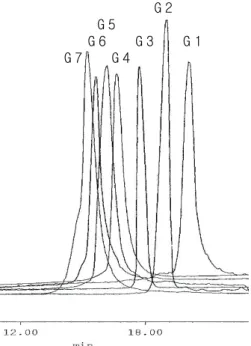
The molecularity of the respective dendrimer of nG[2, 2n-1,1]-2nBT (Scheme 2) is determined by GPC, in which very narrow peak of PDI value closely to 1.00 is observed at shorter retention time with increasing the generation number (Figure 1).
Scheme 2. Schematic view of the benzothiazole 1st to 7th generation dendrimers .
S N O Si Si S N O Si S N O Si Si S N OSi Si S N O Si Si S N O Si Si Si Ph O Si Ph Si S N O Ph S N Si Si Ph O Si Ph S N O Ph S N Si Ph Si Si Ph O Si Ph Si S N O Ph S N Si Si Ph O Si Ph S N O Ph S N Ph S N O Si Si Si Si Ph Ph Ph S N O Si Si Si Ph Ph Ph S N O Si Ph S N O S N O Si Si Si Si Ph Ph Ph S N OSi Si Si Ph Ph Ph S N O Ph S N O Si Ph S N O Si Si Si Si Ph Ph Ph S N O Si Si Si Ph Ph Ph S N O Si Ph N S O S N O Si Si Si Si Ph Ph Ph S N O Si Si Si Ph Ph Ph S N O Ph N S O Ph S i S i S N O S i Si Si Ph P h P h S N O S i N O S i S i S i Ph P h Ph S N O S i S N OS i S i S i P h Ph Ph S NO Si S N O S i Si S i Ph P h Ph S N O S P h S N O Si Si S i P h Ph P h S N O S i N O S i Si S i P h P h P h S NO Si S N O S i S i Si P h Ph Ph S N O S i S N O S i S i S i P h P h P h S NO S S i S N O S i Si Si Ph P h Ph S N O S i N O S i S i S i Ph P h Ph S N O S i S N O Si S i S i Ph P h P h S N O Si S N O S i Si S i P h P h Ph S N O S P h S N O Si Si S i Ph P h Ph S N O S i N O S i Si S i P h Ph P h S N O S i S N O S i S i S i Ph Ph P h S N O S i S N O S i S i S i P h Ph P h S N O S 1G(2,1,1)-2BT 2G(2,2,1)-4BT 3G(2,2,2,1)-8BT 4G(2,2,2,2,1)-16BT 5G(2,2,2,2,2,1)-32BT Si S N O Si Si Si Ph Ph Ph S N O Si N O Si Si Si Ph Ph Ph S N O Si S NO Si Si Si Ph Ph Ph S NO Si S N O Si Si Si Ph Ph Ph S NO S Ph Si Ph Si S NO Si Si Si Ph Ph Ph S NO Si N O Si Si Si Ph Ph Ph S N O Si S N OSi Si Si Ph Ph Ph S N O Si S NO Si Si Si Ph Ph Ph S N O S Si S N O Si Si Si Ph Ph Ph S NO Si N O Si Si Si Ph Ph Ph S N O Si S NO Si Si Si Ph Ph Ph S NO Si S N O Si Si Si Ph Ph Ph S N O S Ph S NOSi Si Si Ph Ph Ph S N O Si N O Si Si Si Ph Ph Ph S N O Si S N O Si Si Si Ph Ph Ph S N O Si S NO Si Si SiPh Ph Ph S N O S Si S N O Si Si Si Ph Ph Ph S N O Si N OSi Si Si Ph Ph Ph S N O Si S N O Si Si Si Ph Ph Ph S N O Si S N O Si Si Si Ph Ph Ph S N O S Ph Si Ph S N O Si Si Si Ph Ph Ph N S O Si N O Si Si Si Ph Ph Ph S N O Si S N O Si Si Si Ph Ph Ph S N O Si S N O Si Si PhSi Ph Ph S N O S Si S N O Si Si Si Ph Ph Ph S N O Si N O Si Si Si Ph Ph Ph S N O Si S N O Si Si Si Ph Ph Ph S N O Si S N O Si Si Si Ph Ph Ph S N O S Ph S N O Si Si PhSi Ph Ph ON S Si N O Si Si Si Ph Ph Ph S N O Si S N O Si Si Si Ph Ph Ph S N O Si S N O Si Si Si Ph Ph Ph S N O S Si S N O Si Si Si Ph Ph Ph S N O Si Si SiON Si Ph Ph Ph S N O Si S N O Si Si Si Ph Ph Ph S N O Si S N O Si Si Si Ph Ph Ph S N O S Ph Si Ph Si Si Ph S N O Si Si Si Ph Ph Ph S N O Si N O Si Si Si Ph Ph Ph S N O Si S N O Si Si Si Ph Ph Ph S N O Si S N O Si Si Si Ph Ph Ph S NO S Si S N O Si Si Si Ph Ph Ph S N O Si N O Si Si Si Ph Ph Ph S NO Si S NO Si Si Si Ph Ph Ph S N O Si S N O Si Si Si Ph Ph Ph S N O S Ph S N O Si Si SiPh Ph Ph S N O Si N O Si Si Si Ph Ph Ph S NO Si S N O Si Si Si Ph Ph Ph S N O Si S N O Si Si Si Ph Ph Ph S N O S Si S N O Si Si Si Ph Ph Ph S N O Si N O Si Si Si Ph Ph Ph S N O Si S N O Si Si Si Ph Ph Ph S N O Si S N O Si Si Si Ph Ph Ph S NO S Ph Si Ph S N O Si Si Si Ph Ph Ph S N O Si N O Si Si Si Ph Ph Ph S NO Si S N O Si Si Si Ph Ph Ph S N O Si S N O Si Si Si Ph Ph Ph S NO S Si S N O Si Si Si Ph Ph Ph S N O Si N O Si Si Si Ph Ph Ph S N O Si S NO Si Si Si Ph Ph Ph S N O Si S N O Si Si Si Ph Ph Ph S NO S Ph S N O Si Si Si Ph Ph Ph S N O Si N O Si Si Si Ph Ph Ph S NO Si S N O Si Si Si Ph Ph Ph S N O Si S N O Si Si Si Ph Ph Ph S N O S Si S N OSi Si SiPh Ph Ph S N O Si N O Si Si Si Ph Ph Ph S N O Si S N O Si Si Si Ph Ph Ph S N O Si S N O Si Si SiPh Ph Ph S N O S Ph Si Ph Si Ph S N O Si Si Si Ph Ph Ph S N O Si N O Si Si Si Ph Ph Ph S N O Si S N O Si Si Si Ph Ph Ph S N O Si S N O Si Si Si Ph Ph Ph S N O S Si S N O Si Si Si Ph Ph Ph S N O Si N O Si Si Si Ph Ph Ph S N O Si S N O Si Si Si Ph Ph Ph S N O Si S N O Si Si Si Ph Ph Ph S N O S Ph Si SiO N S Si Ph Ph Ph S N O Si N O Si Si Si Ph Ph Ph S N O Si S N O Si Si Si Ph Ph Ph S NO Si S N O Si Si Si Ph Ph Ph S N O S Si S N O Si Si SiPh Ph Ph S N O Si N O Si Si Si Ph Ph Ph S N O Si S N O Si Si Si Ph Ph Ph S N O Si S N O Si Si Si Ph Ph Ph S N O S Ph Si Ph S N O Si Si Si Ph Ph Ph S N O Si N O Si Si Si Ph Ph Ph S N O Si N S O Si Si Si Ph Ph Ph S N O Si S N O Si Si Si Ph Ph Ph S N O S Si S N O Si Si Si Ph Ph Ph S N O Si N O Si Si Si Ph Ph Ph S N O Si S N O Si Si Si Ph Ph Ph S N O Si S N O Si Si Si Ph Ph Ph S N O S Ph N S O Si Si Si Ph Ph Ph S N O Si N O Si Si Si Ph Ph Ph S N O Si S N O Si Si Si Ph Ph Ph S N O Si S N O Si Si Si Ph Ph Ph S N O S 6G(2,2,2,2,2,2,1)-64BT 7G(2,2,2,2,2,2,2,1)-128BT
Figure 1. GPC chromatogram of 1st to 7th generation carbosilane dendrimers. G 2 G 5 G 6 G 3 G 1 G 7 G 4 G 2 G 5 G 6 G 3 G 1 G 7 G 4
MALDI mass spectroscopy provides valuable information about the isomolecularity of lower
generation dendrimers (1st generation, 1G[2,0,1]-2BT); however it gives no information about its
purity and molecularities for higher generations. Therefore GPC has been used for the characterization of dendrimers along with various spectroscopic measurements and elemental analysis. The GPC chromatogram in Figure 1 shows very narrow peaks corresponding to the respective generations of the dendrimer. The first peak from the left is that of the highest generation dendrimer, 7G[2,2,2,2,2,2,2,1]-126BT with a molecular weight 67,736 Daltons, and the last peak from the left is that of the lowest generation dendrimer, 1G[2,0,1]-2BT (Mw: 831.27). The most significant feature of the chromatogram
is that each peak has no shoulder in the left and the right side of the peak for the 1st to the 5th
generation dendrimers. On the other hand for the 6th and 7th generation, a little shoulder can be
recognized only on the left side of each peak. The shoulder in the left side of the peak must come from the corresponding dendrimer with impurities, which are stuck between its branches. It is plausible that a higher generation dendrimer has more probability to capture any impurities between its branches. Nevertheless no shoulder in the right side of each peak is observed. In addition the PDI values of the peaks are very close to 1.00 in the range from 1.00 to 1.04. It means that the calculated molecular
weight from GPC is very slightly greater than that of the dendrimer (Mw≥Mn) [9].
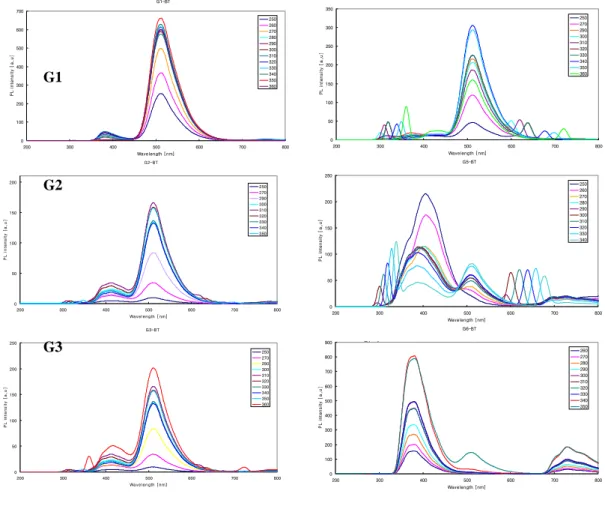
The PL spectra of nG[2,2n-1,1]-2nBT ( n = 1 ~ 6) show one smaller λmax peak at the wavelength of
380 nm and the other bigger one at the wavelength of 512 nm. As the generation of nG[2,2n-1,1]-2nBT
increased from the 1st to the 4th generation the intensity of the smaller λmax at the wavelength of 380
nm unexpectedly increased slowly, but the intensity of the bigger λmax at the wavelength of 512 nm is
decreased. In the end the intensity of λmax at the wavelength of 380 nm is bigger than that of λmax at the
wavelength of 512 nm for the 5th and the 6th generation of nG[2,2n-1,1]-2nBT (n=5, 6) dendrimers. This
can be attributed to the fact that the space around the silicon atoms becomes smaller as the generations increase. In the lower generation dendrimers there is enough space around the silicon atoms for the
bulky 2-benzothiazolephenoxy group to occupy a planar geometry, in which the nitrogen or sulfur atoms can coordinate equatorially with a silicon atom. However, in the higher generation dendrimers 2-benzothiazole group is too bulky to move around the Si atoms, therefore the benzothiazole and phenyl groups rotate to minimize the steric hindrance (Scheme 3). The same pattern of the PL spectra
are observed for the dendrimers of nG[2,2n-1,1]-2nBO ( n = 1 ~6) [10].
Figure 2. PL properties of benzothiazole dendrimers from 1st to 6th generations.
Scheme 3. Position of benzothiazole on dendritic periphery.
Low generation High generation
Dendron S N O SiMe2 Dendron N S O SiMe2 S N O SiMe2 Dendron G1-BT 0 100 200 300 400 500 600 700 200 300 400 500 600 700 800 Wavelength [nm] PL i n ten s it y [ a ,u ] 250 260 270 280 290 300 310 320 330 340 350 360 G2-BT 0 50 100 150 200 200 300 400 500 600 700 800 Wav el en gth [nm] P L inte n s it y [ a , u ] 250 270 290 300 310 320 330 340 350 G3-BT 0 50 100 150 200 250 200 300 400 500 600 700 800 Wave len gth [n m] P L i n te n s it y [ a , u ] 250 270 290 300 310 320 330 340 350 360 G1 G2 G3 G4 G5 G6 G5-BT 0 50 100 150 200 250 200 300 400 500 600 700 800 Wavelength [nm] PL in te n s it y [ a ,u ] 250 260 270 280 290 300 310 320 330 340 G6-BT 0 100 200 300 400 500 600 700 800 900 200 300 400 500 600 700 800 Wavelength [nm] PL i n ten s it y [ a ,u ] 260 270 280 290 300 310 320 330 340 350 G4-BT 0 50 100 150 200 250 300 350 200 300 400 500 600 700 800 Wavelength [nm] P L i n ten s it y [ a ,u ] 250 270 290 300 310 320 330 340 350 360
3. Experimental
All reactions were carried out under a dried nitrogen atmosphere attached to vacuum line. NMR spectra were recorded on a Bruker AC 200 instrument. UV spectra were measured with a HP 8452A diode array ultraviolet visible spectrophotometer. The gel permeation chromatography (GPC) was
performed in THF at 25 oC with a Waters 515 HPLC pump and a Waters 2410 Refractive Index
Detector connected with three columns (Ultrastyragel 0.78 x 30 cm; 103, 104 and 105), which were
calibrated with a narrow molecular weight polystyrene standard. Elemental analyses were carried out at KBSI in Daegu, Korea. The following abbreviations are used: BT refers to benzothiazole, PA refers to phenylethynyl groups and TMEDA refers to tetramethylethylenediamine. In the representation of
nG[2,2n-1,1]-2nX, the nG (specially Gn in figure and experimental part) refers to generation number,
the first 2 in bracket refers to the number of branch in core, the 2n-1refers to the number of branches in
inner shell and last 1 in the bracket refers to the number of functional groups on the periphery and last
2nBT refers to the number of benzothiazole groups on the whole periphery Gn-mCl refer to number of
Si-Cl (m=2,4,..) bonds in nth generation. The hydrosilation and alkynylation processes were described
in previous reports [5,10].
1G[2,1,1]-2BT: 1G[2,0,1]-2Cl (0.30 g, 0.67 mmol) in toluene (25 mL) was slowly added to a mixed
solution of 2-(2-hydroxyphenyl)benzothiazole (0.33 g, 1.45 mmol) and TMEDA (0.17 g, 1.45 mmol) in dried toluene (50 mL) at room temperature. Then, the reaction mixture was warmed and kept at 60
oC for 1.5 hr. The reaction mixture was filtered to remove the TMEDA-HCl salt. 1G[2,0,1]-2BO was
purified and isolated by silica gel chromatography with chloroform-hexane (3:2) as eluent. Yield: 0.44
g (0.53 mmol, 80%) of a light yellow glass. 1H-NMR (ppm, CDCl3): δ = -0.42 (s, 6H, SiMe, G0), 0.42
(s, 12H, SiMe, G1), 6.42 (s, 2H, CH=C, G0), 6.84~7.00, 7.04~7.22, 7.22~7.39, 7.39~7.54, 7.80~7.90,
8.05~8.15, 8.42~8.54 (26H, BT, Ph); 13C-NMR (ppm, CDCl3): δ = -0.56 (SiMe, G1), -0.08 (SiMe, G0),
116.97, 118.04, 119.71, 121.68, 122.35, 125.72, 126.15, 126.86, 127.53, 127.63, 127.98, 128.04, 128.58, 132.77, 132.93, 144.69, 152.02, 158.09, 164.34, 169.55 (BT, Ph); Anal. Calc. for
C48H46N2O2S2Si3 (Mw: 831.28): C, 69.29%, H, 5.54%, N, 3.37%, S, 7.71%. Found: C, 68.77%, H,
5.56%, N, 3.40%, S, 7.71%; MALDI TOF MS, Calc.: 831.28, Found: 831.27 (M+);UV/Vis, λmax = 287
nm, εmax = 0.34×10⁵; GPC: PDI value (Mw/Mn), 1.01 (682/674); Rt, 19.96 mins.
2G[2,2,1]-4BT: The same method as described for the preparation of G1-2BT was used with G2-4Cl
(0.45 g, 0.40 mmol), TMEDA (0.19 g, 1.71 mmol) and 2-(2-hydroxyphenyl)benzoxazole (0.39 g, 1.71
mmol). Yield: 0.59 g (0.31 mmol, 78%) of a light yellow glass.1H-NMR (ppm, CDCl3): δ = -0.66 (s,
6H, SiMe, G0), -0.54 (s, 6H, SiMe, G1), 0.34 (s, 24H, SiMe, G2), 6.02 (s, 2H, CH=C, G0), 6.32 (s, 4H, CH=C, G1), 6.70~6.89, 7.02~7.15, 7.15~7.40, 7.40~7.55, 7.80~7.89, 8.02~8.12, 8.40~8.54 (64H, BT,
Ph); 13C-NMR (ppm, CDCl3): δ = -2.47 (SiMe, G0), -0.53 (SiMe, G1), 1.23 (SiMe, G1), 116.97,
118.04, 119.71, 121.68, 122.35, 125.75, 126.17, 126.90, 127.64, 127.69, 127.96, 127.99, 128.62, 132.77, 132.93, 144.56, 144.48, 152.09, 158.09, 164.25, 169.59 (BT, Ph); Anal. Calc. for
5.54%, N, 3.04%, S, 6.77%; UV/Vis, λmax = 287 nm, εmax = 0.70×10⁵; GPC: PDI value (Mw/Mn), 1.01 (910/895); Rt, 19.14 mins.
3G[2,2,2,1]-8BT: The same method as that of G1-2BT was used with G3-8Cl (0.49 g, 0.20 mmol),
TMEDA (0.20 g, 1.75 mmol) and 2-(2-hydroxyphenyl)benzothiazole (0.40 g, 1.75 mmol). Yield: 0.68
g (0.17 mmol, 85%) of a light yellow glass. 1H-NMR (ppm, CDCl3): δ = 0.82 (s, 6H, SiMe, G0),
-0.75 (s, 12H, SiMe, G2), -0.51 (s, 12H, SiMe, G1), 0.30 (s, 48H, SiMe, G3), 6.00~6.12 (s, 6H, CH=C, G0~G1), 6.22 (s, 8H, CH=C, G2), 6.64~6.86, 6.96~7.12, 7.12~7.39, 7.39~7.54, 7.76~7.89, 8.04~8.15,
8.40~8.52 (134H, BT, Ph); 13C-NMR (ppm, CDCl3): δ = -2.92 (SiMe, G0~G1), -0.61 (SiMe, G3), 0.87
(SiMe, G2), 116.97, 118.04, 119.71, 121.68, 122.35, 125.75, 126.17, 126.90, 127.64, 127.69, 127.96, 127.99, 128.62, 132.77, 132.93, 144.56, 144.48, 152.09, 158.09, 164.25, 169.59 (BT, Ph); Anal. Calc.
for C240H220N8O8S8Si15 (Mw: 4,016): C, 71.71%, H, 5.47%, N, 2.78%, S, 6.37%. Found: C, 71.00%, H,
5.44%, N, 2.30%, S, 6.38%; UV/Vis, λmax = 287 nm, εmax = 1.43×10⁵; GPC: PDI (Mw/Mn), 1.01
(3,241/3,197); Rt, 17.87 mins.
4G[2,2,2,2,1]-16BT: The same method as that of G1-2BO was used with G2-4Cl (0.32 g, 0.061 mmol),
TMEDA (0.12 g, 1.06 mmol) and 2-(2-hydroxyphenyl)benzothiazole (0.24 g, 1.71 mmol). Yield: 0.42
g (0.051 mmol, 83%) of a light yellow glass. 1H-NMR (ppm, CDCl3): δ = -0.86 (s, 18H, SiMe, G0,
G2), -0.75 (s, 24H, SiMe, G3), -0.57 (s, 6H, SiMe, G1), 0.26 (s, 96H, SiMe, G4), 6.04~6.19 (s, 14H, CH=C, G0~G2), 6.21 (s, 16H, CH=C, G3), 6.56~6.85, 6.85~7.14, 7.14~7.36, 7.36~7.50, 7.72~7.84,
8.00~8.12, 8.40~8.50 (278H, BT, Ph); 13C-NMR (ppm, CDCl3): δ = -2.87 (SiMe, G0~G2), -0.85
(SiMe, G4), 0.89 (SiMe, G3), 116.97, 118.04, 119.71, 121.68, 122.35, 125.75, 126.17, 126.90, 127.64, 127.69, 127.96, 127.99, 128.62, 132.77, 132.93, 144.56, 144.48, 152.09, 158.09, 164.25, 169.59 (Ph,
BT); Anal. Calc. for C496H452N16O16S16Si31 (Mw: 8,264): C, 72.02%, H, 5.47%, N, 2.71%, S, 6.19%.
Found: C, 71.83%, H, 5.59%, N, 2.21%, S, 6.18%; UV/Vis, λmax = 287 nm, εmax = 2.74×10⁵; GPC: PDI
(Mw/Mn), 1.04 (4,311/4,114); Rt, 16.69 mins.
5G[2,2,2,2,2,1]-32BT: The same method as that of G1-2BO was used with G5-32Cl (0.40 g, 0.037
mmol), TMEDA (0.14 g, 1.20 mmol) and 2-(2-hydroxyphenyl)benzothiazole (0.27 g, 1.20 mmol).
Yield: 0.51 g (0.030 mmol, 82%) of a light yellow glass. 1H-NMR (ppm, CDCl3): δ = -0.95~-0.48
(96H, SiMe, G0~G4), 0.23 (192H, SiMe, G5), 5.84~6.10, 6.10~6.32 (62H, CH=C, G0~G4), 6.55~6.82,
6.82~7.16, 7.16~7.34, 7.34~7.52, 7.68~7.84, 7.96~8.27, 8.38~8.55 (566H, BT, Ph); 13C-NMR (ppm,
CDCl3): δ = -2.86 (SiMe, G0~G4), -0.84 (SiMe, G5), 117.03, 118.10, 119.73, 121.72, 122.41, 125.75,
126.10, 126.90, 127.61, 127.94, 128.62, 132.82, 132.96, 144.69, 152.02, 158.09, 164.34, 169.55 (Ph,
BT); Anal. Calc. for C1008H916N32O32S32Si63 (Mw: 16,760): C, 72.17%, H, 5.46%, N, 2.67%, S, 6.11%.
Found: C, 71.82%, H, 5.60%, N, 2.67%, S, 6.11%; UV/Vis, λmax = 287 nm, εmax = 5.37×10⁵; GPC: PDI
(Mw/Mn), 1.02 (8,222/8,201); Rt, 16.09 mins.
6G[2,2,2,2,2,2,1]-64BT: The same method as that of G1-2BO was used with G2-4Cl (0.32 g, 0.015
Yield: 0.43 g (0.013 mmol, 83%) of a light yellow glass. 1H-NMR (ppm, CDCl3): δ = -1.76~-0.66 (s,
192H, SiMe, G0~G5), 0.08~0.38 (s, 384H, SiMe, G6), 5.72~6.28 (126H, CH=C, G0~G5), 6.48~6.80,
6.80~7.12, 7.12~7.32, 7.32~7.48, 7.62~7.80, 7.97~8.10, 8.30~8.52 (1142H, BT, Ph); 13C-NMR (ppm,
CDCl3): δ = -1.23 (SiMe, G0~G5), -0.43 (SiMe, G6), 117.03, 118.10, 119.74, 121.73, 122.41, 125.76,
126.91, 127.92, 128.34, 128.63, 132.83, 132.97, 144.69, 152.02, 158.09, 164.34, 169.55 (Ph, BT);
Anal. Calc. for C2032H1844N64O64S64Si127 (Mw: 33,752): C, 72.24%, H, 5.46%, N, 2.65%, S, 6.07%.
Found: C, 71.54%, H, 5.89%, N, 2.64%, S, 6.20%; UV/Vis, λmax = 287 nm, εmax = 1.08×10⁶; GPC: PDI
(Mw/Mn), 1.01 (11,536/11,397); Rt, 15.55 mins.
7G[2,2,2,2,2,2,2,1]-128BT: The same method as that of G1-2BO was used with G7-128Cl (0.27 g,
0.0062 mmol), TMEDA (0.10 g, 0.88 mmol) and 2-(2-hydroxyphenyl)benzothiazole (0.20 g, 0.88
mmol). Yield: 0.36 g (0.0053 mmol, 86%) of a light yellow glass. 1H-NMR (ppm, CDCl3): δ =
-1.02~-0.60 (s, 384H, SiMe, G0), 0.18~0.40 (s, 768H, SiMe, G7), 5.72~6.28 (254H, CH=C, G0~G6),
6.40~7.46, 7.46~7.82, 7.82~8.10, 8.29~8.54 (2294H, BT, Ph); 13C-NMR (ppm, CDCl3): δ = -1.27
(SiMe, G7), - 0.53 (SiMe, G0~G6), 117.84, 121.16, 125.29, 122.78, 124.56, 125.29, 125.89, 126.69, 127.77, 128.22, 129.03, 129.76, 131.22, 131.80, 135.78, 142.86, 144.127, 152.04, 153.21, 163.13 (Ph,
BT); Anal. Calc. for C4080H3700N128O128S128Si255 (Mw: 67,736): C, 72.28%, H, 5.46%, N, 2.64%, S,
6.05%. Found: C, 71.87%, H, 5.90%, N, 2.62%, S, 6.02%; UV/Vis, λmax = 287 nm, εmax = 2.27×10⁶;
GPC: PDI (Mw/Mn), 1.02 (15,206/14,890); Rt, 15.20 mins. Acknowledgements
This work was supported by the Basic Research Program of Dong-A University (2009). References
1. Tomalia, D.A.; Hedstrand, D.M.; Ferritto, M.S. Comb-burst dendrimer topology: new
macromolecular architecture derived from dendritic grafting. Macromolecules 1991, 24,
1435-1438.
2. Vögtle, F.; Gestermann, S.; Hesse, R.; Schwierz, H.; Windischb, B. Functional dendrimers. Prog.
Polym. Sci.2000, 25, 987-1041.
3. Inoue, K. Functional dendrimers, hyperbranched and star polymers. Prog. Polym. Sci.2000, 25,
435-571.
4. Higuchi, M.; Shiki, S.; Ariga, K.; Yamamoto, K. First Synthesis of Phenylazomethine Dendrimer
Ligands and Structural Studies. J. Am. Chem. Soc.2001, 123, 4414-4420.
5. Kim, C.; Seo, W.; Oh, M.-J. Synthesis of Silafluorene on Dendritic Periphery. Bull. Korean Chem.
Soc.2007,28, 1963-1966.
6. Kim, C.; Kim, H. Synthesis of Farnesyl Terminated Carbosilane Dendrimer. Synthesis2005,
7. Trollsås, M.; Hedrick, J.L. Dendrimer-like Star Polymers. J. Am. Chem. Soc. 1998, 120,
4644-4651.
8. Feng, X.-H.; Taton, D.; Ibarboure, E.; Chaikof, E.L.; Gnanou, Y. Janus-Type Dendrimer-like
Poly(ethylene oxide)s. J. Am. Chem. Soc.2008, 130, 11662-11676.
9. Li, S.; McGrath, D.V. Effect of Macromolecular Isomerism on the Photomodulation of
Dendrimer Properties. J. Am. Chem. Soc.2000, 122, 6795-6796.
10. Kim, C.; Kim, H.; Oh, M.-J. Hong, J.-H. Preparation and unequivocal identification of
chromophores-substituted carbosilane dendrimers up to 7th generations. Bull. Kor. Chem. Soc.
2009,(in press).
Sample Availability: Samples are available from the authors.
© 2009 by the authors; licensee Molecular Diversity Preservation International, Basel, Switzerland. This article is an open-access article distributed under the terms and conditions of the Creative Commons Attribution license (http://creativecommons.org/licenses/by/3.0/).