Mary Hiland, organizational consultant and executive coach1
C
onventional wisdom emphasizes the impor-tance to a nonprofit organization of its core leadership: a healthy board chair-executive director relationship (Eadie, 2001; Howe, 2004; Lechem, 2002; P. C. Light, 2002). Organizational effectiveness is at stake when this relationship is weak, or worse, dysfunctional. While such an assertion may seem intuitively correct, there is a lack of empirical work that explores the dynamics of this key relationship or its influence, if any, on the nonprofit organization (Brown, 2000; Miller-Millesen, 2003).In the nonprofit governance literature, consultants and practitioners prescribe the roles and respon-sibilities of board chairs and how those roles and responsibilities are shared with, or distinct from, those of the executive. These typically one size fits
all job descriptions fail to consider the incredible
diversity of the sector. In addition, beyond to do lists and role clarifications, there is very little that helps board chairs or executives anticipate and effectively manage the complexities of their rela-tionship. The roles, as typically assigned, create a paradox in which the board chair is at once pro-viding both support and oversight. This paradox, coupled with the real possibility that both the board chair and the executive are experienced leaders, highlights the importance of learning more about the dynamics of this relationship than simply who should do what.
1 Mary Hiland can be reached at [email protected]
THE STUDY
To learn more about the dynamics and influence of board chair-executive director relationships, a study was conducted in 2005 with board chairs and executives from 16 nonprofit 501(c)(3) organiza-tions in Silicon Valley, California. Semi-structured interviews with open-ended questions were done individually with each volunteer participant to elicit descriptions of the dynamics in their relation-ship and its effect on the organization.
Participants and their organizations were selected on a first come, first served basis so their character-istics were unpredictable. Fourteen of the 32 study participants were female (44%) and 18 were male (56%). Half (8) of the study pairs were of mixed gender and half were the same. The lack of ethnic diversity among participants was disappointing: 94% were Caucasian.
There was diversity among the organizations in the study. The fields of service ranged from recreation to the arts to organizations that provide services to other nonprofits. The largest cluster was human service—25% (4) of the organizations. Study nonprofits ranged in size (measured by annual expenditures) from less than $500,000 to over $10 million. Time in the relationships ranged from 6 months to 5 years.
Social capital is the resource that is created as a result of interpersonal relationships within a social structure (Coleman, 1990). Social capital theory explains how relationships can add value to orga-nizations and is, as yet, under-explored as an asset in nonprofit organizations (Cohen & Prusak, 2001; King, 2004). Social capital theory was used as a lens in the study to understand whether and/or how the board chair-executive director relationships added value to nonprofit organizations.
The Board Chair-Executive Director
Relationship: Dynamics that Create
Value for Nonprofit Organizations
Study findings revealed cumulative patterns of dynamics that, when integrated, formed a typology of good to great board chair-executive relation-ships. This pattern was built from
the following a) types of inter-personal dynamics, b) levels of trust, c) what the pairs worked on together, and d) how the above, combined, linked to social capital creation in the organization.
CHARACTERISTIC
INTERPERSONAL DYNAMICS IN THE RELATIONSHIPS
Based on study participants’ descriptions, five types of
inter-personal dynamics characterized the board chair-executive relationships: facts-sharing, ideas-sharing, knowledge-ideas-sharing, feelings-sharing and give-and-take.
Facts-sharing
Facts-sharing was defined as a one-way giving of information that did not involved the engagement of the other party in the exchange. This interper-sonal dynamic type was primarily demonstrated in reports of how much information the executive shared with the board chair and if it was experi-enced as enough. Facts-sharing was the most basic of the interpersonal interactions and was evident in all study pairs.
Ideas-sharing
The ideas-sharing dynamic represents brain-storming, problem solving, and/or thinking things through together. In contrast to facts-sharing, ideas-sharing involved the engagement of both parties in the interaction—a two-way exchange. Initiated by either party, the focus of board chair-executive ideas-sharing ranged from a quick check-in to consulting each other about orga-nizational issues to the board chair serving as a sounding board for the executive.
Knowledge-sharing
The third interactions type was knowledge-sharing—defined as learning and/or coaching
interaction. This type was dis-tinct from sharing facts or ideas in that there was a teaching com-ponent and identifiable content learned about the organization, something outside the orga-nization or about the person him/herself. The most common examples were coaching of the executive by the board chair and the executive teaching the board chair about the organization or nonprofits in general.
Feelings-sharing
The participants’ descriptions of support, reas-surance, caring and/or appreciation were defined as the feelings-sharing type of interaction, which varied in intensity among the pairs. Expressions of support most often came from the board chair to the executive; expressions of appreciation were exchanged by both.
Give-and-take
The give-and-take dynamic reflected the board chair or executive’s adaptation to the other per-son’s style, personality and/or preferences and their process of working out differences. It is understood that executives need to adapt to new board chairs as they may transition several times over executives’ tenure and the give-and-take dynamic included, but went beyond, the executive adapting to a new board chair. When this dynamic was present, it was quite evident that both parties in the relationship made changes or concessions to accommodate the other or to achieve alignment in a variety of circumstances.
Examining these types of board chair-executive interpersonal interactions from the perspective of trust building provided a framework for
under-B
ased on study participants’descriptions, five types of interpersonal dynamics characterized the board chair-executive relationships: facts-sharing, ideas-facts-sharing, knowledge-sharing, feelings-sharing and give-and-take.
standing their implications. The more diverse the interactions in the pair, the stronger the trust built (Mishra, 1996). The interactions provided the contexts in which trust building behaviors were enacted and the pairs with the strongest trust demonstrated all of the interaction types. It is interesting to note, though, that the frequency of interactions and the amount of time spent together did not relate to the good to great framework that characterized the other study findings. It was the quality, not quantity, of interaction that mattered.
THE STRENGTH OF TRUST
There are numerous, different conceptualizations of trust in the organizational and social science literature (Bigley & Pearce, 1998). These varied con-cepts reflect trust’s complexity. Most address trust
in the context of personal, as compared to working, relationships. The literature on trust-building in organizations is limited. Integrating and adding to the work of Lewicki and Bunker (1996), Reina and Reina (1999), and Mishra (1996), a model of trust building in organizations was formulated.
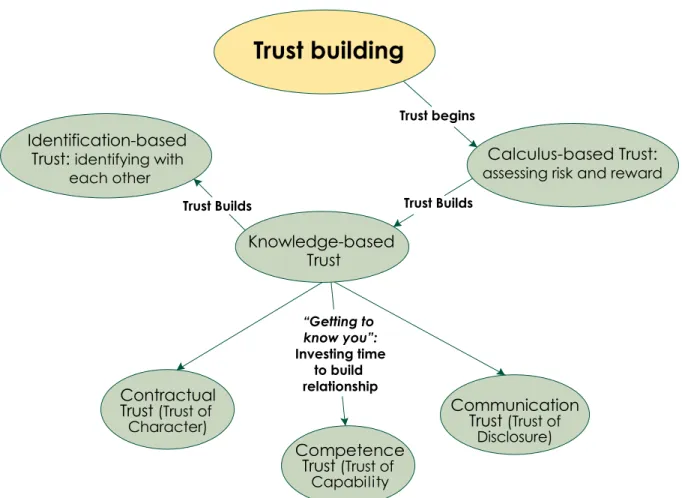
Nineteen different trust-building behaviors were identified. Each was linked to one or more of the interaction types discussed above and each fit within one of three levels of trust in the model: calculus-based (weak trust), knowledge-based (moderate trust), and identification-based (strong trust). These levels are cumulative, i.e., knowl-edge-based trust builds on calculus-based trust; identification-based trust builds on knowledge-based trust. Drawing on Mishra’s research, the level of trust assessed in each study pair was determined
Trust building
Calculus-based Trust: assessing risk and reward Identification-based
Trust: identifying with each other Knowledge-based Trust Contractual Trust (Trust of Character) Competence Trust (Trust of Capability Communication Trust (Trust of Disclosure) “Getting to know you”: Investing time to build relationship Trust begins Trust Builds Trust Builds
by the type and number of different trust-building behaviors they experienced.
The lowest level, calculus-based trust, exists to the extent that punishments and/or rewards motivate someone to invest in a relationship or to remain trustworthy himself. There is a calculation of the value of trusting in a particular relationship and interactions in the relationship reflect a cost-benefit evaluation. Though this is a weak level of trust it is important to note that it is not bad. It is still trust and in some working relationships this level of trust is more than adequate to accomplish goals. Only one study pair did not build trust beyond this level. The next level, knowledge-based trust, results from knowing each other to an extent that facilitates predictability. This level includes trust that built as board chairs and executives gained confidence in each other’s competence, showed respect, com-municated effectively, and honored agreements and commitments. The executive’s willingness to be vulnerable and the board chair creating safety for the executive also exemplified behaviors that built knowledge-based trust. As the model reflects, knowledge-based trust incorporates the behavioral categories most readily associated with trust-building: communication, meeting commitments, and demonstrating competence. Knowledge-based trust was the most common level of trust evident in the relationships. Nine pairs built trust to this level. Six pairs built trust beyond this: those six also built identification-based trust.
Identification-based trust, the highest level of trust, is not as evident in organizational contexts as cal-culus-based or knowledge-based trust (Lewicki & Bunker, 1996). Identification-based trust results from going beyond knowing each other to identify-ing with each other. It is built less on predictability of behavior than on the internalization of each other’s preferences (Sheppard & Tuchinsky, 1996). Pairs with identification-based trust act on behalf of each other and can substitute for each other in other interpersonal interactions. The dynamics in pairs with this level of trust included a more
per-In addition to the levels of trust evident in each pair, the study revealed different patterns in what each pair focused on when they worked together on behalf of the organization. It is the integration of the trust levels and these working-together pat-terns that provide the good to great framework the study revealed. The working-together patterns are discussed next.
THE FOCUS OF WORK
Study participants were asked to describe experi-ences that were characteristic of what they worked on together. Findings indicated three patterns of the scope and type of work the pairs engaged in together: managing, planning and leading. These patterns, like the levels of trust, were cumulative, that is, all pairs planning together were also managing; all pairs leading were also planning and managing. Managing
All the pairs indicated they worked together on some aspect of the internal operations of the orga-nization, for example finances, personnel, facilities, fundraising. This pattern was categorized as man-aging. Also, pairs were managing when they worked on or about the board, e.g., developing board meet-ing agendas together, workmeet-ing on recruitmeet-ing new board members, or identifying board leaders to head committees. Six study pairs worked together only at this level and are referred to as the
man-aging pairs. These manman-aging pairs did not describe
working together with the board. Those with only a managing pattern of working together did not describe working together with anyone else. This was an important distinction.
Planning
The planning pattern of working together was characteristic of pairs who engaged with the board determining direction and strategy, as well as doing other activities directly related to organizational strategic focus. In contrast to the managing pairs,
committees. There were three pairs, the planning pairs, whose work together evidenced only the managing and planning patterns.
Leading
Six study pairs were managing, planning, and lead-ing. These are the leading pairs. They described working with engaged boards on mission-related and strategic work. These leading pairs described a web of board, staff and community relation-ships. The labeling of this pattern as leading is not intended to imply that the other study board chairs and executives were not leaders. The distinction is the level of engagement the pairs had with the external community as well as the level of engage-ment they helped to create between their boards and the community. Neither was evident in man-aging or planning pairs.
LEVELS OF TRUST AND THE
WORKING-TOGETHER PATTERNS
The study found three levels of trust and three patterns of how pairs worked together. Was there a relationship between these two dimensions? There was. Using Mishra’s approach to measuring the strength of trust (i.e., the number of different trust-building behaviors evident) revealed that the strength of trust in the leading pairs was 67% higher than in the planning pairs and 133% higher than in the managing pairs. The planning pairs had stronger trust levels than the managing pairs. Only the leading pairs had achieved the highest level: identification-based trust. The following reflects these findings using a good to great framework:
Good: managing pairs
Managing focus + low to moderate knowledge-based trust
Better:planning pairs
Planning focus + moderate to high knowledge-based trust
Great:leading pairs
Leading focus + identification-based trust
A final question explored in the study was what, if any, influence did the board chair-executive relationship have on the organization from the par-ticipants’ experience? Given the framework, was there a relationship between the nature of that influ-ence, if any, and the good, better or great pairs?
BOARD CHAIR-EXECUTIVE RELATIONSHIPS’ VALUE: SOCIAL CAPITAL CREATION
As noted earlier, social capital theory was used to understand if and how the study pairs’ relationships influenced their organizations. Social capital is the asset created through relationships. It is “the stock of active connections among people” that makes productive action possible in organizations (Cohen & Prusak, 2001, p. 4). Leaders have a critical role to play in creating social capital that is useful to the organizations they serve (Cohen & Prusak, 2001; King, 2004).
All study participants believed that their rela-tionship mattered to the effectiveness of the organization, but, prior to the study few had reflected on “How?”. The study was not structured to specifically measure social capital. However, when participants were asked how their relation-ships affected the organizations their responses were characteristically about key relationships and networks, and other benefits associated with social capital. The primary elements of social capital are resources and relations (Lin, 2001). Individuals come to relationships “with resources over which they have some (possibly total) control and in which they have interests” (Coleman, 1990, p. 300). They engage in various exchanges and transfers of con-trol; that is, they form social relationships toward the goal of achieving their interests. These interac-tions take place within a social structure. Unlike other forms of capital (physical, human, intellec-tual), the resources that are social capital are only accessible through social ties—they are not the possessions or specific attributes of the individual (i.e., not human capital).
The good to great types of board chair-executive director relationships are discussed below in terms
of the social capital created and the benefits that accrued to the organizations as a result. The pairs’ strength of trust, focus of work, and the benefits of social capital creation all aligned within each type. The Good Relationships
As the leadership team for the nonprofit organiza-tion, the board chair and executive director have the opportunity to build social capital with each other, the board, the staff and other stakeholders. By definition, managing pairs were not work-ing in an engaged way with their boards or other stakeholders. However, a trusting board chair-executive relationship alone can generate social capital if that trust facilitates cooperative work rel-evant to organizational goals. “Even when social capital investments are made solely by individu-als who develop ties with one another, many real advantages accrue to the organization as a whole” (Cohen & Prusak, 2001, p. 4). The level of trust in the managing pairs, whose engagement with oth-ers was minimal, was a source
of social capital but there was no evidence that these pairs influ-enced any social capital creation outside of their relationship. These pairs created social capital within their own relationship by building trust, stating expecta-tions and working cooperatively on agreed-upon goals. The benefits for the organization they reported were improved information sharing and better decision making.
The Better Relationships
In addition to developing social capital within their own relationships, the planning pairs cre-ated social capital by strengthening relationships with and engaging the members of their boards of directors. They described doing this by jointly meeting with each board member, appreciat-ing and tappappreciat-ing into board members’ individual
skills, leveraging board members’ networks, and focusing on opportunities for strategic discussion.
Planning pairs described influencing their boards
to be more productive and operate on a strategic versus operational level. These pairs clearly valued the board as an important resource and worked together to tap that resource through purposeful relationship building, thus, creating more social capital. As a result, per their report, the organiza-tion benefited from a well-performing board that generated better information, additional resources and connections, and access to expertise.
The Great Relationships
The leading pairs worked together, with engaged boards, on issues of organizational vision, mission, and strategic focus. They described energy and synergies in their relationship, and with the board and the staff, that catalyzed organizational produc-tivity and engagement with the community. They reported leveraging the relationships and expertise of the board as a result of how they worked together and how this enabled them to make many connections with key people in the community such as funders and legislators. One leading pair reported increased engagement with local ethnic communi-ties around strategic issues that the board chair directly attrib-uted to the relationship with the executive director and how they worked together.
Sources of social capital among the leading pairs included board relationships with staff. One executive director described how the energy of the board had spread to the staff and that the quality of the board that he and the board chair attracted contributed to high staff morale. Another board chair described significant involvement between the board members and staff in working together in key projects and sharing expertise in the organization.
t
he leading pairs worked together, with engaged boards, on issues of organizational vision, mission, and strategic focus. They described energy and synergies in their relationship, and with the board and the staff, that catalyzed organizational productivity and engagement with the community.Leading pairs worked with engaged boards on
mission-related and strategic work. Their boards were active and lending their expertise to the orga-nizations in ways that went beyond their board roles. These pairs described a web of board, staff and community relationships. The social capital built in these relationships facilitated access to a variety of resources—intellectual, financial and social—needed by the organizations. The reach of relationships touched by these board chairs and executives spanned organizational boundaries. They reported attracting more people to the orga-nizations (e.g., volunteers) and emphasized that relationship resources were more fully utilized. The leading pairs noted powerful impacts on the
organizations that resulted from their relationships, how they worked together and the social capital created. Leading pairs described the influence of their relationships on the organizations as motivat-ing, energizmotivat-ing, and engaging others (staff, board members, and stakeholders) on the organizations’ behalf. They described their own involvement with an engaged board of directors—individuals who were giving “work, wealth, and wisdom”—and the valuable personal connections their relationship and their board members’ relationships yielded.
Leading pairs conveyed that, together, they helped
to create the confidence and synergy that permeated the whole organization and improved effectiveness. These findings are reflected in Figure 2 below.
BC/ED The Board The Community
Social
Capital
Social Capital Social Capital Confidence Productivity Better decisions Better decisions Better decisions Information Information Information Networks Synergy Resources Connections Energy Effectiveness LEADING: Engaging with the community to achieve mission. Access to the boards’ networks and external relationships builds social capital. An engaged board adds social capital. Building social capital with the BC/ED relationship. PLANNING: Working with an engaged board on strategic issues. MANAGING: Working on internal operational issues together. Working Together Results in Results in Results inFigure 2. Board chair-executive relationships’ influence: building social capital and the benefits
DISCUSSION
This study provided a closer look at the dynamics of the board chair-executive director relationship in nonprofit organizations and asked if and how this relationship matters to the organization. Con-sistent with the literature (Carlson & Donohoe, 2003; Howe, 2004; Light, 2002; Millesen, 2004) study participants responded with a resound-ing “Absolutely” when considerresound-ing whether the
relationship mattered. Despite this strong con-sensus, or maybe because of it, there had been no empirical exploration of why or how this rela-tionship matters to the nonprofit organizations executives and board chairs serve. By exploring the interpersonal dynamics of the relationship and its impact, this study took a step toward under-standing the powerful potential of this important leadership pair.
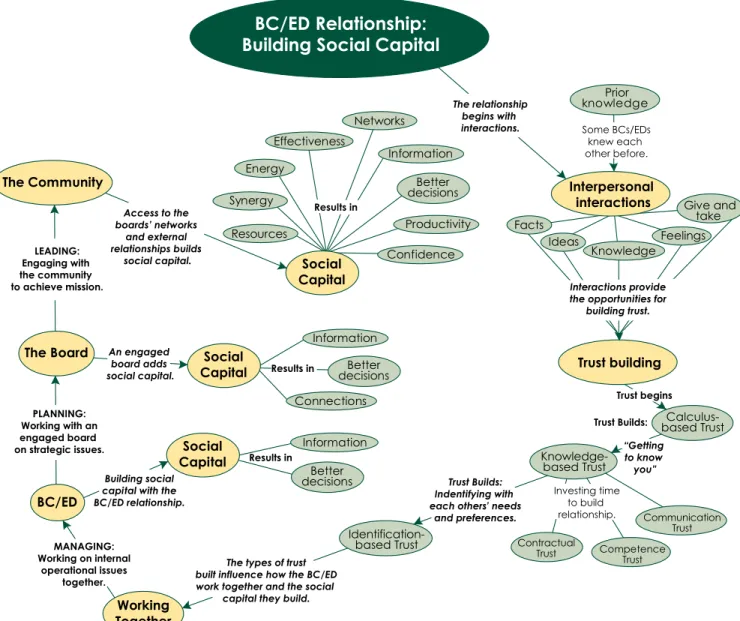
Figure 3. Shows the relationships among all of the findings discussed.
Interpersonal interactions Trust building Calculus-based Trust Facts Ideas Knowledge Feelings Identification-based Trust Knowledge-based Trust Contractual
Trust Competence Trust
Communication Trust BC/ED The Board The Community Social Capital Social Capital Social Capital Give and take Prior knowledge Confidence Productivity Better decisions Better decisions Better decisions Information Information Information Networks Synergy Resources Connections Energy Effectiveness LEADING: Engaging with the community to achieve mission. Access to the boards’ networks and external relationships builds social capital. An engaged board adds social capital. Interactions provide the opportunities for
building trust.
Trust Builds: Indentifying with each others’ needs
and preferences.
“Getting to know you”
The types of trust built influence how the BC/ED work together and the social
capital they build.
The relationship begins with interactions.
Building social capital with the BC/ED relationship. PLANNING: Working with an engaged board on strategic issues. MANAGING: Working on internal operational issues together.
BC/ED Relationship:
Building Social Capital
Working Together Results in Some BCs/EDs knew each other before. Investing time to build relationship. Results in Trust begins Trust Builds: Results in
Trust-building was the primary dynamic in the board chair-executive relationships studied. The nonprofit governance literature emphasizes the importance of trust for an effective board chair-executive relationship but falls short of detailing the interpersonal dynamics and specific behaviors that actually build trust. General statements that information sharing and/or communication are important to the board chair-executive relation-ship do not reflect the nuances of the relationrelation-ship dynamics. The great relationships all demonstrated identification-based trust. Identification-based trust reflects a closer, more personal relation-ship. Understanding these nuances can give board chairs and executives the tools they need to build a great not just a good relationship; to value, not avoid, a more appropriate personal dimension to their interactions. Building a personal connection between the board chair and the executive direc-tor is not only desirable, but contributes to creating social capital.
The leading board chairs were very involved and had frequent, direct contact with staff with whom they worked on specific and varied projects. Contrary to the common view that this type of hands-on, board involvement is characteristic of younger, less sophisticated nonprofits, these participants chaired some of the largest, oldest and best-known nonprofits in the study. Open access to staff was cited several times by board chairs as a source of trust in the executive.
The social capital generated by study pairs resulted in numerous benefits for the organizations. These included: energy, productivity, synergy, links to numerous networks, access to information, and improved decision-making. This study reinforces those who note that nonprofit organizations are uniquely suited to maximizing the potential and promise social capital offers organizations (Chait, Ryan & Taylor, 2005; King, 2004). From generat-ing more productive work within the organization to building critical, richly resourceful relationships with stakeholders, nonprofit organizations have
the opportunity to offer meaning and connection which attracts and builds social capital.
Purposeful attention to relationship building can increase social capital. It was interesting that the majority of study participants indicated that they did not think about working on the relationship— as compared to working on the business of the organization. In the words of one executive: “You forget it’s a relationship.” This is particularly sur-prising given the adamant affirmations of the importance of the relationship to the organization by almost every study participant. If, as the find-ings suggest, the creation of social capital was an unconscious byproduct of a high-trust relation-ship, it suggests that the potential for social capital creation in the study nonprofit organizations was even greater and unrealized.
Relationship building takes time and skill. Failure to recognize the potential and value of social capital for the nonprofit organizations they serve, results in the investment of board chair and executive’s energies and attention elsewhere. The multiple, competing demands they encounter require pur-poseful, strategic thinking in considering where to invest for the best social capital return. This study highlights that one of the first places to invest is in their own relationship.
IMPLICATIONS FOR PRACTICE
Nonprofit leaders need to recognize that the board chair-executive director relationship is an impor-tant and powerful resource that can be leveraged in support of the organization’s mission. They need to promote and engage in dialogue about how to best develop and nurture it. Board chairs and executives should focus on their relationship, rec-ognizing that building the relationship itself is an important component of their work together. Nonprofit leaders need to ensure that the impor-tance of this leadership dyad is reflected in the practices of board chair selection, terms of office, expectations of executives, and board leadership
References
Bigley, G. A., & Pearce, J. L. (1998). Straining for shared meaning in organization science: Problems of trust and distrust. The Academy of Management Review, 23(3), 405.
Brown, W. (2000). Organizational effectiveness in nonprofit
human service organizations: The influence of the board of directors. Unpublished doctoral dissertation,
Claremont Graduate University, Claremont, California. Chait, R., Ryan, W. P., & Taylor, B.E. (2005). Governance
as leadership: Reframing the work of nonprofit boards.
Hoboken, NJ: John Wiley & Sons.
Cohen, D., & Prusak, L. (2001). In good company: How social
capital makes organizations work. Boston: Harvard
Business School Press.
Coleman, J. (1990). Social capital. In Foundations of
social theory (pp. 300-321). Cambridge: Harvard
University Press.
Eadie, D. C. (2001). The board-savvy CEO. Washington, D.C.: BoardSource.
Howe, F. (2004). The nonprofit leadership team: Building
the board-executive director partnership. San Francisco:
Jossey-Bass.
King, N. K. (2004). Social capital and nonprofit leaders.
Nonprofit Management & Leadership, 14(4), 471-486.
Lechem, B. (2002). Chairman of the board. New Jersey: John Wiley & Sons.
Lewicki, R. J., & Bunker, B. B. (1996). Developing and maintaining trust in work relationships. In R. M. Kramer & T. R. Tyler (Eds.), Trust in organizations (pp. 114-139). Thousand Oaks: SAGE.
Light, P. C. (2002). Pathways to nonprofit excellence. Washington, D.C.: The Brookings Institution. Lin, N. (2001). Social capital: A theory of social structure
and action. New York: Cambridge University Press.
Miller-Millesen, J. L. (2003). Understanding the behavior of nonprofit boards of directors: A theory-based approach. Nonprofit and Voluntary Sector Quarterly, 32(4), 521-547.
Mishra, A. K. (1996). Organizational responses to crisis. In R. M. Kramer & T. R. Tyler (Eds.), Trust
in organizations: Frontiers of theory and research.
Thousand Oaks: SAGE.
Reina, D. S., & Reina, M. L. (1999). Trust & betrayal in
the workplace: Building effective relationships in your organization. San Francisco: Berret-Koehler Publishers.
Sheppard, B. H., & Tuchinsky, M. (1996). Micor-OB and the network organization. In R. M. Kramer & T. R. Tyler (Eds.), Trust in organizations: Frontiers of theory and
development. Several board chairs interviewed indicated that their boards spend more time con-cerned about who to bring on the board and how, than they spend on determining leadership suc-cession—who will be the next board chair and why? And, what is the executive director’s role in the process? Although board chairs and executives alike felt positive about their current relationships, the study yielded over twenty stories from them about the times the relationships of the past had not worked and what a negative impact it had for the organization.
Nurturing relationships and establishing and sustaining trust is strategic work essential to orga-nizational effectiveness. The power and potential of relationships must be more broadly recognized and promoted. The importance of connection, caring and meaning should not be lost in an over-emphasis on more “business-like” practices and claims of harried busyness. Trustworthiness is the basis of effective leadership. Nonprofit leaders are stewards of the well-being of individuals and our communities: board chairs and executive directors comprise the key leadership fulcrum of nonprofit organizations. It is a myth that what is personal is not professional and what is professional is not personal. The potential to leverage the board chair-executive director relationship and increase nonprofit organizations’ stock of meaningful, pro-ductive relationships, (i.e. social capital) is great and unrealized. Building and nurturing this rela-tionship must be a priority. n