Security
In An Object-Oriented
Database
James M. Slack
Computer
and Information
Sciences Department
Mankato State University
Mankato,
Minnesota
56002
Abstract
Much of the research in security for object-oriented
databases follows the traditional lines of discretionary
access control, mandatory access control, and multi-
level secure database systems. In this position paper,
our premise is that security and integrity can be im-
plemented in the object-oriented database model. We
propose extensions to the basic data model to incor-
porate security and integrity. Our secrecy/integrity
mechanism is based on the idea that objects are parti-
tioned into protected groups. An object in a protected
group is restricted in the messages it can accept and send.
1
Introduction
Much of the research in security for object-oriented
databases follows the traditional lines of discretionary
access control, mandatory access control, and multi-
level secure database systems. Our premise is that se- curity and integrity can be implemented in the object- oriented database model. We propose extensions to the basic data model to incorporate security and in- tegrity.
In [13], we proposed the notion of a one-way pro-
tected group. A one-way protected group is a set of
one-way protected objects, where each one-way pro- tected object in the group will accept messages only from a distinguished object in the group called the in-
terface object. We showed that a one-way protected group can support data integrity and access integrity as well as access rights based on need-to-know.
We propose a two-way protected group as an ex-
tension of a one-way protected group. The additional
restriction in a two-way protected group is that each
object in the group can only send messages to the interface object of that group. Thus, each implemen- tation object may only communicate with its interface object. We assume each object (including all methods and attributes) will be assigned a single security classi- fication. Millen and Lunt have shown this assumption is flexible enough to allow the enforcement of realistic
security policies [ll]. The model does not depend on
an underlying operating system security kernel, there-
fore, it assumes a trusted object-oriented database
system. The database system could be divided into trusted and untrusted portions, where the trusted por- tion implements the protected group mechanism. Al-
ternatively, the system could be implemented over a
trusted kernel in a conventional approach (e.g., [lo]).
2
Object-Oriented
Database
Model
We assume an object-oriented database model
based on [4, 8, 121:
Object and object identifier. Entities in the real world are modeled as objects in the database. The system assigns each object a unique object identifier.
Attributes and methods. Each object encapsulates
a state and a set of behaviors. The state of an
object is represented by a set of attribute val-
ues. Each attribute value may be a value from
a primitive class (e.g., real, integer, string, etc.),
an object identifier, or a collection. (A collection
can be a set or list of object identifiers.) The be-
havior of an object is defined by a set of methods.
The methods of an object are externally visible;
attributes are not. Therefore, the only way to ac- cess or manipulate an attribute in an object is to invoke one of the object’s methods.
Messages. To invoke a method in an object? a message must be sent to the object requestmg invocation of the method. A message is an object; specifically, each message is an instance of class message.
Classes and instances. A class groups a collection of objects which have the same set of methods and attributes! but which may differ in the values of
those attributes. Each object in such a collection
is an instance of the class.
Class hierarchy and inheritance. Each class may inherit the methods and attributes of other classes. The resulting structure is restricted to be a directed acyclic graph.
We define a class object as 4-tuple consisting of an
identifier for the class, a set of attribute-class pairs,
a set of methods, and a set of class object identifiers from which this class inherits additional methods and
attributes. We define an instance object as a 3-tuple
consisting of an identifier for the instance, a set of
attribute-value pairs, and a class object identifier. Fig-
ure 1 shows an example of the class teachingAssistant
and the instance joe.
Pemxission to copy without fee all or pari of this maaial is granted, provided that the copies are not made or distributed for dust commercial advanlegc. the ACM copyright notice and the tide of the publication and
Identifier: ioe
Attribs: {(Name:‘Joe’),(lU#:394),(Percent:0.40)~ Class: teachtn .qAsscstant
Figure 1: The class object teachingAssistant and the instance object joe.
A subject is an instance object which has the ability to start a message spontaneously. Each user is repre- sented by a subject in the database. There may be other subjects in addition to users, e.g., triggers [6].
A message is an instance of the class message where the attributes of a message include:
b FromObj: the object identifier of the source of
the message,
b ToObj: the object identifier of the target of the message,
b ACI: access control information for the subject
which started the message chain, i.e., the se- quence of messages which resulted m this message being sent from FromObj,
b MethodName: the name of the method in ToObj to be invoked,
b Parameters: MethodName.
a list of parameters to send to
The I methods in class message include SendMessage, ReceiveMessage, SetACI, and GetACI. The attribute AC1 contains access control information for the orig- inating subject. The particular access control infor- mation in use depends on the security and integrity model, e.g., the user identifier for discretionary ac- cess control or Clark-Wilson integrity, security level for mandatory access control. Methods SetACI and GetACI are privileged operations; only certain objects that are registered with the system may invoke them. A spontaneous message (i.e., sent by a subject) does not contain access control information. AC1 is set to null in this case. Any other message contains the ac- cess control information of the message which invoked the associated method.
A return message is a message which contains a return value (i.e., an object identifier) as a parame- ter. The parameter list may also contain other values which identify the message as a return message. It is up to the method language to distinguish return mes- sages from other messages, based on the parameter list.
3
Protected
Groups
Our secrecy/integrity mechanism is based on the idea that objects are partitioned into protected groups. A one-way protected group is a set of one-way pro- tected objects, where each one-way protected object in the group will accept messages only from a distin- guished object in the group called the interface object. In a two-way protected group, each object in the group can only send messages to the interface object of that group. Thus, each implementation object may only communicate with its interface object.
3.1
One-way
Protected
Groups
Each one-way protected group has one or more in- terface objects which accept messages from any source. All other objects in the group are implementation ob- jects. An implementation object is hidden from exter- nal view and only accepts messages from an interface object of the same group.
Each object is augmented with the interface object identifier from which that object will accept messages. If this field is null, then the object will accept mes- sages from any source. This additional information is inherited by subclasses and instances. The approach assumes that the system guarantees the integrity and secrecy of messages.
3.2
Two-way
Protected
Groups
A two-way protected group is a one-way protected group in which each object may only communicate with an int,erface object of the same group. An inter- face object of one group may be an implementation object in another group. A one-way protected object restricts incoming messages; a two-way protected ob- ject restricts incoming and outgoing messages.
Each object is augmented with the set of identi- fiers of objects with which it can communicate. This set of identifiers is the communications set of the ob- ject. If the communications set is null, then the object
can communicate with any object. Each two-way pro- tected group consists of one or more interface objects and a set of implementation objects. Each implemen- tation object is allowed to communicate only with the group’s interface object(s). Each interface object is able to communicate with any implementation object in the group.
The interface object can communicate with any ob- ject in the group if its communications set includes an identifier for each implementation object, or if its com- munications set is null.
In either a one-way or two-way protected group, an implementation object will only accept messages from its interface object. A two-way protected group is stronger than a one-way protected group: an imple- mentation object must send all messages to its inter- face object; there is no such restriction in a one-way protected group.
Note that an object can be an interface object of one group and an implementation object of another. This allows the construction of a lattice of protected groups. Such a lattice could be the basis for a manda- tory access control mechanism.
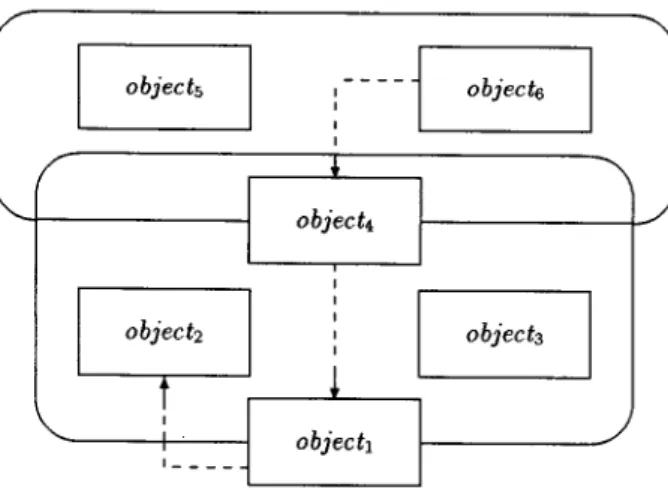
Figure 2 shows a conceptual example of a pair two- way protected groups. The arrows represent messages
Figure 2: A conceptual view of a pair of two-way pro- tected groups.
sent between objects. In this example, objecti is an interface object for the bottom group, and object4 is an interface object for the top group. Notice that object4 is also an implementation object in the bottom group. A message sent from an object in one two- way protected group to an object in the other two- way protected group must pass through the interface objects of both groups.
4
Secrecy/Integrity
Mechanism
A combined secrecy/integrity mechanism can be constructed based on the notion of protected groups. We assume that the system identifies and authenti- cates subjects, that the system can hide the existence of any object (e.g., classes, instances, subjects, mes- sages) from any other object, and that a method can return a value that is indistinguishable from the “ob- ject not found” return value from the system.
The secrecy and integrity of a protected group of objects is based in the interface object for that group. The interface object is the only object in the group which is allowed to invoke the methods GetACI and SetACI in method message, i.e., it is registered with the system for this privilege.
When the interface object receives a message from some other object, that message either contains the access control information of the originating subject, or it contains no access control information, but does contain the object identifier of the source of the mes- sage.
In the first case, the access control information is known. In the second case, the interface object can ob- tain the access control information based on the object identifier of the source of the message. The interface object can then set all further messages in this mes- sage chain to contain the access control information of the originating subject. If the source of the message is not a valid subject, the interface object can reject the message.
The interface object also has access to the access control information of the target object of the mes- sage. This access control information may be stored in the object as additional attributes or in a separate object within the protected group. Using the access control information of the subject and the target ob- ject, the interface object can use the following general outline for each of its methods:
METHOD MethodName (Target, OtherParameters)
BEGIN
IF GetACI is-null THEN
SetACI (access control information of source object)
ENDIF
IF GetACI compares-favorably-with Target.ACI THEN
Invoke Target.MethodNcame (OtherParameters)
ELSE
RETURN (‘Object not found’) ENDIF
END
In this approach, secrecy is a precondition that must be satisfied before access is allowed. The implementation of the comparison operator com- pares-favorably-with depends on the secrecy mecha- nism and the type of access control information.
The implementation of traditional discretionary ac- cess control is straightforward in this setting. Only one-way protected groups are required. A class auth is included in the protected group. This class is respon- sible for checking whether a subject si is authorized to invoke a method m. On receipt of a message, the interface object uses auth to determine whether the source of the message is authorized to invoke the given method. Both grant/give-grant and cascading revoca- tions can be implemented by incorporating more in- formation into auth instances.
Clark-Wilson [5] integrity can be enforced with the one-way protected group approach in the following way. Methods in the interface object are the TPs and objects in the protected group are the CDIs. Access triples are stored in class auth. This is admittedly sim- plistic; more work needs to be done to further develop this approach. Another way to enforce Clark-Wilson style integrity is the Generalized Framework for Access Control;[3, 1, 2, 9] this can be applied to the object- oriented data model based on protected groups.
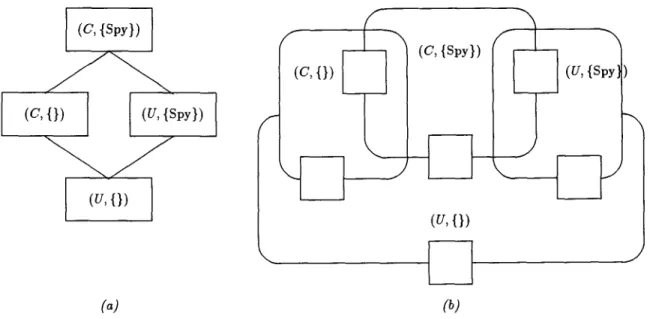
Mandatory access control can be enforced in the fol- lowing way. Let L(g) be the security level of g. Form a two-way protected group for each security level. For any pair of two-way protected groups gr, gz such that L(gi) > L(gz), create an interface object I for gi and make I an implementation object in gz. Object I may be protected by discretionary access control using the interface object in group g2. Figure 3(b) shows how this approach works for the security lattice in Figure 3(a). Each small square represents an inter- face object. A message may be sent from (V, {}) to
a message may not be sent directly (U, {Spy}) or vice versa.
\ / \ ’ (C,{SPYl) f ’ (C, 0) P, {SPY)) \ w 0) / (b) /
(4
Figure 3: Mandatory access control using two-way protected groups. (a) A sensitivity level lattice. (b) Imple-
mentation using two-way protected groups.
This approach does not prohibit “write down” or
“read up” , although this can be prevented in any given
implementation. It is advantageous to allow certain
“write down” and ‘(read up” operations, depending on the subject and the method invoked. One common application is the degrading of classified material. Un-
like the traditional Bell-LaPadula approach, there is
no need to step outside the model for these operations. (This is similar to the approach taken by Abrams, et al. in [l].)
In an object-oriented database model, access in-
tegrity is simply a special case of secrecy where the
controlled method is state-changing. With access in-
tegrity, the subject’s access control information must
compare favorably with the target object’s access con-
trol information before the method is invoked.
5
Future
Work
In this paper, we have shown one way security and
integrity can be implemented in the object-oriented
database model. We proposed extensions to the ba- sic data model to incorporate security and integrity.
These extensions partition objects partitioned into
protected groups. An object in a protected group is restricted in the messages it can accept and send.
Additional work needs to be done to make this ap-
proach viable. In particular, the trusted computing
base must be specified. This is important because as-
surance is spread out rather than isolated within a
kernel. An anonymous reviewer stated the opinion
that interface objects must be part of the Reference
Validation Mechanism, so the flexibility in setting the
AC1 is removed. This is certainly true with the cur-
rent certification and validation mechanism. However,
we take the view that this mechanism is inflexible
and should be modified. Hosmer’s multipolicy model
makes a good case for a new certification mechanism
171.
We also need to show in more detail how security
and integrity policies can be implemented with pro-
tected groups. For example, enforcement of Clark-
Wilson integrity and the Generalized Framework for
Access Control were sketched out in this paper; they need fleshing out.
One of the anonymous reviewers mentioned the “gazillion problem:” that the number of security clas-
sifications can become extremely large. In our ap-
proach, a protected group is necessary for each classi- fication. We must deal with this potential proliferation of protected groups somehow.
Acknowledgments
This work was partially supported by Department
of Defense grant #5-30296 and a Faculty Research Grant from the Graduate School at Mankato State
University. The author wishes to thank John Camp-
bell and Howard Stainer for their support and encour- agement. This does not necessarily reflect the views of these people.
References
[l] Marshall D. Abrams, Kenneth W. Eggers,
Leonard J. LaPadula, and Ingred M. Olson. A generalized framework for access control: An in-
formal description. In 13th National Computer
Security Conference, October 1990.
[2] Marshall D. Abrams, Jody Heaney, Osborne
King, Leonard J. LaPadula, Manette Lazear, and Ingred M. Olson. Generalized framework for ac-
policy. In 14th National Computer Security Con- ference, October 1991.
[3] M.D. Abrams, A.B. Jeng, and I.M. Olson. Unified access control: An informal description. Tech- nical Report MTR89W00230, MITRE Corpora- tion, September 1989.
[4] R.G.G. I(Z,atejuctEe,Xt generation, database sys- tems: Communacataons of the ACM, 34(10):30-33,‘October 1991.
[5] D.D. Clark and D.R. Wilson. A comparison of commercial and military/computer security poli- cies. In IEEE Proceedings of 1987 Symposium on Security and Privacy, April 1987.
[6] K. P. Eswaran. Specifications, implementations, and interactions of a trigger subsystem in an in- tegrated database system. Technical Report Re- search Report RJ1820, IBM, San Jose, California, August 1986.
[7] Hillary H. Hosmer. The multipolicy paradigm. In Proceedings of the 15th National Computer Se-
curity Conference, pages 409-422. NIST/NCSC, October 1991.
[8] Won Kim. Object-oriented databases: Defini- tion and research directions. Transactions on Knowledge and Data Engineering, 2(3):327-341, September 1990.
[9] Leonard J. LaPadula. Formal modeling in a gen- eralized framework for access control. In The Computer Security Foundations Workshop, III, June 1990.
[lo] Teresa Lunt, Dorothy Denning, Roger Schell, and William Shockley. The SeaView formal security policy model. Technical Report SRI Project 1143, A007: Final Report, Volume 2, SRI International, Menlo Park, CA, February 1989.
[ll] Jonathan K. Millen and Teresa F. Lunt. Security for object-oriented database systems. In Sympo- sium on Research in Security and Privacy. IEEE, May 1992.
[12] James M. Slack and Elizabeth A. Unger. A for- mal model of object structure and inheritance for object-oriented database systems. In Proceed-
ings of Great Lakes Computer Science Confer- ence, Kalamazoo, Michigan, October 1991.
[13] James M. Slack and Elizabeth A. Unger. Pro- tected groups: An approach to integrity and se- crecy in an object-oriented database. In 15th Na- tional Computer Security Conference, Baltimore, October 1992. NIST/NCSC.