Contents lists available atScienceDirect
Psychoneuroendocrinology
j o u r n a l h o m e p a g e :w w w . e l s e v i e r . c o m / l o c a t e / p s y n e u e n
Exogenous testosterone in women enhances and inhibits competitive
decision-making depending on victory–defeat experience and trait
dominance
Pranjal H. Mehta
a,∗, Veerle van Son
b, Keith M. Welker
c, Smrithi Prasad
a, Alan G. Sanfey
b,
Ale Smidts
d, Karin Roelofs
baUniversity of Oregon, 1227 University of Oregon, Eugene, OR 97403, USA
bRadboud University, Donders Institute for Brain, Cognition and Behaviour, Centre for Cognitive Neuroimaging, Kapittelweg 29,Nijmegen 6525 EN, The Netherlands
cUniversity of Colorado Boulder, Department of Psychology, 325 UCB, Boulder, CO 80309, USA dErasmus University, Postbus 1738, Rotterdam 3000 DR, The Netherlands
a r t i c l e i n f o
Article history:Received 11 June 2015
Received in revised form 7 July 2015 Accepted 7 July 2015 Keywords: Testosterone Competition Dominance Victory Defeat Decision-making
a b s t r a c t
The present experiment tested the causal impact of testosterone on human competitive decision-making. According to prevailing theories about testosterone’s role in social behavior, testosterone should directly boost competitive decisions. But recent correlational evidence suggests that testosterone’s behavioral effects may depend on specific aspects of the context and person relevant to social status (win–lose context and trait dominance). We tested the causal influence of testosterone on competitive decisions by combining hormone administration with measures of trait dominance and a newly developed social competition task in which the victory–defeat context was experimentally manipulated, in a sample of 54 female participants. Consistent with the hypothesis that testosterone has context- and person-dependent effects on competitive behavior, testosteroneincreasedcompetitive decisions after victory only among high-dominant individuals but testosteronedecreasedcompetitive decisions after defeat across all partici-pants. These results suggest that testosterone flexibly modulates competitive decision-making depending on prior social experience and dominance motivation in the service of enhancing social status.
© 2015 Elsevier Ltd. All rights reserved.
Testosterone is theorized to play a role in behaviors implicated in the pursuit of social status, such as competitive behavior (Mazur and Booth, 1998), but the precise role of this hormone in human social behavior remains controversial. One key limitation is that this body of research is comprised primarily of correlational stud-ies. To date, it remains unknown whether testosterone has acausal
influence on human competitive decision-making, and if so, the precise nature of that influence. To identify the causal impact of testosterone on human competitive behavior, the present study combined hormone administration, measures of trait dominance, and a newly developed social competition task in which the con-text was experimentally manipulated. This novel design allowed us to gain a mechanistic understanding about the nature of testos-terone’s influence on competitive decision-making.
∗ Corresponding author at: Department of Psychology, University of Oregon, Eugene, OR 97403, USA.
E-mail address:[email protected](P.H. Mehta).
Prevailing theories suggest that testosterone should directly boost competitive and dominant behaviors during periods of social competition or challenge (Wingfield et al., 1990; Mazur and Booth, 1998; Archer, 2006). Consistent with thischallenge hypothesisis evidence that higher testosterone is positively related to aggres-sive and dominant behaviors across a variety of non-human animal species, especially during times of social instability (Wingfield et al., 1990; Muller and Wrangham, 2004; Archer, 2006; the biosocial model of status makes similar predictions,Mazur and Booth, 1998; see alsoTerburg and van Honk, 2013). Support for the challenge hypothesis has also emerged in human studies as well. Indeed, a compelling line of research demonstrates that testosterone admin-istration enhances neural, attentional, and behavioral responses to social signals of dominance threat (e.g., angry faces,Hermans et al., 2008; Bos et al., 2012; Terburg et al., 2012; Terburg and van Honk, 2013; Goetz et al., 2014; Enter et al., 2014; Radke et al., 2015). Other studies suggest that testosterone administration influences psychological processes implicated in dominance motivation, such as reduced trust and empathy (Hermans et al., 2006; Van Honk http://dx.doi.org/10.1016/j.psyneuen.2015.07.004
et al., 2011; Bos et al., 2010; Boksem et al., 2013). However, incon-sistencies have also begun to accumulate in other research on testosterone and human social behavior (Mazur and Booth, 1998; Archer, 2006; Eisenegger et al., 2011; Carré and Olmstead, 2015). For example, the few human studies that investigated exogenous testosterone’s influence on status-relevant behaviors such as bar-gaining behaviors or aggression have revealed inconsistent results (e.g.,Eisenegger et al., 2009; Zak et al., 2009; Zethraeus et al., 2009; for relevant review seeEisenegger et al., 2011). Although these studies of bargaining behavior used different methods to exogenously administer testosterone and different populations (Eisenegger et al., 2009: female participants with an average age of 25.16 years in Switzerland who were adminstered a single dose of testosterone sublingually;Zak et al., 2009: male participants with an average age of 20.8 years in the United States who were given Androgel®;Zethraeus et al., 2009: postmenopausal women in Sweden between the ages of 50–65 who were administered testos-terone undecanoate daily for four weeks), it remains unclear what factors account for the heterogeneous results across these studies. Collectively, prior research lends some support for the hypothesis that testosterone may enhance competitive and dominant behav-iors, but there are many inconsistent findings.
These inconsistencies may arise because testosterone’s role in status-relevant behavior could depend on key aspects of the con-textand thepersonrelevant to social status. Consistent with this possibility, several correlational studies reveal that testosterone’s role in status-relevant behavior depends on one specific contex-tual factor: whether a prior dominance contest resulted in victory or defeat (Newman et al., 2005; Schultheiss et al., 2005; Josephs et al., 2006; Mehta and Josephs, 2006; Mehta et al., 2008; Carré et al., 2009, 2013). In a study of undergraduate females for example, high basal testosterone was associated with increased compet-itive behavior after victory and decreased competcompet-itive behavior after defeat (Mehta et al., 2008). These results suggest that higher testosterone is related to a drive to attain high status and leads to heightened reactions to rises/drops in status (victory/defeat) within the dominance hierarchy. Higher testosterone predicts increased competitive behavior after victory presumably to rein-force one’s higher status position in the hierarchy, whereas higher testosterone predicts reduced competitive behavior after defeat presumably to avoid further loss of status in the hierarchy (Mehta et al., 2008). Yet other correlational studies that also accounted for wins versus losses and measured testosterone showed differ-ent results (e.g., null direct associations between testosterone and behavior after victory,Mehta and Josephs, 2006; Carré et al., 2009). These inconsistencies suggest that there is unexplained variability in testosterone’s behavioral effects that cannot be accounted for by the victory–defeat context alone.
A possible explanation for these heterogeneous findings is that testosterone’s role in status-relevant behavior may not only becontext-dependent(prior victory–defeat experience) but may also be person-dependent. Trait dominance assesses a person’s self-reported motivation to attain high status positions but does not strongly correlate with endogenous testosterone (Jackson, 1967; Josephs et al., 2006). Researchers have theorized that testosterone is an unconscious marker of dominance motivation (Terburg et al., 2012) that interacts with consciously experienced, self-reported dominance motivation to influence status-relevant behaviors (Slatcher et al., 2011). Consistent with this theorizing, two correlational studies found that testosterone’s associations with mating and aggressive behaviors were stronger among indi-viduals high in self-reported trait dominance. In one study, men reported to the lab in pairs, completed a self-report trait dominance scale, provided saliva samples for testosterone measurement, and engaged in a seven-minute videotaped social interaction with the other male participant as well as an attractive female
confeder-ate (Slatcher et al., 2011). The men were led to believe that this woman was another participant and that she would choose which of the two men she “clicked” with better. Results revealed a null association between endogenous testosterone and self-reported trait dominance, which is consistent with theory and evidence that testosterone influences dominance motivation outside of con-scious awareness (Josephs et al., 2006; Terburg et al., 2012). Instead, endogenous testosterone interacted with self-reported trait dom-inance to predict men’s dominant mating behaviors (e.g., taking control of the interaction, talking about himself). There was a positive association between testosterone and dominant mating behaviors only among men high in trait dominance, but not among men low in trait dominance. In a second study, participants com-pleted a trait dominance questionnaire, were randomly assigned to win or lose in a cognitive contest, provided saliva samples before and after the competition to assess changes in testosterone con-centrations, and then completed a task that measures aggressive behavior (Carré et al., 2009). Results revealed that endogenous testosterone interacted with trait dominance in the victory con-dition only, a social experience indicative of a more dominant position in the hierarchy. A rise in testosterone after victory was related to increased aggressive behavior only among men high in trait dominance but not among men low in trait dominance1.
These two correlational studies suggest that testosterone is posi-tively related to mating and aggressive behaviors among men high in trait dominance, especially after a victory experience. However, no studies to date have investigated whether testosterone inter-acts with trait dominance and prior victory–defeat experience to predict competitive decision-making.
Taken together, these recent studies lend some indirect sup-port for the hypothesis that testosterone’s influence on competitive behavior should depend on status-relevant aspects of both the con-text (prior win–lose experience) and the person (trait dominance). However, the indirect evidence for this hypothesis has been derived
exclusively from correlational data, and results are inconsistent across studies. To date, it remains unknown to what extent testos-terone has a causal impact on human competitive decision-making, and if so, whether this hormonal influence on behavior depends on specific context- and person-factors implicated in social status (win–lose context and trait dominance). Research that delineates the causal pathway between testosterone and competitive deci-sions is critical to elucidating the neuroendocrine mechanisms of status-relevant behavior, but pharmacological studies that test this casual pathway are lacking. We designed a study in which hor-mone concentrations and the social context were experimentally manipulated in order to address these open questions regarding testosterone’s causal role in competitive behavior.
1. Present experiment
The present experiment integrated hormone administration, measures of trait dominance, and a novel social competition task involving context manipulations in order to gain a mechanistic understanding of testosterone’s causal role in competitive behav-ior. Participants competed on ninety rounds of a cognitive task in which victory–defeat context was experimentally manipulated. After each round of competition, participants made a
competi-1Carré et al. (2009)reported null associations between endogenous testosterone and aggressive behavior in women (non-significant main effect and non-significant testosterone×trait dominance interactions), but these null effects may have emerged because of lower measurement validity for salivary testosterone in females (Granger et al., 2004), because women may be less likely to employ aggression as a means for status attainment (e.g.,Archer, 2009), or because of low statistical power (data from 50 women used in the main analyses). We return to the issue of potential sex differences in testosterone’s behavioral effects in the discussion.
tive decision. Our primary analyses tested the causal impact of testosterone administration on competitive decision-making and whether this hormonal influence on behavior depended on prior victory–defeat experience and trait dominance, two factors rele-vant to the pursuit of social status. These research questions build directly on prior correlational studies, which demonstrate that testosterone’s association with status-relevant behavior varies as a function of prior victory–defeat experience and trait dominance (e.g.,Mehta et al., 2008; Carré et al., 2009; Slatcher et al., 2011).
Besides experimentally manipulating the win–lose context, we also manipulated opponent social rank in the competitive task. Participants competed against lower-ranking, same-ranking, and higher-ranking opponents in multiple competitive bouts. Win–lose experience has received substantial empirical attention in prior correlational research on testosterone and competition, but oppo-nent rank has received little empirical attention in this literature even though this factor is related to psychological theories of social hierarchy. The few correlational studies that examined features of the opponent such as opponent skill found some inconsistent associations with testosterone concentrations (e.g.,Bateup et al., 2002; Neave and Wolfson, 2003; see alsoSalvador, 2005; van der Meij et al., 2010), but no prior study to our knowledge has investi-gated whether testosterone interacts with opponent rank to predict status-relevant behaviors such as competitive decision-making. Thus, we conducted follow-up exploratory analyses to determine the extent to which exogenous testosterone’s influence on compet-itive behavior does or does not depend on the opponent’s rank.
2. Methods 2.1. Participants
Fifty-four healthy females recruited at Radboud University Nijmegen participated in the experiment in exchange for monetary compensation. The protocol was approved by the ethics commit-tee at Radboud University. The age range was restricted to control for potential age-related changes in hormone concentrations (age range = 18–30 years,M= 21.6, SD = 2.4). Participants had no his-tory of psychiatric, neurological, or endocrine disease and were not current using corticosteroids. Only women were studied in the present experiment because the pharmacokinetics of this testos-terone administration technique have been well-established in women but not in men (Tuiten et al., 2000), and this decision is in keeping with the bulk of prior testosterone administration studies that have adopted this same dosage and sublingual admin-istration technique (Eisenegger et al., 2011; Bos et al., 2012). Our study design builds upon this existing well-established body of research. We included only women who were taking hormonal contraceptives in order to control potential fluctuation in testos-terone concentrations across the menstrual cycle. The distribution in hormonal contraceptive was as follows: oral (44 women), hor-monal IUD (Mirena) (8 women), progesterone implant (Nuvaring) (1 woman), and Implanon (1 women). During a phone conversa-tion to schedule participants in experimental sessions, participants were instructed not to sign up for experimental sessions during the stop week (when there was no active contraception).
2.2. Procedure
2.2.1. Informed consent and baseline saliva sample
Experimental sessions were scheduled to begin at 1000 h or 1130 h to control for circadian rhythms in hormone concentra-tions. Participants were given an electronic copy of the consent form prior to arrival at the laboratory. Upon arrival, participants were again explained the procedures and provided informed
con-sent. Next standard collection procedures were used to assess endogenous salivary testosterone concentrations (Schultheiss and Stanton, 2009). Participants provided 2.5 mL of saliva in a sterile polypropylene microtubule. The samples were immediately trans-ported to a freezer for long-term storage.
2.2.2. Testosterone administration
Participants then self-administered a single dose of either testosterone or placebo solution sublingually in a double-blind between-subjects design. The testosterone dose consisted of 0.5 mg of testosterone suspended in a clear solution with 0.5 mg of hydroxypropyl--cyclodextrin, 0.005 mL of 96% ethanol, and dis-tilled water. The presence or absence of testosterone was the only difference between the testosterone and placebo solutions. Pre-vious research in which 0.5 mg of testosterone was administered sublingually in women established the pharmacokinetics of this dosage and testosterone administration technique (Tuiten et al., 2000). Specifically, there was a tenfold increase in serum testos-terone levels within 15 min after administration and a return to baseline within 90 min. However, physiological and psychological effects did not peak until approximately 4–6 h after administration. Several pharmacology studies that adopted this dosage and admin-istration technique in females followed by a 4–6 h delay detected robust psychological and behavioral effects (for relevant reviews, seeEisenegger et al., 2011; Bos et al., 2012). Hence, the behavioral testing session in the present experiment began approximately 4.5 h after testosterone or placebo administration.
2.2.3. Trait dominance
Within one hour after the testosterone versus placebo admin-istration, participants completed the Personality Research Form Need for Power scale, a well-validated self-report measure of dom-inance that contains 16 true–false items (Jackson, 1967). Eight of the items are reverse-coded. Example items include “I try to control others rather than permit them to control me.” and “I avoid pos-itions of power over other people.” (reverse-coded). This scale has been used in prior research on endogenous testosterone and its interactions with self-reported dominance (Slatcher et al., 2011). Scores on this scale can range from 0 to 16 and did so in the present study (M= 6.47, SD = 3.69). As reported above, psychological effects of this sublingual testosterone administration technique are not expected until approximately 4–6 h after administration (Tuiten et al., 2000). Consistent with this evidence, testosterone adminis-tration in the present experiment did not influence scores on this self-reported dominance scale compared to placebo (F(1,49) = 0.13,
p= 0.73,2
partial= 0.003. This evidence indicates that these scores
represent trait levels of dominance and do not reflect changes in self-reported dominance motivation in response to the pharmaco-logical manipulation.
2.2.4. Dot estimation competitive task
Participants completed a newly developed dot estimation com-petitive task, which was inspired by prior research on testosterone, competition, and social hierarchies (Mehta et al., 2008; Zink et al., 2008). This novel social competition task was designed to experimentally manipulate prior win–lose experience in a within-subjects design and measure competitive decision-making in response to the manipulation. This design allowed us to test whether exogenous testosterone’s influence on competitive deci-sions depends on the victory–defeat context and trait dominance. This win–lose context manipulation was included to test our main hypotheses, but we also included an exploratory manipulation of the opponent’s social rank on the task (Zink et al., 2008) – either a high-ranking (three-star-player), medium-ranking (two-star player), or low-ranking opponent (one-(two-star player) – to explore
Fig. 1.Design of the competitive task. Participants completed 90 trials of the task ostensibly against 90 other women. The task was presented as “Phase 1—the New Opponents Phase”. In each trial, participants were given up to four seconds to complete the dot estimation problem and received win or lose feedback (experimentally manipulated). Participants then decided whether to (a) compete again against the same opponent on a new dot estimation problem, or (b) complete a new dot estimation problem without competing. Participants were told that these additional rounds of competition or non-competition would occur in “Phase 2—the Re-Challenge Phase”.
whether this contextual factor also moderates the influence of testosterone on competitive behavior.
Participants were told that they would be completing a compet-itive dot estimation in two phases: Phase 1—the New Opponents Phase, and Phase 2—the Re-Challenge phase, and that the goal of the task is to estimate the number of dots on the screen as quickly and accurately as possible. They were informed that they would com-pete against 90 other women in Phase 1, and that these women had previously completed the task and were grouped into three categories based on task performance: one-star players (lowest performing), two-star players (middle performing), and three-star players (highest performing). Participants were further told that they were being assigned a two-star player ranking for now, but that this rank would be updated at the end of Phase 1 and 2. Thus, this paradigm was designed to model an unstable social hierarchy (Zink et al., 2008).
In Phase 1 of the task, participants competed on 90 trials of a cog-nitive dot estimation task ostensibly against these 90 other women who had previously completed the task and had been ranked based on their performance. A trial of the task is shown inFig. 1. In each trial, participants had four seconds to estimate the number of dots that appeared on the screen as accurately and quickly as possi-ble, based on four choices. Participants selected the response that was closest to their estimate with a button press corresponding to their choice. Although participants were led to believe they were competing with other female opponents who had previously com-pleted the task, in reality the task was pre-programmed. The dot estimation problem seen in each round was randomized (Mean number of dots in each trial = 41, SD = 17), and we experimentally
manipulated the outcome of the competition such that participants received feedback that they either won or lost against the other opponent (45 win trials, 45 lose trials) presented in randomized order. Opponent rank (30 trials against one-star player, 30 trials against two-star players, 30 trials against three-trials players) was also experimentally manipulated and randomized across the 90 tri-als of the task. These experimental manipulations resulted in six task conditions for each participant: 15 victory trials against one-star players, 15 victory trials against two-one-star players, 15 victory trials against three-star players, 15 defeat trials against one-star players, 15 defeat trials against two-star players, 15 defeat trials against three-star player.
After receiving feedback that they had either won or lost the competition, participants then decided whether to (a) compete again against the same opponent on a new dot estimation prob-lem, or (b) complete a practice dot estimation problem without competing (Mehta and Josephs, 2006; Carré and McCormick, 2008; Mehta et al., 2008). Participants decided whether to compete again or not (“Yes” or “No”) with a button press correspond-ing to their choice. Participants were told that these additional rounds of competition or non-competition would occur in a second phase of the task that would happen after they had initially competed against all 90 women in the first phase of the task. In reality, participants never completed the sec-ond phase of the task. The percentage of trials after which participants chose to compete again served as our dependent measure of competitive decision-making. Full written instructions for the dot estimation task are provided in the supplementary material.
2.2.5. Affect
Self-reported state positive and negative affect was measured with the Positive and Negative Affect Schedule (PANAS,Watson et al., 1988) at baseline prior to testosterone/placebo administra-tion, four hours later prior to behavioral testing, and at the very end of the experiment. The primary goal of the current experiment was to test the causal impact of testosterone on competitive deci-sions, but these behavioral effects may potentially be influenced by affective responses to testosterone treatment. Indeed, some studies have shown mood-enhancing effects of testosterone administra-tion (Amanatkar et al., 2014) and theories suggest that positive affect may influence competitive, approach-oriented behaviors (Keltner et al., 2003). Thus, we conducted analyses in which we con-trolled affective responses to testosterone treatment. An effect of testosterone treatment on competitive decisions when controlling for affect would rule out mood changes as an alternative explana-tion for our results.
2.2.6. Beliefs about pharmacological manipulation and suspicion check
In line with prior research (e.g.,Eisenegger et al., 2009), we mea-sured whether participants believed they received testosterone or placebo treatment at the very end of the experiment with a forced choice question (“Do you think you received testosterone or placebo? If you are not sure, please guess. Circle your response.”). Participants also filled out open-ended questions regarding the dot estimation to assess their suspicion with the task (e.g., “Did you think anything about the dot estimation task was odd? If so, please describe.”;Mehta and Josephs, 2006; Mehta et al., 2008). Three participants reported that they did not believe that they were com-peting against real people in the dot estimation task. Therefore, these three participants were excluded from our statistical analy-ses.
2.2.7. Hormone assays
After data collection in the study was complete, saliva samples were shipped on dry ice to Clemens Kirschbaum’s laboratory in Dresden, Germany. Saliva samples were analyzed for testosterone in duplicate using a double-antibody luminescence immunoas-say kit (RE62031; IBL International, Hamburg, Germany). The average inter-assay coefficient of variation was 6.48%, and the average intra-assay coefficient of variation was 8.56%. As expected, baseline testosterone concentrations were not statis-tically different in the experimental groups (testosterone group:
M= 22.11 pg/mL, SD = 11.74; placebo group: M= 22.52 pg/mL, SD = 15.00,t(49) =−0.11,p= 0. 92).
2.3. Statistical analysis strategy
Our primary statistical analyses tested the extent to which testosterone treatment influenced competitive decisions and whether this hormonal influence on decision-making depended on the victory–defeat context and trait dominance. These research questions build on prior correlational studies in which testosterone interacted with prior victory–defeat experience and trait domi-nance to predict status-relevant behavior (e.g.,Mehta et al., 2008; Carré et al., 2009; Slatcher et al., 2011). We used multilevel mod-els to test these questions. As noted by statisticians, multilevel models have advantages in studies when predictor variables are measured or manipulated at more than one level, such as victory versus defeat trial types (Level 1) nested within participants (Level 2) (Garson, 2012). The predictors in our multilevel model were competition outcome (0 = defeat, 1 = victory) as a within-subjects (Level 1) factor along with the Level 2 factors of Testosterone condi-tion (0 = placebo, 1 = testosterone) and Trait Dominance (centered), plus all interaction terms. The dependent variable was the
per-centage of trials in which participants chose to compete again. We also added change in positive affect as a covariate to the model in order to rule out testosterone-induced affective changes as an alternative explanation for our results. To interpret a significant Testosterone×Win–Lose Context×Trait Dominance interaction, we employed theAiken and West (1991)approach in which the intercept and slope estimates from the multilevel model were used to graph competitive decisions after victory and defeat one standard deviation above and below the mean for trait dominance in the placebo and testosterone groups. For an overview of inter-preting statistical interactions, seeAiken and West (1991). Below we describe three follow-up analytical approaches that were used to further investigate the three-way interaction.
2.3.1. Separate analyses of victory and defeat trials
We conducted follow-up multilevel analyses in which we exam-ined the effects of Testosterone condition, Trait Dominance, and their interaction as predictors of competitive decisions separately for victory and defeat trials. This approach allows us to compare our results to prior correlational studies that experimentally manip-ulated victory–defeat context in between-subjects designs and reported separate hormone-behavior results for victory and defeat (e.g.,Carré et al., 2009).
2.3.2. Median split analyses
Although researchers sometimes examine interaction effects by converting continuous variables into categories (e.g., median splits), this technique has significant drawbacks and therefore is not recommended by statisticians (Aiken and West, 1991; Maxwell and Delaney, 1993; Altman and Royston, 2006; MacCallum et al., 2002; Fitzsimons, 2008). One drawback is that the researcher loses information when grouping continuous variables into categories. For example, if a median split is performed on trait dominance lev-els, then an individual just above the median on trait dominance is considered the same as an individual at the very end of the trait dominance distribution. A second drawback is the loss of statistical power with this approach. Despite the weaknesses of this statis-tical approach, in follow-up analyses we conducted median splits on trait dominance scores to determine whether the same pattern of results remained. We included these analyses because we rea-soned that they may be easier to interpret for readers unfamiliar with interpreting interactions in multilevel or standard regression models.
2.3.3. Competitive decisions after victory compared to defeat within individuals
Because the win–lose context manipulation is a within-subjects factor, we also ran analyses in which we directly compared behavioral responses to victory and defeat trials within the same individual. More specifically, we tested whether competi-tive behavior after victory compared to defeat varied as a function testosterone condition and trait dominance scores. We conducted simple slopes analyses (Aiken and West, 1991) in which the param-eter estimates from the multilevel analyses were used to test whether there were statistically significant differences in behav-ioral responses to victory versus defeat one standard deviation above and below the mean on trait dominance for the testosterone and placebo groups.
To further investigate these within-individual behavioral responses to victory versus defeat, we conducted a follow-up multiple-regression analysis in which the dependent variable was the percentage of win trials in which participants chose to compete minus the percentage of loss trials in which participants chose to compete. A positive score indicates that the participant showed a greater propensity to compete again after a victory experience compared to a defeat experience. For example, a participant who
Table 1
Descriptive statistics for main study measures.
Full sample (n= 51) Placebo group (n= 27) Testosterone group (n= 24)
M SD M SD M SD
Trait dominancea 6.47 3.69 6.30 3.45 6.67 4.01
Baseline testosterone (pg/mL) 22.33 13.44 22.52 15.00 22.11 11.74 Positive affect time 1b 24.59 3.91 24.33 3.74 24.88 4.14
Positive affect time 2b 24.12 4.20 23.56 3.81 24.75 4.60
Positive affect time 3b 21.20 4.61 19.70 3.92 22.88 4.82
Negative affect time 1b 15.73 3.20 14.85 2.66 16.71 3.52
Negative affect time 2b 15.45 2.98 15.26 3.19 15.67 2.76
Negative affect time 3b 15.24 3.12 14.85 3.28 15.67 2.93
Competitive decisions (%) 60.66 20.62 64.10 23.68 56.80 16.16 aMeasured with the Personality Research Form Need for Power scale (Jackson, 1967).
bMeasured with the PANAS (Watson et al., 1988). Time 1 = Baseline prior testosterone/placebo administration; time 2 = Approximately 4 h after testosterone/placebo administration prior to the behavioral testing; time 3: At the conclusion of the experiment.
chose to compete on 80% of victory trials and 40% of defeat trials would have score of 40 on this dependent measure (80–40). The key predictors in this analysis were Testosterone condition (0 = Placebo Treatment, 1 = Testosterone Treatment), Trait Dominance (cen-tered), and the Testosterone×Trait Dominance interaction. This statistical approach in which the dependent variable is a difference score is widely employed in studies with repeated measures factors and simplifies interpretation (e.g., studies in which testosterone is exogenous administered in a within-subjects design,Montoya et al., 2013). To interpret a significant Testosterone×Trait Domi-nance interaction, we conducted simple slopes analyses in which the regression model intercept and slopes were used to compare the effect of testosterone versus placebo treatment on competitive decisions one standard deviation above and below the mean for trait dominance (Aiken and West, 1991).
2.3.4. Testosterone and opponent rank
Our main research questions examined the extent to which testosterone interacted with the prior win–lose experience and trait dominance to modulate competitive behavior, but we conducted exploratory analyses in which we tested whether exoge-nous testosterone’s impact on competitive decisions also depended on opponent rank. We added Opponent Rank an additional factor to a multilevel analysis. The predictors in this analysis were Oppo-nent Rank (Lower-ranked, Same-ranked, or Higher-Ranked player) and Competition Outcome (Win or Loss) as within-subjects (Level 1) factors, along with the Level 2 factors of Testosterone condition (0 = placebo, 1 = testosterone) and Trait Dominance (centered), plus
all interaction terms. The dependent variable was the percentage of trials in which participants chose to compete again.
2.3.5. Baseline testosterone and beliefs about the pharmacological manipulation
Finally, we conducted additional analyses to confirm that our results held up when accounting for endogenous baseline testosterone concentrations or beliefs about the pharmacological manipulation.
3. Results
3.1. Descriptive statistics and preliminary analyses
Table 1reports descriptive statistics for the full sample and sep-arately for participants in the testosterone and placebo groups.
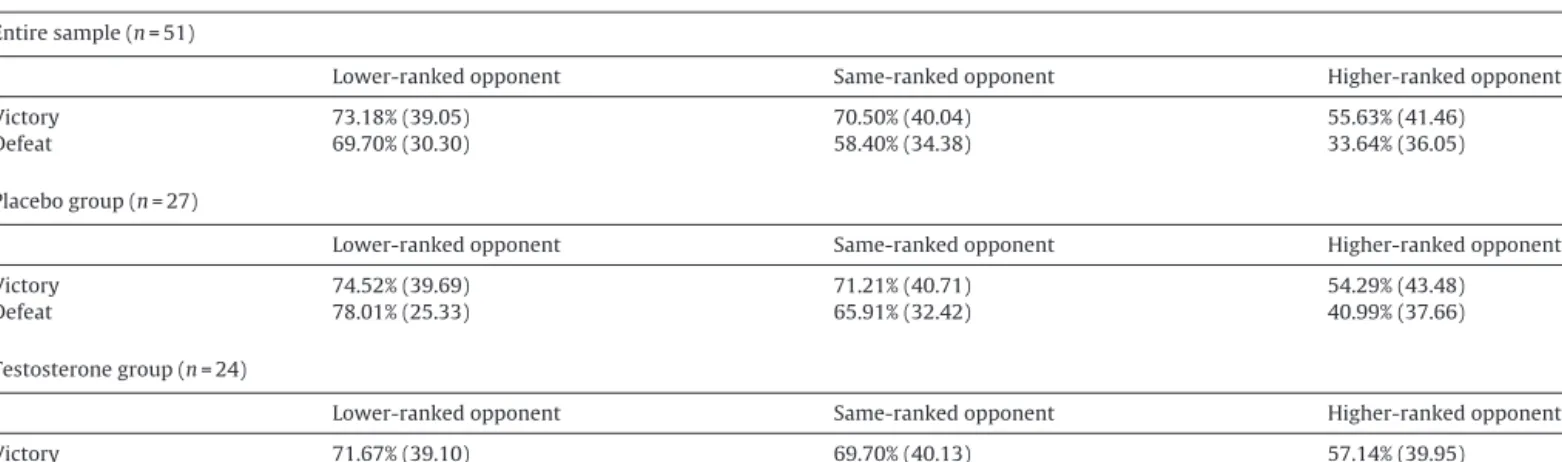
Table 2reports competitive decisions as a function of our two within-subjects experimental manipulations (win–lose experience and opponent rank). There were non-significant differences in trait dominance and baseline testosterone between the testosterone and placebo groups (p’s > 0.10). There were also non-significant effects of testosterone treatment on negative affect (p’s > 0.05), but testosterone treatment increased positive affect compared to placebo from baseline to the end of the experiment (F(2,98) = 4.15,
p< 0.05;2
partial= 0.12;M=−4.63, SD = 3.20; testosterone group: M=−2.00, SD = 3.96). Hence, we included change in positive affect as a covariate in our primary analyses in order to rule out testosterone-induced mood changes as an alternative explanation for the results (see below).
Table 2
Descriptive statistics for competitive decisions (percentage of trials in which participants chose to compete) as a function of competition outcome (victory versus defeat experience) and opponent rank (lower-ranked opponent, same-ranked opponent, or higher-ranked opponent). Means are reported followed by standard deviations in parentheses.
Entire sample (n= 51)
Lower-ranked opponent Same-ranked opponent Higher-ranked opponent
Victory 73.18% (39.05) 70.50% (40.04) 55.63% (41.46)
Defeat 69.70% (30.30) 58.40% (34.38) 33.64% (36.05)
Placebo group (n= 27)
Lower-ranked opponent Same-ranked opponent Higher-ranked opponent
Victory 74.52% (39.69) 71.21% (40.71) 54.29% (43.48)
Defeat 78.01% (25.33) 65.91% (32.42) 40.99% (37.66)
Testosterone group (n= 24)
Lower-ranked opponent Same-ranked opponent Higher-ranked opponent
Victory 71.67% (39.10) 69.70% (40.13) 57.14% (39.95)
Table 3
Multi-level model for competition outcome (Level 1), testosterone treatment (0 = placebo, 1 = testosterone) (Level 2), trait dominance (centered) (Level 2), and all interactions as predictors of competitive decisions (% compete again).
95%CI
B SE df t p Lower Upper
Constant 71.92 5.90 53.15 83.13
Positive affect change 1.02 0.73 46.00 1.407 0.166 −0.44 2.49 Competition outcome −2.57 8.84 47.00 −0.291 0.773 −20.36 15.22 Testosterone condition −17.02 7.32 49.67 −2.325 0.024 −31.72 −2.31
Trait dominance −6.47 5.16 46.76 −1.255 0.216 −16.85 3.90
Testosterone×outcome 12.55 12.90 47.00 0.973 0.336 −13.41 38.51 Testosterone×dominance −4.28 7.00 46.81 −0.612 0.544 −18.35 9.80 Competition uutcome×dominance −3.15 9.41 47.00 −0.335 0.739 −22.08 15.78 Testosterone×outcome×dominance 29.63 12.76 47.00 2.322 0.025 3.96 55.29
Note: The main effect of testosterone condition in this analysis should be interpreted with caution because an independent samplest-test revealed a non-significant effect of testosterone on competitive decisions (see Section3.1in the main text) and because this effect was further qualified by a Testosterone×Competition Outcome×Trait Dominance interaction.
Inconsistent with the hypothesis that testosterone directly boosts competitive behavior, an independent samples t-test revealed that the testosterone (M= 56.80%, SE = 3.30) and placebo groups (M= 64.10%, SE = 4.56) did not statistically differ in over-all rates of competitive decisions (percentage of over-all trials in which participants chose to compete again;t(49) = 1.27,p= 0.21; Cohen’s d = 0.36). This non-significant direct effect of testosterone on com-petitive behavior is consistent with recent correlational research (Mehta et al., 2008, 2009; Carré et al., 2009).
3.2. Effects of testosterone treatment, win–lose context, and trait dominance on competitive decisions
Building on prior correlational studies (e.g.,Mehta et al., 2008; Carré et al., 2009; Slatcher et al., 2011), our primary analyses tested the extent to which the causal impact of testosterone on competitive decisions depended on the win–lose context and trait dominance. We conducted a moderated multilevel linear model analysis with trial types (Level 1) nested within par-ticipants (Level 2). The predictors were competition outcome (0 = defeat, 1 = victory) as a within-subjects (Level 1) factor along with the Level 2 factors of Testosterone condition (0 = placebo, 1 = testosterone) and Trait Dominance (centered), plus all inter-action terms. The dependent variable was the percentage of trials in which participants chose to compete again (see Sec-tion2.3for rationale for this statistical approach). In agreement with the hypothesis that testosterone has context- and person-dependent effects on competitive behavior, this analysis revealed a statistically significant Testosterone Treatment×Competition Out-come×Trait Dominance interaction (b= 29.63, 95% CI [3.96, 55.30],
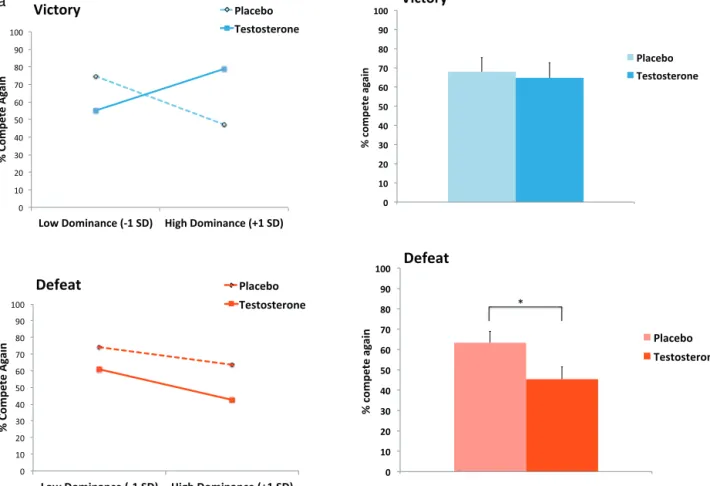
t(47) = 2.32,p= 0.025). In order to rule out testosterone-induced mood change as an alternative explanation for these results, we conducted another multilevel analysis in which change in posi-tive affect was added as a covariate. Once again, the Testosterone Treatment×Competition Outcome×Trait Dominance interaction emerged (b= 29.63, 95% CI [3.96, 55.29],t(47) = 2.32,p= 0.025). The full multilevel model is shown inTable 3. The parameter estimates from the model were used to depict competitive decision-making predicted scores one standard deviation above and below the mean on trait dominance for the testosterone and placebo groups (Fig. 2Column A;Aiken and West, 1991; see also Section2.3for more information on interpreting statistical interactions). We also graphed the effect of testosterone versus placebo on average com-pete rates after victory and average comcom-pete rates after defeat across all participants (ignoring trait dominance scores) (Fig. 2 Col-umn B).
3.2.1. Separate analyses of victory and defeat trials
To interpret the Testosterone×Win–Lose Context×Trait Dom-inance interaction and determine whether the effects of testosterone on competitive behavior were independent from testosterone-induced changes in positive affect, we conducted follow-up multilevel analyses on competitive decisions for vic-tory and defeat trials separately. This approach also allows us to compare our results to prior correlational studies that conducted separate hormone-behavior analyses in the victory and defeat con-ditions (e.g.,Mehta et al., 2008; Carré et al., 2009). These analyses are reported inTable 4. The first model reported inTable 4includes positive affect change, Testosterone Condition, Trait Dominance, and the Testosterone×Trait Dominance interaction as predictors of competitive decisions after victory. Consistent with upper panels of
Fig. 2, this analysis revealed no main effects and a statistically signif-icant Testosterone×Trait Dominance interaction (b= 23.97, 95% CI [4.28, 43.67],t(46) = 2.45,p= 0.018). As reported in the correlation matrix inTable 5, there was a positive association between trait dominance and competitive decisions after victory in the testos-terone group, but this effect did not emerge in the placebo group. This pattern indicates that testosterone treatment increased the propensity to compete again after victory among high-dominant individuals but not among low-dominant individuals. This pattern is highly consistent with the results of a prior correlational study, which also found a Testosterone×Trait Dominance interaction in the victory condition (Carré et al., 2009).
The second model reported inTable 4includes Positive Affect change, Testosterone Condition, Trait Dominance, and the Testos-terone×Trait Dominance interaction as predictors of competitive decisions after defeat. This analysis revealed only a statistically sig-nificant main effect of Testosterone (b=−16.86, 95% CI [−33.70,
−1.01],t(46) =−2.14,p= 0.038). As shown inFig. 2, testosterone administrationreducedthe percentage of trials in which partici-pants chose to compete again after defeat (M= 45.44%, SE = 5.99) compared to placebo (M= 63.34%, SE = 5.62) across all participants. This direct effect of testosterone on reduced competitive decisions after defeat closely overlaps with the results of a prior correla-tional study, which found that higher endogenous testosterone was related to reduced competitive decisions after defeat (Mehta et al., 2008). The pattern suggests that the effect of testosterone on a decreased propensity to compete again after defeat was stronger among high-dominant individuals, but not significantly so as indicated by the non-significant Testosterone×Trait Domi-nance interaction. These analyses further elucidate the pattern of the Testosterone×Competition Outcome×Trait Dominance inter-action shown inFig. 2.
a
b
Fig. 2.Panel A. Interactive effects of testosterone condition and trait dominance on competitive decisions, following standard procedures for interpreting statistical inter-actions (Aiken and West, 1991). Panel B. Effects of testosterone versus placebo on competitive decisions after ignoring trait dominance scores. (For interpretation of the references to color in the figure, the reader is referred to the web version of this article.)
Table 4
Follow-up multi-level analyses for testosterone treatment (0 = placebo, 1 = testosterone), trait dominance (centered), and their interaction as predictors of competitive decisions, separately for victory trials and defeat trials.
Model 1. Dependent variable: competitive decisions after victory (% compete again)
95% CI
B SE t(46) p Lower Upper
Constant 69.25 9.40 50.32 88.18
Positive affect change 0.67 1.41 0.477 0.636 −2.16 3.51
Testosterone condition −3.21 10.54 −0.304 0.762 −24.43 18.02
Trait dominance −9.70 7.21 −1.345 0.185 −24.21 4.81
Testosterone×trait dominance 23.97 9.79 2.450 0.018 4.28 43.67 Model 2. Dependent variable: competitive decisions after defeat (% compete again)
95% CI
B SE t(46) p Lower Upper
Constant 71.27 7.02 57.14 85.40
Positive affect change 1.07 1.05 1.019 0.313 −1.04 3.19
Testosterone condition −16.86 7.87 −2.142 0.038 −32.70 −1.01
Trait dominance −4.42 5.38 −0.822 0.415 −15.26 6.41
Testosterone×trait dominance −5.76 7.30 −0.788 0.435 −20.46 8.94
Table 5
Spearman correlations between trait dominance and measures of competitive decision-making.
Full sample Placebo group Testosterone group
(n= 51) (n= 27) (n= 24)
Competitive decisions after victory (%) 0.08 −0.22 0.45*
Competitive decisions after defeat (%) −0.20 −0.14 −0.36†
Competitive decisions – victory minus defeat (%) 0.19 −0.13 0.47* *p< 0.05.
3.2.2. Median split analyses
Next we conducted a median split on trait dominance in order to determine whether similar results emerged with this alternative approach. As reviewed earlier median split analyses have signifi-cant drawbacks compared to a multiple-regression approach such as reduced statistical power (Aiken and West, 1991; see our Sec-tion2.3for discussion on some of the drawbacks), but we reasoned that these analyses may be easier to interpret for readers unfamiliar with interpreting interactions in regression or multilevel analyses (for additional limitations of median splits and for more details on recommended approaches for interpreting interactions such as those reported above, seeAiken and West, 1991; Maxwell and Delaney, 1993; MacCallum et al., 2002; Altman and Royston, 2006; Fitzsimons, 2008). We conducted an analysis of variance in which we entered Testosterone condition, median split Trait Dominance, and the Testosterone×Trait Dominance interaction as predictors of competitive decisions after victory. Replicating the results of prior analyses, there were no main effects but there was a statistically significant Testosterone Treatment×Trait Dominance interaction on competitive decisions after victory (F(1, 47) = 4.22, p= 0.046,
2
partial= 0.08) with a pattern highly consistent with the upper
portion ofFig. 2Column A (placebo treatment in high-dominant individuals:M= 57.73%, SE = 9.34; testosterone treatment in high-dominant individuals:M= 80.00%, SE = 11.44; placebo treatment in low-dominant individuals:M= 77.85%, SE = 10.44; testosterone treatment in low-dominant individuals:M= 57.01%, SE = 9.67).
We conducted a similar analysis for defeat trials. Testosterone condition, median split Trait Dominance scores, change in Positive Affect, and the Testosterone×Trait Dominance interaction were entered as predictors of competitive decisions after defeat. Con-sistent with the previous analyses and with the results shown inFigure 2, this analysis again revealed a main effect of Testos-terone condition (F(1,46) = 5.24,p= 0.027,2
partial= 0.10) such that
testosterone administration (M= 43.86%, SE = 6.15) reduced com-petitive decisions after defeat compared to placebo administration (M= 63.72%, SE = 5.69), as well as a non-significant Testos-terone×Trait Dominance interaction (F(1,46) = 0.68,p= 0.42). The pattern was consistent with the bottom portion ofFig. 2Column A (placebo treatment in high-dominant individuals:M= 63.12%, SE = 7.50; testosterone treatment in high-dominant individ-uals:M= 36.55%, SE = 9.44; placebo treatment in low-dominant individuals:M= 64.32%, SE = 8.31; testosterone treatment in low-dominant individuals:M= 51.18%, SE = 7.63). These median split analyses corroborate the pattern of the Testosterone×Competition Outcome×Trait Dominance interaction on competitive decision-making obtained from the multilevel analyses and as shown in
Fig. 2.
3.2.3. Competitive decisions after victory compared to defeat within individuals
Most prior correlational studies experimentally manipu-lated victory and defeat using between-subjects designs. The analyses reported above are consistent with the analysis approach used in these prior studies (e.g., Carré et al., 2009). The present experiment employed a within-subjects design to manipulate victory–defeat context in which participants won half of the competitions and lost on the other half. Hence, we conducted additional analyses in which we directly com-pared behavioral responses to victory and defeat trials within the same individual. More specifically, we tested whether competitive behavior after victory compared to defeat varied as a function of testosterone condition and trait dominance scores.
Based on the multilevel analyses (reported above), we con-ducted simple slopes tests (Aiken and West, 1991) for individuals one standard deviation above and below the mean on trait domi-nance. These analyses indicated that high-dominant participants
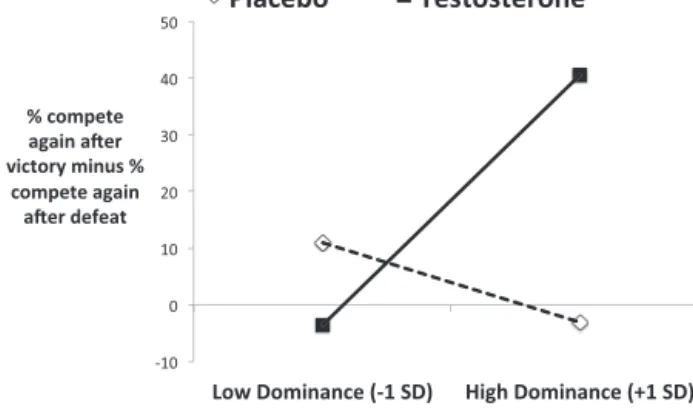
Fig. 3.Interactive effect of testosterone condition and trait dominance on com-petitive decisions after victory minus comcom-petitive decisions after defeat, following standard procedures for interpreting statistical interactions (Aiken and West, 1991).
(+1 SD) who were administered testosterone showed a greater tendency to compete again victory (78.94%) compared to defeat (42.47%) (b= 36.46, SE = 12.29,t(47) = 2.97,p= 0.005), whereas high-dominant participants who were administered placebo did not significantly differ in their behavioral reactions to victory (47.03%) and defeat experience (63.63%) (b=−16.50, SE = 13.09,t(47) = 0.44,
p= 0.664). Low-dominant participants (−1 SD) in both the testos-terone and placebo groups also showed non-significant differences in their behavioral responses to victory and defeat experience (p’s > 0.10; dominant testosterone victory: 54.98% versus low-dominant testosterone defeat: 60.70%; low-low-dominant placebo victory: 74.59% versus low-dominant placebo defeat: 74.01%). Col-lectively, these results indicate that testosterone administration increased the propensity to compete again after victory compared to defeat among high-dominant individuals.
To further investigate these within-individual effects, we also calculated the percentage of victory trials in which a participant chose to compete again minus the percentage of defeat trials in which thesame participant chose to compete again. A posi-tive score indicates a greater propensity to compete again after victory compared to defeat. We conducted a multiple-regression analysis in which we regressed this behavioral measure on to Change in Positive Affect, Testosterone condition, Trait Dominance (standardized), and the Testosterone×Trait Dominance interac-tion. Consistent with the previous analyses, this analysis revealed no main effects and a statistically significant Testosterone×Trait Dominance Interaction (b= 28.15, 95% CI [0.27, 56.03],t(47) = 2.03,
p< 0.05). To interpret this interaction, the regression model slope estimates were used to plot percentage of decisions to compete again after victory minus percentage of decisions to compete again after defeat scores as a function of testosterone and trait dominance (seeFig. 3). See also correlations reported inTable 5.
As shown in Fig. 3 and Table 5, there was a positive asso-ciation between trait dominance and competitive behavior after victory compared to defeat in the testosterone group, but not in the placebo group. Follow-up simple slopes tests (Aiken and West, 1991) also revealed that compared to placebo treatment, testos-terone treatment increased the propensity to compete again after victory relative to defeat among individuals high in trait dominance (+1 SD:b= 41.76, 95% CI [1.61, 81.91],t(47) = 2.09,p< 0.05) but not among individuals low in trait dominance (−1 SD:b=−15.86, 95% CI [−55.95, 24.23],t(47) =−0.80,p= 0.43). The pattern of results shown in Fig. 2 Column A indicates that testosterone’s causal influence on behavioral sensitivity to the prior victory–defeat expe-rience was driven by both anincreasedpropensity to compete again after victory and adecreasedpropensity to compete again after defeat in high-dominant individuals. These analyses further clarify the pattern of results shown inFig. 2.
In summary, our main analyses revealed that the causal impact of testosterone on competitive decisions depended on the victory–defeat context and trait dominance. Testosteroneincreased
competitive decisions after victory only among high-dominant individuals but testosteronedecreasedcompetitive decisions after defeat across all participants. We also found that testosterone enhanced the behavioral discrepancy between choosing to com-pete again after victory compared to defeat in high-dominant individuals.
3.3. Testosterone and opponent rank
Next we conducted follow-up exploratory analyses in which we examined the extent to which the experimental manipulation of opponent rank interacted with testosterone to influence com-petitive decisions. We conducted a moderated multilevel linear model analysis with trial types (Level 1) nested within partici-pants (Level 2). The predictors were Opponent Rank (Lower-ranked, Same-ranked, or Higher-ranked Opponent) and Competition Out-come (Victory or Defeat) as within-subjects (Level 1) factors, along with the Level 2 factors of Testosterone condition (0 = placebo, 1 = testosterone) and Trait Dominance (centered), plus all interac-tion terms. The dependent variable was the percentage of trials in which participants chose to compete again (see Section2.3for rationale for this statistical approach). The full model is reported in the supplemental material (Table S1). This analysis revealed a main effect of Opponent Rank (b=−15.02, 95% CI [−21.22,−8.83],
t(47) =−4.876,p< 0.001) and a marginally significant Opponent Rank×Competition Outcome interaction (b= 6.73, 95% CI [−0.79, 14.24],t(47) = 1.80,p= 0.078)2. As shown inTable 2, participants
were more likely to compete against lower-ranked opponents followed by same-ranked followed by higher-ranked opponents. Participants were also more likely to compete after winning against a ranked opponent compared to losing against a higher-ranked opponent. Crucially, the critical Testosterone×Competition Outcome×Trait Dominance interaction once again emerged in this follow-up analysis (b= 37.75, 95% CI [5.66, 69.83],t(47) = 2.37,
p= 0.022), indicating that our primary result was robust to inclu-sion or excluinclu-sion of the Opponent Rank factor in the statistical model. There were no other significant effects in the model (non-significant interactions between Testosterone condition and Opponent Rank,p’s > 0.10). This analysis indicates that testosterone treatment selectively interacted with prior win–lose experience but not opponent social rank to influence competitive decision-making.
Even though there were non-significant interactions between testosterone and opponent rank, we conducted follow-up analy-ses in which we examined effects of testosterone on competitive decisions for each of the six trial types: defeat again lower-ranked, same-lower-ranked, or higher-ranked opponents; victory against lower-ranked, same-ranked, or higher-ranked opponents. These analyses allowed us to confirm that testosterone’s behavioral effects reported above showed the same general pattern across opponent ranks. In each of these models we included posi-tive affect change, Testosterone Condition, Trait Dominance, and the Testosterone×Trait Dominance as predictors of competitive decision-making. Results of these models can be found in the Supplementary material (Tables S2 and S3, see also Fig. 4). As shown in Table S2, there were statistically significant Testos-terone×Trait Dominance interactions on competitive decisions after victory against lower-ranked opponents (b= 27.39, 95% CI
2This Competition Outcome×Opponent Rank interaction was statistically sig-nificant in simplified analyses with fewer predictors (p< 0.05), suggesting that this is likely a true effect that should be investigated further in follow-up research.
Fig. 4.The effect of testosterone versus placebo treatment on competitive decisions as a function of victory–defeat context and opponent rank across all participants (ignoring trait dominance scores) *p< 0.05.(For interpretation of the references to color in the figure, the reader is referred to the web version of this article.)
[6.18, 48.60],t(46) = 2.599,p= 0.013) and same-ranked opponents (b= 23.97, 95% CI [1.83, 46.10],t(46) = 2.18,p= 0.034) with a simi-lar but non-significant Testosterone×Trait Dominance interaction on competitive decisions after victory against higher-ranked oppo-nents (b= 18.52, 95% CI−4.73, 41.77],t(46) = 1.60,p= 0.116). As shown in Table S3 andFig. 4, compared to placebo testosterone treatment reduced competitive decisions after defeat against lower-ranked (b=−19.36, 95% CI [−36.62,−2.10], t(46) =−2.26,
p= 0.029) and same-ranked opponents (b=−20.34, 95% CI [−40.51,
−0.18],t(46) =−2.03,p= 0.048) with a similar but non-significant pattern for defeat against higher-ranked opponents (b=−12.13, 95% CI [−33.99, 9.73],t(46) =−1.12,p= 0.270). These analyses indi-cate that the effects of testosterone treatment on competitive decision-making showed a similar pattern across opponent ranks.
3.4. Baseline testosterone
Baseline testosterone was uncorrelated with self-reported trait dominance scores (r= 0.01), and follow-up analyses revealed that baseline testosterone did not interact with the treatment condition, trait dominance, or competition outcome (victory versus defeat) to predict competitive decision-making (p’s > 0.10). Further, the
critical Testosterone×Competition Outcome×Trait Dominance interaction remained when controlling for baseline testosterone (b= 29.63, 95% CI [3.96, 55.29],t(47) = 2.32,p= 0.025). These analy-ses suggest that the main results of the present experiment cannot be accounted for by variability in baseline endogenous testosterone concentrations.
3.5. Beliefs about pharmacological manipulation
Twenty-one percent of participants in the testosterone group believed they received testosterone (the remaining participants believed they received placebo), and 19% participants in the placebo group through that they received testosterone (the remaining participants believe they received placebo), an effect indicating that participants’ guesses were no better than chance (2(51) = 0.043,p= 0.84). Further, follow-up analyses revealed that
the Testosterone×Competition Outcome×Trait Dominance inter-action emerged even when controlling for participants’ beliefs (b= 29.63, 95% CI [3.96, 55.29],t(47) = 2.32,p= 0.025). These analy-ses suggest that the main results reported here cannot be accounted for by beliefs about the pharmacological manipulation.
4. Discussion
The present experiment tested the causal influence of testos-terone on human competitive decision-making. According to prevailing theories such as the challenge hypothesis, testosterone should directly boost competitive behaviors during periods of social competition. But correlational research in humans suggests that testosterone-behavior associations may depend on context and personality factors relevant to status (the win–lose context and trait dominance) (e.g.,Mehta et al., 2008; Carré et al., 2009; Slatcher et al., 2011). Consistent with these recent correlational studies, this pharmacological experiment found that testosteroneincreased
competitive decisions after victory only among high-dominant individuals but testosteronedecreasedcompetitive decisions after defeat across all participants. These effects of testosterone on com-petitive decision-making showed the same general pattern across opponent ranks.
These findings build upon a growing correlational literature in humans suggesting that testosterone taps into a person’s status-seeking motivation and alters reactivity to victory and defeat (Newman et al., 2005; Josephs et al., 2006; Mehta et al., 2008). Consistent with these correlational studies, exogenous testos-terone may have increased competitive behavior after victory in high-dominant individuals because these individuals achieved a desirable high-status position and exhibited competitive behavior in order to reinforce their higher social standing and rise further within the dominance hierarchy (Mehta et al., 2008; Carré et al., 2009). In contrast, exogenous testosterone may have decreased
competitive behavior after defeat because these individuals failed to achieve the higher status they desired, leading to heightened stress and a desire to avoid future competition against the same opponent in order to avoid further loss of status in the dominance hierarchy (Mehta et al., 2008; but seeMehta and Josephs, 2006; Carré et al., 2009). The findings suggest that testosterone boosts and inhibits competitive behavior depending on prior social expe-rience (victory versus defeat) and a person’s dominance motivation in the service of enhancing one’s status.
These results are broadly consistent with non-human animal studies on thewinner effect, which show that a combination of experimentally elevated testosterone and prior victory experience increases future aggressive and competitive behavior – behaviors that reinforce one’s higher social rank and encourage continued ascent in the status hierarchy (Trainor et al., 2004; Oliveira et al.,
2009; Fuxjager et al., 2010). Research in California mice shows that victory experiences increase the expression of androgen receptors in regions of the mesolimbic system implicated in dominance moti-vation and reward, including the nucleus accumbens (nACC) and the ventral tegmental area (VTA) (Fuxjager et al., 2010). Testos-terone influences dopamine release in the nACC (Packard et al., 1997), and this region is involved in aggressive and competitive behavior (cf.Fuxjager et al., 2010). Human neuroimaging research also reveals effects of testosterone in the ventral striatum in response to monetary stimuli (Hermans et al., 2010). Hence, testos-terone’s influence on post-victory competitive behavior observed in the present study may be driven by the reinforcing effects of dopamine in these motivational and reward regions of the mesolimbic pathway.
Testosterone treatment boosted post-victory competitive deci-sions only among individuals high in trait dominance, a pattern that converges with prior correlational research (Carré et al., 2009; see alsoSlatcher et al., 2011).Carré et al. (2009)found that endoge-nous testosterone interacted with trait dominance to predict men’s aggressive behavior in the victory condition of their experiment (a cognitive Number Tracking Task competition), and the pattern of the interaction was strikingly similar to that observed in the present experiment. This moderating effect of trait dominance on testos-terone’s behavioral effects in both experimental and correlational studies aligns well with mechanisms involving the mesolimbic sys-tem discussed above. Indeed, dominance is a personality trait that emerges across species and is related to attaining higher status (Johnson et al., 2012; Favati et al., 2014). Dopaminergic activity in the central nervous system correlates with trait dominance in monkeys (Kaplan et al., 2002), and dopamine receptor availabil-ity in the ventral striatum is correlated with status in humans (Martinez et al., 2010). These results suggest that high-dominant individuals may show a testosterone-dependent winner effect due to enhanced androgen sensitivity in the mesolimbic system.
The finding that exogenous testosterone reduced competi-tive behavior after defeat across the entire sample conceptually replicates a prior correlational study, which found that higher endogenous testosterone in females was associated with a reduced desire to compete after defeat on a cognitive Number Tracking Task (Mehta et al., 2008). The present findings taken together with these prior correlational results are consistent with evidence that testosterone enhances sensitivity to status threats. High basal testosterone predicts aversive reactions to social defeat, including increased negative affect, increased activity in the neuroendocrine stress axis, hyper-attention to status threat cues, and impaired performance on complex cognitive tasks (Newman et al., 2005; Josephs et al., 2006; Mehta et al., 2008; Terburg et al., 2012; Zilioli and Watson, 2013; see alsoEnter et al., 2014). Testosterone is also related to enhanced amygdala and hypothalamus activ-ity (Hermans et al., 2008; Goetz et al., 2014; Radke et al., 2015), reduced orbitofrontal cortex activity (Mehta and Beer, 2010), and disrupted amygdala-prefrontal cortex connectivity in response to status threats (van Wingen et al., 2010; Volman et al., 2011). Further, recent evidence suggests that testosterone has context-dependent effects on amygdala responses to dominance threat cues (angry faces); testosterone treatment increased amygdala activ-ity during threat approach but decreased it during social threat avoidance (Radke et al., 2015). Together, these findings suggest that testosterone may heighten negative affect and inhibit competitive behavior after defeat alterations within this subcortical-prefrontal network, a hypothesis that warrants further research.
The present findings may help clarify the causal role of testos-terone on a range of social behaviors. Indeed, the few human studies that investigated the effects of exogenous testosterone on other status-relevant behaviors such as aggression or bargaining behav-ior have found some null and inconsistent effects (see review by