March 2015 Sponsored by Bausch + Lomb Technolas
Latest
Technology
Advances
in Cataract, Refractive,
BY PAVEL STODULKA, MD, PhD
The Third-Generation Victus
Femtosecond Laser
N
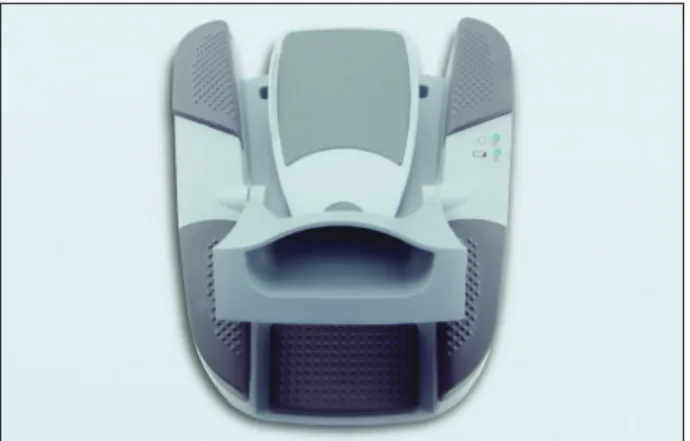
early 3 years ago, Gemini Eye Clinic became the first center in Europe to use the Victus femtosecond laser platform (Bausch + Lomb Technolas). Since then, we have completed more than 5,000 femtosecond laser-assisted cataract surgery (FLACS) procedures and used the laser in count-less refractive surgeries for flap creation in LASIK, tunnel creation in intrastromal corneal ring segments implanta-tion, and, recently, geometric incisions in corneal trans-plantation. Recently, Gemini Eye Clinic upgraded to the third-generation Victus (Figure 1), which includes several updates from the previous platform.UPDATES AND INNOVATIONS
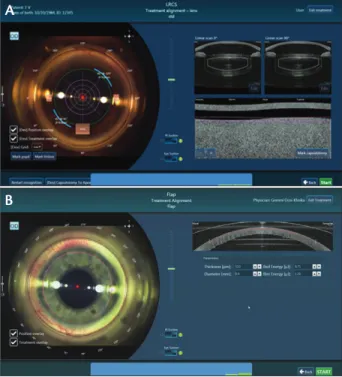
Hardware. Perhaps the greatest innovation in the third-generation Victus is the incorporation of swept source OCT (2S-OCT). This provides high resolution, high contrast, real-time imaging of the steps in LASIK flaps, arcuate incisions, and cataract surgery (Figure 2). The 2S is significantly faster than the previous time-domain OCT device and provides high-speed imaging during all steps of the procedure.
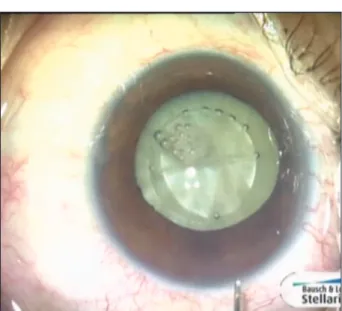
Software. Integration of intraocular structure rec-ognition has improved the speed of procedures per-formed with the Victus, making it more user-friendly and cutting planning and operating time. Several new fragmentation patterns, of which the two most popu-lar are the spider web and grid pattern, are now also available (Figure 3). We use the spider web pattern in most of our routine cases, and the grid pattern we like mostly for hard cataracts.
Additionally, live online-OCT imaging is now available for all procedures and newly introduced for flap creation and astigmatic keratectomy. It is running online through-out all steps of the entire procedure (including laser firing), which is unique among all femtosecond lasers on the market. This provides the surgeon with additional control and assurance during the procedure.
SURGICAL TIPS AND TRICKS
Capsulotomy. Although capsulotomy is an easy step, it is fundamental for the safety of the procedure and also for long-term IOL position. The Victus is capable of pro-ducing reliable anterior capsulotomies.
Phacoemulsification. The graphical user interface of the Victus is user friendly; a clinical image of the fragmentation pattern and all other cuts being planned with the Victus
are displayed prominently. With the grid pattern, using a square phaco tip and high aspiration, I can pick away the nucleus, piece by piece, with no ultrasound energy in most cases. I have also found that I can easily aspirate the center of the capsule with the phaco tip alone after fragmentation, eliminating the need for capsulorrhexis forceps during this maneuver. I continue to hold onto the phaco tip during hydrodissection, using it to separate the already fragmented lens material. This is even useful in brunescent cataracts.
I use high suction, up to 600 mm Hg, with little ultra-sound only, and I will even aspirate the last few frag-ments under high vacuum. As a sidenote, nowadays I use very little ophthalmic viscosurgical device (OVD), as the laser fragmentation allows me to significantly reduce ultrasound energy.
In my hands, I have been able to reduce phaco power by more than 50%, even in dense cataracts and even dur-ing my learndur-ing curve. My average effective phaco time when the Victus was used for lens fragmentation was about 0.25 sec for grade 1 cataracts, 1.1 sec for grade 2, 2.8 sec for grade 3, and 5.8 sec for grade 4. Today I use zero phaco for most of the routine cases.
IOL implantation. I use a variety of IOLs. When pos-sible, I create a 1.8-mm incision and aim for 360º overlap of the capsulotomy with the optic of the IOL. My favor-ite lens is a premium trifocal IOL, and I implant it under irrigation with a 21-gauge irrigating cannula, through a sideport incision. I do not use any OVD.
Figure 1. The third-generation Victus femtosecond laser.
Arcuate incisions. Corneal astigmatism can be cor-rected by performing arcuate incisions along the steep axis of the eye. Depending on the amount of astigmatism, the patient’s age, and the nomogram used, the arcuate inci-sions have to be placed with a certain diameter, depth, and length. Usually we cut to 80% corneal thickness in order to achieve the expected result. These arcuate incisions can be precisely placed and the cutting depth precisely adjusted with the help of the Victus’ 2S-OCT, which provides an image of the cross-section of the cornea at the exact loca-tion of the planned arcuate incision.
I prefer to correct 1.00 to 3.00 D of cylinder with laser arcuate incisions, but they can be used beyond this range as well. The arcuate incisions created with the Victus are reproducible and open easily due to the good cutting performance of the laser. Our statistics shows evidence of 18 months of stability as a result of astigmatism cor-rection by laser arcuate incisions.
Corneal incisions. Most surgeons use three corneal incisions (one primary and up to two secondary) to enter the eye during the phaco part of the procedure. The third-generation Victus allows the surgeon to place these corneal incisions, which can also be planned in a different architecture, individually near the limbus of the eye. My typical incision size is 0.8 to 2.2 mm wide. During
third-generation Victus for astigmatism correction. Currently we have 27 eyes with 18 months’ follow-up. The average age of patients was 40 years; all patients had no other ocular pathology and a clear cornea and either underwent cataract surgery or refractive lens exchange and astigmatism correction for 1.00 to 3.00 D of cylinder.
We performed the arcuate incisions at 80% corneal depth and used the Oshika modified Hoffmann nomo-gram for the treatment. The real-time 2S-OCT showed nice cuts, and the results followed suit. At 12 months, 95% of eyes had cylinders of ≤0.50 D, and 100% were
≤1.00 D, which is comparable to results with toric IOLs. At 18 months, 67% of eyes had a cylinder of ≤ 0.50 D; all patients had a cylinder ≤ 1.50 D.
CONCLUSION
At the beginning, when we started performing FLACS, our cataract surgery workflow slowed down. Today, we are faster than ever, typically scheduling 35 eyes each day, with one crazy record: One surgeon performing 92 cases in 1 day.
In a high-volume clinic like ours, the Victus fem-tosecond laser is an essential piece of equipment. In addition to its cataract surgery functions, which are described above, it can also be advantageous in refrac-tive surgery. This system is completely user friendly and reliable. We have even used the Victus in FLACS procedures on many VIPs, including the past president of the Czech Republic.
In our clinic, we have a poster that reads, “It’s not easy to find a new way, but it’s well worth the effort because it uncovers new horizons.” After many years of hard work and research, we have finally found a new horizon of cataract surgery—FLACS. The Victus femtosecond laser is an integral part of this new horizon. n
Figure 3. Examples of grid (A) and spider web (B) patterns performed with the Victus.
Figure 2. Example of the cataract treatment planning screen (A) and the flap treatment alignment screen of the Victus (B).
A A B
Using the Victus femtosecond laser can help to reduce or eliminate effective phaco time.
BY ERIK L. MERTENS, MD, FEBOphth
Moving Toward Zero Phaco
F
or years, phacoemulsification has been king. Its use of an ultrasonic handpiece to emulsify the crys-talline lens and remove it from the eye was unimaginable before the 1950s. Yet today, surgeons are starting to realize that phacoemulsification—in the future—may no longer be required in cataract surgery. Herein I share my quest of moving toward zero phaco.Since I started using the Victus femtosecond laser (Bausch + Lomb Technolas) in September 2012, I have performed more than 1,100 femtosecond laser-assisted cataract surgery (FLACS) procedures. In my current setup, the Victus is located in one OR and the phaco-emulsification machine in another. My colleague forms the laser portion of the procedure, and I then per-form phacoemulsification and IOL implantation.
Effective phaco time (EPT) with this approach is phe-nomenal. In a small study comparing FLACS and routine cataract surgery, the highest EPTs were 5.2 and 15.3 seconds, respectively. When we calculated the mean, we realized that about 5 times more phaco power was needed in routine cataract surgery than in FLACS, and this was statistically significant.
SETTINGS AND TECHNIQUE
Vacuum can be set between 300 and 400 mm Hg and controlled with the dual-linear footpedal of the Stellaris (Bausch + Lomb); the bottle height is set between 120 and 140 cm. An alternative is to use pressurized infusion, setting the bottle height to 50 cm and the air pressure to 70 mm Hg, as a replacement for the ultrasound hand-piece. In this method, however, the handpiece cannot be used for cortex removal.
I have recently begun to perform translen-ticular hydrodissection, a technique introduced by Sheraz M. Daya, MD, FACP, FACS, FRCS(Ed), FRCOphth. In short, a specially designed chopper is introduced into the nucleus and fluid is injected. The fluid wave travels the cleavage plane and extends posteriorly, achieving hydrodissection of the lens. This technique avoids capsular block, which can occur with a standard hydrodissection technique.
When the Victus is used in grades 1 to 3 cataracts and when the crystalline lens is clear, phaco power is not even required for cataract removal. For this
reason, Bausch + Lomb has developed the Zero Phaco Handpiece (Figure 1) to facilitate nucleus removal with-out ultrasound power. This device is a disposable I/A handpiece with a 15º or 30º beveled needle and a lumen large enough to aspirate the already fragmented nucleus. It is coaxial, preassembled with an infusion sleeve, and designed to work with the Stellaris system.
Using the Zero Phaco Handpiece is easy. An ophthal-mic viscosurgical device is injected, followed by translen-ticular hydrodissection. Then, the handpiece is inserted into the eye and the nucleus is aspirated (Figure 2). The learning curve is minimal with the Zero Phaco Handpiece; although one has to be careful to maintain anterior chamber stability in the beginning, removing the nucleus is pretty straightforward and easy to perform. It can be used with up to grade 3 cataracts.
FLUID CONSUMPTION
I also performed a small study to determine the dif-ference in fluid consumption with FLACS procedures Figure 2. Nucleus aspiration with the Zero Phaco Handpiece. Figure 1. The Zero Phaco Handpiece, designed to work with the Stellaris system, facilitates nucleus removal without ultrasound power. The device’s lumen is large enough to aspirate the already fragmented nucleus.
that required phacoemulsification and those that did not. The lowest and highest amounts of fluid con-sumed in the phaco power group were 28 and 45 cc, respectively, with a mean of 32.55 cc. In the zero phaco group, it was between 45 and 88 cc, with a mean of 75.6 cc. From these results, I determined that there is 2.3 times more fluid consumption when phaco power is not required.
Decreasing phaco power is good; but, bear in mind that higher fluid consumption does create some fluid streams in the eye, which can damage the endothelial cells, penetrate the vitreous, and send some small lens particles through the zonules and into the vitreous.
Whether one is able to use lower phaco power because the Victus femtosecond laser prefragmented the lens, or whether the Zero Phaco Handpiece was used, the goal is to create a perfect balance between lowering phaco power and fluid consumption. In order to achieve this, one must consider the bottle height (the higher the bottle, the more fluid will go through the eye) and vac-uum settings and also take care of fluid leakage through the incisions.
RETREATMENT RATE
The combination of the Victus and the Zero Phaco
Handpiece with a premium trifocal IOL has reduced my retreatment rate from 11% to 3%. It is extremely impor-tant to center the capsulotomy—which the Victus does beautifully, owing to the exact positioning of the capsulotomy—as it simplifies the handling of premium lenses.
I think it is also important to implant a capsular ten-sion ring (CTR) in every case, because it helps to stabilize the bag and the lens. With any premium IOL surgery, good postoperative results are crucial, and this is not only true in the first month but in the upcoming years. Implanting a CTR ensures that the capsule will not shift in the postoperative period.
CONCLUSION
Whether EPT decreases or is eliminated, both are steps in the right direction toward a zero phaco cata-ract surgery procedure. The Victus and the Zero Phaco Handpiece are helpful in achieving this goal. n
Erik L. Mertens, MD, FEBOphth, is Medical Director of Medipolis, Antwerp, Belgium. He states that he is a consultant to Bausch + Lomb Technolas. Dr. Mertens may be reached at [email protected].
The benefits of the Victus in any cataract surgery procedure are plentiful.
BY SOON-PHAIK CHEE, MD
1,001 Routine and
Challenging Cases
H
aving done more than 1,000 femtosecond laser-assisted cataract surgery (FLACS) cases with the Victus femtosecond laser (Bausch + Lomb Technolas) since 2012, I have come to really appreciate the technology. I use it in both routine and challenging procedures, and the benefits of the Victus platform are especially apparent in those difficult cases. Below I share several case studies in which the Victus laser was used for capsulotomy, lens fragmentation, and incision creation.CASE STUDIES
Routine procedure. A patient with moderate nuclear sclerosis presented for cataract surgery. After laser-assisted capsulotomy, I also used the Victus to segment the nucleus into six fragments and to open the incision. I did not use any sculpting, which helped to minimize the ultrasound energy, but rather divided the six seg-ments that the femtosecond laser had already cut deeply into. The nucleus in this case was simple to divide, and I needed to use only a minimum amount of ultrasound to remove the nucleus.
Brunescent cataract. A patient presented with a shal-low anterior chamber and a brunescent cataract. I used the Victus to create two rings and eight segments in the nucleus using the spider web fragmentation pattern. Even in the presence of the dense cataract, I did not have to use much phaco energy, as I was able to crack the nucleus along the segment lines created with the laser.
Coloboma and intumescent cataract. Examination of an intumescent cataract (Figure 1) revealed a coloboma that extended to the back of the eye. The patient’s ante-rior capsule was also thin, and the zonules were deficient. After the iris coloboma was repaired using prolene sutures and a hook that I designed, I was able to use the femtosec-ond laser for all relevant steps of cataract surgery.
Posterior polar cataract. Patients with posterior polar cataracts are at high risk of capsular rupture; however, it is still possible to achieve a capsulotomy that is well-centered and perfectly sized with the femtosecond laser. Having a perfect capsulotomy is extremely helpful in the event that the capsule ruptures, as IOL centration can still be achieved with optic capture.
Eyes with uveitis. Cataract surgery in patients with uveitis can be tricky, as the pupil tends to be stuck. By
placing a Malyugin Ring (MicroSurgical Technology) to expand the pupil, a complete and perfect capsulotomy and a segmented nucleus can still be achieved with the femtosecond laser.
Subluxated cataract. I think this is where I have seen the largest benefits in using a FLACS technique. I do many subluxated cataracts, and I try not to stress the capsule because the anterior rim can rip if stretched too much. I have found benefit in offsetting the femto-second treatment if the nucleus is slightly decentered Figure 2. Using FLACS in subluxated cataract surgery cases allows the surgeon to reexamine the patient after docking and to determine if the nucleus is decentered.
(Figure 2). Generally, the advantage of the Victus in these cases is that I can reexamine the patient just before docking, in order to determine if offsetting the capsulotomy or decentering it slightly is the best approach for treatment.
RETROSPECTIVE STUDY
I recently conducted a retrospective case-controlled study comparing FLACS with the Victus (FLACS group, 995 eyes of 717 patients) to routine cataract surgery cases (routine group, 520 eyes of 413 patients). Patients were treated by one of two surgeons who have done a large volume of FLACS cases. At 1 month postopera-tive, a higher percentage of patients in the FLACS group had achieved a UCVA of 20/20 or 20/25. The difference from the routine surgery group was marginal; however, even a small difference in UCVA is a big difference to patients who have undergone premium IOL surgery.
Regarding mean absolute error, the FLACS group was not different compared with the routine group. Manifest refractive spherical equivalent, however, was significantly
better in the FLACS group, which helps to explain why our patients are able to achieve better UCVA after FLACS.
CONCLUSION
In my hands, the Victus femtosecond laser is the best approach to outstanding postoperative results, even in challenging cases. It also has enhanced my ability to safely handle complicated cases including those shared above. n
Soon-Phaik Chee, MD, is a Senior Consultant Ophthalmic Surgeon and Head of the Cataract Service and Ocular & Inflammation Service at SNEC; Professor in the Department of Ophthalmology, Yong Loo Lin School of Medicine, National University of Singapore; Professor at Duke-National University of Singapore Graduate Medical School; and Head of the Ocular Inflammation Research Group at Singapore Eye Research Institute, all in Singapore. Professor Chee states that she is a paid consultant to Bausch + Lomb Technolas. She may be reached at chee.soon.phaik@ snec. com.sg.
The benefits of the Teneo 317 excimer laser in clinical practice.
BY ROBERT EDWARD ANG, MD
The Next Generations of
Laser Technologies and
Refractive Treatments
O
ver the past few years, femtosecond laser-assisted cataract surgery (FLACS) has received a lot of attention. This technology, which can be used for capsulotomy, lens fragmentation, and corneal arcuate incisions, not only increases safety but also has been observed to improve efficiency and postoperative refractive outcomes. Of the four major players in the FLACS market, I believe that the Victus (Bausch + Lomb Technolas) is the most ideal platform because, in addition to its functions in cataract surgery, it can be used for flap and tunnel creation in refractive surgery and in corneal transplant procedures. Having the same femtosecond laser performing multiple functions saves on equipment acquisition, space in the operating room, and maintenance costs. Combining the Victus with an excimer laser creates a versatile, financially viable platform for a complete cataract and refractive practice.Within the more mature excimer laser technology market, improvements are focused on usability, con-nectivity, and reductions in surgeons’ working time at the laser. For almost all leading systems in the field, one trend is clear: Higher speeds and smaller spot sizes are better. This can translate into a difference of 10 to 20 seconds in ablation time. While this may not seem much in terms of overall treatment time, smaller spot sizes do require faster lasers to reshape the cornea efficiently.
UPGRADED FEATURES
The Technolas Teneo 317 is the latest excimer laser developed by Bausch + Lomb Technolas. There are several upgraded features on the Teneo 317 (Figure 1A) that were not available with the previous generation excimer laser, the Technolas 217P. These include a higher speed (500-Hz); a 1-mm spot size exclusively for the entire treatment; a small-er platform with an small-ergonomic bed; an automated lassmall-er fluence calibration method; a plume evacuator; a touch-screen monitor (Figure 1B) with a centralized database; and a reduced number of software choices that include Proscan (tissue-saving aspheric), Zyoptix HD (wavefront-based Personalized Treatment Advanced), and Supracor.
The feature I like the most is the touchscreen monitor. I no longer need a keyboard to move along during the
different steps of the treatment. More importantly, I find it convenient that I can calculate the treatment and even make changes right there in the laser whereas, in the 217P, I had to calculate using the Zyoptix Diagnostic Workstation Figure 1. New features of the Teneo 317 (A) include a higher speed (500-Hz); a 1-mm spot size exclusively; a smaller platform and ergonomic bed; an automated laser fluence calibration method; a plume evacuator; a touchscreen monitor (B); and treatment modes Proscan, Zyoptix HD, Supracor, and PTK.
A
(ZDW; Bausch + Lomb Technolas) a few hours or even the day before surgery and export the treatment to the server.
A SIMPLIFIED PROCEDURE
Another advantage of the Teneo 317 is that three impor-tant steps—the fluence test, choosing the patient and treatment, and iris registration—require less time, thereby simplifying the procedure.
Fluence test. Energy stability is crucial. The fluence test with the Teneo 317 has to be done at least once a day. Electronic sensors detect any instability, saving time and giv-ing us more confidence.
Choosing the patient and treatment. Patients’ treatment data appears on the screen. The complete data set appears including higher-order aberrations (HOAs), allowing you to select whether you would like Zyoptix wavefront treatment. After the surgeon reviews it, he or she simply presses treat.
Iris registration. Prior to the Teneo 317, iris registra-tion was more challenging. Infrared goosenecks have to be aligned and lights dimmed. Now, the plume evacu-ator automatically comes down, and iris registration is easy to do. This new setup saves a few minutes of my time in each eye.
SOFTWARE ALGORITHMS
The software algorithms have been rationalized and streamlined into three treatments.
Proscan. This algorithm corrects sphere and cylinder and likewise reduces undesired surgically induced spherical aberrations. Proscan preserves the natural aspheric shape of the cornea and is a treatment that can be customized according to a patient’s specific keratometry and Q values.
Zyoptix HD. The wavefront aspheric Zyoptix HD algo-rithm is a combined wavefront and aspheric treatment, designed to correct sphere and cylinder, treat preexisting HOAs as measured by the Zywave, and minimize undesired surgical induced spherical aberrations.
Supracor. The Supracor presbyopic LASIK treatment software is designed to provide good near
In total, 76 eyes reached 6-month follow-up and had a mean spherical equivalent of near plano (-0.15 D). With regard to monocular distance UCVA, 100% of patients were 0.8 and 93% were 1.0 at 6 months postoperative. Distance BCVA was 1.0 in all patients, with rarely any loss of distance corrected vision lines.
The majority (271 of 305 eyes) were treated using Proscan. The mean patient age was 34 years. In total, 46 eyes reached 6-month follow-up and had a mean post-operative spher ical refractive equivalent of -0.14 D. The monocular distance UCVA was 0.8 in 100% of eyes and 1.0 or better in 93%, and the distance corrected vision was 1.0 or better in all eyes.
EQUIPPED WITH SUPRACOR
The Teneo 317 is equipped with the Supracor presby-opic treatment module. Three hyperpresby-opic eyes treated with Supracor have reached 6-month follow-up. Distance UCVA is between 20/20 and 20/30, near vision is J1 to J3, and mean spherical refractive equivalent is near our tar-get of -0.50 D (Table 1).
Consistent with our Supracor experience using the 217P excimer laser, patients gain near and intermedi-ate vision without sacrificing a significant amount of distance vision. The availability of Supracor on the Teneo 317 is a real advantage and differentiates it from other high-speed excimer lasers. Having a presbyopic LASIK treatment will attract the above 40 age group and will act like a “lighthouse” that will expand our refractive practice by bringing both LASIK and cataract patients into the clinic.
CONCLUSION
The Teneo 317 laser is fast, with excellent ergonomics and user-friendliness. More importantly, those of us who have Technolas lasers are used to the precise, safe, and predictable outcomes of the previous generations. The Teneo 317 continues to provide all of these benefits and more. n
TABLE 1. SUPRACOR OUTCOMES
TENEO MRSE preop MRSE 6 Months UDVA 6 Months UIVA 6 Months UNVA
Patient 1 1.25 -0.75 20/30 20/12.5 J1
Patient 2 0.38 -0.25 20/20 20/25 J3
Patient 3 0.75 -0.25 20/20 20/16 J1
The treatment allows one to customize the procedure according to patients’ needs.
BY KIMMO K. LIESTO, MD
Supracor Myopia: Expanding the
Presbyopic Treatment Range
A
s one of the first in Europe to perform Supracor Myopia, which provides a presbyopic treat-ment for myopic cases, I am now able to treat an expanded range of patients who can benefit from refractive surgery and achieve excellent postopera-tive outcomes. This treatment also allows me to custom-ize the procedure according to patients’ personal visual requirements, for instance by offering uni- and bilateral procedures and Supracor mild and regular treatments.The basic principle of the Supracor procedure is much like the principle of a multifocal contact lens: to enhance near vision by creating a near addition in the central 3 mm of the cornea. Supracor positions the distance vision zone in the periphery and ensures a smooth tran-sition to intermediate vision, thereby creating a varifocal system (Figure 1).
A NEW TREATMENT OPTION
Although Supracor for hyperopia has been approved for several years, Supracor for myopia was introduced in 2014. Being able to perform Supracor Myopia means that I can now provide even my younger patients with presbyopic correction and they can maintain their dis-tance vision—this was not achievable with refractive lens exchange or with monovision.
Many presbyopic patients in their 40s wonder if it makes sense to undergo refractive surgery since they will likely need reading glasses in a couple of years. Now what I can tell them is that it does make some sense, because there is a procedure that not only targets far correction but one that also enhances near vision.
My colleague Jouko Rinta-Rahko, MD, and I recently conducted a clinical evaluation in 19 patients (27 eyes) undergoing uni- or bilateral treatment with Supracor Myopia. The average age was 48 years; our protocol is shown in Supracor Myopia: Evaluation. In all cases, treat-ment was centered on the photopic pupil. The benefit is that if one has to do a reoperation, one knows where to aim.
We demonstrated good refractive stability (Figure 2), safety, and efficacy (Figure 3) in the dominant and nondominant eyes. Although a few patients lost 1 or 2 lines of distance visual acuity, they are capable of reading binocularly.
According to a patient questionnaire, about 56% are
spectacle independent, about 25% sometimes require reading glasses, 12% always require reading glasses, and about 5% sometimes require glasses for distance vision. There were no intra- or postoperative complications including diffuse lamellar keratitis or infections. What was also nice to find out is that we did not have any Figure 1. Supracor enhances near vision and provides a smooth transition to intermediate vision.
Figure 2. Postoperative stability in the nondominant eye.
serious optical disturbances like glare or halos; we also noticed, like Robert Edward Ang, MD, mentioned in his article, that dry eye management is important with these patients.
GETTING STARTED
Patient selection and managing patient expectations is the trick of this business. Luckily, the philosophy with Supracor is the same as other refractive procedures: Underpromise and overdeliver. I recommend starting with patients who are unhappy with their progressive lenses and those who have used multifocal contact lens-es for several years, as both groups are good candidatlens-es for Supracor. Other points of advice:
1. When performing the procedure in young myopes, ensure that they understand that the effect of Supracor may not last their lifetimes, as presbyopia continues to develop with age.
2. High spherical aberration can neutralize the treat-ment. This must be considered before performing the treatment in eyes with spherical aberrations.
3. Preoperative examinations are important. Do not take any shortcuts, and be sure to perform cyclorefrac-tion and a full wavefront examinacyclorefrac-tion.
CONCLUSION
Supracor makes it simple to treat a larger population of patients. The procedure itself can be customized to meet patients’ needs, and I think that is extremely ben-eficial with today’s demanding patients.
When I introduce Supracor to my patients, I want them to understand five key messages:
1. Supracor combines the principles of two established technologies, femtosecond LASIK and multifocal con-tact lens optics.
2. Supracor provides a nice balance of far and near vision, with less of a compromise in vision than monovision.
3. Supracor is less invasive than refractive lens exchange. 4. Supracor is reversible.
5. Supracor ensures that the light entering the eye trig-gers pupil constriction to the near vision zone.
CONCLUSION
Usually after patients hear these advantages, they agree to the treatment. In my experience thus far, what I can tell you is that even in Finland—where 25% of the year is endless daylight, 25% is endless darkness, and 50% is endless twilight—Supracor works. If it is functioning at the artic circle, I am pretty sure that the procedure will work everywhere. n
Kimmo K. Liesto, MD, practices with Mehiläinen Group, Helsinki, Finland. Dr. Liesto states that he receives travel grants from Bausch + Lomb Technolas. He may be reached at [email protected].
Protocol:
• Myopic patients, near add: ≥ 0.75 D, age range: 41 to 63 years
• Unilateral treatments performed: Supracor Regular for nondominant eye, target refraction: -0.50 D
• Dominant eye treated with standard femtosecond LASIK (PTA = Personal Treatment Aspheric) with plano distance target if needed
• Nomogram: spherical offset -0.4, 117% • Treatment range:
• Sphere: 0.00 to -7.00 D
• Cylinder: 0.00 to - 4.00 D (plain myopic cylinder included)
The SCORE Analyzer and Zyoptix Diagnostic Workstation 3 are key elements of
the preoperative exam for refractive surgery.
BY DAMIEN GATINEL, MD
Latest Advances in
Diagnostic Technologies
A
ll refractive surgery procedures must start with a preoperative examination that includes diagnostic testing. At the Rothschild Foundation, we spend a lot of time pinpoint-ing the efficient diagnostic platforms. Today, two of the best diagnostic technologies that we use are the SCORE Analyzer (Bausch + Lomb Technolas) and the Zypotix Diagnostic Workstation (ZDW; Bausch + Lomb Technolas).As a LASIK surgeon, my first priority is to avoid the risk of post-LASIK ectasia. Although a variety of ectasia risk assessment systems have been proposed, many have high false negative and false positive rates, and none are objective. On the ORBSCAN IIz (Bausch + Lomb Technolas), which I consider one of the best diagnostic instruments available today, we were obliged to follow our subjective interpretation of ectasia risk.
For this reason, my colleague Alain Saad, MD, and I worked with Technolas recently, using ORBSCAN IIz data to develop a new software module for the objective screen-ing of the risk of corneal ectasia, the SCORE Analyzer. It finally received the CE Mark 2 years ago.
WHAT IS SCORE?
Surgeons can easily export their ORBSCAN data to SCORE, which will then generate a map with the most important metrics that you need to evaluate a patient’s risk for post-LASIK ectasia. The SCORE is a number that is calculated from 12 variables, using discriminate function and alignments, and comprises variables from both the anterior and posterior cornea. It also includes Placido and corneal thickness information. If the SCORE is positive, the surgeon should reconsider the LASIK indication.
In addition to the SCORE readout, a radar map com-prised of six indices is produced. This map follows a basic color code: If green, the value of the index is OK; if yellow or orange, the value is beyond the normal range (Figure 1). The SCORE Analyzer also calculates the average pachymetry and the pachymetry thinning rate profile, an indicator of how quickly the cornea thins toward the center. The lower the profiles, the more suspicious the eye to ectasia.
In my opinion, the advantage of the SCORE Analyzer is simple: Instead of using one index only, for example 3-mm irregularity—which makes it difficult to separate normal from form fruste keratoconus—SCORE uses 12 variables, in combination, to achieve much better seg-regation (Figure 2). This is the core of our algorithm.
WHAT YOU NEED TO KNOW
Who can you use it for? It is important to remember that, in order to run the SCORE, good quality examina-tions are needed. Right now, the SCORE Analyzer can be used for myopic patients who are under the age of 50.
What does the SCORE indicate? When it’s negative, LASIK or PRK are feasible, topographically speaking. (Other conditions should still be taken into consider-ation before planning surgery.) In my opinion, when the Figure 1. The SCORE Analyzer’s radar map is comprised of six indices. If green, the value of the index is OK; if yellow or orange, it is outside the normal range.
Figure 2. The SCORE Analyzer uses 12 variables to achieve much better segregation of normal corneas from those with form fruste keratoconus.
score is positive, the LASIK indication should be recon-sidered. In my opinion, when the score is positive but low (1.5 to 2), PRK is feasible—but again, not LASIK.
BENEFITS OF ZYOPTIX DIAGNOSTIC WORKSTATION 3
Another important investment for preoperative exams is the third-generation ZDW3 (Figure 3), which combines the ORBSCAN 3 anterior segment analyzer and the ZYWAVE 3 wavefront analyzer into one workstation.
The clearest advantage of the ORBSCAN 3 over
previous generations of the device is an improvement in resolution. This allows surgeons to acquire informa-tion about the anterior segment, which can be helpful in LASIK screening and, of course, cataract surgery for IOL calculations. Additionally, looking at the ZYWAVE wavefront sensor, it creates nine times more points as the previous ZYWAVE generation, given the lenslets and centroid density for the ZYWAVE instrument, and allows pupilometry, which is interesting for both cataract and refractive surgery.
The ZDW3 also uses a new icon-driven graphic user interface and, because of the combined software, simpli-fies workflow.
CONCLUSION
The SCORE Analyzer and the ZDW3 are two tech-nologies that are indispensable to refractive surgeons. Both are easy to use and produce valuable information regarding indications for LASIK and other types of sur-gery. n
Damien Gatinel, MD, is an Assistant Professor and Head of the Anterior Segment and Refractive Surgery Department at the Rothschild Ophthalmology Foundation, Paris. Dr. Gatinel states that he is a consultant to Bausch + Lomb Technolas. He may be reached at [email protected].
This versatile system is developed to meet the needs of all surgeons.
BY YANNICK LE MER, MD
Stellaris PC Next Generation: Latest
Advances in Combined Surgery
T
he Stellaris PC is a robust and versatile platform that enables combined surgery, from the ante-rior capsule to the retina. The system, which obtained the CE mark in May 2010, leverages the company’s latest vitreoretinal surgical innovations with the excellence of the Stellaris phaco platform to ensure ease of use and stellar postoperative results.For years I have relied on the Stellaris PC’s advanced technolo-gies to perform various cataract and retina procedures—both standalone and combined—and I have found that it offers me true procedural choice and easy configuration. Most recently, I have begun using the Stellaris PC Next Generation, which received the CE Mark in March 2014
(Bausch + Lomb; Figure 1). Its new features include a larger, easier-to-read display (Figure 2); an integrated laser; and a new footpedal design (Figure 3).
The integrated laser is a classical double-frequency Nd:YAG laser that allows the surgeon to choose between a single shot, a repeated shot, or painting mode. It can be exclusively used as an endolaser or indirect ophthalmo-scope with a separated light source. There is also a large choice of straight and curved laser probes with different diameters (Figure 4).
The new footpedal has optional integrated laser con-trol that can be configured to the surgical preference. In this way, the surgeon can have command of the laser and change the laser setting depending on the proce-dure he or she is performing—for instance, during vitrec-tomy. Also, the design is less angled to enhance surgeon comfort during its use.
USES IN SURGERY
Phacoemulsification. For phaco surgery, the Stellaris PC can be used as a: (1) bilinear system, with separate control of aspiration and ultrasound power, (2) classical
system, with fixed ultrasound power and linear control of aspiration, or (3) collinear system, which is similar to 3-D control in other systems. Within these setups, almost every function may be configured according to surgeon preference, including aspiration, from 0 to 600 mm Hg; the reactivity of aspiration; and the footpedal control, including linear, bilinear, or right-and-left move-ment functions. The Stellaris PC makes surgery easy because the machine can be adapted according to the surgical technique.
Figure 1. The Stellaris PC Next Generation.
Figure 2. The touchscreen display of the Stellaris PC Next Generation is large and easy to read.
Figure 3. The new footpedal design of the Stellaris PC Next Generation.
Vitrectomy. The Stellaris PC Next Generation enables high-speed vitrectomy at a speed of up to 5,000 cuts per minute (cpm). I prefer using bilinear control of the wire-less footpedal for high-speed vitrectomy, as I am able to precisely control the aspiration (from 0 to 600 mm Hg) and cut rate (from cut-by-cut to 5,000 cpm) and change the aspiration rise speed (adjusted to the diameter of the instruments and to the surgeon’s habits). There is absolutely no need for predetermined settings, because everything can be controlled with the footpedal.
REDESIGNED EQUIPMENT
Even more important, there has been good interaction between Stellaris PC users and Bausch + Lomb. From our feedback, the company has redesigned trocars and made valved trocars, wide-angle light pipes, and stiffer 25-gauge light pipes—all of which have helped to sim-plify surgery and make our procedures safer.
Unlike some other valved trocars that tend to fall out during removal of the cannula, the new valved tro-cars (Figure 5) stay in place nicely. I can apply infusion and even pull on the cannula without movement of this valved trocar system. If a silicone oil injection in a previously air-filled eye is required, the surgeon simply removes the valve from the trocar so that air can escape from the eye, prior to injection. The valve may be easily put back on the trocar.
Endoillumination has also improved with the Stellaris PC Next Generation platform. Now the surgeon can change the way he or she looks at the retina by using
a filtered xenon light source with either white, amber, green, or yellow filters, which can be useful during high-speed vitrectomy especially. This allows the surgeon to see everything in the posterior chamber. A separate vapor mercury illumination is available to use with a chandelier or an illuminating laser probe.
CONCLUSION
Using the Stellaris PC Next Generation is an efficient way to perform cataract surgery, retina surgery, and combined surgery techniques. It gives surgeons the opportunity to configure the platform to individual pref-erences and perform a variety of standard and compli-cated cases. The new endoillumination options maximize visualization and minimize phototoxicity risk during reti-nal surgery, and optioreti-nal integrated laser control allows surgeons to control every aspect of phacoemulsification. It is a great advancement in the safety and efficacy of anterior and posterior segment surgery. n
Yannick Le Mer, MD, practices in the Department of Ophthalmology, Fondation Rothschild, Paris. Dr. Le Mer states that he has no financial interest in the products or companies mentioned. He may be reached at ylemer@ forothschild.fr.
Figure 4. Straight and curved laser probes with various diameters are available.
Figure 5. New valved trocars stay in place nicely during removal of the cannula.
www.technolaspv.com/ www.bausch.com