University of Central Florida University of Central Florida
STARS
STARS
Electronic Theses and Dissertations, 2004-20192016
Can Best Practices in Writing Instruction and Standardized
Can Best Practices in Writing Instruction and Standardized
Testing Coexist?
Testing Coexist?
Karen CannavinoUniversity of Central Florida
Part of the Rhetoric and Composition Commons Find similar works at: https://stars.library.ucf.edu/etd
University of Central Florida Libraries http://library.ucf.edu
This Masters Thesis (Open Access) is brought to you for free and open access by STARS. It has been accepted for inclusion in Electronic Theses and Dissertations, 2004-2019 by an authorized administrator of STARS. For more information, please contact [email protected].
STARS Citation STARS Citation
Cannavino, Karen, "Can Best Practices in Writing Instruction and Standardized Testing Coexist?" (2016). Electronic Theses and Dissertations, 2004-2019. 4953.
CAN BEST PRACTICES IN WRITING INSTRUCTION AND STANDARDIZED TESTING COEXIST?
by
KAREN BOEHL CANNAVINO B.A. Florida State University, 1994
A thesis submitted in partial fulfillment of the requirements for the degree of Master of Arts
in the Department of Writing and Rhetoric in the College of Arts and Humanities
at the University of Central Florida Orlando, Florida
Spring Term 2016
ii
iii
ABSTRACT
At the high school level, teachers are tasked with a twofold agenda: they must prepare their students for college level and other post-secondary writing, and they must also make sure they perform well on the standardized writing tests that are required by the state. The stakes in standardized testing continue to rise, especially in Florida. Since the passing of the No Child Left Behind Act in 2002 (NCLB) and the implementation of the Race to the Top Assessment Program (RTTT) in 2009, teachers across the nation have experienced intense pressures related to standardized testing. Many schools’ efforts to conform to testing requirements have had the unintended consequence of narrowing their focus to the content of the test. As teachers and administrators experience the pressure to meet the requirements, it has become impossible to implement any pedagogy without test results in mind.
The challenge facing high school writing teachers is formidable: how can they best choose their new approach to pedagogy, given the pressures of standardized testing, the new curriculum requirements, and the need to ensure that they equip students with the skills they will need to write in college? This thesis explores the question by analyzing the key factors that impact writing instruction in Florida high school classrooms: testing requirements, curriculum requirements, and the content of writing textbooks being used. Do these factors encourage teachers to follow the best practices in writing instruction recommended by field-based research? What knowledge can we gain from comparing these factors, which may be helpful to today’s writing instructors in light of the challenges they face?
iv
Through this research and analysis, I hope to provide insight that can inform high school writing teachers on the heart of the issue: is it possible for best practices in writing instruction and standardized testing to coexist in their classrooms?
v
ACKNOWLEDGMENTS
Dr. Kathleen Bell, my advisor, has been continually patient, kind, and encouraging throughout my long journey. I am forever grateful that she didn’t allow me to give up on this dream of completing a graduate degree. She was very understanding of the hurdles I had to overcome in my personal life to complete this degree. I also learned a great deal from her in the process about research, academic writing, and the world of academia from an educator’s
perspective. I enjoyed our talks and time spent together, and I wish her much happiness and fulfillment in her upcoming retirement.
I would also like to thank my other advisors, Dr. Elizabeth Wardle and Dr. Kevin
Roozen, for their patience, support and understanding. I appreciate all the input and constructive criticism they provided throughout the process.
My family and friends have been very supportive of me throughout this endeavor. I want to thank my husband, Matt Cannavino, for his support and for not allowing me to give up. I also want to thank my mother, Janice Boehl, for her words of encouragement and for all the many hours she spent taking care of my three children so I could devote time to writing my thesis. I also wish to thank my special aunts, whose encouragement, advice and example motivated me to finish despite all the challenges: Dr. Gloria June Crawford, Rita Belcher, Dr. Ellen McElroy, Marcia Williams, and the late Dr. Laura Grounsell.
vi
TABLE OF CONTENTS
LIST OF TABLES ... vii
CHAPTER ONE: INTRODUCTION ... 1
CHAPTER TWO: BEST PRACTICES IN WRITING INSTRUCTION... 16
CHAPTER THREE: STANDARDIZED TESTING FOR WRITING IN FLORIDA ... 31
CHAPTER FOUR: FLORIDA HIGH SCHOOL TEXTBOOK ANALYSIS ... 47
CHAPTER FIVE: CONCLUSION... 67
Politics and Standardized Testing ... 67
Influence of Materials ... 71
Use of Best Practices ... 73
APPENDIX A: FCAT GRADE 10 WRITING RUBRIC ... 75
APPENDIX B: LANGUAGE ARTS FLORIDA STANDARDS FOR 11TH AND 12TH GRADE ... 78
APPENDIX C: LANGUAGE ARTS FLORIDA STANDARDS FOR 9TH AND 10TH GRADE 97 APPENDIX D: FSA ARGUMENTATION WRITING RUBRIC ... 118
APPENDIX E: FSA EXPLORATORY WRITING RUBRIC ... 123
APPENDIX F: SUMMARY OF NAEP RESULTS FOR FLORIDA ... 128
vii
LIST OF TABLES
Table 1: Writing Process Trends for Experienced Versus Inexperienced Writers ... 9
Table 2: Common Themes in Best Practices in Teaching Writing ... 29
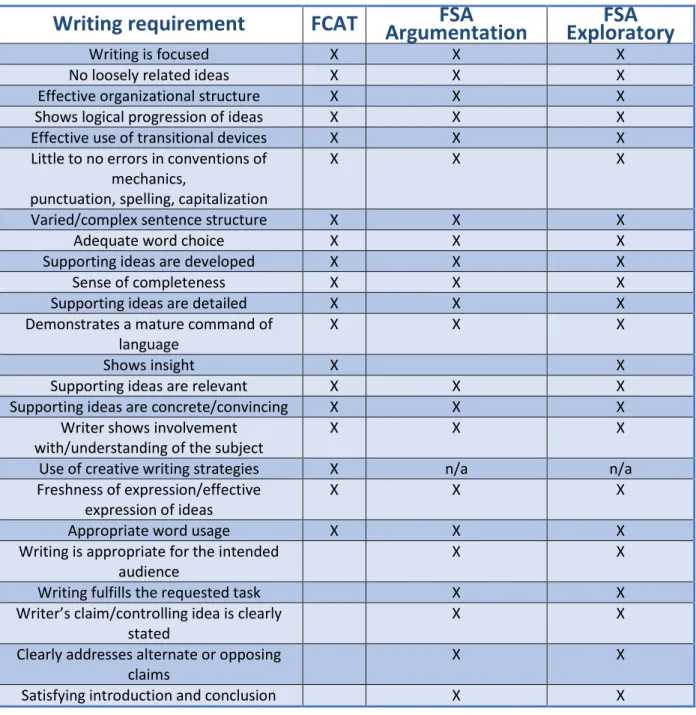
Table 3: Comparison of Writing Requirements for FCAT Writing and FSA Writing Exams ... 41
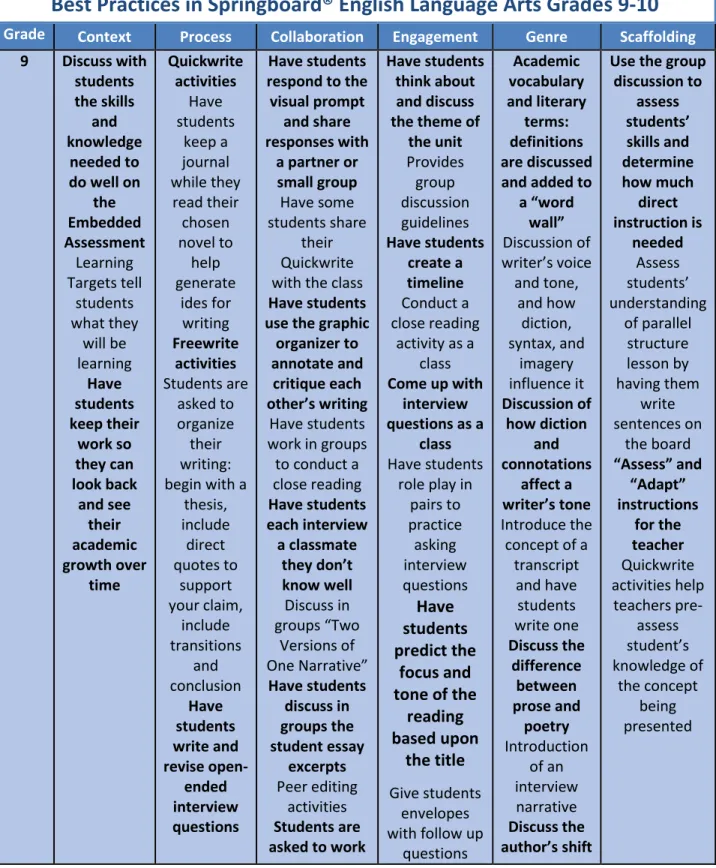
Table 4: Best Practices in Springboard® Florida English Language Arts Grade 9-10 ... 53
Table 5: Springboard® English Language Arts Grade 9 Embedded Assessments ... 57
Table 6: Springboard® English Language Arts Grade 10 Embedded Assessments ... 58
Table 7: Springboard® English Language Arts Grade 11 Embedded Assessments ... 59
Table 8: Springboard® English Language Arts Senior English Embedded Assessments ... 60
Table 9: Best Practices in The Language of Composition: Reading Writing Rhetoric ... 62
1
CHAPTER ONE: INTRODUCTION
Composition as a recognized field of study can be traced back to the early 1960s, when educational reform became a national issue. The National Defense Education Act of 1958 provided an unprecedented amount of money to reform the American education system, and in 1964 it was extended to include English. This call for reform and the dollars that went along with it enhanced English teachers’ self-perception as professionals, and created a renewed
cooperation between the MLA (Modern Language Association) and the NCTE (National Council of Teachers of English).
The idea that bureaucrats considered composition useful and worthy of funding dollars (versus Literature, which had dominated the college English curricula) resonated with some of those who taught FYC (First Year Composition). In 1962, the NCTE Executive Council formed a committee to review what was known or not known about the teaching and learning of
composition. The resulting book, Research in Written Composition, set the precedent for the emerging field of Composition by concluding that almost all past information on the subject should be dismissed because it was not based on scientific research (North preface-16).
However, it wasn’t that nothing was known about composition prior to this document, as may be implied by the committee’s conclusion. Rather, the body of knowledge was almost all based upon composition teachers’ personal teaching experiences. Best practices in teaching
composition were being shared and used among the teaching community. Teachers relied on their peers to help them decide what practices to try, and which ones were effective or
2
Therefore, the NCTE called for “genuine contributions to knowledge” (Braddock et al 5) going forward, based upon scientific research.
As a flurry of scientific based research began, spurred on by the NCTE, the academic field of Composition developed. Through the publication of Research in Written Composition,
the NCTE disseminated information to guide future composition researchers on how to apply scientific research methods to writing situations. The NTCE defined scientific research in composition as studies which involve some actual writing and which employ scientific methods, such as controlled experimentation and textual analysis (Braddock et al 1). By identifying the different variables, how to control them, and methods to accurately report results, the authors of
Research in Written Composition presented guidelines for methods of research that the field of Composition could use in its quest for scientific knowledge regarding writing and writing instruction.
In the mid – 1970s, the amount of research in the field dramatically increased as many universities began to offer graduate programs in Composition. These programs were a result of the credibility the field had achieved from extensive formal academic inquiry into the subject. Concurrently, as new information was gained from research, it started to spur academic reform. Composition teachers recognized a need for changes in the ways composition was being taught. In 1966 at Dartmouth College, the MLA, NCTE, and the National Association for the Teaching of English (from Great Britain) sponsored a month long conference on the teaching of English. Those present at the conference discussed current and past pedagogies, and categorized them into two main areas: those which focused on skills (correctness of grammar, punctuation, spelling, etc.), and those which focused on cultural heritage (teaching specific literary works meant to
3
prepare students for Literature at the university). Participants agreed that a new approach to teaching was needed: one which focused on both language and students’ personal growth as writers (Dixon 1-11). They proposed a new model for teaching writing that recognized students’ need for self-expression and encouraged interaction between teacher and students. The idea was to help students find their personal writing style, unconstrained by conventions. This style was termed “the writer’s authentic voice” (Reynolds n.p.).
Developing the voice of the writer is a concept most likely derived from classical
teachings of rhetoric. The Greek philosopher and teacher Aristotle (384-322 B.C.) is recognized for being the first to arrange what was then known about rhetoric into a cohesive body of
thought. His work, Rhetoric, is often viewed as the foundation for teaching effective
communication (Peeples 14). Aristotle’s major canons of rhetoric include elocution or style, which involve “the linguistic choices the speaker [or writer] must make” (Peeples 14). In their call to bring focus back to individuals’ personal writing style and voice, the Dartmouth
Conference participants were in essence asking writing teachers to go back to the fundamental teachings of rhetoric, which had been missing from American writing classrooms for many years. When Harvard introduced the First Year Composition class in the 1880s, an unintended result was that over time, the teaching of writing became separated from Rhetoric in American education.
The Dartmouth Conference’s conclusions reflected a trend in academic reform that was already beginning. Some writing instructors, mainly at the college level, had already expanded their focus to include instruction in rhetoric as a way to make composition classes more rigorous. The re-emergence of rhetoric into the composition curriculum is discussed in a 1965 article by
4
Wayne Booth, where he explains the need for instruction in the basics of rhetoric, including invention, arrangement, the study of emotional and ethical appeal, and argument analysis (Booth 11). The renewed attention to rhetorical concepts also prompted an interest in the stages of the writing process, as well as “style as an expression of personal ethos” (Bizzell, Herzberg and Reynolds n.p.). In the late 1960s and early 1970s, writing pedagogy began to focus on the voice of the writer, helping students express themselves through language. Peter Elbow, an important advocate for authentic-voice writing, wrote, “When words carry the sound of a person--whether in fiction, poetry, or an essay--they are alive. Without it they are dead” (120). Elbow also helped introduce writing process activities, such as prewriting, which became commonly used in the classroom during this period.
As writing pedagogy changed to incorporate rhetorical concepts, a focus on personal expression, and the writing process, related research began to emerge. By the 1970s and 1980s, the field of composition had accumulated a large body of research, but there was no unanimity, and no core idea or ideas that brought together the knowledge gained up to that point. Research was fragmented into several different modes of inquiry, and very little had been done in terms of comparing these various approaches to each other (North preface 1-5). In the 1987 book by Stephen North, The Making and Knowledge in Composition: Portrait of an Emerging Field, North describes researchers using eight different approaches to contribute knowledge to the field: Practitioners, Historians, Philosophers, Critics, Experimentalists, Clinicians, Formalists, and Ethnographers. He groups these eight approaches into three categories, based upon the
overarching research question they are pursuing: Practitioners are exploring, “What do we do?” Scholars want to know, “What does it mean?”, and Researchers are asking, “What happens?”
5
(intro 3-4). With participants in the field focused on developing their own ideas in eight different directions, North asserts that no one had taken the time to compare the body of knowledge being created to come up with common ideas that the participants in the field could agree upon together. Therefore, from the outside looking in, he demonstrates how difficult it was to synthesize all of the information being contributed and to answer simple questions about the field as a whole such as, “What exactly is the field of composition? Is there a logical
hierarchy of knowledge in the field? Where is Composition research headed?” (North preface 15).
As North and others began to ask about where Composition was headed, many of those engaged in composition research began to examine how writing was traditionally taught in order to figure out how to move forward. What pedagogy, if any, was effective? What was especially ineffective? In 1978, Richard Young wrote an essay in which he described the traditional body of beliefs and practices related to teaching writing as a “paradigm.” He borrowed this word from a book by Thomas Kuhn, who was a professor in the history of science. In Kuhn’s 1963 book, The Structure of Scientific Revolutions, he discusses his theory of how major changes come about in scientific fields. Those in the same field have a shared conceptual model, or paradigm, which governs their activities and research. Results are compared against the paradigm, and new members to the field study the paradigm to gain entrance. When the scientific field reaches a point where beliefs or concepts within its paradigm are not working, the intellectual system begins to break down. As old methods are unable to solve new problems, or researchers
encounter phenomena that cannot be explained by the established beliefs, the paradigm becomes unstable. Eventually, the old beliefs are replaced with new ones, resulting in a paradigm shift
6
(Hairston 76-77). Young concluded that the field of Composition was going through a paradigm shift at that time.
Maxine Hairston describes the traditional paradigm in Composition as pedagogy that focuses on the product, emphasizing style and form over invention and creativity. Feedback from instructors to students was primarily directed toward correctness of grammar, punctuation, and spelling. Textbooks from this time period were devoted primarily to the sentence, the paragraph, usage, and style. Invention, the rhetorical foundation for composing, was viewed as something that naturally occurs, not a skill that could be developed through a formulaic teaching method. Therefore, students were given little direction on how to actually go about writing-- there was no guidance on the invention of ideas and development of content (Young 31-32).
The new pedagogy that emerged in the late 1970s and early 1980s, accelerated by the Dartmouth Conference, was more suited to the population of students that were being admitted to colleges and universities at that time. It was a more diverse population, and many of these students were coming to college without a foundation of writing skills. Composition teachers began to realize that the traditional paradigm, which focused on product (form, style, grammar, etc.) was not working, especially for the students who needed the most help. Students who were inexperienced or not able to write fluently needed guidance on coming up with the composed product itself. It became evident to those in the discipline that the current paradigm lacked a means to address invention. Invention requires a process based approach to writing, and so the new pedagogy, which focused on the composing process and theories around invention, rather than the product, became the new way to teach writing (Young 33-35).
7
Irene Clark and Betty Bamberg, leading researchers in writing process research, identified the traditional paradigm’s lack of attention to process as a reflection of the cultural concept that good writers can produce excellent text effortlessly. A common belief was that either a person could write, or they couldn’t (5). Process research began as a rejection of this cultural idea. Process researchers believed that various activities are involved in the act of writing, and that those activities are consistent among the majority of writers. Their goal was to identify those activities, then categorize and analyze them. Discovering a successive pattern of activities would result in a writing process that could be taught to others. However, in this endeavor they found that the writing process is difficult to study. There are many mental
activities involved, and it is difficult to determine exactly what is going on inside a writer’s brain at any given time. Process research, therefore, is not a precise science. Regardless of method, there is no way to “prove” results, and the information gathered is subject to much interpretation.
Through process research, three main points consistently surfaced among various process studies:
1. The writing process is not linear 2. Processes vary greatly among writers
3. There are similarities in the practices of experienced writers, and groups of inexperienced writers also share similarities in their writing processes
Early in the process movement, the researchers held on to another traditional paradigm belief: that writing occurs in a linear sequence (Clark and Bamberg 8). The linear process, often presented in the form of the “stage process model,” describes writing as a series of tasks. For
8
example, the writer plans, then composes, and then revises. Later, composition researchers began to criticize this approach: “The problem with stage descriptions of writing is that they model the growth of the written product, not the inner process of the person producing it” (Flower & Hayes 367). Attempts were made to hone in on this “inner process” by observing writers thinking aloud. Different methodologies were used to analyze such data, including categorizing (Flower & Hayes 369), coding (Perl 19-25), and naturalistic studies (Berkenkotter 157-160). Although the methods varied, the results consistently refuted the stage process model. Writers, in the act of writing, seem to alternate back and forth between such mental activities as planning, translating, evaluating, reviewing, and editing. Often, these activities lead to the development of sub-plans, where the writer changes course to address a rhetorical goal that has surfaced (Berkenkotter 160-161, Flower & Hayes 372, Perl 32). It was found that there can be significant variation between each writer’s individual processes (Perl 34-37). The order of activities seems to depend on how the individual writer addresses self-defined rhetorical goals, making the writing process unique to each writer and situation (Sommers 330).
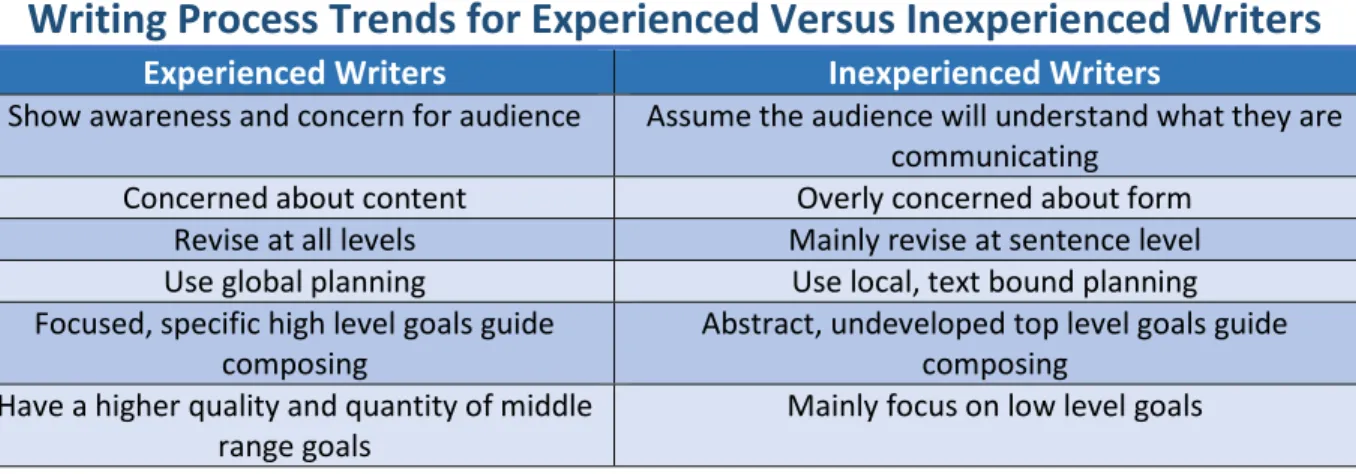
With such variation of writing processes among individuals, researchers began to focus on the trends that became apparent as process research evolved, in an attempt to glean information that could be usefully applied to the classroom. These trends centered around the similarities found in experienced writers versus those found in writers that are not experienced. Some of these trends, outlined by Flower and Hayes (364-379) and Sommers (329-331), are demonstrated in the chart below:
9
Table 1: Writing Process Trends for Experienced Versus Inexperienced Writers
Writing Process Trends for Experienced Versus Inexperienced Writers
Experienced Writers Inexperienced Writers
Show awareness and concern for audience Assume the audience will understand what they are communicating
Concerned about content Overly concerned about form Revise at all levels Mainly revise at sentence level Use global planning Use local, text bound planning Focused, specific high level goals guide
composing
Abstract, undeveloped top level goals guide composing
Have a higher quality and quantity of middle range goals
Mainly focus on low level goals
As is evidenced in the chart, the significant difference between experienced and
inexperienced writers is what they choose to focus on when writing. The inexperienced writers tend to focus on low level issues in their writing, such as sentence structure. In fact, they often spend the majority of their time on such problems (Perl 33). Also, inexperienced writers tend to spend a lot of time composing very few words. In addition, their editing activities are primarily form driven, with little attention to content (Perl 33). Such practices can cause the writer to get “stuck” in the writing process. Some researchers have studied this phenomenon, commonly known as “writer’s block.” One such study found that the students with writer’s block each had unique approaches to writing. However, some of them also had very inflexible approaches which inhibited their writing. For example, one student became stuck on a certain “rule” they had been taught about writing, which was, “always grab your audience.” Even though the rule was inappropriate for her rhetorical situation, the student would not let go of it. In this way, the student developed a writer’s block, and could not continue composing (Rose 394). In contrast, other students had such rules in their head, but recognized when they were not appropriate and
10
abandoned them. These students did not develop writer’s block. Out of the four students with writer’s block, the researcher was able to help three of them by giving them individualized attention. Because process research focuses on the individual writer, addressing each writer’s issues one-on-one was a logical next step for the researcher.
With the idea in mind that many students need help in being introduced to and guided on how write at the college level, many composition scholars concluded that “professors in all disciplines need to be enlisted in the effort” (Bizzell, Herzberg and Reynolds n.p.). This idea manifested itself in the Writing Across the Curriculum (WAC) movement. The WAC movement, which began in the 1970s, allowed for a focus on student writing outside of the English department. The intellectual roots of the concept came mainly from the research and theories of James Britton from the London School of Education. After the Dartmouth
Conference in 1966, there was extensive communication and sharing of ideas between British and American researchers. Consequently, composition researchers in the U.S. became familiar with Britton’s work, and this caused the WAC movement to catch on, especially as a way to respond to negative press about the findings of the 1976 National Assessment of Education Progress in writing. (Bazerman and Russell xiii). The typical WAC program consisted of a series of workshops for faculty of all disciplines, which encouraged them to incorporate more writing into their courses. Janet Emig, one of the leading WAC theorists in the U.S., theorized that “writing in academic settings does not merely improve writing, it improves learning, through a variety of cognitive and social processes. Students should not only learn to write but write to learn” (Bazerman and Russell xiv).
11
When the WAC movement waned in the mid 1980s and 1990s, Composition research moved its attention away from the individual writer and turned its attention to the “social aspects” of writing. In another paradigm shift, field participants began to voice a rejection of then
established idea that there is a teachable writing process which can be applied across all types of writing situations. The simplistic, writer based view held by process theorists did not
acknowledge that writing is a social activity. Therefore, social theorists proposed that a writer’s purpose is to communicate with a certain audience, and to do so successfully he or she must write according to the specific expectations of that audience. This requires knowledge of the particular audience being addressed, including “social aspects,” such as what is considered inappropriate word choice, stylistic conventions, and common terminology (McCarthy 233). Such discussions led to the evolution of genre theory and discourse communities, concepts which focus on the conventions and commonalities used by specific communities that communicate primarily in writing.
Researchers began to explore the role of the community in shaping discourse (Clark and Bamberg 14-15). Instead of perceiving writing as an invention of its author, some believed that “individuals perceive the world according to the shared beliefs and perceptions of the community or communities to which they belong” (Clark and Bamberg 15). A new perspective, that of intertextuality, forced writing instructors to consider “the sources and social contexts from which the writer’s discourse arises” (J. Porter 35). Writing was not the unique invention of its author, but rather the result of a process whereby the writer reinvents borrowed ideas and textual formations to address the rhetorical situation at hand.
12
This completely different perspective on process further complicated writing instruction: instead of trying to define a successful writing process and then deciding how to teach it to others, instructors began to consider the influence of the community that students were being asked to write within. Participants in the discipline began to discuss and define such
communities. The idea of speech communities was already established in the field of linguistics, but the concept was too broad to apply to the study of writing within specific communities. Speech communities include all “people who use the same system of speech signals”
(Bloomfield 29). This definition implies that anyone who can understand what you are saying is a part of your speech community. However, just being able to understand someone’s writing does not in itself make the writing appropriate for its intended audience. Forced to narrow their focus, writing and composition researchers began discussions of genre and discourse
communities. Noting that certain communities had their own accepted ways of writing, each of these could be identified as a genre, or “a distinctive category of discourse of any type, spoken or written” (Swales 33). Discourse communities were even more specific than genres. According to James Porter, a discourse community is “a group of individuals bound by a common interest who communicate through approved channels and whose discourse is regulated” (38-39).
Applying these concepts to the classroom, some writing teachers began to consider the discourse communities that they belonged to, and how their membership in that community affected their teaching. In a broad sense, the idea of an academic discourse community seemed to clarify what they were trying to accomplish, especially for First Year Composition (FYC) instructors. They were charged with teaching students to write in the university, or “general things about academic language use that will help them to write during college” (Wardle “Mutt Genres” 766). Since
13
“FYC teachers often mistake the genres of English studies for genres-in-general” (Wardle “Mutt Genres” 769), this seemed to align with their goal.
However, approaching writing instruction from the academic discourse community
perspective did not improve students’ writing. Just as earlier research proved that there is no one writing process that works for everyone, researchers found that there is no one general academic discourse that could be taught to everyone. Different disciplines within the university each have their own ways of writing and acceptable conventions, and students must become familiar with the standards and characteristics of each one they are exposed to before they can write
proficiently in that area of study. Gaining such familiarity takes time and practice, and each instructor is only equipped to teach his or her own community’s writing conventions. As Elizabeth Wardle found in her study of genres in the university, even if the writing instructor attempts to become familiar with the genres of another academic discipline, “the activities of FYC do not provide the content needed to practice writing those genres in any meaningful way” (“Mutt Genres” 781).
Such research reveals how the complexity of writing processes has led to the inherent problems with the current writing pedagogy in American universities, where FYC courses are pervasive. Instructors must consider not only the individual’s personal writing processes, but also how to best help students make their writing conform to the social constraints of the community that is their intended audience.
Well before the turn of the century, composition had become an established and respected field of study, with undergraduate and graduate degrees offered by many prestigious colleges and
14
universities. There is an extensive body of research that continues to evolve. Along with the NCTE and CCCC, research and university presses regularly publish scholarly work in the field. This work not only informs pedagogy at the college level, but the information is disseminated to high school writing teachers.
At the high school level, teachers are tasked with a twofold agenda: they must prepare their students for college level and other post-secondary writing, and they must also make sure they perform well on the standardized writing tests that are required by the state. The stakes in standardized testing continue to rise, especially in Florida, which is the focus of this thesis. With the passing of the No Child Left Behind Act in 2002 (NCLB) and the implementation of the Race to the Top Assessment Program (RTTT) in 2009, teachers across the nation have
experienced intense pressures related to standardized testing. Many schools’ efforts to conform to testing requirements have had the unintended consequence of narrowing their focus to the content of the test. As teachers and administrators experience the pressure to meet the
requirements, it has become impossible to implement any pedagogy without test results in mind.
The challenge facing high school writing teachers is formidable: how can they best choose their new approach to pedagogy, given the pressures of standardized testing, the new curriculum requirements, and the need to ensure that they equip students with the skills they will need to write in college? This thesis explores the question by analyzing the key factors that impact writing instruction in Florida high school classrooms: testing requirements, curriculum requirements, and the content of writing textbooks being used. Textbooks, as an essential tool that influences and informs the curriculum, have a significant impact on classroom pedagogy.
15
Do these factors encourage teachers to follow the best practices in writing instruction recommended by field-based research? What knowledge can we gain from comparing these factors, which may be helpful to today’s writing instructors in light of the challenges they face?
In this chapter, I have provided a background/history of the academic field of
composition, from which today’s best practices for writing instruction were derived. Chapter 2 will go into detail about what are considered the best practices for writing instruction today, based upon our knowledge of current research in the field of composition. Chapters 3 will discuss the current testing environment, describing the testing requirements and the implications that testing has on schools’ funding and reputation, teachers’ salaries, and how test results can impact students and teachers’ view of themselves as learners and instructors. Chapter 4 will explore some of the textbooks being used in Florida high school classrooms and compare them with the current curriculum and testing requirements for high school writing students in the State of Florida. Chapter 5 will provide an analysis of the information in Chapters 1-4. Through this research and analysis, I hope to provide insight that can inform high school writing teachers on the heart of the issue: Is it possible for best practices in writing instruction and standardized testing to coexist in their classrooms?
16
CHAPTER TWO: BEST PRACTICES IN WRITING INSTRUCTION
To address the question of whether or not best practices in writing instruction can coexist with standardized testing in Florida’s public high schools, we must first establish what those best practices are. According to Graham, MacArthur, and Fitzgerald, editors of Best Practices in Writing Instruction (2013), two ways we can gather information on best practices in writing in an educational setting are to examine the methods of those who are successful in teachingdeveloping writers, and to review scientific studies testing specific instructional writing methods (10-12).
To explore best practices for teaching developing writers in high school, we can draw on studies of the instructional practices of effective writing teachers. A comprehensive analysis of these studies, conducted in 2007 by Graham and Perrins, examined the findings of five
qualitative studies involving writing teachers in grades 4-12 “across different types of schools (private/public, suburban/inner city, and special/regular) and methodologies (qualitative observations/survey methodology).” These teachers were chosen for the studies because either their school had shown impressive results in preparing students to attend college, with 100% or almost 100% of their students going on to college, or the teachers had been recognized by their district supervisors as effective reading and writing instructors (324).
One of the five studies examined by Graham and Perrins involved a school in inner city Chicago called Providence- St. Mel, which had a 25-year track record of having 100% of its graduates attend college. The school serves predominately low income, African American students. The researchers recorded their observations of teachers, administration, and students in
17
the school in the spring of 2003. The researchers’ observations focused on answering the question, “How does the school consistently produce high achievement in its graduates?” At the end of the observation period, they also surveyed the faculty to collect additional data (Pressley, Raphael, Gallagher, DiBella 217-219).
The second study Graham and Perrins analyzed involved a private school called
Benchmark School with 35 years of experience in serving elementary and middle school students that are intelligent but underachieving, mainly due to difficulties with reading. At the time of the study, January through July 2004, the students were predominately from middle class to upper middle class families, and 7.9% of the students were minorities (African American, Asian
American, and Hispanic). The school has a high level of success in teaching students to read, and almost 100% of their students go on to graduate from high school and college. The school has developed its own curriculum over time, based upon internal research and student results. Faculty at the school invented a reading comprehension curriculum that has been proven to generate “gains in reading across a wide variety of measures” (Pressley, Gaskins, Solic and Collins 283-284). Similar to the first study, the researchers’ observations focused on answering the question, “How does the school consistently produce high achievement in its graduates?” The researchers gained knowledge from both informal interviews with faculty and as part of employee training, because some of the researchers were actually employed as teachers at the school during the study (Pressley, Gaskins, Solic and Collins 284-286).
The third study that Graham and Perrins analyzed involved a public elementary school, Bennett Woods Elementary School, in which the students are considered “non-disadvantaged”
18
(Graham and Perrins 324). Compared to other schools in the state, some of which serve children that are even more advantaged, Bennett Woods outperforms in reading and writing achievement. At the time of the study in January 2005, 65% of the students were American born and
Caucasian, 10% were American born minorities (African American, Hispanic, Native
American), and 25% were immigrants or had a recent international visa. Researchers focused on the question, “How does the school consistently produce high reading and writing
achievement in its students?” The researcher method was to visit classrooms and observe, looking specifically for factors that would impact achievement. In addition, ten teachers participated in formal interviews with the lead researcher, where they were asked to share what they felt contributed to the school’s high achievement. The principal was also interviewed, and she shared information on the school’s reading and writing curriculum, how it was being implemented and significant improvements that the school had made on certain aspects of the state test since she had been principal (Pressley, Mohan, Raphael, and Fingeret 223-224).
In the final two studies that Graham and Perrins analyzed, surveys were conducted with “teachers who were nominated by district supervisors as effective instructors of reading and writing” (324). In one of the studies, the supervisors were asked by the researchers to nominate fifth grade teachers based upon a variety of factors, including standardized test scores,
conversations with the teachers about their educational philosophy, direct observations and interactions, and/or positive comments from other teachers, administrators, and parents about the candidates’ teaching skill. The supervisors were also asked to nominate a teacher with three or less years of teaching experience. There were two surveys conducted: an initial survey and a final questionnaire. Of the teachers nominated, 33 responded to the initial survey. For the final
19
questionnaire, 28 teachers from the initial survey plus an additional 34 teachers newly nominated by supervisors from the International Reading Association responded. The initial study asked the teachers two open-ended questions:
1. What are the ten most important elements in your literacy (reading/writing) instruction?
2. Are there some unique elements of instruction for weaker students?
The answers to these questions resulted in 150 teaching practices being identified, and these were all used in the final questionnaire, which asked teachers to rate how often they used each practice (Pressley, Yokoi, Rankin, Wharton-McDonald, and Mistretta 3-5).
The second survey study was similarly conducted, but the teachers surveyed were special education instructors that had been effective in teaching reading and writing to elementary students with reading disabilities. The teachers surveyed were nominated by the reading supervisor in their district. Each supervisor was asked to identify the most effective literary education among primary level special education teachers in his or her district. To garner
additional participants, the researchers sent letters to the special education supervisors in areas of the country not represented in the first sample. They were asked to nominate “their most
effective primary special education teacher of reading” (Rankin-Erickson and Pressley 208). Those nominating the teachers were asked to base their choice on the following criteria: student achievement, the nominated teacher’s explanation of his or her of teaching philosophy and practices, direct observations and interactions with the teacher, and positive comments about the teacher’s skill from parents, administrators, and other teachers. Of the 74 teachers nominated through these two methods, 33 participated in the survey. There was an initial and final
20
questionnaire, and the initial questionnaire in this study was the same one used for the final questionnaire in the first survey study by Pressley, Yokoi, Wharton-McDonald, and Mistretta. In addition, the researchers sent an open-ended questionnaire to the first 20 special education teachers who responded to the second survey study, and also to a random sample of 20 other special education teachers in a local district. This was done to include some data from average and/or weaker teachers. There were 28 teachers that responded to the open-ended questionnaire, and they were asked the following questions:
1. Describe the major reading problems of students with severe, moderate, and mild reading problems, roughly in order of the prevalence of the problems.
2. Identify the elements of instruction you use most consistently with readers at each level of difficulty, roughly in the order of importance of the instructional elements. The final questionnaire used in the second survey study was similar to the first survey study’s final questionnaire, with teachers being asked to categorize how often they use certain teaching practices. There were also some yes/no questions and short answer questions included (Rankin-Erickson and Pressley 209-210).
In their 2007 analysis of these studies, Graham and Perrins bring together the data to show what is known to be effective practices for teaching writing. The same or similar practices were found to be effective regardless of the students’ socio-economic background, race, or where they lived. Special education students were also included, as well as students who were not in special education but had been identified as having difficulties with reading and writing. Graham and Perrins found that despite the diversity of students, teachers across all these studies engaged in similar practices when teaching writing (324). The results indicated ten best
21
Dedicate time to writing and writing instruction, with writing occurring across the curriculum
Involve students in various forms of writing over time
Treat writing as a process, where students plan, draft, revise, edit and share their work Keep students engaged and on-task by involving them in thoughtful activities (such as planning their composition) versus activities that do not require thoughtfulness (such as completing a workbook page that can be finished quickly)
Teach often to the whole class, in small groups, and with individual students; this includes teaching students how to plan, draft, and revise, as well as teaching more basic writing skills
Model, explain, and provide guided assistance when teaching
Provide just enough support so that students can make progress or carry out writing tasks and processes, but encourage students to do as much as they can on their own
Be enthusiastic about writing and create a positive environment where students are constantly encouraged to try hard, believe that the skills and strategies they are learning will permit them to write well, and attribute success to effort and the tactics they are learning
Set high expectations for their students, encouraging them to surpass their previous efforts or accomplishments
Adapt writing assignments and instruction to better meet the needs of individual students (325)
22
Many similarities can be found in comparing these best practices to the ones developed by The National Council of Teachers of English (NCTE), an organization of teachers that conducts ongoing research on the teaching of reading and writing. This organization began in 1911, and has been a resource for information on the teaching of English/Language Arts
education ever since. They publish a variety of books, journals, and other educational materials designed to assist and inform on the teaching of English/Language Arts. In 2008, the NCTE Executive Committee published a position statement which outlined the organization’s beliefs about best practices in teaching writing. The statement has been updated a few times since 2008, most recently in March 2015, but the content has not changed. This statement is meant to
provide guidance to writing instructors at all levels, including high school:
Everyone has the capacity to write, writing can be taught, and teachers can help students become better writers through writing instruction designed to help them acquire new strategies and skills. Teachers should support students’ efforts and give them time to write.
People learn to write by writing. As students write, they experience the writing process firsthand and learn from it. Students must be given time to write both in and out of the classroom, and teachers should know how to create a community where students are comfortable writing in the same room together.
Writing is a process. Teachers must help students understand the different stages of the process, and spend some time guiding students through them. Emphasis should not be placed only upon the final product. Teachers should provide multiple strategies for dealing with typical problems that writers face during the process of composing.
23
Writing is a tool for thinking. The act of writing generates ideas, so teachers should help students realize there are many important uses for writing, such as: to solve problems, identify issues, construct questions, and to try out an idea not fully developed. Teachers should be aware of the various types of thinking people do when they compose, and be able to identify them in writing. Teachers should provide students with strategies for getting started with an idea or coming up with an idea if one doesn’t occur right away. Writing grows out of many different purposes. Writing is not one thing; it varies
according to its audience and purpose. Therefore, teachers should create opportunities for students to write in various writing situations, such as academic, aesthetic, and writing for public participation in a democratic society.
Conventions of finished and edited texts are important to readers and therefore to writers. Readers of a public text expect it to conform to conventional rules of spelling
punctuation, and grammar. They also expect the style of writing to be appropriate for the genre and social situation. Teachers must be familiar with the techniques of teaching editing and should present it as one of the last stages of the writing process- part of preparing the text for an audience to read.
Writing and reading are related. People who read a lot have an easier time writing. In order to write a particular kind of text, it helps to have experience reading texts of that type. Teachers should provide students with access to various genres, and should be explicitly taught the features of different genres.
Writing has a complex relationship to talk. Writers need opportunities to talk to others about what they are writing. This helps them get feedback on their ideas, practice
24
different ways to present what they want to say, and develop ideas through suggestions and information from others. Teachers should take advantage of the strong relationship between talking and writing by setting up and managing discussion groups, balancing talking and writing in the classroom, and setting aside time with each student to discuss their writing.
Literate practices are embedded in complicated social relationships. It makes a difference what language the student used growing up, what culture they come from, and how language was used in that culture. Writers start in different places, and the goal is to add to their knowledge of language, not replace what they are comfortable using. Teachers should discuss with students the need to be flexible with the use of different kinds of language for different social contexts. Teachers should know how to help students master academic classroom English while maintaining their most familiar language.
Composing occurs in different modalities and technologies. Technology today provides various ways of composing, including print, still images, video, and sound. Teachers need to understand the relationship between print and other modalities, and stay up to date on the technology their students are using to communicate and compose.
In addition to these teacher-based best practices, Graham, MacArthur and Fitzgerald arrived at a set of best practices for developing writers which incorporates both teacher-based and scientifically-based instructional writing methods (12-21):
Create a supportive classroom where writing development can flourish
25
Help students acquire the knowledge needed to write effectively Teach foundational writing skills
Regardless of the method used to arrive at the best practices, either teacher-based or scientifically-based, there are no contradictions when comparing these best practice statements to each other. Much of the same information is stated in different ways, with the NCTE’s statement being the most comprehensive.
There are several underlying themes present in these statements of best practices. Two of them, context and engagement, are explained by Michael Knapp in the book, Teaching for Meaning in High-Poverty Classrooms. Knapp discussed how effective best practices focus on helping students understand and apply concepts; they do not focus on low-level skills such as grammar rules and punctuation. He also explains how educators of children in high-poverty areas often take the approach of focusing on low-level skills acquisition instead of what Knapp calls “teaching for meaning” (2-7). Knapp describes three ways that students can derive meaning from classroom instruction:
1. When students become “actively engaged in the attempt to make sense of things they experience in school, they are encouraged to be meaning makers” (7)
2. Students gain understanding by discovering the relationship of parts to the whole, instead of just being taught the parts out of context
26
3. When a context is created for whatever is being taught, students are able to make connections between what they already know and what they are learning
The three aspects of teaching for meaning can be connected back to the progression of composition research described in Chapter 1. Composition researchers, at the onset of the
academic field, were turning away from skills based instruction and looking for a better approach to composition pedagogy. Knapp describes skills-based instruction as the opposite of teaching for meaning. As composition research progressed in the 1960s and 1970s, many in the field advocated an approach for developing the voice of the writer, which encouraged students’ self- expression and more interaction between teachers and students. This interaction could be considered as the active engagement Knapp describes as essential to teaching for meaning.
Another theme present in the best practices outlined is the process based writing
approach. Developed in the 1960s and 1970s, this pedagogy presented writing as a process, with a series of steps that could be used to teach students how to write. Teaching the writing process as an overall concept, instead of focusing on one step (such as revision), can be compared to Knapp’s description of teaching the relationship of parts to the whole. When students are taught the various steps in the writing process, and how to move back and forth between these steps until they arrive at a finished product, they gain an understanding of steps of the writing process in context with each other. In this way, process and context can work together to create effective writing instruction.
27
Collaborative writing is also a common theme in the statements of the best practices. This approach emphasizes students sharing ideas with other students and the teacher, which complements process based instruction and encourages student engagement. According to Graham and Perrin, collaborative writing is a process-related best practice that can help students navigate through the writing process, especially in the early stages of the process (314). When writing alone, language production must come from an internal thought process. When students converse with each other, “verbal and nonverbal signals from a partner constantly stimulate and modify further thought and language production” (Yarrow and Topping 262). Other benefits of collaborative writing include increased engagement and time spent on-task, immediate and individualized help, goal specification, prevention of information processing overload, and the student in the “helper” role learns by teaching and explaining (Yarrow and Topping 262-263).
Another theme demonstrated in the best practices is that of teaching genre. The concept of genre teaches students “how different forms of composition help writers build the world and act in the world in different ways” (Collin 215). In his article, “How Rhetorical Theories of Genre Address Common Core Writing Standards, “ Ross Collin describes how teaching a rhetorical understanding of genre can help students meet the Common Core State Standards (CCSS), which guides the curriculum for Florida teachers, and at the same time understand how different contexts call for different forms and writing style (216-217). Even students that write well can face challenges later if they are not able to transfer their writing skills to different settings (Graham, MacArthur and Fitzgerald 48-49). For example, writing teachers must explicitly teach their students how to write in various formats or situations that they may encounter in college or at work, such as a lab report for science class, a history report, or a
28
business memorandum. Incorporating the concept of genre into a writing pedagogy provides a framework for teaching various forms of writing (Collin 221).
While teaching genre specifically focuses on what types of writing to teach, there is another best practice prevalent in the standards outlined in this chapter that can be applied to any writing classroom, regardless of the content being presented at the time. This best practice is called scaffolding, and it was noted by the researchers in several of the studies Graham and Perrins used for their 2007 analysis. In their observations of Providence St-Mel School, Pressley, Raphael, Gallagher, and Di Bella describe scaffolding as a best practice that contributes to the success of the school. Scaffolding is a process by which teachers systematically check in with individual students to determine who needs help with the task at hand. If a child does need assistance, the teacher provides just enough help so that the student can make progress on his or her own, and then they allow the student to continue on with the task. If the student is having a lot of difficulty, the teacher may even change the assignment a little, customizing it for that particular student (or for the class, if many students are having similar trouble) so they can move on and accomplish the task. This teaching method creates student confidence and encourages self-regulation (224-225).
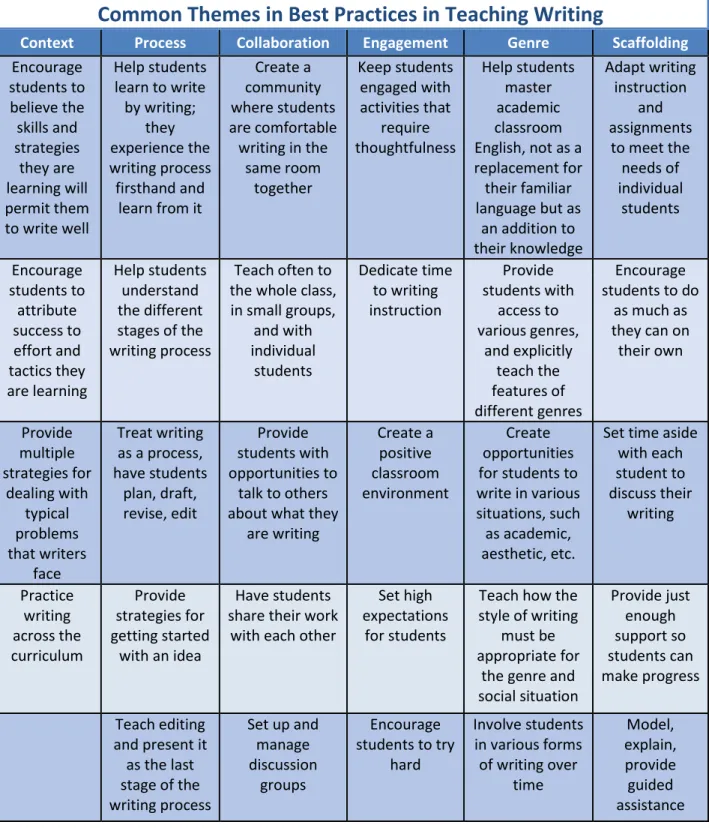
The following chart is provided as a visual resource, which includes the best practices discussed and the common themes they share:
29
Table 2: Common Themes in Best Practices in Teaching Writing
Common Themes in Best Practices in Teaching Writing
Context Process Collaboration Engagement Genre Scaffolding
Encourage students to believe the skills and strategies they are learning will permit them to write well Help students learn to write by writing; they experience the writing process firsthand and learn from it Create a community where students are comfortable writing in the same room together Keep students engaged with activities that require thoughtfulness Help students master academic classroom English, not as a replacement for their familiar language but as an addition to their knowledge Adapt writing instruction and assignments to meet the needs of individual students Encourage students to attribute success to effort and tactics they are learning Help students understand the different stages of the writing process Teach often to the whole class, in small groups, and with individual students Dedicate time to writing instruction Provide students with access to various genres, and explicitly teach the features of different genres Encourage students to do as much as they can on their own Provide multiple strategies for dealing with typical problems that writers face Treat writing as a process, have students plan, draft, revise, edit Provide students with opportunities to talk to others about what they
are writing Create a positive classroom environment Create opportunities for students to write in various situations, such as academic, aesthetic, etc.
Set time aside with each student to discuss their writing Practice writing across the curriculum Provide strategies for getting started with an idea Have students share their work
with each other
Set high expectations
for students
Teach how the style of writing
must be appropriate for
the genre and social situation Provide just enough support so students can make progress Teach editing and present it as the last stage of the writing process Set up and manage discussion groups Encourage students to try hard Involve students in various forms of writing over time Model, explain, provide guided assistance
30
Common Themes in Best Practices in Teaching Writing
Context Process Collaboration Engagement Genre Scaffolding
Don’t emphasize only the final
product Balance talking and writing in the classroom Present writing as a tool for thinking Help students realize there are many important uses for writing
Teach how writing varies according to its
audience and purpose
In the next chapter, I will discuss in detail the writing requirements outlined in the
Florida’s adaptation of the CCSS, the Mathematics Florida Standards (MAFS) and the Language Arts Florida Standards (LAFS), and how well (or not) the standardized testing designed to support these standards aligns with the best practices in teaching writing.
31
CHAPTER THREE: STANDARDIZED TESTING FOR WRITING IN
FLORIDA
In 2002, President Bush signed the No Child Left Behind Act (NCLB), which set in place federally mandated requirements that impacted every public school in the United States. The Act implemented a system that measures student progress through standardized testing and holds states and schools accountable for the test results. When President Obama took office in 2009, he continued with President Bush’s plan to improve school performance through standardized testing by implementing the Race to the Top Assessment Program (RTTT), which provided states with funding to develop standardized testing. Through this program, the U.S. Department of Education awarded two Comprehensive Assessment System grants the following year, each to a consortium of states that applied together for the grants (U.S. Dept. of Ed “RTTT”).
To be eligible for the RTTT grant, Florida joined a consortium of states called the Partnership for Assessment of Readiness for College and Careers (PARCC). PARCC was awarded $185.8 million, and $700 million of that went to Florida. With this grant money, Florida began making significant changes to their curriculum and to their standardized tests. In 2010, the Florida State Board of Education adopted the Common Core State Standards (CCSS). This list of educational standards was approved by the National Governor’s Association and the Council of Chief State School Officers in 2010. The purpose of CCSS is to ensure that students will graduate high school with the skills and knowledge they need to perform in today’s global market (FDOE). In order to evaluate schools on how students are meeting these new standards, the Florida Department of Education began to develop new standardized testing based upon
32
CCSS to replace the Florida Comprehensive Achievement Test (FCAT) that was being used at the time (Jordan).
Florida had a standardized testing program in place long before the NCLB and RTTT program. When the Educational Accountability Act of 1968 was passed, the Florida legislature approved and funded a statewide assessment program, which was implemented in the 1970-71 school year. The main goals of the program were to provide each school district with a way to objectively evaluate the effectiveness of their educational programs, provide relevant data that could be used to compare the districts to each other, and to create an assessment program that would be compatible with the National Assessment of Educational Progress (NAEP). The Florida Department of Education (FDOE) periodically reviews the format of whatever tests are currently being administered, and the tests are changed over time to stay current with the FDOE’s stated educational objectives for each subject area. These objectives are developed using input from committees in each Florida school district.
Although standardized testing was already a common practice in Florida schools, the influx of federal funding brought by national initiatives such as NCLB and RTTT created a high stakes testing environment. In Florida and around the country, there is an intensity and focus on standardized testing results, in which school funding, reputation, and in some cases individual teachers and administrators’ job security depends on the outcome of the tests.
Many schools’ efforts to adapt to the high stakes testing environment have had the unintended consequence of narrowing educators’ focus to the content of the test. As teachers and administrators experience pressure to meet the requirements, it has become impossible to implement any pedagogy without test results in mind.
33
In some instances, reaction to this pressure has had disastrous results. In 2013, thirty five Atlanta Public Schools educators and administrators were indicted by a grand jury after a state review determined that cheating on standardized tests had occurred in more than half the district’s elementary and middle schools. During at least a four year period, the schools’ superintendent at the time, Beverly Hall, presided over a system where threats and intimidation influenced teachers to alter tests, change answers, and falsely certify the test results (Carter 2013).
Although the tests create some level of pressure for every teacher, it varies from school to school. The Atlanta school scandal reflects an extreme amount of pressure for teachers.
However, there are other situations where the teachers may not be as affected by the testing environment. One research study on the effects the high stakes testing environment has had on writing instruction indicates that teachers in high income schools “have more latitude to teach writing in less prescriptive ways because their students continue to make Adequate Yearly Progress (AYP)” (McCarthey 464). These teachers feel that they have the freedom to choose a more personal pedagogy to teach a broader, more inclusive curriculum that will benefit students’ learning as well as provide preparation for the test. However, in low income schools most teachers do not feel they have as much choice in relation to the pedagogy they implement. They feel that they “have less power to resist the law and are monitored to a greater degree than teachers in high income schools” because the majority of their students are not making AYP or performing well on the tests (McCarthey 464). The level of testing related pressure a teacher feels can directly translate into the pedagogy he or she chooses to implement. Common choices
34
when pressure is high are to have students practice the test, to teach only what is on the test, or to teach for the test.
After 10+ years of the high stakes standardized testing environment in Florida, significant changes have been made to the tests themselves, as well as to what is being tested. Between 2007 and 2010, the Next Generation Sunshine State Standards, also known as the Common Core State Standards (CCSS), were approved. This list of educational standards was created by private organizations in Washington, D.C. and mainly funded by private entities such as the Gates Foundation. Despite having no background in education at all, Bill Gates and other like-minded billionaires across the country have had significant influence over the country’s most recent version of education reform, CCSS. This involvement is tied economically to the millions of dollars schools spend on testing activities, related textbooks, and test development.
Unfortunately, the result is that the educational reform taking place through CCSS will ultimately benefit the profit margin of corporations rather than benefitting students on an individual learning level (McGroarty and Robbins 1).
The federal Department of Education maintains that individual states have the option to participate or not in the CCSS initiative. However, since states were required to compete for RTTT funding, non-participation meant not sharing in the $4.35 billion of federal funding dollars that went along with it. Presented at a time of economic crisis in the country, it would have been difficult for any state to decline to participate. In order to receive the money, states had to go along with CCSS and the high-stakes testing environment it perpetuates. Participation resulted in the states relinquishing their control over curriculum, testing, and test results accountability at the state level (McGroarty and Robbins 6-8).
35
The loss of state control over curriculum, assessment, and instructional materials is a major factor negatively affecting public view of CCSS. Common Core has become exceedingly unpopular across the country with many parents, students, and teachers. A movement has gained momentum for students to opt-out of testing, which causes significant problems for schools trying to comply with a program that relies almost entirely on testing results to operate (Martinez n.p.). Most likely in response to negative press about Common Core, Governor Rick Scott decided to publicly break ties with the PARCC consortium in 2013. This break did not mean that Florida would not implement CCSS, but that they would choose their own vendor to create the standardized tests instead of being restricted to the tests chosen by PARCC (Hamilton n.p.).
Another measure Scott used to deflect the unpopularity of Common Core was to rename the academic standards. In 2014, Florida’s adaptation of the CCSS was named the Mathematics Florida Standards (MAFS) and the Language Arts Florida Standards (LAFS). The MAFS and LAFS were approved by the Florida State Board of Education on February 18, 2014 and fully implemented in the 2014-2015 school year (FDOE). The Florida version of CCSS also added back into the curriculum some items that were missing from CCSS, such as the teaching of cursive writing. Not teaching cursive had been a prominent criticism of CCSS since its adoption (Pawlowski n.p.).
Florida schools are evaluated on how students are meeting the MAFS and LAFS through new standardized tests that replaced the FCAT in the 2014-15 school year: the Florida Standards Assessments (FSA). The LAFS related to high school writing are outlined in Appendix B and Appendix C. In order to understand how LAFS has impacted the current writing curriculum and the accompanying standardized test, we can look back to the structure and content of the former
36
FCAT writing test for comparison. The FCAT was administered to students annually from 1998 to 2014, and was revised several times over the years. In 2000, a writing section called FCAT Writing was added to the test, which measured student writing achievement in grades 4, 8, and 10. The test required students to write responses to a specific topic given within a certain period of time. In 2006, FCAT Writing was renamed FCAT Writing+, and a multiple-choice section was added to the test. Writing scores were calculated by combining the writing and multiple choice scores to come up with a cumulative score. In the 2008-2009 school year, the multiple-choice section was removed from the writing assessment, and the test named was changed back to FCAT Writing (FCAT Writing).
The final version of the FCAT Grade 10 Writing test evaluated a student’s ability to write on demand. Students were assigned a topic and given 45 minutes to write either an exploratory or a persuasive essay about the topic. The student was expected to exhibit good grammar and usage, organized and focused ideas, and to support those ideas with good reasoning, examples, details, and facts. Students’ response to the writing prompt was evaluated through a rubric (see Appendix A) which outlined essay requirements for each score level based upon a three level Model of Cognitive Complexity, which was derived from Dr. Norman Webb’s Depth of
Knowledge (DOK) Model of Cognitive Complexity. This three level DOK, which Florida used for its assessment tests between 2004 and 2013, provided a framework for evaluating students’ depth of knowledge. The purpose of this was to tie Florida’s Sunshine State Standards and curriculum directly to the FCAT assessment (FCR-STEM “Content Complexity Florida
Standards” 2). The FCAT Grade 10 Writing test was scored 1-6, with 6 being the highest score. Writing scores were used as part of each school’s grading system, so students’ passing scores