1
E
NTREPRENEURS
'
NEGOTIATION BEHAVIOUR
WORKING PAPER SERIES
2013-01
July 3, 2013
Sabrina Artinger: [email protected] c.ukNir Vulkan
[email protected]2
ENTREPRENEURS' NEGOTIATION BEHAVIOUR
Sabrina Artinger1*, Nir Vulkan1, and Yotam Shem-Tov2
1University of Oxford, Saїd Business School, Park End Street, OX1 1 HP 2Tel Aviv University, Eitan Berglas School of Economics, Ramat Aviv, 69978
ABSTRACT
This study investigates entrepreneurs’ negotiation behaviour. In a framed field experiment we compare small and medium sized business owners with a control group of employed non-entrepreneurs. Our results reveal significant differences in negotiation behaviour and outcomes between the two groups: entrepreneurs use persuasion and express emotions much more extensively than non-entrepreneurs. They gain higher profits when they close a deal, but also close significantly fewer deals than non-entrepreneurs. These results suggest that emotion plays an important role in entrepreneurs’ negotiations and that entrepreneurs have a higher willingness to accept variance in profits than non-entrepreneurs.
Keywords: Negotiation, Entrepreneurship, Experiment
3
1. Introduction
Negotiation is a central aspect of entrepreneurs’ daily business and directly influences companies’ profits. Understanding how entrepreneurs negotiate and how their behaviour influences the outcomes of negotiation is important for entrepreneurship theory and practice. It contributes to answering the question why some people are more successful in exploiting business opportunities than others (Venkataraman, 1997; Shane and Venkataraman, 2000).
For Kirzner (1973) the role of entrepreneurs lies in their alertness to unnoticed business opportunities. Through their alertness, entrepreneurs are able to discover and exploit situations in which they are able to sell for high prices what they can buy or create for lower prices (White, 1976). Stimulated by Shane and Venkataraman (2000), in the last decade entrepreneurship research has come a great deal closer to understanding why, when, and how people recognize and exploit business opportunities. Approaches that proved to be particularly seminal in this context focus on cognitive factors, behaviour and social skills (Baron, 1998; Sarasvathy, 2001; Baron and Markman, 2003). In their reflections of these accomplishments, Venkataraman et al. (2012) promote the development of a new nexus of
entrepreneurship around actions and interactions to understand opportunities as
found as well as made and move beyond the new combination of resources to an understanding of transformation. This paper follows their call for studying entrepreneurs’ intersubjective interactions and aims to draw attention to a central aspect of entrepreneurs’ interactions by investigating entrepreneurs’ negotiation behaviour.
4 Previous research has largely treated entrepreneurs’ negotiation behaviour like a black box: entrepreneurship researchers have studied the influence of inputs, such as the entrepreneurs’ experience, on outputs of negotiation processes, such as success or failure to acquire venture capital (e.g., Zhang, 2011). The actual process, behaviours, and intersubjective interactions of entrepreneurial negotiation have not received much attention so far (Hellmann and Wasserman, 2010). In negotiation research, scholars have studied the impact of expertise and personality on negotiation behaviors and outcomes (Bazerman and Neale, 1992). Results show that experts outperform non-experts (Neale and Northcraft, 1986) and that some characteristics may have a positive effect on negotiation outcomes (Barry and Friedman, 1998). While different groups of experts, including managers, have been studied, entrepreneurs and their specific context have not been considered in negotiation research either.
Studying negotiation behaviour of actual entrepreneurs is important as previous research has demonstrated that entrepreneurs differ in their cognition and behaviour from managers and other groups of non-entrepreneurs (e.g., Sexton and Bowman, 1985; Kaish and Gilad, 1991; Busenitz and Barney, 1997; Baron, 2007, Holm et al., 2013). For example, entrepreneurs have been shown to exhibit a higher ability to adapt to changes in the environment (Sexton and Bowman, 1985) and a higher willingness to accept strategic uncertainty stemming from the interaction with others (Holm et al., 2013). These aspects are highly relevant to negotiation. Moreover, the entrepreneurial context differs significantly from the context managers are embedded in: ownership, information asymmetries, high levels of uncertainty, and the need to quickly adjust to various roles, for example when aiming to acquire funding, selling products, or hiring employees, are inherent and play a central role in entrepreneurial
5 activity (e.g., Carter et al., 1996; Gartner, 1988; Holt, 1992). We thus believe that entrepreneurs’ negotiation behaviour deserves more attention.
In negotiation, conflicting parties aim at a compromise to gain agreement; in the simplest case they aim to agree on how to “divide a pie” , for example, by agreeing on the price at which to sell or buy a resource, service or product. Thereby, the way people act and interact to reach an agreement determines their outcomes. In this paper, we investigate how entrepreneurs interact in distributive negotiations and how this impacts on their profits. A comparison with a control group of non-entrepreneurs allows identifying negotiation behaviours that are specific to entrepreneurs and that can yield indicators for future research on entrepreneurs’ interactions.
Emphasizing the unique demands of the entrepreneurial context and entrepreneurs’ specific role in dealing with these demands, we draw on theoretical work as well as empirical results on entrepreneurial behaviour to examine entrepreneurs’ negotiation behaviour and outcomes. Based on Baron and Markman (2003) we test whether entrepreneur’ social competence as reflected in their use of persuasive behaviours and expressiveness influences negotiation outcomes. Furthermore, based on Kirzner’s theory of the entrepreneur as an alert arbitrageur (1973) and Lazear’s (2005) Jack-of-all-Trades theory, we test whether entrepreneurs are better in exploiting information asymmetries to their advantage and in adjusting to varying scenarios than non-entrepreneurs. Finally based on Knight (1921), Kihlstrom and Laffont (1979), and Holm et al. (2013) we test whether entrepreneurs are more willing to take risks and to accept profit volatility in negotiations.
6 To test these hypotheses, we conducted a framed field experiment. Framed field experiments use experts or participants from the market of interest involving a field context in the commodity, task, stakes, or information set of the subjects (Harrison and List, 2004). We investigated small and medium sized business owners and compare them with a control group of employed non-entrepreneurs. The field context involved the most generic negotiation situation entrepreneurs encounter in their everyday business: buying and selling. Participants negotiated about the price of a good that was to be sold by one participant to another. The advantage of this scenario is that participants in the control group could easily relate to this scenario. Monetary incentives were real; participants could earn up to 350 GBP (547 USD).
An experimental approach is most suitable to study our research questions as it solves the main challenges of studying negotiation: controlling negotiators’ true reservation prices, controlling the available information, and identifying negotiation situations that allow a direct comparison of entrepreneurs and the control group. Furthermore, it allows experimentally manipulating the scenario and information available to test entrepreneurs’ behaviours in different setups that are of particular interest.
In order to facilitate entrepreneurs to easily participate, negotiations were implemented via an online platform. This allowed intensely time restricted entrepreneurs to participate from their work or home computer and enlarged our recruitment outreach. While online experiments have some drawbacks, such as experimental drop-outs, we consider the advantage of reaching a randomized, high quality sample of entrepreneurs who interact in real time as important enough to justify the use of an online platform and outweigh potential disadvantages.
7 In the experiment, participants were matched in pairs and met in a chat room to negotiate with each other. Reservation prices, information, and roles were experimentally controlled. A chat tool enabled life communication while assuring anonymity. Participants had 15 minutes to settle on a price and close the deal. If they did not agree on a price within this time they would lose out on this profit opportunity. In order to test entrepreneurs' ability to adjust to changing set-ups, participants were confronted with three scenarios differing in the information provided and in the role assigned to the participant. We recorded outcomes, process data and all messages exchanged between the negotiators. Combing the experimental approach with content analyses techniques to analyse the chat messages allows detailed analyses of the negotiation process and behaviours.
Our results reveal that entrepreneurs’ negotiation behaviour and outcomes significantly differ from those of non-entrepreneurs: entrepreneurs exhibit persuasive behaviours and express emotions more frequently than non-entrepreneurs. This leads to higher profits when they close a deal, but also to closing fewer deals than non-entrepreneurs. As a result, the variance of entrepreneurs’ profits is higher while their mean profits do not significantly differ from those of non-entrepreneurs. No clear differences could instead be identified with respect to the ability to use information asymmetries or adapt to changing negotiation scenarios.
Our study contributes to the entrepreneurship literature in three major ways: First, we identify and characterize an important gap in the entrepreneurship literature and draw attention to the relevance of studying entrepreneurs’ negotiation processes. Second, we address this research gap by studying how entrepreneurs behave in distributive
8 negotiations and conduct an interactive, framed field experiment. By this we follow the theoretical call of Venkataraman et al. (2012) for studying entrepreneurs’ intersubjective interactions and provide the first empirical results on entrepreneurs’ negotiation behaviour. Finally, our results reveal that in negotiations, entrepreneurs use persuasion and exhibit expressiveness more extensively than non-entrepreneurs and that their behaviour results in a different distribution of negotiation outcomes. These results are in line with the view of Cardon et al. (2005) that emotion is a central element of entrepreneurial activity and with recent results of Holm et al. (2013) showing that entrepreneurs exhibit a higher willingness to accept uncertainty stemming from the interaction with others than non-entrepreneurs. We discuss implications of these results and outline opportunities for future research.
2. Previous Research
2.1 Entrepreneurship Research
Entrepreneurship researchers have investigated how certain input factors impact on outcomes of negotiations. The actual process and entrepreneurs’ behaviours in these processes have been largely uninvestigated. An example for this is the study by Zhang (2011). He uses equity investment data to investigate the effect of founders’ previous start-up experience on venture capital acquisition. He finds that compared with novice entrepreneurs, entrepreneurs with venture-backed founding experience tend to raise more venture capital at an early round of financing and to complete the early round much more quickly. These results imply that skills acquired in previous founding experience – potentially including knowledge and skills related to negotiation - can
9 make entrepreneurs perform better in attracting venture capital; however, the actual behaviours that make them perform better in negotiations have not investigated so far.
Entrepreneneurs’ bargaining power is often assumed to be exogenously given in models of entrepreneurs’ funding choice (e.g., Bowden, 1994; Cable and Shane, 1997; Hellmann, 2002). The purpose of these models is to theoretically analyse rational reactions to given incentives. They do not link to behavioural aspects of negotiations and bargaining processes. An exception to this is Fairchild (2011) who explicitly incorporates empathy and trust. By this he links to two important behavioural aspects of entrepreneurs’ interactions, but also his model does not consider the actual negotiation process.
Another stream of literature analyses the dynamics of interactions between entrepreneurs on the one side and investors, customers, partners, and other stakeholders on the other side and derives implications on how entrepreneurs should behave in in these interactions (e.g., De Clercq et al., 2006). These studies are primarily prescriptive and do not consider how entrepreneurs’ actually behave in negotiations. An important exception to this is the study by Maxwell and Levesque (2011) who analyse entrepreneurs’ behaviours in initial interactions with business angels. Maxwell and Levesque (2011) employ observation interaction techniques to code entrepreneurs’ trust building, trust damaging, and trust violating behaviours in the reality TV show Dragon’s Den. In this show, entrepreneurs pitch their business ideas to a team of five experienced business angels in hopes of persuading them to invest in their business. Results show that entrepreneurs who receive offers from business angels exhibit a larger number of trust-building behaviours during the initial
10 interaction and a smaller number of unintential trust-damaging behaviours than those who do not receive an offer. Furthermore, they show only few deliberate trust-violating behaviours. These results demonstrate the importance of entrepreneurs’ trustworthiness for acquiring funding and suggest that research should pay closer attention to the connection between specific entrepreneurial behaviours and interaction outcomes.
To our best knowledge, there are only two studies addressing the question of behaviors and intersubjective interactions in entrepreneurial negotiation. Both of these studies examine founders’ negotiations about equity splits: (1) Hellmann and Wasserman (2010) examine how founders split equity in a new venture. To motivate their empirical analysis they develop a theory of costly bargaining, where founders trade off the simplicity of accepting an equal split, with the costs of negotiating a differentiated allocation of founder equity. They test these predictions on a large sample of 1,476 founders in 511 entrepreneurial ventures and show that heterogeneity between the team members with respect to idea generation, prior entrepreneurial experience, and capital contributions reduces the likelihood of equal splitting and affects the share premium in teams that split equity unequally. Confirming the predictions of their model, they show that teams that make equity decisions quickly are more likely to split equity equally. Based on these results they estimate that stronger founders who agree to equal splitting leave approximately 10% of the firm equity “on the table”. Furthermore, in a recent study Ramesh and Sarasvathy (presentation at Babson College 2013) investigate the influence of perspective taking on founder equity splits. In an experiment with 239 potential entrepreneurs, they study how perspective taking, the skills and resources that co-founders bring to a venture,
11 their prior beliefs and their characteristics influence how they would split equity in the venture. In this experiment, participants were asked to make decisions about an equity split based on a case given to them. First, they were assigned either role A or role B. After making a decision about the equity split, they were asked to interact with another participant. In a subsequent interaction stage, participants were either assigned the same role as before or switched roles. Results show that participants who take the perspective of their counterpart are more likely to change their position and make a concession concerning the equity share they find acceptable than people who do not. This result suggests that perspective taking is an important factor determining the outcomes of equity splitting and contributes to better understand the high percentage of negotiation failures in equity splitting. Both of these studies demonstrate the importance of investigating entrepreneurial negotiation and interactive behaviours within negotiation processes. To our best knowledge, entrepreneurs’ actual behaviour within negotiation processes and the impact of these behaviours on negotiation outcomes has not been studied so far.
2.2 Negotiation Research
Most of the literature on negotiation is concerned with the theory of negotiation (see Samuelson 2004) and the effectiveness of negotiation strategies (for overviews see Bazerman and Neale, 1992; Lax and Sebenius, 1986). Negotiation researchers have also studied different groups of experts, including managers and sales people. For example, Neale and Northcraft (1986) studied whether results on framing effects and performance constraints gained in studies with student subjects are generalizable to the behavior of professionals who make routine decisions on a daily basis. Their
12 expert sample consisted of 80 professional corporate real estate negotiators. They found that the patterns of experts’ performance were influenced by framing and performance constraints as were those of students and that experts outperformed students in comparable situations. Other authors have studied managers’ bargaining strategies in specific contexts, e.g., international business negotiations, without comparing them to a control group (e.g., Harnett et al., 1973, Khakhar and Rammal, 2013).
Negotiation researchers have also examined how personality influences negotiation behaviour. Over a long period it was believed that individual characteristics do impact on negotiation behaviours and outcomes. But while results on the influence of expertise on negotiation are largely coherent (Loewenstein and Thompson, 2000), findings on how personality might affect negotiation behaviour and outcomes remain contradictory and inconclusive (Neale and Northcraft, 1991, Pruitt and Carnevale, 1993). Large-scale reviews have concluded that individual differences are unreliable predictors of negotiation outcomes (Lewicki et al., 1994; Thompson 1990). Given these conclusions, negotiation researchers have reduced their emphasis on individual differences (Neale and Northcraft, 1991).
Another stream of negotiation research focusses on the influence of context on negotiation behaviours and outcomes. In particular, the cultural context and the social context of negotiations have been in the centre of investigation (e.g., Brett and Okumura, 1998; Kramer et al., 1993). To our best knowledge, the context of entrepreneurship or entrepreneurial markets has not been studied in the negotiation literature either.
13
3. Entrepreneurs’ negotiation behaviour – Hypotheses
As previous research offers little direct pertinent evidence on entrepreneurs’ negotiation behaviour, we draw on entrepreneurship theory and previous research in entrepreneurial behaviour to develop testable hypotheses.
3.1 Persuasiveness
Investigating what makes people successful in exploiting opportunities, Baron and Markman (2003) pronounce the role of social competence. Among other social skills, they investigated the influence of persuasiveness (the ability to influence others to change their view or behavior and reach personal goals), expressiveness (the ability to express emotions and feelings in an appropriate manner), and social adaptability (the ability to adapt to a wide range of social situations) on entrepreneurs’ financial success. They find that social skills, in particular expressiveness and social adaptability, are positively related to entrepreneurs’ financial success. Consolidating evidence of the importance of social skills for the outcome of entrepreneurs’ interactions, Ramesh and Sarasvathy (2013) show that another aspect of social competence, i.e., perspective taking, significantly influences negotiation outcomes.
During negotiations, participants need to shift their position and make concessions. In order to make their counterpart do so, negotiators need to be persuasive and give arguments and reasons for the other to make a concession. Since persuasiveness is a central aspect in negotiation, we hypothesize that entrepreneurs who are involved in negotiations in their everyday business and who on a daily basis experience that their financial outcomes significantly depend on their ability to persuade others make use of persuasive behaviours more extensively than non-entrepreneurs.
14
H1. In negotiations, entrepreneurs use persuasive behaviours more extensively than non-entrepreneurs.
3.2Expressiveness
The aim to resolve an existing conflict makes negotiation frequently contentious and emotional. “As an impetus for and byproduct of social conflict, emotion is potentially central to understanding how individuals think about, behave within, and respond to bargaining situations” (Barry, 1999, p. 94). While strong emotions might lead negotiators to acting impulsively and to making mistakes, negotiators’ expressed emotions can be also an important source of information to their counterpart and might be even used strategically to evoke compassion and the willingness to make concessions in once counterpart (Li and Roloff, 2006). Being able to control and use emotional expressions in once favour can have a positive effect on negotiation outcomes. Indeed, Baron and Markman (2003) found that the ability to express emotions and feelings in an appropriate manner is positively associated with entrepreneurs’ financial outcomes. Based on these results, we hypothesize that in negotiations, entrepreneurs express emotions more frequently than non-entrepreneurs.
H2. In negotiations, entrepreneurs express emotions more frequently than non-entrepreneurs.
3.3Adaptability
While Baron and Markman (2003) provide previous empirical evidence that the ability to adapt to a wide range of social situations positively impacts on entrepreneurs’ financial outcomes, Lazear (2005) provides a theoretical argument for
15 entrepreneurs’ pronounced ability to adapt. Lazear argues that people with a balanced skill-mix across different fields of expertise are more likely to become entrepreneurs as entrepreneurs need to manage different people and tasks and thus must be sufficiently well versed in a variety of fields. This is also true for entrepreneurial negotiation. As pointed out earlier, entrepreneurs have to negotiate with different types of counterparts about various subjects related to their venture. In all these negotiations they constantly need to switch their role, from acting as a buyer to acting as a seller, often in a very short amount of time. While Lazear’s theory assumes people to self-select into entrepreneurship based on their balanced skill-mix, such ability might be innate and/or acquired through entrepreneurial experience. Based on the results of Baron and Markman (2003), Sexton and Bowman (1985), and Lazear (2005) we hypothesize that entrepreneurs are better in adapting to different negotiation set-ups and changing roles than non-entrepreneur and to make higher profits across different negotiation scenarios.
H3. Entrepreneurs are better in adapting to changing negotiation set-ups and roles.
3.4 Information asymmetries
A central element of bargaining is that negotiators do not know the maximum or minimum price the other side is going to accept. In other words, negotiators have private, asymmetric information about their reservation prices. Information asymmetries like this play an important role in entrepreneurship theory: being able to use and exploit information asymmetries is one of the major explanations for entrepreneurial activity (Kirzner 1973). Baron (2006) proposes a pattern recognition perspective to investigate why entrepreneurs identify opportunities. A pattern
16 recognition perspective integrates different factors that have been found to play an important role in opportunity recognition: engaging in an active search for opportunities, alertness, and prior knowledge of an industry or market. Pattern recognition is a key element in expert cognition and likely to drive experts’ negotiation behaviour. Entrepreneurs are used to negotiate in situations of asymmetric information and risk about the actual value of the subject of negotiation. We therefore hypothesize that entrepreneurs are better in using information asymmetries to their advantage leading them to gain higher profits in situations with information asymmetries.
H4. Entrepreneurs are better than non-entrepreneurs in using information asymmetries to their advantage.
3.5 Strategic uncertainty
Entrepreneurs’ willingness to accept risky and uncertainty payoffs is a cornerstone in entrepreneurship theory (Knight, 1921; Kihlstrom and Laffont, 1979). In a recent experimental study with a large, randomized sample Holm et al. (2013) show that entrepreneurs are more willing to accept uncertainty when the source of uncertainty stems from the interaction with others than a control group of non-entrepreneurs. This type of uncertainty is also called strategic uncertainty; it is the subject of game theoretic analyses and behavioural game theory. Strategic uncertainty is also elementary in negotiation. Negotiators aiming to maximize their profits in a distributive negotiation will ask the highest share of the profit for themselves that they think their counterpart will accept to give up. The strategic uncertainty negotiators are experiencing stems from their ignorance about the lowest profit share their
17 counterpart is still going to accept. The higher the profit share a negotiator claims for himself, the higher the likelihood of making a large profit, but also the higher is the likelihood of failing to reach an agreement and not be able to make any profit at all. People’s behaviour this scenario, e.g., their asking level, has been extensively studied in behavioural economics within the framework of the Ultimatum Game (Güth et al., 1982) and in similar form in bargaining tasks such as the Nash Demand Game (Nash, 1953), the Rubinstein-Stahl Alternating Offers Game (1994). While individual attitudes towards strategic uncertainty cannot easily be measured due to the interdependence of decisions and the influence of potentially flawed beliefs about their counterparts’ behavior, people’s minimum asking level, i.e., the highest profit share they reject can be viewed as a proxy for their attitude towards strategic uncertainty (Rubinstein, 1982, Osborne and Rubinstein, 1994). Based on the results we expect entrepreneurs to reject higher profit shares and to have a higher willingness to accept profit variance from negotiation than non-entrepreneurs.
H5a. Entrepreneurs reject higher profit shares than non-entrepreneurs.
H5b. Entrepreneurs’ profits exhibit a greater variance than those of non-entrepreneurs.
4. Methods
4.1Experimental design and procedure
The experiment was conducted in six sessions with 16 to 34 participants each. Participants were randomly assigned a time slot at which they were asked to sign in on our online platform. They received instructions and were then matched in pairs to bargain about the price at which a good would be exchanged between them. One party
18 acted as a buyer of the good, the other party acted as a seller. Monetary incentives were real. Participants knew that they had a fair chance to actually receive the amount they were bargaining about: after the experiment two participants would be randomly selected to receive their profit from one of the scenarios as a real payment via check. This amount could be up to 350 GBP (547 USD) depending on the bargaining success of the respective participant. Instead of paying out a small amount of money to every participant, we preferred this way of incentivizing the negotiations, (a) because a high amount gives more room for meaningful alternating offers, (b) because entrepreneurs might not take a negotiation about a small sum serious or even feel cheap about negotiating about it (Sandri et al., 2010). Bargaining took place in an online chat room via instant messaging (see appendix A for a screenshot). This allowed the participants to communicate with each other while preserving their anonymity. None of the participants had information about the age, gender, or profession of their counterpart. To make the negotiation as realistic as possible and to analyse behavioural differences hypothesized, we allowed for any kind of comments, order of offers, counteroffers and rejections. This enabled us to gather rich behavioural data to study the entrepreneurs’ bargaining strategies and outcomes.
To test for adaptability, we confronted participants with three different bargaining scenarios varying in the roles assigned to the participants - buyers became sellers and sellers became buyers - and in the structure of information provided. Furthermore, participants were randomly re-matched with a new anonymous counterpart1 for each scenario. To test participants’ ability to use information asymmetries to their
1The matching was based on a random algorithm run prior to the experiment to determine the
participant numbers that would be matched in each scenario. When signing in on the platform participants were assigned a random participant number.
19 advantage, scenario 1 and 2 involved asymmetric information. In scenario 1, buyer and seller had private information about their own evaluation of the good; e.g. the cost of producing the good was only known to the seller while the buyer's appreciation of the good was only known to the buyer. The seller had risky information about the reservation price of the buyer, e.g., knowing only the distribution of the buyers' possible reservation prices. Accordingly, the buyer had risky information about the reservation price of the seller, e.g., knowing only the distribution of the sellers' possible reservation prices. In the second scenario, participants knew their own and their opponent's reservation price for the good but both could sell or buy the good elsewhere at a price only known to them. Their counterpart only knew the distribution of possible outside option prices. In the third scenario, participants had complete information about their own and their opponent's reservation price and no outside option existed2.
For each scenario, participants had 15 minutes to settle on a price. Once they agreed on a price they could confirm it making it a binding agreement. If they did not agree within 15 minutes, they would lose out on the chance of making a profit from the exchange. The time left was displayed on the screen and participants were made aware of the consequences of not closing a deal on time.
After having completed all three bargaining scenarios, participants were asked to indicate their age, gender, and professional background, and to fill in a personality
2 This scenario similar to the Ultimatum Game (Güth et al.,1982) . The Ultimatum Game is an
experimental paradigm that has been designed to test theories of alternating-offers-bargaining and received ample attention in behavioural economics. However, our experimental design differs from the Ultimatum Game in that participants are able to communicate and free to decide about the order of offers.
20 inventory including the Big Five (Costa and McCrae, 1992), and locus of control (Rotter, 1966). The Big Five were measured on 5-point scales in accordance with John et al. (1991): extraversion (8 items), agreeableness (9 items), conscientiousness (9 items), neuroticism (8 items), and openness (10 items). Locus of control was measured on a 6 item 5-point scale using a short version of the original Rotter scale (1966).
Observations of participants who negotiate with each other are dependent. For example, whenever a seller is able to claim a profit share of 60%, the buyer will automatically receive the remaining 40%. The assumption of independence therefore requires considering each negotiation once only. Including both parties in the analyses would lead to overestimating effects. To avoid this problem and to maximize the entrepreneurs’ observations we matched both entrepreneurs and non-entrepreneurs with non-entrepreneur counterparts and excluded the counterpart’s observations from the analysis. We included all entrepreneurs and those non-entrepreneurs who faced the same situation with respect to their own and their counterpart’s reservation price, and the role they were assigned in the respective scenario.3. Appendix A contains the instructions.
4.2Coding
To test hypotheses 1 and 2, we coded the messages exchanged in the bargaining processes using content analysis techniques. We coded participants’ efforts to improve the price offered to them by arguing for better conditions (hypothesis 1). We
3
We first identified which role and values of their own and opponents reservation prices participants were assigned to in each scenario. For each entrepreneur with a specific parameter constellation we randomly selected one non-entrepreneur who was confronted with the same parameters in this round.
21 also coded when a participant expressed emotions (hypothesis 2) and whether their emotional expressions had an agreeable or aggressive tone to them. Furthermore, we recorded participants’ initial asking levels, whether a participant opened the conversation, made the opening offer, how often they made, rejected and obtained offers, the concession they were willing to make and when participants explicitly lied about their reservation price or outside option.
The coding was conducted separately by an external and an internal coder without knowledge of the group affiliation or other individual information. After a first assessment of the bargaining protocols, coding categories were discussed and agreed upon. We coded three of the protocols together as part of the training of external coder. Then we coded three further protocols separately, compared and discussed the results before individually continuing with the coding. Coding categories and examples are listed in table A.1 in Appendix A. After the coding was completed, we compared the results. We obtained a reliability of 92 % agreement. We discussed the remaining cases of deviation and agreed on the categories. All together we coded about 37.5 hours of chat conversation.
4.3Samples
4.3.1 Recruitment
We chose to study small and medium sized business entrepreneurs as they are most likely to experience bargaining as a core aspect of their daily business. Large business entrepreneurs are often surrounded by a team of specialists which makes bargaining skills potentially less important for their daily business. Furthermore, we chose employed non-entrepreneurs from a wide range of industries as a control group.
22 Different than the standard, convenient control groups of student subjects, we chose for employees as a control group since they are more representative and more similar to entrepreneurs with respect age and educational background.
Entrepreneurs were recruited via the Entrepreneurship Centre of a major university in the UK, which has access to a large data base of business contacts. From this data base we identified entrepreneurs who started and owned small and medium sized businesses, ran their business for at least one year at the time of the experiment and had 5 or more employees. From the list of entrepreneurs meeting these criteria, we randomly selected 60 to be invited to our experiment. 34 of them registered for the experiment, which equals a response rate of 56.7%. The non-entrepreneurs were recruited via the experimental participant data base of the same university. This data base contains a high percentage of non-student subjects from a wide range of backgrounds. From all employed people in this data base who had no or only little experience with experiments, we randomly selected 100 participants to be invited to our experiment. 94 of them registered for the experiment, which equals a response rate of 94%.
Two entrepreneurs and 10 non-entrepreneurs dropped out early and did not complete the experiment. This equals a drop-out rate of 10.6 %, which can be considered low, particularly, when taking into account the length of the experiment of about one hour. We excluded the observations of these participants from further analyses as it can be assumed that they had been interrupted or had not taken their participation important enough. To avoid effects of drop-outs on their counterparts, we also excluded the
23 observations of the 16 participants who could not complete all parts of the experiment because their counterpart had dropped out.
Our analyses are based on 87 observations of the 29 entrepreneurs who completed all parts of the experiment and 87 observations of those non-entrepreneurs who completed all parts of the experiment and faced the same bargaining setup as the entrepreneurs; i.e., who faced the same reservation price, counterparts’ reservation price, and role in the respective scenario.
4.3.2 Entrepreneurs
The entrepreneurs were aged 27 to 59 years (Mean: 36.7, Median: 36.0). Twenty-one of the entrepreneurs were male, only six were female reflecting the lower participation of women in entrepreneurship in western countries (Kelley et al., 2011). Eighteen of them had one or more co-founders when starting their company and 23 of them stated that their company was growing over the last 12 months. The industries they were active in ranged from Financial Services, Consulting, Education, Technology and Online Media, Energy, Retailing and Marketing, Health Care, Beauty and Fashion and others. Thirteen of them had experience with a previous venture. For the other 16 their current venture was their first experience as an entrepreneur. Twenty had one up to four years of experience, four had between four and eight years of experience, three had more than eight years of experience as an entrepreneur, two did not indicate their years of experience. The number of employees their companies employed was between five to 220 with a mean of 19.9 employees and a median of five employees, indicating a high percentage of small business owners rather than
24 medium sized business owners in our sample. Ten of the entrepreneurs had been trained in bargaining either in a specific course or another formal training program.
4.3.3. Non-entrepreneurs
The non-entrepreneurs were aged 18 to 64 (Mean: 30.7, Median: 28.0) years, five of them did not indicate their age. Twenty-six of them were male, 37 were female, and five did not indicate their gender. The industries they were employed in varied from Academia, Administration, Accounting and Financial Services, Health Care, IT and Engineering, Journalism, other, and five did not indicate their industry. Eighteen of them stated that their current occupational role was managerial, 45 were employees without managerial responsibility, and five did not indicate their job. Only one of them indicated that he had been trained in negotiation.
5. Results
5.1 General results
In 140 out of 174 negotiations a deal was closed and the product was sold to the agreed price. This equals an agreement rate of 81%. In scenario 1, with private information about reservation prices the agreement rate was 75.9%. In scenario 2, with private information about outside options it was 74.1%, and in scenario 3, with complete information 91.4% of the participants reached an agreement.
Overall, entrepreneurs closed significantly fewer deals than non-entrepreneurs; they reached an agreement in 63 out of 87 negotiations while the non-entrepreneurs did so in 77 out of 87 negotiations (Pearson chi 2 = 7.17, p = 0.007). The difference in agreement rates was most pronounced in scenario 1.
25 Agreements rates influence the profits that were generated. Only when a deal was closed, participants would make a profit from the negotiation. In scenario 2, participants had outside options to sell or buy the product to or from a third party, however, a negotiated agreement offered the chance to make a higher profit than generated by executing the outside option.
Overall, mean profits are 97.55 GBP. Thereby, mean profits increased from 70.86 GBP in scenario 1, to 108.95 GBP in scenario 2, and 112.85 GBP in scenario 3. Due to their lower agreement rate, entrepreneurs made lower mean profits than entrepreneurs in scenario 1. In scenario 2 and 3, entrepreneurs made slightly higher mean profits. None of these differences is statistically significant.
When examining profits from closed deals, however, we find that entrepreneurs made significantly higher profits: their mean profit from closed deals was 126.68 GBP. Non-entrepreneurs made on average 107.70 GBP when they closed a deal. This difference is statistically significant (Wilcoxon rank sum test: z = -2.136, p = 0.033). Table A.2 in the Appendix A gives an overview of participants’ profit rates by scenario, group, and in total.
5.2. Hypotheses testing
5.2.1 Persuasiveness
We hypothesized that entrepreneurs exhibit persuasive behaviours more frequently than non-entrepreneurs. To test this hypothesis, we coded how often participants made an argument to convince their counterpart to make concessions. Results show that entrepreneurs use persuasive behaviours much more frequently than
non-26 entrepreneurs. For every 10 arguments non-entrepreneurs made in a negotiation, entrepreneurs made on average 17 arguments. This difference is highly significant (Wilcoxon rank sum test: z = -3.912, p < 0.001), proving strong support for hypothesis 1.
In scenario 1, most of the sellers’ arguments dealt with covering costs of production, while buyers argued about the value the product would have to them. In scenario 2, where outside options existed, arguments focussed on the participants BATNAs (best alternative to negotiated agreement) while in scenario 3 with complete information arguments dealt primarily with fairness considerations. Thereby, entrepreneurs used fairness arguments slightly less often than non-entrepreneurs, however, this difference is not statistically significant (Pearson chi2 = 1.947, p = 0.163).
5.2.2 Expressiveness
Furthermore, we expected entrepreneurs to express emotions more frequently than non-entrepreneurs. Testing hypothesis 2, we find that entrepreneurs expressed emotions 1.38 times as often as non-entrepreneurs. This difference is statistically significantly (Wilcoxon rank sum test: z = -2.590, p < 0.01) supporting hypothesis 2.
While we find no differences in the level of expressed aggressiveness/agreeableness of entrepreneurs and non-entrepreneurs (Wilcoxon rank sum test: z = 1.13, p = 0.257), entrepreneurs’ emotional expressions were significantly more variable than those of the non-entrepreneurs, changing their level of aggressiveness/agreeableness more extensively throughout a negotiation process (Wilcoxon rank sum test: z = -3.797,
27 p < 0.001). This might indicate that the entrepreneurs were more emotionally involved in the negotiation process, or that they used emotional expressions strategically to convince their counterpart of making a concession. Due to the nature of our experiment, we cannot distinguish between these two explanations, but our results provide opportunities and guidance for future research on entrepreneurs’ intentions to use of emotional expressions in negotiations and other forms of interactions.
5.2.3 Adaptability
To test entrepreneurs’ ability to adapt to different negotiation scenarios and roles, we compare entrepreneurs’ and non-entrepreneurs’ outcomes across all three scenarios. If a participant is particularly good in adjusting to different scenarios this should show in his or her accumulated profits across the three scenarios: the better participants are is in adapting to the demands of the new situation, the better their outcomes and the higher their profits should be. Average accumulated profits were 293.86 GBP (SE: 16.67 GBP). This includes all negotiations – those in which a deal was closed and those in which no deal was closed. With 302.10 GBP (SE: 25.84 GBP) entrepreneurs average accumulated profits were higher than those of non-entrepreneurs with 285.62 GBP (SE: 21.20 GBP); however, this difference is not statistically significant (Wilcoxon rank sum test: z = -0.323, p = 0.747). Importantly, when only considering profits from negotiations in which a deal was closed, we find that entrepreneurs did make significant higher accumulate profits than non-entrepreneurs (Wilcoxon rank sum test: z = -2.047, p = 0.041). Their average accumulated profits from closed deals were 360.05 GBP (SE: 22.11 GBP). Non-entrepreneurs average accumulated profits
28 in this case were only 298.36 GBP (SE: 21.17). A clear decision on hypotheses 3 is thus not straight forward and these results will be discussed below. Figure 1 below illustrates these results.
---
Insert figure 1 about here
---
5.2.4 Information asymmetries
To test whether entrepreneurs are better in using information asymmetries to their advantage than non-entrepreneurs, we compare profits in scenario 1 and scenario 2 in which participants were confronted with different types of private information. Scenario 1 involved private information about reservation prices. Scenario 2 involved private information about outside options. Our results do not show significant profit differences between entrepreneurs and non-entrepreneurs in either of these two scenarios (scenario 1: z = 1.766, p = 0.077; scenario 2: z = -0.673, p = 0.501). In scenario 1, entrepreneurs’ profits were slightly lower than those the non-entrepreneurs, while in scenario 2 they were slightly higher. Thus hypotheses 4, that entrepreneurs are better in using information asymmetries in negotiation to their advantage, needs to be rejected.
5.2.5 Strategic uncertainty
In order to test whether entrepreneurs are more willing to accept strategic uncertainty in negotiation than non-entrepreneurs we compare the highest profit shares rejected
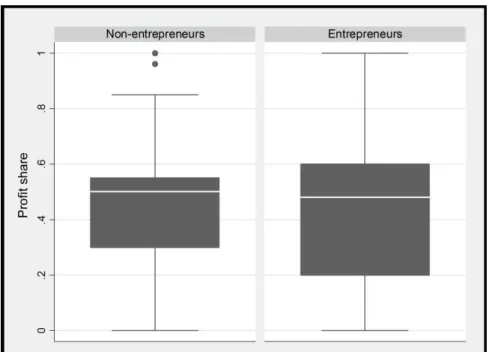
29 by each group and the variation of the profit shares they have successfully claimed. On average entrepreneurs rejected offers that were equal to or below 49.1% (SE: 2.6%) while non-entrepreneurs on average rejected offers equal or below 46.3% (SE: 2.3%). This difference is not statistically significant (Wilcoxon rank sum test: z = - 0.810, p = 0.418) rejecting hypothesis 5a. Testing hypothesis 5b, we find that the distribution of the profit shares entrepreneurs and non-entrepreneurs were able to claim does differ significantly. We can reject the null hypothesis that they were draw from the same distribution (Two-sample Kolmogorov-Smirnov test for equality of distribution functions p= 0.548). The variance in profit shares claimed by entrepreneurs is significantly higher, while no siginifcant differences can be observed in the mean (see figure 2 below). This reflects the lower number of deals closed by entrepreneurs and their higher profits when they close a deal.
---
Insert figure 2 about here
---
5.3 Further results
We find no significant differences between entrepreneurs and non-entrepreneurs with respect to their propensity to open the conversation or making the opening offer. Entrepreneurs’ initial asking levels where insignificantly higher than those of non-entrepreneurs. The concession rates in both groups did not differ. Entrepreneurs made significantly fewer offers than non-entrepreneurs and rejected offer insignificantly more often. While these results suggest that entrepreneurs tend to negotiate harder
30 than non-entrepreneurs, differences are not statistically significant. Table A.3 in the Appendix summarizes these results.
5.4 Robustness tests
Negotiation researchers have tended, over time, to put less emphasize on the influence of personality on negotiation behaviour and outcomes as results on this relationships remain mixed and contradictory despite ample research efforts. Still we feel that a robustness test controlling for the effect of personality is necessary as entrepreneurs have been shown to differ from non-entrepreneurs in a number of characteristics (e.g. Rauch and Frese, 2007; Zhao and Seibert, 2006). For this we measured participants’ locus of control, extraversion, agreeableness, conscientiousness, neuroticism, and openness. Table 1 below summarizes the results. In line with previous research we find that entrepreneurs have a more internal locus of control than non-entrepreneurs. We also find significant differences in neuroticism and openness.
---
Insert table 1about here
---
Controlling for these characteristics, we run random effects linear regressions models to provide robustness tests for our findings. Table 2 below reports on the results of these regressions; they show that the results on persuasiveness and expressiveness are robust when controlling for personality. The result that entrepreneurs gain higher total profits from closed deals is not robust when controlling for personality. The regression coefficient is high and positive but the effect does not reach statistical
31 significance. Thus, hypothesis 3 needs to be rejected. Furthermore, the result that entrepreneurs close fewer deals than non-entrepreneurs is robust when controlling for personality (table A.4 in Appendix A).
---
Insert table 2 about here
---
6. Discussion
Our results reveal significant differences between entrepreneurs’ and non-entrepreneurs’ bargaining behaviours: Entrepreneurs use persuasive behaviours much more often than non-entrepreneurs. This result is highly significant and robust when controlling for individual effects such as personality. Furthermore, entrepreneurs express emotions significantly more often than non-entrepreneurs. Also this result is robust when controlling for personality. Thereby, aggressiveness/agreeableness of the emotions expressed varies much more intensely with entrepreneurs.
These results are in line with previous research emphasizing the importance for entrepreneurs’ of being persuasive (Baron and Markman, 2003) and with Baron (2008) and Cardon (2005) arguing that entrepreneurship is essentially an affective process. They might reflect a higher involvement with entrepreneurs due to the relevance of negotiation to their daily business. Entrepreneurs’ more pronounced use of emotional expressions might also suggest that entrepreneurs use emotions strategically in the negotiation process. Our results suggest that future research should
32 pay attention to emotional expressions and the intention in which entrepreneurs use them in interaction and conflict.
While our behavioural hypotheses were supported, our two hypotheses about bargaining outcomes had to be rejected: contradicting our expectations, entrepreneurs were not better in adjusting to different scenarios, nor could we find significant differences in being able to use information asymmetries to their advantage. Instead, we found that entrepreneurs closed significantly fewer deals than non-entrepreneurs thereby missing out on many profit opportunities. Interestingly, when closing a deal, entrepreneurs made significantly higher profits. This leads to a higher variance in entrepreneurs profits. These results suggest that entrepreneurs’ have a higher willingness to accept profit variances for the getting chance of making high profits, supporting hypothesis 5b. They seem to be willing to take to the risk of not closing a deal for the chance to make a good deal. This corresponds to their higher use of persuasive behaviours. Our results support recent research on entrepreneurs’ pronounced willingness to accept strategic uncertainty stemming from the interaction with others (Holm et al., 2013). They are also in line with theories assuming entrepreneurs to be particularly willing to accept substantial risk for the chance of gaining high profits (Knight, 1921).
These results contribute to behavioural research in entrepreneurship in three major ways: First, we identify, characterize and address an important gap in the entrepreneurship literature. Second, we provide the first empirical results on entrepreneurs’ negotiation behaviour and reveal significant differences between entrepreneurs and non-entrepreneurs with respect to negotiation behaviour and
33 outcomes. Third, we outline opportunities for future research on entrepreneurs’ negotiation behaviour and aim to stimulate research on this important aspect of entrepreneurial activity.
Our results are limited in at least three ways: First, participants were interacting via a chat device. Thus, participants were limited in the way they could express themselves as compared with face-to-face interaction. This was necessary to assure participants’ anonymity and to control for potential individual effects that are not in the focus of this study – for example, potential differences in reactions towards a male or female / young or older counterpart. Given that face-to-face interaction allows for non-verbal communication such as facial expressions and body language, it can be assumed that behavioural differences between entrepreneurs and non-entrepreneurs might be even more pronounced when studying face-to-face negotiations. Given the lively discussions, the degree to which participants showed to be involved in the negotiations, and the behavioural differences observed, our results seem to give a good first impression of entrepreneurs’ negotiation behaviour. Future research should test whether these differences hold in face-to-face negotiations and whether further differences exists in particular with respect to facial expressions and body language and how these impact negotiation outcomes. Second, although entrepreneurs and non-entrepreneurs were recruited using the same invitation text, non-non-entrepreneurs had been approached via the Experimental Data Base of University while entrepreneurs had been approached via the Entrepreneurship Centre of the same University. Hence, while no information about potential counterparts was given to the participants, entrepreneurs might have assumed that they would be negotiating with other entrepreneurs because they were contacted via the Entrepreneurship Centre. Since we
34 believed that the recruitment would have been less credible if the invitation would have come from an address unfamiliar to the entrepreneurs, we accepted that this might happen as we felt the consequences for results are less problematic: given that an entrepreneur would have believed that he was negotiating with other entrepreneurs, he would have even more inclined to behave usual in his daily business. Thus, we do not see that this reduces the validity of results. Third, we base our analyses on a small sample of observations. While we would have preferred to recruit a larger sample of entrepreneurs for our experiment, the recruitment of a randomized, high quality sample seemed more important to us than recruiting a larger sample and compromise on quality.
Based on our results and the limitations of this study we propose the opportunities for future research:
Context: we studied entrepreneurs’ behaviour in distributive negotiation. Furthermore, we studied behaviour the most generic setup - buying and selling. Future research should examine entrepreneurs’ negotiation behaviour in other set-ups, such as negotiations with VCs and banks, partners and employees. In particular, integrative negotiations are highly relevant for the entrepreneurial context and we expected that entrepreneurs might be particularly good in seeing opportunities “how to make the pie larger”. Another question related to context is, whether entrepreneurs are particularly good in persuading others when the negotiation is related to their actual venture, which they are passionate about. This might lead them to hold biased judgements about values but also to have stronger arguments.
35 Face-to-face negotiations: it would be interesting to test whether face-to-face interaction would show even larger behavioural differences between entrepreneurs and non-entrepreneurs. In particular, the role of mimic, voice, and body language is interesting as entrepreneurs have been shown to be particularly passionate about their goals, which is likely to also play an important role in entrepreneurial negotiation in and for their ability to persuade others.
Different control groups: Future research might also consider differences between entrepreneurs and other groups of expert negotiators, such as sales people and managers. While we were interested on how far entrepreneurs differ from non-entrepreneurs who have not been trained in negotiation, a comparison between entrepreneurs and trained individuals would be also interesting and could yield further insights.
7. Summary and Implications
We find that entrepreneurs exhibit more persuasive behaviours and express emotions more frequently in negotiations than non-entrepreneurs. Entrepreneurs close fewer deals that non-entrepreneurs, but when they do, they claim higher profit shares. This suggests that entrepreneurs have a higher willingness to risk closing a deal for the chance of getting a good deal and to accept profit volatility. Our support Baron’s and Cardon’s view that emotions play a crucial role in entrepreneurial processes and suggest that future research should pay attention to entrepreneurs’ expressiveness and their intentions to express emotions, particularly in situations of conflict.
36 References
Baron, R. A., 1998. Cognitive mechanisms in entrepreneurship: Why and when enterpreneurs think differently than other people. Journal of Business Venturing 13 (4), 275-294.
Baron, R. A., 2007. Behavioral and cognitive factors in entrepreneurship: entrepreneurs as the active element in new venture creation. Strategic Entrepreneurship Journal 1, 167-182. Baron, R. A., Markman, G.D., 2003. Beyond social capital: the role of entrepreneurs’ social competence in their financial success Journal of Business Venturing 18, 41–60.
Baron. R.A., 2006. Opportunity Recognition as Pattern Recognition: How Entrepreneurs “Connect the Dots” to Identify New Business Opportunities. Academy of Management Perspectives 20(1), 104-119.
Barry, B., 1999. The tactical use of emotion in negotiation. In R.J. Bies, R.J. Lewicki, and Sheppard, B.H. (Eds.), Research on Negotiation in Organizations. Stanford.
Barry, B., Friedman, R.A., 1998. Bargainer Characteristics in Distributive and Integrative Negotiation. Journal of Personality and Social Psychology 74 (2), 345-359.
Bazerman, M. H., Neale, M. A., 1992. Negotiating Rationally. Free Press.
Bazerman, M., Curhan, J., Moore, D., Valley, K., 2000. Negotiation. Annual Review of Psychology 51, 279-314.
Bowden, R., 1994. Bargaining, size and return in venture capital funds. Journal of Business Venturing 9, 307-330.
Brett, J. M., Okumura, T., 1998. Inter- and intracultural negotiations: U.S. and Japanese negotiators. Academy of Management Journal 41, 495-510.
Bryant, F.B., Smith,B.D., 2001. Refining the Architecture of Aggression: A Measurement Model for the Buss–Perry Aggression Questionnaire. Journal of Research in Personality 35,138-167. doi:10.1006/jrpe.2000.2302
Busenitz, L.W., Barney, J.B., 1997. Differences between entrepreneurs and managers in large organizations: biases and heuristics in strategic decision making. Journal of Business
Venturing 12(1), 9-30.
Buss, A. H., Perry, M. P., 1992. The Aggression Questionnaire. Journal of Personality and Social Psychology, 63, 452-459.
Buss, A. H., Warren, W. L., 2000. The Aggression Questionnaire manual. Los Angeles:Western Psychological Services.
Cable, D.M., Shane, S. 1997. A Prisoner's Dilemma Approach to Entrepreneur-Venture Capitalist Relationships. The Academy of Management Review 22 (1), 142-176.
37
Cardon, M.S., Zietsma, C., Saparito, P., Matherne, B.P., Davis, C., 2005. A tale of passion: New insights into entrepreneurship from a parenthood metaphor. Journal of Business Venturing 20(1), 23-45.
Carter, N.M., Gartner, W.B., Reynolds, P.D., 1996. Exploring start-up event sequences. Journal of Business Venturing 11, 151–166.
Costa, P. T., McCrae, R. R., 1992. Revised NEO Personality lnventory (NEO-PI-R) and NEO Five-Factor Inventory (NEO-FFI) professional manual. Odessa, FL: Psychological
Assessment Resources, Inc.
De Clercq, D., Fried, V. H., Lehtonen, O., Sapienza, H. J., 2006. An Entrepreneur's Guide to the Venture Capital Galaxy. Academy of Management Perspectives 20, 90-112.
Fairchild, R., 2011. An entrepreneur's choice of venture capitalist or angel-financing: A behavioral game-theoretic approach, Journal of Business Venturing 26, 359-374.
Gartner, W. B., 1988. “Who is an entrepreneur?” is the wrong question. American Journal of Small Business 12(4), 11-32.
Güth, W., Schmittberger, R., Schwarze, B., 1982. An experimental analysis of ultimatum bargaining, Journal of Economic Behavior & Organization 3(4), 367-388.
Harnett, D.L., Cummings, L.L., Hamner, W.C., 1973. Personality, bargaining style and payoff in bilateral monopoly bargaining among European managers. Sociometry 36, 325-345. Harrison, G., List, J., 2004. Field Experiments. Journal of Economic Literature, 42, 1009-1055.
Hellmann, T., 2002. A theory of strategic venture investing. Journal of Financial Economics 64, 285-314.
Hellmann, T., Wasserman, N., 2010. The first deal: the division of founder equity in new ventures. NBER working paper series. Working Paper 16922.
Holm, H., Opper,S. Nee, V., 2013. Entrepreneurs Under Uncertainty: An Economic Experiment in China. Management Science.
Holt, D.H., 1992. Entrepreneurship: New Venture Creation. Prentice-Hall, Englewood Cliffs, NJ.
John, O.P., Donahue, E.M., Kentle, R.L., 1991. The “Big Five” Inventory-Versions 4a and 54. Technical Report. IPAR. University of California Berkeley.
Kaish, S., Gilad, B., 1991 Characteristics of opportunities search of entrepreneurs versus executives: Sources, interests, general alertness. Journal of Business Venturing, 6(1), 45-61. Kelley, D.J., Brush, C.G., Greene, P.G., Litovsky, Y., 2011.Global Entrepreneurship Monitor. 2010 Women’s Report. Babson College, and the Global Entrepreneurship Research
Association.
Khakhar, P., Rammal, H.G., 2013. Culture and business networks: International business negotiations with Arab managers. International Business Review 22(3), 578-590.
38
Kihlstrom, R., Laffont, J.,1979. A general equilibrium theory of firm formation based on risk aversion. Journal of political economy 87 (4), 719-748.
Kirzner, I. M.,1973. Competition and Entrepreneurship. Chicago: University of Chicago Press.
Knight, F.H., 1921. Risk, Uncertainty, and Profit. Boston: Houghton Mifflin.
Kramer, R., Newton, E., Pommerenke, L., 1993. Self-enhancement biases and negotiator judgement: effects of self-esteem and mood. Organizational Behavior and Human Decision Processes 56, 110-113.
Lax, D.A., Sebenius, J.K., 1986. The Manager as Negotiator: Bargaining for Cooperation and Competitive Gain. NY: Free Press.
Lazear, E.P., 2004. Balanced Skills and Entrepreneurship. American Economic Review, Papers and Proceedings.
Lazear, E.P., 2005. Entrepreneurship. Journal of Labor Economics 23(4), 649-680.
Lewicki, R.J., Litterer, J.A., Minton, J.W., Saunders, D. M., 1994.Negotiation (2nd ed).Burr Ridge:IL: Irwin.
Lewicki, R.J., Saunders, D., Barry, M., 2005. Negotiation. New York: McGraw-Hill/Irwin. Li, S.,Roloff, M.E. 2006. Strategic Emotion in Negotiation: Cognition, Emotion, and Culture. In Riva, G., Anguera, M.T., Wiederhold, B.K., and Mantovani, F. (Eds.) From
Communication to Presence: Cognition, Emotions and Culture towards the Ultimate Communicative Experience. Festschrift in honor of Luigi Anolli, OS Press, Amsterdam. Loewenstein, J., Thompson, L., 2000. The challenge of learning. Negotiation Journal 16(4), 399-408. doi: 10.1023/A:1026692922914
Maxwell, A.L., Levesque, M., 2011. Trustworthiness: A Critical Ingredient for Entrepreneurs Seeking Investors. Entrepreneurship Theory and Practice, doi: 10.1111/j.1540-6520.2011.00475.
McCrae, R. R., Costa, P. T., 1999. A five-factor theory of personality. In L. A. Pervin and O. P. John (Eds.), Handbook of personality (pp. 139–153). New York: Guilford.
Nash, J.F., 1953. Two-person cooperative games. Econometrica 21, 128–140.
Neale, M. A., Northcraft, G.B., 1991.Behavioral negotiation theory: A framework for conceptualizing dyadic bargaining. In L.L. Cummings, and B.M. Staws (Eds.), Research in organizational behaviour 13, 147-190. Greenwich, CT: JAI Press.
Neale, M. A., & Northcraft, G. B. (1986). Experts, amateurs and refrigerators: Comparing expert and amateur negotiators in a novel task. Organizational Behavior and Human Decision Processes, 38, 305–317.
Osborne, M.J., Rubinstein, A., 1994. A Course in Game Theory. Massachusetts Institute of Technology, MIT Press.
39
Rauch, A., Frese, M., 2007. Born to be an entrepreneur? Revisiting the personality approach to entrepreneurship. In J. R. Baum, M. Frese, and R. Baron (Eds.), The psychology of entrepreneurship research (pp. 41–65). Mahwah, NJ: Lawrence Erlbaum Associates.
Rotter, J.B.,1966. Generalized expectancies of internal versus external control of reinforcements. Psychological Monographs 80, 1-28.
Rubinstein, A.,1982. Perfect Equilibrium in a Bargaining Model. Econometrica 50 (1), 97– 109.
Samuelson, L. 2005. Economic Theory and Experimental Economics. Journal of Economic Literature, 43, 65-107.
Sandri, S., Schade, C., Mußhoff, O., Odening, M.,2010. Holding on for too long? - An experimental study on inertia in entrepreneurs' and non-entrepreneurs' disinvestment choices. Journal of Economic Behavior and Organization 76, 30-44.
Sarasvathy, S. 2001. Causation and Effectuation: Toward a Theoretical Shift from Economic Inevitability to Entrepreneurial Contingency. Academy of Management Review 26, 243-263. Sexton and Bowman, 1985;
Shane, S., Venkataraman, S., 2000. The promise of entrepreneurship as a field of research. Academy of Management Review 25, 217–226.
Thompson et al., 1995
Thompson, L., 1990. Negotiation behavior and outcomes: Empirical evidence and theoretical issues. Psychological Bulletin 108(3), 515-532.
Venkataraman, S., 1997. The distinctive domain of entrepreneurship research: An editor's perspective. In J. Katz & R. Brockhaus (Eds.), Advances in entrepreneurship, firm mergence, and growth 3, 119-138. Greenwich, CT: JAI Press.
Venkataraman, S., Sarasvathy, S.D., Dew, N., Forster, W.R., 2012. Reflections on the 2010 AMR Decade Award: Whither the promise? Moving forward with entrepreneurship as a science of the artificial. Academy of Management Review 37(1) 21–33.
White, L. H., 1976. Entrepreneurship, Imagination and the Question of Equilibrium. In: Littlechild, S. (ed.) Austrian Economics, vol. III, 1990, 87–104. Edward Elgar.
Yu, T. F., 2001. Entrepreneurial Alertness and Discovery. The Review of Austrian Economics, 14(1), 47–63.
Zhang, J., 2011. The advantage of experienced start-up founders in venture capital acquisition: evidence from serial entrepreneurs. Small Business Economics 36(2), 187-208. Zhao, H., Seibert, S. 2006. The Big Five Personality Dimensions and Entrepreneurial Status: A Meta-Analytical Review. Journal of Applied Psychology 91, 259–271.