Tapping Cloud-Based
ERP Solutions to
Capture Global
Business
Opportunities
Sponsored by NetSuite
Sanjeev Aggarwal, Partner
Laurie McCabe, Partner
Dwight Davis, Contributing Analyst
July 2013
T
APPING
C
LOUD
-B
ASED
ERP S
OLUTIONS TO
C
APTURE
G
LOBAL
B
USINESS
O
PPORTUNITIES
K
EY
H
IGHLIGHTS
Global businesses face many challenges when trying to manage subsidiaries and operations in different parts of the world, including managing new operational and financial risks; dealing with multi-currency issues, country-specific tax requirements and regulatory concerns; and getting a clear, 360-degree view of the business.
Cloud-based ERP solutions provide real-time visibility into operations and financial performance; provide a single, automatically upgraded instance of software for all to use; and can allow firms to preserve existing on-premises investments while launching new cloud-based subsidiaries.
Even with cloud-based ERP solutions, global companies need additional functionality to meet more complex geographical, management and financial consolidation requirements.
“Must-haves” include accurate multi-currency exchanges; faster and easier financial consolidation, ease of deployment, use and management; built-in knowledge about local tax requirements; and the ability to tailor the solution.
Businesses of all sizes can manage multiple subsidiaries, business units and legal entities from a single NetSuite account, helping them close their books faster and more accurately and make better business decisions. At the same time, they can provide complete local control for each division without the need for local IT staff or hardware.
By allowing global companies to concentrate on the “business of the business,” rather than worrying about the mechanics of financial management and operations, companies can achieve rapid ROI and often grow revenues significantly with only minimal headcount increases.
Thanks to technological advancements and evolving markets, companies of all sizes can now pursue global business opportunities that were once open only to the largest corporations. But to take advantage of these opportunities, companies must be able to manage and streamline financial operations across countries with different currencies, tax laws, and reporting and oversight requirements. They also must manage financial consolidations at multiple levels: Each subsidiary needs to have local operational control, and the parent company must be able to roll up data into consolidated financial reports.
In years past, these challenges were all but insurmountable for most organizations, especially smaller businesses. All but the biggest corporations lacked the business expertise and the IT budgets and resources required to pursue global operations and markets. Regardless of their size and resources, companies need the visibility, reporting functionality, quality and sophistication that was once
available only via cumbersome and expensive enterprise ERP systems. If they are to “go global,” most companies require solutions that are easier and faster to deploy, less resource intensive to maintain, and more affordable than solutions built and priced for only the biggest players. They also
need solutions that can be easily integrated with existing systems and customized to meet specific operational requirements.
In this paper, we consider the distinct financial and operational challenges that businesses face when launching international operations, and examine the value that global, real-time financial reporting and consolidation solutions can deliver. We discuss the criteria that companies should use to evaluate solutions, and explore how NetSuite’s OneWorld solution measures up to these criteria. NetSuite OneWorld has been designed from the ground up as a cloud-based solution that can provide organizations of virtually any size with the global visibility, consolidation and reporting functionality they need to streamline their operations and gain a competitive edge. Throughout the paper, we reference the experiences of several NetSuite OneWorld customers interviewed for this paper. We conclude with our perspective on how the right tools can give businesses the agility and visibility they need to achieve their global business objectives.
S
ECTION
1: G
OING
G
LOBAL
: A W
ORLD OF
O
PPORTUNITIES
, O
NCE
C
HALLENGES
A
RE
O
VERCOME
The attractions of expanding globally hold true regardless of company size. Among them: Access to new markets, customers and revenue streams
New suppliers, distribution and manufacturing capabilities to increase efficiencies and reduce costs
Access to new labor sources and skills
Many companies are exploring international expansion as one way to spark increased growth in the aftermath of the recent, and deep, recession. They can find plenty of government support when pursuing these efforts, with the Obama administration in 2010 announcing the National Export Initiative, which has a goal of doubling U.S. exports by the end of 2014. Indeed, exports grew 17% in 2010 and almost 15% in 2011 as the world economy recovered. Export growth slipped to only about 5% in 2012, but still totaled a record $2.21 trillion. To keep exports increasing, the U.S. Commerce Department not only runs a wide range of overseas trade missions, but is also working with more than a dozen U.S. cities to help them develop their own local export promotion programs.
A company doesn’t have to be big to be an exporter, of course. For example, the U.S. Census Bureau reports that companies with between 1 and 499 employees accounted for one-third of the value of all exports in 2011. That said, exporting to foreign markets doesn’t require companies to establish local subsidiaries in those markets. Increasingly, however, companies are setting up such international operations in order to get the maximum benefits possible by participating in global markets with local “feet on the ground.”
In these efforts, companies can leverage a variety of technologies to make it easier for them to expand beyond national borders. Cloud computing solutions, in particular, can help free up time and money that companies would otherwise use to buy and maintain IT infrastructure and hire local IT resources. By not sinking money into a globally dispersed IT infrastructure, companies can invest more in their core business and market differentiation. Cloud-based solutions can also help
businesses collaborate with their employees, suppliers, partners and customers in real time, at any location.
However, cloud computing alone isn’t enough to make going global easy. Businesses face many concerns and challenges as they enter new markets and attempt to manage subsidiaries and operations in different parts of the world (Figure 1). Some of the most significant issues they must cope with include managing new operational and financial risks (such as dealing with multi-currency issues, tax structures and compliance concerns), and managing and analyzing financial information on country, regional and consolidated levels to get a clear, 360-degree view of the business.
Figure 1: Top Challenges Businesses Face When Expanding Global Operations
Local accounting, tax and compliance requirements for each subsidiary and the parent company Managing currency exchange rates with historical accuracy, as well as localized currency
conversions for sales and billing and for consolidations
Adhering to local tax regulations and reporting requirements, including managing operations in multiple countries that may have different tax years
Lengthy cycle to roll up financial results from subsidiaries, which delays closing the books Lack of immediate visibility into financials, which delays important decision-making
Lack of confidence in financial data for both individual subsidiaries and for consolidated results due to inaccurate currency conversion
Time-consuming manual processes that are error prone and inefficient
“Siloed” systems for accounting, ERP, ecommerce, etc., between and within subsidiaries and the corporation, which prohibit a clear, 360-degree view of corporate performance
Difficulty managing multiple sales and distribution channels
Finding a global ERP solution that is designed and priced for growing companies with operations in multiple countries
Lack of internal and local IT resources to deploy sophisticated solutions in-house
The ability to grow international operations—either organically or via acquisition—without having to significantly increase IT or financial management headcount
“The company was only consolidating
its financials once each year, and the
process was a spreadsheet nightmare,”
— Sabine Castagnet, Chief operating
officer, Data Physics
S
ECTION
2: U
NDERPOWERED AND
I
NCOMPATIBLE
L
EGACY
S
YSTEMS
C
AN
H
AMSTRING
C
OMPANY
G
ROWTH
Growing globally has very specific implications in terms of business solutions. However, many U.S. companies currently depend on financial systems that weren’t designed to handle the complexities of operating across multiple countries. As firms launch or acquire new overseas subsidiaries, they’re likely to find themselves running—and trying to reconcile—several disparate solutions. Integrating disparate applications and getting them to talk to each other isn’t easy—especially when the individual applications were designed for country or regional requirements and lack the full scope of capabilities that corporate requires. Naturally, supporting a plethora of cobbled-together applications that weren’t right for the job in the first place is also costly and time consuming.
Businesses hobbled by underperforming and incompatible systems soon recognize that they need clear, real-time visibility into operations and performance if they are to fully capitalize on global opportunities. Armed with better insight, they can make better-informed, more proactive decisions, both day-to-day and for strategic planning. The requirements for real-time, accurate data along with the need to aggregate, slice and dice that data to meet both local and corporate financial planning requirements are driving many businesses to turn to cloud computing solutions that—along with streamlining deployment, use and maintenance across multiple locations—provide multinational financial capabilities.
Take the case of Data Physics Corp., a privately held company founded by two Hewlett-Packard alumni in 1984. A designer and manufacturer of signal analyzers, vibration controllers, underwater acoustic equipment, and other test and measurement systems, the company employs just under 100 people distributed across its San Jose, California, headquarters and five operations in the U.K., Germany, France, China and India. Data Physics also has a network of distributor partners covering 34 countries, and approximately 60% of the company’s sales are international.
Ten years ago, Data Physics went through a slow business period and was searching for new growth opportunities. Daily operations—to say nothing of growth—were hampered by a disparate collection of IT systems including Solomon financials, GoldMine CRM and multiple Microsoft Access databases, remembers chief operating officer Sabine
Castagnet. The company was only consolidating its financials once each year, and the process “was a spreadsheet
nightmare,” she says.
Complicating matters was the fact that Data Physics—then
about one-quarter its current size—just had one full-time IT person to manage its on-site server and applications. At the time, the international subsidiaries were just sales offices, and each of them was operating its own local systems.
“Compliance, disaster recovery,
back-up, application patchwork…these
were all painful.”
— Shamyo Chatterjee, Chief
information officer, CallidusCloud
CallidusCloud, a vendor of cloud-based sales performance management, marketing and hiring software services, faced an even more daunting IT landscape. “We had 14 different systems, and it was driving us crazy,” says chief information officer Shamyo Chatterjee. Founded in 1996, the Pleasanton, California–based company has eight subsidiaries across Europe, Asia, India and the Americas, employs about 700 people and expects to book about $110 million in revenues in 2013. Among the 14 software systems CallidusCloud was running in 2010 were Microsoft Dynamics Great Plains financials, Marketo demand generation, Neocase HR, Extensity CRM, Infor ERP and
QuickArrow professional services automation. “We spent a lot of our time building interfaces among these different systems,” Chatterjee says. “And those 14 systems didn’t even include the software that our subsidiaries were using.”
Like Data Physics, “We had spreadsheets flying all over the place,” Chatterjee recalls. CallidusCloud’s IT department, which currently has about 22 employees, was reduced to being “a tactical, keep-the-lights-on business,” he says. “Compliance, disaster recovery, back-up, application patchwork…these were all painful.”
Making matters worse, CallidusCloud was about to embark on a period of growth through an aggressive acquisition strategy.
It needed a solution that could help it lessen the day-to-day demands of just keeping the business running, while supporting rapid growth without also requiring big increases in IT budgets and staffing. For-profit companies aren’t the only organizations faced with the challenges of inadequate IT systems and global expansion pressures. Nonprofit Healing Waters International was founded in 2002 by a couple doing missionary work in the Dominican Republic. The small organization developed a water treatment system and worked with local churches to bring clean water to the residents of their communities. Initially, Healing Waters owned and operated the water treatment systems itself, but it changed its operational model over time and now hands off the completed systems to the local community, which then operates and maintains them.
Despite having just six full-time employees at its Golden, Colorado, headquarters, Healing Waters runs subsidiary offices in the Dominican Republic, Mexico and Guatemala. With no in-house IT staff, the organization was using QuickBooks to manage its finances. However, the founders recognized that QuickBooks wouldn’t be able to meet the growing inventory, multi-currency and project-management demands Healing Waters faced, says chief financial officer John Correa.
As with most nonprofits, categorizing and tracking donor contributions are critical parts of Healing Waters’ operations. While some donors contribute non-restricted funds, others contribute funds specifically for individual communities and projects, so they can’t be used for anything else, Correa explains. “We needed a system that could manage each project from inception, when the first funds come in, through project completion, inauguration and the eventual hand over to the community.” Data Physics, CallidusCloud and Healing Waters each had its unique IT and business challenges, but many organizations face the problem of patchwork IT systems that struggle just to meet current business demands. Layering business growth on top of those systems—especially international
“We got the most for our dollars, plus
we got to deal with the vendor directly
rather than with a reseller,”
— Sabine Castagnet, Chief operating
officer, Data Physics
growth, with all its local currency, taxation and regulation complexities—can easily strain legacy systems to the breaking point. These three organizations, along with thousands of others, eventually found a solution to their problems in the cloud. But first they had to identify the key capabilities they needed in a global financial and ERP solution.
S
ECTION
3: E
VALUATING
C
RITERIA FOR
G
LOBAL
F
INANCIAL AND
ERP S
OLUTIONS
Although large multinational corporations may create extensive requirements documents and conduct rigorous solution assessments and proofs of concept, most companies follow a less formal do-it-yourself path. In fact, according to SMB Group’s2012 Routes to Market Study, 50% of the
businesses use technology and industry analysts as their primary method to research new business solutions; and 41% of these turn to professional advisors/consultants and social media commentary as sources of advice when evaluating a new solution.
That was the route that Data Physics followed, according to COO Castagnet. “The accounting manager and I just went out and searched for solutions on the web,” she says. “We were open to anything initially, and ended up with three candidate solutions: Microsoft Dynamics, SAP and NetSuite. The cloud-based NetSuite solution ultimately made the most sense for us. We got the most for our dollars, plus we got to deal with the vendor directly rather than with a reseller, as would have been the case with both Microsoft and SAP.”
Another company, CIRCA, found its solution—NetSuite OneWorld—by networking with the private equity company backing the firm. A leading international buyer and seller (to private dealers) of jewelry, diamonds and watches, New York–based CIRCA has seven U.S. offices and subsidiaries in Spain, Switzerland and Hong Kong. With 85 employees, just one IT staff member and more than $100 million in multi-currency revenue, CIRCA found that its QuickBooks software couldn’t meet its needs. “We were led to the NetSuite solution because another client of our private equity investor was using it with good success,” explains CIRCA’s controller, Gemell Davis.
Regardless of the nature of their search and evaluation process, organizations would be wise to seek information about several key technical and business areas. Among the most important:
“Must-have” functionality.Most global businesses need more accurate multi-currency exchanges along with simple and rapid financial consolidation. Does the solution calculate financials in local currencies? What languages does it support? Does the solution contain knowledge of local tax regulations and requirements, and help ensure that you follow proper tax filing and remittance procedures? In addition, depending on the type of business you run or the industry you are in, you may have other must-haves, such Healing Waters’ need to track donor funds through the life of a project.
Real-time data visibility, interaction and reporting.Having accurate information and detailed audit trails about budgets, costs, forecasts, supplies, labor and projects—both locally and globally—provides insight with which managers can make better day-to-day and strategic decisions. With a common, centralized database, you enter data once and it is consistent across functions, making data retrieval, querying and reporting much simpler. Detailed audit trails make it much simpler to investigate problems and to meet stringent regulatory
requirements.
Integration.A solution that runs on one unified database can also connect previously disconnected silos of information, giving everyone “a single version of the truth.” Having key business solutions running on one common database also means you spend less time shuffling from one application to another to complete different tasks, helping to facilitate workflows, streamline operations and automate processes.
Resources to implement and manage the solution.The businesses we interviewed for this paper deliberately chose cloud computing over on-premises solutions so they could get up, running and productive more quickly, at a lower cost and with reduced risk. In fact, internal IT resources and VAR, consultant and IT infrastructure costs account for
approximately 15% of the TCO costs in cloud solutions compared to around 70% to 72% in on-premises solutions, according to the SMB Group report,How TCO Benefits Make Cloud Computing a No-Brainer for Many SMBs and Mid-Market Enterprises.
Scalability.Can the solution scale flexibly to quickly meet new or changing demands? In addition to making it easy to add new subsidiaries, can you easily add, change or remove users as requirements shift in individual locations without disrupting the business? How complicated is it to start with financials but add other capabilities—such as CRM or a web store—as needed?
Security.Given the sensitivity of financial and other ERP data, the solution must be secure from both external and internal threats. Among the security capabilities supported should be the ability to easily grant access to specific applications and data based on employee roles or other factors, and to rapidly rescind that access when necessary.
Ease of access and use.Is the information you need at your fingertips, when and where you need it, regardless of where you are—whether you’re using a smartphone or a PC? It’s simpler for users to get up to speed on solutions with visual interfaces, clear and easy navigation, and the same interface throughout. Cloud-based solutions with streamlined mobile interfaces and capabilities help boost productivity on the road.
Communication and collaboration.In a global company, things can get lost in translation. But by making it easier for people in different locations to get on the same page, with the same information, you can reduce the likelihood of misunderstandings and boost productivity and efficiency. How simple is it to track information changes and updates, and notify people when things need their attention?
Ability to modify and add new functionality.How open is the architecture? Does the solution vendor provide application programming interfaces (APIs) and web services so that it’s easy for developers to write add-on solutions? Because no one vendor can build
everything that any customer may need, look for an active third-party developer ecosystem. Global support and service.What type of presence, resources and knowledge does the
vendor have in the regions where your business operates or plans to enter? How does the vendor track, manage and resolve issues at local, regional and country levels?
S
ECTION
4: N
ET
S
UITE
’
S
O
NE
W
ORLD
S
OLUTION
: D
ESIGNED FOR
B
USINESSES WITH
G
LOBAL
R
EQUIREMENTS
Over the last several years, NetSuite has grown to become the one of the world’s leading ERP and financials software suite vendor, providing tightly integrated cloud-based financials, CRM, inventory and ecommerce capabilities to more than 16,000 organizations across more than 110 countries. NetSuite built its solution from the ground up to capitalize on the advantages of cloud computing, an integrated suite approach and an open architecture with many pre-built connectors and integration partners.
Source: NetSuite, 2013
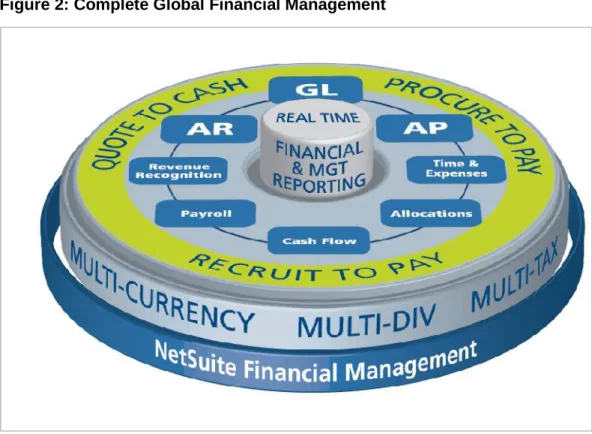
NetSuite OneWorld brings global capabilities to the core cloud services. Out of the box, OneWorld provides support for 19 languages and more than 190 currencies, and tax reporting support and certification for 50 countries. Backed by a global partner network, OneWorld also supports transactional and use taxes for more than 110 countries, can manage multiple subsidiaries with distinct tax years and reporting dates, and delivers a wide range of core capabilities and benefits. As shown inFigure 2, NetSuite OneWorld provides comprehensive capabilities to address a wide range of global financial management requirements.
OneWorld’s specific features and benefits include the following:
Real-time visibility and dashboardsfor users across the organization, tailored to user roles and functions
Reduced start-up and maintenance costsversus comparable on-premises business solution deployments
Anytime, anywhere access to informationfrom traditional desktops to mobile devices, with the same user interface across different functions
Biannual automatic upgradesto OneWorld features and functions that all subscribers receive – and begin to benefit from – simultaneously.
Business process customization and verticalizationvia the SuiteCloud platform, a collection of cloud development tools, applications and infrastructure that lets customers, partners and developers customize NetSuite in various ways; among them, building new functionality, workflows and processes as needed, and connecting to legacy and third-party applications and content providers
NetSuite OneWorld provides global companies with all of the core benefits of NetSuite and adds all of the capabilities that international businesses with multiple subsidiaries need to effectively manage their operations (Figure 3).
Figure 3: Global Business Management with NetSuite OneWorld
Source: SL Associates, 2013
NetSuite OneWorld enables companies to manage multiple subsidiaries, business units and legal entities from a single NetSuite account, helping them close their books faster and more accurately by providing the following capabilities:
Consolidated financial reportingthrough support of hierarchical accounting from the subsidiaries to the corporate headquarters, accommodating all currency conversions and differing taxation rules. Traditionally, companies with disparate financial systems have depended on Excel worksheets, often having to wait for data from their subsidiaries, which added to the delays inherent in manual accounting processes.
Local management of taxes and compliance, which gives each subsidiary the ability to maintain its books, pay its employees, manage accounts receivable and payable, and pay taxes in the currency of the region in which it is located.
Accurate, automated currency conversionfor real-time roll-up of costs, revenues, commissions, etc., across subsidiaries, with automated currency refreshes calculated as rates change for more than 190 currencies. The solution automatically calculates the Cumulative Translation Adjustment (CTA) resulting from using different consolidation rates for different types of transactions.
Multi-currency and multi-language supportfor all financial functions, including accounts receivable, accounts payable, payroll, billing, etc., and for financial steps in the sales process, such as quota management, forecasting and commissions. OneWorld currently supports 19 languages.
Built-in business intelligencewith real-time dashboards that display multiple levels of consolidated reporting and KPIs. Users can also create their own KPIs to meet the needs of both local and corporate stakeholders.
Tools to manage multinational customer relationships and sales channels, including direct sales teams and distribution partners. Individual sales reps can manage orders and forecasts in their own local currencies, and managers can roll up this information at country, regional and corporate levels.
Risk mitigationthrough a transparent, automated financial consolidation process that supports defensible, auditable procedures.
Figure 4: Global Business Management with NetSuite OneWorld
Capability
Benefit
Consolidated Financial Reporting
Delivers real-time financial consolidation at the corporate level while providing country-specific financial reporting, previously accomplished manually through multiple Excel spreadsheets over several days Detailed Audit Trail Automatically tracks and records transactions for later analysis and
compliance with different regulatory demands Local Management of
Sales, Payroll and Other Taxes
Enables calculation and payment of taxes in the currency of the region where the company is located based on local tax laws
Support for Local
Accounting Standards Provides support for country-specific financial and regulatory compliance needs
Automated Currency Rate Refreshes for 190
Currencies
Maintains both the local currency conversion rate and rates used to determine roll-up into corporate currency to provide faster, more accurate currency translation of subsidiary costs, revenues, payroll, commissions, etc.
Flexible Chart of Accounts
Creates a single chart of accounts across subsidiaries or companies; can provide separate charts of accounts for each subsidiary; enables posting between subsidiaries through intercompany journals
Automates Cumulative Translation Adjustment
Automatically calculates the Cumulative Translation Adjustment that results from using different consolidation rates, and month-end or historical rates for balance sheet transactions
currency and Multi-Language Support for All
Financial Activities
Includes global management of accounts receivable, accounts payable, payroll, billing, invoicing, etc., as well as all the financial aspects of the sales process, including quota management, forecasting, quotes and orders, order management, commissions and sales themselves Risk Mitigation Enables risk mitigation through a transparent, automated financial
consolidation process with defensible, auditable procedures
Source: SL Associates, 2013
S
ECTION
5: MAKING THE MOVE TO NETSUITE ONEWORLD
Businesses moving to NetSuite OneWorld have different implementation needs, depending on the complexity of their business, the number of subsidiaries they have, the solutions they have been using and the in-house resources they have access to. Some businesses have been using NetSuite’s core solution, are familiar with it and can add OneWorld functionality with relatively minimal
assistance. At the other extreme, a company with several subsidiaries moving from a hodgepodge of systems may require more hands-on consulting, migration and training.
“We wanted a cloud-based solution,
something that could scale with our
business without requiring that we
increase our IT staff,”
— Phil Vuong, Director of finance,
Gawker Media
“I find NetSuite to be more
administrator and user friendly than
our previous code-based Microsoft
Dynamics system,there was less
implementation pain than I’ve
experienced in the past, both in time
and in the wallet.”
— Gemell Davis, Controller,
CIRCA
Data Physics first implemented a NetSuite solution domestically more than 10 years ago. When it acquired a U.K.-based manufacturer in 2005, it expanded the scope and the reach of its NetSuite solution by adding manufacturing, inventory and routing modules. It added OneWorld functionality in 2011 at both its U.S. operations and its overseas subsidiaries.
“The OneWorld transition didn’t require our U.S. employees to do anything,” says COO Castagnet. “In the U.K., we moved all of the open transactions to OneWorld, since we didn’t want to lose the history of any of those transactions. We hadn’t ported transactions before—just names, contacts and so forth—but the shift to OneWorld went smoothly.”
Online media publisher Gawker Media didn’t have any prior NetSuite experience when it deployed a OneWorld solution in 2009. With two subsidiaries—one in the U.S. and one in Hungary—Gawker was another QuickBooks user that needed more functionality from its financial software. “Invoicing and revenue recognition were our major pain points,” says Phil Vuong, director of finance. “We wanted a cloud-based solution, something that could scale with our business without requiring that we increase our IT staff.”
Gawker worked with a NetSuite consultant on the OneWorld
implementation, which involved a fair amount of customization, according to Vuong. “We actually made it simpler, more bare bones, by stripping out a lot of things,” he explains. “Because we’re privately held, we don’t have to do as much reporting as a publicly held company.”
CIRCA’s OneWorld implementation also involved a fair amount of customization to meet the requirements of its unusual business model. “We buy from the public and sell privately,” explains controller Davis, “so we needed to reverse engineer OneWorld CRM.” CIRCA also integrated its website using OneWorld. Despite that customization and integration work, “I find NetSuite to be more administrator and user friendly than our previous code-based Microsoft Dynamics system,” Davis says. “There was less implementation pain than I’ve experienced in the past, both in time and in the wallet.”
Because every customer’s needs are different, NetSuite engages with customers before the sale to scope out the project, ensure understanding of the solution’s capabilities, and discuss the implementation methodology and timeframes. Once the contract
is in place, NetSuite or a NetSuite partner works with the customer using the phased “NetSuite One” methodology detailed inFigure 5. Following this step-by-step methodology ensures accurate requirements identification, the troubleshooting of any potential issues and a smooth transition to the OneWorld solution. Depending on individual requirements, NetSuite OneWorld customers can be up and running in only a few weeks.
Figure 5: NetSuite One Methodology
Source: SL Associates, 2013
NetSuite and its partners take a “shared consulting” approach, working very closely with the customer throughout the implementation process. Effective change management is critical to success—so starting on day one, NetSuite and its partners work to ensure stakeholder buy-in, comprehensive requirements gathering, adequate testing and strong user adoption. NetSuite provides customers with a portal to access documentation, such as templates for user adoption, training plans and checklists, and how-tos for organizing user groups. NetSuite also has a best practices repository for customers, which offers guidance on about 50 topics—such as how to move payables or inventory to NetSuite OneWorld, and best practices for dealing with multiple currencies—to help smooth deployment. Determining what data should be migrated and what can be archived in a legacy system is another important issue that NetSuite addresses with customers early on. Most customers bring in active data and summary-level trial balances by month to provide historical detail for product comparisons, and can import it with NetSuite’s .csv import wizard and some mapping.
This upfront effort and a solid methodology pay off with a shortened production cycle, as NetSuite has been able to eliminate the need for a pilot in most cases. Comprehensive requirements gathering and testing with super users help iron out any kinks early on, speeding time to productivity when the solution goes live.
S
ECTION
6: M
EASURING
S
UCCESS
By allowing companies to concentrate on the “business of the business,” rather than worrying about the mechanics of financial management and operations, customers are receiving a significant return on investment (ROI) across a range of areas (Figure 6). Based on our interviews with NetSuite OneWorld customers, we estimate companies are achieving positive ROI and payback in one to two years.
Figure 6: Key ROI Benefits Achieved with NetSuite OneWorld
Achieve better, more accurate and more timely decision-making due to real-time access and customizable views of financial data locally and at the corporate level, and “a single version of the truth”
Decrease the time required for financial consolidation and reporting
Gain higher confidence in the accuracy of financial results and more streamlined compliance Improve accounting and operational staff productivity
Improve operational and sales results through higher solution availability versus on-premises solutions
Have remote access to manage operations from anywhere, at any time (possibly mitigating or reducing the need for physical offices and staff in some locations)
Eliminate additional IT infrastructure costs for servers, storage, software, etc.
Eliminate the need to add IT headcount to install and manage IT infrastructure and application software
Source: SL Associates, 2013
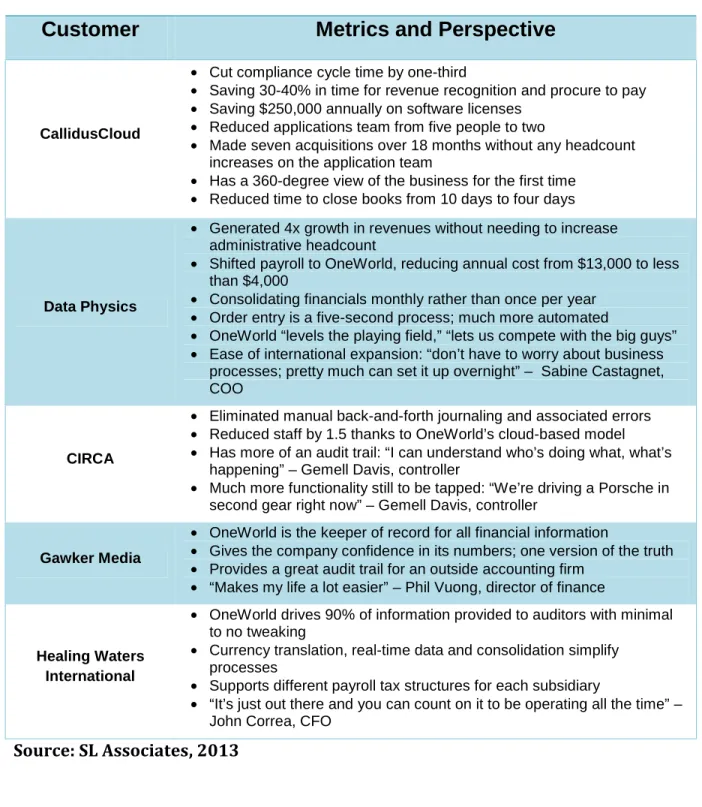
For its part, CallidusCloud estimates that it is saving $250,000 each year on software licenses simply by replacing its former collection of 14 software packages with the multifaceted and integrated OneWorld cloud solution.
Given their distinct requirements and NetSuite implementations, different companies realize different types of benefits from the cloud-based services.Figure 7provides a representative sampling of some of the benefits NetSuite customers cite.
Figure 7: Key ROI Benefits Achieved with NetSuite OneWorld
Customer
Metrics and Perspective
CallidusCloud
Cut compliance cycle time by one-third
Saving 30-40% in time for revenue recognition and procure to pay Saving $250,000 annually on software licenses
Reduced applications team from five people to two
Made seven acquisitions over 18 months without any headcount increases on the application team
Has a 360-degree view of the business for the first time Reduced time to close books from 10 days to four days
Data Physics
Generated 4x growth in revenues without needing to increase administrative headcount
Shifted payroll to OneWorld, reducing annual cost from $13,000 to less than $4,000
Consolidating financials monthly rather than once per year Order entry is a five-second process; much more automated
OneWorld “levels the playing field,” “lets us compete with the big guys” Ease of international expansion: “don’t have to worry about business
processes; pretty much can set it up overnight” – Sabine Castagnet, COO
CIRCA
Eliminated manual back-and-forth journaling and associated errors Reduced staff by 1.5 thanks to OneWorld’s cloud-based model Has more of an audit trail: “I can understand who’s doing what, what’s
happening” – Gemell Davis, controller
Much more functionality still to be tapped: “We’re driving a Porsche in second gear right now” – Gemell Davis, controller
Gawker Media
OneWorld is the keeper of record for all financial information
Gives the company confidence in its numbers; one version of the truth Provides a great audit trail for an outside accounting firm
“Makes my life a lot easier” – Phil Vuong, director of finance
Healing Waters International
OneWorld drives 90% of information provided to auditors with minimal to no tweaking
Currency translation, real-time data and consolidation simplify processes
Supports different payroll tax structures for each subsidiary
“It’s just out there and you can count on it to be operating all the time” – John Correa, CFO
S
ECTION
7: S
UMMARY AND
SL A
SSOCIATES
P
ERSPECTIVE
For a growing number of companies, both large and small, “going global” has become the norm, not the exception. Although mounting and managing global operations aren’t trivial undertakings, the rewards of doing so can quickly outweigh the challenges and risks. And, as demonstrated by the companies profiled in this paper, having NetSuite OneWorld in your corner is a proven way to tilt the balance even more toward the reward side of the equation.
Although it doesn’t claim to be “global operations in a box,” NetSuite OneWorld comes close to delivering that breadth of functionality. For large corporations struggling to manage multiple IT
solutions in different countries, the cloud-based OneWorld gives them a means to bring some order to the chaos. Even if companies don’t completely swap out every legacy system, OneWorld can replace a portion of those systems while easily interfacing and interoperating with those that remain.
Arguably, resource-limited smaller companies can benefit as much as or more from OneWorld given all of the best practices and local knowledge the suite bundles into its services. There is no need to be an expert in local tax regulations or to struggle with rolling up and consolidating financials booked in different currencies when OneWorld easily handles such tasks. As important, companies can grow international operations and revenues with little or no headcount growth at headquarters because the cloud services automate many tasks that would otherwise require complex and labor-intensive manual processes.
In an abstract sense, the anytime/anywhere nature of cloud computing is a natural match for supporting operations distributed around the globe. But the cloud must be paired with sophisticated, reliable and proven ERP services to take the theoretical benefits of cloud computing from the abstract to the actual. Born in the cloud, NetSuite OneWorld knows how to take advantage of all the cloud’s inherent benefits, and it does so with a suite of services tailored to meet the many operational needs of global, and growing, businesses.