ISSN 1818-4952 © IDOSI Publications, 2011 http://metrics.admob.com/wp-content/uploads/2010/06/May-2010-AdMob-Mobile-Metrics-Highlights.pdf 1 http://www.maybank2u.com 2 AmMobile, http://www.ambg.com.my 3
Corresponding Author: Mohd Hilmi Hasan, Computer and Information Sciences Department,
Universiti Teknologi PETRONAS, Bandar Seri Iskandar, 31750 Tronoh, Perak, Malaysia. Tel: +605-3687493, Fax: +605-3656180.
Improving m-Examination Results System Using
Multimedia Messaging Service
Mohd Hilmi Hasan, Nazleeni Samiha Haron, Nur Syafiqah Syazwani Md Yazid Computer and Information Sciences Department, Universiti Teknologi PETRONAS,
Bandar Seri Iskandar, 31750 Tronoh, Perak, Malaysia
Abstract: Mobile devices are becoming more important in daily lives for not just making phone calls, but also for information gathering, personal management and entertainment. They have also gained an increasing demand in education field, for instance m-learning, mobile time table system and many others. The objective of this paper is to present the improvement of current m-examination results systems that send results via SMS. The system was developed in 3-tier architecture and tested by 35 respondents in which it accepts request from student in SMS, does information searching, converts information into PDF document and sends the document to student via MMS. Two types of tests were conducted to evaluate the system namely functional and user acceptance tests. The system was successfully developed and believed can improve the SMS-based examination results system. The study implies potential time saving where MMS-based examination results slip can be used for official transactions on top of its flexibility that is accessible anytime and anywhere. For future works, it is proposed that more security measures be implemented to ensure reliability and both MMS-based and SMS-based functionalities are integrated in a single system to offer more benefits to users.
Key words: MMS SMS MMS-based system SMS-based system Examination results retrieval
INTRODUCTION system. Then the system performs the transaction and Mobile phones have now become important part of SMS. Besides, the study in [5] presents the perception of human lives and have evolved from mere communication air travelers towards m-ticketing implementation. Based on devices to become cameras, organizers, instant messaging the study, it is shown that the main reasons for people to devices and address books [1]. The emerging and growth choose m-ticketing in future is due to its benefits in terms of mobile applications and services are the main forces of ease of reservation, quicker process and many others. behind the increasing needs of mobile systems. Furthermore, mobile technology is also important in According to a business statistical report, there are 92 education and learning field as it provides learning countries generated more than ten millions mobile opportunity anytime and anywhere, while supporting advertisement requests in May 2010 . This huge demand1 knowledge and resource sharing among users [6]. for mobile phone services lead to its implementation in This paper focuses on utilizing mobile phone various field; from personal management use to banking technology in examination results delivery for academic [2], business [3] and gaming [4]. In banking, for instance, institutions. It is learned that there were numerous works there are now numerous banks in the world which provide done in developing mobile system to allow students to mobile services to their customers for selected receive their examination results via Short Messaging transactions such as balance enquiry and mobile phone Service (SMS). One of the examples is a project done in pre-paid credit purchase . These transactions require2,3 India which combines the web and mobile technology to users to send mobile pin and keyword via SMS to the deliver examination results to students. While the results replies the customers with the required information via
are published on web portal, students may also retrieve Therefore, a Multimedia Messaging Service (MMS)-their results via SMS. They have to send SMS request to based examination results system was developed to the specified number and then get immediate reply of their overcome the two issues of limited number of characters examination results which is also via SMS .4 and informal slips as mentioned above. The developed Moreover, the work done in [7] describes the system requires students to send their requests via SMS university information portal that provides information on and then receive replies via MMS. This study focused on the university library, registrar, enrollment, grading and complementing the SMS-based systems instead of accounting. This system has the functionality to send replacing them. It will overcome the stated two limitations requested information to its users via SMS. In its while preserving all the benefits of SMS-based systems. architecture, there is a server which acts as database and The works done in [9] describe the development of MMS-web server. Users send inquiries through the portal, based system which allows instant feedback on teaching. which then forwards the requests to the server. Then the Lecturers and students can communicate in class such as module on server retrieves information from the database asking questions and giving response through MMS. and sends them to users’ mobile phones via SMS. This system can also be used for immediate assessment The SMS-based examination results systems as such as interactive quizzes and so on. However, the described above have contributed to reduce the time system does not have any features for sending taken for students to retrieve their results. This is examination results via MMS.
achieved through instant SMS reply as compared to a Moreover, the previous research has developed a time-consuming web browsing and manual procedure. web service system that applies MMS to mobile devices The system does not require the Internet connection and such as Personal Digital Assistant (PDA) [10]. The study hence students may receive examination results anytime comes out with a model of MMS system environment and and anywhere. Furthermore, both systems described architecture. In this system, a mobile device can receive or above implement the mobile phones’ easy-to-use SMS send multimedia messages to other mobile phones in the interface which helps in providing user-friendliness to environment or web server. The Web Services students. Despite the fact that this kind of system does Description Language (WSDL) involves in the running of provide benefits to its users, some limitations do also the system to define the operations and interface of the exist. The first is regarding the limited number of MMS system to serve the web services. Their works have characters per SMS imposed by the Global System for been taken as reference for designing system architecture Mobile Communications (GSM) technology. GSM of the developed system in this study.
standard allows mobile devices to exchange SMS with a Furthermore, the use of MMS in m-applications can maximum length of 160 7-bit characters per SMS only [8]. carry out significant benefits to users. The study in [11] Due to this limitation, the examination results conveyed to shows that MMS has the potential to generate additional students via SMS must be written in condensed form, revenue in m-commerce through facilitating the which may require some information such as student introduction of m-commerce applications. Apart from that, names, Ids or semester to be excluded from the text. information density and information relevance are Additionally, some information might be too long but considered as two main success factors of m-learning important to be excluded from the text such as the course system [12]. This could be achieved by converting the names. This will require the examination results information into PDF document, that later be sent to users information to be split into more than one SMS via MMS [13-14]. In this study, MMS was chosen in order message. As a result, the examination results are less to provide information density and relevancy in user-friendly. The second limitation is that the SMS-based examination result slip.
examination results cannot be used for official use, In this research, the Spiral Life Cycle methodology which normally requires a formal-looked printed slip. was applied which began with requirements gathering and In other words, the examination results received in literature studies. These were then followed by designing SMS are targeted for personal uses instead of official activities which included software and hardware matters. In this case, students are required to redo the acquisition and system architecture and database design. requesting process of examination results, for example Next, the system prototype was developed and series of download or print from web portal in order to get testing were performed upon it. Feedbacks from each formal-printed slips. testing were used to rectify any problems occurred and
this process was repeated until the finished system was This information is used as requirements for request delivered. Finally, the user acceptance test was performed SMS in order to suit with the regulations of the institution upon the developed system to evaluate its usability. that have been chosen for this study. It may differ in There were 35 respondents participated in this testing different institutions. This information together with the
process. sender’s mobile phone number is then sent to the GSM
On the whole, the objective of this paper is to modem via GSM network. The GSM modem forwards the improve the m-examination results system by sending information to the server to be used by NowSMS examination results slip to students via MMS. software. This software firstly converts the messages
Methods named asNowSMS, in theinbox table. Next, the system
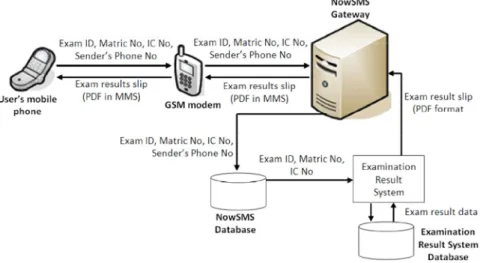
Development Tools: Microsoft Windows-based Acer application named as Examination Result System will TravelMate 3210 computer was used to develop the initiate an interaction with NowSMS. This application system as well as to set it up as a server. A Sony Ericsson program must be kept updated with any new requests W800i/W700i mobile phone on the other hand, was used received by the NowSMS software. In order to do this, it as a GSM modem to enable the sending and receiving of uses a PHP notification script which will ensure that SMS and MMS messages. whenever there is a new request, it will be invoked for For system development, Macromedia Dreamweaver processing. When it captures the particular message from and PHP programming language were used, while MySQL the database, the text trimming process will be performed. Server 5.0 was chosen for database purposes. The captured message will be trimmed into four pieces of Furthermore, NowSMS software was used as a information; matric number, examination ID, IC number middleware to manage the interfacing between GSM and sender’s mobile number. Then, this application will modem and system applications. send the information to the other PHP application module System Architecture: The diagram in Fig. 1 shows the Figure 2 below shows the validation process flow. system architecture of the developed system. Student The received information is compared with students’ initiates the examination results request process by data in another database on the server, namely sending SMS to the specific number provided by the ExaminationResult database. All students’ examination system. The required information to be written in the results are stored in this database. If the validation request SMS is Examination ID, Matric number (student process fails, the program executes the script to send ID) and identification card (IC) number (or personal failure SMS notification to student. Otherwise, the security number). It uses the predetermined format as program continues to the next process. At this stage, the
follow: application will retrieve the matching result from the
SEND<space>MATRIC NUMBER<space>EXAM ID<space>IC NUMBER
from PDU into text mode and then saves it in its database
for validation process.
ExaminationResult database and performs the conversion upon the text data into PDF format document.
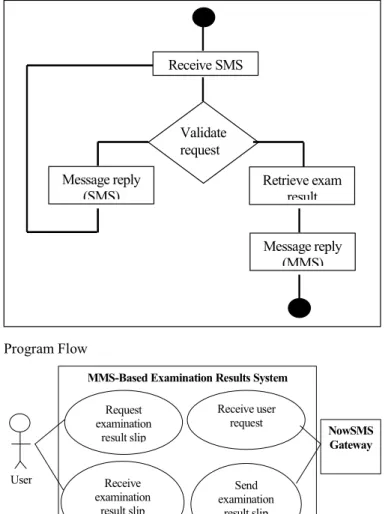
Receive SMS
Validate request Message reply
(SMS) Retrieve exam result
Message reply (MMS)
MMS-Based Examination Results System Request examination result slip Receive examination result slip (MMS) Send examination result slip (MMS) Receive user request NowSMS Gateway User
Fig. 2: Application System Program Flow
Fig. 3: Use Case Diagram
This conversion is done using the FPDF modules NowSMS software. It has one table, inbox to store all the provided by PHP language. The specific design format is incoming messages. If SMS message is received, applied in this conversion process to produce an NowSMS will interact with the SQL script that has been examination result receipt. This PDF document will then defined in the system application program. The message be stored temporarily in a ‘temp’ folder in the system’s and the sender’s mobile number are extracted from the destination file. The application will then forward this PDF SMS. This is the information that will be inserted into the document to NowSMS software for the creation of a reply inbox table. The message is inserted into the sms field message. NowSMS embeds the PDF document into an while sender mobile number is inserted into the hp field. MMS message and forwards it to the GSM modem then. This information will then be passed to the system Finally, the GSM modem sends the MMS message to application programs for further processes. Figure 6
student. shows the NowSMS database design.
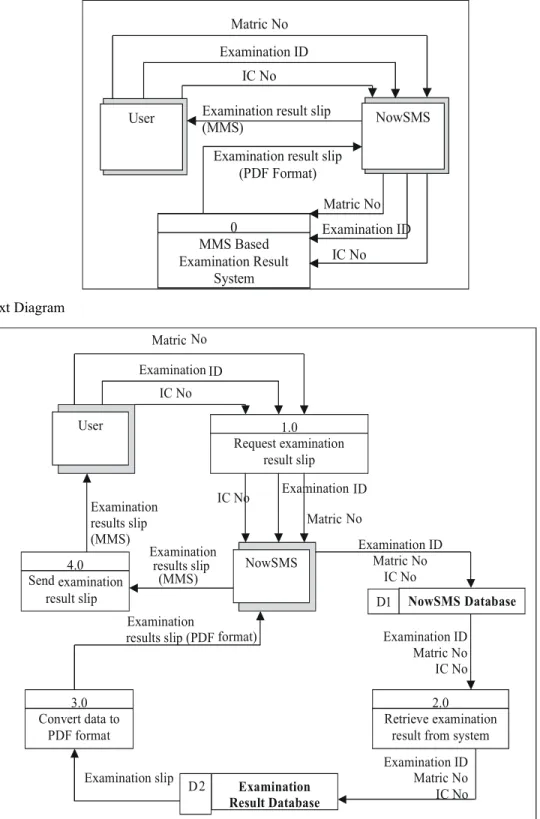
In general, the system does not require any other On the other hand, another database namely user interface than the mobile phone itself. Figures 3, 4 ExaminationResult stores the students’ examination & 5 show the Use Case diagram, Context diagram and results. It is used by the system in the information Data Flow Diagram of the developed system respectively. validation and retrieval processes. There are three tables Database: The developed system has two databases; table stores students’ details such as exam ID, IC number, NowSMS and ExaminationResult. NowSMS database matric number (student ID), studying session (semester), records all messages that are received and sent by the
User NowSMS Matric No
Examination ID IC No
Examination result slip (MMS) 0 MMS Based Examination Result System IC No Examination ID Matric No Examination result slip
(PDF Format) User 1.0 Request examination result slip Matric No Examination ID IC No NowSMS IC No Examination ID Matric No 4.0 Send examination result slip Examination results slip (MMS) Examination results slip (MMS) 3.0 Convert data to PDF format Examination
results slip (PDF format)
D2 Examination
Result Database
2.0
Retrieve examination result from system Examination ID Matric No IC No Examination slip D1 NowSMS Database Examination ID Matric No IC No Examination ID Matric No IC No
Fig. 4: Context Diagram
Fig. 5: Data Flow Diagram for (Level 0)
name and programme. The data extracted from the SMS courses offered by the university. Details for each course sent by users are compared to the student’s data in the are stored in this table such as course code, description Student table in order to retrieve the matched results. The and credit hour. Finally, the Result table stores each Course table on the other hand, stores data for each student’s examination result. Each student’s examination
Fig. 6: NowSMS Database
Fig. 7: ExaminationResult Database
results comprise the following information; student’s exam ID, course taken for the respective semester, course description, credit hour of the courses, grade of each course, credit point of each course and semester credit passed. This table is correlated with the Course and Student tables since it contains the courses taken by each student and the student’s exam ID as its primary key. Figure 7 shows the ExaminationResult database design.
RESULTS AND DISCUSSION
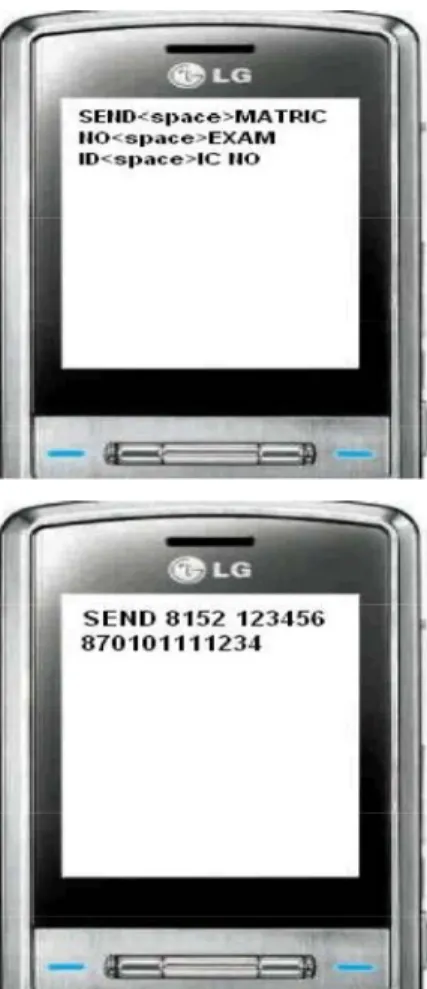
The Prototype: Figure 8 shows the examples of user’s SMS request message to be sent to the system. The request SMS must follow the following predetermined format:
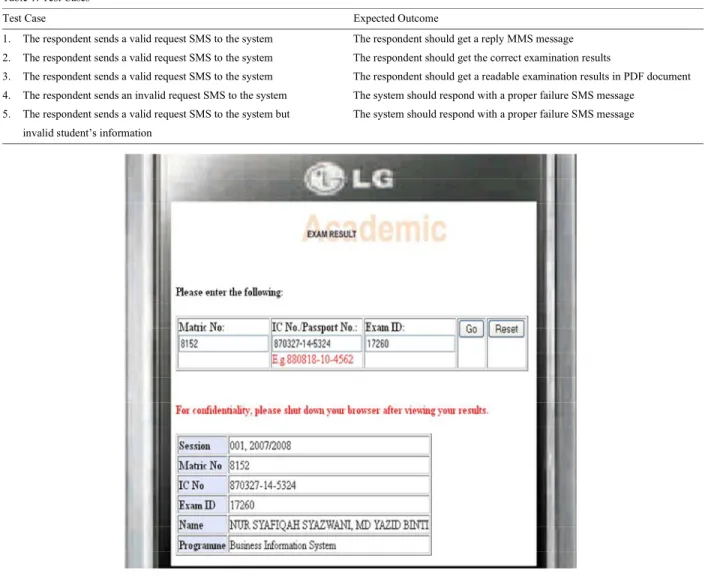
SEND<space>MATRIC NUMBER<space>EXAM ID<space>IC NUMBER Figure 9 shows the example of an MMS reply message that student will receive from the system which contains the examination results in PDF document.
Fig. 8: Examples of Request SMS
System Evaluation: There were 35 respondents participated in the user acceptance tests to evaluate the running and usability of the developed system. The following test cases in Table 1 were used in the tests.
The chart shown in Fig. 10 summarizes the results of the user acceptance tests, in which 93% transactions passed successfully, while another 7% produced errors. Two respondents received the negative outcome for all the test cases listed in Table 1. There was another respondent who obtained negative outcomes for the test cases 1, 2 and 3. The errors were very minor which require some error-handling measures to be imposed in the developed system.
SMS and MMS Comparison: The survey on mobile service charges had been done in this work to compare the costs of SMS and MMS services. Service charges of the three major mobile telecommunication providers in Malaysia were chosen for this analysis. The results concluded that the service charge of SMS is in the range of RM 0.06 to RM 0.10 per message, while the service charge of MMS is in the range of RM 0.25 to RM
Table 1: Test Cases
Test Case Expected Outcome
1. The respondent sends a valid request SMS to the system The respondent should get a reply MMS message 2. The respondent sends a valid request SMS to the system The respondent should get the correct examination results
3. The respondent sends a valid request SMS to the system The respondent should get a readable examination results in PDF document 4. The respondent sends an invalid request SMS to the system The system should respond with a proper failure SMS message
5. The respondent sends a valid request SMS to the system but The system should respond with a proper failure SMS message invalid student’s information
Fig. 9: PDF document in MMS
Fig. 10 System Testing Transaction Ratio The developed system allows students to submit 0.35 per message (RM is Malaysia currency i.e. Ringgit results in PDF document via MMS. By having this, it
Malaysia). is believed that this system could complement the
Eventhough the higher MMS service charge might SMS-based examination results system especially in be considered as a disadvantage, the true benefits of the overcoming two issues; limited number of characters in developed system lie on its capability in providing formal SMS and unofficial format of the SMS-based examination examination slips to users and having more important slip.
information displayed on it. Should the same amount of information of MMS-based slip be sent via SMS, more than one SMS message may be needed which eventually cost as much as MMS. Furthermore, MMS-based examination slip can be used in formal transactions, while SMS-based examination slip is targeted for personal uses.
CONCLUSION
The system requires a server to locate its PHP 5. Mohammadi, F., L. Baktash, R. Moghimi and application modules, databases and also the NowSMS A. Anvari, 2011. Perception of Air Travelers Towards software to manage the incoming and outgoing of SMS Mobile Ticketing: A Case Study in Malaysia. and MMS messages. The requested information which is World Appl. Sci. J., 12(5): 656-667.
originally in text format is converted into PDF document 6. Jalalyazdi, M., S.A.H. Seno and R. Budiarto, 2009. by using the PHP FPDF module. Additionally, the system A New Distributed Resource Management in Mobile also utilizes the GSM modem to interface students’ mobile Grid for M-Learning. World Appl. Sci. J., phones and the system. As a whole, the students only 7(Special Issue of Computer and IT): 107-114. need to use their mobile phones to request and receive 7. Parallag, A.P.M., 2007. SMS-based Information Portal the examination results. for Feliciano Information System of Jose C. Feliciano For future works, it is believed that the system could College. National Library of the Philippines, be more useful if it allows students to retrieve examination Information Technology Division.
results for any previous semesters. Currently, the system 8. Kadirie, J., 2005. The Short Message Service only allows students to retrieve recent semester’s results. (SMS) for Schools/Conferences. Recent Research Moreover, it is also believed that more security measures Developments in Learning Technologies, should be implemented for a more reliable system. Finally, FORMATEX, 2: 856-859.
the best outcome would be achieved should the MMS- 9. Sintiani, D.T., Y.P.A. Heng and K.C. Yow, 2004. based and SMS-based functionalities be integrated in a Promoting Mobile and Interactive Learning through single system. This may provide both benefits of MMS the use of MMS Over Wireless LAN. In the and SMS to the users. While a cheaper SMS is a good Proceedings of International Conference on option for personal use of examination results, MMS on Engineering Education, 16-21 October 2004, the other hand should be opted for formal transactions. Gainesville, Florida, USA.
REFERENCES MMS Applications on Mobile Devices. J. Marine Sci. 1. Balan, R.K., N. Ramasubbu, K. Prakobphol, 11. Swadesh, K.S., J. Woods and M. Ghanbari, 2010. N. Christin and J. Hong, 2009. mFerio: The Design A Business Model for Mobile Commerce and Evaluation of a Peer-to-Peer Mobile Payment Applications using Multimedia Messaging Service. System. In the Proceedings of Mobile Systems, Intl. J. Business Information Sys., 5(4): 418-439. Applications and Services Conference, 22- 12. Petrova, K., 2010. An Implementation of an 25 June 2009, Krakow, Poland, pp: 291-304. mLearning Scenario using Short Text Messaging: 2. Lee, K.C. and N. Chung, 2009. Understanding Factors An Analysis and Evaluation. Intl. J. Mobile Learning
Affecting Trust in and Satisfaction with Mobile and Organisation, 4(1): 83-97.
Banking in Korea: A modified DeLone and McLean's 13. Hasan, M.H., N.S. Haron and N.S.S.M. Yazid, 2010. Model Perspective. Interacting with Computers, Development of Multimedia Messaging Service 21(5-6): 385-392. (MMS)-Based Examination Results System. 3. Priporas, C.V. and I. Mylona, 2008. Mobile Services: In the Proceedings of 9th WSEAS International Potentiality of Short Message Service as New Conference on Applications of Computer Business Communication Tool in Attracting Engineering, 23-25 March 2010, Penang, Malaysia, Consumers. Intl. J. Mobile Communications, 6(4): pp: 157-163.
456-466. 14. Hasan, M.H. and A. Khalid, 2010. Development of
4. Crabtree, A., S. Benford, M. Capra, M. Flintham, A. Multimedia Messaging Service (MMS)-Based Drozd, N. Tandavanitj, M. Adams and J.R. Farr, 2007. Receipt System for Mobile Banking. In the The Cooperative Work of Gaming: Orchestrating a Proceedings of International Symposium on Mobile SMS Game. Computer Supported Cooperative Information Technology, 2010 (ITSim 2010), Work, 16(1-2): 167-198. 15-17 June 2010, Kuala Lumpur, Malaysia, pp: 1-6.
10. Yang, C.C. and C.M. Lin, 2006. Web Services of Technol., 14(3): 165-169.