M. Bieliková (Ed.), IIT.SRC 2005, April 27, 2005, pp. 103-107.
Home Agent-Based Decentralized
User-Mobility with EPA-Selection
Hossam el-ddin MOSTAFA∗ Slovak University of Technology
Faculty of Informatics and Information Technologies
Ilkovičova 3, 842 16 Bratislava, Slovakia
Abstract. With the explosion of Laptop industry, location will no longer be able to influence our frequency of communication and users became more reliant on mobility. This need for mobility has driven companies and industry forums to spend millions of dollars on the research and development (R&D) of wireless protocols to create a seamless connection through home subnet, which is affordable to mobile-IP standards. Therefore, dynamic macro user-mobility is to the centric of all aspects in this work. Our goal is to address a fundamental question of the appropriate level of effectively for a home agent-based decentralized user-mobility using an EPA-selection, and rather to understand the impact of this scheme and MRM algorithms, on the QoS of the system for different network parameters. Also, initial results, primary business issues, key innovations, and the expected impact on the commercial aspects are described.
1
Introduction
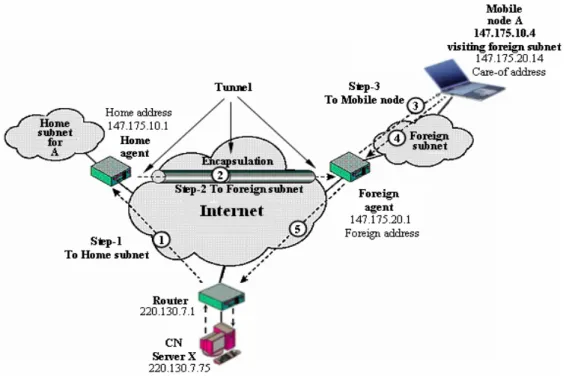
People want to be selectively communicated-anytime and anywhere via any device. One of the most recent attractive broadband communication networks is wireless mobile-IP (MIP) [1], in which when a user with Laptop or portal is decentralized away from it’s home subnet (HS) (macro user-mobility), in contrast to the nomadic user-mobility, it wants to find agents so it does not lose access to the Internet. This access is needed for uninterrupted access to personal data (web-browsing, email, ftp, multimedia streaming....), as well heightened demand for secure services. See Fig. 1 for a complete scenario of MIP operation.
∗ Supervisor: doc. Ing. Pavel Čičák, PhD., Institute of Computer Systems and Networks,
A key objective in providing decentralized mobility support between subnets is to detect the mobile node (MN)’s change of location, to perform handover as the MN moves to a new subnet, to register the MN with a foreign agent (FA) and finally to register this new location with the home agent (HA) [2-4]. That is exactly what mobility resource management (MRM) procedure was defined to be, and in which is our problem.
Fig. 1. MIP scenario
1.1
Foreign agent-based decentralization
However, the reallocating process causes the end-to-end connection to be interrupted [5] and has not got to be reestablished again until the registration is successfully performed with the new subnet.
•
Actually, all of the previous works, ex. [6], considered the registration with the foreign subnet (FS) to be performed by the FA (FA-based), on behalf of the MN, after moving into the FS.•
Furthermore, the registration request must first be routed from FA to HA while both of MN and FA are in the same subnet, FS, but not in HS (i.e., they have to ask for a permission from the HA, which either accepts or denies).•
A single MN is not a robust architecture, as it constitutes a single point of•
When there are a lot of MNs roam in the network, then the problem is further accumulated.Ideally, this interruption of connection should not be neglected but should be further avoided, to bridge the gap between subnets, an area that until now has been largely neglected. Even with route optimization [1], [7], the interruption problem still remains unsolved and MIP doesn’t seem to have a complete enhanced operation.
2
Home agent-based decentralization for MRM
As we could see, interruption is based on the aspect of MIP-registration. The registration, one of the three core capabilities [2-4] of the basic MIP protocol, may be inefficient, since all the registration steps take place while the MN already moved into the destined FS with no forwarding service yet and just waiting until performing a successful registration. Therefore, the registration request experience unnecessary delay in initiating forwarding service and in turn causes access interruption.
•
A more efficient approach would be to initiate the registration with the FA within the HS, before a change in subnet connectivity is detected.•
That is, the nearest HA (i.e. HA-based) performs the choosing process of a FA, on behalf of the MN, according to an equilibrium policy, directly from its updated mobility binding cache (MBC) entry.•
These steps take place while the MN still in the way to the FS, without any loss of time.The scheme requires only minimal changes to nodes S/W. Consequently, servers’ providers will practicalize it as a new update-function or routine in the initial configuration of the basic MIP protocol, to be pre-defined for all nodes. Such management, if properly engineered via modern vendors components, can provide improved quality of service (QoS).
3
HA-based decentralization with EPA-selection
Employing the EPA concept [8], on our HA-based network, so that the discipline of selecting (DoS) the FA is approached as follows: the agents allover the whole network are logically ordered in the MBC according to their activity in each state and the FA is selected to be the first ordered agent from the available ones, only in the intended FS in which the MN will move into. Consequently, the MBC allover the network nodes should be reconfigured.
4
Performance analysis
Applying the EPA principle, in which it is assumed that the system is always at an equilibrium point of the Markov chain of network states, the number of agents (A) in network states will be represented of a multidimensional Markov chain space vector, as follows in Eq. (1).
⎥ ⎥ ⎥ ⎥ ⎥ ⎥ ⎥ ⎦ ⎤ ⎢ ⎢ ⎢ ⎢ ⎢ ⎢ ⎢ ⎣ ⎡ = ⎥ ⎥ ⎥ ⎥ ⎥ ⎥ ⎦ ⎤ ⎢ ⎢ ⎢ ⎢ ⎢ ⎢ ⎣ ⎡ = + + OLS AS AS AS US US US CS CS CS NS NS NS OLS AS US CS NS A A A A A A A A A A A A A A A A A A A L T W T P T L L L L L 2 1 2 2 1 2 1 2 1 2 1 τ τ τ (1)
Where
A
: Total number of network agents.
A
NS : Number of network agents in the normal state (NS).A
CS : Number of network agents in the choosing state (CS).A
US : Number of network agents in the updating state (US).A
AS : Number of network agents in the alerting state (AS).A
OLS : Number of network agents in the on-line state (OLS).τ
: Fetching time of data from the MBC (in sec).TL : Lasting time of registration request (in sec). TP : Propagation time between nodes (in sec). TW : Wasting time between agents (in sec).
This provides that the network throughput, Th, is represented by the number of agents in active state (on-line state) of Eq. (2)
Th
=
No
.
of
active
agents
=
A
OLS(
2
)
Equations (1) and (2) simply show that the throughput of our network of a HA-based decentralized user-mobility with EPA-selection is a function of the number of agents in other various network states, i.e., is a function of different network parameters, τ, TL, TP, TW, …. This will help network designers in choosing the proper system settings.
Motivated by these concerns, and by looking at the problem from a practical and commercial point of view, we are better able to interpret the future results of our opportunity and so build our intuition. Thus, some of the current operational benefits of the HA-based scheme seem obvious: new initiatives in the MIP protocol to the access interruption, better macro-mobility service and performance, and built-in QoS. However, a number of barriers must be overcome before the implementation of the HA-based scheme. The biggest question will be what the business need and customer service impact are for moving from current FA-based to HA-based configuration. We believe that the later case is considered as an excellent opportunity in data networks to improve the decentralization capability in order to avoid the access interruption.
5
Conclusions
With the explosion of the Laptop industry, location will no longer be able to disconnect and influence our frequency of communication and users became more reliant on mobility. This need for mobility has driven companies, standards bodies and industry forums to spend millions of dollars on the research and development (R&D) of Laptops and protocols to create a seamless connection through and to the home subnet, which is affordable, efficient, and transparent to the basic mobile-IP standards. Therefore, dynamic macro user-mobility, in contrast to the nomadic user-mobility, outside home subnet is to the centric of all aspects in this work. This paper addressed the more fundamental question of the appropriate level of effectively for a home agent-based decentralized user-mobility using an EPA selection, and rather understood the impact of this scheme and mobility resource management algorithms, on the QoS of the system for different parameters in wireless networking infrastructure. Also, initial results, primary business issues, key innovations, and the expected impact on the commercial and marketing aspects were described.
Acknowledgement: This work is supported by the Slovak Science Grant Agency,
VEGA, No. VG 1/0157/03, under the project entitled “Methods and tools for development of the secure networked and distributed mobile computer systems and their management II.”
References
1. Jamalipour, A.: The Wireless Mobile Internet: Architectures, Protocols and Services. John Wiley & Sons Ltd., England, 2003.
2. Perkins, C.E.: Mobile IP. IEEE Commun. Magazine, Vol. 35, No. 5 (1997), 84-99. 3. Son, W.: Mobile IP. 2003. http://williamson.cx
4. Cisco Systems: Cisco Mobile IP. 2004. http://www.cisco.com/go/mobile_ip/ 5. Stiller, B., Braun, O., Heursch, A., Racz P. (edts.): Internet Economics II,
Technical Report No. 2003-01, University of the Federal Armed Forces, Munich, Germany, 2003.
6. Jue, J., Ghosal, D.: Design and Analysis of a Replicated Server Architecture for Supporting IP-Host Mobility. ACM Mobile Computing and Commun.Revue, Vol. 2, No. 3 (1998), 16-37.
7. Perkins, C.E., Johnson, D.B.: Route Optimization in Mobile-IP. 1997. Draft-IETF-mobileip-optim-06.txt
8. Fukuda, A., Tasaka, S.: The Equilibrium Point Analysis-A Unified Analytic Tool for Packet Broadcast Networks. In: Proc. of IEEE Globecom’83, San Diego, CA (1983), 33.4.1-33.4.8.