AUTOMATED CLOUD RESOURCE ORCHESTRATION
Changbin Liu
A DISSERTATION in
Computer and Information Science
Presented to the Faculties of the University of Pennsylvaniain
Partial Fulfillment of the Requirements for the Degree of Doctor of Philosophy
2012
Boon Thau Loo
Assistant Professor, Computer and Information Science Supervisor of Dissertation
Jianbo Shi
Associate Professor, Computer and Information Science Graduate Group Chairperson
Dissertation Committee
Jonathan M. Smith (Chair), Professor, Computer and Information Science Zachary G. Ives, Associate Professor, Computer and Information Science Oleg Sokolsky, Research Associate Professor, Computer and Information Science
Yun Mao, Senior Member of Technical Staff, AT&T Labs Research Prithwish Basu, Senior Scientist, Raytheon BBN Technologies
AUTOMATED CLOUD RESOURCE ORCHESTRATION c
COPYRIGHT 2012
ACKNOWLEDGEMENT
Five years is a long journey. It is amazing to see how things have changed and how many people have accompanied, helped and influenced me during the journey. The completion of this dissertation is impossible without them.
First, I am deeply grateful to my extraordinary advisor Professor Boon Thau Loo. Boon has been a role model for me by his talent, passion, diligence and persistence throughout my years at Penn. I feel extremely fortunate to have the opportunity to work with him. Boon’s extensive knowledge in networking, database, security, formal methods, and cloud computing was instrumental in helping me broaden my research view. Moreover, Boon spent substantial time providing me with excellent and comprehensive guidance on conducting research in a professional manner, rang-ing from research topic selection, system design and implementation, collaboratrang-ing with people, writing skills, talk presentation, job and internship searching, to final dissertation. Whenever I had difficulty in research, Boon was always there. Boon was also considerate on my non-research life, and he often generously shared with me valuable life experiences and wisdom. I can never thank him enough for the positive impact that he has on my life.
My research in graduate school centered around cloud computing and wireless networking. In the context of these two areas, I have had the privilege of collabo-rating extensively with two outstanding researchers–Yun Mao and Prithwish Basu.
They are not only my research collaborators, but also my mentors, and they are serving on my thesis committee. Both of them made significant contributions which made my research possible. We had countless stimulating discussions that led to new ideas. I also want to express my gratitude to Yun for offering me chances to do summer interns at AT&T Labs Research in 2010 and 2011. The work at AT&T evolves into part of this dissertation. Yun gave me tremendous guide on computer science skills, including system deployment, programming, debugging, testing and performance analysis. I immensely enjoyed the time when we were coding together. I am thankful to my other mentors at AT&T Labs Research. I am very lucky to work with these knowledgeable and experienced researchers: Mary Fernandez, Kobus van der Merwe, Xu Chen, Edwin Lim and Emmanuil Mavrogiorgis.
I want to express my gratitude to Professor Jonathan Smith, Professor Zack Ives and Professor Oleg Sokolsky for serving on my thesis committee. They provided valuable comments and suggestions for improving this dissertation. I also thank Jonathan for chairing my thesis committee and WPE-II committee.
I would like to thank my colleagues and friends at Penn. Wenchao Zhou and I came to Penn in the same day and also finished our oral defenses in the same day. We went through a lot of joy and pain together. I have worked closely with Rick Correa, Xiaozhou Li, Shiv Muthukumar, Ren Lu, Taher Saeed, Tanveer Gill, Harjot Gill, Anduo Wang, Joseph Kopena and Mihai Oprea on a variety of research projects. They are also my great friends. Many thanks to other friends, including but not limited to: Zhijun Liu, Xi Weng, Jianzhou Zhao, Wei Di, Mengmeng Liu, Zhuowei Bao and Bin Yan.
My research was funded in part by the following funding agencies and sources: National Science Foundation under contract CNS-0721845, CNS-0831376, CNS-0845552, CNS-1040672, CCF-0820208, DARPA through Air Force Research
Laboratory (AFRL) Contract FA8750-07-C-0169, and AT&T Labs Research sum-mer student internship program. I appreciate their support.
Last but not the least, I would like to thank my parents Mingzhen Jiang and Songping Liu for their unlimited support, encouragement, and love. My girlfriend Penghui Sun takes the best care of me for these years. I was always her top priority especially when paper deadlines were close. Without her support I could not possibly come anywhere close to finishing the dissertation.
ABSTRACT
AUTOMATED CLOUD RESOURCE ORCHESTRATION Changbin Liu
Boon Thau Loo
Realizing Infrastructure-as-a-Service (IaaS) cloud requires a control platform for orchestrating the provisioning, configuration, management and decommissioning of a distributed set of diverse cloud resources (i.e., compute, storage, network) serving different clients. Cloud resource orchestration is challenging due to the rapid growth of data centers, the high failure rate of commodity hardware, the enforcement of service and engineering rules, the increasing sophistication of cloud services, and the requirement to fulfill provider operational objectives and customer service level agreements (SLAs).
Towards addressing these challenges, this dissertation makes following contri-butions: (1) An automated resource orchestration platform that allows cloud op-erators to declaratively specify optimization goals and constraints given provider operational objectives and customer SLAs. Based on these specifications, orchestra-tion commands are automatically generated to optimize resource configuraorchestra-tions and allocations within the cloud; (2) A highly available transactional resource orches-tration platform for building IaaS cloud infrastructures. Transactional orchesorches-tration procedures automatically guarantee atomicity, consistency, isolation and durability (ACID) properties for cloud operations. Transactional semantics provide a clean abstraction which enables cloud operators to focus on developing high level cloud services without worrying about the complexities of accessing and managing under-lying volatile distributed resources.
orchestration platform. Using realistic scenarios and workloads derived from pro-duction cloud services, we demonstrate that our platform is able to automatically orchestrate compute, storage, and network resources within and across geographi-cally distributed data centers to meet operational objectives and SLAs.
Contents
ACKNOWLEDGEMENT iv 1 Introduction 1 1.1 Motivation . . . 1 1.2 Existing Solutions . . . 2 1.3 Approach Overview . . . 4 1.4 Organization . . . 9 2 System Overview 10 3 Declarative Automated Orchestration 14 3.1 COPE Architecture . . . 153.2 Use Case Examples . . . 16
3.2.1 ACloud (Adaptive Cloud) . . . 17
3.2.2 Follow-the-Sun . . . 19
3.3 Colog Language . . . 22
3.3.1 Datalog Conventions . . . 23
3.3.2 Centralized Colog . . . 24
3.3.3 Distributed Colog . . . 29
3.4.1 General Rule Evaluation Strategy . . . 35
3.4.2 Solver Rules Identification . . . 36
3.4.3 Solver Derivation Rules . . . 38
3.4.4 Solver Constraint Rules . . . 38
3.4.5 Distributed Solving . . . 39
3.5 Summary . . . 40
4 Transactional Orchestration 41 4.1 TROPIC Architecture . . . 41
4.2 Data Model and Language . . . 44
4.3 Design . . . 50
4.3.1 Logical Layer Execution . . . 52
4.3.2 Physical Layer Execution . . . 56
4.4 Handling Resource Volatility . . . 56
4.4.1 Cross-layer Consistency Maintenance . . . 57
4.4.2 Terminating Stalled Transactions . . . 59
4.4.3 Transactional Semantics . . . 60
4.5 High Availability . . . 61
4.5.1 Controller State Management . . . 61
4.5.2 Controller Failure Recovery . . . 63
4.6 Implementation . . . 65
4.6.1 Development and Deployment . . . 65
4.6.2 Coordination and Persistent Storage . . . 66
4.6.3 Case Study: ACloud . . . 67
4.6.4 Case Study: Follow-the-Sun . . . 69
5 Evaluation 72
5.1 Transactional Orchestration Layer . . . 72
5.1.1 Performance . . . 73
5.1.2 Safety . . . 81
5.1.3 Robustness . . . 84
5.1.4 High Availability . . . 85
5.2 Automated Orchestration Layer . . . 88
5.2.1 Compactness of Colog Programs . . . 89
5.2.2 Use Case: ACloud . . . 91
5.2.3 Use Case: Follow-the-Sun . . . 94
5.3 Summary . . . 98
6 Related Work 99 6.1 Declarative Networking . . . 99
6.2 Constraint Optimization . . . 100
6.3 Cloud Resource Orchestration . . . 101
7 Conclusion 104 7.1 Conclusion . . . 104
7.2 Open Questions and Future Directions . . . 105
7.2.1 Open Questions . . . 106
7.2.2 Cloud Ecosystem . . . 107
7.2.3 Declarative Distributed Constraint Optimizations . . . 107
7.2.4 Automated Synthesis of Declarative Optimizations . . . 108
A Colog Grammar and Syntax 110
C Wireless Network Configuration 120
C.1 COP Formulation . . . 121 C.2 Centralized Channel Selection . . . 123 C.3 Distributed Channel Selection . . . 125
List of Tables
1.1 Comparisons between current solutions and our platform. . . 8
3.1 Mappings from ACloud COP to Colog. . . 27
3.2 Mappings from Follow-the-Sun COP to Colog. . . 32
4.1 Actions supported by TROPIC. . . 49
4.2 An example of execution log for spawnVM. . . 51
5.1 Breakdown of transactions. The columns include the quantity and the average execution time taken by each transaction. . . 87
List of Figures
2.1 System architecture. . . 11
3.1 COPE Architecture. . . 15
4.1 TROPIC architecture. . . 42
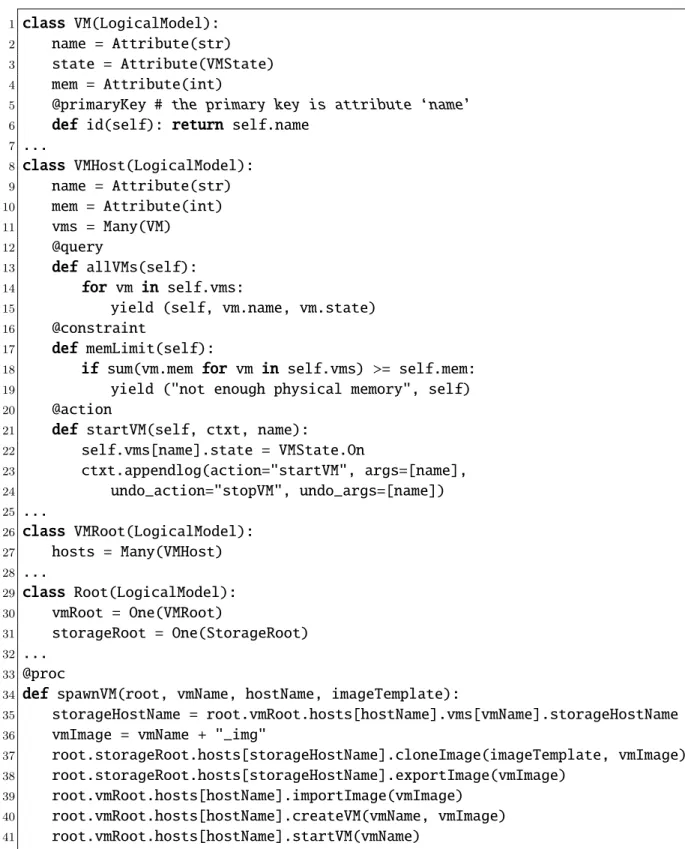
4.2 An example of TROPIC data model. . . 45
4.3 TROPIC code example. . . 46
4.4 The execution flow of transactional orchestration in TROPIC. . . 51
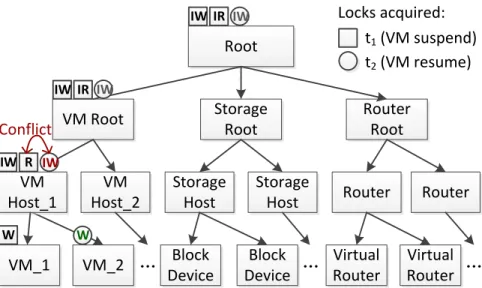
4.5 An example of lock-based concurrency control. The locks acquired by transactionst1 (VM suspend) andt2 (VM resume) are in squares and circles respectively. . . 54
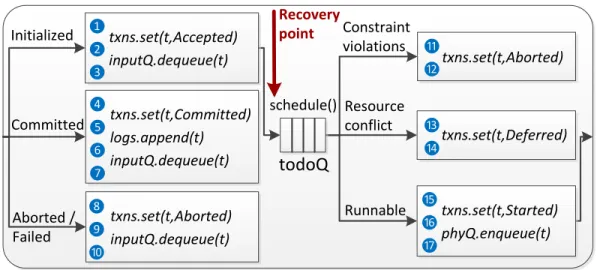
4.6 The design of TROPIC controller for high availability, from the per-spective of a transaction t. Circled numbers denote failure points (FP), and italic texts denote data writes to persistent storage and distributed queues. As indicated from Figure 4.4, the controller takes input from inputQ and feeds phyQ. . . 63
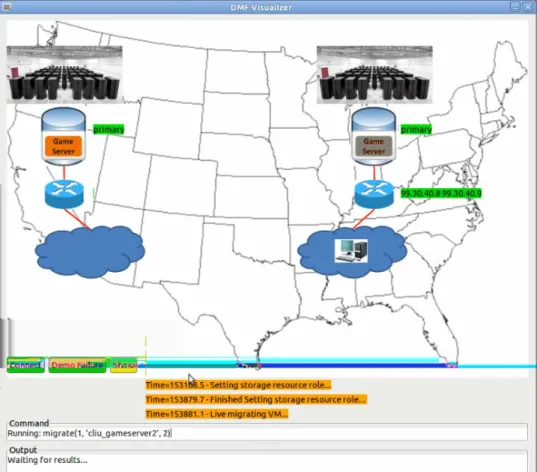
4.7 Follow-the-Sun cloud service. . . 70
5.1 VMs launched per second (EC2 workload). . . 74
5.2 Controller CPU utilization (EC2 workload). . . 74
5.4 Controller overhead at 0.8–1.0 hours (EC2 workload). . . 77
5.5 Transaction throughput as # of compute servers scales up. . . 78
5.6 Transaction throughput as # of transactions scales up. . . 78
5.7 Cloud resource failure and TROPIC’srepair. . . 80
5.8 Workload derived from a data center hosting trace. . . 81
5.9 Safety overhead (hosting workload). . . 82
5.10 Robustness overhead (hosting workload). . . 86
5.11 High availability. Controller failure at 60s and 390s. . . 86
5.12 Average CPU standard deviation of three data centers (ACloud). . . 92
5.13 Number of VM migrations (ACloud). . . 93
5.14 Total cost as distributed solving converges (Follow-the-Sun). . . 97
5.15 Per-node communication overhead (Follow-the-Sun). . . 97
B.1 TROPIC code example–Compute (VM). . . 116
B.2 TROPIC code example–Compute (VMHost). . . 117
B.3 TROPIC code example–Storage. . . 118
Chapter 1
Introduction
1.1
Motivation
The Infrastructure-as-a-Service (IaaS) cloud computing model exemplified by Ama-zon EC2 [2] provides users on-demand, near-instant access to a large pool of vir-tual cloud resources (i.e., compute, storage and network) such as virtual machines (VMs), virtual block devices, and virtual private networks. Theorchestrations[66] of the virtual resources over physical hardware, such as provisioning, configuration, management and decommissioning, are exposed to the users as a service via pro-grammable APIs. These APIs hide the complexity of the underlying orchestration details.
From the cloud provider’s perspective, however, building a robust system to or-chestrate cloud resources is challenging. First, today’s large data centers typically run on the scale of over 10,000 machines based on commodity hardware [50]. As such, software glitches and hardware failures including power outages and network partitions are the norm rather than the exception. This unreliability not only im-pacts the virtual resources assigned to users, but also the controllers that orchestrate
the virtual resources. Second, to orchestrate a massively concurrent, multi-tenant IaaS environment, any engineering and service rule must be met while avoiding race conditions.
Moreover, cloud resource orchestration is highly complex due to the increasing so-phistication of cloud services. First, as many recent proposals [93, 100, 33, 99, 34, 46] have articulated, cloud management is inherently complicated due to the heterogene-ity, infrastructure, and concurrent user services that share a common set of physical resources. Second, configurations of various resource types interact with each other. For example, the locations of VMs have an impact on storage placement, which in turn affects bandwidth utilization within and external to a data center. Third, cloud resources have to be deployed in a fashion that not only realizes provider operational objectives, but also guarantees that the customer service-level agreements (SLAs) can be constantly met as runtime conditions change.
All in all, the orchestration process is complex and potentially tedious and error-prone if performed manually, and motivates the need for scalable and reliable man-agement tools that enable us toautomatepart or all of the decision process without worrying about the complexities of accessing and managing underlying volatile dis-tributed cloud resources.
1.2
Existing Solutions
On the public side, there are open-source IaaS cloud control platforms, such as OpenStack [23], OpenNebula [22] and Eucalyptus [12]. First, none of these solutions perform automated cloud resource orchestration. Second, we found a lack of disci-plined approaches in them to enforce service and engineering rules – most of them are implemented as condition checks (if-then-else), which are scattered in the code
base. Even when violations are detected, the reconciliation mechanisms are usually ad-hoc and problematic. Third, when unanticipated errors occur during orchestra-tion process, they either choose to fail-stop, entering an intermediate state, or to ignore the errors, leading to undefined behavior. Either way, without proper error handling, the system could end up in unknown and usually undesirable states, caus-ing security issues or resources under-utilization. Last but not least, these solutions have limitations in terms of scale, concurrency control, and high availability. For instance, Eucalyptus can only handle 750–800 VMs (a hard limit) [37], race con-ditions exist in OpenStack concurrent VM spawnings even in a small scale cluster deployment [26], and high availability is entirely missing in all these platforms.
On the proprietary side, a variety of commercial IaaS providers exist, such as Amazon EC2 [2], Microsoft Windows Azure [29] and VMWare Distributed Resource Scheduler (DRS) [9] . Unfortunately, how they orchestrate cloud resources is propri-etary. However, we can still infer that these platforms are not ideal. For instance, as anecdotally indicated by the outage report [28], in April 2011 EC2 encountered problems in enforcing safety and concurrency: a human error in router configuration that violates an implicit service rule and a race condition in storage provisioning contributed significantly to the prolonged downtime. Due to similar reasons, an-other EC2 outage occurred in August 2011 [27], and Microsoft encountered a cloud outage in September 2011 [4]. More importantly, these solutions are insufficient in orchestrating increasingly sophisticated cloud services due to the lack of appropri-ate automation tools and programming abstractions. For instance, though VMWare DRS is able to perform automated VM migration, it is narrowly scoped for load bal-ancing and does not allow cloud operators to flexibly customize their policy goals and constraints based on various demands and changing conditions (e.g., migration cost,
load consolidation, data consistency requirement, latency and bandwidth guarantee for customers).
1.3
Approach Overview
This dissertation in particular aims to explore the following challenging research questions in cloud resource orchestration:
1. How can we easily automate cloud resource orchestration? Given provider operational objectives and customer SLAs as policy goals and con-straints, we desire that the platform enables cloud operators to formally model cloud orchestrations, and that it takes the specifications and automatically syn-thesizes orchestration decisions. As cloud services become increasingly sophis-ticated, their orchestration logic is complex. In specifying the orchestration logic, imperative languages like C++ [13] or Java [5] often result in multi-hundred or even multi-thousand lines of code, which is error-prone and stove-piped hence inflexible at customizing policies upon user demands. To ease the process of specifying automated orchestration, we aim to design a compact lan-guage that allows cloud providers to specify orchestration policies succinctly. This language should as well be general enough to capture a variety of cloud resource orchestration scenarios within and across geographically distributed data centers.
2. How can we guarantee orchestration robustness in the presence of cloud volatility? Robustness ensures that failures in an orchestration pro-cedure do not lead to undefined behavior or inconsistent states. This goal is
critical and yet especially challenging because of high volatility in the cloud en-vironment. An orchestration procedure usually involves multiple state changes of distributed resources, any of which can fail due to volatility. For example, spawning a VM typically has the following steps: clone a VM disk image on a storage server; create a VM configuration on a compute server; set up vir-tual local-area networks (VLAN), software bridges, and firewalls for inter-VM communication; finally start the VM. During the process, an error at any step would prevent the client from obtaining a working VM. Worse, the leftover configurations in the compute, storage and network components become or-phans if not properly cleaned up, which may lead to undefined behavior for future orchestrations.
3. How can we ensure a cloud service is safe? I.e., the service’s orches-tration procedures do not violate any constraints. These constraints reflect service and engineering rules in operation. If violated, an illegal orchestration operation could disrupt cloud services or even lead to severe outage [28], e.g., spawning a VM on an overloaded compute server, or migrating a VM to an in-compatible hypervisor or CPU with different instruction sets. Enforcing these constraints is challenging as it often requires acquiring the states of distributed resources and reasoning about them holistically.
4. How can we allow high concurrency of simultaneous orchestrations?
Our objective is to provide a cloud orchestration system at the scale of at least 100,000 cloud resources (e.g., VMs and block devices) [17]. It should be able to perform simultaneous execution of massive orchestration procedures safely, especially when they access the same resources. For example, simultaneous spawning of two VMs on the same compute server may exceed the physical
memory limit of the server. Concurrency control guarantees that simultaneous execution of orchestration procedures avoids race conditions and permits the system to scale.
5. How can we make a cloud orchestration platform highly-available?
In the era of web-scale applications, unavailability of the cloud system directly translates to loss of revenue and service degradation for customers. Based on our estimation of Amazon EC2’s rate of VM creation [3], a mere 10-minute service disruption can result in not fulfilling over 1,400 VM spawn operations in a single region. Such disruptions are unacceptable for mission-critical appli-cations.
To address the above challenges, in this dissertation we present a new point in the design spaces of cloud resource orchestration architectures that aims to achieve scalable and reliable orchestration automation. Specifically, we propose a unified architecture which includes two parts:
• An automated resource orchestration platform [63, 67] that enables cloud oper-ators to specify optimization policy goals and constraints given provider opera-tional objectives and customer SLAs. These policies are compactly specified in a declarative language, which results in orders of magnitude code size reduction compared to imperative languages. Based on these specifications, orchestra-tion commands are automatically generated via integrating a declarative net-working engine [69] with a general constraint solver [13] to optimize resource configurations and allocations within and across distributed data centers [39] in the cloud.
• A highly available transactional resource orchestration platform [66, 64] for building IaaS cloud infrastructures. This platform provides an abstraction
to execute the generated commands in a transactional style to guarantee or-chestration correctness. Transactional oror-chestration procedures automatically guarantee atomicity, consistency, isolation and durability (ACID) properties for cloud operations. Transactional semantics provide a clean abstraction which enables cloud operators to focus on developing high level automated cloud services without worrying about the complexities of accessing and managing underlying volatile distributed resources.
The hypothesis of this dissertation is that our approach of automated cloud re-source orchestration can address the aforementioned challenges. To validate this hypothesis, we have designed and implemented a prototype transactional automated cloud orchestration platform, which is targeted to be used by both private and public cloud operators and service providers, such as Amazon [2], Cloudscaling [8], Rackspace [6], RightScale [7], and Windows Azure [29]. Currently these providers use open-source platforms such as OpenStack [23] or proprietary solutions, which are inadequate in addressing all the problems of orchestration automation, robust-ness, safety, concurrency and high availability. In Table 1.1 we list the comparisons between our platform and current solutions in terms of addressing the research ques-tions.
System Op enStac k Eucalyptus Op enNebula Amazon EC2 Our platform Automation × × × ? X Robustness F ail-stop or ignore unexp ected errors. Require h uman in-terv en tion F ail-stop or ignor e unexp ected errors. Require h uman in-terv en tion F ail-stop or ignore unexp ected errors. Require h uman in-terv en tion ? X Safet y Scattered if-then-else Scattered if-then-else Scattered if-then-else Outage in April and August 2011 [28, 27] X Concurrency Race conditions (Errors in concur-ren t VM spa wn-ing [26]) Small scale de-plo ymen t (750-80 0 VMs [37]) ? Outage in April and August 2011 [28, 27] X High a v ail-abilit y × × × ? X T able 1.1: Comparisons b et w een curren t solutions and our platform.
1.4
Organization
The remainder of this dissertation presents the architecture of our transactional auto-mated cloud resource orchestration platform, its declarative programming language, two use cases and evaluation of its effectiveness. Chapter 2 presents an architectural overview of the system. Chapter 3 describes how cloud resource orchestration is automated via being formulated as declarative constraint optimizations. Chapter 4 describes how generated resource orchestration commands are executed in a trans-actional style to guarantee safety, robustness and to provide concurrency control. Chapter 5 presents our evaluation results. Chapter 6 presents related work. Finally, Chapter 7 summarizes the dissertation and discusses future directions.
Chapter 2
System Overview
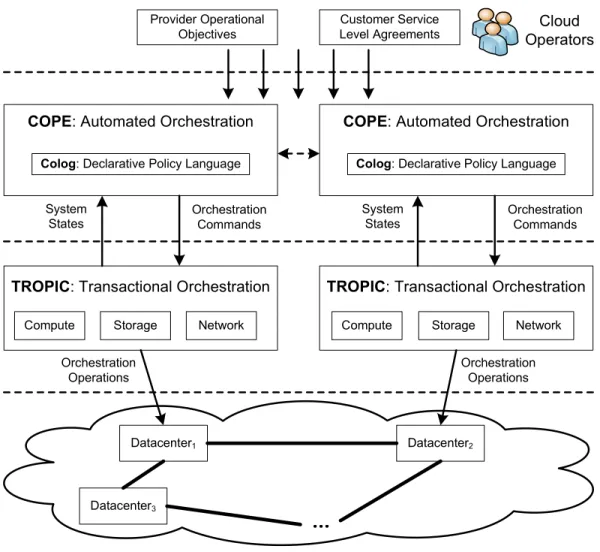
Figure 2.1 presents an overview of the system we are aiming to design and implement in this dissertation. This system is designed for a cloud environment comprising of geographically distributed data centers via dedicated backbone networks or the Internet. At the top, cloud operators specify providers operational objectives and customer SLAs as input. In the middle, the cloud resource orchestration system is comprised of two components, COPE (Cloud Orchestration Policy Engine) [63, 67], and TROPIC (Transactional Resource Orchestration Platform In the Cloud) [66, 64]. COPE is an automated orchestration platform that enables cloud providers to automate the process of resource orchestration. In COPE, there are a distributed network of instances communicating with each other. Provider operational objec-tives and customer SLAs from cloud operators are specified in terms of policy goals, which are subjected to a number of constraints specific to the cloud deployment scenario. COPE formulates these specifications as well as underlying cloud system states reported by TROPIC as a constraint optimization problem (COP), and auto-matically synthesizes orchestration commands which are input into TROPIC to be executed as actual orchestration operations.
Network Storage Orchestration Commands Datacenter1 Datacenter2 Datacenter3 Compute
Colog: Declarative Policy Language
Network Storage
Compute
COPE: Automated Orchestration COPE: Automated Orchestration
Orchestration Operations Orchestration Operations System States Orchestration Commands System States
TROPIC: Transactional Orchestration TROPIC: Transactional Orchestration Colog: Declarative Policy Language Provider Operational
Objectives
Customer Service
Level Agreements OperatorsCloud
Figure 2.1: System architecture.
To ease the process of specifying orchestration COP models, COPE uses a declar-ative policy language Colog to specify policy goals and constraints. Colog specifica-tions are compact and close to mathematical formulation of COPs. Colog originates from declarative networking [69], and it is a distributed variant of Datalog with extended constraint solving and distributed optimization capabilities. Colog is a general policy language that can be widely applied to capture a variety of cloud resource orchestration scenarios within and across data centers.
(i.e., compute, storage and network) and performs actual orchestration operations to manipulate the resources. TROPIC is atransactional orchestrationplatform with a unified data model that enables cloud providers to develop complex cloud ser-vices with safety, concurrency, robustness and high availability. Each data center runs one TROPIC instance. TROPIC translates high-level orchestration commands automatically generated by COPE to low-level operations and executes them in a transactionalstyle with ACID properties (atomicity, consistency, isolation and dura-bility). Transactional semantics provide a clean abstraction to cloud providers to ensure that, orchestrations that encounter unexpected errors have no effect, concur-rent orchestrations do not violate safety rules or cause race conditions, and commit-ted orchestrations persist on physical devices. As a result, service developers only need to focus on developing high level cloud services without worrying about the complexities of accessing and managing volatile distributed resources.
TROPIC and COPE are two loosely-coupled components in our platform. To orchestrate the cloud, COPE first completes constraint solving, and then the op-timization output is all gathered before being sent to TROPIC for transactional execution. In this way, even if TROPIC transactions abort, it does not affect the execution of COPE constraint optimization. Cloud operators only need to rerun Colog programs for reoptimizations.
If COPE is deployed in the centralized mode, its failure will result in no au-tomation commands being generated. Cloud operators have to restart COPE in this case. If COPE is deployed in the distributed mode and one or multiple COPE in-stances fails, the constraint optimization process may produce partial solutions, i.e., only running COPE instances get optimization results. TROPIC adopts a highly available design via using replicated decentralized components, however, it can still
experience failures if there are data center-wide outages. Under this scenario, no orchestration command can be executed in the affected data centers.
Chapter 3
Declarative Automated
Orchestration
In this chapter, we present COPE (Cloud Orchestration Policy Engine) [63]. COPE aims to answer the research question 1 in Chapter 1. COPE is a declarative opti-mization platform that enables cloud providers to formally model cloud resources and formulate orchestration decisions as a constraint optimization problem(COP) given policy goals and constraints. Central to COPE is the integration of a declarative networking [69] engine with an off-the-shelf constraint solver [13]. COPE automates the process of cloud orchestration via the use of a declarative policy language named Colog. We have developed the Colog language that combines distributed Datalog used in declarative networking with language constructs for specifying goals and constraints used in COPs. Moreover, we apply COPE to two representative cloud orchestration use cases that allow us to showcase key features of COPE.
3.1
COPE Architecture
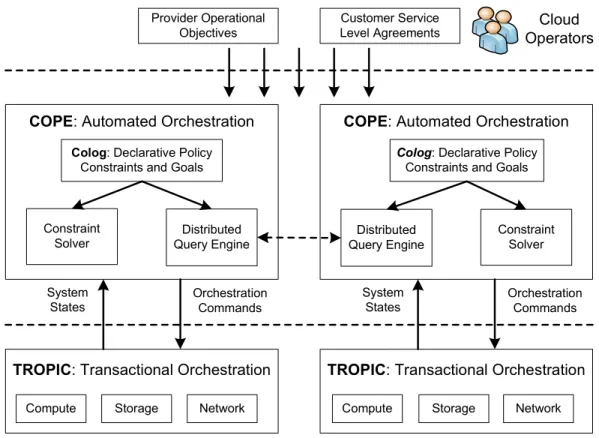
Figure 3.1 presents a system overview of COPE. COPE takes the provider operational objectives and customer SLAs from cloud operators as input. COPE can be deployed in either a centralizedor distributedmode.
Network Storage Constraint Solver Orchestration Commands Distributed Query Engine Compute
Colog: Declarative Policy Constraints and Goals
Network Storage
Compute COPE: Automated Orchestration
Constraint Solver Distributed
Query Engine
Colog: Declarative Policy Constraints and Goals COPE: Automated Orchestration
System States Orchestration Commands System States
TROPIC: Transactional Orchestration TROPIC: Transactional Orchestration
Provider Operational Objectives
Customer Service
Level Agreements OperatorsCloud
Figure 3.1: COPE Architecture.
In the centralized deployment scenario, the entire cloud is configured by one cen-tralized COPE instance. Provider operational objectives and customer SLAs are specified in terms of goals, which are subjected to a number of constraints specific to the cloud deployment scenario. These policy constraints and goals are specified in a declarative policy language called Colog. COPE additionally takes as input sys-tem states (e.g., node CPU load, memory usage, network traffic statistics) gathered from the cloud. The specifications are used by a constraint solver to automatically
synthesizes orchestration commands, which are then input into TROPIC to perform physical orchestration operations to coordinate resources in each data center. As we will discuss in Chapter 4, TROPIC executes orchestration commands in a trans-actional style, where the ACID properties are preserved for a series of commands grouped within a transaction.
In the distributed deployment scenario, there are multiple COPE instances, typ-ically one for each data center. Each COPE node has a set of neighbor nodes that it can directly communicate with via dedicated backbone networks or the Internet. A distributed query engine[25] is used to coordinate the exchange of system states and optimization output amongst COPE instances, in order to achieve a global objective (this typically results in an approximate solution).
A distributed deployment brings two advantages. First, cloud environments like federated cloud [39] may be administered by different cloud providers. This ne-cessitates each provider running its own COPE for its internal configuration, but coordinating with other COPE nodes for inter-data center configurations. Second, even if the cloud is entirely under one administrative domain, for scalability reasons, each cloud operator may choose to configure a smaller set of resources using local optimization commands.
3.2
Use Case Examples
We use the following two scenarios (ACloud and Follow-the-Sun) as our driving ex-amples throughput the thesis. Both exex-amples are representative of cloud resource orchestration scenarios within and across data centers, respectively. We will primar-ily frame our discussions of the use cases in terms of COP expressed mathematically,
and defer the declarative language specifications and runtime support for realizing these COP computations to later sections.
3.2.1
ACloud (Adaptive Cloud)
We consider the cloud service ACloud, a simplified version of what current cloud service providers [2] might offer. In ACloud, a customer may spawn new VMs from an existing disk image, and later start, shutdown, or delete the VMs. In today’s deployment, providers typically perform load balancing in an ad-hoc fashion. For instance, VM migrations can be triggered at an overloaded host machine, whose VMs are migrated to a randomly chosen machine currently with light load. While such ad-hoc approaches may work for a specific scenario, they are unlikely to result in configurations that can be easily customized upon changing policy constraints and goals, whose optimality cannot be easily quantified.
As an alternative, COPE takes as input real-time system states (e.g., CPU and memory load, migration feasibility), and a set of policies specified by the cloud provider. An example optimization goal is to reduce the cluster-wide CPU load variance across all host machines, so as to avoid hot-spots. Constraints can be tied to each machine’s resource availability (e.g., each machine can only run up to a fixed number of VMs, run certain classes of VMs, and not exceed its physical memory limit), or security concerns (VMs can only be migrated across certain types of hosts).
Another possible policy is to minimize the total number of VM migrations, as long as a load variance threshold is met across all hosts. Alternatively, to consolidate workloads one can minimize the number of machines that are hosting VMs, as long as each application receives sufficient resources to meet customer demands. Given these
optimization goals and constraints, COPE can be executed periodically, triggered whenever imbalance is observed, or whenever VM CPU and memory usage changes.
Given the ACloud scenario, we provide its COP-based mathematical model. A COP takes as input a set of constraints, and attempts to find an assignment of values chosen from an domain to a set of variables to satisfy the constraints under an optimization goal. The goal is typically expressed as a minimization over a cost function of the assignments.
In ACloud, suppose cloud providers decide to migrate VMs within a data center in order to balance the load. In this model, there are in total n VMs, denoted as Vi, where i = 1,2, . . . , n. Each VM currently consumes CPU Ci and memory
Mi. This monitored information is reported by the underneath TROPIC platform,
which regularly updates CPU and memory utilization data. There are m compute servers which host the VMs, denoted as Hj, where j = 1,2, . . . , m. Each host Hj
has a physical memory capacity ofHostM emCapj. Given the resource capacity and
demand, the optimization variables of this COP is a VM-to-host assignment Aij,
which means that VM Vi is assigned to hostHj. The value ofAij is 1 (i.e.,VM Vi is
assigned to host Hj) or 0 (otherwise). If we assume that the goal of load balancing
is to minimize the standard deviation of host CPUs across the data center, then the COP can be formulated as followings:
min hostStdevCpu (3.1) hostAvgCpu = 1 m m X j=1 ( n X i=1 (Aij ∗Ci)) (3.2)
hostStdevCpu = v u u t 1 m m X j=1 ( n X i=1 (Aij ∗Ci)−hostAvgCpu)2 (3.3) subject to: ∀i: m X j=1 Aij == 1 (3.4) ∀j : n X i=1 (Aij ∗Mi)<=HostM emCapj (3.5)
Optimization goal: The COP aims to minimize the CPU standard deviation hostStdevCpuacross all hosts. Formula (3.2) aggregates the CPU of all VMs running on each host and computes the average host CPU. Formula (3.3) takes the output of (3.2) and computes the system-wide standard deviation of hosts CPUs. The output from (3.3) is later used by the constraint solver for exploring the search space that meets the optimization goal.
Constraints. The COP is subjected to two representative constraints. straint (3.4) ensures that each VM is assigned to one and only one host. Con-straint (3.5) expresses that no host can accommodate VMs whose aggregate memory exceeds its physical capacity.
3.2.2
Follow-the-Sun
Our second motivating example is based on the Follow-the-Sun scenario [93], which aims to migrate VMs across geographical distributed data centers based on customer dynamics. Here, the geographic location of the primary workload (i.e., majority of customers using the cloud service) derives demand shifts during the course of a day, and it is beneficial for these workload drivers to be in close proximity to the resources
they operate on. The migration decision process has to occur in real-time on a live deployment with minimal disruption to existing services.
In this scenario, the workload migration service aims to optimize for two parties: for providers, it enables service consolidation to reduce operating costs, and for customers, it improves application performance while ensuring that customer SLAs of web services (e.g., defined in terms of the average end-to-end experienced latency of user requests) are met. In addition, it may be performed to reduce inter-data center communication overhead [103, 34]. Since data centers in this scenario may belong to cloud providers in different administrative domains (similar to federated cloud [39]), Follow-the-Sun may be best suited for a distributed deployment, where each COPE instance is responsible for controlling resources within their own data center.
We present a COP-based mathematical model of the Follow-the-Sun scenario. In this model, there arenautonomous geographically distributed data centersC1, ..., Cn
at location 1,2, ..., n. Each data center is managed by one COPE instance. Each site Ci has a resource capacity (set to the maximum number of VMs) denoted as Ri.
Each customer specifies the number of VMs to be instantiated, as well as a preferred geographic location. We denote the aggregated resource demand at location j as Dj, which is the sum of total number of VMs demanded by all customers at that
location. Given the resource capacity and demand, data centerCicurrently allocates
Aji resources (VMs) to meet customer demand Dj at location j.
In the formulation, Mijk denotes the number of VMs migrated from Ci to Cj
to meet Dk. Migration is feasible only if there is a link Lij between Ci and Cj.
When Mijk >0, the cloud orchestration layer will issue commands to migrate VMs
accordingly. This can be periodically executed, or executed on demand whenever system parameters (e.g., demand D or resource availability R) change drastically.
A na¨ıve algorithm is to always migrate VMs to customers’ preferred locations. However, it could be either impossible, when the aggregated resource demand ex-ceeds resource capacity, or suboptimal, when the operating cost of a designated data center is much more expensive than neighboring ones, or when VM migrations incur enormous migration cost.
In contrast, COPE’s COP approach attempts to optimize based on a number of factors captured in the cost function. In the model, we consider three main kinds of cost: (1) operating cost of data center Cj is defined as OCj, which includes typical
recurring costs of operating a VM atCj; (2) communication cost of meeting resource
demand Di from data center Cj is given as CCij; (3) migration cost M Cij is the
overhead of moving a VM from Ci to Cj. Given the above variables, the COP
formulation is:
min (aggOC+aggCC+aggM C) (3.6)
aggOC = n X j=1 ( n X i=1 (Aij + n X k=1 Mkji)∗OCj) (3.7) aggCC = n X j=1 n X i=1 ((Aij + n X k=1 Mkji)∗CCij) (3.8) aggM C = n X i=1 n X j=1 (( n X k=1 max(Mijk,0))∗M Cij) (3.9) subject to: ∀j :Rj ≥ n X i=1 (Aij+ n X k=1 Mkji) (3.10)
∀i, j, k :Mijk+Mjik = 0 (3.11)
Optimization goal. The COP aims to minimize the aggregate cost of cloud providers. In the above formulation, it is defined as the sum of the aggregate op-erating cost aggOC in (3.7) across all data centers, the aggregate communication cost aggCC in (3.8) to meet customer demands served at various data centers, and the aggregate VM migration cost aggM C in (3.9), all of which are computed by summing up OCj,CCij, and M Cij for the entire system.
Constraints. The COP is subjected to two representative constraints. In Con-straint (3.10), each data center cannot allocate more resources than it possesses. Constraint (3.11) ensures the zero-sum relation between migrated VMs between Ci
and Cj for demand k.
3.3
Colog
Language
The above COP mathematical formulations can be specified and solved in any general constraint solvers, such as Gecode [13] and Choco [5]. However, we note that if specified in imperative languages like C++ or Java, the COP program typically consists of multi-hundred lines of code, if not multi-thousand, and the program is error-prone and inflexible to customize as user demands may vary over time. COPE uses a declarative policy languageCologto concisely specify the COP formulation in the form of policy goals and constraints. Colog is based on Datalog [69], a recursive query language used in the database community for querying graphs. Our choice of Colog is driven by its conciseness in specifying dependencies among system states, including distributed system states that exhibit recursive properties. Its root in
logic provides a convenient mechanism for expressing modularized solver goals and constraints. Cologenables clean separation of policy goals and constraints for better usability. Moreover, there exists distributed Datalog engines [25] that will later facilitate distributed COP computations.
Using as examples ACloud and Follow-the-Sun from Section 3.2, we present the Colog language and describe its execution model. The detailed language grammar and syntax can be found in Appendix A. In the rest of this section, we first introduce centralizedColog(without constructs for distribution), followed by distributedColog.
3.3.1
Datalog Conventions
Throughout this dissertation, we use Datalog conventions in [79] to present Colog. A Datalog program consists of a set of declarative rules. Each rule has the form p <- q1, q2, ..., qn., which can be read informally as “q1 and q2 and ... and
qn implies p”. Here, p is the head of the rule, and q1, q2,...,qn is a list of literals that constitutes the body of the rule. Literals are either predicates with attributes, or boolean expressions that involve function symbols (including arithmetic) applied to attributes. The predicates in traditional Datalog rules are relations, and we will refer to them interchangeably as predicates, relations, or tables.
Datalog rules can refer to one another in a mutually recursive fashion. The order in which the rules are presented in a program is semantically immaterial; likewise, the order predicates appear in a rule is not semantically meaningful. Commas are interpreted as logical conjunctions (AND). Conventionally, the names of predicates, function symbols, and constants begin with a lowercase letter, while attribute names begin with an uppercase letter. Function calls are additionally prepended by f .
Aggregate constructs (e.g., SUM, MIN, MAX) are represented as functions with attributes within angle brackets (<>).
3.3.2
Centralized
Colog
Colog extends traditional Datalog with constructs for expressing goals and con-straints and also distributed computations. We defer the discussion of distribution to Section 3.3.3, and primarily focus on centralized Colog here.
Colog specifications are compiled into execution plans executed by a Datalog evaluation engine that includes modules for constraint solving. In Colog program, two reserved keywords goal and var specify the goal and variables used by the constraint solver. The type of goal is either minimize, maximize or satisfy. As its name suggests, the first two minimizes or maximizes a given objective, and the third one means to find a solution that satisfies all given constraints.
Cologhas two types of table attributes –regularandsolver. A regular attribute is a conventional Datalog table attribute, while a solver attribute is either a constraint solver variable or is derived from existing ones. The difference between the two is that the actual value of a regular attribute is determined by facts within a database, e.g., it could be an integer, a string, or an IP address. On the other hand, the value of a solver attribute is only determined by the constraint solver after executing its optimization modules.
We refer to tables that contain solver attributes as solver tables. Tables that contain only regular attributes are referred to asregular tables, which are essentially traditional Datalog based and derived tables.
contain regular tables, andsolver rulesthat contain one or more solver tables. These solver rules can further be categorized as derivation or constraint rules:
• Asolver derivation rule derives intermediate solver variables based on existing ones. Like Datalog rules, these rules have the form p <- q1, q2, ..., qn., which results in the derivation of p whenever the rule body (q1 and q2 and ...
and qn) is true. Unlike regular Datalog rules, the rule head p is a solver table.
• A solver constraint rule has the form p -> q1, q2, ..., qn., denoting the logical meaning that whenever the rule head p is true, the rule body (q1 and
q2 and ... and qn) must also be true to satisfy the constraint. In COPE, all constraint rules involve one or more solver tables in either the rule body or head. Unlike a solver derivation rule, which derives new variables, a constraint restricts a solver attribute’s allowed values, hence representing an invariant that must be maintained at all times. Constraints are used by the solver to limit the search space when computing the optimization goal.
A compiler can statically analyze a Colog program to determine whether it is a Datalog rule, or a solver derivation/constraint rule. For ease of exposition, we add a rule label prefix r, d, and c to regular Datalog, solver derivation, and solver constraint rules respectively.
As an example, the following program expresses a COP that aims to achieve load-balancing within a data center for the ACloud resource orchestration scenario in Section 3.2. This example is centralized, and we will revisit the distributed extensions in the next section.
goal minimize C in hostStdevCpu(C).
var assign(Vid,Hid,V) forall toAssign(Vid,Hid).
r1 toAssign(Vid,Hid) <- vm(Vid,Cpu,Mem), host(Hid,Cpu2,Mem2).
d1 hostCpu(Hid,SUM<C>) <- assign(Vid,Hid,V), vm(Vid,Cpu,Mem), C==V*Cpu.
d2 hostStdevCpu(STDEV<C>) <- host(Hid,Cpu,Mem), hostCpu(Hid,Cpu2), C==Cpu+Cpu2.
d3 assignCount(Vid,SUM<V>) <- assign(Vid,Hid,V). c1 assignCount(Vid,V) -> V==1.
d4 hostMem(Hid,SUM<M>) <- assign(Vid,Hid,V), vm(Vid,Cpu,Mem), M==V*Mem.
c2 hostMem(Hid,Mem) -> hostMemCap(Hid,M), Mem<=M.
Program description. The above program takes as input vm(Vid,Cpu,Mem) and
host(Hid,Cpu,Mem) tables, which are regular tables. Each vm entry stores infor-mation of a VM uniquely identified by Vid. Additional monitored information (i.e., its CPU utilization Cpu and memory usage Mem) are also supplied in each entry. This monitored information can be provided by the cloud infrastructure, which reg-ularly updates CPU and memory attributes in the vm table. The host table stores the hosts’ CPU utilization Cpu and memory usage Mem. Table 3.1 summarizes the
COP Colog
symbol Aij assign(I,J,V)
symbol Ci, Mi vm(I,C,M)
symbol Hj host(J)
formula (3.1) rule goal
formula (3.2), (3.3) rule d1, d2
formula (3.4) rule d3, c1
formula (3.5) rule d4, c2
Table 3.1: Mappings from ACloud COP toColog.
mapping from COP symbols toColog tables, and COP formulas to Colog rules/con-straints identified by the rule labels. For instance, in the table the V attribute in
assign(I,J,V)stores the value ofAij. Given these input tables, the above program
expresses the following:
• Optimization goal: Minimize the CPU standard deviation attribute C in
hostStdevCpu.
• Variables: As output, the solver generates assign(Vid,Hid,V) entries. V are solver variables, where each entry indicates VM Vid is assigned to host Hid if V
is 1 (otherwise 0). assign(Vid,Hid,V) is bounded via the keyword forall to
toAssign table, generated by joining vm with hostin rule r1.
• Solver derivations: Rule d1 aggregates the CPU of all VMs running on each host. Rule d2 takes the output from d1 and then computes the system-wide standard deviation of the aggregate CPU load across all hosts. The output from
d2is later used by the constraint solver for exploring the search space that meets the optimization goal. In most (if not all)Colog programs, the final optimization goal is derived from (or dependent on) solver variables.
and only one host, via first aggregating the number of VM assignments in rule
d3. Similarly, constraint c2 ensures that no host can accommodate VMs whose aggregate memory exceeds its physical limit, as defined in hostMemCap.
To invoke actual constraint solving, Colog uses a reserved event invokeSolver
to trigger the optimization computation. This event can be generated either peri-odically, or triggered based on an event (local table updates or network messages). To restrict the maximum solving time for each COP execution, one can set the parameter solver time.
Using Colog, it is easy to customize policies simply by modifying the goals, con-straints, and adding additional derivation rules. For instance, we can add a rule (continuous query) that triggers the COP program whenever load imbalance is ob-served (i.e.,CinhostStdevCpuexceeds a threshold). Alternatively, we can optimize for the fewest number of unique hosts used for migration while meeting customer SLAs when consolidating workloads. If the overhead of VM migration is considered too high, we can limit the number of VM migrations, as demonstrated by the rules below. d5 migrate(Vid,Hid1,Hid2,C) <- origin(Vid,Hid1), assign(Vid,Hid2,V), Hid1!=Hid2, C==V. d6 migrateCount(SUM<C>) <- migrate(Vid,Hid1,Hid2,C). d7 migrateVM(Vid,Hid1,Hid2) <- migrate(Vid,Hid1,Hid2,C), C==1. c3 migrateCount(C) -> C<=MAX_MIGRATES.
In rule d5, theorigin table records the current VM-to-host mappings, i.e.,VM
be migrated after optimization. In d5, C==V means that if VM Vid is assigned to host Hid2, then VM Vid should be migrated from host Hid1to Hid2. Otherwise, C
is not equal toV. Constraint rulec3guarantees that the total number of migrations does not exceed a pre-defined thresholdMAX MIGRATES.
3.3.3
Distributed Colog
Colog can be used for distributed optimizations, and we introduce additional lan-guage constructs to express distributed computations. Colog uses thelocation speci-fier @ construct used in declarative networking [69], to denote the source location of each corresponding tuple. This allows us to write rules where the input data spans across multiple nodes, a convenient language construct for formulating distributed optimizations. We illustrateCologusing a simple example of two rules that computes all pairs of reachable nodes in a network:
r1 reachable(@S,N) :- link(@S,N).
r2 reachable(@S,D) :- link(@S,N), reachable(@N,D).
The rules r1 and r2 specify a distributed transitive closure computation, where rule r1 computes all pairs of nodes reachable within a single hop from all input links (denoted by the link, and rule r2 expresses that “if there is a link from S
to N, and N can reach D, then S can reach D.” The output of interest is the set of all reachable(@S,D) tuples, representing reachable pairs of nodes from S to D. By modifying this simple example, we can construct more complex routing protocols, such as the distance vector and path vector routing protocols [69].
To provide a concrete distributed example, we consider a distributed implemen-tation of the Follow-the-Sun cloud resource orchestration model introduced in Sec-tion 3.2. At a high level, we utilize an iterative distributed graph-based computaSec-tion strategy, in which all nodes execute alocal COP, and then iteratively exchange COP results with neighboring nodes until a stopping condition is reached. In this exe-cution model, data centers are represented as nodes in a graph, and a link exists between two nodes if resources can be migrated across them. The following Colog program implements the local COP at each node X:
goal minimize C in aggCost(@X,C).
var migVm(@X,Y,D,R) forall toMigVm(@X,Y,D).
r1 toMigVm(@X,Y,D) <- setLink(@X,Y), dc(@X,D).
// next-step VM allocations after migration
d1 nextVm(@X,D,R) <- curVm(@X,D,R1), migVm(@X,Y,D,R2), R==R1-R2. d2 nborNextVm(@X,Y,D,R) <- link(@Y,X), curVm(@Y,D,R1),
migVm(@X,Y,D,R2), R==R1+R2.
// communication, operating and migration cost
d3 aggCommCost(@X,SUM<Cost>) <- nextVm(@X,D,R), commCost(@X,D,C), Cost==R*C.
d4 aggOpCost(@X,SUM<Cost>) <- nextVm(@X,D,R), opCost(@X,C), Cost==R*C.
d5 nborAggCommCost(@X,SUM<Cost>) <- link(@Y,X), commCost(@Y,D,C), nborNextVm(@X,Y,D,R),
Cost==R*C.
d6 nborAggOpCost(@X,SUM<Cost>) <- link(@Y,X), opCost(@Y,C),
nborNextVm(@X,Y,D,R), Cost==R*C. d7 aggMigCost(@X,SUMABS<Cost>) <- migVm(@X,Y,D,R),
migCost(@X,Y,C), Cost==R*C.
// total cost
d8 aggCost(@X,C) <- aggCommCost(@X,C1), aggOpCost(@X,C2), aggMigCost(@X,C3), nborAggCommCost(@X,C4), nborAggOpCost(@X,C5), C==C1+C2+C3+C4+C5.
// not exceeding resource capacity
d9 aggNextVm(@X,SUM<R>) <- nextVm(@X,D,R). c1 aggNextVm(@X,R1) -> resource(@X,R2), R1<=R2.
d10 aggNborNextVm(@X,Y,SUM<R>) <- nborNextVm(@X,Y,D,R).
c2 aggNborNextVm(@X,Y,R1) -> link(@Y,X), resource(@Y,R2), R1<=R2.
// propagate to ensure symmetry and update allocations
r2 migVm(@Y,X,D,R2) <- setLink(@X,Y), migVm(@X,Y,D,R1), R2:=-R1. r3 curVm(@X,D,R) <- curVm(@X,D,R1), migVm(@X,Y,D,R2), R:=R1-R2.
Program description. Table 3.2 summarizes the mapping from COP symbols to Colog tables, and COP equations to Colog rules identified by the rule labels. For instance, each entry in table Ri is stored as a resource(I,R) tuple. Likewise,
COP Colog
symbol Ri resource(I,R)
symbol Ci dc(I,C)
symbol Lij link(I,J)
symbol Aij curVm(I,J,R)
symbol Mijk migVm(I,J,K,R)
equation (3.6) rule goal, d8
equation (3.7) rule d4,d6
equation (3.8) rule d3,d5
equation (3.9) rule d7
equation (3.10) rule d9-10,c1-2
equation (3.11) rule r2
Table 3.2: Mappings from Follow-the-Sun COP to Colog.
the R attribute in migVm(I,J,K,R) stores the value of Mijk. The distributed COP
program works as follows.
• Optimization goal: Instead of minimizing the global total cost of all data cen-ters, the optimization goal of this local COP is the total costC inaggCostwithin a local region,i.e., nodeX and one of its neighbors Y.
• COP execution trigger: Periodically, each node X randomly selects one of its neighborsY (denoted as alink(@X,Y)entry) to initiate a VM migrationprocess1
setLink(@X,Y)contains the pair of nodes participating in the VM migration pro-cess. This in essence results in the derivation of toMigVmin ruler1, which directly triggers the execution of the local COP (implemented by the rest of the rules). The output of the local COP determines the quantity of resources migVm(@X,Y,D,R)
that are to be migrated betweenX and Y for all entries in toMigVm.
1To ensure that only one of two adjacent nodes initiates the VM migration process, for any
givenlink(X,Y), the protocol selects the node with the larger identifier (or address) to carry out the subsequent process. This distributed link negotiation can be specified in 13Cologrules, which we omit for brevity.
• Solver derivations: During COP execution, rule d1 and d2 compute the next-step VM allocations after migration for node X and Y, respectively. Rule d3-6
derive the aggregate communication and operating cost for the two nodes. We note that ruled2andd5-6aredistributedsolver derivation rules (i.e.,not all rule tables are at the same location), and node X collects its neighbor Y’s information (e.g.,
curVm, commCost and opCost) via implicit distributed communications. Rule d7
derives the migration cost via aggregate keywordSUMABS, which sums the absolute values of given variables. Rule d8 derives the optimization objective aggCost by summing all communication, operating and migration cost for both nodeXand Y.
• Solver constraints: Constraints c1and c2 express that after migration node X
and Y must not have too many VMs which exceed their resource capacity given by table resource. Rule c2 is a distributed constraint rule, where X retrieves neighbor Y’s resource table over the network to impose the constraint.
• Stopping condition: At the end of each COP execution, the migration result
migVm is propagated to immediate neighbor Y to ensure symmetry via rule r2. Then in rule r3 both node X and Y update their curVm to reflect the changes incurred by VM migration. Above process is then iteratively repeated until all links have been assigned values, i.e., migration decisions between any two neighboring data centers have been made. In essence, one can view the distributed program as a series of per-node COPs carried out using each node’s constraint solver. The complexity of this program depends upon the maximum node degree, since each node at most needs to performm rounds of link negotiations, wheremis the node degree.
Our use ofCologdeclarative language provides ease in policy customizations. For example, we can impose restrictions on the maximum quantity of resources to be
migrated due to factors like high CPU load or router traffic in data centers, or impose constraints that the total cost after optimization should be smaller by a threshold than before optimization. These two policies can be defined as rules below.
d11 aggMigVm(@X,Y,SUMABS<R>) <- migVm(@X,Y,D,R). c3 aggMigVm(@X,Y,R) -> R<=MAX_MIGRATES.
c4 aggCost(@X,C) -> originCost(@X,C2), C<=COST_THRES*C2.
Rule d11 derives total VM migrations between X and Y. Constraint c3 ensures that total migrations do not exceed a pre-defined threshold MAX MIGRATES. Rulec4
guarantees that aggCost after migration is below the product of the original cost
originCostand a threshold COST THRES.originCostcan be derived by additional 5 Colog rules which are omitted here.
In distributed COP execution, each node only exposes limited information to their neighbors. These information includes curVm, commCost, opCost and resource, as demonstrated in rules d2, d5-6 and c2. This leads to better autonomy for each COPE instance, since there does not exist a centralized entity which collects the information of all nodes. Via distributing its computation, Colog has a second ad-vantage: by decomposing a big optimization problem (e.g., VM migrations between all data centers) into multiple sub-problems (e.g., VM migrations on a single link) and solving each sub-problem in a distributed fashion, it is able to achieve better scalability as the problem size grows via providing approximate solutions.
3.4
Execution Plan Generation
This section describes the process of generating execution plans fromCologprograms. COPE’s compiler and runtime system are implemented by integrating a distributed query processor (used in declarative networking) with an off-the-shelf constraint solver.
In our implementation, we use the RapidNet [25] declarative networking engine together with the Gecode [13] high performance constraint solver. However, the techniques describe in this section is generic and can be applied to other distributed query engines and solvers as well.
3.4.1
General Rule Evaluation Strategy
COPE uses a declarative networking engine for executing distributed Datalog rules, and as we shall see later in the section, for implementing solver derivation and en-forcing solver constraint rules. A declarative networking engine executes distributed Datalog programs using an asynchronous evaluation strategy known as pipelined semi-na¨ıve (PSN) [68] evaluation strategy. The high-level intuition here is that in-stead of evaluating Datalog programs in fixed rounds of iterations, one can pipeline and evaluate rules incrementally as tuples arrive at each node, until a global fix-point is reached. To implement this evaluation strategy, COPE adopts declarative networking’s execution model. Each node runs a set of local delta rules, which are implemented as a dataflow consisting of database operators for implementing the Datalog rules, and additional network operators for handling incoming and outgoing messages. All rules are executed in a continuous, long-running fashion, where rule head tuples are continuously updated (inserted or deleted) via a technique known as
incremental view maintenance [73] as the body predicates are updated. This avoids having to recompute a rule from scratch whenever the inputs to the rule change.
A key component of COPE is the integration of a distributed query processor and a constraint solver running at each node. At a high level, Cologsolver rules are compiled into executable code in RapidNet and Gecode. Our compilation process maps Colog’s goal, var, solver derivations and constraints into equivalent COP primitives in Gecode. Whenever a solver derivation rule is executed (triggered by an update in the rule body predicates), RapidNet invokes Gecode’s high-performance constraint solving modules, which adopts the standard branch-and-bound searching approach to solve the optimization while exploring the space of variables under constraints.
Gecode’s solving modules are invoked by first loading in appropriate inputregular tables from RapidNet. After executing its optimization modules, the optimization output (i.e.,optimization goalgoaland variablesvar) are materialized as RapidNet tables, which may trigger reevaluation of other rules via incremental view mainte-nance.
3.4.2
Solver Rules Identification
In order to process solver rules, COPE combines the use of the basic PSN evaluation strategy with calls to the constraint solver at each node. Since these rules are treated differently from regular Datalog rules, the compiler needs to identify solver rules via a static analysis phase at compile time.
Solver attributes are then identified by analyzing each Colog rule, to identify at-tributes that are dependent on the initial solver variables (either directly or tran-sitively). Once an attribute is identified as a solver attribute, the predicates that refer to them are identified as solver tables. Rules that involve these solver tables are hence identified as solver rules. Solver derivation and constraint rules are differ-entiated trivially via rule syntax (<- vs ->).
Example. To demonstrate this process, we consider the ACloud example in Sec-tion 3.3.2. assign, hostCpu, hostStdevCpu, assignCount, hostMem are identified as solver tables as follows:
• Attribute V in var is a solver attribute of table assign, since V does not appear afterforall.
• In rule d1, given the boolean expression C==V*Cpu, C is identified as a solver at-tribute of table hostCpu. Hence, transitively, C is a solver attribute of
hostStdevCpuin rule d2.
• In ruled3, V is a known solver attribute of assignand it appears in rule head, so
V is a solver attribute of table assignCount.
• Finally, in ruled4, since Mdepends onV due to the assignmentM==V*Mem, one can infer thatM is a solver attribute of hostMem.
Once the solver tables are identified, rules d1-d4 are trivially identified as solver derivation rules. Rules c1 and c2 are legal solver constraint rules since their rule heads assignCountand hostMem are solver tables.
In the rest of this section, we present the steps required for processing solver derivation and constraint rules. For ease of exposition, we first do not consider distributed evaluation, which we revisit in Section 3.4.5.
3.4.3
Solver Derivation Rules
To ensure maximum code reuse, solver derivation rules leverage the same query processing operators already in place for evaluating Datalog rules. As a result, we focus only on the differences in evaluating these rules compared to regular Datalog rules. The main difference lies in the treatment of solver attributes in selection and aggregation expressions. Since solver attribute values are undefined until the solver’s optimization modules are executed, they cannot be directly evaluated simply based on existing RapidNet tables. Instead, constraints are generated from selection and aggregation expressions in these rules, and then instantiated within Gecode as general constraints for reducing the search space. COPE currently does not allow joins to occur on solver attributes, since according to our experience, there is no such use cases in practice. Furthermore, joins on solver attributes are prohibitively expensive to implement and complicate our design unnecessarily, since they require enumerating all possible values of solver variables.
Example. We revisit ruled1in the ACloud example in Section 3.3.2. The selection expression C==V*Cpu involves an existing solver attribute V. Hence, a new solver variable C is created within Gecode, and a binding between C and V is expressed as a Gecode constraint, which expresses the invariant that C has to be equal toV*Cpu. Likewise, in rule d4, the aggregate SUM is computed over a solver attribute M. This requires the generation of a Gecode constraint that binds a new sum variable to the total of all M values.
3.4.4
Solver Constraint Rules
Unlike solver derivation rules, solver constraint rules simply impose constraints on existing solver variables, but do not derive new ones. However, the compilation
process share similarities in the treatment of selection and aggregation expressions that involve solver attributes. The main difference lies in the fact that each solver constraint rule itself results in the generation of a Gecode constraint.
Example. We use as example rule c2 in Section 3.3.2 to illustrate. Since the selection expression Mem<=M involves solver attribute M, we impose a Gecode solver constraint expressing that host memoryMshould be less than or equal to the memory capacity Mem. This has the effect of pruning the search space when the rule is evaluated.
3.4.5
Distributed Solving
Finally, we describe plan generation involving Colog rules with location specifiers to capture distributed computations. We focus on solver derivation and constraint rules that involve distribution, and describe these modifications with respect to Sec-tions 3.4.3 and 3.4.4.
At a high level, COPE uses RapidNet for executing distributed rules whose predi-cates span across multiple nodes. The basic mechanism is not unlike PSN evaluation for distributed Datalog programs [68]. Each distributed solver derivation or con-straint rule (with multiple distinct location specifiers) is rewritten using alocalization rewrite [69] step. This transformation results in rule bodies that can be executed locally, and rule heads that can be derived and sent across nodes. The beauty of this rewrite is that even if the original program expresses distributed derivations and constraints, this rewrite process will realize multiple centralized local COP opera-tions at different nodes, and have the output of COP operaopera-tions via derivaopera-tions sent across nodes. This allows us to implement a distributed solver that can perform incremental and distributed constraint optimization.
Example. We illustrate distributed solving using the Follow-the-Sun orchestration program in Section 3.3.3. Rule d2 is a solver derivation rule that spans across two nodesX andY. During COP execution,d2retrieves rule body tableslinkandcurVm
from node Y to perform solver derivation. In COPE, d2 is internally rewritten as following two rules via the localization rewrite:
d21 tmp(@X,Y,D,R1) <- link(@Y,X), curVm(@Y,D,R1).
d22 nborNextVm(@X,Y,D,R) <- tmp(@X,Y,D,R1), migVm(@X,Y,D,R2), R==R1+R2.
Rule d21is a regular distributed Datalog rule, whose rule body is the tables with locationYind2. Its rule head is an intermediate regular tabletmp, which combines all the attributes from its rule body. In essence, ruled21 results in tabletmpgeneration at node Y and sent over the network to X. This rewrite is handled transparently by RapidNet’s distributed query engine. Ruled22is a centralized solver derivation rule, which can be executed using the mechanism described in Section 3.4.3.
3.5
Summary
This chapter presents COPE, a platform enabling automated cloud resource or-chestration, and its declarative policy language Colog. We have demonstrated the viability of COPE in both centralized and distributed optimization scenarios via two cloud services, where cloud resource orchestration are formulated as constraint opti-mization problems. We have also discussed Colog’s language specification, and the compilation of both centralized and distributed Colog programs.
Chapter 4
Transactional Orchestration
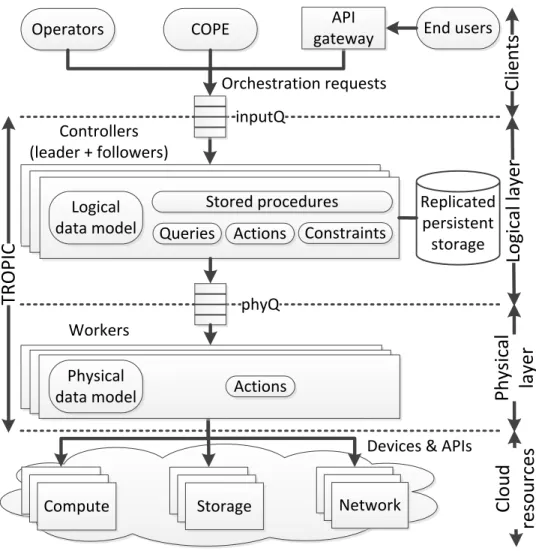
In this chapter we present the design and implementation of TROPIC (Transac-tional Resource Orchestration Platform In the Cloud) [66, 64], and how it achieves transactional orchestration. Residing underneath COPE, TROPIC translates high-level orchestration commands generated by COPE to low-high-level operations to execute. TROPIC aims to answer research questions 2–5 in Chapter 1: robustness,safety,high concurrency, andhigh availability, which are essentially the design goals of TROPIC.
4.1
TROPIC Architecture
To achieve these design goals, TROPIC platform performs transactional cloud re-source orchestrations. Transactions provide ACID semantics which fit our design goals well: (i) Robustness is provided by the atomicity and durability properties, which guarantee that committed orchestrations persist on physical devices, while or-chestrations that encounter unexpected errors have no effect; (ii)Safetyis enforced by integrity constraints in order to achieve transactional consistency; (iii) Concurrency is supported by a concurrency control algorithm that permits multiple transactions