Proceedings of IMECE’06: 2006 ASME International Mechanical Engineering Congress and R&D Expo Chicago, Illinois, USA, November 5-11, 2006
IMECE2006-13777
A PROBLEM SOLVING APPROACH FOR TEACHING ENGINEERING LABORATORIES
Constantin CiocanelResearch Associate ASME Student Member
Department of Mechanical Industrial and Manufacturing Engineering
The University of Toledo Toledo, Ohio 43606 [email protected]
Mohammad H. Elahinia Assistant Professor
ASME Member
Department of Mechanical Industrial and Manufacturing Engineering
The University of Toledo Toledo, Ohio 43606 [email protected]
ABSTRACT
This paper presents the redevelopment method and process of the laboratory experiments for the Mechanics and Vibration Laboratory, MIME3390, in the Mechanical, Industrial, and Manufacturing Engineering Department at the University of Toledo. The redevelopment objective was to transform the learning process from a subject-based learning to a problem-solving learning. Particular objective was to provide the students with more hands-on experience and to challenge them by requesting the procedure for each laboratory experiment to be designed and carried out by each group of students.
This senior level laboratory course consists of experiments in deformable solid mechanics including stress and deflection analysis, fatigue life evaluation, stability and mechanical vibration. Prerequisite courses for this laboratory are Mechanical Design I and Mechanical Vibrations. In line with the program objectives of the department, the following list of objectives has been defined for this course: “Upon successful completion of this course, the students should have: (1) become knowledgeable in the use of standard instrumentation for static and dynamic structural testing, such as strain gages, load frames, impact hammers, and spectrum analyzers; (2) reinforced material studied in previous mechanics and vibrations courses; (3) improved data analysis skills, and (4) further developed laboratory and technical writing skills.”
Prior to this redevelopment, as part of the subject-based approach, a classroom lecture preceded each laboratory session. The lecture consisted of the review of the theory pertaining to each experiment to help students refresh their
knowledge on the subject. Additionally the description and procedure of the laboratory experiment was covered during this lecture. Prior to each class, the lecture notes, along with the laboratory procedures, were posted on the course website. The step-by-step instructions for each experiment were provided to assist the students in setting up and conducting each experiment. Throughout the semester, eleven experiments were performed.
The students wrote individual reports on the experiments consisting of a summary of the acquired data, data analysis, and observations. However, due to the number of students and limited number of lab sessions it was difficult to provide the students with the real hands-on experience with the instrumentation and lab setup. As a result, during the lab the student mostly collected data according to the lab procedure and compiled a report that sometimes was inspired by samples of reports written by former students.
INTRODUCTION
MIME3390 (Mechanics and Vibration Laboratory) is a large-enrollment laboratory course in Mechanical, Industrial, and Manufacturing Engineering Department at The University of Toledo. The main objective of the course is for the student to develop a better understanding of basic mechanics and vibration principles. Over the past few years, the laboratory was for the most part, a subject-based learning process. Each laboratory session was preceded by a classroom lecture. The lecture covered the theory pertaining to each experiment to help students refresh their knowledge on the subject. The instruction for each experiment was also provided to assist the students in setting up and conducting each lab.
Proceedings of IMECE2006 2006 ASME International Mechanical Engineering Congress and Exposition November 5-10, 2006, Chicago, Illinois, USA
The analysis of the student feedback and the instructors’ observations over four semesters prior to the redevelopment revealed the following drawbacks of the subject-based teaching approach that was used to teach the course.
SUBJECT-BASED LEARNING DRAWBACKS
The lab was structured such that students were required to complete a task rather than solve a problem. This approach, in a way, is the opposite of what an engineering graduate is required to do at the workplace, where they are “paid to formulate and solve problems that neither follow from the material presented in the book chapter nor have a single “right” answer that one can find at the end of a book” [1].
The individual involvement toward problem identification and formulation of the solution method was limited or nonexistent. Only one or two students in a group were usually involved in carrying out the experiments while the other members just made only an act of presence in the laboratory. As a result, the latter were often unable to explain the strategies used to solve the problem. The lack of individual involvement has accordingly hampered the achievement of at least one criterion for success of the course.
The student’s grading was done based on the completeness of the submitted report. A grading sheet was available for every laboratory report. The students used this to check whether they addressed in the report all the topics contributing to their grade. This approach yielded relatively standard reports for each experiment and didn’t give students the opportunity to distinguish themselves through best answers to a problem within available resources and restraints. Another significant disadvantage of this approach was that many students compiled their reports using samples of reports written by former students.
The provided standard laboratory procedure did not allow for active inter-group collaborations or discussion of the approach taken in addressing the problem. This limited the individual involvement as well as the development of teamwork skills for the students.
Insufficient experimental set-ups or testing equipment also contributed to some extent to the above-mentioned problems.
Overall, it can be concluded that the previous methodology limited the students’ initiative in structuring and writing the laboratory reports. Also, the feedback provided to the students with each graded lab report was not helping them improve their technical writing as it was focused on the correctness of the answers to the predefined questions rather than on independent interpretation and analysis of the results.
In our opinion, this approach contributed to the erroneous evaluation of the student proficiency on writing technical reports.
PROBLEM-SOLVING APPROACH
The effect of creative education methodologies on student learning has long been the focus of educational researchers. Fink et al. emphasized the need for new methods for engineering education. Through case studies, they showed the effectiveness of such methods in improving the teaching in different engineering disciplines [2]. The authors rightfully count the integration of major components, such as learning tools, learning activities, and learning evaluation, of the course as one of the major aspects of effective teaching. They conclude that by a proper combination of these major components one can improve the students’ learning. Freuler et al. reported on their effort in the College of Engineering at the Ohio State University where they redeveloped the freshman engineering classes to a combined course with hands-on laboratory elements [3]. Teamwork, project management, report writing, and oral presentations were the main parts of this program.
Recently, Smith et al. focused on classroom-based pedagogy of engagement [1]. The authors recognized the active and collaborative learning as better ways for students to learn by being intensely involved in the educational process. These learning methods can further be implemented by encouraging the students to apply their knowledge in many situations. The article indicates the superiority of the problem-based learning over the subject-based learning, as illustrated in Figure 1.
Figure 1 - Problem-solving learning contrasted with subject-based learning [1].
The authors have identified the following attributes of the problem-solving approach: (1) Learning is student-centered (2) Learning occurs in small student groups (3) Teachers are facilitators or guides (4) Problems are the organizing focus and stimulus for learning (5) Problems are the vehicle for the development of clinical problem-solving skills (6) New information is acquired through self-directed learning. More importantly, the problem-solving approach prepares the students for formulating and solving problems they have never been exposed to before.
The Mechanical Engineering Department at Virginia Polytechnic Institute and State University has been using a problem solving approach to teach undergraduate laboratories [4, 5]. The laboratory interweaves instruction on engineering principles with instruction on engineering communication. Using this approach, they have successfully taught advanced topics to undergraduate students [6]. At the Central Connecticut State University, Prusak applied the problem-solving approach in order to develop and improve important skills in the students through laboratory experiments [7]. The students were given limited guidance to develop a projectile device. The experience was aimed at giving students the possibility of guided practice without clearly defined boundaries. The author reports positive outcomes in terms of inter-team communications and organizing.
Morgan and Jones have studied the importance and effectiveness of using computer simulations in engineering education [8]. According to this and similar studies, by using engineering software it is possible to motivate the students and to provide learning at a number of levels, including the cognitive and emotional ones. The authors further elaborated on their experience in using MATLAB for teaching a course on control systems. According to the authors' experience, the use of engineering simulation software could help the students with the process of decision-making and problem solving associated with the discipline of engineering. They also noted that the students enjoyed the computer-based laboratory exercises.
Many publications on engineering education, on the other hand, emphasize the importance of teaching the underlying principles of engineering while maintaining strong math and physics backgrounds. As an example, Pitts shows the importance of basic engineering principles in each discipline using several civil and mechanical engineering applications [9].
In redeveloping the Mechanics and Vibration Laboratory, the problem solving approach was chosen to improve students’ learning and to ensure achieving the course objectives. This approach allows for the combination of several teaching methods in a unitary layout. In the redeveloped course, the number of experiments for each semester is reduced and the step-by-step lab procedures are no longer provided to
the students. In the new approach, a practical problem is designed around each experimental setup available in the laboratory. The problem is introduced to the students through a memorandum that describes each of the problems that the students must solve by performing the experiment. In other words, the redeveloped MIME3390 is a problem solving-based course to provide the students with experience in experimental investigation of mechanical engineering systems and to improve their technical writing skills.
SPECIFICS OF THE PROBLEM SOLVING APPROACH In redeveloping the course, the main objective was to improve the student learning. This was accomplished mainly by changing the teaching approach to problem solving. To this end, students are required to solve practical engineering problems. During the semester, the students work on six engineering problems that range from designing a linear displacement sensor to investigating the torsional vibration in an engine crankshaft. Each of these problems is described to the students in a memorandum (see Appendix B). A supervisor, who defines the purpose of the problem and defines the audience for the report, prepares the memorandum. The memorandum does not contain a procedure to be followed for conducting the experiment. For each laboratory problem, students attend two lectures that discuss the engineering principles of those problems and attend two laboratory sessions. In the lab, the students design the experimental procedure based on their engineering judgments and, for some experiments, they make the actual test specimen. During the second lecture, scheduled between labs, questions and discussions over the ongoing experiment are being entertained. In addition, during same lecture, students deliver presentations on the previous experiment. Each presentation is followed by students addressing the critiques from the faculty, graduate teaching assistants, and their peers. Incorporation of the presentations has enhanced the understanding by the students of the technical issues of the laboratory. For most experiments, the students were asked to perform simulations, using MATLAB/Simulink, in order to develop a better understanding of the theoretical behavior of the system. While the students are encouraged to work in teams toward finding the solution to the problems posed in the memos, they have to communicate their results in individual reports.
The students are allowed to submit a report twice. On the first submission, they receive comments from either the teaching assistants or the instructor on the ways to improve the report.. This submission counts as 60% of the grade received for that particular report. Once the students address the comments, they resubmit the report, which is final and accounts for 40% of the report grade. The final grade in the course is determined 80% by the report grades and 20% by the presentation grades.
The following sections present additional information about the problem-solving approach with more details on one of the lab experiments. The redeveloped experiment is compared with the previous format of the similar experiment.
LINEAR DISPLACEMENT TRANSDUCER EXPERIMENT
The strain gage based linear displacement transducer experiment is essentially a classical straight beam bending experiment twisted into a linear displacement transducer design. In this experiment, the students are required to design and test a strain gage based linear transducer following a set of constraints described in a memorandum received from a product manager of a local small business. To successfully design the transducer, students need to pay special attention to the sensitivity of the device, the measuring range, and the temperature operating range. As for most of the experiments in this new approach, there are two laboratory sessions allocated for this experiment. It is worth noting that the main difference between the redeveloped experiment and the previous experiment is two-fold. The experiment is not introduced through a lab procedure for the students to follow. Instead, it is introduced through a problem. To solve this problem the students need to come up with the lab procedure and perform the experiment. The second main difference is that the students do not receive the specimen. Instead, based on the problem definition they design and build the test sample.
In order to address the issues specified in the memo, the students are required to perform the following:
• Calculate the strain developed along a cantilever beam upon the application of a given displacement at the free end.
• Identify a setup for strain gage installation such that the strain reading will be large enough to meet the transducer sensitivity requirements.
• Install and wire the strain gages at the location calculated analytically.
• Acquire data using the provided equipment and analyze the data according to the memo requirements.
• Comment on the adequacy of using strain gage technology for the development of a linear displacement transducer.
Upon completion of this experiment, each student has developed his/her own transducer, yielding a total of 16 different samples. The differences consisted mainly in the location of the strain gages along the beam simulating the elastic element of the transducer. In order to satisfy the operating range requirements for the designed transducer, the students have calculated the strain gage location along the
beam. The closer the strain gage location to the fixed end of the beam, the better the solution.
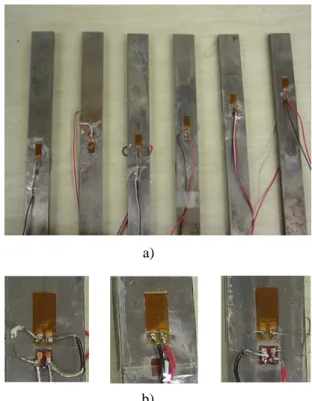
Figure 2 – a) Pictures of selected transducers developed during the lab. b) Close-up view of the installed strain gage on three randomly selected specimens.
Figure 3 – Simulated linear displacement transducer.
The problem was a priori posed such that the students would have to install two strain gages, in the same cross section, on opposite sides of the beam in order to satisfy the operating requirements for the transducer. Pictures of few of the specimens shown in Figure 2 illustrate the variety of solutions provided by the students to the posed problem.
a)
The close-up provided in Figure 2.b illustrates the variety of solutions chosen for gage wiring as well. It is more interesting to highlight this as it was expected that the students would follow the wiring procedure highlighted in the student strain gage installation manuals. The hardware used to evaluate the performance of the transducers is shown in Figure 3.
RESULTS
The problem-solving approach taken in this study has been proven to be a suitable platform for improving student understanding of fundamental engineering principles. The major benefit of using this method is that the students’ learning is enhanced. This outcome is determined by the facts that the students have to design the procedure for running the test and collecting data, they need to analyze the problem from multiple perspectives and, as engineers, they deal with solving practical issues related to the problem. In addition, requiring the students to present the results of their experiments contributes considerably to the learning process. Faculty, graduate teaching assistants, and peers provide feedback on presentations, helping the students to significantly improve their presentation skills.
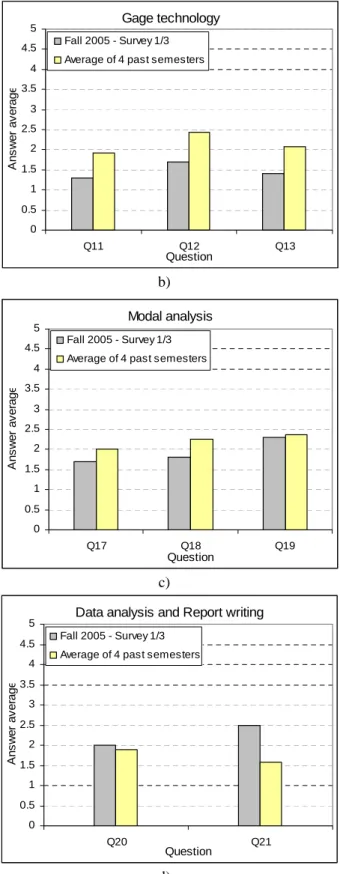
To evaluate the outcome of this approach, two sets of student evaluations were administrated during the semester; one evaluation was taken at the middle of the semester after the completion of three experiments related to the mechanical part of the lab, and one at the end of the semester. The mid semester evaluation was used to identify ongoing issues, specific to the new approach, and to address them accordingly. The end of semester evaluation, more relevant for the outcome of the redevelopment, was compared with the students’ feedback from the past four semesters (see Figure 4). The questionnaire answered by the students (Appendix A – Survey 1/3) addresses the level of achievement of the outcomes of the course.
a)
b)
c)
d)
Figure 4.a-d – Comparison between the level of achievement of the course’s outcome at the end of the current semester and the average of the same from the past four semesters (lower numbers correspond to better outcomes).
Stress calculation 0 0.5 1 1.5 2 2.5 3 3.5 4 4.5 5 Q1 Q2 Q3 Q4 Question A n s w er a v era g e Fall 2005 - Survey 1/3 Average of 4 past semesters
Gage technology 0 0.5 1 1.5 2 2.5 3 3.5 4 4.5 5 Q11 Q12 Q13 Question A ns w e r av erag e Fall 2005 - Survey 1/3 Average of 4 past semesters
Modal analysis 0 0.5 1 1.5 2 2.5 3 3.5 4 4.5 5 Q17 Q18 Q19 Question A n s w er av erag e Fall 2005 - Survey 1/3 Average of 4 past semesters
Data analysis and Report writing
0 0.5 1 1.5 2 2.5 3 3.5 4 4.5 5 Q20 Q21 Question A ns w e r av er ag e Fall 2005 - Survey 1/3 Average of 4 past semesters
The summary of the results (see Figure 4) indicates that overall the redevelopment was successful. To better understand the results, the following must be specified:
• A small research component was included in one laboratory, i.e. the curved beam memo/experiment. Specifically, the students were required to use two bibliographical sources for the normal stress calculation, one being printed in a foreign language. This task proved to be quite difficult and it clearly impacted negatively the overall perception relative to the theoretical understanding of normal stress calculation in curved beams.
• The answer average on question 3 was expected to be five (the lowest level) as no experiment or calculations involving stresses in pressure vessels was involved in the remodeled version of the lab. It is believed that some students answered this question in relation to their general knowledge on pressure vessels stress calculation.
• On the report writing, it is conservative to say that during previous semesters the students overestimated their skills. This was mainly due to the fact that, in previous semesters, for every experiment the students had to compile an almost standard report. In the new approach, the students had to assess independently the information relevant for the beneficiary of the report, to structure it such that would be easy to read and to make sure that was technically sound.
• In the new approach, the students were required to submit a first draft of the report for each experiment. This draft was evaluated by the instructor and the teaching assistant, and then was returned to the students for revisions. The returned report included the written comments of the reviewer. After addressing the suggested revisions, the second and final report was submitted. The contribution to the final grade was 40% for the first draft and 60% for the final report. Communicating the students their mistakes helped them improve their technical writing skills and understand what information needs to be included in a technical report. As this type of feedback was missing in the previous approach, it is believed that the outcome covered by question 21 was highly overrated and that the difference shown in Figure 4 is not accurate.
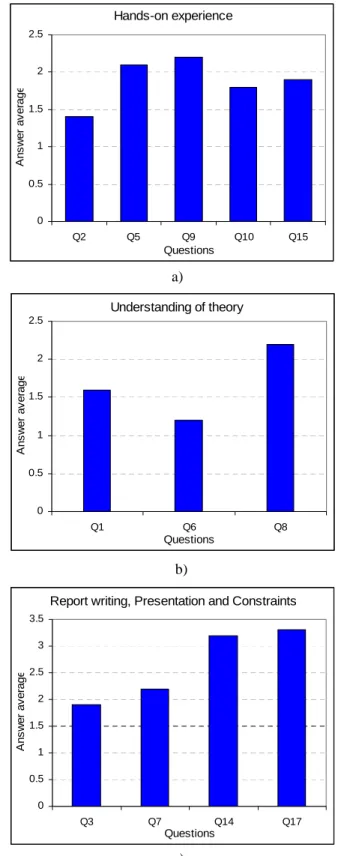
In addition, the results of the instructor’s questionnaire (Appendix A - Survey 2/3) are being presented. The focus on the latter is on four categories: 1) efficiency of the hands-on approach, 2) understanding of the theory and its limitations, 3) constraints and limitations, and 4) presentation and technical writing expertise. The number of questions answered in each category varied, with five questions for the 1st category, three for the 2nd, and two for the 3rd and 4th, respectively. The results are summarized in Figure 5. The answers scale was from 1 to 5, with 1 equivalent to strongly agree and 5 strongly disagree.
Figure 5 – Results of the student evaluation administrated at the end of the semester during which the change in teaching approach occurred. The questions are provided in Appendix A – Survey 2/3 (lower numbers correspond to better outcomes).
Understanding of theory 0 0.5 1 1.5 2 2.5 Q1 Q6 Q8 Questions A n s w er av erag e Hands-on experience 0 0.5 1 1.5 2 2.5 Q2 Q5 Q9 Q10 Q15 Questions A n s w er av erag e
Report writing, Presentation and Constraints
0 0.5 1 1.5 2 2.5 3 3.5 Q3 Q7 Q14 Q17 Questions A ns w er av erag e a) b) c)
A high average, equivalent to strong student disagreement on the proposed approach, has been recorded for the constraints category (see Figure 5). Most students considered the amount of time required to complete each laboratory experiment and the corresponding laboratory report much larger than expected for a two credit hour course.
However, while the time component had a negative impact on the students’ feedback, the educational benefits of the approach have been recognized. This is indicated by the relatively low average values (meaning high level of approval) on theory, hands-on, and report writing and presentation indicators. The hands-on experience was very appreciated and many students agreed that it helped them better understand the theoretical concepts.
The ratings on the completion of the experimental setups and data acquisition would definitely be better if more time would be allocated for these tasks. It is believed that this would affect positively the constraints category as well.
Allowing the students to work independently on the experimental setups was beneficial for the better understanding of the theory. During the lecture time, as well as during the preparation of the experiments, questions were asked on the impact of the theoretical assumptions on the results, on why certain approximations have been made in the theoretical development, on what is the acceptable level of error introduced by such simplifications, etc.
Finally, the report writing and presentation category received higher marks in this pool compared with the ones reported in Figure 4. This is believed to be due to the more focused questions addressing these issues.
In conclusion, we believe that the redevelopment had an overall beneficial impact on the students and we are going to closely monitor the course for the next two semesters and report the results at the next conference.
REFERENCES
[1] Smith, K., Sheppard, S., Johnson, D., and Johnson, R., “Pedagogies of Engagement: Classroom-Based Practices,”
Journal of Engineering Education, American Society of Engineering Education, January 2005, 94(1):87-101. [2] Fink, L., Ambrose, S., and Wheeler, D., “Becoming a
Professional Engineering Educator: A New Role for a New Era,” Journal of Engineering Education, American Society of Engineering Education, January 2005, 94(1):185-194. [3] Freuler, R., Fentiman, A., Demel, J., Gustafson, R., and
Merrill, J. “Developing and Implementing Hands-on Laboratory Exercises and Design Projects for First Year Engineering Students,” 2001 ASEE Annual Conference
(Albuquerque: ASEE, June 2001).
[4] Alley, Michael, and Harry Robertshaw, “Interweaving Engineering and Writing: A Model Large-Laboratory Course at Virginia Tech,” 2001 ASEE Annual Conference
(Albuquerque: ASEE, June 2001).
[5] Alley, Michael, and Harry Robertshaw, “An Effective Incorporation of Student Presentations Into a Large Laboratory Course,” 2001 ASEE Annual Conference
(Albuquerque: ASEE, June 2001).
[6] Elahinia, M., “Teaching Smart Materials to Engineering Undergraduate Students: A Problem Solving Approach,” 2004 ASEE Annual Conference (Salt Lake City: ASEE, June 2004).
[7] Prusak, Z., “Development of Engineering Problem Solving Skills Through Laboratory Experimentation,” 2001 ASEE Annual Conference (Albuquerque: ASEE, June 2001). [8] Morgan, R., and Jones, K., “The Use of Simulation
Software to Enhance Student Understanding,” IEE International Symposium on Engineering Education: Innovations in Teaching, Learning and Assessment (Ref. No. 2001/046), 2001, 33/1-33/6.
[9] Pitts, G. “How do we teach students to relate to real applications,” IEE Colloquium on Engineering Education in the Twenty-First Century (Digest No: 1996/105), May 1996, 5/1-5/5.
APPENDIX A
STUDENT EVALUATION SURVEYS
Survey 1/3
Answer each question as it relates to the course or was demonstrated in the course. Use the following scale. 1 = excellent level, 2 = high level, 3 = adequate level, 4 = below the level expected, 5 = little or no knowledge or skill or topic or problem area was not covered in this course.
1. How well can you calculate stresses in curved beams? 2. How well can you calculate fatigue life and stress in rotating bending fatigue?
3. How well can you calculate stresses in thin wall pressure vessels?
4. How well can you calculate principal stresses from strain gage rosette data?
5. How well can you calculate stresses produced by torsion and bending?
6. How well can you calculate free undamped and damped vibration motion of single degree of freedom linear and rotational systems?
7. How well can you calculate free undamped vibration of multi-degree of freedom linear and rotational concentrated mass systems including eigenvalue and eigenvector solutions? 8. The solution to some of the problems in this course involves using calculus. What is the level of your ability to solve the problems involving calculus?
9. The solution to some of the problems in this course involves using differential equations. What is the level of your ability to solve the problems involving differential equations?
10. This course involves solving problems using basic physics. What is your level of knowledge in solving problems using basic physics?
11. How well do you know the method to mount strain gages? 12. What is your ability to wire strain gages into a Wheatstone bridge circuit?
13. How well do you understand temperature compensation of strain gage circuits?
14. What is the level of your ability to maximize desirable strain output or minimize undesirable strain output using gage orientation and gage position in the bridge circuit?
15. What is the level of your ability to use an Instron tension/compression testing machine?
16. What is the level of your ability to use a rotating bending fatigue machine?
17. What is your ability level to use horizontal and vertical shakers to determine natural frequencies and mode shapes? 18. What is the level of your ability to connect accelerometers to amplifiers and spectral analyzers?
19. What is the level of your ability to use the output from single and multi-channel input to determine equivalent mass,
equivalent spring constant and equivalent-damping ratio for a single degree of freedom system?
20. How well can you analyze experimental data? 21. How well can you write a laboratory report?
Survey 2/3
Please use the scale of 1 (strongly agree) 2 (agree) 3 (not sure) 4 (don’t agree) 5 (strongly disagree) to assess the following statements.
1. The lab helped me to understand the theory better. 2. The hands-on approach of this lab helped me learn more. 3. I improved my technical writing skills through revising the reports based on the instructor’s comments.
4. I used the recommended textbooks to prepare better reports and presentations.
5. I contributed in designing the procedure for the experiments. 6. In writing the reports, I compared theoretical and
experimental results and I was asked to explain the difference. 7. The class helped me improve my presentation skills.
8. I learned to consider limitations and underlying assumptions of a theory before applying it to solve a problem.
9. After solving engineering problems in this course, I feel I am more prepared as an engineer.
10. Instead of receiving a step-by-step lab procedure, I think it is more beneficial for the students to receive a problem to solve by performing the experiment.
11. The memos stated clearly the problems to be investigated. 12. The information provided in the lectures, memorandums, and supplemental materials on the web were enough to understand the problem and to conduct the experiment.
13. The laboratory testing procedures were easy to develop based on the information provided in memos and lectures. 14. There was enough time allocated for the completion of the lab experiments.
15. After completing the course, I feel confident to set up and perform independently (or with minimal assistance) a basic stress or vibration related experiment.
16. I learned to simulate the behavior of a 1-DOF and multi-DOF system through MATLAB/Simulink.
17. The amount of time required to complete the lab reports was acceptable.
18. I will definitively recommend this class to all my engineering majoring friends.
Survey 3/3
APPENDIX B
SAMPLE MEMORANDUM
Engineering Solutions, Inc.
2475 Alexis Rd. Toledo, OH 43613
May 3, 2006
To: Paul Callahan, Test Engineer
From: Michael Andretti, Product Development Director
Subject: Request for Design Recommendations on a Strain Gage Displacement Transducer
Our company is developing a linear displacement transducer and we are exploring several technologies that can be used successfully in developing this product. The strain gage technology, on which your company has extensive experience, is one technology our engineers are considering for this application. Michelle Arbogast, one of our product development engineers, suggested a simple cantilever beam design, with strain gages used as sensing element. In order to test the feasibility of the proposed design, she suggested to perform preliminary tests on a cantilever beam with the following geometry: L= 279mm, w=19mm and h=6mm. Several beam specimens have been already shipped to you.
The outcome of these experiments should indicate: 1) the sensitivity of the device in the proposed configuration, 2) the means to amplify the strain reading in order to measure displacements as small as 0.254mm and, 3) the requirements for the device to operate in an environment with large variations in temperature.
Upon the completion of the tests, we would like to receive from you a report containing the following:
1. the analytical calculations for the strain at the location of the strain gage(s) as a function of the imposed displacement at the free end of the beam.
2. a plot of the actual strain measured by the gage (as determined by the strain indicator) and the theoretical strain on the gage as functions of the displacement of the free end. 3. a cumulative plot of the actual strain measured during three loading-unloading cycles. The imposed displacement should be between 0.254mm and 3.048mm, in 0.254mm increments. 4. comments on the slopes of the two curves generated in step 2 and how those relate to gage installation. Do these results indicate that the setup could be used as a displacement transducer?
Finally, please instruct us about the adequacy of using strain gages and the cantilever beam setup for the development of the linear displacement transducer.
To help you investigating this design, please use the testing equipment shown in Figure 1. This equipment is available in the Mechanics and Vibration Laboratory and has been provided by Vishay Measurements Inc. With it, you should be able to determine a relationship between the imposed displacement at the tip of the beam and the strain reading recorded by the strain indicator. The hardware necessary to install strain gages on the beam and to wire them to the strain indicator is readily available in the laboratory as well. Instructions on strain gage installation accompany the necessary accessories.
Figure 1 - Setup diagram
Note: The beams are made out of steel with the modulus of elasticity of 2.1E+5 MPa. Estimate whether the straight beam theory [Hibbeler R.C., 2003], involved in the analytical calculations of the strain as a function of the imposed deflection, provides an accurate enough result, or a more advanced theory must be involved. All calculations are required in SI units.
Copies to: Michelle Arbogast
References
1. Hibbeler, R.C. 2003, Mechanics of Materials, Fifth edition, Pearson Education,
Inc., Upper Sadle River, New Jersey o7458.
2. Vishay Measurements Group 1997, Student Manual for Strain Gage Technology, Measurements Group, Inc., Education Division.
![Figure 1 - Problem-solving learning contrasted with subject-based learning [1].](https://thumb-us.123doks.com/thumbv2/123dok_us/9449689.2425483/2.918.531.808.681.1028/figure-problem-solving-learning-contrasted-subject-based-learning.webp)