On the Design and Scalability of Distributed
Shared-Data Databases
Simon Loesing
†Markus Pilman
†Thomas Etter
†Donald Kossmann
†∗†Department of Computer Science ∗Microsoft Research
ETH Zurich, Switzerland Redmond, WA, USA
{firstname.lastname}@inf.ethz.ch
[email protected]
ABSTRACT
Database scale-out is commonly implemented by partition-ing data across several database instances. This approach, however, has several restrictions. In particular, partitioned databases are inflexible in large-scale deployments and as-sume a partition-friendly workload in order to scale. In this paper, we analyze an alternative architecture design for distributed relational databases that overcomes the limita-tions of partitioned databases. The architecture is based on two fundamental principles: We decouple query process-ing and transaction management from data storage, and we share data across query processing nodes. The combination of these design choices provides scalability, elasticity, and operational flexibility without making any assumptions on the workload. As a drawback, sharing data among multiple database nodes causes synchronization overhead. To address this limitation, we introduce techniques for scalable trans-action processing in shared-data environments. Specifically, we describe mechanisms for efficient data access, concur-rency control, and data buffering. In combination with new hardware trends, the techniques enable performance charac-teristics that top state-of-the-art partitioned databases.
1.
INTRODUCTION
Modern large-scale web applications have requirements that go beyond what traditional relational databases man-agement systems (RDBMS) provide. For instance, tradi-tional RDBMS are inflexible with regard to evolving data and are too rigid for dynamic cloud environments. In re-sponse to these limitations, new design considerations have triggered the emergence of NoSQL (Not Only SQL) stor-age systems. NoSQL systems have been hyped for their scalability and availability. However, the fundamental de-sign premise behind the NoSQL phenomenon is operational flexibility [39]. Operational flexibility describes all features that either facilitate user interaction or that enable the sys-tem to dynamically react to changing conditions. This in-cludes elasticity, the ability to grow or shrink the system on-demand; ease-of-use, the ability to efficiently write and
Permission to make digital or hard copies of all or part of this work for personal or classroom use is granted without fee provided that copies are not made or distributed for profit or commercial advantage and that copies bear this notice and the full cita-tion on the first page. Copyrights for components of this work owned by others than ACM must be honored. Abstracting with credit is permitted. To copy otherwise, or re-publish, to post on servers or to redistribute to lists, requires prior specific permission and/or a fee. Request permissions from [email protected].
SIGMOD’15,May 31–June 4, 2015, Melbourne, Victoria, Australia. Copyrightc 2015 ACM 978-1-4503-2758-9/15/05 ...$15.00. http://dx.doi.org/10.1145/2723372.2751519.
execute any kind of query; and deployment flexibility, the ability to run out-of-the-box on many commodity hardware servers. These properties have become critical success fac-tors with the advent of cloud computing andBig Data.
In this paper, we evaluate an architecture for distributed transaction processing that is designed towards operational flexibility. Our goal is to keep the strengths of RDBMS, namely SQL and ACID transactions, and at the same time provide the benefits that inspired the NoSQL movement. This architecture is based on two principles: First, data is shared across all database instances. In contrast to dis-tributed partitioned databases [41, 60], database instances do not exclusively own a partition but can access the whole data and execute any query. As a result, transactions can be performed locally. This is a key benefit over partitioned database in which distributed transactions can significantly affect scalability. The second principle is decoupling query processing and transaction management from data storage. While in traditional RDBMS engines the two are tightly cou-pled, we logically separate them into two architectural lay-ers. This break-up facilitates elasticity and deployment flex-ibility as both layers can be scaled out independently [37]. Applying both principles results in a two-tier architecture in which database instances operate on top of a shared record store. Hence, the nameshared-data architecture.
The shared-data architecture has shown to scale for ana-lytical workloads (OLAP). For instance, it is the foundation behind the success of Apache Hadoop [2]. This paper uses the same elemental principles to allow for scalable online transaction processing (OLTP). In a shared-data architec-ture, it is even possible to run an OLTP workload and per-form analytical queries on separate instances but accessing the same data. This mixed workload scenario enables scal-able analytics on live production data. Although the focus of this paper is on OLTP workloads, we outline the implica-tions of performing mixed workloads.
Sharing data raises several technical challenges we ad-dress: First, shared data access requires synchronization [52]. We use lightweightload-link and store-conditional (LL/SC) primitives [25] as a foundation to implement efficient multi-version concurrency control (MVCC) [5] and provide latch-free indexes [35]. Second, data access involves network com-munication. We provide techniques to minimize network re-quests and keep latencies low. In particular, we rely on new technical trends such as fast networking technology (i.e., In-finiBand [24]) as well as in-memory data storage. It is the specific combination of techniques that enables scalability not possible a few years ago.
Storage Applications Clients Request Response Databases SQL Result Data 2 Data 3 Query Proc. Trx Mgmt. Query Proc. Trx Mgmt. Query Proc. Trx Mgmt. Data 1
Figure 1: Partitioned databases
This paper makes three contributions: First, we propose an architecture design for distributed relational databases that enables scalability, fault-tolerance, and elasticity with-out making any assumptions on the workload. Second, we demonstrate that the right combination of established con-cepts and new hardware trends enables scalable transaction processing in shared-data systems. Accordingly, we describe techniques for efficient and consistent data access as part of a reference implementation of the shared-data architecture, a database system called Tell. Third, we show the effec-tiveness of our design and evaluate it against VoltDB [54], MySQL Cluster [41] and FoundationDB [19].
The paper is organized as follows: Section 2 details the key design principles and technical challenges of shared-data ar-chitectures. We review related work in Section 3. Section 4 describes Tell and explains how concurrency control and re-covery are implemented. Section 5 details data access and shared storage. Section 6 presents an experimental evalua-tion of Tell, and Secevalua-tion 7 concludes.
2.
SHARED-DATA ARCHITECTURE
This section describes the design principles and technical challenges behind the shared-data architecture.2.1
Design Principles
In the following, we detail the key design principles moti-vated in the previous section. Moreover, we highlight the ne-cessity for ACID transactions and complex queries, two fea-tures that have recently been relaxed or simplified in many storage systems [12, 16, 45].
Shared data: Shared data implies that every database instance can access and modify all data stored in the database. There is no exclusive data ownership. A transaction can be executed and committed by a single instance. In contrast to partitioned databases, no workload knowledge is required to correctly partition data and minimize the number of dis-tributed transactions. Sharing data provides the following benefits: First, setting up a database cluster is straightfor-ward. Second, the interaction with the database is simplified as partitioning is no longer reflected in the application logic. On the other hand, sharing data requires updates to be syn-chronized, a constraint we address in Section 2.2.
Decoupling of Query Processing and Storage: The shared-data architecture is decomposed into two logically independent layers, transactional query processing and data storage. The storage layer is autonomous. It is implemented as a self-contained system that manages data distribution
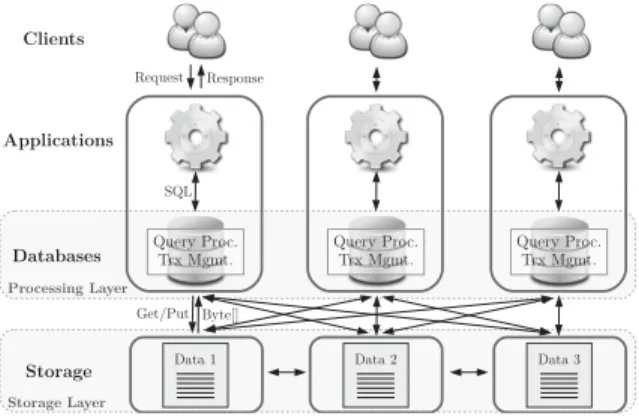
Storage Applications Clients Request Response Databases Get/Put Byte[] SQL
Data 1 Data 2 Data 3
Query Proc. Trx Mgmt. Query Proc. Trx Mgmt. Query Proc. Trx Mgmt. Processing Layer Storage Layer
Figure 2: Shared-data databases
and fault-tolerance transparently with regard to the pro-cessing layer. Hence, replication and data re-distribution tasks are executed in the background without the process-ing layer beprocess-ing involved. The storage system is in essence a distributed record manager that consists of multiplestorage nodes (SN). Data partitioning is not as performance critical as in partitioned databases as data location does not deter-mine where queries have to be executed. Instead, to execute queries, the processing layer accesses records independent of the SNs they are located at. This fundamental difference in the communication pattern is highlighted in Figures 1 and 2. The processing layer consists of multiple autonomous pro-cessing nodes (PN) that access the shared storage system. A mechanism is provided to retrieve data location (e.g., a lookup service) that enables the processing nodes to directly contact the storage node holding the required data.
Logical decoupling considerably improves elasticity as PNs or SNs can be added on-demand if processing resources or storage capacity is required respectively. Accordingly, nodes can be removed if capacity is not required anymore. More-over, the architecture enables workload flexibility. That is, the possibility to execute different workloads. For example, some PNs can run an OLTP workload, while others perform analytical queries on the same dataset.
In-Memory Storage:Modern commodity hardware clus-ters typically have terabytes of main memory at their dis-posal. These numbers exceed the capacity requirements of most applications. For instance, in the TPC-C bench-mark [57], a warehouse requires less than 200 MB. Conse-quently, it is no longer necessary to rely on slow storage de-vices (e.g., hard disks), and instead, the whole data can be kept in-memory. The advantages are obvious: In-memory storage provides low access latencies and avoids complex buffering mechanisms [53]. However, DRAM memory is volatile and data loss must be prevented in case of failures. A common approach to ensure fault-tolerance is replication.
ACID Transactions: Transactions ensure isolated exe-cution of concurrent operations and maintain data integrity. From a developer’s perspective, transactions are a conve-nient way to perform consistent data changes and simplify application development. In particular, development is less error-prone as data corruption and anomalies do not occur. Transactions are indispensable for the majority of applica-tions and are therefore a major feature. We aim at providing full transaction support. That is, ACID transactions can be performed without limitations on the whole data. Transac-tion management is part of the processing layer and does not make any assumption on how data is accessed and stored.
Complex Queries: SQL is the query language in RDBMS. It enables complex queries and includes operators to order, aggregate, or filter records based on predicates. Although al-ternative systems often simplify the query model to improve performance, complex (SQL) queries are not an obstacle to system scalability [47]. In the shared-data architecture, data location is logically separated from query processing. As a result, PNs retrieve the records required to execute a query. This notion can be described asdata is shipped to the query. The ability to run the same query on multiple nodes provides increased parallelism and scalability.
2.2
Technical Challenges
Shared-data architectures run any workload and facilitate elasticity. However, they introduce new challenges.
Data Access: In a shared-data environment, data is likely to be located at a remote location and has to be ac-cessed over the network. Caching data in local buffers is only possible to a limited extent as updates made by one PN have to be visible to the others instantly. As a result, to provide consistent access, most requests retrieve the latest record version remotely from the storage layer. Data access latencies can quickly become a dominant factor in query ex-ecution time and thus, minimizing the interaction with the storage layer is an optimization goal in shared-data systems. In light of restricted buffering possibilities, traditional tech-niques to manage relational data have to be re-evaluated. A major concern in this context is the correct granularity of data storage. That is, whether it is beneficial to group records into pages in order to retrieve or store several records with a request, or whether choosing a finer storage granu-larity (e.g., single record) is a more favorable approach. We suggest to store data at the granularity of a record as this provides a good trade-off between the number of network re-quests and the amount of traffic generated. We justify this design choice and detail the implications in Section 5.
A second challenge of shared data relates to data access paths and indexing. Analogous to data, indexes are shared across multiple PNs and are therefore subject to concurrent modifications from distributed locations. As a result, the shared-data architecture requires distributed indexes that support atomic operations and that are at the same time highly scalable. As a solution, we propose a scalable latch-free distributed B+Tree index in Section 5.3.
In addition to the right techniques, low-latency network-ing technologies such as InfiniBand contribute to reduce the overhead of remote data access. These technologies provide latency and bandwidth guarantees not available a decade back and consequently enable to scale to new levels. For instance, InfiniBand enables Remote Direct Memory Access (RDMA) within a few microseconds and is three orders of magnitude faster than a random read on a local hard disk.
Concurrency Control: Shared data records can be up-dated by any processing node and therefore concurrency control is required across all PNs. Although common pes-simistic and optimistic concurrency control approaches [6] can be used, distribution requires the mechanisms to be ex-amined from a new angle. For instance, a lock-based ap-proach requires centralized lock management. Assuming network latency dominates lock acquisition time, the lock manager quickly becomes a bottleneck. Similarly, increased data update latencies might cause more write-conflicts in an optimistic protocol resulting in higher abort rates.
Accord-ingly, a concurrency control mechanism that minimizes the overhead of distribution allows for the highest scalability.
In this paper, we present a distributed MVCC protocol. A key feature is conflict detection using LL/SC primitives, a particular type of atomicread-modify-write (RMW) opera-tion [50]. Atomic RMW operaopera-tions have become popular in recent years as they enable non-blocking synchronization. In a shared-data architecture, they allow for performing data updates only if a record has not been changed since it has last been read. As a result, conflicts can be identified with a single call. LL/SC primitives are a lightweight mechanism that allows for efficient distributed concurrency control. The details of this technique are presented in Section 4.
2.3
Limitations
The architecture and the techniques presented in this work perform best in the context of local area networks (LAN). LANs allow low-latency communication and are a critical performance factor for several reasons: First, shared data implies limited buffering and causes heavy data access over the network. Second, in-memory data requires synchronous replication in order to prevent data loss in case of failures. Wide area networks (e.g., between data-centers) have higher communication cost than LANs and are therefore unsuited for these requirements. Network bandwidth is another con-straint that can potentially become a bottleneck. The pro-cessing and the storage layer constantly exchange data, and factors such as heavy load or large records can cause network saturation. Some of the techniques we present introduce ad-ditional constraints that are detailed at a later point.
3.
RELATED WORK
Distributed databases that share data have been subject to various research over the years. Oracle RAC [11], IBM DB2 Data Sharing [28], and Oracle Rdb [36] are based on a shared-data architecture. These systems use a global lock-manager to synchronize data access and ensure concurrency control. Data is stored on disk and the granularity of shar-ing data is a page. In contrast, our approach is based on in-memory storage and reduces data access granularity to single records. More fundamentally, these systems rely on traditional tightly-coupled RDBMS engines.
An initial design of a shared-data architecture based on the principles presented in Section 2.1 has been introduced by Brantner et al. [8]. Moreover, the benefits of decou-pling data storage from query processing and transaction management with regard to flexibility and elasticity have been highlighted in several publications [34, 37]. A com-mercial database system that implements our design prin-ciples and that has been developed in parallel to Tell is FoundationDB [19]. FoundationDB provides a “SQL Layer” that enables complex SQL queries on top of a transactional key-value store. FoundationDB has many similarities with Tell such as support for in-memory storage and optimistic MVCC protocol. However, critical implementation details (e.g., indexing, commit validation) have not been published yet. The purpose of this paper is to specifically provide these details. The experimental evaluation highlights that it is the right combination of techniques that is fundamental to achieve high performance. In the TPC-C benchmark Tell outperforms FoundationDB by a factor of 30 (Section 6.5).
Several additional shared-data databases have been pub-lished recently. ElasTras [15] is a shared-data database
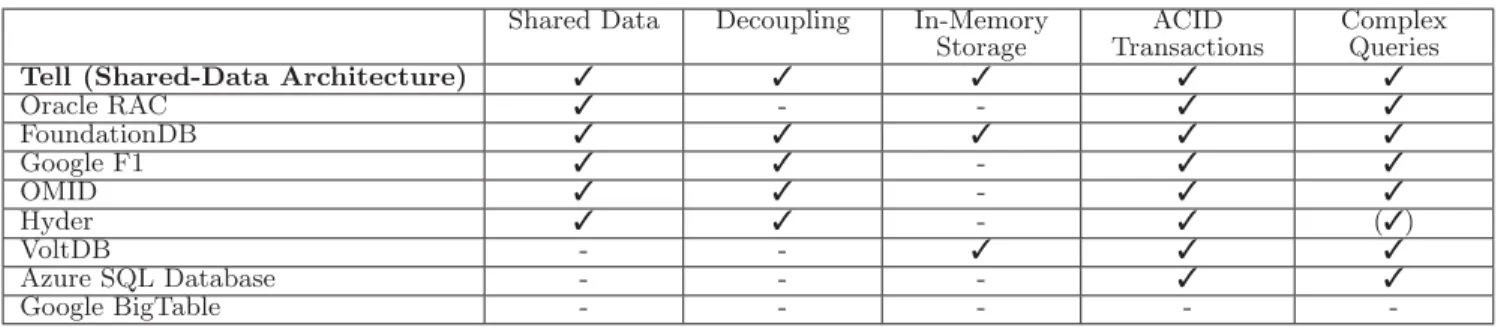
de-Shared Data Decoupling In-Memory Storage ACID Transactions Complex Queries
Tell (Shared-Data Architecture)
Oracle RAC - - FoundationDB Google F1 - OMID - Hyder - () VoltDB - - Azure SQL Database - - - Google BigTable - - - -
-Table 1: Comparison of selected databases and storage systems
signed for multi-tenancy. Data storage is decoupled from transaction management but data partitions (or tenants) are exclusively assigned to PNs. Transactions can only be per-formed on single partitions. In our architecture, PNs can access all data and the scope of a transaction is not lim-ited. Another shared-data database is Google F1 [49]. F1 is built on top of Spanner [13] that has evolved from Mega-store [3]. F1 enables scalable transactions but is designed with regard to cross-datacenter replication. The reported latencies to perform a commit are 50-150 ms. We assume low-latency data access in LANs. A system that implements many of our design principles is OMID [20]. OMID imple-ments MVCC on top of a large data store to provide transac-tion support. However, unlike our approach, OMID requires a centralized component for conflict detection and commit validation. Hyder [7] is a transactional shared-data record manager. Records are stored in a log structure. Updates are appended to the log in total order, and processing servers rollforward the log to reach a common state. Hence, trans-action management is decoupled from storage.
Distributed partitioned databases are nowadays widespread. A thorough review of the architectural benefits is provided by Dewitt and Gray [17]. Partitioned databases provide scal-ability for partition-friendly workloads but suffer from dis-tributed transactions. H-Store [29] and its commercial suc-cessor VoltDB [60] horizontally partition tables inside and across nodes. VoltDB sequentially processes transactions on single partitions without the overhead of concurrency control. Calvin [56] speeds up distributed transactions by reaching agreement before a transaction is executed. Jones et al. [26] propose to speculatively execute local transac-tions while waiting for distributed transactransac-tions to complete. Azure SQL Database [10] is a cloud service that enables to partition data across instances but does not support cross-partition joins. In a shared-data system, the problem of distributed transactions does not arise as PNs can access all data. Partitioning is transparent with regard to the PNs and transactions are local. Accordion [48] and E-Store [55] are two recent systems that propose data placement systems to enable online repartitioning [51] and provide elasticity for partitioned databases. Although these approaches con-siderably improve agility, adding or removing node implies re-partitioning and moving data. In Tell, elasticity is more fine-grained and PNs can be added without any cost.
Main memory databases [32, 58] take advantage of mem-ory performance and cache affinity to optimize processing in the scope of a single machine. A main memory database de-signed for processing mixed workloads is HyPer [30]. HyPer creates copy-on-write snapshots of the data in virtual mem-ory to process OLAP workload independently of on-going OLTP processing. A recent extension [40] allows to offload
analytical processing onto secondary machines to improve OLAP performance. The main difference to Tell is that OLTP queries are only processed on a single master server. Recently, relational databases have been challenged by the emergence of NoSQL systems. NoSQL stores violate our design principles and typically relax consistency guaran-tees in favor of more scalability and availability. Amazon’s Dynamo [16] was one of the first scalable key-value stores that provides eventual consistency to achieve high availabil-ity. Other systems such as BigTable [12] or Spinnacker [45] provide strong consistency and atomic single-key operations but no ACID transactions. G-Store [14] does support ACID transactions for user-defined groups of data objects. The major restriction is that these groups must not overlap. A system that does not have this limitation is Sinfonia [1]. Sin-fonia is a partitioned store that uses Two-Phase Commit to reach agreement on transaction commit. None of the pre-vious NoSQL stores supports a query language as powerful as SQL. However, many strongly consistent NoSQL systems are equivalent to atomic record stores and support basic op-erations as required by the storage layer in Tell.
Table 1 provides an overview of the discussed systems with regard to our design principles.
4.
TRANSACTION PROCESSING AND
CONCURRENCY CONTROL
Figure 3 presents an overview of the components of Tell. The processing node is the central component that processes incoming queries and executes transactions. PNs interact with the commit manager, a lightweight service that man-ages global transaction state (Section 4). Furthermore, a management node monitors the system and initiates a recov-ery process the moment a failure is detected. Finally, data is stored in a distributed storage system consisting of multiple SNs. The storage layer manages data records, indexes, as well as an undo log for recovery (Section 4.4). To enable transactional processing, the storage system must support consistent get/put operations on single records. Moreover, Tell depends on the availability of the storage system in or-der to process queries.
Concurrency control ensures that transactions can run in parallel on multiple PNs without violating data integrity. In this section, we describe a MVCC protocol [5]. More specif-ically, we detail a distributed variant of snapshot isolation
(SI) [4] that uses LL/SC primitives for conflict detection. The SI protocol is part of the transaction management com-ponent on each PN in Tell and guarantees ACID properties. SI is an optimistic protocol [31] in which transactions are never prevented from making progress. Evaluating our de-sign with lock-based protocols is subject to future work.
4.1
Distributed Snapshot Isolation
SI is a MVCC protocol that has been implemented in sev-eral database systems (e.g., Oracle RDBMS, PostgreSQL, Microsoft SQL Server). MVCC stores multiple versions of every data item. Each time a transaction updates an item, a new version of that item is created. When a transac-tion starts, it retrieves a list with all data item versions it is allowed to access. In SI, a transaction is only allowed to access the versions that were written by already finished transactions. This is the so-calledconsistent snapshot the transaction operates with. Transactions check for conflicts at commit time. Updates (insert, update, and delete oper-ations) are buffered and applied to the shared store during commit. In the remainder of the paper, we use the term “apply” to indicate that updates are installed in the store.
The commit of transaction T1 is only successful if none
of the items in thewrite set have been changed externally (applied) by another transactionT2 that is committing or
has committed sinceT1has started. IfT1andT2run in
par-allel and modify the same item, two scenarios can happen: First,T2 writes the changed item to the shared store before
it is read byT1. In that case,T1 will notice the conflict (as
the item has a newer version). Second,T1 reads the item
before it has been written byT2. If this happens,T1 must be able to detect the conflict before it writes the item back. For this purpose, Tell executes an LL/SC operation in the storage layer. LL/SC is a pair of instructions that reads a value (load-link) and allows for performing an update only if it has not changed in the meantime (store-conditional). LL/SC is stronger thancompare-and-swap as it solves the ABA-Problem [38]. That is, a write operation on a mod-ified item fails even when the value matches the initially read value. LL/SC is the key to conflict detection. If all updates of transactionT1can be applied successfully, there
are no conflicts and the transaction can commit. If one of the LL/SC operations fails, there is a write-write conflict andT1will abort (i.e., revert all changes made to the store). SI avoids many of the common concurrency control anoma-lies. However, some anomalies (e.g., write skew) prevent SI to guarantee serializability in all cases [18]. Proposed solu-tions for serializable SI [9, 27, 61] are not designed for dis-tributed systems or require centralized commit validation. Still, we mean to provide serializable SI in the near future.
To provide SI semantics across PNs, each node interacts with a dedicated authority, thecommit manager.
4.2
Commit Manager
The commit manager service manages global snapshot in-formation and enables new transactions to retrieve three el-ements: A system-wide uniquetransaction id (tid), a snap-shot descriptor and thelowest active version number (lav).
Transaction idsare monotonically incremented numeric values that uniquely identify a transaction. Every running transaction requires atid before it can execute data opera-tions. Given its system-wide uniqueness, thetidis not only used to identify transactions but also defines the version number for updated data items. In other words, a transac-tion creates new versions for updated data items with the
tid as version number. Due to the fact thattids are incre-mented, version numbers will increase accordingly. Hence, as tids and version numbers are synonyms, the set of tids
of completed transactions also defines the snapshot (i.e., the set of accessible version numbers) for starting transactions.
Get/Put Byte[] Commit Manager Processing Node Storage Interface Query Processing Trx. Mgmt. Application Logic Buer
Schema Data Indexes Trx. Log
P ro c e ss in g S to ra g e Management Node Node Mgmt.
Distributed Storage System
Figure 3: Tell architecture and components The snapshot descriptoris a data structure computed for each transaction that specifies which versions can be ac-cessed. It consists of two elements: First, a base version number bindicating thatband all earlier transactions have completed. Second, a set of newly committed tids N. N
contains all committed transactions with tid > b but not
b+ 1. Whenb+ 1 commits, the base version is incremented until the next non-committedtidis reached.
The implementation of the snapshot descriptor involves low computational cost. bis an integer and N is a bitset. Starting withb at offset 0, each consecutive bit in N rep-resents the next highertid and if set indicates a committed transaction. Hence, the snapshot descriptor is small even in the presence of many parallel transactions (e.g.,N≤13 KB with 100,000 newly committed transactions).
When accessing a data item with a set of version numbers (or version number set)V, the transaction reads the version with the highest version number v matching the snapshot descriptor. More formally, we define the valid version num-ber set the transaction can accessV as:
V:={x|x≤b∨x∈N }
The version with numbervis accessed:
v:=max(V ∩V)
The lowest active version numberis equal to the low-est base version number among all active transactions. That is, the highest version number globally visible to all transac-tions. Version numbers smaller than thelav are candidates for garbage collection (Section 5.4).
In order to communicate with the processing nodes, the commit manager provides a simple interface. The following three functions are supported:
• start() → (tid, snapshot descriptor, lav): Signal the
start of a new transaction. Returns a newtid, a snap-shot of the current state, and thelav.
• setCommitted(tid)→void: Signals thattid has
suc-cessfully committed. Updates the list of committed transactions used to generate snapshot descriptors.
• setAborted(tid)→void: Same as above but for aborts.
To scale and ensure fault-tolerance, several commit man-agers can run in parallel. Commit manager nodes use the shared store to synchronize ontidsand on the snapshot. The uniqueness of every tid is ensured by using an atomically incremented numeric counter in the storage system. PNs update the counter using LL/SC operations to ensure that
tids are never assigned twice. To prevent counter synchro-nization from becoming a bottleneck, PNs can increment the counter by a high value (e.g, 256) to acquire a range oftids
that can be assigned to transactions on-demand. We opted for continuous ranges oftids because it is simple to imple-ment. However, the approach has limitations (e.g., higher abort rate). Using ranges of interleavedtids [58] is subject to be implemented in the near future. To synchronize the current snapshot (i.e., the list of committed transactions), we use the storage system as well. In short intervals, every commit manager writes its snapshot to the store and there-after reads the latest snapshots of the other commit man-agers. As a result, every commit manager gets a globally consistent view that is at most delayed by the synchroniza-tion interval. Operating on delayed snapshots is legitimate and does not affect correctness. Nevertheless, the older the snapshot, the higher the probability of conflicts. In practice, a synchronization interval of 1 ms did not noticeably affect the overall abort rate (Section 6.3.3).
4.3
Life-cycle of a Transaction
This section describes the life-cycle of a transaction and enumerates the different transaction states:
1. Begin: In an initial step a transaction contacts the commit manager to retrieve its snapshot.
2. Running: While running on a PN, a transaction can access or update any data item. Read operations re-trieve the item from the store, extract the valid version and cache it in case the item is re-accessed. Updates are buffered on the PN in the scope of the transaction. Data storage and buffering are detailed in Section 5. 3. Try-Commit: Before starting the commit procedure,
a log entry with the ids of updated items is written to the transaction log. This is a requirement for recovery and fail-over (Section 4.4). We proceed with applying updates to the store using LL/SC operations. On suc-cess, the transaction commits. Otherwise, we abort. 4. (a) Commit: All data updates have been applied.
Next, the indexes are altered to reflect the up-dates, and a commit flag is set in the transaction log. Finally, the commit manager is notified. (b) Abort: On conflict, applied data updates are
rolled back. A transaction can also be aborted manually. In this case, no updates have been applied (as we skipped the Try-Commit state). Last, the commit manager is notified.
4.4
Recovery and Fail-Over
This section illustrates how node failures are addressed. Failures are detected by the management node using an eventually perfect failure detector based on timeouts. Al-though we describe fail-over for single node failures, han-dling multiple failures concurrently is supported.
4.4.1
Failure of a processing node
PNs act according to the crash-stop model. That is, in case of transient or permanent failures, all active transac-tions on a failed node are aborted. In particular, committing transactions with partially applied updates must be reverted to ensure correctness. As soon as a failure is detected, a re-covery process is started to roll back the active transactions
of the failed node. Correct recovery is enabled by a trans-action log that contains the status of running transtrans-actions.
The transaction log is an ordered map of log entries lo-cated in the storage system. Before applying updates, a transaction must append a new entry to the log. Every entry is identified by the tid and consists of the PN id, a timestamp, thewrite set, and a flag to mark the transaction committed. Thewrite set is a list of updated record ids.
When the recovery process is started, it first discovers the active transactions of the failed node. This involves retriev-ing the highesttid from the commit manager and iterating backwards over the transaction log until the lowest active version number is reached. The lav implicitly acts as a rolling checkpoint. Once we encounter a relevant transac-tion, we use thewrite set and revert the changes made by the transaction. That is, the version with number tid is removed from the records. On completion of the recovery process, all transactions of the failed node have been rolled back. The management node ensures that only one recov-ery process is running at a time. However, a single recovrecov-ery process can handle multiple node failures.
4.4.2
Failure of a storage node
The storage system must handle node failures transpar-ently with regard to the processing nodes. In order to remain operational, PNs require data access and assume a highly available storage system. Obviously, a failure must not lead to data loss. Moreover, downtime must be minimized as it will cause transaction processing to be delayed. Availability is guaranteed by replicating data. As data is kept in volatile storage (main memory) a SN ensures that data is replicated before acknowledging a request. This implies synchronous replication regardless of the replication protocol used (Read-One-Write-All, majority quorum, etc.). If a node fails, the storage system fails-over to the replicas and enables on-going processing of requests. Eventually, the system re-organizes itself and restores the replication level. Ensuring high avail-ability in simple record stores is a well studied field [12, 16]. The storage layer in Tell uses a management node to de-tect failures. The same node manages partitioning, restores the replication factor, and enables PNs to look-up the loca-tion of replicas. To prevent a single point of failure, several management nodes with a synchronized state are required.
4.4.3
Failure of a commit manager
In a single commit manager configuration, a failure has system-wide impact. PNs are no longer able to start new transactions, and the system is blocked until a new commit manager is available. Once all active transactions at the moment of failure have committed (the commit manager is not required for completion), a new commit manager can be started. To restore its state, the commit manager re-trieves the last used tid and the most recently committed transactions from the transaction log.
To prevent a single point of failure and increase availabil-ity, multiple commit managers can operate in a cluster. As pointed out previously, commit managers synchronize their state. If a commit manager becomes unavailable, PNs au-tomatically switch to the next one. New commit managers can determine the current state from the data of the other managers. Recall that the commit managers regularly write their state to the storage system. Hence, state information is accessible independently of commit manager availability.
5.
DATA ACCESS AND STORAGE
Tell provides a SQL interface and enables complex queries on relational data. The query processor parses incoming queries and uses the iterator model to access records. Records are retrieved and modified using basic data operations, such asread andwrite, and are stored in a key-value format. In this section, we explain how relational data is mapped to the key-value model and detail data access methods.
5.1
Data Mapping
The mapping of relational data to the key-value model is straightforward: Every relational record (or row) is stored as one key-value pair. The key is a uniquerecord identifier (rid). Ridsare monotonically incremented numerical values. The value field contains a serialized set of all the versions of the record. This row-level storage scheme is a significant de-sign decision as it minimizes the number of storage accesses. For instance, with a single read operation, a transaction re-trieves all versions of a record and can select the one that is valid according to the snapshot. On update, a transaction adds a new version to the record and writes back the entire record during commit. Again, a single atomic write request applies the update or identifies a conflict.
Grouping records into pages, as disk-oriented databases do in order to reduce the number of I/O operations [22], is of limited use in a shared-data architecture. A record needs to be re-fetched on every access because it can be changed any-time by remote PNs. Consequently, a coarse-grained storage scheme would not reduce the number of requests to the stor-age system but only increase network traffic. In contrast, a more fine-grained storage scheme (e.g., store every version as a key-value pair) would require additional requests to iden-tify added versions. Committing transactions would have to check for new versions before applying updates and con-sequently conflict detection would become more expensive. Although storing single versions reduces network traffic, we opt for an approach that minimizes network requests.
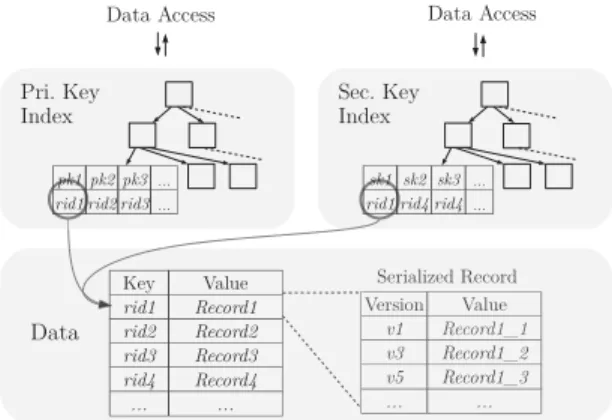
To read a record, PNs rely on index structures. Indexes contain references to therid and enable a PN to retrieve records with all versions (Figure 4). To update a record, it is first read. Next, a new version of the tuple reflecting the changes of the update is added to the set of versions. The entire record is kept in the transaction buffer, and fur-ther updates to the record directly modify the newly added version. Finally, the record is applied at commit time.
To further minimize the number of network requests and improve performance, Tell aggressively batches operations (i.e., several operations are combined into a single request). Batching enables transactions to access multiple records with a single request but it is also used to combine concurrent read operations from different transactions on the same PN. Batching is part of the interface to the store and therefore enables to combine requests across multiple transactions.
5.2
Mixed Workloads
OLTP workloads typically consist of short-running trans-actions that access few records. Every transaction requires a limited amount of remote accesses and utilizes low band-width. Thus, OLTP execution can be parallelized and scales with the number of PNs (Section 6). OLAP workloads, on the other hand, perform long running queries that access large amounts of data. For instance, an OLAP query might execute an aggregation that involves a full table scan (i.e.,
Sec. Key Index Data Key Value rid1 Record1 rid2 Record2 rid3 Record3 rid4 Record4 ... ... Version Value v1 Record1_1 v3 Record1_2 v5 Record1_3 ... ... Serialized Record
Data Access Data Access
Pri. Key Index
pk1 pk2 pk3...
rid1 rid2 rid3...
sk1 sk2 sk3 ...
rid1 rid4 rid4...
Figure 4: Storage and access of data records
access all the records of a table). To process this query, a PN must read (and transfer over the network) all the records of the table. Obviously, processing this query has limitations with regard to latency and bandwidth utilization.
To enable the efficient execution of mixed workloads, we propose to push down selected relational operators into the storage layer. For instance, executing simple operations such as selection or projection in the SN would enable to reduce the size of the result set and lower the amount of data sent over the network. A more advanced solution is to execute a shared scan over the entire data in the storage layer as sug-gested in [46, 59]. A dedicated thread could scan all stored records and pre-filter data for complex OLAP queries [44]. The challenge is to perform the scan efficiently without af-fecting on-going get/put operations. Mixed workloads are beyond the scope of this paper. Nevertheless, the concept of performing basic processing tasks in the storage layer is a promising direction for future work.
5.3
Latch-free Index Structures
Indexes provide an efficient lookup mechanism to iden-tify matching records for a given attribute (or a set of at-tributes). Indexes can be accessed by multiple transactions in parallel and therefore require concurrency control. In a shared-data architecture, integrity must be maintained across nodes as an index can be modified by multiple PNs. Traditionally, index integrity is enforced using latches. How-ever, latch-free algorithms have become popular recently [23]. In a distributed setting, the absence of latches is even more desirable as network communication increases latch acquisi-tion cost. Moreover, the absence of latches ensures system-wide progress. Accordingly, Tell provides a latch-free B+tree.
5.3.1
B+Tree Index
The B+tree is one of the most used index structures in relational databases. Over the last decades, many variations have been optimized for concurrent access [21, 33]. Particu-larly noteworthy is the Bw-tree [35], a latch-free variant for modern hardware. Taking the techniques of the Bw-tree as a reference, we have implemented a latch-free B+tree con-currently accessible by multiple PNs.
The B+Tree index is entirely stored and maintained in the storage layer (every node is stored as a key-value pair) and can be accessed by all PNs. To synchronize index updates, every node in the tree is atomically modified in the storage system (using LL/SC operations). On lookup, a transaction accesses the root node and traverses the tree until the leaf-level is reached. B+tree nodes are cached in the processing
layer to improve traversal speed and minimize storage sys-tem requests. Caching works as follows: All index nodes with exception of the leaf level are cached. The leaf-level nodes are always retrieved from the storage system. If the range of the leaf node (lowest and largest value) does not match the data in its parent (i.e., the leaf node has been split or merged), then the parent nodes are recursively up-dated (i.e., the latest version is retrieved from the storage system) to keep the cache consistent. The caching mecha-nism is independent of the synchronization of index changes.
5.3.2
Design Considerations
In order to prevent unnecessary network requests and in-crease scalability, versioning information is excluded from all indexes. Instead of maintaining a key-reference entry for every existing version, only a single index entry per record is maintained. As a result, it is not necessary to insert new index entries on every record update (i.e., whenever a new version is added) but only when the indexed key is modified. Less index insertions improve index concurrency.
Version unaware indexes have limitations. In particular, it is not possible to identify for which versions an index entry is valid. In the absence of that information, a transaction may retrieve a record that is not valid according to its snapshot descriptor. Although these reads are unnecessary, they are performed independently of the index and do not affect index concurrency. In addition, index-only scans are not possible as the validity of an entry can not be verified.
5.4
Garbage Collection
Updates add new versions and over time records become larger. To prevent data items from growing infinitely, garbage collection (GC) is necessary. Garbage collection deletes the versions and index entries that are never going to be ac-cessed again. We use two garbage collection strategies: The first one iseager and cleans up data records and indexes as part of an update or read operation respectively. The sec-ond strategy islazy and performs GC in a background task that runs in regular intervals (e.g., every hour). The latter approach is useful for rarely accessed records.
Record GC is part of the update process. Before applying a record, a transaction first verifies if older versions can be removed. To determine evictable versions, a transaction uses the lowest active version number it has obtained from the commit manager on transaction start. Given a record with version numbersV and thelav, we defineC as the version number set of a record visible to all transactions:
C:={x|x∈V ∧x≤lav}
The set of garbage collectable version numbersGis:
G:={x|x∈C∧x=max(C)}
The versionmax(C) is not garbage collected to guarantee that at least one version of the item always remains. All versions whose number is inGcan be safely deleted before the record is written back to the storage system.
Index entries are also subject to garbage collection. Index GC is performed during read operations. During the read operation following an index lookup, a transaction verifies if some of the index entries are obsolete. Given an index entry
kwith keya, we defineVaas the version number set of all versions that containawithVa⊆V. kcan be removed from
the index if the following condition holds:
Va\G=∅
Index nodes are consistently updated. If the LL/SC opera-tion fails, GC is retried with the next read. In the evaluaopera-tion (Section 6) both GC strategies are used.
5.5
Buffering Strategies
In this section, we present three approaches to improve buffering in a shared-data architecture. The effectiveness of each strategy is illustrated in Section 6.7.
5.5.1
Transaction Buffer
Transactions operate on a particular snapshot and do not necessarily require the latest version of a record. Accord-ingly, data records, once read by a transaction, are buffered and reused in the scope of the transaction. Every trans-action maintains a private buffer that caches all accessed records for the duration of the transaction’s lifetime. This caching mechanism has obvious limitations: There is no shared buffer across transactions, and buffering is only ben-eficial if transactions access the same record several times.
5.5.2
Shared Record Buffer
The second approach is based on a shared record buffer used by all transactions on a processing node. It acts as a caching layer between the transaction buffers and the storage system. Although records can be modified by remote PNs and new transactions need to access the storage system to retrieve the most recent record version, transactions running in parallel can benefit from a shared buffer. For instance, if a transaction retrieves a record, the same record can be
reused by a transaction that has started before the first one (i.e., a transaction with an older snapshot).
This strategy is implemented using version number sets
(as defined in Section 4.2). In the buffer, we associate to each record a version number set that specifies for which version numbers the record is valid. Comparing the version number set of the transaction’s snapshot descriptor with the version number set of the buffered record allows for determining if the buffer entry can be used or if the transaction is too recent. If a transaction with version number set Vtxwants to read a record with version number set B, the following conditions are used to verify the validity of the buffer entry: 1. Vtx⊆B: The buffer is recent enough. We can access
the record from the buffer and no interaction with the storage system is necessary.
2. Vtx ⊆ B: The cache might be outdated. We first getVmax, the version number set of the most recently
started transaction on the processing node. Then, we retrieve the record from the storage system and re-place the buffer entry. Finally,B is set to Vmax. As all transactions inVmax committed before the record
was read, it is certain to be a valid version number set. The rational behindVmaxis to keepB as big as possible
to improve the likelihood that condition 1 holds for future data accesses. Once a record is retrieved from the buffer, we check if the versions contained in the record are valid according toVtx. This step preventsphantom reads.
To insert a record into the buffer, we apply the procedure of condition 2. If the buffer is full a replacement strategy (e.g., Least-Recently-Used) is used to evict entries. Record updates are applied to the buffer in awrite-throughmanner. Each time a transaction applies an update, the changes are
written to the storage system and if successful, to the buffer as well. B is set to the union of tid and Vmax. Vmax is a valid version number set for updated records because if a transaction inVmax would have changed the record, the
LL/SC operation to the storage system would have failed. Buffer updates are atomic to ensure consistency.
In the presence of multiple concurrent transactions access-ing the same items on a processaccess-ing node, global bufferaccess-ing re-duces the number of read requests to the storage system and thus lowers data access latencies. This comes at the price of additional management overhead and increased memory consumption on the PNs.
5.5.3
Shared Buffer with Ver. Set Synchronization
This variant is an extension of the previously described shared buffer. The key idea of this approach is to use the storage system to synchronize on version number sets of records. The advantage is that a PN can verify if a buffered record is valid by retrieving its version number set. If the buffer is not valid, the record is re-fetched. This strategy saves network bandwidth as version number sets are small compared to records.
Record updates are handled the same way as for the shared record buffer except that a transaction not only writes the data changes to the storage system but also updates the version number set entry. The mechanism for data access is slightly different. A buffered record is accessed according to the following conditions:
1. Vtx⊆B: The buffer entry is valid.
2. Vtx ⊆ B: The cache might be outdated. We fetch the record’s version number set B from the storage system.
(a) IfB=B the buffered record is still valid. (b) IfB =B the record must be re-fetched.
More-over,B is replaced byB.
Although this strategy reduces network traffic, it comes at the expense of additional update overhead. For each record update, two requests are performed in the storage layer.
An optimization to reduce the number of additional stor-age system requests is record grouping. Instead of main-taining one version number set per record, multiple records are grouped in a cache unit and share a common version number set. By default, multiple sequential records of a re-lational table are assigned to a cache unit. The mechanism for record access and update remains the same except that once the version number set is updated, all buffered records of a cache unit are invalidated. The advantage of this strat-egy is that less version number sets have to be written and read from the storage system. For instance, multiple up-dates to the same cache unit only require the version num-ber set to be updated once. On the other hand, records are more frequently invalidated and re-fetched.
This strategy benefits from a workload with a high read ratio as cache units will be invalidated less often. The higher the update ratio, the more buffered records are invalidated and eventually the update overhead outweighs saved requests.
6.
EXPERIMENTAL EVALUATION
This section presents an evaluation of Tell. We first de-scribe environment and methodology before presenting ex-perimental results. Our experiments are based on the TPC-C benchmark that is popular both in industry and academia.
6.1
Implementation and Environment
The PN in Tell is implemented in 15,608 lines of C++ code. Transaction management and data access are per-formed with the techniques described in Sections 4 and 5 re-spectively. PNs have a synchronous processing model. That is, a thread processes a transaction at a time. While waiting for a I/O request to complete, another thread takes over.
PNs interact with the RamCloud storage system (RC) [43]. RC is a strongly consistent in-memory key-value store de-signed to operate in low-latency networks. Data is accessed using a client library that supports atomicGetandPut op-erations (i.e., LL/SC). The key space is range-partitioned to distribute load across SNs. RC supports remote backup with fast recovery [42]. The backup mechanism synchronously replicates everyputoperation to the replicas and thereafter asynchronously writes it to persistent storage. The replica-tion factor (RF) specifies the number of data copies. RC uses replication for fault-tolerance only. All requests to a particular partition are sent to the master copy.
The benchmarking infrastructure consists of 12 servers. Each machine is equipped with two quad core Intel Xeon E5-2609 2.4 GHz processors, 128 GB DDR3-RAM and a 256 GB Samsung 840 Pro SSD. A server has two NUMA units that consist each of one processor and half the memory. A process is by default assigned to one NUMA unit. This assignment allows to run two processes per server (usually a PN and a SN) and thus doubles the maximum number of logical nodes (24). The servers are connected to a 40 Gbit QDR InfiniBand network. All nodes use the same switch.
6.2
The TPC-C Benchmark
The TPC-C is an OLTP database benchmark that mod-els the activity of a wholesale supplier. Load is generated byterminalclients. Every terminal operation results in one database transaction. Terminals are run separately from the system under test (SUT). Our TPC-C implementation dif-fers from the specification (Rev. 5.11) [57]. Specifically, we have removed wait times so that terminals continuously send requests to the PNs. The number of terminals threads is se-lected so that the peak throughput of the SUT is reached.
The size of the database is determined by the number of warehouses (WH). The default population for every TPC-C run is 200 WHs. In our implementation, a warehouse occu-pies approximately 189 MB of RamCloud memory space.
The standard TPC-C transaction mix is write-intensive with a write ratio of 35.84% The throughput metric is the new-order transaction rate (TpmC). That is, the number of successfully executed new-order transactions per minute. Not included are failed transactions (i.e., aborted or tak-ing too long). The TpmC represents around 45% of all is-sued transactions. The TPC-C standard mix inserts large amounts of data (i.e., at high throughput up to 30 GB/min) and restricted us to limit the measurement interval to 12 minutes for every TPC-C run. The benchmark is executed 5 times for each configuration and the presented results are averaged over all runs. The measured performance was pre-dictable and the variations were very low.
To evaluate read-intensive scenarios, we propose an addi-tional TPC-C mix. This mix consists of three transactions and provides a read-ratio of 95.11%. As we change the per-centage of new-order transactions, throughput is measured in number of transactions per second (Tps). Table 2 gives an overview of both workload mixes.
Workload Mix WriteRatio ThroughputMetric New-Order Payment Transaction MixDelivery Order Status Stock Level
Write-Intensive (Standard) 35.84% TpmC 45% 43% 4% 4% 4%
Read-Intensive 4.89% Tps 9% 0% 0% 84% 7%
Table 2: Write and read-intensive workloads for the TPC-C benchmark
0 100 200 300 400 500 600 700 800 900 1,000 1 2 3 4 5 6 7 8 T p mC (in 1 '00 0s)
Number of processing nodes RF1
RF2 RF3
Figure 5: Scale-out processing (write-intensive)
Commit Managers 1 2 3
TpmC 958’187 955’759 955’608
Tx abort rate (%) 14.75 15.59 15.91
Table 3: Commit managers (write-intensive)
6.3
Scale-Out
This section studies scale-out behavior and highlights that Tell can scale with an increasing number of nodes. We con-ducted experiments in which the number of PNs, SNs, and commit managers is varied individually and analyzed the effect on throughput.
6.3.1
Processing
Figure 5 presents results for the standard TPC-C mix. For this experiment, we increase the number of PNs. All other components have enough resources and do not limit performance (7 SNs, 1 commit manager).
With no replication (RF1), throughput increases with the number of processing resources from 143,114 TpmC with 1 PN to 958,187 TpmC with 8 PNs. The TPC-C suffers from data contention on the warehouse table and there-fore throughput does not increase linearly. Contention is reflected in the overall transaction abort rate (for all TPC-C transactions) that grows from 2.91% (1 PN) to 14.72% (8 PNs).
Increasing the replication factor adds overhead as updates are synchronously replicated. With RF3, we reach a peak throughput of 350,257 TpmC with 8 PNs, thus 63.2% less than with RF1. Synchronous replication increases latency and consequently affects the number of transactions a worker thread can process. In the 8 PN configuration, the average transaction response time increases from 10.69 ms with RF1 to 29.67 ms with RF3. Increasing the number of processing threads to compensate for higher access latencies has no effect because of excessive context switching on the PNs. The transaction abort rate with RF3 is similar to the one with RF1 as the probability of conflict is alike (higher pro-cessing time compensates for lower throughput). Increas-ing data contention causes more aborts and throughput de-creases. For example, with 10 WHs throughput reaches 341,917 TpmC (8 PNs, RF3).
Figure 6 shows the results of the same experiment but running the read-intensive TPC-C mix. As read operations only retrieve records from the master copy (and do not re-quire interaction with the replicas), their latency is not
af-0 10 20 30 40 50 60 70 1 2 3 4 5 6 7 8 T ra n sa c tio n s/s ec ( in 1' 000 s)
Number of processing nodes RF1
RF2 RF3
Figure 6: Scale-out processing (read-intensive)
0 100 200 300 400 1 2 3 4 5 6 7 8 T p mC (in 1 '00 0s)
Number of processing nodes SN7
SN5 SN3
Figure 7: Scale-out storage (write-intensive)
fected by an increase in the replication level. Consequently, the higher the read-ratio of a workload, the less the perfor-mance impact of replication. Figure 6 illustrates this ob-servation. With RF3 and 8 PNs, the throughput is 25.7% lower than with RF1, a considerable improvement compared to the write-heavy scenario.
Figures 5 and 6 emphasize that Tell enables scalable OLTP processing with an increasing number of processing resources. The performance loss due to synchronous replication under write-intensive workloads is a common effect related to repli-cation as a technique that is not specific to the shared-data architecture or the RamCloud implementation.
6.3.2
Storage
Figure 7 shows the scale-out of the storage layer. We ex-ecute the TPC-C standard mix with RF3 on three storage configurations (3, 5, and 7 SNs) and measure the system throughput with increasing load. In all configurations the storage layer is not a bottleneck, and therefore, the through-put difference is minimal. The configuration with 3 SNs can not run with more than 5 PNs. With 6 PNs, the benchmark generates too much data to fit into the combined memory capacity of 3 SNs. Consequently, the storage resources in a cluster should be determined by the required memory ca-pacity and not by the available CPU power.
6.3.3
Commit Manager
Table 3 shows the performance impact of running several commit managers (with 8 PNs, 7 SNs, and RF1). Com-mit managers use a simple protocol to assign unique tids
0 50 100 150 200 250 300 350 400 22 26 30 34 38 42 46 50 54 58 62 66 70 74 78 T p mC (in 1' 000)
Total number of CPU cores MySQL Cluster RF3
FoundationDB RF3 VoltDB RF3 Tell RF3
Figure 8: Throughput (TPC-C standard)
Small 22-24cores (mean±σ, ms) Large 70-72cores (mean±σ, ms) Standard Tell 14± 17 32± 41 MySQL Cluster 34± 26 43± 40 VoltDB 706± 2159 655± 1875 FoundationDB 149± 183 120± 138 Shard Tell 14± 17 32± 41 VoltDB 62± 102 22± 59
Table 4: TPC-C transaction response time
particular, they are not required for complex tasks such as commit validation. The state among commit managers is synchronized using the approach described in Section 4.2. Table 3 shows that running the TPC-C benchmark with a synchronization delay of 1ms caused no significant impact on throughput and on the transaction abort rate. Conse-quently, the commit manager component is not a bottleneck.
6.4
Comparison to Partitioned Databases
This section evaluates Tell against two state-of-the-art partitioned databases, VoltDB and MySQL Cluster:
VoltDB [54] is an in-memory relational database that partitions data and serially executes transactions on each partition. The more transactions can be processed by sin-gle partitions, the better VoltDB scales. Consequently, we use single-partition transactions whenever possible. Trans-actions are implemented as stored procedures that are pre-compiled to optimize execution. VoltDb supports replica-tion (called K-factor) and enables to asynchronously write a transaction log to the SSDs (VoltDB command log). As a re-sult, it provides similar durability guarantees as RamCloud. VoltDB Enterprise 4.8 is run in configurations of 1, 3, 5, 7, 9, and 11 nodes (8 cores each) with 6 partitions per node (as advised in the official documentation). The nodes commu-nicate with TCP/IP over InfiniBand. Our implementation follows the performance related recommendations described in [60]. In particular, the terminals invocate transactions asynchronously and use multiple node connections.
MySQL Cluster [41] is another partitioned database with an in-memory storage engine (i.e., NDB). A cluster configuration consists of three components: Management nodes (MN) that monitor the cluster, Data nodes (DN) that store data in-memory and process queries, and SQL nodes that provide an interface to applications and act as federators towards the DNs. MySQL Cluster synchronously replicates data. Our benchmark environment runs MySQL
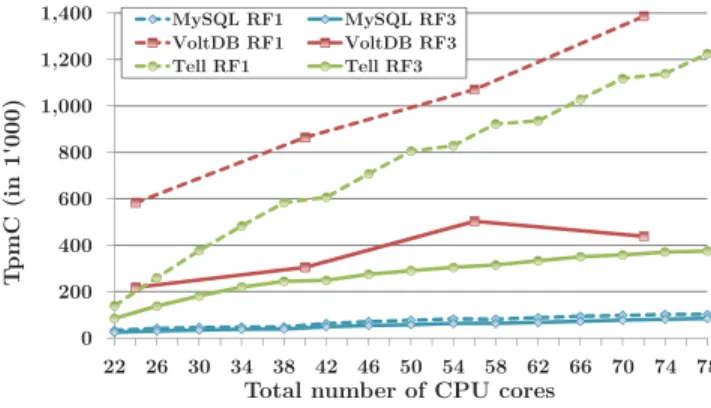
0 200 400 600 800 1,000 1,200 1,400 22 26 30 34 38 42 46 50 54 58 62 66 70 74 78 T p mC (in 1'000)
Total number of CPU cores MySQL RF1 MySQL RF3
VoltDB RF1 VoltDB RF3 Tell RF1 Tell RF3
Figure 9: Throughput (TPC-C shardable)
Cluster 7.3.2 and uses the InfiniBand network as well. The benchmark is executed with 3, 6, and 9 DNs. We vary the number of SQL nodes and use two MNs. Terminals use pre-pared statements to execute transactions against the SUT.
With regard to partitioned databases, the data model and the workload require careful consideration. The TPC-C data model is ideal for sharding. Most tables reference the warehouse id that is the obvious partitioning key. The read-only item table can be fully replicated across all parti-tions. The TPC-C workload is more problematic. According to the TPC-C specification [57], remote new-order (clause 2.4.1.8) and remote payment (clause 2.5.1.6) transactions access data from several warehouses and therefore require cross-partition transactions. In the TPC-C standard mix, the ratio of cross-partition transactions is about 11.25%.
Figure 8 compares VoltDB and MySQL Cluster to Tell. The figure presents the peak TpmC values for the TPC-C standard mix with RF3 on a varying number of CPU cores (i.e., the sum of all cores available to the database cluster). Each data point corresponds to the configuration with the highest throughput for the given number of cores. For in-stance, a minimal VoltDB cluster consists of 3 nodes (24 cores). The minimal Tell configuration with 22 cores consists of 1 PN (4 cores), 3 SNs (12 cores), 2 commit managers (4 cores), and 1 MN (2 cores). In comparison to Tell, VoltDB and MySQL Cluster do not scale with the number of cores. While Tell reaches a throughput of 374,894 TpmC with 78 cores, MySQL Cluster and VoltDB achieve 83,524 and 23,183 TpmC respectively. The scalability of the partitioned databases is presumably limited by distributed transactions that require coordination across nodes. In particular, VoltDB suffers from cross-partition transactions as throughput decreases the more nodes are added. This observation is emphasized by VoltDB’s high latency (Table 4). MySQL Cluster is slightly faster than VoltDB because single-partition trans-actions are not blocked by distributed transtrans-actions. The experiment highlights that the techniques presented in this work efficiently interact. Moreover, the shared-data archi-tecture enables much higher performance than partitioned databases for OLTP workloads that are not fully shardable. In a second experiment, we evaluate Tell given a work-load that is optimized for partitioned databases. To that end, we modify the TPC-C benchmark and remove all cross-partition transactions. This alternative workload, called
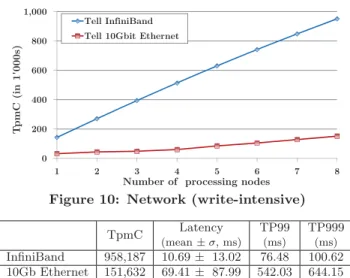
TPC-C shardable, replaces remote new-order and payment transactions with equivalent ones that only access one WH. Figure 9 compares Tell to VoltDB and MySQL Cluster using the TPC-C shardable with RF1 and RF3. Again, we