Observations Along a South Texas Fence Line
q
Stephen S. Burkhart, M.D.
Abstract: Suture anchors are being increasingly reported as a means offixation of torn rotator cuff tendons to bone. The author has developed a mechanical model for the suture anchorerotator cuff construct based on an analogy to the deadman system used to stabilize a corner fence post. Using this model, one can demonstrate a mechanically favorable angle of insertion of the suture anchor (
q
1) such that the anchor’s pullout strength is increased at low angles ofq
1. Inaddition, the angle that the suture makes with the direction of pull of the rotator cuff (
q
2) has a direct effect on tension inthe suture. A low angle of
q
2minimizes the total tension in the suture, thereby minimizing the chance of suture breakage.F
orm follows function. As physicians and scientists, we accept this immutable tenet of nature. However, some of nature’s important functions can be difficult to recognize if the form is well disguised. Allow me to explain the lessons I have learned about suture anchors by studying a South Texas fence line.The Deadman Analogy
Suture anchors have been reported as a means of
fixation of torn rotator cuff tendons to bone.1-3Tensile loading of a buried suture anchor by the rotator cuff through an intercalated suture creates a complex system of forces that can be configured in a variety of ways, each with different mechanical consequences. To my knowledge, the mechanical consequences of these
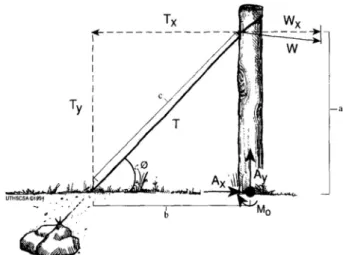
con-figurations have not been rigorously investigated. I recognized the analogy of a suture anchor to a deadman as I was watching a new barbed wire fence being constructed on a South Texas ranch. At the corner fence post, the fence crew placed a deadman, which is a large buried rock attached by means of a twisted wire to the top of the corner fence post (Fig 1). The function of
the deadman is to counteract the pull of the fence wire and thus prevent the corner post from leaning.
The analogy of the deadman system to the suture an-chor system then becomes obvious. The deadman is analogous to the suture anchor, the deadman wire is analogous to the suture, and the pull of the fence wire on the corner post is analogous to the pull of the rotator cuff. The fence post is represented by the compressed rotator cuff tissue between the suture and the bone (Fig 2).
Fig 1. Representation of the anchoring effect of a corner fence post by adeadman. The deadman is a large rock buried under the ground and attached to the fence post by means of a wire at an angleqto the ground. (T, tension in deadman wire; W, pull of fence wire; Axand Ay, ground reaction forces; Mo, ground reaction moment; Tx, component of tension in x direction; Ty, component of tension in y direction; Wx, pull of fence wire in x direction). (Courtesy of the University of Texas Health Science Center at San Antonio.)
From the Department of Orthopaedic Surgery, the University of Texas Health Science Center at San Antonio, Texas, U.S.A.
DOI of original article:http://dx.doi.org/10.1016/0749-8063(95)90100-0.
qThis article is a reprint of a previously published article. For citation
pur-poses, please use the original publication details:Arthroscopy1995;11:119-123 Address correspondence to Stephen S. Burkhart, M.D., The San Antonio Orthopaedic Group, 150 E. Sonterra Blvd, Suite 300, San Antonio, TX 78258, U.S.A. E-mail:[email protected]
Ó2014 by the Arthroscopy Association of North America 0749-8063/1141/$36.00
http://dx.doi.org/10.1016/j.arthro.2014.06.001
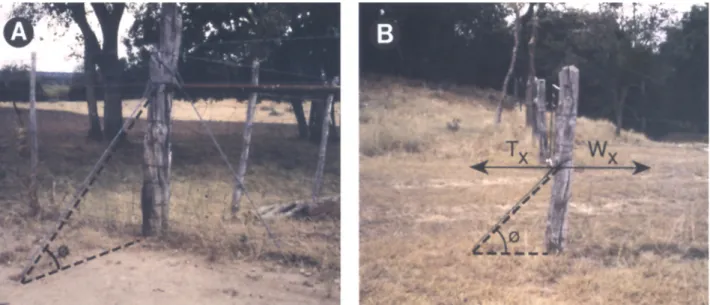
South Texas ranchers have an “ideal angle” (
q
) for the deadman.4They try to place the deadman so thatq
(the angle that the deadman wire makes with the ground) is less than or equal to 45 (Fig 3A). They have found that if they place the deadman too close to the post so thatq
is greater than 45, the post tends to gradually lean away from the deadman untilq
is reduced to 45 and equilibrium is reached (Fig 3B).If we look at the free body diagram (Fig 4), we can understand why the fence post leans. The only force in the X-direction resisting the pull of the wire (Wx) is the
X-component of the tension in the deadman wire (Tx). The
post will lean until it reaches equilibrium so that Tx¼Wx.
One can intuitively see that Txincreases as
q
decreases.The relationship between Tx and
q
can morerigor-ously be shown by formulating the three equilibrium equations for this system (Figs 1 and 4):
Fig 2.Analogy of the deadman system to the suture anchore rotator cuff system. The deadman is analogous to the suture anchor; the deadman wire is analogous to the suture; the pull of the fence wire on the corner post is analogous to the pull of the rotator cuff; and the fence post is analogous to the com-pressed rotator cuff tissue between the suture and the bone. (Courtesy of the University of Texas Health Science Center at San Antonio.)
Fig 3. (A) The deadman wire makes an angleqwith the ground. The ranchers’ideal angle is less than or equal to 45. This corner post has two deadman systems at right angles to each other. (B) The deadman for this corner post was placed too close to the post, so thatqwas greater than 45. The post leaned away from the deadman untilqwas reduced to approximately 45. At that point, the system had reached equilibrium, with Txequal to Wx.
Fig 4. Free body diagram of the deadman system. The only force resisting the pull of the wire (Wx) is the X component of tension in the deadman wire (Tx). (Courtesy of the University of Texas Health Science Center at San Antonio.)
SFx ¼ WxþAxTx ¼ 0
SFy ¼ AyWyTy ¼ 0
SM ¼ WxaTxaþM0 ¼ 0
By substituting the additional relationships a ¼ csin
q
b ¼ ccos
q
Tx ¼ Tcosq
Ty ¼ Tsin
q
one establishes the important relationship T cos
q
¼ constant.Because
q
is inversely proportional to cosq
, T de-creases asq
decreases, and Txincreases asq
decreases.The Suture Anchor Construct
This model shows two important mechanical re-lationships in the suture anchor construct. First of all,
because T cos
q
¼constant, tension in the suture is less at lower angles ofq
. Ideally, to minimize tension in the suture, thereby minimizing the chance of suture breakage, we should not place the anchor directlythe suture to balance the pull of the rotator cuff (Wx). The system will attempt to reach equilibrium by having the rotator cuff pull away from the anchor to develop a Txto balance Wx. This can cause failure of the repair as well as very high tension in the suture at high angles ofq. (B) Optimal su-ture orientation at 45 or less. This configuration“builds in”a Tx to balance Wx. (Courtesy of the University of Texas Health Sci-ence Center at San Antonio.)
Fig 6.Pullout strength of a suture anchor increases asq de-creases. That is, a suture anchor is more difficult to pull out at a low angle ofq(6A) than at a high angle ofq(6B). (Courtesy of the University of Texas Health Science Center at San Antonio.)
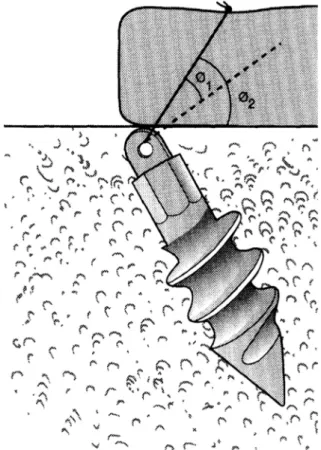
Fig 7. Representation ofq1and q2.q1, the pullout angle for the anchor (angle the suture makes with the perpendicular to the anchor);q2, the tension-reduction angle (angle the suture makes with the direction of pull of the rotator cuff). Ideally,q1 andq2should both be less than or equal to 45. (Courtesy of the University of Texas Health Science Center at San Antonio.)
under the cuff but at the lateral edge of it, and we should place the suture obliquely into the rotator cuff tendon to minimize
q
(Fig 5).Secondly, pullout strength of a suture anchor in-creases as
q
decreases (Fig 6). One can calculate that there is 41% more resistance to pullout atq
¼45than atq
¼ 90.5 This is one other reason to try to minimizeq
.The Obliquely Placed Suture Anchor
One can infer from the above discussion that it is mechanically advantageous to place the suture anchor oblique into bone. However, if this is done, then there are two ideal angles of interest (Fig 7):
q
1¼the pull-out angle for the anchor, which is theangle the suture makes with the perpendicular to the anchor; and
q
2¼the tension-reduction angle, which is the anglethat the suture makes with the direction of pull of the rotator cuff.
Ideally, both
q
1andq
2should be less than or equal to45, the ideal angle that the ranchers strive for on their deadman wires.
Avoiding Predestined Failure
An ideally placed suture anchor will have an obliquely-placed suture that develops a tension (Tx) to
balance the pull of the rotator cuff (Wx) (Fig 5B).
However, rotator cuff tears are frequently repaired directly over the top of a bone trough with a vertical suture (Fig 8A). This is a dysequilibrium situation because there is no Txto balance Wx(Fig 8B). The only
way that this system can reach equilibrium is for the cuff to pull away from its bed, thereby decreasing
q
until there is a Tx adequate to counteract Wx. This isexactly analogous to the fence post leaning until it reaches its“ideal angle”.
It is interesting and instructive to look at the balance of forces in a standard rotator cuff repair through bone tunnels. Because the tunnels are always positioned obliquely across the greater tuberosity, there is always a significant Txin this configuration to balance Wx, thus Fig 8. (A) If a vertically placed suture is used to repair the rotator cuff, there is no Txto balance Wx. (B) The vertical suture confi gura-tion can only reach equilibrium if the repaired rotator cuff pulls away from its bed, decreasing q until Txis adequate to balance Wx. (Courtesy of the University of Texas Health Science Center at San Antonio.)
Fig 9. Rotator cuff repair through bone tunnels. The obliquity of the tunnels ensures a significant Tx to balance Wx. (Courtesy of the University of Texas Health Science Center at San Antonio.)
fi x
Tx¼T cos
q
, the total tension T in the suture increasesas
q
increases. Asq
approaches 90 (the vertically-placed suture), one must bear in mind that cos 90¼0, so that T in this case would be infinite. It is important to appreciate that asq
approaches 90, the tension in the suture rises dramatically, and the chance of suture breakage is much greater than at low angles ofq
.Conclusions
Attention to minimizing the angle of insertion of the suture anchor (
q
1), as well as the angle that the suturemakes with the rotator cuff (
q
2) can increase thepull-out strength of the anchor and reduce the tension in the suture, thereby minimizing the chance of suture breakage. The deadman theory of suture anchors ex-plains how to maximize the mechanical stability of the
References
1. Bartlett EC. Arthroscopic rotator cuff repair. Presented at the Arthroscopy Association of North America, Fall Course, Albuquerque, NM, October 7, 1993.
2. Bachner EJ, Snyder SJ. Arthroscopicfixation of the torn rotator cuff tendon using suture anchors and permanent mattress sutures: A preliminary report. Presented at the Arthroscopy Association of North America, 1994 Speciality Day Meeting, New Orleans, LA, February 27, 1994. 3. Tippett JW. Arthroscopic repair of the rotator cuff using
plastic suture anchors. Presented at the Arthroscopy As-sociation of North America, 1994 Specialty Day Meeting, New Orleans, LA, February 27, 1994.
4. Faris ME. Personal communication, January 1993. 5. Burkhart SS. The deadman theory of suture anchors.
Pre-sented at Update 1994: New Perspectives in Arthroscopy and Sports Medicine, Palm Springs, CA, March 16-19, 1994.