Task 160.10.60 Alternative Goods Movement Technology
Analysis, Draft Working Paper, Review of Alternative
Zero-Emission Container Transport Technologies
(without Appendices)
A
LTERNATIVE
G
OODS
M
OVEMENT
T
ECHNOLOGY
A
NALYSIS
F
INAL
W
ORKING
P
APER
R
EVIEW OF
A
LTERNATIVE
Z
ERO
-E
MISSION
C
ONTAINER
T
RANSPORT
T
ECHNOLOGIES
Prepared for
Los Angeles County
Metropolitan Transportation Authority October 31, 2008
2020 East First Street, Suite 400 Santa Ana, California 92705
T
ABLE OFC
ONTENTSS
ECTIONP
AGE1.0
INTRODUCTION... 4
1.1
Preliminary Assessment ... 7
1.2
Technical Inquiry... 8
2.0
PRELIMINARY ASSESSMENT... 8
2.1
Methodology ... 8
2.2
Preliminary Findings ... 10
3.0
TECHNICAL INQUIRY ... 13
3.1
Methodology ... 13
3.2
Findings ... 14
3.2.1 Proponent Responses...14 3.2.2 Tabulated Summary ...513.2.3 Cost Estimate Comparison...52
4.0
COMBINED COMMERCIAL AND TECHNICAL INQUIRY... 59
4.1
Methodology ... 59
4.2
Findings ... 59
1.0
INTRODUCTION
This paper summarizes a review of alternative, ‘zero-emission’ transportation technologies that may be considered for application to the transport of marine cargo containers in the I-710 Corridor.
Earlier this year, URS Corporation (URS), under subcontract to Cambridge Systematics, Inc., completed for the Ports of Los Angeles and Long Beach an assessment of alternative technologies for transporting marine cargo containers within the ports, and between the ports and a near-dock intermodal facility less than 5 miles away. The Proponents and their systems identified for potential application to this short-haul scenario represent the same field of potential technologies to be considered for application to the longer-haul truck cargo diversion scenario being considered in the I-710 Corridor Project EIR/EIS.
The objective of the Alternative Goods Movement Technology Analysis, Task 160.10.60 of the I-710 Corridor Project EIR/EIS scope of work, is to define a general, hypothetical alternative technology that may be reviewed as a surrogate for any of the several specific candidate technologies. The definition of the technology for this purpose draws directly on the Zero-Emissions / Electric Container Mover System Study, performed for the Ports of Los Angeles and Long Beach. The study area for potential new technology application showing preliminary alignment alternatives is shown in Figure 1.
This study identified the broadest possible range of alternative technologies and Proponents for potential application to the near-dock intermodal market, or for circulation of containers with the port(s). The information used to characterize each technology was obtained directly from the Proponents, either via telephone or via written responses. On the basis of this information, the consultant team evaluated the responsiveness of each technology to the market scenario, and the commercial readiness of each Proponent to deploy their technology in a revenue service demonstration. The evaluations reflected:
a.) The responsiveness of each Proponent to both the technical and commercial queries (i.e. Did the Proponent provide complete and knowledgeable answers?), b.) The assessed responsiveness of each proposed technology to the scenario (i.e.
c.) The assessed commercial capability of each Proponent to develop, deliver and assure their proposed solution (i.e. is this a viable commercial entity with a viable business plan?).
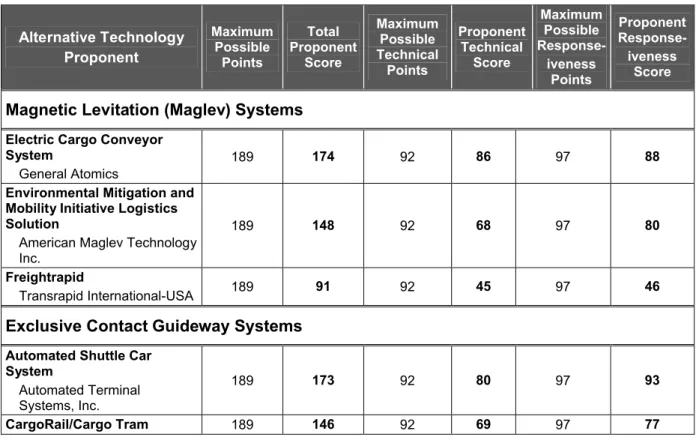
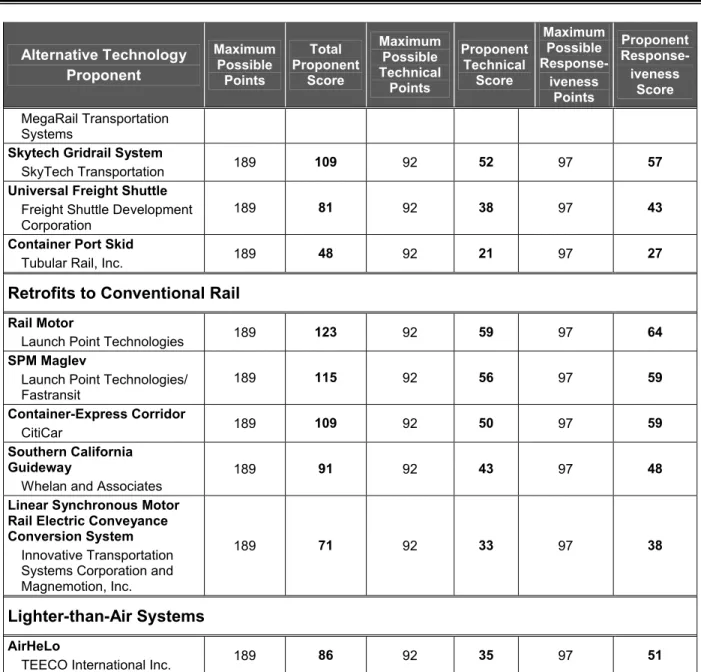
The findings of the study include aggregated numerical scores for a range of criteria, each scored on a fixed scale. While these aggregated scores result in an apparent ranking of technologies and Proponents, they are not weighted to reflect actual priorities and needs of a potential operating agency, nor do they indicate how these Proponents could respond to an actual opportunity to deliver an operating system.
The study does enable the categorization of the technologies into four general families, and scales the assessed readiness of the Proponents within each of those families to respond to a deployment opportunity.
Finally, the technical information obtained about these families of technologies provides input to the definition of the generalized alternative technology surrogate to be evaluated in the I-710 Corridor Project EIR/EIS.
The review of alternative technologies was accomplished in two steps:
A Preliminary Assessment was prepared on the basis on telephone interviews with individual technology Proponents and their responses to a set of standard questions. The Preliminary Assessment reviewed the business capabilities of the Proponents and the general feasibility of their technology concepts as applied to the near-dock container transport market. (Preliminary Assessment of Alternative Technologies and Proponents – September 4, 2007).
A subsequent Technical Inquiry elicited the written responses of individual Proponents to a set of rudimentary standard performance requirements based upon two hypothetical service scenarios. (Technical Assessment of Alternative Technologies and Proponents – December 14, 2007)
Both components of the overall assessment are therefore based on information provided by the technology Proponents themselves. The technical inquiry gave Proponents an opportunity to refine the information they had provided previously, and resulted in some changes in the technical comparison of the technologies.
This document presents the findings of the two steps as an integrated report, illustrating the sequential development of the assessment.
1.1
P
RELIMINARYA
SSESSMENTThe Preliminary Assessment identified viable, interested Proponents that could be considered for demonstration and deployment of an alternative zero emission container transport system. Fourteen (14) Proponents of alternative technologies were identified by the ports and the consulting team, or identified themselves directly to the consultant team. The technologies represented are all in the research and development stage, with no version of the technology currently operating in a practical application. Figure 2 is a listing of the candidate technologies and their Proponents, with a short description of each technology.
Figure 2
Original Field of Alternative Technologies and Proponents
Name of Technology / Proponent Summary Description of Technology Aeroscraft
Worldwide Aeros Corporation Manned blimp that could eventually be operated by remote control
AirHeLo
TEECO International, Inc. Lighter-than-air airship
Automated Shuttle Car System
Automated Terminal Systems, Inc.
Electric shuttle – electrically driven motorized platforms
CargoRail/Cargo Tram
MegaRail Transportation Systems
Manual transport of trucks and containers in a train consist on an elevated guideway or in the street
Container Port Skid
Tubular Rail Electric power roller system
Container-Express Corridor
CitiCar Automated at-grade system partially using existing rail within the Port
Electric Cargo Conveyor System
General Atomics
Permanent magnet, large-air-gap levitation, linear synchronous motor propulsion
Environmental Mitigation and Mobility Initiative Logistics Solution
American Maglev Technology
Magnetic levitation system – using automated driverless vehicles
Freightrapid
Transrapid International-USA Magnetic levitation with synchronous longstator linear motor propulsion
LIM-Rail and MagRailtm
Innovative Transportation Systems Corporation
LIM-Rail: Automated rail electrification system using linear induction motor
MagRail: Automated magnetic levitation system above existing rail
Rail Motor and SPM Maglev
Launch Point Technologies
Rail Motor: Electric propulsion of conventional locomotives
SPM Maglev: Retrofitting of permanent magnets and linear synchronous motors in existing railbed.
Skytech Gridrail System
SkyTech Transportation Linear induction motor with electric transport above and below rails
Southern California Guideway
Whelan and Associates Linear induction motor with electric transport in an elevated guideway
grade-Name of Technology / Proponent Summary Description of Technology
Freight Shuttle Development Corporation separated, elevated guideway system
1.2
T
ECHNICALI
NQUIRYIn the subsequent Technical Inquiry, Proponents were invited to respond to two hypothetical service scenarios, and to provide physical, operating, and estimated cost characteristics of their systems’ applications. The responses to this inquiry enabled a more detailed assessment of each technology’s technical attributes, and of the stated capabilities of their Proponents.
Of the originally identified Proponents, Worldwide Aeros Corporation, developer of the Aeroscraft lighter-than-air technology did not respond to the Technical Inquiry, so the assessment considered the technologies proposed by thirteen of the fourteen originally identified Proponents.
The findings of the Technical Inquiry were presented in a separate draft report, combined herein with the preceding Preliminary Assessment in a summary of the entire process.
2.0
PRELIMINARY ASSESSMENT
2.1
M
ETHODOLOGYThe technologies and proponents included in the original list were (a) identified by the ports of Los Angeles and Long Beach, (b) obtained through independent consultant research and (c) identified directly by proponents themselves.
The descriptions of these technologies and of their proponents were derived from the information provided to the ports by the proponents, websites of the proponents, information provided to the consultant team by the proponents, and telephone interviews with the proponents.
Questions were asked of each proponent during the telephone interview to assist in filling out a Survey of Alternative Technologies and Proponents (Appendix A). In most instances the interview questions were the same for each proponent, to elicit their descriptions of such attributes as:
The form and capabilities of the proponent company;
The overall technology being proposed;
The technologies and their proponents were described in a matrix that captures general information, firm capabilities and features of each technology.
The preliminary evaluation matrix was developed to assess in general terms the proponents’ (business) capabilities and the maturity of their technologies. Commercial evaluation criteria included such items as:
Whether the proponent has developed a marine container transport system that could reach an application demonstration stage within 5 years,
Whether the proponent has built a working proof of concept for a part of its proposed technology;
Whether the proponent has identified committed strategic or development partners for the proposed technology;
Whether the proponent has developed other commercial transportation products,
Whether the proponent has a business plan for commercialization of the technology that could be used to finance the technology and the proponent, and
Whether the proponent could produce financial statements.
Most of the proponents indicated that business plans and financial statements were proprietary. Thus, these criteria were evaluated based on a verbal reassurance that the proponent had a business plan and financial statements, if applicable to their business model.
The assessment also included a high-level look at each of the technologies as identified below.
Whether the proponent is considering the use of commercially proven systems or components in the technology, or is using proprietary technology.
Whether the proponent defined a guideway for the technology.
Whether the proponent defined a propulsion system to move the vehicles within the system.
Whether the proponent defined a system for command and control that would ensure that the vehicles know where they are in the system at all times, maintain a safe distance between vehicles to avoid collisions, ensure the vehicles go to the correct location at a terminal, rail yard or a rail yard located outside port property, and ensure
that if an automated system is proposed there is communication between the vehicle, wayside signals and a communication center; protection between vehicles and the vehicles are dispatched to the correct destination.
Whether the proponent defined a system for loading and unloading of the vehicles at various points in the system such as shipside, terminals, sorting yards and rail facilities, and where the technology would start.
Whether the proponent defined a design for vehicles and if an automated vehicle is proposed what system is located on the vehicle to ensure its location is known when traveling in the system.
Whether the proponent defined a physical system for switching with the ability to change from one guideway to another, to collect and distribute vehicles, to assist in system recovery, ability to move off the guideway to a location such as a terminal and to move back on the guideway in order to deliver the container to the end destination.
Whether the proponent defined a physical system and algorithm for sorting and storage of the containers that would ensure the containers are moved to correct locations whether it is a storage facility, a terminal or a rail facility, and if multiple containers are transported on a vehicle how the multiple containers get to correct locations.
Whether the proponent defined an operating plan for the technology with such things as operating rules and protocol, number of vehicles, staffing requirements and terminals served.
Whether the technology is a zero based emissions technology.
Each of technologies was evaluated for each of the technical criteria (guideway through sorting and storage) on the basis of whether the technology being proposed is (a) based on a conceptual idea or (b) based on a conceptual design, an existing design, an existing component and/or an existing system.
2.2
P
RELIMINARYF
INDINGS The 14 proponents represent independent systems that apply alternative technologies to transport containers from either a ship or a terminal to locations that could be on or off port property.
One of the proponents, TransRapid International, stated that they were not pursuing adaptation of their magnetic levitation (maglev) passenger technology for container freight transport.
Two proponents, Alternative Hybrid Locomotive Technologies (proposing a locomotive operated on ethanol and batteries) and KACI Intermodal Systems
(proposing diesel locomotives to move containers), were both eliminated from the evaluation process because they did not satisfy the qualifying criterion of zero emissions and therefore are not among the 14 proponents identified.
Automated Terminal Systems (ATS), proponent of the Automated Shuttle Car Systemtechnology has stated that they are proposing to a private developer to build a system for the Port of Taranto, in southern Italy. This project will be privately financed, using a 90-year land lease concession from the Italian government. ATS has a letter of intent from the private developer and anticipated this intent will be converted to a supply contract by the end of September 2007. ATS intends to start demonstrating the equipment in early 2008. The current team for ATS includes (1) Ederer - fabrication and supply of equipment, (2) Halcrow - planning, detailed design and project management and (3) ATS - supply of the technology (ATS is responsible for the design of the shuttle cars, ancillary equipment and system configuration (software), the operating system and overall system integrator).
Proponents of at least three other technologies identified strategic or development partners.
The development team for MegaRail and its CargoRail technology includes MegaRail (system design and integration and prime contractor), Clark Precision Machines and Metals (vehicle production, guideway production and ramp and station production), Micrin Company (electronics production, electrical harness production and sheet metal fabrication) and Austin Bridge and Road (site engineering design, on-site guideway assembly and pier and guideway installation).
The development team for General Atomics and its Electric Cargo Conveyor System technology includes General Atomics (prime contractor and maglev systems), California State University – Long Beach (system architecture), Mackin Engineering (civil engineering), Hall Industries (chassis), Lawrence Livermore National Lab (magnetics analysis) and Union Switch & Signal (communications and signaling).
The development team for American Maglev Technology and its Environmental Mitigation and Mobility Initiative technology includes American Maglev Technology (developer and manufacturer of the maglev technology), Calyon Bank (for the debt portion of the project finance plan), and Jervis B. Webb Company (custom automatic guided vehicle to transfer containers between truck beds and maglev chassis).
Among the principal findings, the interviews indicated that while most Proponents did not have operating plans tailored to a specific port application, they did have a clear intent for how their system would operate within a port or container line-haul setting.
During the interview process, each Proponent was questioned on the steps to build an operating application demonstration of the technology, and how long that would take. All of the Proponents interviewed indicated that building and testing of an application demonstration could be accomplished in 5 years or less even though many Proponents did not identify strategic or development partners.
All of the Proponents contacted are interested in participating in industry outreach to learn more about the goals and requirements of the ports of Los Angeles and Long Beach.
Based on the responses to date, the technologies identified may be characterized by four general categories. These four categories are:
Magnetic Levitation (Maglev) Systems
Electric Cargo Conveyor System – General Atomics
Environmental Mitigation and Mobility Initiative Logistics Solution – American Maglev Technology
Freightrapid – Transrapid International-USA
Exclusive Contact Guideway Systems
Automated Shuttle Car System – Automated Terminal Systems, Inc.
CargoRail/Cargo Tram – MegaRail Transportation Systems
Container Port Skid – Tubular Rail
Skytech Gridrail System – SkyTech Transportation
Universal Freight Shuttle – Freight Shuttle Development Corporation
Retrofits to Conventional Rail
Rail Motor and SPM Maglev – Launch Point Technologies
Southern California Guideway – Whelan and Associates
Lighter-than-Air
Aeroscraft – Worldwide Aeros Corporation
AirHeLo – TEECO International Inc.
Detailed information regarding each alternative technology and Proponent is presented in Appendix A.
3.0
TECHNICAL INQUIRY
3.1
M
ETHODOLOGYIn the Task 1 Update of September 4, 2007, a preliminary assessment was made of the fourteen candidate technologies. Among the findings of the preliminary assessment was a ranking of technologies and Proponents based on their aggregate technical and commercial responses, collected via telephone interviews.
To assess technical capabilities further, a list of technical questions (Appendix B) was developed and sent by email to all fourteen Proponents. These questions were based on two hypothetical service scenarios, defined to establish a common understanding and enable comparison. Follow up calls were made to ensure receipt of the information.
The marine termini defined for the hypothetical service scenarios were Berths 224 through 226 and Berth 301. They were selected because they serve several marine terminals, they are near land that could accommodate construction of the alternative technology and the siting of a transfer station in the marine terminal back lots should not impede current operations.
Proponents were asked to provide their responses to the hypothetical service requirements, including alignments to two hypothetical sites, in addition to schedule, guideway, propulsion, command and control, loading and unloading interfaces, switching, sorting and storage, operations plans, start up and test, permits/approvals/code compliance, construction management and costs.
A throughput requirement of 1,500 containers in an eight hour period was established based upon an 8,000 TEU ship, four cranes to offload, typical crane productivity and an estimate of intermodal lifts from one ship at berth. This estimate was provided to each Proponent.
A team of URS technical experts evaluated and scored the Proponents’ responses in terms of technical feasibility and responsiveness (whether the Proponent provided the information to allow for a technical evaluation). To assist the evaluators, a “perfect score” was defined to identify the total number of points assigned to each question in terms of technical feasibility and responsiveness.
3.2
F
INDINGS3.2.1
Proponent Responses
Of the fourteen originally identified Proponents, thirteen responded to the technical inquiry. Worldwide Aeros Corporation, Proponent of the Aeroscraft technology did not respond to the technical inquiry. In addition, Innovative Transportation Systems Corporation proposed Lim-Rail only with Magnemotion; while, LaunchPoint Technologies proposed two different alternative technologies (SPM Maglev and Rail Motor), so a total of fourteen alternative technologies were assessed.
Some of the names of the alternative technologies and companies changed slightly from the preliminary assessment.
The evaluations of the fourteen alternative technologies are summarized in the following profiles.
AirHeLo
TEECO International, Inc.
AirHeLo would use a fleet of lighter-than-air airships to move transfer containers from ships to transshipment points; however the Proponent did not describe how the containers would be transferred from ships to airships.
Integration– No description of the integration of the various system elements (i.e., the air ships, power control, container loadingunloading mechanisms, etc.).
Schedule – The basic use of airships is an established technology; the adaptations necessary for this application could be developed within 5 years. However, the schedule is missing information such as proof of concept, steps leading to a working prototype, and working with the Federal Aviation Administration.
Alignment Hypothetical Sites – An air route between Berths 224 through 226 and the SCIG is feasible in principal, subject to Federal Aviation Administration approval. This
would require coordination with other commercial and general aviation traffic. However, the feasibility of storage of airships on the water when not in operation would have to be tested and proven or airships would have to be stored on-site (taking up additional port property) or at off-site land-based areas.
Guideway – Not applicable for airship operations.
Propulsion – In principle the propulsion system is a valid response to the zero emissions requirement. However would have to be proven for this application and power requirements.
Command and Control – The command and control system is feasible based on the assumption that the Proponent can obtain certification for a Federal Aviation Administration-approved air cargo operation for a manned airship whose landings and lift-off operations are monitored by an air traffic control tower. But if the Proponent is proposing a remote-controlled operation, this is not a currently Federal Aviation Administration-authorized airship operation.
Loading and Unloading – No description of the proposed operations or equipment for loading and unloading containers. Loading containers to and from an airship is not the “same as the existing cranes.” The Proponent may well be able to come up with a feasible system, but no description is provided with this submittal to substantiate feasibility.
Vehicles – A fleet of one to five airships was proposed for the fleet which more than likely would be insufficient to provide the throughput of containers required. In addition, while the propulsion system is a valid response to a zero emissions requirement, the system would need to be proven for an application of carrying cargo containers, given the power requirements and duty cycle.
Switching – Not applicable for airship operations.
Sorting and Storage – Insufficient description of what the sorting and storage system consists of to assess its feasibility.
Operating Plan– Insufficient information provided to support a realistic Operating Plan.
Start Up and Test– No information provided about the nature of the system startup or testing.
Permits, Approvals and Code Compliance – Federal Aviation Administration certification of an air cargo operation may be possible, but Proponent’s description of their approach to certification is insufficient. In addition, a community relations program is not supported by the information provided.
Construction Management – Most components of the proposed technology have a proven history; however no mention of a quality control program or who will monitor construction.
Automated Shuttle Car System
Automated Terminal Systems, Inc.
Automated Shuttle Car System is proposed as a fully automated cargo container system for transporting cargo containers between marine/rail and other terminals, including a fully automated container yard.
Integration – The Proponent does not explain how all of the various system elements will be integrated into one alternative technology since no prototype is in service. The Proponent has identified a proven control system.
Schedule – The schedule shows approximately 4 years to start service; however the durations for some of the activities such as property acquisition/condemnation prototype testing, and testing and commissioning appear to be optimistic.
Alignment Hypothetical Sites
Alignment Feasibility
The horizontal alignment curve radii appear feasible.
The alignment is primarily along existing rail alignments; with the corridor width requirements this appears feasible.
The dual track elevated trackway is approximately 44 feet wide while the at-grade dual trackway is approximately 50 feet wide except where power substations are provided (1 substation per ½ mile).
It is not clear if the alignment would use the existing Henry Ford Avenue bridge crossing or if there is a need to construct a new bridge crossing.
Right-of-Way
The guideway alignment/separate right-of-way corridor appears to primarily stay within or adjacent to Port owned rail right-of-ways. Although conflicts with existing rail lines and utilities are expected the right-of-way requirements conceptually appear feasible.
Footprint and Space
General footprint and space requirements are feasible at this stage of project development.
A potential issue is storage yards; although Terminal areas are large and can therefore accommodate large storage yards, communication facility and a maintenance facility, there is insufficient information on the space/footprint requirements of the proposed yard.
Guideway
Feasibility
Based upon a high level evaluation of the guideway alignment and cross-sections, the guideway appears feasible. There is a potential for the electric busbar (shown in cross-section parallel with and between tracks) to conflict with cross-traffic at grade crossings.
No information is given on the elevated guideway span lengths nor concrete column supports type, size, spacing, location, etc.
Configuration
The Terminal configuration shown in the schematic appears feasible.
Automated Shuttle Cars and traditional trucks are on opposite sides of the Terminal. The rail mounted gantry cranes extend to both sides of the Terminal enabling them to load/unload both the automated shuttle cars and/or trucks as needed.
The Terminal also consists of an Inspection Facility, Command Control Room, and Maintenance Facility, which are all located such that they do not interfere with the loading/unloading operations.
Propulsion – The propulsion system is feasible although no prototype is in service; it uses current passenger propulsion systems.
Command and Control – The command and control system is feasible from a conceptual standpoint although no prototype is in service. The Command and Control systems would use currently available positive train control technology.
Loading and Unloading – The Proponent proposes to use existing technology (trucks) to move cargo containers from the terminal to the system, then place the containers under load and unload stations that can move to load the containers.
Vehicles –The vehicle proposed appears to be able to accommodate cargo containers of various sizes, with the ability to secure containers.
Switching– The switch system as a stand-alone rail system is feasible.
Sorting and Storage – Containers are to be sorted into a long-haul shuttle car system or the yard depending on information associated with the container.
Operating Plan – Proponent has provided a reasonable operation plan for the technology at this stage of development.
Start Up and Test – The program appears to be feasible; however a test period of 48 consecutive hours without fault appears to be too short a timeframe.
Permits, Approvals and Code Compliance– Limited information on permits, approval and codes to determine if the Proponent understands the process. In addition, the response indicates a robust community relations program.
Construction Management – The designers of the system will manage/monitor the construction contractors. The quality control mentioned is brief but leads one to assume a good understanding of a quality control program.
CargoRail/Cargo Tram
MegaRail Transportation Systems
CargoRail/Cargo Tram is proposed as a coupled dual-mode conveyance that could operate in port and railroad intermodal areas on existing paved surfaces.
Integration– The response does not explain how all of the various system elements will be integrated into one alternative technology.
Schedule – The schedule appears to have all of the elements for a project but 30 months from preliminary design to demonstration could be optimistic.
Alignment Hypothetical Sites
Alignment Feasibility
Feasibility of alignment is highly dependent on Caltrans approval of use of their right-of-way. Caltrans will likely object to any structures built within their right-of-way, specifically structures that are built adjacent and/or directly over their roadway facilities.
In addition, the alignment is along existing State Route 47/103 where there does not appear to be adequate space within the median and/or along shoulders for placement of column supports.
Although not likely, if Caltrans does approve a project, extensive coordination and interaction will be necessary, resulting in extended schedules and escalated costs
Because Caltrans will likely not approve development within their right-of-way, proposed alignment is likely not feasible.
Right-of-Way
Proponent acknowledges that utility relocation will be unknown until a site survey is undertaken. This is a reasonable assumption.
Footprint and Space
General footprint and space requirements are feasible at this stage of project development. Some potential issues are:
Communication facility – Although space requirements for a small system control building is most likely minimal, insufficient information provided by Proponent on space requirements.
Maintenance facility – Although the Terminal areas are relatively large and capable of accommodating a maintenance facility, insufficient information on space/footprint requirements is provided by the Proponent.
Guideway
Feasibility
Insufficient information provided by the Proponent on the guideway.
The information provided does not demonstrate the structural ability of the guideway to support the required loads.
No thickness dimensions are given for the surface track on which vehicle tires rest/ are supported. Surface track/beams that support vehicle appear inadequate for required span lengths and loads.
Piers also appear incapable of supporting required loads. Piers would need to have a maximum spacing of 40 feet to support the loads. Each pier is specified to support a maximum load of 94k lbs (thus one container per pier and one container per span).
It is unclear how the Proponent proposes to carry three to five container cars (as specified) across spans greater than 40 feet such as the span required across the Cerritos Channel.
Proponent specifies stainless steel columns to sit over tapered spud concrete base with no bolting required, this does not appear structurally sound.
Cross-arm (bolted on) appears incapable of supporting asymmetrical loads (e.g., vehicles traveling around turns, containers loaded on one side only), also the guideway does not appear to have any means of resisting overturning forces applied to vehicles traveling along horizontal curves.
Configuration
Insufficient information provided by the Proponent.
Propulsion – The propulsion system is feasible, using current state of-the-art direct drive motors and monitoring systems. Even though designed as a separate guideway,
with the types of voltages described the power should not be connected to any existing railroad lines.
Command and Control – The command and control system is feasible. It would operate much in the same manner as do today’s railroads.
Loading and Unloading – The technology is proposed to use existing processes and equipment for loading and unloading cargo containers. The CargoTrams will act like trucks with the ability to make similar turning movements.
Vehicles – The proposed vehicle appears to be able to accommodate cargo containers of various sizes, with the ability to secure containers and with enough clearance to operate on the street or guideway.
Switching –The system is feasible but not fail-safe. The central control system should have more control at switching then the tram operator. The central control monitoring system would know where other vehicles are and not rely on line of sight by the tram operator.
Sorting and Storage – The Proponent proposes to use existing systems and operate within the current terminal operator operations.
Operating Plan – The CargoTram portion of system seems fairly well thought-out and the operating plan between the Port and the SCIG seems feasible, though required headways, particularly at peak demand, could require multiple guideways to meet throughput requirements. There should be better documentation of how required headways are attained.
Start Up and Test– Acknowledges a potential start-up and test program in accordance with detailed test and start-up procedures.
Permits, Approvals and Code Compliance – Limited information on permits, approvals and meeting codes to determine if the Proponent understands the process. In addition, no mention of meeting the communities or people who live in the impacted communities.
Construction Management – MegaRail and partners; as designers of the system, are proposed as construction managers, thus as designers in the alternative technology are in the best position to manage the construction.
Container-Express Corridor
CitiCar
CitiCar is proposed to move cargo containers within an automated corridor using existing railroad track and specialized electrically-powered vehicles.
Integration– The response does not explain how all of the various system elements will be integrated into one alternative technology. Electrified third rail technology is not acceptable when involved with current two rail standard railroad track configurations. It would promote electrical hazards.
Schedule – The schedule does not take into account permitting, approvals, test and start up, working with Pacific Harbor Lines or working with Federal Railroad Administration about placing equipment on existing track. The schedule appears to be optimistic with 18 months proposed for prototype trials and certification to begin.
Alignment Hypothetical Sites
Alignment Feasibility
Although more information would help, the alignment is most likely feasible.
The map of alignment is a single-line diagram with no background (existing topography/infrastructure) information; however, Proponent does propose to route alignment along existing railroad alignments.
Right-of-Way
Insufficient information is provided by the Proponent.
Assuming the guideway alignment can traverse along/adjacent to existing railroad right-of-way, proposed right-of-way requirements would appear to be feasible.
Proponent does not specify whether guideway is at grade or elevated. If the guideway is at grade, potential conflicts with the existing railroad alignments must be addressed.
Proponent implies no conflicts with cross traffic, if alignment is at grade this is likely not feasible.
Footprint and Space
General footprint and space requirements are feasible at this stage of project development.
Some potential issues are: (a) Other Systems Components – insufficient data to evaluate and (b) Maintenance Facility – Even if maintenance work is contracted out, inoperable vehicles will still need to be removed from track/guideway and serviced at alternate locations within the system to keep operations going.
Guideway
Feasibility
Insufficient information provided by the Proponent.
Proponent does not specify if guideway is at grade or elevated. No information given on structural methods and materials.
Configuration
Insufficient information provided by the Proponent.
Propulsion – Electrified third rail technology is not acceptable when involved with current two rail standard railroad track configurations. It would introduce electrical hazards.
Command and Control– The Command and Control System is highly conceptual, with little definition, and the command and control software for this system is in the planning stage. In addition, CitiCar proposes to use existing rail to move cargo containers and use an automated system to carry cargo containers. While the vehicle is sharing existing track, there is no mention of the need to monitor all vehicles (some beyond the control of the Proponent such as locomotives and rail cars) that occupy the existing rail system in order to avoid collisions.
Loading and Unloading – The system being proposed uses existing systems and terminal operators for loading and unloading. Cars will need to be spotted but with existing gantry cranes to load and unload specific spotting may not be an issue since the cranes can move to match the vehicle.
Vehicles – The vehicle proposed is described as a standard railroad flatcar, which appears to be able to accommodate cargo containers of various sizes, and with the ability to secure containers.
Switching –Electrified third rail technology is not acceptable when involved with current two rail standard railroad track switching configurations. It would introduce electrical hazards. No details on how the switch is controlled or monitored.
Sorting and Storage – The Proponent leaves sorting and storage up to each terminal operator.
Operating Plan– The most basic elements of an operating plan are not included.
Start Up and Test– No information is provided on a start up and testing program.
Permits, Approvals and Code Compliance –Limited information on permits, approval and codes to determine if the Proponent understands the process. In addition, CitiCar assumes Bombardier (a potential vehicle supplier) has the only permits but there will be permits and approvals for the new track and system. In addition, no information is provided to indicate the need to communicate or coordinate with Pacific Harbor Lines or any other railroad. Also, there appears to be limited information on community relations to determine if the Proponent understands the process.
Construction Management – Based on limited information, construction management appears to be understood, but there is no apparent understanding of a quality control program.
Container Port Skid
Tubular Rail
Container Port Skid is proposed to propel a container-carrying skid (vehicle) on an electric power roller system.
Integration– The response does not explain how all of the various system elements will be integrated into one alternative technology. There is no prototype in service; all data based from on a conceptual design.
Schedule– No schedule provided, unable to assess.
Alignment Feasibility
Alignment appears to be primarily along/adjacent to existing railroad alignments.
Proponent provided information for one hypothetical application, not two as requested.
Right-of-Way
Although the alignment appears to follow along/adjacent to existing railroad alignments, the right-of-way requirements do not appear feasible.
Proponent proposes a dual guideway (minus track/beams) to meet required throughput of containers. Although the skids operate on top of the columns with no guideway/track, required land acquisition for column supports will still be extensive and likely not feasible.
A dual guideway (minus the track/beams) will still require a minimum 100-foot-wide right-of-way for the entire length of the alignment.
Footprint and Space
General footprint and space requirements are feasible at this stage of project development.
Some potential issues are:
Guideway – There does not appear to be sufficient space along the proposed alignment to accommodate guideway space requirements.
Other System Components – Existing building/roadway infrastructure will likely not be capable of accommodating a turntable of the minimum required diameter for reversing vehicles. In addition space required for a dual guideway turntable will be even greater.
Sorting Areas – Insufficient information provided by Proponent. Not clear if the Proponent is proposing to develop new sorting area/system or use existing sorting area/system.
Wayside Communications – Communication Facility – Insufficient information provided by Proponent.
Maintenance Facility – Proponent proposes not to have a centralized maintenance facility and would therefore need to perform work on skids and support/roller columns while the system is operating. Given that the 275 total skids consumer 4/5 of the entire alignment, it is not clear how the remainder of operations will continue if one skid or support/roller column breaks down.
Guideway
Feasibility
Insufficient information provided; the Proponent’s description of the guideway is vague.
No information/schematic is given regarding the structural design of skid and roller support columns.
No information is given for the method of crossing the Cerritos Channel.
Proponent proposes approximately one support/roller column every 60 feet; this equates to approximately 4.5 support/rollers per 275-foot skid. The skids (275 feet by 50 feet) can hold approximately. 35 containers; this equates to approximately 2.3 million lbs. Ultimately this means that each support/roller will need to support approximately 500,000 lbs.
No technical information is given on type, shape and material of the support/roller columns.
Configuration
Insufficient information provided.
Proponent did not provide any schematic on the configuration of the system such as loops, spurs, etc.
Propulsion – Unable to assess, propulsion either not described or identified as proprietary and confidential.
Command and Control– No prototype in service. Vague data on how the vehicles can not operate faster then the rollers. Visual operation for monitoring and anti-collision is not safe.
Loading and Unloading – While some information was provided such as loading and unloading shipside, the use of a round house can be a limiting factor in operation of the system. In addition, if space is a premium at the port, this system could potentially not be accommodated within the existing space.
Vehicles– The vehicle may be feasible, but the weight of the vehicle with 25- to 40-foot containers will be enormous and requires massive infrastructure to accommodate the alternative technology. Also, no description of the vehicle and ability to accommodate cargo containers of various sizes and no schematic of the vehicle.
Switching –The approach to switching as described by the Proponent does not appear to be practical. It appears to be inefficient and time consuming. As proposed, it may not be able to handle the amount of container throughput.
Sorting and Storage – Limited information to determine if the Proponent understands basic principles of sorting and storage of cargo containers.
Operating Plan – The operating plan is not even developed to a basic degree. No description is provided of the simplest information required – how a container or a vehicle moves through the system, how it is handled, sorted, loaded and unloaded. No description is provided of how the throughput requirements are met, nor how peaks or valleys in demand are handled.
Start Up and Test– No start up and test program identified.
Permits, Approvals and Code Compliance –Limited information on permits, approval, codes and a community relations program to determine if the Proponent understands the process.
Construction Management – Limited information on construction management to determine if the Proponent understands the process or the need for a quality control program.
Electric Cargo Conveyor System
General Atomics
Electric Cargo Conveyor System (ECCO) is proposed as a grade separated, fully automatic – driverless container transport system using stationary levitation magnets and linear synchronous motor propulsion.
Integration– The response does not explain how all of the various system elements will be integrated into one alternative technology since. The Proponent has teamed with proven suppliers of signal and vehicle systems, and has built a test track.
Schedule – The schedule addresses the steps to be taken to place a system into operational service.
Alignment Hypothetical Sites
Alignment Feasibility
Horizontal alignment curve radii appear feasible.
Alignment primarily along/adjacent to existing railroad alignments, thus minimizing impact to existing buildings/facilities.
Elevated dual trackway approximately 20 feet wide, with 5-foot-diameter concrete columns spaced approximately every 100 feet.
Corridor width requirements appear feasible and minimize the required right-of-way impacts. However it should be noted that only 3 feet separate two vehicles passing side by side an opposite directions, the Port may want to increase offset between tracks.
Proponent acknowledges need to coordinate with other agencies, as well as, special track/span considerations for crossing over the Cerritos Channel.
Right-of-Way
The elevated guideway alignment minimizes right-of-way impacts by maintaining an alignment primarily along/adjacent to existing railroad alignments.
Although conflicts with existing entities and infrastructure are expected, the right-of-way requirements appear feasible.
Footprint and Space
General footprint and space requirements are feasible at this stage of project development.
Feasibility
Guideway appears to be feasible; information provided by Proponent is very comprehensive.
Guideway methods, materials, and dimensions all appear sound.
Configuration
System appears feasible as described; however, the diagrams do not clarify how vehicles circulate (return to origin).
Schematic states that loops would only be used for higher throughputs (greater than 1500 container/direction per 8-hour period). If no loops are used, it appears that bi-directional operation would be required on each track.
Propulsion – The propulsion system was developed for military applications and has been proven on their test track.
Command and Control– The command and control system appears to have elements needed for operational service. It is based on equipment currently used for passenger and freight rail service. The software was developed under the Federal Transit Administration’s Urban Maglev program.
Loading and Unloading – The loading and unloading system proposed has a mix of existing technology (cranes, etc.) and newer technology (GRID system). The Proponent proposes a one-stop location to loading and unload cargo containers, with terminal operators trucking containers to the site. The Proponent is also identifying that the system could operate ship side, with no need for trucking to the system.
Vehicles – The vehicle proposed appears to be able to accommodate cargo containers of various sizes, with the ability to secure containers and with enough clearance to accommodate subsystems underneath.
Switching –The proposed switch has the benefit of first being used 30 years ago.
Sorting and Storage – The sorting and storage system relies upon two different approaches. If the terminal operators truck the containers to the system, the terminal operators will sort and store, if containers are loaded directly from the ship, sorting and storage will be accommodated at the end of the line.
Operating Plan – Proponent has provided a realistic operation plan for the technology at this stage of development.
Start Up and Test– Commissioning program appears to be comprehensive.
Permits, Approvals and Code Compliance –A requirements document should identify the permitting approval and code process. In addition, at this time a high-level, conceptual idea of community involvement was mentioned.
Construction Management – Possible consortium model with the construction managed by the consortium and General Atomics supplying the technology, with an engineering and construction firm as general contractor. Each firm to have a quality control program.
Environmental Mitigation and Mobility Initiative Logistics Solution
American Maglev Technology
Environmental Mitigation and Mobility Initiative Logistics Solution (EMMI) is proposed to use a grade separated fleet of magnetically levitated trains to move cargo containers.
Integration– The response does not explain how all of the various system elements will be integrated into one alternative technology since no prototype is in service. On the positive side the Proponent has accomplished and validated full power control, dynamic braking and regeneration, and operational service of a 60-foot-long vehicle in actual operating conditions.
Schedule – The schedule indicates that the manufacturing, design, working prototype and proof of concept has been completed for a cargo application, when based on the interviews it has not. The schedule is optimistic.
Alignment Hypothetical Sites
Alignment feasibility
Horizontal curve radii within the guideway alignment appear feasible.
The alignment is primarily proposed along existing rail alignments.
The required width of the corridor is reasonable at approximately 30 to 60 feet depending on horizontal clearance requirements.
Right-of-way
Assuming proposed alignment is capable of staying within Port-owned rail right-of-way, the approach appears feasible. It should be noted that even if alignment stays within existing rail right-of-way utility relocations will most likely still be required.
Footprint and space requirements
General footprint and space requirements are feasible at this stage of project development.
Some potential issues are:
Storage Yard – not included in the proposal. It is not clear if the Proponent is proposing to use existing storage yards as is.
Sorting Area – Not included in this proposal. It is not clear if the Proponent is proposing to use existing sorting areas as is, or is proposing a new system.
Maintenance Facility – Although there is no specific maintenance facility proposed, maintenance activities will still be performed within the Terminal area at proper maintenance areas. Insufficient information provided by Proponent on space requirements of a maintenance area.
Guideway
Feasibility
Guideway concept appears to be feasible.
Information provided by Proponent is comprehensive.
Structural components of guideway methods, materials, and dimensions all appear conceptually feasible.
Configuration
Propulsion – The propulsion system needed for operational service uses current and proven state of the art technology.
Command and Control – The Proponent’s command and control system is based on automatic train control and communication based train control technology currently in use today; even though a prototype system is not in place.
Loading and Unloading– The system is to use existing load/unload systems. There is no description of the interface such as does the terminal operator need to provide the cargo containers to the system.
Vehicles – The vehicle proposed appears to be able to accommodate cargo containers of various sizes, with the ability to secure containers and with enough clearance to accommodate subsystems underneath.
Switching – The switching system has the benefit of current maglev switching and monitoring practices.
Sorting and Storage –Sorting and storage is not addressed and there is no mention of how the containers are to get to the system, much less what to do with empties.
Operating Plan – The Proponent has provided a reasonable operating plan for the technology at this stage of development, but does not address such items as special maintenance equipment, a maintenance facility, avoidance of conflict with railroads, etc.
Start Up and Test – There is no start up and testing information for a freight system included.
Permits, Approvals and Code Compliance –Limited information on permits, approval and codes to determine if the Proponent understands the process. In addition, at this time a high level, conceptual idea of community involvement.
Construction Management– The Proponent to monitor, who is involved in the design of the system. In addition, at this time, proposes to follow ISO 9001.
Freightrapid
Transrapid International-USA
Freightrapid is a proposed adaptation of the Transrapid passenger technology, using electromagnetically-levitated vehicles, propelled by a liner synchronous longstator motor to transport standard containers.
Integration– The response does not explain how all of the various system elements will be integrated into one alternative technology.
Schedule– No schedule included, unable to assess.
Alignment Hypothetical Sites
Alignment Feasibility
Insufficient information specific to hypothetical scenarios provided by Proponent.
Proponent provided information that is assumed for one hypothetical site, not two as requested.
The proposed guideway alignment is primarily along/adjacent to the existing I-710 alignment, thus minimizing impact to existing buildings/facilities, though there would likely be insufficient space to accommodate a dual guideway along this alignment without extensive re-alignment of I-710.
Although two single guideway alignments may be feasible along/adjacent the existing I-710 alignment, the Proponent does not specify how proposed alignment will traverse west over existing private right-of-way from I-710 to the Southern California Intermodal Gateway.
The Proponent does not outline necessary coordination with other agencies, as well as special span considerations for crossing over existing water ways within the port.
Right-of-Way
Footprint and Space
General footprint and space requirements are feasible at this stage of project development.
Some potential issues are the storage yard and sorting area – Proponent proposes a container storage/retrieval system as shown on their schematics, however no information is provided on the approximate size/footprint of the system.
Guideway
Feasibility
Guideway appears feasible based on information provided..
Proponent has already developed existing guideways currently in use In high-speed passenger service.
Configuration
The configuration appears feasible based on information provided.
Schematic provided by Proponent outlines track scheme/propulsion layout and is very comprehensive including information on relative locations of substations, container storage/retrieval systems, tracks, stations, switchgears, maintenance facilities etc.
Propulsion – System currently in place for passenger applications but container freight application is in the conceptual phase.
Command and Control – System appears to be in place for passenger and cargo applications but freight is in the conceptual phase. Software would have to be modified for freight application.
Loading and Unloading– The gantry bridge crane appears to be a viable solution to the loading and unloading of cargo containers; however the Proponent did not provide all the information requested and thus the evaluator was unable to assess part of this section. In addition, there is mention of a standard 20-foot and 40-foot cargo container, but the Proponent does not state the alternative technology can handle various sized cargo containers.
Vehicles – The vehicle proposed appears to be able to accommodate cargo containers of various sizes, with enough clearance to accommodate subsystems underneath. However, the Proponent did not provide a fleet size, did not state the ability to accommodate cargo containers other than the standard 20-foot and 40-foot containers or describe how to secure containers on the vehicle.
Switching – The system as identified appears to be feasible. The system in place is for passenger and cargo applications but containerized freight application is in the conceptual phase.
Sorting and Storage –No information provided, unable to assess.
Operating Plan – Technology builds on currently operating high-speed passenger technology. Proponent provides reasonable level of detail; however does not address such items as interfacing with existing railroads, recovery from service disruptions and operations and maintenance of the system.
Start Up and Test– No information provided, unable to assess.
Permits, Approvals and Code Compliance – No information on permits, approvals and a community relations program, unable to assess.
Construction Management– No information provided, unable to assess.
Linear Synchronous Motor Rail Electric Conveyance Conversion System
Innovative Transportation Systems Corporation and Magnemotion Inc.
Linear Synchronous Motor Rail Electric Conveyance Conversion System (Lim-Rail) is proposed as a retrofit of existing tracks with a linear synchronous motor system to move containers on railroad flatcars under automated propulsion and control.
Integration– The response does not explain how all of the various system elements will be integrated into one alternative technology. There is no prototype in use. There appears to be no consideration taken to evaluate the increased load on the existing rail lines or if the rail companies would allow it. To avoid overloaded capacities on existing rail systems, the alternative technology should be separate from the existing track.
Schedule – The schedule does not take into account the involvement of the Federal Railroad Administration in a project that involves the placement of a device on railroad track.
Alignment Hypothetical Sites
Alignment Feasibility
Proponent is not proposing any new alignments and intends to use existing rail alignments.
Proponent provided information for one hypothetical site, not two as requested.
Right-of-Way
Proponent is proposing to re-use existing rail tracks, resulting in minimal impacts to existing right-of-way and utilities.
Footprint and Space
Proponent is not proposing any new guideway alignments and intends to use existing railroad alignments, storage yards, railroad yards, etc.
Guideway
Feasibility
Proponent is not proposing any new guideway alignments and intends to use existing railroad alignments.
Configuration
Not applicable Proponent is proposing to use existing railroad tracks
Propulsion – The propulsion system as described appears to be feasible. However, installing this system would interfere with the current operating process in place.
Command and Control – No mention of a central control system for monitoring and routing. As described, the node controller has too much authority. Vehicles should communicate with a central control and the central control should allow the vehicles to stop, slow and proceed. In addition, one area mentions a node controller and another mentions a high level controller in an operations facility; thus no true definition of what a controller is. Based on viewing the web video it appears that the system allows two vehicles to occupy the same block, this is not a safe way of controlling collisions and allowing the stopping of heavy containers. In addition, the Proponent proposes to use
existing rail to move cargo containers and use an automated system to carry cargo containers. While the vehicle is sharing existing track, there is no mention of the need to monitor all vehicles (some beyond the control of the Proponent such as locomotives and rail cars) that occupy the existing rail system in order to avoid collisions.
Loading and Unloading – Proposes to use existing systems for loading and unloading but did not respond to a number of the questions.
Vehicles – The vehicle proposed appears to be a standard railroad flatcar, which appears to be able to accommodate cargo containers of various sizes, and with the ability to secure containers.
Switching –Insufficient data was provided to assess the switch system and no data on sorting and storage.
Sorting and Storage – No information on sorting and storage.
Operating Plan – This response does not address how you would replace truck movements with the alternative technology and does not appear to address such items as service disruptions, repair of vehicles and a control facility.
Start Up and Test – The information provided does not explain a start up or testing program.
Permits, Approvals and Code Compliance – No information on permits, approvals and code compliance. The technology attaches to existing rail; the Proponent will need to seek clearance from the Federal Railroad Administration. In addition, existing railroads are to use the system but there appears to be no information on how to engage the railroads to use the new technology. Also, no information on a community relations program.
Construction Management– No information on a construction management program.
Rail Motor
Launch Point Technologies
Rail Motor is proposed as a retrofit to conventional track, a linear rail motor to be mounted to existing rail lines to electrically propel passive railcars and locomotives.
Integration– The response does not explain how all of the various system elements will be integrated into one alternative technology. There is no prototype in use today. There appears to be no consideration taken to evaluate the increased loads on the existing rail lines or if the rail companies would allow it. To avoid overloaded capacities the system should be separate from the existing track. Lastly, for this alternative technology to be truly integrated with existing railroad operations, the Proponent would need to equip every train in a railroad fleet of locomotives with a remote control for this port site.
Schedule– Schedule does not include time for the Federal Railroad Administration time to review an application that is retrofit to the existing rail system.
Alignment Hypothetical Sites
Alignment Feasibility
Proponent is not proposing any new alignments and intends to use existing rail alignments.
Right-of-Way
Right-of-way requirements appear feasible at this time. Proponent is proposing to re-use existing rail tracks, resulting in no/minimal impacts to existing right-of-way and utilities.
Footprint and Space
Proponent is not proposing to construct a new guideway and intends to use existing railroad alignments.
Guideway
Feasibility
Proponent is not proposing any new guideway alignments and intends to use existing railroad alignments.
Configuration