Contents
1. Executive summary
...1
2. Introduction
...6
2.1 Background ...6
2.2 Rationale ...6
3. Psychological factors that contribute to the driving risks of young adults
...8
3.1 Adolescence as a time of change and heightened risk ...8
3.2 Personality and attitudinal factors ...9
3.2.1 Sensation-seeking and impulsivity ... 9
3.2.2 Aggression and hostility ... 10
3.2.3 Tolerance for risk ... 11
3.2.4 Attitudes and beliefs ... 11
3.2.5 Summary of personality and attitudinal factors ...12
3.3 Cognitive and perceptual risk factors ...12
3.3.1 Summary of hazard perception factors ...13
3.4 Social factors ...13
3.4.1 Peer factors ...13
3.4.2 Actions of peers as directly protective ...14
3.4.3 Parental factors ... 15
3.4.4 Summary of social factors ... 15
3.5 Conclusions to psychological characteristics ...16
4. Key elements of best practice road safety education programs
...17
4.1 Content issues ...17
4.1.1 Tailoring and targeting the program ... 17
4.1.2 Vehicle handling and higher order skills ...19
4.1.3 Hazard perception and insight training ...20
4.1.4 The role of fear and coping strategies...21
4.1.5 The importance of a theory-driven program ...21
4.2 Process issues ...22
4.2.1 The importance of interactive participation ...22
4.2.2 Facilitator ...22 4.2.3 ‘Dose’ ...23 4.3 Evaluation issues ...24 4.3.1 Process evaluation ...24 4.3.2 Outcome evaluation ...25 4.4 Challenges ...25
5. Components of best practice model
...27
5.1 Content ...27
5.2 Program delivery and methods ...28
5.3 Program evaluation ...29
5.4 Counter-productive issues...29
Young adult road users (aged 17-24 years) are one of Queensland’s most ‘at risk’ road user groups. For every 100 000 young adults in Queensland, approximately 20 die in road crashes each year. This is almost three times higher than the risk for the average Queenslander, and is higher still for young adult road users in rural areas.
Research has shown that the biggest factor contributing to young driver road crash fatalities is their inexperience. Other key factors putting young drivers at such high risk include: • less developed visual and perceptual skills
• inability to accurately identify and respond to risks or hazards when driving • overconfidence
• inattention, caused by inexperience coping with distractions while driving
• tendency to drive at high risk times (for example, at night and with a number of other young people in the car)
• alcohol or drugs
• deliberate risk-taking (for example, high speed driving and tailgating).
To better understand the psychological characteristics associated with the risk-taking behaviour of young novice drivers, in 2008 the former Queensland Transport, in conjunction with the Centre for Accident Research and Road Safety (CARRS-Q), undertook a literature review. This review also examined research on the elements of best practice driver education programs for senior school students (Years 10-12) and young novice drivers.
The major findings from the Literature Review are outlined below, and are explored in greater detail in the body of the report.
Psychological factors related to risk-taking behaviours of young adult
road users
Personality and attitudinal factors
Adolescence is a key developmental period, during which young people (aged 13-18 years) prepare themselves for adulthood, often engaging in risk-taking behaviour to test boundaries. This is also the time when the consequences of risk-taking behaviour can be fatal. Some young people are more likely to seek new experiences, be more impulsive, more tolerant of risky situations and engage in risks for the thrill of the experience. These personality factors are associated with an increased crash risk. This tendency towards risk-taking behaviour is generally displayed in many areas of the young person’s life (for example, they may struggle to control their temper and be quick to start arguments).
Young people may also define safe driving differently to experienced drivers. Some young people have the perception that there are greater benefits to risky behaviour, and are less likely to identify the costs of risk-taking behaviour.
…the biggest factor contributing to young driver road crash fatalities is their inexperience.
Cognitive and perceptual factors
Research supports the premise that driving can be considered a rite of passage into adulthood1,
yet at this stage young novice drivers have not developed the ability to assess risks accurately and are often overconfident of their driving ability.
Less skilled drivers need to devote a greater proportion of their attention to conscious decision-making and monitoring of their driving. Therefore, novice drivers have a lesser amount of ‘spare’ capacity available to notice hazards and to manage competing tasks (for example, operating radios and distracting passenger behaviours). With increasing driving skill, the development of better cognitive ‘maps’ reduce the demands on a driver’s information processing capacity. The development of more accurate and detailed understanding of traffic situations means that young drivers’ expectations of ‘what might happen next’ gradually correspond better with reality, which increases their ability to detect and respond to hazards.
Inexperienced drivers show less awareness than older drivers of the realities of the road system in operation, where other road users cannot always be relied upon to follow the road rules. In addition, young drivers also struggle with moderating their driving based on their awareness of risks and their driving capabilities.
Social relationships
Parents and peers can influence a young person’s attitude towards, and likelihood of being involved in, risk-taking behaviours. If young people are surrounded by people with a positive view of risky behaviours, they are more likely to engage in such behaviours themselves. They may perceive dangerous behaviour to be more socially acceptable or that there is a minimal chance of being hurt or caught as a result. They may even believe that others will think more highly of them for doing so. In contrast, if a young person feels that their parents monitor a large part of their behaviour (for example, supervising their activities, restricting car use and modelling safe road use behaviours) they are less likely to be killed or injured on the road.
Best practice road safety education for young novice drivers
The following elements of best practice road safety education programs have been identified:
Program content
An effective road safety education program will include the following content:
• A focus on attitudinal change, not on the acquisition of driving skills. Attitudes to be targeted include:
○ acceptance of dangerous risk-taking behaviour (for example, impairment due to drugs/
alcohol, fatigue, speed, or distraction)
○ impulsive and aggressive driving
○ reducing the influence of risk-taking friends on driver behaviour
○ awareness of self limitations
○ parental engagement in modelling safe driving behaviours2
○ changing the perception of risky behaviour (such as speeding or drinking) as ‘safe’ and
having benefits (such as impressing people or getting there faster). • A focus on cognitive or perceptual skill development, including:
○ hazard perception – young people have a less developed ability to scan their
environment and predict the behaviour of other road users
○ attention control – young drivers find it difficult to prioritise competing tasks (for
example, operating radios, distracting passengers)
○ impact of over-confidence—young drivers believe their driving skills are better than they
really are.
• Material that helps students understand and maximise the benefits of Queensland’s graduated driver licensing system for learner and provisional licensing, including:
○ learners under 25 years must log 100 hours of certified, supervised driving experience
before being eligible to apply for a provisional licence
○ peer passenger restrictions—P1 provisional licence holders under 25 years can only
carry one passenger aged under 21 years between 11 pm and 5 am
○ high-powered vehicles are restricted for provisional drivers under 25 years of age.
• Road safety goals that are appropriate for the developmental age of participants. For example, programs need to target passenger behaviour (the role of a supportive or protective peer or ‘good mate’) as well as driving behaviour.
• Emotional messages should not focus on evoking fear and should be accompanied by specific risk management strategies (for example, providing options to deal with a speeding driver).
• Information on selecting and planning safe travel options (for example, public transport, designated drivers).
• Young driver programs should be designed to fit within the school road safety curriculum, covering Prep Year to Year 12 and beyond.
Program delivery and methods
An effective program will include the following methods and processes of delivery: • Skilled individuals to deliver the program who can effectively motivate, engage, build
rapport with, and manage interactive and small group discussions, especially with young people.
• Facilitators who are aware of the relevance of the program to participants, particularly when presenting in different environments (for example, rural or urban areas), as different driving experiences need to be acknowledged3. Young drivers in urban areas will generally
have more experience driving on motorways, whereas young rural drivers may have more experience driving on unsealed roads.
• Classroom teachers who have detailed information on the program, so they can reinforce road safety messages between program sessions, or even present sessions themselves. • A component in which the participants’ previous driving experience is acknowledged.
Emotional messages should not focus on evoking fear, and should be accompanied by specific risk management strategies.
• Participants have a debrief at the end of each session to check that the intended road safety message was received and understood.
• Parents and carers are provided with practical information to help them reinforce and practice road safety skills with young drivers in the road environment4.
• Messages are presented on multiple occasions over time, as research shows that information delivered on only one occasion is less effective than when repeated over a period of weeks or months.
• Road safety program information is reinforced in other subjects in the school curriculum. • Program components are interactive and encourage student discussion and participation
(for example, small group work, role plays, debates, interactive media tools, individual tasks and large group work) as lecture style communication is less likely to result in behavioural change.
• Young people are involved in the direction of the course – the facilitator needs to be flexible enough to manage this process.
• Ensure that presenters (including guests or role models) provide consistent road safety messages from course to course, not various presenters sharing their individual stories of the dangerous things they did when younger – ‘I was lucky to survive when I was 18’.
• Problem-solving options are offered (for example, what to do if a friend has been drinking and tries to drive).
Program evaluation
Program evaluation is vital, as it gives the road safety education provider the opportunity to assess the effectiveness of their program and make improvements or modifications as necessary.
• It is important to not only undertake ‘process’ evaluations (which identify, for example, whether the facilitator was engaging, if the course ran on time, if participants completed the entire program), but also to conduct ‘outcome’ evaluations (which identify whether the behaviour changes of participants were long-lasting, if participants were less likely to speed after completing the course). More information on evaluation can be found at
www.transport.qld.gov.au/sde.
• The completion of a questionnaire prior to attending the program to raise participants’ awareness of road safety issues can provide valuable pre-course benchmark data for evaluative purposes.
• Programs should preferably be evaluated by observed behaviour change and crash-based evaluations.
Elements that should not be included in a road safety education program
While it is recognised that not all best practice components may be able to be included in a program, it is important to ensure that no harm is caused unintentionally. Research has identified that the following elements should not be included in road safety education programs delivered to young people:
• Components that encourage students to obtain their provisional driver licences earlier than they otherwise might, as this can lead to an increase in crash rates. It takes many years to become a competent driver, and the safest period for young novice drivers is when they have a learner licence and are supervised while driving.
It takes many years to become a competent driver…
• Preaching or moralising, as this can make the audience disengage and feel they are being judged.
• Single sessions, if the aim is longer term behaviour change, as messages need to be repeated over a number of sessions to lead to sustained behaviour change.
• Components that set out to shock, traumatise or evoke fear (for example, presenting graphic images of crashes) as some students can develop anxiety disorders. Also research indicates that this method of delivery does not lead to lasting behaviour change for this audience. • An emphasis on vehicle control skills, as research suggests that this can lead to
overconfidence and risk-taking behaviours in young novice drivers, since they believe their driving skills are stronger than they really are. The following issues need to be addressed if it is thought necessary to include vehicle control skills as a component in a program to make the program attractive to students:
○ these activities should form only a minor part of the overall program
○ any driving demonstrations or activities should focus on increasing risk awareness,
rather than increasing vehicle control skills. For example, if emergency braking practice is included, the focus should be on how long it takes to stop, rather than improving the braking manoeuvre itself
○ repetition of behind-the-wheel activities should be avoided, as this tends to lead
students to focus on improving skills, rather than changing attitudes
○ if driving demonstrations are used, it is vital that the students are made aware that
attitudinal changes and risk awareness are essential – they are not ‘expert drivers’ as it takes many years of practice to become a competent driver
○ on-road driving better reflects the everyday reality of driving.
Information for schools and providers of road safety education programs
The research on best practice programs informed the development of two related products: 1. Schools’ guide: – How to select providers of road safety education programs for senior school
students (Schools’ Guide). This was developed because of the number of providers and community groups in Queensland who offer road safety education and training programs to students in Years 10–12 and young novice drivers. This guide can help schools decide which road safety programs would be suitable for delivery to their senior school students.
2. A guide to evaluating road safety education programs for young adults (Evaluation Guide). This guide was designed to assist providers of road safety education programs targeting young road users to evaluate and improve the effectiveness of their programs. There is a pressing need for such a tool, as most road safety education programs have not been evaluated and many providers do not have either the expertise to self-evaluate their programs or the resources to employ expert consultants to undertake such a task.
An emphasis on vehicle control skills…can lead to overconfidence and risk-taking for young novice drivers…
2. Introduction
CARRS-Q was commissioned to review research on the psychological characteristics of young drivers who are at greater risk of being involved in road crashes. This research helped to identify the key elements of best practice driver education programs for senior school students (Years 10-12) and young novice drivers.
2.1 Background
Young people (17-25) are the most ‘at risk’ road user group by age. It is estimated that they have a two and a half to three times greater risk of being involved in a fatal crash than individuals in other age groups. This pattern is especially true among young males, who have a three times greater risk of road death and injury than young females.
This situation is also common in other jurisdictions in Australia and in comparable countries such as New Zealand, Canada and the United States. There are common elements of risk and common elements of effective programs that may be applied in Queensland to reduce the road-related injuries and deaths of young people.
There have been a number of attempts to develop educational programs in jurisdictions across Australia and internationally, though many of these programs have not been rigorously evaluated. However, the programs that have been evaluated share a number of similar features, which are outlined in this document.
The research presented within this document also takes into account Queensland’s recent graduated licensing system (GLS) policy initiatives for young drivers.
Educational programs for senior school students and young novice drivers must be understood within this context. In July 2007, the Queensland Government introduced a number of
initiatives to address the high mortality rates of young people on the road. The Queensland graduated licensing system includes an extended learner phase, a requirement for 100 hours of supervised driving experience, a two-phase provisional licence system, compulsory ‘L’ and ‘P’ plate use and peer passenger, high-powered vehicle, mobile phone and late night driving restrictions.
2.2 Rationale
The over-representation of young people in crashes has led to the development of a range of programs for students in Years 10-12 and young novice drivers (aged 17-25).
The aim of this analysis is to present literature that profiles the psychology of young people who are at a greater risk of road-related risk-taking behaviours resulting in crashes and subsequent death or injury. The document also describes the key elements of effective road safety education programs designed to improve road safety for senior secondary students and young novice drivers.
The objectives of this document are to:
• report on the findings of the risk-taking behaviours of senior school students and young novice drivers; and
• identify the key elements of effective education programs and a best practice model.
Young people are at a two and a half to three times greater risk of being involved in a fatal crash than other age groups.
From this literature review, two related documents have been developed (which can be found at
www.transport.qld.gov.au/sde):
• Schools’ guide: How to select providers of road safety education programs for senior school students: designed to assist schools and community groups in selecting suitable providers of road safety education programs targeting senior school students (Years 10-12) and young novice drivers; and
• A guide to evaluating road safety education programs for young adults: designed to assist providers of road safety programs targeting senior school students (Years 10-12) and young novice drivers to evaluate and improve the effectiveness of their programs.
3. Psychological factors that contribute
to the driving risks of young adults
Young people aged 16 to 25 years are more likely to be injured in vehicles than those in other age groups5. This literature review addresses the psychological factors that contribute to
the driving risks of adolescents and young adults. A number of risk factors are outlined, including attitudinal, cognitive (judgment and reasoning), perceptual and social factors. An understanding of the individual characteristics of risky driving behaviours has the potential to enhance road safety education programs6.
It is also important that any program designed to change the behaviour of young people is developed with recognition of the Queensland graduated licensing system.
This research explores the relationship between young people’s risk-taking behaviour and the impact on road safety outcomes. Risk factors compromise safety, whereas protective factors lessen the likelihood of drivers engaging in risky behaviour, mediate or moderate risk factors, and actively promote safe behaviour7. Given the elevated rates of injury and the frequency of
risk-taking among young people, it is important to clarify the factors shown to increase the likelihood (risk factors) or reduce the likelihood (protective factors) of involvement in risky behaviour. Further it is often the combined impact of a number of psychological risk factors (for example, poor decision-making combined with peer influences) and the absence of multiple protective factors (for example, parental monitoring combined with responsible peers) that results in negative outcomes such as crashes or injury8, 9.
In addition, young people also have a tendency to drive at times and in situations of greater risk than more mature drivers (for example, at night and for social reasons). Research suggests that serious crashes involving young novice drivers are more likely to occur at night when there are a number of friends in the car, with the further possibility that these passengers could have been drinking and are disruptive to the driver. Also young novice drivers tend to drive older vehicles that do not have the in-built safety features of newer vehicles, and which provide less protection for vehicle occupants in the event of a crash10.
It is also important to note that a young person’s exposure to risk does not suddenly develop in late adolescence. Risky attitudes toward road use (such as aggression and impulsiveness) can be present well before young people learn to drive11. For example, Vassallo and colleagues12
found that evidence of sensation-seeking, impulsivity and hostility in mid-adolescence was associated with risky driving behaviour between 18 and 21 years of age.
This review focuses on the factors related to road use that are most commonly linked to an increased likelihood of crashes and injury. For young novice drivers, these factors (both risk and protective factors) are more prominent for males than females. Additional factors that can impact on safe driving, such as alcohol use, are also explored.
3.1 Adolescence as a time of change and heightened risk
The adolescent period between childhood and adulthood (from 13 to 18 years) is a key developmental period, as adolescents are striving for independence and autonomy, and creating an identity to prepare themselves for adulthood. This period is characterised by important milestones and changes related to identity formation in areas of education, work and relationships, as well as personal risk-taking, exploration and experimentation13. This
developmental period can be associated with involvement in risk-taking in a number of areas, including binge drinking, drug use, poor diet, unsafe sex and other behaviours.
Important biological, psychological and social changes occur during adolescence. Biological changes are characterised by skeletal growth and sexual development, and psychological development is shown by changes in cognitive skills (thinking and reasoning) and personality development. Social relationships also change and there is an increasing importance placed on relationships with peers and an increasing independence from parents. Conforming to the values of social groups is also of considerable importance14. The young novice driver may
also have an increased opportunity for, and interest in, risk-taking behaviour, which happens together with increased vulnerability as the consequences of risk-taking behaviour potentially become more serious.
3.2 Personality and attitudinal factors
This section provides an overview of the psychological characteristics of sensation-seeking by adolescents and their tolerance for risk. In addition, it explores adolescents’ expectations regarding risk, as well as the relationship between aggression, injury and crash rates. Many of these factors have been shown to be associated with crash risk or risky behaviours at a single point in time. However, in some cases, the research has been conducted over time (longitudinal).
Studies have shown that a young person’s likely participation in risky behaviours is associated with particular personality factors including15-18:
• having a greater tolerance of situations that are risky • being impulsive
• being a thrill-seeker
• having unrealistic expectations about the outcome of risky behaviour
• having expectations about the ease or difficulty of the risky behaviour and/or more positive behaviours.
3.2.1 Sensation-seeking and impulsivity
The personality type of a thrill seeker or a sensation seeker has been consistently shown to be related to increased risk-taking behaviour19-20. Zuckerman21 defines sensation-seeking as a
personality trait whereby people tend to seek “varied, novel, complex, and intense sensations and experiences” and are more willing “to take physical, social, legal, and financial risks for the sake of such experiences”.
Young people generally report greater sensation-seeking than older people22. Young people
who have more sensation-seeking tendencies by nature are also more likely to speed and drive under the influence of alcohol or drugs, as well as display other risky driving behaviours. A Queensland study supported these theories, as it discovered that greater sensation-seeking was associated with reports of more speeding behaviour, especially for young drivers23.
A study in the United States of America (USA) involving college students24 also found that
students with a greater tendency to be sensation seekers had an increased involvement in risky behaviour. A Queensland study showed that sensation-seeking was associated with more
reports of drug driving among university students25. Young people in New Zealand who were
more impulsive and less cautious were also more likely to drug drive or drive recklessly26.
The personality type of a thrill seeker has been consistently shown to be related to increased risk-taking behaviour.
Rolison and Scherman27 found that among 171 older adolescents (aged 18-21 years), those with
a stronger sensation-seeking personality type were more involved in risk-taking. A New Zealand longitudinal study28 found that risk-taking personality traits could also remain consistent
across time. In this study, personality traits were measured when participants were aged 18, and then they were asked about their driving behaviour when they were aged 21. Those participants who were more impulsive at age 18 were more likely to be involved in risky driving behaviour at age 21.
In a large Norwegian sample of over 4 500 young people, thrill or sensation-seeking was related to overall risky driving behaviours such as speeding, rule violations and driving too closely to the vehicle ahead. The study also found that the relationship between personality factors (including sensation-seeking) and risky driving was affected by the young person’s attitudes to risky driving behaviour. Interestingly, a study of 700 young Swedish drivers29 found that
sensation-seeking personality traits were associated with a higher likelihood of road rule violations, but not the likelihood of other driving behaviours such as mistakes and inattention.
Another study of young Canadian drivers30 found that those who were more sensation-seeking
reported more traffic violations. The researchers found that those who had a need for thrills, immediate and novel sensations and who where less conforming, were more likely to have had a crash.
A comprehensive review of sensation-seeking and driving behaviour literature31 concluded that
sensation-seeking is related to overall risky driving behaviours: specifically speeding, drink driving and drug driving.
It appears that sensation-seeking tendencies, which are more common among young people, have some association with road-related risky behaviours and increased crash risk. The importance of understanding individuals who are sensation seekers was highlighted by Tay and
colleagues23. They commented on the road safety implications for young people who have a
greater willingness to take risks for the sake of the thrill.
3.2.2 Aggression and hostility
A number of studies have found that young people who generally react or behave in an aggressive manner are also more likely to take risks. To measure aggression, researchers typically ask young people how they react to events and how they behave in certain situations. This might include having difficulties with self-control of temper, being ‘hot-headed’ or being quick to start an argument. Arnett1 suggests that being young and aggressive and taking more
driving risks is not an unexpected combination. He reports increased testosterone (a hormone linked to aggression) and decreased serotonin (a hormone that helps to regulate moods) is evident in this developmental period. In his study, he found that generally being more aggressive was associated with drink driving, speeding, having raced cars and passing in a no-passing zone.
People who reported more physical or verbal hostility as well as aggression were also more likely to have had a higher number of traffic offences and serious traffic offences32-33. Patil
and colleagues6 found that crashes were more likely for aggressive female drivers than for
aggressive male drivers. However, serious crashes were more likely for males who have a tendency to be more physically or verbally hostile, than for women who have the same tendency.
…being more aggressive was associated with drink driving, speeding, having raced cars and passing in a no-passing zone.
3. Psychological factors that contribute to the driving risks of young adults
3.2.3 Tolerance for risk
Young people have been found to have a greater tolerance for less socially acceptable behaviours and risks. Fergusson34 also suggests that young people may differ in the way they
define what represents safe driving. Risk perception can be defined as a personal view of risk – in this case, road risks35. Adolescents have been found to be more likely to engage in risky
driving behaviours (such as speeding) if they have a greater misunderstanding of crash risks36.
Deery37 noted that young drivers, compared with drivers in other age groups, saw relatively low
levels of risk in driving situations. Patil et al6 found that serious crashes for young women were
associated with tolerance for socially unacceptable behaviour.
3.2.4 Attitudes and beliefs
Research has identified that participants who had favourable attitudes toward transport-related risk-taking behaviours were more likely to behave in a risky manner38. For example,
a favourable attitude toward being a passenger of a drink driver was associated with an increased likelihood of being in a vehicle with a drink driver. In addition, young people also report identifying greater benefits of risky behaviour and are less likely to identify the costs of risk-taking39.
Grube and Voas18 built on previous findings when they developed and tested a conceptual
model for understanding under-age drinking and driving behaviours with 706 drivers in the USA aged between 16 and 20. The authors found that people were more likely to drive under the influence of alcohol or be a passenger of a drink driver if they had more positive expectations about risky behaviour, particularly physical risks. Participants were also more likely to be involved in risky behaviour if their friends approved, and if they believed that it was difficult to avoid being a passenger of a drink driver. Males were less likely than females to believe that drink driving was dangerous and that options other than drink driving were more difficult than driving under the influence. Therefore, factors that protect females against risky driving behaviour may include greater consideration of negative consequences and an understanding of potential dangers, and a greater willingness to consider alternatives to risk-taking.
Two recent Queensland studies have further examined young people’s attitudes and beliefs about drug driving. Firstly, Armstrong et al25 conducted research into drug driving among
university students, with their results showing that some young people believed there are more social rewards for drug driving than punishments for drug driving. These same young people were more likely to drive after taking illicit drugs. In another qualitative study40, unlicensed
Queensland drivers identified a number of costs and benefits of their driving behaviour. For example, unlicensed driving was reported by some participants to be an adrenalin rush, fun, relief from boredom and a release of aggression.
3.2.5 Summary of personality and attitudinal factors
The ‘risk’ and ‘protective’ factors described so far are comprised primarily of personality factors and perceptions about risk and consequences. Individual personality characteristics are highly stable and, as such, may not be an appropriate target for interventions. However, it is important that they be understood and considered in intervention strategies.
The findings regarding perceptions of the positive or negative outcomes of risky behaviour have important implications for road safety programs. Research showing that young people are
Young people have been found to have a greater tolerance for less socially acceptable behaviours and risks
affected by their evaluation of costs and benefits suggests that targeting their decision-making processes, and challenging their perception and acceptance of risk-taking behaviour, might lead to more effective targeted and relevant road safety messages.
Overall, young drivers have generally been shown to have a greater acceptance of, and
tolerance for, risk. Young drivers are more likely to seek a thrill sensation in life and on the road – this is particularly true for young males. Young males are also more likely to score high on measures of aggression and hostility which, in turn, is related to their driving behaviour.
3.3 Cognitive and perceptual risk factors
Young drivers have been found to take greater driving risks than older drivers. That is, they are more likely to speed or drive at a speed too fast for the conditions, follow too closely to the vehicle in front, change lanes inappropriately and drive aggressively41. These factors tend to
coincide with a lack of experience. A report published by the Transportation Research Board in the USA suggests that more emphasis should be placed on young drivers’ levels of awareness of risky actions, rather than any explicit desire on their part to drive in a risky way (for example, speeding and following too closely)42.
This section focuses on the cognitive and perceptual skills affecting a young person’s understanding and response to potential risks and hazards. The research indicates that a young person’s ability to identify hazards, respond appropriately to hazards and adjust their skills according to the driving environment, all affect the likelihood of them being involved in crashes or receiving traffic violation notices.
Research suggests that young drivers’ perceptual and cognitive skills are insufficiently developed to ensure their safe driving behaviour. There has been recent interest in the role of brain development – specifically, the suggestion that those parts of the brain responsible for decision-making and controlling impulses are not fully mature until an individual reaches their mid twenties. However, it is currently not known how brain development impacts driving. Steinberg suggests that over the teenage years an ‘executive suite’ of capabilities, rather than a single process, develops. This includes cognitive development (for example, attention, reasoning ability and perception) and the capacity to control behaviour. Young people in their early teenage years exhibit a marked improvement in reasoning and information processing skills when compared with children, however these skills are considered to be still developing
throughout their teenage years43. The continued development of advanced executive functions
suggests that young people of driving age may find it difficult to modify thrill and sensation-seeking behaviour or to regulate their emotions44-46. It appears that information processing,
attention selection and hazard perception may differ in early adulthood as a result of brain development through these years.
Hazard perception relates to a person’s ability to perceive and identify driving hazards41.
It requires scanning of the environment, evaluating the relative location of other road users and predicting their behaviour34. More experienced drivers are able to detect hazards faster41.
A deficit in hazard perception skills has been associated with increased crash rates, even when age and driving exposure (distance travelled) are statistically controlled47. Hazard perception
skills are closely linked with situational awareness, attentional control, time sharing and self-calibration skills (moderating behaviour to match the difficulty of the driving situation with the driver’s level of skill)35.
3. Psychological factors that contribute to the driving risks of young adults
Hazard perception relates to a person’s ability to perceive and identify driving hazards.
Young drivers generally perceive road hazards less holistically37 and tend to rate situations as
less hazardous than older drivers34. In particular, young men are less likely to perceive crash
risks48, 49. McKnight and McKnight50 identified that novice drivers typically did not scan as far
into the distance as experienced drivers, whereas both novice and experienced drivers identify near hazards in a similar way51. Whelan, Groeger, Senserrick and Triggs52 showed novice drivers
focused more on near hazards, particularly those in adjoining lanes. As such, novice drivers were not as skilled at detecting hazards in their own lane. These findings highlight the importance of driving experience, and indicate that a driver’s mental model of the road
environment changes with driving experience41. This situation is further compounded by
greater difficulties among inexperienced drivers, compared with experienced drivers,
in attentional control and prioritising competing tasks and distractions (for example, passenger behaviour, radios and mobile phones etc).
Young drivers are also less likely to moderate their driving according to their capabilities. An ability to respond effectively to hazards involves both an accurate perception of the hazard as well as an understanding of one’s own driving skills for the current situation53, 54. Young drivers
typically over-estimate their driving skills relative to others52, 54, 55.
3.3.1 Summary of hazard perception factors
Hazard and risk perception skills are fundamental to driving. The research summarised here suggests that, in comparison with more experienced drivers, young drivers are less able to quickly and efficiently detect all of the hazards they encounter37. The information obtained from
hazard perception is critical for young people to be able to determine whether a situation or environment is risky. A common conclusion from much of the research referred to is that under-estimation of risk factors is a contributor to crashes involving young drivers. The tendency for young novice drivers to be over-confident and over-estimate their skills (relative to the driving environment) further contributes to their risk of crashing.
3.4 Social factors
Both parents and peers influence a young person’s exposure to risk, as well as their risk-taking behaviours. A peer can be defined as someone of a similar age and developmental stage who is not a relative56. It has been suggested that both peer and parental relationships change during
adolescence57, 58. Importantly, the relationship between parental and peer influences are not
independent of the other59-61. For example, Hawkins et al62 reported that if a young person feels
their parents monitor a large part of their behaviour, they are less likely to have friends who engage in risky behaviours.
3.4.1 Peer factors
The risk-taking behaviours demonstrated by adolescents are generally related to the social activities they engage in63. Many studies have found a relationship between a young person’s
behaviour and their friends’ behaviour. For example, Simons-Morton et al64 conducted an
observational study of around 500 teenage drivers and found young drivers with a male teenage passenger were more likely to drive faster and allow shorter following distances than other drivers. A two-to-three fold increase in fatal crash risk has been shown when there are two or more passengers travelling with a young driver,65 with an increased risk of multiple
Young drivers typically over-estimate their driving skills relative to others.
injuries for passengers66. In contrast, the crash risk for older drivers decreases with an
increase in passengers. It is interesting to note that the gender of the passenger has an impact on the young driver’s behaviour. Having a male passenger (for both females and males) is associated with the greatest risk64.
The presence of peers in the car can have a direct influence on a young person’s driving style. These direct influences might include young persons causing the driver to be distracted, (for example, by talking or adjusting the radio), or they might directly influence peers through encouraging certain behaviours (for example, saying “go faster” or “overtake the car in front”).
In addition to direct influences, young drivers often feel indirect
pressure from their peers because they believe their friends expect them to behave in a certain way. For example, young people may think their peers see risky driving as positive, desirable, expected or something that fits with their image. Accordingly, the young person might drive the way they think their friends expect them to (such as aggressively or in a risky manner)67. Several studies have demonstrated that processes
a young person uses to control the image they project during social interactions might also play a role in the way the young person drives. Young people may, for example, use reckless driving as a way to convey an image they think will impress their peers.
The general influence of peers has been shown as relevant in numerous studies (for example, Borasari et al68). Shope et al69 found young people who are more influenced by peer pressure
are more likely to drive in a riskier manner. Additionally, Beck and Treiman70 found those who
felt driving after drinking was acceptable were more likely to drive while intoxicated. Such findings linking the presence of peers with increased risk have also been shown in
laboratory experiments. In a laboratory experiment in which people played computer games45,
young adults (18-24 years) took significantly more risks in the company of a peer than when they were on their own. This effect of the influence of peers was greater for young players than for players aged over 24 years. They also found that in the company of a peer, young people were more likely to focus on the benefits of risk-taking rather than the costs of risk-taking. This was even more likely with younger teens (11-16 year olds).
3.4.2 Actions of peers as directly protective
Similarly, the positive influence of others can reduce the likelihood of being involved in crashes.
Monto et al71 examined factors associated with people who would try to stop their friends
from drink driving. They found young people who had more social support and who were more similar to a potential drink driver were more likely to try to stop that person from drink driving. Other studies have shown the relationship between the potential drink driver and friend is important, as being close friends with the potential drink driver and predicting negative consequences of not protecting their friends meant they were more likely to intervene72,73.
However, they also found that the potential impact on their own image was an important predictor. The less threat to the masculinity of the potential drink driver, the more likely friends were to intervene73.
3. Psychological factors that contribute to the driving risks of young adults
Research by Åberg74 found that college students who felt their friends disapproved of drink
driving behaviour were more likely to do something to intervene. Ulleberg75 examined the
likelihood of 16-25 year olds addressing the unsafe driving behaviours of their friends while they were a passenger. The research showed the young people who were more accepting of risks and who saw more costs to speaking up, reported they were less likely to speak up to persuade a friend to change their risky driving behaviours.
3.4.3 Parental factors
Parents are often able to exert a direct influence on their children’s behaviour, particularly as the enforcers of any driving restrictions,76 and also as the people who control access to cars80.
Some USA based studies have indicated that having parents who enforce greater restrictions is associated with a reduced crash risk, reduced risky driving behaviour and reduced violations (such as speeding tickets) in the first year of independent driving77, 78.
However, research in the USA has found parents mostly request information from their children (where they are going, with whom and when they will return79), rather than placing
restrictions on them (such as trip conditions). It is also suggested that parents of young drivers allow greater privileges than is consistent with safety80. One possible explanation,
according to Simons-Morton and colleagues67, is that parents see driving as a general risk
but not as a particular risk to their children. They consider their child to be more mature and more responsible than the ‘average’ child. Lack of parental restrictions may also flow from a belief that the young driver has passed a licence test and is, therefore, a safe driver. Another possible explanation is that parents are pleased to be relieved of some driving duties. Shope81 reported on a study that aimed to understand adolescents who drive in a risky way,
particularly those who drink and drive. For this long-term study, initial data collection involved a large number of students in grades five and six. Another questionnaire was completed when the same students reached grades 10 and 12. Additionally, driver history data was collected for over 13 000 participants, with this data being updated each year. Amongst other factors, Shope investigated family and behavioural factors. It was found, in general, that teens who had higher levels of parental monitoring, nurturing and family connectedness before gaining their license had lower subsequent rates of serious offences and crashes when they were older. This shows that there is a link between adolescents’ perceptions of monitoring and youths’ involvement in risk-taking behaviour82.
Parents also play an important role in modelling safe driving behaviours to their children, with studies showing that parents with poor driving records tend to have children with poor driving records.
3.4.4 Summary of social factors
As noted above, adolescence is a key developmental period, marked by important changes in peer and parental relationships. Therefore, in order to develop effective road safety education interventions targeting adolescents, it is essential to understand peer and parental social influences. Both peers and parents provide direct influences on adolescent behaviour, which can have positive or negative effects on a young person’s driving behaviour. It is important to understand that peers and parents also provide indirect influences, particularly related
Parents are often able to exert a direct influence on their children’s behaviour…
Parents also play an important role in modelling safe driving behaviours to their children…
to what young people think their parents and peers expect of them. In addition to individual adolescent strategies that target young people’s views of how they think their parents and peers expect them to behave, strategies could also target behavioural change in peers or parents.
3.5 Conclusions to psychological characteristics
The aim of this review was to profile the individual psychological factors of young people who are at greater risk of road-related risk-taking behaviours, car crashes and related death or injury. Young road users are a particular concern, as they are significantly over-represented in crashes. This psychological profile identifies a range of relevant attitudinal, cognitive, perceptual and social factors.
With regard to attitudinal factors, the personality factors of sensation-seeking, tolerance of risk, hostility and aggression were explored. Three aspects of cognitive and perceptual skills were reported: young people’s lesser ability to recognise hazards, to respond to hazards and to self-calibrate (moderate their behaviour relative to risk and capabilities). In particular, young people are more likely to be over-confident about their driving skill levels. Finally, the profile discussed social factors, particularly the perception that young people have regarding their relationships with peers and their parents.
All the factors discussed were related to either engagement in risky behaviour, increased violations or increased crash risk. Of note, is that many of these factors reflect long-term patterns86, highlighting the need for strategies that are implemented across an individual’s
lifespan, commencing when they are young and providing consistent road safety messages on a regular basis.
Many key risk factors are addressed by Queensland’s graduated licensing system, however additional factors such as those described here cannot necessarily be incorporated in such a system. Ferguson34 suggests that risky
driving behaviours can be perceived by a young person as having a number of benefits and are, therefore, difficult to change through interventions (for example, young people might enjoy the rush of risky driving). However, there is still a critical need for well-informed, well-evaluated and effective road safety education programs that are interlinked with legislative reforms such as the Queensland graduated licensing system.
The key elements of best practice road safety education programs targeting senior school road users and novice drivers, identified through this research, are described below. Through
consideration of these key elements, together with the companion Schools’ Guide, the
effectiveness of road safety education programs is sought to be improved by influencing positive behaviour change.
3. Psychological factors that contribute to the driving risks of young adults
This chapter focuses on best practice road safety education programs relevant for senior school students, although it is recognised that not all novice drivers attend senior school. It is also acknowledged that the audience for behaviour change interventions may be indirect (that is, directed at changing the behaviour of someone close to the student). This might include targeting parents to influence their child’s driving behaviour.
The following elements are important in any program designed to encourage behaviour change among young people84:
• clearly defining the target problem
• clearly defining who the program is aimed at
• clearly defining what behaviour is aimed to be changed
• careful consideration of who will present and deliver the messages • consideration of how long and often the program will be delivered
• consideration of how the program will be evaluated and continuously improved. The following sections provide some background details on some of the key characteristics and are divided into content and process issues. Content issues relate to the message, while process issues relate to the way the message is delivered.
4.1 Content issues
4.1.1 Tailoring and targeting the program
Road safety education programs which aim to change the behaviour of participants need to be tailored to the specific target group85. Young people need to feel that a program is relevant to
them and, in order to engage interest, the program must be meaningful and developmentally appropriate86. Researching the needs of young people is critical and should occur prior to
the development and delivery of a program86, 87. This research might involve focus groups or
interviews with target groups (for example, school staff, students or parents). It should include ensuring content is effectively tailored for the needs of those who participate in the program. Nation et al88 suggested that ways to ensure content is relevant to an audience include
understanding local norms, understanding appropriate language and being sensitive to cultural
factors. For example, a review of drug and alcohol education programs89 concluded that some
programs failed to reduce alcohol use because student interest was not gained before or during delivery of the program. In these cases, it was suggested that activities were developmentally inappropriate, or that the activities were theoretical and not meaningful to participants. Adolescence is a unique developmental period in a person’s life. It corresponds with great change in skills and experiences. Programs need to tailor material to the skill levels of adolescents with regard to their intellectual, cognitive and social development44. For example,
during adolescence, relationships with friends change, and friends and peers increasingly affect behaviour90.
…it is essential that programs are relevant for the audience in order to produce positive outcomes.
With regard to selecting the target audience for the program, an important concern is whether to deliver the program to everyone in a group, to adolescents who have a characteristic that puts them at an increased risk of engaging in risk-taking behaviour, or directly and intensively to a few adolescents. This choice can be understood in terms of universal, selective and indicated approaches to program design:
•
Universal prevention strategies
address an entire population regardless of the level of risk. The aim of such an approach is to reach a large number of individuals at once and develop knowledge or skills so that they have sufficient competence to prevent or reduceengagement in risk-taking behaviour91. There are no screening methods used in this
approach. The message is often shorter and might include a media campaign.
•
Selective prevention strategies
are tailored toward a subset of adolescents who are identified as being at greater risk of engaging in risky behaviour due to attributes that put them in a particular population subset (for example, young males). Many tools and processes can be used to select particular individuals. Selective programs are designed to target a sub-group of the population, rather than individuals, within the sub-group91. Roadsafety programs targeting adolescents can be considered a selective approach, as they target a group at elevated risk of crashes.
•
Indicated strategies
are designed for individuals who meet a specified risk criteria, for example, repeat drink drivers. Indicated programs address risk factors associated with an individual rather than a group91. They might include specific counselling programs.There is merit in programs which target all young people, or a selection of high risk young people, and the choice depends considerably on the aims and resources of the road safety education program.
Another important consideration is the level of engagement in risk-taking behaviour by the target individuals84, 86. Most road safety education
programs will probably have to be delivered to a group that includes adolescents at different stages of involvement in risk-taking road user behaviours, and at different stages of their driver licensing process. For example, out of a group of adolescents of the same age, some adolescents might never have consumed alcohol, others might have experimented with alcohol, while others may drink on a regular basis. Similarly, some may already have a licence to drive, and some may not. Hence, a program designed to prevent drink driving will be attempting to change the behaviour of participants who are at potentially different stages of personal development86, 92. Therefore, the program material would need to
accommodate these differences, to ensure all participants found it personally relevant. There are a number of road safety education programs that target change among significant others groups (for example, parents) while ultimately hoping to change the risk-taking behaviour of adolescents. Such programs are attempting indirect behaviour change. Programs such as Checkpoints in the USA93 and RoadAware2 in Western Australia, include a parental
component.
Most commonly, however, change programs are targeted at the adolescents directly. School-based programs play an important role in this for a number of pragmatic reasons. Adolescents meet, and are influenced by, many of their risk-taking friends at school. School-based
4. Key elements of best practice road safety education programs
programs also avoid some of the difficulties associated with identifying a location, ensuring attendance and arranging transport94. However, the school curriculum (especially for senior
school students) is already crowded. Therefore, communities need to decide what sort of priority should be placed on health and safety education being delivered to students in schools, in the context of their core education function.
Some program researchers have suggested that it could be more economical and more effective to target change in more than one risk-taking behaviour within a single program95-97. That is, the
one program might try to prevent young people from being passengers of a drink driver as well as encouraging the same group to wear bicycle helmets when cycling. Research suggests that schools “are less interested in having to adopt a separate health promotion program for every separate target behaviour or risk factor”97. However, it is unclear whether working on a number
of behaviours is as effective as working on one behaviour at a time.
4.1.2 Vehicle handling and higher order skills
Christie98 noted that few driver education and training programs are developed for newly
licensed provisional drivers, and that many young drivers enrol in traditional, defensive, skill-based driving courses. In recent years, there has been a growth in the number of advanced driving courses which focus on emergency handling skills (such as skid control). Typically, these occur over one or two days at a test track facility. However, reviews of novice drivers’ participation in such programs have found no crash or injury reduction99 , 100, 104, 105,. Just as
with learner drivers, such training actually has the potential to be counter-productive because it gives insufficient emphasis to higher-order skills (such as hazard perception) and has the potential to influence a false increase in confidence, which can result in an underestimation of the levels of risk98, 101, 102.
Mayhew and Simpson103 suggest that advanced training in vehicle-handling skills in particular,
leads to overconfidence. Such overconfidence may replace any cautious behaviour by young drivers. A Finnish study104 indicated that an education program which was extended to include
skid training actually increased crashes on slippery roads. The authors suggested that the training appeared to increase participants’ confidence more than their skills to handle difficult driving conditions.
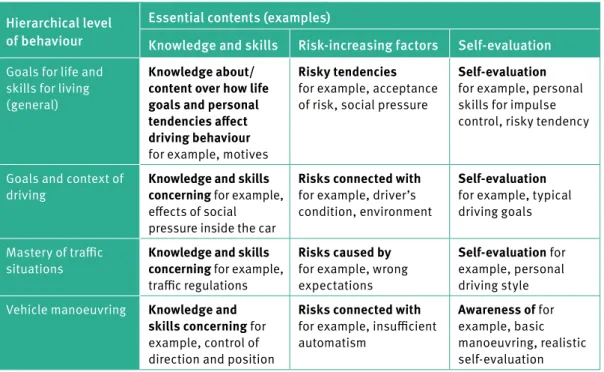
The GADGET Matrix (Table 1) provides an overview of how driver education can be seen as a multi-level and multi-skilled task105. Vehicle handling skills are at the lowest level of the
hierarchy and provide the basic skills for successful operation of the vehicle. The goals and motives that guide driving behaviours are shown in higher levels of the hierarchy (for example, personal skills for impulse control and social pressure and motives).
… traditional, defensive, skill-based driving courses for novice drivers have found no crash or injury reduction.
Table 1. The GADGET Matrix
106Hierarchical level of behaviour
Essential contents (examples)
Knowledge and skills Risk-increasing factors Self-evaluation
Goals for life and skills for living (general)
Knowledge about/ content over how life goals and personal tendencies affect driving behaviour for example, motives
Risky tendencies for example, acceptance of risk, social pressure
Self-evaluation for example, personal skills for impulse control, risky tendency
Goals and context of
driving Knowledge and skills concerning for example, effects of social pressure inside the car
Risks connected with for example, driver’s condition, environment
Self-evaluation for example, typical driving goals
Mastery of traffic
situations Knowledge and skills concerning for example, traffic regulations
Risks caused by for example, wrong expectations
Self-evaluation for example, personal driving style
Vehicle manoeuvring Knowledge and skills concerning for example, control of direction and position
Risks connected with for example, insufficient automatism
Awareness of for example, basic manoeuvring, realistic self-evaluation
4.1.3 Hazard perception and insight training
Training related to perceptions of, and response to, hazards is one potential approach to driver education that requires more evaluation. This approach stems from the recognition that ‘higher-order skills’ such as hazard detection are a critical skill. It is also recognised that attempts to improve these skills in young people are less likely to succeed if the individual has little or no driving experience. Williams10 suggested that after licensing, with some experience gained,
training may include developing cognitive or judgment skills.
For example, ‘insight training’ is an approach that is designed to promote more accurate recognition and understanding of the limitations, and insight and awareness of risk when driving105. It aims to produce ‘wise’ drivers rather than ‘skilled’ drivers
and, therefore, focuses on young drivers making good judgments. Theoretical support for insight training exists41, 103, 105, 107, 108. However, the approach can have
difficulties in maintaining the focus on training higher-order skills (for example, hazard perception) while not creating over-confidence or over-estimation of skills109.
Some Australian approaches have been designed to improve hazard perception and insight. For example, the Victorian Transport Accident Commission (TAC) developed the DriveSmart CD-based training program, based on a program of research in which a simulator was used to evaluate hazard perception and attentional control skills. The results showed that participants who underwent training performed better than an untrained control group both immediately and after four weeks of training. An additional task was completed to assess driver confidence. The results showed no difference in trained and control participants’ confidence levels either before or after training. Accordingly, the authors suggested the DriveSmart program did not induce over-confidence (a key factor associated with crash risk for other training programs – see Senserrick and Haworth105). The CD is now distributed to newly licensed drivers in Victoria.
4. Key elements of best practice road safety education programs
Another example, evaluated by Senserrick and Swinburne110 is the Skilled Drivers of Australia
driver-training program, promoted by AAMI Insurance for drivers aged under 25 and available in most capital cities. The program was designed to change attitudes and motivation and raise awareness of factors known to contribute to crashes. The program showed promise by demonstrating positive changes that the authors concluded were likely to reduce the risk of crash involvement.
Overall, insight training is designed to address poor driving-related attitudes associated with greater risk-taking, rather than physical driving skills. Therefore, the focus is on issues such as over-confidence, over-estimation of one’s own skills and under-estimation of risk110. The
effectiveness of insight training is uncertain, however there is some support for the theoretical assertions behind insight training105. Importantly, at a minimum, it has not shown to be
counter-productive99.
4.1.4 The role of fear and coping strategies
A number of studies have shown that fear-based education has little impact on the audience111.
Research also suggests that exposing some young people to traumatising experiences such as visiting morgues to view road crash victims, watching graphic emergency services presentations on road crashes or re-enactments of serious road crashes can be detrimental to some participants. While most young people will forget these experiences, some may develop acute stress or post traumatic stress disorders which can have devastating impacts on mental health and which are difficult to treat112, 114.
Furthermore, research undertaken by Lewis and colleagues113 has highlighted the importance
of including information about coping strategies (for example, options for refusing to get into a car with a drunk driver) with emotion-based messages. They suggest that this will increase the likelihood that a message will be persuasive. Having coping skills, and having a belief that options involving less-harmful behaviour are available, is important.
4.1.5 The importance of a theory-driven program
Having a theoretical basis to the design of a program, (both the message and the way the message is delivered) has clear implications for the success of the program. “A theory is a system of assumptions and rules to describe, predict and explain the nature of specified
phenomena”6. The chosen theory needs to have been shown to predict, with consistency and
strength, the target behaviour (or behaviours) of change. Nigg et al97 argues that behaviour
change theories do more than just explain behaviour – that they also explain the ‘why’ and ‘how’ of change. According to Fagan and Mihalic115, if those who deliver programs (such as
teachers) see an intervention as logical, they are more likely to follow program directions and deliver it as designed.
There is little research which explores the effectiveness of delivering the same message using different theoretical models86. However, many of the well-evaluated behaviour change
programs (for example, Plan a Safe Strategy, Life Skills Training and Project Northland86, 116, 117)
have used psychological principles of social learning and cognitive behavioural presentation strategies.
A theory-based design is important in designing the message and the way in which a message is delivered.