Open Log Management Platform
Security Target
Release Date: 30 June 2009
Version: 2.0
Prepared for:
LogLogic Inc.
110 Rose Orchard Way, Suite 200
San Jose, CA 95134
Prepared by:
Savvis Federal Systems
45901 Nokes Boulevard
Sterling, VA 20166
Table of Contents
INTRODUCTION... 6 1.1 STREFERENCE... 6 1.2 TOEREFERENCE... 6 1.3 DOCUMENT CONVENTIONS... 6 1.4 DOCUMENT TERMINOLOGY... 7 1.5 DOCUMENT ACRONYMS... 11 1.6 TOEOVERVIEW... 13 1.7 TOEDESCRIPTION... 13 1.7.1 Physical Boundaries... 16 1.7.1.1 Hardware Components... 16 1.7.2 Logical Boundaries... 17 1.7.3 Operational Environment... 18 1.7.4 TSF Data... 19 1.7.5 Security Attributes... 19 1.7.6 User Data... 201.7.7 Features Outside Evaluated Scope... 20
1.7.8 Guidance Documentation... 20
1.7.9 LogLogic Collectors... 20
2 CONFORMANCE CLAIMS... 22
2.1 CCCONFORMANCE CLAIMS... 22
2.2 PP AND PACKAGE CLAIMS... 22
2.3 CONFORMANCE RATIONALE... 22
3 SECURITY PROBLEM DEFINITION... 23
3.1 ASSUMPTIONS... 23
3.1.1 Intended Usage Assumptions... 23
3.1.2 Physical Environment Assumptions... 23
3.1.3 Personnel Assumptions... 23
3.2 THREATS... 24
3.2.1 TOE Threats... 24
3.2.2 Analytical Threats... 25
3.3 ORGANIZATIONAL SECURITY POLICIES... 25
4 SECURITY OBJECTIVES... 26
4.1 INFORMATION TECHNOLOGY (IT)SECURITY OBJECTIVES... 26
4.2 SECURITY OBJECTIVES FOR THE OPERATING ENVIRONMENT... 26
4.2.1 Non-IT Security Objectives For The Operating Environment... 26
4.2.2 IT Security Objectives For The Operating Environment... 27
4.3 SECURITY OBJECTIVES RATIONALE... 27
5 EXTENDED COMPONENTS DEFINITION... 34
5.1.1 FIA Identification and Authentication... 34
5.1.1.1 FIA_UAU_TRD.1 Timing of authentication with a third party... 34
5.1.1.2 FIA_UID_TRD.1 Timing of identification with a third party... 34
5.1.2 IDS IDS Component Requirements... 35
5.1.2.1 IDS_ANL.1 - Analyzer analysis... 35
5.1.2.2 IDS_RCT.1 - Analyzer react... 36
5.1.2.3 IDS_RDR.1 - Restricted data review... 36
5.1.2.4 IDS_STG.1 - Guarantee of analyzer data availability... 36
6 SECURITY REQUIREMENTS... 37
6.1 SECURITY FUNCTIONAL REQUIREMENTS... 37
6.1.1 Security Audit (FAU)... 39
6.1.1.1 FAU_GEN.1 (1) Audit Data Generation... 39
6.1.1.2 FAU_GEN.1 (2) Audit Data Generation... 40
6.1.1.3 FAU_SAR.1 Audit Data Review... 41
6.1.1.4 FAU_SAR.2 Restricted Audit Review... 41
6.1.1.5 FAU_SAR.3 Selectable Audit Review... 41
6.1.1.6 FAU_SEL.1 Selective Audit... 41
6.1.1.7 FAU_STG.2 Guarantees of Audit Data Availability... 41
6.1.1.8 FAU_STG. 4 Prevention of Audit Data Loss... 42
6.1.2 Cryptographic Support (FCS)... 42
6.1.2.1 FCS_CKM.1(1) Cryptographic Key Generation (SSH)... 42
6.1.2.2 FCS_CKM.1(2) Cryptographic Key Generation (HTTPS/SSL/TLS)... 42
6.1.2.3 FCS_CKM.1(3) Cryptographic Key Generation (Blowfish)... 42
6.1.2.4 FCS_CKM.2 Cryptographic Key Distribution... 42
6.1.2.5 FCS_CKM.4 Cryptographic Key Destruction... 42
6.1.2.6 FCS_COP.1(1) Cryptographic Operation (SSH Confidentiality)... 43
6.1.2.7 FCS_COP.1(2) Cryptographic Operation (SSH Integrity)... 43
6.1.2.8 FCS_ COP.1(3) Cryptographic Operation (HTTPS/SSL/TLS)... 43
6.1.2.9 FCS_ COP.1(4) Cryptographic Operation (Blowfish)... 43
6.1.2.10 FCS_ COP.1(5) Cryptographic Operation (SHA-1)... 43
6.1.2.11 FCS_ COP.1(6) Cryptographic Operation (MD5)... 43
6.1.3 User Data Protection (FDP)... 44
6.1.3.1 FDP_IFC. (1) Subset Information Flow Control –log transfer (LL Secure Tunnel)... 44
6.1.3.2 FDP_IFF.1(1) Simple Security Attributes- log transfer (LL Secure Tunnel)... 44
6.1.3.3 FDP_IFC.1 (2) Subset Information Flow Control – event log encrypted (SFTP, SCP, HTTPS, FTPS, Checkpoint log sources)... 44
6.1.3.4 FDP_IFF.1(2) Simple Security Attributes - event log encrypted (SFTP, SCP, HTTPS, FTPS, Checkpoint log sources)... 45
6.1.3.5 FDP_IFC.1 (3) Subset Information Flow Control –event log outbound initiated (HTTP, FTP, CIFS, MSSQL)... 45
6.1.3.6 FDP_IFF.1(3) Simple Security Attributes- event log outbound initiated (HTTP, FTP, CIFS, MS SQL)... 45
6.1.3.7 FDP_IFC.1 (4) Subset Information Flow Control – event log inbound initiated (SYSLOG) 46 6.1.3.8 FDP_IFF.1(4) Simple Security Attributes- event log inbound initiated (SYSLOG)... 46
6.1.3.9 FDP_IFC.1(5) Subset Information Flow Control – network traffic control... 46
6.1.3.10 FDP_IFF.1(5) Simple Security Attributes- network traffic control... 47
6.1.4 Identification and Authentication (FIA)... 47
6.1.4.1 FIA_AFL.1 Authentication failure handling... 47
6.1.4.2 FIA_ATD.1 User Attribute Definition... 48
6.1.4.3 FIA_UID_TRD.1 Timing of Identification with a third party... 48
6.1.4.4 FIA_UAU_TRD.1 Timing of Authentication with a third party... 48
6.1.5 Security Management (FMT)... 48
6.1.5.1 FMT_MOF.1 (1) Management of security functions behavior - IDS... 48
6.1.5.2 FMT_MOF.1 (2) Management of security functions behavior... 49
6.1.5.3 FMT_MSA.1 Management of security attributes... 50
6.1.5.4 FMT_MSA.3 Static attribute initialization... 50
6.1.5.5 FMT_MTD.1 Management of TSF data... 50
6.1.5.6 FMT_SMF.1 Specification of management functions... 50
6.1.5.7 FMT_SMR.1 Security Roles... 53
6.1.6 Protection of TSF (FPT)... 53
6.1.6.1 FPT_ITT.1 Basic internal TSF data transfer protection... 53
6.1.6.2 FPT_FLS.1 Failure with Preservation of Secure State... 53
6.1.6.3 FPT_STM.1 Time Stamps... 53
6.1.7 Trusted path/channels (FTP)... 54
6.1.7.1 FTP_ITC.1 (1) Inter-TSF trusted channel... 54
6.1.9 IDS Component Requirements (IDS)... 54
6.1.9.1 IDS_ANL.1 Analyzer Analysis... 54
6.1.9.2 IDS_RCT.1 Analyzer React... 55
6.1.9.3 IDS_RDR.1 Restricted Data Review... 55
6.1.9.4 IDS_STG.1 Guarantee of Analyzer Data Availability... 55
6.1.9.5 IDS_STG.2 Prevention of Analyzer data loss... 56
6.2 TOESECURITY ASSURANCE REQUIREMENTS... 56
6.3 SECURITY FUNCTIONAL REQUIREMENTS FOR THE OPERATIONAL ENVIRONMENT... 57
6.3.1 FIA_UAU_SRV.1Authentication via authentication server... 58
6.3.2 FIA_UID_SRV.1 Identification via authentication server... 58
6.3.3 FTP_ITC.1 (2) Inter-TSF trusted channel ... 58
6.4 SECURITY REQUIREMENTS RATIONALE... 58
6.4.1 Rationale for Not Satisfying All Dependencies... 58
6.4.2 TOE SFR to TOE Security Objective Tracings... 62
6.4.3 TOE SFR Rationale... 63
6.4.4 SAR Rationale... 67
List of Figures
Figure 1: TOE Deployment Configuration #1 ... 14
Figure 2: TOE Deployment Configuration #2 ... 15
Figure 3: LX and ST appliances deployed in an optional failover configuration ... 15
Figure 4: TOE Physical Boundaries ... 16
List of Tables
Table 1: Document Terminology ... 11Table 2: Document Acronyms ... 12
Table 3: LogLogic v4.6.1 Hardware... 17
Table 4: LogLogic v4.6.1 Software components ... 17
Table 5: Tracings between Threats and Security Objectives... 28
Table 6: Security Functional Requirements ... 38
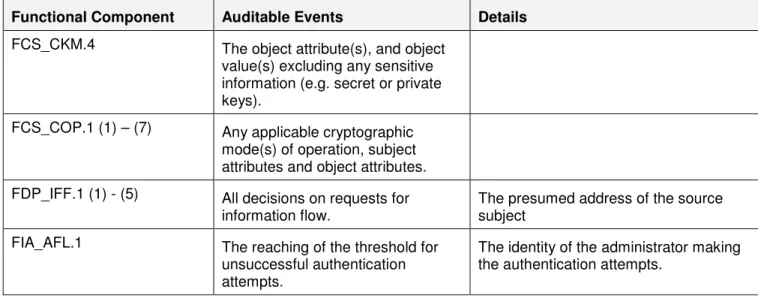
Table 7: Auditable Events – FAU_GEN.1 (1) ... 40
Table 8: Auditable Events – FAU_GEN.1 (2) ... 41
Table 9: FMT_MOF role to function restriction... 50
Table 10: Specification of Management Functions ... 53
Table 11: Additional Analytical Functions... 55
Table 12: Security Assurance Requirements ... 57
Table 13: Security Functional Requirements for Operational Environment ... 58
Table 14: SFR Dependencies ... 61
Table 15: Mapping between TOE SFRs and Security Objectives... 63
Introduction
This document presents the Security Target (ST) for the LogLogic v4.6.1 Open Log Management Platform at Evaluation Assurance Level 2+.
An ST document provides the basis for the evaluation of an information technology (IT) product or system (e.g., target of evaluation (TOE)). An ST principally defines:
• A set of assumptions about the security aspects of the environment, a list of threats which that product is intended to counter, and any known rules with which the product must comply.
• A set of security objectives and a set of security requirements to address that problem. The ST for a TOE is a basis for agreement between developers, evaluators, and consumers on the security properties of the TOE and the scope of the evaluation. Because the audience for an ST may include not only evaluators but also developers and, “those responsible for managing, marketing, purchasing, installing, configuring, operating, and using the TOE” this ST minimizes terms of art from the Common Criteria for Information Technology Security Evaluations (CC).
1.1 ST Reference
This section will provide information necessary to identify and control the Security Target and the TOE.
ST Title LogLogic v4.6.1 Open Log Management Platform Security Target
Version: 2.0
Publication Date: 30 June 2009
ST Author Savvis Federal Systems (SFS) Assurance Level: EAL2 augmented with ALC_FLR.2 Protection Profile
Conformance
U.S. Government Protection Profile: Intrusion Detection System Analyzer for Basic Robustness Environments, Version 1.3, 25 July 2007.
1.2 TOE Reference
The TOE claiming conformance to this ST is identified as: LogLogic v4.6.1 Open Log Management Platform with one or more LX Appliance (Model numbers LX510, LX1010, and LX2010) and one or more ST Appliance (Model numbers ST2010 and ST 3010). Throughout the remainder of the ST, the TOE is referred to as LogLogic v4.6.1.
1.3 Document Conventions
This section describes the conventions used to denote CC operations on security requirements and to distinguish text with special meaning. Selected presentation choices are discussed here to aid the Security Target reader.
The CC allows several operations to be performed on functional requirements; assignment, iteration, refinement, and selection are defined in Section C.4 the CC version 3.1 Part 1.
a) The assignment operation is used to assign a specific value to an unspecified parameter, such as the length of a password. An assignment is indicated by showing the value in square brackets [assignment_value(s)]
b) The refinement operation is used to add detail to a requirement, and thus further restricts a requirement. Refinement of security requirements is denoted by bold for additions and strike-through for deletions.
c) The selection operation is used to select one or more options provided by the CC in stating a requirement. Selections are denoted by underlined italicized text.
d) The iteration operation is used to repeat or reuse a CC requirement multiple times in the same document with different operations used to complete the requirement for each occurrence. Iterations are denoted by an increasing number inside parenthesis following the requirements short name. Example: FCS_COP.1 (1).
e) Plain italicized text is used for both official document titles and text meant to be emphasized more than plain text.
1.4 Document Terminology
This section describes terms that are used throughout the IDSSPP and Section 4 of Part 1 of the Common Criteria. The following terms are a subset of those definitions. In addition to these general definitions, this Security Target also references specialized definitions. They are listed in table 1 below to aid the user of the Security Target.
Term Definition
Analyzer data Data collected by the Analyzer functions
Analyzer functions
The active part of the Analyzer responsible for performing intrusion analysis of information that may be representative of vulnerabilities in and misuse of IT resources, as well as reporting of conclusions.
Anomaly Activity determined by the TOE as deviating or inconsistent from the norm.
Assets Information or resources to be protected by the countermeasures of a TOE.
Attack
An attempt to bypass security controls on an IT System. The attack may alter, release, or deny data. Whether an attack will succeed depends on the vulnerability of the IT System and the effectiveness of existing countermeasures.
Audit
The independent examination of records and activities to ensure compliance with established controls, policy, and operational procedures, and to recommend indicated changes in controls, policy, or procedures.
activities, and whether any actual or attempted security violations occurred, legitimate and unauthorized. Authentication To establish the validity of a claimed user or object. Authentication data Information used to verify the claimed identity of a user.
Authorized Administrator A subset of authorized users that manage an IDS component
Authorized User A user that is allowed to perform IDS functions and access data
Availability Assuring information and communications services will be ready for use when expected.
Compromise
An intrusion into an IT System where unauthorized disclosure, modification or destruction of sensitive information may have occurred
Confidentiality Assuring information will be kept secret, with access limited to appropriate persons.
Class A grouping of CC families that share a common focus.
Data Source
Networked third-party devices or applications such as firewalls, VPN concentrators, servers, routers, switches, storage devices, and applications
Evaluation Assessment of a PP, a ST or a TOE, against defined criteria. IDS component A Sensor, Scanner, or Analyzer.
Information Technology (IT)
System May range from a computer system to a computer network
Integrity Assuring information will not be accidentally or maliciously altered or destroyed.
Intrusion Any set of actions that attempt to compromise the integrity, confidentiality or availability of a resource.
Intrusion Detection
Pertaining to techniques which attempt to detect intrusion into an IT System by observation of actions, security logs, or audit data. Detection of break-ins or attempts either
manually or via software expert systems that operate on logs or other information available on the network.
Intrusion Detection System (IDS)
A combination of Sensors, Scanners, and Analyzers that monitor an IT System for activity that may inappropriately affect the IT System's assets and react appropriately.
IDS Analyzer (Analyzer)
The component of an IDS that accepts data from Sensors, Scanners and other IT System resources, and then applies analytical processes and information to derive conclusions about intrusions (past, present, or future).
IDS Scanner (Scanner)
The component of an IDS that collects static configuration information that might be indicative of the potential for a future intrusion or the occurrence of a past intrusion of an IT System.
IDS Sensor (Sensor)
The component of an IDS that collects real-time events that may be indicative of vulnerabilities in or misuse of IT resources.
IT Product
A package of IT software, firmware and/or hardware, providing functionality designed for use or incorporation within a multiplicity of systems.
Java An object-oriented programming language based loosely on C++ language and developed by Sun Microsystems, Inc.
MySQL
A multithreaded, multi-user SQL database management system (DBMS) owned by a subsidiary of Sun
Microsystems, Inc.
Network Two or more machines interconnected for communications
Object A passive entity in the TOE, that contains or receives information, and upon which subjects perform operations. Operational environment The environment in which the TOE is operated.
Package A named set of either functional or assurance requirements
Packet
A block of data sent over the network transmitting the identities of the sending and receiving stations, error-control information, and message.
Packet Sniffer A device or program that monitors the data traveling between computers on a network
Protection Profile (PP) An implementation-independent set of security requirements for a category of TOEs that meet specific consumer needs. Scanner data Data collected by the Scanner functions
Scanner functions The active part of the Scanner responsible for collecting configuration information that may be representative of vulnerabilities in and misuse of IT resources (i.e., Scanner
data)
Security
A condition that results from the establishment and maintenance of protective measures that ensure a state of inviolability from hostile acts or influences.
Sensor data Data collected by the Sensor functions
Sensor functions
The active part of the Sensor responsible for collecting information that may be representative of vulnerabilities in and misuse of IT resources (i.e., Sensor data)
Security Attribute
A property of subjects, users (including external IT products), objects, information, sessions and/or resources that is used in defining the SFRs and whose values are used in enforcing the SFRs.
Security Policy
The set of laws, rules, and practices that regulate how an organization manages, protects, and distributes sensitive information.
Security Target (ST) A set of security requirements and specifications to be used as the basis for evaluation of an identified TOE.
Subject An active entity in the TOE that performs operations on objects.
Target of Evaluation (TOE)
An IT product of system and its associated administrator and user guidance documentation that is the subject of an evaluation.
Threat
The means through which the ability or intent of a threat agent to adversely affect an automated system, facility, or operation can be manifest. A potential violation of security
TOE Security Functions (TSF)
A set consisting of all hardware, software, and firmware of the TOE that must be relied upon for the correct
enforcement of the TSP.
TOE Security Policy (TSP) A set of rules that regulate how assets are managed, protected, and distributed within a TOE.
Trojan Horse
An apparently useful and innocent program containing additional hidden code which allows the unauthorized collection, exploitation, falsification, or destruction of data.
TSF data Data created by and for the TOE, that might affect the operation of the TOE.
and are subject to the rules of the TSP.
User Any entity (human user or external IT entity) outside the TOE that interacts with the TOE.
User data Data created by and for the user, that does not affect the operation of the TSF.
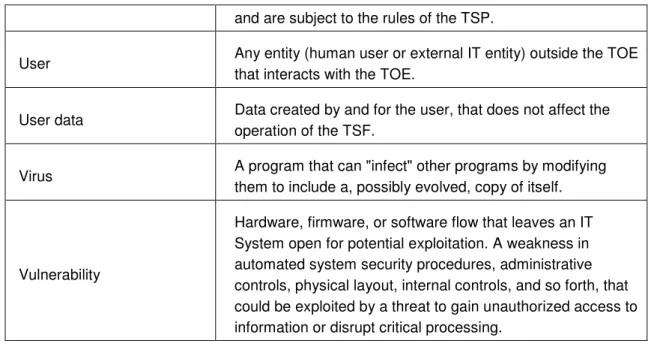
Virus A program that can "infect" other programs by modifying them to include a, possibly evolved, copy of itself.
Vulnerability
Hardware, firmware, or software flow that leaves an IT System open for potential exploitation. A weakness in automated system security procedures, administrative controls, physical layout, internal controls, and so forth, that could be exploited by a threat to gain unauthorized access to information or disrupt critical processing.
Table 1: Document Terminology
1.5 Document Acronyms
CC Common Criteria
CLI Command Line Interface CM Configuration Management EAL Evaluation Assurance Level GUI Graphical User Interface HA High Availability
IDS Intrusion Detection System
IDSAPP Intrusion Detection System Analyzer Protection Profile
IT Information Technology NTP Network Time Protocol OSP Organizational Security Policy PP Protection Profile
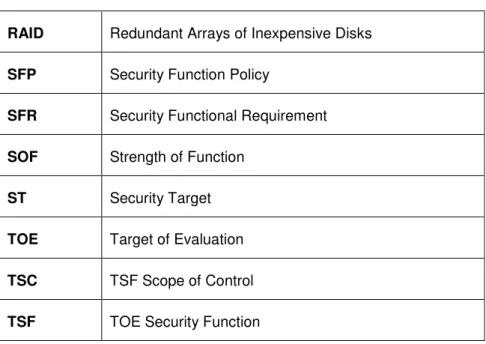
RAID Redundant Arrays of Inexpensive Disks SFP Security Function Policy
SFR Security Functional Requirement SOF Strength of Function
ST Security Target TOE Target of Evaluation TSC TSF Scope of Control TSF TOE Security Function
1.6 TOE Overview
The TOE is LogLogic v4.6.1 Open Log Management platform, an Intrusion Detection system (IDS) that analyzes event logs for network anomalies or security policy breaches. The TOE provides administrative alerts, flexible reporting, and searching on the analyzed data and long term storage of unaltered event logs.
Log data is collected from networked third-party sources such as firewalls, VPN concentrators, servers, routers and switches, storage devices, and applications (both commercial and custom developed).
1.7 TOE Description
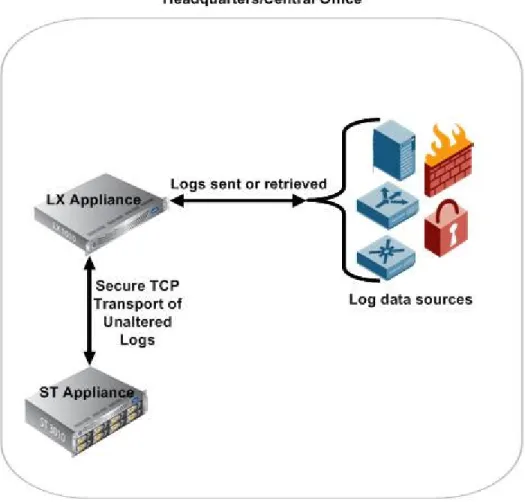
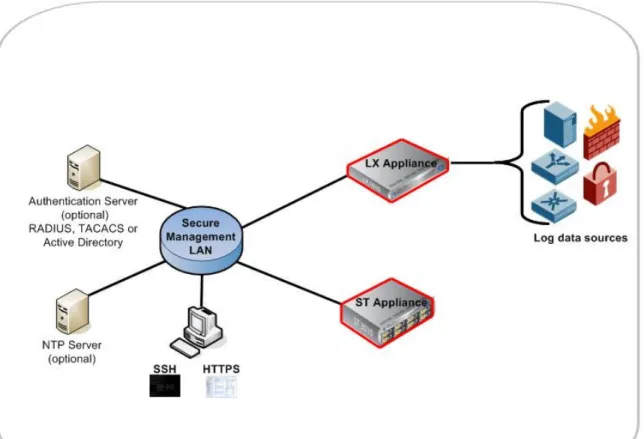
The LogLogic v4.6.1 TOE is composed of two families of physically distinct components. The LX series of appliances normalizes event log data, stores it in a database, and provides analysis, alerting, and reporting through metalog creation.
The LX appliance supports a number of methods to capture event logs from log sources:
1. The LX appliance can be configured to receive streamed event logs using the SYSLOG, HTTP, or HTTPS protocols.
2. The LX appliance can receive event logs from sources configured to use a collector agent.
3. Event log files can be transferred to the LX appliance using a file transfer method with one of the following protocols: SFTP, SCP, HTTP, HTTPS, FTP, FTPS, CIFS.
4. The following source specific methods:
a. Outbound log file retrieval to Checkpoint LEA /CPMI log sources b. Outbound MS SQL queries via JDBC
The LX appliance provides searching and flexible reporting via provided templates and up to 15,000 custom reports.
The TOE computes a MD5 hash for each event log file it collects and stores the hash value in the database separately from the log itself. It will check for that MD5 hash value in the database and if it already exists then it is considered to be a duplicate and does not replace the file.
The ST series of appliances archives unaltered logs for long-term retention. The LX and ST appliances communicate over an encrypted TCP tunnel providing for the secure transfer of logs or archiving. Adding additional appliances scales the solution as the monitored network and log data volume grow.
The LX and ST have their own independent data stores and log retention periods. The LX appliance has the capability of archiving raw log data and metadata for up to 90 days. The ST appliance provides for long-term archival of raw log data.
Log data older than 90 days on the ST appliance can be searched. Alternatively, administrators can use the Replay function. The replay function will stream archived logs stored on the ST device back to the LX device for re-analysis, alerting, and reporting.
The following conditions must be met for the TOE to be deployed in the evaluated configuration: 1. At least one LogLogic LX Appliance (There can be more than one LX deployed in the
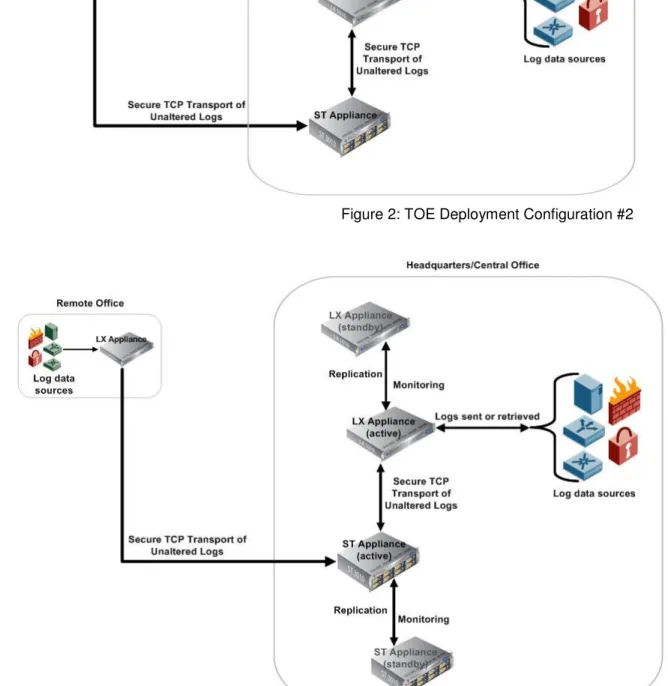
evaluated configuration ) and at least one LogLogic ST Appliance (There can be more than one ST deployed in the evaluated configuration.) When configured to support HA, the TOE consists of a minimum of three network appliances such that at least one ST or LX is part of a HA pair.
2. To utilize all of the evaluated security functionality of the TOE, the TOE environment would include commercially available RADIUS, TACACS, or Active Directory authentication servers.
Figure 1 represents the minimal set of the TOE components required to provide the full set of functionality described in this ST. Figure 2 shows how additional LX Appliances can be added to the deployment. Figure 3 shows the LX and ST appliances deployed in an optional HA failover configuration.
Figure 2: TOE Deployment Configuration #2
1.7.1 Physical Boundaries
This section lists the specific hardware and software components of the product and denotes which are in the TOE and which are in the environment. Figure 4shows a depiction of the TOE and its environment
.
Figure 4: TOE Physical Boundaries
1.7.1.1
Hardware Components
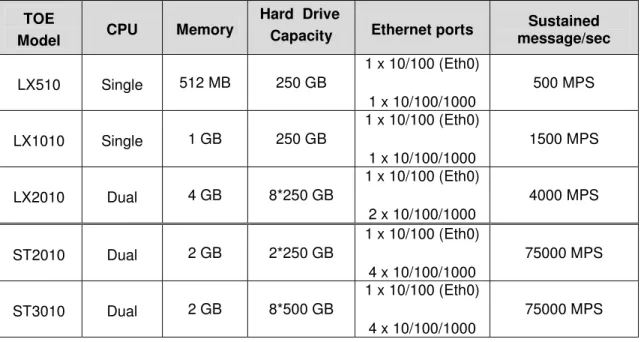
Table 3 identifies the LogLogic v4.6.1 appliance models that comprise the TOE’s hardware components and provides detailed specifications of the LX and ST models.
Table 3: LogLogic v4.6.1 Hardware
Each TOE hardware model is pre-installed with the software components identified in table 4 below.
TOE Software Component Description
LogLogic v.4.6.1 The LogLogic software
Linux OS A hardened Linux kernel Operating System MySQL A relational database management system
Tomcat A Java HTTP web server environment for Java code to execute
Java SDK A set of programming tools and data structures for Java code to execute
Table 4: LogLogic v4.6.1 Software components
1.7.2 Logical Boundaries
The TOE consists of a minimum of two network appliances (one LX and one ST appliance) each executing the software described in table 2. When configured to support HA, the TOE consists of a minimum of three network appliances such that at least one ST or LX is part of a HA pair. The TOE captures event log data from a variety of network sources in the operating environment and analyzes them for anomalies. An anomaly is activity determined by the TOE as deviating or inconsistent from the norm. The TOE provides administrative alerts when an anomaly is detected. The Analyzer data is stored in a database and made available for viewing, searching,
TOE
Model CPU Memory
Hard Drive
Capacity Ethernet ports message/sec Sustained
LX510 Single 512 MB 250 GB 1 x 10/100 (Eth0) 1 x 10/100/1000 500 MPS LX1010 Single 1 GB 250 GB 1 x 10/100 (Eth0) 1 x 10/100/1000 1500 MPS LX2010 Dual 4 GB 8*250 GB 1 x 10/100 (Eth0) 2 x 10/100/1000 4000 MPS ST2010 Dual 2 GB 2*250 GB 1 x 10/100 (Eth0) 4 x 10/100/1000 75000 MPS ST3010 Dual 2 GB 8*500 GB 1 x 10/100 (Eth0) 4 x 10/100/1000 75000 MPS
The TOE includes security management capabilities through a web server interface and a CLI. The web server interface provides management functionality, and an implementation of SSLv.3/TLS protocol to support that functionality. The CLI provides a limited management interface available through a physical serial console connection. Access by serial port is restricted to authorized administrators allowed physical access. The CLI is also accessible through SSHv2. The TOE requires administrators to be successfully identified and authenticated before access to the web server interface or CLI is granted. The TOE includes an optional facility to interact with an external RADIUS, TACACS, or Active Directory identification and
authentication server that is located in the operating environment. For Active Directory, only the roles provided by the TOE are permitted in the evaluated configuration.
The web server interface divides Administrator tasks from User tasks through a navigation menu. All management functions are allowed only if the user has the appropriate authorization.
Administrators can also perform User functions on the Appliance as needed. Once a function is selected, the user or administrator is presented with a tab-based, hyperlinked web pages providing access control specific management functions.
The TOE maintains its own logical security domain for code execution and does not contain a general-purpose operating system or the ability to run user applications. Further, the TOE ensures external IT entities cannot directly affect secure operation of the TOE by providing network traffic filtering. The TOE provides secure transfer of event logs when transferred between LX and ST devices through a LogLogic proprietary encrypted tunnel.
To support generation of accurate timestamps in audit records and reports, the TOE provides NTP client and server functions for accurate sources of time and clock synchronization. Appliances within the TOE can synchronize with other TOE appliances, or alternatively, can interface to an external NTP server located in the operating environment. When the TOE provides NTP server functionality for synchronization among TOE appliances, LX Appliances must use an ST Appliance as the source NTP server.
1.7.3 Operational Environment
This section describes TOE dependencies on the environment in which the TOE is operated. The intended TOE environment is a secure data center that protects the TOE from unauthorized physical access. Only authorized administrators are to have access to connect to the serial console, or gain physical access to the hardware storing log data. Appropriate administrator security policy and security procedure guidance must be in place to govern operational management of the TOE within its install environment.
• The Operational Environment must include one or more log data device sources on one or more monitored networks including any peripheral devices and/or cabling.
• Log Sources in the Operational Environment that utilize Collector Agents for the TOE to be capable of capturing log data must be configured with the appropriate collector for that source.
• The Operational Environment must protect data transmitted from sources that use non-secure protocols.
• The Operational Environment must include Web browser (Microsoft Internet Explorer 6.0 or higher, or Mozilla Firefox 2.0 or higher) to be used by administrators of the TOE to communicate with the TOEs web GUI interface.
• The Operational Environment must include java virtual machine (JVM) v1.5 or higher (for Real-Time Viewer).
• The Operational Environment must include a SSHv2 client • The Operational Environment must include a SSLv3 or TLS client
• Alerts notify the administrator of any unusual network traffic or Appliance system anomalies.
o If the alert feature is configured to use Simple Network Management Protocol (SNMP) Trap actions to notify the administrator when an alert is generated, the TOE is dependent upon a network management station running an SNMP server in the TOE operational environment.
o If the alert feature is configured to send e-mail messages when an alert is triggered, the TOE is dependent upon an SMTP server in the TOE operational environment. The SNMP server can be any entity capable of receiving SNMP traps V1 or V2c.
o If the alert feature is configured to send SYSLOG messages when an alert is triggered, the TOE is dependent upon an SYSLOG server in the TOE operational environment.
• If the LogLogic v4.6.1 TOE is configured to use RADIUS, TACACS, or Active Directory authentication, the TOE is dependent upon a RADIUS or TACACS or Active Directory authentication server in the TOE operational environment.
• If the LogLogic v4.6.1 TOE is configured to use an external source to provide an accurate source of time and clock synchronization, the TOE is dependent upon a NTP server in the TOE operational environment.
A monitor and keyboard locally connected to the appliance must at a minimum be available for installation and initial configuration. For installation, identification and authentication to the TOE is required. The monitor and keyboard are optional once the installation and configuration is completed.
1.7.4 TSF Data
The TSF data consists of the following: • Information flow policy rules • Audit trail
• Analytical result data related to IDS_ANL.1.2 • Unaltered duplicate copies of the event log • Configuration settings
• Alerts and alert rules • Report templates • Cryptographic keys
1.7.5 Security Attributes
• Information flow policy rules • Source Device IP address • Authentication key
• Transport layer port • TCP, UDP protocol
1.7.6 User Data
• Event data in transit to the TOE
Once event logs from external sources have been stored within the TOE, that data is no longer considered user data.
1.7.7 Features Outside Evaluated Scope
This section identifies the features that the LogLogic v4.6.1 TOE provides which are not in the scope of current Common Criteria evaluation. These features are not required to meet any of the security claims for the TOE.
The following features interfere with the TOE security functionality claims and must be disabled or not configured for use in the evaluated configuration.
a) An SNMP agent running on the Appliance, responding to SNMP queries. (Note this is separate and distinct from the TOEs capability to send SNMP trap alerts.)
b) The LogLogic Web Services API. The LogLogic Web Services API allows for the development of 3rd party programs for use as an alternative tool to interface and manage
a LogLogic Appliance.
c) Updating Appliance Software feature. (Updating the appliance software would remove the TOE from the evaluated configuration.)
d) Using NAS, SAN, and/or WORM storage connectivity and optional raw log data encryption with a LogLogic ST Appliance.
e) The LogLogic LG 400 and MX models are not part of the TOE. Those model offer only a subset of the evaluated security functionality.
f) Use of the restore function in non-HA failover pair. (Backup and restore functionality are allowed only if they're used as part of an HA failover pair using SCP.)
g) Use of Parsed data alerts. Parsed data alerts meets certain conditions specified using an exact phrase based on a Pre-defined Search Filter.
1.7.8 Guidance Documentation
The TOE includes the following administrative guidance:
• LogLogic Administration Guide, Release 4.6, September 2008
• LogLogic Users Guide, Release 4.6, September 2008
• LogLogic Quick Start Guide, Release 4.5, June 2008
• Supplemental Installation and Administrative Guidance for the Common Criteria
Evaluated Configuration, version 1.0, June 30, 2009
1.7.9 LogLogic Collectors
The evaluated configuration allows use of LogLogic developed collectors. A collector is installed on specific log sources to enable the TOE to capture log data from those sources. A LogLogic developed collector is required for the following log sources:
• IBM i5/OS
• IBM z/OS (OS/390) • ISS Site Protector • Novell eDirectory
• Symantec AntiVirus • HP NonStop
2 Conformance Claims
2.1 CC Conformance Claims
This ST was developed to Common Criteria (CC) for Information Technology Security Evaluation Part 1 – September 2006 Version 3.1, Revision 1 and CC for Information Technology Security Evaluation Parts 2 & 3 – September 2007 Version 3.1 Revision 2.
The ST is:
CC Version 3.1 Part 2 extended. CC Version 3.1 Part 3 conformant.
2.2 PP and Package Claims
This ST is Evaluation Assurance Level 2 augmented with ALC_FLR.2.
The ST is conformant with the U.S. Government Protection Profile: Intrusion Detection System Analyzer for Basic Robustness Environments, Version 1.3, 25 July 2007. [IDSAPP]
2.3 Conformance Rationale
This section provides rationale for demonstrable conformance on why the ST is considered to be “equivalent or more restrictive” than the [IDSAPP] The rationale below demonstrates the ST levies more restrictions on the TOE and less restrictions on the operational environment.
Security problem definition: Equivalent. Assumptions, threats, and OSPs as defined in the PP are unmodified in the ST.
Security objectives: More restrictive. O.EXPORT exists in the PP but not in the ST as the TOE does not make analyzer data available to other IDS components. In addition, OE.AUDIT_SORT and OE.AUDIT_PROTECTION are objectives met by the TOE and not the operating environment. Therefore it levies less restriction on the operational
environment.
SFRs: More Restrictive. FPT_ITA.1, FPT_ITC.1, FPT_ITI.1 and FIA_AFL.1 from [IDSAPP] are removed in the ST as the TOE does export data to other trusted IT entities, per PD-0127. FIA_UAU.1 and FIA_UID.1 were modified to include an option for user authentication by an external authentication server.
SARs: Equivalent. The Security Assurance Requirements for EAL2 are drawn from [IDSAPP] and are unmodified.
3 Security Problem Definition
The TOE described in this PP is intended to operate in environments having a basic level of robustness. Basic robustness allows processing of data at a single sensitivity level in an environment where users are cooperative and threats are minimal. Authorized users of the TOE are cleared for all information managed by the IDS component, but may not have the need-to-know authorization for all of the data. Hence, the risk that significant damage will be done due to compromise of data is low.
Entities in the Operating environment on which the TOE depends for security functions must be of at least the same level of robustness as the TOE. It is necessary for such an environment that the underlying operating system on which the IDS component is installed be evaluated against a basic robustness protection profile for operating systems.
The TOE in and of itself is not of sufficient robustness to store and protect information of such criticality that the integrity or secrecy is critical to the survival of the enterprise.
3.1 Assumptions
The assumptions are ordered into three categories: personnel assumptions, physical environment assumptions, and operational assumptions
.
3.1.1 Intended Usage Assumptions
A.ACCESS The TOE has access to all the IT System resources necessary to
perform its functions.
A. REM_OPER The authorized administrators will only be able to remotely access the
TOE using secure protocols, strong authentication, and from trusted platforms.
3.1.2 Physical Environment Assumptions
A.PROTCT The TOE hardware and software critical to security policy enforcement
will be protected from unauthorized physical modification.
A.LOCATE The processing resources of the TOE will be located within controlled
access facilities, which will prevent unauthorized physical access.
A.DIRECT Only authorized administrators within the physically secure boundary
protecting the TOE have access to the TOE from direct (not logically controlled) connection (for example, serial console or an associated switch console port).
3.1.3 Personnel Assumptions
A.MANAGE There will be one or more competent individuals assigned to manage the
TOE and the security of the information it contains.
A.NOEVIL The authorized administrators are not careless, willfully negligent, or
hostile, and will follow and abide by the instructions provided by the TOE documentation.
A.NOTRST The TOE can only be accessed by authorized users.
A.INTEGR The authorized administrator will ensure that measures are taken in the
Operating environment to protect event logs in transit.
3.2 Threats
The following are threats identified for the TOE and the IT System the TOE monitors. The TOE itself has threats and the TOE is also responsible for addressing threats to the environment in which it resides. The assumed level of expertise of the attacker for all the threats is
unsophisticated.
3.2.1 TOE Threats
T.COMINT An unauthorized person may attempt to compromise the integrity of the
data analyzed and produced by the TOE by bypassing a security mechanism.
T.COMDIS An unauthorized person may attempt to disclose the data analyzed and
produced by the TOE by bypassing a security mechanism.
T.LOSSOF An unauthorized person may attempt to remove or destroy data analyzed
and produced by the TOE.
T.NOHALT An unauthorized person may attempt to compromise the continuity of the
TOE’s analysis functionality by halting execution of the TOE.
T.PRIVIL An unauthorized user may gain access to the TOE and exploit system
privileges to gain access to TOE security functions and data.
T.IMPCON The TOE may be susceptible to improper configuration by an authorized
or unauthorized person causing potential intrusions to go undetected.
T.INFLUX An unauthorized user may cause malfunction of the TOE by creating an
influx of data that the TOE cannot handle.
T.UNATHDVCE An unauthorized device may attempt to interact with the TOE causing an
influx of data that the TOE cannot handle.
T.DATACOMP A user or process may cause through an unsophisticated data-targeting
attack or error, TSF data to be inappropriately accessed (viewed, modified, or deleted). This includes TSF data transmitted between the TOE.
T.INSECUSE An authorized user or administrator may use or administer the TOE in an
insecure manner that allows disclosure of, corruption to, or disruption of access to sensitive log data.
T.INTEGR An unauthorized user may attempt to modify event log data in transit from IT devices in the Operating Environment to the TOE.
3.2.2 Analytical Threats
T.FALACT The TOE may fail to react to identified or suspected vulnerabilities or
inappropriate activity.
T.FALREC The TOE may fail to recognize vulnerabilities or inappropriate activity
based on IDS data received from each data source.
T.FALASC The TOE may fail to identify vulnerabilities or inappropriate activity based
on association of IDS data received from all data sources.
3.3 Organizational Security Policies
An organizational security policy is a set of rules, practices, and procedures imposed by an organization to address its security needs. This section identifies the organizational security policies applicable to the IDSAPP.
P.ANALYZ Analytical processes and information to derive conclusions about intrusions
(past, present, or future) must be applied to IDS data and appropriate response actions taken.
P.DETECT Static configuration information that might be indicative of the potential for a
future intrusion or the occurrence of a past intrusion of an IT System must be collected.
P.MANAGE The TOE shall only be managed by authorized users.
P.ACCESS All data analyzed and generated by the TOE shall only be used for authorized
purposes.
P.ACCACT Users of the TOE shall be accountable for their actions within the IDS.
P.INTGTY Data analyzed and generated by the TOE shall be protected from modification.
P. PROTCT The TOE shall be protected from unauthorized accesses and disruptions of
4 Security Objectives
This section identifies the security objectives of the TOE and its supporting environment. The security objectives identify the responsibilities of the TOE and its environment in meeting the security needs.
4.1 Information Technology (IT) Security Objectives
The following are the TOE security objectives:
O.PROTCT The TOE must protect itself from unauthorized modifications and
access to its functions and data.
O.IDACTS The Analyzer must accept data from IDS Sensors or IDS Scanners
and then apply analytical processes and information to derive conclusions about intrusions (past, present, or future).
O.EVENTS The TOE must collect and store information about all events that are
indicative of inappropriate activity that may have resulted from misuse, access, or malicious activity of IT System assets.
O.RESPON The TOE must respond appropriately to analytical conclusions.
O.EADMIN The TOE must include a set of functions that allow effective
management of its functions and data.
O.ACCESS The TOE must allow authorized users to access only appropriate
TOE functions and data.
O.IDAUTH The TOE must be able to identify and authenticate authorized users
prior to allowing access to TOE functions and data.
O.OFLOWS The TOE must appropriately handle potential audit and Analyzer
data storage overflows.
O.AUDITS The TOE must record audit records for data accesses and use of the
Analyzer functions.
O.INTEGR The TOE must ensure the integrity of all audit and Analyzer data.
O.SECRMT The TOE must ensure secure communication in support of remote
administration.
O.TMSTMP The TOE will provide a time stamp for its own use.
O.TRAFFIC The TOE must filter the flow of all network traffic from IT entities
attempting to interact with the TOE.
O.LOGCON When the TOE transfers event log data to another TOE component,
it will ensure the confidentiality and integrity of the data.
4.2 Security Objectives for the Operating Environment
This section defines the non-IT security objectives for the environment and the IT security objectives for the environment.
4.2.1 Non-IT Security Objectives For The Operating Environment
The non-IT security objectives for the environment listed below are to be satisfied without imposing technical requirements on the TOE. Thus, they will be satisfied through application of procedural or administrative measures and will not require the implementation of functions in the TOE hardware and/or software.
OE.INSTAL Those responsible for the TOE must ensure that the TOE is delivered, installed, managed, and operated in a manner which is consistent with IT security.
OE.PHYCAL
Those responsible for the TOE must ensure that those parts of the
TOE critical to security policy are protected from any physical attack.
OE.CREDEN Those responsible for the TOE must ensure that all access
credentials are protected by the users in a manner which is consistent with IT security.
OE.PERSON Personnel working as authorized administrators shall be carefully
selected and trained for proper operation of the Analyzer.
OE.INTROP The TOE is interoperable with the IT System it monitors and other
IDS components within its IDS.
OE.INTEGR The authorized administrator for the TOE must ensure that
appropriate measures have been taken in the TOE operating environment to protect event log data in transit to the TOE from modification or disclosure by use of physical isolation or cryptographic means.
4.2.2 IT Security Objectives For The Operating Environment
The following IT security objectives for the environment are to be addressed by the operating environment by technical means.
OE.I&A If the TOE is configured to use external authentication, the TOE
operating environment shall provide the ability to uniquely identify and authenticate users.
OE.TMSTMP If the TOE is configured to use an external time source, the TOE
operating environment shall be able to generate reliable timestamps for the TOE’s use.
4.3 Security Objectives Rationale
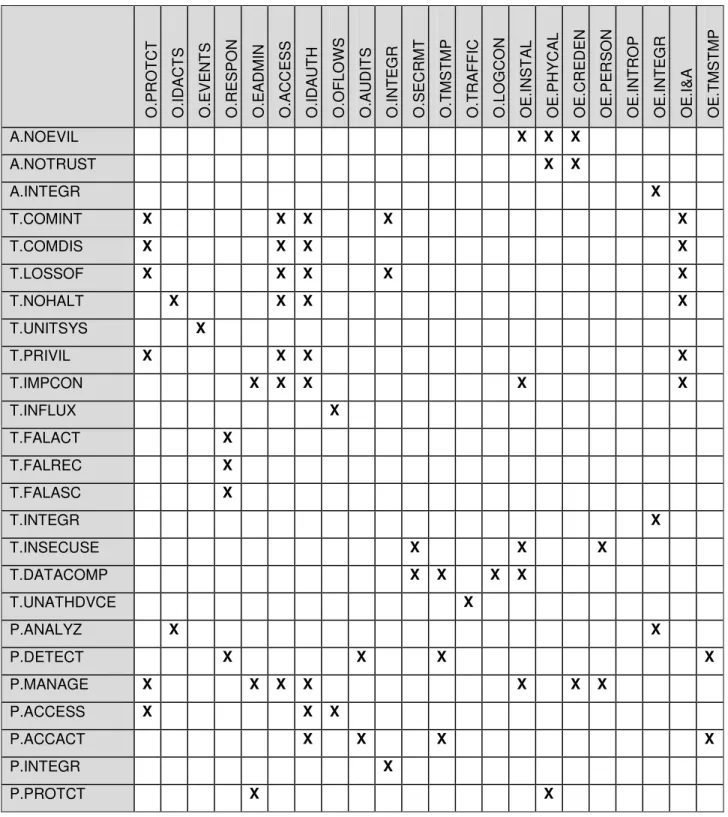
This section provides a rationale for the existence of each assumption, threat, and policy
statement. Table 3 Security Environment vs. Objectives demonstrates the mapping between the assumptions, threats, and polices to the security objectives is complete. The following discussion provides detailed evidence of coverage for each assumption, threat, and policy.
O .P R O TC T O .ID A C T S O .E V E N TS O .R E S P O N O .E A D M IN O .A C C E S S O .ID A U TH O .O FL O W S O .A U D IT S O .IN TE G R O .S E C R M T O .T M S TM P O .T R A FF IC O .L O G C O N O E .IN S T A L O E .P H Y C A L O E .C R E D E N O E .P E R S O N O E .IN TR O P O E .IN TE G R O E .I& A O E .T M S T M P A.ACCESS X A.PROTCT X A.LOCATE X A.MANAGE X
O .P R O TC T O .ID A C T S O .E V E N TS O .R E S P O N O .E A D M IN O .A C C E S S O .ID A U TH O .O FL O W S O .A U D IT S O .IN TE G R O .S E C R M T O .T M S TM P O .T R A FF IC O .L O G C O N O E .IN S T A L O E .P H Y C A L O E .C R E D E N O E .P E R S O N O E .IN TR O P O E .IN TE G R O E .I& A O E .T M S T M P A.NOEVIL X X X A.NOTRUST X X A.INTEGR X T.COMINT X X X X X T.COMDIS X X X X T.LOSSOF X X X X X T.NOHALT X X X X T.UNITSYS X T.PRIVIL X X X X T.IMPCON X X X X X T.INFLUX X T.FALACT X T.FALREC X T.FALASC X T.INTEGR X T.INSECUSE X X X T.DATACOMP X X X X T.UNATHDVCE X P.ANALYZ X X P.DETECT X X X X P.MANAGE X X X X X X X P.ACCESS X X X P.ACCACT X X X X P.INTEGR X P.PROTCT X X
Table 5: Tracings between Threats and Security Objectives
A.ACCESS The TOE has access to all the IT System resources necessary to perform its
functions.
A.PROTCT The TOE hardware and software critical to security policy enforcement will be protected from unauthorized physical modification.
The OE.PHYCAL provides for the physical protection of the TOE hardware and software.
A.LOCATE The processing resources of the TOE will be located within controlled access
facilities, which will prevent unauthorized physical access. The OE.PHYCAL provides for the physical protection of the TOE.
A.MANAGE There will be one or more competent individuals assigned to manage the TOE
and the security of the information it contains.
The OE.PERSON objective ensures all authorized administrators are qualified and trained to manage the TOE.
A.NOEVIL The authorized administrators are not careless, willfully negligent, or hostile, and
will follow and abide by the instructions provided by the TOE documentation. The OE.INSTAL objective ensures that the TOE is properly installed and operated and the OE.PHYCAL objective provides for physical protection of the TOE by authorized administrators. The OE.CREDEN objective supports this assumption by requiring protection of all authentication data.
A.NOTRST The TOE can only be accessed by authorized users.
The OE.PHYCAL objective provides for physical protection of the TOE to protect against unauthorized access. The OE.CREDEN objective supports this
assumption by requiring protection of all authentication data.
A.INTEGR The authorized administrator will ensure that measures are taken in the
Operating environment to protect event logs in transit.
The OE.INTEGR environment objective counters this threat by requiring an authorized administrator to ensure that appropriate measures have been taken in the operating environment to protect event log data from modification while in transit to the TOE.
T.COMINT An unauthorized person may attempt to compromise the integrity of the data
analyzed and produced by the TOE by bypassing a security mechanism.
The O.IDAUTH and OE.I&A objectives provide for authentication of users prior to any TOE data access. The O.ACCESS objective builds upon the O.IDAUTH and OE.I&A objectives by only permitting authorized users to access TOE data. The O.INTEGR objective ensures no TOE data will be modified. The O.PROTCT objective addresses this threat by providing TOE self-protection.
T.COMDIS An unauthorized person may attempt to disclose the data analyzed and produced
by the TOE by bypassing a security mechanism.
The O.IDAUTH and OE.I&A objectives provide for authentication of users prior to any TOE data access. The O.ACCESS objective builds upon the O.IDAUTH and
OE.I&A objectives by only permitting authorized users to access TOE data. The O.PROTCT objective addresses this threat by providing TOE self-protection.
T.LOSSOF An unauthorized person may attempt to remove or destroy data analyzed and
produced by the TOE.
The O.IDAUTH and OE.I&A objectives provide for authentication of users prior to any TOE data access. The O.ACCESS objective builds upon the O.IDAUTH and OE.I&A objectives by only permitting authorized users to access TOE data. The O.INTEGR objective ensures no TOE data will be deleted. The O.PROTCT objective addresses this threat by providing TOE self-protection.
T.NOHALT An unauthorized person may attempt to compromise the continuity of the TOEs
analysis functionality by halting execution of the TOE.
The O.IDAUTH and OE.I&A objectives provide for authentication of users prior to any TOE function accesses. The O.ACCESS objective builds upon the
O.IDAUTH and OE.I&A objectives by only permitting authorized users to access TOE functions. The O.IDACTS objective addresses this threat by requiring the TOE to collect all events, including those attempts to halt the TOE.
T.UNITSYS Unauthorized attempts to access IT systems may go undetected which causes
modification of the IT System protected data or undermines the IT System security functions.
The O.EVENTS objective counters this threat by requiring the TOE collect and store event logs that might be indicative of inappropriate activity.
T.PRIVIL An unauthorized user may gain access to the TOE and exploit system privileges
to gain access to TOE security functions and data.
The O.IDAUTH and OE.I&A objectives provide for authentication of users prior to any TOE function accesses. The O.ACCESS objective builds upon the
O.IDAUTH and OE.I&A objectives by only permitting authorized users to access TOE functions. The O.PROTCT objective addresses this threat by providing TOE self-protection.
T.IMPCON The TOE may be susceptible to improper configuration by an authorized or
unauthorized person causing potential intrusions to go undetected.
The OE.INSTAL objective states the authorized administrators will configure the TOE properly. The O.EADMIN objective ensures the TOE has all the necessary administrator functions to manage the product. The O.IDAUTH and OE.I&A objectives provide for authentication of users prior to any TOE function accesses. The O.ACCESS objective builds upon the O.IDAUTH and OE.I&A objectives by only permitting authorized users to access TOE functions.
T.INFLUX An unauthorized user may cause malfunction of the TOE by creating an influx of
data that the TOE cannot handle.
The O.OFLOWS objective counters this threat by requiring the TOE handle data storage overflows.
T.FALACT The TOE may fail to react to identified or suspected vulnerabilities or inappropriate activity.
The O.RESPON objective ensures the TOE reacts to analytical conclusions about suspected vulnerabilities or inappropriate activity.
T.FALREC The TOE may fail to recognize vulnerabilities or inappropriate activity based on
IDS data received from each data source.
The O.IDACTS objective provides the function that the TOE will recognize vulnerabilities or inappropriate activity from a data source.
T.FALASC The TOE may fail to identify vulnerabilities or inappropriate activity based on
association of IDS data received from all data sources.
The O.IDACTS objective provides the function that the TOE will recognize vulnerabilities or inappropriate activity from multiple data sources.
T.INTEGR An unauthorized user may attempt to modify event log data in transit from
IT devices in the Operating Environment to the TOE.
The OE.INTEGR environment objective counters this threat by requiring an authorized administrator to ensure that appropriate measures have been taken in the operating environment to protect event log data from modification while in transit to the TOE.
T.INSECUSE An authorized user or administrator may use or administer the TOE in an
insecure manner that allows disclosure of, corruption to, or disruption of access to sensitive log data.
The O.SECRMT objective counters this threat by ensuring that administrators use secure communication when performing remote administration of the TOE that will not be disclosed or modified.
The OE.PERSON objective mitigates this threat by ensuring that users are made aware of their responsibilities for using the TOE’s functions in a secure manner. The OE.INSTAL objective mandates that the TOE be installed in a secure manner.
T.DATACOMP A user or process may cause through an unsophisticated data-targeting attack
or error, TSF data to be inappropriately accessed (viewed, modified, or deleted). This includes TSF data transmitted between the TOE.
The O.LOGCON objective counters this threat by ensuring when the TOE forwards event log data to another TOE component, data will not be disclosed or modified.
The O.SECRMT objective counters this threat by ensuring that administrators use secure communication when performing remote administration of the TOE that will not be disclosed or modified.
The O.TMSTMP and OE.TSMTMP objectives help mitigate this threat by assisting time-based analysis of activities associated with data access. The OE.INSTAL objective mandates that the TOE be installed in a secure manner.
T.UNATHDVCE An unauthorized device may attempt to interact with the TOE causing an influx of data that the TOE cannot handle.
The O.TRAFFIC objective counters this threat by filtering the flow of TCP/IP network traffic from IT entities attempting to interact with the TOE.
P.ANALYZ Analytical processes and information to derive conclusions about intrusions
(past, present, or future) must be applied to IDS data and appropriate response actions taken.
The O.IDACTS objective requires analytical processes be applied to data collected from Sensors and Scanners.
P.DETECT Static configuration information that might be indicative of the potential for a
future intrusion or the occurrence of a past intrusion of an IT System must be collected.
The O.AUDITS and O.IDACTS objectives address this policy by requiring collection of audit and Scanner data.
P.MANAGE The TOE shall only be managed by authorized users.
The OE.PERSON objective ensures competent administrators will manage the TOE and the O.EADMIN objective ensures there is a set of functions for administrators to use. The OE.INSTAL objective supports the OE.PERSON objective by ensuring administrator follow all provided documentation and maintain the security policy. The O.IDAUTH objective provides for authentication of users prior to any TOE function accesses. The O.ACCESS objective builds upon the O.IDAUTH objective by only permitting authorized users to access TOE functions. The OE.CREDEN objective requires administrators to protect all authentication data. The O.PROTCT objective provides for TOE self-protection.
P.ACCESS All data analyzed and generated by the TOE shall only be used for authorized
purposes.
The O.IDAUTH objective provides for authentication of users prior to any TOE function accesses. The O.ACCESS objective builds upon the O.IDAUTH objective by only permitting authorized users to access TOE functions. The O.PROTCT objective provides for TOE self-protection.
P.ACCACT Users of the TOE shall be accountable for their actions within the IDS.
The O.AUDITS objective implements this policy by requiring auditing of all data accesses and use of TOE functions. The O.IDAUTH objective supports this objective by ensuring each user is uniquely identified and authenticated. The O.TMSTMP and OE.TMSTMP objectives will provided a time stamp for each audit.
P.INTGTY Data analyzed and generated by the TOE shall be protected from modification.
P. PROTCT The TOE shall be protected from unauthorized accesses and disruptions of analysis and response activities.
The O.OFLOWS objective requires the TOE handle disruptions. The OE.PHYCAL objective protects the TOE from unauthorized physical modifications.
5 Extended Components Definition
This section defines the newly defined components (also known as extended components) used to define the security requirements for this ST. The extended components defined in this section are members of existing CC Part 2 families and are based on the existing CC Part 2 SFRs.
5.1.1 FIA
Identification and Authentication
The FIA class is extended to include 2 additional components.
The FIA class addresses the requirements to verify a claimed user identity. The extended components defined in this section require the TOE to ensure that either the Operating environment or the TOE verifies claimed user identities.
5.1.1.1
FIA_UAU_TRD.1 Timing of authentication with a third party
FIA_UAU_TRD.1 is an extension to the FIA_UAU family. This extended requirement is necessary since a CC Part 2 SFR does not exist that allows for the authentication to be performed by the TOE or Operating environment, but required by the TOE. This extended SFR is based on CC Part 2 FIA_UAU.1.
Management: FIA_UAU_TRD.1
The following actions could be considered for the management functions in FMT:
• If authentication is by the TOE, management of the authentication data by an administrator
• If authentication is by the TOE, management of the authentication data by the associated user
• Managing the list of actions that can be taken before the user is authenticated.
Audit: FIA_UAU_TRD.1
The following actions should be auditable if FAU_GEN Security audit data generation is included in the PP/ST:
• Minimal: Unsuccessful use of the authentication mechanism; • Basic: All use of the authentication mechanism;
• Detailed: All TSF mediated actions performed before authentication of the user. Hierarchical to: No other components.
Dependencies: FIA_UID.1 Timing of identification or
FIA_UID_TRD.1 Time of identification with a third party.
FIA_UAU_TRD.1.1 The TSF shall allow [assignment: list of TSF mediated actions] on behalf of the user to be performed before the user is authenticated by the [selection: Operating environment, TOE or the Operating environment as configured by the administrator].
FIA_UAU_TRD.1.2 The TSF shall require each user to be successfully authenticated by [selection: Operating environment, TOE or the Operating environment as configured by the administrator] before allowing any other TSF-mediated actions on behalf of that user.
5.1.1.2
FIA_UID_TRD.1 Timing of identification with a third party
FIA_UID_TRD.1 is an extension to the FIA_UID family. This extended requirement is necessary since a CC Part 2 SFR does not exist that allows for the identification to be performed by the TOE
or Operating environment, but required by the TOE. This extended SFR is based on CC Part 2 FIA_UID.1.
Management: FIA_UID_TRD.1
The following actions could be considered for the management functions in FMT: • If identification is by the TOE, management of the user identities;
• If an authorized administrator can change the actions allowed before identification, the managing of the action lists.
Audit: FIA_UID_TRD.1
The following actions should be auditable if FAU_GEN Security audit data generation is included in the PP/ST:
• Minimal: Unsuccessful use of the user identification mechanism, including the user identity provided;
• Basic: All use of the user identification mechanism, including the user identity provided. Hierarchical to: No other components.
Dependencies: None
FIA_UID_TRD.1.1 The TSF shall allow [assignment: list of TSF mediated actions] on behalf of the user to be performed before the user is identified by the [selection: Operating environment, TOE or the Operating environment as configured by the administrator].
FIA_UID_TRD.1.2 The TSF shall require each user to be successfully identified by the [selection: Operating environment, TOE or the Operating environment as configured by the administrator] before allowing any other TSF-mediated actions on behalf of that user
.
5.1.2 IDS
IDS Component Requirements
A family of IDS requirements was created to specifically address the data collected and analyzed by an IDS. The audit family of the CC (FAU) was used as a model for creating these
requirements. The purpose of this family of requirements is to address the unique nature of IDS data and provide for requirements about collecting, reviewing and managing the data. These requirements have no dependencies since the stated requirements embody all the necessary security functions. The IDS family includes these classes, components, and elements below:
5.1.2.1
IDS_ANL.1 - Analyzer analysis
IDS_ANL.1.1 The TSF shall perform the following analysis function(s) on all IDS data received:
a) [selection: statistical, signature, integrity]; and b) [assignment: other analytical functions].
IDS_ANL.1.2 The TSF shall record within each analytical result at least the following information:
a) Date and time of the result, type of result, identification of data source; and
5.1.2.2
IDS_RCT.1 - Analyzer react
IDS_RCT.1.1 The TSF shall send an alarm to [assignment: alarm destination] and take [assignment: appropriate actions] when an intrusion is detected.
5.1.2.3
IDS_RDR.1 - Restricted data review
IDS_RDR.1.1 The Analyzer shall provide [assignment: authorized users] with the capability to read [assignment: list of Analyzer data] from the Analyzer data.
IDS_RDR.1.2 The Analyzer shall provide the Analyzer data in a manner suitable for the user to interpret the information.
IDS_RDR.1.3 The Analyzer shall prohibit all users read access to the Analyzer data, except those users that have been granted explicit read-access.
5.1.2.4
IDS_STG.1 - Guarantee of analyzer data availability
IDS_STG.1.1 The Analyzer shall protect the stored Analyzer data from unauthorized deletion.
IDS_STG.1.2 The Analyzer shall protect the stored Analyzer data from modification. IDS_STG.1.3 The Analyzer shall ensure that [assignment: metric for saving Analyzer
data] Analyzer data will be maintained when the following conditions occur: [selection: Analyzer data storage exhaustion, failure, attack].
5.1.2.5
IDS_STG.2 - Prevention of Analyzer data loss
IDS_STG.2.1 The Analyzer shall [selection: 'ignore Analyzer data', 'prevent Analyzer data, except those taken by the authorized user with special rights', 'overwrite the oldest stored Analyzer data '] and send an alarm if the storage capacity has been reached.
6 Security Requirements
This section defines the security requirements for the TOE and the operational environment (that is, for hardware, software, or firmware external to the TOE and upon which satisfaction of the TOE’s security objectives depends).
The CC divides security requirements into two categories:
• Security functional requirements (SFRs), that is, requirements for security functions such as information flow control, audit, I&A.
• Security assurance requirements (SARs) that provide grounds for confidence that the TOE meets its security objectives (for example, configuration management, testing, and vulnerability assessment).
The security requirements that are levied on the TOE are specified in this section of the ST.
6.1 Security Functional Requirements
This section defines the TOE SFRs that are directly taken from the CC Version 3.1 or from the extended components defined in Section 5. The TOE shall satisfy the SFRs stated in the table below which lists the names of the SFR components. Following the table, the individual functional requirements are restated with any necessary operations completed.
Functional Component Functional Component Name PP Conformance1
FAU_GEN.1 (1) Audit Data Generation Drawn directly FAU_GEN.1 (2) Audit Data Generation Added
FAU_SAR.1 Audit Data Review Drawn directly
FAU_SAR.2 Restricted audit review Drawn directly FAU_SAR.3 Selectable Audit Data Review Drawn directly
FAU_SEL.1 Selective audit Drawn directly
FAU_STG.2 Guarantees of audit data availability Drawn directly FAU_STG.4 Prevention of audit data loss Drawn directly FCS_CKM.1 (1) Cryptographic Key Generation Added
FCS_CKM.1 (2) Cryptographic Key Generation Added FCS_CKM.1 (3) Cryptographic Key Generation Added FCS_CKM.2 Cryptographic Key Distribution Added FCS_CKM.4 Cryptographic Key Destruction Added FCS_COP.1 (1) Cryptographic Operation Added FCS_COP.1 (2) Cryptographic Operation Added FCS_COP.1 (3) Cryptographic Operation Added FCS_COP.1 (4) Cryptographic Operation Added
1 This column indicates whether the SFR was drawn directly from the PP, modified from the PP, or added