CONTENTS
Chapter 5. Project Management
5-1ChAPTER AT A GLANCE 5-3
5.1 uNDERSTANDiNG PROJECT MANAGEMENT 5-4
What is project management? 5-4
Why is project management important? 5-4
What makes a good project lead? 5-6
Overview of key project phases 5-6
5.2 PLANNiNG YOuR PROJECT 5-8
Forming your initial project team 5-8
Developing a business case 5-9
Creating a project charter 5-10
identifying your stakeholders 5-11
Assembling the larger project team 5-11
Developing a project plan 5-14
using ongoing project management resources 5-16
5.3 ASSESSiNG YOuR CuRRENT STATE 5-20
Metrics and how to use them 5-21
5.4 DESiGNiNG YOuR SOLuTiON 5-22
identifying areas for improvement 5-22
Determining project objectives and your future state 5-22 Defining your project’s scope and requirements 5-24
5.5 iMPLEMENTiNG YOuR SOLuTiON 5-26
Directing and managing the project 5-26
Disseminating information 5-27
5.6 MEASuRiNG AND SuSTAiNiNG iMPROvEMENTS 5-29
Measuring the project impact 5-29
Sustaining your change 5-29
5.7 APPENDiCES 5-31
Appendix A: Developing a Project Plan 5-32
Appendix B: Project Status Report Template from OR Supply Chain Project 5-36
Appendix C: Sample Risk Management Report from OR Supply Chain Project 5-38
Appendix D: Sample Budget from OR Supply Chain Project 5-40
Appendix E: Results and Benefits Report Samples from OR Supply Chain Project 5-41
Appendix F: Cost Benefit Analysis Sample from OR Supply Chain Project 5-42
Appendix G: Determining and using Project Metrics 5-43
Appendix h: ORSC Program Current Sample State high Level Process Map 5-45
Perioperative departments function in busy environments where the staff is required to tend to a number of activities and processes. Bringing an ORSC improvement project into the mix can be done successfully by applying the fundamentals of project management.
The objective of this chapter is to provide an overview of the key activities that contribute to a project’s success. Clinicians, supply chain professionals and others involved in the project can use this chapter to guide them from planning to project close. For those with more project management experience, it can serve simply as a resource.
Beyond outlining the importance of project management, this chapter provides key insight and advice on project planning, current state analysis and the development of a future state plan. It also examines the elements of developing a business case, how to implement a project and measure results as well as how to manage scheduling and how best to sustain your successes and results.
5.1 uNDERSTANDiNG PROJECT
MANAGEMENT
What is project management?
Project management is the discipline of planning, organizing, and managing resources to bring about the successful completion of a specific goal. It should not be mistaken for operations management, which is the management of day-to-day activities to deliver a repeatable service or result, such as the normal cycle of work completed in a department.
A project has clear objectives intended to achieve a unique result. It is temporary in nature but is usually expected to deliver lasting change. As well, staff members may be assigned to project roles that are different from their operational roles. In mid- to large-sized organizations, a project management office, or PMO, may exist. If your hospital has a PMO, you should leverage its expertise. In mid- and small-sized organizations, where there is no PMO, there may be project managers working in other departments. Try to access the expertise these individuals possess to help manage your project.
Why is project management important?
Project management increases the likelihood of delivering projects that are on time, on budget and that meet objectives. It also contributes to the effective and efficient use of resources.
Projects are often undertaken to change the status quo, and project management deals with the impact of that change. This includes provisions for communicating project objectives, engaging stakeholders, and providing training and other formal change management practices. Project management also provides a framework for managing risk, which is essentially any factor that can positively or negatively affect your ability to meet the project objectives.
Additionally, good project management involves an understanding of your project’s scope and the impact a scope change can have. For example, if you were to start a project to improve the restocking process for the OR and soon after decided to make a scope change by including the introduction of bar coding, it would have an impact on the following:
if your hospital has a project management office, you should leverage its expertise. if you don’t have one, there may be project managers working in other departments who can advise you on your project.
• Budget: Higher cost as more work must be done.
• Quality: Improved quality as bar coding is more accurate than
manual tracking.
• Schedule: Extended schedules as more work must be done.
• Resources: Increased resources as more and different resources are required. • Risk: Increased risk as a new technology is introduced.
But the most challenging aspect of project management is to maintain an acceptable balance between all these different project elements, that is, scope, quality, budget, schedule, resources and risks, while still meeting the project objectives.
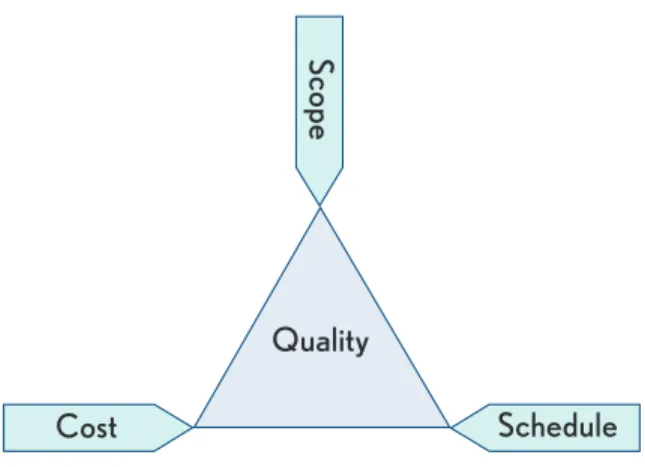
The relationship between scope, cost, schedule and quality can be seen below in Figure 1.
Figure 1: Project Risk: Balancing the triangle of constraints.1
Successful management of project risk can be viewed as the balance of divergent constraints. A change in one constraint has an impact on the others and can affect the quality of the project. The quality of the project is the result of the management of the other three elements or constraints (with resources as an implied aspect of cost).
1 Source: Adapted from: http://upload.wikimedia.org/wikipedia/commons/a/a6/The_triad_constraints.jpg
Some signs of poor project management include the following:
• Projects that miss timelines • Projects that have cost overruns
• Projects that fail to meet the stated objectives or benefits • Projects that face resistance (passive and active) when implementation occurs • Frequent turnover in project team members
• Resources unwilling to sign on to projects, with the understanding that, “it won’t change anything”
• Organizations unwilling to take on project work • The organization as a whole has limited knowledge/use of project management techniques. Schedule Cost Sco pe Quality
What makes a good project lead?
The project lead or project manager is responsible for starting, organizing and planning the project as well as for making sure the work actually happens. The project lead assigned may not ‘own’ the operational departments affected by the project, but there should be interaction between the project team and the operational teams to gain organizational support and meet the project objectives. A good project lead will possess most or all of the following characteristics:
• Be organized.
• Have great communication skills and be able to interact with all levels
of the organization.
• Have excellent managerial skills to lead and keep project team members
on track and ensure quality of project deliverables.
• Have mediation and facilitation skills that can align the diverging
interests of multiple stakeholders.
• Be able to assess and manage risk.
An individual who has taken a project management course, has a Project Management Professional designation or has project management experience would be a key asset.
Overview of key project phases
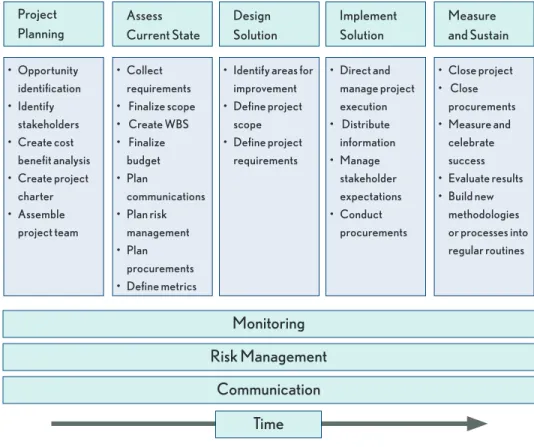
The project life cycle is a collection of generally sequential, but sometimes overlapping, project phases. For the purposes of this guide, these activities will be referred to as Project Planning, Assessing your Current State, Designing your Solution, Implementing your Solution and Measuring and Sustaining your Improvements. They are described on the following page in Figure 2.
TIP: Learn more about project management?
Project Management
international (PMi) http://www. pmi.org, which oversees the Project Management Body of Knowledge (PMBOK) Guide and Standards and the widely recognized Project Management Professional (PMP) designation, is an excellent source of information on project management
techniques, including the skills needed to lead successful projects.
Figure 2: Activities specific to each of your project’s key phases as seen through the project life cycle.
Some activities are specific to each of the project phases while others, such as monitoring the project, managing risk and communicating the status and objectives of the project, are meant to be performed continuously throughout the life of the project. In an ideal project, the Project Planning, Assessing your Current State, Designing your Solution, Implementing your Solution and Measuring and Sustaining your Improvements phases would be distinct, but in reality they often overlap.
The overlap of these phases occurs because projects are by their nature iterative, i.e., involving frequent repetitious actions. As such, they require continuous modification and updating as new information impacts the project. For this reason, project documents should never be considered closed.
TIP: Remember that all projects evolve and change. • Change is inevitable. The project plan is meant to evolve. Do not create it thinking it will be stored and forgotten about.
• Late changes cost more.
The cost of change increases exponentially as you progress through the project. it is better to plan ahead and make the changes you need early on in the project rather than invest in a course of action only to change project direction later in the process.
• Opportunity identification • identify stakeholders • Create cost benefit analysis • Create project charter • Assemble project team • Collect requirements • Finalize scope • Create WBS • Finalize budget • Plan communications • Plan risk management • Plan procurements • Define metrics
• identify areas for improvement • Define project scope • Define project requirements • Direct and manage project execution • Distribute information • Manage stakeholder expectations • Conduct procurements • Close project • Close procurements • Measure and celebrate success • Evaluate results • Build new methodologies or processes into regular routines Project Planning Assess Current State Design Solution implement Solution Measure and Sustain Monitoring Risk Management Communication Time
Project Management
Forming your initial project team
While there are usually few people involved in the project during the initiation phase, some key roles still need to be performed. Depending on the size of the project, in the initiation phase these roles may be performed by one or more people:
Role Function
Project Sponsor/ Executive Sponsor
• Person or group that provides the financial resources, in cash or in kind for the project.
• Champions the project, which includes being the spokesperson to higher levels of management to gather support throughout the organization and promote the benefits the project will bring.
• The sponsor is most active during the project’s start up until it is formally authorized and will play a significant role in the initial scope and charter definition.
• For issues beyond the control of the project manager, the sponsor serves as a conduit for the escalation of issues or risks that may impact on the project’s success.
• The sponsor may also be involved in authorizing scope change, phase-end reviews and decisions to proceed or not to proceed when risks are particularly high.
Project Lead or Project Manager (PM)
• The PM is most active when the project is authorized to proceed. • The PM manages stakeholder expectations (this is difficult because stakeholders may have competing objectives).
• The PM must manage the influence of the various stakeholders in relation to the project requirements to ensure a successful outcome.
• The PM is responsible for determining what processes are appropriate and the degree of rigour to be applied to each process.
• The PM must determine the most appropriate method of carrying out the project. Decisions must be made regarding who will be involved, what resources are necessary, and the general approach to completing the work. Project
Governance/ Project Steering Committee
• Project governance provides a comprehensive framework for the management of the project and includes clearly established provisions for accountability, roles and responsibilities and an established (and ideally consistent) method of controlling, monitoring, measuring, and managing the project.
Developing a business case
The business case is a persuasive argument for a proposal. Developing a business case, sometimes called a cost-benefit analysis, allows you to formalize your project opportunity. This will help gain approval to proceed. It is a complete document that provides a rigorous analysis along with all the information required to justify a recommendation. It is also important to identify who will help sell the business case.
The business case should essentially answer two questions: 1) Is this the best way
to spend our money or do better alternatives exist?; and, 2) Does the project
provide value?
Elements of your business case should include the following:
•
Background.
What is the problem or opportunity? Who is the customer (patient, staff, etc.) affected by the problem? What is the impact?•
Decision statement.
What should you do?•
Objectives.
What results are you seeking and what are the resource (or other) constraints?•
Comparison.
Show the alternatives using a matrix of cost/benefit/risk. This demonstrates you have considered all options. Use three to four alternatives, one of which is maintaining the status quo.•
Recommendation.
Identify a favoured course of action.•
Details.
Include financial details such as cost-benefits, an outline of an action plan with milestones and dates.The business case is used to generate the financial metrics the project sponsor will use to determine if he/she wants to fund the project. The business case is also used to calculate a return on investment (ROI), which is the ratio of money gained or lost on a project relative to the amount of money invested. It is usually expressed as a percentage. For a more thorough explanation of cost benefit analysis, see this chapter’s Appendix F.
Business Case vs. Project Charter
Some of the content in the business case is also found in the project charter and vice versa. Depending on an organization’s methodology, the business case and project charter may be one or two documents. The contents of the documents may also shift depending on the methodology used. Regardless of your organization, all the elements in the business case and project charter should be addressed in the Project Planning phase. if your organization does not have a methodology, templates can be found in Appendices B and C for this chapter.
Your organization may already have business case templates that you can use. Additionally, a quick scan of your immediate resources may allow you to find many good examples you can tailor to fit your needs.
Creating a project charter
A key project document, the project charter allows you to think through the entire project before work begins. It includes the project requirements, criteria, assumptions and constraints. At a minimum, the project charter should provide the following information:
Key Element Usually Includes:
The project purpose and/or justification
• Problem statement
• Organizational need (patient safety, reduce inefficiency, etc.) • Technological advance
• Legal requirements (government/standard compliance) Measurable project objectives
and success criteria
• Benefits and metrics to be collected high level requirements • Requirements from multiple stakeholders high level project description
(scope)
• The current state • The future state
• What project elements are included (in scope) • What is not included (out of scope)
high level risks • issues that may impact the project
Summary milestone schedule • The overall project timeline • Key milestones
• Key deliverables
Summary budget • The overall cost of the project
Project approval requirements • Governance structure • Who decides on project success • Who decides when the project is done • Who is authorizing the charter • Who approves the scope
Key resources • Named project sponsor
• Named project manager
• high level organizational chart for project team Communication plan • how communication will be handled throughout the
project life cycle
Training • What type of training, and who will need training
TIP: Know your audience.
if you know who may fund the project, you can customize your business case to that department’s objectives. Consider:
• Who is funding the project?
What do they need? how does my project align with their goals? What decision do they need to make? And what is their level of knowledge? • Is this a ‘win’ from
multiple perspectives? For example, does it satisfy a business need while also providing value for clinical teams and patients?
• What are the benefits of doing this project? There may be hard benefits (dollars) and soft benefits (customer satisfaction). What benefits does my organization value? • What are the costs of doing this project? Start with a high level project budget to assess the potential costs of
undertaking the project. Cost categories can include internal and external resources (consultants or subject matter experts) and other purchases (storage carts, supplies).
identifying your stakeholders
Stakeholders are people or organizations who are actively involved in the project or whose interests may be positively or negatively affected by the performance or completion of the project.
To conduct a stakeholder analysis, determine who should be involved in the project, who are key influencers, who the key decision makers are, and how decisions are made.
When identifying stakeholders and their degree of influence, it is important to understand and be realistic about how decisions are made in your organization.
• Will project decisions be made in a dictatorial fashion, where one individual
or department has final authority?
• Will it be majority rule, where everyone has a say and the majority wins? • Will it be unanimous, where everyone must agree before proceeding?
In general, having few people involved in the decision making process will result in short-term project gains as decisions will be made quickly. In the long term, this approach will cause more effort in change management activities and more resistance in implementation as more people will feel they were not involved in the project.
Remember to look at the big picture when thinking about who really must be engaged. Consider all those who are currently involved with or ‘touch’ the current state processes and all those who will ‘touch’ or be affected by the future state processes.
Assembling the larger project team
In the planning phase, the project team should represent all departments, business functions and external partners that will or could be affected by the project.
TIP: Get multiple stakeholder buy-in now for easier
implementation later.
While involving all stakeholder groups (clinicians, surgeons, materials management, etc.) in the decision making process can prolong the time it takes to make decisions, implementation is easier if all groups feel engaged in the project.
It is important to staff the team appropriately. Ensure your team has the following:
• A cross-functional representation • A blend of skill sets and perspectives
• People who are knowledgeable and passionate
• Support from key clinical and non-clinical leaders, including
surgical practitioners.
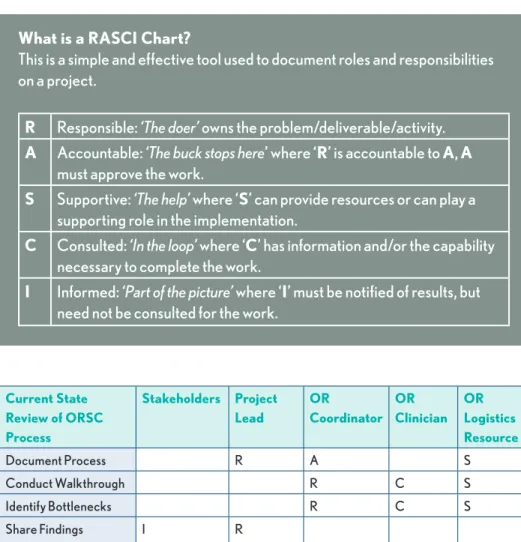
Once the project team is staffed, in addition to an organizational chart, also consider documenting project roles and responsibilities with a RASCI chart, as outlined below. Current State Review of ORSC Process Stakeholders Project Lead OR Coordinator OR Clinician OR Logistics Resource Document Process R A S Conduct Walkthrough R C S identify Bottlenecks R C S Share Findings i R
Figure 3. Typically, the processes and activities involved in a project are listed down the left side
of a RASCi chart and the roles are listed across the top.
TIP: How to work with a part-time project team.
Projects staffed by people that must perform the project work in addition to their day-to-day responsibilities often fail because these staffers are stretched beyond their limits. To ensure the best chance for success, the project lead or project manager should be a dedicated full-time resource. The operational team must also have dedicated time allotted to the project. ideally, members should be seconded to the project team with their home positions backfilled. if this is not possible, other internal or external resources must be part of the project team.
What is a RASCI Chart?
This is a simple and effective tool used to document roles and responsibilities on a project.
R Responsible: ‘The doer’ owns the problem/deliverable/activity.
A Accountable: ‘The buck stops here’ where ‘R’ is accountable to A, A
must approve the work.
S Supportive: ‘The help’ where ‘S’ can provide resources or can play a supporting role in the implementation.
C Consulted: ‘In the loop’ where ‘C’ has information and/or the capability necessary to complete the work.
I informed: ‘Part of the picture’ where ‘I’ must be notified of results, but need not be consulted for the work.
The following table shows a typical ORSC project team, and describes each member’s responsibilities:
Project Role/Team Member High-Level Responsibilities
Project Director • Provides leadership and direction for the operational management of the project and the ongoing implementation of strategies.
• Develops communication strategies for the various levels of stakeholders and participants.
Project Manager or Project Lead
• Provides day-to-day project management and hands-on support for the project.
• Supports training by consultants on new systems to OR and supply chain personnel to facilitate knowledge transfer for future implementations at other sites.
inventory Data Analysts • Provides data collection, analysis and categorization of supplies used.
Periodic Automatic Replenishment (PAR) Optimization Analyst(s) (can be from the materials management or shared service organization)
• Provides data analysis and knowledge transfer to ORSC staff in the review of all supply locations and usage levels.
• Redesigns areas and determines new PAR and minimum values, and may set up barcodes and configure
scanning devices.
OR Senior Leader • Provides clinical resources and support to the project team. • Communicates to the staff, surgeons and the
surgery program.
OR Clinician(s) • Provides input into the proposed process changes and partners with the heads of service to implement changes in their respective services.
• Provides a leadership role for small working groups. • Collaborates and communicates with staff and surgeons on changes.
• Exhibits role model behaviour required to successfully manage the process and changes.
OR Supply Chain Technician(s) • Provides hands-on assistance to PAR optimization analysts to review existing supplies configuration, reorganize supplies onto new carts, and generally shadow consultants to enable knowledge transfer for future implementations at
other sites.
infection Control Personnel • Provides guidance on how proposed supply locations and storage medium changes conform to infection control standards.
Developing a project plan
The project plan is sometimes referred to as the project schedule or work breakdown structure (WBS). It is a detailed list of the activities that must be performed to meet the project objectives and is designed to provide you with a tool to keep track of them.
As part of creating the project plan, you must complete the following: 1. Define the activities that will be part of the plan.
2. Sequence the activities.
3. Estimate the resources needed for the activities. 4. Estimate the duration of the activities.
5. Develop the schedule.
6. Identify milestones (e.g., a critical activity or significant target). 7. Communicate the plan to the team and stakeholders.
To define the activities in the project plan, you must subdivide project deliverables and project work into smaller more manageable components. The project should define the level of detail required in the project plan. As a general rule, the components of the project plan should be detailed enough to allow you to schedule, estimate costs, monitor and control it.
If the project plan is too high-level, you might not notice the slippage of activities early enough to take corrective action. Where possible, describe project plan activities in terms of outcomes rather than actions, for example, document current state ORSC processes and assess or analyze them against your desired future state conditions or outcomes.
For more information and examples, please refer to the Appendices for this chapter.
TIP: If your project is changing someone’s job, talk to HR.
if your project involves significant changes to staff roles and
responsibilities, it is important to involve a stakeholder from the human resources department and in some cases a union representative. having these stakeholders involved upfront will help identify and resolve any issues prior to implementing the project.
EXAMPLE: The importance of good detail in a project plan
if you were completing a data optimization project and the project plan lacked detail, it might look something like the following:
Activity: Data Optimization
Duration: 4 months
Resources: 2 people (full-time equivalent)
Two months into the data optimization, when the project sponsor asks for a status update and a projection of when the activity will end, you would not be able to answer these questions because the project plan lacks details of the activities.
if the project plan included the following detailed activities, the project lead would have a much better idea of the status of the project. Below is a more detailed plan.
Data Optimization
Confirm scope and methodology week 1
Review systems and document current state week 2
Design and document future state week 2
Extract stock item/usage information week 3 & 4 Extract non stock and consignment item/usage information week 3 & 4
Complete initial scrub week 5 to 8
Estimate detailed optimization effort week 8
Agree on descriptions/fields week 9
Perform detailed optimization week 10 to 16
At the two-month point, according to this detailed plan, the following activities should be complete: confirmation of scope and methodology, review of the current state, definition of the future state, extraction of your item/usage information, the completion of the initial scrub and the estimation of the detailed optimization.
if these activities are all on track and complete, you can demonstrate that the project is on track. if some of these activities are not complete, you can determine why and whether the time can be recovered or if the target will be missed.
For more detail on developing the project plan, please refer to Appendices A, B, C
As a general rule, the components of your project plan should be detailed enough to allow you to schedule, estimate costs, monitor and control it.
using ongoing project management resources
Risk management plan
A risk management plan is a systematic approach to setting the best course of action by identifying, assessing, understanding, acting on and communicating risk issues. It is a living project document that should be continually updated. As the project progresses, risks will go from being generic to being specific. When assessing a risk, the two main factors are: determining the likelihood
that the risk will materialize; and determining its subsequent impact on the
project. High probability and high impact risks should be addressed first. At a minimum, a mitigation strategy must be in place for these high impact, high probability risks.
To help identify risks, ask team members to pretend they are at the project post-mortem and that the project has failed. Ask them to discuss what went wrong. The obstacles they imagine could become elements of your risk management plan. See this chapter’s Appendix C for a risk management template.
Communication plan
The project communication plan should define how information will be collected from various project areas and how often it will be updated and reported. It should also address how unplanned communication should take place (i.e., anything outside of regularly scheduled briefings). This may include visual communication tools, such as bulletin boards, notices and email blasts. The communication plan will also define how information will be controlled and distributed, and how often. It should describe how the project information will flow throughout the organization and who decides where information flows. It should also describe which stakeholders and team members should have access to particular areas of information (e.g., should everyone on the project see how much the project costs?). The last element of the project communication plan should address where project information will be stored.
To help identify risks, pretend the project has failed and ask your team to discuss what might have gone wrong. The obstacles they imagine could become part of your risk plan.
The communication plan is especially important in a project environment because:
• Projects are usually staffed by a matrix organization (i.e., the project team
members may not report to the project manager in their operational roles), so it is essential to build a common understanding of objectives and benefits for the project team.
• Projects may affect many operational teams, some positively and others
negatively. All these parties need to be aligned to the one project objective and understand how the project will change their activities.
• Resistors often complain of not being properly informed of the change or
not being involved. The communication plan provides a framework to make sure this does not happen.
Decision log
The project team may consider using a decision log to keep track of key decisions, recording when they were made and by whom.
Procurement
Procurement should be addressed very early in the project. Items requiring long lead times to procure, such as consultants, subject matter experts, or capital equipment, should be considered in advance so that the appropriate procurement policies and procedures for either your organization or those of the funding organization can be followed. (It should also be clear from the beginning of the project which set of procurement policies and procedures will be used.)
Change management
Change management is a pre-defined framework established to help an organization introduce and accept changes that affect people, processes or technology. Change management activities must be outlined at the beginning of a project and continually defined throughout so that they are ready to implement at the project close. Leaving these activities too late usually results in the rejection of the new processes or a very costly change.
TIP: What’s in your communications toolbox?
The ORSC pilot projects that inform this guide used several means to communicate objectives, including:
• Explaining the project at existing staff meetings. • holding specific project meetings.
• using newsletters (existing or brand new).
• Creating striking visual displays on bulletin boards in the OR area or staff lounge areas. • Proposing friendly competition among staff such as case cost challenges among surgeons. • hosting professionally facilitated sessions such as Kaizen events (part of the Lean methodology).
Key elements of change management include:
•
The communication plan:
How you share project objectives, project status, changes and project successes with all project stakeholders.•
Stakeholder management:
Formally managing the influence and objectives of the stakeholders.•
Stakeholder engagement:
Early and frequent involvement of stakeholders in key project decisions and project activities.•
Sponsor support:
Foster sponsor support through communications and actions that support the project.•
A shared purpose:
Show the need for change.•
Champions:
Assemble a team of people at different levels of theorganization that champion or sell the project to their peers and colleagues.
•
Addressing concerns:
Seek to address the concerns of resistors early on.•
Offering recognition:
Recognize both effort and progress.•
Developing skills:
Identify skill gaps in the organization and give people the skills they need to succeed.•
Training:
Training and other forums can ease the transition to the future state.To promote change, find people at different levels of the organization to champion or sell the project to their peers and colleagues.
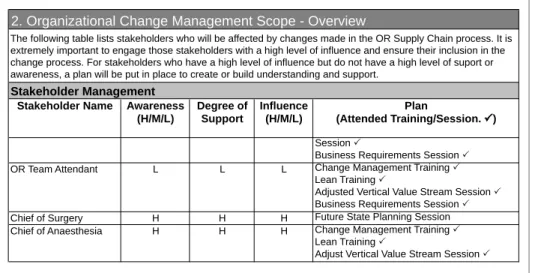
Figure 4, below, shows a working change management document identifying the stakeholders affected by the change and rating their levels of awareness, support and influence.
Figure 4: Example of a high-level change management plan. (courtesy of North York
General hospital)
Stakeholder Name Awareness (H/M/L) Degree of Support Influence (H/M/L) Plan (Attended Training/Session. !) Session !
Business Requirements Session !
OR Team Attendant L L L Change Management Training !
Lean Training !
Adjusted Vertical Value Stream Session ! Business Requirements Session !
Chief of Surgery H H H Future State Planning Session
Chief of Anaesthesia H H H Change Management Training !
Lean Training !
Adjust Vertical Value Stream Session !
2. Organizational Change Management Scope - Overview
The following table lists stakeholders who will be affected by changes made in the OR Supply Chain process. It is extremely important to engage those stakeholders with a high level of influence and ensure their inclusion in the change process. For stakeholders who have a high level of influence but do not have a high level of suport or awareness, a plan will be put in place to create or build understanding and support.
5-20 //
5.3 ASSESSiNG YOuR CuRRENT STATE
Assessing your current state is essentially a matter of gathering timely and relevant information concerning the process your project is designed to improve. This information will form a starting point, or baseline metric. When documenting the current state, the following tools and techniques can be used:
Process mapping.
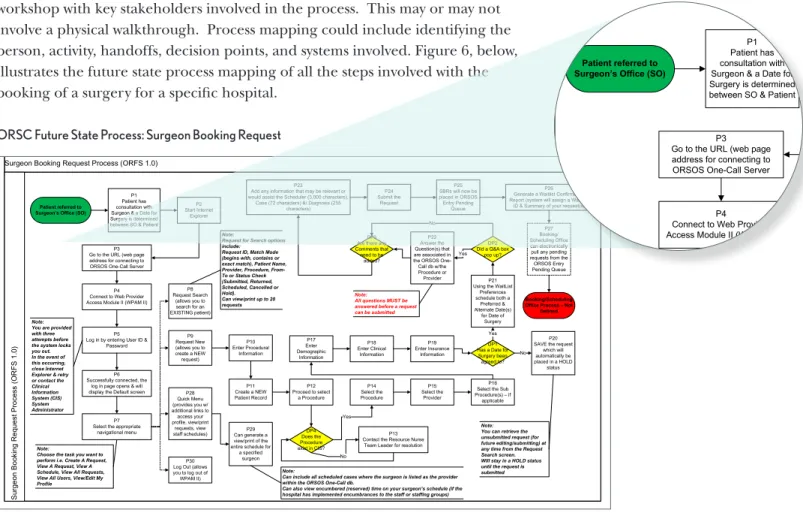
Conduct a current state process mapping workshop with key stakeholders involved in the process. This may or may not involve a physical walkthrough. The process mapping could include identifying the person, activity, handoffs, decision points, and systems involved.Figure 5: This current state process map from a pilot project hospital in Toronto examines the chain
of tasks triggered by a surgeon booking request process. it looks at the tasks and who must
perform them. For a full version of this map, see this chapter’s Appendix H.
Research.
Gather information. Ask: Does the organization have anydocumentation that already exists such as process flows, procedure documents or health and safety documents?
Physical walkthrough.
Look at a given process from an outsider’s perspective. Ask: What is it? Why does it happen? How does it happen? Who does it? Where does it happen? When does it happen? For example, if your project will include the implementation of case carts, pick a particular high-use procedure and look to answer all of these questions. Physically walk through all steps/areasof the hospital where those pieces of equipment are received, ordered, used and discarded.
Peer review.
Try to have a peer review your current state. Use an organization such as the OHA, or access your professional network. Peers will bring a fresh perspective to your environment and may identify gaps, opportunities or ask questions you have not considered.Multiple perspectives review.
Look at the current state process from different perspectives. How does the current state differ when viewed by clinicians, support staff, surgeons and even patients?issues-based review.
Look for specific pain points. Areas that are high risk to patient, high volume, high cost, high frustration, and that cause patient delays or decrease patient volumes and flows. For these issues, try to find the root cause (which is not always apparent).Metrics and how to use them
Often used to monitor operations, metrics are useful tools for project
management and quality control. Metrics are designed to reflect progress in the areas of resource use, budget, people assets, scheduled technical achievements, performance milestones and project outcomes. They can also be used to define success, purpose, task completion and can provide a quick comparison between actual results and planned results or outcomes.
Metrics must be timely, accurate and relevant, and they should be accepted as meaningful by those responsible for the project execution. Metrics reflect what is rather than what should be or what the team wants. See this chapter’s Appendix G for more information on metrics.
TIP: To find root causes, use a simple technique called 5-Why.
Keep asking ‘why’ until you find the root cause. For example, if the problem is that cases are cancelled because of stock outs at the cart level, ask:
Why?
Because MDR never stocks the carts correctly.
Why?
Because procedure cards sent to MDR are incorrect.
Why? Because nurses are frustrated maintaining procedure cards and don’t do it frequently.
Why?
Because the names in the item master file are confusing, duplicated, and don’t make sense to clinicians.
Why?
Because materials management maintains the item master without input from other departments.
Solution: Optimize item master file and establish a nomenclature that can be used by all in the organization. Optimize the procedure cards. Make it easier for procedure cards to be maintained.
identifying areas for improvement
On a day-to-day basis, hospital staff members are primarily focused on providing quality patient care and professional service. Yet, within their areas of expertise and even within their physical work areas, front-line staff often have some of the best ideas for organizational or business unit specific improvements. While staff members can be canvassed for improvement suggestions, it is best to have a structured method and accepted process for bringing forward and developing opportunities.
Organizations with effective means of generating improvement suggestions foster an environment of ‘continuous improvement’ that leverages trust, stakeholder engagement and feedback. Consider showing staff and stakeholders that they are being heard by implementing suggestions and using a system of recognition and rewards that encourages excellence.
Determining project objectives and your
future state
To determine your project objectives and complete the business case, you must take a high-level view of your current state and understand what you want your future state to be. Documenting the current state (which includes people, activities, tools and systems) and designing the future state should be done across functional areas.
Define the difference between the current state and future state and determine what you need to get to the future state. The gap between your current
and future state becomes the focus for the project objectives and part of the initial plan.
Future State
The future state can sometimes be a blend of things that can be done in the short, medium and long term. When looking to design the future state, the following tools and techniques can be used:
Research leading practices.
This can be done in a number of ways, including using Internet resources (e.g., the Integrated Supply Chain Management Leading Practices Compendium), accessing industry or sector publications, networking with peers, arranging peer reviews, finding visionaries or leaders5.4 DESiGNiNG YOuR SOLuTiON
The gap between your current and future state becomes the focus for the project objectives and part of the initial plan.