Exercise therapy for multiple sclerosis (Review)
Rietberg MB, Brooks D, Uitdehaag BMJ, Kwakkel G
This is a reprint of a Cochrane review, prepared and maintained by The Cochrane Collaboration and published inThe Cochrane Library
2004, Issue 3
T A B L E O F C O N T E N T S 1 HEADER . . . . 1 ABSTRACT . . . . 2
PLAIN LANGUAGE SUMMARY . . . .
2 BACKGROUND . . . . 3 OBJECTIVES . . . . 3 METHODS . . . . 4 RESULTS . . . . 7 DISCUSSION . . . . 9 AUTHORS’ CONCLUSIONS . . . . 9 ACKNOWLEDGEMENTS . . . . 10 REFERENCES . . . . 12 CHARACTERISTICS OF STUDIES . . . . 20 DATA AND ANALYSES . . . .
20 ADDITIONAL TABLES . . . . 24 APPENDICES . . . . 30 FEEDBACK . . . . 31 WHAT’S NEW . . . . 31 HISTORY . . . . 32 CONTRIBUTIONS OF AUTHORS . . . . 32 DECLARATIONS OF INTEREST . . . . 32 SOURCES OF SUPPORT . . . . 32 INDEX TERMS . . . . i Exercise therapy for multiple sclerosis (Review)
[Intervention Review]
Exercise therapy for multiple sclerosis
Marc B Rietberg2, Dina Brooks3, Bernard MJ Uitdehaag4, Gert Kwakkel1
1Department of Physiotherapy, VU University Medical Center, Amsterdam, Netherlands.2Department of Rehabilitation Medicine, section Physical Therapy, VU University Medical Center, Amsterdam, Netherlands.3Department of Physical Therapy, University of Toronto, Toronto, Canada.4Departments of Neurology and Clinical Epidemiology and Biostatistics, VU University Medical Center, Amsterdam, Netherlands
Contact address: Gert Kwakkel, Department of Physiotherapy, VU University Medical Center, PO Box 7057, Amsterdam, 1007 MB, [email protected].
Editorial group:Cochrane Multiple Sclerosis Group.
Publication status and date:Edited (no change to conclusions), published in Issue 1, 2011. Review content assessed as up-to-date: 18 March 2004.
Citation: Rietberg MB, Brooks D, Uitdehaag BMJ, Kwakkel G. Exercise therapy for multiple sclerosis.Cochrane Database of Systematic Reviews2004, Issue 3. Art. No.: CD003980. DOI: 10.1002/14651858.CD003980.pub2.
Copyright © 2011 The Cochrane Collaboration. Published by John Wiley & Sons, Ltd.
A B S T R A C T
Background
No intervention has proven effective in modifying long-term disease prognosis in Multiple Sclerosis (MS) but exercise therapy is considered to be an important part of symptomatic and supportive treatment for these patients.
Objectives
To assess the effectiveness of exercise therapy for patients with MS in terms of activities of daily living and health-related quality of life. Search methods
We searched the Cochrane MS Group Trials Register (searched: March 2004), Cochrane Central Register of Controlled Trials (CEN-TRAL) “The Cochrane Library Issue 2, 2004”, MEDLINE (from 1966 to March 2004), EMBASE (from 1988 to March 2004 ), CINAHL (from 1982 to March 2004), PEDro (from 1999 to March 2004). Manual search in the journal ’Multiple Sclerosis’ and screening of the reference lists of identified studies and reviews. We also searched abstracts published in proceedings of conferences. Selection criteria
Randomised Controlled Trials (RCTs) that reported on exercise therapy for adults with MS, not presently experiencing an exacerbation; outcomes that include measures of activity limitation or health-related quality of life or both.
Data collection and analysis
Two reviewers independently extracted data and methodological quality of the included trials. Disagreements were resolved by discussion. The results were analysed using a best-evidence synthesis based on methodological quality.
Main results
Nine high-methodological-quality RCTs(260 participants) met the inclusion criteria. Six trials focussed on comparison of exercise therapy versus no exercise therapy, whereas three trials compared two interventions that both met our definition of exercise therapy. Best evidence synthesis showed strong evidence in favour of exercise therapy compared to no exercise therapy in terms of muscle power function, exercise tolerance functions and mobility-related activities. Moderate evidence was found for improving mood. No evidence was observed for exercise therapy on fatigue and perception of handicap when compared to no exercise therapy. Finally, no evidence
was found that specific exercise therapy programmes were more successful in improving activities and participation than other exercise treatments. No evidence of deleterious effects of exercise therapy was described in included studies.
Authors’ conclusions
The results of the present review suggest that exercise therapy can be beneficial for patients with MS not experiencing an exacerbation. There is an urgent need for consensus on a core set of outcome measures to be used in exercise trials. In addition, these studies should experimentally control for ’dose’ of treatment, type of MS and should include sufficient contrast between experimental and control groups.
P L A I N L A N G U A G E S U M M A R Y
The impact of excercise therapy for multiple sclerosis
MS is a chronic disease of the central nervous system. The variable distribution of the damage in the myelin sheath of nerves may lead to loss of strength, sensation, co-ordination and balance causing severe and progressive limitations of function in daily life. To date, there is no effective treatment for MS, however, a number of studies suggest that exercise interventions aimed to improve daily functioning of patients with MS are effective. Nine randomized controlled trials of exercise therapy for MS patients were included in this review six of which used no therapy as the comparator. There was strong evidence in favor of exercise therapy, compared to no therapy, regarding muscle function and mobility while no evidence was found of improved fatigue, in one study only. No one specifically targeted exercise program was more successful than others. No eleterious effects were described in the included studies.
B A C K G R O U N D
Multiple sclerosis (MS) is a chronic disease of the central nervous system. The variable distribution of demyelination and axonal loss throughout the central nervous system may lead to disorders of strength, sensation, co-ordination and balance, as well as visual, cognitive and affective deficits, that may lead to severe progressive limitations of functioning in daily life. Although the exact aeti-ology of the disease is unknown, it is generally accepted that MS involves an abnormal immune response within the central ner-vous system. In Europe, at least 350,000 persons have the disease. Wide variations exist between and within European countries in the incidence of MS (3.4/100,00 between 1983 and 1987 in West-ern areas of Norway to 11.6/100,000 between 1979 and 1993 in western Seinäjoki, Finland) and its prevalence (38-58/100,000 in France to 144/100,000 in North-western Sardinia), as well as in the general standard of care for MS patients (Pozzilli 2002). One of the primary aims of rehabilitation for patients with mul-tiple sclerosis is to increase their levels of activity and participa-tion and increase their independence (Langdon 1999). Recent ad-vances in drug therapies, such as with ß-interferon that reduce relapse rate offer renewed hope (Anonymous 1995). However, a clinically meaningful effect of drug therapy on disability (activ-ity) has not yet been demonstrated (Freeman 1997). Therefore, the symptomatic and supportive therapies that aim to achieve an
optimisation of daily functioning of patients with MS remain im-portant. The role of rehabilitation with physical training being a central component is perceived to be important in this process. In most cases the exercise therapy is part of a goal-orientated, mul-tidisciplinary approach (for exampleFreeman 1997;Patti 2003); although, sometimes, exercise therapy is offered by one discipline only (for exampleFuller 1996;Svensson 1994).
To our knowledge, the effectiveness of exercise-based rehabilita-tion programmes for multiple sclerosis has not been formally as-sessed in a systematic review. In 2001, a meta-analysis on the effec-tiveness of physical, psychological, and functional interventions in treating clients with multiple sclerosis was performed (Baker 2001), suggesting that occupational therapy (OT) was effective in treating the deficits in MS. However, this systematic review was not focussed on effects of exercise therapy alone, but also on the effects of other intervention regimes, such as psychotherapy and electrotherapy. In addition, pre-experimental designs without a control group were included in the analysis, which may have biased the found outcomes. Recently, a systematic review on the effectiveness of OT interventions on functional ability, social par-ticipation or health-related quality of life or both in patients with MS was performed (Steultjens 2003). No recommendations could be made on whether occupational therapy improves outcome in MS patients. The authors conclude that further research is needed,
2 Exercise therapy for multiple sclerosis (Review)
due to lack of (randomised controlled) efficacy studies. In addi-tion, Steultjens review (Steultjens 2003) was not focused on effects of exercise therapy alone, but also examined the effects of educa-tion, advice and counselling. In addieduca-tion, quasi-experimental trials (Cook 1980) were included in the analysis. This review focused only on the effects of exercise therapy for MS.
O B J E C T I V E S
The primary aim of the present review was to determine whether exercise therapy is an effective treatment for patients with MS in terms of Activities of Daily Living (ADL).
The secondary objective is to determine the effects of exercise therapy on health-related quality of life (HRQoL) in these patients.
M E T H O D S
Criteria for considering studies for this review
Types of studies
The review was restricted to randomised controlled clinical trials (RCT’s). RCT’s are defined as trials in which investigators allocate eligible people to treatment and control group on a random basis (Clarke 2000). Randomized Cross-over trials were considered as RCT’s (Clarke 2000).
Types of participants
Studies with patients, of all ages and of either sex, who fulfilled a clinical diagnosis of Multiple Sclerosis (as described byMcDonald 2001;Poser 1983;Schumacher 1965) were included. For inclu-sion in this review the patients under research have to be free of exacerbation.
Types of interventions
All trials that fitted the authors’ definition of exercise therapy were considered for inclusion. Exercise therapy was defined as: “a series of movements with the aim of training or developing the body by a routine practise or as a physical training to promote good physical health” (Webster’s New World Dictionary 1982) The goal of the exercise therapy had to be associated to one or more of the following codes of the International Classification of Functioning (ICF) (Appendix 1): code b455 (exercise toler-ance functions), code d410 (changing basic body position), code d415 (maintaining a body position), code d430 (lifting and carry-ing objects), code d435 (movcarry-ing objects with lower extremities),
code d440 (fine hand use), code d445 (hand and arm use) code d450 (walking), code d455 (moving around), code d460 (moving around in different locations), code d510 (washing oneself ), code d530 (toileting), code d540 (dressing), code d550 (eating), code d560 (drinking).
Therefore, the included interventions concerned studies that ap-plied:
rehabilitation, physical therapy (with or without using training equipment), training, functional training, home physical train-ing, and aquatic exercise. Studies were excluded if the goal of the therapy primaraly focussed on improving physical functions, but was associated with learning to handle products, technology and equipment in daily living. As a result, the following codes of the ICF-classifications were excluded: code e120 (products and tech-nology for personal indoor and outdoor mobility and transporta-tion), code e1151 (assistive products and technology for personal use in daily living).
In line with the above codes for exclusion, the following interven-tions were not incorporated in the present analysis: baths, elec-trotherapy, electric stimulation (functional, neuromuscular), tran-scutaneous electrical nerve stimulation (SeeAppendix 1).
Types of outcome measures
Studies that used types of outcome that measured aspects of activ-ities limitation or HRQoL were included
Search methods for identification of studies
Electronic searches
(1) The Cochrane MS Group Specialised Register (March 2004) (2) the Cochrane Central Register of Controlled Trials (CEN-TRAL) The Cochrane Library, Issue 2, 2004(Appendix 3) (3) MEDLINE (January 1966 to March 2004)(Appendix 4) (4) EMBASE (January 1988 to March 2004)(Appendix 5) (5) CINAHL (from 1982 to March 2004)
(6) PEDro (from 1999 to March 2004)
(7) Dutch electronic databases PICarta and DOC-online (1999 to March 2004)
Searching other resources
In addition, a manual search in the journal ’Multiple Sclerosis’ was performed. References presented in relevant publications were examined and abstracts published in proceedings of conferences were searched. The principal author of the study was contacted whenever more information about the trial was needed.
Data collection and analysis
Study selection
Two reviewers (MJCP & MBR) independently screened titles and abstracts of all studies identified by the search strategy and dis-carded irrelevant publications in order to create a list of eligi-ble studies. After the potential trials had been retrieved, each re-viewer independently applied the inclusion/exclusion criteria to unblinded full reports. Additional information was sought, where necessary, for all trials that appeared to meet the inclusion criteria. Consensus was used to resolve disagreements concerning the final inclusion of studies, and a third reviewer was consulted if disagree-ments persisted.
Methodological quality assessment
Two reviewers (DB, MBR) independently assessed the method-ological quality of included trials, using an 11-items scoring list (seeAppendix 2). This list contains seven criteria for internal va-lidity and four descriptive criteria. All items were scored as clearly yes (2 points), clearly no (0 points) or not sure (1 point). Equal weight was applied to all items. Scores of individual items were summed to obtain overall score. Inter-rater agreement on method-ological quality scale scores was assessed by means of the kappa statistic (Cohen 1960). The kappa coefficient ranges between zero (completely chance-explained agreement) and one (perfect agree-ment). A third reviewer resolved disagreements.
Data extraction
The following information was systematically extracted by the re-viewers: study design, description of randomisation, characteris-tics of the participants (number, type of MS, disease duration, age, gender and Expanded Disability Status Scale [EDSS]-score), inclusion/exclusion criteria, description of the study and control treatment, outcome measures, length of follow up, and number of patients withdrawn or dropping out of the trial. For studies where the required data were missing, further details were requested from the main author of the manuscript.
Analysis
In order to allow for differences in applied treatment contrast, the analysis focused on comparisons of an exercise therapy interven-tion with a non-exercise interveninterven-tion. Studies that applied exercise training for the control group as well were separated from those studies in which the control group received no exercise training. In case of comparability between two or more independent studies we pooled reported results into summary effect sizes. If a quantitative analysis was not applicable due to diversity of outcome measures, then a qualitative best-evidence synthesis was performed on the basis of the Cochrane list (see “Methodological quality of included studiesTable 1”). Included studies that obtained at least 50% (or 11 out of 22 points) of the maximum feasible methodological quality score were considered to be of ’high quality’, whereas stud-ies that achieve 10 points or less on the Cochrane list were judged as ’low quality’ RCTs (van Tulder 2003).
Evidence was graded into ’Strong evidence’ (evidence from studies providing consistent, statistically significant findings in outcome
measures in multiple high-quality RCTs), ’Moderate evidence’ (ev-idence from studies providing at least consistent findings among multiple low-quality RCTs, or CCTs, or one high-quality RCT, or a combination of these), or ’Limited evidence’ (one low-quality RCT, or CCT, or both). ’Conflicting evidence’ was classified as conflicting statistically significant positive and statistically signif-icant negative results among RCTs, or CCTs, or both. ’No evi-dence’ was classified as no RCTs or CCTs if the number of studies showing evidence is less than 50% of the total number of retrieved studies within the same category of methodological quality (van Tulder 2003).
R E S U L T S
Description of studies
See:Characteristics of included studies;Characteristics of excluded studies.
Electronic and manual searches identified 2593 titles and ab-stracts. Of these, 2570 were excluded. Reasons for exclusion were: reference to diseases or disorders of the central nervous sys-tem other than MS, reference to MS but not in combination with exercise therapy, and duplicate publications. Theses were ex-cluded unless an article was published from it in a journal. Of the remaining 24 articles, seven met all the inclusion criteria as stated above ( DeBolt 2004; Jones 1999; Lord 1998; Mostert 2002;Petajan 1996;Solari 1999;Wiles 2001). The 17 excluded trials (Craig 2003; DeSouza 1984; Di Fabio 1997; Di Fabio 1998;Freeman 1997;Freeman 1999;Fuller 1996;Gehlsen 1984; Gehlsen 1986;Ketelaer 1978;Langdon 1999;Lanzetta 2004;Patti 2003;Peterson 2001;Rodgers 1999;Svensson 1994;Wiles 2003) and details of why they failed to meet the inclusion criteria for this review are outlined in the Table of Characteristics of Excluded Studies. Freeman 1999 was discussed, but finally rejected because the objective of the trial was multi disciplinary treatment and not exercise therapy. In addition, examination of conference proceed-ings for unpublished and ongoing trials of exercise therapy in MS resulted in two additional RCTs (Carter 2003;O’Connell 2003). The first authors of these two RCTs then provided us with infor-mation.
The search strategy revealed nine RCTs (Carter 2003; DeBolt 2004;Jones 1999;Lord 1998;Mostert 2002;O’Connell 2003; Petajan 1996;Solari 1999;Wiles 2001) which were included in the present review. Details of the nine trials included in the present review are presented in the Table of Characteristics of Included Studies and in the Additional Table 1. The included nine trials were conducted in five different countries (seven trials in Europe and two in the United States). All trials were published after 1995 and written in English. The included nine trials involved a total
4 Exercise therapy for multiple sclerosis (Review)
of 260 participants. Six trials contained between 20 and 50 par-ticipants (DeBolt 2004;Lord 1998;Mostert 2002;Petajan 1996; Solari 1999;Wiles 2001), whereas in three trials fewer than 20 participants were involved (Carter 2003;Jones 1999;O’Connell 2003).
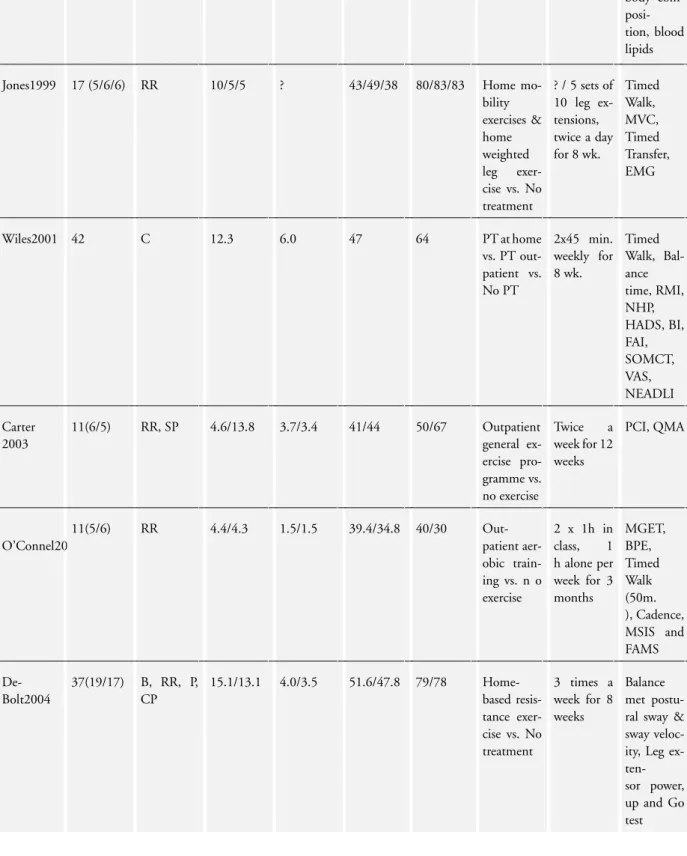
Six trials (Carter 2003; DeBolt 2004; Jones 1999; O’Connell 2003; Petajan 1996; Wiles 2001), involving 164 participants, compared one or two exercise therapy interventions with a no treatment condition and three trials (Lord 1998;Mostert 2002; Solari 1999), involving 96 participants, compared two interven-tions that both met our criteria of exercise therapy. The study char-acteristics are provided in detail in the Table of Charchar-acteristics of Included Studies and in Additional Table 2.
Risk of bias in included studies
Initially methodological quality scores could not be obtained for the studies ofCarter 2003andO’Connell 2003, since only the abstracts as published in proceedings of conferences were available. The methodological quality scores of the above studies were based on additional information as provided by the first authors. Two reviewers (DB, MBR) independently assessed the methodological quality of the remaining trials. These results are presented in Addi-tionalTable 2. There was disagreement between two independent reviewers on six of the 77 criteria scored (7.8%). Cohen’s kappa was 0.88. The methodological quality scores of the six included studies that investigated exercise therapy versus no exercise therapy ranged from 50% to 73% of the maximum feasible score, whereas the three studies focused on exercise therapy versus a control exer-cise intervention ranged from 64% to 82%. All studies were clas-sified as high-methodological-quality RCTs. For all nine studies a summary of key indicators of internal validity is listed below.
Concealed allocation: Six studies (DeBolt 2004;Jones 1999;Lord 1998;O’Connell 2003;Solari 1999;Wiles 2001) provided some information about the method of randomisation that was used, which suggested that randomisation was probably concealed or randomisation lists were appropriately generated, or both.
Intention-to-treat analysis: Three studies (Carter 2003;O’Connell 2003; Solari 1999) stated that they had used intention-to-treat analysis.
Blinded outcome assessment: Two studies (Solari 1999;Wiles 2001) stated that they had used a blinded assessor for all outcome mea-sures.
All studies provided information on ethical issues. All participants gave written consent and trial protocols were approved by research ethics committees.
Effects of interventions Participant characteristics
Details are presented in the Table of Characteristics of Included Studies and in Additional Table 2 (Table 2). The participants of the studies considered in the present review all fulfilled a clini-cal diagnosis of Multiple Sclerosis. Most included studies describe that a neurologist assessed patients’ eligibility for inclusion. Cri-teria for exacerbation or relapse were not defined. For trials com-paring exercise therapy with no exercise therapy, the severity of the disease, as expressed by the EDSS-score, ranged from 1 to 6.5. In addition, different types of MS (benign, relapsing-remitting, secondary-progressive, progressive and chronic MS) were consid-ered. Mean disease duration of the subjects ranged from 4.3 to 15.1 years. The mean percentage of women ranged from 30% to 83% and the mean age of the participants ranged from 34.8 to 51.6 years. For the trials comparing exercise therapy with a control exercise intervention, EDSS-scores ranged from 1 to 6.5, relaps-ing-remitting-, primary-progressive-, secondary-progressive- and chronic progressive MS were considered. The mean disease dura-tion of the participants ranged from 11.2 to 18.3 years. The mean percentage of woman ranged from 48 to 85 and the mean age of the participants ranged from 44 to 54 years.
Study characteristics
Exercise therapy versus no exercise therapy
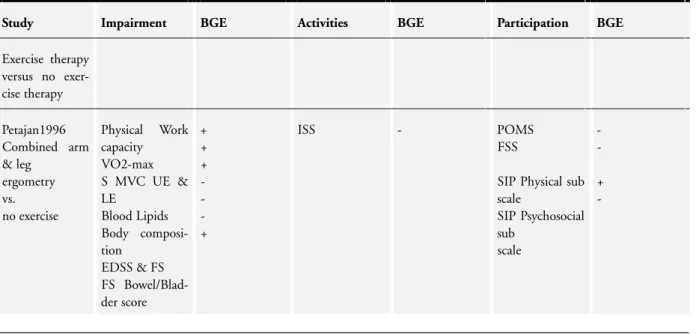
In the study ofPetajan 1996, ambulatory patients with MS par-ticipated in a 15-week outpatient exercise training programme to improve measures of physical fitness and to determine its effects on ADL, mood and levels of fatigue. Patients with MS were randomly assigned to an exercise or non-exercise group. Exercise therapy consisted of 3 x 40 minute sessions per week of combined arm and leg ergometry. Of the 54 patients originally selected for the study, six were excluded for reasons unrelated to the research project and to MS. Two additional subjects were excluded secondary to an MS exacerbation. Thus, data from 46 participants were used for statistical analysis. Compared with the control group, the exercise therapy group showed statistically significant increases in maximal aerobic capacity (VO2 max.) and Physical Work Capacity (PWC) after the treatment period. For maximum isometric strength, sig-nificant differences between groups after 15 weeks of intervention were found for summed upper extremity strength (i.e., shoulder flexion, shoulder extension, elbow flexion, and elbow extension) and for summed lower extremity strength (i.e., hip extension, hip flexion, knee flexion, and knee extension). For the upper extremity three (i.e., shoulder flexion, shoulder extension, and elbow flex-ion) out of the four measured muscle groups reached statistically significant changes. Whereas for the lower extremity one (knee extension) out of the four measured muscle groups reached statis-tically significant change. Compared with the non-exercise group, the exercise therapy group improved significantly on all aspects of the physical subscale (i.e., ambulation, mobility, body care and movement) of the Sickness Impact Profile (SIP) after 10 weeks of training. After 15 weeks of training there was still a significant effect for the total score on the physical subscale (but only the
mobility aspect reached significance).
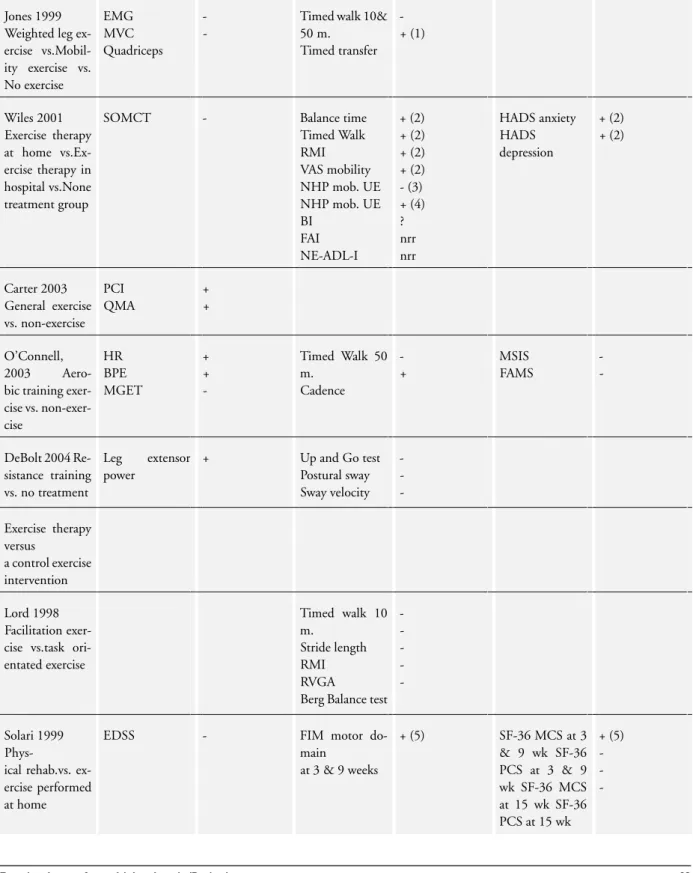
Jones 1999 compared a mobility exercise programme with a weighted leg exercise training programme and with a control group receiving no exercise. Both exercise programmes were performed at home. Nineteen patients with MS were randomly allocated to the three arms of the trial. One patient of the weighted leg exer-cise group left the study after four weeks, due to back pain, which was believed not to be the result of the intervention. One patient of the mobility exercise group had a relapse shortly after the be-ginning of the study. These dropouts left 17 patients for statisti-cal analyses. Muscle strength (MVC) of quadriceps and the func-tional activities walking and transferring (Timed Walk and Timed Transfer) were measured, respectively. Although the weighted leg group improved significantly on time needed for chair transfers, no significant differences were found between the three groups for gait speed, ability to transfer and muscle strength.
Wiles 2001 performed a randomised cross-over trial to deter-mine whether physiotherapy can improve mobility in patients with chronic MS and whether there is a difference between treat-ments at home and in the outpatient clinic. Forty-two patients with chronic MS were randomly allocated to one of the six per-mutations of three-week intervals: treatments consisted of phys-iotherapy at home, in the outpatient clinic and no therapy. Forty patients formed the basis of the analysis, because two patients de-clined further assessments. No statistically significant differences were found between both exercise groups on the Rivermead Mo-bility Index (RMI) or any of the secondary moMo-bility measures (i.e. balance time, timed walk, nine hole peg test, assessor global mo-bility change scale, VAS-patient momo-bility, VAS-carer momo-bility, and VAS-falls). Wiles 2001 reported a significant treatment effect on the primary outcome RMI when hospital or home-based phys-iotherapy were compared with no physphys-iotherapy. This was cor-roborated by significant effects on all above-mentioned secondary measures in favour of exercise therapy compared to no exercise. In addition, statistically significant effects were found in favour of exercise therapy for mood and reduction in anxiety and depres-sion measured with the Hospital Anxiety and Depresdepres-sion Scale (HADS).
InCarter 2003, 11 participants with mild to moderate MS, who were able to walk for at least four minutes, were randomly assigned to an exercise group or to a non-exercise group. The 12-week outpatient exercise-training programme consisted of twice-weekly supervised general aerobic, strengthening and flexibility exercise sessions. Of the 13 participants originally selected for the study, two were excluded before the start of the intervention, one having severe hypertension and one having developed abdominal cancer. There was a significant reduction in the normalised physiological cost index (PCI, represented by the formula: Working heart rate -Resting heart rate (beats per minute) divided by speed of walking (metres per minute) scores after 12 weeks in the exercising group, but not in the non-exercising control group. In addition, there was a significant difference between the groups in the percentage
change in PCI. When comparing the exercise with the non-exercise group, significant effects were observed for isometric strength in the hip flexors and knee flexors of both limbs, the knee extensors and the ankle dorsal flexors of the right limb, but not in the ankle dorsal flexors or the knee extensors of the left limb.
O’Connell 2003conducted a randomised controlled trial to assess the effects of an outpatient exercise therapy programme on MS patients with mild disability. Eleven participants, in the relapse-re-mitting stage of the disease, were randomly allocated to an exercise or non-exercise group. Exercise training consisted of twice-weekly, one hour supervised aerobic training in circuit style and once-weekly individual exercise. Two participants from the experimen-tal group were excluded due to relapse. Following the three-month exercise training programme, the exercise group had improved sig-nificantly regarding fitness as measured with a Modified Graded Exercise Test (MGET) and quality of life as measured with the Functional Assessment of Multiple Sclerosis (FAMS) compared to baseline. The mean change in heart rate, cadence and Borg’s Per-ception of Exertion were statistically significantly larger in favour of the exercise group when compared to the non-exercise group. No significant differences were found on the Multiple Sclerosis Impact Scale (MSIS) and gait speed.
In the study ofDeBolt 2004, MS patients participated in an eight-week home-based resistance exercise programme to examine the effects on balance, leg extension power, and mobility. After strat-ification by disability level and age, participants were randomly assigned to an exercise or a non-exercise group. Exercise therapy consisted of resistance training (i.e., chair raises, forward lunges, step-ups, heel-toe raises, and leg curls) three times a week. The control group maintained their current level of activity. Of the 37 patients originally selected for the study, 1 was excluded secondary to an MS exacerbation. Thus, data from 36 (exercise group n = 19, and controls n = 17) participants remained for statistical anal-ysis. After the intervention a significant difference between groups was found for leg extensor power. No between-group effects were found for exercise therapy on mobility and balance.
Exercise therapy versus a control exercise intervention Lord 1998used a pilot study to compare two exercise therapy ap-proaches to improve walking in outpatients with gait disturbances due to MS. Comparison was made between a facilitation and a task-oriented approach. In total twenty-three patients with clini-cally stable MS were randomised; however, three participants (two from the facilitation group and one from the task group) were excluded due to a relapse or further medical intervention. Ten in each group completed the study, and were treated for a minimum of 15 treatments over a five to seven week period. Participants in both groups showed a significant overall improvement in mobility, as measured with the 10-metre timed walk, stride length, RMI and the Rivermead Visual Gait Assessment and in balance using the Berg Balance Test. No significant differences between the two exercise groups were found.
Solari 1999assessed the efficacy of an inpatient physical
rehabilita-6 Exercise therapy for multiple sclerosis (Review)
tion programme on impairment (body functions and structures), disability (activities) and quality of life (QoL) of patients with MS in a randomised, single-blind controlled study. Fifty ambu-latory patients with MS were assigned to three weeks of physical rehabilitation (study group) or to exercises performed at home (controls). The inpatient rehabilitation programme consisted of twice-daily exercise periods, each 45 minutes long, and included passive (stretching, mobilisation) and active interventions (for ex-ample facilitation of a normal gait pattern). Patients were evalu-ated at baseline, 3, 9, and 15 weeks. Five patients withdrew from the study before the end of the study period (three in the reha-bilitation group: one had an exacerbation, two deteriorated clini-cally; two controls: one failed to present for the last examination, one deteriorated), but all were included in the analyses. No sig-nificant differences were found for impairment (body functions and structures), as measured by the Expanded Disability Status Scale (EDSS). At the end of the intervention significant differences were observed between the study group and the control group in disability (activities), as assessed by the Functional Independence Measure (FIM) motor domain and overall health-related QoL as measured with the mental composite score (emotional role-limi-tation, mental health, vitality and social functioning) of the SF-36. These differences remained at nine weeks.
InMostert 200237 MS patients taking part in an inpatient re-habilitation programme were randomly assigned to an aerobic ex-ercise training group or to a non-training group. The four weeks aerobic training intervention consisted of five 30 minute sessions per week of bicycle exercise with individualised intensity. The non-exercise group took part in the normal physical therapy of the rehabilitation programme but agreed not to increase their phys-ical activity level. Of the 37 patients originally included, 26 re-mained for statistical analyses. Two were excluded because of sig-nificant change in the exercise electrocardiogram . Three patients quit the study directly after random assignment to the exercise group. Two suffered from elevated spasticity of the lower extrem-ities after testing. Of the non-exercise group, three patients had motivational problems to sustain the intervention program; two others had symptom exacerbations. Compared with baseline, the exercise group demonstrated a significant improvement of the aer-obic threshold, an improvement in HRQoL (as measured with the SF-36), and an increase in activity level. However, in the present study statistical analyses were restricted to within-group compari-son. Therefore, the differential effects between the groups remain inconclusive.
Best evidence syntheses
All details of outcome measures based on between-group assess-ments are presented in Additional Table 3 (Table 3).
Exercise therapy versus no exercise therapy
The best evidence synthesis of studies comparing exercise therapy versus no exercise therapy for MS patients was based on six RCTs (164 participants). All studies were of high methodological quality.
Strong evidence was found in favour of exercise therapy on out-come of muscle power functions (ICF code b730, seeAppendix 1), as measured with maximum voluntary contraction (Jones 1999;Jones 1999), Quantitative Myometry Assessment (Carter 2003) and leg extensor power (DeBolt 2004) and exercise toler-ance functions (ICF code b455), as measured by the Modified Graded Exercise Test (O’Connell 2003), Physical Work Capacity (Petajan 1996), VO2-max. (Petajan 1996), the Physiological Cost Index (Carter 2003) and the Borg’s Perception of Exertion Scale (O’Connell 2003O). In addition, strong evidence was found for exercise therapy on mobility related activities (ICF codes d410 changing basic body position, d415 maintaining a body position, d450 walking, d455 moving around and d460 moving around in different locations) as measured with the Rivermead Mobility Index (Wiles 2001), timed transfer (Jones 1999), balance time (Wiles 2001) and walking cadence (O’Connell 2003).
Moderate evidence was found that exercise therapy improved hand and arm use (ICF code d445) as measured with the Nine-Hole Peg Test (Wiles 2001), and that it improved mood, as assessed with the Hospital Anxiety and Depression Scale (Wiles 2001) and the Profile of Mood States (Petajan 1996).
No evidence was found that exercise therapy has a significant ef-fect on outcome of blood lipids, body composition and EDSS (Petajan 1996), fatigue, as measured with the Fatigue Severity Scale (Petajan 1996) and cognitive impairment, as measured with the Short Orientation-Memory-Concentration Test (Wiles 2001). In addition, no evidence was found for outcome on ADL and instru-mental ADL in general. Finally, no evidence was found for exercise therapy on outcome of HRQoL, as measured with the Multiple Sclerosis Impact Scale and the Functional Assessment of Multi-ple Sclerosis (O’Connell 2003) and the Sickness Impact Profile (Petajan 1996).
Exercise therapy versus a control exercise intervention
Three high-methodological-quality RCTs (96 participants) com-pared exercise therapy with a control intervention. In all three studies the control intervention met our criteria of exercise ther-apy as well. Best evidence synthesis shows that there is no evidence (Lord 1998;Mostert 2002;Solari 1999) that exercise therapy is more effective than a control exercise intervention for MS patients on factors related to physical fitness (VO2-max.), mobility (gait speed, stride length, Rivermead Mobility Index, Rivermead Vi-sual Gait Assessment, Berg Balance Test, Functional Independence Measure motor domain and Baecke Activity Questionnaire), fa-tigue (Fafa-tigue severity Scale) and health related quality of life (SF-36).
D I S C U S S I O N
This systematic review investigated the effectiveness of exercise therapy for MS patients in terms of activities of daily living and
health-related quality of life. Unfortunately, statistical pooling of data was not possible mainly due to differences in measurements of outcome. Instead, a qualitative analysis using levels of evidence was performed showing strong evidence in favour of exercise ther-apy compared to no exercise therther-apy in terms of muscle power functions, exercise tolerance functions and mobility-related activ-ities. Moderate evidence was found for improving mood. How-ever, no evidence was observed for exercise therapy on fatigue and perception of handicap when compared to no exercise therapy. Finally, no evidence was found that specific exercise therapy pro-grammes, including type of exercise therapy and type of setting, were superior in improving activities and participation than other exercise treatments. This latter finding suggests that the contrast of treatment between experimental and control treatment is an important element in determining the effectiveness of treatment in MS. Although the above conclusions are based on high-quality RCTs, it should be noted that most studies included a small num-ber of patients. This lack of statistical power could have introduced type-II-error. In addition, it seems that included studies empha-sised when presenting the results on the within group differences. Moreover, one study restricted the statistical analysis to within-group changes and not between-within-group differences (Mostert 2002). Interestingly, only the study ofMostert 2002Mdescribes evidence of deleterious effects after testing, by means of elevated spastic-ity of the lower extremspastic-ity in two subjects. However, no evidence of deleterious effects of exercise therapy was described by any of the nine included studies. Although in seven trials, dropouts due to an MS exacerbation were reported in groups receiving exercise training (two inPetajan 1996; one inJones 1999; three inLord 1998; one inSolari 1999; two inMostert 2002; two inO’Connell 2003; one inDeBolt 2004), none of the authors of the concerned trials related these dropouts to the applied intervention. This latter finding seems to be important, because people with MS have tra-ditionally been advised by doctors to avoid exercise therapy due to the potential effect on triggering an exacerbation or worsening dis-ease activity. Incrdis-eases in core temperature can lead to a transient increase in the frequency of clinical signs and symptoms of MS (White 2000). Acknowledging that fatigue affects the vast major-ity of patients, it was believed that exercise could not be tolerated and that it was preferable to focus on conserving energy. On the other hand, avoiding exercise also has its disadvantages. Seden-tary people have an increased risk of developing a large number of other health problems, like obesity and cardiovascular disease. In addition, the very low activity levels observed in people with MS (Ng 1997;Stuifbergen 1997) often coincide with a loss in leisure activities, social contacts, or normal activities of daily life, which are important for self-esteem and psychological well-being. Participants
All participants considered in the present review fulfilled a clini-cal diagnosis of Multiple Sclerosis, as described byPoser 1983or McDonald 2001. However, there was much diversity among
stud-ies with regard to patient characteristics. The large range of 1 to 6.5 in the EDSS-scores, best illustrates the diversity in severity of the disease among participants. In the studies considered different types of MS were included. However, none of the trials stratified patients on the basis of type of MS. Therefore, the effectiveness of exercise therapy for different types of MS remains indistinct in the present review. Finally, patients of all ages and of either sex were included. The percentage of female participants (64%) seems to reflect the epidemiological findings about the between-gender dis-tribution of MS (Pozzilli 2002). The mean age of the participants ranged from 34 to 54 years. Most studies had an upper limit of 65 years of age for participants, restricting the generalisation of the present findings.
Exercise programmes
The present review did not control for ’dose’ (intensity, duration and frequency) of exercise therapy. However, intensity, duration and frequency seem to be important factors in modifying treat-ment effects. In the present review, there was diversity among the included trials with regard to duration and frequency of training sessions, while intensity was often poorly described. Thus, it is impossible to state the best ’dose’ of treatment to achieve opti-mal beneficial effects of exercise therapy in terms of activities and participation for patients suffering from MS. Optimum number, duration and intensity of treatment sessions all need further study. Methodological quality of the RCTs
RCTs are generally considered to be the best paradigm of inter-vention research providing the strongest scientific proof of the ef-fectiveness of an intervention (van Tulder 2003v). Most system-atic reviews evaluating the effectiveness of therapeutic interven-tions are confined to evaluating RCTs. The methodological qual-ity score of the RCTs included in the present review ranged from 55% to 82% of the maximum feasible score of 22 points. Even though adequate methodological approaches such as concealment of allocation, blinding of the outcome assessor, and inclusion in the analysis of all randomised participants are recognised as the most important factors in reducing bias (Schulz 1995), only one trial (Solari 1999) included in this review met all three of the above methodological criteria. In addition, reviewers were unable to obtain a methodological quality score for the studies ofCarter 2003andO’Connell 2003, since only the abstracts as published in proceedings of conferences were available. Instead, the method-ological quality scores of these studies were based on information as provided by the first authors, which may have biased the results. Outcome measures
Although some studies measured the same domains, different test protocols were used for strength, physical fitness, balance, gait speed and HRQoL, which impeded pooling of data. The large variety in outcome measures used underscores the need for a gen-eral agreement about most important measures to assess effects
8 Exercise therapy for multiple sclerosis (Review)
of exercise intervention. International consensus about a core set of outcome measures to determine the effect of exercise therapy would enable comparison of the magnitude of effect of different exercise regimens.
Potential biases of systematic reviews
Selection of all relevant studies is crucial to the validity of a system-atic review. However, several biases can be introduced by the litera-ture search and selection procedure (van Tulder 2003v). We might have missed relevant unpublished trials, which are more likely to be small studies with non-significant or negative results due to publication bias (Egger 1998). Screening references of identified trials and systematic reviews may result in an overrepresentation of positive studies in the review, because trials with a positive re-sult are more likely to be referred to in other publications, leading to reference bias (Goetzsche 1987). The literature search was re-stricted to English, German, French and Dutch publications. Al-though reviewers acknowledge that systematic reviews should aim at inclusion of all relevant trials, independent of language, identi-fying trials published in any language is difficult, time consuming and costly. It is possible to include trials, of other languages, in a future update of this review.
Summary and future research
In summary, the present research synthesis suggests that exer-cise therapy can be beneficial for patients with MS on isometric strength, physical fitness and mobility-related ADLs such as time needed for transfer, walking cadence and balance time. In addi-tion, positive findings were found for outcomes related to mood, such as anxiety and depression. Finally, no evidence was found that specific exercise therapy programmes were more successful in im-proving activities and participation than other exercise treatments. These conclusions were based on a best research evidence synthesis due to lack of comparability between measurements of outcome, acknowledging that defining the levels of evidence is essentially an arbitrary and subjective way of summarising evidence (De Vet 2003). No evidence of deleterious effects of exercise therapy were described in the identified studies.
This review provides a template for the inclusion of future trials and could be used to guide further research. It shows the need for research in older individuals, those more disabled (EDSS-score
over 6.5) and those diagnosed for over 18 years. To overcome the problem of heterogeneity between subjects, future studies should stratify patients on the basis of type of MS. There is an urgent need for a general agreement about core set of measurements to be applied in MS trials investigating effectiveness of exercise therapy. Outcome measures in the activities of daily living and HRQoL domains should be included. In addition, these studies should ex-perimentally control for ’dose’ of treatment and sufficient contrast in type of intervention and adhere to the methodological princi-ples, especially concealment of allocation, blind recording and an adequate description of the number of dropouts.
A U T H O R S ’ C O N C L U S I O N S Implications for practice
The results of this review suggest that exercise therapy, whether similar to that recommended for the healthy population or modi-fied to simply maintain function, does have efficacy in MS. There was no evidence described of deleterious effects of exercise therapy for patients with MS and the effect of type of MS remains unclear. Based on these results, it seems reasonable to promote exercise therapy to patients with MS not experiencing an exacerbation.
Implications for research
There is an urgent need for a consensus on a core set of mea-surements of outcome to be used in exercise trials. These out-come measures should be reliable and valid and reflect activities of daily living and quality of life domains. In addition, these studies should experimentally control for ’dose’ of treatment and suffi-cient contrast in type of intervention between experimental and control groups and adhere to the methodological principles, espe-cially concealment of allocation, blind recording and description of dropouts.
A C K N O W L E D G E M E N T S
The authors would like to thank Mrs. I Wijbrands and Mr. PCW van Wieringen (PhD) for their valuable contribution to this manuscript. A special thanks to Mrs. M.J.C. Pieper and Mrs. L.M. Selhorst for their assistance on the protocol.
R E F E R E N C E S References to studies included in this review
Carter 2003 {published and unpublished data}
Carter P, White CM. The effect of a general exercise training on effort of walking in patients with multiple sclerosis. 14th International World Confederation for Physical Therapy. Barcelona, 2003. [: RR–PL–1517]
DeBolt 2004 {published data only}
DeBolt LS, McCubbin JA. The effects of home-based resistance exercise on balance, power, and mobility in adults with multiple sclerosis. Archives of Physical and Medical Rehabilitation2004;85(2):290–7. [MEDLINE: 14966716]
Jones 1999 {published data only}
Jones R, Davies-Smith A, Harvey L. The effect of weighted leg raises and quadriceps strength, EMG and functional activities in people with multiple sclerosis.Physiotherapy
1999;85(3):154–61.
Lord 1998 {published data only}
Lord SE, Wade DT, Halligan PW. A comparison of two physiotherapy treatment approaches to improve walking in multiple sclerosis: a pilot randomized controlled study.
Clinical rehabilitation1998;2(6):477–86. [MEDLINE: 9869251]
Mostert 2002 {published data only}
Mostert S, Kesselring J. Effects of a short-term exercise training program on aerobic fitness, fatigue, health perception and activity level of subjects with multiple sclerosis.Multiple sclerosis2002;8(2):161–8. [MEDLINE: 11990874]
O’Connell 2003 {published and unpublished data}
O’Connell R, Murphy RM, Hutchinson M, Cooke G, Coote S. A controlled study to assess the effects of aerobic training on patients with multiple sclerosis. 14th International World Confederation for Physical Therapy. Barcelona, 2003. [: RR–PL–2105]
Petajan 1996 {published data only}
Petajan JH, Gappmaier E, White AT, Spencer MK, Mino L, Hicks RW. Impact of aerobic training on fitness and quality of life in multiple sclerosis.Annals of Neurology1996;39(4): 432–41. [MEDLINE: 8619521]
Solari 1999 {published data only}
Solari A, Filippini G, Gasco P, Colla L, Salmaggi A, La Mantia L. Physical rehabilitation has a positive effect on disability in multiple sclerosis patients.Neurology1999;52
(1):57–62. [MEDLINE: 9921849]
Wiles 2001 {published data only}
Wiles CM, Newcombe RG, Fuller KJ, Shaw S, Furnival-Doran J, Pickersgill TP. Controlled randomised crossover trial of the effects of physiotherapy on mobility in chronic multiple sclerosis. Journal of Neurology, Neurosurgery & Psychiatry2001;70(2):174–9.
References to studies excluded from this review
Craig 2003 {published data only}
Craig J, Young CA, Ennis M, Baker G, Boggild M. A randomised controlled trial comparing rehabilitation against standard therapy in multiple sclerosis patients receiving intravenous steroid treatment. Journal of Neurology, Neurosurgery & Psychiatry2003;74:1225–30. [MEDLINE: 12933923]
DeSouza 1984 {published data only}
DeSouza LH. A different approach to physiotherapy for multiple sclerosis patients.Physiotherapy1984;70(11):26–9.
Di Fabio 1997 {published data only}
Di Fabio RP, Choi T, Soderberg J, Hansen CR. Health-related quality of life for patients with progressive multiple sclerosis: influence of rehabilitation.Physical Therapy1997;
77(12):1704–16. [MEDLINE: 9413449]
Di Fabio 1998 {published data only}
Di Fabio RP, Soderberg J, Choi T, Hansen CR, Schapiro RT. Extended outpatient rehabilitation: its influence on symptom frequency, fatigue, and functional status for persons with progressive multiple sclerosis. Archives of Physical Medicine & Rehabilitation1998;79(2):141–6. [MEDLINE: 9473994]
Freeman 1997 {published data only}
Freeman JA, Langdon DW, Hobart JC, Thompson AJ. The impact of inpatient rehabilitation on progressive multiple sclerosis.Annals of Neurology1997;42(2):236–44. [MEDLINE: 9266735]
Freeman 1999 {published data only}
Freeman JA, Langdon DW, Hobart JC, Thompson AJ. Inpatient rehabilitation in multiple sclerosis: do the benefits carry over into the community?. Neurology1999;52(1): 50–6. [MEDLINE: 9921848]
Fuller 1996 {published data only}
Fuller KJ, Dawson K, Wiles CM. Physiotherapy and mobility in multiple sclerosis: a controlled study.Clinical rehabilitation1996;10:195–204.
Gehlsen 1984 {published data only}
Gehlsen GM, Grigsby SA, Winant DM. Effects of an aquatic fitness program on the muscular strength and endurance of patients with multiple sclerosis. Physical Therapy1984;64(5):653–7. [MEDLINE: 6718494]
Gehlsen 1986 {published data only}
Gehlsen G, Beekman K, Assmann N, Winant D, Seidle M, Carter A. Gait characteristics in multiple sclerosis: progressive changes and effects of exercise on parameters.
Archives of Physical Medicine & rehabilitation1986;67(8): 536–9. [MEDLINE: 3741079]
Ketelaer 1978 {published data only}
Ketelaer P, Van Diest R, Van Muysewinkel A, Van Geyseghem L, Keersmaekers A, Delaite D, et al.Evaluation and results of the rehabilitation in multiple sclerosis (author’s transl). Journal Belge de medicine Physique Rehabilitation
1978;1(3):227–45. [MEDLINE: 757423]
10 Exercise therapy for multiple sclerosis (Review)
Langdon 1999 {published data only}
∗Langdon DW, Thompson AJ. Multiple sclerosis:
a preliminary study of selected variables affecting rehabilitation outcome. Multiple Sclerosis1999;5(2): 94–100. [MEDLINE: 10335517]
Lanzetta 2004 {published data only}
Lanzetta D, Cattaneo D, Pellegatta D, Cardini R. Trunk control in unstable sitting posture during functional activities in healthy subjects and patients with multiple sclerosis. Archives of Physical and Medical Rehabilitation
2004;85(2):279–83. [MEDLINE: 14966714]
Patti 2003 {published data only}
Patti F, Ciancio MR, Cacopardo M, Reggio E, Fiorilla T, Palermo F, et al.Effects of a short outpatient rehabilitation treatment on disability of multiple sclerosis patients: a randomised controlled trial.Journal of Neurology2003;250
(7):861–6. [MEDLINE: 12883930]
Peterson 2001 {published data only}
Peterson C. Exercise in 94 degrees F water for a patient with multiple sclerosis.Physical Therapy2001;81(4):1049–58. [MEDLINE: 11276186]
Rodgers 1999 {published data only}
Rodgers MM, Mulcare JA, King DL, Mathews T, Gupta SC, Glaser RM. Gait characteristics of individuals with multiple sclerosis before and after a 6-month aerobic training program.Journal of Rehabilitation and Research
1999;36(3):183–88. [MEDLINE: 10659801]
Svensson 1994 {published data only}
Svensson, B, Gerdle B, Elert J. Endurance training in patients with Multiple Sclerosis: Five case studies.Physical Therapy1994;74(11):1017–24. [MEDLINE: 7972362]
Wiles 2003 {published data only}
Wiles CM, Newcombe RG, Fuller KJ, Jones A, Proce M. Use of videotape to assess mobility in a controlled randomized crossover trial of physiotherapy in chronic multiple sclerosis. Clinical Rehabilitation2003;17(3): 256–63.
Additional references Anonymous 1995
IFN-ß Multiple Sclerosis Study Group and the University of British Colombia MS/ MRI Analysis Group. Interferon beta-1b in the treatment of multiple sclerosis: final outcome of the randomised controlled trial.Neurology1995;45(7): 1277–85.
Baker 2001
Baker NA, Tickle-Degnen L. The effectiveness of physical, psychological and functional interventions in treating clients with Multiple Sclerosis: A meta-analysis. The American Journal of Occupational Therapy2001;55(3): 324–31. [MEDLINE: 11723974]
Clarke 2000
Clarke M, Oxman AD editors. Analysing and presenting results. Cochrane Handbook for Systematic Reviews of
Interventions 4.1 [updated June 2000]. Review Manager (RevMan) [Computer programme]. Version 4.1 2000.
Cohen 1960
Cohen, J. A coefficient of agreement for nominal scales.
Educational and Psychological measurements1960;20:37–46.
Cook 1980
Cook, Campbell.Quasi-Experimentation: Design & Analysis Issues for Field Settings. Rand McNally, 1980.
De Vet 2003
De Vet HC, van Tulder MW, Bouter LM. Levels of evidence: intellectual aid or absolute judgement?.Journal of Clinical Epidemiology2003;56(9):917-8; author reply 919.
Egger 1998
Egger M, Smith GD. Bias in location and selection of studies.British Medical Journal1998;316(7124):61–6.
Goetzsche 1987
Goetzsche PC. Reference bias in reports of drug trials.
British Medical Journal1987;295:654–6.
McDonald 2001
McDonald WI, Compston A, Edan G, Goodkin D, Hartung HP, Lublin FD, et al.Recommended diagnostic criteria for multiple sclerosis: guidelines from the International Panel on the diagnosis of multiple sclerosis.
Annals of Neurology2001;50(1):121–7. [MEDLINE: 11456302]
Ng 1997
Ng AV, Kent-Braun JA. Quantitation of lower physical activity in persons with multiple sclerosis. Medicine and Science in Sports and Exercise1997;29(4):517–23.
Poser 1983
Poser CM, Paty DW, Scheinberg L, McDonald, Davis FA, Ebers GC, et al.New diagnostic criteria for multiple sclerosis: guidelines for research protocols. Annals of Neurology1983;13(3):227–31.
Pozzilli 2002
Pozzilli C, Romano S, Cannoni S. Epidemiology and current treatment of multiple sclerosis in Europe today.
Journal of Rehabilitation Research and Development2002;39
(2):175–85. [MEDLINE: 12051462]
Schulz 1995
Schulz KF, Chalmers I, Hayes RJ, Altman DG. Empirical evidence of bias. Dimensions of methodological quality associated with estimates of treatment effects in controlled trials.Journal of American Medical Association1995;273(5): 408–12.
Schumacher 1965
Schumacher GA, Beebe GW, Kibler RF, Kurland LT, Kurtzke JF, McDowell F, et al.Problems of experimental trials of therapy in multiple sclerosis.Annals of the New York Academy of Sciences1965;122:552–68.
Steultjens 2003
Steultjens EMJ, Dekker LJ, Bouter LM, Cardol M, Van de Nes JCM, Van den Ende CHM. Occupational Therapy for
multiple sclerosis.Cochrane Database of Systematic Reviews
2003, Issue 3. [DOI: 10.1002/14651858.CD003608.]
Stuifbergen 1997
Stuifbergen AK. Physical activity and perceived health status in persons with multiple sclerosis.Journal of Neuroscience Nursing1997;29(4):238–43. [MEDLINE: 9307926]
van Tulder 2003
van Tulder M, Furlan A, Bombardier C, Bouter L. Updated method guidelines for systematic reviews in the cochrane collaboration back review group. Spine2003;28(12): 1290–9. [MEDLINE: 12811274]
White 2000
White AT, Wilson TE, Davis SL, Petajan JH. Effect of precooling on physical performance in multiple sclerosis.
Multiple Sclerosis2000;6(3):176–80.
∗Indicates the major publication for the study
12 Exercise therapy for multiple sclerosis (Review)
C H A R A C T E R I S T I C S O F S T U D I E S
Characteristics of included studies [ordered by study ID] Carter 2003
Methods RCT. Random assignment to exercise (EX) or non-exercise (NEX) groups Participants N = 11EX: N = 6, NEX: N = 5
Inclusion criteria: EDDS score of 6.0 or less, stable disease process within the last 6 weeks, able to walk for 4 minutes, full understanding of written and spoken English
Exclusion criteria: acute exacerbation of MS, ongoing corticosteroid therapy, other significant medical conditions Type MS: Relapsing-remitting or secondary-progressive MS
Disease duration (yr) ± SD (range): EX: 4.6 ± 1.4 (1-14), NEX: 13.8 ± 1.0 (12-18) Mean age (yr) ± SD (range): EX: 41 ± 3.2 (23-55), NEX: 44 ± 2.8 (37-53) % female: EX: 50%, NEX: 67%
Mean EDSS-score ± SD: EX: 3.7 (2.0-5.5), NEX: 3.4 (2.5-5.0)
Interventions Outpatient supervised general aerobic, strengthening and flexibility exercise sessions.Twice a week for a period of 12 weeks. In addition, subjects were encouraged to undertake one further unsupervised session per week
Subjects in the non-exercise group were asked to maintain their normal activity level Outcomes PCI and QMA of muscle force in lower limbs. Assessments at baseline and after 12 weeks
Notes Drop outs: Not when the study started , however 2 subjects were not entered due to 1 having severe hypertension and 1 developing abdominal cancer
Trial presented at the World Confederation for Physical Therapy 2003 in Barcelona. Article will be submitted for publication
DeBolt 2004
Methods RCT. Random assignment to exercise (EX ) or non-exercise (NEX) groups Participants N = 37: EX = 19, NEX= 17
Inclusion criteria: Healthy adults with MS, ability to walk (with or without assistive devices) at least 20 m without rest
Exclusion criteria: -Type MS: B,P, CP, RR
Disease duration (yr) ± SD (range): EX: 15.1 ± 12.2 , NEX:13.1 ± 11.2
Mean age (yr) ± SD (range): EX: 51.6 ± 7.3, NEX: 47.8 ± 10.5 % female: EX: 79, NEX: 78 Mean EDSS-score ± SD: EX: 4.0 ± 1.8 (1-6.5), NEX: 3.5 ± 1.5 (1.5-6
Interventions Home-based, lower-extremity resistance training Individualised 3 times a week for 8 weeks. Mean adherence 95%. Controls Maintained current level of activity
Outcomes Balance measured with force platform resulting in measurement of postural sway (anterior-posterior, mediolateral) and sway velocity. Leg extensor power, Up and Go test
DeBolt 2004 (Continued)
Notes Drop outs: 1 subjects was excluded secondary to an MS exacerbation
Jones 1999
Methods RCT. Random assignment to the no activity (NEX), general physiotherapy exercises (EX) or the weighted leg raises (WLR) groups, using sealed envelopes
Participants N = 17: NEX= 5, EX= 6, WLR = 6
Inclusion criteria: Clinically confirmed relapsing/remitting MS, ambulant with or without the use of walking aids Exclusion criteria: Relapse of MS in the preceding 6 months
Type MS: Relapsing-remitting MS
Dis. dur. (yr)±SD(range): NEX: 10(2.5-20), EX: 5(1-15), WLR: 5(1.5-8) Mean age (yr) ± SD (range): NEX: 43 (36-54), EX: 49 (41-59), WLR: 38 (40-48) % female: NEX: 80, EX: 83.3, WLR: 83.3
Mean EDSS-score ± SD: ?
Interventions EX: general mobility exercises, performed at home, with the aim of improving the patient’s physical function (exercise duration and frequency similar for each person)WLR: weighted leg raises specifically to strengthen the quadriceps (5 sets of 10 leg extensions on both legs, twice a day), performed at homeEX & WLR: Mean adherence % (range)69% (45-100%)
controls: Programme of supportive phone calls, but no physical intervention
Outcomes 10 and 50m Timed Walk Test (time and pulse rate), quadriceps MVC (KgF), EMG turns (turns/sec) and Timed transfer
Assessments: Baseline and after 8 weeks
Notes Drop outs: 2: 1 subject was excluded due to back pain and 1 subject was excluded due to a relapse of MS Definition MS not specified
Lord 1998
Methods RCT. Random assignment to one of two treatment groups (facilitation approach (F) and a task-oriented approach (T)), by using sealed envelopes and block randomisation
Participants N = 20: F=10, T=10
Inclusion criteria: Able to walk 10m inside with or without supervision, clinically apparent relapse within 3 months before entry, clinically stable chronic progressive or relapsing-remitting MS
Type MS: Chronic progressive or relapsing-remitting Dis.dur.(yr)±SD(range): F:18.3±7.0(9-28), T: 14±8.1(4-26) Mean age (yr)±SD(range): F:52.1±11(35-69),T: 54.1±8.1(43-65) % female: F: 80, T: 70
Mean EDSS-score ± SD: ?
Interventions facilitation(F) versus functional(T) out patient trainingF: reducing impairments in terms of postural control, balance responses, ability to recruit motor activity in different parts of the range, muscle length, tonus change and bony malignment by using both passive and active techniquesT: disability focused programme of functional exercises based on necessary components required for walking and functional mobilityF&T: 15-19 (one hour) treatment sessions
14 Exercise therapy for multiple sclerosis (Review)
Lord 1998 (Continued)
over a period of 5-7 weeks
Outcomes 10m Timed Walk Test, RMI, RVGA, BBT and AS. Assessment at baseline and after 5-7 weeks
Notes Drop outs: 3 drop-outs ; 2 from the facilitation group and 1 from the task group were excluded due to a relapse or further medical intervention
Definition MS not specified
Mostert 2002
Methods RCT. Random assignment to the exercise training (EX) or the non exercise (NEX) group Participants N= 26: EX=13, NEX =13
Inclusion criteria: Diagnosis of clinically definite MS (Poser 1983), able to pedal on a free standing bicycle ergometer Exclusion criteria: History of cardiovascular, respiratory, orthopaedic or metabolic diseases or other medical condi-tions, acute exacerbations of MS during at least two previous months
Type MS: Relapsing-remitting, chronic-progressive or relapsing-progressive MS Disease duration (yr) ± SD (range): EX: 11.2 ± 8.5 (2-27), NEX: 12.6 ± 8.1 (2-25) Mean age (yr) ± SD (range): EX: 45.23 ± 8.66, NEX: 43.92 ± 13.90
% female: EX: 76.9, NEX: 84.6
Mean EDSS-score ± SD: EX: 4.6 ± 1.2 (2.5 - 6.5), NEX: 4.5 ± 1.9 (1 - 6.5)
Interventions Inpatient bicycle exercise training with individualised intensity For a period of 4 weeks, 5x30-min training sessions a week
Controls: Normal inpatient physiotherapy of the rehabilitation programme
Outcomes Kurtzke’s FS, Kurtzke’s EDSS, BAECKE -Activity Questionnaire, SF-36, FSS and maximal aerobic capacity Assess-ment at baseline and after 4 weeks
Notes Drop outs: 12: 2 subjects quit due to motivational problems, 2 subjects were excluded due to elevated spasticity, 2 subjects were excluded because of significant ST segment change in the exercise ECG, 3 subjects decided to quit directly after random assignment to the exercise group and 3 subjects were excluded due to symptom exacerbations The study mentioned 11 dropouts instead of 12. Number of subjects in each group is 13, while in table 2 the number of subjects in the exercise groups is 12
O’Connell 2003
Methods RCT. Random assignment to exercise (EX) or non-exercise (NEX) group Participants N = 11: EX = 5, NEX = 6
Inclusion criteria: Kurtzke’s EDDS-score between 0 and 3, Relapse-remission stage of MS, independently mobile and static in physical ability
Exclusion criteria: changes in medication and physical status over last 3 months, need for aid/appliance for mobility Type MS: Relapsing-remitting MS
Disease duration (yr) ± SD (range): EX: 4.4 ± 4.5 , NEX: 4.3 ± 3.2 Mean age (yr) ± SD (range): EX: 39.4 ± 6.5 , NEX :34.8 ± 12.8 % female: EX: 40, NEX: 30
O’Connell 2003 (Continued)
Mean EDSS-score ± SD: EX: (1 - 2), NEX: (1- 2.5)
Interventions Outpatient aerobic training sessions in circuit style performed in classes.2x1h sessions in class and one session alone per week for a period of 3 months.
controls: No exercise training
Outcomes MGET, Borg’s Perception of Exertion, Timed Walk (50m.), Cadence, MSIS and FAMS. Assessments at baseline and after 3 months
Notes Drop outs: 2: 2 subjects (EX) were excluded due to a new relapse.
Trial presented at the World Confederation for Physical Therapy 2003 in Barcelona. Part of a continuing trial
Petajan 1996
Methods RCT. Random assignment to exercise (EX ) or non-exercise (NEX) group Participants N = 46: EX = 21, NEX = 25.
Inclusion criteria: Diagnosis of clinically definite MS (Poser 1983) and Kurtzke’s EDSS-score of 6.0 or less. Exclusion criteria: History of cardiovascular, respiratory, orthopaedic, metabolic or other medical conditions involve-ment in any form of regular physical activity for 6 months prior to the study
Type MS: ?
Disease duration (yr) ± SD: EX: 9.3 ± 1.6 , NEX: 6.2 ± 1.1 Mean age (yr) ± SD: EX: 41.1 ± 2.0, NEX: 39.0 ± 1.7 % female: EX: 71.4, NEX: 64.0
Mean EDSS-score ± SD: EX: 3.8 ± 0.3, NEX: 2.9 ± 0.3
Interventions EX: Outpatient training sessions of combined arm & leg ergometry 3x40-min training sessions a week for a period of 15 weeksMean adherence 97% (91-100)
NEX: No exercise training15 weeks
Outcomes Kurtzke’s FS, Kurtzke’s EDSS, ISS, POMS, SIP, FSS, maximal aerobic capacity, isometric strength, blood lipids and body composition Assessments at baseline and after 5, 10 and 15 weeks
Notes Drop outs: 8: 6 subjects were excluded for reasons unrelated to the project and MS, 2 subjects were excluded secondary to an MS exacerbation
Solari 1999
Methods RCT. Random assignment to exercise (EX) or non-exercise (NEX) group. A stratification procedure, in relation to disease severity (EDSS-score: 3.0-4.5 and 5.0- 6.5), was undertaken before randomisation
Participants N = 50: EX = 27, NEX = 23
Inclusion criteria: Clinically definite or laboratory supported MS (Poser ,1983), Kurtzke’s EDDS-score between 3.0 and 6.5, age between 18-65 years
Exclusion criteria: one or more exacerbations in the preceding 3 months, cognitive impairment (MMSE < 23.8) , history of cardiovascular, respiratory, orthopaedic, psychiatric or other medical conditions, pregnancy, Treatment with immunosuppressants, interferons, 4-aminopyridine or experimental drugs in the 6 months before enrolment, rehabilitation therapy in the 3 months before admission
16 Exercise therapy for multiple sclerosis (Review)
Solari 1999 (Continued)
Type MS: Relapsing-remitting, primary- progressive or secondary- progressive MS Disease duration (yr) ± SD (range): EX: 44.6 ± 10.2, NEX: 44.9 ± 10.6
Mean age (yr) ± SD (range): EX: 44.6 ± 10.2, NEX: 44.9 ± 10.6 % female: EX: 63, NEX: 48
Mean EDSS-score ± SD: 5.5 (3.0-6.5), NEX: 5.5 (3.5-7.0)
Interventions Inpatient physical rehabilitation programme with passive and active interventions.15 weeks; 2x45-min exercise sessions a day for a period of 3 weeks, versus 12 weeks of a self-executed exercise programme at home
Outcomes Kurtzke’s EDSS, FIM, SF-36, HAI and HRSD Assessment at baseline and after 3, 9 and 15 weeks
Notes Drop outs: 5- patients withdrew from the study before the end of the study period (3 rehabilitation: 1 had a exacerbation, 2 deteriorated clinically; 2 controls: 1 failed to present for the last examination, 1deteriorated), but all were included in the analyses
Details of physical rehabilitation program have been described elsewhere (in Italian). The study is ongoing. The range of EDDS-scores of the control group exceeds the 6.5 of the inclusion criteria
Wiles 2001
Methods RCT. Random assignment to one of the 6 permutations of 3 (EX/EXH/NEX) eight week treatment periods separated by 8 week intervals, using sealed envelopes
Participants N = 42: PT/PTH/NT: N = 42
Inclusion criteria: Diagnosis of definite or probable MS, complaining of difficulties with walking, age 18 years or older, able to walk 5m with or without a mechanical aid
Exclusion criteria: Current relapse of MS, major general medical or surgical disorders, pregnancy Type MS: Chronic MS
Dis. duration (yr) ± SD (range): EX/EXH/NEX: 12.3 ± 8.4 Mean age (yr) ± SD (range): EX/EXH/NEX: 47.2 (28.2-68.8) % female: EX/EXH/NEX: 64.3
Mean EDSS-score ± SD: 6.0 (4.0-6.5)
Interventions EX: outpatient physiotherapy, with an individualised problem solving approach, focusing on specific facilitation techniques EXH: physiotherapy at home with a individualised problem solving approach, focusing on specific functional activities at home EX & EXH: twice a week (45-min) for a period of 8 weeks
controls: no therapy
Outcomes Timed Walk (6m. with one turn), NHP-test, RMI, BI, FAI, NE-ADL-I, HADS, SOMCT, VAS.
Assessments 1 week before and the week after each treatment period and 8 weeks after the final treatment period Notes Drop outs: 2: 1 subject declined further assessment after a single treatment period and 1 subject withdrew after
recruitment but before treatment
E/C, experimental vs. control group N indicates number of patients in each group OT: occupational therapy