TEACHING WRITING PROCEDURE TEXT THROUGH
DEMONSTRATION
Melinda Prawati, Sofian, Endang Susilawati
English Education Study Program, Teacher Training and Education Faculty of Tanjungpura University
Email : [email protected]
Abstract: This research was designed to answer the research question about whether teaching writing procedure text through demonstration for Conversation Elementary III E-Colink Education Centre Pontianak is effective. Starting from an alternative hypothesis, this research took the design of a Pre-Experimental Study. The number of total sample was 10 students. Before doing the treatments, the writer did a pre-test. After the treatment, a post-test was administered to the sample. The result shows that the mean score of students pre-test was 47.75 while the post-test was 70.75. The different score between pre-test and post-test was 23. The calculation of the t-test showed that the T-ratio is higher than the T-Value (6.10 > 2.228 at . It is concluded that that teaching writing procedure text through demonstration give a high VLJQLILFDQW HIIHFW WR LQFUHDVH WKH VWXGHQWV¶ DFKLHYHPHQW LQ ZULWLQJ SURFHGXUH WH[W
Key words: Demonstration, Writing, Procedure Text
Abstrak: Penelitian ini dilakukan untuk menjawab pertanyaan penelitian apakah mengajar teks prosedur melalui teknik demonstrasi untuk level Conversation Elementary III E-Colink Education Centre Pontianak efektif. Hipotesis untuk penelitian ini adalah: Mengajar teks procedure melalui teknik demonstrasi adalah efektif untuk prestasi nilai siswa. Rancangan penelitian ini adalah menggunakan Pre-Experimental Studi. Jumlah total sampel pada penelitian ini adalah 10 orang siswa. Sebelum melakukan treatment, penulis telah melakukan lebih dahulu tes awal dan tes akhir. Hasil dari keduanya menunjukkan bahwa nilai rata-rata siswa pada tes awal adalah 47,75 sementara itu pada tes akhir adalah 70,75. Perbedaan nilai antara tes awal dan tes akhir adalah 23. Kalkulasi dari nilai t menunjukkan bahwa ratio T adalah lebih tinggi dari
SDGD QLODL 7 ! GL. Kemudian dapat disimpulkan bahwa mengajar teks
prosedur melalui teknik demonstrasi memberikan hasil yang signifikan untuk meningkatkan kemampuan siswa dalam menulis teks prosedur.
Kata kunci: Demonstrasi, Menulis, Teks Prosedur
nglish has been spoken by people from all over the world. Everyone knows about this famous language even though they can or can not practice in speaking or writing the language well. There are four skills which must be mastered by the students. They consist of speaking, listening, reading, and writing. Writing is a productive skill. However it must be through a process which is not easy to get it
E
through. Students need more attention when they learn the rules or the steps from writing form.
Therefore, writing skill is more complex and more difficult than other skills to teach because it is not only requiring mastery on grammatically and rhetorical devices but also on FRQFHSWXDO DQG MXGJHPHQW GHYLFHV %URZQ VWDWHV ³$V D PHWKRG RI communication, writing could be used to establish and maintain contact with others, WUDQVPLW LQIRUPDWLRQ H[SUHVV WKRXJK IHHOLQJ DQG UHDFWLRQV HQWHUWDLQ DQG SHUVXDGH´ In the teaching and learning process of writing, the teacher has an important role.
For this purpose, a teacher should give much practice WR LPSURYH VWXGHQW¶V ability in English. They should be a model of English and should be able to choose the materials and methodology in presenting the materials to reach the objective of teaching and learning process. Using writing to teach can make visible the process students and teachers go through of as they learn (Haycraft, 1978: 97).
Writing a procedure text is one of the writing competence that the students have to produce or performed. However it is not easy to teach for the beginner as it is to these of Elementary level III students of E-Colink Education Centre Pontianak. Although they belong to conversation class, writing skill should also be supplementary covered because the skill will also contribute to the students speaking skill. They often feel confused about what they will write. The text has purpose to instruct how to do something or make something in particular structures such as (goal, ingredients/materials, method and conclusion/evaluation). The language features that mostly used are imperative mood of verbs (Anderson and Kathy, 1998).
To enable the students achieve the competence of writing procedure text, the teacher should use an appropriate method or technique concerning this, demonstration technique should be the appropriate one. It is based on what De Porter and Hernacki (2004: 13) says that demonstration in particular, and their contribution to language learning is to create an optimal environment, either physical or mental. The demonstration step gives students the opportunity to see and hear the details related to the skill being taught.
Therefore, the writer was interested to overcome the problems faced by students in the Conversation Elementary III in teaching procedure text through demonstration. It might create new atmosphere for students because they might enjoy the activities and be interested in the materials.
Theoretical Framework
Approach of Teaching Writing
Learning a foreign language is an integrated process by which the learner should study the four basic skills: listening, speaking, reading, and writing. We use it to understand our world through listening and reading and to communicate our feeling, need, and desires through speaking and writing. Writing is the most complicated skill in English for foreign or second language learners. Richard & Renandya (2002) said that the difficulty is due not only to the need to generate and organize ideas using an appropriate choice of vocabulary, sentence, and paragraph organization but also to turn such ideas into a readable text.
To solve the problems, we can apply and choose some approaches which are suitable with the purpose of writing itself. In relation to this, Thanatkun Tangpermpoon (2008: 2) says that there are three characteristics of writing approach as follows:
a. Product-based approach
Product-Based Approach have been called by several names: the controlled-to-free approach, the text-based approach, and the guided composition (Raimes, 1983; Silva, 1990).
Basically, writing in product-based approaches has served to reinforce L2 writing in terms of grammatical and syntactical forms.
Writing in the product-based approach is viewed as a simple linear model of the writing process which proceeds systematically from prewriting to composing and to correcting (Tribble, 1990).
However, Hairston (1982) and Raimes (1983) found that product-based writing can in no way be described as linear or as neat is generally believed.
b. Process-based approach
Process-based writing is viewed as the way writers actually work on their writinJ WDVNV IURP WKH EHJLQQLQJ VWDJH WR WKH HQG RI WKH ZULWWHQ SURGXFW 2¶%ULHQ (2004) defines the concept of this approach as an activity in which teachers encourage learners to see writing not as grammar exercise, but as the discovery of meaning and ideas. In learning activity, teachers can explore student thoughts and develop their own writing by using 5 step writing process model of Herwins:
1. Pre-writing
2. First draft composing 3. Feedback
4. Second draft writing 5. Proofreading
c. Genre-based approach
Genre-based approach as the way to language and literacy education that combines an understanding of genre and genre teaching together in the writing class (Hammond and Derewianka, 2001).
According to Badger and White (2000), writing in the genre-based approach is regarded as an extension of the product-oriented approach since learners have an opportunity to study a wide variety of writing patterns.
The strengths and the weakness from each approach already described in the previous section it seems that the three approaches complement each other. To integrate each approach, teachers should start teaching writing with one approach and then adapt it by combining the strengths of other approaches in the class. In addition, teachers also can apply social interaction or asked students to do in group or in pairs. Through working in groups or in pairs, learners will improve their writing from their partners and instructors comment and also develop their critical thinking skills. Teachers still keep on track to help students in self-correct when they writing progress. Teachers will keep attention to help students writing development start from beginning until the end.
Purpose of Teaching Writing
Harmer (2004: 86) states that writing is a process and that we write is often heavily influenced by constraints of genres, then these elements have to be present in learning activities. In genre-based approach, the focus of writing is to integrate the knowledge of a particular genre and its communicative purpose, these help learners to produce their written products to communicate to others in the same discourse community (Tangpermpoon, 2008: 6).
In this research, the writer focuses in procedure text as one of the kind of text that should be mastered by the Conversation Elementary III. It includes from the instruction and the standard in the course itself. In developing writing as a communicative skill, students should constantly be aware that particular topics in writing fit particular situations and confirm to particular conventions.
In the context of physical sciences, writing is characterized by short sentences and short forms or symbolic signs. Siahaan (2007: 215) says, writing is a physiological activity of the language user to put information in the written text. In writing we need to think abroad about the ideas and also the choice words. Writing is not just arranging words into a sentence, linking the sentences into a paragraph, and ordering the paragraphs into a text. It also requires grammatical and lexical knowledge, understanding in applying the grammatical knowledge into different context and purposes and knowledge of topic that are going to be written (Hyland, 2003: 3-14). Genre Based Approach as Teaching Writing Approach
According to Anthony (1963: 63-7), an approach is a set of correlative assumptions dealing with the nature of language teaching and learning. It is generally agreed that writing is the most difficult skill to aster for foreign or second-language learners. The difficulty is due not only to the need to generate and organize ideas using an appropriate choice of vocabulary, sentence, and paragraph organization but also to turn such ideas into a readable text (Richards & Renandya, 2002). In this research, the writer focus on a genre-based approach to the teaching of writing in describing a lesson plan.
In teaching writing, students need to produce the language through written. It means the goal in writing is students can supported their written with their communicative language. Richards (2006) says that communicative competence includes the following aspects of language knowledge:
a. Knowing how to use language for a range of different purposes and functions. b. Knowing how to vary our use of language according to the setting and the
participants.
c. Knowing how to produce and understand different types of texts.
d. Knowing how to maintain communication despite having limitations in one language knowledge.
In foreign or second-language writing, a genre-based approach refers to teaching learners how to make use of language patterns to achieve a coherent, purposeful composition (Hyland, 2003). Using the genre-based approach, a teacher is required to get learners to write or produce a text or composition (that is, an academic essay) on the basis of purpose, organization and audience (Paltridge, 2001). Thus, a genre-based approach to the teaching of writing is one in which writing is viewed as both process
and product of the whole process of writing. According to Feez & Joyce (1998), TBI is thus based in an approach to teaching language which involves:
a. Teaching explicitly about the structures and grammatical features of spoken and written texts.
b. Linking spoken and written texts to the cultural context of their use.
c. Designing units of work which focus on developing skills in relation to whole texts.
d. Providing students with guide practice as they develop language skills for meaningful communication through whole texts.
Based on the some explanation above, to teach students is writing procedure text, the researcher use the demonstration as a technique. The implementation from demonstration in teaching writing procedure text is Genre Based Approached or in other names is Text Based Teaching or Text Based Instruction (TBI).
As its name implies, the core units of planning in TBI are text types. These are identified through needs analysis and through the analysis of language as it is used in different settings.
Writing a Procedure Text
One factor which accounts for differences in text is the purpose for which the text is being used. When constructing a piece of text, the writer makes choice of words will depend again on the purpose and context of the text. Procedure text are common factual genres that provide instructions on how to do something. Further, Anderson & Kathy (1998: 2) explain that a procedure is a piece of text that tells the reader or listener how to do something. The purpose of procedure text is to provide sequenced information or directions so that people can successfully perform activities in safe, efficient, and appropriate ways.
3URFHGXUH WH[W LV DOUHDG\ IDPLOLDU ZLWK SHRSOH¶V GDLO\ Oife, for example in giving instructions to make something, in games rules, in recipes, manual steps, directions of destination (Derewianka. 2004: 23-27). The context consists of three parts:
a. Title/goal b. List of material
c. Steps/method/procedures
To arrange a good procedure text, we need the common text organization that should be applied in writing procedure text. Derewianka (1995: 27) mentions, the text organization of a procedure text as follows:
a. The focus of instructional texts is on a sequence of actions b. The structure is easily recognized
c. Each stage serves a particular function
d. The text may also include comments on the usefulness, significance, danger, fun, etc.
e. Headings, subheadings, numbers, diagrams, photos are often utilized to make instructions as clear and easy to understand as possible.
Then, Anderson & Anderson (1997: 52-55) cited in Siti Aimah (2008: 154) states that the generic structure of a procedure text contains:
a. An introductory statement that gives the aim or goal. This maybe the title of the text or an introductory paragraph.
b. A list of the materials that will be needed to complete procedure: a.) This may be a list or a paragraph.
b.) This step may be left out in some procedures. c. A sequence of steps in the order they need to be done:
a.) Numbers can be used to show first, second, third, and so on.
b.) The order is usually important; such word as now, next, and after this can be used.
c.) Usually the steps begin with a command such as add, stir, or push.
Using sequences must be considered important. As Mangubhai and Pritchard (1996, p. 64) conclude that sequence or order, is very important in both describing a process or reporting a procedure and they help to link the sentences. Sequences such as then, next, after this, make clear the sequence in which events or stages in a proces occur. The sequences are usually placed at, or near, the beginning of a sentence. After looking the clarity principle, we might decide to use a sequence to make each step of the process clear. On the other hand, using the reality principle, we might decide that sequence are not needed because the process is described in natural time order and the readers knowledge of the world will make the sequence clear to her or him.
The Use of Demonstration as a Technique in Teaching Writing Procedure Text Before further information, the writer would like to present the definitions of demonstration:
a. Demonstration is away to show how to do something step by step so that the students can learn new skills and how to do something themselves (Barclay & Vynckt, 1984).
b. Demonstration is a way to represent the subject by showing the objects directly or a way to do something by showing its process (Joesof Djajasastra, 1982). From some of definition above, we can conclude that demonstration is a medium used in the teaching-learning process to show something by using object directly. Most of the students often face difficulties when their teacher asks them to write. One of the reasons that make them difficult to writes is because they sometimes do not know what they will write caused by the lacking of the vocabularies and ideas. This situation also will be a challenge for the teacher to make the activity of writing becomes attractive and enjoyable.
Language teacher should create an exciting learning environment by focusing on meaning interpreted through movement or in other words, language learners perform physically. In this research, demonstration is a part of modelling text because modelling can involves students indirectly and physical activities. As has been mentioned before, time can be saved by using objects or things because showing the objects directly is a more rapid process than speaking or explaining.
The learning-teaching cycles involves three stages as stated by Firkins, Arthur, Forey, Gail, and Sengupta, Sima (2007: 7):
a. Modelling a text
c. Independent construction of a text
Demonstration indirectly creates a concrete experience for the students. In general, younger students need more concrete experiences which facilitates in learning. After getting the demonstration, the students are expected to be able to write their experiences in the form of procedural text.
Framework
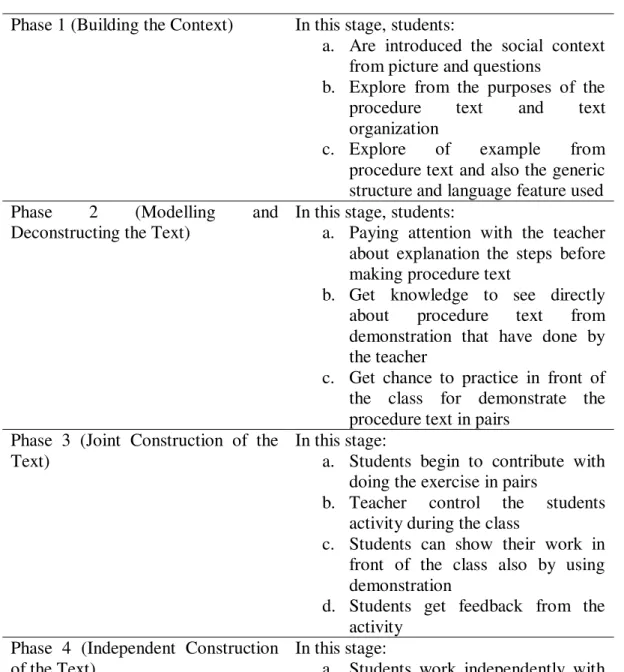
To teach students in writing procedure text, the researcher used the demonstration as a technique. The implementation from demonstration in teaching writing procedure text is in line with Genre Based Approach or it is called Text Based Teaching or Text Based Instruction (TBI). Feez & Joyce (1998, p. 28-31) give the following description of how a text-based approach is implemented:
Table 1. Description of How TBI is implemented Phase 1 (Building the Context) In this stage, students:
a. Are introduced the social context from picture and questions
b. Explore from the purposes of the procedure text and text organization
c. Explore of example from procedure text and also the generic structure and language feature used Phase 2 (Modelling and
Deconstructing the Text)
In this stage, students:
a. Paying attention with the teacher about explanation the steps before making procedure text
b. Get knowledge to see directly about procedure text from demonstration that have done by the teacher
c. Get chance to practice in front of the class for demonstrate the procedure text in pairs
Phase 3 (Joint Construction of the Text)
In this stage:
a. Students begin to contribute with doing the exercise in pairs
b. Teacher control the students activity during the class
c. Students can show their work in front of the class also by using demonstration
d. Students get feedback from the activity
Phase 4 (Independent Construction of the Text)
In this stage:
the material
b. Students can also get feedback form their independent activity Phase 5 (Linking to Related Text) In this stage:
a. Students have free to learn and apply their learning during home b. Students can also apply
independent learning in their home Based on the literature review and the framework above, it could be said that demonstration could achieve VWXGHQW¶V ability in writing procedure text.
Method of Research Form of Research
The aim of research is to know the achievement of teaching procedure text given to the Conversation Elementary III level students E-Colink Education Centre by using demonstration. There are various kinds of methods that can be applied in solving the problem. It is essential to describe the method to be used when research is conducted. The method of research is defined as the way to achieve the purpose of the research. Based on the purpose of research, the method, which is applied here must relevant to the problems of this research. The appropriate one to be used in this research is pre-experimental design on one-group pretest-posttest design.
Population and Sample a. Population
According the definition above, the population of this research are the students in the Conversations Elementary III E-Colink Education Centre Pontianak. There are five classes for this level with the total population is 41 students. b. Sample
In this research, the researcher took one class out of five classes. The researcher choose the class of Conversation Elementary III B because for the other classes teach by different teachers. The total numbers of students in class Conversation Elementary III B is 10 students.
Methods of Collecting the Data
In this research, the researcher applies the measurement technique to measure the students achievement in writing. The measurement is administered twice. The first measurement is called pretest, its purpose is to collect the data before the experiment is conducted, so that the researcher knows the students precondition before experiment. The second one is posttest, its purpose is to collect the data after the experimental treatments are given.
Instruments of Collecting the Data
a. The instruments for pre-test is writing test b. The instruments for post-test is writing test
¦
¦
t D D¦
2 D 1 N N N D D D t 2 2In relation to the problem formulation, technique of data analysis will present some analysis to find out the result of this research. After having the test, the data is analyzed through the following procedures:
1. Analyzing WKH VWXGHQWV¶ LQGLYLGXDO VFRUH RI SUHWHVW DQG SRVWWHVW
The students individual score can we get from the total number of each items to be evaluated
2. Analyzing the students means score of pretest and posttest
The mean score is the sum of the individual score divided by the total number of individual. The mean score is also called the average score can be formulated as follows:
Where:
= the mean score
= the total score of the students
= the number of the students who take the test
(Adopted from Hadi: 2004) 3. Analyzing the students mean score of pretest and posttest
&% = :$$$$2 - :$$$$1
Where:
&% = The different score of pre-test and post-test
:$$$$1 = The means score of pre-test
:$$$$2 = The means score of post-test
(Adapted from Hadi: 2004) 4. Analyzing the students significant score pre-test and post-test.
™;2 G ™G2 ± ™G2) N
Where:
= the t-value for correlated means
= the difference between the paired scores = the mean of the differences
= the sum of the squared difference scores = the number of pairs
(Adopted from Hadi: 2004)
To know the significant effect of the treatment, the researcher compares of X2-X1 to determine whether the treatment has differential effect on the
groups. Then t- test is used to analyze the treatment influence. The next stage, DQDO\]LQJ WKH HIIHFW RI WKH WUHDWPHQW LW LV FDOOHG ³(IIHFW 6L]H (6 ´ 7KH formula is as follows:
ES = P§1
0 Where:
ES : Effect size
T : The result of t-test N : Number of students
The result is categorized as follows:
(6 ” LV FDWHJRUL]HG DV ORZ
(6 ” LVcategorized as moderate. ES > 0,8 is categorized as high.
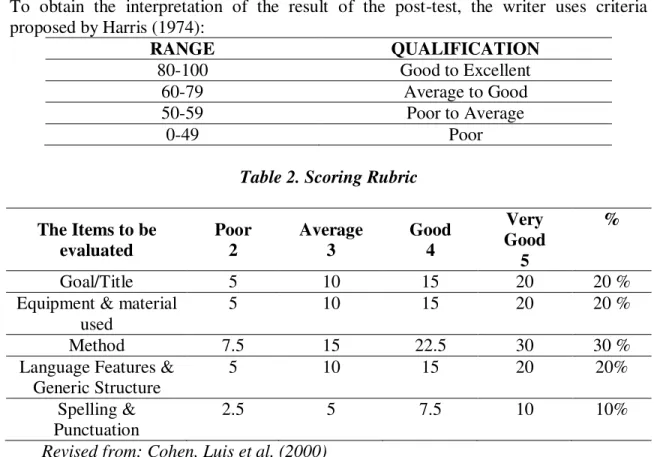
To obtain the interpretation of the result of the post-test, the writer uses criteria proposed by Harris (1974): RANGE QUALIFICATION 80-100 Good to Excellent 60-79 Average to Good 50-59 Poor to Average 0-49 Poor
Table 2. Scoring Rubric
The Items to be evaluated Poor 2 Average 3 Good 4 Very Good 5 % Goal/Title 5 10 15 20 20 %
Equipment & material used
5 10 15 20 20 %
Method 7.5 15 22.5 30 30 %
Language Features & Generic Structure
5 10 15 20 20%
Spelling & Punctuation
2.5 5 7.5 10 10%
Revised from: Cohen, Luis et al. (2000)
Research Findings and Discussions a. Findings
1.) The students mean score of pre-test
The pretest was given before the treatment or the process of teaching. The result of pre-test showed the total score of the students was 477.5 and the mean score of the students score was 47.75 and it is qualified was poor.
1 N N X D M t 2 d ) 1 10 ( 10 1285 23 t
2.) The students mean score of post-test
The post-test was held after the teaching or the treatments. The purpose of this test is to know the students achievement in writing skills by using procedure text through demonstration techniques. The total score of the students in this test was 707.5 and the mean score was 70.75. It is qualified was average to good.
3.) The students different score of pre-test and post-test
The students different score is taken based on the students mean score of post-test minus by the students mean score of the pre-test. In this research, the result showed that the students different score of pre-test and post-test is 23.
XD = X2 ± X1
= 70.75 ± 47.75 = 23
The students qualification score of pre-test and post-test:
Test Mean Qualification
Pre-test 47.75 Poor
Post-test 70.75 Average to Good
Interval 23
4.) The significance of the interval score of pre-test and post-test
The significance of the different score of pre-test and post-test was calculated by using t-test formula as follow:
™ ;2 G ™ G2 ± (Ã@) 2 0 = 6575 ± (230) 2 10 = 6575 ± 52.900 10 = 6575 ± 5290 = 1285
90 1285 23 t 27 . 14 23 t t = 23 3.77 = 6.10
From the result of computation above, it was obtained that the value of t-test observed is bigger than t-table. Thus, it means that the mean score of pre-test and post-test of the experiment group being observed have a significant difference.
The calculation of t-test indicates 6.10. First, the degree of freedom or df = N-1 (the number of students who take the test-1) is determined. There are 10 students who take the test in this research, then df = 9 (6.10 > 2.228).
5.) The analysis of the effect of the treatment
After counting the significant score of the pre-test and post-test, the writer describes the finding of the effect of the treatment in order to see how significant is the effect of the treatment in order to see how significant is the effect of the teaching writing procedure text through demonstration. The computation of effect of the treatment can be seen as follows:
ES = t§1 N = 6.10§1 10 = 6.10¾0.1 = 6.10(0.31) = 1.92
Based on the results, the significant score of the effect size is categorized as ³+LJKO\ (IIHFWLYH´ with ES > 0.8 (1.92 > 0.8). It means that teaching writing procedure text through demonstration give a high significant effect to increase the students achievement in writing procedure text.
b. Discussions
From the result of the computation of t-test, the t-value was higher than t-table (6.10 > 2.228). The t-table about 2.228 with the degree of freedom (df) : N-1 (10-9 = 1) at the level 0.05.
Based on the result that has been explained, the teaching writing procedure text through demonstration had the significance results for students achievement in writing procedure text. Therefore, the major hypothesis which VWDWHG WKDW ³7HDFKLQJ SURFHGXUH WH[W WKURXJK GHPRQVWUDWLRQ LV HIIHFWLYH WR LQFUHDVH WKH VWXGHQWV DFKLHYHPHQW´ is accpeted.
In implementing demonstration as a technique of teaching writing procedure text to the students, the researcher who was also became the teacher got some difficulties, as follows:
1. In preparing the material, the writer need more time.
2. The teacher needs extra time for make students calm and ready for the materials.
3. The teacher got short time to explain all of the material because the time that given.
4. The teacher should be prepare all the things to support the demonstration. Because that, the researcher also got some advantages when applying this technique to the students in teaching writing procedure text as follows:
1. Demonstration technique helps the students to start applying their idea in writing a procedure text, especially using the real things that make them more interest.
2. Demonstration is useful for the students to get the knowledge in writing a procedure text because demonstration is easy was to make them understand. 3. The students are more interactive in teaching and learning process because
they are encouraged to work in pairs or in individually when do the the test EHFDXVH WKH\¶UH QHYHU JRW WKLV WHFKQLTXH EHIRUH
Finally, based on the data anlysis, the researcher found that there was an increasing of the students achievement in writing a procedure text. It could be proven by comparing the mean score of the pre-test and post-test. Based on the score indicated students performance in post-test was better than in pre-test. This finding showed that there was a difference score of pre-test and post-test after receiving the treatments.
Conclusion and Suggestion a. Conclusion
Referring to the research findings and the analysis of the students test result, the writer draws conclusions as follow: (a). The students mean score of pre-test is 47.75 which is categorized as poor, (b). The students mean score of post-test is 70.75 which is categorized as average to good, (c). Teaching writing of a procedural text can increase students achievement. It is shown by the students score in post-test which is better than pre-test, (d). The students achievement has been improved with the interval score of pre-test and post-test is 23 (twenty three), (e). The obtain t-value of the differences of the tests is 6.10, whereas in t-table with 9 degrees of freedom at .05 level of significant is 2.228. From this result, we can conclude that the obtain t-value
is higher that the t-table (6.10 > 2.228). It indicates that the alternative Hypothesis (Ha) is accepted. It means that teaching procedure text through demonstration to the Conversation Elementary III at E-Colink Education Centre is effective to be applied, (f). Using demonstration is an effective way to teach writing of procedure text to the students. The students became encouraged to write, actively involved, paid more attention and interested in teaching and learning process. The students achievement is increased; the score of post-test is better than the score of pre-test (70.75 > 47.75) and the effectiveness of teaching procedural text through demonstration is categorized as highly effective with ES > 0.8 (1.92 > 0.8).
b. Suggestion
Referring to the conclusion and the discussion of the research, the writer provides some constructive suggestions for teacher, students, and future research as follows: (a). The teacher was suggested to use demonstration technique for their students in writing procedure text because this technique helped the students to be easier in constructing a procedure text and stimulated the students interaction and learning so that it makes the students are more interesting in teaching and learning process, (b). The teacher are also suggested to be more explain about the language use in procedure text for example form of present tense that used in writing of procedure text so the students can be more comprehend how to write a good procedure text and also the other characteristic of the structures of procedure text and sequence of time that used, (c). The students should be attention with the materials and less their noisy when their in the classroom, (d). For the future research, try to another technique for next research in writing procedure text to compare the result later.
Bibliography
Aimah, Siti. (2008). Demonstration as a Medium in the Teaching of Writing Procedure Text: An Action Research via http://jurnal.unimus.ac.id access on 13th June 2012 at 8.00 am
Anderson, Mark and Anderson Kathy. (1997). Text Type in English 2. Australia: Mackmillan
Anderson, Mark and Anderson. Kathy. (1998). Text Type in English 3. South Yarra: Macmillan Education Australia PTY LTD
Anthony, E. M. 1963. Approach, method and technique Enqlish Language Teaching 17: 63-7.
Badger, R. and White, G ³$ SURFHVV JHQUH DSSURDFK WR WHDFKLQJ ZULWLQJ´ ELT Journal 54(2): 153-160.
Barclay, Elley J. And Vynckt, Susan Van der. (1984). Easy to Make Teaching Aids for Nutrition Teaching-Learning. Paris: UNESCO
Brown, H. D.(1992). Language Assessment Principles and Classroom Practice. New York: Longman
Cohen, Luis et al. (2000). Research Method in Education. Fifth Edition. London and New York: Routledge-Falmer is an imprint of the Taylor and Francis Group Derewianka, Beverly. (1995). Exploring How Text Work. Newtown: Primary English
Teaching Association.
Derewianka, Beverly. (2004). Exploring How Texts Work. Australia: Primary English Teaching Association
Djajasastra, Joesoef. (1982). Metode-Metode Mengajar. Bandung: Angkasa
Feez, S., and H. Joyce. (1998). Text-Based Syllabus Design. Australia: Macquarie University
Firkins, Arthur, Forey, Gail and Sengupta, Sima. (2007). A Genre-Based Literacy Pedagogy: Teaching Writing to Low Proficiency EFL Students. Hongkong: English Language Teaching Journal
Hadi, Sutrisno. (2004). Metodologi Research 3. Yogyakarta: ANDI
Hairston, M. ³7KH ZLQGV RI FKDQJH 7KRPDV .XKQ DQG WKH UHYROXWLRQ LQ WKH WHDFKLQJ RI ZULWLQJ´ &ROOHJH &RPSRVLWLRQ DQG &RPPXQLFDWLRQ -88. Hammond, Jennifer and Derewianka, B. (2001). Genre. In Carter, R. And Nunan, D.
The Cambridge Guide to Teaching English to Speakers of Other Language. (pp.186-193). Cambridge University Press.
Harris, David P. (1974). Testing English as a Second Language. New Jersey: Mc. Graw Hill-Hall Book Company
Harmer, Jeremy. (2004). How To Teach Writing. New York: Longman Inc
Haycraft, J. 1978. An Introduction to English Language Teaching. London: Longman. Hyland, Ken. (2003). Genre and Second Language Writing. USA: The University of
Michigan Press
Mangubhai, Francis and Pritchard, Ruth. (1996). English on Cue-Developing Skills in English Language. Queensland: USQ Press
2¶ %ULHQ 7HUHVD ³:ULWLQJ LQ D IRUHLJQ ODQJXDJH 7HDFKLQJ DQG OHDUQLQJ´
Integrated approaches to improve students writing skills For English Major Students Language Teaching 37: 1-28.
Paltridge, B. (2001). Genre and the language learning classroom. Michigan: University of Michigan
Porter De Bobbi & Hernack Mike. (2004). QuantumTeaching. Bandung: Kaifa
Raimes, Ann. (1983). Techniques in Teaching Writing. (pp.1-30). Oxford: Oxford University Press
Richards, J.C. (2006). Communicative Language Teaching Today. Cambridge: Cambridge University Press
Richards, J.C and Renandya, W. A. (2002). Methodology in Language Teaching: An Anthology of Current Practice. Cambridge: Cambridge University Press
Siahaan, Sanggam. (2007). Issues in Linguistics. Pematangsiantar: Graha Ilmu
Silva, T. (1990). Second language composition instruction: Developments, issues, and directions in ESL. In B. Kroll (Ed.) Second Language Writing: Research Insights for the Classroom. (pp.11-36). New York: Cambridge University Press.
Tangpermpoon, Thanatkun. (2008). Integrated Approaches to Improve Students Writing Skills for English Major Students. Retrieved June 10th 2012 from ABC Journal Vol. 28, No. 2