Testing Conditional Independence on Discrete Data
using Stochastic Complexity
Alexander Marx
Max Planck Institute for Informatics, and Saarland University
Saarbrücken, Germany [email protected]
Jilles Vreeken
CISPA Helmholtz Center for Information Security, and Max Planck Institute for Informatics
Saarbrücken, Germany [email protected]
Abstract
Testing for conditional independence is a core aspect of constraint-based causal discovery. Although commonly used tests are perfect in theory, they often fail to reject independence in practice, especially when conditioning on multiple variables. We focus on discrete data and propose a new test based on the notion of algorithmic independence that we instantiate using stochastic complexity. Amongst others, we show that our proposed test,SCI, is an asymptotically unbiased as well asL2 consistent estimator for conditional mutual information (CMI). Further, we show
thatSCIcan be reformulated to find a sensible threshold forCMI that works well
on limited samples. Empirical evaluation shows thatSCI has a lower type II error
than commonly used tests. As a result, we obtain a higher recall when we useSCI
in causal discovery algorithms,withoutcompromising the precision.
1
Introduction
Testing for conditional independence plays a key role in causal discovery (Spirtes et al., 2000). If the true probability distribution of the observed data is faithful to the underlying causal graph, conditional independence tests can be used to recover the undirected causal network. In essence, under the faithfulness assumption (Spirtes et al., 2000) finding that two random variablesX andY are conditionally independent given a set of random variablesZ, denoted asX ⊥⊥Y |Z, implies that there is no direct causal link betweenXandY.
As an example, consider Figure 1. NodesF and T are d-separated givenD, E. Based on the faithfulness assumption, we can identify this from i.i.d. samples of the joint distribution, asF will be independent ofT givenD, E. In contrast,D6⊥⊥T |E, F, as well asE6⊥⊥T |D, F.
Conditional independence testing is also important for recovering the Markov blanket of a target node—i.e. the minimal set of variables, conditioned on which all other variables are independent of the target (Pearl, 1988). There exist classic algorithms that find the correct Markov blanket with provable guarantees (Margaritis and Thrun, 2000; Peña et al., 2007). These guarantees, however, only hold under the faithfulness assumption and given aperfectindependence test.
In this paper, we are not trying to improve these algorithms, but rather propose a new independence test to enhance their performance. Recently a lot of work focuses on tests for continuous data; methods ranging from approximating continuous conditional mutual information (Runge, 2018) to kernel based methods (Zhang et al., 2011), we focus on discrete data.
For discrete data, two tests are frequently used in practice, theG2test (Aliferis et al., 2010; Schlüter, 2014) and conditional mutual information (CMI) (Zhang et al., 2010). While the former is
theoreti-cally sound, it is very restrictive as it has a high sample complexity; especially when conditioning on
F
D
E
T
Figure 1: [d-Separation] Given the above causal DAG it holds thatF ⊥⊥T |D, E, orFis d-separated ofT givenD, Eunder the faithfulness assumption. Note thatD6⊥⊥T |E, F andE6⊥⊥T |D, F. multiple random variables. When used in algorithms to find the Markov blanket, for example, this leads to low recall, as there it is necessary to condition on larger sets of variables.
If we had access to the true distributions, conditional mutual information would be the perfect criterium for conditional independence. EstimatingCMI purely from limited observational data
leads, however, to discovering spurious dependencies—in fact, it is likely to find no independence at all (Zhang et al., 2010). To useCMIin practice, it is therefore necessary to set a threshold. This is
not an easy task, as the threshold should depend on both the domain sizes of the involved variables as well as the sample size (Goebel et al., 2005). Recently, Canonne et al. (2018) showed that instead of exponentially many samples, theoreticallyCMI has only a sub-linear sample complexity, although
an algorithm is not provided. Closest to our approach is the work of Goebel et al. (2005) and Suzuki (2016). The former show that the empirical mutual information follows the gamma distribution, which allows them to define a threshold based on the domain sizes of the variables and the sample size. The latter employs an asymptotic formulation to determine the the threshold forCMI.
The main problem of existing tests is that these struggle to find the right balance for limited data: either they are too restrictive and declare everything as independent or not restrictive enough and do not find any independence. To tackle this problem, we build upon algorithmic conditional independence, which has the advantage that we not only consider the statistical dependence, but also the complexity of the distribution. Although algorithmic independence is not computable, we can instantiate this ideal formulation with stochastic complexity. In essence, we compute stochastic complexity using either factorized or quotient normalized maximum likelihood (fNML and qNML) (Silander et al., 2008, 2018), and formulateSCI, theStochastic complexity basedConditionalIndependence criterium. Importantly, we show that we can reformulateSCI to find a natural threshold forCMIthat works
very well given limited data and diminishes given enough data. In the limit, we prove thatSCI is
an asymptotically unbiased andL2consistent estimator ofCMI. For limited data, we find that the qNML threshold behaves similar to Goebel et al. (2005)—i.e. it considers the sample size as well as the dimensionality of the data. The fNML threshold, however, additionally considers the estimated probability mass functions of the conditioning variables. In practice, this reduces the type II error. Moreover, when applyingSCIbased on fNML in constraint based causal discovery algorithms, we
observe a higher precision and recall than related tests. In addition, in our empirical evaluationSCI
shows a sub-linear sample complexity.
In this work we build upon and extend the basic ideas we first presented as (Marx and Vreeken, 2018). Here we specifically focus on the theory and properties of using stochastic complexity for measuring conditional independence. Those readers that are interested in how SCI can be used in the discovery of directed Markov blankets we refer to (Marx and Vreeken, 2018).
For conciseness, we postpone some proofs and experiments to the supplemental material. For reproducibility of our experiments we make our code available online1 and released an efficient
version ofSCI in the R-packageSCCI.
2
Conditional Independence Testing
In this section, we introduce the notation and give brief introductions to both standard statistical conditional independence testing, as well as to the notion of algorithmic conditional independence. Given three possibly multivariate random variablesX,Y andZ, our goal is to test the conditional independence hypothesisH0: X ⊥⊥Y | Zagainst the general alternativeH1:X 6⊥⊥Y | Z. The
main goal of a good independence test is to minimize the type I and type II error. The type I error is defined as falsely rejecting the null hypothesis and the type II error is defined as falsely accepting the null hypothesis.
A well known theoretical measure for conditional independence is conditional mutual information based on Shannon entropy (Cover and Thomas, 2006).
Definition 1Given random variablesX,Y andZ. If
I(X;Y |Z) :=H(X |Z)−H(X|Z, Y) = 0
thenX andY are called statistically independent givenZ.
In theory, conditional mutual information (CMI) works perfectly as an independence test for discrete
data. However, this only holds if we are given the true distributions of the random variables. In practice, those are not given. On a limited sample the plug-in estimator tends to underestimates conditional entropies, and as a consequence, the conditional mutual information is overestimated— even for completely independent data, as in the following Example.
Example 1 Given three random variablesX1,X2andY, with resp. domain sizes1 000,8and4. Suppose that we are given1 000samples over their joint distribution and find thatHˆ(Y |X1) =
ˆ
H(Y | X2) = 0. That is, Y is a deterministic function ofX1, as well as ofX2. However, as |X1|= 1 000, and given only1 000samples, it is likely that we will have only a single sample for eachv∈ X1. That is, finding thatHˆ(Y |X1) = 0is likely due to the limited amount of samples, rather than that it depicts a true (functional) dependency, whileHˆ(Y |X2) = 0is more likely to be due to a true dependency, since the number of samplesn |X2|—i.e. we have more evidence. A possible solution is to set a thresholdtsuch thatX ⊥⊥Y |Z ifI(X;Y | Z)≤t. Settingtis, however, not an easy task, astis dependent on the quality of the entropy estimate, which by itself strongly depends on the complexity of the distribution and the given number of samples. Instead, to avoid this problem altogether, we will base our test on the notion ofalgorithmicindependence. 2.1 Algorithmic Independence
To define algorithmic independence, we need to give a brief introduction to Kolmogorov complexity. The Kolmogorov complexity of a finite binary stringxis the length of the shortest binary programp∗ for a universal Turing machineU that generatesx, and then halts (Kolmogorov, 1965; Li and Vitányi, 1993). Formally, we have
K(x) = min{|p| |p∈ {0,1}∗,U(p) =x}.
That is, programp∗is the most succinctalgorithmicdescription ofx, or in other words, the ultimate lossless compressor for that string. To define algorithmic independence, we will also need conditional Kolmogorov complexity,K(x|y)≤K(x), which is again the length of the shortest binary program
p∗that generatesx, and halts, but now givenyas input for free.
By definition, Kolmogorov complexity makes maximal use of any effective structure inx; structure that can be expressed more succinctly algorithmically than by printing it verbatim. As such it is the theoretical optimal measure for complexity. In this point, algorithmic independence differs from statistical independence. In contrast to purely considering the dependency between random variables, it also considers the complexity of the process behind the dependency.
Let us consider Example 1 again and letx1,x2, andybe the binary strings representingX1, X2and Y. AsY can be expressed as a deterministic function ofX1orX2,K(y|x1)andK(y|x2)reduce
to the programs describing the corresponding function. As the domain size ofX2is8and|Y|= 4, the program to describeY fromX2only has to describe the mapping from8to4values, which will be shorter than describing a mapping fromX1toY, since|X1|= 1 000—i.e.K(y|x2)≤K(y|x1)in
contrastHˆ(Y |X
1) = ˆH(Y |X2). To rejectY ⊥⊥X|Z, we test whether providing the information ofX leads to a shorter program than only knowingZ. Formally, we define algorithmic conditional independence as follows (Chaitin, 1975).
Definition 2Given the stringsx, yandz, We writez∗ to denote the shortest program forz, and analogously(z, y)∗for the shortest program for the concatenation ofzandy. If
IA(x;y|z) :=K(x|z∗)−K(x|(z, y)∗) +
holds up to an additive constant that is independent of the data, thenxandyare called algorithmically independent givenz.
Due to the halting problem Kolmogorov complexity is not computable, however, nor approximable up to arbitrary precision (Li and Vitányi, 1993). The Minimum Description Length (MDL) princi-ple (Grünwald, 2007) provides a statistically well-founded approach to approximate it from above. For discrete data, this means we can use the stochastic complexity for multinomials (Kontkanen and Myllymäki, 2007), which belongs to the class of refined MDL codes.
3
Stochastic Complexity for Multinomials
Givennsamples of a discrete univariate random variableXwith a domainXof|X |=kdistinct values,xn ∈ Xn, letθˆ(xn)denote the maximum likelihood estimator for xn. Shtarkov (1987) defined the mini-max optimalnormalized maximum likelihood (NML)
PNML(xn | Mk) =
P(xn|θˆ(xn),Mk) Cn
Mk
, (1)
where the normalizing factor, or regretCn
Mk, relative to the model classMkis defined as
CMn k= X
˜ xn∈Xn
P(˜xn |θˆ(˜xn),Mk). (2) The sum goes over every possiblex˜nover the domain ofX, and for each considers the maximum likelihood for that data given model classMk. Whenever clear from context, we drop the model class to simplify the notation—i.e. we writePNML(xn)forPNML(xn| Mk)andCknto refer toCMn k.
For discrete data, assuming a multinomial distribution, we can rewrite Eq. (1) as (Kontkanen and Myllymäki, 2007) PNML(xn) = Qk j=1 |vj| n |vj| Cn k , writing|vj|for the frequency of valuevjinxn, resp. Eq. (2) as
Cn k = X |v1|+···+|vk|=n n! |v1|!· · · |vk|! k Y j=1 |v j| n |vj| .
Mononen and Myllymäki (2008) derived a formula to calculate the regret in sub-linear time, meaning that the whole formula can be computed in linear time w.r.t.n.
We obtain the stochastic complexity forxnby simply taking the negative logarithm ofPNML, which
decomposes into a Shannon-entropy and the log regret
S(xn) =−logPNML(xn), =nHˆ(xn) + logCkn. 3.1 Conditional Stochastic Complexity
Conditional stochastic complexity can be defined in different ways. We consider factorized normalized maximum likelihood (fNML) (Silander et al., 2008) and quotient normalized maximum likelihood (qNML) (Silander et al., 2018), which are equivalent except for the regret terms.
Givenxnandyndrawn from the joint distribution of two random variablesXandY, wherekis the size of the domain ofX. Conditional stochastic complexity using the fNML formulation is defined as
Sf(xn|yn) = X v∈Y −logPNML(xn |yn=v) =X v∈Y |v|Hˆ(xn|yn=v) +X v∈Y logCk|v|,
whereyn =vdenotes the set of samples for whichY =v,Ythe domain ofY with domain sizel, and|v|the frequency of a valuevinyn.
Analogously, we can define conditional stochastic complexitySqusing qNML (Silander et al., 2018). We prove all important properties of our independence test for both fNML and qNML definitions, but for conciseness, and becauseSfperforms superior in our experiments, we postpone the definition of Sq and the related proofs to the supplemental material.
In the following, we always consider the sample sizenand slightly abuse the notation by replacing
S(xn)byS(X), similar so for the conditional case. We refer to conditional stochastic complexity as S and only useSforSqwhenever there is a conceptual difference. In addition, we refer to the regret terms of the conditionalS(X |Z)asR(X|Z), where
Rf(X|Z) =
X
z∈Z
logC|X ||z| .
Next, we show that the regret term is log-concave inn, which is a property we need later on. Lemma 1 Forn ≥1, the regret termCn
k of the multinomial stochastic complexity of a random variable with a domain size ofk≥2is log-concave inn.
For conciseness, we postpone the proof of Lemma 1 to the supplementary material. Based on Lemma 1 we can now introduce Theorem 1 that is essential for our proposed independence test. Theorem 1 Given three random variablesX,Y andZ, it holds thatRf(X |Z)≤ Rf(X |Z, Y). Proof: Consider thatZcontainspdistinct value combinations{r1, . . . , rp}. If we addY toZ, the number of distinct value combinations,{l1, . . . ,q}, increases toq, wherep≤q. Consequently, to show that Theorem 1 is true, it suffices to show that
p X i=1 logC|ri| k ≤ q X j=1 logC|lj| k (3) wherePp
i=1|ri|=Pqj=1|lj|=n. Next, consider w.l.o.g. that each value combination{ri}i=1,...,p is mapped to one or more value combinations in{l1, . . . ,q}. Hence, Eq. (3) holds, if thelogCknis sub-additive inn. Since we know from Lemma 1 that the regret term is log-concave inn, sub-additivity
follows by definition.
Now that we have all the necessary tools, we can define our independence test in the next section.
4
Stochastic Complexity based Conditional Independence
With the above, we can now formulate our new conditional independence test, which we will refer to as theStochastic complexity basedConditionalIndependence criterium, orSCI for short.
Definition 3LetX,Y andZbe random variables. We say thatX ⊥⊥Y |Z, if
SCI(X;Y |Z) :=S(X |Z)−S(X |Z, Y)≤0. (4) In particular, Eq. 4 can be rewritten as
SCI(X;Y |Z) =n·I(X;Y |Z)
+R(X |Z)− R(X |Z, Y).
From this formulation, we see that the regret terms formulate a thresholdtSfor conditional mutual
information, wheretS =R(X |Z, Y)− R(X|Z). From Theorem 1 we know that if we instantiate
SCI using fNML thatR(X |Z, Y)− R(X |Z)≥0. Hence,Y has to provide a significant gain such thatX 6⊥⊥Y |Z—i.e. we needHˆ(X|Z)−Hˆ(X |Z, Y)> tS/n.
4.1 Factorized SCI
To formulate our independence test based on factorized normalized maximum likelihood, we have to revisit the regret terms again. In particular,Rf(X |Z)is only equal toRf(Y |Z), when the domain size ofXis equal to the domain ofY. Further,Rf(X|Z)− Rf(X |Z, Y)is not guaranteed to be equal toRf(Y |Z)− Rf(Y |Z, X). As a consequence,
ISf(X;Y |Z) :=Sf(X |Z)−Sf(X|Z, Y) is not always equal to
ISf(Y;X |Z) :=Sf(Y |Z)−Sf(Y |Z, X). To achieve symmetry, we formulateSCIfas
SCIf(X;Y |Z) := max{ISf(X;Y |Z), I
f
S(Y;X |Z)}
and say thatX ⊥⊥Y |Z, ifSCIf(X;Y |Z)≤0.
There are other ways to achieve such symmetry, such as via an alternative definition of conditional mutual information. However, as we show in detail in the supplementary, there exist serious issues with these alternatives when instantiated with fNML.
Instead of the exact fNML formulation, it is also possible to use the asymptotic approximation of stochastic complexity (Rissanen, 1996), which was done by Suzuki (2016) to approximateCMI. In
practice, the corresponding test (JIC) is, however, very restrictive, which leads to low recall.
In the next section, we show the main properties forSCI using fNML. Thereafter, we compareSCI
toCMI using the threshold based on the gamma distribution (Goebel et al., 2005), and empirically
evaluate the sample complexity ofSCI.
4.2 Properties of SCI
In the following, for readability, we writeSCI to refer to properties that hold for both versions of SCI,SCIf andSCIq.
First, we show that ifX⊥⊥Y |Z, we have thatSCI(X;Y |Z)≤0. Then, we prove that n1SCI is
an asymptotically unbiased estimator of conditional mutual information and isL2consistent. Note that by dividingSCI bynwe do not change the decisions we make as long asn <∞. Since we only acceptH0ifSCI ≤0, any positive output will still be>0after dividing it byn.
Theorem 2 IfX ⊥⊥Y |Z,SCI(X;Y |Z)≤0.
Proof: W.l.o.g. we can assume thatISf(X;Y |Z)>=ISf(Y;X |Z). Based on this, it suffices
to show thatISf(X;Y |Z)≤0ifX ⊥⊥Y |Z. As the first part ofISfconsists ofn·I(X;Y |Z),
it will be zero by definition. We know thatRf(X |Z)− Rf(X |Z, Y)≤0(Theorem 1), which
concludes the proof.
Next, we show that 1
nSCI converges against conditional mutual information and hence is an asymp-totically unbiased estimator of conditional mutual information and isL2consistent to it.
Lemma 2 Given three random variablesX,Y andZ, it holds thatlimn→∞1nSCI(X;Y |Z) = I(X;Y |Z).
Proof: To show the claim, we need to show that
lim
n→∞I(X;Y |Z) +
1
n(R(X |Z)− R(X|Z, Y)) = 0.
The proof forISf(Y;X | Z)follows analogously. In essence, we need to show that n1(R(X | Z)− R(X |Z, Y))goes to zero asngoes to infinity. From Rissanen (1996) we know thatlogCn k asymptotically behaves likek−1
2 logn+O(1). Hence, 1 nR(X |Z)and 1 nR(X |Z, Y)will approach zero ifn→ ∞.
As a corollary to Lemma 2 we find that 1
nSCI is an asymptotically unbiased estimator of conditional mutual information and isL2consistent to it.
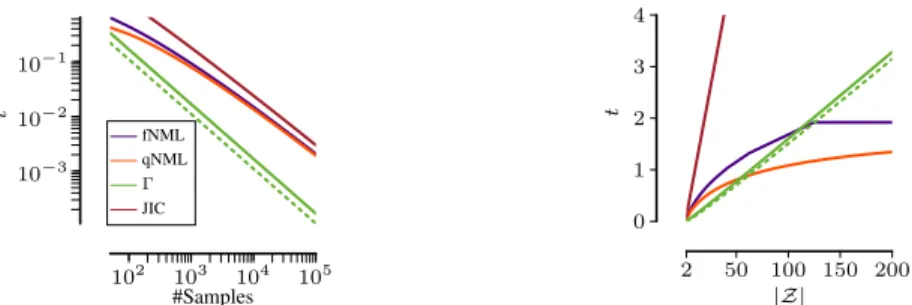
102 103 104 105 10−3 10−2 10−1 #Samples t fNML qNML Γ JIC 2 50 100 150 200 0 1 2 3 4 |Z| t
Figure 2: Threshold forCMIusing fNML, qNML,JIC and the gamma distribution withα= 0.05
(solid) andα= 0.001(dashed) for different sample sizes and fixed domain sizes equal to four (left)
and fixed sample size of500and changing domain sizes (right).
Theorem 3 LetX,Y andZ be discrete random variables. Thenlimn→∞E[n1SCI(X;Y|Z)] = I(X;Y|Z), i.e. n1SCI is an asymptotically unbiased estimator for conditional mutual information. Theorem 4 LetX,Y andZ be discrete random variables. Thenlimn→∞E[(n1SCI(X;Y|Z)− I(X;Y|Z))2] = 0i.e. 1
nSCI is anL2consistent estimator for conditional mutual information. Next, we compare both of our tests to the findings of Goebel et al. (2005).
4.3 Link to Gamma Distribution
Goebel et al. (2005) estimate conditional mutual information through a second-order Taylor series and show that their estimator can be approximated with the gamma distribution. In particular, they state that ˆ I(X;Y |Z)∼Γ |Z| 2 (|X | −1)(|Y| −1), 1 nln 2 ,
whereX,Y andZ refer to the domains ofX,Y andZ. This means by selecting a significance thresholdα, we can derive a threshold forCMI based on the gamma distribution—for convenience
we call this thresholdtΓ. In the following, we comparetΓagainsttS =R(X |Z, Y)− R(X |Z).
First of all, for qNML, liketΓ,tS depends purely on the sample size and the domain sizes. However,
we consider the difference in complexity between only conditioningXonZand the complexity of conditioningXonZandY. For fNML, we have the additional aspect that the regret terms for both R(X |Z)andR(X |Z, Y)also relate to the probability mass functions ofZ, and respectively the Cartesian product ofZandY. Recall that forkbeing the size of the domain ofX, we have that
Rf(X |Z) =X
z∈Z
logCk|z|. AsCn
k is log-concave inn(Lemma 1),Rf(X|Z)is maximal ifZis uniformly distributed—i.e. it is maximal whenH(Z)is maximal. This is a favourable property, as the probability thatZis equal to Xis minimal for uniformZ, as stated in the following Lemma (Cover and Thomas, 2006). Lemma 3IfX andY are i.i.d. with entropyH(Y), thenP(Y =X)≥2−H(Y)with equality if and only ifY has a uniform distribution.
To elaborate the link betweentΓandtS, we compare them empirically. In addition, we compare
the results to the threshold provided from theJIC test. First, we comparetΓ withα= 0.05and α= 0.001totS/nfor fNML and qNML, andJIC on fixed domain sizes, with|X |=|Y|=|Z|= 4
and varying the sample sizes (see Figure 2). For fNML we computed the worst case threshold under the assumption thatZis uniformly distributed. In general, the behaviour for each threshold is similar, whereas qNML, fNML andJIC are more restrictive thantΓ.
Next, we keep the sample size fix at500and increase the domain sizes ofZfrom2to200, to simulate
multiple variables in the conditioning set. Except toJIC, which seems to overpenalize in this case,
we observe that fNML is most restrictive until we reach a plateau when|Z|= 125. This is due to the
fact that|Z||Y|= 500and hence each data point is assigned to one value in the Cartesian product.
We have thatRf(X |Z, Y) =|Z||Y|C1 k.
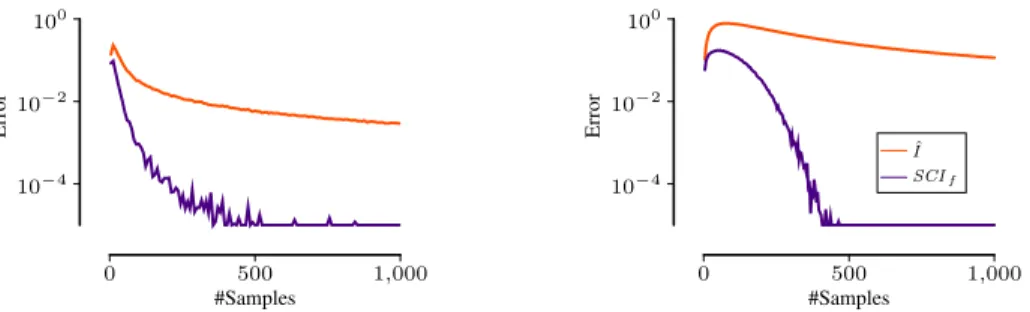
0 500 1,000 10−4 10−2 100 #Samples Error 0 500 1,000 10−4 10−2 100 #Samples Error ˆ I SCIf
Figure 3: Error forSCIfandIˆcompared toI, whereI(X;Y|Z)=0. Left:|X |=|Y|=2and|Z|=4. Right:|X |=|Y|=4and|Z|=16. Values smaller than10−5are truncated to10−5.
It is important to note, however, that the thresholds that we computed for fNML assume thatZandY are uniformly distributed andY ⊥⊥Z. In practice, when this requirement is not fulfilled, the regret term of fNML can be smaller than this value, since it is data dependent. In addition, it is possible that the number of distinct values that we observe from the joint distribution ofZandY is smaller than their Cartesian product, which also reduces the difference in the regret terms for fNML.
4.4 Empirical Sample Complexity
In this section, we empirically evaluate the sample complexity ofSCIf, where we focus on the type I error, i.e. H0: X ⊥⊥Y | Z is true and henceI(X;Y | Z) = 0. We generate data accordingly and draw samples from the joint distribution, where we setP(x, y, z) = 1
|X ||Y||Z| for each value configuration(x, y, z)∈ X × Y × Z. Per sample size we draw1 000data sets and report the average
absolute error forSCIfand the empirical estimator of CMI,Iˆ. We show the results for two cases in Fig. 3. We observe that in contrast to the empirical plug-in estimatorIˆ,SCI
f quickly approaches zero, and that the difference is especially large for larger domain sizes.
In the supplemental material we give a more in depth analysis alltogether. Our evaluation suggest that the sample complexity is sub-linear. In particular, we find that the number of samplesnrequired such thatP(|SCInf(X;Y | Z)/n−I(X;Y | Z)| ≥ ) ≤δ, with= δ = 0.05is smaller than 35 + 2|X ||Y|2/3(|Z|+ 1).
To illustrate this, consider the left example in Figure 3 again. We observe that for=δ = 0.05,
nneeds to be at least52, which is smaller than the value from our empirical bound function, that
is equal to67. If we require = 0.01andδ = 0.05, we observe thatnmust be at least 72. In
comparison, forI,ˆ nneeds to be at least140for= 0.05and684for= 0.01.
4.5 Discussion
The main idea for our independence test is to approximate conditional mutual information through algorithmic conditional independence. In particular, we estimate conditional entropy with stochastic complexity. We recommendSCIf, since the regret for the entropy term does not only depend on the sample size and the domain sizes of the corresponding random variables, but also on the probability mass function of the conditioning variables. In particular, when fixing the domain sizes and the sample size, higher thresholds are assigned to conditioning variables that are unlikely to be equal to the target variable.
By assuming a uniform distribution for the conditioning variables and hence eliminating this data dependence fromSCIf, it behaves similar toSCIq andCMI where the threshold is derived from the gamma distribution (Goebel et al., 2005).SCIfis more restrictive and the penalty terms of all three decrease exponentially w.r.t. the sample size.
SCI can also be extended for sparsification, as is possible to derive an analytical p-value for the
significance of a decision using the no-hypercompression inequality (Grünwald, 2007; Marx and Vreeken, 2017).
Last, note that as we here instantiateSCI using stochastic complexity for multinomials, we implicitly
assume that the data follows a multinomial distribution. In this light, it is important to note that stochastic complexity is a mini-max optimal refined MDL code (Grünwald, 2007). This means that for any data, we obtain a score that is within a constant term from the best score attainable given our model class. The experiments verify that indeed,SCI performs very well, even when the data is
sampled adversarially.
5
Experiments
In this section, we empirically evaluate SCI based on fNML and compare it to the alternative
formulation using qNML. In addition, we compare it to theG2test from thepcalgR package (Kalisch et al., 2012),CMIΓ(Goebel et al., 2005) andJIC (Suzuki, 2016).
5.1 Identifying d-Separation
To test whetherSCI can reliably distinguish between independence and dependence, we generate
data as depicted in Figure 1, where we drawFfrom a uniform distribution and model a dependency fromXtoY by simply assigning uniformly at random eachx∈ Xto ay∈ Y. We set the domain size for each variable to4and generate data under various samples sizes (100–2 500) and additive
uniform noise settings (0%–95%). For each setup we generate200data sets and assess the accuracy.
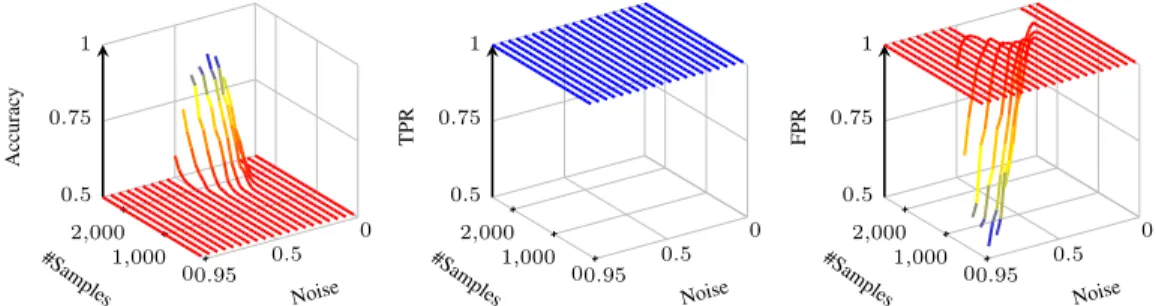
In particular, we report the correct identifications ofF ⊥⊥T |D, Eas the true positive rate and the false identificationsD ⊥⊥T | E, F orE ⊥⊥ T |D, F as false positive rate.2 For theG2test and
CMIΓwe selectα= 0.05, however, we found no significant differences forα= 0.01.
In the interest of space we only plot the accuracy of the best performing competitors in Figure 4 and report the remaining results as well as the true and false positive rates for each approach in the supplemental material. Overall, we observe thatSCIfperforms near perfect for less than70% additive noise. When adding70% or more noise, the type II error increases. Those results are
even better than expected as from our empirical bound function we would suggest that at least
378samples are required to have reliable results for this data set. SCIq has a similar but slightly worse performance. In contrast, CMIΓ only performs well for less than30%noise and fails to identify true independencies after more than30%noise has been added, which leads to a high type
I error. TheG2test has problems with sample sizes up to500and performs inconsistently given
more than35%noise. Note that we forcedG2to decide for every sample size, while the minimum number of samples recommended forG2 on this data set would be1 440, which corresponds to 10(|X | −1)(|Y| −1)(|Z|).
5.2 Changing the Domain Size
Using the same data generator as above, we now consider a different setup. We fix the sample size to
2 000and use only10%additive noise—a setup where all tests performed well. What we change is
the domain size of the sourceFfrom2to20while also restricting the domain sizes of the remaining
variable to the same size. For each setup we generate200data sets.
From the results in Figure 5 we can clearly see that onlySCIf is able to deal with larger domain sizes as for all other test, the false positive rate is at100%for larger domain sizes, resulting in an
accuracy of50%.
5.3 Plug and Play with SCI
Last, we want to show howSCI performs in practice. To do this, we run the stable PC
algo-rithm (Kalisch et al., 2012; Colombo and Maathuis, 2014) on theAlarmnetwork (Scutari and Denis, 2014) from which we generate data with different sample sizes and average over the results of10
runs for each sample size. We equip the stable PC algorithm withSCIf,SCIq,JIC,CMIΓand the default, theG2test, and plot the averageF1score over the undirected graphs in Figure 6. We
observe that our proposed test,SCIf outperforms the other tests for each sample size with a large margin and especially for small sample sizes.
2For0%noise,Fhas all information aboutDandE. Hence, in this specific case,D 6⊥⊥T |E, F and
0 1,000 2,000 0 0.5 0.95 0.5 0.75 1 #Samples Noise Accurac y (a)SCIf 0 1,000 2,000 0 0.5 0.95 0.5 0.75 1 #Samples Noise Accurac y (b)SCIq 0 1,000 2,000 0 0.5 0.95 0.5 0.75 1 #Samples Noise Accurac y (c)CMIΓ 0 1,000 2,000 0 0.5 0.95 0.5 0.75 1 #Samples Noise Accurac y (d)G2
Figure 4: [Higher is better] Accuracy ofSCIf,SCIq,CMIΓ andG2for identifyingd-separation using varying samples sizes and additive noise percentages, where a noise level of0.95refers to95%
additive noise. 2 5 10 20 0.5 0.75 1 |F| Accurac y SCIf SCIq CMIΓ G2 JIC
Figure 5: [Higher is better] d-Separation with2 000samples and10%noise on different domain sizes
of the source nodeF.
As a second practical test, we compute the Markov blanket for each node in theAlarmnetwork and report the precision and recall. To find the Markov blankets, we run the PCMB algorithm (Peña et al., 2007) with the four independence tests. We plot the precision and recall for each variant in Figure 7. We observe that againSCIfperforms best—especially with regard to recall. As for Markov blankets of sizekit is necessary to condition on at leastk−1variables, this advantage in recall can be linked
back toSCIfbeing able to correctly detect dependencies for larger domain sizes.
6
Conclusion
In this paper we introducedSCI, a new conditional independence test for discrete data. We derive SCI from algorithmic conditional independence and show that it is an unbiased asymptotic estimator
for conditional mutual information (CMI). Further, we show how to useSCI to find a threshold for CMI and compare it to thresholds drawn from the gamma distribution.
In particular, we propose to instantiateSCI using fNML as in contrast to using qNML or thresholds
drawn from the gamma distribution, fNML does not only make use of the sample size and domain sizes of the involved variables, but also utilizes the empirical probability mass function of the
0.1 0.5 1 2 5 10 20 0 0.2 0.4 0.6 0.8 1 #Samples (×1 000) F1 G2 CMIΓ JIC SCIq SCIf
Figure 6: [Higher is better]F1score on undirected edges for stable PC usingSCIf,SCIq,JIC,
CMIΓandG2on theAlarmnetwork for different sample sizes
1 5 10 20 0 0.2 0.4 0.6 0.8 1 #Samples (×1 000) Precision SCIf SCIq
CMIΓ G2 JIC 1 5 10 20 0 0.2 0.4 0.6 0.8 1 #Samples (×1 000) Recall
Figure 7: [Higher is better] Precision (left) and recall (right) for PCMB usingSCIf,SCIq,JIC,
CMIΓandG2to identify all Markov blankets in theAlarmnetwork for different sample sizes.
conditioning variable. Moreover, we observe thatSCIfclearly outperforms its competitors on both synthetic and real world data. Last but not least, our empirical evaluations suggest thatSCI has a
sub-linear sample complexity, which we would like to theoretically validate in future work. Acknowledgements
The authors would like to thank David Kaltenpoth for insightful discussions. Alexander Marx is supported by the International Max Planck Research School for Computer Science (IMPRS-CS). Both authors are supported by the Cluster of Excellence on “Multimodal Computing and Interaction” within the Excellence Initiative of the German Federal Government.
References
Aliferis, C., Statnikov, A., Tsamardinos, I., Mani, S., and Koutsoukos, X. (2010). Local Causal and Markov Blanket Induction for Causal Discovery and Feature Selection for Classification Part I: Algorithms and Empirical Evaluation. Journal of Machine Learning Research, 11:171–234. Canonne, C. L., Diakonikolas, I., Kane, D. M., and Stewart, A. (2018). Testing conditional
inde-pendence of discrete distributions. InProceedings of the Annual ACM Symposium on Theory of
Computing, pages 735–748. ACM.
Chaitin, G. J. (1975). A theory of program size formally identical to information theory. Journal of
the ACM, 22(3):329–340.
Colombo, D. and Maathuis, M. H. (2014). Order-independent constraint-based causal structure learning.Journal of Machine Learning Research, 15(1):3741–3782.
Cover, T. M. and Thomas, J. A. (2006). Elements of Information Theory. Wiley.
Goebel, B., Dawy, Z., Hagenauer, J., and Mueller, J. C. (2005). An approximation to the distribu-tion of finite sample size mutual informadistribu-tion estimates. InIEEE International Conference on
Communications, volume 2, pages 1102–1106. IEEE.
Kalisch, M., Mächler, M., Colombo, D., Maathuis, M. H., and Bühlmann, P. (2012). Causal inference using graphical models with the R package pcalg.Journal of Statistical Software, 47(11):1–26. Kolmogorov, A. (1965). Three approaches to the quantitative definition of information. Problemy
Peredachi Informatsii, 1(1):3–11.
Kontkanen, P. and Myllymäki, P. (2007). MDL histogram density estimation. InProceedings of the Eleventh International Conference on Artificial Intelligence and Statistics (AISTATS), San Juan,
Puerto Rico, pages 219–226. JMLR.
Li, M. and Vitányi, P. (1993). An Introduction to Kolmogorov Complexity and its Applications. Springer.
Margaritis, D. and Thrun, S. (2000). Bayesian network induction via local neighborhoods. In
Advances in Neural Information Processing Systems, pages 505–511.
Marx, A. and Vreeken, J. (2017). Telling Cause from Effect using MDL-based Local and Global Regression. InProceedings of the 17th IEEE International Conference on Data Mining (ICDM),
New Orleans, LA, pages 307–316. IEEE.
Marx, A. and Vreeken, J. (2018). Causal discovery by telling apart parents and children. arXiv
preprint arXiv:1808.06356.
Mononen, T. and Myllymäki, P. (2008). Computing the multinomial stochastic complexity in sub-linear time. InProceedings of the 4th European Workshop on Probabilistic Graphical Models, pages 209–216.
Pearl, J. (1988). Probabilistic reasoning in intelligent systems: Networks of plausible inference. Morgan Kaufmann.
Peña, J. M., Nilsson, R., Björkegren, J., and Tegnér, J. (2007). Towards scalable and data efficient learning of Markov boundaries.International Journal of Approximate Reasoning, 45(2):211–232. Rissanen, J. (1996). Fisher information and stochastic complexity.IEEE Transactions on Information
Technology, 42(1):40–47.
Runge, J. (2018). Conditional independence testing based on a nearest-neighbor estimator of conditional mutual information. InProceedings of the International Conference on Artificial
Intelligence and Statistics (AISTATS), volume 84, pages 938–947. PMLR.
Schlüter, F. (2014). A survey on independence-based markov networks learning.Artificial Intelligence
Review, pages 1–25.
Scutari, M. and Denis, J.-B. (2014). Bayesian Networks with Examples in R. Chapman and Hall, Boca Raton. ISBN 978-1-4822-2558-7, 978-1-4822-2560-0.
Shtarkov, Y. M. (1987). Universal sequential coding of single messages. Problemy Peredachi
Informatsii, 23(3):3–17.
Silander, T., Leppä-aho, J., Jääsaari, E., and Roos, T. (2018). Quotient normalized maximum likelihood criterion for learning bayesian network structures. InProceedings of the International
Conference on Artificial Intelligence and Statistics (AISTATS), volume 84, pages 948–957. PMLR.
Silander, T., Roos, T., Kontkanen, P., and Myllymäki, P. (2008). Factorized Normalized Maximum Likelihood Criterion for Learning Bayesian Network Structures.Proceedings of the 4th European
Workshop on Probabilistic Graphical Models, pages 257–264.
Spirtes, P., Glymour, C. N., Scheines, R., Heckerman, D., Meek, C., Cooper, G., and Richardson, T. (2000).Causation, prediction, and search. MIT press.
Suzuki, J. (2016). An estimator of mutual information and its application to independence testing.
Zhang, K., Peters, J., Janzing, D., and Schölkopf, B. (2011). Kernel-based conditional independence test and application in causal discovery. In Proceedings of the International Conference on
Uncertainty in Artificial Intelligence (UAI), pages 804–813. AUAI Press.
Zhang, Y., Zhang, Z., Liu, K., and Qian, G. (2010). An improved IAMB algorithm for Markov blanket discovery.Journal of Computers, 5(11):1755–1761.
A
Extended Theory
A.1 Proof of Lemma 1Proof: To improve the readability of this proof, we writeCn
Las shorthand forCMn L of a random
variable with a domain size ofL. Sincenis an integer, eachCn
L>0andC0L= 1, we can prove Lemma 1, by showing that the fraction Cn
L/CLn−1is decreasing forn≥1, whennincreases. We know from Mononen and Myllymäki (2008) thatCn
Lcan be written as the sum CLn = n X k=0 m(k, n) = n X k=0 nk(L−1)k nkk! ,
wherexkrepresent falling factorials andxkrising factorials. Further, they show that for fixednwe can writem(k, n)as
m(k, n) =m(k−1, n)(n−k+ 1)(k+L−2)
nk , (5)
where m(0, n)is equal to1. It is easy to see that fromn = 1ton = 2the fractionCn L/CLn−1 decreases, asC0
L= 1,CL1 =LandCL2 =L+L(L−1)/2. In the following, we will show the general case. We rewrite the fraction as follows.
Cn L CLn−1 = Pn k=0m(k, n) Pn−1 k=0m(k, n−1) = Pn−1 k=0m(k, n) Pn−1 k=0m(k, n−1) + m(n, n) Pn−1 k=0m(k, n−1) (6) Next, we will show that both parts of the sum in Eq. 6 are decreasing whennincreases. We start with the left part, which we rewrite to
Pn−1 k=0m(k, n) Pn−1 k=0m(k, n−1) = Pn−1 k=0m(k, n−1) + Pn−1 k=0(m(k, n)−m(k, n−1)) Pn−1 k=0m(k, n−1) = 1 + Pn−1 k=0 (L−1)k k! nk nk − (n−1)k (n−1)k Pn−1 k=0m(k, n−1) . (7)
Whennincreases, each term of the sum in the numerator in Eq. 7 decreases, while each element of the sum in the denominator increases. Hence, the whole term is decreasing. In the next step, we show that the right term in Eq. 6 also decreases whennincreases. It holds that
m(n, n) Pn−1
k=0m(k, n−1)
≥ m(n, n) m(n−1, n−1) .
Using Eq. 5 we can reformulate the term as follows. n+L−2 n2 m(n−1, n) m(n−1, n−1) = n+L−2 n2 1 + m(n−1, n)−m(n−1, n−1) m(n−1, n−1)
After rewriting, we have that n+L−2
n2 is definitely decreasing with increasingn. For the right part of
the product, we can argue the same way as for Eq. 7. Hence the whole term is decreasing, which
A.2 Quotient SCI
Conditional stochastic complexity can also be defined via quotient normalized maximum likelihood (qNML), which is defined as follows
Sq(xn |yn) = X v∈Y |v|Hˆ(xn|yn=v) + logC n |X |·|Y| Cn |Y| . We refer to the regret term ofSq(X |Z)with
Rq(X |Z) = log Cn |X |·|Z| Cn |Z| .
Analogously to Theorem 1 for fNML, we can define the following theorem for qNML.
Theorem 5 Given three random variablesX,Y andZ, it holds thatRq(X|Z)≤ Rq(X|Z, Y). Proof: Considernsamples of three random variablesX,Y andZ, with corresponding domain sizesk,pandq. It should hold that
Rq(X |Z)≤ Rq(X |Z, Y) ⇔logC n kq Cn q ≤logC n kpq Cn pq .
We know from Silander et al. (2018) that forp∈N, p≥2, the functionq7→ C n p·q
Cn
q is increasing for
everyq≥2. This suffices to proof the statement above.
To formulateSCI using quotient normalized maximum likelihood, we can straightforwardly replace S withSqin the independence criterium—i.e.
SCIq(X;Y |Z) :=Sq(X|Z)−Sq(X|Z, Y)
and say thatX ⊥⊥Y |Z, ifSCIq(X;Y |Z)≤0. By writing down the regret terms forSCIq(X;Y | Z)andSCIq(Y;X | Z), we can see that they are equal and henceSCIq is symmetric, that is,
SCIq(X;Y |Z) =SCIq(Y;X|Z).
Since we showed that Theorem 5 holds for qNML, Theorems 2-4 can also be proven for qNML using the same arguments as for fNML.
A.3 Alternative Symmetry Correction for Factorized SCI
To instantiateSCI using fNML, we take the maximum betweenISf(X;Y |Z)andISf(Y;X|Z)to
achieve symmetry. We could also achieve symmetry when we base our formulation on an alternative formulation of conditional mutual information, that is
CMI(X;Y |Z) =H(X |Z) +H(Y |Z)−H(X, Y |Z). (8) In particular, we formulate our alternative test by replacing the conditional entropies in Eq. 8 with stochastic complexity based on fNML
SCIfs(X;Y |Z) =Sf(X |Z) +Sf(Y |Z)−Sf(X, Y |Z).
By writing down the regret terms, we see thatSCIfs(X;Y |Z) =SCIfs(Y;X |Z). In particular, if
we only consider the regret terms, we get
X
z∈Z
C|X ||z| +C|Y||z|− C|X ||Y||z| . (9)
From Eq. 9 we see that all regret terms depend on the factorization givenZ. ForISf(X;Y | Z),
however, we compare the factorizations ofXgiven onlyZto the one givenZandY, and similarly so forISf(Y;X |Z). In addition, forSCIfall regret terms correspond to the same domain, either to the domain ofX orY, whereas forSCIfsthe regret terms are based onX,Y and the Cartesian
2 5 10 20 0.5 0.75 1 |F| Accurac y SCIf SCIfs SCIq CMIΓ G2
Figure 8: [Higher is better] d-Separation with2 000samples and10%noise on different domain sizes
of the source nodeF.
it performs worse thanSCIf for large domain sizes. This can also be seen in Figure 8, for which we conducted the same experiment as in Section 5.2, but also appliedSCIfs.SCIqexhibits similar behaviour likeSCIfs, as it also considers products of domain sizes.
There also exists a third way to formulateCMI, i.e.
CMI(X;Y |Z) =H(X, Z) +H(Y, Z)−H(X, Y, Z)−H(Z). (10) When we replace all entropy terms with the stochastic complexity in Eq. 10, we would get an equivalent formulation toSCIq, as the regret terms would sum up to exactly the same values. Hence,
we do not elaborate further on this alternative.
B
Experiments
In this section, we provide more details to the true positive and false positive rates w.r.t. d-separation. Further, we show how wellSCI and its competitors can recover multiple parents with and without
additional noise variables in the conditioning set. B.1 TPR and FPR for d-Separation
In Section 5.1 we analyzed the accuracy ofSCIf,SCIq,CMIΓandG2for identifying d-separation. In Figure 9, we plot the true and false positive rates to the corresponding experiment. In addition, we also provide the results forSCIfsandCMIΓwithα= 0.001. Since we did not provide the accuracy ofJIC for this experiment in the main body of the paper, we plot the accuracy, true and false positive
rates ofJIC in Figure 11 and analyze those results at the end of this section.
From Figure 9, we see thatSCIfandSCIfsperform best. Only for very high noise setups (≥70%)
they start to flag everything as independent. TheG2test struggles with small sample sizes. It needs more than500and is inconsistent given more than35%noise. Note that we forcedG2to decide for every sample size, while the minimum number of samples recommended forG2on this data set would be1 440, which corresponds to10(|X | −1)(|Y| −1)|Z|(Kalisch et al., 2012). Further, we observe that there is barely any difference betweenCMIΓusingα= 0.05orα= 0.001as a significance level. After more than20%noise has been added,CMIΓstarts to flag everything as dependent.
Next, we also show the accuracy for identifying d-separation forCMI with zero as threshold in
Figure 10. Overall, it performs very poorly, which raises from the fact that it barely finds any independence. In addition to the accuracy ofCMI, we also plot the average value thatCMI reports
for the true positive case (F ⊥⊥T |D, E), where it should be equal to zero. It can be seen that it is dependent on the noise level as well as the sample size. This could explain, whySCIf performs best on the d-separation data. Since the noise is uniform, the threshold forSCIfis likely to be higher the more noise has been added.
TheJIC test has the opposite problem. For the d-separation scenario that we picked it is too restrictive
and falsely detects independencies where the ground truth is dependent, as shown in Figure 11. As the discrete version ofJIC is calculated from the empirical entropies and a penalizing term based on
0 1,000 2,000 0 0.5 0.95 0 0.5 1 #Samples Noise TPR 0 1,000 2,000 0 0.5 0.95 0 0.5 1 #Samples Noise FPR (a)SCIf 0 1,000 2,000 0 0.5 0.95 0 0.5 1 #Samples Noise TPR 0 1,000 2,000 0 0.5 0.95 0 0.5 1 #Samples Noise FPR (b)SCIq 0 1,000 2,000 0 0.5 0.95 0 0.5 1 #Samples Noise TPR 0 1,000 2,000 0 0.5 0.95 0 0.5 1 #Samples Noise FPR (c)SCIfs 0 1,000 2,000 0 0.5 0.95 0 0.5 1 #Samples Noise TPR 0 1,000 2,000 0 0.5 0.95 0 0.5 1 #Samples Noise FPR (d)G2 0 1,000 2,000 0 0.5 0.95 0 0.5 1 #Samples Noise TPR 0 1,000 2,000 0 0.5 0.95 0 0.5 1 #Samples Noise FPR (e)Γ.05 0 1,000 2,000 0 0.5 0.95 0 0.5 1 #Samples Noise TPR 0 1,000 2,000 0 0.5 0.95 0 0.5 1 #Samples Noise FPR (f)Γ.001
Figure 9: True positive (TPR) and false positive rates (FPR) ofSCIf,SCIq,SCIfs,G2andCMIΓ withα= 0.05(Γ.05) andα= 0.001(Γ.001) for identifying d-separation. We use varying samples
sizes and additive noise percentages, where a noise level of0.95refers to95%additive noise.
the asymptotic formulation of stochastic complexity—i.e.
JIC(X;Y |Z) := max{Iˆ(X;Y |Z)−(|X | −1)(|Y| −1)|Z|
2n logn,0},
it penalizes quite strongly in our example since|Z| = 16. As JIC is based on an asymptotic
formulation of stochastic complexity, we expect it to perform better given more data.
0 1,000 2,000 0 0.5 0.95 0.5 0.75 1 #Samples Noise Accurac y 0 1,000 2,000 0 0.5 0.95 10−2 10−1 #Samples Noise CMI Score
Figure 10: Accuracy ofCMI (left) and the average value returned byCMI for the true independent
case (right) for varying samples sizes and additive noise percentages.I(F;T |D, E)is larger for
small sample sizes.
B.2 Identifying the Parents
In this experiment, we test the type II error. This we do by generating a certain number of parents
0 1,000 2,000 0 0.5 0.95 0.5 0.75 1 #Samples Noise Accurac y 0 1,000 2,000 0 0.5 0.95 0.5 0.75 1 #Samples Noise TPR 0 1,000 2,000 0 0.5 0.95 0.5 0.75 1 #Samples Noise FPR
Figure 11: Accuracy, true positive (TPR) and false positive rates (FPR) ofJIC for identifying
d-separation. We use varying samples sizes and additive noise percentages, where a noise level of
0.95refers to95%additive noise.
• uniform distribution with a domain sizeddrawn uniformly withd∼unif(2,5),
• geometric distribution with parameterp∼unif(0.6,0.8),
• hyper-geometric distribution with parameterK∼unif(4,6), or
• poisson distribution with parameterλ∼unif(1,2).
Given the parents, we generateT as a mapping from the Cartesian product of the parents toT plus
10%additive uniform noise. Then we generate for each distribution200data sets with2 000samples,
per number of parentsk∈ {2, . . . ,7}. We applySCIf,SCIq,CMIΓandG2on each data set and we check for eachp∈PAT whether they output the correct result, that is,p6⊥⊥T |PAT\{p}. We plot the averaged results for eachkin Figure 12. It can clearly be observed thatSCIf performs best and still has near to100%accuracy for seven parents. Although not plotted here, we can add
that the competitors struggled most with the data drawn from the poisson distribution. We assume that this is due to the fact that the domain sizes for these data sets were on average larger than for all other tested distributions.
In the next experiment, we generate parents and target in the same way as mentioned above, whereas we now fix the number of parents to three. In addition, we generatek∈ {1, . . . ,7}random variables Nthat are drawn jointly independent fromTandPAT and are uniformly distributed as described above. Then we test whether the conditional independence tests under consideration can still identify for eachp∈PAT thatp6⊥⊥T |N∪PAT\{p}.
The averaged results forG2,JIC,SCIf,SCIq andCMIΓare plotted in Figure 12. Notice that the results forG2are barely visible, as they are close to zero for each setup. In general, the trend that we observe is similar to the previous experiment, except that the differences betweenSCIfand its competitors are even larger.
2 3 4 5 6 7 0 0.2 0.4 0.6 0.8 1 #Parents Accurac y 1 2 3 4 5 6 7 0 0.2 0.4 0.6 0.8 1 #Noise Variables Accurac y G2 JIC CMIΓ SCIq SCIf
Figure 12: Left: Percentage of parents identified, where we start with only two parents and increase the number of parents to seven. Right: Percentage of parents identified, where we always use three parents, add independently drawn noise variables to the conditioning set.
B.3 Empirical Sample Complexity
To give an intuition to the sample complexity ofSCI, we provide an empirical evaluation. The goal
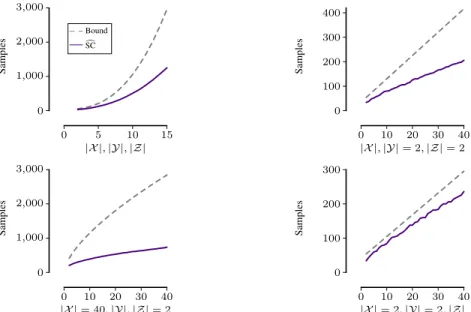
0 5 10 15 0 1,000 2,000 3,000 |X |,|Y|,|Z| Samples Bound c SC 0 10 20 30 40 0 100 200 300 400 |X |,|Y|= 2,|Z|= 2 Samples 0 10 20 30 40 0 1,000 2,000 3,000 |X |= 40,|Y|,|Z|= 2 Samples 0 10 20 30 40 0 100 200 300 |X |= 2,|Y|= 2,|Z| Samples
Figure 13: Estimated sample complexities for independently generated data s.t.P(|SCInf/n−I| ≥
0.05)≤0.05and the suggested bound function that is calculated as35 + 2|X ||Y|23(|Z|+ 1). For all
setups, increasing the domain size ofX,Y,Ztogether or independently, the bound function is larger than the empirical value.
w.r.t the size Cartesian product of the domain sizes and always larger than the bounds calculated from synthetic data. However, we do not argue that this is the minimal bound that can be found, nor that it is impossible to pass the bound, as we can only evaluate a subset of all possible data sets. What makes us optimistic is that it has been shown that there exists an algorithm with sub-linear sample complexity to estimateCMI (Canonne et al., 2018).
The problem that we would like to solve is to provide a formula that calculates the number of samplesnsuch thatP(|SCInf(X;Y | Z)−I(X;Y | Z)| ≥ )≤δ, for smallandδ. Thereby, we focus on annsuch that the probability of making a type I error, i.e. rejecting independence whenH0: X ⊥⊥Y |Zis true, is low. In our empirical evaluation, we set=δ= 0.05and draw
samples from data with the ground truthI(X;Y |Z) = 0by assigning equal probabilities to each
value combination ofX,Y andZ—i.e. we setP(x, y, z) = 1
|X ||Y||Z|for each value configuration
(x, y, z)∈ X × Y × Z. We conduct empirical evaluations for varying domain sizes ofX,Y andZ, where we define w.l.o.g.|X | ≥ |Y|, as the test is symmetric. For each combination of domain sizes, we calculateP(|SCInf(X;Y |Z)−I(X;Y |Z)| ≥) =P(SCInf(X;Y |Z)≥0.05)≤0.05as
follows: We start with a smalln, e.g.2, generate1 000data sets and check if over those data sets
P(SCInf(X;Y |Z)≥0.05)≤0.05holds. If not, we increasenby the minimum domain size ofX, Y andZ. We repeat this procedure until we reach ann, for whichP(SCInf(X;Y |Z)≥0.05)≤
0.05holds and report thisn.
In Figure 13 we plot those values for varying either the domain sizes ofX,Y orZindependently or jointly. From these evaluations, we handcrafted a formula that shows that it is possible to find ann that is sub-linear w.r.t. the domain sizes ofX,Y andZfor which empiricallyP(SCInf(X;Y |Z)≥
0.05)≤0.05always holds. Hence, we additionally plot for each domain size the corresponding
suggested bound for the sample complexity w.r.t. the formula35 + 2|X ||Y|23(|Z|+ 1). We observe
that the empirical values fornare always smaller than the values provided by this formula. We want to emphasize that this is only an example function to show the existence of a sub-linear bound for this data. From the plots we would expect that there exists a tighter bound, however, we did not optimize for that. For future work we would like to theoretically validate a sub-linear bound function.
![Figure 1: [d-Separation] Given the above causal DAG it holds that F ⊥ ⊥ T | D, E, or F is d-separated of T given D, E under the faithfulness assumption](https://thumb-us.123doks.com/thumbv2/123dok_us/9901539.2483554/2.918.362.558.110.200/figure-separation-given-causal-holds-separated-faithfulness-assumption.webp)
![Figure 4: [Higher is better] Accuracy of SCI f , SCI q , CMI Γ and G 2 for identifying d-separation using varying samples sizes and additive noise percentages, where a noise level of 0.95 refers to 95%](https://thumb-us.123doks.com/thumbv2/123dok_us/9901539.2483554/10.918.215.703.103.479/figure-higher-accuracy-identifying-separation-varying-additive-percentages.webp)
![Figure 6: [Higher is better] F 1 score on undirected edges for stable PC using SCI f , SCI q , JIC , CMI Γ and G 2 on the Alarm network for different sample sizes](https://thumb-us.123doks.com/thumbv2/123dok_us/9901539.2483554/11.918.285.643.110.247/figure-higher-better-undirected-stable-alarm-network-different.webp)
![Figure 8: [Higher is better] d-Separation with 2 000 samples and 10% noise on different domain sizes of the source node F .](https://thumb-us.123doks.com/thumbv2/123dok_us/9901539.2483554/15.918.291.626.110.260/figure-higher-better-separation-samples-different-domain-source.webp)