Concordia University St. Paul Concordia University St. Paul
DigitalCommons@CSP
DigitalCommons@CSP
CUP Ed.D. Dissertations Concordia University Portland Graduate Research
Summer 6-21-2019
Eighth-Grade Students Without Home Internet: A Case Study of a
Eighth-Grade Students Without Home Internet: A Case Study of a
One-to-One Laptop Program at a Title 1 School
One-to-One Laptop Program at a Title 1 School
Stacey J. FlinnerConcordia University - Portland, [email protected]
Follow this and additional works at: https://digitalcommons.csp.edu/cup_commons_grad_edd Part of the Education Commons
Recommended Citation Recommended Citation
Flinner, S. J. (2019). Eighth-Grade Students Without Home Internet: A Case Study of a One-to-One Laptop Program at a Title 1 School (Thesis, Concordia University, St. Paul). Retrieved from https://digitalcommons.csp.edu/cup_commons_grad_edd/333
This Dissertation is brought to you for free and open access by the Concordia University Portland Graduate Research at DigitalCommons@CSP. It has been accepted for inclusion in CUP Ed.D. Dissertations by an authorized administrator of DigitalCommons@CSP. For more information, please contact [email protected].
Concordia University - Portland
CU Commons
Ed.D. Dissertations Graduate Theses & Dissertations
Summer 6-21-2019
Eighth-Grade Students Without Home Internet: A
Case Study of a One-to-One Laptop Program at a
Title 1 School
Stacey J. Flinner
Concordia University - Portland
Follow this and additional works at:https://commons.cu-portland.edu/edudissertations
Part of theEducation Commons
This Open Access Dissertation is brought to you for free and open access by the Graduate Theses & Dissertations at CU Commons. It has been accepted for inclusion in Ed.D. Dissertations by an authorized administrator of CU Commons. For more information, please contact [email protected].
CU Commons Citation
Flinner, Stacey J., "Eighth-Grade Students Without Home Internet: A Case Study of a One-to-One Laptop Program at a Title 1 School" (2019).Ed.D. Dissertations. 303.
Concordia University–Portland College of Education Doctorate of Education Program
WE, THE UNDERSIGNED MEMBERS OF THE DISSERTATION COMMITTEE CERTIFY THAT WE HAVE READ AND APPROVE THE DISSERTATION OF
Stacey J. Flinner
CANDIDATE FOR THE DEGREE OF DOCTOR OF EDUCATION
Donna Graham, Ph.D., Faculty Chair Dissertation Committee Julie McCann, Ph.D., Content Specialist
Eighth-Grade Students Without Home Internet:
A Case Study of a One-to-One Laptop Program at a Title 1 School
Stacey J. Flinner
Concordia University–Portland College of Education
Dissertation submitted to the Faculty of the College of Education In partial fulfillment of the requirements for the degree of
Doctor of Education in Educational Leadership
Donna Graham, Ph.D., Faculty Chair Dissertation Committee Julie McCann, Ph.D., Content Specialist
Michael Hollis, Ph.D., Content Reader
Concordia University–Portland
Abstract
To bridge the digital divide, school districts across the nation are adapting one-to-one Information and Communication Technologies (ICT) for their students. Each student in the program receives a laptop, Chromebook, or tablet for them to do digital assignments at school as well as at home. While the ICT digital divide was significantly reduced with one-to-one
programs, another divide emerged from students who did not have access to the internet at home. The purpose of this qualitative study was to find out how students who did not have internet access at home felt about being a one-to-one ICT program. The researcher used Lave and Wenger’s (1991) situated learning theory as the theoretical framework to support the data, student narratives, and findings in the study. The sample in the study were 15 one-to-one middle school students who did not have internet access at home from a Title I school in Texas. The researcher’s qualitative methods to collect data included a questionnaire, individual interviews, as well as three focus groups. The results of this study indicate that students in the sample had difficulty conducting research, collaborating in group work, and trouble with completing digital homework assignments. The researcher also shared recommendations to improve the one-to-one ICT programs and policies to serve all students.
Keywords: digital divide, information, and communication technologies, one-to-one, instructional technology
Dedication
This dissertation is dedicated to the memory to my grandmother Hortencia Corona Woodard. She was my biggest cheerleader who always encouraged me to pursue my educational goals. Her dream lives through me. I love and miss you, Grandma.
Acknowledgments
First and foremost, thank you to our Heavenly Father, for whom none of this would be possible. I give Him all the glory and honor as I finish this journey.
I want to thank the students and administrators in the district who participated and helped me in this study. A special thank you to my team who have been there through every step of the way. Your love and support are appreciated more than you will ever know.
To my parents, who always knew that I was called to teach. Thank you for always
supporting my educational goals. Mom introduced me to literacy at a very young age and likes to brag that I taught myself to read and write at the age of three. “And just think, it all started with a Fisher Price School Days Desk.” My dad went back to school while I was in high school and would sit and do homework with me. Dad, I saw you struggle, but I never saw you quit. Thank you for being that example to me. To my stepdad, Sam, thank you for always having my back. To my husband Clint who had to endure all my craziness throughout this journey. Thank you for ‘talking me down’ and for believing in me when I did not believe in myself. To Christi, I really could not have done this without you. You have been my biggest cheerleader and
supporter. The words thank you are not enough to show my appreciation. To Jen and Christine, my partners in crime. You two helped me keep my sanity in check, and you know how hard that is! I love you both! To Jerry C. (RIP), thank you for making me a better teacher.
Finally, to my fantastic faculty chair, Dr. Donna Graham, whose encouragement, support, and a great sense of humor got me through this very tedious process. You are a superhero; you should really wear a cape.
Table of Contents Abstract ... ii Dedication ... iii Acknowledgments... iv List of Tables ... x List of Figures ... xi Chapter 1: Introduction ... 1 Introduction ... 1
Background, Context, History, and Conceptual Framework for the Problem ... 1
Statement of the Problem ... 4
Purpose of the Study ... 5
Research Question ... 5
Relevance, Rationale, and Significance of the Study ... 6
Relevance. ... 6
Rationale. ... 6
Significance... 7
Definition of Terms... 9
Assumptions, Limitations, and Delimitations ... 10
Assumptions. ... 10
Limitations and delimitations. ... 11
Limitations. ... 11
Delimitations. ... 11
Chapter 2: Literature Review ... 13
Introduction ... 13
Background of the problem. ... 14
Computers and pedagogy. ... 15
The digital divide. ... 17
Theoretical Framework ... 21
Review of the Literature ... 26
Digital pedagogy. ... 26
Computer-based assessment. ... 28
Benefits of one-to-one instructional technology use. ... 30
21st century learning methods. ... 32
Review of Methodological Issues ... 35
Synthesis of Research Findings ... 38
Critique of Previous Research ... 39
Chapter 2 Summary ... 41
Chapter 3: Methodology ... 43
Introduction ... 43
Statement of the Problem ... 43
Research Question ... 43
Purpose and Design of the Study ... 44
Population and Sample Selections ... 46
Sources of Data ... 48
Identification of Attributes ... 51
Data Analysis Procedures ... 52
Limitations of the Research Design ... 54
Validation ... 54
Credibility ... 55
Dependability ... 55
Expected Findings ... 56
Ethical Issues ... 56
Conflict of interest assessment... 56
Researcher’s position. ... 57
Ethical issues in the study. ... 57
Chapter 3 Summary ... 57
Chapter 4: Data Analysis and Results ... 58
Introduction ... 58
Description of the Sample ... 59
Research Methodology and Analysis... 62
Summary of the Findings ... 66
Presentation of the Data and Results ... 67
Homework... 73
Equity... ... 74
Future.... ... 75
Suggestions. ... 76
Thematic Category 2: Equity. ... 78
Thematic Category 3: Future. ... 82
Thematic Category 4: Suggestions. ... 83
Chapter 4 Summary ... 85
Chapter 5: Discussion and Conclusion ... 87
Introduction ... 87
Discussion of the Results ... 90
Thematic category 1: Homework... 90
Thematic category 2: Equity. ... 91
Thematic category 3: Future. ... 92
Thematic category 4: Suggestions. ... 93
Discussion of the Results in Relationship to the Literature ... 95
Homework... 95
Equity… ... 95
Future….. ... 96
Suggestions. ... 96
Limitations ... 97
Implications of the Results for Practice, Policy, and Theory ... 97
Practical implications. ... 97
Role of technology directors. ... 98
Policy implications... 99
Strengths and weaknesses. ... 99
Recommendations for Further Research ... 102
Future implications. ... 103
Recommendations for district technology directors. ... 104
Recommendations for teachers. ... 105
Conclusion ... 109
References ... 110
Appendix A: Parental Consent Form ... 120
Appendix B: Digital Questionnaire (for all sample students) ... 122
Appendix C: One-on-One Interview Questions ... 123
Appendix D: Focus Group Questions ... 124
List of Tables
List of Figures
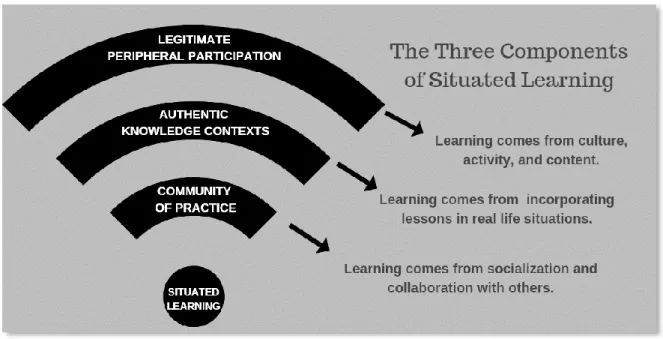
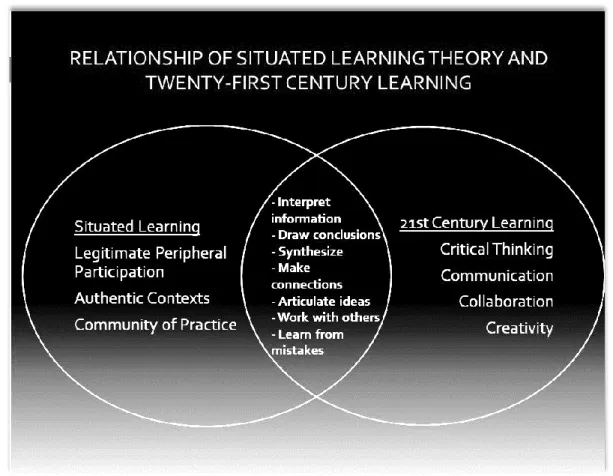
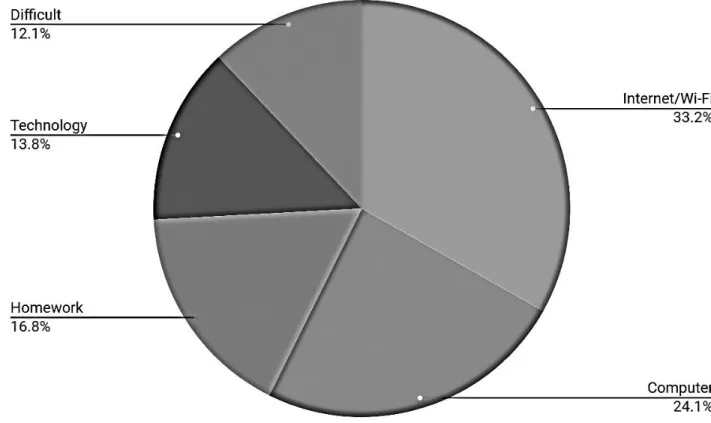
Figure 1. Three Components of the Situated Learning Theory... 33 Figure 2. Situated Learning About 21st century learning... 33 Figure 3. Word Frequency in Data. ... 61
Chapter 1: Introduction Introduction
Public education has embraced instructional technology in the last few decades in order to prepare students for college and future careers. Many are using 21st century learning skills and STEM learning methods, particularly with the inclusion of information and communication technologies (ICT) in schools (The Partnership for 21st century learning, 2013). As these ICT technologies merge with pre-K–12 curriculum, some districts have taken instructional
technology usage further by providing each student with a portable wireless device, usually a laptop or a tablet. This process is known as one-to-one Information and Communication
Technology (ICT) programs. ICT allows students who do not have computers at home the ability to have daily access at school and home. School districts throughout the country embraced one-to-one ICTs to help close the digital divide between low-income, minority students, and their counterparts (Zilka, 2016).
As schools introduced the one-to-one ICT programs into schools, the digital divide initially appeared to shrink considerably. However, another problem presented itself (Vigdor et al., 2014). Many districts found themselves giving one-to-one wireless devices to students with the assumption that they had regular wireless or broadband internet at home (Zhang et al., 2015). Districts are reevaluating these one-to-one ICT programs to accommodate students who do not have home internet access.
Background, Context, History, and Conceptual Framework for the Problem
According to The Partnership for 21st century learning (2013), 21st century learning methods encourage learning to focus on the 4C’s: critical thinking, communication,
and innovation, career and life skills, and digital literacy skills. These skills have been
determined instrumental for students in order to work in future careers (Kivunja, 2015). Without 21st century learning skills, American students would not be qualified for or trained to fill these future high-demand jobs (Siu et al., 2014).
Since President Barack Obama’s 2011 State of the Union address, many public, private, and charter school administrators have developed curriculum to emphasize Science, Technology, Engineering, and Mathematics (STEM) programs. “STEM project-based learning (PBL) is a current instructional strategy that is student-driven, interdisciplinary, collaborative, and technology-based” (Han et al., 2015, p 2). The emphasis on STEM was developed to meet the 21st century post-secondary educational and vocational requirements needed for future careers in STEM fields (Han et al., 2015).
Another issue with the curriculum standards, such as No Child Left Behind (NCLB), is the emphasis on state-mandated standardized testing to measure student achievement. In 2001, the U.S. Congress enacted the No Child Left Behind Act (NCLB), where schools were held to test-based accountability to determine student achievement (U.S. Department of Education, n.d.). This act forced states and school districts to revise their curriculum standards in order to prepare students to pass state assessments (Deming et al., 2016).
While the intention behind NCLB was good, one of the setbacks was the change from teaching the curriculum to “teaching the test,” especially in large urban districts where they appeared to have the most to lose if their students did not do well on these tests (Reback, Rockoff, & Schwartz, 2014). The emphasis on these standardized tests to regulate school and student achievement did not benefit students as far as taking charge of their learning (Deming et al., 2016). The emphasis on standardized testing may have led schools to adopt strategies that
may have produced harm to student learning (Deming et al., 2016). For example, in Texas, some schools have categorized students who generally would not qualify for special education. This distinction exempted these students from taking these tests, which, in turn, may have caused them to harm educationally (Deming et al., 2016).
In 2010, the Elementary and Secondary Education Act (ESEA) was enacted to make modifications to NCLB (U.S. Department of Education, n.d.). This act lessened the penalties on failing schools, focused more on student achievement, and encouraged an emphasis on students using critical thinking skills, conducting research, problem-solving, and communications (U.S. Department of Education, n.d.). One of the revisions was the emphasis on technological
improvements to school infrastructures as well as an emphasis on technology education. This act incorporated the need for more instructional technology and infrastructure to support it, and therefore emphasized 21st century skills into public school curricula (U.S. Department of Education, n.d.).
In 2015, Every Student Succeeds Act (ESSA) was signed by Obama in order to give states more flexibility in setting their standards to measure school and student achievement. Although this act replaced NCLB, it also continued to emphasize standardized testing as an indicator of school and student success (U.S. Department of Education, n.d.). In March 2018, the U.S. Congress issued the Congressional Review Act to eliminate the accountability regulations in ESSA. Even with the accountability regulations absent, state mandated-standardized testing continues to be used to measure student achievement, particularly measuring increases and decreases in student learning within the core subjects, but at the same time negating the STEM and 21st century modalities which are not measured on these standardized tests. Technology and pedagogy can no longer be treated as two separate entities; instead, they are intertwined and
imperative for the education of all students (Voogt et al., 2013). Therefore, to prepare students for future STEM careers, states should reconsider their view on standardized testing as the primary assessment of student learning and achievement.
The theoretical framework for this study is founded on situated learning theory from Lave and Wenger (1991) which is directly related to the 21st century learning methods used in many STEM programs throughout the country (Han et al., 2015). The three components in situated learning that include legitimate peripheral participation, the knowledge presented in authentic contexts, and community of practice (Lave & Wenger, 1991). These three components allow students to partake in their own learning experience using the 4C’s of 21st century
learning: critical thinking, communication, collaboration, and creativity (Rogers, 2016). The ICTs used in the classroom not only help students with the 4C’s of 21st century learning in their formal education, but also helps them in their practical everyday lives, including job skills, research skills, and socialization. (Kong et al., 2014).
The empirical research for this study indicates that there are not many studies that focus on the lack of internet access and the effects on student achievement and homework completion. There is much research on the digital divide as it pertains to students who do not have ICTs in their homes (Rogers, 2016). Most of that research has to do with the lack of hardware, and few have addressed the lack of home internet access for students in urban areas (Vigdor et al., 2014).
Statement of the Problem
While one-to-one laptop programs are becoming more popular throughout the country, there has been little research on the impact of these programs. The digital divide is still present among many low Socio-Economic Status (SES), minority, and English Language Learner (ELL) students who may not be able to participate in these progressive programs because of lack of
home internet access (Rogers, 2016; Vigdor et al., 2014). The problem this study will explore is how do eighth-grade students without home internet access perceive the use of a one-to-one laptop program, in a Title I middle school in Texas. With the implementation of one-to-one technologies in many urban school districts, each student has regular access to ICT. However, the same students may not have regular internet access at home to complete their assignments required by their teachers.
Purpose of the Study
The purpose of the study is to explore how eighth-grade students without regular home internet access perceive the use of a one-to-one laptop program in a Title I middle school in Texas. The researcher wanted to know if not having internet access hinders student achievement for those students in a one-to-one ICT program. The researcher hopes the findings of the study helps to improve all one-to-one ICT programs throughout school districts across the country.
Research Question
The research question was developed by reviewing the literature on the use of instructional technology in schools and its effect on learning. The research question that guided this study:
How do eighth-grade students without regular home internet access perceive the use of a one-to-one laptop program in a Title I middle school in Texas?
The research question focuses on examining details on the new use of instructional technology within the confines of a program of choice within a Title I middle school.
Specifically, the researcher wants to know if one-to-one laptop students who do not have regular home internet access are at a disadvantage over their classmates who do have regular internet access at home. The researcher also wants to discover how those students feel about the challenges of not having home internet access for educational purposes.
Relevance, Rationale, and Significance of the Study
Relevance. This study is relevant to the area of pre-K–12 pedagogy because it hopes to provide new knowledge and data regarding the use of technology in the form of laptop programs for students who do not have regular internet access at home. This study will provide information to determine how Title I students in a one-to-one laptop program feel about not having internet access at home, and the challenges the lack of internet poses on their studies. Students in Title I schools often have less access to technology and therefore, may not have the same computer skills as their counterparts (Osborne & Morgan, 2016). The study will help educators to benefit from a better understanding of how to better serve the digital education needs of all students, and particularly of students who may not have regular home internet access.
Rationale. The importance of technology in everyday life had become even more significant now than in the 1990s when ICTs became present in many homes in the United States. (Patrikakou, 2016). No longer are ICTs used for entertainment purposes, but they have also become an essential part of educational and professional goals. With the addition of 21st century learning skills, technology has become an intricate part of closing any achievement gaps. (Rogers, 2016).
Since this study is about middle school students in a Title I school who do not have internet access at home, digital learning is imperative considering the students are using the ICTs at school, but also at home without their teachers to help them. The blending of the informal and formal technology teaching to all students is essential in order to help close the digital gap (Kong et al., 2014). In other words, incorporating the situated learning theory framework to narrow the digital divide.
Although many school districts have ICT use in their classrooms, much of the focus of curriculum and instruction emphasizes passing the state-mandated assessments (Deming et al., 2016). The focus on standardized testing has created curriculum narrowing, in which teachers only focus their curriculum on “teaching the test” (Deming et al., 2016). Standardized testing emphasis has dramatically affected technology education courses, such as keyboarding.
The lack of technology education courses leads teachers to have to teach necessary ICT skills within their limited instructional time (Voogt et al., 2013). If teaching instructional technology was a priority as teaching students how to pass a standardized test, the digital learning gap would significantly close. (Voogt et al., 2013). Therefore, the emphasis on both standardized testing and 21st century learning appear to be counterproductive in attempts to reduce the digital divide.
The empirical studies in the literature indicate a need for additional research on how one-to-one ICT effects student achievement overall (Kong et al., 2014; Patrikakou, 2016; Rivers, 2017; Vigdor et al., 2014; Walsh et al., 2014). Other studies have concluded that research should specifically focus on student achievement among students in low SES, English Language
Learners (ELL), and minorities, who statistically, may less likely have personal ICTs in their homes (Vigdor et al., 2014).
Significance. Students who use technology to complement their studies are more likely to master the 4C’s of 21st century learning and therefore will be more prepared for those jobs that these skills are needed for in the future (Kong et al., 2014). Lave and Wenger’s theory of situated learning is the framework that supports the premise as to why a one-to-one ICT
environment is ideal for students. The situated learning theory promotes learning and practicing skills related to factual and realistic circumstances, and the one-to-one ICT programs support this
(Gaffney & Kercsmar, 2016) by giving the tools needed outside of the classroom and adapting it into their homes. Allowing students to use ICTs in order to gain 21st century learning skills allows students to not only master these skills but to take charge of their learning (Siu et al., 2014). Therefore, students who use ICTs as they are learning are more likely to retain the content in their lesson when assessed using the same ICT (Fan-Ray & Hwang, 2014).
There is evidence of a digital divide among schoolchildren related to their use of computers and the internet (Fan-Ray & Hwang, 2014); however, there have not been many studies on students in a one-to-one learning environment for those who do not have the internet at home. Title I schools where 40% or more of students qualify for free or reduced lunch, often have less regular home internet access and therefore may not have adequate resources to complete projects, collaborate with other students, or to complete homework assignments (Rogers, 2016).
Even with an increase of public and charter schools with one-to-one ICT programs, low SES, minority, and ELL students are less likely to have regular home internet (Zhang et al., 2015). Research indicates that providing all students with access to ICTs allows for an increase in access to learning opportunities and equitable resources (Zhang et al., 2015). Students at high SES schools, therefore, have a distinct advantage over students at low SES schools in completing assignments, and therefore have higher academic achievement since they are more than likely to have had ICT and internet access in their homes (Hatlevik, Guomundsdottir, & Loi, 2015).
Finally, this research study will help educators understand the students who may not have internet access at home. The focus of this study is to inform educators that equal technology access at school does not always equal technology access at home. The 21st century learning skills that many school districts are promoting in school may not be relevant at home if students
do not have internet access daily at home. Although students are given a wireless device in a one-to-one ICT program, without every student having regular internet access at home, there is still a digital divide among students. With this digital divide among students at home, there will still be an achievement gap among students, and therefore, educational opportunities are not equal among all students, even among students within the same school.
Definition of Terms
Digital divide. Bancroft (2016) describes the digital divide as members of underserved populations lacking enough experience and instruction in digital environments. The group includes people who do not have access to computers, smartphones, tablets, or other internet-abled electronic devices. People in this group also includes those who do not have regular internet access.
Information communications technologies (ICT). This term is used to describe
software, hardware, internet-based programs, telecommunications, computer applications, course management software, and new technologies as they emerge (García-Valcárcel, Basilotta, & López, 2014).
One-to-One laptop program. A one-to-one laptop program is a learning environment that provides each student with a mobile technology device such as a laptop computer to be used in class and for homework assignments (Gagne, 2013).
Science, technology, engineering, and mathematics (STEM). STEM is a curriculum based on the combination of the four disciplines to fill future jobs in those fields (Department of Education, n.d.).
Title I school. A government designation where a school has 40% or more students who qualify for free or reduced lunch (Department of Education, n.d.).
21st century learning Skills. The Partnership for 21st century learning (2013) defines 21st century learningSkills as advanced skills that students need to engage the rapidly changing technological world around them. These skills include life and career skills, learning, and innovation skills (critical thinking, communication, collaboration, and creativity), technology skills, and knowledge in the core subjects of reading, writing, and math.
Assumptions, Limitations, and Delimitations
Assumptions. In order to conduct the study, there are several assumptions made in order to validate the findings of the study. Teachers in the Trailblazer Academy, a pseudonym, use specialized online textbooks and software in order to do their lessons, so the expectation is that all students bring their laptops daily. Behaviors, attitudes, expectations, or hopes fundamental to the validity of the study, e.g., high school teachers are implementing the sense of belonging strategies to all students.
1. All students participated in an ICT laptop program.
2. All students in the study will be in the Trailblazer Academy for the 2018–19 school year.
3. Student questionnaires, interviews, accurately reflected the thoughts and feelings of the students in the study.
4. Since the district, school, and students are anonymous in this study; it is also assumed that students never misrepresented their stance on being a one-to-one student without home internet access.
5. Digital native students are knowledgeable in digital educational skills, when, in fact, many schools do not mandate technology courses.
Limitations and delimitations. Limitations occur due to influences that are out of the control of the researcher. They represent potential shortcomings, influences, or other conditions that put restrictions on the methodology and conclusion of the research. On the other hand, delimitations are within the control of the researcher. They represent choices made by the researcher to set boundaries for the research. The following limitations/delimitations were present in this study.
Limitations. With any qualitative study, there are limitations where things may not go as planned. Deliberate or non-deliberate factors can impact the validity of results. The researcher has identified some of the limitations of this study in order to lessen the chances of inaccuracy in the study, therefore increasing the likelihood of getting the most accurate and credible results.
1. Student questionnaires, interviews, to evaluate home internet access were used for qualitative analysis for this study.
2. The results may not reflect the actual usage of computers by students due to intentional or unintentional falsification.
3. It was also limited by the number of participants, including only those students who responded to only the questionnaire.
4. The daily duration of time students used laptops at home for school use could not be determined.
Delimitations. This study focuses on how eighth-grade students perceive the use of a one-to-one laptop program, in a middle school in Texas without regular home internet access. Therefore, delimited to one middle school within a specific district, not incorporating other schools or grade levels.
1. It does not measure how laptop programs are used to determine if other factors (i.e., absenteeism, illness) influence student achievement.
2. It also did not attempt to measure student engagement in learning 21st century learning skills.
3. Student input is solely used to determine the results of this study.
Chapter 1 Summary
The primary focus of this study was to find out how students in a one-to-one ICT program felt about not having the internet at home and how they felt it affected their learning. The results of this research obtained a better understanding of the needs of students who may not have regular internet access at home and how that affected their grades and overall academic achievement. This research study can inform policy and practice within school districts that have one-to-one ICT programs within their schools. The primary interest of this study was to gain an understanding of the needs of SES, ethnic, and ELL students in such one-to-one programs in a Title I middle school.
Chapter 2: Literature Review Introduction
The literature review research focuses on instructional technology, the digital divide, and frameworks that support the findings of this study. In order to address the research problem, a variety of theoretical considerations were needed for the study. Critical phrases used in the research were the digital divide, instructional technology, one-to-one information and
communication technologies (ICTs), home internet access, 21st century learning, computers in the classroom, pre-K–12 pedagogy, homework, situated learning, constructivism, and
connectivism.
The researcher conducted inquiries using the educational databases through the
Concordia University library site such as SAGE, ProQuest, and JSTOR, and the Armadillo ISD (a pseudonym for the district for the school in the study) libraries site, as well as the Google Scholar research search engine. This chapter will examine the background of the problem with one-to-one programs without 100% home internet access participation, a brief history of the use of instructional technology in the classroom, and the evolution to what instructional technology is today. This literature review will also show the connection between the theoretical framework and the research to support this study.
The research for the digital divide is in two parts, the first being the initial ICT digital divide haves and have-nots; which then lends itself to the secondary digital divide. The second part focuses on people who do not have regular home internet access. Since one-to-one laptop students without home internet access are relatively new to urban and rural school districts, most of the investigation was focused on any digital divide in education, particularly in low-SES and rural areas.
The framework section will describe the learning theories that support the instructional technology pedagogy and 21st century practices in the digital classroom today, with a heavy emphasis on situated learning. The importance of these frameworks lies in the necessity of the use of these learning theories in current instructional technology practices. These theories are particularly imperative for those schools that have high Title I, a majority-minority enrollment, high ELL students, and a high number of low-SES students. These schools must keep their students current in educational technology for them to compete with their counterparts from schools that do not have their same ethnic or socioeconomic demographics.
Background of the problem. Most adults who were in school before the technology boom of the 1990s can remember their teachers and librarians using filmstrips, slides, movie projectors, VCRs, and VHS tapes as teaching tools (Veletsianos, 2016). These early instructional technologies had one primary purpose: to complement content in the classroom (Gagne, 2013). The use of these technologies was at the discretion of the teacher, were not interactive, and therefore, did not require much creative thought or were not student-center driven (Gagne, 2013).
Although teachers have used instructional technologies in their classrooms for decades, it was not until the 1980s, when microcomputers appeared in the school libraries that instructional technologies began to affect classroom curricula (Gagne, 2013). Computers had given students opportunities to discover and create digital projects. With the availability of computer labs came computer literacy courses to teach students the basics of keyboarding, word processing, and creating spreadsheets.
As technology has changed in the classroom, so must the methods on how content is delivered and received. Kong et al. (2014) stated that with the increased use of technology as a learning tool, learning must become more individualized and at the same time, learning must
expand outside of traditional classrooms. Social interaction and collaboration are vital to the use of instructional technologies. Digital learning must not only include classes contained in the traditional classroom but expanded to learning worldwide (Kong et al., 2014). These practices include video conferencing, interactive digital notebooks, and digital group projects where students and teachers can interact in real time.
Computers and pedagogy. The introduction of computers to most students in the 1980s was at the computer lab in their school. Although the computer labs were a popular place among students in the schools, students were limited to computer use to one day a week, particularly in primary grades (Gagne, 2013). As computers became smaller and more affordable, the
technology curriculum in schools began to change.
Teachers began to see that for students to excel in instructional technology, they would need frequent access to computers (Baepler, 2014). Students began using programs they learned on computers, so it became necessary for school districts to purchase more computers. As laptop computers replaced desktop devices due to their mobility and cost, districts began purchasing laptops and carts for mobile electronic access from anywhere in the building (Gagne, 2013).
Just as technology changes, so does the demand for using it. Instead of students
memorizing and regurgitating information, students show content knowledge by creating digital projects. As a result, the shift in instruction incorporated more 21st century learning methods (Gagne, 2013). The technology used for educational purposes has given students an unlimited amount of information at their fingertips. With pedagogical shifts in educational delivery becoming digital, there also had to be a shift in homework and project delivery (Kong et al., 2014).
Teachers began requiring students to turn in printed papers, projects, and multimedia content instead of those created from pen and paper. Computer labs became crowded, and there were never enough classroom computer carts in the school for everyone to use. Some districts began purchasing “class sets” to meet the instructional technology demand in their classrooms. School and public libraries with low SES enrollment, and those in rural schools became sanctuaries for learners who needed technology for learning but did not have it at home to use (Berdik, 2016).
School districts soon realized that although the demand for computers was high, giving each teacher a class set was expensive (Berdik, 2016). Libraries also had trouble keeping up with the demand for loaners since students still needed the computers after school hours (Berdik, 2016). Many district leaders then decided to implement their one-to-one laptop programs to meet the needs and demands of students and teachers alike. The one-to-one programs closed one digital gap among students but created another (Osborne & Morgan, 2016). Students without internet access at home were limited to how they could complete homework assignments.
Too much focus, however, has been on the emerging technologies and not enough focus on the emerging practices of instructional technologies, such as 21st century learning methods and STEM (Veletsianos, 2016). Many districts would purchase the instructional technologies without having a plan in place to implement how the ICTs were to be distributed and used. Some had not considered the professional development and teacher efficacy for these ICTs (Carter et al., 2016). School district leaders get excited about having the latest and greatest technologies in their schools, but once they get those technologies, educators wonder how to use these technologies to complement the content they are required to teach (Veletsianos, 2016).
Since one-to-one instructional technology practices in urban public schools are relatively new, the emerging instructional technology practices are underutilized (Veletsianos, 2016). While studies show that students now are all Digital Natives, meaning they have had access to information readily available all of their lives, a common false assumption is these Digital Natives therefore must possess all of the skills needed to do necessary word processing, keyboarding, or other skills required in an instructional technology environment (Patrikakou, 2016). Although they are considered necessary, classes such as keyboarding are often electives, or such as in the state of Texas, no longer offered (Meyer, 2017). This paradox plagues students from low SES environments who may have never had a computer or home internet, and therefore never have learned those skills at home (Vigdor et al., 2014).
The digital divide. The creation of the internet promoted instructional technology to flourish. Initially, the definition of the digital divide described people who had access to ICTs versus those who did not (Eynon & Geniets, 2016). Access to technology at home, namely the internet, and a personal computer, became not only a status symbol, but also an educational tool within the home. With the advances in technology in the 1990s and early 2000s, technology made every task more accessible such as banking, filing taxes, and even ordering take out (Patrikakou, 2016).
As mobile technology continued to advance, the digital divide became smaller in 2007 after Apple’s introduction of the iPhone (Joan Ganz Cooney Center, 2016). Soon other
companies followed with their cheaper versions of the internet-based and Wi-Fi compatible smartphone, more people have at least one type of ICT in their household; therefore, the digital divide redefined as the gap that separates the consumers of content on the internet from the producers of content (Osbourne & Morgan, 2016). In other words, the gap is between those who
use the internet for purchasing, social media, and entertainment versus those who use the internet to work, for education, and for creating content (Daughtery et al., 2014).
A study conducted by the Joan Ganz Cooney Center at the Sesame Street Workshop found 94% of children (ages 6 to 13) in a low socioeconomic group have access to the internet and Wi-Fi-enabled devices (Joan Ganz Cooney Center, 2016). This finding supports the idea that the initial digital divide gap has closed considerably. However, the same study also indicated that the new second digital divide is still considerably vast because of lack of regular home internet access. According to the study, 23% of the families interviewed had mobile-only access (namely a smartphone) and that 24% of the mobile-only families had a disruption of their internet
services within the last 12 months of the survey due to inability to pay. Other findings included that 21% of the mobile-only families also share the ICT among multiple individuals, and
therefore internet access for each person in the household is limited, and 29% of the mobile-only families often exceed their data plan limits, making regular internet access difficult to maintain (Joan Ganz Cooney Center, 2016).
Along with the emphasis on Science, Technology, Engineering, and Mathematics (STEM) modalities, project-based learning initiatives, and the increased use of technology in everyday life, it is even more critical now that students have access to ICTs and regular internet access (Patrikakou, 2016). In 2014, President Barack Obama and federal government leaders concentrated on getting high-speed internet and ICTs to classrooms, particularly in the lower-income and rural areas (Patrikakou, 2016). Even with these attempts, too many students are deficient technologically in their pursuit of education.
These findings have a significant impact on students who are in a one-to-one ICT program (Kong et al., 2014). In a one-to-one digital classroom, students use digital textbooks,
software, and Learning Management Systems (LMS) such as Blackboard and Google Classroom to complete digital homework, work collaboratively on project-based learning assignments, and participate in flipped classroom modules (where students learn content online at home instead of in the classroom). The ICT and the supporting digital tools and ancillaries available to students help bring instructional pedagogy from teacher-centered to student-centered learning, which empowers students to take control over their learning and to become producers of digital content (Fan-Ray & Hwang, 2014).
However, many students who have the same Wi-Fi-enabled ICT device cannot do their digital homework because they do not have regular and reliable internet access at home (Enyon & Geniets, 2016). The challenges for these students to do the same homework on the same computer as their counterparts, but without the same regular home internet access is a problem. This digital divide at home, therefore, hinders students’ achievement simply because of their lack of regular home internet access (Rogers, 2016). In other words, the digital divide is present in the digital classroom; all students have the same advantages at school, but the divide is still present at home.
Payne (2015) discussed the problem with one-to-one ICT programs where districts purchased a device for each student but then realized that many students did not have internet access at home. Payne suggested that districts implement a plan before deploying instructional technology in schools, particularly Title I schools. One of the recommendations was to make sure both teachers and students were trained on how to use the devices. According to Payne (2015), many students who come from low-income backgrounds may not have the same experiences with ICTs that their classmates have because they have not been exposed to them.
In 2013, Armadillo Independent School District (AISD), a pseudonym for the research site implemented its first one-to-one program to provide one-to-one iPad 2s to all students in grades 7–12. At the time, there was a technology deposit fee of $50 for the student to obtain an iPad. The district reduced the deposit fee to $10 for students who were on the free-reduced lunch program. Even with the fee reduction, the iPad one-to-one program was not very successful because some parents (many with multiple children in the district) could not afford the technology fee.
In order to make the district a valid one-to-one program, in 2015 the AISD introduced the district one-to-one laptop program. What made this program different was there were no
technology fees, and therefore, every student received a laptop at the beginning of the school year. In the last four academic years, the AISD appeared to have a solution in order to reduce the digital divide.
AISD provided students in grades 7–12 with a Dell laptop to use throughout the school year in order to support 21st century and district STEM initiatives. The instructional technology goal for the district is to support 21st century learning initiatives to close the gap of the digital divide and to prepare students for future jobs in science, technology, engineering, and
mathematics (Armadillo ISD, n.d.). Since students in elementary and intermediate campuses use iPad or Chromebook class sets to incorporate digital learning in their classes, the focus of this study will focus on middle school students.
One of the dilemmas that have arisen from the district’s one-to-one program is that students are assigned digital assignments and homework to complete, without the teacher knowing which students are without regular home internet access. (Voogt et al., 2013). Some students may divulge that information to students; however, many may not for shame and fear of
ridicule from their peers. Those students must then figure out how they can complete their digital assignments without affecting their grade negatively (Vigdor et al., 2014). Other students use their smartphones as hot spot Wi-Fi access ports so they can get their homework done. However, many students do not have unlimited data plans or may share their data plans with other
members of the household (Joan Ganz Cooney Center, 2016).
There is no longer a digital divide in the secondary AISD brick, and mortar classrooms since every student have the same access to ICTs and internet while at school; however, there was no preparation for the unforeseen digital divide between the students who have the internet at home and those who do not. The authenticity of learning in a 21st century environment is crucial since all assessments need to be aligned with real life situations (Giannakos, Pappas, Jaccheri, Sampson, 2016). It is essential to address the digital divide because the authentication piece will not be present if the collaboration piece outside of school is lacking. For these reasons, student achievement in one-to-one instructional technology for middle school students without home internet access is the focus of this dissertation.
Theoretical Framework
The theoretical framework in this qualitative study comes from the situated learning theory from Lave and Wenger (1991). Situated learning has three components: legitimate peripheral participation, the knowledge presented in authentic contexts, and community of practice. These three components allow the learner to participate in their own learning experience actively.
This theoretical framework begins by examining a learner’s legitimate peripheral participation, which puts embedded learning into three categories: the learner’s culture,
teacher should present lessons in authentic contexts. The third component shows that learners acquire knowledge through interaction and socialization (see Figure 1).
Figure 1. Lave & Wenger’s (1991) three components of the situated learning theory. (Flinner, 2018).
The theoretical framework for this study illustrates the similarities of situated learning and the 21st century learning skills required by school districts in one-to-one programs. The 21st century learning model focuses on collaboration, communication, critical thinking, and
creativity. In a situated learning environment, such as in a one-to-one ICT environment, learning is based on activity in and with the world, involving the individual and moving beyond the reception of factual knowledge (Lave & Wenger, 1991).
In the situated learning theory, the acquisition of knowledge comes from the cooperative and participatory methods of teaching (Stein, 2017). One of the positives of situated learning is that the teacher facilitates learning, but most importantly, directed by the learner in where the learner obtains knowledge from others. The situated learning theory in a one-to-one ICT environment has likenesses with 21st century learning methods. When comparing situated
learning and 21st century learning methodologies, there are quite a few similarities. (See Figure 2).
Figure 2. Relationship of Lave & Wenger’s (1991) Situated learning theory and The Partnership for 21st century learning’s framework (2011). (Flinner, 2018).
Situated learning emphasizes student-centered learning, which not only means that the student is learning from the teacher but most importantly, the student is learning from trial and error from themselves and their peers. According to Stein (2017), in situated learning, the social learning process is dependent on the practice and not necessarily the outcome. This method helps students not only learn but also retain the information learned the collaborative process.
Situated learning requires that the learning come from experiences, dialogue with others, and the context of the lesson. In order to be a part of the community of learners, all learners must have the same resources (Stein, 2017). Developing this community is evident not only in
pedagogy but in the business world as well. Many jobs require a person to be a productive employee, which entails the person to be a good decision maker, communicator, as well as a problem solver (Baloian & Zurita, 2015).
Since many districts are emphasizing college and career readiness, using the situated learning theory found in 21st century learning methods would be beneficial. If all employees had the same situated learning training and resources, then all can help search for solutions, generate ideas, in order to problem solve and identify any opportunities using the skills learned in school. Therefore, working within real-life 21st century learning situations in the classroom can give students the practical experiences they need in order to work with others well beyond their formal learning.
For these reasons, the 21st century learning modalities help students prepare for future careers by using the 4C’s in collaboration with instructional technology: collaboration,
communication, critical thinking, and creativity. (The Partnership for 21st century learning, 2013). These skills are critical for students to experience and master in their formal learning as they go through their primary and secondary educational levels. The situated learning theory therefore is instrumental and complements the 21st century methods well.
The theoretical framework also takes into consideration the importance of the social aspect of shared learning (Zydney & Warner, 2016). The commonalities between the situated learning theory and 21st century learning strategies benefit the one-to-one laptop student. Lave and Wenger (1991) stated:
Shared participation is the stage on which the old and the new, the known and the unknown, the established and the hopeful, act out their differences and discover their
commonalities, manifest their fear for one another, and come to terms with their need for one another’ their thesis stressed regularity in the outcomes of practice (p. 116).
The social aspect of shared learning, therefore, needs to be included as an essential component of a student’s formal learning.
It is essential to understand that the educational setting in which a student is learning is essential in the retention of the content (Housley-Gaffney & Kercsmar, 2016). The social context of the learning process cannot be mastered solely by face-to-face synchronous meetings but must also include asynchronous contact and virtual meeting spaces. By using non-traditional
instructional methods to complement mandated content, students are more than likely learn and retain information if they can experience the process of situated learning (Housley-Gaffney & Kercsmar, 2016). The situated learning theory negates and replaces the use of memorization (a traditional process) as a method of learning.
In this study, Armadillo ISD students have the same equipment while at school;
therefore, there is no digital divide present, and students can learn using 21st century skills via situated learning. The challenge is when the students who do not have home internet access try to complete their assignments, group work, and peer collaboration (Daugherty et al., 2014). The students without internet at home will not have the same situated learning experience as required in their 21st century learning modalities. Without the same situated learning experiences as their counterparts, the students may have an adverse effect on their digital experiences, grades, and overall academic achievement. The impact on the student’s academic achievement not only influences their learning, but it also has an impact on their life skills after they finish their formal education. The impact would also affect any future job prospects for the student, making them ineligible for many of the jobs that 21st century skills would afford.
Review of the Literature
The purpose of the study is to explore how eighth-grade students without regular home internet access perceive the use of a one-to-one laptop program in a Title I middle school in Texas. This review will evaluate the Technological Pedagogical Content Knowledge (TPACK) standards as it relates to digital learning. The benefits of one-to-one instructional technology use as it pertains to pre-K–12 learning is also discussed in this section. This section also describes the use of 21st century learning methodologies in relation to digital instruction, as well as a review of the methodological issues. A synthesis of the research findings is also included in this chapter. The literature review also presents the empirical, theoretical, and practical frameworks that support the framework for this study. The literature review will also review the
methodological issues surrounding the digital divide, a synthesis of research finding, as well as the critique of previous research.
Digital pedagogy. For instructional technology programs to be successful, teachers must understand the uses and best practices of digital learning as it pertains to their curriculum (Voogt et al, 2013). Instructional technology and pedagogy are no longer two separate entities, instead, they need to be synonymous. The Technological Pedagogical Content Knowledge (TPACK) conceptual framework complements traditional pedagogical practices by integrating general practices with instructional technology (Voogt et al, 2013). According to Agyei & Keengwe (2014), TPACK is a combination of three components: content knowledge, pedagogy
knowledge, and technology knowledge. In order to effectively teach in a one-to-one learning environment, these three elements must be mastered.
Research however has shown that students tend to do well in online assessments if they are familiar with online assignments in the classroom as well as at home (Agyei & Keengwe,
2014). The electronic assessments used for data collection on students’ knowledge of content attributes to this success. The students appear to model the digital learning skills from what they learn in the classroom. These successes can also be duplicated from the home in the form of digital homework assignments (Agyei & Keengwe, 2014). The successes, however, were developed by digital programs that follow the TPACK framework, and not necessarily by educators using TPACK to create their digital lessons.
The adaptation of TPACK or other digital learning methodologies such as SAMR (Substitution, Augmentation, Modification, and Redefinition), and 21st century learning skills are becoming more common in classrooms. Teacher evaluations and classroom walkthrough requirements have now included effective instructional technology uses in lessons (Texas Education Agency, n.d.). Principals are now evaluating teachers’ use of technology in the classroom as to how they students are participating in meaningful digital activities within their lessons (Texas Education Agency, n.d.).
Kuo and Hwang (2014) conducted a study on how to teach and improve problem-solving strategies for students using instructional technology. In this study, 170 fifth grade elementary students from Taiwan were put through a five-cycle learning cycle approach. Students were evaluated based on their e-portfolios submitted for this study. The researchers wanted to know if students’ web-based problem-solving performance was related to their problem-solving ability. They also wanted to know if there were any sub-abilities relating to web-based problem-solving ability can be found via the students' e-portfolios. They also wanted to find out what factors affected the students’ web-based problem-solving performance were included in the students’ information-searching portfolios.
The five phases used for to answer the research questions for this study are prior
knowledge construction, keyword adoption, information identification, information abstraction, and thinking elaboration. In the first phase, the researchers established the content that the students knew before introducing the web-based problem-solving exercises. During the second phase, teachers gave students keywords and synonyms to use for their research. In the
information identification phase, the teachers would guide students to identify reliable primary sources for their assignment, including how to be critical of information found online. In the fourth phase, students were taught how to bookmark and save their online sources in order to retrieve them later. In the final phase, thinking elaboration, students were required to
demonstrate their knowledge on the topic they researched. “This phase also offers an opportunity for peers to reflect on what they have done, which is consistent with both Piaget’s theory of cognitive development and with the theory of social constructivism” (Kuo &Wang, 2014, p. 173).
The findings of this study show that the students’ web-based problem-solving skills as well as their problem-solving abilities improved using the five-cycle phase. The researchers credited the approach based on the problem-solving theory where students were required to solve social issues following the five-phase learning cycle online. Since the students used cognitive and social environmental factors, the research shows that the situated learning theory works, and it emphasizes the importance of 21st century learning skills to students in grades pre-K–12.
Computer-based assessment. To support 21st century learning methods in order for students are college and career ready, it is important for learners to experience the constant changes of technology in their classrooms. As the digital instructional devices change, so must the delivery of content (Kivunja, 2014). For example, teachers used to ask students to raise their
hands if they understood the content. As technology changed, the manual hand raise was sometimes substituted by classroom clickers. The classroom clickers were soon replaced with online formative assessment tools such as Kahoot!, Nearpod, and functions in learning
management systems.
Instructional technology has changed what and how information is taught in the
classroom, and most importantly, how students reveal their understanding of the content being taught. Since ICT devices have become more affordable, access to technology has led to a transition in content delivery from traditional paper and pencil testing to the use of computer-based assessments (Agyei & Keengwe, 2014). As more classrooms use online classwork and homework, students will adapt the learning experience to the online formative assessment methods, including benchmarks. As students use the ICTs throughout the school year, their experiences will easily transfer when they are required to take a computer-based state
standardized assessment. As students master these skills, they can be easily transferred to college classes and careers in later years.
Students who have access to ICTs and internet both at school and at home may be more comfortable and familiar with digital learning method, and therefore they may perform better on an online assessment. Online state assessments, such as the State of Texas Assessment of
Academic Readiness (STAAR) will be issued completely online in the next five years (Texas Education Agency, n.d.) and students alike considering many of their benchmarks are already taken by students in an online format, such as Data Management for Assessment and Curriculum
(DMAC), iStation, and iReady.
Vigdor et al (2014) conducted a study to determine if having access to a computer and internet at home was advantageous to students and their academic achievement. The study was
conducted in North Carolina among minority students and those with a low socioeconomic status. The study concluded that students who obtained both computer and internet access at home saw a significant decrease in reading and math test scores in the fifth and eighth grade levels. The researchers concluded that students who do not have properly guided parental supervision of their child’s computer and internet use were more likely to score lower on their formative assessments than children whose parents actively monitored their screen time.
Benefits of one-to-one instructional technology use. With the introduction of one-to-one programs in schools, districts use different devices to use in their instructional technology programs. Although laptops, Chromebooks, and tablets operate differently, and may have different operating systems (Apple, Windows, and Android), they are all Wi-Fi-enabled devices used to deliver digital content to students. Despite the use of these different Wi-Fi devices, there are a number of studies that support the use of one-to-one technology use in schools.
A series of 10 studies by Zheng et al. (2016) showed that laptop programs among these studies showed a significant increase in scores in English, writing, math, and science courses. The studies also showed that students began using the laptops for classes other than their core courses, and personal uses that they would not otherwise have experienced without the devices. “More student-centered, individualized, and project-based instruction; enhanced engagement and enthusiasm among the students; and improved teacher-student and home-school relationships” (Zheng et al., 2016, p. 1075). The studies showed a positive impact to scores.
In another study, Clarke (2016) conducted a mixed methods study to see if student use of one-to-one laptop programs increased scores on a reading assessment. The quantitative results of this study indicated a positive relationship between the frequency of use of laptops for
the laptop for schoolwork showed a decrease in the same reading assessment. The students who showed lower scores were more likely to use the laptop for entertainment and social media than schoolwork. In the same study, the qualitative results showed that the lack of Wi-Fi at home was one of the barriers to student achievement. The one-to-one laptop program proved to be a
decisive factor in student learning in Clarke’s study.
Other uses of one-to-one technologies focused on the Common Core State Standards (CCSS), which was implemented in 42 states (Alabama, Oklahoma, Texas, Virginia, Alaska, Nebraska, Indiana, and South Carolina did not adopt these standards into their public schools). A study by Hodgkin (2016) researched a California school that incorporated the SAMR
(Substitution, Augmentation, Modification, and Redefinition) into their CCSS lessons. One of the results of the mixed methods study indicated that the technology was used to augment more than 50% of the lessons, and the teachers in the same study stated that their experiences with a one-to-one laptop program were positive and believed that all schools in California should have one-to-one laptop programs in their secondary schools.
Student preference, although not considered on most of the studies in this literature review, is something that researchers should be reflected in future studies. Ellison (2017) showed that traditional subjects, such as English Language Arts and Reading, can successfully meet conventional standards. A student in the Ellison study participated in a literacy lesson that incorporated the online game Minecraft to practice and master the art of storytelling.
The benefits of one-to-one ICT programs in schools have shown to be a positive learning environment and experience for students. The use of one-to-one instructional technologies in the classroom appears to be a benefit for students in order to prepare them for STEM and other technical careers. The ICTs promoted communication, collaboration, critical thinking, and
creativity among the student in Ellison’s study. These skills allowed real-life experiences, trial, and error, and gave this student ownership in his learning, all while enjoying the experience because the process did not feel like the student in this study was learning; instead, he was doing something he enjoyed at home: playing video games.
21st century learning methods. Rogers (2016) stated that although most students know how to use ICTs for consumption, few low-income and minority students know how to use ICTs for production. In order to get students to use ICTs to promote creativity, critical thinking, collaboration, and communication, it is vital that students learn to integrate their learning using digital methods (Rogers, 2016). In attempts to help students succeed in their homework and projects, a few practical studies have shown that 21st century learning focuses on work. For example, Kou and Hwang (2013) found that student achievement and content retention improved significantly among elementary school students when they were allowed, so do web-based problem-solving lessons at school.
Bartholomew and Strimel (2018) researched 708 middle schools using an open-ended 21st century curriculum design to see if such methods were effective in student achievement and therefore preparing students for future careers. Their findings indicated that the majority of students were able to adapt well to the open-ended design problems both in and out of school and were comfortable doing so. The researchers suggest that one way of increasing student success is “by affording students more opportunities for completing open-ended design problems in school settings” (Bartholomew & Strimel, 2018, p. 776). Students reported that the lessons were fun, engaging, and more creative than traditional methods even though these lessons were considered more difficult.
One method to shorten the digital dividewas the use of mobile internet buses and libraries that check out Wi-Fi routers to students. For example, the San Francisco Library has a TechMobile lab that has a computer lab, Wi-Fi and instructors on board travel to underserved neighborhoods to offer lessons in basic computing applications, block-based coding, Lego Robotics, and 3-D printing. (Berdik, 2016).
Some school districts have collaborated with mobile technology companies to provide Wi-Fi enabled devices and low or no-cost internet access. For example, Broward County, Fla. libraries and schools teamed up with T-Mobile to offer low-income students tablets and internet access to selected students who may not have internet and device access in their homes.
Although good in theory, the program only has only 300 tablets and access points, and there are unfortunately more students than there are devices (Enis, 2017).
While some teachers are leery of using technology in their lessons for fear of students using the technology for social media and gaming, other educators have become sneaky in incorporating instructional technologies into their curriculum. Teachers have successfully used the technology that students use daily in order to teach lessons (Rivers, 2017). Programs such as Kahoot! and Edpuzzle gaming apps to engage the students in learning by making them a part of the process.
Although many teachers are weary of using video games as a tool for learning, studies show that gamification makes a positive impact on learning, as well as retention of the content learned. Gamification allows students to play, experiment, and problem solve while completing certain tasks in their lessons. These exercises allow students to practice the 5Cs of 21st century learning in a fun and interactive learning environment.