Characterization of User Mobility Trajectories by
Implementing Clustering Techniques.
A Master's Thesis
Submitted to the Faculty of the
Escola Tècnica d'Enginyeria de Telecomunicació de
Barcelona
Universitat Politècnica de Catalunya
by
Freddy Cróquer
In partial fulfilment
of the requirements for the degree of
MASTER IN TELECOMMUNICATIONS ENGINEERING
Advisor: Oriol Sallent
Abstract
Current and legacy technologies for wireless communications are facing an explosive demand of capacity and resources, triggered by an exponential growing of traffic, mainly due to the proliferation of smartphones and the introduction of demanding multimedia and video applications. There is the anticipation that future generation of wireless communications systems, 5G, will attend the growing demand on capacity and network resources, along with the necessity for blending novel technology concepts including Internet of Things, machine communications, the introduction of heterogeneous network architectures, massive arrays of antennas and dynamic spectrum allocation, among others.
Moreover, self-organizing networks (SON) functions incorporated in present mobile communication standards provide limited levels of proactivity. Therefore, it is foreseen that future network are required of highly automation and real-time reaction to network problems, topology changes and dynamic parameterization.
The flexibility to be introduced in 5G networks by incorporating virtualized hardware architecture and cloud computing, allow the inclusion of big data analytics capabilities for finding insights and taking advantage of the vast amounts of data generated in the network system. The full embodiment of big data analytics among the Radio Access Network optimization and planning processes, allow gathering an end to end knowledge and reaching the individual user level granularity.
The purpose of this work is to provide a case of study for smartly processing collected data from mobility traces by using a hierarchical clustering function, an unsupervised method of data analytics, for characterizing the different user mobility trajectories to extract an individual user mobility profile.
The methodology proposed references a knowledge discovery framework which uses Artificial Intelligence processes for finding insights in collected network data and the use of this knowledge for driving SON functions, other optimization and planning processes, and novel operator business cases.
Keywords:
RAN planning and optimization, 5G, LTE, SON, Machine Learning, Data Analytics, Big Data, Hierarchical Agglomerative Clustering, User-Level Knowledge, Knowledge Discovery.
Dedication:
To my mother María González, my grandmother Ramona González Pacheco and my grandfather Aristómenes Gonzalez for loving me in excess.
To my friends María Alejandra Pérez, Daniel Hernández, Alejandro Padilla and Pol Alemany who accompanied me in this chapter of my life.
Acknowledgments
I would like to thank to all the professors and fellow telecommunication professionals who lead me to reach this point of my professional career and assisted me in this project: To Diógenes Marcano, Miguel Diaz, Andrea Marcano, Luis Lago, Neil Fernández, Oriol Sallent, Ramón Ferrús, Juan Sánchez González and Anna Umbert.
Revision history and approval record
Revision Date Purpose
0 23/12/2016 Document creation 1 25/02/2017 Chapter 1 and 2 corrected 2 28/04/2017 Chapter 3 and 4 corrected. 3 8/05/2017 Last version corrected.
Written by: Reviewed and approved by:
Date 08/05/2017 Date 08/05/2017
Name Freddy Cróquer Name Oriol Sallent
Table of contents
Abstract ... 1 Acknowledgments ... 3 List of figures ... 7 List of tables ... 9 List of Abbreviations ... 10 1. Introduction ... 11 1.1. Objectives: ... 14 1.2. Thesis outline ... 14 1.3. 1.3 Workflow ... 152. Data analytics and the New Generation of Mobile Communications Network Technologies Context. ... 17
2.1. Data analytics and mobile cellular networks scenario ... 17
2.1.1. Big traffic data ... 18
2.1.2. Big location data ... 18
2.1.3. Big heterogeneous data ... 19
2.2. 5G networks overview. ... 19
2.2.1. Current and Future Mobile Networks Challenges and Requirements. ... 20
2.2.2. Network flexibility through virtualized architecture... 21
2.3. SON and data analytics in 5G context. ... 22
2.4. User-level knowledge discovery through ML techniques... 23
2.5. Previous work on user mobility patterns ... 25
3. Methodology for Categorizing Mobility Patterns using Clustering Techniques ... 27
3.1. Data Acquisition and preprocessing stage: ... 27
3.1.1. Qualipoc software ... 29
3.1.2. NQView software ... 32
3.2. Knowledge Discovery Stage... 34
3.2.1. Clustering Algorithms ... 34
3.2.2. Data analytics software selection ... 38
3.2.2.1. RStudio ... 38
3.2.2.2. RapidMiner ... 42
3.2.2.3. Final selection of data analytics tool. ... 50
3.3. Knowledge exploitation stage: ... 50
4.1. Data acquisition and pre-processing stage. ... 52
4.2. Knowledge discovery stage: Characterization of user mobility pattern. ... 55
4.2.1. Weighted edit distance computation. ... 55
4.2.2. Hierarchical Agglomerative Clustering for mobility routes characterization.57 4.3. Knowledge Explotaition ... 59
4.3.1. SON functions and network performance applications. ... 59
4.3.2. OTT services and MNO related business cases ... 60
5. Conclusions and Future Work ... 62
5.1. Conclusions ... 62 5.2. Future Work ... 62 Bibliography ... 64 Appendices ... 66 Appendix A. ... 66 Appendix B ... 69
List of figures
Fig. 1. Gantt chart of this project. ... 16
Fig. 2. AI-SON knowledge based process. [Source: UPC]. ... 27
Fig. 3. Map of Routes ... 28
Fig. 4. Main Qualipoc Interface ... 29
Fig. 5. Qualipoc actions menu... 30
Fig. 6. Qualipoc job settings. ... 31
Fig. 7. NQView Workspace. ... 33
Fig. 8. NQView Extracted Parameters. ... 33
Fig. 9. Dendrogram: Hierarchical clustering representation. [Source:Morgan Kaufmann] 36 Fig. 10. Agglomerative and divisive clustering algorithms [Source:Morgan Kaufmann] ... 36
Fig. 11. Weighted edit distance example. ... 38
Fig. 12. RStudio Layout. ... 39
Fig. 13. RStudio loaded dataset.. ... 40
Fig. 14. Weighed edit distance matrix ... 40
Fig. 15. Agnes Dendrogram. ... 41
Fig. 16. General view of Rapidminer’s design perspective. ... 43
Fig. 17. RapidMiner's Repository View. ... 43
Fig. 18. RapidMiner Operations View. ... 44
Fig. 19. RapidMiner's Process View. ... 45
Fig. 20. Dataset loading Rapidminer ... 45
Fig. 21. Description view for Hierarchical Cluster. ... 46
Fig. 22. Folder View for Hierarchical Clustering. ... 47
Fig. 23. RapidMiner tree cluster representation. ... 47
Fig. 24. Dendrogram View for Hierarchical Clustering ... 48
Fig. 25. Description view for Flatten Clustering. ... 48
Fig. 26. Folder view of Flatten Clustering. ... 49
Fig. 27. Graphic view for Flatten Clustering... 49
Fig. 28. Weighted edit distance results of “12072016 Home-Work” sequence... 56
Fig. 29. Weighted edit distance results of an Operator 2 mobility sequence ... 57
Fig. 30.Hierarchical Agglomerative Clustering dendrogram from route sequencies. ... 58
Fig. 31. Extract of Dataset1 pre-processed. ... 66
Fig. 32. Edit Distance Matrix from Dataset1 ... 67
Fig. 34. DIANA dendrogram of Dataset1 in R. ... 68 Fig. 35. Dataset2 representing high mobility and non-mobility periods in a normalized time scale... 69 Fig. 36. RStudio Hierarchical Clustering dendrogram with average linkage. ... 70
List of tables
Table 1. Default monitors available in Qualipoc software [Source: SwissQual]. ... 31
Table 2. Overview of the different clustering methods. [Source: SwissQual]. ... 35
Table 3. Qualipoc raw data. ... 53
Table 4. Extract from PCI sequence vector Dataset ... 54
List of Abbreviations
MNO Mobile Network Operator RAN Radio Access Network SON Self-Organized Networks
5G Fifth Generation of Mobile Communications OPEX Operative Expenditures
CAPEX Capital Expenditures AI Artificial Intelligence
ML Machine Learning
QoS Quality of Service QoE Quality of Experience IoT Internet of Things IoV Internet of Vehicles
D2D Direct-to-Direct (Communications) M2M Machine-to-Machine (Communications) SDN Software Defined Network
NFV Network Function Virtualization HC Hierarchical Clustering
HAC Hierarchical Agglomerative Clustering GSM Global System for Mobile communications UMTS Universal Mobile Telecommunications System LTE Long Term Evolution
PSC Primary Scrambling Code RSCP Received Signal Code Power PCI Physical Cell Identity
RSRP Reference Signal Received Power RSRQ Reference Signal Received Quality RSSI Received Signal Strength Indicator
OFDM Orthogonal Frequency Division Multiplexing CRAN Cloud-RAN
1.
Introduction
Along with the evolution of the mobile cellular technologies, the demand of data services keeps increasing. The first generation of mobile networks was meant for providing voice services through an analog radio access interface; but the big jump came with the deployment of the second and third generation of digital wireless communications, introducing Internet data-packet based traffic leading to an exponential increase data volume processed by the system.
Therefore it was required to exploit the network resources in a more complex way. Some successful solutions for the capacity problem were implemented including dense deployment of base stations, improvement of the physical layer with the use of more advanced digital modulation techniques, efficient frequency reuse, among others technology improvements.
Nevertheless, when the amount of network elements, data traffic and parameters considerably surpasses the human talent in charge of the access system configuration, optimization and management activities, a level of automation on those areas becomes a necessity.
With the deployment of Long Term Evolution (LTE) standard, based in an all IP infrastructure, the automation of certain tasks related to Radio Access Network (RAN) planning and optimization were introduced through self-organizing network (SON) capabilities. SON allows introducing automatic management algorithms in order to relieve and help the Mobile Network Operator (MNO) on specific Operation and Management (O&M) functionalities, reducing the operational expenditures (OPEX) pressure [1].
The SON functionalities include self-configuration, self-optimization and self-healing. Self-configuration processes are performed in the initial deployment of the nodes, providing installation parameters on the new nodes. The self-optimization processes are executed when the network is operational for tuning automatically the parameters of the different network elements; it also permits detecting and bringing solutions for the network issues that can be solved through optimization. Self-healing automatic processes localize and correct network failures, providing a temporary solution for the problem.
Currently, as a consequence of the growth of the smartphone market in past years, an enormous demand of resources was generated in the mobile communication systems as never before, mainly due to the introduction of demanding multimedia and video
Therefore, a big data analytics approach is expected to be introduced in the wireless mobile networks domain, in order to take advantage of those vast amounts of user generated data by processing and analyzing it for finding insights and for extracting relevant information in a fast, feasible and efficient way.
The main techniques for data analytics are artificial intelligence (AI) and Machine Learning (ML). Artificial intelligence is the area of knowledge which studies how to give devices and machines the ability to learn and have human-like intelligence. ML is a category of AI, centered in allowing the machine to learn and have human-like intelligence. ML techniques can be categorized as [2]:
Supervised: these algorithms use a training set of data to create a function for labeling observed data. In a classification problem, new data is mapped into classes with a classifier function, obtained of previously observed data.
Unsupervised: these algorithms use unlabeled data to find common patterns between the objects. A clustering problem is a case of unsupervised learning. Semi-supervised: these algorithms combine unlabeled and labeled data to
generate mapping function or classifier. Artificial neural networks are a good example.
Here, future implementations of wireless networks have to support intelligent software provided of ML capabilities, which allow the system to predict system behavior, characterize it, find hidden patterns in the data and allowing algorithms continuously learn about the network processes and providing dynamic responses to network/user demands [2].
For instance, combining data analytics capabilities with SON functions and processes, the network generated data can be explored for providing SON algorithms of end-to-end level of knowledge about the network. This knowledge includes the user specific data dimension or user-level, to understand the individual user behavior and exploit this information to take efficient SON decisions related to user performance [3].
Moreover, the fifth generation wireless and mobile communications or 5G, anticipates the increase of data transmission rates, enormously boost the quantity of wireless devices connected to the network and reduce latency perception; with an improved quality of service having an user centered approach [4]. 5G should support novel applications like direct device to device (D2D) communications, Internet of Things (IoT), Internet of Vehicles (IoV), e-healthcare and Machine to Machine (M2M) communications. These applications are foreseen to have a considerable impact on data traffic and connectivity.
This introduces additional stress on balancing MNO’s Capital Expenditures (CAPEX) and OPEX against the foreseen planning and operation requirements to make 5G a profitable effort, while delivering improved Quality of Service (QoS) and enhanced user experience. 5G networks are required to be focused on providing the best level of individual user performance. However, it is important on this complex ecosystem to optimize the network resources available, for fulfilling the demand of individual subscribers for diverse content applications and trends. Also, novel user centered business models are positioned as an interesting opportunity for MNO for monetizing the user information hided over different network databases, including information from user location.
In both technical and business levels the characterization of user behavior, and in particular the user location, is becoming very important. In the big data era, it is possible obtain this user level knowledge, by categorizing location data through data analytic techniques in a very efficient manner. This includes the characterization of the mobility patterns of the network subscribers which can find a big amount of applications.
The mobility information of the subscribers gathered for predicting the user movement; it can facilitate network processes including the anticipation of handovers, scheduling data rate demand, predicting network congestions, acting dynamically over continuous network issues which might affect individual users and triggering automated SON functions in a proactive way. On the business side, knowing the mobility information finds its applications, for example, on designing tailor made promotions, more efficient publicity campaigns, and third party use of the user information.
Past research work [2, 7, 13-16] have studied methodologies for finding user mobility patterns through diverse data analytics techniques. Some of them have been performed with simulation tools that reproduce user mobility transitions. Network location data like base station identifiers, is processed by using supervised and semi-supervised ML techniques.
This master project proposes a practical case for implementing data analytics process into the context of mobile networks for building a mobility profile for categorizing mobility sequences. The location data used comes from base station registers collected by walk test. An unsupervised clustering function is executed over data gathered from mobility traces of a network user. The use of unsupervised ML techniques is suitable for discovering new clusters of trajectories by grouping together the mobility sequences according to its similarity. Using unsupervised techniques providing higher levels of
scalability compared to supervised functions, because former techniques do not need a training set of trajectories categorized beforehand.
The outcome of this data analytics process will allow obtaining relevant information by characterizing and categorizing the different trajectories registered. Finally, it discusses several possible use cases involved in the mobile networks management and operation, related to RAN optimization, planning and possible operator business endeavors. The methodology used in this work references a framework proposed in [5], which describes an AI based process applied to mobile communication systems, for driving relevant decisions as input for SON mechanisms. However, in the context of this project, the outcome of this process can be extended to other applications related to RAN performance and operator’s business cases.
1.1. Objectives:
This research work has been developed based on following objectives:
Acquire mobility traces by collecting network information through walk tests and pre-process this data into mobility sequences.
Compare different unsupervised ML clustering techniques and data analytics tools, in order to select the most adequate for characterizing user mobility patterns.
Perform an analysis of the pre-processed data, using the selected ML technique and tool, in order to discover relevant knowledge about user mobility trajectories.
Discuss use cases related to mobile network automated functions such as SON and other business services for exploiting the knowledge obtained.
1.2. Thesis outline
This project is divided in the following six chapters:
Chapter 1 presents an introduction of the important topics to be addressed in this work, including the evolution of the mobile networks technologies, SON functionalities for planning and optimization of the access system, an overview of
data analytics techniques and next generation of mobile network 5G concepts for justifying the importance and the context of this work.
Chapter 2 explains with more detail the motivation of including data analytic techniques in mobile network scenarios, by describing the different requirements, challenges, changes which will be incorporated in 5G, along with referencing previous work related to characterizing patterns of movements of mobile networks users by implementing data analytics processes.
Chapter 3 describes the methodology and framework used for characterizing user mobility patterns according to mobility routes by defining the different processes implemented in this work, including the description of the data collection tools, data mining software, and hierarchical clustering processes. Chapter 4 includes the methodology execution results for discovering the user
mobility profile from characterizing the different user mobility patterns by using hierarchical clustering function on pre-processed data from registered traces. Chapter 5 resumes the conclusions from the knowledge obtained in this work
with a summary of different applications and proposals for improving the efficiency of the algorithm.
1.3. 1.3 Workflow
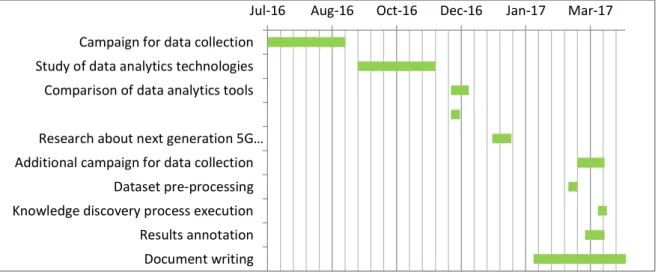
This project has been developed in the following steps: Campaign for data collection
Study of data analytics technologies Comparison of data analytics tools
Research about next generation 5G communications technology Defining data analytics mechanism implemented
Dataset pre-processing
Knowledge discovery process execution Results annotation
Document writing
Fig. 1. Gantt chart of this project.
Jul-16 Aug-16 Oct-16 Dec-16 Jan-17 Mar-17 Campaign for data collection
Study of data analytics technologies Comparison of data analytics tools Research about next generation 5G… Additional campaign for data collection
Dataset pre-processing Knowledge discovery process execution Results annotation Document writing
2.
Data analytics and the New Generation of Mobile
Communications Network Technologies Context.
In this chapter, the motivation of big data analytics in the context of mobile communications networks is introduced, emphasizing the need of implementing data analytics mechanisms in current mobile networks scenario. Then, an overview of future evolution of 5G wireless communications system is presented, describing its requirements and challenges to overcome current mobile networks constraints and the inclusion of data analytics mechanisms as an integral part of network processes. The motivation for network automation through data analytics-enhanced SON is described, along with its impact in QoS, and Quality of Experience (QoE) in the context of 5G systems. The user-level knowledge discovery process and use cases are described later. Finally, previous research about the use of data analytics techniques for characterizing mobility patterns from users is described.
2.1. Data analytics and mobile cellular networks scenario
The application of big data analytics in the wireless communication systems is expected to be a powerful tool for improving the performance of future mobile communications systems, the user experience and increase effectively the revenue of MNOs.
Nowadays, (O&M) systems are forecasted to show a joint limitation of processing power and computing capacity, because of the continuous increase in the amounts of data traffic that is being generated by the network and users [8]. The exponential increment of mobile data traffic is caused by the proliferation of multimedia, video and other mobile broadband applications, different performance related metrics registered by the network and stored on different databases, and the expected increase of network connections due to the introduction of new technologies such IoT [6].
The introduction of big data analytics can provide a wider view of the whole system, by making use of the control and traffic data available for gaining meaningful knowledge about network and user behaviors. Another benefit of the big data analytics is that it opens the door for real-time processing, allowing operators to monitor the network conditions in real time for making faster decisions for network optimization and for improving user experience.
Not only the operator’s technical departments can capitalize the usage of big data analytics in the different network procedures, other important areas such as marketing, customer support and sales departments can have its own applications for exploiting the knowledge acquired. For example, data analytics outcome can be used to identify the target audience for enhancing the effectiveness of publicity, advertisement campaigns and promotions. MNO can also develop innovative business models, improve user loyalty, and design new services according to subscriber’s needs.
Big data analytics is based mainly in techniques such as AI and ML. AI is the area of data science which studies the capabilities of a machine to have human-like intelligence. However, ML centers its attention in the ability that computer systems and programs have to learn by themselves, discover patterns in the data and improve program’s reaction to new data inputs. Big data analytics also offer additional features including efficient parallel computing, low-cost high-efficiency capabilities and fault tolerant [6].
For the user oriented point of view of this work, three categories of big data in wireless communication systems can be of interest.
2.1.1. Big traffic data
Huge amounts of traffic data are being carried by operator’s infrastructure. The employment of big data mechanisms for analyzing big traffic data streams can allow the operator to obtain highly interesting insights about traffic and subscribers behavior for improving network performance and take more efficient decisions [6].
Open source tools such as Apache Hadoop, developed by Yahoo!, is widely used for big data processing with distributed computing features. It was inspired by scalable platforms like GSF and MapReduce owned by Google. These tools allow handling and processing big quantities of data using thousands of computer servers. It was demonstrated that a Hadoop platform implemented in a commercially deployed mobile network, can monitor and analyze mobile data traffic in orders of Terabytes, showing high efficiency and reduced cost. [2]
2.1.2. Big location data
Location in the context of mobile communications can bring interesting information about human activities, providing insights about the behavior and regular habits of the user [6]. This information can be exploited for public planning, transporting, demographic trends, alerts about crowded places, emergency services, crime analysis, among other use cases. On the business side, the exploitation is related to mobile advertising and publicity.
The source of this data is provided by technologies embedded in mobile devices such as GPS, WiFi, Bluetooth.
By the incorporation of big data processing capabilities in future wireless network infrastructure, location data information given by the cell the user is connected to, adds a an important dimension for mobility analysis and for characterizing mobile subscriber geographical behavior. This location information can be manipulated with help of big data analysis and serve as drive decisions for SON algorithms and O&M system in mobility related use cases for efficient resource allocation.
2.1.3. Big heterogeneous data
Heterogeneous data refers to very diverse network parameters and metrics that network stores in different databases, including for example system throughput, call drops, handover failures, etc. It also includes marketing department databases which include costumer related information such as costumer profile and billing information. This performance and costumer centric information can be disaggregated and processed with the use of big data analytics in a very efficient manner for user focused use cases, which include characterizing individual subscriber performance for improving quality perception. The next section contains a review of the future generation 5G wireless systems and its capabilities, where data analytics are integrated and play an important role for processes such as data for network optimization and capacity planning. Most researchers support the inclusion of big data analytics through AI and ML capabilities in next generation networks for building a fully intelligent system that could help to discover, analyze and take advantage of the big quantities of data available for taking effective actions.
2.2. 5G networks overview.
When we think of a new generation of wireless communications, there is the expectation for an increase in the network capacity and higher data rates which overcome resource limitations in the legacy generations deployed. Besides this premise, 5G, the next generation of mobile communications and wireless systems is being designed from a wider point of view. This paradigm change includes embracing current and new radio access concepts, supporting new business models, new services and trending applications; in order to meet new technology challenges for 2020 and further [9].
2.2.1. Current and Future Mobile Networks Challenges and Requirements.
A review of current mobile technology challenges can show the main drivers of 5G research:
The massive data traffic demand triggered by the use of smartphones, with capabilities for more demanding multimedia applications, high definition video and other wireless broadband services; accounted by 2014 the 88% of total data traffic [2]. Intelligent mobile devices permanently generate data from geo-localization, phone calls, mobile applications used and air interface measurements.
In addition, it is expected that more than 50 billion of IoT devices with applications such as smart home, smart cars, smart office, among others, will be connected and operative by 2020. Also applications like M2M communications consisting of low-power consumption devices are growing very fast.
Furthermore, it is difficult for 4G to cover the traffic demand with the current base station centered model; changes are needed in the architecture of RAN for increasing the capacity of the network. Those changes are expected to be included in 5G, featuring the implementation of heterogeneous access network architecture with macro and small cells; moreover, with the use of massive arrays of small size antennas transmitting in higher frequencies, combined with highly directional beamforming gains that helps to mitigate the interference while offering a suitable coverage range [12].
Research and efforts of 5G pre-standardization made by projects, institutions, operators, big telecommunications vendors and academics already defined the requirements for the new evolution of mobile and wireless technologies in order to accommodate to the forthcoming demands.
For the high user data rate and capacity demands, 5G has to provide data rates in the order of Gbps: 1 Gbps in high mobility and peaks of 10 Gbps in low mobility scenarios. Also, it is expected that the new technologies will deliver around 1000-fold increase of data bandwidth per area unit, resulting in better user connectivity in crowded scenarios. [9]
5G requirements also cover new wireless concepts including machine communications and ubiquitous IoT scenarios. For adapting to the reliability needs of sensors and communicating machine applications, the latency is expected to be reduced 10 times compared to 4G, with 1 ms in roundtrip time. Additional requirements include supporting until 100 times the number of connected devices per cell and more efficient energy
saving procedures to increase 10 times battery life; these conditions are needed for coping the high number of IoT devices that will proliferate in the near future.
2.2.2. Network flexibility through virtualized architecture.
5G will be provided of flexibility for optimizing the network resources, supporting new business models such as vertical industries, new costumers necessities and facilitate partnership models through Software Defined Networking (SDN) and Network Function Virtualization (NFV). This virtualized, software oriented environment, is an opportunity for introducing big data analytics and automation capabilities in the network operation and resources management [2].
SDN is envisaged to be a solution for the configuration and maintenance in front of the required architecture and air interface changes in this heterogeneous, dense small cells and massive antenna deployment. SDN contemplates a division between control and data planes through software implementation, allowing the independency of control and data plane, providing an architectural flexibility into the 5G network. This separation of control and data plane allows reducing the control overhead; improving the efficiency in the resource delivery and software oriented implementations for reducing current hardware limitations.
The NFV separates the network functions in a virtualized manner from lower hardware resources, in order to divide the management resources from the actual network functions [10]. NFV permits flexible architecture of the network functions encompassing Operations Support System (OSS), core and radio edge functions. It can provide cloud technology services, enabling network scalability and reduced cost solutions for addressing the traffic variability, through automation of the deployment, configuration, optimization and repairing mobile network functions.
Along with SDN and NFV, Cloud RAN (C-RAN) will help solving issues and CAPEX and OPEX constraints, improving system architecture, mobility, coverage performance and energy efficiency while reducing the network deployment and operation investment. C-RAN is based on the centralization of Base Band Units (BBU) in remote locations such as operator central offices and for pooling radio and network resources through virtualization. In the cell site, the Remote Radio Heads (RRU) includes the transceiver devices, amplifiers and filters. BBU and RRU are connected through optical fiber. This virtual environment eases the scalability of the RAN, the integration of different services, provides efficient resource management and reduces infrastructure costs for MNOs.
The 5G challenges, requirements and architecture changes described in this section, demand an evolution in how to take advantage of the data generated in this diverse new generation ecosystem, from an optimization and planning point of view. Big data analytics is envisioned as a tool to obtain full network intelligence and end to end knowledge off this massive data available from different network source for different network utilities, and making 5G network deployment a profitable business for network operators.
SON algorithms on top of big data analytics are expected to be fully implemented in the design of 5G among most of the RAN tasks motivated by a bigger complexity in the future network topologies, architectures, technologies and parameters to take care of. This improved conception of SON described in the next section.
2.3. SON and data analytics in 5G context.
MNO’s capital expenditure (CAPEX) and operational expenditures (OPEX) will be impacted directly as result of the new technologies trends and requirements for 5G featuring multiple RATs, heterogeneous cell approach, virtualized architecture of network, an ultra-dense number of network nodes, demanding applications and novel use cases sharing the new mobile and wireless ecosystem.
In WCDMA and LTE, SON capabilities were introduced to attend these challenges, alleviating MNO’s complex management procedures and reducing OPEX and CAPEX stress. The tasks where SON processes intervened were very specific and composed of automated loops algorithms, triggered by specific network conditions for particular KPI optimization. Also, SON algorithms are vulnerable to conflicts between the the different SON functions, and also the possible human intervention on the parameter configuration [10]. Independent SON functions running at the same time can cause conflicts between them, adding instability in the network performance. Nevertheless, SON coordination was later introduced to address those issues with proper limitations.
However, in 5G it is expected a more complicated management scenario with the introduction of virtualized network elements, C-RAN, very dense cell deployment, supporting of a great quantity of connections and the support of multiple vertical industries use cases. Contrary to legacy networks, where SON had a reactive design and punctual use cases, 5G challenges demand an evolution of SON capabilities for deeper and more proactive automation to attend all the 5G requirements while making it a profitable endeavor for MNO’s.
Challenges and requirements for future 5G SON implementations are described in [4]. In legacy systems, the knowledge of possible network states is already or partially known for triggering specific SON compensation mechanisms. The data for gathering this knowledge is based on drive test collection, subscriber complaints and network management KPIs and measurements. This is not compatible with the premise of low latency and resource efficiency 5G networks need to provide.
5G SON mechanisms require massive intelligence and end-to-end network visibility. This end-to-end visibility of the network can be achieved by intrinsically enhancing SON with big data analytics. Big data analytics is expected to provide the knowledge and intelligence needed by SON to have the global visibility of the network status in real-time, associating network response with the network parameters and the capability to understand and to anticipate the subscriber behavior.
The enhanced SON concept is expected to be a primary tool for helping 5G networks to reach high levels of QoS and QoE [4]. This novel term of QoE refers to the end-to-end network performance quality perceived by individual subscribers. With the evolution of network architecture, the physical layer, and control plane, the quality paradigm needs to evolve along with them for meeting 5G requirements.
The global knowledge acquired by big data analytics allows reaching the individual user dimension when processing data. With this, the disaggregation of user related performance metrics measuring individual subscriber experience and enhancing the QoE. The importance of QoE arises in applications like mobile broadband video. The traffic of broadband video over internet is forecasted to grow at a very fast pace due to the increase video applications subscriptions, new advertisements models and content delivery services. Technical centered QoS metrics (packet loss, loss rate, etc) are not enough to measure the user satisfaction in this fueled video ecosystem. QoE have to deal with user perception and there is still open research in how to measure the related parameters and KPIs in next generation networks. However, QoE can be enhanced by approaching improvements in SON and big data analytics for 5G systems. [4]
2.4. User-level knowledge discovery through ML techniques
With the inclusion of AI, knowledge models can be obtained for understanding multiple dimensions of the network. The gathered data is processed using big data analytics techniques such as AI and ML mechanisms. The latter are based in classification,
prediction and clustering, involving supervised, semi-supervised and unsupervised techniques respectively.
The knowledge models are classified according to the following dimensions: user-level, which contemplates the characterization of individual user conditions or services; cell level, where the characterization is related to the conditions around each cell in the network; and cell cluster level, which characterizes cell groups according to its similarities.
The inclusion of big data analytics in future mobile networks allows exploiting the user-level dimension, disaggregating network data until reaching the individual subscriber level. This work focuses in studying a case for modeling knowledge in the user-level dimension.
Three use cases for user-level knowledge discovery. The use cases proposed for user level knowledge modeling includes:
Spatial-domain traffic pattern characterization: this case describes the behavior of the user in terms of the cells the user was connected to, along with the services used and the volume generated while being connected. The order of the cells the user is connected was relevant for predicting future user location and possible trajectories for dynamic resource allocation.
Time-domain traffic pattern characterization: refers to the characterization of the user behavior in terms of the mobile services used by an individual along a defined time span or the traffic generated by those services.
Performance characterization: Describes the performance experienced by users in terms of the QoS KPIs such as accessibility, mobility, retainability, availability. Together with the performance at cell level, it can help identifying which actions are needed in case of individual performance degradation.
The knowledge about user-level dimension can be obtained by the inclusion of big data analytics in the network O&M processes, and its outcome can be used as input for smart planning and optimization decisions driven by automated algorithms such as SON and its use cases. The user focused paradigm to be used in 5G and SON implementations along with big data analytics, will allow not only measuring technical driven QoS standards, but also individual user satisfaction and perception about network performance.
Due to method of data collection, only limited metrics are registered from the walk test perspective; however, location data is available as base stations identifiers, which can be
used for characterizing the mobility pattern of the user according to the different trajectories followed. A clustering technique is applied to base station sequences for characterizing the individual mobility profile.
A framework knowledge discovery process from data acquired from several sources is presented in [5]. It will be referenced in this work as a methodology for data collection, processing and the characterization of the location data. Moreover, use cases will be discussed for exploiting the user mobility patterns characterization. The next chapter describes this knowledge discovery process.
2.5. Previous work on user mobility patterns
Research work on mobility patterns is addressed in [2]. Here an algorithm for obtaining knowledge about user mobility patterns through the application of Hierarchical Agglomerative Clustering (HAC). It is performed as a function on collected trajectories from mobile users. The outcome of this function is used for addressing the problem of location prediction for efficient allocation of resources.
User location knowledge is anticipated to play an important role for cases with dynamic bandwidth allocation and location management. The importance of recorded user trajectories for historical movement data is highlighted as main input for the clustering algorithm. The movement randomness arises as a sensible factor for consideration in the data processing algorithm, which results in noise and degradation of accuracy in any predictive model which considers user trajectory patterns.
The methodology in [7] is valuable for the project here presented, especially for the knowledge discovery process, calculation distances between user sequence vectors, application of a clustering algorithm to describe similarities among user trajectories, and the association of additional vectors to one of the groups defined.
The location prediction based on supervised ML was studied in [13]. Here the existence of a training set based in a semi-Markov process is assumed and it compares the prediction performance according to different training set sizes, performance with real data and computation complexity. The dataset used is based on movements over a GSM network of one unique student stored in a server. There is no explanation in how the data is collected.
In [14], the problem of localization of mobile devices is approached from the point of view of sensor and mobile network terminals. This research uses a semi-supervised ML
method, combining labeled and unlabeled data; the former is used for estimating the relative location of the mobile device and the latter is used for model calibration. In case of indoor coverage, it is mentioned that GPS systems may not work for locating users. The application of ML in mobile network use cases are mentioned and described in [15]. Here it is explained the necessity of incorporating intelligent hardware and software in the network system for certain real time applications which require faster response and quick decision making.
The first use case described prediction based on the link strength and the time during such strength drops below certain threshold, allowing applications to take actions in advance. The second use case describes its use for minimal wastage of resources performing handover predictions. Lastly the use of ML techniques for routing in ad-hoc networks and intrusion detection is described.
In [16], clustering techniques are combined with the concept of sequential pattern mining to develop an approach for predicting future movement of mobile users. This paper states that single user measurements may cause loss of important information on individual movement history and it is suggested to group similar users that share similar behavior. It references the work in [2], which takes into account randomness of user movements and how it provides noise to the prediction model.
3.
Methodology for Categorizing Mobility Patterns using
Clustering Techniques
The methodology applied in this work for studying mobility patterns of mobile users, references the framework proposed on [5], for AI based knowledge process for 5G networks, focused in the specific case for knowledge discovery stage in the user-level mode. User mobility patterns are obtained as the outcome of knowledge discovery phase and it will drive the decisions in the SON exploitation.
The AI based knowledge process is composed by the following 3 stages illustrated in Fig. 2:
Fig. 2. AI-SON knowledge based process. [Source: UPC].
3.1. Data Acquisition and preprocessing stage:
In this stage, user data is collected from different sources. Those sources can be obtained from stored MNO data, including measured network data like typical QoS KPIs, performance measurements and network counters, customer service databases, etc; Also, the data from external sources can be used for estimating the user behavior in extended scenarios which impact network traffic resources; those external sources include data gathered from installed applications, internet information services, social media and open databases, among others.
After collecting this raw and heterogeneous data from multiple sources and locations, the obtained dataset may present vast redundancy, inconsistency and unusable registers.
This unpolished dataset needs to be formatted, cleaned, depurated and filtered through various processes for avoiding unnecessary storage space and reaching the best possible algorithm efficiency. The pre-processed dataset that will act as input for the ML functions in the knowledge discovery stage.
In this work, the network data is collected from the user perspective, as there is no access to the network management system. Mobility parameters are monitored and collected using the drive test application called Qualipoc, installed on an Android mobile device with LTE and UMTS connectivity.
Location data such base station registers can be gathered using this walk test collection method; it can provide enough information for obtaining relevant information about mobility trajectories of the user.
The city where data was collected is the Metropolitan Area of Barcelona.
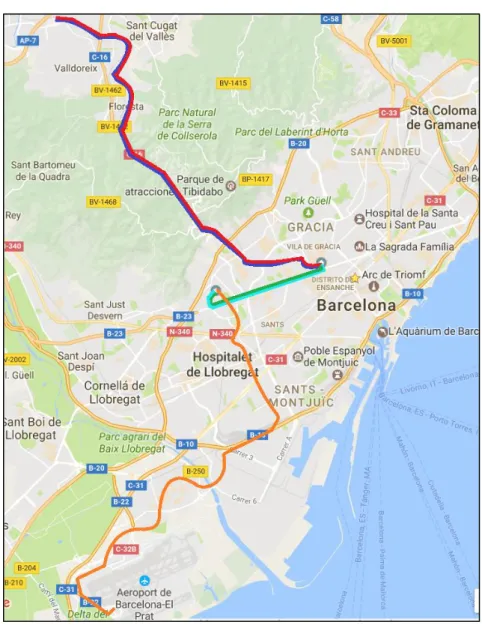
The Fig. 3 shows a description of the different trajectories followed, including: Home-Work: colored in blue. Route from Gràcia to Sant Cugat. Work-Home: colored in red. Route from Sant Cugat to Gràcia
Home-Univ: colored in light blue. Route from Gràcia to Universitat Politecnica de Catalunya (UPC)
Univ-Home: colored in dark green.Route from UPC to Gràcia
Univ-Airport: colored in orange. Route from UPC to Airport of Barcelona
However, other routes were considered, but the trajectories followed are highly similar to the main routes described.
3.1.1. Qualipoc software
QualiPoc (powered by SwissQual) is a smartphone tool for RF optimization which allows collecting voice and data service measurements and mobile network testing. It supports most of the mobile networks technologies implemented worldwide, including GSM, UMTS LTE and WiFi standards, and it covers multiple protocol layers in real-time. The main use case for this application is testing indoor and outdoor network mobile parameters. For this project the software was used for monitoring radio parameters and collecting mobile network data for UMTS and LTE access technologies.
Fig. 4 shows the main Qualipoc interface. The top screen banner displays the connected cell information including by default the connected channel, the cell ID number, the received signal power and received signal quality. Depending on the technology, those parameters have a different name and description:
For UMTS, the connected channel number is called UMTS Absolute Radio Frequency Channel Number (UARFCN); a number assigned to each radio channel used as defined in the UMTS specifications [17]. The cell is identified by its Primary Scrambling Code (PSC), a number between 0 and 512 used for synchronization purposes. The received signal power is defined by the Access Stratum1 Received Signal Code Power (AS1 RSCP) and refers to the measured received power in the corresponding physical communication channel in dB units. The measured quality is given by the Ec/Io, defined as the ratio between energy per code bit and the interference level also in dB units. In the LTE technology, the connected channel number value in the banner is the Downlink EUTRA Absolute Radio Frequency Channel Number (DL EARFCN) [18]. The cell identifier is the Physical cell ID (PCI). The received signal indicator is given by the Reference Symbol Received Power (RSRP), and is used in LTE for measuring the power received by the mobile device from the eNodeB. Finally, the Reference Signal Received Quality (RSRQ) indicates the quality of the signal received from the eNodeB as a ratio between the RSRP, the Received Signal Strenght Indicator (RSSI) multiplied by the number of resource blocks delivered where RSSI is measured. The RSSI is defined by the 3GPP as the the average received power observed in the OFDM reference symbols for antenna port 0.
Fig. 5 shows the Qualipoc action menus, where band forcing, freeze monitoring option, screenshot, text marker and photo marker actions can be selected.
Several predefined and customizable monitors can be selected and displayed for following in real time the measurements. The table 1 describes the content of each available monitor.
Table 1. Default monitors available in Qualipoc software [Source: SwissQual].
A measurement job can be created by displaying the settings menu on the top right icon and selecting the Jobs option. In the settings view for measurements job (Fig. 6) options for band forcing, access points selection and packet capture are available. The forcing options permit to select the network interface including mobile data; Wi-Fi and a default setting for mobile phone normal usage; the network type option allows fixing the mobile technology, including GSM, WCDMA, LTE and free access technology selection, according to the operator’s RAT settings.
The Qualipoc software incorporates the following test functionalities: “Call”, for voice call connection
“Data”, for data connection to an access point supporting Dropbox, Email, FTP, HTTP transfer, etc
“Message” for SMS MMS functionality
“Multi-Data, Multi-Mix, Multi-RAB, and Parallel” for data and call test sequentially or in parallel or random Multi-RAB tests
“Idle Monitoring”, which allows the monitor and collection of network RF parameters while performing normal use of the smartphone. This test functionality will be used in this work.
Maximum duration test in seconds is configured as 0, for disabling automatic test time. 3.1.2. NQView software
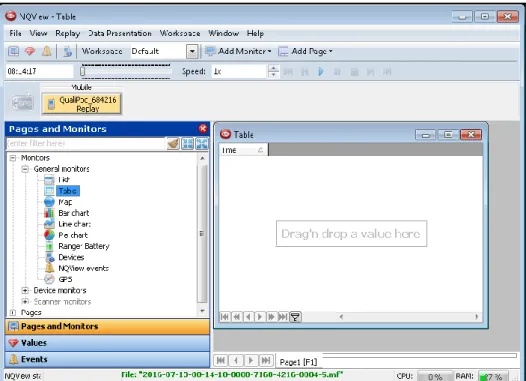
The data collected was processed with NQview Version 15.0.0.19. NQview is a graphical user interface for benchmarking and optimization analysis powered also by SwissQual. It provides a graphical and quick summary of data collected by Qualipoc. It offers predefined monitors of the radio conditions, custom visualizations workspaces and allows exporting the parameters registered in a .csv format for posterior analysis.
Files from Qualipoc job measurements can be uploaded into NQview environment, and be visualized in multiple formats for further analysis. First, the measurements files have to be extracted from the phone using a USB cable and to be saved in the computer where NQView installed.
The main layout of NQView is displayed in the Fig 7. This interface allows replaying the loaded measure and the data can be visualized in the workspace located in the right center of the main view. The uploaded file name is presented in the lower bar. By default, the file name displays the date and hour the measures were taken, as well as the code of Qualipoc software used.
Fig. 7. NQView Workspace.
On the left page, different options for monitoring are displayed in the “Pages and Monitors” field, including table, graph, maps, among others, that can be drag-and-dropped onto the workspace for previewing the measured data. Also, predefined monitors and pages for corresponding technology parameters such as GSM, WCDMA, LTE, WiFi, among others can be displayed in this option.
For this work, NQView will serve as a tool for exporting a data table which contains different radio parameters like PCI, RSRP, RSRQ, along the instant the measurement was taken; all LTE parameters. However, only PCI data is considered for characterizing the differerent mobility trajectory of the user.
This will be the raw data which will be pre-processed and its outcome will serve as input of the following Knowledge Discovery Stage.
3.2. Knowledge Discovery Stage
This stage envisions the use of ML mechanisms in order to construct models for obtaining relevant knowledge about network related subscriber behavior, which can be used for driving pertinent SON decisions [5]. ML techniques are used for processing the data collected for obtaining different knowledge models. For this work different mobility traces can be grouped by using clustering techniques, according to its similarity for building a mobility pattern footprint.
3.2.1. Clustering Algorithms
Clustering refers to a process for organizing different data objects into groups according to its similarities. The subsets of grouped dataset objects are called clusters. Data objects assigned into the same subset group have higher similarity than those who belong to another group. The similarity and dissimilarity calculations are based on the attributes which describe the objects according to the pairwise distance between them.
Contrary to supervised ML techniques such as classification algorithms, class labels or tags are not known beforehand when implementing the clustering algorithm. The process of clustering, also called clustering analysis, is useful for discovering previously unknown patterns observed in the dataset and, in the context of this work, can provide higher scalability for discovering new trajectory groups.
Cluster analysis has multiple use cases which include business intelligence, image recognition, biology and security. In mobile networks, it is a suitable technique for discovering and categorizing individual user mobility and traffic behavior.
Table 2. Overview of the different clustering methods. [Source: SwissQual].
The use of partitioning methods requires knowing from the beginning the numbers of clusters to be built. In mobile networks, the number of mobility patterns can be huge and unpredictable; moreover, defining the number of clusters or patterns from the beginning implies a considerable limitation. Hierarchical methods do not have this limitation and would be ideal for exploring the different individual user patterns.
Density-based clustering method includes arbitrary shapes for the probabilistic density regions. The use of complex regions can be a limitation for the analysis of the information provided by the algorithm
The grid-based method focuses first in summarizing the object space into a finite number of cells before grouping the objects. Again, the number of cells created is finite and the algorithm has limitations for processing big datasets.
Therefore, the data characterization through hierarchical clustering methods is selected because the simplicity and descriptive information it provides, highly useful for posterior analysis.
Hierarchical clustering is a characterization method for cluster analysis which builds a hierarchy or tree of groups. The most used way to represent hierarchy of cluster is dendrograms. A dendrogram is a graphic tree to display the hierarchical sequence of clusters. An example of this structure is presented in the Fig. 9.
Fig. 9. Dendrogram: Hierarchical clustering representation. [Source:Morgan Kaufmann]
Each dendrogram level represents different groups of objects according to a hierarchy measured by a similarity scale. Data representation through dendrogram is very descriptive for visualization and analysis. In level l=0 every single dataset object represents its own cluster. In level l=1, a and b form a first cluster. As the levels goes up, the objects stay grouped until reaching the highest level. For example, the right branch starts grouping d and e objects in l=2; then in l=3, c is grouped together with d and e and finally, all objects form the biggest cluster in l=4, which is the higher level. The similarity scale quantifies the distance between the different groups.
Hierarchical clustering (HC) algorithms could be classified in two categories: “Bottom-up” as agglomerative clustering method and “Top-Down” as divisive hierarchical clustering method. Fig. 10 shows graphically the process of agglomerative (AGNES) and divisive (DIANA) clustering algorithms on a dataset {a,b,c,d,e}
In agglomerative clustering, each object starts in its own group and then, every two groups the most similar are merged into bigger clusters as the process moves up in the hierarchy level, until one cluster is formed including all dataset objects. On the contrary, in divisive clustering all objects start into one cluster, and the groups are partitioned into several smaller clusters, with the least dissimilarity between each group, until reaching the lowest level generates one object clusters.
The dissimilarities in hierarchical clustering are measured by calculating the distance between the different objects in the dataset. After calculating the dissimilarity, the type of linkage distance, inherited in the HC algorithm, defines how the links between the different the cluster groups are joined together in the hierarchy is built.
The linkage distances can be classified into three categories: single linkage, for when the dissimilarity is the smallest among two objects in opposite groups; complete linkage, where the calculation takes into account the largest dissimilarity between the grouped objects and average linkage, where the dissimilarity is the average among all objects in opposite groups. The use of single and complete linkage portrays the extreme conditions for distance calculation among cluster groups. Average linkage represents a balance between the former two techniques, being less sensitive to distortions and noisy data. Therefore, average linkage techniques are used in this project.
In this project the mobility trajectories are measured by Cell ID registers along an increasing time scale. Each mobility trajectory is modelled as vector including a sequence of Cell ID in string format. However, time varying sequences are affected by the accelerations and decelerations and other uncertainties that the walking path adds; for instance, if the person registering the data is walking faster or slower, the waiting span for the bus or a train, the waiting for the traffic lights change, etc.
The problem for calculating the distance between categorical sequences can be solved by using the weighted edit distance, also called Levenshtein distance, is an algorithm used in the bioinformatics for DNA, RNA, and aminoacids sequence analysis, and also finds its application in natural language processing for spelling correction.
The edit distance when comparing two strings, is defined as number of several edit operations including insertions, deletions and substitutions; that are needed to convert the first string into the other one. By definition, each operation has a weight or cost when performed. The delete and insertion operation accounts for a cost equal to 1, the substitution operation accounts for a cost equal to 2 and a perfect match accounts for a cost equal to 0. The weighted edit distance algorithm is a special case of edit distance,
which counts the minimum total edit operation cost it takes for transforming a string into another.
Fig. 11. Weighted edit distance example.
The Fig. 11 illustrates an example of the weighted edit distance procedure between the string sequence and . In (a) the operation substitution of A per D accounts for a cost of 2. In (b) the C character is deleted with a cost of 1. In the following step, B is substituted by a C (cost equals to 2) and in the last stage, the character D is added with a cost of 1, for a total optimal edit cost of 6.
3.2.2. Data analytics software selection
Before performing the knowledge discovery process, a descriptive study between the data analytics tools RStudio and RapidMiner will be done, in order to highlight the pros and cons of each software and select the one what better adjust to the project purpose. One will be selected as main data analysis software in this project for analyzing the preprocessed data through different ML techniques.
3.2.2.1. RStudio
RStudio is a graphical development interface for R, which is an open source environment and programming language for statistical analysis and graphics developed by R Foundation. R is broadly used for data mining, biomedical research and financial fields; it supports a great quantity of libraries and packets that incorporates functions for data analytics, mathematics operations and graphics. The R packages can be downloaded from CRAN (Comprehensive R Archive Network) servers and other websites, such as Github.
Fig. 12 shows the RStudio main interface which comprises several modules. The edition console (bottom left) supports direct code programming and execution using R syntax and also displays coding outputs and system messages. On the top left, a preview of loaded datasets and scripts files details are shown. On the top right there are the environment and history panels. In the environment panel, datasets and R objects can be
loaded and displayed. The history panel shows the historical of submitted R code. The bottom left panel is used mainly for plot visualization and summary of loaded packages.
Fig. 12. RStudio Layout.
For the HC study, “Cluster” for R library will be used. It includes clustering functions such as AGNES (Agglomerative Nesting) and DIANA (Divisive Analysis Clustering). AGNES is the function for Hierarchical Agglomerative Clustering algorithm. Compared with other R functions for agglomerative clustering like hclust, AGNES describes additional information such as agglomerative coefficient, which measures the amount of clustering structure obtained. AGNES supports the different methods for computing the clustering distance such as complete linkage, single linkage, average linkage, among others.
DIANA function is used for computing divisive hierarchical clustering of the datasets in a top-down manner, being the only R implementation of this algorithm. The function builds a divisive coefficient according to the clustering structure and a graphic display for further analysis.
Each function computes the clustering hierarchy by computing a dissimilarity matrix using methods for measuring the distance between numeric sequences such as as Euclidean and Manhattan. As stated before, the vectors fields studied in this work have string format, and need to be manipulated as nominal values. Euclidean and Manhattan distance computing methods are not adequate for measuring distances for nominal values. Because of this, Levenshtein distance (or edit distance) arises as a method for calculating the dissimilarity matrix for nominal datasets.
There are several R package for computing edit distance for sequence matrix. The most used are the “stringdist” package and the “cba” packages. The former incorporates a function called stringdistmatrix, based in Levenshtein distance for building a dissimilarity matrix between different string sequences; however, it does not incorporates the well-known weighted edit distance method and just an arbitrary Levenshtein distance algorithm.
The “cba” (Clustering Business Analysis) package, includes the function sdists() which stands for Sequence Distance Computation. This function computes a dissimilarity matrix between vector of strings manipulating them as sequence of symbols, allowing to select diverse distance calculation methods including the weighted edit distance computation. The outcome matrix of the sdists() function, can be directly used as input for the AGNES and DIANA funcions.
Morever, sdists() computes the weighted edit distances between the adjacent column registers. Datasets streams must be loaded in the R as observed in Fig. 13, where “Data1”, “Data2”, “Data3” and “Data4” are the column datasets to be compared and 1, 2, 3 and 4 the row names which represent the sample metric row.
Fig. 13. RStudio loaded dataset..
For this particular example, Fig. 14 shows an example of the structure of the distance matrix d; it is a diagonal matrix where each field which indicates the weighted edit distance between the datasets.
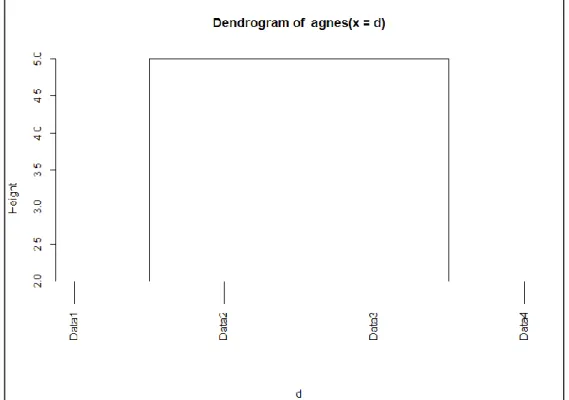
Using the plot() function the AGNES dendrogram is created. Fig. 15 shows the structured HAC dendrogram of the example dataset, joining together the objects in two groups, one branch including Data 1 and Data 2 and the second branch including Data 3 and Data 4. Each branch groups two objects which have least distance cost, being the cost in this case equals to 2, according to the computed dissimilarity matrix. The height scale indicates the distance cost which separates the grouped objects, aligned with the horizontal line that joins the individual sequences Data1 with Data2 and Data3 with Data4 respectively. In this case, the individual edit cost of Data1 compared with both Data3 and Data4 is 4, likewise, the distance between Data2 with both Data3 and Data4 is 6. The upper horizontal line which joins the two groups has a height of 5, being the average distance between the individual objects belonging to different groups.
Fig. 15. Agnes Dendrogram.
The outcome of both hierarchical clustering techniques, AGNES and DIANA are very similar. However, the fact that DIANA does not incorporate the option for controlling the linkage method used for joining the different cluster objects, provides uncertainty on the manner the cluster structure is built. For this project, only AGNES is used to overcome this limitation. An example of both clustering techniques implementations is shown in Appendix A.
![Fig. 2. AI-SON knowledge based process. [Source: UPC].](https://thumb-us.123doks.com/thumbv2/123dok_us/9916608.2484710/29.892.121.757.455.750/fig-ai-son-knowledge-based-process-source-upc.webp)
![Table 1. Default monitors available in Qualipoc software [Source: SwissQual].](https://thumb-us.123doks.com/thumbv2/123dok_us/9916608.2484710/33.892.194.698.254.625/table-default-monitors-available-qualipoc-software-source-swissqual.webp)
![Fig. 9. Dendrogram: Hierarchical clustering representation. [Source:Morgan Kaufmann]](https://thumb-us.123doks.com/thumbv2/123dok_us/9916608.2484710/38.892.187.707.124.377/fig-dendrogram-hierarchical-clustering-representation-source-morgan-kaufmann.webp)