HPC with Python: An MPI-parallel
implementation of the Lattice
Boltzmann Method
Lars Pastewka Andreas GreinerDepartment of Microsystems Engineering, University of Freiburg, Germany
The Lattice Boltzmann Method is well suited for high-performance computational fluid dynamics. We show by means of a common two-dimensional test case, the lid-driven cavity problem, that excellent parallel scaling can be achieved in an implementation based on pure Python, using thenumpylibrary and the Message Passing Interface. We highlight opportunities and pitfalls for the implementation of parallel high-performance codes in the high-level language Python.
1 Introduction
The Boltzmann transport equation (BTE) was introduced by Ludwig Boltzmann in the context of kinetic gas theory (Boltzmann, 1896) and is a statistical model for the transport of molecular constituents during flow (Cercignani, 1988). The Lattice Boltzmann method (LBM) is a numerical scheme based on a discretized version of the BTE, introduced by McNamara and Zanetti in 1988 (McNamara et al., 1988). LBM models have been used for the last three decades to study the dynamics of fluids in many different applications, from multiphase flow (Gunstensen, Rothman et al., 1991; Grunau et al., 1993), porous media (Aharonov et al., 1993; Gunstensen and Rothman, 1993) to microfluidics (Zhang, 2011). A thorough review of its applications in fluid dynamics and beyond can be found in Succi (2001).
2 The Boltzmann transport equation
The BTE describes the time of evolution of the probability densityf(v,r, t)for
find-ing a molecule with massmand velocityvat positionras a function of timet. The
moments of this probability density define the mass densityρ(r, t), the momentum
densityj(r, t)and the temperatureT(r, t)in D-dimensional space, ρ(r, t) =m Z dDv f(v,r, t) (1) j(r, t) =ρ(r, t)u(r, t) =m Z dDvvf(v,r, t) (2) kBT(r, t) = m2 Dρ(r, t) Z dDv[v−u(r, t)]2f(v,r, t), (3)
where we have defined the average velocity u(r, t) at position r. We have here
assumed a monoatomic system with molecules of massmandkB is the Boltzmann
constant.
The BTE describes the total time-rate of change of this probability distribution,
df /dt. We know that for large timestit must relax towards statistical equilibrium,
given by the Maxwell velocity distribution function (Huang, 1987),
feq(v;ρ,u, T) = ρ m m 2πkBT D/2 exp −m(v−u) 2 2kBT . (4)
A common approximation is to assume relaxation of f towards feq with a single
characteristic timeτ, as suggested by Bhatnagar, Gross, and Krook (BGK) in 1954
(Bhatnagar et al., 1954),
df(v,r, t)
dt =−
f(v,r, t)−feq(v;ρ(r, t),u(r, t), T(r, t))
τ . (5)
Eq. (5) is the BGK-Boltzmann equation. Note that the total differential off is df dt = F(r) m ∂f(v,r, t) ∂v +v ∂f(v,r, t) ∂r + ∂f(v,r, t) ∂t , (6)
whereF(r)is an external force acting on the molecules.
We will remain within the context of this single (BGK) relaxation time approxim-ation, but modern developments of the method aim at introducing multiple
relaxa-tion times, for example by relaxing the cumulants off individually (Geier, Greiner
et al., 2006; Geier, Schönherr et al., 2015).
2.1 The Lattice Boltzmann Method in two dimensions
The BTE is discretized in space, velocity and time. Discretizing Eq. (5) on a regular (square) lattice in space is straightforward. However, we also require a suitable discretization of velocity space and the time step. Both are chosen such that the distance between interpolation points in velocity space multiplied by the time step equals the distance between points on the spatial lattice; in other words, a molecule traveling on the spatial lattice travels between integer number of lattice points during one time step.
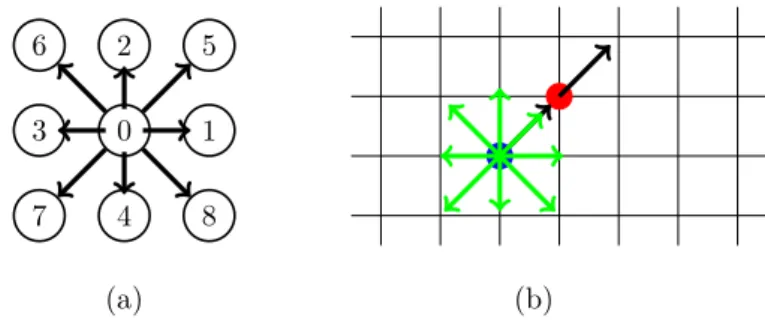
The particular realization of the velocities used by us is shown in Fig. 1a. The velocity set contains 9 directions. Each direction is assigned the index shown in Fig. 1a. Direction0 zero hence describes the population of molecules at rest. This
specific discretization in two-dimensional space (D = 2) with nine directions is
commonly denoted by D2Q9. 0 1 2 3 4 5 6 7 8 (a) (b)
Figure 1:Discretization of the BTE. (a) Discretization of velocity space into nine directions. The numbers uniquely identify the direction. (b) Regular two-dimensional lattice used for the spatial discretization.
The discrete velocities are therefore given by the directions to the eight neighbors divided by the time step. We have nine velocity vectorsci, withi= 0, . . . ,8for each
directioni. We now also require the occupation numbers for these nine directions.
where xj is the discrete lattice point and i denotes the direction. Note that the
moments of the probability density Eqs. (1) and (2) become
ρ(xj, t) = X i fi(xj, t) (7) u(xj, t) = 1 ρ(xj, t) X i cifi(xj, t), (8)
whereρ(xj, t)is now the number density, i. e. we assume unit molecular mass.
The discretized BGK-Boltzmann equation (5) then reads
fi(xj+ci·∆t, t+ ∆t) =fi(xj, t)−ω[fi(xj, t)−fieq(xj, t)] (9)
where∆tis a time step used for the discrete dynamical propagation of the
occupa-tion numbers. We have introduced the normalized relaxaoccupa-tion parameterω= ∆t/τ
and the external forcesF(r) are set to zero. Note that the left hand side and the
first term on the right hand side of Eq. (9) is a discretization of the total differential off. The expression for the equilibrium distribution function in the nine directions
is (Mohamad, 2011; Wolf-Gladrow, 2000) fieq(xj, t) =wiρ(xj, t) 1 + 3ci·u(xj, t) + 9 2[ci·u(xj, t)] 2 −3 2u 2(x j, t) , (10)
with wi = 4/9, 1/9 and 1/36for directions0,1-3 and4-8, respectively. Note that
like Eq. (4) for the continuous distribution function, Eq. (10) is obtained by apply-ing the maximum entropy principle under the constraint of mass and momentum conservation to the discrete distribution function (Mohamad, 2011; Wolf-Gladrow, 2000).
To give a rough idea of how Eq. (9) propagates the occupation numbers for the individual directions, we describe as an example what happens to f5. Assume we
have a finite value for directionfiincludingf5, their magnitude given by the length
of the green arrows, respectively, and based at the position shown by the blue spot in Fig. 1b. At time t the r.h.s. of Eq. (9) relaxesf5 towards the local equilibrium
given by the black arrow based at the blue spot, which is commonly called the collision operation (Boltzmann, 1896). Time propagation is described by the l.h.s. of Eq. (9). After one time step ∆t, the occupation f5 will be handed to the red
algorithmic implementation of Eq. (9) is conveniently split into these streaming and collision steps.
2.2 Implementation in Python and
numpy
The quantity that specifies the state of our simulation are the occupation num-bers fi(xj). We represent these as a single contiguous numpy1 array calledf_ikl.
Note that the suffixes in our specific naming scheme indicate the number of array dimensions and their function. In the present case, iklstands for three array di-mensions: i is a direction (array dimension of size 9), k is the lattice position in
x-direction, and l (size nx) the lattice position in y-direction (size ny). Below we
also encounterc, which denotes a Cartesian array dimension (size 2). This naming convention eases readability of the code and translation of formulas containing lin-ear algebra intonumpyoperations and is borrowed from the GPAW code (Mortensen et al., 2005; Enkovaara et al., 2010). Note that becausenumpy’s default storage order is row-major, the arrayf_iklis stored in what is commonly called the structure of arrays (SoA) storage order (Obrecht et al., 2011; Qi, 2017).
The streaming part can be cast into the form listed in Code Listing 1, which uses thenumpy.roll function and automatically takes care of periodic boundary conditions. numpy.roll rolls the data on the lattice into the direction specified byaxis in the code listing by a distance given by c_ic[i]. Note that c_ic[i] is a one-dimensional array of length 2 that specifies the Cartesian coordinates of
directioni. Taking the example of the f_iklarray, a roll operation on occupation
number1 andaxis0 with unit distance will assignf1,k,l→f1,k+1,l.
import numpy as np
c_ic = np.array([[0, 1, 0, -1, 0, 1, -1, -1, 1],
[0, 0, 1, 0, -1, 1, 1, -1, -1]]).T def stream(f_ikl):
for i in range(1, 9):
f_ikl[i] = np.roll(f_ikl[i], c_ic[i], axis=(0, 1))
Code Listing 1:Implementation of the streaming step
The collision part of Eq. (9) is also straightforward to implement. To translate an expression like Eq. (9) into vectorizednumpy code, it can be useful to write it down in Einstein notation. Einstein notation can be cast directly in Python code using thenumpy.einsumfunction. Code Listing 2 shows a naive but straightforward implementation of the collision step, split into the computation of the equilibrium distribution function inequilibriumand the final collision step incollide, where
omegais the relaxation parameter ωof Eq. (5).
import numpy as np
w_i = np.array([4/9, 1/9, 1/9, 1/9, 1/9, 1/36, 1/36, 1/36, 1/36]) def equilibrium(rho_kl , u_ckl):
cu_ikl = np.dot(u_ckl.T, c_ic.T).T uu_kl = np.sum(u_ckl**2, axis=0)
return (w_i*(rho_kl*(1 + 3*cu_ikl + 9/2*cu_ikl**2 - 3/2*uu_kl)).T).T def collide(f_ikl, omega):
rho_kl = np.sum(f_ikl , axis=0)
u_ckl = np.dot(f_ikl.T, c_ic).T/rho_kl
f_ikl += omega*(equilibrium(rho_kl , u_ckl) - f_ikl) return rho_kl , u_ckl
Code Listing 2:Naive implementation of the collision step
It is worth pointing out that the collision implementation of Code Listing 2 does not lead to optimal performance. The Python code can be further optimized by unrolling all multiplications with c_ic and eliminating the terms that vanish due to zeros in c_ic. This implementation is our optimized reference Python implementation. We additionally benchmark this Python implementation against a C++ collision kernel integrated into our Python code withpybind112 andeigen3.
2.3 Parallelization strategy
We parallelize the LBM using spatial domain decomposition and the message pass-ing interface (MPI)4. The collision part of the LBM is then embarrassingly parallel.
It is a spatially local operation and no communication is required. Note that we
2https://github.com/pybind/pybind11, Version 2.2.2 3https://eigen.tuxfamily.org/, Version 3.3.4 4https://www.mpi-forum.org/
could also have decided to parallelize in the direction space by distributing the oc-cupation numbers for the individual directions onto separate MPI processes. This would then require communication during the collision step. This is, however, disad-vantageous because there are just nine directions and parallelism would be limited to just nine parallel processes.
rank 0 rank 1 rank 2
rank 3 rank 4 rank 5
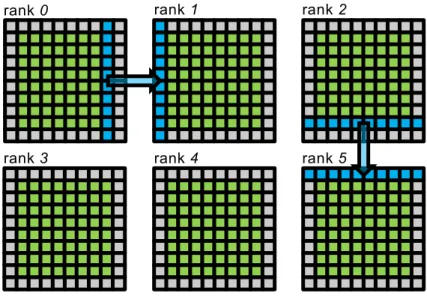
Figure 2: Domain decomposition and communication strategy. We decom-pose the full two-dimensional lattice into spatial domains of roughly equal size (green lattice points). We then add an additional ghost region of unit thickness surrounding these domains (gray lattice points). During each communication step, we communicate the outermost green active lattice into the adjacent out-ermost ghost lattice (as exemplified by the blue arrows). This requires four communication steps, two of which are indicated by the arrows.
Parallelization in the spatial domain requires communication during the streaming step. All occupation numbers that are moved past a domain boundary need to be communicated to the neighboring domain. We implement this by adding an addi-tional ghost region to the simulation domain. Figure 2 illustrates the concept for a decomposition in 3×2 domains. The green lattice points are our active
computa-tional domain and the grey points are the ghost lattice points. We now communicate the region adjacent to the ghost points into the respective ghost points of the neigh-boring domain as shown in Fig. 2beforethe streaming step. Within the streaming step, we then stream the relevant occupation numbersfifrom the ghost points into
Com-munication to the right and bottom as shown in Fig. 2 (for each domain) plus their reverse, communication to left and top.
We implement communication in Python using thempi4py5bindings to the MPI
library. The Python code responsible for communication is shown in Code Listing 3. We need onpeSendrecvcall to communicate in each of the four directions.Sendrecv
takes care of sending data in one direction and simultaneously receiving it from the opposite direction. ndxand ndy in the code are the number of domains inx and y-direction.
from mpi4py import MPI
comm = MPI.COMM_WORLD.Create_cart((ndx, ndy), periods=(False, False)) left_src , left_dst = comm.Shift(0, -1)
right_src , right_dst = comm.Shift(0, 1) bottom_src , bottom_dst = comm.Shift(1, -1) top_src , top_dst = comm.Shift(1, 1) def communicate(f_ikl):
comm.Sendrecv(f_ikl[:, 1, :], left_dst ,
recvbuf=f_ikl[:, -1, :], source=left_src) comm.Sendrecv(f_ikl[:, -2, :], right_dst ,
recvbuf=f_ikl[:, 0, :], source=right_src) comm.Sendrecv(f_ikl[:, :, 1], bottom_dst ,
recvbuf=f_ikl[:, :, -1], source=bottom_src) comm.Sendrecv(f_ikl[:, :, -2], top_dst ,
recvbuf=f_ikl[:, :, 0], source=top_src)
Code Listing 3:Implementation of the communication step
At the time of this writing, allmpi4pycommunication methods require contiguous
numpy arrays. The input arrays in Code Listing 3 need therefore be cast into con-tiguous arrays usingnumpy.ascontiguousarrayand a temporary contiguous buffer is required for receiving data. These intermediate steps have been omitted from the code excerpt for brevity.
3 Results for the lid-driven cavity
The lid-driven cavity is frequently used to test fluid dynamics simulation programs. Given a quadratic box with a sliding lid, as shown in Fig. 3a, we use equilibrium
initial conditions, Eq. (10), for the discrete BGK-Boltzmann transport equations. The initial values were chosen asρ= 1.0 andu= 0 at timet= 0.
· · · · · · · · · · · · · · · · · · · · · · · · · · · · · · · · · · · · · · · · (a) (b)
Figure 3:Lid-driven cavity. (a) The system consists of a quadratic box with hard walls drawn in black and a lid that slides to the right with a prescribed velocity, drawn in red. The lattice points all lie inside the box and the walls lie half way between boundary lattice points and (virtual) solid lattice points outside the box. (b) Streamlines in the steady state for a domain of300×300 lattice points andω= 1.7, corresponding to Reynolds number1000, given the typical velocity of the sliding lid asulid= 0.1. The figures is visualized using thestreamplotfunction of the matplotlib6library. The lattice is resampled
into a30×30lattice before determining the streamlines.
The lid moves with a given velocityulid in direction 1, i. e. to the east. We apply
bounce-back boundary conditions on the black boundaries and the prescribed wall velocity boundary conditions on the red wall. The full boundary conditions can be written as
fi=fi∗−6wiρwallci·ulid (11)
wherei∗indicates the direction before bounce-back andρwall is the fluid density at
the wall. More information can be found in Ref. (Mohamad, 2011; Wolf-Gladrow, 2000). Note that we apply bounce back boundary conditions to all parallel domains, but we introduce ghost buffers only for domain boundaries in interior domains, not for the outer boundaries of edge domains. Using this approach, we do not need special treatment of boundary or interior domains. Bounce back of particles in an interior is simply overridden in the next communication step. Outer boundaries of edge domains are not communicated when specifyingperiods=(False, False)in
the call toCreate_cartin Code Listing 3. This keeps our Python implementation as simple as possible and free of specific treatment of corner cases.
We calculated the velocity field in the steady state. Figure 3b shows the stream-lines of the flow field after 1 million time steps for a lattice of 300×300 lattice
points with ω = 1.7 and the velocity of the lid chosen as ulid = 0.1. The sliding
lid induces a large vortex rotating clock wise. The two lower corners show small vortices rotating in the opposite direction.
In order to demonstrate the scaling behavior for the parallel version of our code, we calculated the steady state solution of the problem for different sizes of the simulation domain 300×300, 1,000×1,000, 3,000×3,000 and 10,000×10,000
lattice points on bwForCluster NEMO at the University of Freiburg (2x Broadwell E5-2630v4 at 2.2 GHz per compute node with a 100 Gbit/s Omni-Path intercon-nect). The square computational lattice was divided in rectangular subregions, with each subregion assigned to one process.
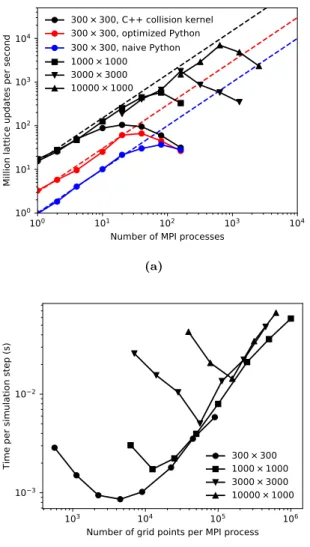
A common measure for the speed of an implementation of the Lattice Boltzmann Method is the number of million lattice updates per second (MLUPS), which we compute for the lid-driven cavity. Fig. 4a reports this measure for the naive and optimized Python implementation as well as for the Python implementation using a C++ implementation of the collision kernel, all using double precision floating-point arithmetics. It is immediately clear that the Python&C++ implementation is fastest, reaching about 15 MLUPS on a single core, while the naive Python implementation reaches only 1 MLUPS. Scaling for all implementations is excellent and the dashed lines in Fig. 4a shows ideal scaling for the three implementations. For a10,000×10,000lattice, the Python&C++ implementation peaks at7billion
lattice updates per second (BLUPS = 1000MLUPS) when using640MPI process
(32NEMO compute nodes).
Figure 4b shows the execution time (per simulation step) as a function of number of lattice points per MPI process. For each lattice there is a minimum in execution time that moves to a smaller number of lattice points per MPI process with decreas-ing lattice size. This means the larger the overall lattice, the larger the portions that reside on each MPI process must be for scaling to be optimal.
100 101 102 103 104 Number of MPI processes
100 101 102 103 104
Million lattice updates per second
300 × 300, C++ collision kernel 300 × 300, optimized Python 300 × 300, naive Python 1000 × 1000 3000 × 3000 10000 × 1000 (a) 103 104 105 106
Number of grid points per MPI process 103
102
Time per simulation step (s) 300 × 3001000 × 1000 3000 × 3000 10000 × 1000
(b)
Figure 4: Parallel scaling of the lid-driven cavity on bwForCluster NEMO. (a) Strong scaling test for different system sizes. The dashed lines show ideal scaling with1 MLUPS,3 MLUPS and15MLUPS per MPI process for the naive, optimized and C++ implementations. (b) Weak scaling test showing the execution time required for a single simulation step for the implementation using C++ collision kernels.
4 Discussion
Figure 4a shows that the three implementations achieve different execution speeds. The optimized Python implementation is already 3× faster than the naive
imple-mentation, while the C++ collision kernels gain another factor of 5× in speed. Scaling is good for all implementations and breaks down at a higher number of MPI processes for the slower implementations. For the 300×300 lattice, all three
implementations achieve almost identical execution speed at160MPI processes. At
this point, the execution time is entirely dominated by the cost of communication between the processes.
Parallel scaling breaks down at different points for different lattice sizes. More insights are obtained from the weak scaling test of Fig. 4b, which shows that there is a minimal number of lattice points per process, such that computation and not communication or idling dominates the aggregate cost. This number depends on the overall size of the lattice and is around 5,000 for the small 300×300 lattice
and100,000 for the largest10,000×10,000 lattice. Assuming a square region per
process, we end up with a surface to volume relation of about0.06to0.01. Because
the point of breakdown occurs at different surface to volume ratios, we believe that cost of communication is not its source. There are slight differences in run-time between the individual processes because the global lattice is not evenly divisible by the lattice used for domain decomposition, leading to slight variations in the size of the local domains. These differences in run-time are likely exacerbated at a larger number of total MPI processes, leading to some idling processes. More investigation is necessary to clarify this point. We also note that this result is specific for the D2Q9 model and is likely different for other two-dimensional and three-dimensional models.
The maximum performance of7BLUPS reached by our implementation is
com-parable to recent reports of 5 BLUPS reached on an implementation on multiple
graphics processing units (GPUs) (Xu et al., 2018), albeit for a D3Q19 lattice and a multi-relaxation time collision operation, but (presumably) single precision floating-point arithmetics. Xu et al. (Xu et al., 2018) report 5 BLUPS on 12 NVIDIA
K20M GPUs. Assuming linear scaling, we reach5BLUPS at240MPI processes or 24NEMO compute nodes. An extensive test of the CPU-based LBM
implementa-tionMusubi (Hasert et al., 2014) using double precision floating-point arithmetics was recently presented by Qi (Qi, 2017). On Hazel Hen (Haswell E5-2680v3 at 2.50 GHz with a Cray Aries interconnect),Musubi achieves around10MLUPS per
5 Conclusions
We have demonstrated a parallel implementation of the Lattice Boltzmann Method (LBM) in Python using the numpy library and the mpi4py bindings to the Mes-sage Passing Interface (MPI) that yields excellent scaling on bwForCluster NEMO. We have further shown that implementing the collision operation in the lower level programming language C++ yields a significant performance gain. It eliminates the creation of temporary buffers and avoids multiple loops over data structures. Our C++ optimization appears competitive with recently reported performances of implementations of the Lattice Boltzmann Method (Xu et al., 2018; Hasert et al., 2014), but one has to keep in mind that most published benchmarks are obtained for three-dimensional lattices while we here discuss only the two-dimensional case. Yet, our implementation can still be optimized further, e. g. by fusing streaming and collision steps, looping over data structures in a manner that maintains cache-coherency (Pohl et al., 2003) or by hiding communication behind computation. Future work will focus on extending the present code to three-dimensions and im-plementing further optimizations.
Implementing high-performance codes in Python has the advantage of fast de-velopment times and compact codes that can be used to test implementation and parallelization strategies before optimizing portions of the code in a lower-level lan-guage. Our naive parallel LBM implementation has160lines of Python code,34of
which are a parallel implementation ofnumpy.saveusing MPI I/O. The simplicity of this code makes Python and MPI also suitable for teaching parallel computing. We note that more complex parallel simulation codes implemented largely in Py-thon, for example the GPAW code (Mortensen et al., 2005; Enkovaara et al., 2010) and associated libraries (Larsen et al., 2017) for electronic structure calculations, have emerged over the past years. Python is maturing towards a language that al-lows rapid development of parallel simulation codes for high-performance computing systems. Libraries such aspybind11andeigenmake extending Python with native numerical code straightforward.
Our full parallel implementation of the Lattice Boltzmann Method can be found online7.
Acknowledgements
The authors acknowledge the support by the state of Baden-Württemberg through bwHPC and the German Research Foundation (DFG) through grant no INST 39/963-1 FUGG as well as through the Research Unit FOR 2383 ProMiSe under Grant No. GR 2622/6-1.
Corresponding Author
Lars Pastewka:[email protected]
Department of Microsystems Engineering, University of Freiburg, Georges-Köhler-Allee 103, 79110 Freiburg, Germany
ORCID
Lars Pastewka https://orcid.org/0000-0001-8351-7336
Licensecba4.0https://creativecommons.org/licenses/by-sa/4.0
References
Aharonov, E. and D. H. Rothman (1993). »Non-Newtonian flow (through porous media): A lattice-Boltzmann method«. In:Geophys. Res. Lett.20.8, pp. 679–682.
Bhatnagar, P. L., E. P. Gross and M. Krook (1954). »A model for collisionless processes in gases I: small amplitude processes in charged and neutral one-component systmes«. In:Phys. Rev.94, pp. 511–525.
Boltzmann, L. (1896).Vorlesungen über Gastheorie. Barth.
Cercignani, C. (1988).The Boltzmann Equation and its Applications. Springer.
Enkovaara, J. et al. (2010). »Electronic structure calculations with GPAW: A real-space implementation of the projector augmented-wave method«. In:J. Phys.: Condens. Mat-ter 22.25, p. 253202.
Geier, M., A. Greiner and J. G. Korvink (2006). »Cascaded digital Lattice Boltzmann automata for high Reynolds number flow«. In:Phys. Rev. E73, p. 066705.
Geier, M., M. Schönherr, A. Pasquali and M. Krafczyk (2015). »The cumulant lattice Boltzmann equation in three dimensions: Theory and validation«. In:Comput. Math. Appl.70.4, pp. 507–547.
Grunau, D., S. Chen and K. Eggert (1993). »A lattice Boltzmann model for multiphase fluid flows«. In:Physics of Fluids A: Fluid Dynamics5.10, pp. 2557–2562.
Gunstensen, A. K. and D. H. Rothman (1993). »Lattice-Boltzmann studies of immiscible two-phase flow through porous media«. In:J. Geophys. Res.98.B4, pp. 6431–6441. Gunstensen, A. K., D. H. Rothman, S. Zaleski and G. Zanetti (1991). »Lattice Boltzmann
model of immiscible fluids«. In:Phys. Rev. A43.8, pp. 4320–4327.
Hasert, M. et al. (2014). »Complex fluid simulations with the parallel tree-based Lattice Boltzmann solver Musubi«. In:J. Comput. Sci.5, pp. 784–794.
Huang, K. (1987).Statistical Mechanics. Wiley, New York.
Larsen, A. H. et al. (2017). »The Atomic Simulation Environment-A Python library for working with atoms«. In:J. Phys.: Condens. Matter 29, p. 273002.
McNamara, G. R. and G. Zanetti (1988). »Use of the Boltzmann equation to simulate lattice gas automata«. In:Phys. Rev. Lett.56, pp. 2332–2335.
Mohamad, A. A. (2011).Lattice Boltzmann Method. Springer.
Mortensen, J. J., L. B. Hansen and K. W. Jacobsen (2005). »Real-space grid implement-ation of the projector augmented wave method«. In:Phys. Rev. B71.3, p. 035109. Obrecht, C., F. Kuznik, B. Tourancheau and J.-J. Roux (2011). »A new approach to
the lattice Boltzmann method for graphics processing units«. In:Comput. Math. Appl.
61.12, pp. 3628–3638.
Pohl, T., M. Kowarschik, J. Wilke, K. Iglberger and U. Rüde (2003). »Optimization and profiling of the cache performance of parallel Lattice Boltzmann codes«. In: Parallel Process. Lett.13.04, pp. 549–560.
Qi, J. (2017). »Efficient Lattice Boltzmann simulations on large scale high performance computing systems«. PhD thesis. Rheinisch-Westfälische Technische Hochschule Aa-chen.
Succi, S. (2001).The Lattice Boltzmann Equation for Fluid Dynamics and Beyond. Clar-endon Press, Oxford.
Wolf-Gladrow, D. A. (2000).Lattice Gas Cellular Automata and Lattice Boltzmann Models Mechanics. Springer, Berlin.
Xu, L., A. Song and W. Zhang (2018). »Scalable parallel algorithm of multiple-relaxation-time Lattice Boltzmann Method with large eddy simulation on multi-GPUs«. In:Sci. Program.2018, p. 1298313.
Zhang, J. (2011). »Lattice Boltzmann method for microfluidics: models and applications«. In:Microfluid. Nanofluidics10.1, pp. 1–28.