Distribution Agreement
In presenting this thesis or dissertation as a partial fulfillment of the
requirements for an advanced degree from Emory University, I hereby grant to Emory University and its agents the non-exclusive license to archive, make
accessible, and display my thesis or dissertation in whole or in part in all forms of media, now or hereafter known, including display on the world wide web. I understand that I may select some access restrictions as part of the online submission of this thesis or dissertation. I retain all ownership rights to the copyright of the thesis or dissertation. I also retain the right to use in future works (such as articles or books) all or part of this thesis or dissertation.
Signature:
_____________________________ ______________
Factors influencing the implementation and adoption of water and sanitation interventions in urban slums in low- and middle-income countries
By
Rachel E. Pittluck Master of Public Health
Global Environmental Health
_________________________________________ Thomas F. Clasen Committee Chair _________________________________________ Paige Tolbert Committee Member
Factors influencing the implementation and adoption of water and sanitation interventions in urban slums in low- and middle-income countries
By
Rachel E. Pittluck Master of Public Health Global Environmental Health
_________________________________________ Thomas F. Clasen, JD, MSc, PhD Committee Chair _________________________________________ Paige Tolbert, PhD Committee Member
Factors influencing the implementation and adoption of water and sanitation interventions in urban slums in low- and middle-income countries
By
Rachel E. Pittluck
Bachelor of Science in Foreign Service Georgetown University
2010
Thesis Committee Chair: Thomas F. Clasen, JD, MSc, PhD
An abstract of
A thesis submitted to the Faculty of the Rollins School of Public Health of Emory University in partial fulfillment of the requirements for the degree of
Master of Public Health in Global Environmental Health
Abstract
Factors influencing the implementation and adoption of water and sanitation interventions in urban slums in low- and middle-income countries
By Rachel E. Pittluck
Purpose: Global water and sanitation estimates mask significant disparities within countries. Much is made of the urban–rural divide, with rural populations lagging in access, but many city dwellers are themselves left behind. Inadequate water and sanitation are a defining feature of slums, which house a large
proportion of the urban population in low- and middle-income countries (LMICs). Addressing the water and sanitation needs of slum residents will be essential for achieving the inclusive promise of the Sustainable Development Goals. It is, therefore, important to understand what drives poor water and sanitation conditions in these settings. The goal of this review was to understand factors that affect the implementation of water and sanitation strategies in LMIC slum settings and to consider how public health researchers might better leverage their work to support decision-making in these contexts.
Methods: The review draws on published and grey literature identified through keyword searches of PubMed, Scopus, the New York Academy of Medicine Grey Literature Report, websites of key stakeholders, and Google.com. Additional literature was identified through snowballing and checking reference lists. Documents included in the review were published in English between January 1, 2000 and April 1, 2018. They were reviewed for relevance to urban settings in LMICs.
Results: A range of economic, spatial, social, institutional, political, and
informational factors complicate the provision of water and sanitation in slums. Their location and built environment, combined with high population density, make slums particularly vulnerable to the risks of inadequate water and
sanitation. Political and institutional barriers, notably lack of tenure security, leave many slums underserved by the public sector. Typical on-site solutions such as pit latrines are a poor match for these settings, but there is limited research on what does work. Global indicators do not provide useful benchmarks to measure safe access in slums, and slum populations are often poorly represented in the data.
Conclusions: Public health researchers can contribute to improving water and sanitation in slums in three key areas: (1) identifying appropriate indicators; (2) ensuring representative data; and (3) studying which water and sanitation interventions work in urban slums, under which conditions.
Factors influencing the implementation and adoption of water and sanitation interventions in urban slums in low- and middle-income countries
By
Rachel E. Pittluck
Bachelor of Science in Foreign Service Georgetown University
2010
Thesis Committee Chair: Thomas F. Clasen, JD, MSc, PhD
A thesis submitted to the Faculty of the Rollins School of Public Health of Emory University in partial fulfillment of the requirements for the degree of
Master of Public Health in Global Environmental Health
TABLE OF CONTENTS
Introduction 1
Global burden of unsafe water and sanitation 1
Progress and remaining gaps 2
What is a slum? 4
Water and sanitation in slums 6
Methods 8 Results 10 Economic factors 10 Spatial factors 13 Social factors 15 Institutional factors 18 Political factors 20 Informational factors 24 Discussion 25 Limitations 28
Conclusion and recommendations 30
References 32
INTRODUCTION
Global burden of unsafe water and sanitation
Water, sanitation, and hygiene (WASH) have long been recognized as important determinants of health. Inadequate WASH is one of the primary risk factors for diarrheal disease, a leading cause of mortality and disability-adjusted life-years (DALYs) worldwide [1]. While the burden of diarrheal disease has decreased over the past two decades, it remains high in absolute numbers, particularly among young children. The Global Burden of Diseases, Injuries, and Risk Factors Study 2015 (GBD 2015) estimated that diarrheal disease accounted for 1.31 million deaths in 2015; 499,000 of these deaths were among children under the age of five [1]. Prüss-Ustün and colleagues estimated that inadequate WASH was responsible for 842,000 diarrhea deaths in 2012—1.5% of the total disease burden and nearly 60% of the diarrheal disease burden [2]. These estimates are supported by evidence that interventions to provide improved water or sanitation can significantly reduce diarrhea [1, 3, 4]. From 2005 to 2015, increased access to safe water and sanitation reduced diarrheal DALYs by 13.4% [1].
In addition to diarrhea, inadequate water and sanitation have been associated with a range of other adverse health outcomes, from helminth infections and vector-borne diseases to malnutrition and stunting [5-9]. Increasingly, evidence suggests that WASH has implications for cognitive development [10, 11].
Research has also highlighted the contribution of WASH to other measures of human development, from educational attainment to gross domestic product [12].
Progress and remaining gaps
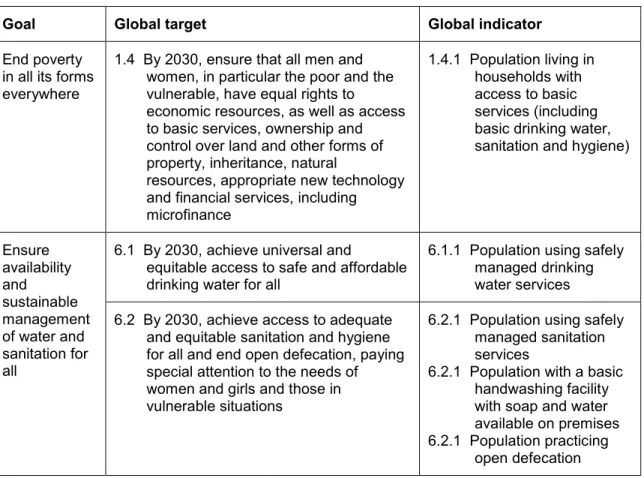
Recognition of the importance of safe water and sanitation led to their inclusion in the Millennium Development Goals (MDGs), under Goal 7 on environmental sustainability, and subsequently to calls for greater investment at the global level, including the United Nations (UN) International Decade for Action “Water for Life” 2005–2015 [13]. The Sustainable Development Goals (SDGs) went a step further, devoting Goal 6 to ensuring water and sanitation for all [14, 15]. (See Table 1.) These international commitments acknowledge the value of water and sanitation, both in their own right and as foundational to other development aims.
The push to achieve the MDGs led to significant progress. Between 1990 and 2015, 1.9 billion people began using piped water supplies, and 2.1 billion have gained access to improved sanitation [16]. But important gaps remain. In 2015, 2.3 billion people still lacked basic sanitation, including nearly one billion people practicing open defecation; 844 million people did not have even a basic drinking water service [17]. However startling, these global estimates mask significant disparities, both between and within countries [12, 18]. Tackling these
inequalities will be essential for achieving the SDGs, which feature a much greater focus on equity and access for all than their predecessors.
Much has been made of the urban–rural divide, with rural populations lagging behind their urban counterparts in both water and sanitation access. Urban populations are far more likely to have sewer connections and piped water
supplies [17]. Consequently, research and programs often focus on rural communities. But while rural access to drinking water has improved steadily since 1990, urban access has stagnated or improved only marginally [18]. In some places, the proportion of the urban population with access to basic sanitation or piped water on premises has fallen [17, 19]. Dos Santos and colleagues argue that this decline may be driven by the growth of informal settlements, including peri-urban areas that blur the line between urban and rural [18].
Furthermore, city averages do not tell the full story [20, 21]. As the
WHO1/UNICEF2 Joint Monitoring Programme for Water Supply, Sanitation and Hygiene (JMP) and others become better at disaggregating the data, they have revealed profound disparities in access between the urban rich and the urban poor [17, 21]. Yet, wealth quintiles likely do not account for the full range of socioeconomic determinants of access [18]. The sampling methodology of nationally representative surveys often does not permit robust comparisons between subgroups, which might capture other facets of marginalization [12]. In many cases, national surveys and censuses undercount or exclude marginal populations, such as informal settlements [20, 22]. Undercounting occurs for a variety of reasons: certain areas or individuals may be hard to reach, or political incentives may “render populations in slum settlements invisible in the data”
1 World Health Organization 2 United Nations Children's Fund
[20]. Perversely, these are the same populations that tend to have poor access to basic services, including water and sanitation.
What is a slum?
Slums are difficult to define. Within the same country, different organizations or authorities may use different definitions [20, 23]. The terminology may also vary; in English alone, terms such as slum, shanty town, squatter settlement, informal settlement, and peri-urban area are often, but not always, used interchangeably [24]. In this paper, slum and informal settlement will be treated as synonyms.
The most commonly used definition of a slum was developed by the UN Expert Group Meeting in 2002 and adopted by the UN Human Settlements Programme (UN-Habitat) in order to track progress toward MDG Goal 7 [24]. Target 7.D called for achieving significant improvement in the lives of at least 100 million slum dwellers by 2020 [16]. Interestingly, Goal 7 also housed the water and sanitation targets, recognizing the inherent link between these issues. UN-Habitat’s operational definitional identifies “a slum household as one in which the inhabitants suffer one or more of the following ‘household deprivations’: lack of access to [an]improved water source, lack of access to improved sanitation facilities, lack of sufficient living area, lack of housing durabilityand lack of security of tenure” [25, p. 2]. Despite its pervasiveness, this definition has been criticized for focusing too much on the individual household level and ignoring the spatial aspects and neighborhood-level dynamics associated with slums [20, 26]. (See Figure 1.)
While slums have existed since at least the 18th century, the problem has grown more acute in recent decades due to the rapid urbanization occurring globally. The first global estimates, produced by UN-Habitat in 2003, estimated that nearly 1 billion people, or one-third of the world’s urban population, lived in slums [24]. The MDGs raised the profile of the problem, and Target 7.D was surpassed. Yet the absolute number of people living in slums has continued to rise [16]. UN-Habitat estimates that, since 2000, the global slum population has grown by an average of 6 million people a year—a staggering 16,500 people per day [25]. The problem is greatest in developing countries, where 90% of urban growth is occurring [25]. In sub-Saharan Africa, nearly 60% of the people living in cities reside in slums [25]. Slums remain a significant challenge throughout the world as urbanization outpaces local capacity to plan or provide.
Although treated here as a single phenomenon, it is important to recognize that slums—and the people who live there—are diverse. Slums are “a physical and spatial manifestation of urban poverty and intra-city inequality,” but not all people living in slums are poor nor do all poor people reside in slums [24, p. xxvi]. The deprivation and dangers of informal settlements go beyond poverty, although they are linked [26]. Compared to rural or non-slum urban populations, studies have found higher mortality and morbidity in slum settings, particularly among infants and children [26-29]. The physical environment is an important reason for this higher burden: crowding and limited access to safe water and sanitation facilitate the spread of infectious diseases, including enteric infections [21, 30].
Water and sanitation in slums
Estimates of improved WASH coverage are rarely available for informal
settlements, and, as previously described, these populations are often not fully captured in citywide or national figures. Despite the lack of disaggregated data, it is evident that WASH conditions in most slums are insufficient to ensure health and well-being. Indeed, inadequate water and sanitation are often included in defining which households or settlements constitute slums. Two of the five criteria established by UN-Habitat (and used by many others) to define a slum household refer to the availability of improved water and sanitation [25].
Combined with crowded living conditions, shoddy construction, and vulnerability to flooding, inadequate water and sanitation in slums can result in highly
polluted environments and a high risk of exposure to fecal contamination [31, 32]. (See Figure 2.)
Because water and sanitation are biological necessities, people will arrange access to them in some way. However, the resulting access may not be adequately safe, reliable, affordable, or dignified [12, 33]. There is limited research on how
informal settlements negotiate access where more formal services are unavailable or unreliable [18]. The strategies used to access water and sanitation depend on the social and cultural norms, economic and environmental resources, and political and institutional structures of a given slum.
Slums are often not connected to municipal water supplies or sewer systems [18]. Where connections do exist, infrastructure may be poorly constructed or
maintained. Access to water may be intermittent, due to authorities cutting off supplies or a lack of pressure in the system [34, 35]. Intermittent water supply has been associated with lower microbial quality and higher risk of waterborne disease; it also forces households to store water, which can introduce
contamination [36, 37]. Informal connections can further compromise the quality and safety of the water supply [33]. People living in slums often rely on a
combination of market solutions and community governance to fulfill their basic water and sanitation needs [18, 38]. These small-scale providers are generally unregulated and may be illegal [39, 40].
Sanitation facilities may be non-existent or insufficient and poorly maintained. Even where facilities exist, excreta may not be properly managed. In a study of 12 low- and middle-income cities, 98% of households used toilets, suggesting high coverage, but only 29% of fecal waste was safely managed [12, 41]. Unsafe sanitation practices may pollute the environment, spreading contamination to households and communities far beyond the source.
Many slum households rely on shared water and sanitation infrastructure, although this term encompasses a range of conditions. The number of
households (and individuals) utilizing a block of toilets, a single pit latrine, or a standpipe can vary widely with important consequences for sustainability, health, and quality of life. In a single slum in Nairobi, Corburn and Karanja found that
the number of people sharing a toilet ranged from 17 to 232 [42]. The cost of shared facilities may be prohibitive for some households, and inadequate
cleanliness, security, or privacy may discourage use [42, 43]. Estimates of access to shared facilities generally do not capture travel or queuing time [40].
Addressing the water and sanitation needs of people living in slums will be essential for delivering on the inclusive promise of the SDGs. It is, therefore, important to understand what is at the root of poor WASH conditions in these areas and how the water and sanitation needs of slum residents might be
addressed. This review will lay out the factors that influence the implementation or adoption of water and sanitation interventions in urban slums, focusing on low- and middle-income countries. It will then consider the role that public health research can play in improving the situation.
METHODS
The goal of this paper was to better understand the decision-making environment for water and sanitation in slum settings and to consider how public health
researchers and other scientists might better leverage their work in these contexts. To this end, relevant literature was reviewed to identify factors that drive or present barriers to the implementation of water and sanitation strategies in slums in low- and middle-income countries. Given the breadth of the topic area and the diversity of available literature, a systematic review was not undertaken. Systematic reviews are most appropriate for a narrowly-defined question [44, 45]. Despite its limitations, a narrative review format was
determined to better serve the purposes of this paper by permitting a wider scope [46, 47].
The review draws on published literature identified through a structured search process of PubMed and Scopus using terms related to implementation and decision-making around water and sanitation interventions, including: policy*, decision*, framework, driver, barrier, challenge, scaling up, scale-up,
implementation, adoption. Searches were also conducted using the above terms in combination with terms related to slum settings, including slum, informal settlement, urban poor, low-income urban, and unplanned.
Given the policy orientation, unpublished and grey literature was sought through searches of the New York Academy of Medicine Grey Literature Report,3 websites of key stakeholders (the World Bank, the Water and Sanitation Program, WHO, UN-Habitat, Water and Sanitation for the Urban Poor, U.S. Agency for
International Development, IRC), and basic search engines (Google.com). Additional literature, both published and unpublished, was identified through snowballing and from the reference lists of key articles.
All searches were conducted between December 2017 and April 2018. The review includes published and grey literature from January 1, 2000 to April 1, 2018; earlier publications were considered less relevant to current trends in
making. Although no geographic restrictions were placed on the searches, the literature was reviewed for relevance to low- and middle-income countries and urban settings. No language restrictions were placed on the search, but only English language documents or abstracts were reviewed. Where possible, this paper has drawn on reviews and documents that synthesize the available
evidence in order to provide a more global picture of water and sanitation in slum settings.
RESULTS
This review builds on a typology developed by Pierce, which synthesizes and categorizes barriers to basic services in slums [34]. Pierce’s typology includes five categories of barriers: economic, spatial, social, institutional, and political. A sixth (informational) is added here. The focus has also been shifted from
“barriers” to the more neutral “factors” in order to accommodate attributes that enable or drive investments in water and sanitation.
While presented together here, it should be noted that the factors discussed act at multiple scales: individual, household, community, city, national, and global. The nature and relative importance of these factors will depend on the political
economy of a particular slum and must be considered through that local lens.
Economic factors
Poor conditions are commonly assumed to stem from residents’ inability or unwillingness to invest in WASH improvements. The cost of interventions is “an
often-cited constraint for an investment decision, whether governments, the private sector, or households and individuals” [12]. Numerous studies, however, have demonstrated the willingness of people living in slums to pay for water and sanitation [39]. Indeed, residents of slum often pay higher rates for water and sanitation services than more well-off residents in other parts of the city [18, 34]. Subbaraman and colleagues estimated that, in one Mumbai slum, the excess amount of money spent by residents each year on water under the informal system could pay for new community-wide infrastructure five times over [39]. Residents in this community spent over 8% of their annual income on water, well above the 3-5% benchmark used by many governments and international
organizations [12, 39].
That is not to say that people who live in slums do not experience economic barriers to achieving safe water and sanitation. Lack of funds are often reported as a deterrent to investment in water and sanitation infrastructure, as well as utilization of existing resources [35, 42, 48]. Cost may also influence residents’ decisions about which water and sanitation options to utilize; this can have important implications for the safety of the services, as well as the environmental and functional sustainability. For example, in Kisumu, Kenya, people living in informal settlements were more likely to opt for manual pit latrine-emptying services, which were cheaper [49]. In Malawi, despite concerns about limited space for constructing new latrines, landlords were reluctant to invest in ecological sanitation (EcoSan) because of its cost [50].
Economic and financial considerations are important at higher levels of decision-making, too. In particular, the perception that slum residents are unwilling or unable to pay reduces the incentive of water utilities to extend network coverage to these areas [18, 34, 38]. Connecting informal settlements to water supply or sewerage may have high upfront costs due to their peripheral location or physical conditions [18]. Balancing the investment and maintenance costs with
affordability can be a significant challenge [18]. Even in community-run schemes, an emphasis on cost recovery can exclude the poorest [40]. Subsidies intended for the poor are often captured by wealthier urban residents—those with existing service connections or resources to navigate the system [38, 51, 52].
Economic considerations may influence donors’ decisions as well. For example, Dagdeviren and Robertson assert that the World Bank’s focus on slum upgrading in the 1970s and 1980s arose because it was less expensive than alternative policy choices [40].
Cost and affordability should be viewed as “only one dimension of access,” however, and decision-makers should recognize that economic considerations may be more salient for some slum households than for others [18, p. 503]. Not all residents of informal slums are financially destitute. Addressing only the economic barriers to improved water and sanitation—through subsidies, for example—misses many of the key issues [20, 24, 40].
Spatial factors
In many slums, physical characteristics also affect the water and sanitation situation. While some papers refer to them as technical or environmental factors, this paper will retain Pierce’s categorization of these characteristics as “spatial,” which captures the importance of place in determining the health and well-being of slum residents [34]. Multiple authors have argued that slums must be
understood and studied as spatial entities [26, 32].
A key spatial factor is the overall location of the settlement. Slums may be located on the periphery of the city or beyond its formal boundaries. Extending service infrastructure to these areas can be expensive or technically difficult, and utilities may be disinclined to do so, especially in light of concerns about residents’ ability to pay [18]. In addition to increasing the volume required, connecting slums to the water supply may shift the geography of demand away from distribution centers [18]. Geographic extension can affect the quality and regularity of the supply provided to communities near the edge [34].
As unplanned and often illegal communities, slums also tend to develop on land that is otherwise undesirable, including areas that are prone to flooding or landslides such as ravines, floodplains, and riverbanks [34, 40]. Using spatial analysis, Olthuis et al. have shown that slums will even grow onto adjacent waterbodies, further exacerbating residents’ vulnerability to flooding and other disasters [32]. A high water table or unstable ground make installing some types of infrastructure, such as pit latrines or septic tanks for flush toilets, problematic
or even impossible. Such infrastructure may require more frequent maintenance or replacement, increasing the cost to residents or service providers.
The built environment poses similar technical challenges. Both density and housing quality are included in UN-Habitat’s definition of a slum, and each characteristic complicates the provision of water and sanitation in these areas [38]. Where land is scarce, providing on-site sanitation at a household level or replacing pit latrines may not be possible. Space constraints motivate the sharing of facilities, which is considered inadequate by most standards [53]. Where rural households might choose to cover and replace a full latrine, residents of densely developed urban communities may choose to empty the pit instead [21]. Safely managing feces during removal and transport poses an additional challenge for households that are not connected to sewer systems. Narrow streets can make it difficult for service providers to access infrastructure for repairs or maintenance, including emptying, leading many to rely on unhygienic manual services [21]. The low quality and limited durability of construction materials in slums may not support the installation of permanent infrastructure like pipes or taps [40].
Physical conditions, such as high residential density and poor housing quality, also increase the risk of exposure to fecal contamination [31, 43]. Proper fecal sludge management is a major gap in urban sanitation supply chains, and the slum environment exacerbates the associated dangers [31]. While the UN and JMP classify pit latrines as improved sanitation, many experts consider them inappropriate for dense urban settings [19, 54]. Both the absence and poor
management of sanitation facilities can result in contamination of local water supplies or open drains where children play [18, 42].
In the dense context of slums, even more than in other urban environments, safe water and sanitation are communally produced. McGranahan asserts that, in light of these spillover effects, “the share of urban households facing serious sanitary problems is far more” than official coverage figures imply [43, p. 242]. The results of a recent systematic review and meta-analysis support this
conclusion: the authors found that neighborhood sanitation provides benefits comparable to and separate from the effect of household sanitation [55].
Similarly, Fuller and Eisenberg suggest that herd immunity accounts for a large proportion of the protection offered by WASH interventions [56]. The indirect effect is particularly strong for sanitation: their model found that, when coverage of the intervention reached 100%, “sanitation provides no direct benefit to the user, but protects the entire community equally” [56, p. 1204].
Social factors
McGranahan argues that slum residents’ apparent unwillingness to invest in better sanitation is, in fact, a collective action problem [43]. As described above, sanitation is a local public good, which limits the individual household incentive to invest or act even where there is demand. Many WASH interventions seek to increase demand for improved water and sanitation, but investments that might arise from increased private demand will not necessarily guarantee a safer, more sanitary environment for the individual or household.
Addressing such a problem typically takes the form of government intervention— e.g., subsidized provision of services or the enforcement of sanitation regulations [43]. These solutions are difficult to arrange in informal settlements in low- and middle-income countries, where capacity and financial resources may be limited. Community-driven initiatives may overcome some of this incentive problem [57]. In rural settings, community-led total sanitation (CLTS) has been deployed
successfully to generate collective demand and investments in improved sanitation [58]. But the conditions in urban environments are different.
Physically, as described above, the quality and scarcity of land can pose technical barriers, raising costs and requiring more expert involvement. Urban
communities, particularly informal settlements that house more transient populations, may also have lower levels of social cohesion [34, 38, 40]. In heterogeneous settlements, community-based service provision may exclude some groups or serve them unequally [40].
Social cohesion affects collective efficacy and group decision-making. Simiyu et al. describe how tenants in Kisumu would decide collectively not to pay rent until their landlords constructed sanitation facilities; but their efforts were
undermined by a lack of cooperation, which landlords leveraged to evict tenants who did not pay [49]. Interestingly, the reliance on shared facilities in slums means that many water and sanitation decisions are already made collaboratively [49].
Where collective action has been mobilized, it can effect important changes in decision-making at higher scales [40, 43]. In some cases, community organizing around water or sanitation has resulted in government recognition or improved land tenure, which are themselves barriers to safe WASH [57]. In a review of 50 water supply and sanitation case studies, community participation and
ownership was found to be one of the most important factors in driving the successful provision of pro-poor services [59]. Narayanan and colleagues found community participation to be significantly associated with the effectiveness of bottom-up approaches4 to service delivery in slums; on their own, bottom-up approaches did not have a significant effect [60].
The ability of slum residents to organize and advocate for themselves depends on the social capital present in the community, as well as the power of the
individuals. People who reside in slums experience marginalization through multiple pathways, including poverty, which can limit their ability to advocate for themselves.
There is a tendency to conflate informal settlements with transient or migrant populations, and to view them as temporary phenomena [32]. While some slums have largely itinerant populations, others are home to quite stable populations [38]. Often, slums develop or are maintained on account of discrimination
against certain groups based on caste, ethnicity, race, or religion [34]. Individuals
and groups that face discrimination may choose or be forced to settle in slums [34]. In many countries, settlement patterns—and underinvestment in some communities—are a legacy of colonial systems of power and division [33, 42, 61-64].
Institutional factors
Informal settlements also face a number of institutional barriers to water and sanitation access. Tenure status is the most commonly cited. People who are living in areas that are considered illegal or unrecognized by the government can find it difficult or impossible to obtain formal water and sanitation services [33, 39]. Utilities may not be allowed to provide services to these areas, or they may simply not be obligated [43]. Regardless of the reason, the resulting failure to provide pushes residents of slums into informal service arrangements, which are harder to regulate, more expensive, and often prone to issues of quantity, quality, or reliability [39, 40].
Security of tenure is one element of UN-Habitat’s slum definition, but, as with the other criteria, the tenure status and official recognition of slums varies widely. Some countries, like India, have defined multi-tiered systems of
recognition; in other places, the distinctions are less well defined [65]. Because formal recognition often carries an obligation for the government to provide some level of services, there are political and economic considerations behind decisions about whether to recognize a slum. Indeed, governments are at times unwilling to extend services to slums because they fear that doing so would imply
recognition [40]. In one study, the landlord used residents’ payment for services to advocate for regularization; the government was reluctant to provide these services because they planned to use the land for a sports stadium in the future [33].
Tenure status does not affect only formal service provision by public and private entities outside the slum. It also shapes residents’ ability to invest directly in water and sanitation infrastructure. Land rights determine the availability of space on which to place infrastructure. In a case study from Prampram, Ghana, residents cited the lack of space or rights over available space as a key barrier to having a latrine [48]. In another study from Ghana comparing three communities near Accra, the lack of land rights and ownership forced people to share
inadequate sanitation facilities or defecate in the open [53].
Land rights and tenure security also influence how permanent residents consider themselves. This affects their incentives to invest in water or sanitation
infrastructure [43, 53]. If residents view themselves as temporary, they may not choose to invest limited resources in something that cannot move with them [49]. Often, tenants must rely on landlords to make water and sanitation investments, including maintenance, and landlords may not be willing, particularly if they live off-site [49, 50]. According to UN-Habitat, however, tenure security is more important than home ownership in addressing the problems of slums [24]. This suggests that there are neighborhood-level benefits that go beyond individual economic security.
While legal frameworks can be a tool for ensuring more inclusive service provision, laws can also foster greater exclusion and deprivation. What
constitutes acceptable sanitation from a legal standpoint may not be affordable or feasible for slum communities, particularly if they are not reached by formal networks or appropriate subsidies [21, 43]. Cairncross et al. describe this
phenomenon: “Some low-cost sanitation schemes in cities have been impeded (or even abandoned) by the blind application of outdated building regulations that make some aspect of the technology illegal or that impose technology standards that are simply too expensive such as Senegal’s peri-urban standard $500 latrine with two pits for alternate use” [66, p. 5]. If the buildings themselves do not meet certain legal standards, they may be exempted from formal service provision [40]. Small-scale providers, a key source of water and sanitation services in slum communities, may also be threatened by regulations. In many settings, they operate in an uncertain space “between official tolerance and illegality” [40, p. 17].
Political factors
Although many factors contribute to inadequate water and sanitation in slums, the problem stems first from the government’s failure to provide services. UN-Habitat suggests that the very existence of slums represents a failure of policy— “of housing policies, laws and delivery systems, as well as of national and urban policies”—and of political will [24, p. 5].
Above the community level, policy and investment decisions largely depend on the government’s overall slum policy. Dagdeviren and Robertson describe three primary strategies for addressing slums: (1) clearance through forced or legal evictions; (2) benign neglect; and (3) regularization of settlement conditions (e.g., slum upgrading) [40]. The first two have fallen out of favor, with a shift towards
in situ upgrading and rights-based policies at the national level [24]. But
regularization and upgrading have challenges and costs—political as well as economic. Recognizing slums requires a commitment of resources, which may be unpopular with other urban residents [40].
The weakness or absence of the government in slums creates a vacuum both economically and politically. As previously described, a variety of small-scale providers step in to meet the basic service needs of those living in slums. Politically, the leadership vacuum can be filled by slum residents or
non-governmental groups likes NGOs and CBOs. The often-precarious legal situation of slums also makes them vulnerable to capture by local gangs, landlords, or politicians [35, 40].
Capture may refer to specific resources (like communal water taps) or to representation through vote-banking and patron–client dynamics [34].
Politicians may seek to gain local support by securing access to services like water and sanitation, but maintenance of these benefits can be a problem [43]. In many cases, such dynamics further reduce the ability of slum residents to advocate for themselves.
Another barrier is the fragmentation of responsibility around water and
sanitation [33, 38, 40, 67]. Multiple sectors have a stake in water and sanitation decisions, and, in many countries or cities, no single entity has been given authority. Decentralization has exacerbated this problem. Local governments have been given responsibility for delivery water and sanitation services, but they have not been equipped with the necessary funding or capacity [66].
This fragmentation is not specific to slums, but responsibility in such settings tends to be even more diffuse. Depending on the community, the provision of basic services (including water and sanitation) involves some combination of public, private, and voluntary sector entities [60]. The landscape of decision-making and service provision are therefore more complicated. While this review and other syntheses treat slums as monolithic, they are far from it. Even within the same city, two slums may differ greatly in terms of demographics, history, and legal standing. Different political interests may be at play locally. The differences both shape and reflect the governance structure and political economy of each slum. The ability of residents to advocate for resources and specific investments is similarly varied [21, 61]. Understanding these dynamics, and where the power resides in any particular slum, is important for
implementing effective water and sanitation interventions and essential for sustaining them [21].
Not all decision-making is local, however. The reliance on donor funding in many low- and middle-income countries means that donor priorities—and the global policy trends they reflect—can have an important influence on decisions about how to invest in water and sanitation. Numerous articles mention the influence of neoliberalism, pushing governments towards privatization and market-based schemes [33, 40]. While health concerns are often underrepresented in local decision-making, they play a more prominent role globally [33, 68]. Clark and Gundry suggest that this importance stems at least in part from the MDGs [68].
Global policy agendas like the MDGs and SDGs shape national and local decision-making through a number of channels, including the setting of indicators [67]. UN-Habitat cautions that indicators are tools for obtaining consensus and direction—that is, they are political, not merely technical [24]. In deciding what is measured, global agendas can determine what kinds of
investments are made. Olthuis et al. suggest that slum upgrading programs have focused on basic service provision and infrastructure, rather than environmental improvements or legal protections, because the UN-Habitat definition focuses on household-level characteristics [32]. Interventions then are targeted at this level. A number of papers suggest that the indicators and benchmarks in use are not appropriate for slum settings [19, 20, 59]. The authors argue that, even if such targets are achieved, they will not adequately address the health risks and other dimensions of safe access such as affordability.
Informational factors
Decision-making for water and sanitation in slums is hampered by a lack of data. Their existence at the physical and legal edges of society make informal
settlements easy to overlook—by accident or intention. The lack of information often stems from other barriers. Real estate and administrative records can be an important source of population information; lack of tenure status or rapid (and informal) development in slum areas may leave residents underrepresented in such records [38]. Physical conditions can make surveys of slums difficult or undesirable. Lucci et al. describe how enumerators may bypass certain areas that appear “hostile and unsafe or hard-to-reach,” including places where the
environment is unsanitary [20, p. 299]. Political and social factors may also drive which communities are included in sampling frames [20].
Data drive decision-making and resource allocation [20]. Thus, undercounting of slum populations has important implications for the investments made in these communities. The global push to achieve access for all requires that we
“understand where the poor live and what their levels of access are” [12, p. 25]. Furthermore, the type of measures used may not adequately capture the situation in slums as discussed above.
Additionally, there is limited evidence about which WASH interventions work in slum settings and under what conditions [12, 18, 54, 69, 70]. Much of the
research has focused on the more visible water and sanitation gap: rural areas [18, 26]. Findings from studies in rural communities may not be transferrable to
urban settings broadly, however, and they may be especially ill-suited to address the specific challenges of slums. The focus on pit latrines as a solution is an often-cited example of this mismatch [19]. Stakeholders inclined to make decisions based on evidence do not have the context-specific research or data to guide their plans in slums.
DISCUSSION
Estimates of water and sanitation access in cities suggest very high rates of coverage and contribute to the prevailing focus on the urban–rural divide. But these estimates mask staggering disparities between the urban rich and poor, as well as between different parts of the city. Slums, in particular, have extremely poor water and sanitation conditions.
It is easy to blame these conditions on economic barriers, but the reality is more complex. Not all slum residents are poor, and those who are still pay a premium for water and sanitation services compared to other urban dwellers. The high cost of water and sanitation services may drive residents’ (or their landlords’)
decisions about which technologies to invest in; it may also affect use and maintenance of existing facilities.
Cost and affordability are only one factor influencing the adoption of water and sanitation strategies in informal settlements, however. Spatial barriers, arising from the location and physical conditions of slums, can raise the cost and limit the feasibility of certain interventions. High residential density and low quality
construction can increase the risk of exposure to fecal contamination associated with inadequate sanitation. Many informal settlements are built on land prone to flooding, exacerbating this risk.
Arguably the most important factor driving water and sanitation access in slum settings is the community’s tenure status. Security of tenure can make residents more willing to invest in constructing or upgrading infrastructure, by alleviating fears of eviction. Utilities and other providers may not have a mandate to serve communities that are seen as illegal, and governments may not view it as their responsibility. Addressing issues of land tenure can remove institutional barriers to service provision, allowing slum households to be connected to the municipal water supply and sewers. Municipal services are often cheaper than the informal services available to many slum residents, so tenure security can also eliminate economic barriers to access. However, governments or individual politicians may have a vested interests in maintaining the slum’s unofficial status. Formal
recognition of slums is ultimately a political decision, with political and economic costs to weigh. Given this lack of influence and their often-precarious legal
situation, slums are vulnerable to capture by powerful individuals (including politicians) and gangs.
Slum populations are diverse, and people may be driven to reside in slums for a variety of reasons. They are likely to house people who are new to the city, as well as groups that experience discrimination based on race, ethnicity, caste, or
settlement areas are a direct legacy of colonialism; this history contributes to continuing underinvestment and limited service provision. Combined with the low socioeconomic status of many residents, these social factors can limit the political influence of slum communities, making it easy for politicians to ignore their needs.
Strengthening community participation and collective efficacy can shape decision-making and investment at higher levels. It can improve the
sustainability of those investments, too. The water and sanitation strategies selected are more likely to align with community priorities and be appropriate for local conditions. Involving residents throughout the process can also address the long-term maintenance and management issues that plague many water and sanitation projects.
Because many of the challenges with providing adequate water and sanitation in informal settlements arise from broader governance issues (e.g., housing, land tenure, urban planning), improving the water and sanitation situation requires a broader policy approach [40]. One barrier that receives relatively little attention in the literature is the capacity of the state or local actors to provide water and sanitation. Even where governments have made a commitment to “pro-poor” or “poor-inclusive” water and sanitation services, they may not have the capacity to deliver.
One important gap limiting the authorities’ ability to address the water and sanitation needs of slum populations is the lack of information. People living in slums are often un- or underrepresented in national surveys, which shape government and donor priorities and resource allocation. Available data are not usually disaggregated in such a way that the particular needs of slums can be identified. Evidence on the effectiveness of interventions rarely comes from slum settings and may not be transferrable. These informational gaps hamper the ability of even well-meaning governments, donors, and other providers to meet the water and sanitation needs of people living in slums.
Limitations
As UN-Habitat notes, “slum” is a convenient catch-all term that masks the
diversity of settlement types and communities represented by it [24]. The context of these communities, both locally and nationally, affects how the economic, technical, social, institutional, and political factors described broadly in this review manifest themselves. The specific manifestation of these factors has important implications for water and sanitation decision-making and the type (and quality) of access that results. Similarly, identifying the process—and priorities—that drive policy-makers and technocrats requires a more local approach than the one taken here.
While this review has sought to present evidence from a wide range of contexts, it was not a systematic review and does not purport to be comprehensive. Drawing on reviews that synthesized evidence from a range of contexts (where possible)
should improve the generalizability of the results. Selection bias remains a concern, however. Another key limitation is that, due to the nature of the available literature, this review focuses on barriers as reported by residents through surveys or as identified by the authors. Thus, it identifies perceived barriers, which may not be the most important. Very few studies have attempted to directly study the barriers in slum settings. The evidence overall is weak, coming primarily from case studies or cross-sectional surveys.
The search strategy did not include a comprehensive list of terms used for slums in specific contexts, as has been done in some recent reviews [26, 54]. It was limited to the most common English terms for slums. Because this review relied on other reviews where possible, this is likely to be a minor limitation. It is likely that focusing the search on water and sanitation failed to retrieve relevant
literature, as these issues are often treated under the heading of basic service provision or slum upgrading. Identifying additional sources through snowballing and from reference lists lessens this concern.
Finally, while this review has treated water and sanitation together, a combined approach may not be appropriate in every context. Decision-making processes and delivery systems may be distinct. Identifying a set of shared drivers and barriers may be too crude, burying important nuances. Progress in sanitation has lagged behind water worldwide, especially in urban areas. It may be valuable to consider water and sanitation separately, in order to tease out the unique
challenges that have hampered the expansion of sanitation in dense urban environments.
CONCLUSION AND RECOMMENDATIONS
Despite the global progress in water and sanitation coverage, slum communities continue to be left behind. Addressing the range of barriers that contribute to inadequate water and sanitation in the settings requires political will and a recognition of the rights of people living in such informal settlements. In the absence of these political enablers, broad and lasting progress is unlikely.
This review uncovered a great number of tools and frameworks purporting to guide decision-makers in making water and sanitation investments [59, 72-76]. There is little evidence of whether or how decision-makers actually use these resources, however. Slums are not always explicitly considered in these
frameworks, and many do not address the spatial and political issues that pose the highest barriers to slums. In some cases, as with tools employing quantitative microbiological risk assessment (QMRA), local governments and other
stakeholders may lack the capacity necessary to apply the tool. Here public health researchers may play an important role in collecting the necessary data inputs and in identifying locally-appropriate interventions to address the findings.
While there is disagreement among authors about how much health concerns drive investment in water and sanitation, public health researchers and other scientists must recognize that, “purely evidence-based policy making is
unrealistic and naïve” [71, p. 4]. Working in collaboration with experts from other fields and with individuals steeped in the context of interest, public health
researchers can better leverage the discipline’s strengths to create impact. Public health researchers can make important contributions to improving water and sanitation in slum settings in three key areas: (1) identifying appropriate indicators; (2) ensuring representative data; and (3) studying which water and sanitation interventions work in urban slums, under which conditions.
Understanding what drives decision-making at local, national, and global levels is an essential step in ensuring that public health research is translated into impact. Public health researchers interested in uncovering these processes would do well to draw on the work of other disciplines, including political science, economics, and sociology, which are better suited to answering such questions. This is particularly important where many of the key drivers and barriers lie outside the realm of health, as in the case of water and sanitation in slums.
REFERENCES
1. GBD Diarrhoeal Diseases Collaborators, Estimates of global, regional, and national morbidity, mortality, and aetiologies of diarrhoeal diseases: a systematic analysis for the Global Burden of Disease Study
2015. Lancet Infect Dis, 2017. 17(9): p. 909-948.
2. Pruss-Ustun, A., et al., Burden of disease from inadequate water, sanitation and hygiene in low- and middle-income settings: a
retrospective analysis of data from 145 countries. Trop Med Int Health,
2014. 19(8): p. 894-905.
3. Clasen, T.F., et al., Interventions to improve water quality for preventing
diarrhoea. Cochrane Database Syst Rev, 2015(10): p. Cd004794.
4. Wolf, J., et al., Assessing the impact of drinking water and sanitation on diarrhoeal disease in low- and middle-income settings: systematic
review and meta-regression. Trop Med Int Health, 2014. 19(8): p.
928-42.
5. Loch, K. and G. Howard, Water-related vector-borne diseases. Afr Health, 1994. 16(2): p. 14-7.
6. Akombi, B.J., et al., Stunting, Wasting and Underweight in Sub-Saharan
Africa: A Systematic Review. Int J Environ Res Public Health, 2017.
14(8).
7. Strunz, E.C., et al., Water, sanitation, hygiene, and soil-transmitted
helminth infection: a systematic review and meta-analysis. PLoS Med,
2014. 11(3): p. e1001620.
8. Dangour, A.D., et al., Interventions to improve water quality and supply, sanitation and hygiene practices, and their effects on the nutritional
status of children. Cochrane Database Syst Rev, 2013(8): p. Cd009382.
9. Grimes, J.E., et al., The relationship between water, sanitation and
schistosomiasis: a systematic review and meta-analysis. PLoS Negl Trop
Dis, 2014. 8(12): p. e3296.
10. Ngure, F.M., et al., Water, sanitation, and hygiene (WASH),
environmental enteropathy, nutrition, and early child development:
making the links. Ann N Y Acad Sci, 2014. 1308: p. 118-28.
11. Sclar, G.D., et al., Effects of sanitation on cognitive development and
school absence: A systematic review. Int J Hyg Environ Health, 2017.
220(6): p. 917-927.
12. Hutton, G. and C. Chase, The Knowledge Base for Achieving the
Sustainable Development Goal Targets on Water Supply, Sanitation and
Hygiene. Int J Environ Res Public Health, 2016. 13(6).
13. UN. International Decade for Action 'WATER FOR LIFE' 2005-2015.
2015 [cited 2018 April 9]; Available from: http://www.un.org/waterforlifedecade/.
14. UN, The Sustainable Development Goals Report 2017. 2017, United
Nations: New York.
15. UN General Assembly, Transforming our world : the 2030 Agenda for
16. UN, The Millennium Development Goals Report 2015, C. Way, Editor. 2015.
17. WHO/UNICEF Joint Monitoring Programme for Water Supply, S., and Hygiene (JMP), Progress on drinking water, sanitation and hygiene:
2017 update and SDG baselines. 2017, World Health Organization (WHO)
and United Nation's Children's Fund (UNICEF): Geneva.
18. Dos Santos, S., et al., Urban growth and water access in sub-Saharan
Africa: Progress, challenges, and emerging research directions. Science
of the Total Environment, 2017. 607-608: p. 497-508.
19. Satterthwaite, D., Missing the Millennium Development Goal targets for
water and sanitation in urban areas. Environment and Urbanization,
2016. 28(1): p. 99-118.
20. Lucci, P., T. Bhatkal, and A. Khan, Are we underestimating urban
poverty? World Development, 2018. 103: p. 297-310.
21. Hawkins, P., I. Blackett, and C. Heymans, Poor-Inclusive Urban Sanitation: An Overview: Targeting the Urban Poor and Improving
Services in Small Towns, in Water and Sanitation Program. 2013,
International Bank for Reconstruction and Development/The World Bank: Washington, DC.
22. Bartram, J., et al., Global Monitoring of Water Supply and Sanitation:
History, Methods and Future Challenges. International Journal of
Environmental Research and Public Health, 2014. 11(8): p. 8137-8165. 23. Nolan, L.B., Slum Definitions in Urban India: Implications for the
Measurement of Health Inequalities. Population and Development
Review, 2015. 41(1): p. 59-84.
24. UN-Habitat, The Challenge of Slums - Global Report on Human
Settlements 2003. 2003, UN-Habitat: Nairobi.
25. UN-Habitat, Slum Almanac 2015-2016: Tracking Improvement in the
Lives of Slum Dwellers. 2016, UN-Habitat: Nairobi.
26. Ezeh, A., et al., The history, geography, and sociology of slums and the
health problems of people who live in slums. The Lancet, 2017.
389(10068): p. 547-558.
27. Gruebner, O., et al., Place of Residence Moderates the Risk of Infant
Death in Kenya: Evidence from the Most Recent Census 2009. PLoS One,
2015. 10(10): p. e0139545.
28. Mberu, B.U., et al., Health and health-related indicators in slum, rural,
and urban communities: a comparative analysis. Glob Health Action,
2016. 9: p. 33163.
29. Garenne, M., Urbanisation and child health in resource poor settings
with special reference to under-five mortality in Africa. Arch Dis Child,
2010. 95(6): p. 464-8.
30. Breiman, R.F., et al., Population-based incidence of typhoid fever in an urban informal settlement and a rural area in Kenya: implications for
typhoid vaccine use in Africa. PLoS One, 2012. 7(1): p. e29119.
31. Robb, K., et al., Assessment of Fecal Exposure Pathways in Low-Income Urban Neighborhoods in Accra, Ghana: Rationale, Design, Methods, and
Key Findings of the SaniPath Study. Am J Trop Med Hyg, 2017. 97(4): p. 1020-1032.
32. Olthuis, K., et al., Slum Upgrading: Assesing the importance of location
and a plea for a spatial approach. Habitat International, 2015. 50: p.
270-288.
33. Saravanan, V.S., et al., Urbanization and human health in urban India:
institutional analysis of water-borne diseases in Ahmedabad. Health
Policy Plan, 2016. 31(8): p. 1089-99.
34. Pierce, G., Why is basic service access worse in slums? A synthesis of
obstacles. Development in Practice, 2017. 27(3): p. 288-300.
35. Subbaraman, R., et al., Multidimensional Measurement of Household
Water Poverty in a Mumbai Slum: Looking Beyond Water Quality. PLoS
One, 2015. 10(7): p. e0133241.
36. Bivins, A.W., et al., Estimating Infection Risks and the Global Burden of Diarrheal Disease Attributable to Intermittent Water Supply Using
QMRA. Environ Sci Technol, 2017. 51(13): p. 7542-7551.
37. Kumpel, E. and K.L. Nelson, Intermittent Water Supply: Prevalence,
Practice, and Microbial Water Quality. Environ Sci Technol, 2016. 50(2):
p. 542-53.
38. Cross, P. and A. Morel, Pro-poor strategies for urban water supply and
sanitation services delivery in Africa. Water Sci Technol, 2005. 51(8): p.
51-7.
39. Subbaraman, R., et al., The social ecology of water in a Mumbai slum:
failures in water quality, quantity, and reliability. BMC Public Health,
2013. 13: p. 173.
40. Dagdeviren, H. and S. Robertston, Access to Water in the Slums of the
Developing World: Working Paper Number 57. 2009, International
Policy Centre for Inclusive Growth: Brasilia, Brazil.
41. Blackett, I.C., P.M. Hawkins, and C. Heymans, The missing link in sanitation service delivery : a review of fecal sludge management in 12
cities (English), in Water and Sanitation Program Research Brief. 2014,
The World Bank Group: Washington, DC.
42. Corburn, J. and I. Karanja, Informal settlements and a relational view of
health in Nairobi, Kenya: Sanitation, gender and dignity. Health
Promotion International, 2016. 31(2): p. 258-269.
43. McGranahan, G., Realizing the Right to Sanitation in Deprived Urban Communities: Meeting the Challenges of Collective Action, Coproduction,
Affordability, and Housing Tenure. World Development, 2015. 68: p.
242-253.
44. Collins, J.A. and B.C.J.M. Fauser, Balancing the strengths of systematic
and narrative reviews. Human Reproduction Update, 2005. 11(2): p.
103-104.
45. Buckley, D.I., et al., The Refinement of Topics for Systematic Reviews: Lessons and Recommendations From the Effective Health Care Program.
Methods Research Report. . 2013, Agency for Healthcare Research and
46. Ferrari, R., Writing narrative style literature reviews. Medical Writing, 2015. 24(4): p. 230-235.
47. Grant, M.J. and A. Booth, A typology of reviews: an analysis of 14 review
types and associated methodologies. Health Info Libr J, 2009. 26(2): p.
91-108.
48. Obeng, P.A., et al., The latrine ownership ladder: A conceptual
framework for enhancing sanitation uptake in low-income peri-urban
settings. Management of Environmental Quality: An International
Journal, 2015. 26(5): p. 752-763.
49. Simiyu, S., M. Swilling, and S. Cairncross, Decision-making on shared
sanitation in the informal settlements of Kisumu, Kenya. International
Journal of Environmental Health Research, 2017. 27(5): p. 377-393. 50. Chunga, R.M., et al., Adopt or Adapt: Sanitation Technology Choices in
Urbanizing Malawi. PLoS One, 2016. 11(8): p. e0161262.
51. Mara, D., et al., Sanitation and health. PLoS Med, 2010. 7(11): p. e1000363.
52. WaterAid, Turning Slums Around: The Case for Water and Sanitation. 2008, WaterAid: London.
53. Awunyo-Akaba, Y., et al., Sanitation investments in Ghana: An
ethnographic investigation of the role of tenure security, land ownership
and livelihoods. BMC Public Health, 2016. 16(1).
54. Lilford, R.J., et al., Improving the health and welfare of people who live in
slums. The Lancet, 2017. 389(10068): p. 559-570.
55. Jung, Y.T., et al., Effects of neighbourhood and household sanitation conditions on diarrhea morbidity: Systematic review and meta-analysis. PLoS One, 2017. 12(3): p. e0173808.
56. Fuller, J.A. and J.N. Eisenberg, Herd Protection from Drinking Water,
Sanitation, and Hygiene Interventions. Am J Trop Med Hyg, 2016. 95(5):
p. 1201-1210.
57. McGranahan, G. and D. Mitlin, Learning from Sustained Success: How Community-Driven Initiatives to Improve Urban Sanitation Can Meet
the Challenges. World Development, 2016. 87: p. 307-317.
58. Lüthi, C., J. McConville, and E. Kvarnström, Community-based
approaches for addressing the urban sanitation challenges. International
Journal of Urban Sustainable Development, 2010. 1(1-2): p. 49-63.
59. Murungi, C. and M.W. Blokland, Benchmarking for the provision of water supply and sanitation services to the urban poor: An assessment
framework. International Journal of Water, 2016. 10(2-3): p. 155-174.
60. Narayanan, S., et al., Delivering basic infrastructure services to the urban poor: a meta-analysis of the effectiveness of bottom-up approaches. Utilities Policy, 2017. 44: p. 50-62.
61. Chaplin, S.E., Indian cities, sanitation and the state: The politics of the
failure to provide. Environment and Urbanization, 2011. 23(1): p. 57-70.
62. Appelblad Fredby, J. and D. Nilsson, From "All for some" to "Some for all"? A historical geography of pro-poor water provision in Kampala. Journal of Eastern African Studies, 2013. 7(1): p. 40-57.
63. Dill, B. and B. Crow, The colonial roots of inequality: access to water in
urban East Africa. Water International, 2014. 39(2): p. 187-200.
64. Fox, S., The Political Economy of Slums: Theory and Evidence from
Sub-Saharan Africa. World Development, 2014. 54: p. 191-203.
65. Subbaraman, R., et al., Off the map: The health and social implications of
being a non-notified slum in India. Environment and Urbanization, 2012.
24(2): p. 643-663.
66. Cairncross, S., et al., Hygiene, sanitation, and water: what needs to be
done? PLoS Med, 2010. 7(11): p. e1000365.
67. Cronin, A.A., et al., Water, Sanitation and Hygiene: Moving the Policy
Agenda Forward in the Post-2015 Asia. Asia & the Pacific Policy Studies,
2015. 2(2): p. 227-233.
68. Clark, R. and S.W. Gundry, The prominence of health in donor policy for
water supply and sanitation: a review. J Water Health, 2004. 2(3): p.
157-69.
69. Brown, J., et al., A controlled, before-and-after trial of an urban
sanitation intervention to reduce enteric infections in children: Research
protocol for the Maputo Sanitation (MapSan) study, Mozambique. BMJ
Open, 2015. 5(6).
70. Turley, R., et al., Slum upgrading strategies involving physical
environment and infrastructure interventions and their effects on health
and socio-economic outcomes. Cochrane Database of Systematic Reviews,
2013(1).
71. WSP, Evaluating the Political Economy for Pro-Poor Sanitation
Investments. 2011, World Bank: Washington, DC.
72. Kerstens, S.M., et al., A new approach to nationwide sanitation planning
for developing countries: Case study of Indonesia. Science of The Total
Environment, 2016. 550: p. 676-689.
73. Törnqvist, R., et al., A framework for planning of sustainable water and
sanitation systems in peri-urban areas, in Water Science and
Technology. 2008. p. 563-570.
74. Osinde, R.N., Framework for Promoting Pro-poor water and Sanitation
Governance in Urban Programmes and Projects. 2007, UN-Habitat:
Nairobi, Kenya.
75. Ramôa, A., et al., Urban sanitation technology decision-making in
developing countries: a critical analysis of process guides. International
Journal of Urban Sustainable Development, 2016. 8(2): p. 191-209. 76. Mills, F., et al., Faecal Pathogen Flows and Their Public Health Risks in
Urban Environments: A Proposed Approach to Inform Sanitation
TABLES AND FIGURES
TABLE 1. Sustainable Development Goals, targets, and indicators related to drinking water, sanitation, and hygiene
Goal Global target Global indicator
End poverty in all its forms everywhere
1.4 By 2030, ensure that all men and women, in particular the poor and the vulnerable, have equal rights to
economic resources, as well as access to basic services, ownership and control over land and other forms of property, inheritance, natural
resources, appropriate new technology and financial services, including microfinance
1.4.1 Population living in households with access to basic services (including basic drinking water, sanitation and hygiene)
Ensure availability and sustainable management of water and sanitation for all
6.1 By 2030, achieve universal and
equitable access to safe and affordable drinking water for all
6.1.1 Population using safely managed drinking water services 6.2 By 2030, achieve access to adequate
and equitable sanitation and hygiene for all and end open defecation, paying special attention to the needs of women and girls and those in vulnerable situations
6.2.1 Population using safely managed sanitation services
6.2.1 Population with a basic handwashing facility with soap and water available on premises 6.2.1 Population practicing
open defecation SOURCE: Adapted from [17].
FIGURE 1. The township of West Point, a slum neighborhood in Monrovia, Liberia. SOURCE: CDC/CDC Connects, 2015.
FIGURE 2.A slum in Ecuador that experienced high rates of cholera due to unsafe water. SOURCE: CDC, 1992.