
The effectiveness of local economic development programmes in Ekurhuleni Metropolitan Municipality
93
0
0
Full text
(2) The Effectiveness of Local Economic Development Programmes in Ekurhuleni Metropolitan Municipality by BOITUMELO G MABOGOANE 920211562 MINOR DISSERTATION. Submitted in partial fulfillment of the requirements for the degree MAGISTER COMMERCII in BUSINESS MANAGEMENT in the FACULTY OF MANAGEMENT at the UNIVERSITY OF JOHANNESBURG. Supervisor: Dr P. Thomas. 2016. ii.
(3) Declaration of own work I, Boitumelo Geraldine Mabogoane, declare that this mini dissertation is my own unaided work and that all sources have been accurately reported and acknowledged. It is submitted in partial fulfilment of the requirements for the degree of Master of Commerce at the University of Johannesburg. It has not been previously submitted at any institution to obtain an academic qualification.. Name : Boitumelo G Mabogoane. iii.
(4) ACKNOWLEDGEMENTS The writing of this mini dissertation has been one of the most significant challenges that I ever had to face in my life. First and foremost, I would like to thank the Almighty God for giving me the wisdom, strength and tenacity to endure my studies and persevere. I am grateful to God for the good health and wellbeing that enabled me to finish this dissertation. Without the support, patience and guidance of the following people, this study would not have been completed: . Dr Drotskie, the former faculty HOD of Business Management for believing in me and giving me a second chance after I took a break to start a business. Her wisdom, knowledge and commitment to the highest standards motivated me.. . Dr Peta Thomas, my mentor and supervisor for her excellent guidance, caring, patience and expertise. Without your knowledge and understanding, this study would not have been completed.. . All of the Department Faculty members for your unfailing support and patience and willingness to help at all times.. . The Ekurhuleni Metropolitan Municipality, department of Economic Development for availing yourselves and your assistance with my studies.. . Mrs Virginia Ntshole, my sister in law for holding the fort at work when times were tough, I can never thank you enough.. . My friend and study partner, Mrs Lebogang Simelane, who inspired my final effort even when I wanted to quit.. . My church friends, church committees that I serve in for encouragement and understanding. You are too many to mention!. . My brother in law and a good friend, Dr. Thabo Mabogoane who always believed in my capabilities, always willing to help and give his best suggestions.. . My mother, Isabella Mmonye who always supported, encouraged and believed in me in all my endeavours.. . My father, Mathibe Jacob Mmonye, without whom, this effort would have been worth nothing. Your love, support and constant patience has taught me so much about discipline and perseverance. You always believed in me and never gave up on me even when I put my studies on hold to start a business you kept on pushing me to be the best that I can be and for that I am thankful.. iv.
(5) . My Pastors, Pastors Siphiwe Christopher Mathebula and Phindi Mathebula for always teaching us to never give up no matter what.. . My friends, colleagues, family and relatives for the patience, support you gave me throughout my studies.. . My in laws for your encouragement at all times.. . Everyone else who has directly and indirectly contributed for this mini dissertation to be completed.. . My daughter Rorisang and son Motshwane Jr., for your understanding and giving me space to complete this, mommy loves you dearly.. . Last but not least, my husband, Motshwane Mabogoane who was always there, stood by me through the good times and bad times. Thank you for your patience and understanding as well as loving me throughout this journey. Without you, this would not have been possible.. Dedicated to my late brother Thabang Mmonye and my late father in law, Mampuru Isaac Mabogoane, you were the best and will never be forgotten.. v.
(6) ABSTRACT The aim of this research is to review the extent to which the Ekurhuleni municipality’s local economic development (LED) supports its development programmes and initiatives in the northern region of Ekurhuleni. South Africa, like most developing countries, is faced with high levels of unemployment and the country’s municipalities have a role to play in creating opportunities for small businesses to grow with as much support as possible from each municipality. Ekurhuleni Metropolitan Municipality has its own challenges in terms of the growth and development of small business. The literature review suggested that LED programmes have yielded mixed results in communities as some tend to be pro-growth and not pro-poor oriented. This means that a person with limited resources but a good business idea might not find the LED supportive because the LED is not pitched to help the micro business while a more potentially profitable business with lots of resources might find the LED offerings useful. A literature review is presented which covers the past research and theory of LED, also evaluating the success of LED within the South African context, highlighting the challenges and implementation in South Africa. In South Africa LED is considered as a local community’s response to local initiatives with the community taking ownership of the development process. This research sought to investigate the background of the LED programmes offered by the Ekurhuleni Metropolitan Municipality to small business in the area of Edenvale and, whether the LED offerings are considered effective, or not, by the gaining the personal perspectives of selected small business in that municipal area. Qualitative research theory was applied using semi structured questions to gain rich insights. Fourteen respondents were interviewed, they are SMMEs within the same geographic area as the researcher’s SMME. The highlight of the findings was discovering that the many small to medium business enterprises (SMMEs) were not aware of the services that the municipal LED unit provides indicating that there were poor information communication channels between the LED unit and SMMEs. The researcher recommends the use of road shows, workshops and information sessions to bring awareness to local community SMMEs.. vi.
(7) Table of Contents. 1.1 1.2. 1.3 1.4. 1.5 1.6 1.7 1.8 1.9 2.1 2.2 2.3 2.4. 2.5 2.6. 2.6 3.1 3.2 3.3 3.4. Description Plagiarism declaration Acknowledgements Abstract List of Figures List of Tables List of Appendices Key Concepts Abbreviations and Acronyms Chapter 1: Introduction and problem statement Introduction Background to the research problem 1.2.1 The role of South African Municipalities 1.2.2 Introducing Ekurhuleni Metropolitan Municipality 1.2.3 Challenges for Ekurhuleni 1.2.4 Integrated Development Plan Research problem Research objectives 1.4.1 Primary objective 1.4.2 Secondary objectives Research questions Justification of the study Literature review strategy Chapter layout Conclusion Chapter 2: Literature review Introduction Defining Micro, Small and Medium Enterprises The global perspective of the role of SMMEs South African perspective of Local Economic Development 2.4.1 Obstacles to SMMEs in South Africa 2.4.2 Principles informing SMME development in Gauteng Ekurhuleni Metropolitan Municipality business centre for SMME development The legislative and policy framework on LED in SA 2.6.1 SEDA’s role 2.6.2 The need for training and information through training Conclusion Chapter 3: Research methodology Introduction Research philosophy Research approach 3.3.1 Primary and secondary data Why the qualitative research approach was adopted. Page number ii iv vi d e f g H 1-16 1 1 3 5 9 10 13 13 13 13 14 14 15 15 16 17-31 17 17 19 21 23 24 26 28 30 30 31 32-46 32 33 34 35 36 a.
(8) 3.4.1 The questionnaire structure 3.4.2 Research strategy assumptions 3.4.3 Sampling 3.4.4 Population 3.5 Data collection 3.5.1 Collecting primary data using a questionnaire 3.5.2 Pilot study 3.5.3 Data analysis 3.6 Reliability and validity 3.6.1 Reliability 3.6.2 Validity 3.6.3 Criteria fulfilled by this research strategy 3.7 Ethical considerations 3.8 Limitations to the study 3.9 Conclusion Chapter 4: Research findings and discussion 4.1 Introduction 4.2 Responses to part A of the questionnaire 4.3 Interview question 1 “Do you participate in any small business forums given by EMM?” 4.3.1 Discussion 4.4 Interview question 2 “Do you receive any information on small business opportunities/ help to work in the area?” 4.4.1 Discussion 4.5 Interview question 3 “Does EMM provide regular information sessions on by-laws governing small businesses?” 4.5.1 Discussion 4.6 Interview question 4 “Do you think it is necessary to have by-laws governing small businesses?” 4.6.1 Discussion 4.7 Interview question 5 “Is your business registered on EMM’s database for small businesses? Is it really necessary to register on the database?” 4.7.1 Discussion 4.8 Interview question 6 “Any concluding remarks or recommendation on doing business in EMM?” 4.9 Conclusion Chapter 5: Conclusions and recommendations 5.1 Introduction 5.2 Meeting the research objectives 5.3 Analysing the relationships between business and LED 5.4 Managerial recommendation one 5.4.1 Conclusion one 5.5 Managerial recommendation two 5.5.1 Conclusion two. 38 38 38 39 40 41 43 43 44 44 44 45 46 47 47 48-55 48 48 49 50 50 51 52. 53 53 53 54. 55 55 55 56-63 56 56 57 60 60 60 60 b.
(9) 5.6 5.6.1 5.7 5.7.1 5.8 5.8.1 5.9 5.10. Managerial recommendation three Conclusion three Managerial recommendation four Conclusion four Managerial recommendation five Conclusion five Recommendations for future research Conclusion References Appendices. 61 61 61 61 61 61 62 62 64 69. c.
(10) List of Figures. Figure 1.1 Figure 1.2 Figure 2.1 Figure 3.1. Description Map of Gauteng Map of Ekurhuleni Sources of local competitive advantage Stages of the research process. Page 7 8 21 32. d.
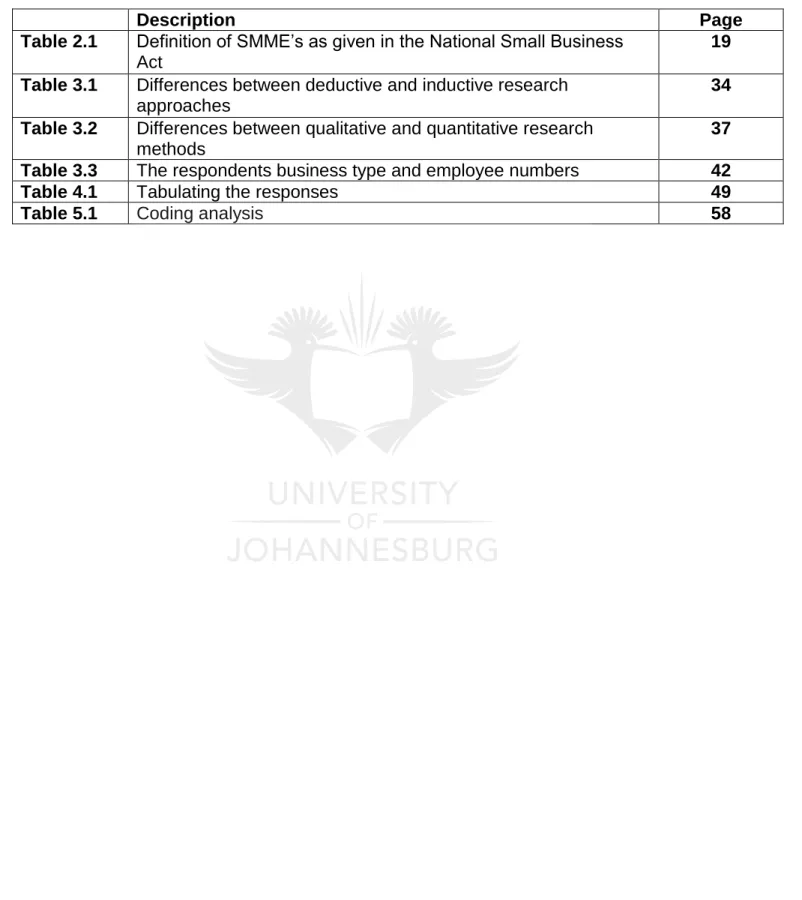
(11) List of Tables Table 2.1 Table 3.1 Table 3.2 Table 3.3 Table 4.1 Table 5.1. Description Definition of SMME’s as given in the National Small Business Act Differences between deductive and inductive research approaches Differences between qualitative and quantitative research methods The respondents business type and employee numbers Tabulating the responses Coding analysis. Page 19 34 37 42 49 58. e.
(12) List of Appendices Appendix A Appendix B. Description Questionnaire Interview transcripts. Page 69 75. f.
(13) KEY CONCEPTS Small, Micro, Medium Enterprise (SMME) - Like other countries, the issue of what constitutes a small or medium enterprise is a major concern in SA. Various authors have usually given different definitions to this category of business. “A common definition of SMEs includes registered businesses with less than 250 employees” (IFC, 2009: 9). In practice, SMEs are defined in a number of different ways, generally with reference either to the number of employees or to turnover bands (or a combination of both, as in the National Small Business Act 1996, which also allows for variations according to industry sector). The definition of SMEs by size is necessary, but it is not sufficient for an understanding of a sector where the realities are not only complex, but also dynamic. (Mahembe, 2011:24). Central Business District (CBD) - it is the focal point of a city. It is the commercial and office centre of the city and usually is the centre point for transportation networks. Economic Development (ED) – Business Dictionary defines Economic Development as progress in an economy, or the qualitative measure of this. It usually refers to the adoption of new technologies, transition from agriculture-based to industry-based economy, and general improvement in living standards. Local Economic Development (LED) – LED can be defined as: “a process in which local governments and/or community based groups manage their existing resources and enter into partnership arrangements with the private sector, or with each other, to create new jobs and stimulate economic activity in an economic area” (Zaaijer & Sara, 1993:129).. g.
(14) ABBREVIATIONS AND ACRONYMS CBD. Central Business District. DBSA. Development Bank of Southern Africa. DLG. Department of Local Government. DLGH. Department of Local Government and Housing. DPLG. Department of Provincial and Local Government. DTI. Department of Trade and Industry. EMM. Ekurhuleni Metropolitan Municipality. ED. Economic Development. EDD. Economic Development Department. IDP(s). Integrated Development Plan(s). LED. Local Economic Development. MMC. Member of Mayoral Committee Executive Council. SMME(s). Small, Micro, and Medium Enterprise(s). SME. Small, medium, enterprise. SACN. South African Cities Network. SALGA. South African Local Government Association. h.
(15) Chapter 1: Introduction and problem statement 1.1 Introduction The promotion of Local Economic Development (LED) is one of the core functions of municipalities in South Africa. LED strategies in South Africa (SA) tend to form part of a new approach to development. Economic development is a mandate of the national government to the local municipalities. There are policies in place but LED strategies have been implemented with seemingly very few successes, mostly as a result of lack of capacity within municipalities (Nel, 2001).The researcher is throughout this chapter highlighting the reasons for conducting this project and briefly highlights the research strategy by which it was conducted. The chapter describes to the reader the extent of the area the study covers and also identifies the research population and the sample the study focuses on. 1.2 Background to the research problem Enormous challenges are facing South Africa, in general economic growth and development are some of the core problems that the country faces. “Since 1994, South Africa’s macroeconomic strategy has sought to accommodate the forces of globalisation and ensure the country’s re-entry into the global economy after two decades of relative international economic isolation. One key component of restructuring for globalisation has been a shift in the burden of responsibility for economic development from national to local government level and of the promotion of local economic development (LED) planning across post-apartheid South Africa” (Rogerson, 2002). People invade city areas in search of better life and jobs without considering where they will reside while looking for the anticipated job opportunities and reasonable living conditions. They seek refuge. 1.
(16) from unoccupied land they come across with the hope of finding work. They then decide or are forced to lead lives that are very unbearable where there are no services at all. Those that seek accommodation in the townships help put more pressure on those scarce services as they may not be employed. It is pressures such as these that municipalities have to respond to and plan for.. The government in its South African Yearbook 2013/14 identifies the 12 outcomes that it needs to achieve. This can only be done with the assistance from local municipalities as they are closer to communities (South African Yearbook, 2013/14). The 12 outcomes are as follows: . “improved quality of basic education. . a long and healthy life for all South Africans. . all people in South Africa are and feel safe. . decent employment through inclusive economic growth. . a skilled and capable workforce to support an inclusive growth path. . an efficient, competitive and responsive economic infrastructure network. . vibrant, equitable and sustainable rural communities with food security for all. . sustainable human settlements and improved quality of household life. . a responsive, accountable, effective local government system. . environmental assets and natural resources that are well protected and continually enhanced. . a better South Africa and contributing to a better and safer Africa and world. 2.
(17) . an efficient, effective and development-oriented public service and an empowered, fair and inclusive citizenship”.. From these outcomes of government one can conclude to say that municipalities have a huge role to play as far as community development is concerned. Government’s success in supporting economic development is dependent on the extent to which the three spheres of government (national, provincial and local governments) align their strategies and coordinate their actions in order to achieve integrated outcomes in the municipal areas (Policy Guidelines for Implementing LED, 2005:12). 1.2.1 The role of South African municipalities It is important to consider the current government’s stated mandate that resonates down to the level of municipalities - “South Africa is a constitutional democracy with a three tier system of government and independent judiciary. The national, provincial and local levels of government all have legislative and executive authority in their own spheres, and are defined in the constitution as ‘distinctive, interdependent and interrelated’”(South African Yearbook 2013/14).. The municipalities are the third level of government after the national and the provincial levels. Ekurhuleni Metropolitan Municipality, like all other municipalities, is the pinnacle of the decentralisation of government power, administration and governance in geographic areas of post-apartheid South Africa. The Ekurhuleni Metropolitan Municipality like all other municipalities is mandated to use its resources and economic power to transform. 3.
(18) and improve the livelihoods of the many thousands of the people living in and around it (Constitution of the Republic of South Africa, Act 108 of 1996:151-156).. Metropolitan municipalities are responsible for all local services, development and delivery in the metropolitan areas. Local Economic Development is also a mandate of metropolitan municipality such as Ekurhuleni Metropolitan Municipality (EMM). Based on this responsibility, the authors Zaaijer and Sara suggest LED is “ A process in which local governments and/ or community based groups manage their existing resources and enter into partnership arrangements with the private sector, or with each other, to create new jobs and stimulate economic activity in an economic area”(Zaaijer & Sara, 1993:129).. In order to foster economic growth in communities, “broadly representative institutions must be established to address local economic development needs. Their purpose would be to formulate strategies to address job creation and community development…” (ANC,1994:83). The economy grows when more and more businesses and factories are encouraged in a local municipal area. The economy of an area will improve for the better if more people can get employment and then afford to pay taxes and municipal rates. Any economic development programme is then judged by its ability to create jobs, promote economic stability and expanding opportunities that can sustain the livelihoods of the people of the designated area. All economic developmental plans are based on utilising the available infrastructure, physical landscape, capital and market economics as starting point and the quality of all these factors can spell the success or failure of the municipality in improving the local economy. It is the responsibility of the municipality to perfect and. 4.
(19) make efficient markets as it already is involved in local business activities as suppliers of infrastructure, tax collector regulator of land and building and activities. By doing this the municipality will be creating a conducive and or enabling environment for business activities to take place.. 1.2.2 Introducing Ekurhuleni Metropolitan Municipality Ekurhuleni Metropolitan Municipality (EMM) is one of the six metropolitan municipalities that came into being with the advent of democracy in 1994 in South Africa. It is situated in South Africa’s manufacturing hub. Companies has set up their plants strategically around Ekurhuleni since it is close to major road networks, rail and air freight. Originally a rich mining region, it has a well-developed transport network which has contributed, over the years, to notable industrial growth, making it the industrial hub of Gauteng Province. Ekurhuleni is easily accessible to major centres in Gauteng, and has a welldeveloped air, road and rail infrastructure (SACN, 2014).. Ekurhuleni Metropolitan Municipality is one of the most densely populated areas in the Gauteng Province and can be regarded as one with the largest and having the most diverse economy in the country more than that of many countries in Africa. It accounts for nearly a quarter of Gauteng’s economy and contributes over a third of the national Gross Domestic Product (GDP) through the production of goods and commodities from the many factories and service centres located in this area (SACN 2014). The networks of roads, airports, railways lines, telephones, working and well-functioning electricity grid and advanced telecommunications put the Metro as the transportation of South Africa. It. 5.
(20) has the Oliver Reginald Tambo International Airport that connects Gauteng and other South African cities and also connects South Africa with the rest of the world. There is also the Maputo Development Corridor which is a gateway to Maputo harbour which connects to the eastern countries of the world; there is the City Deep Container terminal for distribution of goods entering the county to the rest of the country. The LED vision for Ekurhuleni Metropolitan Municipality is that of creating an “inclusive wealth-generating economy” with the LED mission statement given as to “Facilitate a conducive environment where all can participate in a wealth generating local economy by focusing on economic growth, empowerment and transformation” (Ekurhuleni Municipality, 2003).. 6.
(21) Figure 1.1: Map of Gauteng Source: Sedibeng District Municipality Maps, 2014. Historically, Ekurhuleni urban development has been closely associated with gold mining, but today is a multi-nodal structure with no single dominant node of activity. The Ekurhuleni Local Municipality covers an extensive area stretching from the town of Germiston in the west to a town of Springs and Nigel in the east. The municipality has incorporated the towns of Alberton, Bedfordview, Benoni, Boksburg, Brakpan, Edenvale, Germiston, Katlehong, Kempton Park, Nigel, Olifantsfontein, Springs, Tembisa, Wattville, Kwa-Tema and Etwatwa with these towns having Central Business Districts (CBD) that 7.
(22) have well developed infrastructure, highly accessible by rail and road. The periphery of these towns in Ekurhuleni has parcels of vacant land with low development densities and historically disadvantaged communities are situated there (SACN,2014). Figure 1.2: Map of Ekurhuleni Source: South African government Global Information Systems, 2015. For its diverse and large economy with the aforementioned advantages, the Ekurhuleni Local Municipality therefore has to be at the forefront of excellent and effective service delivery where the livelihood of the residents of the area ought to be one of the most improved in the country. It is expected that in such a situation enough jobs are available 8.
(23) where the people – all people - can lead a decent living. It is accepted that it cannot be spoken of an area where there is totally no unemployment, but with attributes and capacities, EMM should be the one where protests for services are minimal. There should be fewer people who still live in squalor after these twenty years of democracy. Great things are expected of this municipality in as far as better life for the people is concerned. It then remains to be seen whether the extent or impact that the LED initiatives in EMM has a positive effect on the SMMEs in Edenvale. 1.2.3 Challenges for Ekurhuleni This study was inspired by the following message from the former South African President, Nelson Mandela, “My government and I are aware of the many obstacles that have prevailed against small business- historical injustices with prevented the majority of South Africans from gaining access to finance and other resources, restricted their access to major markets, and indeed, prevented millions of people from becoming entrepreneurs. These practices have resulted in what is now a very, distorted economy, in which so many small businesses and black businesses are confined to the margins of economic activity”. (Source: Message from Former President Nelson Mandela, in “The President’s Conference on Small Business”, 1995). For the purposes of this study, considering the large area that Ekurhuleni encompasses, focus is on the Northern region of the municipality, that covers Edenvale, area. Edenvale area was selected because the researcher owns an SME in the area and wanted to assess if the other local SME’s are benefitting from Ekurhuleni LED programmes. Parnell (2004) states that, “for municipalities to achieve their economic objectives, they require. 9.
(24) the commitment of politicians to poverty reduction, job creation and small business support”. The levels of poverty and unemployment in Ekurhuleni are unacceptably high and need to be addressed. Those people living in poverty generally live on the urban periphery, far away from job opportunities and social amenities. This is indicative of the rural-to-urban migration of people in search of jobs indeed; migration into the area is a key challenge and has resulted in the establishment of many informal settlements and informal trading activity. Hence this study attempting to drive economic growth in the area in order to help alleviate the challenges mentioned here. The success or failure of the municipality to improve the livelihoods of the people living in the area depends entirely on the programmes designed by the municipality and their implementation. The government requires every municipality to come up with a master plan containing subsidiary plans for its actions for a year or for a number of years to carry out its activities. This in municipal terms is called the Integrated Development Plan (IDP). 1.2.4 Integrated Development Plan The IDP gives a municipality guideline as what it has planned to do for a particular financial year or subsequent years to deliver developmental goals the municipality sets for itself. “Integrated Development Plan (IDP), is a process through which municipalities prepare a strategic development plan which extends over a five-year period. The Integrated Development Plan is a product of the IDP process. The Ekurhuleni Metropolitan Municipality is the principal strategic planning instrument which guides and informs all planning, budgeting, management and decision making processes in the municipality” (Ekurhuleni IDP 2013/14). The IDP serves as a road map or manual to. 10.
(25) achieve the goals set by the municipality, it is a necessary tool that municipalities use to track their progress.. IDP provides a framework for all the activities of a municipality (Carrim, 2001:1-2). The analysis and thorough study of the IDP against actual achievements will indicate whether, the municipality truly followed the IDP goals. The IDP also indicate the programmes and budget the municipality will require to carry out this mandate of the government. It has to have timeframes that must be met otherwise it will be a mockery of the intentions of the government about municipalities to be vehicles of service delivery and economic development. Essentially the IDP states the vision, needs, goals and action plan of the municipality during the council’s term of office, as part of a long term vision and plan for municipal development. Economic growth, development and job creation are amongst the five key performance areas of EMM. For the purposes of this study the researcher looked into the business support, financing mechanisms and business linkages to SMMEs provided by EMM LED department to the Northern region, Edenvale area.. It remains to be seen what strategies or measures the municipality employs to realise the intentions of the government on local economic development. It remains to be seen whether the Metro is succeeding in creating jobs and alleviating poverty amongst the people living in this area through SMME development. Employment is a catalyst to improved living standards of people. Small, medium and big businesses and cooperatives offer jobs to the people. It is then incumbent upon the municipality to make it possible for the business to grow and therefore hire more and more people. Small businesses and. 11.
(26) small entrepreneurs should in all respects be assisted to function maximally in order to employ good numbers of local communities. The Ekurhuleni Metropolitan Municipality is in a good position to achieve the goals of their local economic development strategy. The Municipality should support the very small businesses which are also contributing to economic growth. There are various programs that municipalities should promote, for example support and retention of SMMEs, improving business climate and cooperatives (RSA, 2005). In March 1995, the Government released a White Paper on National Strategy for the Development and Promotion of Small business in South Africa, in which an elaborate policy and strategy framework on small business development was delineated. The White Paper articulated the Government’s rationale for small business promotion as follows stating that the primary objective of the national policy framework was to create an enabling environment for small enterprises (DTI, 2005): “With millions of South Africans unemployed and underemployed, the Government has no option but to give its full attention to the fundamental task of job creation, and to generating sustainable and equitable growth. Small, medium and micro-enterprises (SMMEs) represent an important vehicle to address the challenges of job creation, economic growth and equity in our country. Throughout the world, one finds that SMMEs are playing a critical role in absorbing labour, penetrating new markets and generally expanding economies in creative and innovative ways. We are of the view that – with the appropriate enabling environment – SMMEs in this country can follow these examples and make an indelible mark on this economy. The stimulation of SMMEs must be seen as part of an integrated strategy to take this economy onto a higher road – one in which our economy is. 12.
(27) diversified, productivity is enhanced, investment is stimulated and entrepreneurship flourishes”.. This research is aimed at investigating the penetration that the Local Economic Development initiatives in Ekurhuleni has had for the SMMEs in Edenvale. Local Economic Development is a strategy of government which is aimed at reducing, if not eradicating unemployment and poverty by way of stimulating economic growth in so doing, ensuring local economic development. 1.3 Research problem EMM is one of the well-established Metropolitan municipalities with a huge potential of future economic growth since it is close to major transport networks. The problem therefore is, the extent or impact that the LED initiatives in EMM has on SMME’s in Edenvale. For the purposes of this study and time constraints the research was limited to only Edenvale SMMEs in the Northern region. 1.4 Research objectives The following research objectives were explored, primary and secondary research objectives. 1.4.1 Primary research objective To establish whether the EMM LED unit offers business support through providing information. 1.4.2 Secondary research objectives To attain the primary objective the following secondary objectives were set:. 13.
(28) Secondary research objective 1: To determine the expectation of LED programmes in place to support SMMEs - with a literature review; Secondary research objective 2: To evaluate the effectiveness of the support the municipality gives to each of sampled small and medium enterprises; Secondary research objective 3: To make recommendations as to how EMM LED unit can achieve their LED mandate based on the field study. 1.5 Research questions The study seeks to answer the following two questions: . Is LED in EMM Edenvale implemented in such a way so as to encourage economic growth?. . What programmes are in place to support SMMEs?. 1.6 Justification of the study Municipalities around the world face to varying degrees, the similar problems of inequality, unemployment, increasing poverty levels and limited basic services to local communities (Horn & Lloyd, 2001:59). The government is inundated with a huge responsibility as far as economic growth and development. This is made worse by globalisation, urbanisation and the ever increasing competitive environment. This study will attract the attention of the municipal heads and other officials to the shortcomings that they may experience with regard to implementation of Local Economic Development strategies. Having studied this report, managers will now be able to attend to this sector of the economy better as this is very important to the development of SMMEs in the Edenvale area of EMM.. 14.
(29) 1.7 Literature review strategy There is a great deal of different literature on local economic development (LED) that was reviewed by the researcher. Secondary literature was consulted to understand what other authors and researchers say about the topic. Academic theses and dissertations already conducted by fellow researchers formed part of the literature search with academic resources from accredited academic journals available on the internet maximally used to find more on the topic. Government and municipal reports and policies relevant to the EMM LED were studied.. 1.8 Chapter layout The dissertation is laid out in the following chapters: . Chapter 1: Research background and problem statement. This chapter is comprised of the introduction to the background of the study, the problem statement and overview of how the study was executed.. . Chapter 2: Literature review. This chapter is made up of a literature review of LED value and processes and SMMEs’ role in economic activity giving the different perspectives of different authors.. . Chapter 3: Research strategy. The chapter deals with the research design adopted for this study to address the problem statement.. . Chapter 4: Findings and discussion. This presents the findings and discussion of the field study.. 15.
(30) . Chapter 5: Conclusions and recommendations. This chapter focuses on the interpretation and the discussion of the findings with reference to the literature reviewed.. 1.9 Conclusion As an introduction to the research, chapter 1 attempted to provide a succinct summary of the lines of argument, a foundation was laid for the study. The following topics were covered: the role of South African municipalities, overview and challenges of EMM, the research problem statement and objectives thereof as well as justification of the study. Chapter 2 concentrates on literature studied that has relevance to the understanding the contribution of past research done in this field.. 16.
(31) Chapter 2: Literature review 2.1 Introduction This chapter reviews the role of LED, key actors within LED successful application and, different approaches taken globally. Horn and Lloyd (2001) note that local authorities (municipalities) across the world face, to different degrees, the same problems and challenges of inequality, poverty, unemployment and other shortcomings regarding servicing the basic human needs (Horn & Lloyd, 2001:59). The realities of running LED plans efficiently and effectively are compounded for municipalities by new realities like urbanisation, continuous technological change and competition on a global scale that all rapidly changes the local business environment required to support an SMME if it is to remain competitive. These issues impact on the economies of cities and towns because an unhealthy business environment affects the ability to contribute to GDP. 2.2 Defining Micro, Small and Medium Enterprises There is growing recognition of the important role of micro, small and medium enterprises play in economic development. They can be described as efficient and job creators, the feeders of big businesses and the fuel to the national economy. Even in the developed industrial economies, it is the SMME sector rather than the big businesses that is the largest employer of workers. Interest in the role of SMMEs in the development process continues to be in the forefront of policy debates in most countries. The issue of what constitutes a small or medium enterprise is a major concern in the literature. Different authors have given different definitions to this category of business for instance the definition of firms by size varies among researchers. Some attempt to use the capital assets while others use skill of labour and turnover level. Others define SMMEs in terms. 17.
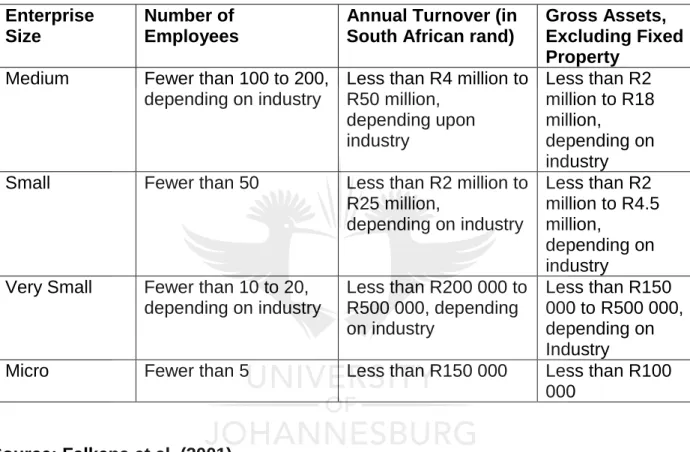
(32) of their legal status and method of production. The most widely used framework in South Africa is that set by the definition of the South African National Small Business Act 102 of 1996, which sets out five categories for business in South Africa (Table 2.1). The defining criteria are quite complex including: the number of employees per business size; annual turnover; plus the business’s gross assets excluding fixed property. The definitions used predominantly for South African SMME categories are as follows:. Micro and survivalist enterprises: The turnover is less than the VAT registration limit (that is, R150 000 per year). These enterprises usually lack formality in terms of registration. They include, for example, spaza shops, minibus taxis and household industries. They employ no more than 5 people. Survivalist enterprise: The income generated is less than the minimum income standard or the poverty line. This category is considered preentrepreneurial, and includes hawkers, vendors and subsistence farmers.. Very small enterprise: These are enterprises employing fewer than 10 paid employees, except mining, electricity, manufacturing and construction sectors, in which the figure is 20 employees. These enterprises operate in the formal market and have access to technology. They are also often not registered for VAT.. Small enterprise: The upper limit is 50 employees. Small enterprises are generally more established than very small enterprises and exhibit more complex business practices. Should be registered to gain the benefits of VAT but often are not.. 18.
(33) Medium enterprise: The maximum number of employees is 100, or 200 for the mining, electricity, manufacturing and construction sectors. These enterprises are often characterised by the decentralisation of power to an additional management layer.. Table 2.1: Enterprise Size Medium. Small. Very Small. Micro. Definitions of SMMEs as given in the National Small Business Act Number of Employees. Annual Turnover (in South African rand). Gross Assets, Excluding Fixed Property Fewer than 100 to 200, Less than R4 million to Less than R2 depending on industry R50 million, million to R18 depending upon million, industry depending on industry Fewer than 50 Less than R2 million to Less than R2 R25 million, million to R4.5 depending on industry million, depending on industry Fewer than 10 to 20, Less than R200 000 to Less than R150 depending on industry R500 000, depending 000 to R500 000, on industry depending on Industry Fewer than 5 Less than R150 000 Less than R100 000. Source: Falkena et al. (2001). 2.3 The global perspective of the role of SMMEs The role of SMMEs is very important in the development of the economy of each country. It is a fact that if SMMEs want to be successful and competitive, they must absorb all the knowledge they can get on the industry within which they operate. One of the ways that the government can influence business growth is through clustering of businesses. “Clusters provide a vehicle to bring companies, government and local institutions together. 19.
(34) in a constructive dialogue about upgrading, offering a new business mechanism for business-government collaboration. Cluster initiatives provide a new way for organizing economic development efforts that go beyond traditional efforts to reduce the cost of doing business and enhance the overall business environment” (Porter, 2000:30). In Figure 2.1 Porter demonstrates the conditions typically present for a cluster of business to be successful. Demand conditions drive a continual need from consumers for better and improved goods; the input factors highlights a number of resources required for success but Porter notes the most important of these being the continued need for new relevant information – all the other input factors will be driven by what the business learns from new information and uses in ways to make itself more competitive. The context of competitive rivalry is important as it drives innovation which ensures business survival but again argued in this research as the extent to which a business gets information that helps it be ready to make change and adapt. Related and supporting industries create a cluster of businesses that not only support each other in business relationships but also flow information between them for ongoing quality improvement.. 20.
(35) Figure 2.1: Sources of local competitive advantage. Source: Adopted from Porter (2000:20) Porter (2000:20) said that physical location should no longer be a source of competitive advantage in an era of global competition, rapid transport and high-speed telecommunications. Porter suggests that clustering businesses helps cities focus and direct their available economic development efforts and encourages small businesses to complement each other more than competing with one another. Businesses (such as SMMEs) often respond well to a cluster concept as they “amplify” each other’s efforts to be innovative (Porter, 2000:20). In other words building a cluster node as can exist in Edenvale eventually generates internal node efficiencies and self-support. Porter notes 21.
(36) in Figure 2.1 the interrelated forces for cluster success require a constant inflow of information to continually attain new competitive qualities and so advance the immediate geographic region (Porter, 2000:20). This may subsequently also aid in facilitating faster local growth of all business in the area.. LED units in municipalities should use clustering to their advantage as could enable the municipality to be able to reach and disseminate information to businesses in a more efficient manner. In Ekurhuleni municipality, particularly Edenvale, there is a tendency of similar businesses to be located within close physical proximity so this could be developed along the Porter cluster lines. 2.4 The South African perspective of LED support The vision that forms the core of the Department of Provincial and Local Government’s (DPLG) Policy Guidelines for implementing LED in South Africa is of “creating robust and inclusive local economies that exploit local opportunities, address local needs and contribute to national development objectives such as economic growth and poverty eradication” (DPLG, 2005:10). Rogerson noted that national government has set out a way forward for local government to deliver on LED plans stating, “National government has provided a range of programmes that will facilitate LED endeavours” (Rogerson, 2006:235). As introduced in chapter 1, many Ekurhuleni towns do have well developed infrastructure and are highly accessible by rail and road. The EMM current situation and role is now discussed in more detail.. 22.
(37) 2.4.1 Obstacles to SMMEs in South Africa Bosma and Levie (2009) reveals that the South African economy is dominated by large companies and the public sector. There is a need to stimulate the economy through small businesses and create employment. According to Venter et al. (2008) it was only in 1995 when the government created a policy on SMMEs in the form of the White Paper on National Strategy for the development and promotion of small business in SA. The government believes SMME development is vital for the growth of the economy, hence they formulated a policy and programmes to encourage new businesses and the growth of existing businesses. Despite the national guidelines that the South African government has put in place, SMMEs still achieve limited growth due to some typical obstacles that hinder growth. Olawale and Garwe (2010) in their paper, Obstacles to the growth of new SME’s in South Africa, highlight the following:Internal obstacles . Access to finance. . Management skills. . Location and networking. . Investment in information technology and cost of production. External obstacles . Economic variables and markets. . Crime and corruption. . Labour, infrastructure and regulations.. 23.
(38) 2.4.2 Principles informing SMME development in Gauteng According to the National Treasury Research on SMMEs (2008) South Africa has an estimated 2.8 million SMMEs which contribute 52%-57% of GDP. SMMEs also provide about 60% of jobs, and contribute more than 40% of the country’s total remuneration. This means that SMMEs in South Africa employ more people than private sector and government combined. There is a growing recognition of the important role SMMEs play in economic development. SMMEs have been noted to be an area of concern for many policy makers in an attempt to accelerate economic growth. There is a need to know where SMME’s are located in the local municipality and the contribution they make in their community. The following principles from Gauteng SMME Policy Framework (2009-2014) inform the design and management of SMME development interventions in the province (Gauteng SMME Policy Framework, 2009-2014): a. The Gauteng Provincial Government provides oversight and leadership in the development of the SMME sector in the province, liaising closely with key national government departments and agencies, as well as with all district, metropolitan and local municipalities. b. SMME development services enhance the potential for economic transformation in the province, removing the dualism that is currently found in the economy and practically. supporting. opportunities. for. Broad. based. black. economic. empowerment (BBBEE). c. Wherever possible systemic and sustainable approaches to SMME development are applied in order to address the underlying constraints and barriers experienced. 24.
(39) by the sector and ensuring all SMMEs in the province benefit from these interventions. d. The creation of provincial and local business environments that enable the growth of SMMEs within the province is a continuous process of assessment, reform, and dialogue with the business community. e. All SMME development services are carefully targeted, demand oriented, responsive and integrated. f. Wherever possible, all actors engaged in the SMME sector- public, private and community, as well as national, provincial and local agencies, and the SMME sector itself ( as represented by business membership organisations) work together to ensure their actions are complementary and coordinated. g. Regular and structures dialogue between provincial and local governments and the SMME sector is essential to the design of effective support interventions and a better business environment. h. Provincial SMME development pays special attention to the constraints and challenges facing women, young people, people with disabilities and enterprises operating in previously disadvantaged areas in the province. i. New methods and instruments are developed to promote SMME development in the province, including the use of pilot and flagship projects which test new approaches to SMME incubation, innovation and development. j. Investments are made into the generating and management of knowledge concerning the provincial SMME sector and development interventions.. 25.
(40) k. SMME development interventions in the province is aligned with the targeted sectors and clusters as specified in the draft Gauteng Industrial Policy Framework. l. Specific SMME development strategies are formulated in each of the identified sectors and development targets set and monitored. m. The Gauteng Provincial Government as well as all district metropolitan and local municipalities perform regulatory impact assessments on all new local policies, laws and regulations to clarify the positive and negative impacts these will have on the SMME sector before they are introduced. n. Clear targets are set for the development of SMMEs in the province, which shall be regularly monitored and reported. The criteria set by these statements are clear in that the role is definitively one of support for SMME business. Information should flow from LED to SMMEs in relation to many different information needs not limited to but such as: Item (b) ‘SMME development services [should] enhance the potential for economic transformation’; Item (i) ‘New methods and instruments are developed to promote SMME development’; Item (j) ‘Investments are made into the generating and management of knowledge’; and, Item (m) ‘Assessments on all new local policies, laws and regulations to clarify the positive and negative impacts these will have on the SMME sector (and advise SMMEs of their impact and implications]. 2.5 Ekurhuleni Metropolitan Municipality business centre for SMME development Ekurhuleni Metropolitan Municipality (EMM) is strategically located, both within Gauteng Province which is centrally situated within South Africa. All major railway lines converge. 26.
(41) at Germiston in Ekurhuleni, and from Germiston station commuter rail lines extend to all major destinations in South Africa. The east-west road infrastructure has been well developed, and much of the road networks lead into the Greater Johannesburg area – Johannesburg being a continental hub of business. SACN (2014 notes however that there is a lack of developed north-south infrastructure transport linkage). Unfortunately, Edenvale lies to the north of Germiston so road infrastructure is not as optimised as it could be. Over half of all work trips north-south are made by private car. The bus service is under-utilised, while the supply of minibus taxi services generally exceeds the demand. Yet, Oliver Tambo International Airport in the EMM area is Africa’s busiest airport, and is the entry point for South Africa of most foreign visitors. In 2014, the airport was handling over 16 million passengers a year, hosts over 50 airlines and employs about 18 000 people. In addition to OR Tambo there are the Rand Airport and other airfields in Brakpan and Springs (SACN, 2014). According to Bennet (1988:49), “an LED is a sub-national action that occurs within the context of a local labour market. It is aimed at increasing and accelerating economic growth and employment and achieving a more equitable distribution of income”. Thus with the EMM potential infrastructure the role of supporting LED for all local town SMMEs should be possible. Especially, when considering the economic output/contribution from Ekurhuleni in 2002 in terms of the entire South African national economy which was: +/- R44, 5 billion overall which meant EMM was contributing +/- 7, 4% of total country production; EMM contributed to +/- 6, 9% of all national employment;. 27.
(42) Per capita gross output per month in EMM was placed at +/- R17 783.00 (exceeding the 2002 national average of R13 140.00) by nearly R5 000.00.. Over the period 1998 to 2003 Ekurhuleni’s formal economy grew by an estimated average of 3% per annum. (Ekurhuleni growth and development strategy 2025:2005). In an attempt to reach out to local communities Ekurhuleni Metropolitan Municipality has established a Business Centre within its borders. Ekurhuleni Metropolitan Municipality Business Centre (EBC) is located at Kempton Park, the Northern region of Ekurhuleni Metropolitan Municipality. It houses the LED unit; EMM Tender Advice Centre (TAC) and the Small Enterprise Development Agency (SEDA) offices. The intention is to ensure easy access to information and services that the municipality provides. 2.6 The legislative and policy framework on Local Economic Development in South Africa The legislative and policy framework for LED is founded in national legislation, policies and frameworks dealing with socio-economic development and poverty alleviation. The framework is aimed at promoting a strategic approach to the development of local economies and a shift away from narrow municipal interests focused only on government’s inputs into ad-hoc projects. Local Economic Development initiatives in some municipal areas are overseen by local Section 21 companies set up not for commercial gain but with a very strong business learning focus (training and skills transfer) with active promotion of small entrepreneurs (SMMEs) in support of the local authorities efforts to initiate LED projects. Nel (2001:9-10) suggests that this type of community-based and non-governmental organisation can operate on a broad plane as. 28.
(43) agents and proponents of LED-type activities forming partnerships to ensure the success of initiatives with key stakeholders such as EMM. This suggests that if EMM LED support for SMME is under resourced it could turn to Section 21s playing this role when seeking extra support for its SMMEs. The World Bank recommends poverty alleviation through Local Economic Development should be integrated noting that LED initiatives should be to provide poor communities with the basic services such as water, electricity, education, health care, roads and sewerage. Active participation by communities involved in LED initiatives needs to be identified if a municipality is to provide meaningful economic growth. The World Bank (2003:4) further views LED as a process by which public, business and NGO partners work collectively to create better conditions for economic growth and employment generation. These sentiments are corroborated by Blakely (1994:9) and Nel (2001:1) who further note LED as a practice through which local government and community organisations encourage business and employment. The international mandate for LED based on these opinions seems very clear on what is expected to be achieved by respective international states. Local Economic Development should serve as initiatives by locals to work together to achieve sustainable economic growth and improve on their quality of lives with economic benefits to be received by all in the community in the quest to lessen poverty and unemployment. Some municipalities will find it more challenging than other municipalities to support economic development that can provide services to the people. These municipalities generally lack in resources and skills to manage and support the activities that can or are intended to alleviate poverty and joblessness among the members of the communities under their jurisdiction.. 29.
(44) 2.6.1 SEDA’s role In line with the World Bank view (section 2.4) - that local business support works best when supported by an interrelated effort by government and NGOs - the role of a parastatal development agency is now discussed. According to Venter, Urban and Rigwema (2008) the South African national Small Enterprise Development Agency (SEDA) came into being in 2004 with the intention of integrating the various small enterprise agencies in the country, into a single development agency. The aim was to implement national support networks that integrate government funded support measures across all spheres of government as well as to initiate national entrepreneurship drives and training opportunities for small businesses. SEDA’s mission now is to develop, support and promote small enterprises throughout partnerships with various role players, including global partners who make international best practices available to local entrepreneurs. SEDA is an integral part of the EMM business centre and probably the most important would be on interpreting the mission statement against the EMM contribution to the national economy. – to disseminate knowledge, know-how and. information that enables business growth and competiveness. 2.6.2 The need for training and information through training Nieman (2001) talks about a need by LED, their partners and the SMMES themselves to understand how continuous skills development and training contribute to the competitiveness of businesses. In his paper, Nieman explains that SMME training can be approached from different angles, namely; business skills training, technical skills training and entrepreneurial skills training. For the South African economy to grow and thrive, the country requires skilled and well informed entrepreneurs. The White Paper on National. 30.
(45) Strategy for the Development and Promotion of Small Business in South Africa and the first President’s Conference on Small business in March 1995 (Republic of South Africa: 1995) made the following recommendations on training: . “Training courses should be modular and relevant to the needs of the sector and target groups. . More attention needs to be given to the training of trainers, the better coordination of training services to avoid duplication and research and training methods. . Local business service centres should be used as training network agencies”.. Training is necessary to be able to impart knowledge on basic skills for running a business, like marketing skills, financial skills, human resource skills, negotiation skills as well as communication skills. 2.7 Conclusion The success of LED is dependent on the cooperation among the municipalities, government and local stakeholders. The purpose of this chapter was to review the literature studied with emphasis on LED in South Africa as well as the international perspective and also covering EMM’s infrastructure and how EMM enhances its local economy. The next chapter discusses the research approach underpinning this study, the research design that was adopted to investigate the research problem statement and the research objectives.. 31.
(46) Chapter 3: Research Methodology 3.1 Introduction The previous chapter focused on the literature review on local economic development. In order to meet the research objectives this chapter is aimed at the research process to be followed, the approach and methods of collecting data. According to Mouton (2002:36) “research methodology is a strategy of inquiry which moves from the underlying philosophical assumptions to research design and data collection, and influences the way in which the researcher collects data. It outlines the techniques, methods, tools, and procedures used in conducting the research design that the researcher wants to follow”. Zikmund, Babin, Carr, and Griffin simplify the stages of the research process (2013:60).. The figure 3.1 shows how the researcher is pivotal in managing the successful research and this chapter’s sections show how this model’s (Figure 3.1) requirements were met. Figure 3.1 Stages of the research process. Source: Zikmund et al. (2013:60). 32.
(47) 3.2 Research philosophy This study can either be interpretive or positivist in nature. According to the principles of positivism, it depends on quantifiable observations that lead themselves to statistical analysis. It has been noted that “as a philosophy, positivism is in accordance with the empiricist view that knowledge stems from human experience. It has an atomistic, ontological view of the world as comprising discrete, observable elements and events that interact in an observable, determined and regular manner” (Collins, 2010:38). This process is simply when a researcher collects data using existing theory to develop hypotheses or research questions about the research problem so as to come up with a research strategy to investigate the problem.. Interpretivism is “associated with the philosophical position of idealism, and is used to group together diverse approaches, including social constructionism, phenomenology and hermeneutics; approaches that reject the objectivist view that meaning resides within the world independently of consciousness” (Collins, 2011:38).. This study follows a qualitative research method which aims to produce a rounded understanding on the basis of rich, contextual and detailed data (Mason, 1996:4). The researcher wanted to get an understanding of how LED benefits local businesses from the business owners first hand, hence the choice of qualitative research method was selected.. 33.
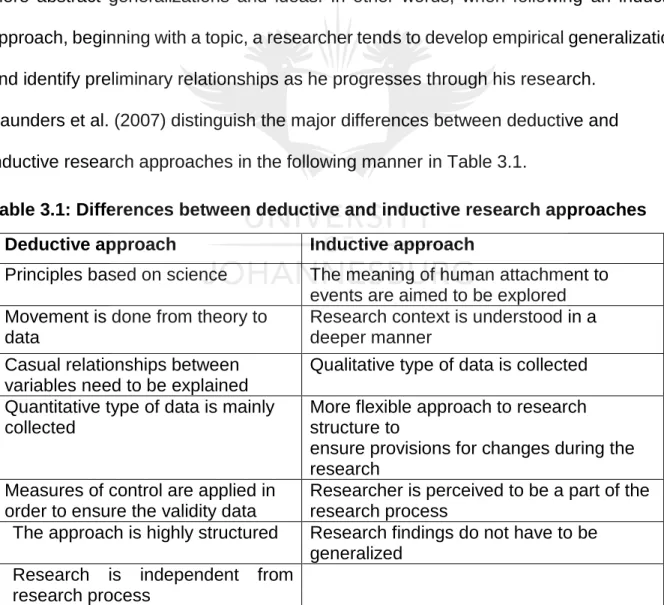
(48) 3.3 Research approach It has been noted in the literature review that this research will be seated on the use of existing relevant research and theory.. An inductive approach is used to make sense of raw primary data. Saunders, Lewis and Thornhill,(2007:118) describe an inductive approach as one of which the researcher starts with collecting data in an attempt to develop theory whereas Neuman (2003:51) affirms inductive research to begin with detailed observations of the world, which moves towards more abstract generalizations and ideas. In other words, when following an inductive approach, beginning with a topic, a researcher tends to develop empirical generalizations and identify preliminary relationships as he progresses through his research. Saunders et al. (2007) distinguish the major differences between deductive and inductive research approaches in the following manner in Table 3.1. Table 3.1: Differences between deductive and inductive research approaches Deductive approach. Inductive approach. Principles based on science. The meaning of human attachment to events are aimed to be explored Research context is understood in a deeper manner. Movement is done from theory to data Casual relationships between variables need to be explained Quantitative type of data is mainly collected. Measures of control are applied in order to ensure the validity data The approach is highly structured Research is independent research process. Qualitative type of data is collected More flexible approach to research structure to ensure provisions for changes during the research Researcher is perceived to be a part of the research process Research findings do not have to be generalized. from. 34.
(49) Samples need to be selected of a sufficient size in order to be able to generalize research conclusions. Source: Saunders et al., 2007. The sample size of the research is small and casual relationships are not proven, only explored to establish whether the EMM LED unit offers business support through providing business information (the primary objective section 1.4). The research follows an inductive approach to understanding the context of the relationship wanting to use experiences of SMMEs to understand how they viewed the EMM LED role. The inductive approach structure is flexible to allow for changes during the research process and it is qualitative in nature. The inductive approach allows the researcher to use what she learns at each interview to dig deeper at the next interview and gain more understanding of the researched situation. 3.3.1 Primary and secondary data Data was collected by perusing municipal documents (i.e. the Integrated Development Plans, Municipal Annual reports, Municipal Assessment reports, Municipal Training schedules) and by the use of questionnaires (Appendix A to solicit information from SMME’s working in Edenvale.. The researcher collected data based on the findings represented by the literature review and used to help frame the questions that were asked of interviewees. The primary data collection used individuals who managed or owned a small business who agreed to participate in the semi-structured interviews. The interviews sought to provide a detailed 35.
(50) description and explanation of the real situation of SMME’s ability to successfully conduct business fulfilling using area’s municipal business initiatives in relation to the expected impact of Local Economic Development initiatives on the SMMEs of the respondents in the immediate community of Edenvale in Ekurhuleni Metropolitan Municipality. The municipality LED members were not interviewed as the public policy is freely available to all South African citizens either on the internet or on request. The research wanted to see how well this stated policy actually worked for SMMEs. The gathered data was presented in chapter 4 in the form of tables and graphs for easy reading and interpretation. 3.4 Why the qualitative research approach was adopted The research design provides a structure of the research and links all of the elements of the research together. The research design is defined as an overall plan put in place to conduct a research study. It is a framework and guideline of the way a particular researcher would go along to conduct a study according to Babbie and Mouton (Babbie & Mouton, 2001:74). In order to meet the aims of the study, the researcher conducted a predominantly qualitative study so as to solicit directly information from the small businesses affected by EMM LED in the area. This assists in finding out about the feelings and views of the people and the government regarding the local economic development intended to reduce the sufferings of the communities, particularly the historically disadvantaged. The qualitative research approach is characterized by two qualities, namely diversity of opinions from respondents and participation by individuals who are active stakeholders in the subject under study (Bless, Higson-Smith & Kagee, 2006:43). Denzin and Lincoln (2000:10) indicate that both qualitative and quantitative researchers are concerned with. 36.
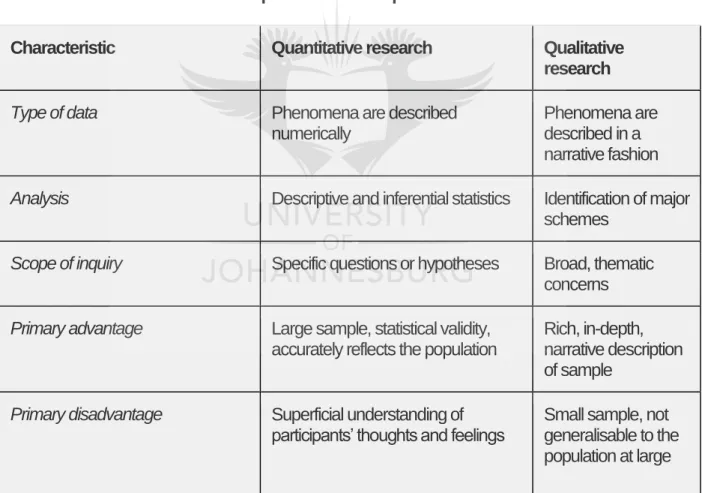
(51) the individuals’ point of view. However, qualitative investigators think they can get closer to the actor’s perspective through detailed interviewing and observation. These authors argue quantitative researchers are seldom able to rely on more remote, inferential empirical methods and materials.. Table 3.2 presents the main differences between qualitative and quantitative research methods as suggested by Van der Stroep and Johnson (2010).. Table 3.2: Differences between qualitative and quantitative research methods Characteristic. Quantitative research. Qualitative research. Type of data. Phenomena are described numerically. Phenomena are described in a narrative fashion. Analysis. Descriptive and inferential statistics. Identification of major schemes. Scope of inquiry. Specific questions or hypotheses. Broad, thematic concerns. Primary advantage. Large sample, statistical validity, accurately reflects the population. Rich, in-depth, narrative description of sample. Primary disadvantage. Superficial understanding of participants’ thoughts and feelings. Small sample, not generalisable to the population at large. Source: Van der Stroep et al. (2010). 37.
(52) A qualitative approach was deemed as necessary using the Table 3.2 to arrive at this decision because views and or opinions were solicited from SMMEs in the Edenvale area. The researcher drew conclusions from whatever information was available publicly on LED initiatives in Edenvale and, from selected SMME members in the area. 3.4.1 The questionnaire structure The structure of the questionnaire was divided into three sections, Part A, Part B and Part C. Part A focused on the background information about the business and included information such as the sector or industry within which the SMME operates, the number of years the business has been in operation, the number of people the business employs as well as annual turnover for the business. Part B concentrated on challenges that SMMEs face and the business support they believe that they receive from an LED. The last part, which is part C was to establish whether respondents were aware of the local economic development business centre in EMM, whether they receive support from EMM, the knowledge they have of local by-laws (which will affect their ability to perform business legally) and what they think can be done to assist SMMEs. 3.4.2 Research strategy assumptions The researcher, in this study assumed that municipalities and interested private parties such as the SEDA, are tasked by national government with implementation of the initiatives contained in the Local Economic Development Framework with the purpose of creating jobs and stimulating economic growth. 3.4.3 Sampling Two general sample categories are available according to Zikmund (2003:381), namely probability sampling and non-probability sampling.. A convenience, non-probability. 38.
(53) sampling method was followed. The target population chosen is SMMEs around Edenvale area as this study seeks to address the effect of LED within Edenvale. This sample was selected as it was convenient for the researcher to access the SMMEs in the area, since the researcher’s SMME is also located in Edenvale. According to Neelankavil, convenience samples are selected at the convenience of the researcher. They could be a collection of subjects easily grouped, such as members of a particular class, churchgoers, factory workers, persons responding to a promotion or individuals who visit a shopping centre. In this research, the respondents were locally accessible to the researcher’s own place of work and were all SMMEs by the definitions described in chapter 2 for SMMEs (Neelankavil, 2015:230). The researcher dropped off an interview form with each of the targeted respondents and then arranged a time to come and hold the interview with each respondent. This gave the respondent time to think about the questions and prepare for the interview. The ethics of the process were stated on the interview forms (Appendix A) so the respondent knew they did not have to participate if they did not want to. 3.4.4 Population Saunders et al. (2009:212) note that “for some research questions it is possible to collect data from an entire population as it is of a manageable size. However, you should not assume that a census would necessarily provide more useful results than collecting data from a sample which represents the entire population. Sampling provides a valid alternative to a census when (Saunders et al., 2009:212): . “It would be impracticable for you to survey the entire population;. . Your budget constraints prevent you from surveying the entire population;. 39.
(54) . Your time constraints prevent you from surveying the entire population;. . You have collected data but need the results quickly”.. Due to time and budget constraints convenience sampling was used as the SMMEs participants were easily available and inexpensive. This however means that only a small purposefully drawn sample was taken of SMMEs and this affects the validity of interpreting the data for SMMEs experiences of LED support other than those in this physical area. 3.5 Data collection There are three types of interviews to collect qualitative field data and they can be structured, semi-structured or unstructured. Structured interviews are normally verbally administered questionnaires in which a list of predetermined questions were asked, with little or no variation and no scope for follow-up questions that warrant further elaboration while semi-structured interviews have several key questions that help define the areas to be explored, but also allows for a bit of diversion in order to pursue a response in more detail. Unstructured interviews are time consuming and do not reflect any preconceived theories. Unstructured interviews are difficult to manage in the sense that they simply start with an opening question and progresses based on the initial response (Dougherty, 2009:77; Collins & Hussey, 2003:173). Interviews were used in this study to explore the views, experiences, beliefs and motivations of the research participants. This study followed a semi-structured interview process. The questions asked drew their source from themes on the LED role expectations as found in the literature reviewed – with emphasis on information flowing from LED to SMME. The researcher had a background in the theory of LED support from preparing chapter 2 and the interview form. She used this. 40.
(55) background to draw the respondents into discussion. Interviews were recorded on a cellphone and the researcher made notes on the interview forms.. 3.5.1 Collecting primary data using a questionnaire The authors Eriksson and Kovalainen note that, “The key to success in a qualitative business research is not the method and its use, but your ability to formulate and reformulate your research questions” (Eriksson & Kovalainen, 2008:27). To this end, the researcher drafted questions (see Appendix A for the entire questionnaire and the ethics statement prepared for each respondent) for this study are based on themes that review information flowing between LED and an SMME in chapter 2 literature. The questionnaires were delivered personally to selected respondents to complete followed by a brief one-on-one interview. All interviews were done by the researcher to ensure that no new bias or differences in understanding of the body of knowledge were introduced by having more than one interviewer. In some cases due to various reasons of language and literacy levels, the researcher had to explain parts of the questionnaire before conducting the interview. Table3.3 shows the respondent SMME targeted and, their number of employees. Seventeen interviews were anticipated but only 14 were finally obtained. The businesses all found it difficult to find the time to sit down for the interviews as they run their own businesses hands-on.. 41.
(56) Table 3.3: The respondents business type and employee numbers (SMME). Respondent business type. Number of people employed by the business 8. Number of respondents anticipated to interview 2. Number of respondents finally interviewed 1. BGM048 Leisure & tourism BGM050 Consulting BGM057Information technology & Computers BGM084 Catering & Hospitality BGM086 Catering & Hospitality BGM093 Interior decorating BGM094 Hair & Beauty BGM019 Hair & Beauty BGM077 Medical Services BGM001 Property development BGM003 Property development BGM023 Professional services BGM026 Horticulture BGM030 Printing& publishing Total interviews. 5 4. 1 1. 1 1. 15. 2. 1. 5. 1. 1. 3. 1. 1. 7. 2. 1. 5. 1. 1. 6. 1. 1. 5. 1. 1. 1. 1. 1. 4. 1. 1. 3. 1. 1. 2. 1. 1. 17. 14. Source: Researcher’s own compilation, 2015. 42.
Figure


+4

Outline
The South African perspective of LED support
The need for training and information through training
Why the qualitative research approach was adopted
Limitations
Rate the experience that Ekurhuleni Metropolitan Municipality’s (EMM) Local Economic Development has provided to support your business measures
Related documents
Index Contents Page Statement of access fi Abstract iii Acknowledgements v Index vi List of figures x List of plates xv List of tables xvi Statement on sources declaration xviii
TABLE OF CONTENTS Abstract Acknowledgements List of Figures List of Tables Chapter One - Introduction 1.1 Sustainable Development in New Zealand and Brazil 1.2 Motivation Of The
