A Fresh Look at Optimizing
Array
Bound
Checking
Rajiv Gupta Philips Laboratories
North American Philips Corporation 345 Scarborough Road Briarcliff Manor, NY 10510 E-mail: [email protected]
Abstract - This paper describes techniques for optimizing range checks performed to detect array bound violations. In addition to the elimination of range check:s, the optimizations discussed in this paper also reduce the overhead due to range checks that cannot be eliminated by compile-time analysis. The optimizations reduce the program execution time and the object code size through elimination of redundant checks, propagation of checks out of loops, and combination of multiple checks into a single check. A minimal control flow graph (MCFG) is constructed using which the minimal amount of data flow information required for range check optimizations is com- puted. The range check optimizations are per- formed using the MCFG rather the CFG for the entire program. This allows the global range check optimizations to be performed efficiently since the MCFG is significantly smaller than the CFG. Any array bound violation that is detected by a program with all range checks included, will also be detel:ted by the program after range check optimization and vice versa. Even though the above optimizations may appear to be similar to traditional code optimizations, similar reduction in the number of range checks executed can not be achieved by a traditional code optimizer. Experi- mental results indicate that the number of range checks performed in executing a program is greatly reduced using the above techniques.
Keywords - Range Analysis, Flow Analysis, Minimal Control Flow Graph, Constant Propaga- tion, Induction Variable Elimination.
Permission to copy without fee all or part of this material is granted provided that the copies are not made or distributed for direct com- mercial advantage, the ACM copyright notice and the title of the publication and it:% date appear, and notice is given that copying is by permission of the Association for Computing Machinery. To copy otherwise, or to republish, requires a fee and/or specific permission.
01990 ACM C-89791-364-7/90/0006/0272 $1.50 Proceedings of the ACM SIGPLAN’SO Conference on Programming Language Design and Implementation. White Plains, New York, June 20-22, 1990.
1. Introduction
To aid in the debugging of programs under development, many compilers generate run-time checks to detect dynamic errors due to array bound violations. The overhead of these checks is quite high resulting in inefficient code with high execution times. Earlier investigations indicate that execution times for programs can double if run-time checks are performed[3]. This is true for both optimized and unopthized code because trad- itional optimizations are ineffective in reducing the overhead due to array bound checks[3]. Most com- pilers allow the programmer to control the genera- tion of run-time checks through a switch to be specified at compile-time. The programs are com- piled with run-time checks only during the debug- ging phase. When the software is being used in production environment it does not include the run-time checks. Thus, even if the software appears to execute normally, it may be providing incorrect results due the run-time errors. To ensure high reliability, the run-time checks should not be removed from the software. In this paper optimi- zations that greatly reduce the run-time overhead due to array bound checks are presented. Thus, the security of correct execution can be achieved at a small run-time cost.
The reduction of run-time overhead due to range checks is treated as an optimization per- formed through compile time analysis. The optim- izations described in this paper reduce the run- time overhead through elimination, propagation, and combination of range checks. The elimination of checks that can either be performed at compile-time or are unnecessarily performed repeatedly is carried out. This is analogous to the traditional optimizations of constant folding and common subexpression elimination. The propaga- tion of range checks out of loops reduces the number of times a check is executed at run-time. This is analogous to the loop invariant code
motion optimization.
A
combinationof multiple
checks into a single check is possible in certain
instances.
The
range check optimizer,that performs the
optimizations, first constructs a cofitrol flow graph
(CFG) for the program. The statements in this
flow graph are the source level statements rather
than intermediate
code statements.
Preceding
each program statement range checks for all array
accesses in that statement are introduced. It is
assumed that the range check optimizer can dis-
tinguish between the original program statements
and the range checks, From this augmented CFG
a minimal
control flow graph (MCFG)is con-
structed which consists only of the range check
expressions and those program statements that
define identifiers used in these expressions. After
the removal of irrelevant
code, and subsequently
irrelevant
basic blocks, a significantly
smaller
MCFG results. The MCFG is used to perform the
range check optimizations and computing the
use- defdata flow information
required to perform
these optimizations.
The size of the MCFG is
smaller and therefore the global range check
optimizations can be performed efficiently. Furth-
ermore, the use-def information
computed to per-
form the range checks is only a subset of the data
flow information for the entire program.
Markstein
et a/[81 d eveloped compiler tech-
niques for eliminating range checks and propagat-
ing checks out of inner loops. The elimination
algorithm presented in this paper is more general
than the one proposed in [8]. This algorithm takes
advantage
ofthe
monotonicnature of definitions.
Repeated execution of a definition
of the type
i=i+l
causes the value of
ito increase monotoni-
cally. Therefore there is no need to repeatedly
examine whether i is greater than the lower bound
of an array. A very high percentage of subscript
variables are monotonic in nature and therefore
range checking overhead
can be significantly
reduced by exploiting monotonicity.
The propaga-
tion algorithm presented is also more general than
the one proposed in [8]. First, it takes advantage
of monotonicity.
Second, it performs code hoisting
prior to propagation
which moves checks out of
loops that cannot be moved by the algorithm in
[8]. The combination
optimizations
are not per-
formed at all in [8]. Therefore, the techniques
presented in this paper optimize more range checks
than those developed by Markstein et a/[8].
Harrison also used compile time analysis to
reduce the overhead due to range checks in his
work[4]. Compile-time techniques of range propa-
gation and range analysis are employed yielding
bounds on the ranges of variables at various points
in a program. The range information
is used to
eliminate redundant range checks on array sub-
scripts.
The techniques presented in this paper
also reduce the overhead due to range checks
through compile-time analysis. However, in con-
trast to Harrison’s work the overhead reduction is
not achieved only by elimination
of range checks.
The techniques presented in this paper reduce the
run-time overhead due to range checks that can-
not be eliminated by moving the checks out of
loops so that they are executed less frequently and
combining several checks into one. Harrison’s
techniques will be less effective when applied to
dynamic arrays since value range analysis will not
be effective.
The elimination
and propagation
techniques presented in this paper are equally
effective for static and dynamic arrays. Harrison’s
techniques require
use-defand
def-useinformation
for the entire program while techniques in this
paper require the computation of a subset of use-
definformation
and no
def-useinformation.
The
range check optimizations
are performed much
more efficiently
using the MCFG
than range
analysis and range propagation.
Consider the
situation where the program contains a statement
i = j +
kand variable i is used in an array sub-
script expression. In Harrison’s
approach value
range analysis for i would require range analysis
for j and k. However, in the techniques presented
in this paper only data flow information regarding
i will be computed.
Suzuki and Ishihata discuss the implementa-
tion of a system that performs array bound checks
on a program in[6].
Thesystem creates logical
assertions
immediately
before
array
element
accesses that must be true for the program to be
valid.
These assertions are then proven, by a
theorem prover, using techniques similar to induc-
tive
assertion
methods.
Such techniques
are
significantly
more expensive than the techniques
presented in this paper.
Suzuki’s system has
several limitations. As an example it cannot check
the correctness of an array accesses in a loop if the
correctness depends on some data whose value is
set before the execution of the loop. The tech-
niques presented in this paper are based upon flow
analysis thus avoiding such limitations.
The array
accesses that cannot be verified by Suzuki’s system
still
require dynamic
checking. The techniques
presented in this paper will also reduce the over-
head due to checks that cannot be eliminated.
Although
the optimizations
in this paper
eliminate, propagate, and combine range checks,
they do not degrade the reliability
of the software.
Any array bound violation
that is detected by a
program with all range checks included, will also
be detected. by the program after range check
optimization
and vice veraa. It is assumed that
the
range
check
optimizer
is implemented
separately
from the traditional
code optimizer.
An environment in which a debugger for optimized
code(5] is to be provided, the integration
of the
range check: optimizer with the traditional
code
optimizer will make it possible to provide highly
efficient cods? during debugging phases.
In subsequent sections the construction of the
minimal CJ’G and descriptions of various range
check optimizations
and their implementations are
discussed. These techniques are not only highly
efficient but also much more effective in optimizing
range checks than traditional
code optimizations.
Finally
some experimental
results demonstrating
the effectiveness of the range check optimizations
are presented.
Minimal Control Flow Graph
For efiicient implementation
of range check
optimizations,
the Minimal
Control Flow Graph
for a program is constructed from the
CFGaug-
mented with the range checks to be performed.
The basic blocks of the
CFGcontain a sequence of
source level statements rather than intermediate
code statements.
Definition:
Given a CFG G=(N,E), where N is the
set of nodes corresponding to the basic blocks and
E is the set of directed edges connecting the nodes.
The corresponding
MCFGG,-(N,,,,E,)
consists of
the following:
(i)
N,,,EN: A node “i belongs to iv,,, if it con-
tains a range check or a definition for an
identifier used in a range check.
(ii)
E,:
Aset of edges that
preacruethe control
flow of the original CFG. The control flow is
preservedif
for
every
directed
path
p-<n,,ni ..n, > in G, there is a correspond-
ing paih “p’ ii G, which is obtained by elim-
inating all nodes ni p N,,, in
p.J
To construct the MCFG first all statements
other than the range checks and those statements
that
define identifiers
used in array subscript
expressions are eliminated.
Next all redundant
(i) Elimination of Null Nodes
(ii) Elimination of Loops
ni
nj A
ni
nj
(iii)Jr
+
Elimination of Redundant Edges
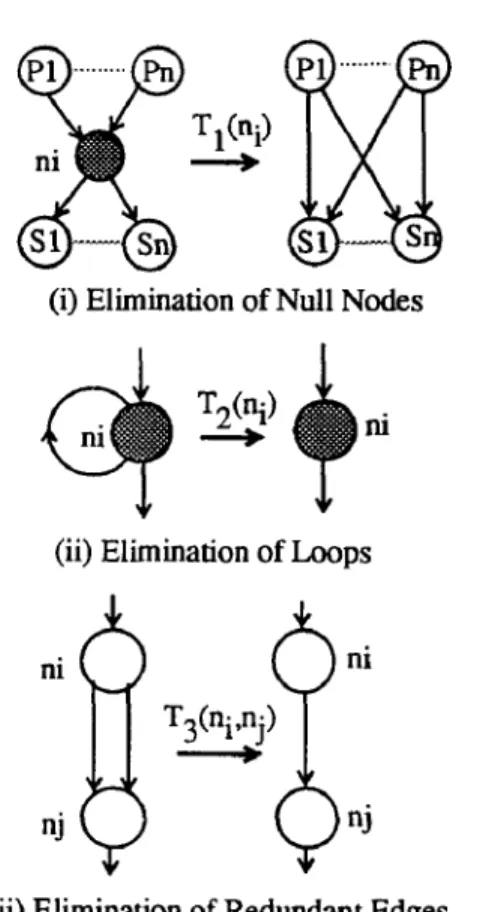
Fig. 1. Transformations for Constructing the MCFG
nodes from this CFG are eliminated to obtain a
smaller flow graph which is the MCFG. To elim-
inate redundant nodes the transformations
in Fig.
1 are applied repeatedly. Transformation
Z’dn,)
eliminates an empty node n, and introduces edges
that connect every predecessor of n, with every
successor of n,.
TAni) eliminates
self loops
toenable elimination
of an empty node ni by Tr(ni).
Transformation
T.Jn,,n,)is used to eliminate
a
redundant edge from
n,to n,.
Claim:
Application
of transformations
T,,
T,and
T,in any order, till no more transformations
can
be applied, yields a
uniqueand
validMCFG.
Proof:Each
of the
above
transformation
preeerveathe control flow:
(4
T,( n,): For each predecessor-successor pair
(P,,sl) of n, this transformation
replacesthe
path
<p,,n,,s,>in the original flow graph by
the path
<pJ,sk>in the transformed
flow
graph.
(ii)
Tdn,):The paths containing
n, prior
to
application of this transformation
are of the
form
<pJ,n,+,st>,where
pJis
apredecessor of
n ,, sk is a successor of n, and
n,+denotes one
or more occurrences of fli. These paths are
replaced by the path
<p,,n,,sL> inthe
transformed flow graph.
(iii)
Tdn,,n,):
This
transformation
eliminates
redundant
edges and therefore all paths
present in the original flow graph are also
present in the transformed flow graph.
From the above discussion it is clear that each of
the above transformations
preserve the control
flow. Consider any two nodes, say
n,and n,, that
belong to the MCFG. If there is a directed path
from ni to nj in the original flow graph then there
will also be such a path in the MCFG. Similarly if
there is no path from n, to n, in the original flow
graph there cannot be one in the MCFG. This is
because when edges are added to the flow graph in
transformation
T, these edges connect nodes which
already had a path between them. Furthermore,
no edges are added by
T,which connect nodes
that do not have a path between them.
The
transformation
T,removes redundant edges and
therefore does not create or destroy any paths.
The repeated application of these transformations
preserves the control flow resulting in a
validMCFG.
The MCFG is unique by definition.
The
nodes contained in the MCFG are the non-empty
set of nodes which is unique. The set of edges in
the MCFG is also unique. This is because if we
consider the existence of two valid MCFG’s then
there must be at least one execution path in one
MCFG that is absent in the other MCFG. How-
ever, this implies that one of the MCFG does not
preserve the flow of control and therefore cannot
be valid. Hence, the MCFG for a given CFG is
unique. The order in which the transformations
are applied does not effect the outcome. This is
because candidates for
T,, T,and
T,remain can-
didates, even if some other applications
of the
transformations are made first. [3
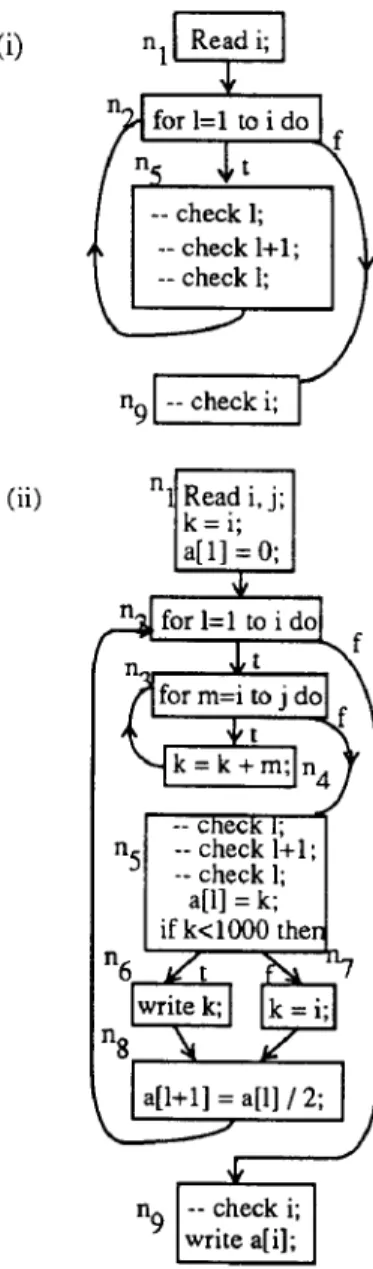
The construction of the MCFG is illustrated
in Fig. 2. The code corresponding to the range
checks is preceded by ‘-‘.
Fig.
2(ii) showsthe
same CFG after elimination
of irrelevant
state-
ments. Application
of transformations
yields the
MCFG shown in Fig. 2(iii). Node
n,is eliminated
by applying
TXnJ.Following this nS is eliminated
by applying
Tl(nJfollowed by
T,(n$.Transforma-
tion
T,also eliminates n, and
n,,This results in
two edges from n6 to n8 one of which is eliminated
using
Tdn,n.& ‘8 -- l check 1+1; -_ check 1; I (i) Augmented CFG “1 Read i; l-l “6 h7 (ii)n1
(iii) MCFG
Q
Pl
Pl
A3
Sl ... sn
p1 ... pn&”
Sl
Pig. 3. Elimination of Null Nodes
The purpose of removing empty nodes is to
reduce the size of the flow graph so that the range
check optinnizations
can be performed
more
efficiently.
IHowever, removal of certain empty
nodes may ncrease the number of edges in the
flow graph. This will increase the amount of com-
putation performed during the range check optimi-
zation phase. The increase in the number of edges
is caused by transformation
T,(n,) which connects
every predecessor of ni with every successor, of n,.
The increase in the number of edges can be
avoided by restricting the application of transfor-
mation
TXn.i) to only those nodes which have
either a single predecessor or a single successor (see
Fig. 3). It should be noted that if this approach is
taken then all empty nodes will not be removed
from the CPG.
After the MCFG is constructed use&f infor-
mation for only the range checks is computed. If a
definition
included in the MCFG is not used by
any of the range checks it is eliminated.
This may
result in adc’iitiona1 empty nodes which can also be
eliminated using the transformations in Fig. 1. The
size of the MCFG is further reduced by applying
the transformations
in Fig. 4. In some instances a
node s; that contains nothing but range checks
can be eliminated
and its checks moved to its
predecessor or successor.
The transformation
Tdn,)‘shown in Fig. 4 moves checks into the prede-
cessor node of s;. Similarly
Tdni) moves checksto
a successor node. Self loops are removed using
Tini)and this may create additional opportunities
for applying
Toni).The transformations
T, T,(ii)
/A
7
v
7
0
TSo
“i cj
c’
cj
(iii)
J
“i
c.i
n.
J
cj
7
il’
0
Tgo
Pig. 4. Additional Transformations
and
T,also preserve the control flow. The above
transformations
not only reduce the size of the
flow graph but also cause the checks to
propagate.The application of transformation
Tin,)followed
by the application
of Tdn,)(or
Tdn,))propagates
the checks belonging to )2; out of a loop.
In the example in Fig.P(iii) nodes
n6and ns
are combined using
Tdn.J.The resulting MCFG is
shown in Fig. 5(i). After these nodes are combined
the check I’-- check 1” appears twice in n6 and will
be eliminated through local analysis. It should be
noted that elimination
of this check would have
required global analysis if the original CFG were
used instead of the MCFG.
The
experimental
results show that the size of the MCFG is half
that of the CFG in most cases. After the MCFG
has been constructed range check optimizations
are applied. These optimizations
are described in
subsequent sections. The range checks present in
the optimized MCFG will be performed at run-
time. The original CFG is modified to include the
range checks present in the optimized MCFG. This
CFG should be used by the compiler for code gen-
(i>
nl Read i;4
(ii)
n9 -- check i;
Fig. 5. (i) MCFG; (ii) CFG with Range Checks eration. The CFG with range checks correspond- ing to the MCFG in Fig. 5(i) is shown in Fig. 5(ii). 3. Range Check Optimizationz
If an array subscript is a constant the range check is performed at compile-time. In this paper, additional optimizations, that are not as direct and require analysis are discussed. The upper and lower bounds of an array a are referred to as MAX(a) and MIN(a) respectively. The lower and upper bound checks are treated separately as sometimes it is possible to optimize one and not the other.
3.1. Local Elimination
If the same check appears more than once in a basic block, and the use-def information indi- cates that same definitions are used in these checks, all but one of the checks is eliminated. In the example of Fig. B(iii) after basic blocks ng and ng are combined the check ‘I-- check 1” appears twice in the same basic block. Thus, one of these is eliminated.
3.2. Global Elimination
Global elimination of range checks is carried out, through global flow analysis. At a given point in the program the checks that have been per- formed previously and are still valid are con- sidered to be live. By propagating live checks other checks may be eliminated. Analysis similar to that for available expressions is carried out, by formulating the problem as a forward data flow equation[l]. The algorithm for this optimization is shown below. The checks killed by a basic block are computed differently from available expres- sions since a check may not, be killed if an identifier used in the expression is redefined by a monotonic definition.
Definition: A definition of an identifier kills a range check if the range check uses that identifier except in the following situations:
(i) Monotonically Increasing: A check lb<i is not, killed by a definition of the form ici+c, itc +i, and ice%, where constant c takes values 1,2,3,4 ,...; and
(ii) Monotonically Decreasing: A check isub is not killed by definitions of the form ici-c, it -c+i, and i-i/c.
Algorithm for Global Elimination:
Step 1: Compute the following sets for all basic blocks:
CXlLL[B] - set of checks performed outside B that are killed by definitions inside B.
C-GEN[B] - set, of checks that reach the end of the basic block B. A check performed in a basic block reaches the end if the definitions between the point at which the check is performed and the end of the basic block do not, kill the check.
Step 2: Compute sets CJN and C-OUT, where CJN is the set, of checks live at the entry of the basic block and C-OUT is the set of checks live upon exit, of the basic block by solving the follow-
ing:
CJV[B1]-+, where B, is the initial
basic block.
CJh[B]-n
CLOUT[P], where Pred(B) is the
PfPd(B)
set of bas.ic blocks that are predecessors of B.
~,CC~T[B]=(C_IN[B]-C_KILL[B])UC_GEN[B]
Step 3:
Eliminate redundant checks.
Acheck ci in
basic block B is redundant
if there is another
check
cj'C_1;N[B]
such that c, performs the same
check
as
ci and it is not killed by a definition
before it reaches the check ci.
--
MlN(a)
5 i, i 5 MAX(a)
Sl: a,[i] t S2: i.1 X then
-- MIN(a) < i, i <
MAX(a)
S3: a[i] t a[i] + 1 endifS4: i t i + 1; -- MlN(a) 5 i, i 5 MAX(a) S5: a$] + Before Elimination -- Ml’N(a) 2 i, i 2 MAX(a) Sl: a$] c S2: il X then
S3: a[i] + a[i] + 1 endif
S4: i t i + 1; i5; l$w4
. E. t
After Global Elimination
In the above example a
range check per-formed for t’he execution of statement Sl is valid
during the execution of statement S3. Thus, no
range check needs to be performed before to exe-
cuting
S3. After
S4 increments
i, the check
i 5
MAX(a)
is killed while the check MIN( a) 5 i is
still alive. Thus, the latter check is not made dur-
ing the execution of
S5.Monotonicity
property is
useful because a large percentage of definitions are
monotonic.
3.3. Propagation of Checks Out of Loops
The goal of propagation
is to reduce the
number of times the checks are executed by mov-
ing them out of loops. As mentioned earlier some
amount of propagation is carried out during the
construction
ofthe MCFG.
In this section an
algorithm
to propagate additional
range checks
out of a loop is presented. The innermost loops are
processed first and the outermost loops are pro-
cessed last.
Thus, a range check may be pro-
pagated across multiple nesting levels. This optim-
ization is illustrated
by the example shown below.
As shown, to move a check involving the for loop
check must be
variable
outside a loop, the
modified.
for icmin to max do -- MIN(a) 5 i, i < MAX(a) -- MIN( a) 5 j, j 2 MAX(a) -- MIN(a) 5 k, k 5 MAX(a) a/i] + a/j] + a[k]
j+j+l end for
Before Propagation
__ if min 5 max then
MIN(a) 5 min, max 5 MAX(a) -- MIN(a) 2 j
-- MIN(a) 5 k, k 5 MAX(a) for icmin to max do
-- j I MAX(a) a[i] t a[j] + a[k] j&j+1
end for
After Propagation
In the above example the check MIN(a)<j
is
moved
out of the loop because the value ofj
increases monotonically.
The algorithm by Mark-
stein et a/[81 does not take advantage of monotoni- city.The algorithm that takes a single loop and
moves the checks out of the loop is presented next.
The checks
propagated in Step 2 of this algorithmwill not be propagated by the algorithm used by
Markstein et al
[8].Algorithm for Propagation:
This algorithm first performs code hoisting to
propagate checks to those basic blocks that dom-
inate the loop exit. Next checks belonging to thebasic blocks dominating
the loop exit are con-
sidered for propagation
out of the loop.
The
checks that can be propagated are identified and
propagated by this algorithm.
Step
1: Determine the blocks from which checks
can be propagated out of loops. Checks from a
block
bare considered for propagation
if
b dom-inates all loop e&s, i.e., every path from the entry
node to all loop ezits passes through b. In the loop shown next the shaded blocks satisfy this criterion.
Step 2: Code hoisting - Propagate checks from nodes that do not dominate all loop exits to nodes that dominate all loop exits as follows:
Let ND - be the set of nodes that do not dominate all loop exits,
C(n) - set of checks performed in n, and
P - set of nodes such that for each node ncP, succ(n)nND#t$ and n is the unique predecessor of nodes in succ(n), where succ(n) is the succes- sor set of n.
loop I
Propagate a check e into block n from blocks in WCC(~) if
et n C(s) J~SVCC(I)
where ntP, and e uses the same definitions in each block that belongs to succ(n).
) until no more checks can be propagated
In the loop shown above the checks common to nodes nz and ng may be moved to n1 in this step.
Step 3: A check e from a block that satisfied the criterion in step 1 is moved out of the loop if: (i) Check e uses only definitions from outside
the loop body (i.e., e is a loop invariant). This is determined from the use-def informa- tion computed prior to applying the optimi- zations; or
(ii) Check e is of the type lb <i and all definitions of i inside the loop are of the form ici+c, icc+i, or icifc, where constant c takes values 1,2,3,4,..; or
(iii) Check e is of the type isub and all definitions of i inside the loop are of the form
ici-c, it -c+i, or i+-i/c, where constant c takes values 1,2,3,4...; or
(iv) Check e is of the form
II --lbsi op c, i op c<ub”, where i is the for loop variable, opt (+,-,/,*}, and c is a con- stant. The check is modified to 11 --if min 2 max then
lb<min op c, max op c<ub”, where min and
maz are the minimum and maximum values taken by the for loop variable.
3.4. Combination of Range Checks
The combination optimizations are local optimizations that combine multiple checks into a single check. Range checks on a variables V, and v,, due to their use as array subscripts for ele- ments of the same array, are combined if the only definition of v1 that reaches the check is of the form v,cv, op c, where opr {+,-,/,*} and c is a constant. The range checks for the same array and different arrays can also be combined as long as their subscript expressions are also related in a similar manner as the above optimization. The following example demonstrates this optimization. Since j is obtained by incrementing i the checks
Cl and C2 are combined using the first optimiza- tion. The resulting check is combined with with
C3 using the second optimization.
j+i+l
Cl -- MIN(a) 2 i, i 5 MAX(a) C2 -- MIN(a) 5 j, j 5 MAX(a)
C3 -- MIN(b) 5 i, i 5 MAX(b) a[i] c a[j] + b[i]
Before Combination
jti+l
-- maximum(MIN(a), MIN(b)) < i, i 5 minimum(MAX(a>l, MAX(b)) a[i] c a[j] + b[i]
After Combination
3.5. Interprocedural Optimiaations
The techniques described above are applied to a single procedure. It is also possible to per- form interprocedural range check optimizations. Interprocedural propagation can be performed by moving checks from the start of a procedure to each of the call sites. In other words the checks are propagated from a called procedure to the caller. In the example shown below the checks
MIN(a)<i and isMAX are eliminated after they are moved ,3,t the call site because i and j are con- stants at the call site. Interprocedural constant propagation would also have resulted in elimina- tion of these checks if i and j are constants at every call site of procedure printarray. Interpro- cedural propagation is applicable to non-recursive procedures. It should not be applied to recursive and mutually recursive procedures.
procedure printarray(a: vector; i,j: int; var k: int) var 1: int; ?
begin
-- MIN(:L) 5 i, j 5 MAX(a) for I+i to j do print(a[l]); k +- (i -!- j) div 2; -- MIN(:L) < k, k 5 MAX(a) print(a[lc]); end begin printarray(a, 1, 5, k); -- MIN(a) 5 k, k 5 MAX(a) a]k] + a[k] + 1;
Before Interprocedural Optimization
procedurt! printarray(a: vector; i,j: int; var k: int) var 1: int; begin for 14 to j do print(a[l]) k e (i + j) div 2; -- MIN(rt) 5 k, k 5 MAX(a) print(a[:C]); end begin -- MIN(a) 5 1, 5 5 MAX(a) printarr:ty(a, 1, 5, k) -- MIN(a) < k, k 5 MAX(a) a[k] - a[k] + 1;
After Irrterprocedural Propagation
Interprocedural elimination of checks can be achieved by propagating live checks across pro- cedure calls, The checks on value of k are live at the end of the procedure printarray. By propagating
this information to the caller the checks on k are eliminated in the example shown. However, if there had been other execution paths to the checks for k in the caller this may not have been possible.
procedure printarray(a: vector; i,j: int; var k: int) var 1: int;
begin
for lci to j do print(a[l]) k + (i + j) div 2; -- MIN(a) 2 k, k < MAX(a) print(a[k]); end begin printarray(a, 1, 5, k) a[k] c a[k] + 1; end
After Interprocedural Elimination
4. Ordering the Optimizations
The order in which the optimizations are applied is important. The local, global, and inter- procedural elimination of range checks should be performed prior to propagation of checks. This is because redundant checks will not be considered as candidates for propagation. Following intrapro- cedural propagation, the checks that have moved to the top of procedures, are propagated across procedure boundaries. This creates new opportun- ities for elimination. Thus local and global elimi- nation are repeated again. The combination of checks is carried out last because it may not be possible to eliminate checks after they have been modified by combination. Range check optimiza- tion does not degrade the reliability of the software because any array bound violation that is detected by a program with all range checks included, will also be detected by the program after range check optimization.
5. Traditional Code Optimizations vs Range Check Optimizations
The results of range check optimizations can be influenced by other code optimizations. This interaction should be taken into account if the range check optinliz;l tions are being implemented as part of a traditional code optimizer. Constant propagation[7,2] may enable certain range checks
tion and induction variable elimination may result in removal of checks. If a program performs range checks on variables 21; and “j and variable “j is computed by vjtvi or Vjtv;+l, using COPY propa-
gation or induction variable elimination the check on vj can be eliminated.
while (condt) loop
i+i+4; T1=not(iWN(a)<-j<==MX(a)); if Tl then error;
41
+ 4; Td=not(MIN(a)<=j<=MAX(a)); if Td then error; ahI +i+4; endwhile;while (condt) loop
iti+4; -- MIN(a)<=j, j<==(a))
41
c 4; -- MIN(a)<-j, j<==MAX(a)) 41 +-i+4; endwhile;Before Range Check Optimization -- MIN(a)<-j, j<-MAX(a))
while (condt) loop i+i+4;
41
- 4; a[j] c i + 4; endwhile;Before Code Optimization
After Range Check Optimization
T=not(MIN(a)<=j<=MAX(a)); while (condt) loop
i+i+4; if T1 then error; 41 +- 4; if T2 then error; a[j] c i + 4; endwhile;
After Code Optimization
Although traditional optimizations may help in range check optimization they are not a substi- tute for the latter. This observation is also sup- ported by the experimental results obtained by Chow[3]. The combination of range checks will not be carried out by a traditional code optimizer. Propagation of checks out of for loops and elimi- nation and propagation of checks that rely on the observation that the value of the subscript vari- able monotonically increases or decreases in a loop are also not performed by a traditional code optimizer. The example shown above illustrates a situation where one might expect a traditional optimizer to perform well. The two range checks are identical as well as loop invariant. A tradi- tional code optimizer will neither combine the checks nor move them out of the loop. This is because it cannot distinguish between range checks and rest of the code. However, if range check elimination and propagation are used one check is eliminated and the other is moved out of the loop thus requiring a check to be executed once at run- time.
6. Experimental Results
The results of applying intraprocedural range check optimizations to a small set of programs are shown in the Table below. The execution times of the programs without range check optimizations (NOPT), after elimination (ELIM), after elimina- tion and propagation (PROP), and finally after elimination, propagation, and combination (COMB) are shown. These times are normalized with respect to the program execution time without range checks. As can be seen from the results the overhead due to range checks is drasti- cally reduced. Around 25% reduction in code size also resulted after range check optimization. As shown in section 2 the size of the MCFG is half that of the CFG in most cases. Thus the optimiza- tions can be performed efficiently using the MCFG. The percentage of monotonic definitions is high and therefore greater degree of optimization is achieved by taking advantage of monotonicity.
NOPT EIJM PROP COMB
FFT 2.00 1.60 1.31 1.26 MATMUL 1.87 1.45 1.00 1 .oo PERM 2.33 1.33 1.22 1.22 QUEEN 1.78 1.70 1.51 1.51 QUICK 3.25 1.98 1.46 1.46 TOWERS 2.40 1.40 1.40 l.;lO
The number of node,< in the MCFG relative to the number of the node> ~II the original CFG for
some programs is shown below (SIZE). The size of the MCFG is half that of the CFG in most cases. The percentage of definitions of variables used in subscript e:cpressions that were found to be mono- tonic (MDEFS) are shown below. The programs with 100% monotonic definitions only used for loop variables in their subscript expressions. The non- monotonic definitions were mostly initializations which are often constants and therefore can be checked at compile-time.
In this paper optimizations for reducing the number of range checks that have to be performed to detect array bound violations were presented. These optimizations are performed efficiently using a smaller MCFG. Only partial use-def information is computed. Furthermore, the use of monotonicity makes the algorithms presented in this paper more effective than previous algorithms. The elimina- tion and propagation optimizations are also effective in optimizing range checks for dynamic arrays. Substantial reduction in run-time over- head resul;s after the range check optimizations are applied.
Acknowle’dgements - I am grateful to Mary Lou Soffa and the referees for their suggestions in improving this paper.
References
1. A.V. Aho, R. Sethi, and J.D. Ullman, Com- pilers: Principles, Techniques, and Tools, Addison-Wesley, 1988.
2. D. Callahan, K.D. Cooper, K. Kennedy, and L. Torczon, “Interprocedural Constant Pro- pagation,” Proceedings 14th ACM Symposium
on P:&ciples of Programming Languages, pp. 152-161, 1986.
3. F. Chow, “A Portable Machine-independent Global Optimizer - Design and Measure- ment 3,” Ph.D. Thesis, Technical Report 83- 254, Computer Sytems Lab, Stanford Univer-
sity, Dec., 1983.
4. W. Harrison, “Compiler Analysis of the Value Ranges for Variables,” IEEE Transac-
tions on Software Engineering, vol. 3, no. 3, pp. 243-250, 1977.
5. J. Hennessy, “Symbolic Debugging of Optim- ized Code,” Trans. on Programming Languages and Systems, vol. 4, no. 3, pp. 323-344, July, 1982.
6. N. Suzuki and K. Ishihata, ‘LImplementation of Array Bound Checker,” Proceedings 4th ACM Symposium on Principles oj Program- ming Languages, pp. 132-143, 1977.
7. M.N. Wegman and F.K. Zadeck, “Constant Propagation with Conditional Branches,” Proceedings 12th ACM Symposium on Princi- ples of Programming Languages, pp. 152-161, 1984.
8. V. Markstein, J. Cocke, and P. Markstein, “Optimization of Range Checking,” Proceed- ings of SIGPLAN’82 Symposium on Compiler