NO. 0608 S P D I S C U S S I O N P A P E R
Pension System
Reforms
Anita M. Schwarz
September 2006
Public Disclosure Authorized
Public Disclosure Authorized
Public Disclosure Authorized
Public Disclosure Authorized
Pension System Reforms
Anita M. Schwarz*
September 2006
* Anita Schwarz is Lead Economist at the World Bank.
PE
NS
IO
RE
N
FO
RM
PR
IM
ER
rē -fo r´m v.t. & i. 1. m ake (in stitutio n, p roced ure etc.) b etter b y rem ov al o r aban donm ent of im perfec tio ns, fau lts o r error s prīm er n. 1. ele m en tary bo ok to equ ip p erson w ith in form ation pe´ns ionn. 1. perio dic pa yment made on re tireme nt or abov e spe cified agePENSION SYSTEM REFORMS
Anita M. Schwarz
September 2006
In typical pension systems, individuals are asked to make contributions and based on the number of contributions made and the level of those contributions, a pension is awarded. Contributions from workers generally finance these pensions. Since higher income individuals tend to make more frequent contributions due to a more stable work history and higher contributions based on their higher wages, pension expenditures are naturally skewed toward those who paid for them, the higher income individuals. The normal tools for poverty and social impact analysis are often not applicable given the contributory nature of the systems. The paper looks at these issues, provides a framework in which to view pension reforms, and provides some pension-specific tools which do allow a sensible poverty and social impact analysis to take place.
Table of Contents
I. Introduction………... ...….5
II. Support Mechanisms for the Elderly and Disabled………....…….7
II.1 Contributory systems………..…….7
II.2 Noncontributory pension systems……….……….8
III. The Redistributive and Social Impact of Pension Systems………....9
III.1 The defined-benefit, pay as you go system………...….10
III.1.1 Intentional redistribution………..……….…...10
III.1.2 Unintentional redistribution………...……11
III.1.3 Intergenerational redistribution………...………..…..11
IV. The defined-contribution system………....…14
V. Voluntary or supplemental pensions………...…15
VI. Rationale for Pension System Reform………...………... ..…15
VII. Types of Reform and the Distributional Consequences………...………..17
VII.1 Parametric reforms………...……….…..17
VII.1.1 Contribution rates………...………..17
VII.1.2 Wages that are subject to contributions……….………17
VII.2 Systemic reforms………...………...………. ….20
VII.3 Regulatory reforms to investment guidelines………...…..…..21
VII.4 Administrative reforms……….……… .…21
VIII. Impact of Pension Reform on Stakeholders………..……… …..22
IX. Checklist and Tools for Analysis……….……… ….23
IX.1 Taking stock of the current system………...…23
IX.1.1 Are the elderly poor?...…..24
IX.1.2 What are the living arrangements of the elderly?...…..24
IX.1.3 What are coverage rates?... ..…24
IX.1.4 What is the fiscal status of the pension system now and in the near future?...…..25
IX.1.5 Is the contribution rate affordable?... ..…26
IX.2 Benefit structure: fairness and redistribution………...…26
IX.2.1 Are the benefits adequate?... …..26
IX.2.2 Are the pensions fairly provided?...…..27
IX.2.3 How redistributive is the pension system?... ..…30
IX.2.4 Benefit incidence analysis………...………..…32
X. Conclusions………….………. …..34
Figure 1 Comparison of Internal Rates of Return in a Social Security System over Time,
United States, 1960 and 2005………...13
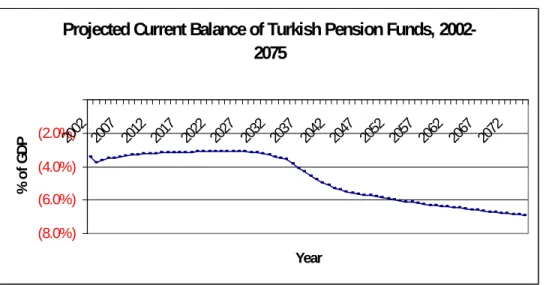
Figure 2 Deficits in the Turkish Pension System………...…………..…..26
Figure 3 Pension Equity within a Cohort of Women………... …..29
Figure 4 APEX Models of Pensions System……….……..………... ..…31
Table 1 Distribution of Beneficiaries of Federal Public Expenditures on Pensions in March, 2002………...……..33
I.
Introduction
Pension systems are designed to provide an income to those individuals who suffer a loss in earnings capacity through advanced age, the experience of a disability, or the death of a wage earner in the family. While, in some cases, the systems are designed to facilitate direct transfers from the government to these particular target groups and may be evaluated as such, in most cases, the emphasis is on providing a mechanism whereby the individual might insure himself against the loss of future earnings.
Why are pension systems needed? In most traditional societies, families or communities care for individuals who reach old age, become disabled, or suffer the death of a wage earner. However, even in these instances, there are always individuals who do not have children to care for them or whose communities and families are too poor to supply adequate care or are otherwise unable or unwilling to supply care. As societies modernize and people move from the communities in which they have been raised, community and family ties weaken and leave the elderly and disabled without an adequate safety net. Individuals may try to save, but, in the absence of secure financial markets, savings often take the form of real estate, livestock, or jewelry, all of which suffer from fluctuations in price and potential misfortunes due to disease, theft, or war. For these reasons, the government often takes on the role of making some type of pension system available.
Even in developed countries, in which reasonably secure financial markets exist, governments frequently either support pensions directly or mandate the participation in pension plans furnished by employers or private pension providers. Two reasons are commonly cited for government involvement in old-age pension systems either as direct provider or as regulator and mandator. First, workers may suffer from “myopia” and not think about old age when they are young and healthy. By the time they begin to worry about old age, it may be too late for them to take adequate steps to provide for themselves. Second, workers may incur “moral hazard” by consuming as much as possible when young, with the expectation that society will care for them when they are old. The only way that governments can limit the costs of caring for the elderly is to require participation in a pension plan for those individuals who can afford it and then limit direct government transfers to those people who were too poor to be able to save during their working years.
What are the objectives of a pension system? First, a pension system tries to reduce poverty among the elderly. Second, a pension system tries to smooth consumption between the working years and the retirement years, such that an individual does not suffer a huge drop in living standards when old age or disability reduces his earning ability.1 While the first objective can be evaluated much like the objective of any other social program, the second is considerably different. In order for the second objective to be met, those people who earn more and consume more during their working years should continue to receive more and consume more during their retirement years. This feature makes pension systems unlike virtually all other forms of government expenditure. In the case of education spending, for example, ideally, there should not be a disparity in spending per pupil based on the income level of the pupil, or, if there is, the government should focus its spending on poorer pupils, with the rationale that government spending is meant to complement private spending on
1In fact, the International Labour Organization endorses a minimum standard of 40 percent of an individual’s wage for
30 years of work. While the definition of an individual’s wage is somewhat vague, it is clear that the standard is relative to some measure of one’s own wage, not a minimum poverty level.
goods such as education. A similar argument could be made for health spending or spending on roads or electricity. Ideally, the government’s spending should benefit all members of society equally or be targeted toward lower-income individuals.2
While the first pension-system objective, that of poverty reduction, may be financed through general revenues, consumption smoothing is typically financed by contributions from workers. Usually, workers make contributions based on their incomes and expect to receive pensions that are also based on their incomes.
However, the financing of pension systems through contributions that are calculated based on wages introduces a new set of problems from the point of view of poverty and social impact. It becomes close to impossible to collect and record contributions from workers who are not part of the formal sector. Determining income for groups such as farmers and the self-employed is difficult. Even in the United States, where the highly feared tax authorities collect social security contributions, compliance among the self-employed, excluding household employees, is estimated at less than 50 percent, while it stands at 96 percent for the rest of the population. The “informalization” of workers allows employers to avoid not only employment-related contributions and income taxes, but also compliance with unduly difficult labor regulations and standards. As a result, many workers in World Bank client countries are not covered under contributory pension systems.
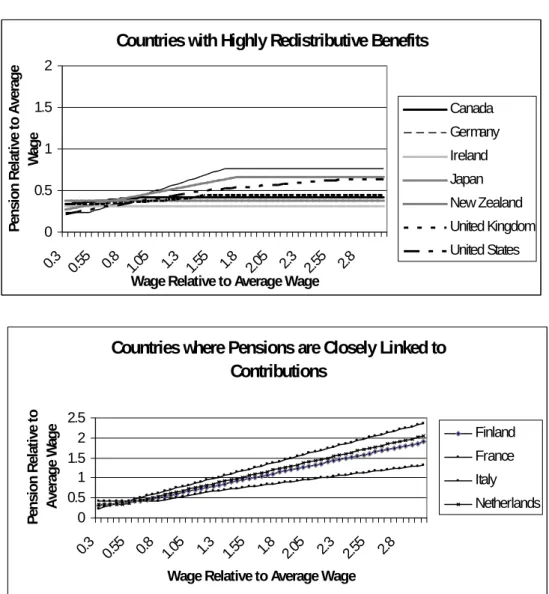
Neither one of the two pension-system objectives—neither poverty reduction nor consumption smoothing—is necessarily to be preferred over the other; they simply represent separate societal priorities; countries place different emphases on these two objectives. Some countries, such as Australia, New Zealand, and, to a lesser extent, the United States, focus on poverty reduction more than consumption smoothing. New Zealand offers a flat pension, unrelated to previous income, to all individuals of a certain age, while Australia offers a means-tested pension that provides some level of benefit to more than 75 percent of the elderly. But, even within contributory schemes, such as the one in the United States, a progressive benefit formula can result in a greater focus on poverty reduction relative to consumption smoothing. While the average pension paid is around 40 percent of the relevant wages, high-income individuals receive as little as 20 percent of their wage level in the United States, while high-income individuals receive 100 percent of their previous wage. By contrast, countries such as Austria and Sweden strongly link contributions and benefits and achieve much higher rates of consumption smoothing.
Moreover, some countries choose to distinguish between these objectives by pursuing them using separate instruments. Social assistance programs, either part of overall programs or programs especially targeted on the elderly, may account for the bulk of poverty reduction, while the contributory system focuses on consumption smoothing. The French and German systems would fall in this category, wherein the pension system itself is not expected to redistribute toward the poor, and old-age poverty relief is provided by other instruments. Other countries try to achieve both objectives using only one instrument. But trying to achieve both objectives through one instrument may create conflicts. Consumption smoothing implies that benefits should be tightly linked to contributions and therefore to income, with redistribution occurring across an individual’s lifetime, but not between individuals. On the other hand, poverty reduction among the elderly clearly involves providing resources for the elderly poor. Within a contributory system, this usually implies that the resources come from the other contributors. But redistributing within the program
weakens the link between contributions and benefits and can have a severely negative impact on the incentives for contribution compliance. Of course, mandating participation in a pension plan oriented toward consumption smoothing may prevent some myopic individuals from finding themselves in poverty in old age; so, the two objectives are interrelated up to a certain income level. Given the possibility that more than one instrument may be used for old-age support, the pension system should not be viewed in isolation. The pension system may be merely one of many elements comprising the social safety net for elderly individuals. Each individual element need not incorporate the same level of redistribution since the pension system’s objectives extend beyond redistribution. Therefore, it might be sensible to review all programs affecting the elderly population jointly rather than reviewing each individually. However, the task of this chapter is to look specifically at these issues with respect to pension programs and not at overall programs for the elderly even in the cases where social assistance programs are applicable to the elderly.
The remainder of the chapter is organized as follows. The next section reviews mechanisms for providing support for the elderly and disabled. The subsequent section considers redistributive and social elements within these mechanisms. The rationale for pension system reforms is examined thereafter. The types of pension system reform and the distributional and social consequences of each type are then explored. The impact of pension reform on stakeholders is assessed in the penultimate section. Finally, a checklist and toolbox for analyzing the poverty and social impacts of pension reforms are presented.
II.
Support Mechanisms for the Elderly and Disabled
II.1 Contributory systems
The primary method for providing old-age support is contributory pension systems. Contributory pension systems are frequently described according to either the relevant financing mechanism or the benefit structure. Financing mechanisms are generally of two types: pay as you go or fully funded mechanisms. In pay as you go, current workers make contributions based on their current earnings. These contributions are immediately used to pay benefits for current recipients; the worker who is making the contribution only receives a promise from the government that it will pay benefits related to these contributions when the worker becomes eligible for a pension.i In what is known as fully funded pension systems, worker contributions are invested, rather than spent, and the investment earnings are an integral part of the benefits eventually paid. These investments can be managed by a monopolistic public agency or competitively, with participation by the private sector. Benefit mechanisms are also of two types: defined-benefit mechanisms and defined-contribution mechanisms. Under the defined-benefit mechanism, the pension received is usually a function of income expressed as a percentage of income per year of contribution; it may also be defined in some other manner. The distinction is that the benefit provided is specified in some way. Should financing fall short, someone, typically either the government in a public plan or the employer in an employer-based plan, has the responsibility to provide the pension. Alternatively, under the defined-contribution mechanism, the defined-contribution is specified as a percentage of wages, and rates are specified for employees, employers, and, potentially, the government, but the final pension is determined by the amount in one’s pension account at the time of retirement, which includes both
the contributions and the investment earnings on those contributions. Under this system, no specific benefit is promised; the pension is completely dependent on the money in the account, and there is no need for a guarantor of last resort.3 Financial assets fully back the promise made in this case, which is simply a return of the money in the account.
In a strictly stylized world, the risk characteristics of these two types of pension systems would be considerably different, with governments or employers bearing the risk in defined-benefit systems, and workers bearing the risk in defined-contribution systems. However, in practice, these distinctions are quite blurred. The parameters in defined-benefit systems can change, substantially altering the nature of the benefit promised. Many Bank client countries find themselves unable to pay pensions on a timely basis, which imposes considerable risks on retirees during their most vulnerable years. Most defined-contribution systems, on the other hand, carry government guarantees of minimum pensions or are only one component in a broader pension strategy, whereby the other components mitigate the risks to the worker that are attributable to the defined-contribution arrangement.
Typically, defined-benefit systems are of the pay as you go sort, and defined-contribution systems are of the fully funded sort. It is possible for a defined-benefit system to be fully funded because the guarantor maintains sufficient financial assets to cover the liabilities in the plan. However, should investment returns fall in any particular year, the employer has the obligation to offset the lower returns by increasing his contribution. A hybrid defined-contribution, pay as you go system has been pioneered in the last decade that is called notional accounts. The key feature is that contributions are recorded and earn “notional” interest rates. The combination of contributions and notional interest earnings determine the pension benefit, much as in conventional defined-contribution systems. However, because the system is financed on a pay as you go basis and because there are no financial assets behind the accounts, the government must define the interest rate it will pay on the contributions. The system may run deficits, unlike in the case of a true defined-contribution system, and, if it does, the government is obliged to cover the deficits. As a result, the notional account system is not a true defined-contribution system, since, by defining both the contribution and the interest rate paid, the government has implicitly defined the benefits.
II.2. Noncontributory pension systems
Even where a contributory system exists, there will always be people who do not participate in the labor markets covered by the social security system, who do not participate sufficiently regularly to qualify for benefits, or whose low lifetime earnings leave them with even lower pension benefits. This is particularly true for the many informal sector workers in numerous Bank client countries. And, in many cases, groups of workers, such as the self-employed or farmers, are not covered by the national pension system because it is considered too difficult to assess income and collect contributions from these groups.
All of these groups are at risk of poverty in old age if they do not qualify for a contributory pension or if they qualify only for a small pension. As a result, most high- and middle-income countries with contributory systems also offer minimal benefits for those people who do not qualify. This benefit can take the form of a demogrant, whereby everyone above a certain age receives the benefit, on the
basis of a residency or citizenship requirement, as in countries as varied as Nepal and New Zealand, or it can be means tested, such that only those elderly with incomes below a certain level are eligible to receive the benefit. A few countries, such as New Zealand and, until 15 years ago, Australia, choose to offer only this type of demogrant or means-tested benefit in lieu of a contributory system. The benefit in most cases is financed directly through general tax revenues. Both types of noncontributory systems tend to reduce poverty among the elderly. Obviously, the means-tested benefit is more well targeted toward the poor elderly, but, given the costs and complications involved with means testing, the potential changes to incentives, and the behavior of individuals trying to meet the qualifications, the demogrant approach may be a better solution in some countries. Some countries institute a demogrant, but then use other mechanisms to target resources more effectively away from higher-income individuals and toward lower-income individuals. New Zealand, for example, uses its progressive income tax to reduce the value of the demogrant to higher-income individuals. Similarly, some lower-income countries, such as Georgia and Nepal, ostensibly offer a demogrant, but the amount is so low that higher-income individuals are not interested in collecting it, and the systems are, to this extent, engaging in affluence testing rather than means testing.
Since the purpose of the noncontributory pension is clearly poverty reduction, with no attempt at consumption smoothing, some countries choose to integrate this social assistance for the elderly with the social assistance systems for the nonelderly, resulting in one national social assistance system. From a targeting perspective, such integration is ideal since resources flow to those most in need, regardless of age. However, from an administrative and social point of view, there may be arguments for separating the programs. Goals such as inducing working-age individuals to reenter the workforce are clearly not an issue in terms of the elderly; annual means testing may be necessary for working-age individuals whose situation can change dramatically from one year to the next, but less necessary for elderly individuals living alone or as part of a couple since their income situation is unlikely to improve in the future. Finally, elderly people who were not poor during their working lifetime may feel especially stigmatized because they now must seek social assistance.
III.
The Redistributive and Social Impact of Pension Systems
Any social program that may involve expenditures in double-digit percentages of gross domestic product will have substantial impact on the economy in which it exists. Pension systems can affect poverty among the elderly; they can affect relationships between younger and elder cohorts, as well as family living arrangements; they also have a substantial impact on labor markets and employment, particularly if they are financed through contributory systems; they can impact national savings and the development of financial markets; they can affect the composition of government spending by squeezing out other types of spending; they can even affect the overall level of government spending. A huge body of literature exists on each one of these issues and would be impossible to summarize here.4 However, it should be noted that much of this literature is derived from case studies and data on the United States and other countries of the Organisation for Economic Co-operation and Development. It is questionable whether all these results will apply equally across the board in the Bank’s client countries.
4The literature is extensive and includes Corsetti and Schmidt-Hebbel (1997); Diamond and Hausman (1984); Disney
This chapter focuses on the direct distributive impact of the pension system, ignoring secondary impacts arising through the economy. The distributive impact will depend on the type of pension system existing in the country.
III. 1 The defined-benefit, pay as you go system
While the goal of a defined-benefit, pay as you go system is ostensibly to base benefits on contributions, thereby creating an institution that will allow individuals to smooth consumption over their lifetimes in the absence of a secure market institution, this type of pension scheme always has distributional implications within generations and across generations, some intentional, and others unintentional. Countries frequently try both to redistribute toward the poor and to provide a savings mechanism within these systems. However, there is a natural tension between redistribution in a contributory system and the provision to individuals of incentives to contribute by tying the benefits to contributions. There are also limits to how much true redistribution can be accomplished within a contributory system since the majority of redistribution occurs from one group of contributors to another. If coverage is low, both groups may be receiving relatively similar incomes.
III.1.1 Intentional redistribution
Intentional redistribution in a defined-benefit scheme across a cohort takes place through at least three mechanisms. Most defined-benefit systems have a minimum pension, but individuals must contribute for a set period of time before they may receive this minimum pension. The minimum pension almost always involves some redistribution. Because of the minimum pension, minimum-wage workers who contribute for the minimum contribution period almost always receive higher pensions than the pensions they would have earned based on the formula. This, of course, leaves open the option that workers may game the system by contributing only enough to qualify for the minimum pension, but the poverty-reduction objectives of pension systems have usually overridden these concerns. The higher the level of the minimum pension, the more the incentive issue begins to override the poverty-reduction issue.
A second mechanism for redistribution results from a possibly progressive benefits formula. The United States is one of a few countries explicitly offering a benefits formula that provides a declining replacement rate as income goes up. Related to this approach, but usually less progressive, are schemes offering separate replacement rates for different groups of workers, usually by crediting more years of service per year of contribution. In Serbia for example, women are given 15 percent more years of service credit over and above their years of contribution. In other countries, this special credit is given to particular occupations such as teachers or miners.
A third mechanism for explicit redistribution, more common than the second, is the front-loaded
benefit formula, whereby the first 10-15 years of service are awarded higher benefit rates than are
subsequent years. The thinking is that lower-income workers are more likely to interrupt their working careers, particularly in the formal sector, and are therefore unlikely to accumulate significant amounts of time in formal sector service. If the early years of contribution are rewarded more heavily, these workers will still be able to retire with reasonable pensions. As with minimum pensions, this design feature raises incentive issues; if people can earn reasonable pensions with only 10-15 years of contribution, why should they contribute throughout their careers. Nevertheless, countries continue to use this mechanism in the name of redistribution.
III.1.2 Unintentional redistribution
In addition to intentional redistribution, there are common design features within defined-benefit systems that have unintentional distributive consequences. One of the primary features is the
averaging period for wages used to calculate the pensions. Pensions are expressed as a percentage of
wages, but the wages may be defined as the last salary earned, as the average salary over the last five years, or as average wages over any period up to the lifetime average wage. If the averaging period is any period less than full career, then there is a redistribution involved. Individuals pay contributions on wages throughout their careers; if the pensions are not linked to the average career wage, then the pensions are not linked to the average contributions either. In addition, there is a systematic income-based bias to the extent that higher-income and more well educated workers generally experience more rapid wage growth, particularly toward the ends of their careers. Thus, the shorter the averaging period, the more redistribution there is in the system from future workers to current pensioners and the greater the redistribution toward higher-income pensioners who earn the highest wages at the ends of their careers.
A second issue is the life-expectancy differential between income classes. Higher-income individuals tend to live longer. This differential tends to make the defined-benefit scheme regressive, given that higher-income individuals will receive benefits for a longer period because of their longer life expectancy, resulting in a higher total benefit paid even if the monthly pension is identical.
A final issue is the life-expectancy differential between men and women. Defined-benefit schemes do not distinguish between the benefit rates paid to men and those paid to women even though women tend to receive the benefits for more years because of their longer life expectancy. As a result, there is an automatic redistribution from men to women implicit in the defined-benefit scheme. The common practice of allowing women to retire earlier with the same benefits only intensifies this redistribution.5
III.1.3 Intergenerational distribution
While the distributional consequences usually involve intracohort redistributions, the redistribution impact in defined-benefit schemes is larger between cohorts. Rarely are the schemes costed out in such a way that they are actuarially fair. Usually, a contribution rate is chosen; a benefit rate is chosen, and eligibility conditions are chosen. These parameters are almost never actuarially consistent. Since the schemes are normally set up when the country is young, the parameters are often selected to maintain a balance between revenues and expenditures in the first years, with perhaps a small accumulated surplus. Because, at the start, many contributors are young, and few elderly are collecting benefits, contribution rates usually start low, and benefits are fairly generous. As a result, from the beginning, contributions rarely cover the future benefits to be paid out to these same contributors; the expectation is that the contributions of future generations will be used to pay the benefits of current workers. As long as population continues to grow rapidly, the scheme is viable, as all pyramid schemes would be. But, when the population of paying cohorts starts to
5One might argue that this redistribution is corrected by the fact that men frequently leave widows and other survivors,
while women do not. The pension to the man and his survivor is roughly equivalent in duration or may even be larger than the pension given to the longer-lived woman, who typically does not leave a survivor.
stabilize in size or when it falls, huge deficits appear. Attempts to fix the fiscal deficits by raising contribution rates and reducing benefits exacerbate the intercohort redistribution problems. Younger cohorts are asked to pay higher and higher contributions and receive fewer benefits; they are often required to postpone retirement, which also results in fewer benefits paid in total.
While there may be some justification for transferring income from one cohort to another, especially when particular cohorts are hard hit by wars, recessions, or a transition to a market economy, the redistribution system initiated under defined-benefit systems does not involve only a one-time transfer, but will result in undesirable and unexpected redistributions over time.
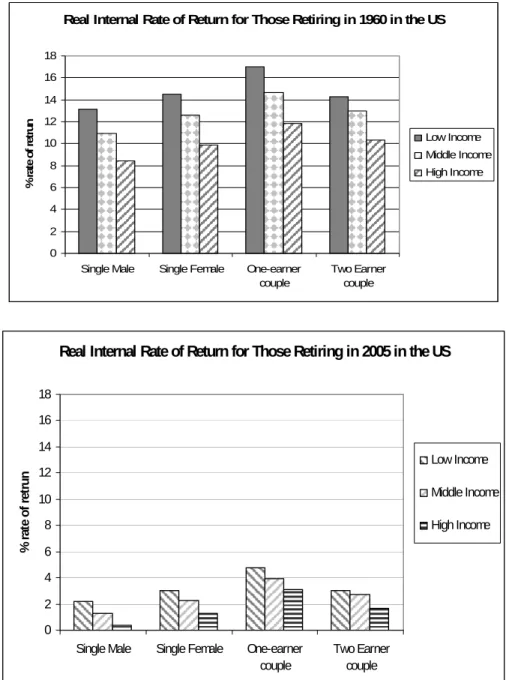
Even if the system were actuarially balanced at its introduction, changes in life expectancy and fertility will require continuous adjustments to maintain actuarial balance.6 In countries where analyses have been carried out, the intercohort redistributions substantially overwhelm the intracohort redistribution, as shown in Figure 1 for the United States. Both panels in the figure show the internal rate of return in the social security system, the implicit rate of return that contributions made to the system would receive given the benefits that are provided by the system for two different cohorts, those retiring in 1960 and those retiring in 2005. While internal rates of return are higher for lower-income earners than they are for higher-income earners, the differences are not huge within the cohort of retirees in any particular year. The differences between those retiring in 1960, shown in the left-hand panel, and those retiring in 2005, shown in the right-hand panel, are far more pronounced than the differences within the cohort. Furthermore, the analysis represented in the figure does not take into account the mortality differences between low-income and high-income individuals, and assumes that all individuals have the same life expectancy. When mortality differentials are included, the intracohort distribution almost disappears. And these results apply to the US system, which is designed to be highly redistributive, with marginal benefit rates declining with income. Most defined-benefit systems do not incorporate even this element of redistribution and thus are unlikely to be positively redistributive. A more complete analysis of the US system can be found in Steuerle and Bakija (1994).
6It should be noted that younger cohorts can be expected to live longer and therefore receive more benefits than their
parents’ generation, which might provide some compensation for having to pay higher contribution rates or for receiving lower benefits, but there is usually a lag between the change in the underlying demographics and the change in the policies, so that there is no automatic linkage to maintaining actuarial balance. Some cohorts receive net transfers; others lose.
Figure 1 Comparison of Internal Rates of Return in a Social Security System over Time, United States, 1960 and 2005
Real Internal Rate of Return for Those Retiring in 1960 in the US
0 2 4 6 8 10 12 14 16 18
Single Male Single Female One-earner couple Two Earner couple % rat e o f re tru n Low Income Middle Income High Income
Real Internal Rate of Return for Those Retiring in 2005 in the US
0 2 4 6 8 10 12 14 16 18
Single Male Single Female One-earner
couple Two Earner couple % ra te o f re tru n Low Income Middle Income High Income
IV.
The defined-contribution system
Little redistribution takes place in a pure defined-contribution system by contrast. Individuals at retirement get back their own contributions with the investment interest that these contributions have earned.
However, most systems are not pure defined-contribution systems; they contain an element of redistribution. Many systems, such as those in Chile and Mexico, provide a minimum pension guarantee to workers, such that, after a given period of contribution, a minimum pension will be provided by the government. Other systems, such as those in Malaysia and Singapore, provide a guaranteed minimum rate of return, which can be redistributive depending on the level. If the minimum rate of return is high, it obviously redistributes from the guarantor, usually the government, to pensioners, but without regard to the income level of the pensioner. On the other hand, there are a few cases where the rate of return is virtually fixed ex ante, and, if the fund can earn better rates of return, then individuals lose by belonging to the fund, but, again, the loss is not dependent on income level. A second redistributive element arises through the provision of annuities. An annuity is one mechanism for converting an account balance into a stream of periodic payments. Typically the individual purchases an annuity from a life insurance company which guarantees monthly payments as long as the individual or spouse lives. The payments can be adjusted upwards periodically, often with inflation. As with defined-benefit pensions, if individuals are forced to buy annuities, higher-income individuals who are typically longer-lived gain at the expense of lower-higher-income, shorter-lived individuals, since the annuities are not priced differently for different income groups. Most countries (aside from those in Latin America) also require the use of unisex annuities when annuities are chosen. In unisex annuities, both men and women are in the same annuity pool, with no price differential. As with defined-benefit plans, unisex annuities result in a transfer toward women, who are, on average, longer lived than men.
Many countries do not require annuitization and set up programmed withdrawals as a benefit option, whereby an individual withdraws an amount from his account each month that is specified on an annual basis depending on the rate of return that the fund received on its investment earnings and the expected duration of the retirement. Upon the death of the individual, the balance in the individual’s account is inheritable by whomsoever the individual specifies. Under this approach, individuals take a risk that they will outlive the money in their accounts since they are not guaranteed payments for life, as under an annuity, but shorter-lived individuals have the option of leaving an inheritance rather than allowing the account to revert to the insurance company, which uses the money to cross-subsidize longer-lived individuals. Since lower-income individuals tend to die sooner than do higher-income individuals, the option of programmed withdrawals reduces the redistribution toward the rich.
A third, more indirect potential distributive element is linked to the investment policy of the pension fund. In some countries, assets, particularly when they are publicly managed, are invested largely in housing or in programs perceived to be socially beneficial (at the expense of lower rates of return to workers). In this case, there is a transfer from workers to the beneficiaries of the investment, and it is usually not a progressive transfer since it rewards those who are politically powerful and not those who are poor.
V.
Voluntary or supplemental pensions
In defined-benefit and defined-contribution pensions, governments typically impose ceilings on the income that is subject to contributions, and the same ceiling is typically used in calculating benefits. The thinking is that, while governments want to promote poverty reduction and consumption smoothing among the elderly, they are generally not concerned with whether the super rich of the world have sufficiently smoothed their incomes. Since all requirements reduce individual freedom, a ceiling on the contribution requirement limits the impact to only what is necessary to prevent old age poverty and overcome myopia. The ceiling is often set at three to five times the average wage. Thus, the mandatory systems do not provide substantial consumption smoothing among higher-income individuals.
But governments would still like to provide incentives so that higher-income individuals save for consumption smoothing purposes. Governments do this by offering tax advantages for voluntary or supplemental savings. Typically, governments do not tax contributions made to voluntary pension systems or the returns the contributions earn; they tax only the benefits when these are received.7 The policy represents an attempt by the governments to encourage long-term savings, which can then be invested and help stimulate growth in the economy. By and large, those people who take advantage of these schemes are higher-income individuals, resulting in tax reductions for these individuals. From a distributional standpoint, the policy can be worthwhile if the growth arising from the increased long-term savings helps the poor. However, the evidence generally suggests that higher-income individuals do not increase their savings in order to access these tax-advantaged retirement funds, but merely shift their savings from one instrument to another. In this case, the policy merely lowers the taxes on the rich without substantial improvements in growth or in lowering poverty. Thus, some countries impose limits on the amount of income that can earn tax advantages even if the income is saved through the pension system.
VI. Rationale for Pension System Reform
The primary goal of a pension system should be to provide adequate, affordable, sustainable, and robust retirement income.8 Most Bank-sponsored reforms attempt to achieve all these goals.
However, the overwhelming reason for the Bank’s involvement in pension reform issues is the fiscal implications, largely of defined-benefit systems, although sometimes also of social assistance benefits for the elderly. Since the systems are rarely actuarially designed from the outset, it is not surprising that, with the aging of populations, changes in the contributing labor force, poor system design, and poor administration, the systems begin to run deficits. Deficits within the pension system can be huge relative to overall gross domestic product and the overall deficits of a country. In Brazil in the late 1990s, for example, three-fourths of the government fiscal deficit of 8 percent of gross domestic product was directly attributable to social security. In countries such as Serbia, the fiscal deficit of the pension funds runs to 7 percent of gross domestic product. Such large deficits clearly create a drag on the entire economy.
7Sometimes, governments tax contributions and make the pensions nontaxable. In a few cases, both contributions and
benefits are exempt from tax. A systematic review of tax treatment can be found in Whitehouse (1999).
These large deficits have huge distributional implications, particularly in countries with low labor-force coverage. If only 5-10 percent of the labor labor-force is part of the pension system, and the system is running deficits that need to be financed from general revenue, then money from all individuals who contribute to the general revenue is being transferred to the 5-10 percent of the population that is covered by the pension system, making even a progressively designed system potentially regressive. In the majority of Bank client countries, coverage among the working-age population is below 50 percent; deficits in these pension systems clearly lead to regressive outcomes. Given the already huge intergenerational transfers that occur in these defined-benefit systems, the low coverage, combined with the financing of deficits from general revenue, pushes the cost of providing pensions not only on to younger cohorts covered under the system, but on to younger cohorts who are not even covered by the system, making the impact more regressive. As a result, much of the focus of pension reform at the World Bank is on reducing the fiscal deficits so that the pension system, if limited in coverage, is financed through contributions from that same limited population rather than through transfers from the broader population.9
Pension reform efforts have also attempted to increase coverage as a means of providing old-age security to a broader segment of the population, but most attempts at increasing coverage have not been successful. The one positive preliminary result occurred in Mexico, where the government provides a flat contribution per day of worker contribution to the defined-contribution system, which amounts to approximately 5.5 percent of the minimum wage. The government contribution doubles the contributions going to the pension funds for low-income workers, which increases the incentive for low-income workers to contribute. Since this flat government contribution has been implemented, coverage among the lower three deciles of the income distribution has expanded. But, because there are few successful examples, governments are turning to social assistance pensions as a means of providing support to elderly people who are not covered under contributory social security programs, rather than seeking to expand coverage. These social assistance programs are, in some cases, embedded within general social assistance, while, in other cases, they exist as stand-alone programs or are tied to the contributory pension system.
Countries running defined-contribution systems that might be earning poor investment returns also encounter trouble if substantial numbers of the elderly fall below the poverty line. Appropriate supervision and regulation of this type of pension fund and of voluntary pension systems need to be provided, along with flexibility in the investment of assets, so that the investment funds supply sufficient returns to workers making contributions. In some cases, governments see the pension fund reserves as a ready source of financing for whatever politically motivated investments they might desire. However, there is a trade-off between providing workers reasonable returns on their contributions and getting cheap financing for what might be socially laudable investment projects. Improvements in the functioning of capital markets may also be required before pension funds can provide adequate old-age support.
9It is certainly possible that the group of people covered by the pension system is identical to the group of people paying
taxes, suggesting no increased regressivity from pension deficits. However, with the introduction of broad-ranging value added taxes in a large number of countries, it is more likely that the tax base is broader than the coverage of the pension system.
VII. Types of Reform and the Distributional Consequences
Since the primary reason, by far, for pension reforms has been to address the fiscal impact, the reforms have focused largely on improving fiscal deficits first. From a distributional standpoint, this is an appropriate focus given the incomplete coverage and the potential for regressive distribution from noncovered lower-income groups to covered higher-income groups. Any reform that lowers the fiscal deficit will be beneficial from a distributive perspective.
Pension reforms can be grouped into at least four different categories: parametric reforms which involve changes in parameters of current pension systems, systemic reforms which involve introducing a new type of pension system to replace or complement the existing system, regulatory reforms which involve changes in the investment regulations of funds which have investible assets, and administrative reforms.
VII.1 Parametric reforms
Pension systems rely on three subgroups of parameters: contribution parameters, benefit parameters, and eligibility conditions for receiving pensions. Many parametric reforms involve changes in all three subgroups. Each of these parameters has a distributive impact within the group of contributors and beneficiaries, as do the reforms. These reforms also affect the fiscal sustainability of the pension system and the fiscal sustainability affects the redistribution from outside the pension system to the contributors and beneficiaries of the pension system.
Contribution-revenue parameters apply to both defined benefit and defined contribution systems, as well as voluntary systems. However, the impact on fiscal sustainability primarily occurs in defined benefit systems. Parameters include the following:
VII.1.1 Contribution rates.
Raising contribution rates clearly lowers the take-home salaries of workers and the net benefits that workers receive from the pension system. Rising labor costs may reduce or cause stagnation in the level of employment in the formal sector. These have a negative impact on workers, but may be necessary to maintain fiscal balance. Contribution rates above 15 percent are likely to have negative labor-market impact.
VII.1.2 Wages that are subject to contributions.
Raising the ceiling of the wages that are subject to contributions, another common measure, tends to be positively distributive in that higher-salaried workers pay more of their incomes into the pension fund, although, in the longer run, they will usually receive higher benefits, too. Thus, while there may be a positive redistributive effect in the short run, there will be little impact in the long run as benefits for higher-income individuals rise, particularly if the higher long-run benefits are not fiscally sustainable.
Benefit parameters include the following:
• accrual rate (the rate of benefit per year of service).
Lowering the accrual rate clearly makes pensioners worse off and lowers their net rate of return from the system, but it helps avoid transfers from younger cohorts and those people who are not covered by the system when the system runs deficits.
• averaging period for wages.
The averaging period for wages should ideally be the full career, which best aligns the average contributions paid with the average benefits received. A shift toward full-career wages tends to be progressive since high-income workers gain if pensions are based on the final full year of salary.
• revalorization of wages.
Wages should be revalued according to average wage growth in order to provide incentives for workers to contribute during their early years. This variable could be thought of as a providing a rate of return on contributions. Revalorization of wages to average wage growth are equivalent to giving workers a rate of return equal to wage growth on their contributions. Lower revalorization theoretically could lead to better fiscal sustainability, but usually results in increased evasion since workers earn low rates of return on early contribution and thus ends up undermining fiscal sustainability. This variable is among the variables that are least understood by individuals who are not pension professionals, but it has a huge impact on the actual benefits delivered by the pension system.
• postretirement indexation of pensions.
The postretirement indexation of pensions should ideally be undertaken relative to inflation so as to protect the purchasing power of pensions during the retirement years. Lack of indexation results in the older elderly receiving substantially lower pensions and less protection than the younger elderly who might be able to work. Women, who generally live longer than men, are also disproportionately disadvantaged by a lack of indexation since their real pensions will fall over a greater number of years. Indexation to wage growth is essentially unaffordable for most countries and not justifiable from the perspective that the retiree does not need to increase his consumption over the course of his retirement, assuming that health expenditures are otherwise covered, regardless of how average wages change with respect to the pension. Postretirement indexation of pensions is an issue in both defined-benefit and defined-contribution systems as well as in noncontributory benefits.
• minimum pension.
The level of the minimum pension is set too high in most countries, sometimes as high as or higher than the minimum wage. Given that minimum-wage workers make contributions from their wages, have families to support, and pay income taxes, while pensioners do not make contributions, have fewer family members to support, and usually pay no or fewer income taxes, it does not make sense to give pensioners more than the net wage they earned while they were working. Lowering the minimum pension might put some pensioners into poverty, but this has to be balanced against the goal of
limiting out-of-system transfers and the goal of tying contributions to benefits in order to encourage individuals to contribute. The minimum pension affects both defined-benefit and defined-contribution systems as well as noncontributory defined-benefits, which are a form of minimum pension.
Eligibility conditions include the following:
• retirement age.
Ideally, the age of retirement should rise as life expectancy and the ability to work of the older population increase, restricting pension benefits to those people who are considered too old to work. An average of 15 years in retirement should be the goal of the pension system. In most cases, raising the age of retirement may reduce the number of lower-income individuals who collect pensions since their life expectancy is generally lower. However, benefits would be available to the survivors, who may be more numerous than the survivors of higher-income individuals, and the difference in life expectancy within the covered population, which is, itself, only the higher-income classes in the country, may not be that great. Equalizing retirement ages for men and women tends to be pro-women as it substantially raises the pension levels for most women. Retirement age changes affect both defined-benefit and defined-contribution systems as well as noncontributory benefits and voluntary pension systems. In defined-benefit systems and noncontributory pensions, retirement age changes improve fiscal sustainability, while in the case of defined-contribution systems and voluntary systems, they raise the level of pensions.
• years of service required before receiving a pension.
Raising the years of service required before an individual may receive a full pension may similarly discriminate against lower-income individuals, who generally have shorter eligible working careers, but, again, the differences within the covered population may not be that great, and providing prorated pensions for shorter working careers may address this issue sufficiently.
• means testing.
In the case of noncontributory benefits, countries sometimes introduce means-testing in order to reduce the fiscal costs or change the threshold for pension eligibility. Both of these measures reduce the numbers of people eligible for pensions, but balances this with lower fiscal costs, requiring fewer transfers from the working generations to the elderly.
A special note is warranted about reforms that represent a step toward a system of notional accounts or a point system. In some respects, these systems represent a new paradigm and therefore should be dealt with through systemic reforms. However, in other respects, they still involve liabilities for the government and can be mimicked through a combination of parametric reforms. In both systems, contributions are collected and recorded. In notional accounts, the actual contribution is recorded, and a notional interest rate is earned on the contributions. In the point system, individuals receive pension points each year depending on how long they contributed and on the basis of which wage, with the points then converted into a financial value at retirement. An implicit notional interest rate will equate the two, as will some combination of conventional defined-benefit
parameters. Both systems tend to favor lifetime average income as the basis for determining pensions and closely link benefits and contributions, with the same distributional consequences as noted above. Notional accounts have the added feature that pensions are automatically reduced as life expectancy rises, suggesting that, as life expectancy increases, a larger and larger share of pensioners will receive only the minimum pension if they do not postpone retirement. Most other parameters of these systems are identical to those in conventional defined-benefit systems and their distributional impact is exactly the same.
In almost all cases, parametric reforms particularly in defined-benefit systems will reduce the level of pensions and thus potentially put more elderly in poverty or require greater contributions from workers, also putting people at risk of poverty. These measures are nonetheless essential for maintaining the affordability and sustainability of the pension system. Without these measures, the pension system will pass its fiscal stress on to other sectors (squeezing out spending in other areas), encourage the use of inflation to cover deficit spending, or begin to accumulate arrears. None of these possibilities has positive social consequences. The accumulation of arrears is particularly detrimental since individuals who have reached old age and suddenly find themselves without pension benefits have few alternative means of support. Sustainability becomes even more of a social issue when coverage under the pension system is not complete and fiscal resources must be drawn from a broader population to cover pensions for the few, usually the higher-income few. Furthermore, many common reform measures improve the distributional consequences of pension systems and often remedy unintentional negative effects. They may make pension systems fairer by more directly linking pensions to the contributions paid, and the perception of greater fairness can improve contribution compliance.
VII.2 Systemic reforms
Many countries in the past 15 years have shifted from reliance on pure defined-benefit systems to defined-contribution systems or to a mixed system with both a defined-benefit component and a defined-contribution component. In the long run, the defined-contribution systems involve less redistribution, both positive and negative, than was inherent in the defined-benefit systems. They are also more able to contain the costs of the pension system, so that those individuals who pay will ultimately be beneficiaries of the system, and to reinstate the initial aim of smoothing consumption among individuals during their lifetimes. Since much of the redistribution within defined-benefit systems was often regressive, these changes should be positive. However, pure defined-contribution systems that are not accompanied by a safety net do not prevent the elderly, even those elderly who were middle income during their working years, from falling into poverty. Governments must provide a safety net, such as a minimum-pension guarantee, to protect workers against excessive fluctuations in capital markets. Governments that use both a defined-benefit component and a defined-contribution component normally allow the defined-benefit component to function as the safety net. However, the minimum-pension guarantee reintroduces an element of redistribution into the system, usually from the whole population to the covered minority, and breaks the link between contributions and benefits. Therefore, it needs to be designed to provide protection for workers, but not to be so generous that it distorts incentives or causes large-scale redistribution.
It should be noted, nonetheless, that a shift to a funded system involves transition costs since the government must continue to pay pensions to current pensioners and acquired rights to current workers when they retire even as workers begin to put part or all of their contributions into
individual defined-contribution accounts. During this transition period, there is an increase in the regressiveness of the system because the government, through general revenue drawn from the whole population, pays pensions for the covered minority. However, this increase in regressiveness needs to be viewed as a temporary cost required to eliminate regressiveness in the system over the medium and longer term.
Other systemic changes include introduction of a noncontributory benefit which tends to be positively redistributive as people who previously had no access to pensions now are provided some benefits. Introduction of a voluntary pension system has redistributive consequences only through its tax treatment as noted above.
VII.3 Regulatory reforms to investment guidelines
Regulatory reforms rarely have direct redistributive implications. However, improvements in regulation and supervision are positive steps in ensuring that the contributions that workers and their employers make will be available to them during retirement. Regulation and supervision can insure that less financially sophisticated consumers, typically with lower incomes, are treated as fairly as those with more financial knowledge. The demand for assets from pension funds can also spur development in capital markets, and this may add stability and depth to other financial-market transactions.
VII.4 Administrative reforms
Administrative reforms focus on unifying multiple systems within a country, improving collection compliance, improving benefit service, individualizing databases, improving record keeping, and strengthening the eligibility criteria for disability, as well as aggregating contribution collection with tax collection.
The unification of systems involves a great deal more than the administrative process. Countries that have fragmented systems usually have separate benefit and contribution structures. During a unification, some groups clearly lose benefits. In a few cases, there are groups that gain benefits, but, to be affordable, the unification typically occurs at the level of the least generous scheme. Despite the presence of losing groups, not only does the unification improve the overall fiscal picture, but the defragmentation of the labor market results in a better allocation of labor and less uncertainty for all groups, which no longer have to fear the loss of pension benefits when faced with voluntary or involuntary job change.
Improving benefit service usually not only improves service, but reduces the ability of corrupt officials to take bribes to expedite payment, which the poor cannot afford, making benefits more equally available to all income groups.
While all these improvements tend to enhance fiscal sustainability and the functioning of the pension system, it should be noted that many pension systems effectively function as quasi-social-assistance agencies so that anyone bold enough to present a pension claim will eventually be paid because the pension fund does not maintain sufficient records to check whether the individual has paid contributions. To the extent that these pensions reduced poverty and were being paid to individuals who had not contributed, poverty may temporarily increase. However, in the longer run, as contribution collections rise, the pension fund may be able to reduce the contribution rate, which
would be an improvement for all workers. The government can then determine where to focus its poverty-reduction efforts most effectively rather than paying out pensions only to individuals bold enough to present false documents to the authorities.
VIII. Impact of Pension Reform on Stakeholders
Stakeholders for pension reform include, of course, pensioners themselves, workers and their union representatives, and employers, as well as government agencies administering pensions and the Ministry of Finance. Pension reform typically takes place in the context of a deficitary pension system. The remedy for the deficit invariably involves reducing benefits. Clearly, pensioners and unions are not going to be in favor of these changes. Workers also frequently oppose reforms, but this is less understandable. In many cases, the pensions they have been promised are not going to materialize or are at risk if no changes are made. The changes might cut future benefits, but they generally increase the probability that benefits will be received, such that the expected value of the benefit may even be higher than before. But persuading workers and pensioners of the benefits of the reforms, which will occur in the future, is a tough job and requires a politically powerful reform champion within government. For both pensioners and workers, reforms are usually phased in gradually so that no cohort faces an abrupt loss of benefits.
One issue that makes the reform of pension systems more difficult than the reform of other programs is the acquired rights of workers. Workers make contributions to the pension system in return for the promise of future benefits. Politically, it may be difficult to tell these same workers that the benefits they have already paid for are now going to be reduced. As a result, pension reforms usually have to be phased in slowly, with some grandfathering of existing contributors. The legal and constitutional status of these rights varies considerably. A few countries have ruled that workers who have begun work under a particular pension system with particular parameters have the right to continue working under the same parameters even if the pension laws are changed. Other countries dictate that already accumulated rights cannot be touched, but all benefits earned after the date of reform will fall under the new system. Still other countries have ruled that the government can change any parameter of the pension system at any time. Specific details of worker rights are also sometimes written into a country’s constitution, such as retirement age provisions in Brazil or the method of pension indexation in Uruguay.
Pension agencies may be either supportive of reforms or unsupportive, depending on how the reforms affect them. The unification of systems generally results in the shutting down of some administrative systems, with a potential loss of jobs or prestige. Similarly, transferring responsibility for contribution collection to tax authorities may result in a loss or reallocation of jobs. Breaking the monopoly power of public pension systems by introducing private pension funds may also be viewed negatively. Even at the ministerial level, since pension reforms are frequently undertaken to improve fiscal sustainability and involve collaboration with the Ministry of Finance, turf issues between the ministry in charge of pension programs, usually Labor or Social Affairs, and the Ministry of Finance may also surface. On the other hand, administrative reforms, which involve additional investment financing for the pension agency, are usually viewed quite positively.
Generally, Ministries of Finance view pension reforms quite positively and are very supportive. However, since the introduction of a mandatory, funded system usually involves spending fiscal resources in the short run, this particular type of reform may be problematic from the perspective of the Ministry of Finance. It is possible to adjust the design of the funded scheme in order to reduce costs. For example, the definition of the eligibility criteria for the new scheme—whether it is only open to new entrants, to people under the age of 30, under 40, under 50, or whatever age—will affect the number of people who join the new scheme and the extent of the loss of pension revenue as people put all or part of their contributions in their own individual accounts instead of contributing to the public pension system. Countries can also choose how much of the contribution goes to the individual accounts for those eligible to join them; some countries have mandated that only 2 percentage points of a much larger contribution rate are allocated to the individual accounts, but allow it to grow over time. The benefits offered to those who switch to the funded system from the public system may also be designed in a generous manner, which would encourage heavy switching, or in a less generous manner, which would discourage switching. Even the default option—what happens when people do not make choices—has an impact on who switches and to what. Finally, public information on the options available may make a big difference in managing switching decisions so that the result is fiscally feasible.
IX. Checklist and Tools for Analysis
Before analyzing the poverty and social impact of pension reforms, one ought to answer a few basic questions. Countries have made very different choices about the design of their pension systems, and coverage within the systems varies substantially as well. So, an initial stocktaking of the choices that a country has made will produce a more well informed analysis.
IX.1 Taking stock of the current system
IX.1.1 Are the elderly poor? The first step is to determine how poor the elderly are. Several recent
analyses suggest that the elderly are not uniformly poor in many Bank client countries.10 Pockets of poverty exist, but the elderly often live within extended families, which frequently means that poverty rates are no higher among them than the rates existing among the rest of the population. In countries where such cohabitation is common, the elderly who do live alone or as couples fall into one of two categories: (a) those elderly who have sufficient means and choose to live on their own,11 and (2) those elderly who have no one to care for them. It is the latter group that is clearly at greater risk of poverty. The other case in which the elderly may become particularly vulnerable occurs when the adult children on whom the elderly were depending for old-age support disappear because of illness (such as AIDS), civil wars, or even extensive migration. These elderly are then left with few means of support. These results are very different from those in developed countries where the elderly depend on public pension support more than family in their old age.
While it is useful to look at the pre- and posttransfer poverty positions of the elderly, it is important to recognize that pension arrangements have an impact on living arrangements. While many elderly would face poverty if their pensions were suddenly taken away, living arrangements might have
10Schwarz (2005); Kakwani and Subbarao (2004); Whitehouse (2000).
11 Evidence from developed countries suggests that independent living is a preferred state among the elderly, and, when
changed in a way to accommodate the elderly if a pension system had not existed or had deteriorated over time. There are significant number of multi-generational households in the Europe and Central Asia Region in countries where the pension system no longer offers meaningful pensions. The extent of poverty among the elderly and the identification of pockets of poverty among the elderly will provide insights into whether scarce fiscal resources should be transferred to the elderly and to which groups they should be targeted, particularly if thorough means testing is not feasible. This analysis needs to take place through examination of household surveys during a poverty assessment. Potential target groups that should be considered include widows, rural workers, the eldest of the elderly, people with substantial health problems, but not all of these groups are at risk of poverty in all countries.
IX.1.2. What are the living arrangements of the elderly? How much income do the elderly need? In countries
where cohabitation is common, the elderly who are part of larger households need far less income to avoid poverty than do the elderly who are living alone. However, the one consumption category that may require significant increases in expenditure for the elderly is health care. If the elderly are responsible for even a portion of their own health care expenses, the income requirements of the elderly go up significantly.
IX.1.3 What are coverage rates? The third step in taking stock is to determine the percentage of the
labor force that is actually covered and contributing to the pension system. Coverage rates as a percentage of the labor force vary from as low as 5 percent to as high as 95 percent. Coverage tends to vary by region and by income, with low coverage in poorer countries and in countries with newer systems. Coverage is thus typically lower in parts of Africa and Asia, though there are many exceptions. Uruguay, for example, which does not have a particularly high income, has a relatively high coverage rate of 80 percent.
Coverage is important in terms of the degree of redistribution within a pension system. If coverage is high, redistribution within the pension system implies that overall redistribution occurs from the rich to the poor. If coverage is low, redistribution within the pension system may have little impact on overall redistribution, since whatever redistribution may be occurring is taking place between relatively high-income groups of individuals. The bigger concern in this case is the redistribution from outside the pension system to the covered elderly when the system runs deficits. Similarly, government contributions to a system may be positive if the coverage is high, particularly if these contributions are targeted, but may be highly regressive if coverage is low. While information on coverage can be gleaned from household surveys, there seems to be a systematic underreporting of coverage in such surveys. It is not clear whether this is a sampling issue or whether there is some other bias causing underreporting. Most pension agencies tend to have reasonable records of the number of contributors. A comparison of age- and specific data with age- and gender-specific labor-force data ought to provide a better picture of labor-force coverage.
However, labor-force coverage is only part of the picture. In many countries, coverage among the labor force is completely mismatched with the percentage of the elderly collecting pensions. In some cases, as in many countries in the Europe and Central Asia Region prior to transition, labor-force participation was close to 100 percent, and everyone was covered. As a result, virtually all elderly qualify for a pension. But the high rates of unemployment that have accompanied the transition to a market economy and the privatization, downsizing, and closing of many state-run enterprises have led to declining formal labor-force participation rates, and this will mean lower rates of coverage among the elderly in the future. By contrast, in parts of Africa, Asia, and Latin America, coverage