ISSN: 1836-6821, DOI: http://hdl.handle.net/10524/52439 University of Hawai’i Press
LANGUAGES AND SCRIPTS REFLECTING PATANI MALAY
MULTIPLE IDENTITIES IN THAILAND’S DEEP SOUTH
Uniansasmita Samoh
Research Institute for Languages and Cultures of Asia, Mahidol University [email protected]
Abstract
Thailand’s Deep South is linguistically complex, with five languages (Patani Malay, Standard Thai, Classical Malay, Standard Malay, Arabic) and three scripts (Thai, Arabic-based Jawi, Roman-based Rumi) in active use. This study provides an overview of the linguistic landscape of the region, followed by an interview-based analysis of Patani Malay speakers’ complex ethnic identity as reflected in their use of and attitudes toward each language and writing system. It concludes that each language and script occupies a unique domain, underlining the social reality that Patani Malay speakers possess multiple identities. The Patani Malay language reflects their Patani Malay ethnic identity. Standard Thai reflects their national identity as Thai citizens. Classical Malay written in Arabic-based Jawi script and Arabic reflect their Islamic identity, while Standard Malay written in Roman-based Rumi reflects their Nusantara ‘Malay world’ identity.
Keywords: Patani Malay, writing systems, multiple social identities. ISO 639-3 codes: mfa, tha, may
1. Introduction
The majority of people in Thailand’s Deep South, i.e. Pattani1, Yala and Narathiwat Provinces, as well as the
Thepha, Na Thawi, Chana, and Saba Yoi Districts of Songkhla Province, are Patani Malay mother tongue speakers, numbering 1,421,173 people (National Statistical Office 2010). Autonyms used by Patani Malay people include /ɔɣɛ nnayu/, /ɔɣɛ nnayu ttaniŋ/ and /o m layu/, where /ɣɛ ɯ ɔɣɛ/ means ‘people’, /ttaniŋ/ refers to the Pattani region, and /nnayu/ and /mɯlayu/ both connote ‘Malay’. Thai is the national language, and spoken and written Malay, as well as Arabic, are also in use in this region. Yamirudeng (2017) describes the complexity of the relationship between languages and identity in the Deep South the following way:
[The Patani] Malay language is a key to Malay ethnic identity but, because it is stigmatized by the dominant [group], the relationship to it is paradoxical. Because these Malay Muslims were aware of their position as a subordinate group in society, for them speaking Malay and Thai is a strength, but speaking only Malay is seen as a weakness. (p. 65)
It is obvious that Patani Malay is not the sole language forming a constituent of Patani Malay social identity. A larger view of the role of various languages and scripts in this multicultural region is therefore needed. In addition to linguistic identity, a major issues of concern in this region includes chronic under-achievement in school (Premsrirat 2015). Patani Malay is the predominant mother tongue but is not officially accepted or used in education. As a consequence, Patani Malay-speaking students have the lowest scores in National Testing because compulsory education is in Thai. Some government officials and academics feel that the
1 This paper follows the spelling convention Pattani for the geographical area and Patani for the people and their language.
issue of identity and the existential threat to the Patani Malay language and culture are among the main causes underlying current political unrest in the Deep South (National Reconciliation Commission, 2006). At the same time, the ethnic language and culture are declining at a rapid rate in urban areas where code mixing and language shift are rampant (Masor 2018). Even in rural areas the younger generation is using Patani Malay more infrequently while Thai is increasingly used as a result of education policies and the mass media (Premsrirat et.al. 2008). This puts the Patani Malay language under considerable threat, leading to “ethno-linguistic angst” (Joll 2013:1) and a collective lack of self-confidence within the language community.
The purpose of this study therefore is to examine how the use of each language and script reflects Patani Malay social identity. After describing the background situation of language and script usage for the Patani Malay community in southern Thailand, a brief overview on previous studies on the relationship of language and script to identity will be given. Qualitative research is carried out through oral interviews, participant observation, and documentation. The results from the analysis of the interviews show how the different languages and scripts reflect the multiple components of the Patani Malay identity. The final discussion concludes that the Patani Malay community possess a layered identity, as reflected by the languages and scripts used in the area. Patani Malay and spoken and written Standard Thai reflect their Patani Malay ethnic identity and Thai national identity, respectively, written Classical Malay rendered in the Arabic-based Jawi script reflects both their Islamic and ethnic identity, while Standard Malay using a Roman-based orthography called Rumi script reflects their general Nusantara ‘Malay world’ identity.
2. Languages and scripts used in Thailand’s Deep South
Five languages (Patani Malay, Standard Thai, Classical Malay, Standard Malay, Arabic) and three scripts (Thai, Arabic-based Jawi, Roman-based) are in active use by a large number of people in Thailand’s Deep South. Patani Malay is the mother tongue of most people, encompassing 83% of the overall population, and in active oral use (Premsrirat 2010). It is widely used in various contexts, such as in conversation with family and friends, and among Patani Malay speakers in schools, mosques, markets, coffee/tea shops, offices, etc. Patani Malay phonology and syntax as found in Islamic documents differ from both Classical Malay written in the Arabic-based Jawi script, and from Standard Malay, the national language of Malaysia, using the Roman-based Rumi orthography (Premsrirat & Samoh 2012), see section 2.2.
Standard Thai as the national language is a second language for most people in the area. It is the medium of instruction as well as the language of textbooks in schools and universities. It is widely and almost exclusively used in radio, television, newspapers, etc. and is very important in the work domain. Areas of daily use include markets and government offices (including provincial halls, district offices, police stations and hospitals). Thai has a growing impact on Patani Malay in that a “mixed language” integrating components of Thai and Patani Malay is becoming more commonly used in daily life, especially among people who live in urban areas and those who have regular contact with government agencies, educational institutions and the mass media (Premsrirat et al. 2008). Some young urban Patani Malay people now use more Thai than Patani Malay.
The majority of the population in this area are Muslims, which is why Arabic as the language of the Qur’an is used in religious domains and for some classes at local universities. In addition, Arabic is used for writing mosque names, school names, etc. The oral and written use of Patani Malay, Classical Malay and Standard Malay is described in the following three sections.
2.1 Use of Patani Malay
Patani Malay has no traditional writing system but is often found written in informal Thai-based or Roman-based scripts. It is also used as an oral medium of instruction in a variety of Islamic educational institutions. The oldest of these institutions are the Pondok schools, where the teaching is based on textbooks (kitab) authored by Islamic scholars2. Pondok students usually are teenagers or adults, and only religious subjects
are taught. Most villages have a Tadika (shortened from Taman Didikan Kanak-Kanak) school, which provides basic Islamic learning in the evenings and weekends for children aged 5 to 12. Teaching materials and textbooks mainly come from the Pustaka, the local organization that is responsible for Tadika schools, although some are provided by the Thai Ministry of Education. In recent years, private Islamic schools have grown in popularity. There, Patani Malay children study both an Islamic track and a secular academic track 2 Such as Sheikh Daud Al-Fathoni and Sheikh Ahmad Al-Fathoni.
(similar in content to Thai government schools), at the primary or secondary levels. In these three educational contexts, Patani Malay is used to explain subject content and for interaction between learners and teachers because it is the language that both learners and teachers understand best.
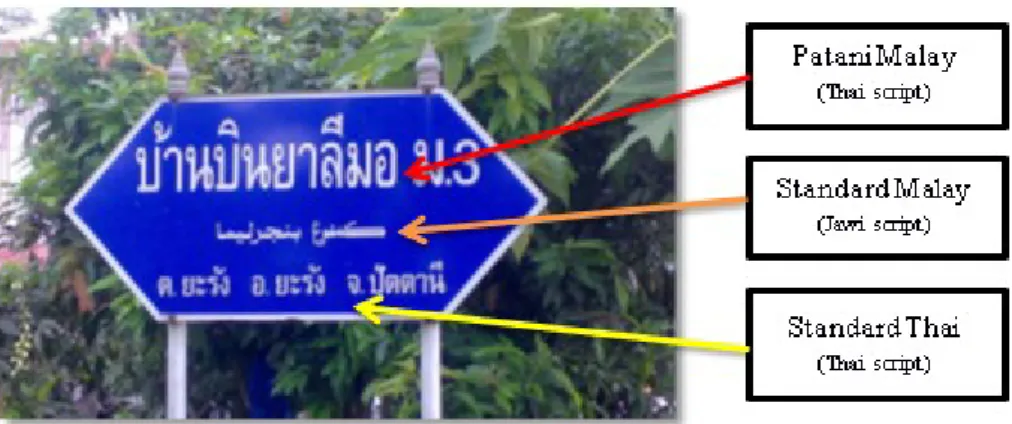
Since local people know the Thai language and script from the compulsory education system, Patani Malay village signs are often rendered in Thai script. The example in Figure 1 shows the Patani Malay name of the village, /binya limɔ/ ‘five wild longan trees’ in Thai script and /banɟar lima/ in Standard Malay (Jawi script), and the names of the Thai district, subdistrict, and province in Standard Thai (Thai script). Other signs in the region feature other languages as well, including Standard Malay (Rumi script), Arabic, Chinese and English.
Figure 1: Village name sign using three languages written in two scripts (photo by author)
Patani Malay written in an informal Thai-based orthography can also be found in posts on popular social media platforms, such as Facebook and Line. This is especially true of the younger generation who are more familiar with Thai script. An example is shown in Figure 2.
Figure 2: Patani Malay written in Thai script on social media (used by permission)
2.2 Use of Classical Malay
Classical Malay reflects Malay as it was used approximately 700 years ago, with an Arabic-based writing system known throughout Southeast Asia as Jawi (Yusoff 2005). It is used for teaching the Islamic religion (Paramal et al. 2015), such as traditional textbooks called kitab Jawi ‘current textbooks’ or kitab tua ‘old textbooks’. There are also kitab kuning ‘yellow textbooks’ which were translated from Arabic textbooks or
produced by Patani scholars. Kitab Jawi are used in traditional Islamic Pondok schools and also in private Islamic schools in the higher grades (Sanawi level). In addition, Classical Malay is also used for Islamic teaching at mosques in the communities. The text in figure 3 is Classical Malay in Jawi script, with Arabic explanations in parentheses.
Figure 3: Sample page from a kitab Jawi (photo by author)
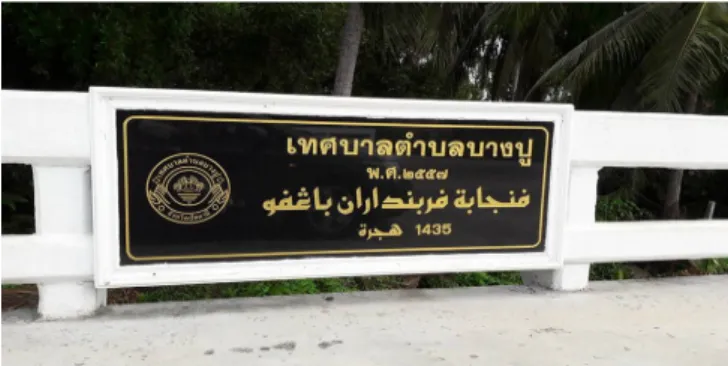
To further complicate matters, people in Thailand’s Deep South also use Jawi script for writing what they call “Standard Malay”. This is different from Standard Malay used in Malaysia in that features of Classical Malay, Standard Malay, and Patani Malay are mixed together and written in Jawi script, based on the individual’s linguistic repertoire and personal preference. People who studied only in Pondak schools tend to use the Classical Malay style of Jawi, while those who studied in Private Islamic Schools tend to use a mixture of Classical Malay and Standard Malay features when writing Jawi (Paramal et. al. 2015). Because Jawi orthography has not been standardized, much of the public usage on signs and documents shows spelling errors. For example, in the photo below, the word ‘office’ should be spelled تباجف /pəɟabat/, but on the sign it is written تباجنف /pənɟabat/, adding /n/ between the vowel /ə/ and consonant /ɟ/ and making the word unintelligible.
Figure 7: Sign on bridge stating that the bridge was built by the municipal office (photo by author)
2.3 Use of written Standard Malay
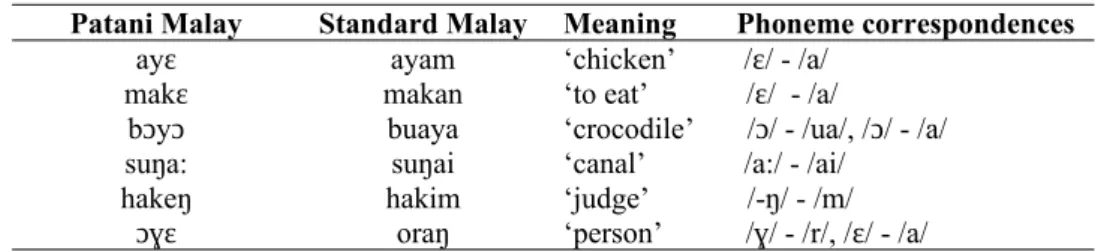
Standard Malay is the national language of Malaysia and differs from Patani Malay in both phonology and syntax. Patani Malay has received more influence from Thai, whereas Standard Malay has been influenced more by English (Premsrirat and Samoh 2012). Phonological variation between these two languages can be seen in in Table 1.
Table 1: Phonological differences between Patani Malay and Standard Malay (Premsrirat & Samoh, 2012) Patani Malay Standard Malay Meaning Phoneme correspondences
ayɛ ayam ‘chicken’ /ɛ/ - /a/ makɛ makan ‘to eat’ /ɛ/ - /a/
bɔyɔ buaya ‘crocodile’ /ɔ/ - /ua/, /ɔ/ - /a/ suŋa: suŋai ‘canal’ /a:/ - /ai/
hakeŋ hakim ‘judge’ /-ŋ/ - /m/
ɔɣɛ oraŋ ‘person’ /ɣ/ - /r/, /ɛ/ - /a/
The syllable structure of Patani Malay and Standard Malay is often different as well. The majority of Patani Malay words have reduced the first syllable to a lengthened onset in mono- or disyllabic forms, replacing the original prefixes or prepositions in Standard Malay (Premsrirat and Samoh 2012), as illustrated in Table 2.
Table 2: Morphonological differences between Patani Standard Malay (Premsrirat & Samoh, 2012)
Patani Malay Standard Malay Meaning
ssɛpaʔ tərsepa? ‘accidentally stumble’
bbulu bərbulu ‘hairy’
kkɯɟuʔ tərkəɟut ‘shock’
ddalɛ: di dalam ‘inside’
mmanɔ di mana ‘where’
Standard Malay is used in textbooks for the Standard Malay language subject in Tadika schools, private Islamic schools, and some government schools. For example, Tadika schools teach reading and writing in Standard Malay using the Rumi script on a simple level, so that students are able to read and write words and short sentences. Some schools teach additional subjects using Standard Malay materials, as seen in Figure 4.
Figure 4: Textbook produced in Thailand containing Standard Malay in Rumi script (photo by author)
Standard Malay is also used in various written and printed media found in the area, including signs and billboards, as well as some documents that are issued by some government agencies such as the Southern Border Provinces Administration Center (SBPAC), local health offices, hospitals, and local universities. An example is shown in Figure 5.
Figure 5: Sign with Standard Thai (top), Standard Malay in Roman-based Rumi orthography (middle and bottom), and Standard Malay in Jawi script (lower middle) (photo by author)
3. Language and identity
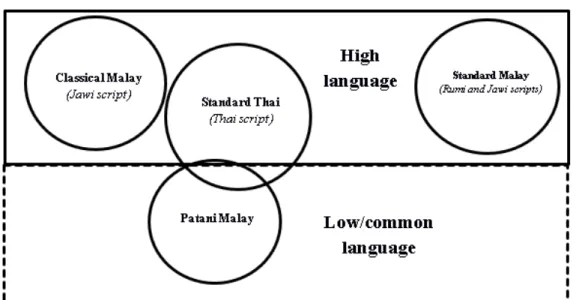
The linguistic situation in the Deep South presents a classic example of diglossia (Ferguson 1959), especially in terms of high and low language. Classical and Standard Malay, both of which are written and used in textbooks, are regarded as high languages while Patani Malay is regarded as a low language because it is mainly in oral use. Standard Thai, as the national language, also enjoys an elevated status. This extended diglossia, as illustrated in Figure 6, impacts the way people perceive their identity. Identity is linked to values and emotional significance (Schüpbach 2008:40). It encompasses the way individuals and groups define themselves and are defined by others, and also how they relate to others on the basis of race, ethnicity, religion, language, and culture (Deng 1995; Hogg & Abrams 1988).
Language is a key component of identity in that even a single linguistic feature can indicate membership in a certain social group: “Language features are the link which binds individual and social identities together” (Tabouret-Keller 1998:317). This is particularly the case for the ethnic identity of minority groups, where the symbolic value of a separate language is seen as stronger than the actual language use ( De Vos 1975:15). The script with which a language is written can also relate to identity, as in the case of the Hindustani language being split into Urdu, written in an older Perso-Arabic script, and Hindu, in a more recently-created Devanagari script after the partition of India (Agnihotri 2007). Similarly, in Serbian areas of Croatia, the Latin-based Serbo-Croatian script, was replaced with an older Cyrillic script to assert Serbian identity (Spolksy 2009; Sudetic 1993).
4. Methodology
The present study was conducted through participant observation in various cultural settings (mosques, teashops, markets, etc.), documentary research (newspapers, books, radio and television broadcasts, etc.) and, of special importance, interviews with people knowledgeable about the Patani Malay linguistic situation. Therefore, participants were selected using purposive sampling; all of the interviewees were well-educated (university degrees or advanced Islamic studies) and held respected positions in their communities as teachers, religious leaders, professors, business people, government officials, politicians, etc. All interviewees could thus be considered stakeholders in current discussions about cultural identity, social cohesion, and the future of the region. Out of 65 people interviewed, 52 were native speakers of Patani Malay (42 males, 10 females) while 13 were non-Patani Malay speakers (4 male, 9 female). The apparent gender imbalance is partly the result of Patani Malay culture; a male interviewer would needs the female’s family’s permission and would be required have a male member of her family member present at all times. Even then, a female might hesitate to express herself. By contrast, many of the non-Patani Malay speaking females were Thai government officials whose duties brought them into frequent contact with community members. Detailed information about the interviewees can be found in the appendix.
The interviews were conducted orally using semi-structured questions by the researcher, a native speaker of Patani Malay, asked in either Patani Malay or Thai, according to the participant’s language preference. Of the 52 Patani Malay speakers interviewed, 29 chose to answer in Thai. It is unclear why so many Patani Malay speakers chose to answer in Thai; they may have assigned the formal, academic interview to the Thai language domain, or they were unsure of what Patani Malay vocabulary should be used to discuss these academic concepts.
The interviews were recorded, transcribed and proofread by the researcher. Following King and Horrocks’ (2010) principles for organizing themes, the text segments (defined as a unit expressing a complete thought) were divided into thematic categories and coded in Microsoft Excel based on whether such factors as ethnic identity, national identity, Islamic identity, and Malay world identity were mentioned. It is not possible to examine the correlation between interviewees’ responses and gender, age, educational backgrounds and occupations/positions, because this data was not collected.
5. Results
The evaluation of the questionnaires indicates that the different languages and scripts in use reflect ethnic, national and religious identity. The five languages and three scripts are each indicators of a particular facet of identity. There is a strong sense of ownership for Patani Malay, concern regarding its vitality, positive attitudes towards Thai as the national language, while also having feelings of attachment to Standard Malay language and script. Classical Malay written in Jawi script is strongly associated with the population’s religion and is thus is held in high regard, manifest in concerns regarding obvious spelling mistakes due to lack of a standardized orthography.
5.1 Patani Malay as a marker of ethnic identity
In the interviews conducted for this research, many Patani Malay speakers expressed strong views and an elevated sense of ownership towards the Patani Malay language (here called Melayu), referring to it by such terms as the language of our ethnic group, our first language, our local language, original language of us, the language of our ancestors, our treasures, and our mother tongue, as shown below:
ภาษามลายูเราสื่อสารแค่เฉพาะคนเชื้อชาติเดียวกับเรา
We use the Melayu language for communicating within our ethnic group only. Science professor, male, age 38
ถ้ามีคนไทยก็ใช้ภาษาไทย แต่ในหมู่พวกเราด้วยกันนี้จะใช้ภาษามลายู
If Thai people are present, we speak Thai, but among ourselves we use Melayu. Retired government teacher and local cultural expert, male, age 70
ภาษามลายูถิ่นนี้เป็นภาษาดั้งเดิม เฮาะ กีตอแอะฮ เพราะเป็นภาษาคนเฒ่าคนแก่ของเรา อย่างน้อย ๆ ก็เป็นสมบัติอย่างหนึ่ง
This local Melayu language is our original language because it is the language of our ancestors and it is our heritage. Teacher in multilingual education program, female, age 37
มือลายู ตือปะแต ยอ ปือติง กือรานอ บาฮาซอ เฮาะ ออแร ทูวอ ดูลู บาฮาซอ เฮาะ อีบุนดอ กีตอ
The local Melayu language is important because it is the language of our ancestors and it is also our mother-tongue. Linguistic researcher, male, age 42
Possibly due to the view of Patani Malay as an expression of their own identity, the Patani Malay interviewees were aware of and concerned about the vitality of the Patani Malay language. They feel that the language is somewhat endangered, due to the increasing number of people speaking Thai and the mixing of Patani Malay and Thai in spoken language, especially among younger people and people who live in the urban areas:
ผมสังเกตจากเด็กๆ แถวบ้าน เด็กสมัยใหม่เรียนสามัญไปด้วย และมักจะพูดภาษาท้องถิ่นปนกับภาษาไทย ซึ่งทำาให้ปู่ย่าตายาย หรือคนเฒ่า
คนแก่ที่ยังไม่ได้เรียนภาษาไทยก็จะงงๆ เพราะเด็กๆ มักจะใช้ภาษาไทยทับศัพท์กับภาษามลายูท้องถิ่น คำาศัพท์ลึกๆ ของภาษามลายูเด็ก
อาจไม่รู้เลยใช้ภาษาไทยแทน เลยต้องเรียนภาษามลายูเชิงวิชาการเพื่อให้เด็กมีกระบวนการคิดและอ่านเรียนรู้ภาษา มลายู ท้องถิ่นได้อย่าง
ลึกซึ้ง และสามารถพูดคุยกับคนสมัยก่อนได้อย่างไม่มีปัญหา
I have seen among the village children that the new generation who studies in government schools tend to speak the local language mixed with Thai words. This leaves the elders who have not studied Thai confused, because the kids will use Thai loan words along with Malayu. The more difficult words in Melayu are not known to these kids. They use Thai words instead. Thus the kids must study Melayu with an academic approach so that the kids can understand Melayu at a deeper level and can speak with their elders without problems. Tutor, male, age 25 5.2 Jawi script as a marker of religious identity
Jawi script appears to be a symbol of the Islamic Patani Malay community’s identity. The interviewees associate Jawi script with Islam, Pondok schools, kitab (religious textbooks), the Qur’an, and the Arabic language and script, which is sacred to them. For this reason, Jawi script has greatly influenced the people of the region as a symbol of Islam and has high prestige.
สถาบันที่ยังคงอนุรักษ์ซึ่งยาวีสคริป คือ สถาบันปอเนาะ แล้วประชากรส่วนใหญ่ของคนในพื้นที่ส่วนใหญ่พ่อแม่จะให้ความสำาคัญให้ไปเรียน
ที่ปอเนาะ แล้วคนที่เรียนปอเนาะจะมีไอเดนตีตี้ของตนเองสูงมาก
The institutions that still preserve the Jawi script are the Pondok. As for the majority of people in the area, most of the parents send their children to study in the Pondok. And the people who have studied in the Pondok have a strong identity. Primary Malay teacher, male, age 31
กือบาเญาะแกญอ กาลู กีตอ กาตอ บาฮาซอ ยาวี บาฮาซอ อากามอ
( อิซแล
) กีตอ. บีลอ ยาวี กาเอะแต บากี กีตอ ดาน ยูเกาะ อากัน
ยาดี ไอเดนตีตี ปาดอ กีตอ
Most people would say that the Melayu language written in the Jawi script is our (Islamic) religious language. When speaking of Jawi, Jawi is our identity. Private Islamic school teacher, male, age 37
อักษรยาวีสำาหรับคนในสามจังหวัดชายแดนภาคใต้เป็นอักษรที่สำาคัญอย่างยิ่ง แล้วก็สอดคล้องกับชีวิตและประเพณีวัฒนธรรมของมลายูที่นี่
เพราะว่าถ้าพูดถึงมลายูที่นี่ก็หมายถึงผู้ที่นับถือศาสนาอิสลาม แล้วอักษรยาวีเป็นตัวอักษรเหมือนกับอาหรับ แล้วก็ภาษาอัลกุรอาน
The Jawi script, for people in the South, is the most important script. And it is part of the way of life and customs of the Melayu people in this area. If you speak about the Melayu people in this area, you are talking about Islamic people. And the Jawi script is like the Arabic language and the language of the Qur’an. Islamic studies professor, male, age 475.3 Standard Thai as a marker of national identity
National standardized testing over the past decade shows that the Thai language abilities of Patani Malay children are the lowest in the nation (UNICEF, 2018). This has led to questions of how Patani Malay people view the Thai language, and whether they are motivated to learn it. Thus, the interviews included prompt
questions such as “Is Thai important?” and “When do you use Thai?” The following quotations are representative of the responses of most interviewees, indicating that fluency in Thai is necessary as a facet of their identity as citizens of Thailand who need the language for economic, educational, and other practical purposes.
บาฮาซอ ซีแย จำาเป็น กีตอ กือนอ วี อาดอ ยูเกาะ ซือบะ กีตอ โดะ ดี นากือรี ซีแย กีตอ โดะ ดาแล มือแรเตาะฮ นากือรี ซีแย กีตอ กือ
นอ วี ปานา บาฮาซอ ซีแย ซือบะ กาลู กีตอ เนาะ กีรูเเมาะฮ 'ปีตา เนาะ กี ดี อำาเภอ ตุฮ กีตอ กือนอ แ'กแจะ ซีแย
The Siamese language is necessary. We must be able to speak Siamese, because we live in Thailand. We are under the authority of the Siamese nation. We must be good at using the Siamese language, because if we need to go to hospital, or to the district office, we must speak Siamese. Government official, male, age 30
ถ้าพูดถึงการทำางาน การติดต่อในสถานที่ต่างๆ ไม่ว่าจะเป็นหน่วยราชการหรือว่าสถานที่ต่างๆ ที่อยู่รอบๆ บ้านหรือในสังคมทั่วๆ ไป ก็ ต้อง
ใช้ภาษาไทยโดยส่วนใหญ่
If we speak about work, communicating in various places, whether in government offices or in other places that are nearby our homes, or in the larger society, we must use Thai most of the time. University researcher, male, age 35
บาฮาซอ ซีแย นิฮ ปือติง ดี รูเเมาะฮกีตอ กีตอ กือรานอ บาฮาซอ ซีแย ตุฮ บาฮาซอ เฮาะ กือรายอแอ บาฮาซอ ภาษาราชการ มัซตี ยอ
กือนอ รือตี ดี ซือกี อิซแล เซินดีรี ปน ซอกอง ยูเกาะ วี รือตี บาเญาะ บาฮาซอ
The Siamese language is necessary. In our area Siamese is necessary, because Siamese is the language of the government. The government language. It is necessary to know it. The Islamic religion encourages us to be good at many languages. Linguistic researcher, male, age 40 5.4 Standard Malay and Roman-based Rumi orthography as a marker of transnational Malay identity For the Patani Malay community, Standard Malay appears to be linked to the history of the greater Malay world, giving them a sense of being “connected” or “linked” to a larger transnational group, as shown below.
ในบริบทอาเซียนภาษารูมีเป็นภาษาหลัก ยังไงเสียรูมีก็มีความสำาคัญ มันก็ได้เปรียบถ้ารู้ภาษารูมี มัน เชื่อมเรากับประเทศอาเซียนได้ เช่น
มาเลเซีย อินโดนีเซีย เขาใช้ภาษารูมีกันทั้งนั้น
In the ASEAN context, Rumi (Standard Malay) is the main language. Rumi is important. It's an advantage to know Rumi. It connects us with ASEAN countries such as Malaysia, Indonesia, where they all use Rumi. History professor, male, age 45
ภาษามลายูรูมีจำาเป็นมาก อย่าลืมว่าชายแดนเราติดมาเลเซีย เด็กเราถ้ารู้รูมีก็จะเชื่อมกับคนมาเลเซีย อินโดได้ ถ้าเรารู้ภาษาก็จะ
สามารถ เชื่อมได้เลย เด็กบ้านเราสมัยนี้จะไปเรียนที่มาเลเซียกันเยอะเด็กต้องได้พื้นฐานรูมี
Melayu Rumi (Standard Malay) is very necessary. Remember that the southern boundary of Thailand connects to Malaysia. If our children know Rumi, they can connect to Malaysian and Indonesian people. If we know the language, we can be connected. Today, many students are going to Malaysia for study so they should learn basic Rumi. Government researcher, female, age 47
ในท้องถิ่นที่นี่เราใช้ภาษายาวีมากกว่า แต่มลายูรูมีนั้นมีความสำาคัญ ใช้เชื่อมโยงสัมพันธ์กับประเทศใกล้เคียง โลกมลายูงัยไม่ว่าประเทศ
มาเลเซีย อินโด ใช้ภาษามลายูรูมีเป็นภาษาทางการของเขา
In this local area, we use the Jawi language more but Melayu Rumi (Standard Malay) is important and it is used to link with neighboring countries in the Malay world such as Malaysia and Indonesia. They use Melayu Rumi (Standard Malay) as the official language. Retired professor of Malay language, male, age 67
5.5 Language and script as an expression of human rights
Much of the political discourse surrounding the unrest in the south makes reference to human rights in general, and cultural rights in particular. Some of the interviewees see the use of Patani Malay language as a right, as indicated by the following remarks given in response to the prompt, “If the government did not allow people to speak Patani Malay, what would you think?” The interviewees felt that if they were
forbidden to speak their language, they would be angry or feel that their rights had been violated, although they did not cite United Nations or other legal documents to prove their case.
โกรธน่ะครับ เพราะเหมือนกับว่ารัฐบาลกำาลังละเมิดสิทธิของเราอ่ะ ถ้าสมมุติว่าผมถามกลับกันน่ะคับ ถ้าสมมุติบังคับให้คนภาคใต้ไม่ให้พูด
ภาษาปักษ์ใต้แดมอจะรู้สึกยังไง
I would be angry, because it would be like the government was violating our rights. If I asked in reply, what if they forced the Southern Thai people not to speak their Southern Thai dialect, how would they feel? Local NGO employee, male, age 35
สิ่งเหล่านี้ก็เป็นสิทธิของวัฒนธรรม เราจะไปห้ามไม่ได้ เพราะเป็นศิวิไลซ์ เป็นวิถีชีวิตของเขา ถ้าไปห้ามก็ถือว่าเป็นการละเมิดสิทธิ เพราะ
เป็นวัฒนธรรม ห้ามไม่ได้วัฒนธรรม
This is about cultural rights. It can’t be forbidden, because this is about a civilization, their way of life. If it is prohibited, it is violating their rights because this relates to culture. Culture cannot be outlawed. Islamic studies professor, male, age 50
ในความคิดส่วนตัวก็ถือว่าเป็นการที่ไม่ดี อาจจะบอกว่าผิดเลยก็ได้เพราะว่ามันเป็นการกีดกันทางภาษา ก็เหมือนเป็นการดูถูกคนนั้น
เหมือนกัน ถือว่าเป็นการดูถูกเพราะว่าเป็นภาษาของเขาที่ใช้มาโดยตลอด แต่ถ้าไม่ให้พูดก็เหมือนเป็นการ ไม่ให้เกียรติเขาด้วย อืม เป็นการ
ไม่ให้เกียรติ
In my opinion, it would be a bad thing. You could say it would be very wrong, because it is discrimination against a language, and it is like looking down on the speakers of the language. It would be looking down on them because it is their language that they have used forever. If you don’t allow them to speak it, it is like you are not honoring them. Like not honoring them. University researcher, male, 35
Patani Malay speakers also see Jawi script in relation to rights, as shown in the following interviewee comments in response to the question prompt, “If the government did not allow the use of the Jawi script, how would you feel?”
ผมไม่เห็นด้วย ก็คือว่า ไปจำากัดสิทธิของเขา แล้วก็อย่าลืมว่า อักษรยาวีเนี้ยะชาวบ้านทั่วไปเขาถือว่าเป็นอัตลักษณ์อย่างหนึ่งของตัวเขา ถึง
แม้ว่า ในความเป็นจริงแล้วโดยทั่วไป ความสามารถในการอ่านเขียนยาวีน้อยมาก อย่างไรก็ตามก็ยังรู้สึกว่ายาวีนี้เป็นอัตลักษณ์ของเขา
หากว่าไปห้ามไม่ให้ใช้ยาวี โดนต่อต้านแน่นอน
I would not agree. It would be like limiting their rights. And do not forget that the Jawi script, all the villagers feel that it is part of their identity. Even if in reality their ability to read and write Jawi is very low, they still feel that Jawi is part of their identity. If people were forbidden to use Jawi there would be resistance for sure. Linguistics professor, male, age 62
6. Discussion
Language as a link between individual and social identity (Tabouret-Keller 1998) is reflected in the interviews conducted for this study. The Patani Malay identity is linked to multiple languages and scripts, which illustrates the fluidity of people's identities (Leach 1964; Hall 1996).
6.1 Ethnic identity
The clear implication from the responses of the interviewees is that the key linguistic feature of the ethnic identity is Patani Malay as the mother tongue of most people in the Deep South. It is the language used most in daily life. One of the interview questions asked how people would feel if the Patani Malay language w ere forbidden. Many had a very emotional response, talking about their right to use their language and how people would oppose such an unjust law. In addition, several interviewees were very concerned about the vitality of the Patani Malay language, especially among urban youth who tend to use Thai or a mixture of Patani Malay and Thai.
6.2 National identity
The interviewees had generally positive attitudes toward the Thai language. Thai is used for education and for speaking to non-Patani Malay speakers. One of the interview questions asked how people would feel if
the Thai language was forbidden. They replied that they would not agree, even though the response was not as emotional as it was when they were asked how they would feel if Patani Malay were forbidden. They replied that Thai was necessary for education and life as citizens of Thailand.
6.3 Malay world identity
For people of the Deep South, the Standard Malay language is linked to the history of the greater Malay world and a common identity rooted in the past when the Patani Sultanate was a respected part of the that world. The Patani Malay interviewees in this study consider Rumi script a bridge between ethnically Malay people spread across South East Asia in Malaysia, Indonesia, and Brunei. Keywords used by many interviewees in reference to Rumi included “link” and “connect”. This reflects a connection between a local Patani Malay identity and a wider Malay world identity.
6.4 Islamic identity
The key linguistic feature of the Islamic identity is the Classical Malay language written in Jawi script. While the Patani Malay spoken language carries many functions and has close emotional connections to daily life, many interviewees spoke of Jawi as an important symbol of their unique identity. The fact that it is an Arabic-based script also gives it power in the thinking of the local people, as the language is linked to Islam. Several Patani Malay interviewees feel that the Thai government has come to accept the use of Jawi script because of its connection to Islam. Seeing how important Jawi script is to people of the Deep South, the state has become more supportive of its use.
7. Conclusion
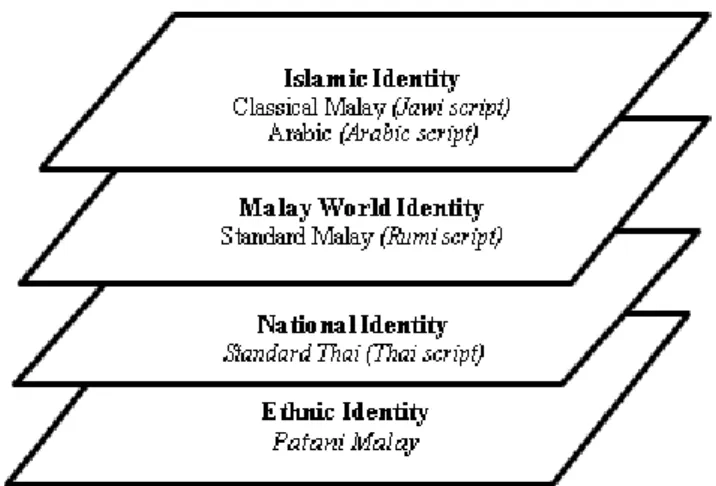
For the reasons discussed above, the Patani Malay identity as it relates to languages and scripts can be envisioned as comprising various layers, starting from the community and moving to the global level, as represented in the figure below.
Figure 8: Multiple layers of Patani Malay language and script identity
Thailand's Deep South is unique in how a complex array of languages and scripts contribute to people’s sense of identity. As such, issues involving languages and scripts are pivotal to Patani Malay people’s sense of self-esteem, as well as their feelings of linguistic and cultural security. These factors should be carefully considered by NGOs, government agencies, and other organizations working to foster social cohesion and development in the Deep South.
References
Agnihotri, Rama Kant. 2007. Identity and multilinguality: The case of India. In Tsui, Amy, & Tollefson, James W. (Eds), Language policy, culture, and identity in Asian contexts, 185-204. Hillsdale, NJ: Erlbaum.
De Vos, George A. and Romanucci-Ross, Lola (Eds.). 1975. Ethnic identity: Cultural continuities and change. Palo Alto: Mayfield.
Ferguson, Charles. 1959. Diglossia. Word 15.2:325–340.
Hall, Stuart (Ed.). 1996. Modernity: An introduction to modern societies. Malden, MA: Blackwell. Hogg, Michael and Dominic Abrams. 1988. Social identifications: a social psychology of intergroup
relations and group processes. London: Routledge.
Joll, Christopher. 2013. Language loyalty and loss in Malay South Thailand: From Ethno-religious rebellion to ethno-linguistic angst? Paper presented at the Seminar of the Malay Studies Department, National University of Singapore. November 15, 2013.
King, Nigel and Horrocks, Christine. 2010a. Interviews in qualitative research. Los Angeles: Sage.
Leach, Edmund R. 1964. Political systems of highland Burma: A study of Kachin social structure. Boston: Beacon Press.
Masor, Rusdee. 2018. The situation of code-mixing between Patani Malay and Thai by Patani Malay-speaking people in Pattani Province. In David Hirsh and Suwilai Premsrirat (Eds.) Language Revitalization: Insights from Thailand, 251-268. Bern: Peter Lang.
National Reconciliation Commission. 2006. Report of the National Reconciliation Commission (NRC): Overcoming violence through the power of reconciliation. Bangkok: National Reconciliation Commission. Retrieved from http://thailand.ahrchk.net/docs/nrc_report_en.pdf
National Statistical Office. 2010. National census results. Retrieved from www.nso.go.th/sites/2010.
Paramal Waemaji, Sama-alee Waeyusoh, Jeh-ubong Jehhusen, Al-yufri Sahe Abdullah, Mano Assidik, Awae Khosali and Awae Baderu. 2015.
ป้ายชื่อส่วนราชการและป้ายประชาสัมพันธ์ภาษามลายู
อักษรยาวี
[Analysis of government signage using the Jawi script]. Pattani: Pattani Info Service. Premsrirat, Suwilai. 2010. The role of MTB MLE in ECD and education: Experiences and challenges insouthern Thailand. Paper presented at the International conference on language, education, and the millennium development goals, Bangkok, November 9-11, 2010.
http://www.seameo.org/languagemdgconference2010/doc/presentations/day1/SuwalaiPremsrirat-sn.pdf
Premsrirat, Suwilai. 2015. Patani Malay in Thai education. In Craig A. Volker and Fred E. Anderson (Eds.), Education in languages of lesser power: Asia-Pacific perspectives, 91–110. Amsterdam; Philadelphia: Benjamins.
Premsrirat Suwilai, Pitiphatthanakosit Ubolwan, Al-yufri Sahe Abdullah, Thawornphat Mayuree, Paramal Waemaji, Choosri Isara, Masor Rusdee, Burarungrot Mirinda, and Kabae Tuwaekholiyoh. 2008.
รายงานการวิจัย “โครงการสำารวจสถานการณ์ภาษาในพื้นที่สามจังหวัดชายแดนภาคใต้”
[Research reports on language situation survey in 3 Southernmost Provinces in Thailand]. Bangkok: Center for Peace Studies. Mahidol University.Premsrirat, Suwilai, and Samoh, Uniansasmita. 2012. Planning and implementing Patani Malay in bilingual education in Southern Thailand. Journal of the Southeast Asian Linguistics Society 5:85–96.
Schüpbach, Doris. 2008. Shared languages, shared identities, shared stories: A qualitative study of life stories by immigrants from German-speaking Switzerland in Australia. Berlin: Peter Lang. Spolsky, Bernard. 2009. Language management. Cambridge: Cambridge University Press.
Sudetic, Chuck. 1993. Balkan Conflicts Are Uncoupling Serbo-Croatian. The New York Times. December 26, 1993. Retrieved from
https://www.nytimes.com/1993/12/26/world/balkan-conflicts-are-uncoupling-serbo-croatian.html .
Tabouret-Keller, André. 1997. Language and identity. In Florian Coulmas (Ed.), The handbook of sociolinguistics, 313-343. Oxford UK: Wiley-Blackwell.
UNICEF. 2018. Bridge to a brighter tomorrow: the Patani Malay-Thai multilingual education programme. Bangkok: UNICEF Thailand.
Yamirudeng, Munirah. 2017. What it means to be Malay Muslims: the role of language in ethnic identity construction and ethnic maintenance of Thai-Malay Muslims. Journal of Humanities and Social Sciences 13.1:37-68.
Reviewed: Received 30 May 2018, revised text accepted 21 November 2018, published 10 December 2018 Editors: Editor-In-Chief Dr Mark Alves | Managing Eds. Dr Paul Sidwell, Dr Nathan Hill, Dr Sigrid Lew
Appendix A: Interviewee Profiles
Patani Malay SpeakersSex Age Group Occupational Group
M F 25-35 36-59 60+ 2 1 1 Artist 4 2 2 2 Businessman 1 1 Engineer 2 1 1 Government official 8 1 8 1 Islamic teacher 1 1 Medical technician 5 3 1 1 NGO worker 1 1 Politician 9 1 6 2 Professor 2 2 2 2 Researcher
1 1 School Committee Member
1 1 School director
1 1 Security Consultant
4 5 3 4 2 Teacher
2 2 Tutor
Total 42 10 16 28 8
Non-Patani Malay Speakers
Sex Age Group Occupational Group
M F 25-35 36-59 60+ 1 1 Education official 3 1 3 1 Government official 6 2 4 Professor 1 1 1 1 Security official Total 4 9 1 6 6
Acknowledgments: This article was developed and adapted from the author's Mahidol University Ph.D.
dissertation entitled "A study of the complexity of language, script, and identity in Thailand's Deep South". This research was supported by the Thailand Research Fund (TRF) under the Royal Golden Jubillee Ph.D. (RGJ-Ph.D.) scholarship program.
Appendix B: Questions for interviews
What do you think about the importance of language? Why?
What language do you speak with family members, relatives, neighbors, or the people in your community? What do you think about Patani Malay? Is it important? Why?
Have you ever studied in a Tadika school, Islamic private school or Pondok institution? Have you ever studied Jawi script?
Can you read Jawi script? Can you write Jawi script? Is Jawi script important? Why?
Have you ever studied the Rumi alphabet? Can you read Rumi?
Can you write Rumi? Is Rumi important? Why?
Have you ever learned Standard Malay (Bahasa Malaysia)? Can you understand Standard Malay (Bahasa Malaysia)? Can you speak Standard Malay (Bahasa Malaysia)? Is Standard Malay important? Why?
Have you ever learned Thai? Can you understand Thai? Can you speak Thai? Can you read Thai? Can you write Thai? Is Thai important? Why?
When do you use Patani Malay? Please tell me in detail. When do you use Jawi script? Please tell me in detail. When do you use Rumi? Please tell me in detail.
When do you use Standard Malay? Please tell me in detail. When do you use Thai? Please tell me in detail.
What would you think/feel if the government did not allow people in the Three Southern Border Provinces use Patani Malay?
What would you think/feel if the government did not allow people in the Three Southern Border Provinces use Jawi script?
What would you think/feel if the government did not allow people in the Three Southern Border Provinces to use Rumi orthography?
What would you think/feel if the government did not allow people in the Three Southern Border Provinces to learn Standard Malay?
What would you think/feel if the government did not allow people in the Three Southern Border Provinces to use Thai?
What language is most important to you? Why?
What are the similarities and differences between PM and Standard Malay? Describe it. Do you know what are the similarities/differences between Patani Malay and Standard Malay? Do you know what are the similarities/differences between Patani Malay and Jawi?
Do you know what are the similarities/differences between Jawi and Rumi? Do you know what are the similarities/differences between Jawi and Arabic? Thank you for your kind cooperation.