5 February 2016 EMA/135580/2012 Information Management
Detailed guidance on the electronic submission of
information on medicinal products for human use by
marketing authorisation holders to the European
Medicines Agency in accordance with Article 57(2) of
Regulation (EC) No. 726/2004
Chapter 3.II: XEVPRM User Guidance
Version 3.11
Version number: Published: Date of coming into force:
Version 3.11 February 2016 1 February 2016 Version 3.10 20 January 2016 20 January 2016
Version 3.9 19 November 2015 23 November 2015
Version 3.8 19 May 2015 1 May 2015
Version 3.7 22 December 2014 16 June 2014
Version 3.6 8 July 2014 16 June 2014
Version 3.5 16 June 2014 16 June 2014
Version 3.4 5 March 2014 16 June 2014
Version 3.3 28 February 2014 16 June 2014
Version 3.2 31 January 2014 16 June 2014
Version 3.1 17 January 2013 1February 2013
Table of contents
Table of contents ... 2
Summary of changes ... 8
Introduction ... 9
Background information ... 10
Available operation types to be used in an XEVPRM ... 11
1. Initial submission of medicinal product data ... 13
1.1. Initial Submission of an Authorised Medicinal Product (AMP) ... 13
Table 1a- Authorised Medicinal Product – language requirements ... 18
1.1.1. Submission of medicinal products authorised in EEA countries outside the EU ... 19
1.1.1.1. Submission of medicinal products authorised in Liechtenstein ... 19
Table 1b - Requirements for AMP records and attachments for countries with more than one national language ... 20
Table 2 - Art 57(2) data element requirements overview for authorised medicinal product submission ... 22
1.2. Authorised medicinal product - element structure ... 32
1.2.1. Local Number (AP.1) ... 33
1.2.2. EV Code (AP.2) ... 33
1.2.3. New Owner ID (AP.3) ... 34
1.2.4. Marketing Authorisation Holder (MAH) code (AP.4) ... 34
NOTE 1 ... 34
1.2.5. Qualified Person responsible for Pharmacovigilance (QPPV) code (AP.5) ... 35
1.2.6. Pharmacovigilance System Master File Location (PSMFL) code (AP.6) ... 35
1.2.7. Pharmacovigilance enquiry email (AP.7) ... 35
1.2.8. Pharmacovigilance enquiry phone (AP.8) ... 36
1.2.9. Sender local code (AP.9) ... 36
1.2.10. Info date format (AP.10)... 36
1.2.11. Info date (AP.11) ... 36
1.2.12. AMP - Authorisation details element structure (AP.12) ... 37
1.2.12.1. Authorisation country code (AP.12.1) ... 37
NOTE 2 ... 38
1.2.12.2. Authorisation procedure (AP.12.2) ... 38
NOTE 3 ... 39
1.2.12.3. Authorisation status (AP.12.3) ... 39
NOTE 4 ... 40
1.2.12.4. Authorisation number (AP.12.4) ... 41
1.2.12.5. Authorisation/renewal date (AP.12.5) ... 43
1.2.12.6. Authorisation/renewal date format (AP.12.6) ... 44
1.2.12.7. MRP/DCP/EMEA number (AP.12.7) ... 44
1.2.12.8. EU number (AP.12.8) ... 45
1.2.12.9. Orphan drug status (AP.12.9) ... 45
1.2.12.11. Invalidated date format (AP.12.11) ... 46
1.2.12.12. Invalidated date (AP.12.12) ... 46
1.2.12.13. Legal basis (AP.12.13) ... 47
NOTE 5 ... 47
NOTE 6 ... 48
1.2.12.14. Medicinal product types (AP.12.MPT.1) ... 48
1.2.13. AMP - Presentation Name element structure (AP.13) ... 48
1.2.13.1. Full Presentation Name (AP.13.1) ... 50
1.2.13.2. Product Short Name (AP.13.2) ... 51
1.2.13.3. Product INN/Common Name (AP.13.3) ... 53
1.2.13.4. Product Company Name (AP.13.4) ... 55
1.2.13.5. Product Strength Name (AP.13.5) ... 57
1.2.13.6. Product Form Name (AP.13.6) ... 59
1.2.14. Authorised pharmaceutical form (AP.APT.1) ... 62
NOTE 7 ... 63
NOTE 8 ... 64
1.2.15. Package description (AP.13.7) ... 64
1.2.16. Comment (AP.14) ... 65
1.2.17. AMP - Pharmaceutical product elements (AP.PPs)... 65
1.2.17.1. Administrable Pharmaceutical Form (PP.1) ... 75
Process map 1 - Referencing administrable pharmaceutical form in a pharmaceutical product ... 77
1.2.17.2. Administration route (PP.AR.1) ... 78
Process map 2 - Referencing route of administration in a pharmaceutical product ... 79
1.2.17.3. Pharmaceutical product drug ingredients and medical device(s) ... 80
NOTE 9 ... 83
NOTE 10 ... 84
1.2.17.4. Active ingredient substance code (PP.ACT.1) ... 85
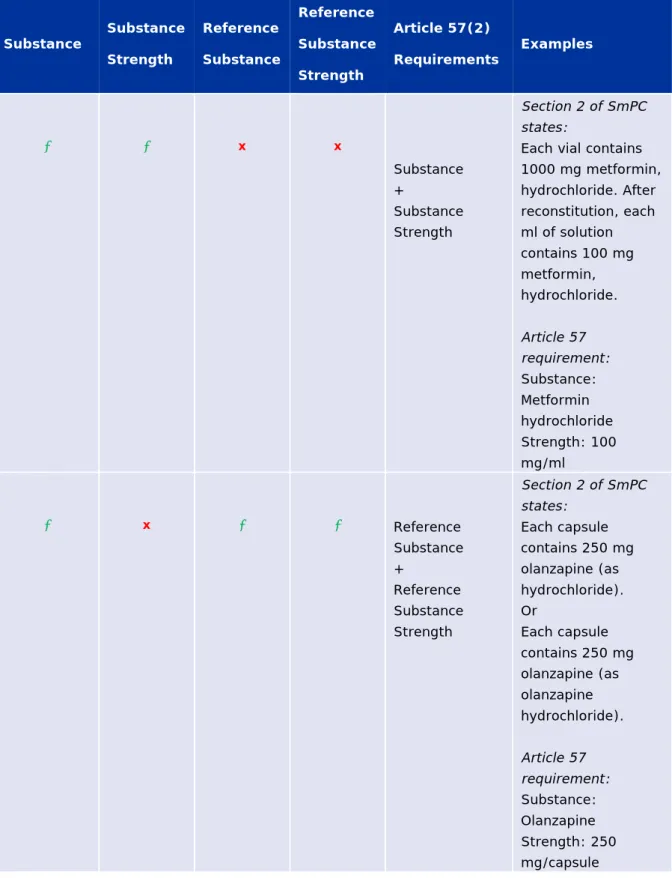
Table 3 - Requirements on how to reflect information on substance and strength in section 2. Qualitative and Quantitative Composition of the SmPC ... 87
1.2.17.5. Active ingredient substance strength ... 88
NOTE 11 ... 89
NOTE 12 ... 90
1.2.17.6. Active ingredient concentration type Code (PP.ACT.2)... 90
1.2.17.7. Active ingredient substance value(s) ... 91
1.2.17.8. Excipient substance code (PP.EXC.1) ... 95
1.2.17.9. Excipient substance strength ... 96
1.2.17.10. Adjuvant substance code (PP.ADJ.1) ... 96
1.2.17.11. Adjuvant substance strength ... 97
1.2.17.12. Medical Device Code (PP.MD.1) ... 98
1.2.18. Product ATC Code(s) (AP.ATC.1) ... 98
1.2.19. AMP - Product Indications (AP.INDs) ... 99
1.2.19.1. MedDRA version (AP.IND.1) ... 99
1.2.19.3. MedDRA Code (AP.IND.3) ... 100
Additional MedDRA Coding examples ... 101
1.2.20. Previous EV Code (AP.PEV.1) ... 103
1.2.21. AMP - Printed Product Information (PPI) Attachments... 103
1.2.21.1. Attachment EV Code (AP.PPI.1) ... 104
NOTE 13 ... 104
1.2.21.2. Attachment validity declaration (AP.PPI.2) ... 104
1.3. Initial submission of a QPPV information ... 106
1.4. Initial submission of an Approved Substance ... 107
To request a new approved substance to be inserted in the XEVMPD: ... 108
To request an update of an existing approved substance in the XEVMPD to add a substance translation or an alias: ... 108
1.5. Initial submission of a Reference Source ... 109
1.5.1. Local Number (S.1) ... 109
1.5.2. EV Code (S.2) ... 110
1.5.3. Reference source name (S.3) ... 110
1.5.4. Comment (S.4) ... 110
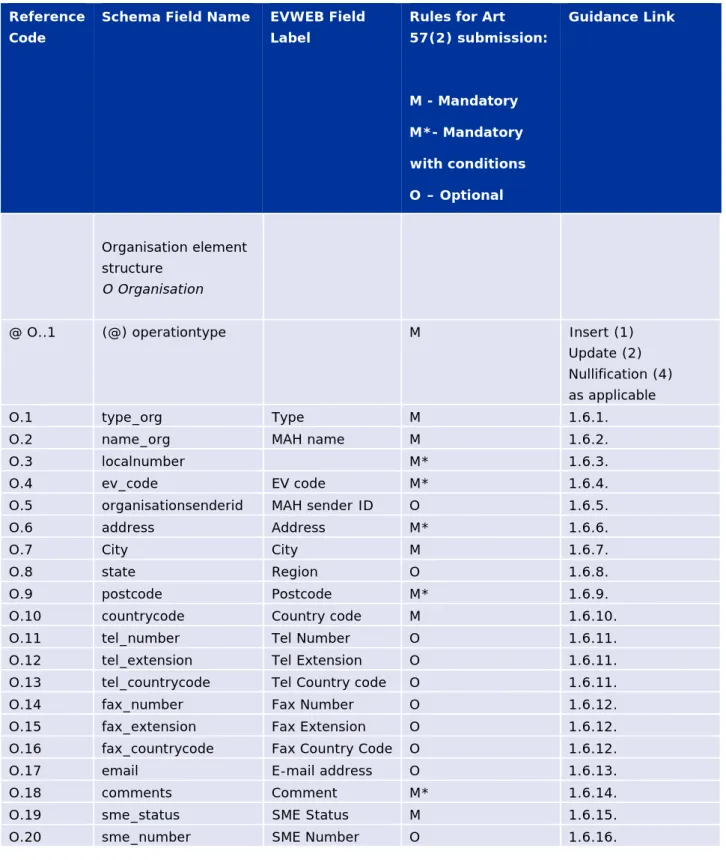
1.6. Initial Submission of a Marketing Authorisation Holder (MAH) Organisation... 111
NOTE 14 ... 111
Table 4 - Art 57(2) data elements requirements overview MAH organisation submission .. 114
1.6.1. Type of organisation (O.1) ... 115
1.6.2. Organisation name (O.2) ... 115
1.6.3. Local Number (O.3) ... 115
1.6.4. EV Code (O.4) ... 116
1.6.5. Organisation Sender Identifier (O.5) ... 116
1.6.6. Address (O.6) ... 116
1.6.7. City (O.7) ... 116
1.6.8. State (O.8) ... 116
1.6.9. Postcode (O.9) ... 117
1.6.10. Country Code (O.10) ... 117
1.6.11. Telephone number (O.11)/Extension (O.12)/Country Code (O.13) ... 117
1.6.12. Fax number (O.14)/Extension (O.15)/Country Code (O.16) ... 117
1.6.13. Email address (O.17) ... 117
1.6.14. Comment (O.18) ... 117
1.6.15. SME status (O.19) ... 118
1.6.16. SME number (O.20) ... 119
1.7. Initial submission of an ATC Code ... 120
1.7.1. Type Term (ST.ATC.1) ... 121
1.7.2. ATC Code (ST.ATC.2) ... 121
1.7.3. New owner ID (ST.ATC.3) ... 121
1.7.4. ATC Code description (ST.ATC.4) ... 122
1.7.5. Version Date Format (ST.ATC.5) ... 122
1.7.6. Version Date (ST.ATC.6) ... 122
1.8. Initial submission of an Authorised/Administrable Pharmaceutical Form ... 123
1.8.1. Type Term (ST.PF.1) ... 124
1.8.2. Local Number (ST.PF.2)... 124
1.8.3. EV Code (ST.PF.3) ... 125
1.8.4. New owner ID (ST.PF.4) ... 125
1.8.5. Name of the Pharmaceutical Form (ST.PF.5) ... 125
1.8.6. Version Date Format (ST.PF.6) ... 125
1.8.7. Version Date (ST.PF.7) ... 125
1.8.8. Previous EV Code (ST.PF.8) ... 125
1.8.9. Comment (ST.PF.9) ... 125
1.9. Initial Submission of a Route of Administration (RoA) ... 127
1.9.1. Type Term (ST.AR.1) ... 128
1.9.2. Local Number (ST.AR.2) ... 128
1.9.3. EV Code (ST.AR.3) ... 129
1.9.4. New owner ID (ST.AR.4) ... 129
1.9.5. Name of the Route of Administration (ST.AR.5) ... 129
1.9.6. Version Date Format (ST.AR.6) ... 129
1.9.7. Version Date (ST.AR.7) ... 129
1.9.8. Previous EV Code (ST.AR.8) ... 129
1.9.9. Comment (ST.AR.9) ... 129
1.10. Submission of an attachment ... 131
NOTE 15 ... 132
1.10.1. Local Number (ATT.1) ... 136
1.10.2. File name (ATT.2) ... 136
1.10.3. File type (ATT.3) ... 136
1.10.4. Attachment name (ATT.4) ... 137
1.10.5. Attachment type (ATT.5) ... 137
1.10.6. Language code (ATT.6) ... 137
1.10.7. Attachment version (ATT.7) ... 137
1.10.8. Attachment version date (ATT.8) ... 137
1.10.9. Version date format (ATT.9) ... 138
1.11. Initial submission of a Pharmacovigilance System Master File Location (PSMFL) ... 139
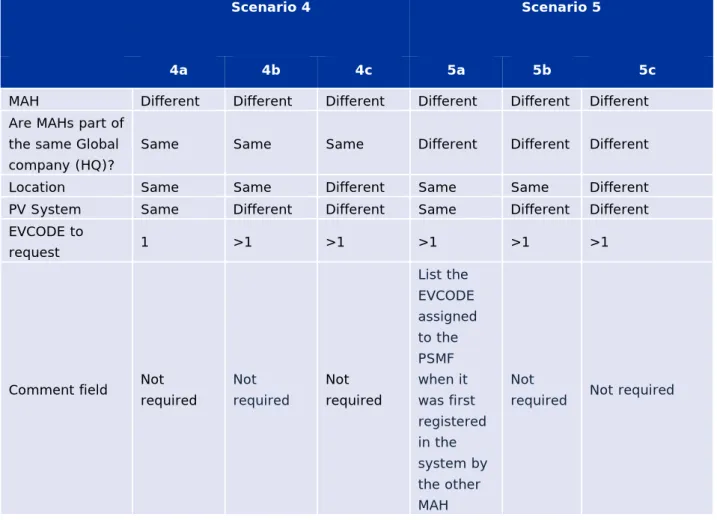
Table 5 – Requesting a single/multiple PSMFL EV Code(s) by the same MAH ... 140
Table 6 – Requesting a single/multiple PSMFL EV Code(s) by different MAHs ... 141
1.11.1. Local Number (MF.1) ... 143
1.11.2. EV Code (MF.2) ... 144
1.11.3. Pharmacovigilance System Master File Company (MF.3) ... 144
1.11.4. Pharmacovigilance System Master File Department (MF.4) ... 144
1.11.5. Pharmacovigilance System Master File Building (MF.5) ... 145
1.11.6. Pharmacovigilance System Master File Street (MF.6) ... 145
1.11.7. Pharmacovigilance System Master File City (MF.7) ... 145
1.11.8. Pharmacovigilance System Master File State (MF.8) ... 145
1.11.9. Pharmacovigilance System Master File Postcode (MF.9) ... 145
1.11.11. Comment (MF.11) ... 145
2. Maintenance of medicinal product data ... 146
Scope and objectives ... 146
2.1. Transition maintenance phase - Electronic submission plan ... 147
2.1.1. Submission date for Type IA Variations ('Do and Tell') excluding the notification of changes to the QPPV and PSMFL ... 149
2.1.2. Submission date for Type IB Variations ... 149
2.1.3. Submission date for Type II Variations ... 150
2.1.4. Submission date for Type II Variations (MRP/DCP) ... 151
2.1.5. Submission date for Type II Variations (NAP) ... 151
2.1.6. Maintenance of a Qualified Person responsible for Pharmacovigilance (QPPV) ... 152
2.1.6.1. Business process to notify the change of QPPV details ... 152
Process map 3 – Change of QPPV details ... 153
2.1.6.2. Business process to notify the change of a QPPV within the organisation ... 153
2.1.6.3. Process map 4 – Change of a QPPV ... 154
2.1.7. Maintenance of XEVMPD Controlled Vocabularies (CVs) by the MAH ... 155
NOTE 16 ... 155
2.1.7.1. Maintenance of a Marketing Authorisation Holder (MAH) Organisation entity ... 155
Process map 5 – Maintenance of an MAH entity in the XEVMPD... 157
2.1.7.2. Maintenance of Pharmacovigilance System Master File Location (PSMFL) entity .. 158
Process map 6 – Maintenance of PSMFL entity ... 159
2.1.8. Maintenance of authorised medicinal product (AMP) entity ... 160
Process map 7 - Overall business process to amend medicinal product information in the XEVMPD ... 161
2.1.8.1. Variations of marketing authorisation ... 162
2.1.8.2. (Lifting of) suspension of marketing authorisation ... 164
2.1.8.3. Transfer of marketing authorisation ... 165
Process map 8 – Transfer of marketing authorisation ... 166
2.1.8.4. Renewal of marketing authorisation ... 166
Process map 9 – Renewal of marketing authorisation ... 168
2.1.8.5. Change of authorisation procedure following a referral ... 168
2.1.8.6. Revocation/Withdrawal/Expiry of Marketing Authorisation (MA) ... 168
2.1.8.7. Nullification of medicinal product ... 169
2.2. Scenarios for maintenance of medicinal products ... 170
2.2.1. Change of QPPV within the MAH organisation ... 170
Process map 10 – Amendment of an AMP entity following a change of QPPV ... 170
2.2.2. Amendment of an AMP entity following a change in the referenced PSMFL information ... 171
Process map 11 – Amendment of an AMP entity following a change of a PSMFL ... 171
2.2.3. Bringing AMP entities up to date and amending the referenced information ... 172
Process map 12 – Amendment of an AMP entity ... 172
2.2.4. Nullification of duplicated/obsolete XEVMPD entities ... 173
2.2.4.1. Nullification of AMP entities ... 173
2.2.4.2. Nullification of MAH organisation entities... 175
Process map 14 – Nullification of duplicated/obsolete MAH organisation entity ... 176
2.2.4.3. Nullification of PSMFL entity ... 177
Summary of changes
Following the publication of version 3.10 on 20 January 2016:
• Article 57 helpdesk ([email protected]) was replaced with EMA Service Desk (https://servicedesk.ema.europa.eu) throughout this document;
• 1.2.12.7. MRP/DCP/EMEA number (AP.12.7) was amended;
• 2.2.4. Nullification of duplicated/obsolete XEVMPD entities was amended. The changes are highlighted.
The below sections were amended following the publication of version 3.9 on 19 November 2015. The changes are highlighted.
Please note that editorial changes of this document are not included in the summary of changes. • EXAMPLE 4
• Table 1a- Authorised Medicinal Product – language requirements • 1.2.13. AMP - Presentation Name element structure (AP.13) • 1.2.19. AMP - Product Indications (AP.INDs)
• 1.3. Initial submission of a QPPV information
• 1.11. Initial submission of a Pharmacovigilance System Master File Location (PSMFL) • 2.1.1. Submission date for Type IA Variations ('Do and Tell')
• 2.1.6. Maintenance of a Qualified Person responsible for Pharmacovigilance (QPPV) • 2.1.6.1. Business process to notify the change of QPPV details
Introduction
This document provides user guidance on:
• the data elements to be completed for the electronic submission of information on medicinal products for human use authorised in the European Economic Area (EEA) using the eXtended EudraVigilance Medicinal Product Report Message (XEVPRM);
• the maintenance of medicinal product data previously submitted.
The data elements for medicinal products are based on the following reference information: • Summary of Product Characteristics (SmPC), which serves the purpose of validation of the
information provided in the structured data elements: − Section 1. Name of the medicinal product,
− Section 2. Qualitative and quantitative composition, − Section 3. Pharmaceutical Form,
− Section 4.1 Therapeutic indications,
− Section 4.2 Posology and method of administration, − Section 5.1 Pharmacodynamic properties,
− Section 6.1 List of excipients,
− Section 6.5 Nature and contents of container, − Section 7. Marketing Authorisation Holder, − Section 8. Marketing Authorisation Number,
− Section 9. Date of first authorisation/renewal of the authorisation, − Section 10. Date of revision of the text;
• Medicinal product authorisation information (as referred to in the Legal Notice on the Implementation of Article 57(2) of Regulation (EC) No. 726/2004 published by the Agency); • Pharmacovigilance information (as referred to in the Legal Notice on the Implementation of Article
57(2) of Regulation (EC) No. 726/2004 published by the Agency).
All medicinal product names/marketing authorisation holder names used in this document are fictitious and were created for the purposes of being used as examples in this User Guidance.
Background information
New pharmacovigilance legislation (Regulation (EU) No 1235/2010 amending Regulation (EC) No 726/2004 and Directive 2010/84/EU amending Directive 2001/83/EC) was adopted by the European Parliament and European Council in December 2010. The legislation is the biggest change to the regulation of human medicines in the European Union (EU) since 1995. It has significant implications for applicants and holders of EU marketing authorisations. The European Medicines Agency is
responsible for implementing much of the new legislation and developed a framework for compliance and delivery of key requirements. The legislation applies from July 2012.
One of the key deliverables of the new legislation relates to the submission of medicinal product information by marketing authorisation holders to the European Medicines Agency. Article 57(2) of Regulation (EC) No 726/2004, as amended by Regulation (EU) 1235/2010 and Regulation (EU) 1027/2012, requires:
• the Agency to publish the format for the electronic submission of information on medicinal products for human use by 2 July 2011;
• marketing authorisation holders to submit information to the Agency electronically on all medicinal products for human use authorised in the European Union by 2 July 2012, using this format;
• marketing authorisation holders to inform the Agency of any new or varied marketing authorisations granted in the EU as of 2 July 2012, using this format.
Marketing authorisation holders are also required to submit information concerning all medicinal products for which they hold a marketing authorisation in EEA countries outside the EU (i.e. Iceland, Liechtenstein and Norway), as the pharmacovigilance legislation has been incorporated into the EEA Agreement and entered into force in the EEA on 28 May 2014.
Medicinal products falling out of scope of Article 57(2) of Regulation (EC) No 726/2004 legal obligations include:
• Investigational medicinal products
• Products for which the marketing authorisation is not valid
• Traditional use registration application for a herbal medicinal products (Article 16a of Directive No 2001/83/EC)
• Simplified registration application for a homeopathic medicinal products (Article 14 of Directive No 2001/83/EC)
• Medicinal products within the scope of Article 5 of Directive 2001/83/EC i.e. 'Named patient use' falling under Article 5(1) and 'EU Distribution Procedure' under Article 5(2)
• Parallel Distributed/Imported medicinal products (Article 76(3) and (4) of Directive No 2001/83/EC)
• Medicinal products authorised outside the EEA or following a non-EU procedure
Medicinal products falling out of scope of Article 57(2) legal obligation may be submitted on voluntary basis in line with the requirements and business processes described in this guidance.
Medicinal product data shall be submitted to the eXtended EudraVigilance Medicinal Product Dictionary (XEVMPD) using the eXtended EudraVigilance Medicinal Product Report Message (XEVPRM). For more information please see below:
• Detailed information on the XEVPRM structure and the applicable business rules can be found in
Chapter 2: Electronic submission of information on medicinal products by marketing authorisation holders and Chapter 3.I: Extended EudraVigilance product report message (XEVPRM) technical specifications of the published Detailed guidance on the electronic submission of information on
medicinal products for human use by marketing authorisation holders to the European Medicines Agency in accordance with Article 57(2) of Regulation (EC) No. 726/2004 published at the Agency's website.
Available operation types to be used in an XEVPRM
• Operation type 'Insert' (1): allows the sender organisation to insert medicinal product information in the XEVMPD.
For EVWEB users, a command button 'Reinsert' (1) is also available. This operation type allows EVWEB users to re-insert an existing medicinal product whilst retaining the previous information and create a new medicinal product with the operation type 'Insert'.
• Operation type 'Update' (2): allows the sender organisation to correct erroneous information previously submitted.
As per specific guidance provided in section 2. Maintenance of medicinal product data of this document, this operation type shall be used to maintain some of the medicinal product information.
• Operation type 'Variation' (3): This operation type is no longer available as it should not be used
to notify the Agency of a variation procedure of an authorised medicinal product in the context of maintenance of medicinal product data during the transition maintenance phase. As of 16 June 2014, the "Variation" button is removed from the EVWEB application. Gateway users, who will submit an XEVPRM containing an authorised medicinal product assigned with operation type 'Variation' (3) will receive a negative XEVPRM acknowledgement as the entire XEVPRM will be rejected.
The process to be followed to amend an authorised medicinal product entity following a variation procedure is described in section 2.1.8.1. Variations of marketing authorisation of this document.
• Operation type 'Nullification' (4): allows users to flag incorrectly submitted information (including duplicated information) as 'non-current'.
• Operation type 'Change ownership' (5): This operation type is no longer available.
The relevant processes to be followed to amend an authorised medicinal product entity following a transfer of marketing authorisation are described in section 2.1.8.3. Transfer of marketing
authorisation of this document.
• Operation type 'Invalidate MA' (6): This operation allows the sender organisation to submit a notification about the withdrawal of an authorised medicinal product from the market via an XEVPRM. The 'Invalidate MA' operation covers a number of scenarios including the transfer of an
authorised medicinal product to a third party and a renewal of the marketing authorisation (MA) by the marketing authorisation holder (MAH) if the marketing authorisation number changes.
Further information on specific scenarios where such operation can be used is provided in section 2. Maintenance of medicinal product data of this document.
Following a successful submission of new medicinal product data, an EV Code is assigned to each XEVMPD entity (i.e. data element). The EV Code is provided to the marketing authorisation holder sender organisation via an eXtended EudraVigilance Medicinal Product Report Message
Acknowledgement (XEVPRM_ACK). For more information please see below:
• Detailed information related to an XEVPRM Acknowledgement can be found in Chapter 5: Extended EudraVigilance product report acknowledgement message and Chapter 3.I: Extended
EudraVigilance product report message (XEVPRM) technical specifications of the published Detailed
guidance on the electronic submission of information on medicinal products for human use by marketing authorisation holders to the European Medicines Agency in accordance with Article 57(2) of Regulation (EC) No. 726/2004 published at the Agency's website.
1.
Initial submission of medicinal product data
1.1.
Initial Submission of an Authorised Medicinal Product (AMP)
Authorised Medicinal Product (AMP) must be submitted in the XEVMPD via an XEVPRM with the operation type 'Insert' (1).
In accordance with point (b) of Article 57(2) of Regulation (EC) 726/2004, marketing authorisation holders shall, by 2 July 2012 at the latest, electronically submit to the European Medicines Agency (the Agency) information on all medicinal products for human use authorised in the European Union, using the format referred to in point (a). This includes centrally authorised medicinal products.
In accordance with the Legal Notice on the Implementation of Article 57(2) of Regulation (EC) No. 726/2004, information on medicinal products for new marketing authorisations in the Union after 2 July 2012 shall be submitted by marketing authorisation holders electronically to the Agency as soon as possible and no later than 15 calendar days from the date of authorisation (i.e. 15 calendar days from the date of notification of the granting of the marketing authorisation by the competent
authority).
Regulatory processes for issuing marketing authorisations and authorisation numbers for medicinal products can differ depending on the country of authorisation or the authorisation procedure. This has been recognised as a challenge for the unique identification of medicinal products. The future use of the ISO IDMP standards will allow for the assignment of additional identifiers as an indexing
mechanism, which can be applied supplementary to existing systems like the assignment of marketing authorisation numbers.
Medicinal products are being characterised as part of the initial XEVPRM submissions based on the main following characteristics:
a) Name of the medicinal product b) Marketing authorisation holder c) Marketing authorisation number
d) Authorising body (i.e. Competent Authority)
e) Qualitative and quantitative composition (ingredients, strength, authorised/administrable pharmaceutical form)
Whenever any of the characteristics described above (point a. to e.) for a medicinal product are different, a separate medicinal product entity should be submitted in the XEVMPD. This also applies to medicinal products for which one marketing authorisation has been issued with the same marketing authorisation number.
For centrally authorised medicinal products, separate authorisation numbers (EU numbers) exists for each medicinal product and package presentation. Therefore, for each presentation (each EU number) a separate medicinal product entity should be submitted to the XEVMPD (see EXAMPLE 5).
EXAMPLE 1
In the UK, a marketing authorisation has been granted for 'Diclofenac 50 mg' formulation. The marketing authorisation number is: PL 1234/000.
The marketing authorisation holder is company MAH-AZ.
The marketing authorisation refers to the following medicinal products names: 'Diclofenac PharmaB 50 mg tablets'
'Diclofenac tablets' 'Diclofenac 50 mg'
Based on the principles outlined above (different medicinal product names), the marketing authorisation holder should submit three separate medicinal product entries to the XEVMPD:
AMP entity 1: "Full Presentation Name" (AP.13.1) = Diclofenac PharmaB 50 mg tablets AMP entity 2: "Full Presentation Name" (AP.13.1) = Diclofenac tablets
AMP entity 3: "Full Presentation Name" (AP.13.1) = Diclofenac 50 mg
EXAMPLE 2
In the UK, marketing authorisation has been granted for the medicinal product 'Amoxicillin 200 mg tablets'.
The medicinal product is available in the following pack sizes: 15 tablets, 30 tablets. The marketing authorisation number applicable to both pack sizes is PL 1234/001. The marketing authorisation holder is company MAH-XYZ.
Based on the principles outlined above (the package quantity is not one of the criteria that is normally required for a separate medicinal product entity for non-centrally authorised medicinal products to be created in the XEVMPD), the marketing authorisation holder can submit one medicinal product entity to the XEVMPD (see Option 1).
It is also acceptable for marketing authorisation holders to submit one separate medicinal product for each package presentation for non-centrally authorised medicinal products, where more than one package presentation is covered by one marketing authorisation number. In such case, two medicinal product entries should be submitted to the XEVMPD, each containing different package size in the 'Package Description' field (see Option 2).
Please note that mandatory provision of pack size information and the information on the product down to the pack size level have been deferred to until ISO IDMP standards implementation. Therefore, if Option 1 is selected, a major resubmission will need to be performed when ISO IDMP standards will be implemented.
Option 1
AMP entity 1:
"Full Presentation Name" (AP.13.1) = Amoxicillin 200 mg tablets "Authorisation Number" (AP.12.4) = PL 1234/001
Option 2
AMP entity 1:
"Full Presentation Name" (AP.13.1) = Amoxicillin 200 mg tablets "Authorisation Number" (AP.12.4) = PL 1234/001
"Package Description" (AP.13.7) = 15 tablets
AMP entity 2:
"Full Presentation Name" (AP.13.1) = Amoxicillin 200 mg tablets "Authorisation Number" (AP.12.4) = PL 1234/001
"Package Description" (AP.13.7) = 30 tablets
EXAMPLE3
In France, marketing authorisation has been granted for the medicinal product 'Paracétamol 150 mg comprimés'.
The medicinal product is available in the following pack sizes: 30 tablets and 60 tablets.
The marketing authorisation number applicable: 123 456-7 (30 tablets), 123 456-8 (60 tablets). The marketing authorisation holder is company MAH-XYZ.
Based on the principles outlined above (different authorisation number for each pack size), the marketing authorisation holder should submit two medicinal product entries to the XEVMPD:
AMP entity 1:
"Full Presentation Name" (AP.13.1) = Paracétamol 150 mg comprimés "Authorisation Number" (AP.12.4) = 123 456-7
"Package Description" (AP.13.7) = 30 comprimés
AMP entity 2:
"Full Presentation Name" (AP.13.1) = Paracétamol 150 mg comprimés "Authorisation Number" (AP.12.4) = 123 456-8
"Package Description" (AP.13.7) = 60 comprimés
EXAMPLE 4
In the UK, marketing authorisation has been granted for the medicinal product 'Ibuprofen 250 mg'. The medicinal product is available as film-coated tablets and capsules in separate package
presentations.
The marketing authorisation number applicable for both medicinal products: PL 1234/004. The marketing authorisation holder is company MAH-XYZ.
Based on the principles outlined above (different pharmaceutical forms), the marketing authorisation holder should submit two medicinal product entries to the XEVMPD:
AMP entity 1 (film-coated tablet):
"Full Presentation Name" (AP.13.1) = Ibuprofen 250 mg "Authorisation Number" (AP.12.4) = PL 1234/004
Pharmaceutical form = Film-coated tablet
AMP entity 2 (capsule):
"Full Presentation Name" (AP.13.1) = Ibuprofen 250 mg "Authorisation Number" (AP.12.4) = PL 1234/004 Pharmaceutical form = Capsule
EXAMPLE 5
In the EU, marketing authorisation has been granted for the medicinal product 'COMET'.
The medicinal product is available as 10 mg and 40 mg tablets in the same package presentation. The marketing authorisation number is: EU/1/13/999/001.
The marketing authorisation holder is company MAH-ABC.
Section 1. Name of the medicinal product states of the SmPC states: COMET 10 mg tablets
COMET 40 mg tablets
The marketing authorisation holder should submit one medicinal product entity with the two pharmaceutical products (i.e. 10 mg tablets and 40 mg tablets) to the XEVMPD:
"Full Presentation Name" (AP.13.1) = COMET 10 mg + 40 mg film-coated tablets "Authorisation Number" (AP.12.4) = EU/1/13/999/001
"EU Number" (AP.12.8) = EU/1/13/999/001
"Package Description" (AP.13.7) = Blister (PVC-Alu) – 14 x 10 mg + 14 x 40 mg tablets
EXAMPLE 6
Marketing authorisation has been granted for a centrally authorised medicinal product 'TRADENAME XYZ 50 U/ml and 100 U/ml Concentrate for solution for infusion'.
The marketing authorisation holder is company MAH-LMN.
The marketing authorisation numbers and the corresponding package descriptions are:
EU/1/03/000/001: TRADENAME XYZ - 100 U/ml - Concentrate for solution for infusion - Intravenous use - Vial (glass) - 5 ml (100 U/ml) – 1 vial
EU/1/03/000/002: TRADENAME XYZ - 100 U/ml - Concentrate for solution for infusion - Intravenous use - Vial (glass) - 5 ml (100 U/ml) - 10 vials
EU/1/03/000/003: TRADENAME XYZ - 50 U/ml - Concentrate for solution for infusion - Intravenous use - Vial (glass) - 5 ml (50 U/ml) - 1 vial
EU/1/03/000/004: TRADENAME XYZ - 50 U/ml - Concentrate for solution for infusion - Intravenous use - Vial (glass) - 5 ml (50 U/ml) – 10 vials
Based on the principles outlined above (different authorisation numbers for each presentation) the marketing authorisation holder should submit four medicinal product entries to the XEVMPD:
AMP entity 1:
infusion
"Authorisation Number" (AP.12.4) = EU/1/03/000/001
"EU Number" (AP.12.8) = EU/1/03/000/001
"Package Description" (AP.13.7) = 1 vial
AMP entity 2:
'Full Presentation Name' field = TRADENAME XYZ 100 U/ml Concentrate for solution for
infusion
"Authorisation Number" (AP.12.4) = EU/1/03/000/002
"EU Number" (AP.12.8) = EU/1/03/000/002
"Package Description" (AP.13.7) = 10 vials
AMP entity 3:
"Full Presentation Name" (AP.13.1) = TRADENAME XYZ 50 U/ml Concentrate for solution for infusion
"Authorisation Number" (AP.12.4) = EU/1/03/000/003
"EU Number" (AP.12.8) = EU/1/03/000/003
"Package Description" (AP.13.7) = 1 vial
AMP entity 4:
"Full Presentation Name" (AP.13.1) = TRADENAME XYZ 50 U/ml Concentrate for solution for infusion
"Authorisation Number" (AP.12.4) = EU/1/03/000/004
"EU Number" (AP.12.8) = EU/1/03/000/004
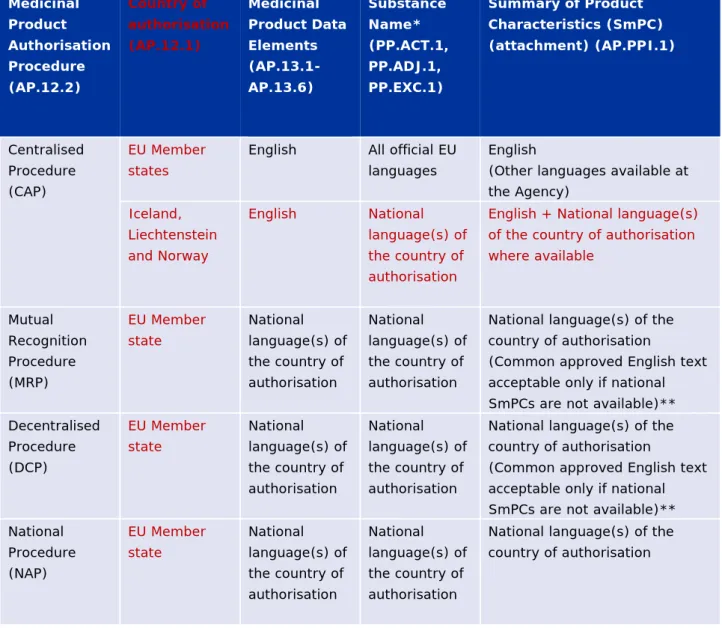
Table 1a- Authorised Medicinal Product – language requirements
Medicinal Product Authorisation Procedure (AP.12.2) Country of authorisation (AP.12.1) Medicinal Product Data Elements (AP.13.1-AP.13.6) Substance Name* (PP.ACT.1, PP.ADJ.1, PP.EXC.1) Summary of Product Characteristics (SmPC) (attachment) (AP.PPI.1) Centralised Procedure (CAP) EU Member statesEnglish All official EU languages
English
(Other languages available at the Agency) Iceland, Liechtenstein and Norway English National language(s) of the country of authorisation
English + National language(s) of the country of authorisation where available Mutual Recognition Procedure (MRP) EU Member state National language(s) of the country of authorisation National language(s) of the country of authorisation
National language(s) of the country of authorisation
(Common approved English text acceptable only if national SmPCs are not available)** Decentralised Procedure (DCP) EU Member state National language(s) of the country of authorisation National language(s) of the country of authorisation
National language(s) of the country of authorisation
(Common approved English text acceptable only if national SmPCs are not available)** National Procedure (NAP) EU Member state National language(s) of the country of authorisation National language(s) of the country of authorisation
National language(s) of the country of authorisation
* Plant Latin binominal names or Latin herbal preparation names of authorised medicinal products if reflected in the SmPC are also acceptable
** When the SmPC in the national language becomes available, it must be provided in the context of the data maintenance, i.e. when the variations lead to changes as listed in section 2.1.8.1. Variations of marketing authorisation.
1.1.1.
Submission of medicinal products authorised in EEA countries
outside the EU
In general Iceland, Liechtenstein and Norway, have, through the EEA agreement, adopted the complete Union acquis on medicinal products and are consequently applying the EU rules governing marketing authorisation procedures (i.e. national, centralised, decentralised and mutual recognition procedures). However, the Commission’s decisions (including decisions granting Marketing
Authorisations) do not directly confer rights and obligations to holders of a marketing authorisation in these countries. The marketing authorisations granted by the European Commission have to be transposed by the competent authorities of Iceland, Liechtenstein and Norway through corresponding decisions on the basis of relevant national laws. In such a case, these marketing authorisations granted in Iceland, Liechtenstein and Norway are legally separate from the Commission’s decision granting MA.
Therefore, separate entries for the marketing authorisations granted in Iceland, Liechtenstein and Norway should be submitted in the XEVMPD under Article 57(2) requirements. For medicinal products authorised in Liechtenstein, Norway and Iceland via the centralised procedure, the applicable country code (i.e. LI/NO/IS) must be specified.
1.1.1.1. Submission of medicinal products authorised in Liechtenstein
It is clarified in theNotice to Applicants (Volume 2A, Chapter 1)that on the basis of a bilateral
agreement between Liechtenstein and Austria automatic recognition of the Marketing Authorisations granted via Mutual Recognition Procedure (MRP) or Decentralised Procedure (DCP) is operational. This allows Liechtenstein to use Marketing Authorisations granted by Austria provided that the applicants have identified Liechtenstein as CMS in the application form submitted with MRP or DCP applications. At the end of the procedures, Austria grants authorisations that are recognised by Liechtenstein. This marketing authorisation can be considered as a marketing authorisation granted in accordance with the pharmaceutical acquis for the purpose of EU legislation.
Therefore the marketing authorisation of these products has to fulfil requirements provided for in, inter
alia, Regulation (EU) 726/2004 and Directive 2001/83/EC.
The attachment to be used for reference in a medicinal product entity is an Austrian SmPC. The data elements AP.13.1 - AP.13.6 must however be provided in German.
In the Notice to Applicants (Volume 2A, Chapter 1) it is also clarified that on the basis of a bilateral agreement between Liechtenstein and Switzerland, a Swiss marketing authorisation is effective in Liechtenstein. This recognition has no effects outside the customs union between Switzerland and Liechtenstein. Consequently, a marketing authorisation granted by the Swiss authorities and
recognised by Liechtenstein, while Switzerland does not apply the EU pharmaceutical acquis, cannot be considered as a marketing authorisation granted in accordance with the pharmaceutical acquis for the purpose of EU legislation and therefore falls outside the scope of, inter alia, Regulation (EU) 726/2004 and Directive 2001/83/EC.
Therefore, marketing authorisations granted by the Swiss authorities and recognised by Liechtenstein fall out of scope of Article 57(2) requirements and do not therefore need to be submitted to the XEVMPD per Article 57(2) requirements.
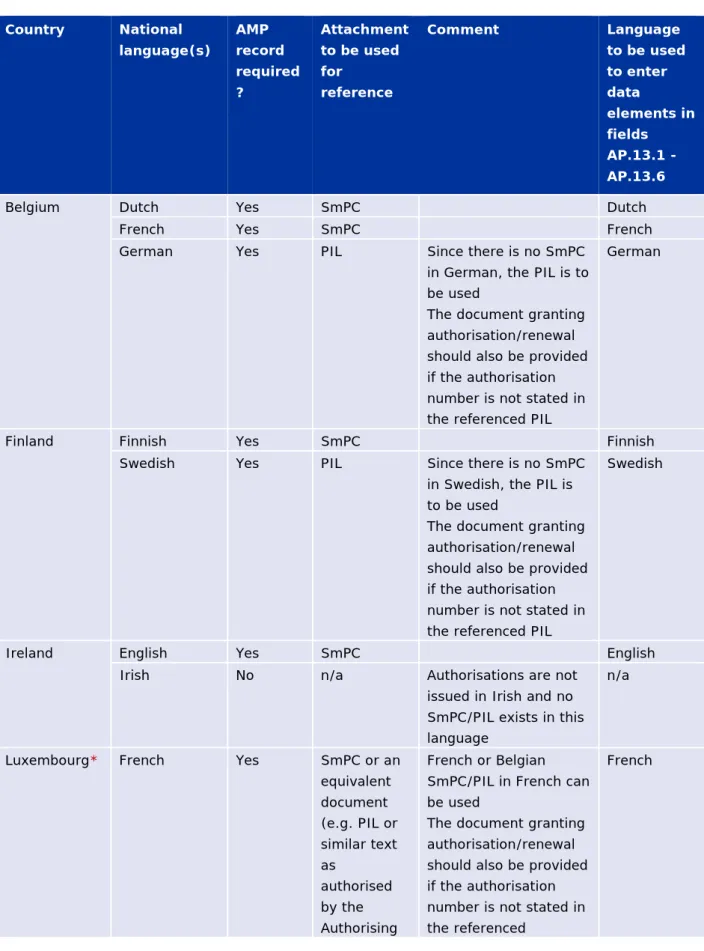
Table 1b - Requirements for AMP records and attachments for countries
with more than one national language
Country National language(s) AMP record required ? Attachment to be used for reference Comment Language to be used to enter data elements in fields AP.13.1 - AP.13.6
Belgium Dutch Yes SmPC Dutch
French Yes SmPC French
German Yes PIL Since there is no SmPC
in German, the PIL is to be used
The document granting authorisation/renewal should also be provided if the authorisation number is not stated in the referenced PIL
German
Finland Finnish Yes SmPC Finnish
Swedish Yes PIL Since there is no SmPC
in Swedish, the PIL is to be used
The document granting authorisation/renewal should also be provided if the authorisation number is not stated in the referenced PIL
Swedish
Ireland English Yes SmPC English
Irish No n/a Authorisations are not
issued in Irish and no SmPC/PIL exists in this language
n/a
Luxembourg* French Yes SmPC or an equivalent document (e.g. PIL or similar text as authorised by the Authorising French or Belgian SmPC/PIL in French can be used
The document granting authorisation/renewal should also be provided if the authorisation number is not stated in the referenced
Country National language(s) AMP record required ? Attachment to be used for reference Comment Language to be used to enter data elements in fields AP.13.1 - AP.13.6 Body) SmPC/PIL German Yes SmPC or an equivalent document (e.g. PIL or similar text as authorised by the Authorising Body) German, Austrian or Belgian SmPC/PIL in German can be used The document granting authorisation/renewal should also be provided if the authorisation number is not stated in the referenced
SmPC/PIL
German
Luxemburgish No n/a Authorisations are not issued in Luxemburgish and no SmPC/PIL exists in this language
n/a
Malta English Yes SmPC The document granting
authorisation/renewal should also be provided if the authorisation number is not stated in the referenced SmPC
English
Maltese No Authorisations are not
issued in Maltese and no SmPC/PIL exists in this language
n/a
* Table 1b covers the scenario when the French as well as the German SmPC/PIL are provided to the Luxembourgish Authority. If MAH have decide to provide only the French SmPC/PIL or only the German SmPC/PIL to the Luxembourgish Authority, then only one product entity referencing the applicable document should be submitted in the XEVMPD.
Where, in exceptional circumstances, the national SmPC for non-centrally authorised products (MRPs/DCPs/NAPs) is not available, a similar text (i.e. the English common text, package information leaflet or other similar text as authorised by the Authorising Body) can be used as an attachment for the submission in the XEVMPD. The data elements AP.13.1 - AP.13.6 must however be provided in the language of the country where the marketing authorisation applies.
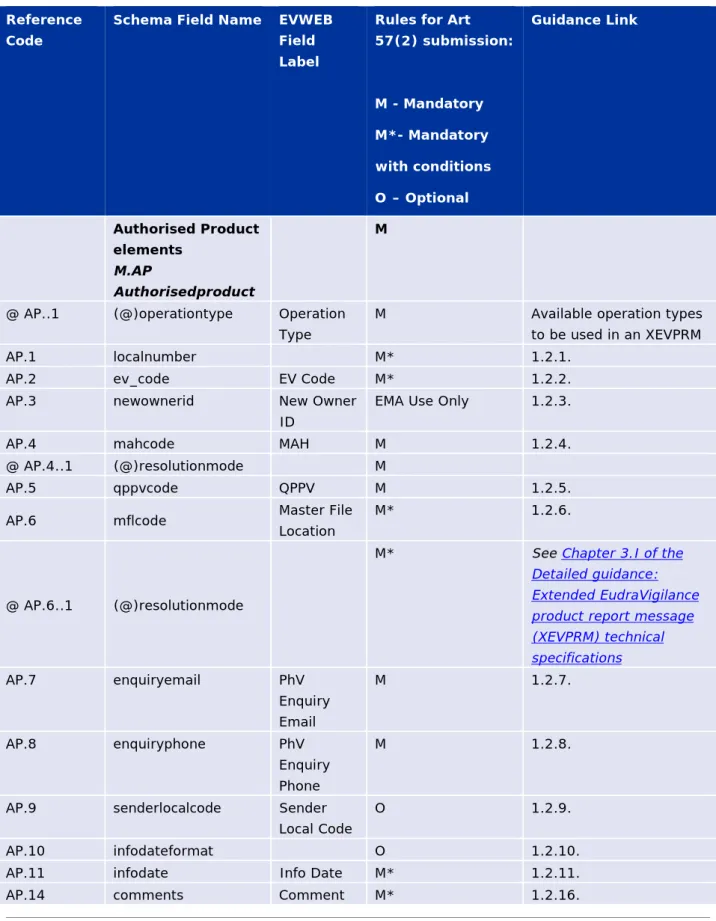
Table 2 - Art 57(2) data element requirements overview for authorised
medicinal product submission
Reference Code
Schema Field Name EVWEB Field Label
Rules for Art 57(2) submission: M - Mandatory M*- Mandatory with conditions O – Optional Guidance Link Authorised Product elements M.AP Authorisedproduct M
@ AP..1 (@)operationtype Operation Type
M Available operation types
to be used in an XEVPRM
AP.1 localnumber M* 1.2.1.
AP.2 ev_code EV Code M* 1.2.2.
AP.3 newownerid New Owner
ID
EMA Use Only 1.2.3.
AP.4 mahcode MAH M 1.2.4.
@ AP.4..1 (@)resolutionmode M
AP.5 qppvcode QPPV M 1.2.5.
AP.6 mflcode Master File
Location
M* 1.2.6.
@ AP.6..1 (@)resolutionmode
M* See Chapter 3.I of the
Detailed guidance: Extended EudraVigilance product report message (XEVPRM) technical specifications AP.7 enquiryemail PhV Enquiry Email M 1.2.7. AP.8 enquiryphone PhV Enquiry Phone M 1.2.8.
AP.9 senderlocalcode Sender
Local Code
O 1.2.9.
AP.10 infodateformat O 1.2.10.
AP.11 infodate Info Date M* 1.2.11.
Authorised Product – Authorisation element AP.12 authorisation M AP.12.1 authorisationcountryc ode Authorisati on Country Code M 1.2.12.1. AP.12.2 authorisationprocedur e Authorisati on Procedure M 1.2.12.2.
AP.12.3 authorisationstatus Authorisati on Status
M 1.2.12.3.
AP.12.4 authorisationnumber Authorisati on Number
M 1.2.12.4.
AP.12.5 authorisationdate Authorisati on/Renewal Date
M 1.2.12.5.
EV Web field label changed from "Authorisation Date" to "Authorisation/Renewal Date" AP.12.6 authorisationdatefor mat M 1.2.12.6.
AP.12.7 mrpnumber MRP/DCP/E
MEA Number
M* 1.2.12.7.
EV Web field label changed from "MRP/DCP Number" to
"MRP/DCP/EMEA Number"
AP.12.8 eunumber EU Number M* 1.2.12.8.
AP.12.13 legalbasis Legal Basis M 1.2.12.13.
AP.12.9 orphandrug Orphan
Drug
M 1.2.12.9.
AP.12.10 Intensivemonitoring Additional Monitoring
O 1.2.12.10.
EV Web field label changed from "Intensive Monitoring" to "Additional Monitoring"
AP.12.11 withdrawndateformat M* 1.2.12.11.
AP.12.12 withdrawndate Invalidated Date
Elements within the Medicinal Product Types element AP.XX medicinalproductty pe
M New element applicable
from June 2014
AP.12.MPTs medicinalproducttype Medicinal Product Types M* 1.2.12.14. Elements within the Authorised Product – Presentation Name element AP.13 presentationname M
AP.13.1 productname Full
Presentatio n Name
M 1.2.13.1.
AP.13.2 productshortname Product Short Name
M* 1.2.13.2.
AP.13.3 productgenericname Product INN/Comm on Name
M* 1.2.13.3.
EV Web Field label changed from "Product Generic Name" to "Product INN/Common Name" AP.13.4 productcompanynam e Product Company Name M* 1.2.13.4.
AP.13.5 productstrength Product Strength Name
M* 1.2.13.5.
AP.13.6 productform Product
Form Name
M* 1.2.13.6.
AP.13.7 packagedesc Package
Description
Elements within the Authorised Pharmaceutical Forms element AP.XX authpharmforms M AP.APF authpharmform M 1.2.14. The Pharmaceutical Product – Active Ingredient element PP.ACT activeingredient M
PP.ACT.1 substancecode Substance Name
M 1.2.17.4.
@
PP.ACT.1..1
(@)resolutionmode M See Chapter 3.I of the
Detailed guidance: Extended EudraVigilance product report message (XEVPRM) technical specifications PP.ACT.2 concentrationtypecod e Amount Value Type M 1.2.17.6. PP.ACT.3 lowamountnumervalu e Low Amount Numerator Value M
(
LowAmount)
Numerator Value
(PP.ACT.3)
PP.ACT.4 lowamountnumerprefi x Low Amount Numerator prefixM (Low Amount) Numerator
Prefix (PP.ACT.4)
PP.ACT.5 lowamountnumerunit Low Amount Numerator Unit
M (Low Amount) Numerator
Unit (PP.ACT.5) PP.ACT.6 lowamountdenomvalu e Low Amount Denominat or Value M (Low Amount) Denominator Value (PP.ACT.6) PP.ACT.7 lowamountdenompref ix Low Amount Denominat or prefix M (Low Amount) Denominator Prefix (PP.ACT.7)
PP.ACT.8 lowamountdenomunit Low Amount Denominat or Unit M (Low Amount) Denominator Unit (PP.ACT.8) PP.ACT.9 highamountnumerval ue High Amount Numerator Value
M* High Amount Numerator
Value (PP.ACT.9) PP.ACT.10 highamountnumerpre fix High Amount Numerator prefix
M* High Amount Numerator
Prefix (PP.ACT.10) PP.ACT.11 highamountnumeruni t High Amount Numerator Unit
M* High Amount Numerator
Unit (PP.ACT.11) PP.ACT.12 highamountdenomval ue High Amount Denominat or Value M* High Amount Denominator Value (PP.ACT.12) PP.ACT.13 highamountdenompre fix High Amount Denominat or prefix M* High Amount Denominator Prefix (PP.ACT.13) PP.ACT.14 highamountdenomuni t High Amount Denominat or Unit M* High Amount Denominator Unit (PP.ACT.14) The Pharmaceutical Product – Adjuvant elements PP.ADJ adjuvant M*
PP.ADJ.1 substancecode Substance Name
M 1.2.17.10.
@
PP.ADJ.1..1
(@)resolutionmode M See Chapter 3.I of the
Detailed guidance: Extended EudraVigilance product report message (XEVPRM) technical specifications PP.ADJ.2 concentrationtypecod e Amount Value Type M Same principle as described in 1.2.17.6.
PP.ADJ.3 lowamountnumervalu e Low Amount Numerator Value M Same principle as described in
(
LowAmount) Numerator
Value (PP.ACT.3)
PP.ADJ.4 lowamountnumerprefi x Low Amount Numerator prefix M Same principle as described in (Low Amount) Numerator Prefix (PP.ACT.4) PP.ADJ.5 lowamountnumerunit LowAmount Numerator Unit
M Same principle as
described in (Low
Amount) Numerator Unit (PP.ACT.5) PP.ADJ.6 lowamountdenomvalu e Low Amount Denominat or Value M Same principle as described in (Low Amount) Denominator Value (PP.ACT.6) PP.ADJ.7 lowamountdenompref ix Low Amount Denominat or prefix M Same principle as described in (Low Amount) Denominator Prefix (PP.ACT.7) PP.ADJ.8 lowamountdenomunit Low
Amount Denominat or Unit M Same principle as described in (Low Amount) Denominator Unit (PP.ACT.8) PP.ADJ.9 highamountnumerval ue High Amount Numerator Value M* Same principle as
described in High Amount
Numerator Value (PP.ACT.9) PP.ADJ.10 highamountnumerpre fix High Amount Numerator prefix M* Same principle as
described in High Amount
Numerator Prefix (PP.ACT.10) PP.ACT.11 highamountnumeruni t High Amount Numerator Unit M* Same principle as
described in High Amount
Numerator Unit (PP.ACT.11) PP.ADJ.12 highamountdenomval ue High Amount Denominat or Value M* Same principle as
described in High Amount
Denominator Value (PP.ACT.12) PP.ADJ.13 highamountdenompre fix High Amount Denominat or prefix M* Same principle as
described in High Amount
Denominator Prefix (PP.ACT.13)
PP.ADJ.14 highamountdenomuni t High Amount Denominat or Unit M* Same principle as
described in High Amount
Denominator Unit (PP.ACT.14) The Pharmaceutical Product – Excipient element PP.EXC excipient M*
PP.EXC.1 substancecode Substance Name
M 1.2.17.8.
@
PP.EXC.1..1
(@)resolutionmode M See Chapter 3.I of the
Detailed guidance: Extended EudraVigilance product report message (XEVPRM) technical specifications PP.EXC.2 concentrationtypecod e Amount Value Type O Same principle as described in 1.2.17.6. PP.EXC.3 lowamountnumervalu e Low Amount Numerator Value O Same principle as described in
(
LowAmount) Numerator
Value (PP.ACT.3)
PP.EXC.4 lowamountnumerprefi x Low Amount Numerator prefix O Same principle as described in (Low Amount) Numerator Prefix (PP.ACT.4) PP.EXC.5 lowamountnumerunit LowAmount Numerator Unit
O Same principle as
described in (Low
Amount) Numerator Unit (PP.ACT.5) PP.EXC.6 lowamountdenomvalu e Low Amount Denominat or Value O Same principle as described in (Low Amount) Denominator Value (PP.ACT.6) PP.EXC.7 lowamountdenompref ix Low Amount Denominat or prefix O Same principle as described in (Low Amount) Denominator Prefix (PP.ACT.7) PP.EXC.8 lowamountdenomunit Low
Amount Denominat or Unit O Same principle as described in (Low Amount) Denominator Unit (PP.ACT.8) PP.EXC.9 highamountnumerval ue High Amount Numerator Value O Same principle as
described in High Amount
Numerator Value (PP.ACT.9)
PP.EXC.10 highamountnumerpre fix High Amount Numerator prefix O Same principle as
described in High Amount
Numerator Prefix (PP.ACT.10) PP.EXC.11 highamountnumeruni t High Amount Numerator Unit O Same principle as
described in High Amount
Numerator Unit (PP.ACT.11) PP.EXC.12 highamountdenomval ue High Amount Denominat or Value O Same principle as
described in High Amount
Denominator Value (PP.ACT.12) PP.EXC.13 highamountdenompre fix High Amount Denominat or prefix O Same principle as
described in High Amount
Denominator Prefix (PP.ACT.13) PP.EXC.14 highamountdenomuni t High Amount Denominat or Unit O Same principle as
described in High Amount
Denominator Unit (PP.ACT.14) The Pharmaceutical Product element PP pharmaceuticalpro duct M PP.1 pharmformcode Administra ble Pharmaceu tical Form M 1.2.17.1.
EV Web Field label changed from
"Pharmaceutical Form" to "Administrable
Pharmaceutical Form"
@PP.1..1 (@)resolutionmode M See Chapter 3.I of the
Detailed guidance: Extended EudraVigilance product report message (XEVPRM) technical specifications Elements within the Authorised Product – Product Indication element AP.IND productindication M
AP.IND.1 meddraversion MedDRA Version
M 1.2.19.1.
AP.IND.2 meddralevel MedDRA
Level
M 1.2.19.2.
AP.IND.3 meddracode MedDRA
Term M 1.2.19.3. The Pharmaceutical Product – Administration Route element PP.AR adminroute M
PP.AR.1 adminroutecode Route Of Administrat ion
M 1.2.17.2.
@ PP.AR.1..1 (@)resolutionmode M See Chapter 3.I of the
Detailed guidance: Extended EudraVigilance product report message (XEVPRM) technical specifications Elements within the Authorised Product – ATC element AP.ATC productatc M
AP.ATC.1 atccode ATC Code M 1.2.18.
@
AP.ATC.1..1
(@)resolutionmode M See Chapter 3.I of the
Detailed guidance: Extended EudraVigilance product report message (XEVPRM) technical specifications The Pharmaceutical Product – Medical Device elements M* PP.MD.1 medicaldevicecode Medical Device M 1.2.17.12.
The Authorised Product – Printed Product Information Attachment element AP.PPI ppiattachment M
AP.PPI.1 attachmentcode Product Attachment
M 1.2.21.1.
@
AP.PPI.1..1
(@)resolutionmode M See Chapter 3.I of the
Detailed guidance: Extended EudraVigilance product report message (XEVPRM) technical specifications
AP.PPI.2 validitydeclaration Validity Declaration
M* 1.2.21.2.
1.2.
Authorised medicinal product - element structure
The below schema shows the individual data fields/sections to be provided for an authorised medicinal product submission.
The XEVPRM field description may differ from EVWEB field description; therefore each field name also references the assigned XEVPRM field code (e.g. AP.13.4, AP.PPI.1). For example:
Field AP.13.1
XEVPRM field description = "productname"
EVWEB field description = "Full Presentation Name"
Field AP.13.3
XEVPRM field description = "productgenericname" EVWEB field description = "Product INN/Common Name"
1.2.1.
Local Number (AP.1)
Unique reference number for an AMP entity in an XEVPRM following an operation type 'Insert' (1) must be assigned.
When an authorised medicinal product is submitted in an XEVPRM with the operation 'Insert' (1), a local number must be assigned to this product. When the XEVPRM Acknowledgement is received, and providing that the submission was successful, this local number should be used to identify the
corresponding EV Code.
EXAMPLE: XEVMPD - Insert of an AMP
EXAMPLE - XEVPRM Acknowledgement received following an insert of an AMP
See also document Quality Control of medicinal product data submitted as per the legal requirement introduced by Article 57(2) of Regulation (EC) No 726/2004 for related information.
1.2.2.
EV Code (AP.2)
EudraVigilance (EV) Code of the authorised medicinal product must be specified if the operation type is NOT an 'Insert' (1).
I.e. if maintenance related operations are performed on an authorised medicinal product entity which was successfully inserted in the XEVMPD, the EV Code of the AMP entity must be referenced in this data field.
1.2.3.
New Owner ID (AP.3)
This field is reserved for EMA use only.1.2.4.
Marketing Authorisation Holder (MAH) code (AP.4)
Marketing Authorisation Holder code corresponding to the legal entity of the medicinal product in a given country as indicated in section 7. Marketing Authorisation Holder of the SmPC must be specified.
• If the MAH organisation was previously successfully submitted in the XEVMPD and an MAH organisation EV Code had been assigned, the MAH can be selected from the available
EudraVigilance look-up table (EVWEB users). Gateway users should populate the 'MAH code' field (AP.4) with the assigned organisation EV Code received in the XEVPRM Acknowledgement. List of available MAH organisations with their assigned EV Codes can be found in the XEVMPD look-up table, and in the Controlled Vocabulary (CV) lists published on the Agency's website - see "eXtended Eudravigilance Product Dictionary (XEVMPD) organisations".
See also section 1.6. Initial Submission of a Marketing Authorisation Holder (MAH) Organisation of this document for related information.
NOTE 1
The MAH XEVMPD look-up table and the published Organisation CV list are different from the list of organisations registered in EudraVigilance. The list of organisations registered with Eudravigilance is the list of all registered stakeholders (Regulators, Pharmaceutical Industry and Sponsors) and is accessible to registered users in the restricted area of the EudraVigilance Human website.
The "Extended EudraVigilance product report message (XEVMPD) Organisations" list available as part of the Controlled Vocabularies published on the Agency's website contains details of the marketing authorisation holder organisations available in the XEVMPD. These organisation entities should be referenced as applicable in the medicinal product information submitted.
• If the MAH organisation entity does not exist in the XEVMPD, the MAH information can be added using the Organisation section of the XEVPRM. See section 1.6. Initial Submission of a Marketing Authorisation Holder (MAH) Organisation of this document for further information on how to submit
an MAH organisation in the XEVMPD.
1.2.5.
Qualified Person responsible for Pharmacovigilance (QPPV) code
(AP.5)
The QPPV code of the QPPV responsible for the authorised medicinal product must be specified.
• The EU QPPV, and where such does not exist, the local QPPV/Responsible person (e.g. for purely national authorisations) should register with EudraVigilance. Following the registration, a QPPV Code is assigned. The QPPV code is maintained by the Agency’s EudraVigilance (EV) Registration Team and can be retrieved from:
− The EudraVigilance website (restricted area accessible for registered users only) under "QPPV list" (by Gateway/EVWEB users) or;
− EudraVigilance look-up table in the XEVMPD Data Entry Tool (EVWEB) (by EVWEB users). • If the requested QPPV does not exist in the XEVMPD, MAH shall contact the EudraVigilance
Registration Team to register the requested QPPV in EudraVigilance.
See section 1.3. Initial submission of a QPPV information of this document for further information on how to submit QPPV information in the XEVMPD.
MAHs must ensure that the QPPV Code referenced in their AMPs is a valid QPPV Code referring to a current QPPV (e.g. the QPPV Code is not "retired" in the EV Registration database).
1.2.6.
Pharmacovigilance System Master File Location (PSMFL) code (AP.6)
The Pharmacovigilance System Master File Location (PSMFL) code of the place where the PSMF for the authorised medicinal product is located must be specified if the PSMFL information was submitted in the XEVMPD and the PSMFL Code is available.MFL EV Code is a unique code assigned by the eXtended EudraVigilance Medicinal Product Dictionary (XEVMPD) to a specific PSMF and PSMF location.
• If the Master File Location information was previously successfully submitted in the XEVMPD and a PSMFL EV Code had been assigned, the PSMFL can be selected from the available EudraVigilance look-up table (EVWEB users). Gateway users should populate the 'MFL' field (AP.6) with the assigned MFL EV Code received in the XEVPRM Acknowledgement.
• If the required Master File Location was not inserted in the XEVMPD, the Master File Location information can be added using the Master File Location section of the XEVPRM.
Further information on what triggers the request of PSMFL EV Code and how to submit MFL information in the XEVMPD are available in section 1.11. Initial submission of a Pharmacovigilance System Master File Location (PSMFL) of this document.
1.2.7.
Pharmacovigilance enquiry email (AP.7)
The email address where enquiries related to Pharmacovigilance can be submitted must be specified.
The marketing authorisation holder needs to decide, which email address they wish to specify for dealing with Pharmacovigilance enquiries. The contact information for Pharmacovigilance enquires (e-mail and phone) will be made public by the Agency.
1.2.8.
Pharmacovigilance enquiry phone (AP.8)
The phone number where enquiries related to Pharmacovigilance can be directed must be specified.
The marketing authorisation holder needs to decide, which phone number they wish to specify for dealing with Pharmacovigilance enquiries. It may be the same as the phone number of the QPPV. The contact information for Pharmacovigilance enquires (e-mail and phone) will be made public by the Agency.
1.2.9.
Sender local code (AP.9)
The sender local code for the authorised medicinal product used by the marketing authorisation holder for internal reference purposes may be specified.
The sender local code specified by the MAH is not used in the XEVMPD for maintenance; it can be any technical code.
1.2.10.
Info date format (AP.10)
Format of the info date should correspond to "102" for "CCYYMMDD".
1.2.11.
Info date (AP.11)
The date when the lifting of suspension of a marketing authorisation becomes effective must be specified when "Authorisation Status" changes from "Valid - Suspended" to any "Valid" status.
"Info date" field (AP.11) is linked to the "Authorisation status" information.
When the "Authorisation status" (AP.12.3) changes from "Valid – Suspended (2)" to: − Valid (1); or
− Valid – Renewed/Varied Marketing Authorisation (8); or − Valid - Transferred Marketing Authorisation (9);
the data element in "Info date" field (AP.11) should indicate the date when the lifting of the suspension of a marketing authorisation becomes effective.
1.2.12.
AMP - Authorisation details element structure (AP.12)
1.2.12.1. Authorisation country code (AP.12.1)
The country code of the country of authorisation must be specified.
The country code is to be specified using the ISO-3166-1 standard. The official list of ISO 3166-1 country codes is maintained by the International Organization for Standardization (ISO).
• For medicinal products authorised via centrally authorised procedure, "European Union (EU)" should be specified.
− However, for medicinal products authorised in Liechtenstein, Norway and Iceland via the centralised procedure, the applicable country code (i.e. LI/NO/IS) must be specified.
• For medicinal products authorised via national or MRP/DCP procedure, the applicable EEA country should be specified.
• For medicinal products authorised via a non-EU authorisation procedure, a non-EEA country should be specified. Medicinal products authorised via a non-EU procedure are submitted in the XEVMPD on voluntary basis. Such products are not within the scope of Article 57(2) requirements.
NOTE 2
• For United Kingdom, the code "GB" should be used as the officially assigned code in accordance with the ISO country codes.
"UK" is a "reserved code" assigned at the request of national ISO member bodies, governments and international organizations. This applies to certain code elements required in order to support a particular application, as specified by the requesting body and limited to such use; any further use of such code elements is subject to approval by the ISO 3166/MA. More information about reserved codes can be found on the ISO website.
• For Greece, the code "GR" (not "EL") should be used as the officially assigned code in accordance with the ISO country codes.
1.2.12.2. Authorisation procedure (AP.12.2)
The procedure through which the medicinal product was authorised must be specified. List of available authorisation procedure values can be found in the XEVMPD look-up table and in the Controlled Vocabulary (CV) lists published on the Agency's website - see "eXtended Eudravigilance
Product Dictionary (XEVMPD) authorisation procedures".
• EU authorisation procedures - Centralised Procedure (1): to be selected when entering centrally authorised medicinal product.
The authorisation country code (AP.12.1) must be specified as "EU".
However, for medicinal products authorised in Liechtenstein, Norway and Iceland via the centralised procedure, the applicable country code (i.e. LI/NO/IS) must be specified. See the Commission's websitefor information on the centralised procedure.
• EU authorisation procedures - Mutual Recognition Procedure (3): to be selected when entering mutually recognised medicinal product and in case of repeat-use procedure.
The authorisation country code (AP.12.1) must be specified as one of the EEA countries. See the Commission's websitefor information on the mutual recognition procedure. • EU authorisation procedures - National Procedure (4): to be selected when entering
nationally authorised medicinal products.
The authorisation country code (AP.12.1) must be specified as one of the EEA countries. • EU authorisation procedures - Decentralised Procedure (7): to be selected when entering
medicinal product authorised via decentralised procedure.
The authorisation country code (AP.12.1) must be specified as one of the EEA countries. See the Commission's websitefor information on the decentralised procedure.
NOTE 3
In case of volunteer submission of medicinal product falling outside the scope of Article 57(2) requirements, and for which a marketing authorisation is not granted (e.g. herbal medicinal product with no registration), the value "EU authorisation procedures - National Procedure (4)" should be selected.
− Indication of the legal basis or the medicinal product type must be provided in data fields "Legal Basis" (AP.12.13) and "Medicinal Product Type" (AP.12.MPTs).
− The "Authorisation country code" (AP.12.1) must be specified as one of the EEA countries.
• Non EU authorisation procedure (5): to be selected when entering medicinal products authorised outside the EEA.
The authorisation country code (AP.12.1) must not be specified as "EU" or any of the EEA countries.
• EU authorisation procedures - Traditional use registration for herbal medicinal products (11): to be selected when entering herbal medicinal products registered under the Traditional Herbal Medicines Registration Scheme.
The authorisation country code (AP.12.1) must be specified as one of the EEA countries. • EU authorisation procedures - Simplified registration procedure for homeopathic medicinal products (12): to be selected when entering homeopathic medicinal products registered via the simplified registration procedure.
The authorisation country code (AP.12.1) must be specified as one of the EEA countries.
1.2.12.3. Authorisation status (AP.12.3)
The status of the authorisation of a medicinal product must be specified.
The information stated in this field does not refer to the marketing status (i.e. marketed/not marketed).
List of available authorisation status values can be found in the XEVMPD look-up table and in the Controlled Vocabulary (CV) lists published on the Agency's website - see "eXtended Eudravigilance
Product Dictionary (XEVMPD) authorisation status".
• Valid (1): applicable to a medicinal product for which the marketing authorisation is valid.
• Valid - Suspended (2): applicable to a medicinal product for which the marketing authorisation is suspended. When the suspension has been lifted, the status of the medicinal product should be changed either to a "valid" status or to a "not valid" status (e.g. revoked or withdrawn) as applicable.
• Not valid - Withdrawn by marketing authorisation holder (3): applicable to a medicinal product for which the marketing authorisation has been withdrawn by the marketing authorisation holder.
• Not valid - Revoked by Competent Authority (4): applicable to a medicinal product for which the marketing authorisation has been revoked by a Competent Authority/European Commission. • Not valid - Not renewed by Competent Authority (5): applicable to a medicinal product for
which the marketing authorisation has not been renewed by the Competent Authority/European Commission.
• Not valid - Not submitted for renewal by marketing authorisation Holder (6): applicable to medicinal product for which the marketing authorisation holder did not submit a request for
renewal.
• Not valid - Expired due to Sunset Clause (7): applicable to medicinal product for which the marketing authorisation has expired due to the Sunset Clause.
• Valid – Renewed/Varied Marketing Authorisation (8): applicable to medicinal product for which the marketing authorisation has been renewed or varied and a new marketing authorisation number has been assigned by the National Competent Authority.
• Valid - Transferred Marketing Authorisation (9): applicable to medicinal product for which the marketing authorisation was transferred from one marketing authorisation holder to another.
This authorisation status is to be used by the new MAH as part of the transfer of marketing authorisation process.
• Not Valid – Superseded by Marketing Authorisation Renewal/Variation (10): applicable to