STRUCTURE AND CLASSIFICATION OF INTANGIBLE ASSETS
IN INDUSTRIAL ENTERPRISES
Katherine Anokhina
*1. Introduction
At the rapid development of STP a steady increase in the value immaterial resources of the company’s activities can be observed. At the end of the 19th century, economists noted that the performance of enterprises depends not from material components such as instruments and objects of labor, financial and human resources but from immaterial components, namely: inventions, know-how, business contacts, reputation and brand awareness, and so on.
The Organization for Economic Cooperation and development notes that in many countries, investments in intangible assets exceeds growth in more traditional form of capital, namely machinery, equipment and buildings. Available data for several countries demonstrates the rapid growth of interest in intangible resources. In the UK, investments in intangible assets increased by more than 2 times between 1970 and 2004. Recent studies demonstrate annual investments in intangible assets in the United States in the amount of 800 billion and 1 trillion dollars. Thus the positive trend of involvement of intangible assets in the enterprise value can be traced for many years.
Despite the relevance of the choice of research topics, many theoretical and methodological issues related to intangible resources are still not disclosed. The issues relating to terminological-conceptual nature and classification features require a more detailed analysis.
Despite the large number of scientific works which are devoted to IR (intangible resources) and classification of assets, there is no unity among scientists about establishing their composition by types. Most scholars who work on IR issues, anyway, use in their researches the achievements of the authors who have made a significant contribution to exploring issues and the nature of intellectual capital. J. Daum and H. Bontis are no exception representing intangible assets through the classification of intellectual capital, and thus seek to cover as many components that are not captured by accounting statements.
2. The main material research
G. Ahonin and T. Hassi divided intangible assets into two types: generating (those that create value) and commercial (those which are used in trade, commercial purposes, may produce income). The first group includes human capital, internal and external structure. The second – intangible property rights [1, p.277–286].
T. O. Garanina [2, p.10–11] believes that intangible assets, intangibles and intellectual capital are interchangeable. The author finds that it is unlawful to narrow immaterial assets only to those recognized in the accounting. Therefore their composition must provide two subgroups: those that are recognized and not recognized in the financial statements.
In his work G. G. Azhaldov and N. N. Karpova divide intangible assets to intellectual property objects, organizational costs, expenses for purchasing licenses for natural resources management, cost of research and development work, know-how and business reputation (Fig. 1) [3, p.163].
Fig. 1. Composition of intangible assets according G. G. Azhaldov and N. N. Karpova (compiled by the author on materials [3, p.163])
Undoubtedly, such a vision simplifies evaluation of intangible assets, because assessment is carried out taking into account all legal norms and normative documents used in business. However, targeting only the most common components can not reveal all the hidden possibilities of the company and involve them to work and increase the capitalization of the company. Moreover, the present classification contains a clear guidance on cost approach in assessing components of intangible assets, but there are other methods of valuation of IA, therefore we should not exclude them in the classification as those that do not meet requirements.
The classification of intangible assets of R. Reilly and R. Schweis [4, p.29] is currently the widest. Unlike IFRS 3 and FASB classification (where the number of groups is five), this classification is composed of ten groups, namely: intangible assets associated with marketing (trademarks, trade names, brand names, logos, colors); intangible assets related to technology (patents: patents on technological processes, patents on business methods, technical documentation, laboratory logs, technical know-how); intangible assets related to creative activity (literature works and copyrights on them, musical works, publishing rights, photographs, maps, prints); intangible assets related to data processing (proprietary software, copyrights on software, computerized databases, integrated circuits, microchips and their templates); intangible assets related to engineering activities (industrial designs, patents on products, trade secrets, blueprints and diagrams, corporate records, projects, technical know-how); intangible assets related to customers (customer lists, customer contracts, customer relationships, open purchase orders); intangible assets related to contracts (lucrative contracts with suppliers, licensing agreements, franchise agreements, subscription rights, futures contracts); intangible assets related to human capital (skilled labor force and wages, contracts, agreements with unions, employment contracts); intangible assets associated with the land (lease rights, rights for subsoil use, easements, rights for airspace, rights for water space);
Intangible assets of the enterprise
Intellectual Property
Organizational costs
Goodwill
The costs on licenses acquiring for natural resources, the cost on
R&D, know-how - inventions; - utility models; - industrial designs; - trademarks; - service marks; - appellations of origin; - computer programs; - database; - topology of integrated circuits; - selection achievements.
intangible assets related to “goodwill” (goodwill of organization, goodwill of professional practice, personal professional reputation, the total value of the business as a going concern).
M. Yashchensky and N. V. Dyukova divide the perspective of components of intangible assets of R. Reilly, R. Schweis and consider it as the best of the existing ones [5, p.63]. However, the authors note that, unfortunately, it is not optimal or complete. As the disadvantage of this classification can be considered a duplication of certain groups, such as: intangible assets related to technologies and engineering activities or intangible assets related to customers and contracts. The components of these groups are very closely linked and such classification can cause a repeat or ambiguity to which group a particular object should be included.
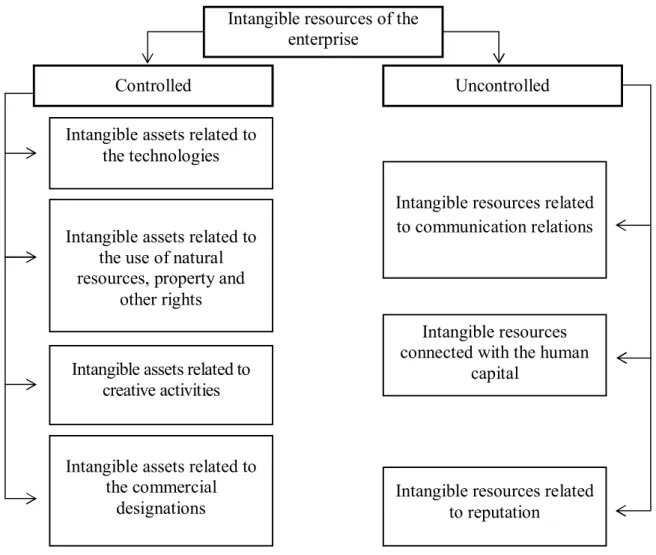
Based on these principles the author’s classification of the company’s immaterialities was formed (Fig. 2). As intangible assets, even with the inclusion of goodwill, do not include all the intangible components of the company’s activities, it was decided to analyze the composition of the company’s intangibles based on the category of “intangible resources”. IR consist of identified, controlled by the company and uncontrolled by the company. Identified and controlled by the company IR are the intangible assets of the company and include all the intangible assets that are approved in the P(S)BO No. 8. The difference of composition of groups of intangible assets by the author’s classification from composition of groups of IA by the accounting standard is to unite the three groups (the right to use natural resources, the right to use property and other intangible assets) in one “Intangible assets related to the use of natural resources, property and other rights” group. This is due to a similar economic essence of these IR components. They create additional immaterial opportunities for the company related to the use of material objects that do not belong to them.
All other intangible components of activity which are uncontrollable by the company, to which there were no property rights, were attributed to the group of “Uncontrolled intangible resources”. Uncontrolled IR include elements of human and communication capital, as well as goodwill (Fig. 2). Let’s consider in more detail the composition of IR and assets of companies according to the author’s classification and let’s start from controlled intangible assets.
Intangible assets related to the technologies are attributed to industrial property object, namely patents on technological processes, patents on business methods, proprietary software, patents on products, unpatented objects; technical documentation: laboratory logs, technical know-how; industrial designs, trade secrets, blueprints and diagrams, corporate records, domain names, address, website design and more.
The second subgroup consists of intangible assets related to the use of natural resources, property and other rights, such as lease rights, rights for subsoil use, easements, rights for air space, rights for water space, right for land use, building, rights for rent, right for use of other property (except the right of permanent land use), right to engage in activities, royalties agreements, leasing (rental) agreements, license agreements, franchise agreements, construction permit, use of economic and other benefits and so on.
The composition of intangible assets related to creative activities include rights for intellectual property such as literature, art, music, computer programs, compiling data (data bases), performance, phonogram, videogram, transmission (program) of broadcasting organizations and others.
The last, fourth group of intangible assets includes the assets related to the commercial designations, such as trademarks, rights to the name of a business entity that is used in the agreements, signs, ads, advertising, accounts or letterheads, trademark (brand) names, logo, used color and shape and so on.
Fig. 2. Classification of intangible resources
The second IR group of the company are those that cannot be controlled by the company and for which the ownership rights cannot be registered, respectively they cannot be sold and classified as intangible assets of the company. The first subgroup consists of IR related to communication relationships, as a part of which the following intangible resources of the company are considered: contracts with suppliers, futures contracts, customer lists, customer contracts, customer relationships, agreements with unions and others.
The second IR subgroup that are not controlled by the company are the IR connected with the human capital of the company. It consists of management processes, management philosophy, management culture, systems of organization, planning, analysis and control of the company, qualification, education, knowledge, competence, entrepreneurial and innovative capacity of the labor force, employment contracts.
The last third subgroup of the uncontrolled IR consists of the IR related to reputation, namely the history of the organization, reputation and image.
Thus, the author’s classification of IR of the company provides for the allocation of a separate sub-group of resources that can be controlled by the company. Controlled, proprietary IR are suggested to be identified with intangible assets of the company. Herein the goodwill, human, organizational, communication capital, as components of IR cannot be controlled by the company, they can not be registered into ownership, consequently, they can not be integrated to the assets of the company or sold separately from the company. This means that goodwill, human, organizational, communication capital cannot be attributed to intangible assets compose a separate IR group.
Intangible assets related to the commercial
designations
Intangible assets related to the technologies
Intangible assets related to creative activities
Intangible resources related to communication relations Intangible assets related to
the use of natural resources, property and
other rights
Intangible resources related to reputation
Intangible resources of the enterprise
Uncontrolled Controlled
Intangible resources connected with the human
3. Conclusion
Thus, in the process of historical development of the productive forces, there were changes in their composition and structure. Leading positions among other resources were held by raw material, logistical, financial and human resources. Recently intangible components of the company’s activities acquired a great significance as a part of the resources. It is thanks to the latest technologies, commercial designations, human capital, goodwill and other intangible components, companies are able to take advantage in the competition. In the leading economies of the world the intangible resources of the companies has exceeded the material in value.
Scientists believe that the Ukrainian economical lag in comparison with the leading countries is caused by a low level of intangible resources of domestic companies. Thus, further research should focus on improving the level of development and efficiency of the use of intangible resources of the companies, which gives place to the qualitative development of the Ukrainian economy.
References
1. Hussi T. Managing intangible assets – a question of integration and delicate balance / T. Hussi, G. Ahonen // Journal of Intellectual Capital. – 2002. – Vol. 3. – № 3. – Pp. 277–286.
2. Гаранина Т. А. Интеллектуальный капитал организации как фактор создания ценности бизнеса: определение, оценка и управление: автореф.дис. на соискание науч. степени канд. экон. наук: спец. 08.00.05 «Экономика и управление народным хазяйством» / Т. А. Гаранина. – Санкт-Пербург, 2009. – 26 с. 3. Азгальдов Г. Г. Оценка стоимости интеллектуальной стоимости и нематериальных активов / Г. Г. Азгальдов, Н. Н. Карпова. – М.: Международная Академия Оценки и Консалтинга, 2006. – 400 с. 4. Рейли Р. Оценка нематериальных активов / Р. Рейли, Р. Швайс. – М.: Квинто-консалтинг, 2005. – 761 c. 5. Ященский М. Структура и функции нематериальных активов в экономике знаний [Электронный ресурс] / М. Ященский, Н. В. Дюкова. – Экономика предприятия. – 2010. – № 3–4. – С. 60–65. – Режим доступа: http://pk.napks.edu.ua/library/compilations_vak/ eiu/2010/3_4/p_60_65.pdf.
Summary
In this article, the author attempts to identify and analyze the main prerequisites of agro-industrial integration in Ukraine at the institutional level: the institutional environment and transaction costs; forms and mechanisms of interaction between the participants, the measures of state support. The implicit constraints of integration processes in the investigated area were examined.
A combined approach to a reasonable assessment of the benefits of integration was proposed. Finding a balance between the obvious economic interests and implicit constraints will actively involve farmers in the integration processes and thus contribute to the removal of the domestic agricultural sector out of the crisis.
Keywords: integration, the agro-industrial complex, the institutional environment, taxation.
JEL classification: O320
![Fig. 1. Composition of intangible assets according G. G. Azhaldov and N. N. Karpova (compiled by the author on materials [3, p.163])](https://thumb-us.123doks.com/thumbv2/123dok_us/947722.2623398/2.892.137.815.103.576/composition-intangible-assets-according-azhaldov-karpova-compiled-materials.webp)