Program Analysis Based Approaches to Ensure Security
and Safety of Emerging Software Platforms
by Yunhan Jia
A dissertation submitted in partial fulfillment of the requirements for the degree of
Doctor of Philosophy
(Computer Science and Engineering) in The University of Michigan
2018
Doctoral Committee:
Professor Z. Morley Mao, Chair Professor Atul Prakash
Assistant Professor Zhiyun Qian, University of California Riverside Assistant Professor Florian Schaub
ACKNOWLEDGEMENTS
Five years have passed since I moved into the Northwood cabin in Ann Arbor to chase my dream of obtaining a Ph.D. degree. Now, looking back from the end of this road, there are so many people I would like to thank, who are an indispensable part of this wonderful journey full of passion, love, learning, and growth.
Foremost, I would like to gratefully thank my advisor, Professor Zhuoqing Morley Mao for believing and investing in me. Her constant support was a definite factor in bringing this dissertation to its completion. Whenever I got lost or stucked in my research, she would always keep a clear big picture of things in mind and point me to the right direction. With her guidance and support over these years, I have grown from a rookie to a researcher that can independently conduct research.
Besides my advisor, I would like to thank my thesis committee, Professor Atul Prakash, Professor Zhiyun Qian, and Professor Florian Schaub for their insightful suggestions, com-ments, and support.
I am grateful to Jie Hui, Samsung Kwong, Alex Yoon, Kranthi Sontineini from T-Mobile, who have gaven me tremendous support during my first paper submission. I also want to thank other collaborators I have fortunately worked with, Zhi Xu, Xiao Zhang, Cong Zhen, Claud Xiao, Wenjun Hu, David Choffnes, Kevin Lau, Professor Harsha V. Madhyastha and Professor Henry Liu, for their advice and support throughout this journey. This journey would have never been the same without my close friends Qi Alfred Chen, Yuru Roy Shao, and Ding Zhao, who always helped and pushed me through project after project. Alfred’s deep love in research, Roy’s Diligence, Ding’s vision and interdisciplinary
knowledge helped me build my character, and added new dimensions to my work.
I’m also grateful to my fiends and colleagues Hongyi Yao, Yihua Guo, Haokun Luo, Yuanyuan Zhou, Sanae Rosen, Ashkan Nikravesh, Mehrdad Moradi, Shichang Xu, Ke David Hong, Yikai Lin, Chao Kong, Xiao Zhu, Jie You, Yulong Cao, Shengtuo Hu, Boyu Tian, Earlence Fernandes, Amir Rahmati, Dongyao Chen.
Finally, I thank my father, Xinsheng Jia, mother, Xinzhi Xue, cousin, Xuejing Lin, and my girlfriend Xiyu Hu for being the constant pillars of support in my life. Their unconditional love and support helped me bring this adventure to its end. This dissertation is dedicated to them.
I would also like to acknowledge the NSF grants 1318306, 1526455, CNS-1345226, CNS-1318722, CNS-1059372, CNS-1318306, and the Naval Research grant N00014-14-1-0440 for the support of my research.
TABLE OF CONTENTS
DEDICATION . . . ii
ACKNOWLEDGEMENTS . . . iii
LIST OF FIGURES . . . viii
LIST OF TABLES . . . x
ABSTRACT. . . xi
CHAPTER I. Introduction . . . 1
1.1 Problems . . . 1
1.1.1 Flaws being inevitable in software development and are non-trivial to detect . . . 3
1.1.2 Insufficient and coarse-grained permission system. . . . 4
1.1.3 Security always being an afterthought. . . 4
1.2 Contributions . . . 5
1.2.1 Understanding and Detecting Open Port Vulnerability on Mobile Device . . . 6
1.2.2 Enforcing Contextual Integrity on Appified IoT Platform 7 1.2.3 Providing Efficient Dynamic Testing Support to Self-driving Functionalities . . . 8
II. Understanding and Detecting Open Port Vulnerability on Mobile Device 10 2.1 Introduction . . . 10
2.2 Background and Threat Model . . . 14
2.3 Design Pattern of Open Port Apps . . . 15
2.4 OPAnalyzer Approach . . . 17
2.4.1 Entry Point Analysis . . . 18
2.4.3 Sensitive API Selection . . . 20
2.4.4 Usage Path Analysis . . . 22
2.4.5 Evaluation . . . 26
2.5 Usage and Vulnerability . . . 29
2.5.1 Popularity and Permission Usage . . . 29
2.5.2 Usage Family Categorization . . . 31
2.5.3 Security Implications . . . 33
2.6 Exploits Case Studies . . . 34
2.6.1 Intended for Use by App Users . . . 35
2.6.2 Intended for Communication with Backend . . . 35
2.6.3 Intended for Local Communication . . . 36
2.7 Mitigation Strategy . . . 37
2.8 Related Work . . . 41
2.9 Conclusion . . . 42
III. Enforcing Contextual Integrity on Appified IoT Platform . . . 43
3.1 Introduction . . . 43
3.2 Related Work and Background . . . 48
3.2.1 IoT Security . . . 49
3.2.2 Background . . . 50
3.3 Threat Model and Problem Scope . . . 52
3.4 Attack Taxonomy . . . 53
3.4.1 Reported IoT Attacks . . . 53
3.4.2 Migrated from The Smartphone Platforms . . . 56
3.5 ContexIoT Design . . . 62
3.5.1 Context Definition . . . 62
3.5.2 ContexIoT Approach . . . 64
3.5.3 Comparison with Other Context-based Security Ap-proaches . . . 67
3.6 Implementation . . . 69
3.6.1 SmartApp Patching Implementation . . . 69
3.6.2 End-to-End Implementation. . . 74
3.7 Evaluation . . . 75
3.7.1 Effectiveness of Secure Logic Patching . . . 77
3.7.2 Permission Request Frequency . . . 77
3.7.3 Runtime Performance . . . 79
3.8 Usage Discussion . . . 80
3.9 Conclusion . . . 81
IV. Providing Efficient Dynamic Testing Support to Self-driving Func-tionalities. . . 82
4.1 Introduction . . . 82
4.2.1 Autonomous Vehicle Platform Design . . . 87
4.2.2 A Motivating Example . . . 88
4.3 Related Work . . . 90
4.3.1 Guided Fuzzing . . . 90
4.3.2 Whitebox Fuzzing . . . 92
4.4 The AutoFuzzer Approach . . . 93
4.4.1 Problem Scope . . . 93
4.4.2 Fuzzing . . . 95
4.4.3 AutoFuzzer Overview . . . 97
4.4.4 Design and Implementation . . . 97
4.5 Evaluation . . . 100
4.6 Discussion and Future Work . . . 102
4.6.1 Providing Root Cause Analysis Support . . . 102
4.6.2 Extending domain-specific mutations . . . 102
4.6.3 Naturalistic trace driven testing . . . 103
4.7 Conclusion . . . 104
V. Future Work & Conclusion . . . 106
5.1 Future Work . . . 106
5.1.1 Usability Research on Context-based Access Control . . 106
5.1.2 Fuzz Testing for Self-driving Functionality with Deep Learning Components . . . 107
5.1.3 Verification Support for Self-driving Functionality . . . 108
5.2 Concluding Remarks . . . 108
LIST OF FIGURES
Figure
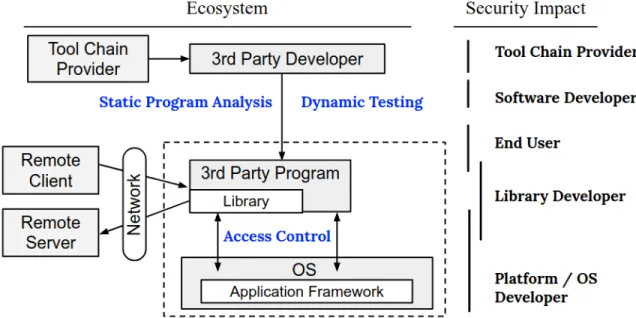
1.1 The three program analysis approaches we take in this thesis to ensure
platform safety and security . . . 6
2.1 Design pattern of open port Android app . . . 16
2.2 OPAnalyzer approach overview . . . 18
2.3 Snippet from real app showing control-flow jump from the native code layer (Left) to the application layer (Right). . . 19
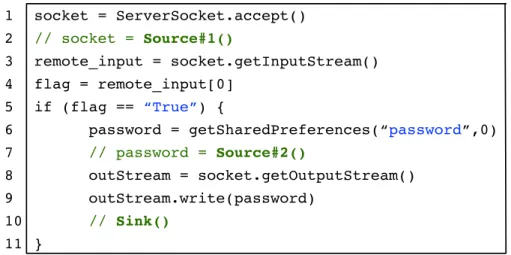
2.4 An example for implicit and explicit taint logic. . . 22
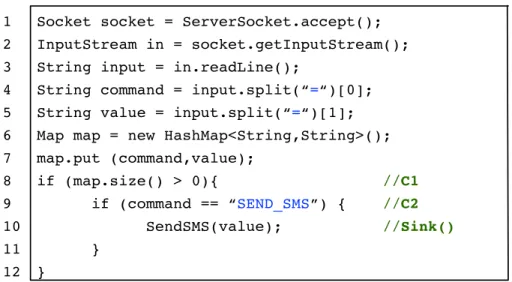
2.5 Sample app code showing that sensitive API is protected by constraints . . 23
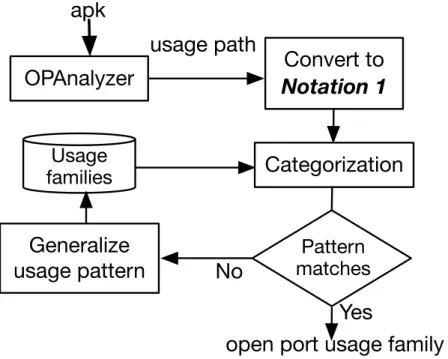
2.6 Usage categorization methodology . . . 25
2.7 Permission protected APIs triggered by remote input. . . 30
2.8 SecureServerSocket design . . . 39
3.1 SmartThings architecture overview . . . 50
3.2 Code snippet of surveillance disabling attack . . . 58
3.3 Code snippet of pin code snooping attack . . . 60
3.4 Code snippet of remote control attack . . . 61
3.5 ContexIoT overview with a concrete example showing our context-based access control . . . 64
3.6 Code snippet showing how the surveillance disabling attack app is patched with the ContexIoT secure logic . . . 70
3.7 Screenshots showing the benign and attack context in the malicious Au-toLockDoor app . . . 76
3.8 CDF of the estimated life-time permission request prompts for 283 com-modity SmartApps patched by ContexIoT . . . 78
3.9 Breakdown of the end-to-end event trigger latency with and without Con-texIoT patching on virtual and physical devices . . . 80
4.1 SAE 6 levels of Autonomous Vehicles . . . 83
4.2 Traditional physical CAN bus vehicle platform . . . 84
4.3 Virtual CAN bus design of emerging autonomous vehicle . . . 85
4.4 Example message received by controller module of Apollo AV platform . 85 4.5 The open-access automated vehicle of at the University of Michigan . . . 87
4.6 Code snippet of a working path following app . . . 89 4.7 Example of improper dynamic controller that led to out-of-control failure 90
4.8 Apollo self-driving platform architecture . . . 94
4.9 The workflow of AFL . . . 96
4.10 AutoFuzzer design . . . 98
4.11 The mutation engine of AutoFuzzer . . . 99
4.12 Running the mutated trace with inserted obstacles in our simulation . . . 100
4.13 Produced unique crashes over time . . . 101
4.14 Produced unique hangs over time . . . 101
LIST OF TABLES
Table
1.1 Overview of emerging platforms covered in this proposal . . . 5 2.1 OPAnalyzer output for three popular “Wormhole” apps that are reported
vulnerable . . . 26 2.2 Evaluation of accumulative improvement brought by (1) handling explicit
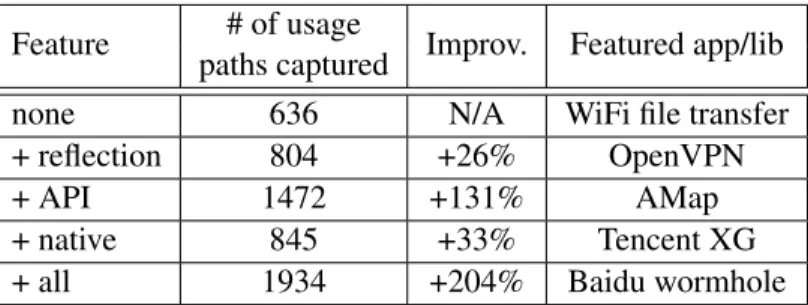
Java reflection and (2) adding open-port specific sensitive API (3) captur-ing native code jump. . . 28 2.3 Open port usage and potential vulnerability. V1:sensitive data leakage,V2:
privileged remote execution,V3: DoS. . . 30 2.4 Case study of verified exploitable app categorized by the intended usage
of open port. . . 32 3.1 A taxonomy of reported IoT attacks and their applicability to the
Smart-Things platform . . . 54 3.2 A taxonomy of smartphone malware classes and their applicability to the
SmartThings platform . . . 57 3.3 Comparison of the context definitions among related work . . . 62 3.4 Evasion attacks on context-based security approaches . . . 67
ABSTRACT
Our smartphones, homes, hospitals, and automobiles are being enhanced with software that provide an unprecedentedly rich set of functionalities, which has created an enormous market for the development of software that run on almost every personal computing de-vices in a person’s daily life, including security- and safety-critical ones. However, the software development support provided by the emerging platforms also raises security risks by allowing untrusted third-party code, which can potentially be buggy, vulnerable or even malicious to control user’s device. Moreover, as the Internet-of-Things (IoT) technology is gaining vast adoptions by a wide range of industries, and is penetrating every aspects of people’s life, safety risks brought by the open software development support of the emerg-ing IoT platform (e.g., smart home) could bremerg-ing more severe threat to the well-beemerg-ing of customers than what security vulnerabilities in mobile apps have done to a cell phone user. To address this challenge posed on the software security in emerging domains, my dis-sertation focuses on the flaws, vulnerabilities and malice in the software developed for platforms in these domains. Specifically, we demonstrate that systematic program analyses of software (1) Lead to an understanding of design and implementation flaws across differ-ent platforms that can be leveraged in miscellaneous attacks or causing safety problems; (2) Lead to the development of security mechanisms that limit the potential for these threats.We contribute static and dynamic program analysis techniques for three modern platforms in emerging domains – smartphone, smart home, and autonomous vehicle. Our app analy-sis reveals various different vulnerabilities and design flaws on these platforms, and we propose (1) static analysis tool (OPAnalyzer) to automates the discovery of problems by
searching for vulnerable code patterns; (2) dynamic testing tool (AutoFuzzer) to efficiently produce and capture domain specific issues that are previously undefined; and (3) propose new access control mechanism (ContexIoT) to strengthen the platform’s immunity to the vulnerability and malice in third-party software.
Concretely, we first study a vulnerability family caused by the open ports on mobile devices, which allows remote exploitation due to insufficient protection. We devise a tool called OPAnalyzer to perform the first systematic study of open port usage and their secu-rity implications on mobile platform, which effectively identify and characterize vulnerable open port usage at scale in popular Android apps. The analysis reveals that nearly half of the open ports are unprotected and can be directly exploited remotely, and reports vulnera-bilities in over 50 popular apps to the corresponding parties for security patch. We further identify the lack of context-based access control as a main enabler for such attacks, and begin to seek for defense solution to strengthen the system security. We study the popular smart home platform, and find the existing access control mechanisms to be coarse-grand, insufficient, and undemanding. Taking lessons from previous permission systems, we pro-pose the ContexIoT approach, a context-based permission system for IoT platform that supports third-party app development, which protects the user from vulnerability and mal-ice in these apps through fine-grained identification of context. Finally, we design dynamic fuzzing tool, AutoFuzzer for the testing of self-driving functionalities, which demand very high code quality using improved testing practice combining the state-of-the-art fuzzing techniques with vehicular domain knowledge, and discover problems that lead to crashes in safety-critical software on emerging autonomous vehicle platform.
CHAPTER I
Introduction
Our smartphones, homes, hospitals, and automobiles are being enhanced with software that provide an unprecedentedly rich set of functionalities, which has created an enormous market for the development of software that run on almost every personal computing de-vices in a person’s daily life, including security- and safety-critical ones. Taking the smart-phone industry as an example, we can see that it took only four years for the iOS and Android, which open their software development to third party developers to dominate the market [81]. Recently, this open development fashion has quickly spread to many other emerging domains. For example, the Internet-of-Things (IoT) has quickly evolved from its initial stage, where sensors and actuators each provide hard-coded and disjoint function-ality, to an application centric era, where programming frameworks are provided for third party developers to build apps to manage a single or even a number of smart devices at the same time to realize more advanced and smarter control. Many such open IoT platforms, for example Samsung SmartThings [41], Apple HomeKit [8], Google Weave/Brillo [23], and Android Things [5] have already gained great popularity among home users today.
1.1
Problems
Despite the benefit of providing an enriched set of functionalities, the open software development support of platforms also comes with security and safety risks by allowing
untrusted third party code to control user’s device. In the mobile ecosystem, as of the end of 2016, there are more than 2 million apps available for download in Apple’s App Store and Google Play, respectively. Anyone can become a developer of these apps, with a de-ployment fee of as low as $25, and deploy their code at a global scale. These developers can be inexperienced, careless or even malicious, posing great threats to the end users’ privacy, property, and even their well-beings, if the code runs on safety-critical devices. For exam-ple, recent work [92] has shown that a malicious smart home app claiming to only monitors the battery of devices can stealthily control the user’s door lock to allow break-in and theft. Moreover, we have envisioned similar threats on the emerging Autonomous Vehicle (AV), which is the next much-anticipated platform, and has unprecedented its high demand for code reliability, and strong requirement for security. As an example, inheriting from the Control Area Network (CAN) bus [17] system from traditional automotive design, self-driving functionalities are developed as individual components that plugged into the CAN bus. As the automakers usually outsource the development of some peripheral functional-ities to third party suppliers, any bugs or vulnerabilfunctional-ities in the code could introduce great safety risks. For example, the massive recall of Jeep Cherokee in 2015 was caused by the vulnerability embedded in its 4G/LTE modem, whose compromise would put the vehicle in a situation where collisions become inevitable [24].
To limit the potential security and safety risks of running third party code, these emerg-ing platforms usually will need to deploy a two-stage security mechanism. An vetting process to prevent vulnerable or malicious code from getting into the market; 2) A runtime access controlmodel to restrict the software behavior, in case vulnerabilities or malice con-tained in the software evade the offline detection in the first stage. As a main enabler for an automated software quality assurance, the program analysis techniques including both static analysis and dynamic testing are widely adopted by the emerging platforms to build their vetting processes. Meanwhile, to ensure the runtime security and safety, a permis-sion model is usually in place to define a software’s access to sensitive resources [57]. The
program analysis technique and the permission model are the main focuses of this proposal. However,in reality, the threats from the potentially buggy, vulnerable or even mali-cious software have never been thoroughly mitigated even on the most mature platform, the smartphone, not to mention the smart home and autonomous vehicle platforms, where these security mechanisms are still in the primary stage or even not in place. The reasons for these emerging platforms to remain insecure in practice are multifold, and we detail three of them from the perspectives of different parties in the software development ecosystem, which fall into the scope of this thesis.
1.1.1 Flaws being inevitable in software development and are non-trivial to detect
The security of computer systems fundamentally depends on the quality of its underly-ing code. Despite a long series of research in academia and industry, security vulnerabilities and flaws regularly manifest in program code, for example as failures to account for buffer boundaries [118] or as insufficient validation of input data [102]. From the app developer’s perspective, it is never easy to always produce code without vulnerabilities and flaws.
The discovery of flaws and vulnerabilities is a classic yet challenging problem. Due to the inability of a program to identify non-trivial properties of another program, the generic problem of finding software vulnerabilities is undecidable [142]. As a consequence, the state-of-the-art approaches for spotting security flaws are either limited to specific types of vulnerabilities or build on tedious and manual auditing. Although some classes of vulnerabilities recurring throughout the software landscape exist for a long time, such as buffer overflows and format string vulnerabilities, automatically detecting their incar-nations in specific software projects is often still not possible without significant expert knowledge [104].Thus it requires continuous efforts to extend the scope of vulnerability patterns that can be automatically detected.
1.1.2 Insufficient and coarse-grained permission system.
The permission system is concerned with limiting the access to sensitive resources on the host, and it is enforced by a reference monitor, which mediates every attempted ac-cess by a user-space program to the resources owned by the platform. From the platform’s perspective, designing and implementing a permission system that balances usability and security is non-trivial. For example, web site isolation makes it difficult to share photos be-tween two sides without manually downloading and re-uploading them. While applications can pre-negotiate data exchanges through IPC channels or other APIs, requiring every pair of applications to pre-negotiate is inefficient or impossible. From a security standpoint, ex-isting access control mechanisms including both installation time and runtime permission systems have long been criticized to be coarse-grained, insufficient, and undemanding. For instance, they require users to make out-of-context, uninformed decisions at install time via manifests [3, 66], or they unintelligently prompt users to determine their intent [28, 53]. From numerous studies on Android and iOS permission systems [57, 146, 157, 161], a key design flaw is that the users are usually out of context.
1.1.3 Security always being an afterthought.
From the market’s perspective, security have always been an afterthought in cyberspace. Many security issues, such as the ActiveX exploitation [1], the recent Spectre and Melt-down vulnerabilities [30] are all side effects of one illness: The software industry and the customers that develops the software rarely think about security first. From the software developer’s perspective, functionality always has the highest priority, and in the state of affairs, little things like security is bolted on once these software are widely adopted. For example, on the emerging autonomous vehicle platforms we investigated so far, neither the security vetting nor the access control have been proposed despite its high code quality and reliability demands. It’s critical to understand the unique challenges of supporting these security mechanisms on such safety-critical platforms and make them happen.
Scope Problem Program Analyses Applied
Smartphone Insecure open pors leads to remote large-scale attack
Static program analysis to identify vulnerability that has predefined code patterns
Autonomous vehicle
A lack of software quality assurance measures against
flaw and vulnerability
Dynamic program analysis combining guided fuzzing with domain knowledge to detect
runtime problems that lead to crash
Smart home Insufficient and coarse-grained access
control
Context-based access control to mitigate the threats from vulnerable and malicious code at
runtime that have evaded vetting
Table 1.1: Overview of emerging platforms covered in this proposal
1.2
Contributions
The dissertation proposes practical solutions towards addressing the aforementioned problems. More specifically, my research try to advance the security of the platforms in three emerging domains – smartphone, smart home, and self-driving car by identifying de-sign and implementation flaws in code that lead to attacks or safety problems and build platform-level defense to mitigate the threats. Utilizing static and dynamic program analy-sis, I 1) systematically examined the vulnerabilities exposed by open port usage on mobile devices which lead to remote large-scale attacks; 2) designed and implemented a new ac-cess control model for appified IoT platform that enforces contextual integrity; 3) Devised enhanced fuzzing practice to test self-driving functionalities on emerging autonomous ve-hicle platform.
Table 1.1 shows an overview of the emerging platforms covered in this proposal and the program analyses we applied. The three proposed techniques – static program analysis, dynamic testing, and context-based access control each focus on one critical aspect of the security and safety of different platform, and are complementary to each other by limiting the threats from certain types of problems that cannot be effectively detected by the other approaches. As shown in Table 1.1, static program analysis is efficient in detecting prob-lems at scale with code coverage guarantee, but are limited to probprob-lems whose patterns have been recognized as code properties. Dynamic testing, though does not ensure full code
cov-Figure 1.1: The three program analysis approaches we take in this thesis to ensure platform safety and security
erage, can be used to discover problems that are not well-defined or not distinguishable at code level, and is especially effective in detecting reliability problems in critical use cases that have real-time requirements. Shown in Figure 1.1, these two approaches can be used together to improve the vetting practice of emerging software platforms. The proposed context-based fine-grained access control, on the other hand, is responsible for restricting the suspicious program’s behavior at runtime, and is complementary to the vetting process by mitigating the threats caused by the inevitable inaccuracy during the vetting.
In summary, my dissertation demonstrates that: Systematic program analyses of soft-ware (1) Lead to an understanding of design and implementation flaws across different platforms that can be leveraged in miscellaneous attacks or causing safety problems; (2) Lead to the development of security mechanisms that limit the potential for these threats.
1.2.1 Understanding and Detecting Open Port Vulnerability on Mobile Device
Open ports are typically used by server software to serve remote clients, and this usage historically leads to remote exploitation due to insufficient protection [86, 47].
Smart-phone inherits the open port support, but since they are significantly different from tradi-tional server machines in performance and availability guarantees, little is known about how smartphone apps use open ports and what the security implications are. We perform the first systematic study of open port usage on mobile platform and their security impli-cations. To achieve this goal, we design and implement OPAnalyzer, a static analysis tool which can effectively identify and characterize vulnerable open port usage in Android apps. Using OPAnalyzer, we perform extensive usage and vulnerability analysis on a dataset with over 100K Android apps. OPAnalyzer successfully classified 99 of the mobile usage of open ports into 5 distinct families, and from the output, we are able to identify several mobile-specific usage scenarios such as data sharing in physical proximity. In our subse-quent vulnerability analysis, we find that nearly half of the usage is unprotected and can be directly exploited remotely. From the identified vulnerable usage, we discover 410 vulner-able apps with 956 potential exploits in total. We manually confirmed the vulnerabilities for 57 applications, including popular ones with 10 to 50 million downloads on the official market, and also an app that is pre-installed on some device models. These vulnerabilities can be exploited to cause highly-severe damage such as remotely stealing contacts, pho-tos, and even security credentials, and also performing sensitive actions such as malware installation and malicious code execution. We have reported these vulnerabilities and also propose countermeasures and improved practices for each usage scenario.
1.2.2 Enforcing Contextual Integrity on Appified IoT Platform
The IoT has quickly evolved to the new appified stage where third party developers can write apps. Like other appified platforms, e.g., the smartphone, the permission sys-tem plays an important role in the platform security. However, design flaws in the current IoT platform permission models have been reported to expose users to significant harm such as break-ins and theft [92]. To solve these problems, a new access control model is needed for both current and future IoT platforms. We propose ContexIoT, a context-based
permission system for appified IoT platforms that provides contextual integrity by support-ing fine-grained context identification for sensitive actions, and runtime prompts with rich context information to help users perform effective access control. Context definition in ContexIoT is at the inter-procedure control and data flow levels, that we show to be more comprehensive than previous context-based permission systems for the smartphone plat-form. ContexIoT is designed to be backward compatible and thus can be directly adopted by current IoT platforms.
We prototype ContexIoT on the Samsung SmartThings platform [41], with an automatic app patching mechanism developed to support unmodified commodity SmartThings apps. To evaluate the system’s effectiveness, we perform the first extensive study of possible attacks on appified IoT platforms by reproducing reported IoT attacks and constructing new IoT attacks based on smartphone malware classes. We categorize these attacks based on lifecycle and adversary techniques, and build the first taxonomized IoT attack app dataset. Evaluating ContexIoT on this dataset, we find that it can effectively distinguish the attack context for all the tested apps. The performance evaluation on 283 commodity IoT apps shows that the app patching adds nearly negligible delay to the event triggering latency, and the permission request frequency is far below the threshold that is considered to risk user habituation or annoyance.
1.2.3 Providing Efficient Dynamic Testing Support to Self-driving Functionalities
Autonomous Vehicle (AV), which monitors the driving environment and conduct some or all of the driving tasks, has the potential to significantly change the future of ground mobility, while they must be evaluated thoroughly before the release and deployment. The recent advancement in AV has created an enormous market for the development of software-based self-driving functionalities, and ensuring the security and reliability of the code running on the AV becomes a pressing demand for the AV makers, especially when the huge code base contains third party code coming from the use of libraries, packages,
and out-sourced functionalities, such as the Mobileye vision technology [33] and Velodyne lidar technology [52]. However, after the a measurement study of several self-driving func-tionalities, we find that static program analysis is no longer sufficient in detecting potential risks in the code base. Some problems may not be revealed, however, until the vehicle encounters certain physical roadside conditions. Taking lessons from the fuzzing, which is one of the most effective dynamic testing approaches that are widely adopted in software testing, we propose AutoFuzzer approach, an efficient fuzz testing framework for detecting exceptions, such as crashes, failing built-in code assertions, and potential vulnerabilities specifically in self-driving scenarios.
We prototype AutoFuzzer on the Baidu Apollo [12], which is yet the most mature AV platform that are publicly available, containing complete solutions in positioning, per-ception, planning, control, etc. Specifically AutoFuzzer introduces an enhanced mutation engine that includes realistic atomic perturbations to improve the efficiency of fuzzing, and addresses the challenge of testing the distributed in-vehicle system by interfacing the fuzzer with the internal Inter Procedure Communication (IPC) mechanism. AutoFuzzer provides a portable solution without requiring any change to the target code bases, and is generally applicable to AV platforms with the similar Robot Operating System (ROS) [40] based architecture. The evaluation shows that it detects unique crashes and hangs much more efficient than the state-of-the-art fuzzing tool in the self-driving scenarios.
CHAPTER II
Understanding and Detecting Open Port Vulnerability on
Mobile Device
2.1
Introduction
An open port (or a listening port) is a communication endpoint for accepting incoming connections in computer networking model, typically used by server applications to handle requests from remote clients. However, these ports can also be connected by malicious clients if not carefully protected, exposing potential vulnerability in the server software to remote exploitation. Such inherent weakness has always accompanied the usage of open ports throughout the history of network services, opening doors for large numbers of severe Internet attacks such as TCP SYN flooding attacks [86], the Conficker worm [47], and more recently the Heartbleed bug [25]. To mitigate the problem in these traditional usage scenarios, firewalls and user authentication mechanisms are usually adopted.
In the recent evolution to the mobile era, smartphone operating systems inherit the sup-port for open sup-port. But for smartphone apps, traditional open sup-port use cases such as hosting network services no longer apply. One major reason is that compared to stationary server machines with wired network connectivity, the mobility nature of smartphones makes it difficult to maintain a stable IP address. Moreover, the IPs assigned to mobile devices are often behind a NAT (network address translation) preventing incoming network
connec-tions. Also, continuously receiving network traffic can easily drain the battery of a mobile device, leading to a form of denial-of-service (DoS) attack [164]. Due to these inherent differences, our current understanding about smartphone usage of open ports are rather limited.
With the immense popularity of smartphones, any potential smartphone open port usage may directly expose end users to severe damage. Several such examples have already been reported recently, called “Wormhole” apps [35], where open ports in popular Android apps allow an attacker to remotely collect location data, insert contacts, and even install app without authorization, and over 100M devices are affected. While these exploits are alarming, it is still unclear whether these vulnerabilities are exposed by popular use cases of open ports in the smartphone ecosystem, or just by poor implementation practices.
In this work, we perform the first systematic study of open port usage and the security implications on mobile platform. To achieve this goal, we design and implement a tool called OPAnalyzer, which can effectively identify and characterize vulnerable open port usage in Android apps. To use OPAnalyzer, we first formalize open port app design pattern in the language of program analysis, which in high level specifies what sensitive functions are triggered from open ports, and how they are triggered. With these definitions, OPAna-lyzer first uses static taint analysis to track the information flow from the remote input entry point, and identifies the sensitive functionalities that can potentially be triggered. After this step, a set of usage paths of the open port are generated, which will lead to remote exploits if not well protected. To help prioritize human inspection, OPAnalyzer examines the se-curity checks along the usage paths guarding the sensitive functionality. If the execution of a given path is found to have no constraints or contains only weakchecks, a potential remote exploit is directly revealed (§2.4.4). OPAnalyzer also dynamically tests whether the vulnerable port is open by default, and labels the weak paths ashighly insecureif the cor-responding port opens automatically at app launching time. For high precision, our design leverages the Amandroid approach [156], which supports flow-, context-sensitive data-flow
analysis.
To ensure high effectiveness, we overcome several engineering challenges in the tool implementation. First, our analysis needs accurate identification of the permission-protected APIs, but the API to permission mappings provided by the most recent work, PScout [61], are incomplete for our purpose since it does not consider the prerequisites of the API usage. To address this limitation, we improve PScout to automatically fix some common missing cases (§2.4.3). Second, we find that Java reflection is commonly used to handle remote input from open ports, which is not resolved by many static taint analysis tools such as Amandroid. To ensure the call graph completeness, we add an extra analysis to locate the target class or method, which successfully resolves over 86% Java reflection use cases in our app dataset (§2.4.4). Third, we find that many apps actually implement open port usage in native code, which cannot be captured by Java-layer static analysis alone. Therefore, our tool also includes native code support based on binary analysis tech-niques, which is commonly excluded in nearly all existing static analysis tools on Android apps due to high engineering efforts [60, 97, 100, 156](§2.4.2).
Using OPAnalyzer, we perform an open port usage analysis on 24K popular Android apps from Google Play, and successfully classify 99% of the usage paths into 5 categories: data sharing, proxy, remote execution, VoIP call, and PhoneGap (§2.5.2). We also find that significantly different from traditional usage, ports in some categories were mostly intended only for clients in physical proximity of the smartphone, or even on the same device.
Among these open port usage families, many are found to directly enable a number of serious remote exploits if not well protected. More specifically, we use OPAnalyzer to examine the security checks along the identified usage paths, and find that they gener-ally lack sufficient protection: for the most popular usage, data sharing, over half of the paths can be easily triggered by any remote attacker, and in some usage categories such as proxy, over 80% of the paths are not protected. From OPAnalyzer output, we uncover 410 vulnerable applications with 956 potential exploits in total, and manually confirm 57
vulnerable apps that have not been previously reported, including popular ones on the mar-ket and even a pre-installed app on some device models. These newly-discovered exploits can lead to a large number of severe security and privacy breaches. for example remotely stealing sensitive data such contacts, photos, and even security credentials and performing malicious actions such as executing arbitrary code and installing malware remotely (§2.6). To get an initial estimate on the impact of these vulnerabilities in the wild, we performed a port scanning in our campus network, and immediately found a number of mobile de-vices in 2 minutes which were potentially using these vulnerable apps. we have reported these vulnerabilities to the relevant parties through vulnerability tracking systems including CVE [15] and CERT [51], and some of them have been acknowledged (e.g., CVE-2016-5227, VR-176). We encourage readers to view several short attack video demos at our project website [32].
Leveraging the insights from these analysis, we further categorize the vulnerable apps based on their intentions of open port, and discuss defense strategies depending on the unique characteristics in each category (§2.7). Specifically, for the physical proximity us-age, which does not have any effective and usable protection yet, we propose a transparent socket-level solution that allows users to conveniently verify a connection from a device nearby and can be easily adopted by app developers.
We summarize the key contributions of this work:
• We formalize open port app design pattern, and develop OPAnalyzer to systemat-ically characterize open port usage in Android apps and detect exposed vulnerability. To ensure high accuracy, we tackle several challenges,e.g.,improving the API to permission mapping completeness, resolving Java reflection, and enabling native code analysis.
• Using our tool, we perform the first systematic study of open port usage and their security implications on mobile platform. We are able to classify 99% of the identified usage into 5 distinct usage families, and discover some mobile-specific scenarios. We find that nearly half of these usage paths have no protection implemented, which can directly
be triggered by remote attackers to leak sensitive information and perform high-privileged actions.
• We perform an in-depth analysis on the vulnerable open port usage, and construct real exploits to validate the threats. From the results, we manually confirmed 57 new vulnerable apps containing popular ones on the market and also a pre-installed app on some device models, which can be used to remotely steal sensitive user data such as photos, security credentials, and perform malicious actions such as executing arbitrary code and installing malware. We also suggest countermeasures and improved practices to mitigate these problems in each intended open port usage scenario.
2.2
Background and Threat Model
In this work, we broadly define mobile apps with open TCP or UDP ports asopen port apps. And two types of open port apps are covered by our study. (1)Mobile service app provides useful functionality such as sharing files on the handset by opening a file server to be connected by user’s desktop. (2)Malicious open-port appsintentionally open ports to carry out malicious activities such as receiving commands from remote attackers for data theft or device control. Our study does not focus on malware detection, since it’s very hard to distinguish malicious and legitimate open port usage without having a comprehensive understanding of the designed functionality of each app. Instead, we focus on identifying problematic usage (including both malicious and legitimate) that exposes vulnerabilities to attacker and affects the well-being of the user.
Threat model. The threat to an app with open ports comes from the attackers with the ability to reach these ports. In the design of popular smartphone operating systems such as Android, ports are reachable from both the same device, e.g., another app or a script on the web page, and another host in the same network with the victim device. Thus, compared to the majority of previously-reported smartphone app vulnerabilities that only consider the threat from on-device malware [169, 87, 90, 170, 60], open port apps additionally face
threats from network attackers, e.g., local network attacks, and web attackers, e.g., mali-cious scripts, which is much more diverse and also of wider range. More specifically, in this work we consider the followingthreeadversary types:
(1) Malware on the same device. A malicious app, or malware, installed by the smart-phone user can use netstat command or proc file /proc/<pid>/net/tcp to find the listening ports on the same device and send exploitation traffic.
(2) Local network attacker. For victims behind NAT or using private WiFi networks, attackers sharing the same local network can use ARP scanning [10] to find reachable smartphone IP addresses at first, and then launch targeted port scanning to discover vulner-able open ports.
(3) Malicious scripts on the web. When a victim user visits an attacker-controlled website using their mobile device, malicious scripts running in the handset’s browser can exploit the vulnerable open ports on the device by sending network requests, which doesn’t require any permission.
For each of these three threat models, we have prepared short attack video demos on our website [32] to help readers more concretely understand their practicality.
Scope and assumptions. Our study focuses on TCP ports, which are most commonly
used. We did not study UDP ports, but we argue that our methodology can be easily adapted for it. Our tool is expected to handle obfuscated Android apps as long as they can be disassembled. In the current implementation, our tool only fails to analyze very few samples (0.6% of apps in our dataset); for them, even the disassembling process cannot succeed.
2.3
Design Pattern of Open Port Apps
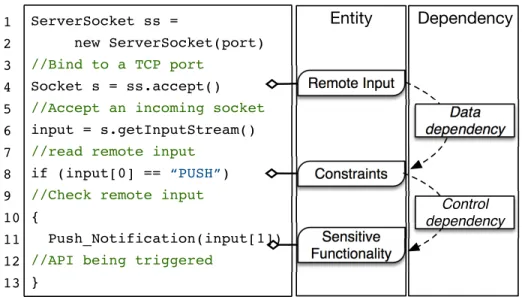
Figure 2.1 shows a simple example Android app that opens a port for accepting remote command to push notifications on the user’s device. The app first creates aServerSocket
ServerSocket ss =
new ServerSocket(port)
//Bind to a TCP port
Socket s = ss.accept()
//Accept an incoming socket
input = s.getInputStream()
//read remote input
if (input[0] == “PUSH”)
//Check remote input
{
Push_Notification(input[1])
//API being triggered
} Remote Input Sensitive Functionality Constraints Entity Dependency Data dependency Control dependency 1 2 3 4 5 6 7 8 9 10 11 12 13
Figure 2.1: Design pattern of open port Android app
from the socket and serves the request. In this example, the app checks whether the remote input contains the “PUSH” command, and if so, it starts pushing the messages contained in the remote input to device’s notification bar.
We generalize the logic of Android apps with open ports as the design pattern shown on the right side of Figure 2.1, consisting of three different entities and the dependency relationship among them.
Remote entry point is defined as the content passed to the open port app from the incoming sockets. And it serves as the entry point in our analysis framework (§2.4.1). Security mechanisms such as authentication token can be used to authorize the remote access to the app.
Sensitive functionality refers to the sensitive API set that can be triggered by remote input. The sensitive API set defined in this work contains (1) APIs protected by the Android permission system e.g.,sendTextMessage()protected bySEND SMS permission, and (2) APIs not protected by permissions but considered sensitive in the open port context. For example, an app does not require any permission to read its own data cache. However, if the data is written back to the incoming socket and transmitted to the remote client, a potential information leakage is caused, since the app cache may contain sensitive user data. We
describe our approach to construct sensitive API set in§2.4.3.
Constraintsrefer to the conditional statements along the path between the remote in-put and the sensitive APIs. It is usually introduced by the protocols that the app uses to communicate with the remote clients. If the constraints on a path are easy to bypass, the sensitive functionality on the path may be exploitable by remote attacker to launch privilege escalation attack. We discuss more on the strength of the constraints in§2.4.4.
Dependency. We identify the dependency between remote input and sensitive API
as theProgram Dependency, consisting ofcontrol dependencyanddata dependency. We use it to describe the “trigger” relationship between the source and the sink, which is shown to be efficient for us to characterize open port usage and understand their security implications.
In practice, the dependency between the remote entry point and sensitive API set of an app is not easy to characterize. The analysis must handle various program flow jumps in the Android lifecycle, including inter-component communications, Java reflection, and even jumps from native code, to accurately model the open port functionality. Moreover, to identify those vulnerable paths that can be leveraged by remote attacker, the analyzer is required to evaluate whether a given usage path is practically exploitable in terms of the timing window for attacker, and the strengths of the checks performed on the path. We design OPAnalyzer to analyze the usage and security implications of these apps to address these technical challenges.
2.4
OPAnalyzer Approach
The goal of OPAnalyzer is bi-fold (1) to characterize the open port usage on mobile de-vices, and (2) to identify vulnerability exposed by the usage. To achieve the goal, we design OPAnalyzer to automatically discover all the sensitive functionalities that can be triggered by remote input and examine the constraints that guard them. We define a usage pathas a program path from the remote entry point to a single sensitive functionality with all the
APK Native Code Analyzer Application Layer Analyzer Environment Builder
Usage Path Analyzer
Entry Points Sensitive APIs
Reachability Analyzer
Constraints Analyzer Taint Analysis Engine
Usage Paths Weak Paths Highly Insecure Paths OPAnalyzer Output Exploits
Figure 2.2: OPAnalyzer approach overview
conditional statements along the path annotated. OPAnalyzer performs the analysis on us-age path level, so that various functionality of a given open port can be comprehensively examined.
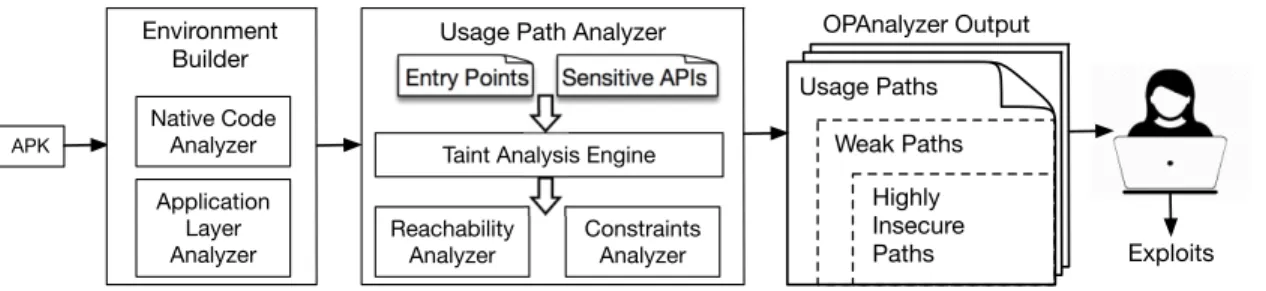
Figure 2.2 shows the overview of OPAnalyzer’s approach. (1) OPAnalyzer takes apk
files as input, extracts both Dalvik bytecode and native shared objects to build the environ-ment for the app; (2) It calculates the entry points from both the native code and Dalvik bytecode for subsequent static analysis(§2.4.1). (3) It constructs the Inter-component Data Flow Graph (IDFG) and Data Dependency Graph (DDG) from the entry points based on Amandroid, which are both flow- and context-sensitive; (4) It performs taint analysis to study the dependency between remote input and a precomputed sensitive API set(§2.4.3), and outputs the paths.(5) Constraints analyzer examines all the checks along the paths that are control dependent on the remote input, and annotates the strength of each constraint. (6) Reachability analyzer filters those paths unreachable from the program entry set, and annotates the run-time reachability for each path(§2.4.4). Usage categorization and vulner-ability discovery are then performed on the annotated usage paths.
In the remainder of this section, we provide an overview of the main analysis steps and how we overcome several challenges.
2.4.1 Entry Point Analysis
Entry point analysis collects the remote entry points from both Dalvik and native code. It integratesapktoolas its front-end to decompress the apk file. Dalvik bytecodes are
de-v0 = accept( sock,&addr,&addr_len) //accept a remote incoming socket if (v0 == “action”){
system(“am broadcast com.example.action”) //broadcast an intent in Java layer }
else {
system(“am startservice com.example.UploadService”)
//start an application service in Java layer }
<receiver android:name=“com.example.ActionReceiver”> <intent-filter>
<action android:name=“com.example.action” /> //specify that action will be handled by receiver </intent-filter>
</receiver>
<service android:name=“com.example.UploadService” android:process=“.uploadService” />
//an upload service that runs in separate process 1 2 3 4 5 6 7 8 9 10
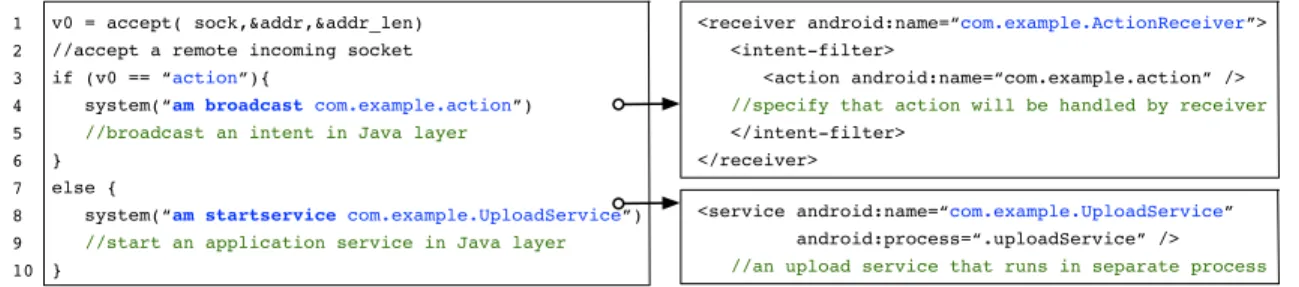
Figure 2.3: Snippet from real app showing control-flow jump from the native code layer (Left) to the application layer (Right).
coded tosmaliformat and further converted to an IR calledPilar. The application layer analyzer extracted those Java classes that accept connections from either ServerSocket
orServerSocketChannel, which are the only Android framework APIs for apps to open TCP port in Java, as entry points. However, apps can also embed the open port function-ality into the native code either for the purpose of disguising their stealth behavior or for performance reasons. Thus we implement a native code analyzer to collect those entry points embedded in native code and capture the control-flow jumps from native code to the Java layer.
2.4.2 Native Code Analyzer
Figure 2.3 is a code snippet from a real app showing the open port functionality em-bedded in native code. The app accepts the incoming socket in native Ccode, and passes the control-flow to application layer to serve the request. Shown on line 4, native code broadcasts anintentusing thesystem function, and theintent is captured by the Java layer receiver and triggers theActionReceiverlogic. Another type of control-flow jump in this example is shown online 8. The app starts a service defined in the Android man-ifest from native code, and the UploadService starts running in the background. Such cross-layer interactions cannot be captured by existing static analysis approaches, leading to inaccuracy in the security analysis. We design and implement a native code analyzer that captures such control-flow jumps based on inter-procedure taint analysis.
The native code analyzer takes the shared object files extracted from the apk as in-put, and performs taint analysis on the decompiled assembly code. The taint source is the socket accepted from the open port, while the sinks are those function calls that can ini-tiate control-flow jump to application layer, such as system(). After locating the source and sink in the assembly code, it analyzes whether there is a path that propagates the taint value to the sink either explicitly or implicitly. Thesystem()function calls in Figure 2.3 are not directly tainted by thesource, but are control-dependent on the tainted conditional statement, as an example of implicit taint. The taint analysis handles inter-procedure calls, as well as asynchronous I/O. To handle many clients simultaneously in native code, app can perform non-blocking I/O using Linux’s epoll facility [21], which provides readi-ness notification to simulateI/Omultiplexing. To serve multiple requests, the thread uses
epoll waitto get tasks from event queue, andepoll ctlto add new connections waiting to be handled into the event queue. The taint analysis propagates taint values accurately through such asynchronous function calls by keeping track of each event queue. We show how the native code analyzer improves the effectiveness of our tool in§2.4.5
The native code analyzer is implemented as a plug-in for IDAPro written in Python. It usesIDAPro[26] as the front-end, and performs the inter-procedural data-flow analysis on the CFG of the assembly code. The time it takes for analyzing an app depends on the number of shared object files contained in the app. The mean analyzing time is 80.0 seconds with the interquartile range of 74.9 seconds.
2.4.3 Sensitive API Selection
OPAnalyzer aims at characterizing all the sensitive functionality triggered by remote input. To define the sensitive API set and categorize their functionality, we need an accurate mapping from Android APIs to the permissions they require. However, constructing such mapping for our use case is non-trivial because our analysis is performed on the component level. We detail the challenges and our solutions below.
PScout [61] provides a static analysis approach to find the mappings between API calls and permissions. However, we find that it suffers from some completeness problems. Tak-ing the ServerSocketas an example, which requires AndroidInternet permission. In the mappings generated by PScout, we only find the constructor of the ServerSocket
mapped to the Internet permission, while other sensitive APIs such as accept() and
getOutputStream() are missing. We suspect that it is because Android enforces some permission checks at the class level instead of API level. Although enforcing the permis-sion check at the constructor implies that all the member functions of this class are also protected, the incompleteness of the< AP I, permission >mappings restricts its usabil-ity for program analysis, especially when the analysis is performed on the component level. To address this problem, we design a static analysis tool to automatically add such missing APIs to the mappings. For every class constructor presented in the original PScout output, the tool takes the AOSP source code as input and extracts all the member functions of the class to complete the mappings.
In addition, we find that some APIs are not protected by Android permissions, how-ever, when used together, are also considered sensitive in the mobile service context. For example, an app retrieves the device location and stores it in the application data cache. Once a remote connection comes in, it reads the location data from the cache and sends it to the remote attacker. In this scenario, the incoming socket does not trigger any per-mission check except INTERNET, which we think is granted by default, but the sensitive location data is stolen and leaked asynchronously. To capture such sensitive functionality in the mobile service context, we manually collect all the sources that an app can retrieve data asynchronously that do not require permission, including app cache, database, shared preference, etc. We define a pseudo permission calledDATA LEAK. If the data written to the incoming socket is dependent on the data retrieved from these asynchronous sources, we consider it as invoking theDATA LEAKpermission check. The pseudo permission together with the associated API pairs are added to the sensitive API set.
socket = ServerSocket.accept()
// socket = Source#1()
remote_input = socket.getInputStream() flag = remote_input[0]
if (flag == “True”) {
password = getSharedPreferences(“password”,0)
// password = Source#2() outStream = socket.getOutputStream() outStream.write(password) // Sink() } 1 2 3 4 5 6 7 8 9 10 11
Figure 2.4: An example for implicit and explicit taint logic.
2.4.4 Usage Path Analysis
To identify program dependency, OPAnalyzer performs taint analysis on the DDG rooted from remote entry points, taking the remote input as source, and sensitive API set assink. It outputs all the usage paths that the remote input can trigger, together with all the constraints that guard the sinks, which are useful for open port usage categorization and vulnerability discovery.
IDFG and DDG.are built for each remote entry point using Amandroid, which include all those Inter-Component Communication (ICC) edges, and are both flow- and context-sensitive. However, the control-flow jumps introduced by Java reflection cannot be cap-tured by this approach. Since we find that reflections are heavily used in our dataset, and also are found in those well-knownWormhole apps, we add reflection support to the taint analysis engine.
Java reflectionis used by programs to examine or modify the runtime behavior of apps running in Java virtual machine. We have seen reflections used in apps for both legitimate purpose (e.g., bypass some API-level restrictions) and malicious purpose (e.g., disguise the entry to malicious code). Handling reflection accurately is impossible for static analysis, and remains challenging even combining runtime analysis [141]. To capture the control-flow jumps of reflection to our best effort, we implement a handler in the IDFG builder
Socket socket = ServerSocket.accept(); InputStream in = socket.getInputStream(); String input = in.readLine();
String command = input.split(“=“)[0]; String value = input.split(“=“)[1]; Map map = new HashMap<String,String>(); map.put (command,value); if (map.size() > 0){ //C1 if (command == “SEND_SMS”) { //C2 SendSMS(value); //Sink() } } 1 2 3 4 5 6 7 8 9 10 11 12
Figure 2.5: Sample app code showing that sensitive API is protected by constraints
similar to the one used in FlowDroid [60], which can link the target class or method invoked by reflection to the calling function, and add the missing edges to the IDFG. Currently, it only handles reflection calls with targets explicitly provided in the same procedure, and will miss those whose targets are not deterministic statically. However, we find that over 86% of reflections in our dataset can be handled by applying this heuristic, and it also helps identify significantly more vulnerable paths as shown in§2.4.5.
Java layer taint analysisis used to examine the dependency among remote input and sensitive APIs. We define a notion to describe the explicit and implicit dependency rela-tionships among statements. The notion is further used to categorize usage.
Notion 1 The dependency relationship between two statements along the same usage path is either implicit or explicit, and transitivity applies.
stmt1 E
−→stmt2 :ifstmt2is explicitly tainted by the return value ofstmt1. stmt1
I −
→stmt2 :ifstmt2is implicitly tainted by the return value ofstmt1. stmt1
I −
→ {stmt2 E
−→stmt3} :if stmt3 is explicitly tainted by the return value of
stmt2, and bothstmt2andstmt3 are implicitly tainted by the return value ofstmt1.
ex-pressions, whileimplicit taintreflects the “triggering” relationship, in which the source is presented in the conditional statements. Shown in Figure 2.4, the first taint source comes from the remote input, and flag is explicitly tainted by the remote input, since it is derived from it. All the statements in the if block are implicitly tainted by the flag, since they are control-dependent on the ifstatement. Specifically, another taint source is identified as thegetSharedPreferences, which reads data from an asynchronous source. The passwordread from the shared preferences is written to the socket, identified as an
explicit taintrelationship between statements inline5andline6. Thus, the dependency relationship along this usage path is expressed as:
accept()−→I {getSharedP ref erences()−E→write()}
To further narrow down the potential vulnerable path list, and provide insights to identify the vulnerability, OPAnalyzer integrates both constraints analysis and reachability analysis to help analyst prioritize paths output by OPAnalyzer to reduce human efforts.
Constraints analyzer examines all the conditional statements along the usage path to which the sensitive API is control dependent on. Shown in Figure 2.5, the remote input is separated into two substrings and put into aMap. The sensitive APISendSMSis control dependent on two constraints. ConstraintC1 defined inline 8checks whether the Mapis empty, while the constraintC2inline9checks whether thecommandpassed in from remote input is “SEND SMS”. Both checks are easy to bypass, an arbitrary remote attacker can construct the input string to bypass the checks and trigger the malicious payload to be sent via SMS, which results in a remote privilege redelegation attack [90]. OPAnalyzer annotates a constraint asweakif it is either (1) comparison with constants or (2) comparison with a predefined set of trivial API (e.g., Map.size(), Set.isEmpty()). The heuristic reduces human efforts by prioritizing usage paths that are obviously easy to be controlled, but could introduce false negatives(§2.4.5).
Reachability analyzer characterizes the reachability of a path using both static and dynamic approaches. First, the static analysis models the app Activity lifecycle, and
OPAnalyzer
Categorization
apk
usage path
No
Usage
families
Pattern
matches
Yes
open port usage family
Convert to
Notation 1
Generalize
usage pattern
Figure 2.6: Usage categorization methodology
filters those usage paths unreachable from the program entry set. The dynamic approach identifies those usage paths that start with a port that is open by default at app launching time. These paths are annotated ashighly insecuresince remote attacker has a large timing window to exploit them. Note that ports that are not open by default are still vulnerable to the on-device malware in our threat model, since the malware can monitor theprocfile and exploit the vulnerable paths as long as it detects the port is open. The dynamic analysis is implemented using function hooking based on Xposed framework [54], and combined with device automation, the analyzer automatically annotates reachability results on the usage paths.
Usage categorization methodology. Shown in Figure 2.6, OPAnalyzer aggregates
usage paths with similar open port usage into one family based on the sensitive APIs they contain and the notion. It extracts usage paths and converts them toN otion1. The cate-gorization approach matches the notion of new paths with those already identified patterns. If an incoming path cannot be categorized into any of the existing families, we manually generalize its usage to a pattern and add a new family to the existing usage family set.
Fol-Wormhole
family Sample app
Entry points
Usage paths
Weak path Not weak path
total exploitable total exploitable
Baidu BaiduMap 1 15 8 8 7 0
Tencent QQ Downloader 4 16 1 1 15 1
AMap Minimap 1 4 0 0 4 3
Table 2.1: OPAnalyzer output for three popular “Wormhole” apps that are reported vulner-able
lowing this approach, OPAnalyzer categorizes most of the usage paths except a few that cannot be converted toN otion1(§2.5.2).
Vulnerability discovery methodology.Considering an attacker in our threat model, to exploit a usage path and trigger the sensitive functionality, he needs to (1) find the right tim-ing when the port is open, (2) bypass all the checks along the path to execute the sensitive API. The usage paths output from OPAnalyzer come with the reachability information, sen-sitive functionality, and strengths of predicates all annotated, help human analyst efficiently examine these two prerequisites for an attack, and identify vulnerability. Specifically, OP-Analyzer prioritize “weak paths” and “highly insecure” paths for manual inspection. And note that we also selectively examined the other usages paths in the OPAnalyzer output since they may also be vulnerable to remote exploits. Some of the interesting vulnerabili-ties (e.g., AirDroid exploit) in our case study(§2.6) are actually identified in those non-weak usage paths.
2.4.5 Evaluation
We obtain 24,000 apps from the PlayDrone dataset [152] to evaluate our tool, which contains top 1000 popular apps from each of the 24 categories in the Google Play including entertainment, tools, etc. Our evaluation focuses on the vulnerability discovery of OPAna-lyzer, which is the most security critical functionality.
Discovery accuracy. To evaluate the false positives (FPs) of the weak path detection, we first define the FPs as “weak” paths that are verified to benotexploitable through man-ual inspection. We examined the weak usage paths output by OPAnalyzer, and constructed
remote input to see if the sensitive functionality could be triggered. We call these weak paths that are verified to be exploitable vulnerable paths, and the rest of them are consid-ered as FPs. Among the 24,000 apps, 6.8% of them (1632) have open-port functionality, and 133 weak paths are identified to be reachable at app launching time by OPAnalyzer. We manually identified 113 vulnerable paths that can be easily exploited by constructing remote input (FP rate 15.1%). The FPs mainly come from paths that contain checks on the runtime property of the app. As an example, a usage path is guarded by the constraint
if (debugMode == True)will not be triggered when the app is in release mode, but will be output falsely as weak path.
Due to the lack of any publicly accessible study of open port vulnerabilities on mobile platform, we run OPAnalyzer on the recently-reported Wormhole apps from the Chinese app market to evaluate the false negatives (FNs) of OPAnalyzer. To the best of our knowl-edge, they are the only reported instances that contain confirmed open port exploits, which are usable as ground truth in the FN evaluation. The FNs of the weak path detection are those paths that are not annotated as “weak”, but are verified to be exploitable with our manual inspection. Wormhole apps are vulnerable due to their integrations of vulnerable SDKs including Baidu, Qihoo360, AMap, and Tencent [35], and thus we choose the most popular apps in each SDK category. We do not test on Qihoo360 library since the prob-lem only affects an old beta version which can no longer be found in apps on major app markets.
As shown in Table 2.1, OPAnalyzer discovers usage paths that contain sensitive func-tionality in all of the three apps, with some of them reported as weak paths. Unfortunately, the report has no detailed path information that can be used as ground truth for evaluation, we do our best to manually analyze the decompiled app to find exploitable paths. For Baidu SDK, OPAnalyzer detects all the exploitable paths that we manually discovered, and even discovers new exploits that have not been reported in the report, such as stealing the WiFi
Feature # of usage Improv. Featured app/lib paths captured
none 636 N/A WiFi file transfer
+ reflection 804 +26% OpenVPN
+ API 1472 +131% AMap
+ native 845 +33% Tencent XG
+ all 1934 +204% Baidu wormhole
Table 2.2: Evaluation of accumulative improvement brought by (1) handling explicit Java reflection and (2) adding open-port specific sensitive API (3) capturing native code jump.
as weak paths. However, three exploits (FNs) from those non-weak paths are identified. We find that one of the conditional statement shared by all 4 usage paths depends on value that is defined beyond the IDFG of the remote entry point. OPAnalyzer thus does not consider the check as “weak” since its value cannot be determined, while it turns out to be constant in the run time. It is due to the limitation of lacking of backward analysis support, so that OPAnalyzer doesn’t have enough visibility into how a variable encountered on the usage path is propagated to this procedure, if it is defined beyond the IDFG of the entry point. This affects the accuracy of the information leakage tracking and constraints analysis, and can be solved by integrating backward slicing technique [60, 163]. We plan to add that to the OPAnalyzer in the future.
False negatives may also be introduced by the native code analyzer due to a limitation inherited from theIDA-PROfront end. ARM processor supports multiple interaction sets mixed in one segment in the runtime, while the disassembler can interpret one type at the same time in the static analysis [9]. And when the 16-bit “Thumb” and 32-bit “ARM” in-structions coexist within one segment due to optimization, the disassembling result may be incorrect. Additionally, the native code analysis of OPAnalyzer does not cover all possible types of interactions between native code and Java code. Combining native code and Java code analysis is a fundamental challenge of Android app analysis [117], and we leave it as future work to accurately model all the control- and data-flow transitions between native and Java layers.
We also evaluate the improvement on the effectiveness of OPAnalyzer’s path discovery brought by three of our engineering efforts; namely (1) adding open-port specific APIs to the sensitive API set, (2) handling explicit Java reflections, and (3) capturing native code jump. Shown in Table 2.2, integrating these features greatly improves the coverage of OPAnalyzer by 204%, while completing the sensitive API set turns out to be the most effective engineering effort we spent. These improvements reduce false negatives, which is crucial to our system.
Performance. The most compute-intensive step in OPAnalyzer is the taint analysis, which includes building the IDFG and DDG, and running the Dijkstra’s algorithm on the DDG to find all the usage paths. We measure the time to perform the taint analysis for the top 1000 popular apps from our dataset. The experiment runs on a machine with Intel Core i5-3470 CPU and 8GB of RAM. For apps with at least one entry point, the median processing time for OPAnalyzer to finish the taint analysis is 61.5 seconds with standard deviation of 127.2.
2.5
Usage and Vulnerability
With the usage paths output from OPAnalyzer, we systematically study open port usage and their security implications in the top 1000 popular apps from each of the 24 different categories on Google play.
2.5.1 Popularity and Permission Usage
Among the 24,000 apps, we identified open port functionality in 6.8% (1632), while 50% of these open port apps have more than 500K downloads.
Sensitive permission usage. To understand the most common functionality triggered by remote input, we use the API to permission mappings constructed in§2.4.3 to get the set of sensitive permissions. Figure 2.7 shows the top security-sensitive permissions involved in open port usage. Surprisingly, we find that in open port apps, a rich set of highly-sensitive
0 5 10 15 20 25
WRITE_EXTERNAL_STORAGEC2DM_RECEIVEDATA_LEAKACCESS_COARSE_LOCATIONACCESS_FINE_LOCATIONGET_TASKCAMERA READ_CONTACTSDISABLE_KEY_GUARDWRITE_SETTINGRECORD_AUDIOCALL_PHONESEND_SMS
% of open port apps
Sensitive permissions
Figure 2.7: Permission protected APIs triggered by remote input.
Usage
category Pattern
Usage
paths Perc. Apps
Weak
paths Vuln.
Data sharing accept()
I
−
→ {APIdata read E
−→write()} 1340 69.3% 425 775 V1
Proxy accept()−E→APIout connection 122 6.3% 59 101 V1,V3
Remote
execution accept()
I or E
−−−−→APIexecution 127 6.5% 41 69 V2,V3
VoIP call accept()−→I APIaudio setting 45 2.3% 27 11 V3
PhoneGap Categorized using
code signature 282 14.6% 141 0 N/A
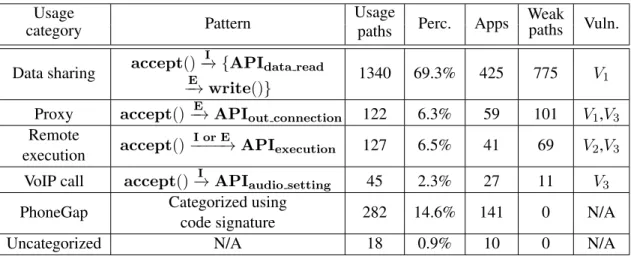
Uncategorized N/A 18 0.9% 10 0 N/A
Table 2.3: Open port usage and potential vulnerability. V1:sensitive data leakage,V2:
privi-leged remote execution,V3: DoS.
OS-level functions in Android can be invoked remotely, ran