Normative Multiagent Systems and Trust
Guido Boella
Dipartimento di Informatica
Universit`a di Torino- Italy.
E-mail: [email protected]
Leendert van der Torre
CWI Amsterdam and
Delft University of Technology.
E-mail: [email protected]
Abstract
In this paper we use recursive modelling to formalize sanction-based obligations in a qualitative game theory. In particular, we formalize an agent who attributes men-tal attitudes such as goals and desires to the normative sys-tem which creates and enforces its obligations. The wishes (goals, desires) of the normative system are the commands (obligations) of the agent. Since the agent is able to reason about the normative system’s behavior, our model accounts for many ways in which an agent can violate a norm believ-ing that it will not be sanctioned. The theory can be used in theories or applications of trust to understand when it is necessary to revise it.
1. Introduction
Recently there has been interest in extending multiagent systems with concepts traditionally studied in deontic logic, such as obligations, permissions, rights, commitments, et cetera. In this paper we discuss the impact on trust of the theory behind our approach of defining obligations in vir-tual communities [1, 2], which is based on the following two assumptions.
1. Our motivation for defining normative multiagent sys-tems is to define a theory of rational decision mak-ing in combinations of multiagent systems and nor-mative systems, for which we use recursive modelling and the attribution of mental attitudes to normative sys-tems [2].
2. The role of deontic logic in our normative multiagent systems is to define the logic of the mental attitudes of the agents, for which we use input/output logics [20]. We focus in this paper on the motivations of the agents when they violate norms, such that it can also be applied in other theories and applications, in particular, of trust.
In particular, a sophisticated theory of trust dynamics would not increase trust if an agent only fulfills promises
out of selfishness, because in the future the promise may not serve its needs. Analogously, it would not decrease the trust if the other agent did its best to fulfill the promise, but failed due to circumstances beyond its control. As applica-tions of normative multiagent systems get more sophisti-cated, we need a more detailed model of rational decision making agents in such systems.
The layout of this paper is as follows. In Section 2 we discuss rational decision making in normative multiagent systems, and in Section 3 the effect of violations on trust. In Section 4 we introduce the multiagent system, in Sec-tion 5 we define obligaSec-tions and in SecSec-tion 6 optimal deci-sions of the agents, which are illustrated in Section 7.
2. Rational decision making in normative
multiagent systems
A theory of rational decision making is essential for many theories and applications in which agents are able to violate norms and such norm violations have consequences, such as theories of fraud and deception [10], threats in per-suasion [18], trust and reputation, electronic commerce, vir-tual communities [1, 21], social agents [8], agent-based software engineering [12, 16], et cetera. This can be op-posed to the Shoham and Tennenholtz’ characterization of social laws in game theory [22], because their theory may be useful to study the use of norms in games and the emergence of norms in multiagent systems, but it is less useful to study the effectiveness of norms. We thus assume that norms are represented as soft constraints, which are used in detective control systems where violations can be detected (you can enter a train without a ticket, but you may be checked and sanctioned), instead of hard constraints, which are restricted to preventative control systems that are built such that viola-tions are impossible (you cannot enter a metro station with-out a ticket).
Normally an agent fulfills its obligations, because other-wise its behavior counts as a violation that is being sanc-tioned, and the agent dislikes sanctions. Moreover, it may not like that its behavior counts as a violation regardless of
the sanction, and it may act according to the norm regard-less of whether its behavior counts as a violation, because it believes that this is fruitful for itself or for the commu-nity it belongs to. There are three categories of exceptions to this normal behavior.
First, an agent may violate an obligation when the vio-lation is preferred to the sanction, like people who do not care about speeding tickets. In such cases of norm viola-tions, the system may wish to increase the sanctions asso-ciated with the norms which are violated (for speeding) or decrease the sanction of another norm (death penalty).
Secondly, the agent may have conflicting desires, goals or obligations which it considers more important. Obliga-tions may conflict with the agent’s private preferences like wishes, desires, and goals. In the case of conflict with goals the agent has committed to, the agent has to decide whether the obligation is preferred to the goal, as well as whether it should change its mind. Moreover, even respectful agents, that always first try to fulfill their obligations before they consider their private preferences, do not fulfill all obliga-tions in the case of contradictory obligaobliga-tions.
Thirdly, the agent may think that its behavior does not count as a violation, or that it will not be sanctioned. This may be the case when the normative system has no advan-tage in sanctioning the agent. One possibility is that the sanction has a cost for the system which overcomes the damage done by the violation: e.g., the sanction for not hav-ing payed taxes may be applied only above a certain thresh-old of money. But more likely the absence of violation is due to an action of the agent. The agent can change the sys-tem’s behavior by affecting its desires or its goals. Its ac-tion may abort the goal of the normative system to count the agent’s behavior as a violation or to sanction it, as in the case of bribing, or it may trigger a conflict for the norma-tive system. The agent can use recursive modelling to ex-ploit desires and goals of the normative system thus mod-ifying its motivations and inducing it not to decide for the sanction.
3. Trust
There are many trust definitions: the agents have a goal which can be achieved by means of the other agent’s action [10]. They “bet” on the behavior of the other agents ([19]), since they could get the same good in other ways (i.e., buy-ing the same good at an higher price from another agent they know already) [11], [13]. One prominent class of trust scenarios are when an agent believes that the trustee “is un-der an obligation to do Z”. In these situations, according to [17] “trust amounts to belief in de facto conformity to nor-mative requirements”.
Our theory can be useful in theories and applications of these normative scenarios of trust under two respects:
• a structural dimension for characterizing trust and its dynamics.
• a behavior dimension relating recursive modelling and trust dynamics.
A characterization of trust dynamics should be based on norm behavior: trust should be increased if an agent fol-lowed its commitments and obligations, while it should be decreased in case norms are violated. But as we discussed, norms can be violated for different reasons, which should be considered in the dynamic adjustment of trust:
• Behavioristic trust dynamics: increase trust when the norm is fulfilled, decrease when the norm is violated. • Sanction trust dynamics: decrease trust if the norm is
violated if the associated sanction does not provide a motivation for the trustee.
• Goal trust dynamics: increase trust when the agent has a goal to fulfil the norm, even if it is not able to respect the norm for some external reason, decrease when it has no goal to fulfil norm or the goal is conflicting with more important goals.
• Desire trust dynamics: increase trust when the agent desires to fulfill the: desires represent the inner moti-vations of an agent, while goals can be adopted from other agents’ ones.
• Cooperative trust dynamics: in case of norm violation the agent informs the other agents (an example of mu-tual support or mumu-tual responsiveness). This problem is addressed, e.g., [4, 5, 14].
The second dimension concerns the behavior of agents. If the fact that the agents have a goal which can be achieved by means of the other agent’s action is at the basis of trust, as highlighted by [10], a trust situation is inherently a strate-gic situation. Two agents are in a stratestrate-gic situation if an agent “believes that there is an interference and that her re-wards, the results of her projects, depend on the actions of another agent”. For this reason, an agent must have a pro-file of the other agents (apart from the first case above, it can simply observe its behavior). As we discuss in Section 6, a basic ability of agents is to recursively model the be-havior of the other agents. In our model this is at the ba-sis of the definition of obligation: only by recursively mod-elling the decision of the normative system an agent can un-derstand whether it will be sanctioned or not. Thus, to build a dynamic model of trust under obligations, it is useful to have a complete model of the decision making under obli-gations which includes also the recursive modelling abili-ties of agents.
4. Normative multiagent system
We first explain the multiagent system and thereafter the normative extension. Agents (A) are described (AD) by ac-tions called decision variables (X) and by motivations (M) guiding its decision making. The motivational state of an agent is composed by its desires (D) and goals (G). Agents may share decision variables, desires or goals, though this is not used in the games discussed in this paper. Desire and goal rules can be conflicting, and the way the agent resolves its conflicts is described by a priority relation (≥) that ex-presses its agent characteristics [7]. The priority relation is defined on the powerset of the motivations such that a wide range of characteristics can be described, including social agents that take the desires or goals of other agents into account. The priority relation contains at least the subset-relation, which expresses a kind of independence between the motivations.
Definition 1 (Agent set) An agent set is a tuple
hA, X, D, G, AD,≥i, where
• the agents A, decision variables X, desires D and goalsGare four finite disjoint sets.M =D∪Gare the motivations defined as the union of the desires and goals.
• an agent descriptionAD : A → 2X∪D∪G is a com-plete function that maps each agent to sets of decision variables, desires and goals, such that each decision variable is assigned to at least one agent. For each agenta ∈ A, we write Xa forX ∩AD(a),Da for
D∩AD(a),GaforG∩AD(a).
• a priority relation≥:A→2M×2Mis a function from
agents to a transitive and reflexive relation on the pow-erset of the motivations containing at least the subset relation. We write≥afor≥(a).
Desires and goals are abstract concepts which are de-scribed (M D) by – though conceptually not identified with – rules (R) built from literals (L). Rules consist of an an-tecedent (body, input) and a consequent (head, output), which are in our case respectively a set of literals and a literal. This simple structure of rules keeps the formal ex-position simple and is sufficient for our purposes here, for the extension of rules to pairs of propositional sentences we can use input/output logics [20]. As priorities are associ-ated with mental attitudes instead of rules, the priority of a rule associated with a desire may be different from the prior-ity of the same rule associated with a goal. It is well known that desires are different from goals, and we can adopt dis-tinct logical properties for them. For example, goals can be adopted from other agents, whereas desires cannot. In this paper we do not make any additional assumptions on de-sires and goals, and we thus do not formally characterize
the distinction between desires and goals, because it is be-yond the scope of this paper.
Definition 2 (MAS) A multiagent systemM AS is a tuple
hA, X, D, G, AD, M D,≥i:
• the set of literals built from X, written as L(X), is X ∪ {¬x | x ∈ X}, and the set of rules built from X, written asR(X) = 2L(X)×L(X), is the set of
pairs of a set of literals built fromXand a literal built fromX, written as{l1, . . . , ln} → l. We also write
l1∧. . .∧ln → land whenn = 0we write> → l.
Moreover, forx∈X we write∼xfor¬xand∼(¬x)
forx.
• the motivational descriptionM D : M →R(X)is a complete function from the sets of desires and goals to the set of rules built fromX. For a set of motivations S⊆M, we writeM D(S) ={M D(s)|s∈S}.
Example 1 Consider a multiagent systemhA, X, D, G, AD, M D,≥i withA = {a,n},Xa = {x},Xn = {y},
Da = {d1, d2},Dn = {d3},G = ∅,M D(d1) = > →
x,M D(d2) = y → ¬x,M D(d3) = > → y,≥ais such
that{> → x, y → ¬x} ≥ {y → ¬x} ≥ {> → x} ≥ ∅. Agentacould also considerd3in his priority ordering, but
we assume thatd3 does not have any impact on it. Agent
adesires unconditionally to decide to do x, but if agentn decidesy, then agentadesires¬x, since the second rule is preferred over the first one in the ordering. Agentndesires to doy.
To describe the normative system, we introduce several additional items. The basic idea of the formalization of our normative multiagent system is that the normative system can be modelled as an agent, and therefore mental attitudes like desires and goals can be attributed to it, because it is autonomous and it possesses several other properties typi-cally attributed to agents. Example 1 can be interpreted as a game between an agent and its normative system instead of between two ordinary agents. In the context of this pa-per, this idea is treated as a useful way to combine multia-gent systems and normative systems, though it can also be defended from a more philosophical point of view. A moti-vation has been discussed in [3], though in that paper we did not give a formalization of normative multiagent systems as we do in this paper. First we identify one agent in the set of agents as the normative agent. We represent this norma-tive agent byn∈A. Moreover, we introduce a set of norms Nand a norm descriptionV that associates violations with decision variables of the normative agent. Finally, we as-sociate with each agent some of the goalsGDof the nor-mative agent, which represents the goals this agent is con-sidered responsible for. Note that several agents can be re-sponsible for the same goal, and that there can be goals no agent is considered responsible for. We do not assume that
agents can only be responsible for their own decisions. In some more complex social phenomena agents may also be responsible for other agents’ decisions, and this assumption may be relaxed in the obvious way. For example, in some le-gal systems, parents are responsible for actions concerning their children, or the owners of artificial agents are respon-sible for the actions the agents perform on their behalf.
Definition 3 (Norm description) A normative multia-gent systemN M AS is a tuplehA, X, D, G, AD, M D,≥ ,n, N, V, GDi, wherehA, X, D, G, AD, M D,≥iis a mul-tiagent system, and:
• the normative agentn∈Ais an agent.
• the norms{n1, . . . , nm}=Nis a set disjoint fromA,
X,D, andG.
• the norm descriptionV : N ×A → Xn is a
com-plete function from the norms to the decision variables of the normative agent: we writeV(n, a)for the deci-sion variable which represents that there is a violation of normnby agenta∈A.
• the goal distributionGD:A→2Gnis a function from
the agents to the powerset of the goals of the norma-tive agent, whereGD(a)⊆Gnrepresents the goals of
agentnthe agentais responsible for.
5. Obligations
We define obligations in the normative multiagent sys-tem. The definition of obligation incorporates a simple logic of rules, for which we writer∈out(R)if the ruleris in the closure of the setRfollowing notational conventions in in-put/output logic [20]. Due to the simple structure of rules, the logic is characterized by the single proof rule monotony, i.e., fromL→lwe deriveL∪L0 →l. A rule follows from
a set of rules if and only if it follows from one of the rules of the set. We discuss the implied logical properties of obli-gations after the definition.
Definition 4 (Out) LetM AS=hA, X, D, G, AD, M D,
≥ibe a multiagent system.
• A ruler1 = L1 → l1 ∈ R(X)follows from a set of
motivationsS ⊆ M, written asr1 ∈ out(S), if and
only if there is ar2 =L2 →l2 ∈M D(S)such that
L2⊆L1andl1=l2.
The definition of obligation contains several clauses. The first one is the central clause of our definition and defines obligations of agents as goals of the normative agentn, fol-lowing the “Your wish is my command” strategy. It says that the obligation is implied by the desires of agentn, im-plied by the goals of agentn, and it has been distributed by agent nas a responsibility of agenta. The latter two steps are represented byout(GD(a)). The following four
clauses describe the instrumental part of the norm (accord-ing to Hart [15]’s terminology), which aims at enforc(accord-ing its respect. The second clause can be read as “the absence ofp counts as a violation”. The third clause says that the agent desires the absence of violations, which is stronger than say-ing that it does not desire violations, as would be expressed by> →V(n, a)6∈ out(Dn). This is the only rule which does not hold only in the context of the obligation (Y), but which holds in general (>), since violations are always dis-preferred. The fourth and the fifth clause relate violations to sanctions. Note that these four rules are only motivations, which formalizes the possibility that a normative system does not recognize that a violation counts as such, or that it does not sanction it. Both the recognition of the viola-tion and the applicaviola-tion of the sancviola-tion are the result of au-tonomous decisions of the normative system. We moreover assume that the normative system is also motivated not to apply sanctions as long as there is no violation, because oth-erwise the norm would have no effect. Finally, for the same reason we assume in the last clause that the agent does not like the sanction.
Definition 5 (Obligation) LetN M AS=hA, X, D, G, AD, M D,≥,n, N, V, GDibe a normative multiagent sys-tem. InN M AS, agent a ∈ A is obliged to decide to do x∈L(Xa)with sanctions∈L(Xn)ifY ⊆L(Xa),
writ-ten asN M AS|=Oan(x, s|Y), if and only if∃n∈Nsuch
that:
1. Y → x∈ out(Dn)∩out(GD(a)): ifY, then agent
ndesires and has as a goal thatx, and this goal has been distributed to agenta.
2. Y ∪ {∼x} → V(n,a) ∈ out(Dn)∩out(Gn): ifY
and∼xis done by agent a, then agentnhas the goal and the desireV(n,a): to recognize it as a violation done by agent a.
3. > → ¬V(n,a)∈out(Dn): agentndesires that there
are no violations.
4. Y ∪ {V(n,a)} →s∈out(Dn)∩out(Gn): ifY and
agentndecidesV(n,a), then agentndesires and has as a goal that it sanctions agenta.
5. Y →∼s ∈ out(Dn): ifY, then agent ndesires the
absence ofs. This desire not to sanction expresses that it only sanctions in case of a violation.
6. Y →∼s∈out(Da): ifY, then agentadesires the
ab-sence ofs, which expresses that agentadoes not like to be sanctioned.
The following proposition shows that obligations sat-isfy the monotony property, also called more precisely the strengthening of the antecedent property, or the strengthen-ing of the input property, which means that an obligation in contextY is also an obligation in contextY ∪Z. This is
in accordance with Kant’s interpretation of norms and with standard approaches in deontic logic such as input/output logic [20].
Proposition 1 (Monotony) If a normative multiagent sys-tem N M AS satisfies O(x, s|Y), then it also satisfies O(x, s|Y ∪Z).
Proof. First, note that the monotony property holds for out, i.e.,Y →x∈out(R)impliesY ∪Z →x∈out(R)
for anyY, x,R and Z, because if there is a L → l ∈
M D(S)such thatL ⊆Y andl =x, then using the same rule we have that there is aL → l ∈ M D(S)such that L⊆Y ∪Zandl=x. Second, note that all clauses of the definition of obligation consist of expressions ofout. Con-sequently, obligation satisfies the monotony property.
However, the monotony property does not imply that a conflict between obligations leads to a kind of inconsis-tency or trivialization. In certain cases there may be con-flicting obligations. This is in accordance with Ross’ notion of prima facie obligations, which says that there can be a prima facie obligation forpas well as a prima facie obliga-tion for¬p(but only an all-things-considered obligation for one of them), and input/output logics under constraints [20]. It has been observed many times in deontic logic, that there are good reasons why classical deontic logics make a con-flict inconsistent, but in practical applications concon-flicts oc-cur and deontic logics should be able to deal with conflict-ing obligations.
Other properties discussed in the logical literature of rules and norms [20] are not valid, due to the limited struc-ture of the rules without disjunctions and with only a sin-gle literal in the head of the rule. We finally note that sanc-tions are directly associated with obligasanc-tions and not repre-sented by means of further obligations, because this is the way it works in many legal systems. Moreover, obligations which have the same head but different sanctions are repre-sented as distinct obligations.
6. Behavior
We now take a subjective view on the multiagent sys-tem. That is, we consider an agenta ∈ A that considers an action of itself followed by an action of the normative agentn. The agent description of the agentAD(a)is the agent’s self-image, and the agent description of the norma-tive agentAD(n)is agenta’s profile of the normative agent. Finally, the normative multiagent descriptionN M AS satis-fies an obligation when agentabelieves to be obliged. This is in accordance with Castelfranchi’s idea that for obliga-tions to be fulfilled they must be believed and accepted as such [9].
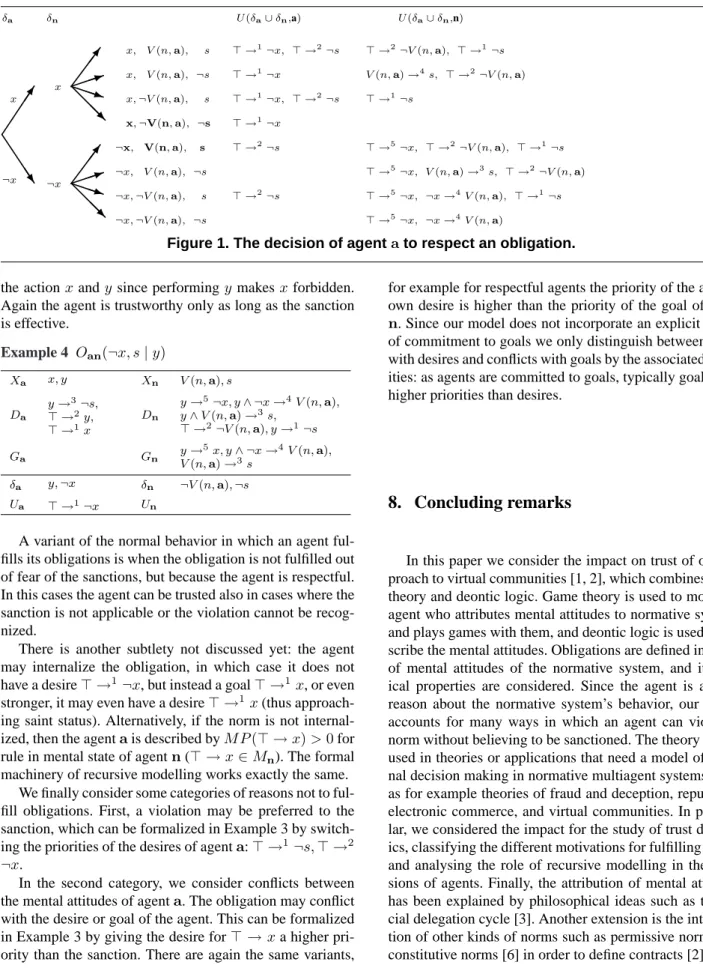
The basic picture is visualized in Figure 1 and reflects the deliberation of agentain various stages. This figure should
be read as follow. Agentais the decision maker: it is mak-ing a decisionδa, and it is considering the effects of the ful-filment or the violation of the obligations it is subject to. To evaluate a decisionδaaccording to its desires and goals (DaandGa), it must consider not only its actions, but also the reaction of agent n: agent nis the normative system, which may recognize and sanction violations. Agenta re-cursively models agentn’s decisionδn(that agentntakes according to agenta’s point of view), typically whether it counts the decisionδa as a violation and whether it sanc-tions agentaor not, and then bases its decision on it. Now, to find out which decision agentnwill make, agentahas a profile of agentn: it has a representation of agentn’s mo-tivational state. When agentamakes its decision and pre-dicts agentn’s, we assume that it believes that agent nis aware of it.
The agents value, and thus induce an ordering on, deci-sions by considering which desires and goals have been ful-filled and which have not. In the general case, agentamay consider its own desires and goals as well as the desires and goals of agentn, whereas agent nonly considers its own goals and desires. For example, respectful agents care not only about their own desires and goals, but also about the ones attributed to the normative agent. Given a decisionδa, a decisionδnis optimal for agentnif it minimizes the un-fulfilled motivational attitudes inDnandGnaccording to the≥nrelation. The decision of agentais more complex: for each decisionδait must consider which is the optimal decisionδnfor agent n.
Definition 6 (Recursive modelling) LethA, X, D, G, AD, M D,≥,n, N, V, GDi be a normative multiagent system, moreover:
• the set of decisions∆is the set of subsets ofL(Xa∪
Xn)that do not contain a variable and its negation. A
decision is complete if it contains, for each variable in Xa∪Xn, either this variable or its negation. For an
agenta ∈ Aand a decisionδ ∈ ∆ we writeδa for
δ∩L(Xa).
• the unfulfilled motivations of decisionδfor agenta∈
Aare the set of motivations whose body is part of the decision but whose head is not.
U(δ, a) = {m ∈ M ∩AD(a) | M D(m) = L →
l, L⊆δandl6∈δ}.
• A decision δ (where δ = δa ∪ δn) is optimal for
agentnif and only if there is no decisionδ0
nsuch that
U(δ,n) >n U(δa∪δ0n,n). A decision δ is optimal
for agentaand agentnif and only if it is optimal for agentnand there is no decisionδa0 such that for all de-cisionsδ0 =δa0 ∪δn0 andδa∪δ00noptimal for agentn
The following example illustrates unfulfilled motiva-tional states. More detailed examples with normative agent and recursive modelling are given in the following section.
Example 2 (Example 1, continued) Given a decision δn = {y}. For δa = {¬x}, the unfulfilled
motiva-tions are U(δa∪δn,a) = {> → x}: {y} ⊆ δa∪δn
and ¬x ∈ δa ∪ δn so the rule y → ¬x is
satis-fied. For δ0
a = {x}, U(δ0a ∪ δn,a) = {y → ¬x}.
The optimal decision of agent a is δa = {¬x},
be-cause{y→ ¬x} ≥ {> →x}.
7. Examples
Before we discuss the formalization of the examples in Section 2, we introduce some notational conventions to rep-resent the examples compactly. In particular, in the first example there are ten rules, and consequently there are
210= 1024sets to be ordered. Definition 7 introduces stan-dard lexicographic ordering used in the examples in this pa-per, which says that a single rule with high priority is more important than any set of rules with lower priority (formal-ized using exponential functions).
Definition 7 Let S be a set of motivations and |S| be the number of elements ofS. Let the motivation priority M P : S → {0, . . . ,|S|} be a function from S to inte-gers between0 andS. We say thatS0 ⊆S is preferred to S00 ⊆Saccording to lexicographical ordering if and only
ifΣs∈S0M P(s)|S|≥Σs∈S00M P(s)|S|.
Moreover, in the examples we assume that the priority of each agent’s own desires and goals are written as super-script on the arrow, thusx→i ymeansM P(x→y) =i,
and the priority of the motivations of other agents is0 un-less explicitly indicated otherwise. We typically do not dis-tinguish between a motivation and the rule describing it, such that for example we write M P(L → l) = i for M P(m) = iwithM D(m) = L → l. In the tables we visualize agentaon the left hand side and agentnon the right hand side. The upper part describes the normative sys-tem, and the lower part the optimal decisions with the asso-ciated unfulfilled rules.
The first example is visualized in Figure 1 and repre-sents the normal behavior of an agent that acts accord-ing to the norm. The first two branches represent the two different alternatives decisions δa of agent a: {x} and {¬x}. The subsequent ones represent the decisionsδn of agent n: {V(n,a), s},{V(n,a),¬s},{¬V(n,a), s}, and
{¬V(n,a),¬s}.
The agent includes the content x of the obliga-tion Oan(x, s | >) in δa for the fear of sanction s (> →2 ¬s ∈ Da), even if it prefers not to do x (> →1 ¬x ∈ Da). In this case the agent can be trusted
only as long as it is known that the sanction is effec-tive. Example 3 Oan(x, s| >) Xa x Xn V(n,a), s Da > → 2¬s, > →1¬x Dn > →5x,¬x→4V(n,a), V(n,a)→3s, > →2¬V(n,a),> →1¬s Ga Gn > → 5x, ¬x→4V(n,a), V(n,a)→3s δa x δn ¬V(n,a),¬s Ua > →1¬x Un
We illustrate this example in some detail to illustrate the notion of recursive modelling. The basic idea is to reason backwards, that is, we first determine the optimal decisions of agentnfor any given decision of agenta, and thereafter we determine the optimal decision of agenta, assuming the optimal replies of agentn. The optimal decisions of agentn depending on the corresponding decision of agentaare vi-sualized in boldface. On the right side, the unfulfilled de-sires and goals of both agents are represented. Agentacan only make two complete decisions, eitherxor¬x.
If agentadecidesδa={x}, then agent ndecides δn = {¬V(n,a),¬s}, because this is the only decision in which all its goals and desires are fulfilled. Its uncon-ditional desire and goal that agentaadopts the norma-tive goal which is the content of the obligation> →5
x∈out(GD(a))is satisfied sinceδa ={x}. Analo-gously the desires not to prosecute and sanction indis-criminately are satisfied inδa∪δn:> →2¬V(n,a)∈
out(Dn)and> →1 ¬s ∈ out(Dn). The remaining conditional attitudes¬x→4V(n,a)∈out(Gn), etc. are not applicable and hence they are not unsatisfied (¬x 6∈ δa ∪δn). Given δa whatever other decision agent nwould have taken, it could not satisfy more important goals or desires, soδn={¬V(n,a),¬s}is an optimal decision. E.g.δ0
n = {¬V(n,a), s}would leave> →1 ¬sunsatisfied:U(δ
a∪δ0n,n) = {> →1 ¬s} ≥n U(δa∪δn,n) = ∅(≥ncontains at least the subset relation, soM P(∅) = 0).
If agenta’s decidesδ0
a={¬x} , then agent n chooses
δ00
n = {V(n,a), s}, with unfulfilled desires and goals
U(δ0
a∪δ00n={¬x, V(n,a), s},a) ={> →2¬s}and
U(δ0
a∪δ00n,n) = {> →5 x,> →2 ¬V(n,a),> →1 ¬s}.
Finally, agentacompares the optimal decisions of agent n. Neither of them fulfill all the desires and goals of agent a. It decides forδainstead ofδ0a, by comparing unsatisfied goals and desires:U(δa0∪δn00,a) ={> →2¬s} ≥aU(δa∪
δn,a) ={> →1¬x}.
Conditional obligations work in exactly the same way, as the following variant shows. Agentacannot perform both
δa V(n,a)→4s, > →2¬V(n,a) > →2¬V(n,a), > →1¬s > →2¬s > →2¬s > →1¬x > →1¬x > →1¬x, > →2¬s > →1¬x, > →2¬s J J JJ^ Á δn > →1¬s ¬x ¶ ¶¶7 PPPq ³³³1 @ @@R ¶¶ ¶ 7 PPPq ³³³1 @ @@R ¬x U(δa∪δn,n) ¬x,¬V(n,a), s ¬x, V(n,a), ¬s x,¬V(n,a), s x, V(n,a), ¬s ¬x,¬V(n,a), ¬s x,¬V(n,a), ¬s > →5¬x, ¬x→4V(n,a) > →5¬x, V(n,a)→3s, > →2¬V(n,a) > →5¬x, > →2¬V(n,a), > →1¬s > →5¬x, ¬x→4V(n,a), > →1¬s U(δa∪δn,a) x, V(n,a), s ¬x, V(n,a), s x x
Figure 1. The decision of agentato respect an obligation.
the actionxandysince performingymakesxforbidden. Again the agent is trustworthy only as long as the sanction is effective. Example 4 Oan(¬x, s|y) Xa x, y Xn V(n,a), s Da y→3¬s, > →2y, > →1x Dn y→5¬x, y∧ ¬x→4V(n,a), y∧V(n,a)→3s, > →2¬V(n,a), y→1¬s Ga Gn y→ 5x, y∧ ¬x→4V(n,a), V(n,a)→3s δa y,¬x δn ¬V(n,a),¬s Ua > →1¬x Un
A variant of the normal behavior in which an agent ful-fills its obligations is when the obligation is not fulfilled out of fear of the sanctions, but because the agent is respectful. In this cases the agent can be trusted also in cases where the sanction is not applicable or the violation cannot be recog-nized.
There is another subtlety not discussed yet: the agent may internalize the obligation, in which case it does not have a desire> →1¬x, but instead a goal> →1x, or even stronger, it may even have a desire> →1x(thus approach-ing saint status). Alternatively, if the norm is not internal-ized, then the agentais described byM P(> →x)>0for rule in mental state of agentn(> →x∈Mn). The formal machinery of recursive modelling works exactly the same.
We finally consider some categories of reasons not to ful-fill obligations. First, a violation may be preferred to the sanction, which can be formalized in Example 3 by switch-ing the priorities of the desires of agenta:> →1¬s,> →2 ¬x.
In the second category, we consider conflicts between the mental attitudes of agenta. The obligation may conflict with the desire or goal of the agent. This can be formalized in Example 3 by giving the desire for> →xa higher pri-ority than the sanction. There are again the same variants,
for example for respectful agents the priority of the agents’ own desire is higher than the priority of the goal of agent n. Since our model does not incorporate an explicit model of commitment to goals we only distinguish between goals with desires and conflicts with goals by the associated prior-ities: as agents are committed to goals, typically goals have higher priorities than desires.
8. Concluding remarks
In this paper we consider the impact on trust of our ap-proach to virtual communities [1, 2], which combines game theory and deontic logic. Game theory is used to model an agent who attributes mental attitudes to normative systems and plays games with them, and deontic logic is used to de-scribe the mental attitudes. Obligations are defined in terms of mental attitudes of the normative system, and its log-ical properties are considered. Since the agent is able to reason about the normative system’s behavior, our model accounts for many ways in which an agent can violate a norm without believing to be sanctioned. The theory can be used in theories or applications that need a model of ratio-nal decision making in normative multiagent systems, such as for example theories of fraud and deception, reputation, electronic commerce, and virtual communities. In particu-lar, we considered the impact for the study of trust dynam-ics, classifying the different motivations for fulfilling norms and analysing the role of recursive modelling in the deci-sions of agents. Finally, the attribution of mental attitudes has been explained by philosophical ideas such as the so-cial delegation cycle [3]. Another extension is the introduc-tion of other kinds of norms such as permissive norms and constitutive norms [6] in order to define contracts [2].
References
[1] G. Boella and L. van der Torre. Norm governed multiagent
systems: The delegation of control to autonomous agents. In Procs. of IEEE/WIC Intelligent Agent Technology
Con-ference, pages 329– 335. IEEE Press, 2003.
[2] G. Boella and L. van der Torre. Contracts as legal
institu-tions in organizainstitu-tions of autonomous agents. In Procs. of
AAMAS’04, New York, 2004.
[3] G. Boella and L. van der Torre.∆: The social delegation
cy-cle. In Procs. of∆EON’04, Madeira (PG), 2004.
[4] G. Boella and L. van der Torre. The distribution of
obliga-tions by negotiation among autonomous agents. In Procs. of
ECAI’04, Valencia, 2004.
[5] G. Boella and L. van der Torre. Groups as agents with
men-tal attitudes. In Procs. of AAMAS’04, New York, 2004.
[6] G. Boella and L. van der Torre. Regulative and constitutive
norms in normative multiagent systems. In Procs. of KR’04, Whistler (CA), 2004.
[7] J. Broersen, M. Dastani, J. Hulstijn, and L. van der Torre.
Goal generation in the BOID architecture. Cognitive Science
Quarterly, 2(3-4):428–447, 2002.
[8] C. Castelfranchi. Modeling social action for AI agents.
Ar-tificial Intelligence, 103:157–182, 1998.
[9] C. Castelfranchi, F. Dignum, C. Jonker, and J. Treur.
Delib-erate normative agents: Principles and architecture. In
Pro-ceedings of The Sixth International Workshop on Agent The-ories, Architectures, and Languages (ATAL-99), Orlando,
FL, 1999.
[10] C. Castelfranchi and R. Falcone. Social trust: A cognitive
ap-proach. In C. Castelfranchi and Y.H. Tan, editors, Trust and
Deception in Virtual Societies, pages 55–90. Kluwer
Aca-demic, Dordrecht, Holland, 2002.
[11] P. Dasgupta. Trust as a commodity. In D. Gambetta, editor,
Trust: making and breaking cooperative relations, pages 49–
72. Basic Blackwell, Oxford (UK), 1988.
[12] T. Eiter, V. S. Subrahmanian, and G. Pick. Heterogeneous
active agents, I: Semantics. Artificial Intelligence, 108(1-2):179–255, 1999.
[13] D. Gambetta. Can we trust trust? In D. Gambetta, editor,
Trust, Making and Breaking Cooperative Relations. Basil
Blackwell, Oxford, 1988.
[14] D. Grossi, F. Dignum, L. Royakkers, and J.J. Meyer.
Collec-tive obligations and agents: Who gets the blame? In Procs.
of∆EON’04, Madeira, 2004.
[15] H.L.A. Hart. The Concept of Law. Clarendon Press, Oxford,
1961.
[16] N. R. Jennings. On agent-based software engineering.
Arti-ficial Intelligence, 117(2):277–296, 2000.
[17] A.J.I. Jones. On the concept of trust. Decision Support
Sys-tems, 33(3):225–232, 2002.
[18] S. Kraus, K. Sycara, and A. Evenchik. Reaching agreements
through argumentation; a logical model and implementation.
Artificial Intelligence, 104:1–69, 1998.
[19] N. Luhmann. Familiarity, confidence, trust. problems and
al-ternatives. In G. Gambetta, editor, Trust, pages 94–107. Ox-ford, 1990.
[20] D. Makinson and L. van der Torre. Input-output logics.
Jour-nal of Philosophical Logic, 29:383–408, 2000.
[21] L. Pearlman, V. Welch, I. Foster, C. Kesselman, and
S. Tuecke. A community authorization service for group col-laboration. In Procs. of the IEEE 3rd International Workshop
on Policies for Distributed Systems and Networks. 2002.
[22] Y. Shoham and M. Tennenholtz. On the emergence of social
conventions: Modeling, analysis and simulations. Artificial