Markus Venzin, Georg von Krogh and Johan Roos
In this chapter we pursue two goals. First, we aim at giving the reader an overview of the concept of knowledge within the management literature. We thereby concentrate on four major layers. We start by explaining why the concept of knowledge is important for strategic management. Then we explore the basic assumptions about knowledge and knowledge development. Three different epistemologies are out-lined that enable us to better understand the various contributions to knowledge. Based on these epistemological distinctions, we then pro-ceed to explore various categories and applications of knowledge.
The second goal of this chapter is to give an example of ‘contextual-ized’ research on knowledge. We will show how the previously men-tioned four layers are closely connected to each other. Contextualizing theory building therefore is a research methodology that pays homage to this close link between epistemological assumptions, knowledge appear-ances, knowledge applications, and the question of why the issue of knowledge is addressed. Isolated statements about one of these four layers have to be treated with caution. As an example, we will take the concept of ‘tacit’ knowledge and show on the basis of three articles how this knowledge category is closely linked to each layer and how it is influenced and modified, depending on the epistemological assumptions the articles are based on.
Nonaka and Takeuchi (1995) will be used to explain some of the autopoietic assumptions, whereas Simon’s (1993) article is marked by more cognitivistic assumptions. The connectionistic epistemology will be clarified by the work of Kogut and Zander (1992; Zander and Kogut, 1995). We will show how it is often problematic to place an entire article in one of the epistemologies described. Hence, we see the three epis-temologies as a continuum, knowing that most articles cannot be
attributed solely to one epistemology. We chose these examples to illustrate how differences in epistemological assumptions influence the appearance and the application of knowledge.
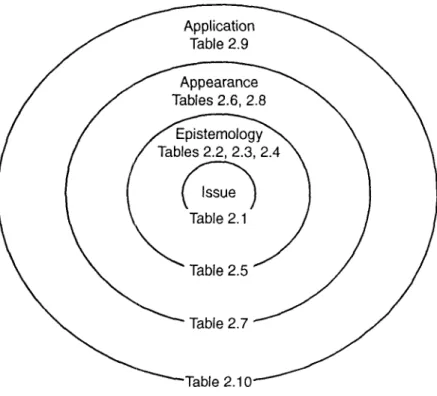
Resulting from this chapter is a research map (see Figure 2.1) that facilitates further theory building on the concept of knowledge within the field of strategic management. It is a generic tool for other academic work that contextualizes arguments as to why the issue of knowledge is important, with underlying epistemological assumptions, knowledge appearances and applications.
Contextualized Theory Building
Contextualizing theory building means revealing and clarifying the research issues, the epistemological origins of the concepts discussed, and their appearances and applications. Activities of concept creation and retrofitting alternate; while ‘walking on the research map’, new concepts have to be consistent with the researcher’s epistemology and legitimated by a research issue. If an existing concept is used, it has to be carefully retrofitted, which means that application, appearance, epis-temology and the issue as such have to be matched with one’s own work. This notion of retrofitting further expands the work done by von Krogh and Roos who perceive retrofitting as ‘making ideas adjust to old design Principles’ (1996b: 730). Representing a modest effort to push the field in
the direction of more intensive research on the concept of knowledge, this chapter suggests the four-step approach illustrated in Figure 2.1. Theory building consists of exploring the research issue, the epistemo-logical roots, the appearances and the applications.
STEP 1: ISSUE Knowledge as a theoretical issue has to be explored. Researchers have to explain why it becomes increasingly important to carry out research on knowledge within the field of strategic manage-ment. The goal is to validate the need to adapt strategic management theory to the contemporary challenges of a knowledge-based economy. Resulting from step 1 are research questions that steer further theory building. This chapter suggests six reasons why strategic management would profit from exploring the concept of knowledge. Mostly implicitly, the research interests are closely tied to epistemological assumptions. Consequently, researchers have to position themselves in step 2 within the epistemologies to be able to see the limitations of their own ways of thinking and to gain inspiration for new, interesting research questions derived from other epistemological areas. This constant alternation is a sustainable source for further theory building.
STEP 2: EPISTEMOLOGY Theory building requires a careful investigation of fundamental assumptions. We claim that before researching into the concept of knowledge itself, the process of knowledge development has to be explored by revealing its epistemological roots. We argue that concepts take different forms depending on the epistemology they are based on. To understand these basic assumptions, on which the concepts and theories addressed are based, is therefore essential for new concept generation, but also for the integration and comparison of existing concepts, which will be shown by means of articles by Simon (1993), Zander and Kogut (1995) and Nonaka (1994).
STEP 3: APPEARANCE Here the appearance of knowledge, or how pre-vious studies have conceived of knowledge in strategic management studies, is discussed. By ‘appearance’, we mean the different forms that knowledge can take, expressed by numerous adjectives of knowledge (e.g. tacit, explicit, embedded, social or encoded). These appearances differ fundamentally between. the three epistemologies. We will outline these differences by means of one example: we will retrofit the concept of ‘tacit knowledge’. We argue that in respect of this concept the articles researched can be clearly positioned, except the article by Herbert Simon, where tacit knowledge is not explicitly mentioned. In that case, it has to be explored to what extent knowledge in the cognitivistic epis-temology might be tacit, and how this is expressed.
STEP 4: APPLICATION It has to be explored how the concept of knowledge is applied to the field of strategic management. Currently, we are
experi-encing an explosion of knowledge management approaches, which are partly contradictory in their results. The diverging managerial respon-sibilities that result from the three epistemologies may serve as an example: most cognitivist studies consider the identification, collection and central dissemination of information as the main knowledge devel-opment activity. The connectionists, on the other hand, believe that knowledge resides in the connections and hence focus on the self-organized dispersed information flow. Contrary to the previous two epistemological lines of thought, autopoietic epistemology stresses the interpretation and not the gathering of information as a major managerial responsibility. Consequently, strategic models differ fundamentally, because they are partly based on different epistemological assumptions, and aim at structuring different issues. We will see how different notions of ‘tacit knowledge’ (Polanyi, 1958; 1966) result in different ways to transfer knowledge, because they are based on distinct epistemologies and the studies address different issues.
Both the retrofitting and the generation of concepts would benefit from discussion of these four steps. The question mark in Figure 2.1 stands for the undiscovered area of the map that has to be revealed while working with (‘walking on’) the map. This can be done by new concept creation (e.g. new research streams in cognitive science or philosophy). A con-siderable potential for theory building lies in the retrofitting of concepts. By taking existing concepts and retrofitting them within a different epistemology, the map is expanded. We argue that careful retrofitting of existing concepts adds more value to the understanding of knowledge in strategic management than. the uncontextualized invention of more and more new concepts.
The research methodology presented in this chapter represents an opportunity to structure the academic conversation about knowledge and strategy. The various concepts can be related to each other, which makes them comparable. Again, transparency is vital. It is then up to each individual to decide in what situations one or the other epis-temology might be more appropriate. The following sections attempt to draw the research map focusing on knowledge in strategic management, and to show how researchers may use a small part of the map while researching strategic management in the knowledge era. The overview of the tables presented is given in Figure 2.2.
Strategizing in the Knowledge Economy
Recent contributions to the field of strategic management have pointed out that ‘knowledge’, in one form or another, is of central importance to the development of sustainable competitive advantage of companies. But why is knowledge an issue in strategic management, and how can it
Figure 2.2 Overview of tables in Chapter 2
potentially influence the field? In order to be able to answer this ques-tion, it is of great importance to integrate the economic and sociological perspectives, because only both together create a profound under-standing of the nature of the knowledge society (Stehr, 1994).
The following arguments are intended to move the concept of knowl-edge from an exogenous variable in economic analysis to an endogenous one, while at the same time shedding more light on the potential for strategic management scholars to rethink the role of knowledge in their own work according to their very own epistemology. In sum, knowl-edge is important for the theoretical realm of strategic management for the following six reasons (and possibly more).
Knowledge Implies Sustainable, Heterogeneous Resource Distribution
As mentioned in the first chapter, strategic management has been domi-nated by an external factors approach which attributed more significance to a company’s environment than to the company itself. Over the last 15 years, however, researchers in the field have brought a second point of reference into focus: ‘the resource-based view’ (Selznik, 1957; Penrose, 1959; Mahoney and Pandian, 1992). This approach, mostly viewed as complementary to the ‘environment-based view’ (Hamel and Heene, 1994a; Henderson and Cockburn, 1994), explains competitive advantage as a result not of product--market positions but of differences in equip-ment and combinations of critical organizational resources (Wernerfelt,
1984; Dierickx and Cool, 1989; Amit and Schoemaker, 1993). This
theor-etical view allows for sustainable differences in resource endowment, since there are certain resources that are in limited supply for a company (Peteraf, 1993). Characteristics for such. resources are that they are hard to substitute, imitate and transfer (Barney, 1991). Owing to the complex
and idiosyncratic nature of knowledge, which we will elaborate more profoundly below, strategy development based on the company’s valu-able knowledge is likely to lead to sustainvalu-able competitive advantage.
The increased relevance of intangible resources, and knowledge in particular, for sustainable differentiation has led to an explosion of new
publications on knowledge and knowledge management. Knowledge measurement is a good example of a new branch in the field of strategic management. Eccles (1991) pointed out the importance of knowledge measurement: he described the trend towards qualitative performance measurement tools (innovation, personnel, customer satisfaction etc.) instead of mere financial evaluation. Kaplan and Norton (1992; 1993) expanded upon this idea and introduced with their ‘balanced score-card’ an instrument which combines performance measurements from different perspectives (i.e. knowledge ‘development perspective, custo-mer perspective and financial perspective). The Swedish insurance company Skandia was inspired by this idea and developed its own instrument to evaluate their intellectual and financial assets: the ‘Busi-ness Navigator’ (Skandia, 1994; Brooking, 1996). Since then, much effort has been devoted to research on the measurement of (core) competences (Klavans, 1994; McGrath et al., 1995), of abilities (Klein and Hiscocks, 1994) and of technological knowledge (Bohn, 1994), and on the meaning of employee know-how and other ‘intangible resources’ (Hall, 1992; 1993).
Besides the measurement of knowledge, other research questions arise from the observation that knowledge implies sustainable, heterogeneous resource distribution. How long is competitive advantage ‘sustainable’? How can investments in knowledge be passed on to stakeholders? How can they be informed about the value of the hidden assets? What is the future role of traditional resources? ‘Who owns intangible resources? Where is the balance between knowledge exploitation and develop-ment? To what extent can alliances promote the development of unique knowledge combinations? How quickly can new knowledge be developed?
Knowledge Changes the Nature of Resource Investment Decisions
The above research questions point in one direction: how can intangible resources be managed? How can we know what knowledge we have and what we will need in the future? The low predictability of the impact that knowledge has on the performance of an economy leads to the question of how these resource bundles that are connected with
knowledge might be observed and understood. Friedrich von Hayek (1975: 434) pleads for distinct scientific methods to approach complex phenomena (he refers to markets) that can hardly ever be fully known or measured. He argues that in most cases it is enough to develop ‘imperfect true knowledge’ (1975: 438) about a phenomenon that is characterized by organized complexity (i.e. the character of the structure depends not only on the properties of the individual elements and their relative frequency of occurrence, but also on their interconnections). Hayek suggests focusing on mere pattern predictions ‘of some of the general attributes of the structures that will form themselves, but not containing specific statements about the individual elements of which the structures will be made up’ (1975: 436).
Consequently, strategic management needs new tools to see emergent patterns in knowledge endowments. A company has to be able to iden-tify current knowledge inside and outside the company, and to decide upon knowledge development projects. Strategic knowledge manage-ment will be of high importance, because the formation of knowledge is a lengthy process, which brings us directly to the next point. Decisions on investments in particular knowledge areas are increasingly difficult to make, because knowledge is only partly transferable or tradable. Path Dependency in the Knowledge Economy Increases
Path dependency refers to the phenomenon that organizations are restricted in their evolutionary scope. Past decisions and actions to a large extent prescribe the future development of the company. We argued that resource endowment in the knowledge economy is sustainable, heterogeneous and reinforced through positive feedback. This means that it is very difficult for companies to develop funda-mentally new resources. The probability increases that the economy will gradually lock itself ‘into an outcome not necessarily superior to alternatives, not easily altered, and not entirely predictable in advance’ (Arthur, 1989: 128). Leonard-Barton (1992) observed that excellence in the dominant discipline (e.g. marketing) reinforces the development of this particular field, but at the same time inhibits the development of other expertise (e.g. technology). A similar argument is outlined in Cohen and Levinthal’s (1990) study on ‘absorptive capacity’ in which the authors show that innovative performance is path-dependent. They argue that an early lack of investment in an area of expertise may foreclose the future development of a technical capability in that area (1990: 128).
Although increased path dependency leads to a narrower set of options, on the other hand it lends increased importance to strategic management. Because the company is, at least on the knowledge level, pa&dependent, it is more important to blaze a trail in advance. New ways to cope with the increased danger of being locked onto a specific
path have to be further explored, e.g. experimentation (Leonard-Barton, 1995). The ability to recognize, imagine and create patterns, and thus to develop knowledge foresight, may be the distinguishing factor in a knowledge economy, because it stakes out ‘ex ante limits to competition’ (Peteraf, 1993).
Knowledge Triggers Positive Feedback Loops Rather Than Negative Ones
As already mentioned, classical economic theory is based on the assumption of diminishing returns resulting in predictable equilibrium for prices and market shares, yet the parts of the economy that are knowledge-based are largely subject to increasing returns (Arthur, 1994: 3). Increasing returns therefore allow for a variety of possible equi-librium points. The challenge in the knowledge society therefore is to select a path that may lead to a preferred equilibrium point, knowing that the ‘best’ solution from an economic and technical point of view is not always the most successful.
A second implication of the increased importance of knowledge is that the positive feedback mechanisms widen the gap in the two-class society, i.e. between knowledge workers and blue-collar workers (Drucker, 1994). The more knowledge one has, the faster it will develop. The traditional conceptual distinction between the three economic sectors becomes more and more obsolete. What will be more important to study is the emergence of a social division into blue-collar and knowledge workers. Consequently, Reich (1991: 174) sees the future of work in three distinct categories: routine production services, in-person services and symbolic-analytic services. We need to understand how knowledge-based work differs from material-based work (Drucker, 1986), and how organizational forms may change and so influence strategic decisions.
Knowledge Changes the Nature of Work and Property
In the past decades, our societies have experienced a shift towards the post-industrial society (Bell, 1973). Inherent in the terms ‘postmodern-ism’, ‘post-capitalism’ or ‘post-industrial society’, is the suggestion that a crisis, a radical break or a coupure (Jameson, 1992) in existing concepts triggers the creation of something entirely new. ‘Most goods purchased are intended to provide a service or a function, and there are few “pure” services unconnected to certain commodities’ (Stehr, 1994: 135, italics his). The partial replacement of traditional resources by knowledge gives rise to new work forms.
Property is distributed and not identical with the possession of objects. Rather it is increasingly intangible and invisible (1994: 84). This shift weakens Marx’s criticism of the division of labour (and his concept of the revolutionary reserve) because the critical resources reside to a
large extent in the individuals themselves. Furthermore, as the benefits from knowledge start to surpass the benefits from physical capital (Lane, 1991: 415), the attempts to measure and evaluate knowledge have been intensified (Stewart, 1994). But the more widely complex knowledge is distributed among loosely connected workforces, the more difficult becomes the attribution of intellectual property to any individual owner. Intellectual property is often controlled by corporate actors, and cannot be sold, given away or inherited (Stehr, 1994: 85).
This embeddedness of individual knowledge in the corporate knowl-edge system explains the importance of continuous employment. Both employee and employer benefit from a close and sustainable work relationship, because it encourages the development of firm-specific knowledge (i.e. knowledge that is valid only within a specific company). This particular knowledge type enables the firm to differentiate itself from the competitors and hence generates competitive advantage. On the other hand, the emphasis on firm-specific knowledge forces the employee into dependence on the employer, because the most important asset that the employee could offer to a new employer would in most cases be firm-specific knowledge. Hence, the responsibility of managers in the knowledge economy is to ensure the employability of the organ-izational members instead of guaranteeing them lifelong employment. Employees need to be given the opportunity to acquire knowledge that is not only valuable within one firm. If knowledge is the most important asset, companies attract the best knowledge workers only if they offer them interesting knowledge development projects that increase their value on the job market (von Krogh and Venzin, 1997).
Knowledge Emphasizes the Social Context
Although the ownership of knowledge is not entirely confined to the individual, the number of institutions which create meaning (and knowl-edge) in any society has increased. Whereas in the Middle Ages the Church and some Greek philosophical texts were the most important sources for the creation of meaning, nowadays individuals draw on different sources when they interpret events, and by doing so create knowledge. ‘Meaning is the result of my explanation of past lived experiences which are grasped reflectively from an actual now and from an actually valid reference schema’ (Schutz and Luckmann, 1974: 16, emphasis added).
Thus, we move away from controlled ‘production’ of meaning through a few institutions towards a pluralistic, self-referential and context-sensitive way of meaning creation. As knowledge develops through the social creation of new meanings of concepts, it has lost its universal character. Today, we have to cope with conflicting and often paradoxical knowledge, leading to the phenomenon that in a knowledge society the number of ‘best’ solutions to well-defined problems decreases. In some
situations it will be very difficult to attain a shared meaning of an issue, because meanings are idiosyncratic: they develop over time and are related to prior experience. ‘If people want to share meaning, then they need to talk about their shared experience in close proximity to its occurrence and hammer out a common way to encode it and talk about it’ (Weick, 1995: 188).
Consequently, one might argue that strategic processes involve a broad group of organizational members. Yet they engage in meaning creation within small teams that have the possibility to establish common ground.
Table 2.1 Strategic issues in the knowledge economy
Issue 1 Knowledge implies sustainable, heterogeneous resource distribution Issue 2 Knowledge changes the nature of resource investment decisions Issue 3 Path dependency in the knowledge economy increases
Issue 4 Knowledge triggers positive feedback loops rather than negative ones Issue 5 Knowledge changes the nature of work and property
Issue 6 Knowledge emphasizes the social context
To sum up, the emergent importance of knowledge as a source of competitive advantage summarized in Table 2.1 makes it necessary to rethink strategic concepts fundamentally. The link between knowledge and strategy has to be further developed, because the nature of knowl-edge is different from that of traditional resources. Knowlknowl-edge cannot be fully owned by the company: it is not easy to transfer or to imitate, it is context-sensitive and it is observer-dependent. Existing strategic tools that partly claim to have universal relevance to all industries and managerial situations are of limited use. Strategic management theory needs to explore new ways of observing emergent equilibrium points of a resource that cannot be fully measured or described. Thereby, deci-sions on knowledge development and exploitation are facilitated. Being the intellectual leader does not necessarily also mean being ahead of one’s competitors. Timing of exploitation and exploration of knowledge becomes increasingly important, because there is no single equilibrium point that can be targeted.
Uncovering Epistemological Assumptions
Given that the concept of knowledge is so important for strategic management theory, we have to advance our understanding of the nature of knowledge and knowledge processes as described in the following quotation:
Knowledge is constituted by the ways in which people categorize, code, process and impute meaning to their experiences. . . . Knowledge emerges out
of a complex process involving social, situational, cultural and institutional factors. The process takes place on the basis of existing conceptual frame-works and procedures and is affected by various social contingencies, such as skills, orientations, experiences, interests, resources and patterns of social interaction characteristic of the particular group or interacting set of indi-viduals, as well as those of the wider audience. (Arce and Long, 1992) Frank Blackler (1995) presents different categories of knowledge which all describe the nature of knowledge but refer back to the process by which it was acquired. Encultured knowledge, for example, refers to the process of achieving shared understandings (1995: 1024), whereas embodied knowledge is acquired by doing and requires physical presence. Hence, in order to grasp the nature of knowledge, it is first of all important to understand the process of knowledge development. This section provides a brief introduction to the most influential contributions to epistemology that have shaped management thinking.
Reasons to Discuss Epistemological Assumptions
Differences in the personal epistemology are manifested in different ways to categorize knowledge, such as the use of different analytical techniques, and/or different ways to define the boundaries of the pro-cesses of knowledge development. By uncovering the epistemological roots of current strategic management theories, we hope to bridge over controversial discussions about the nature and practices of strategy as mentioned in the previous section. Hence, besides the importance of epistemology for contextualized theory building, we study epistemolo-gical assumptions for several other, more practice-oriented, reasons.
First, understanding epistemological assumptions ensures effective knowledge management. The managerial tools and practices employed in a company have to match the specific nature of knowledge (von Krogh and Roos, 1996a). As knowledge becomes more and more important in our society, the ability to manage knowledge is critical: ‘In order to manage knowledge assets, we need not merely to identify them but to understand them - in depth - in all their complexity: where they exist, how they grow or atrophy, how managers’ actions affect their viability’ (Leonard-Barton, 1995: xii).
Distinct managerial responsibilities and practices arise from each epistemology. Consequently, being familiar with a different possible epis-temology means having a larger knowledge management repertoire, and a better understanding of the limitations of each approach.
Second, because knowledge development is contingent (i.e. depen-dent on the context), researchers as well as managers need to interpret and understand changes in corporate epistemology. Individuals and organizations can hardly be assigned to one single way of knowing. Distinct epistemologies emerge from the connection to a specific task or situation. Knowing more about existing epistemologies facilitates
understanding of the context. Following Deborah Tannen’s (1995) work on conversational styles, we support her plea for mutual understanding of a different way of developing knowledge rather than to obtrude on one’s epistemology. Knowing more about the current epistemological mode, and that of the co-worker, will decrease misunderstandings.
Third, if we are able to recognize different epistemologies, we might also be able to choose a distinct mode depending on the current situation. We claim that - similarly to the active choice of a speech style - it is also possible to choose and apply a distinct epistemology. Mary Crawford states that ‘speakers do not speak in a vacuum. They attempt to choose language that will “work” interactionally. Their use of lan-guage is situational and strategic. And what “works” depends on the social status of the speaker and the power relations between speaker and listener’ (1995: 44). Hence, ways of thinking can be assigned to specific tasks, or vice versa. The conscious choice of an epistemological mode is a
critical success factor for research and management.
In the rest of this section, we would like to help the reader to reflect upon his or her own epistemology, and in turn to assess the epis-temology of others in order to contextualize, better understand, and retrofit contributions in the field of strategic management. This facilitates the ongoing conversation within the strategy research community, and may generate a mutual understanding for other epistemologies.
The epistemological distinction that we suggest as a basis for posi-tioning, concept development and retrofitting is based on the con-tributions of Varela et al. (1991) and von Krogh and Roos (1995b). These authors refer back to cognitive science because it has been most influential for scientists studying organizational knowledge - although it has not yet been established as a mature science (Varela et al., 1991: 4). Also, building as it does on neuroscience, biology, philosophy, linguis-tics, artificial intelligence and cognitive psychology, cognitive science combines insights from various fields. The distinctions made by cog-nitive science allow for a positioning within distinct epistemological areas. The following sections will provide a brief overview of the three epistemologies discussed in Varela et al. (1991), and von Krogh and Roos (1995b). To keep the overview parsimonious we assumed that the claims made are valid on several organizational levels, from the indi-vidual to the industry.
Cognitivist Epistemology
The beginning of cognitivist epistemology can be traced back to the mid 1950s, when Herbert Simon, Noam Chomsky, Marvin Minsky, John McCarthy and others developed a particular way of knowing. Organ-izations are considered to be open systems which develop knowledge by formulating increasingly accurate ‘representations’ of their pre-defined worlds. Because knowledge is seen as a representation of these worlds,
data accumulation and dissemination are the major knowledge develop-ment activities in organizations: the more data organizations can gather, the closer the representation will be to reality. Hence, most cognitivist approaches equate knowledge with inform&ion and data.
When gathering information from the external environment the brain stores facts, relates them to existing experiences and creates a picture of the world. The world is considered to be a pre-given object, event or state which can be perceived in an objectivistic way. What varies from one person to another is the ability to represent reality. The ‘truth’ of knowledge is understood as the degree to which inner representations correspond to the world outside. As new things are learned, this ‘truth will be constantly improved. Learning in the traditional epistemology means taking information from the environment and relating it to the previously acquired frames of reference, to the cognitive map (Varela, 1979). This is the way in which representations can be improved. Because the cognitivists view the human brain and the organization -‘as a “machine” of logic and deduction’ (von Krogh and Roos, 1995b: 14), knowledge is believed to be developed by processing incoming data according to ‘universal’ rules. The whole organization essentially follows the same ‘login gate’ as a mainframe computer, which consists of various propositions using ‘if . . . then’, ‘not’, ‘and’, and ‘or’ as connections for statements or propositions. The cognitivistic profile is summarized in Table 2.2.
EXAMPLE: SIMON In the article by Herbert Simon (1993) the properties of
the cognitivistic epistemology are - in our view - predominant. He states that in order to survive in an uncertain world, companies have to anticipate the shape of the future, generate alternative options for effec-tive operation, and implement new plans rapidly and efficiently (1993: 134). The first step - the anticipation of the future - calls for rep-resentation: ‘anticipation is of value to the degree that it is as accurate as, or more accurate than, the anticipation of the other players, and accompanied by implementation as effective as theirs or more effective’ (1993: 136). Accuracy is an important concept in Simon’s work. This shows that he somehow refers to a pre-given world that has to be por-trayed as precisely as possible in order to ensure a solid basis for action. Therefore, as many data as possible have to be gathered - as early as possible: ‘If a prospective major factor is detected early, and monitored as it approaches closer to realization, estimates of lead times can be modi-fied, and planningand preparation times change accordingly’ (1993: 134). Once the world is represented, the generation of alternatives has to follow certain rules: ‘One severe test of a theory of alternative generation or design is to see whether the theory can be converted into a computer program that carries out the process automatically and successfully’ (1993: 138). Simon substitutes intuition or subjective insights by objective, explicit data (e.g. customer databases, memos, codified rules, experience
Table 2.2 Cognitivistic profile
Profile criteria Theoretical statement Managerial statement View of one’s own
organization Perception of the environment, and positioning in it Notion of knowledge Knowledge development Characteristics of truth
‘An organization works like a mainframe computer; it is open for information that is collected and stored centrally. Action is steered by the “main frame” of the top management.’
Marketing manager: ‘Our company is formed by the founder. He still makes the important decisions.’
‘The environment is pre-given. Head of strategy department: ‘I am The main task for the responsible for depicting the organization is to represent/ actual situation and for picture it and to adapt to it developing options for the top
universally.’ management.’
‘Knowledge is a fixed and representable entity (data) universally stored in computers, databases, archives and
manuals. Knowledge can be easily shared across the organization.’
Human resource manager to a new employee: ‘We have a large documentation of what our knowledge is. If you spend some time reading it, you will understand how the company works.’
‘The cognitivist develops knowledge through the assimilation and dissemination of incoming information. Inner representations that partly or fully correspond to the outer world are created.’
Head of research: ‘The number of new patents is our most important indicator for our knowledge development. We have to bargain for knowledge.’
‘Truth is the degree to which our inner representations correspond to the world outside. Truth is defined as dependent on the amount of information.’
Employee: ‘The more information we have, the more truth we have.’
reports, books, manuals or policy descriptions). He does not distinguish between data, information and knowledge, or between ‘to be informed’ and ‘to know' (1993: 135). The implementation process as described by Simon makes it even clearer that the organization operates according to universal rules that have to be reinforced continually. These rules have one main frame of reference: the top management. Herbert Simon talks about the ‘absorption of strategic plans’ (1993: 141) - which means that it is possible to reach consensus about policies and to implant ‘them firmly in the hundreds of heads’ (1993: 139).
Connectionistic Epistemology
Representationism as it has been described in the cognitivist epistemo-logy is still prevalent in the connectionistic epistemoepistemo-logy, but the
process of representing reality is different. In connectionism, the rules on how to process information are not universal, they vary locally. Organ-izations are seen as self-organized networks composed of relationships, and driven by communication. The main method in the connectionistic epistemology is to look at relationships and not to focus on the indi-vidual or the entire system. Thus, the connection&t’s models are built up on a large number of interacting units that are able to influence one another by sending activation signals down interconnecting pathways. Organizations are seen as networks.
Like the cognitivists, the connectionists consider information proces-sing the basic activity of the system. The connectionists see the process of shaping an organization as dependent not only on the stimuli entering the system but also on the system itself. Relationships and communica-tion are the most important issues of cognicommunica-tion. Another essential difference between these two cognitive models is that the connectionists make no distinction between structures that store information and others that process information. Both functions are embodied in the connections between the units. Organizational knowledge is a state in a system of interconnected individuals. Thus, the number of connections, the dynamics of the information flow, and the capacity to store this infor-mation characterize the network (which is similar to a computer net-work). The rules of these connections therefore form an essential part of knowledge. The connection&tic profile is summarized in Table 2.3. EXAMPLE: ZANDER AND KOGUT Zander and Kogut (1995) suggest that knowledge of the firm ‘can be characterized into “information” and “know-how”. It consists of the competence of the individuals and of the organizing principles by which relationships among individuals, groups, and members to an industrial network are structured and coordinated’ (1995: 77). Information, as the authors describe it in an earlier article (Kogut and Zander, 1992: 386), stands for knowledge which can be transmitted without loss of integrity once the syntactical rules required for deciphering it are known. Know-how, on the other hand, is a description of knowing how to do something. Put differently, knowledge is ‘held by the individual, but is also expressed in regu-larities by which members cooperate in a social community’ (1992: 383). Consequently, Kogut and Zander (1992) argue that firms exist only because they are better at transferring and sharing knowledge than the market. In other words, organizations can make more accurate represen-tations of the environment, because they can process and store a higher amount of data than an individual: ‘Firms exist because they provide a social community of voluntaristic action structured by organizing principles that are not reducible to individuals’ (1992: 384). Kogut and Zander differ from the cognitivists because they believe that these rules may vary throughout the company: ‘It is the persistence in the organ-izing of social relationships in which knowledge is embedded’ (1992:
Table 2.3 Connectionistic profile
profile criteria Theoretical statement Managerial statement View of one’s own
organization Perception of the environment, and positioning in it Notion of knowledge Knowledge development Characteristics of truth
‘The virtual organization consists of individuals who are connected mostly through information technology. Action is self-organized and steered by local rules that refer to several frames of reference.’
Treasurer: ‘The key feature of our company is the strong network that allows us to solve complex problems.’
‘Clusters of the organizational CFO: ‘We analyse the different network produce different regional market trends in our pictures of the pre-given world company. The different financial that form the basis for a goals of our subunits are set differentiated adaptation.’ according to these results.’ ‘Knowledge resides in the
connections of experts and is problem-solution oriented. Knowledge is dependent on the state of the network of
interconnected components.’
CEO: ‘My knowledge has developed through the
interaction with others, mostly over ICT. If I lost my laptop, I guess that I would lose about 70% of my knowledge.’ ‘Local rules in a network of
individuals determine how knowledge is accumulated. This allows self-organized groups to develop specific knowledge in order to represent their own environment.’
Sales manager: ‘I develop knowledge by establishing new connections and thereby extending my network. I have to bargain for a central position in the network.’
‘Different experts who have accumulated information about parts of the objective reality bargain about the truth.’
CEO: ‘Our experts define what we consider to be the truth in our company.’
385). Further they state that ‘it is the sharing of a common stock of knowledge, both technical and organizational, that facilitates the transfer of knowledge within groups’ (1992: 389). Hence, the capability of sharing knowledge throughout the company is dependent on existing knowledge that is shared. In order to increase the knowledge transfer capacity, Kogut and Zander suggest developing higher-order organizing principles that act as mechanisms by which technologies can be codified into a language accessible to a wider circle of individuals (1992: 389). Autopoietic Epistemology
Autopoietic epistemology provides a fundamentally different under-standing of the input coming from outside a system. Input is regarded not as information, but as data, the smallest units of potential informa-tion. Information itself is data put into a certain context. It is the first
process step by which knowledge is acquired. Thus, autopoietic systems are simultaneously open and closed: open with regard to data, but closed to information and knowledge. Knowledge cannot be directly conveyed from one individual to another, because data have to be interpreted. Signals from outside can stimulate processes within the system, but they always follow the self-defined rules of the system. To be operationally closed regarding information is the central aspect of an autopoietic system that organizes itself. The boundaries of the system are defined by these rules. Thus, only data can pass these frontiers.
As an example, Maturana and Varela (1980) take the cell as a living system that is self-referring, which means that the cell is an autonomous entity where everything happens in reference to itself (Varela et al., 1991: 121). Components of the cell produce other components which produce the units that produced them. The membrane is the border of the cell that limits the diffusion. By doing so, the membrane facilitates the internal production which keeps the membrane alive. This cycle of self-production characterizes the theory of autopoiesis, a name derived from
the Greek words auto (self) and poiesis/poein (production). The auto-poietic profile is summarized in Table 2.4.
EXAMPLE: NONAKA AND TAKEUCHI The analysis of the epistemological assumptions of Nonaka and Takeuchi (1995) results in their being positioned closer to the autopoietic epistemology: in their work, the world is not perceived as a fixed and objective entity, for it is not possible to represent reality. Nonaka and Takeuchi state that ‘Japanese intellectual tradition suggests that ultimate reality for the Japanese lies in the delicate, transitional process of permanent flux, and in visible and concrete matter, rather than in eternal, unchanging, invisible and abstract entity’ (1995: 31-2). The organization is seen as a living organ-ism rather than a machine for processing information (1995: 9). In contrast to ‘Western thinking’, Nonaka and Takeuchi explain how the Japanese intellectual tradition focuses on the ‘oneness’ of humanity and nature, body and mind, and the self and other. The ‘oneness’ between humanity and nature expressed in the Japanese language and their flexible view of time and space ‘clearly illustrates a Japanese tendency to deal with sensitive emotional movements rather than to abide by any fixed worldview or metaphysics’ (1995: 29). Hence, the world in this view is not pre-given as in the previous epistemologies.
The denial of the separation between mind and body leads to the emphasis on physical experience. That means that each individual has to create his or her own knowledge through experience: formal data lose their determinative role in knowledge creation. Knowledge is perceived as ‘justified true belief’ (1995: 21).l Inherent in this definition is the rejection of the assumption that ‘truthfulness’ is the major attribute of knowledge, as it is to be found in the epistemologies previously out-lined. Two additional characteristics of knowledge are added. First, by
Table 2.4 Autopoietic profile
Profile criteria Theoretical statement Managerial statement View of one’s own
organization Perception of the environment, and positioning in it Notion of knowledge Knowledge development Characteristics of truth
‘The autopoietic company is an Human resource manager: autonomous and observing ‘Everybody in our organization system that is simultaneously is a free agent. We try to open for data but closed for develop opportunities and information. It is a group of support the organizational individuals who have created members by putting them into an emergent frame of reference.’ a c t i o n . ’
‘The world is brought forth in conversations. The environment and the organization are coevolving systems.’
CEO: ‘We try to create new businesses/industries, and we are constantly searching for discontinuity as a source of innovation.’
‘Knowledge resides in mind, body, and the social system. It is observer- and
history-dependent, context-sensitive and not directly shared, only indirectly through discussions.’
Controller: ‘Our knowledge is private. We respect each other as individuals who have undergone different experiences and who come from different cultures.’
‘The process of interpreting incoming data in conversations is the cornerstone in knowledge development. This enables the autopoietic systems to make distinctions and to create meaning according to observations and previous experiences.’
Production employee: ‘From time to time we talk about our production processes and allocate a considerable part of our time to developing knowledge about other activities. I have to make an effort to gain inspiration from others.’
‘Truth is not a main issue. By accepting that there is not an objective reality, different standpoints are possible. Reality is socially created.’
Secretary: ‘We all create our own reality. There are many truths in our company - and they are respected by everyone.‘
considering knowledge to be a personal or social ‘belief’ the subjective character of knowledge is highlighted. In order to be knowledge, a statement must be true (objective truth), and in addition, individuals have to believe that it is true (subjective attitude towards the truth). Hence, the ‘belief condition’ reveals the individual attitude towards knowledge (e.g. a statement/proposition) which denies the existence of one true representation of reality. Second, the ‘justification condition’ requires sources of evidence of truth. By distinguishing between the traditional epistemology and the theory of knowledge creation, ‘the former naturally emphasizes the absolute, static, and non-human nature of knowledge, typically expressed in propositional forms in formal logic, Whereas the latter sees knowledge as a dynamic human process of justifying personal beliefs as part of an aspiration of “truth”’ (Nonaka,
1994: 15). Hence, knowledge has to be validated, although it is known that absolute ‘truth’ can never be attained.
Relating Emerging Knowledge Strategy Issues to the Epistemologies
what we have attempted to show in this section is that cognitivistic, connectionistic and autopoietic epistemologies vary in their perceptions of concepts like ‘organization’, ‘knowledge’ and ‘truth’. These differ-ences allow of the positioning of scientific contributions within these epistemologies. Tables 2.2, 2.3 and 2.4 summarized the three epistemo-logies and aimed at supporting the positioning of new statements within these epistemologies. Practical statements are distinguished from theoretical statements to show the relevance of epistemological profiling for academics as well as for managers. Table 2.5 in turn reveals how the issues presented in the previous section vary in their very nature depending on their epistemological assumptions.
Issue 1 (i.e. knowledge implies sustainable, heterogeneous resource distribution), for example, takes a different shape in scientific contri-butions that can be positioned within the cognitivistic epistemology compared with work based on connectionistic or autopoietic epistemo-logical assumptions. From a cognitivistic point of view, knowledge is a fixed and representable entity (data) universally stored in computers, databases, archives and manuals. This in turn implies that knowledge can be easily shared within the organization, and across organizational boundaries. Hence, from a cognitivistic viewpoint, issue 1 has little relevance, i.e. sustainable differences in the resource endowment hardly exist, because it is not very difficult to transfer and imitate knowledge. For the connectionists, knowledge resides in the expert links. Knowl-edge is dependent on the state of the network of interconnected com-ponents. Local rules in a network of individuals determine how knowledge is accumulated. Barriers to the transfer of knowledge would essentially come from the lack of knowledge about the expert network resulting in inefficient search rules. Kogut and Zander (1992), for example, consequently focus on the importance and at the same time on the difficulties of discovering the procedural rules that are needed to reveal the required data hidden somewhere in the organization. Now, using the words of Kogut and Zander, one might say that it is more difficult for another organization to discover the procedural rules of a targeted competitor, and therefore knowledge can imply sustainable heterogeneous resource endowment. In addition, it is not very likely to succeed in transferring knowledge by transferring single individuals, because knowledge resides in the connections between experts. This might also explain why investment companies, for example, started to entice away entire teams from their competitors.
From an autopoietic viewpoint, knowledge is always private and is never 100% equal from one individual to another. Hence, sustainable
Issue 1 Knowledge implies sustainable, heterogeneous resource distribution Issue 2
Knowledge changes the nature of resource investment decisions
Issue 3
Path dependency in the knowledge economy increases
There is no significant impact of knowledge on the heterogeneity of the resource distribution, because knowledge can be transferred as easily as a commodity. It is accessible for all companies in the same way
Knowledge is visible and easy to measure. Resource allocation decisions for knowledge
development projects are therefore similar to investment decisions made in more tangible areas Because knowledge is easy to transfer, path dependency does not necessarily increase in the
knowledge economy. If a company wants to change the path, new knowledge can be easily bought from outside
Knowledge implies sustainable heterogeneous resource
endowment, because the search rules and the connections are not directly accessible to competitors
It is not easy to observe the knowledge status and flow in organizations. Resource allocation decisions therefore have to include effects on the dynamic knowledge links within and outside an organization
Path dependency increases in the knowledge economy, because it takes more time to redirect the development or transfer of
resources, i.e. to identify and change the network with its locally varying dynamics
Knowledge implies sustainable heterogeneous resource endowment because knowledge is individually created by a process of
internalization and externalization
It is not easy to evaluate knowledge and knowledge development, because it is not directly observable. Resource allocation decisions for knowledge development therefore cannot always be made explicit, and they are hard to communicate As knowledge is deeply
idiosyncratic and hard to transfer or imitate, path dependency increases in an economy where knowledge is the decisive production factor
Issue 4
Knowledge triggers positive feedback loops rather than negative ones
Issue 5
Knowledge changes the nature of work and property
Issue 6
Knowledge emphasizes the social context
It is most probable that along with an increasing amount of knowledge comes a position/task assignment closer to the main frame (i.e. top management), which in turn would lead to a increased access to data flows
Because knowledge is seen as a commodity that can be identified, measured and traded, neither the nature of property nor the nature of work changes
Knowledge is universal and is not Knowledge is partly dependent on context-dependent the context: the state of the network
The more knowledge a company has, the more links have been established that in turn reveal several other connections in the expert network. Thus, a new connection potentially triggers positive feedback
If organizations are seen as a network of experts who are more or less replaceable, more flexible work forms gain in impact, and
organizational and industry boundaries vanish. Knowledge can only be partially revealed, and property therefore depends on the accessibility of one’s own
knowledge
Knowledge triggers positive feedback loops as new distinctions enable the autopoietic system to make further observations, which in turn leads to new distinctions
As knowledge resides in the individual and is to a large extent tacit (i.e. it cannot be articulated and transformed into structural capital), property is distributed, and long-term physical and emotional experiences in groups become more important
Knowledge is individually
developed, and meaning creation is dependent on previous experiences and the current situation
differences in resource (knowledge) distribution exist as organizations consist of a divergent group of individuals. To make these differences apparent in a competitive context, we need to explore to what extent individual knowledge is different from social knowledge, and in turn, to what extent it is less difficult to share knowledge with organizational members compared with individuals outside the organization. The example of the violin-maker Stradivarius shows that although he wanted to convey his knowledge about making a violin to his students, he never fully succeeded in doing so. Nonaka et al. (Nonaka, 1994; Nonaka and Takeuchi, 1995) describe the transfer of knowledge therefore as a process of internalization and externalization, where the student-teacher rela-tionship in the form of an apprenticeship or work groups with physical experiences is stressed. Consequently, it is more difficult to transfer knowledge from organization to organization, because organizations normally do not work together in such an intensive way.2
Table 2.5 reveals the epistemological position of this chapter. The issues discussed in the previous section best conform to the autopoietic assumptions. The following section will show how differences in funda-mental epistemological assumptions result in considerable variances in appearances and applications of knowledge, a subject which has already been briefly touched upon in the last few pages.
Knowledge Appearances
We start out by strengthening the connection between strategy and knowledge, by reviewing different appearances of knowledge, and knowledge-related concepts. As an example, ‘tacit knowledge’ will be retrofitted. As it might not be sufficient to identify appearances of knowledge, in order to understand and to manage knowledge the epis-temological roots are explored in the following paragraphs. We show how retrofitting as a method works by means of the concept of ‘tacit knowledge’.
Selected Categories of Knowledge
Various authors have elaborated with subtle distinctions on the concept of ‘knowledge’.3 This is a manifestation of the ongoing knowledge
development on this issue. The variety of terms a language contains for certain aspects of life can serve as an indicator of the significance and the extent of knowledge in that field. The vocabulary of the Eskimo language, for example, contains about 40 different words for snow. There is no doubt that snow is an integral part of Eskimo life, since it is at times vital for them to know the exact category of snow they are confronted with. Table 2.6 lists a summary of frequently used categories of knowledge.4
Table 2.6 Categories of knowledge
References Knowledge Explanation
Polanyi (1958; 1966; 1969); Spender (1993) Zuboff (1988); Blackler (1995); Nonaka and Takeuchi (1995); Collins (1993) Zuboff (1988); Blackler (1995); Collins (1993) Blackler (1995); Prahalad and Bettis (1986); Argyris and Lyles (1985); Collins (1993)
Berger and Luckmann (1966); Astley and Zammuto (1992); Brown and Duguid (1991); Badaracco (1991); Collins (1993)
Zander and Kogut (1995); Bohn (1994); Winter (1987); Ryle (1958) Tacit Embodied Encoded Embrained Embedded Event Procedural
A person knows more than he can express in words (Polanyi). A painter, for example, cannot describe in detail how he goes about drafting a new picture. This category explores the
development of knowledge as well as
knowledge transfer relative to the interaction of explicit and tacit knowledge
Knowledge in this category results from experiences of physical presence (i.e. project work). The emphasis lies on the process of knowledge development. Prahalad and Bettis (1986) call this ‘unique combinations of business experience’
Knowledge that remains in the company after all employees have gone home (Skandia, 1994), i.e. notebooks, data banks containing
information on customers and employees, product catalogues, codified rules and regulations, itineraries, training materials, etc. This category of knowledge depends on the cognitive abilities which allow of the recognition of underlying patterns (for example of a new industry), the reflection of basic assumptions (see ‘dominant logic’ by Prahalad and Bettis; and ‘double loop learning’ by Argyris and Schon or abstractions synthesizing
The emphasis lies on the process of knowledge construction. Knowledge is here embedded in a variety of contextual factors and not objectively pre-given. Shared knowledge is generated in different language systems, (organizational) cultures and (work) groups
This category describes knowledge of events but also trends within and outside the organization (for example, company A buys company B, or the number of accidents has dropped by 20%) Contrary to the knowledge of events, this category encompasses knowledge of processes and as opposed correlations. Examples include ‘if . . . then’ scenarios, knowledge of product processes or procedural knowledge, for example contract negotiations
Of course, the table is not a complete list. Researchers in the field of knowledge and knowledge management have created and used more terms than those mentioned. ‘Strategic’ knowledge is, for example, not listed in the table because it represents higher-order knowledge categories - ‘meta-knowledge’. Strategic knowledge is knowledge about knowledge: where it is located, how it is stored, how it is transferred, what type of knowledge it is and how swiftly it changes over time. Reflection on knowledge develops strategic knowledge.
The various definitions of knowledge from the last section may have given the reader an impression of how difficult it is to develop a definition of knowledge that is uniformly accepted in the management realm. Despite the many words employed to describe knowledge, it is often difficult to conduct a conversation about knowledge with these words. Winter (1987: 180) notes that words like information, innovation, transfer, diffusion, learning, knowledge and competence are parts of the realm of discourse, but are not really conducive to it. The differentiation between ‘tacit knowledge’ (Polanyi, 1966) and ‘embodied knowledge’ (Zuboff, 1988; Nonaka, 1991; Hedlund and Nonaka, 1992; Hedlund, 1994) may serve as an example. Embodied knowledge is only partially articulated and results from physical presence. Zuboff puts it this way:
For it was also through the body’s exertions that learning occurred and for those who were to become skilled workers, long years of physically demanding experience were an unavoidable requirement. . . . Where the
skilled worker was concerned, the body’s sentience was also highly structured by a felt knowledge of materials and procedures. (1988: 36)
Embodied knowledge refers more to the process of knowledge devel-opment, and where knowledge actually resides. Tacit knowledge, on the other hand, describes the more inherent attributes, the condition of the knowledge category, so to speak. A closer examination of the knowledge types led to the following four criteria for clustering the knowledge categories: objects of knowledge development; processes of knowledge development; location of knowledge; and
knowledge-related concepts.
Clustering Knowledge Categories
Most commonly, knowledge is categorized according to the object of
knowledge development (i.e. biotechnology, mathematics or linguistics). Procedural knowledge, for instance, encompasses knowledge of pro-cesses and correlation, which include ‘if . . . then’ scenarios, knowledge of product processes, or contract negotiations. Event knowledge is another example of this kind. It refers to knowledge of what happens
launches) or within the company (e.g. purchase of new computers, company profile on Internet). On the meta-level, if knowledge itself becomes the object of knowledge development, we may find strategic knowledge concerning itself with questions like where specific knowl-edge can be found, how knowlknowl-edge develops, or how knowlknowl-edge is mediated.
In the literature on knowledge, categorizations can be found that put strong emphasis on the process of knowledge development. As mentioned at the beginning of the previous section, encultured knowledge is one
example of this category, because it refers back to the process by which shared understandings have been achieved. Another example of a knowl-edge category that is closely related to the process by which knowlknowl-edge is developed is embedded knowledge. As such, it is embedded in a variety of contextual factors, and is constructed by a social system. Shared knowledge is generated in different language systems, (organizational) cultures and (work) groups. If the context changes (e.g. culture), knowl-edge also changes. Concepts that can be summarized as embrained knowledge are other examples of this category. Embrained knowledge depends on the cognitive abilities which enable one to see underlying patterns (for example of a new industry), the reflection of basic assump-tions (see ‘dominant logic’ by Prahalad and Bettis, 1986; and ‘double loop learning by Argyris and Schon, 1978), or abstractions and synthesizing.
Another way to approach the nature of knowledge is to research the location of knowledge. Although embodied knowledge also refers back to the process of how knowledge developed, namely through physical experiences, we put more emphasis on the result of this knowledge development process and categorize embodied knowledge under loca-tions of knowledge. The reason is that the result of this physical knowledge development process is that the knowledge thereby created is partly tacit and therefore closely related to an ontological entity. Distinctions between individual, group, company, inter-company, customer or industry knowledge indicate the carrier of knowledge (Walsh, 1995). The same close connection to a specific location can be found in encoded knowledge. If knowledge is stored in some form in addition to the human body, we call this category encoded knowledge. If knowledge is encoded, it has been stored in some form (e.g. text, sound, graphics) and can be easily located (e.g. in notebooks, manuals, videotapes).
Retrofitting Knowledge Categories
The challenge that researchers face now is to retrofit the knowledge appearances they intend to borrow from other academics with their own work. This requires a careful exploration of the basic assumptions they are constructed on. The notion of ‘tacit knowledge’ may serve as an
example. We chose tacit knowledge because we think that a profound understanding of this concept is essential for most researchers who explore the issues outlined earlier, and because our understanding of this form is so limited. Table 2.7 summarizes an attempt to retrofit the different knowledge categories with the epistemologies. Procedural and event knowledge have not been retrofitted, because we believe that objects of knowledge development do not fundamentally differ in nature except in one respect: within autopoietic epistemology, observations focus more on the collation of context data than in the other two epistemologies.
In the following we will briefly describe the first category of Table 2.7: tacit knowledge. The concept of tacit knowledge can be traced back to Michael Polanyi (1958; 1966; 1969) who suggested that individuals know more than they can say. Polanyi suggests that knowledge that can be expressed is only a small part of the whole body of knowledge.
EXAMPLE: SIMON Herbert Simon has been positioned in the cognitivistic realm, where tacit knowledge is not explicitly mentioned. As we under-stand his work, there is no knowledge that cannot be codified. Hence, is it impossible to retrofit the concept of tacit knowledge with cognitivistic epistemology? Is there any knowledge that cannot be made explicit from a cognitivistic point of view? Here we have the chance to expand the research map: if the organization works like a computer, one might speculate that tacit knowledge exists if the amount of data is too high and too complex to be presented on one screen. Even though data are available in fragments, it is not possible for the system to connect the various parts. Imagine a map containing some information about a region: roads, religions, precipitation, topography, languages, political orientation, population. If the map is well designed, it might still be possible to retrieve the information required. But at some point, a map will not be able to represent all available information. Hence, the tacit dimension of knowledge - in the cognitivistic epistemology - might be rooted in the limitations of analogue data perception.
EXAMPLE: KoGuT AND ZANDER Kogut and Zander (1992) adapted
Polanyi‘s work to connectionistic assumptions. They rephrased Polanyi’s well-known statement and argue that: ‘organizations know more than contracts can say. The analysis of what organizations are should be grounded in the understanding of what they know how to do’ (1992: 383). Further, they state that:
an interpretation of his [Polanyi’s] argument is that tacit knowledge consists of search rules, or heuristics, that identify the problem and the elements consisting of the solution (Polanyi, 1966, pp. 23-24). The act of solving a problem rests on a sense of how the phenomena function; the formal
Tacit knowledge Knowledge is not very likely to be Knowledge can be tacit if the search Tacit knowledge is physical and tacit. Only if the amount of data is rules for knowledge that hide subjective, being created in a too high and complex for a somewhere in the organization are specific practical context. It can only representation by some means, not fully transparent be partly conveyed by processes might it be the case that knowledge comparable to master-apprentice
is only partially explicit relations
Embodied knowledge All knowledge can be gained All knowledge can be gained As knowledge resides in mind, without practical experience, only without practical experience; only body and the social system, bodily through cognitive learning: this through cognitive learning: this experiences are of high importance category is not of high importance category is not of high importance
Encoded knowledge It is possible to encode 100% of It is possible to encode 100% of Encoded knowledge represents only existing knowledge existing knowledge a small part of existing knowledge Embrained knowledge Embrained knowledge refers to the Embrained knowledge is the ability Embrained knowledge refers to the
capacity to centrally collect data to identify and map the relevant ability to scale up, to observe from within and outside the system, network of interrelated components experiences from various contexts, and to identify universal rules and that influence one‘s own operations and to recognize patterns in the patterns that influence this data and to recognize the higher-order interpretation processes involved in
flow rules and dynamics of this network these experiences
Embedded knowledge Knowledge is universal, and Knowledge is embedded in a Embedded knowledge explains the embedded knowledge is therefore distinct state of the network of phenomenon that knowledge not a relevant knowledge category interconnected components of changes its meaning across different
expression of the solution is unlikely to capture fully this procedural knowledge, or even the data and information (or clues, as Polanyi describes it) leading to the solution. Thus, even in the arena of problem identification and solving, the know-how of heuristic search precedes the formal knowledge of the solution. (1992: 389)
From this quote, we learn that within the connectionistic view, tacit knowledge exists because the appropriate search rules cannot be revealed. In contrast to Nonaka, Kogut and Zander argue that it is ‘unlikely’ - but theoretically possible - that knowledge can be made entirely explicit. On the one hand, data have to be made explicit. The challenge to articulate knowledge might reside in the difficulties of grasping data in their very nature, which. shows that they are close to -or even partly in - the autopoietic epistemology. They abandon the idea that the human brain works like a computer and admit that there might be parts that cannot be codified. From an autopoietic point of view, there is some knowledge that can never be entirely conveyed to others, because the sum of experiences that an individual undergoes through-out time is unique. The knowledge created resides partly in the body. But on the other hand, the authors do not further investigate this. Instead, they stress the importance of discovering the procedural rules that are needed to reveal the required data hidden somewhere in the organization.
EXAMPLE: NONAKA AND TAKEUCHI The way in which Nonaka
charac-terizes tacit knowledge is very much in line with Polanyi‘s original notion: knowledge of experience tends to be tacit, physical and subjective, since it is created in a specific practical context and has analogue qualities. Analogue processes are typically found in the master-apprentice rela-tionship, where the student shares the experience of his teacher by carrying out the same task at the same time. Nonaka differs from Polanyi in the way power is perceived. In Nonaka’s work, the relationship between the master and the apprentice is not described as determined by
authority, as is the case with Polanyi. For Nonaka, power and authority are not major issues.
After having studied the underlying assumptions of the different
appearances of knowledge, the next step is to identify these appearances
in their hidden forms. In management literature, knowledge often
appears wrapped up in related constructs as shown in Table 2.8, such as competence, invisible assets, intangible assets, strategic assets, absorptive
capacity, architectural competence, organizational memory, capabilities,
and skills. In most contributions to the strategic management literature, authors use several of these concepts simultaneously, and often