UTILIZING BIAS AND VARIANCE THEORY
Cemre Z o u .
Submitted for the Degree of Doctor of Philosophy
from the University of Surrey
Centre for Vision, Speech and Signal Processing Faculty of Engineering and Physical Sciences
University of Surrey Guildford, Surrey GU2 7XH, U.K.
March 2014
P ro Q u e s t N u m be r: 27750477
All rights reserved
INFO RM ATION TO ALL USERS
The quality of this reproduction is dependent on the quality of the copy submitted.
in the unlikely event that the author did not send a complete manuscript and there are missing pages, these will be noted. Also, if material had to be removed,
a note will indicate the deletion.
uest
P roQ uest 27750477
Published by ProQuest LLC (2019). Copyright of the Dissertation is held by the Author.
Ail Rights Reserved.
This work is protected against unauthorized copying under Title 17, United States Code Microform Edition © ProQuest LLC.
ProQuest LLC
789 East Eisenhower Parkway P.O. Box 1346
Ensemble methods are widely preferred over single classifiers due to the advantages they offer in terms of accuracy, complexity and flexibility. In this doctoral study, the aim is to understand and analyze ensembles while offering new design and pruning techniques. Bias-variance frame works have been used as the main means of analysis, and Error Correcting Output Coding (ECOC) as an ensemble technique has been studied as a case study within each chapter.
ECOC is a powerful multiclass ensemble classification technique, in which multiple two class base classifiers are trained using relabeled sets of the multiclass training data. The relabeling information is obtained from a preset code matrix. The main idea behind this procedure is to solve the original multiclass problem by combining the decision boundaries obtained from sim pler two class decompositions. While ECOC is one of the best solutions to multiclass problems, it is still suboptimal. In this thesis, we have initially presented two algorithms that iteratively update the ECOC framework to improve the performance without a need of re-training.
As a second step, in order to explain the underlying reasons behind the improved performance of ensembles and give hints on their designs, we have used bias and variance analysis. The ECOC framework has been theoretically analyzed using Tumer and Ghosh (T&G) bias-variance model, and its performance has been linked to that of its base classifiers. Accordingly, design hints on ECOC have been proposed. Moreover, the definition of James has been used for experimentation in order to explain the reasoning behind the success of ECOC compared to single multiclass classifiers and bagging ensembles. Furthermore for bias-variance analysis, we have established the missing links between some of the popular theories (theories of Geman, T&G and James) existing in the literature by providing closed form solutions.
The final contribution of this thesis is on ensemble pruning. In order to increase efficiency and decrease computational and storage costs without sacrificing and preferably enhancing the gen eralization performance, two novel pruning algorithms to be used for bagging and ECOC ensem bles have been proposed. The proposed methods, which are shown to achieve results better than the state of the art, are theoretically and experimentally analysed. The analysis also em bodies the bias and variance theory.
Key words: Ensemble, ECOC, Bagging, Bias and Variance, Pruning
Email: c.zor(a)surrey.ac.uk WWW: http://www.cemre.co.uk/
Acknowledgements
Describing my own self has never been a big issue: yet another needle in the hay, dust in the
wind, or an adventure seeker on an empty street. Having said that, I must admit I was never
successful at properly describing what I have been working on for the last god-knows-how-many years even to my father (Ph.D.). Therefore, I would like to start by thanking you, who for some strange reason decided to go through this thesis to see how many nanometres I was able to extend the boundaries of science, while the limit goes to 42. I hope you won’t be disappointed. Well, who says hope is the denial of reality?
Trying to write a non-oxymoron acknowledgement without using the word gratitude, I would like to express my sincerest appreciation and thanks to my supervisor, Terry Windeatt. Although the tennis racket I got to play against him has managed to get rusty of being unused, I must say we have covered so many interesting and challenging topics in our weekly meetings so far to compensate for this loss: Turkey vs. England, Lake District vs. Peak District, Nadal vs. Federer, Canon vs. Nikon, the colours of my bags, my new boyish look, how he forgot his kids at the shopping mall, and some awesome machine learning research.
At this point I have to say that this thesis would never come out in a proper shape if it wasn’t for the emergency helps, stunning intelligence and tolerance of the holy Josef Kittler. Having almost stopped expecting to meet people who can both be clever and humble, Terry and Josef has reminded me it is not always true that expectation is the root of ail heartache. While ail those rule by blind madness and pure greed, oh yes well keep on trying.
Every time when i look in the mirror, ail these lines on my face getting dearer would definitely
get me depressed, if I would not be able to put a smile on my face when I think about the years I spent in Surrey. Never without you, Stu; ever without our ups and downs, Murat; no way without your monologues, Evren. / dose my eyes, only for a moment and I am in 2009 with Martin, Nataliya, Shervin, Pouria and Ash cooking in a Manor Park kitchen, or laughing out loud with Erhan, or non-stop asking for advice from Nazli, or mocking the whole world with Husos. Ail my
dreams pass before my eyes, but supergiris don’t cry, do they Rui?
But my dreams, they are not empty. Maybe that is the reason I managed to get my emotional
age as 16 in a recent test. Though, it should be obvious to the reader that there is no proper model fitting in these tests! This reminds me of the fact that if we’d go again ail the way from the
start and if I was given the chance to model my life from scratch, I would again fit the existence
of Aycan and Meri to the center of it, even at the expense of them living thousands of kilometres away. Afferin Caner, Eda, Kedi and Esra would be the exception handlers, taking me to my childhood whenever I ask: is there anybody still in there? As for the echoes of my past, the
voices of ages still in my mind, would any one than Berkin and Gizem fit?
Before anything else, I should calm down my being very undude and remember to acknowledge the best times of my whole Ph.D. adventure that have taken place in Istanbul and Barcelona. Ozge, Saygin, Ozben, Emrecan, Ozgur, Rahmi, Gulbin Abla, Ayhan Abi, Berrin Hoca: After all /
Note that one day in the future in a swimming pool with Cagri, Paul and Mykyta, in a ukulele and piano jam with Charles, in a house party with Tim or Dalia, on unicycles with Teo, in a going- nowhere religion discussion with Aarushi and Muhammad, I will somehow end up talking about my thesis to legitimize these acknowledgements. Till then, the proof for how these sentences are related to my thesis is damn trivial: Friendship is everything. Friendship is more than talent, it is more than the government, it is almost the equal of family.
Having talked about friends, at this point I also have to thank (to not get them offended) Ronnie, Tony, Brian, Freddie, Ian, Ritchie and Klaus, who were always there when no one else was. Without you guys, depressions would not be manageable, let alone be resolvable.
I don’t know if this is the real life, or if this is just fantasy. But the happy ones are near, aren’t they Mr. mm? When my fist clenches crack it open, before i lose my cool and spin you sudden. To whoever is thinking I am gone nuts: Some things, / can’t explain, you would not understand, this is how i am.
Though, you would empathize with me when I admit that as another matter of researcher insanity, I keep on questioning if ail that we see or seem, but a dream within a dream. You know what, I don’t care either ways as long as Se, Erkancim, Kucuk Giz, Mefkur, Ucan, Tekdis and Tank will be with me even if I wake up. If this thesis is of any value to be “dedicated”, it would be to a single laughter of any of them. And if I ever get to read these lines again in a far faraway future, I will remember that, we will meet in Montauk...
Finally, my sincerest thanks go to all those fighting against the world that is full of kings and
queens, who blind your eyes and steal your dreams, during the months I was writing up this
thesis. While we live according to race, color or creed, we’ii just keep on trying, we’ii tread that fine line, we’ii keep on trying, till the end of time.
Who says Ph.D. is only teenage wasteland (./?) At the end of the day, it calls my name and i
hear it scream: “Doctorl”
Contents
1 Introduction 1 1.1 O bjectives... 5 1.2 Contributions ... 6 1.3 Organization... 7 1.4 List of Publications ... 82 Updating Error Correcting Output Coding (ECOC) Matrices 11 2.1 ECOC B ackground... 12
2.1.1 Encoding of the ECOC Matrix ... 13
2.1.2 Decoding of the ECOC Matrix ... 16
2.1.3 Update of the ECOC M atrix... 18
2.2 FLIP-ECOC and FLIP-ECOC+... 19
2.3 Experiments... 23
2.3.1 FLIP-ECOC using a Predefined Validation S e t... 24
2.3.2 FLIP-ECOC and FLIP-ECOC+ without a Predefined Validation Set . . . . 28
2.3.3 Comparison with the State of the A r t ... 31
2.4 Conclusions... 33
3 Bias-Variance Analysis for Classification 36
3.1 Bias-Variance Background... 38
3.1.1 Bias-Variance Analysis of James ... 41
3.1.2 Bias-Variance Analysis of Domingos ... 45
3.1.3 Tumer and Ghosh Model (T&G Model) ... 46
3.1.4 On the Link Between Margins and the Generic Bias-Variance Analysis . . 57
3.2 Calculating the Expected Added Error for E C O C ... 59
3.2.1 Discussion... 65
3.3 Bias-Variance Analysis of James using T&G Model ... 67
3.3.1 Connection between the Frameworks of T&G and G e m a n ... 68
3.3.2 Connection between the Frameworks of James and T&G ... 69
3.3.3 Discussion ... 77
3.4 Experimentation ... 79
3.5 Conclusions... 87
4 Advances on Ensemble Pruning 93 4.1 Pruning Background ... 94
4.2 Pruning Bagging Ensembles for Two Class Problems using Walsh Coefficients . . 98
4.3 ECOC Pruning using the ECOC Accuracy Measure {AcEc - P )...104
4.3.1 Interpretation of AcEc ... 108
4.3.2 Further Analysis on AcEc - P ... 109
4.3.3 Possible Extension to AcEc - P\ HADI ... 116
4.4 Experimentation ... 119
4.4.1 Two Class Experiments using Bagging E nsem bles...119
4.4.2 Multiclass Experiments using ECOC E n se m b le s...122
4.5 Conclusions...138
Contents IX
Lists of Acronyms and Symbols
Lists of Acronyms ACRONYM SVM NN ECOC HD comb DECOC randECOC MLP ECOC-One UCI MLR Acc/Big Tr. Acc/Small Tr. FLIP Acc. FLIP+ Acc. T&G SE VE LM KNORE REP MDM AcEc AcEc — P W1P W2P SDP PSDP HADI HDM CV MEANINGSupport Vector Machine Neural Network
Error Correcting Output Coding Hamming Distance
Combination rule Discriminant ECOC
ECOC matrices with random entries {-1,+1} Multilayer Perceptron
ECOC-Optimizing Node Embedding DC Irvine Machine Learning Repository
Accuracy for ECOC trained on training+validation sets Accuracy for ECOC trained on training set only Accuracy obtained after using FLIP-ECOC Accuracy obtained after using FLIP-ECOC+ Tumer and Ghosh
Systematic Effect Variance Effect Levenberg-Marquardt K-nearest-oracles Reduce Error Pruning Margin Distance Minimization ECOC Accuracy Measure
Pruning using the ECOC Accuracy Measure First Order Walsh Pruning
First and Second Order Walsh Pruning Semidefinite Programming
Ensemble Pruning Using Semidefinite Programming
Accuracy, Diversity and Hamming Distance Information Based ECOC Pruning The HD Measure for ECOC matrix rows
List of Symbois for ail chapters SYMBOL MEANING T h k N (f> d y , y Ÿ B m i B P P h m h L Ls SY SŸ SZ e Ù) 7(9) rT n P P P pave pECOC m f An ECOC matrix
Minimum HD between any pair of codewords Number of classes
Number of classifiers Input Pattern
Underlying (unknown) target label function
Function estimating the underlying target label function, 0 The response identified by 0 for an input pattern
Prediction by the main predictor identified by dfor an input pattern Prediction by the base classifier (predictor) i for pattern Sm
Vector consisting of base classifier predictions Probability distribution function for the response Probability distribution function for the predictor Probability distribution by the predictor m for class cjj
Average probability distribution over all predictors, for class ojj
Loss function
Squared error loss function Systematic part of Y
Systematic part of Ÿ
Label of the second dominant class label for an input pattern Approximation (estimation) error for probability distributions Class symbol
Indicator function which is equal to 1 if the logical statement qis correct
Zero-mean and variance noise of the estimation error for classifier m and class cjt
Average n f over classifiers m, for class w,
T&G bias for estimation error, for classifier m and class w. Average over classifiers m, for class w.
Expected value of bm', equals to scaled bias difference, for classifier m
Average scaled bias difference, {p^), over all classifiers m, given classes a>i, cjj Expected value of bave, equals to
Expected value of bEcoc
Contents XI SYMBOL MEANING (of)2 (<fiŸ 2 cr (o ^ C O C )2 C
y
ECOCdist; e z med P S O f 0-i c o r f K G G K T sp V nlb gain lossVariance of n f , for classifier mand class w. Average {o -fŸ over base classifiers m,for class
Variance of bm\ equals to scaled variance sum, ,( ^ ) ,n j)^ classifier m
Average scaled variance, over all classifiers m,given classes w,, cjj
Variance of bave
Variance of bEcoc
Correlation coefficient
Ensemble bias factor, used for estimating p for mean combination rule
The distance between the codeword of each class coj and that of an input codeword Normalization coefficient for calculating ECOC probabilities
Bayes error
Median of the probability distibution of b
Number of patterns Selection set of patterns
Summation of the probabilities for the recessive classes in T&G model Error term corresponding to for ECOC
Average O f, over base classifiers m,for class i
Signature vector in MDM
A reference vector in first quadrant for MDM
Binary decomposition function for ECOC base classifier i
Relabeling function for AcEc Target-mapping function tor AcEc
Accuracy matrix of Zhang framework
Accuracy and diversity matrix of Zhang framework Normalized G matrix
Desired size of the pruned ensemble Walsh mapping
Spectral coefficients for Walsh transform
Number of patterns representing (dis)agreement betw. classifiers in W2P Selected classifier at a given run during pruning
AcEcmeasured on the n^^-level-basic
Gain in AcEcon top of nibas a result of misclassification Loss in AcEcon top of nibas a result of misclassification The number of 1 bits in an equi-split column
Chapter 2 specific symbois SYMBOL MEANING q 7 a H U
Upper threshold for bit flipping in FLIP-ECOC, for zero conversion in FLIP-ECOC+ Lower threshold used for zero conversion in FLIP-ECOC+
Threshold for bit flipping without validation in FLIP-ECOC+ Accuracy matrix
Updated ECOC matrix
Chapter 3 specific symbois
SYMBOL A U, th hJ2 Padd nave ^add M a b X * Xa X[) D s H ij MEANING Decision region
Minimum and maximum of the set of all data points Minimum and maximum of the set of points in A Expected added error region value for the classifier m Average expected added error over all classifiers
Expected added error for the mean combination rule (averager) Expected added error for ECOC
Margin
Distance between the pattern Xa and x*
Difference between the boundaries of the ideal and imperfect classifier Data pattern at the optimal decision boundary
Data pattern aXx* + a
Data pattern at the imperfect classifier boundary, x* + b
A training set
Constant used in calculation of b, in terms of prob. distribution derivatives Set of base classifiers, m,for which ^
Chapter 4 specific symbols
SYMBOL MEANING
4
hf
Mutual exclusive areas under probability distributions in T&G model Threshold for selecting classifiers according to W1P in W2P
Number of patterns in class cjx belonging to superclass 1, for base cl. i
Number of patterns in class cjy belonging to superclass -1, for base cl. i
Number of misclassified patterns in class o)x belonging to superclass 1, for base cl. i
Contents X lll
SYMBOL MEANING
Hi Number of misclassified patterns belonging to superclass 1, for base cl. i
Mi Number of misclassified patterns belonging to both superclasses, for base cl. i
j j r Stands for classifier j classifying pattern z correctly
The total number of patterns for which = aand yj^ = b
U Accuracy matrix for HADI
D Diversity matrix for HADI
F HDM matrix for HADI
5 Normalization constant for matrix D in HADI
w Weights for U, D, F matrices in in HADI
INTRODUCTION
Within machine learning research, an ensemble is defined as a group of learning models which
are combined in order to reveal an aggregate output prediction. Ensemble methods can operate
as simply as taking a vote between individual models which are trained independently on the
given problem, or in a more complicated way such as combining models to be trained consec
utively to compensate for the weaknesses of each other. They can be used in solving different
tasks such as classification, regression and clustering. In this thesis, we aim to understand
and analyze ensemble classification while offering new design and pruning techniques, via utiliz
ing bias-variance theoretical analysis. Error Correcting Output Coding (ECOC) as an ensemble
technique has been studied in detail as a case study within each chapter.
A great amount of research has been conducted on ensembles over the last decade, resulting
in different methods for combining classifiers and proposing theoretical explanations for the ad
vantages brought about by them. Some of these advantages of ensemble methods that make
them preferable over single learning models (classifiers) in terms of accuracy, complexity and
flexibility are as follows:
• Ensembles aim to correct individual classifier errors using composite systems and make
use of potentially valuable information from less successful classifiers instead of com
pletely discarding them [59]. The reasons behind improved performance have also been
theoretically explained via bias-variance decomposition [36, 15, 61, 80, 58, 59] and gen
eralization error bound analysis using the margin concept [52].
• Complexity issues arising from problems like parameter tuning in large training sets can be
overcome using ensembles. Instead of a finely tuned strong single classifier, an ensemble
composed of suboptimal and therefore less complex classifiers may still provide improved
accuracy despite the reduced complexity.
Chapter 1. Introduction
• Ensembles may help tackling difficult learning tasks by dividing the main problem into
simpler tasks. This division might be accomplished in several ways such as combining
classifiers trained on different data obtained from different sources, or combining classifiers
trained on completely different features, or feature or data subspaces.
Ensembles can be formed of homogenous or heterogeneous models [57]. Homogenous models
are composed of the different executions of the same learning algorithm. For example, bagging
[5] and boosting [26], in which the same type of classifiers are trained on different subsets of the
training data, constitute homogenous ensembles. Heterogeneous models on the other hand are
defined as the combinations of different learning algorithms on the training data. Stacking [71]
has been shown to be an example of a powerful heterogeneous ensemble. In stacking, different
algorithms are trained using the training data, and a combiner algorithm is used as a second step
to be trained on the decisions of these algorithms to give the final prediction. Finally, it should be
mentioned that it is also possible to create a combination of the models in several ways. Note
that while creating different models, an important issue is the accuracy/diversity dilemma. On
one hand, one would like to have classifiers with high accuracy; on the other hand, it is desired
that they are uncorrelated so as to benefit from their differences. However, increased accuracy
usually brings about similar classifiers, which lack diversity.
Ensembles can be generated using offline and online learning techniques. The most commonly
used ensemble methods are based on offline learning in which the entire set of training samples
is processed all at once. On the other hand, the aim in online learning is to handle training
patterns one at a time in a sequential way, due to storage and time restrictions or the changing
nature of the training patterns over time. Given a new training sample, the hypothesis obtained
from the previous samples (note that in general, the training samples themselves are not stored)
is updated using a feedback mechanism. The online ensemble is defined as “single-update” if it
only updates one ensemble member (base classifier) for each training instance, or as “multiple-
update” otherwise [25].
Error Correcting Output Coding (ECOC) is a strong ensemble classification method which aims
to solve a multiclass problem by decomposing it into multiple simpler two class problems. The
is actually a very commonly used method in the literature: Many binary classification methods
such as Support Vector Machines (SVMs) are generally extended to multiclass classification via
employing methods such as one-versus-one and one-versus-all; both of which are examples of
simple ECOC approaches. Note that ECOC can be composed of homogenous or heterogeneous
models, and can be generated using online and offline techniques, although the most common
approaches contain homogenous models, which are learnt offline.
Although there has been a lot of research conducted on the encoding and decoding (testing)
strategies of ECOC ensembles, they are still open problems. In this thesis we firstly investigate
two new methods, FLIP-ECOC and FLIP-ECOC+, to update already encoded matrices as a pre
liminary study. The methods have been applied on some commonly used ECOC strategies such
as one-versus-all and randomly generated codes (randECOCs). It should be mentioned that the
latter is an important ECOC design, as it has been proven in [35] that its performance is close to
that of the Bayes classifier when the matrix is sufficiently long and the base classifiers are strong
enough. Therefore, any improvement on long randECOCs through updates is an important con
tribution to the performance of ECOC. The results show that the update algorithms bring about
successful outcomes on long randECOCs especially when used with datasets possessing big
training sets, or having separate validation data. Furthermore, for short randECOCs, it is pos
sible to reduce the size of the original matrix to less than half and still have better performance
as a result of using the update algorithms. Improvements on one-versus-all matrices have also
been presented. Having performed comparisons with the state of the art encoding and update
algorithms used with strong base classifiers, it has been found that the best overall performances
are obtained with FLIP-ECOC applied on long randECOCs.
As a second step, to be able to understand and analyze the success and characteristics of en
sembles, we have utilized bias and variance analysis, with a case study on ECOC. Just like
margin analysis, bias-variance decomposition is used in the literature as a means to investigate
the behaviours of classifiers and their generalization performances. The fact that the bounds
obtained in margin theory are not tight enough for practical design makes bias-variance analysis
Chapter 1. Introduction
individual performances of classifiers, but also helps make comparisons between them. Hence,
using the bias-variance framework, we both evaluate the reasoning behind the success of ECOC
and also compare its performance relative to bagging ensembles and single multiclass classi fiers.
While carrying out bias-variance analysis, it has to be borne in mind that there are several
frameworks proposed in the literature that extend the initial decomposition of Geman, which was
formulated on the regression setting, to be used for classification. These frameworks try to de
fine bias and variance on the hard outputs of classifiers using 0/1 loss; however most of them
bring about unwanted properties such as a nonzero bias assigned to the Bayes classifier. Over
coming the drawbacks of many of these frameworks, James in [36] defines a decomposition that
is applicable to general loss functions. In this decomposition, two additional terms, namely sys
tematic effect and variance effect, which reveal the effects of bias and variance on the prediction error, are proposed.
On the other hand and from a different perspective, Tumer and Ghosh propose a model [58, 59],
which measures the bias and variance on the estimation errors of the underlying a posteri
ori probability distributions. Thus, the measurements are performed on the soft outputs of the
classifiers using squared loss, without a need of any manipulation to Geman’s original decom
position. The effects of bias and variance on the classification performance are also shown in
closed form in this model.
As another contribution, we establish the missing link between the Tumer Ghosh model (T&G
model) and the framework of James for the classification scenario. That is, we formulate the
bias-variance terms defined in James derivations in terms of those from T&G model. T&G
model’s connection to Geman’s original decomposition is also provided. This study provides fur
ther insights to the bias-variance theory applied on soft and hard classifier outputs by different
definitions, and at the same time brings about closed form explanations for when and how the
systematic effect and variance effect defined by James provide improvements or deterioration in
the classifier performance. These findings are later on used in interpreting the experimental re
The final contribution of this thesis is on the pruning of ensembles. Decreasing the size of an
existing ensemble system without sacrificing performance is of importance due to the advan
tages it brings about such as reduced time and storage requirements. Using the idea of binary
mappings, we propose two novel pruning strategies to be used for the pruning of bagging en
sembles for two class problems and ECOC ensembles for multiclass. Note that binary mappings
are convenient to be used within the ECOC framework due to the fact that it is composed of two
class base classifiers.
The pruning methodology applied on the bagging ensembles inherits the idea of Walsh coeffi
cients [33] derived from logic design. We show that these coefficients can be used to stand for
accuracy and diversity, which are crucial in the design of bagging ensembles. The novel pruning
algorithm, W2P, utilizes this information and outperforms the state of the art pruning strategies
in most cases.
It should be noted that the applications of most state of the art ensemble pruning methods on
ECOC are not very successful. This is due to the fact that these methodologies are primar
ily designed for voting ensembles and they do not take the specific requirements of the ECOC
framework into account: The connection between the accuracies of the base classifiers solving
different two class problems and the ensemble accuracy of the main multiclass problem has
not previously been established. By referencing to the idea of binary mappings used in W2P
to establish this connection, we propose a novel accuracy measure for ECOC, namely AcEc,to
be used in the pruning algorithm: AcEc - P. This method not only outperforms state of the art
pruning methods in the majority of the cases, but also shows that under certain circumstances it
is possible to use only 30% of the initial ECOC size to improve its performance. Theoretical anal
yses on AcEcand AcEc- P to point out their relation between accuracy, diversity and Hamming
distance -which are all crucial in the designs of ECOC matrices- have been presented followed
by a bias-variance analysis using the methodologies defined previously.
1.1 Objectives
The overall aim of this thesis is to understand and analyze ensembles while offering new design
Chapter 1. Introduction
been utilized. Furthermore, ECOC ensembles have been studied as a case study within each chapter. A list of our objectives can be given as;
• Understanding the structure of ensembles, specializing on ECOC. Proposing update meth
ods to be used on the encoded ECOC matrices.
• Comparing and utilizing different bias-variance analysis existing in the literature for under
standing ensembles. Setting up the missing link between the frameworks of T&G model
and James.
• Using bias-variance analysis to theoretically and experimentally evaluate ECOC ensem
bles.
• Proposing novel ensemble pruning algorithms, with a special application on ECOC.
• Carrying out theoretical evaluation, including bias-variance analysis, on the pruning algo
rithms proposed.
1.2 Contributions
The main contributions of this thesis can be summarized as follows:
• Two novel ECOC update algorithms, FLIP-ECOC and FLIP-ECOC+ are presented (in Chapter 2).
• The links between the two popular but diverse bias-variance decompositions, the T&G
model and the framework of James, have been established. Closed form solutions are
obtained (in Chapter 3).
• ECOC framework has been theoretically analyzed via T&G bias-variance model. Perfor
mance of ECOC ensembles has been linked to that of the constituent base classifiers. Design hints have been proposed (in Chapter 3).
• ECOC, bagging and single classifiers are experimentally evaluated and compared using
• Two novel pruning algorithms, W2P and AcEc - P, to be used in pruning bagging en
sembles for two class problems and ECOC ensembles for multiclass problems have been
proposed. The methods are theoretically and experimentally analyzed (Bias-variance the
ory is also utilized within the analysis) (in Chapter 4).
1.3 Organization
This thesis is organized as follows.
Chapter 2 gives an insight about the Error Correcting Output Coding (ECOC) ensemble clas
sification framework by going into details of encoding, decoding and update strategies existing
in the literature, and presents two new update strategies to be used for binary ECOC matrices:
FLIP-ECOC and FLIP-ECOC+. Experimental results are given for different scenarios, such as
for datasets with and without separate validation sets, and comparisons are carried out with state
of the art methodologies to point out the success of the proposed methodologies.
Chapter 3 discusses the margin and bias-variance theories, which are used in the literature to
analyze the performances of classifiers. Different bias-variance frameworks that are defined for
the classification setting are compared and the frameworks of James, Domingos and T&G model
are explained in detail. ECOC ensembles are analyzed using T&G model, and the missing links
between the decompositions of James and T&G model are established. Experimental evidence
is used to support the success of ECOC ensembles over bagging and single classifiers.
In Chapter 4, after describing the commonly used state of the art pruning methodologies, two
new pruning algorithms, W2P and AcEc-P, to be used in pruning bagging ensembles for 2 class
problems and ECOC ensembles for multiclass problems are presented respectively. Theoretical
and experimental analyses have been performed to demonstrate the improved performances
of the methods compared to the state of the art. Bias and variance analysis as described in
Chapter 2 is utilized here as another means of analyzing the results.
Finally in Chapter 5, conclusions of this study are given together with possible future work direc
Chapter 1. Introduction
1.4 List of Publications
The list of publications that came as a direct result of the contributions mentioned in this study
are as follows:
• Cemre Zor, Terry Windeatt, and Berrin Yanikoglu. Bias-variance analysis of ECOC and
bagging using Neural Nets. In ECML Workshop on Supervised and Unsupervised Ensem
ble Methods and their Applications (SUEMA), 2010.
• Cemre Zor, Berrin A. Yanikoglu, Terry Windeatt, and Ethem Alpaydin. Flip-ECOC: A
greedy optimization of the ECOC matrix. In international Symposium on Computer and
information Sciences (iSCiS), pages 149-154, 2010.
• Cemre Zor, Terry Windeatt, and Berrin A. Yanikoglu. Bias-variance analysis of ECOC and
bagging using neural nets. In Ensembles in Machine Learning Applications, pages 59-73.
2 0 1 1 .
• Cemre Zor and Berrin A. Yanikoglu. Optimization of the ECOC matrix. In 19th IEEE Signal
Processing and Applications Conference (SiU), pages 944-947, 2011.
• Terry Windeatt and Cemre Zor. Ensemble pruning using spectral coefficients. IEEE Neural
Netw. Learning Syst, 24(4):673-678, 2013.
• Cemre Zor and Berrin A. Yanikoglu. ECOC pruning using accuracy, diversity and Hamming
distance information. In 21st IEEE Signal Processing and Applications Conference (SiU),
pages 113-117, 2013.
• Cemre Zor, Terry Windeatt, and Josef Kittler. ECOC matrix pruning using accuracy infor
mation. In Multiple Classifier Systems, pages 386-397, 2013.
The other publications that have taken place during this doctoral study, which have links to the
topics of interest as mentioned within the following chapters, can be found below:
• Cemre Zor and Terry Windeatt. Upper facial action unit recognition. In IEEE international
• Terry Windeatt and Cemre Zor. Minimising added classification error using Walsh coeffi
cients. iEEE Transactions on Neurai Networks, 22(8) :1334-1339, 2011.
• Terry Windeatt and Cemre Zor. Low training strength high capacity classifiers for accurate
Chapter 2
UPDATING ERROR CORRECTING OUTPUT CODING (ECOC)
MATRICES
Error Correcting Output Coding (ECOC), initially proposed by [14] using communication theory,
is a powerful multiclass ensemble classification technique in which multiple two class classifiers
are trained using relabeled sets of the multiclass training data. The relabeling information is
obtained from a preset matrix. The main idea behind this procedure is to solve the original mul
ticlass problem by combining the decision boundaries obtained from simpler two class decom
positions. While doing so, the errors that individual two class base classifiers make are aimed
to be corrected up to a certain degree. (Note that the classifiers that construct an ensemble are
called base classifiers.)
Multiclass extensions of many of the existing binary classification techniques in the literature
like Support Vector Machines (SVMs) [12] make use of methods such as one-versus-one or
one-versus-all approaches. These methods are actually basic ECOC approaches, where the
decisions of multiple simpler binary classifiers are combined to end up with a complex multiclass
boundary and decision. It should be noted that higher performance and / or more efficient
algorithms (summarized in Sec. 2.1) than one-versus-one and one-versus-all approaches can
be used within the ECOC framework, making them preferable over these standard approaches
used commonly in the literature.
There are various ways to construct/design (encode) and test (decode) ECOC matrices. There
has however been relatively less interest on the implementations of efficient update methodolo
gies of the already encoded matrices. In this chapter, as a preliminary study, we aim to provide
insights on the ECOC ensemble classification framework by investigating different encoding and
decoding strategies followed by the proposal of two novel update methodologies: FLIP-ECOC
[82] and FLIP-ECOC+ [81]. The update strategies are of importance as they are problem inde
pendent and applicable to all binary ECOC designs, aiming to boost their performances during
decoding. Experimental evidence not only supports that these methods improve classification
accuracy but also that they help speed up training complexity/time, as it is possible to use much
simpler base classifiers and still end up with a better performance than the original, as a result
of the update process.
In Sec. 2.1, ECOC framework has been introduced and background information about existing
encoding, decoding and updating methodologies in the literature are provided. Later on in Sec.
2.2, the two novel update algorithms, FLIP-ECOC and FLIP-ECOC+, are presented. Finally,
experimental results are demonstrated in three different subsections within Sec. 2.3, followed by
a discussion and future work planning in Sec. 2.4.
2.1 ECOC Background
In an ECOC matrix r, a particular element indicates the new label for the patterns
belonging to class o)j€[\, to be used in training the base classifier i for a k class problem.
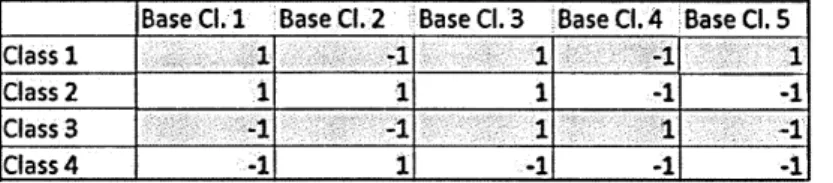
The row of r is denoted as r j and named as the “codeword” for class cjj. An example ECOC
matrix is provided in Figure 2.1 for a 4 class problem to be solved using 5 base classifiers.
In this example, the base classifier 1 is trained using the instances from classes {1,2} after
relabeling them as positive (+1) and the instances from classes {3,4} as negative (-1). These
new classes formed up as the combinations of the existing ones are now called “superclasses”.
At this point the existence of the “ternary ECOC” which has initially been proposed by Allwein et
al. in [1] should be noted. In this strategy a particular ECOC matrix element rp can take values
{-1,0,4-1} where the zero element is used to indicate the classes that are to be taken out of the
consideration of a base classifier and not used in its training.
During decision making (testing), decisions of all base classifiers for a given test instance X are
located in a vector B = [Bi, ...,Bn], where B{ is the hard or soft output of the classifier i for the
2.1. ECOC Background 13
Base Cl. 1 Base Cl. 2 Base Cl. 3 Base Cl. 4 Base Cl. 5
Class 1 1 -1 1 -1 1
Class 2 1 1 1 -1 -1
Class 3 -1 -1 1 -1
Class 4 -1 1 -1 -1 -1
Figure 2.1 : An example ECOC matrix for a 4 class problem with 5 base classifiers
T , which represents a codeword for the class of interest, are computed using a distance metric such as the standard Hamming or Euclidean distance, or L I norm. The class F, for which this
distance is minimum is chosen as the estimated class label, as shown in Eq. 2.1.
F = arg min dist(B, t j)
j= l...k (2.1)
As the name implies, ECOC can handle incorrect base classification results up to a certain
degree during decoding. Specifically, when Hamming Distance (HD) is used as the distance
metric, up to l(h - 1)/2J single bit errors can be corrected if the minimum HD between any pair
of codewords is h.
In the literature, there are several data dependent and independent approaches suggested for
designing (encoding) and testing (decoding) ECOC matrices as given in Sec. 2.1.1 and Sec.
2.1.2; however they still remain as open problems. There are also a few suboptimal methodolo
gies proposed for the refinement/update of the existing ECOC matrices, which are summarized
in Sec. 2.1.3.
2.1.1 Encoding of the ECOC Matrix
In order to encode a standard (binary) ECOC matrix for a k class problem, the most straightfor
ward approach would be to create a so called exhaustive code, which has length - 1, by
using all possible class combinations to form up the superclasses. More specifically, this length is
complementary, all-zero or all-one columns, which include redundant information. While being
computationally expensive for large k,this method does not guarantee the best performance.
Other than exhaustive codes, there are various data independent and dependent methods pro
posed for the encoding of the ECOC matrix. As for data independent approaches, the code
matrix is advised to be designed to have large HD between the codewords of different classes
in order to help with the error correction in the testing stage. Moreover, when deterministic clas
sifiers such as Support Vector Machines (SVMs) are used as base classifiers, the HD between
a pair of columns should also be large enough so that the outputs of the base classifiers are
uncorrelated and their individual errors can be corrected by the ensemble [14]. After the intro
duction of the “zero” (“don’t care”) element in [1], several data independent approaches have
been proposed in the literature.
Some commonly used data independent techniques can be listed as one-versus-all, one-versus-
one, dense random and sparse random codes. In one-versus-all encoding, the number of base
classifiers are equal to the number of classes, and each base classifier is obtained by training
a particular class against the rest. One-versus-one encoding on the other hand embodies base
classifiers, for which two classes of interest are trained against each other whereas the rest
corresponds to zero elements in the ECOC matrix. These classes with zero elements are not
taken into consideration during training. Thus, a total of comb(k,2) many classifiers, where
combstands for the combination rule, are required for one-versus-one encoding. Although they are not supposed to reveal optimal performances, one-versus-all and one-vs-one methods are
commonly used in the literature to create multiclass classifiers by combining binary ones, such as the case for multiclass SVMs.
Dense and sparse random codes have been introduced by Allwein et al. in [1] after the presen
tation of the zero element. In dense random coding, a binary matrix consisting of fl0log2(i^)l
columns is created for a kclass problem, and each bit in the matrix is chosen randomly between
{-1,1). After the generation of as many as 10000 dense random codes, the one that has the
largest distance between each pair of codewords and that does not have any identical columns
is selected. Sparse random coding, on the other hand, consists of ternary ECOC matrices which
2.1. ECOC Background 15
probability 1/2. The number of columns to be used in sparse coding is fl5log2(A:)l, and the
selection process used after the construction step is similar to that of the dense random codes.
The idea in data dependent ECOC designs is to encode matrices by making use of the input
data in order to have base classifiers which are meaningful within a given domain. Pujol et
al. in [51] have proposed Discriminant ECOC (DECOC), which aims to create superclasses that
maximize the discriminability within the given problem. Starting from the set of all classes and by
trying to split the classes at hand into the most separable subsets in each iteration, the method
ends up with a tree structure. This structure is expected to reveal sets of superclasses that are
highly discriminative, and these superclasses are later on inserted inside the ECOC matrix. The
criterion used during splitting is based on mutual information and the search procedure used is
a floating search method [50], named Sequential Forward Floating Search. Thus, the target is
to create high-performance column classifiers which can better fit the decision boundaries of the
problem training set, while keeping the number of classifiers to a minimum. Later on in Subclass
Problem-Dependent Design [23], DECOC has been modified in order to split the original set of
classes into more distinguishable subclasses, by using mutual information between the features
and the class labels. On top of the procedure explained above for DECOC, an additional step
of creating many other simple subproblems is carried out when a base classifier is not capable
of distinguishing between classes well enough. Another extension of DECOC, namely Forest-
ECOC, has been introduced in [19]. In Forest-ECOC, the aim is to embed multiple trees that
best split the original set of classes into distinguishable ones inside an ECOC, rather than one
tree. It has been experimentally worked out that using 2 or 3 trees is generally enough to reveal
accurate results. Furthermore for Forest-ECOC, as opposed to DECOC and Subclass Problem-
Dependent Design approaches, classification scores instead of mutual information are used for
creating each node of the tree. Finally, Bautista et al. propose minimal length ECOC designs,
and via applying genetically inspired methods such as mutation and cross-over they try to encode
these matrices and tune classifier parameters in a way to end up with improved generalization
performance [4].
Data dependent approaches intend to improve accuracy over data independent approaches and
increase efficiency by generating not more than “sufficient” number of columns to represent the
that expensive parameter optimizations, which might be needed as a result of possible difficult
base problems in data independent approaches, might be avoided by the creation of data depen
dent, simpler base problems. However, overall improvement in speed is not always guaranteed.
Finally and most importantly for the encoding of ECOC matrices, it should be mentioned that
although problem dependent coding approaches provide successful outcomes, it has been the
oretically and experimentally proven that ECOC matrices, which are created by randomly as
signing the values {-1,4-1} to each matrix element (randECOCs), give close to optimum (Bayes)
performance when they consist of several columns trained with strong base classifiers [35, 37].
These kind of matrices would therefore guarantee the best performance unless the relatively
long training time is perceived as a limitation. The suggested length of the randECOC depends
on its theoretical rates of convergence to Bayes error as explained in [35]; however a common
convention of using between 100 to 150 columns for multiclass problems of not more than 10
classes would generally provide satisfactory results. Note that for problems with small number
of classes, repeated columns can be trained with different perturbations of data such as boot
strapping [17].
2.1.2 Decoding of the ECOC Matrix
There are many strategies used in the decoding of the ECOC matrix apart from standard de
coding technique based on the Hamming or Euclidean distance, or L I norm. A general loss-
weighted decoding consists of the assignment of a weight matrix to each position of the ECOC
matrix to be used during distance calculation. Commonly, weights are driven using the prior
information about the class frequencies or information about classifier decisions on the training
data. It has been shown in [6] that in order to overcome weight estimation using all training
data, out-of-bootstrap error estimate can be adopted as a good estimator: While carrying out
training on bootstrapped samples per base classifier, the patterns left out of bootstrapping for
each classifier can be used for the estimation of weights. Other than the general weighted de
coding approaches, methods such as “Centroid of Classes” [35], “Dempster-Shafer decoding”
[53], “Loss-based decoding” [1], and “Probabilistic-based decoding” [49] can be listed among
2.1. ECOC Background 17
Standard decoding can be perceived as the minimization of the distance between a multidimen
sional codeword vector and target vertices of the multidimensional ECOC hypercube. However,
if patterns belonging to a class tend to form up a cluster, then the centroid of this cluster might be
a more suitable target vector for the class of interest than the already existing preset codeword.
In this way, each class ends up defining its own representative. This method is called “Centroid
of Classes” [35], and for an ECOC matrix consisting of k classes and N columns, the element
of the N dimensional centroid for each class is computed by taking the average over the outputs
of the base classifier for all patterns. A pattern is then classified according to the closest cen
troid in the sense of Euclidean distance. In Dempster-Shafer decoding [53], it is assumed that
each of the k class labels, which a pattern can be assigned to, has one corresponding proposi
tion. The decoding is based on the concept of probability mass functions which assign values to
these propositions. Each column j of the ECOC matrix can be regarded as providing evidence
for class memberships, which can be defined by a mass function that uses the outputs of this
classifier for the superclasses at hand. The evidence of a column for a class can be combined
with evidence from previous columns, and the mass function of the combination of classifiers are
found using Dempster’s rule of combination recursively. The class corresponding to the maxi
mum probability mass function is then assigned as the decision class. Loss-based decoding [1]
on the other hand, aims to find the class label among the set of possible labels that minimizes
the total loss computed using all base classifier decisions for a given test instance, where the
loss function is dependent on the “margin” of this instance. Linear and exponential loss-based
functions can be used within this framework. Finally in Probabilistic-based decoding, Passerini
et al. suggest making use of class conditional probabilities derived from base classifiers for de
coding [49]. Detailed descriptions of the existing decoding methodologies have been presented
in [66] and [22].
It has been shown in [22] that if the above mentioned strategies are used for the decoding of
ternary ECOC matrices, problems of the “decoding bias” and different “dynamic range biases”
occur due to the use of the zero element. During the distance measuring between the test
codeword and a class codeword in decoding, the distance between a { - 1,-11} bit and a 0 bit
should be set to zero, whereas this is not the case in most of the decoding strategies. The idea
here is that the distance value should not increase with the number of 0 positions, which do not
On the other hand, a “dynamic range bias” corresponds to the difference amongst the ranges of
values that can be obtained for each class codeword during decoding. In most of the existing
algorithms, when the ternary encoding is used, dynamic range changes inversely proportional
to the number of zeros, whereas it is expected to stay constant. In order to overcome these
problems of decoding bias and dynamic range bias, two algorithms, namely Pessimistic Beta
Density Distribution decoding and Loss-weighted decoding, have been presented in [22]; and
results have been shown to provide improved performance for ternary matrices.
2.1.3 Update of the ECOC Matrix
In addition to the general work in the area of improving the ECOC approach through better
encoding or decoding strategies, there has been little work done on the update of the ECOC
matrix as a post-processing step to further improve the accuracy.
In an early work aiming at the joint optimization of the base classifier trainings and the ECOC
matrix encoding [60], Alpaydin and Mayoraz train a multilayer perceptron to learn the new ECOC
code matrix, allowing small modifications from the original. Initially, a single layer perceptron is
formed by treating the training samples as inputs and the corresponding labels as outputs. Later
on, another single layer network is created by having the outputs of the dichotomizers generated
by ECOC as inputs and the desired ECOC labels as the targets. The weights to be estimated
within this second perceptron are the final ECOC matrix entries. These two single layer networks
are finally combined to give a multilayer perceptron (MLP) to be trained.
In a more recent work, Zhong et al. address the idea of code optimization by formulating a
framework that takes into account the misclassification errors of test instances using SVMs as
base classifiers, along with the Hamming distance between different columns [75]. In this method
called JointECOC, it has been reported that the problem is NP-complete whose exact solution
is computationally intractable and an approximate solution can be obtained after relaxing some
constraints.
In ECOC-Optimizing Node Embedding (ECOC-One) proposed in [18], the purpose is to extend
2.2. FLIP-ECOC and FLIP-ECOC+ 19
the data domain. Iteratively, new base classifiers are added to the coding design, by minimizing
the confusion matrix of classes using a validation set. As a result, the HD between the classes
that most overlap is aimed to be increased, and the generalization performance to be improved.
A further contribution of ECOC-One is the use of a weighting strategy to define the relevance of
the base classifiers.
As for the update of the ECOC matrix, the closest work to our methodologies presented in Sec.
2.2 has been concurrently proposed by Essaiera et al. where a one-versus-one coding matrix is
updated in a problem-dependent way [20]. In this approach called Recoding ECOC, the 0 entries
of the original code matrix are proposed to be changed into +1 or -1, if the corresponding
class happens to be correctly classified by this dichotomizes Our method can be seen as a
complement of this work where the updates are intended for non-zero entries, regardless of the
encoding, training and decoding methods used.
2.2 FLIP-ECOC and FLIP-ECOC+
Since the tasks of the dichotomizers are often non-trivial, the training often does not result in
achieving the classification indicated by the ECOC matrix, even when it is designed in an intel
ligent way. While the errors made by individual dichotomizers may be corrected by ECOC, the
original ECOC matrix can as well be optimized so as to better match the trained dichotomiz
ers. This can be done by considering the performances of base classifiers over the individual
classes, and changing the ECOC matrix whenever it is deemed beneficial. For this purpose, in
this section, we propose two update algorithms, FLIP-ECOC [82] and FLIP-ECOC+ [81]. These
algorithms aim to flip the bits of the given binary matrix from 1 to -1 or vice versa; or convert
them into the “don’t care” bit 0, when the corresponding base classifier and class specific ac
curacies suggest doing so. The flips and the zero conversions are done in a controlled way by
consulting the validation accuracy.
Consider an ECOC matrix t and a set of base classifiers that are trained according to this code
matrix. The accuracy matrix H, which is of the same size as r, is obtained by measuring the
Hji is measured as the proportion of the samples in class coj that are correctly classified by the
base classifier i according to the target value specified by ry/. Note that r is a binary matrix and
it might have been encoded or decoded using any methodology for binary matrices.
Within the FLIP-ECOC algorithm, the update of the ECOC matrix r is aimed at taking the H
matrix into consideration and analyzing whether its elements have “low” values, which would
relate to poor base classifier performances on individual classes. The Hji entries that have
corresponding tji values lower than a threshold value are potentially flipped so as to better match
what is learned by the base classifiers. In other words, if the decision of the base classifier
does not match the target label, the labels are considered for change in the updated matrix
U. Therefore, by making use of the updated matrix without a need of re-training, higher class
accuracies for base classifiers are expected during decoding.
The approach can be explained using a simple example. Assume that a classifier i is fully wrong
in classifying a particular class a>j on the validation set when the target for this class has been
preset to -1 . In other words, ry, = -1 and Hji = 0% . In this situation, changing the tji value from
-1 to +1 corresponds to matching the code matrix to the trained classifier /; whereas this was
not the case during training. This modification results in a change in Hji to 100%, while leaving
other entries in r and H unchanged. The rationale is that if the validation set is expressive of the
test set, a similar effect is expected during the test set decoding.
Flipping the entries of the original ECOC matrix may bring about its own drawbacks: After a
flip is applied, unwanted deterioration in the characteristics of the matrix such as the decrease
in row-wise or column-wise HDs or increase in the confusion regions may be expected. For
example, although a particular accuracy value for the given class and classifier of interest {Hjt)
would increase, the deterioration of row-wise HDs may cause severe reduction in the overall
accuracy. That is to say, the loss of an overall high HD between classes can adversely affect the
relatively small accuracy increase obtained on a single class as a result of flipping a bit. In order
to overcome this, FLIP-ECOC embodies an iterative step that modifies only one element of the
code matrix r in each iteration and tests the effects of this change on the overali validation set
accuracy. If the change is deemed beneficial, it is accepted.
Within the flip process, the ry, entries are firstly listed in ascending order according to their
2.2. FLIP-ECOC and FLIP-ECOC+ 21
approach, namely hill-climbing, the listed r ji entries are sequentially proposed for flipping. Note
that in order to account for classifiers that have performance worse than 50%, q is advised to
be 0.5. However, it can be argued that this threshold should be kept lower in order to avoid
ambiguity regions in the decision domain. In each iteration, a flip and therefore an ECOC update
is accepted if the validation set accuracy does not decrease when the updated ECOC matrix is
used in the decoding process instead of the current one. By considering the validation accuracy
at this stage, the method is expected to take care of the above mentioned ECOC characteristics
and thus the error correction capacity, and carry out updates without causing any degradation.
In Algorithm 1 , pseudocode for the method is provided.
Algorithm 1: FLIP-ECOC
Data: ECOC matrix r
Accuracy matrix H
Threshold q
Result: Updated ECOC matrix U
List Tij s.t Hij < ^ in an ascending order ;
noElements<-number of elements in the list;
currentState<-original ECOC matrix, r;
for r <- 1 to noElementsdo
nextState<-flip element of currentState;
Again <-valAccu racy[n extState]-valAccu racy[cu rre ntState] ;
If Again > 0 then
currentStatef-nextState;
U ^currentState;
An extended version of the method, namely FLIP-ECOC+, has been proposed in [81]. In FLIP-
ECOC+, the modifications within the binary ECOC matrix t are carried out in terms of a conver
sion into zero bits as well as flipping, depending on an additional threshold. The use of the third
label, zero, is expected to handle the cases where the classifier decisions are not strong enough
to justify a labeling to either class. Thus, the thresholding for conversion into zero takes place
on the regions of ambiguity; i.e. where the corresponding accuracy matrix entries are close to
out flips without a requirement of validation. While aiming to speed up the method, a should
be kept low in order not to sacrifice performance. Preliminary experimental evidence suggests
that a can be as high as 0.3, and that conversion into zero elements gives satisfactory results
when applied to the ECOC bits whose corresponding accuracy elements are between 0.3 and
0.6. Pseudocode for FLIP-ECOC+ is given in Algorithm 2.
Algorithm 2: FLIP-ECOC+_____________________________________________________
Data: ECOC matrix r
Accuracy matrix H
Thresholds or, 7,^
Result: Updated ECOC matrix U
forall the Nij < a d o
L FlipT,, currentState<-T ;
List Tij s.t Hij < g in an ascending order ;
noElements<-number of elements in the list;
for r 4- 1 to noEiementsdo
if a <= Hij < y then
nextStateWlip element of currentState;
else if y < - Hij < q then
nextState<-zero element of currentState;
Again <-valAccuracy[nextState]-valAccuracy[currentState];
if Again > 0 then
cu rrentState <- n extState ;
U<-currentState______________________________________________________________ FLIP-ECOC and FLIP-ECOC+ in their current forms aim to update only binary coding matrices
due to the fact that flips of the non-zero bits in ternary codes may cause redundancy in columns,
which have to be specially taken care of. For example, any bit flip in a one-vs-one coding would
cause the column corresponding to this bit to be completely redundant, and removing it may not
be a desirable move. Likewise, any zeroing in an already sparse matrix such as a sparse random
code would also encounter the same problem. However, modifications on the methods, together
with applications of smart ternary decoding methodologies as proposed in [22] are expected to
2.3. Experiments 23
2.3 Experiments
In order to show how the proposed update algorithms improve performances of the already
encoded binary ECOC matrices and to make comparisons with state of the art, three sets of
experiments have been performed in this section.
The aim in the first set of experiments given in 2.3.1 is to observe the applicability of FLIP-
ECOC on problems/applications which already provide/need validation sets. Here, comparisons
are made between the results obtained with and without the application of FLIP-ECOC on ran
dECOCs, by adhering to the same training sets. That is to say, after setting aside a separate
training and a validation set, a given ECOC matrix is trained on the training set and an updated
matrix is obtained after flips are performed using the validation. Later on, the results obtained
from the already trained original ECOC matrix are compared with those of the updated matrix.
In the second set of experiments given in Sec. 2.3.2, problems which include datasets without
predefined validation sets, are analyzed. That is, comparisons are made between the results
obtained from the original ECOC trained on the originai training set, versus, the results obtained
after employing FLIP-ECOC by setting aside a validation set out of training. This is in order to
see if utilizing FLIP-ECOC by sacrificing the training set size brings about any improvements in
performance. This section also includes results for the performance of FLIP-ECOC+.
Finally, in the last set of experiments given in Sec. 2.3.3, results obtained using FLIP-ECOC on
randECOCs as well as on one-versus-all matrices are compared with those acquired from some
state of the art ternary encoding techniques. Performance of ECOC-One, as state of the art
update methodology, has also been evaluated within the comparison.
All experiments have been carried out on 5 UCI Machine Learning Repository (UCI MLR) [2]
datasets, summary of which can be found in Table 2.1. Neural Networks (NNs) used with
Levenberg-Marquardt backpropagation have been selected as the base classifiers. The use
of NNs is due to the fact that they are easy to manipulate to account for weak and strong clas
sification by changing the level of training and number of nodes, without a separate need of
2.3.1 FLIP-ECOC using a Predefined Validation Set
The initial set of experiments on FLIP-ECOC aims to show the performance of the method on
problems having separate validation sets using randECOCs, which are binary matrices easy to
manipulate to account for both strong and weak ensembles. For this, randECOCs having number
of columns (number of base classifiers) equal to 10, 25, 75 and 150 are used. Furthermore, the
number of nodes for NNs used are varied between 2 and 16, and the level of training between 2
and 15 epochs.
For the datasets having separate test sets, the input training sets have been split into two so as to
form up a training and a validation set; and