University of Groningen
Dropout in Learning Vector Quantization Networks for Regularized Learning and
Classification Confidence Estimation
Villmann, Thomas; Ravichandran, J.R.D.; Saralajew, Sascha; Biehl, Michael
IMPORTANT NOTE: You are advised to consult the publisher's version (publisher's PDF) if you wish to cite from it. Please check the document version below.
Document Version
Publisher's PDF, also known as Version of record
Publication date: 2018
Link to publication in University of Groningen/UMCG research database
Citation for published version (APA):
Villmann, T., Ravichandran, J. R. D., Saralajew, S., & Biehl, M. (2018). Dropout in Learning Vector
Quantization Networks for Regularized Learning and Classification Confidence Estimation. 15-21. Abstract from Mittweida Workshop on Computational Intelligence , Mittweida, Germany.
Copyright
Other than for strictly personal use, it is not permitted to download or to forward/distribute the text or part of it without the consent of the author(s) and/or copyright holder(s), unless the work is under an open content license (like Creative Commons).
Take-down policy
If you believe that this document breaches copyright please contact us providing details, and we will remove access to the work immediately and investigate your claim.
MiWoCI Workshop - 2018
Report 01/2018
Submitted: 23.06.2018
Published: 25.06.2018
Frank-Michael Schleif
1,2∗,3∗, Thomas Villmann
2(Eds.)
(1)
University of Applied Sciences Wuerzburg-Schweifurt, Sanderheinrichsleitenweg 20,
97074 Wuerzburg, Germany
(2)
University of Applied Sciences Mittweida, Technikumplatz 17,
09648 Mittweida, Germany
(3)
University of Birmingham, School of Computer Science,
Edgbaston, B15 2TT Birmingham, UK
Contents
1
Tenth Mittweida Workshop on Computational Intelligence
4
2
Maschine Learning Using Dynamic Models for Partially Observed Time
Se-ries Analysis
5
3
Feature Learning for Galaxy Characterization: Possible Directions & Open
Questions
6
4
Differential Privacy for GMLVQ
7
5
Towards Fair LVQ - Introducing Fairness Criteria into the GLVQ Cost
Func-tion
8
6
Multilabeling in LVQs
9
7
Tree Edit Distance Learning with Median GLVQ and Symbol Embeddings
11
8
Objective Feature Selection using GMLVQ with Directly Incorporated
L1-Regularization
13
9
Dropout in GLVQ
15
10 A Comparison of Classifier Learning Strategies and Their Counterparts in
Adaptive Filter Theory
22
11 News from the Stoneage of Machine Learning: the Statistical Physics of
Learning in a Nutshell
23
12 Processing Gene Expression Data for Detection of mRNA Degradation
Patterns by Cluster Analysis Using a Bio-specific Similarity Measure
24
13 Machine Learning in Biomedical Datasets
26
14 Using GANs for Dense Three Dimensional Reconstruction of Neuronal
Tis-sue from Electron Microscopy Stacks
27
15 Transfer Learning for Robust Control of Bionic Prostheses
28
16 Handling Concept Drift and Domain Differences in an Online-Learning
En-vironment
29
17 Top Tier Conferences - What Makes the Difference Between Accept and
Reject - Some Reviewer Insights
31
Impressum
Publisher:
University of Applied Sciences Mittweida
Technikumplatz 17,
09648 Mittweida, Germany
Editor:
Prof. Dr. Thomas Villmann
Prof. Dr. Frank-Michael Schleif
Techical-Editor:
Prof. Dr. rer. nat. habil. Frank-Michael Schleif
Contact:
URL:
http://techfak.uni-bielefeld.de/
∼
fschleif/mlr/mlr.html
1
Tenth Mittweida Workshop on Computational
Intelli-gence
From 25 June to 27 June 2018 we had the pleasure to organize and attend the tenth
Mittweida Workshop on Computational Intelligence (MiWoCi 2018). Multiple
scien-tists from the University of Bielefeld, HTW Dresden, the University of Groningen (NL),
the University of Birmingham (UK), the University of Applied Sciences Mittweida, the
University of Applied Sciences Wuerzburg-Schweinfurt and the Porsche AG met in
Mittweida, Germany, to continue the tradition of the Mittweida Workshops on
Compu-tational Intelligence -
MiWoCi’2018.
The aim was to present their current research, discuss scientific questions, and
exchange ideas. The seminar centered around topics in machine learning, signal
pro-cessing and data analysis, covering fundamental theoretical aspects as well as recent
applications, partially in the frame of innovative industrial cooperations. This volume
contains a collection of abstracts which accompany some of the discussions and
pre-sented work of the MiWoCi Workshop.
Our particular thanks for a perfect local organization of the workshop go to Thomas
Villmann as spiritus movens of the seminar and his PhD and Master students.
Mittweida, June, 2018
Frank-M. Schleif
Learning Pharmacokinetic Models
Kerstin Bunte
??
University of Groningen, Groningen, NL
Abstract
To understand trends in individual responses to medication, one can take a purely data-driven machine learning approach, or alternatively ap-ply pharmacokinetics combined with mixed-effects statistical modelling. To take advantage of the predictive power of machine learning and the explanatory power of pharmacokinetics, a latent variable mixture model for learning clusters of pharmacokinetic models is proposed and demon-strated on a clinical data set. The proposed strategy automatically con-structs different population models that are not based on prior knowl-edge or experimental design, but result naturally as mixture component models of the global latent variable mixture model. The parameter of the underlying multi-compartment ordinary differential equation model are analyzed via identifiability analysis on the observable measurements, which reveals the model is structurally locally identifiable. Further ap-proximation with a perturbation technique enables efficient training of the proposed probabilistic latent variable mixture clustering technique using Estimation Maximization.
Evaluation of Galaxy classification schemes with
GMLVQ + feature learning for galaxy
characterization: possible directions & open
questions
Aleke Nolte
??
University of Groningen, Groningen, NL
Abstract
In Astronomy, automatic classification of galaxies is becoming increas-ingly important as astronomic surveys are generating more and more data. Yet, galaxy classification is not a well defined problem: Classifi-cation schemes are numerous and are commonly hand-designed, thereby possibly underling human cognitive biases. Building on work previously presented at ESANN, we investigate with the help of prototype-based methods how well a particular galaxy classification scheme is supported by the data. While our previous dataset contained only a handful of features, our current analysis is based on a variety of galaxy descriptors derived from photometric and spectroscopic observations. However, a po-tential problem of some of the galaxy descriptors is that they are based on historically grown model-assumptions which have been developed on the basis of bright and clearly-visible nearby galaxies, and may therefore not adequately describe fainter, or more distant galaxies. To explore possible alternative descriptors, we intend to also present ideas and open questions on feature learning for galaxy characterization, if time allows.
Learning Vector Quantization and its privacy
Johannes Brinkrolf
Bielefeld University, CITEC - Center of Excellence, Germany
Abstract
Digital information is collected daily in growing volumes. Mutual benefits
drive the demand for the exchange and publication of data among parties.
However, it is often unclear how to handle these data properly in the case
that the data contains sensitive information. Differential privacy has become
a powerful principle for privacy-preserving data analysis tasks in the last few
years, since it entails a formal privacy guarantee for such settings. This is
obtained by a separation of the utility of the database and the risk of an
individual to lose his/her privacy.
In the workshop contribution we briefly review the problem of statistical
disclosure control under differential privacy model and address the question
how much the prototypes differ from those obtained from similar training
sets. Furthermore, we present an approach for gaining a differential private
LVQ model from learned models on different subsets via the sample and
aggregate framework.
Towards Fair LVQ - Introducing Fairness
Criteria into the GLVQ Cost Function
Astrid Bunge
∗1, Carolin Hainke
1, Leon Sindelar
1, Matthias
Vogelsang
1, Benjamin Paaßen
1, and Barbara Hammer
1 1Machine Learning Group
Center of Excellence Cognitive Interaction Technology
Bielefeld University
Machine learning methods promise to speed up and ease human decision
making in various fields, such as finance, jurisprudence and medicine. Yet,
just like their human counter part, these decisions are prone to prejudice
through biased data, resulting in possibly discriminatory decisions[2]. One
approach to address such biases is to incorporate a formalized fairness
cri-terion to the objective function of a machine learning algorithm. We have
extended the error function of the generalized learning vector quantization
classifier in [1] with the classic and normalized mean difference term
refer-enced in [2]. The modification punishes any differential treatment between
a protected group and its complement. By evaluating the effect of this
fair-ness term on an artificial and real data set from the educational domain, we
observed an increase in fairness under certain circumstances, while retaining
most of the classification accuracy.
References
[1] Atsushi Sato and Keiji Yamada. “Generalized learning vector
quantiza-tion”. In:
NIPS’95 Proceedings of the 8th International Conference on
Neural Information Processing Systems
(1995), pp. 423–429.
[2] I. Zliobaite. “Measuring discrimination in algorithmic decision making”.
In:
Data Mining and Knowledge Discovery
31.4 (2017), pp. 1060–1098.
doi
:
https://doi.org/10.1007/s10618-017-0506-1
.
Multi-Label LVQ for Multi-Class Classication Learning
M. Kaden
1, A. Villmann
1,2and , T. Villmann
11Hochschule Mittweida, SICIM, CI-Group, 2Schulzentrum Döbeln-Mittweida
Classication learning usually deals with problems where data have to be assigned to one cer-tain class. This scenario, however, frequently does not match with real world experiences, where objects/subjects may belong to several classes. For example, patients may suer from multiple dis-eases or scientic articles share quite a few authors. For these examples, data sample might belong to more than one class (illness/author). In contrast, possibilistic classication deals with probabilistic class decisions and class belongings. Both approaches are known as multiple classication problems or multilabel classication [1].
In this contribution we address the multilabel classication problem for learning vector quantiza-tion models. Particularly, we discuss how to deal with multilabels for soft learning vector quantizaquantiza-tion introduced in [2]. Thereby, log-likelihood ratio or cross-entropy are possible loss functions [3]. Further, we discuss approaches which realize multilabel classication in generalized learning vector quantiza-tion (GLVQ,[4]). The rst approach considers sets of best matching prototypes regarding the given multilabeled training sample whereas in a seconsd approach a cross entropy approach is used to model the possibility for more than one class assignments. The cross-entropy approach for GLVQ considers the classication of data samples as a probabilistic event keeping the idea of the classier function [5]. For both algorithmic approaches, possibilistic as well as possibilistic strategies are discussed. Fur-ther, the problem of an adequate performance evaluation for those methods will be addressed during the talk.
References
[1] F. Herrera, F. Charte, A.J. Rivera, and M.J. del Jesus. Multi-Label Classication Problem Analysis, Metrics and Techniques. Springer, 2016.
[2] S. Seo and K. Obermayer. Soft learning vector quantization. Neural Computation, 15:15891604, 2003.
[3] A. Villmann, M. Kaden, S. Saralajew, and T. Villmann. Probabilistic learning vector quantization with cross-entropy for probabilistic class assignments in classication learning. In L. Rutkowski, R. Scherer, M. Korytkowski, W. Pedrycz, R. Tadeusiewicz, and J.M. Zurada, editors, Proceedings of the 17th International Conference on Articial Intelligence and Soft Computing - ICAISC, Za-kopane, LNCS 10841, pages 736749, Cham, 2018. Springer International Publishing, Switzerland. [4] A. Sato and K. Yamada. Generalized learning vector quantization. In D. S. Touretzky, M. C. Mozer, and M. E. Hasselmo, editors, Advances in Neural Information Processing Systems 8. Proceedings of the 1995 Conference, pages 4239. MIT Press, Cambridge, MA, USA, 1996.
[5] A. Villmann, M. Kaden, S. Saralajew, W. Hermann, M. Biehl, and T. Villmann. Reliable patient classication in case of uncertain class labels using a cross-entropy approach. In M. Verleysen, editor, Proceedings of the 26th European Symposium on Articial Neural Networks, Computational Intelligence and Machine Learning (ESANN'2018), Bruges (Belgium), pages 153158, Louvain-La-Neuve, Belgium, 2018. i6doc.com.
Tree Edit Distance Learning with Median
GLVQ and Symbol Embeddings
Benjamin Paaßen
1, Claudio Gallicchio
2, Alessio Micheli
2, and
Barbara Hammer
11
Center of Excellence Cognitive Interaction Technology
Bielefeld University
2
Department of Computer Science
University of Pisa
This contribution is based on the ICML 2018 Paper [6].
For vectorial data, metric learning has yielded tremendous improvements
in classification accuracy and can be considered a standard method [1, 7].
Re-cent research has tried to translate these successes to structured data metrics,
in particular edit distances [1, 5]. However, metric learning for edit distances
is complicated my multiple challenges. First, efficint edit distance algorithms
rely on metric conditions on the metric parameters [4], which are difficult to
enforce during learning. Second, changing the metric parameters can also
change the optimal edit scripts, making a direct optimization infeasible [5].
Finally, most indirect optimization approaches require frequent updates of
all pairwise edit distances, making them slow for bigger data sets [2].
To address these challenges, we have developed a new metric learning
approach for tree edit distance learning, which works as follows. First, we
represent the data via few prototypes by means of median relational GLVQ
[3]; second, we compute all cheapest edit scripts between data points and
there closest correct and closest wrong prototypes using a novel
forward-backward algorithm [4]; third, we optimize vectorial representations of the
tree labels according to the GLVQ cost function. We iterate these three steps
until convergence.
The use of a vectorial embedding ensures metric conditions, while the
use of prototypes ensures that only a small number of backtraces needs to
be computed in each optimization step. This reflects in a favorable scaling
behavior, making our new metric learning scheme applicable to data sets of
thousands of trees and hundreds of thousands of nodes.
Our experimental results on one artificial and five real-world data sets
show that our new metric learning scheme outperforms the state-of-the-art
in tree edit distance metric learning and improves upon the standard tree
edit distance in almost all cases.
References
[1] Aurélien Bellet, Amaury Habrard, and Marc Sebban. “A Survey on
Metric Learning for Feature Vectors and Structured Data”. In:
arXiv
abs/1306.6709 (2014). eprint:
1306.6709
.
url
:
http://arxiv.org/
abs/1306.6709
.
[2] Aurélien Bellet, Amaury Habrard, and Marc Sebban. “Good edit
simi-larity learning by loss minimization”. In:
Machine Learning
89.1 (Oct.
2012), pp. 5–35.
doi
:
10.1007/s10994-012-5293-8
.
[3] David Nebel et al. “Median variants of learning vector quantization for
learning of dissimilarity data”. In:
Neurocomputing
169 (2015), pp. 295–
305.
doi
:
10.1016/j.neucom.2014.12.096
.
[4] Benjamin Paaßen. “Revisiting the tree edit distance and its backtracing:
A tutorial”. In:
ArXiv e-prints
(2018).
url
:
https://arxiv.org/abs/
1805.06869
.
[5] Benjamin Paaßen, Bassam Mokbel, and Barbara Hammer. “Adaptive
structure metrics for automated feedback provision in intelligent
tutor-ing systems”. In:
Neurocomputing
192 (2016), pp. 3–13.
doi
:
10.1016/
j.neucom.2015.12.108
.
[6] Benjamin Paaßen et al. “Tree Edit Distance Learning via Adaptive
Sym-bol Embeddings”. In:
Proceedings of the 35th International Conference
on Machine Learning (ICML 2018)
. Ed. by Jennifer Dy and Andreas
Krause. Vol. 80. accepted. Stockholm, 2018.
[7] Petra Schneider, Michael Biehl, and Barbara Hammer. “Adaptive
Rel-evance Matrices in Learning Vector Quantization”. In:
Neural
Compu-tation
21.12 (2009), pp. 3532–3561.
doi
:
10.1162/neco.2009.11-08-908
.
Objective Feature Selection using GMLVQ with
Directly Incorporated
L
1-Regularization
Falko Lischke1?, Thomas Neumann1, Sven Hellbach1, Thomas Villmann2, and
Hans-Joachim B¨ohme1
1 University of Applied Sciences Dresden, Friedrich-List-Platz 1, 01069 Dresden,
Germany{lischke,neumann,hellbach,boehme}@htw-dresden.de
2 Saxony Institute for Computational Intelligence and Machine Learning,
Univ. Applied Sciences Mittweida, 09648 Mittweida, Germany
Frequently, high-dimensional features are used to represent data to be classi-fied. One such field of application with high-dimensional features is speech-based emotion recognition. The development of the feature sets used for these appli-cations can be seen monitoring the respective changes in approaches presented for the Interspeech challenges since 2009. The 384 features used in the first In-terspeech Emotion Challenge 2009 have become 6373 features since 2012 [8][9]. Linear SVM are still frequently used for classification, as in [10]. Instead of the predefined feature sets, more and more attempts are being made to have them learned automatically from artificial neural networks (MLP) [11]. In order to learn optimal features for MLP, it is assumed that the available data contains a large amount of variations provided by a huge database. In contrast, prototype-based methods frequently can work successfully with fewer data [1].
In our MiWoCI contribution we propose a new approach to learn inter-pretable classification models from such high-dimensional data representation. To this end, we extend a popular prototype-based classification algorithm, the matrix learning vector quantization (GMLVQ), to incorporate an enhanced fea-ture selection objective viaL1-regularization [7]. In contrast to previous work, we
propose a framework that directly optimizes this objective using the alternating direction method of multipliers (ADMM) and manifold optimization.
To incorporate the idea of feature selection into GMLVQ, we add a regular-ization termR(Ω) =kΩk1to the GMLVQ optimization objectiveE(Ω, W, X)
minimize
Ω,W E(Ω, W, X) +ξR(Ω) , (1) whereξ >0 is a regularization parameter to control sparsity of Ω. We suggest for optimization the ADMM as a proximal algorithm to optimize Eq. 1 directly without approximation of theL1-norm [3]. For the optimization using ADMM,
we decouple the data and regularization term by incorporation of a second vari-ableφ∈Rn×n: minimize Ω,W,φ E(Ω, W) +ξR(φ) subject toΩ=φ, kΩk2 2= 1 . (2)
Manifold optimization is used in the update steps due to constraints and simul-taneous optimization of several variables. A detailed description of the approach can be found in [6].
We show that our method achieves state-of-the-art results on an artificial data set from Bojer et al. [2] and on the Berlin Database of Emotional speech [4] with eGeMAPS features [5] and show its abilities to select relevant dimensions from the features. In both experiments, GMLVQ with L1-regularization based
on our framework achieves similar accuracies as standard classifiers (Decision Tree and linear SVM). In addition, the accuracy could be increased by an ad-ditional regularization of the manually selected eGeMAPS features. This shows that an objective feature selection can result in higher accuracy than subjec-tively selected features. Our optimization framework offers an opportunity to select features from more extensive feature sets based on objective criteria.
References
1. Biehl, M., Hammer, B., Villmann, T.: Prototype-based models in machine learning. Wiley Interdisciplinary Reviews: Cognitive Science 7(2), 92–111 (2016)
2. Bojer, T., Hammer, B., Schunk, D., Von Toschanowitz, K.: Relevance determina-tion in learning vector quantizadetermina-tion. In: Proc. of ESANN (2001)
3. Boyd, S., Parikh, N., Chu, E., Peleato, B., Eckstein, J.: Distributed optimization and statistical learning via the alternating direction method of multipliers. Foun-dations and Trends in Machine Learning 3(1), 1–122 (2011)
4. Burkhardt, F., Paeschke, A., Rolfes, M., Sendlmeier, W., Weiss, B.: A database of german emotional speech. In: Interspeech. vol. 5, pp. 1517–1520 (2005)
5. Eyben, F., Scherer, K.R., Schuller, B.W., Sundberg, J., Andr´e, E., Busso, C., Dev-illers, L.Y., Epps, J., Laukka, P., Narayanan, S.S., Truong, K.P.: The geneva min-imalistic acoustic parameter set (gemaps) for voice research and affective comput-ing. IEEE TAC 7(2), 190–202 (April 2016)
6. Lischke, F., Neumann, T., Hellbach, S., Villmann, T., B¨ohme, H.J.: Direct incorpo-ration of l 1 -regularization into generalized matrix learning vector quantization. In: ICAISC. pp. 657–667. Springer (2018)
7. Schneider, P., Biehl, M., Hammer, B.: Adaptive relevance matrices in learning vector quantization. Neural Computation 21(12), 3532–3561 (2009)
8. Schuller, B., Steidl, S., Batliner, A.: The interspeech 2009 emotion challenge. In: 10th Annual Conference of the ISCA (2009)
9. Schuller, B., Steidl, S., Batliner, A., et al.: The interspeech 2017 computational paralinguistics challenge: Addressee, cold & snoring. In: ComParE, Interspeech 2017. pp. 3442–3446 (2017)
10. Sinith, M.S., Aswathi, E., Deepa, T.M., Shameema, C.P., Rajan, S.: Emotion recog-nition from audio signals using support vector machine. In: 2015 IEEE RAICS. pp. 139–144 (Dec 2015)
11. Wen, G., Li, H., Huang, J., Li, D., Xun, E.: Random deep belief networks for recog-nizing emotions from speech signals. Computational intelligence and neuroscience 2017 (2017)
Dropout in Learning Vector Quantization
Networks for Regularized Learning and
Classication Condence Estimation
T. Villmann
1, J.R.D. John Ravichandran
1, S. Saralajew
2, and M. Biehl
3 1University of Applied Sciences Mittweida
2Dr. hc. F. Porsche AG
Weissach
3University Groningen
1 Introduction
Dropout during training of deep multilayer perceptron networks (deep MLP)
is an appropriate method to prevent the network from overtting [1]. Further,
dropout during the working phase can be used to judge the condence of
the network regarding the output [2]. The output could be a regression
value or a class label depending on the task. For single perceptrons with
weights
ω
i∈
R
nand biases
β
ithe outputs for a given data vector
x
∈
R
nare calculated as
h
i(
x
) =
g
i(
h
ω
i,
x
iE
+
β
i)
, where
h
ω
i,
x
iE
is the Euclidean
inner product. Dropout in antework of perceptrons then is realized by setting
ω
ij= 0
randomly with probability
p
drop.
Learning vector quantization (LVQ) was not studied regarding dropout
techniques so far. Yet, a respective investigation should be comparable to
the approach in (multi-layer) perceptrons. For this purpose, we consider in
this contribution the matrix learning LVQ variant (GMLVQ,[3]) and relate
this model to a multilayer network structure comparable to MLP. We denote
the resulting model as LVQ-multylayer-network LVQ-MLN.
2 The LVQ-MLN model
2.1 Model Description
Standard GMLVQ uses the distance measure
δ
˜
Ω(
x
,
w
k) = (
Ω
(
x
−
w
k))
2for
similarity between data
x
and prototypes
wk
where
Ω
∈
R
m×nis a projection
matrix. An alternative for
δΩ
˜
is the measure
dΩ
(
x
,
wk
) = (
Ωx
−
wk
)
2(1)
where
Ωx
= (
h
ω
1,x
i
E, . . . ,
h
ω
m,
x
i
E)
(2)
and
ω
jare the row vectors of
Ω
. Now, the prototypes live in the projection
space
R
m. The GMLVQ network realizes the class assignment
c
(
x
) =
c
ws
(x)for a data sample
x
by means of a winner-take-all competition (WTAC)
s
(
x
) =
argmin
k(
dΩ
(
x
,
wk
))
(3)
where
c
(
wk
)
is the class label of prototype
wk
.
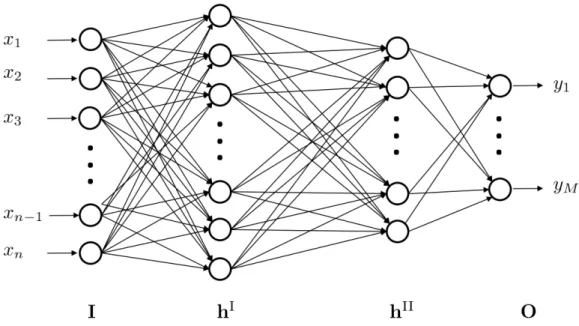
Now we consider a GMLVQ network as a multilayer network containing
two hidden layers
h
Iand
h
IIas suggested in [4], see Fig. 1.
The nodes
h
Iiof the rst hidden layer
h
I∈
R
npare perceptron units
according to
h
Ii(
x
) =
g
iIh
ω
i,
x
iE
+
β
iI(4)
with activation functions
g
Ii, perceptron weight vectors
ω
i∈
R
nand biases
β
iI∈
R
n.
Thus, the rst layer performs a maybe nonlinear projection
h
I(
x
) =
g
IΩ,β(
x
)
(5)
of the data depending on the activation functions
g
IΩ,βwith
Ω
=
ω
1, . . . ,ω
npand the bias vector
β
∈
R
np. Therefore, this layer is
de-noted as projection layer in this context. If
β
iI= 0
and
g
iI(
z
) =
id
(
z
)
is the
identity for all
i
= 1
. . . n
pthe projection simply becomes
h
I(
x
) =
Ωx
as
Figure 1: Illustration of an LVQ-MLP network with two hidden layers.
The second layer
h
IIis fully connected to the previous layer
h
Ivia
h
IIj(
x
) =
g
IId
h
I(
x
)
,
w
j(6)
realizing the prototype response. Here,
d
is an arbitrary (dierentiable)
dis-similarity measure and
g
IIis the activation function for the second layer
usu-ally chosen as the identity function id
(
z
) =
z
. If
d
is the squared Euclidean
metric,
d
h
I(
x
)
,
wj
=
dΩ
(
x
,
wk
)
is valid.
For a crisp classier network, the output layer
O
∈
R
Mis calculated as
O
l=
MX
k=1H h
IIl(
x
)
−
h
IIk(
x
)
(7)
where
H
(
z
) =
1
if
z
≥
0
0
else
is
the Heaviside function. Thus,
O
lreturns the winning rank of the prototype
wl
. Hence,
O
l= 1
is valid i
l
=
s
(
x
)
with
realizing the WTAC (3). Therefore, we denote the output layer also as
com-petition layer. Finally, the data point
x
is assigned to the class of the
cor-responding winning output unit
c
ws
(x). Thereby, the formula (7) for the
determination of the winning rank is equivalent to the winning rank
deter-mination known from the neural gas network [5].
2.2 The Loss Function of LVQ-MLN
The loss function for the LVQ-MLN is based on the output calculation
ac-cording to (7). Let
h
II+(
x
)
be dened as
h
II+(
x
) =
h
IIs+(
x
)
with
s+
=
arg
min
k
{
O
k|
c
(
wk
) =
c
(
x
)
}
and
h
II−(
x
) =
h
IIs−(
x
)
with
s
−=
arg
min
k
{
O
k|c
(
wk
)
6
=
c
(
x
)
}
indicating the best correct and best incorrect classifying prototypes according
to the output layer. Then the local loss is given as
L
(
x
, W,
Ω
,
β
) =
φ
θ,ϑµ
xk
,
h
II(9)
with
µ
xk
,
h
II=
h
II +(
x
)
−
h
II−(
x
)
h
II+(
x
) +
h
II−(
x
)
is the equivalent to the classier function of GMLVQ and
φ
θ,ϑ(
z
) =
1
1 + exp
zθ−
ϑ
.
(10)
is the sigmoid function known from GMLVQ. Remember, the layer
h
II(
x
)
is connected to layer
h
I(
x
)
via (6) and
h
I(
x
)
depends on the matrix
Ω
by the projection layer (5) and the perceptron layer (4). Applying these
replacements we obtain
L
(
x
, W,
Ω
,
β
) =
φ
θ,ϑd
g
IΩ,β(
x
)
,
ws
+−
d
g
ΩI,β(
x
)
,
ws
−d
g
IΩ,β(
x
)
,
ws
++
d
g
ΩI,β(
x
)
,
ws
−!
(11)
where we have taken
g
II(
z
)
=id
(
z
)
.
Learning in LVQ-MLN can be performed by stochastic gradient descent
learning (SGDL,[6, 7]) as usual in multilayer network learning [8].
2.3 Dropout in LVQ-MLN network
The dropout strategy in the LVQ-MLN can easily be realized applying them
to the matrix
Ω
of the projection layer
g
IΩ,β(
x
)
from (5). This could be done
during training preventing overtting or for condence estimation when
ap-plied during the test phase. The training dropout should be compared with
other regularization techniques as known for GMLVQ [9] whereas condence
considerations should be compared with reject option methods [10] or
confor-mal prediction analysis for LVQ [11, 12]. Obviously, LVQ-MLN oers great
similarity to MLP networks, and therefore, a comparison with MLP-classiers
is mandatory.
References
[1] N. Srivastava, G. Hinton, A. Krizhevsky, I. Sutskever, and R.
Salakhut-dinov. Dropout: A simple way to prevent neural networks from
overt-ting. Journal of Machine Learning Research, 15:19291958, 2014.
[2] Y. Gal and Z. Ghahramani. Dropout as a Bayesian approximation:
Representing model uncertainty in deep learning. In M.F. Balcan and
K.Q. Weinberger, editors, Proceedings of the International Conference
on Machine Learning, New York, New York, USA, volume 48, pages
10501059, 2016.
[3] P. Schneider, B. Hammer, and M. Biehl. Adaptive relevance matrices in
learning vector quantization. Neural Computation, 21:35323561, 2009.
[4] T. Villmann, M. Biehl, A. Villmann, and S. Saralajew. Fusion of deep
learning architectures, multilayer feedforward networks and learning
vec-tor quantizers for deep classication learning. In Proceedings of the 12th
Workshop on Self-Organizing Maps and Learning Vector Quantization
(WSOM2017+), pages 248255. IEEE Press, 2017.
[5] Thomas M. Martinetz, Stanislav G. Berkovich, and Klaus J. Schulten.
'Neural-gas' network for vector quantization and its application to
time-series prediction. IEEE Trans. on Neural Networks, 4(4):558569, 1993.
[6] H. Robbins and S. Monro. A stochastic approximation method. Ann.
Math. Stat., 22:400407, 1951.
[7] S. Graf and H. Lushgy. Foundations of Quantization for Probability
Distributions, volume 1730 of Lect. Notes in Mathematics. Springer,
Berlin, 2000.
[8] I. Goodfellow, Y. Bengio, and A. Courville. Deep Learning. MIT Press,
2016.
[9] P. Schneider, K. Bunte, H. Stiekema, B. Hammer, T. Villmann, and
Michael Biehl. Regularization in matrix relevance learning. IEEE
Trans-actions on Neural Networks, 21(5):831840, 2010.
[10] L. Fischer, D. Nebel, T. Villmann, B. Hammer, and H. Wersing.
Rejec-tion strategies for learning vector quantizaRejec-tion a comparison of
prob-abilistic and deterministic approaches. In T. Villmann, F.-M. Schleif,
M. Kaden, and M. Lange, editors, Advances in Self-Organizing Maps
and Learning Vector Quantization: Proceedings of 10th International
Workshop WSOM 2014, Mittweida, volume 295 of Advances in
Intelli-gent Systems and Computing, pages 109118, Berlin, 2014. Springer.
[11] G. Shafer and V. Vovk. A tutorial on conformal prediction. Journal of
Machine Learning Research, 9:371421, 2008.
[12] F.-M. Schleif, X. Zhu, and B. Hammer. A conformal classier for
dis-similarity data. In L. Iliadisand I. Maglogiannis, H. Papadopoulos,
K. Karatzas, and S. Siouta, editors, Proceedings of AIAI 2012, Halkidiki,
Greece, volume 382 of IFIP Advances in Information and
Communica-tion Technology, pages 234243, Berlin, 2012. Springer.
A comparison of classifier learning strategies and
their counterparts in adaptive filter theory
Daniel Staps
†, Alexander Lampe
†and Julia Schulte
‡ †Hochschule Mittweida, Germany,
{
dstaps, lampe
}
@hsmw.de
‡
CI Tech Sensors AG, Burgdorf, Switzerland, [email protected]
The requirements on the reliability and quality of security paper processing have been rising
contin-uously in recent years. Focusing on the field of banknote processing in banknote readers, this results
in a steady improvement of existing and the development of new image processing algorithms. In the
majority of cases, the target of those algorithms is to distinguish a limited number of banknote classes
ranging from 2 to about 100 and the classification rules are based on reference samples for each class.
The number of reference samples for each class varies between a few, e.g., 10, samples, up to a huge
number, e.g., 10000, samples. In view of the last figure, the relatively small number of banknote classes
to be discriminated and the capabilities of machine learning algorithms, the question arose whether the
latter can be trained such that they achieve a classification performance comparable to classical banknote
processing algorithms, i.e., fulfilling existing industry standards.
As to provide a first answer, a tensorflow framework based on a convolutional neural network (CNN)
inception v3 model [1, 2] was chosen and its last layers, the classification part, were trained to detect
the different denominations of EUR and USD banknotes. This training was done with different learning
strategies, with varying parameters, e.g. learning rate and training batch size, and with different banknote
image formats being fed into the network. Measuring the resulting classification accuracies, the
investi-gation shows that with the chosen network a performance as good as that of current signal processing
algorithms can be achieved in principle for valid banknote records. However, the resulting performance
heavily relies on the learning strategy chosen and the selected parameters. The detailed results will be
presented and discussed at the conference.
In addition, when trying to understand the details and differences of the learning strategies applied for
optimization of the classifier’s weights, it turns out that the underlying algorithms are quite similar to
those used for optimization of adaptive filters’ coefficients, e.g., the ADAM algorithm [3] resembles the
NLMS algorithm [4]. Consequently, the characteristics of different optimization strategies used in machine
learning can in part be deduced from those of their adaptive filter counterparts.
References
[1] Y. Taigman, M. Yang, M. Ranzato, and L. Wolf, “Deepface: Closing the gap to human-level
performance in face verification,” in
Proc. IEEE Conf. Computer Vision and Pattern Recognition
,
Jun. 2014, pp. 1701–1708.
[2] C. Szegedy, W. Liu, Y. Jia, P. Sermanet, S. Reed, D. Anguelov, D. Erhan, V. Vanhoucke, and
A. Rabinovich, “Going deeper with convolutions.”
[3] D. P. Kingma and J. Ba, “Adam: A method for stochastic optimization.”
[4] F. Yassa, “Optimality in the choice of the convergence factor for gradient-based adaptive algorithms,”
and Signal Processing IEEE Transactions on Acoustics, Speech
, vol. 35, no. 1, pp. 48–59, Jan. 1987.
The statistical physics of learning in a nutshell
-news from the stoneage of machine learning
Michael Biehl
??
University of Groningen, Groningen, NL
Abstract
We revisit the successful statistical physics of learning which has con-tributed significantly to the theory of neural networks and machine learn-ing. In this framework, large systems with many adaptive parameters are considered which are optimized by means of stochastic training pro-cesses. The formal treatment of learning systems in thermal equilibrium situtations facilitates the application of methods borrowed from statistical physics and provides mathematically exact descriptions of, for instance, typical learning curves in model situations. We review the basic concepts in terms of the perceptron classifier and layered neural networks for re-gression tasks. Finally, we discuss potential applications of the framework in view of the recently regained popularity of neural networks.
Processing Gene Expression Data for Detection
of mRNA Degradation Patterns by Cluster
Analysis Using a Bio-specic Similarity Measure
Katrin Bohnsack
1, Röbbe Wünschiers
1, and Thomas Villmann
21University of Applied Sciences Mittweida, Research Group
Biotechnology/Chemistry,
2University of Applied Sciences Mittweida, Saxony Institute for
Computational Intelligence and Machine Learning
In this work, the task is to cluster microarray gene expression data of the cyanobacterium Nostoc PCC 7120 for detection of messenger RNA (mRNA) degradation patterns. We search for characteristic patterns of degradation which are caused by specic enzymes (ribonucleases) allowing a further biological in-vestigation regarding biochemical mechanisms behind.
The mRNA degradation is part of the regulation of gene expression because it regulates the amount and the longlivity of mRNA, which is available for translation into proteins. A particular class of RNA degrading enzymes are ex-oribonucleases which degrade the molecule from its ends, whereby a degradation from the 5' end, the 3' end or from both ends is theoretically possible [1, 2].
In this investigation, the information about exoribonucleolytic degradation is given in a microarray data set containing gene expression values of1251genes.
The data set provides gene expression vectors containing the expression values of up to10short distinct sections of a gene ordered from the genes 5' end to its
3' end [3]. For each gene, two expression vectors are available for both nitrogen xing and non-nitrogen xing conditions, which have to be considered separately due to biological reasons. Accordingly, after ltering and preprocessing, two datasets for clustering are obtained consisting of133 10-dimensional expression
vectors. The preprocessing of data is described in detail in [4].
The similarity of the expression vectors is frequently judged by the Euclidean distance dE or by the Spearman rank correlation ρS. Unfortunately, the rank
correlation is not a similarity measure. Yet, the shifted value ρS + 1 would
deliver a similarity [5]. However, due to the usually noisy expression values, small positive correlations might contain little to no corellation information. Thus, we recommend to apply a non-linear transormation of ρS according to
sS(ρS, β, θ) = 1 1 + exp−ρS−β
θ
to obtain a dissimilarity valuedS = 1−sS. Thereby, the values forβ andθare in relation according to β=θ·ln 1 −y y +x (2)
whereby a xed x ∈ (−1,1) is required to be mapped onto a given y =
ss(ρS, β, θ)∈(0,1). Thus, a user specic dierentiation between negative and
positive correlated gene expression vectors is possible. Further, the choice of the valuesxandy allows an adequate adjustment regarding the noise level of gene
expression values. After systematic evaluation, we have chosenx=y= 0.5and
θ= 0.05for our clustering experiments.
Clustering was performed using anity propagation (AP,[6]). The number of clusters obtained by AP depends on the so-called self-similarity for the data vectors. This dependence was used to identify stable cluster soltuions by self-similarity control.
To evaluate the clustering results, several cluster validity measures are ap-plied. Further, visual data inspections by t-SNE [7] as well as respective cluster visualizations are provided for interpretation analysis of clusters.
References
[1] J. Houseley and D. Tollervey. The many pathways of RNA degradation. Cell, 136:763776, 2009.
[2] V.R. Kaberdin, D. Singh, and S. Lin-Chao. Composition and conservation of the mRNA-degrading machinery in bacteria. Journal of Biomedical Sciences, 18(23):112, 2011.
[3] S. Motameny and R. Wünschiers. Clustering approach to detect mRNA -degradation patterns from DNA-microarray gene-expression data. Biosys-tems and Information Technology, 1(1):613, 2012.
[4] K. Bohnsack. Clustering of gene expression data to detect mRNA degra-dation patterns. Technical Report in prep., University of Applied Sciences Mittweida, 2018.
[5] D. Nebel, M. Kaden, A. Bohnsack, and T. Villmann. Types of (dis−)similarities and adaptive mixtures thereof for improved classication learning. Neurocomputing, 268:4254, 2017.
[6] B.J. Frey and D. Dueck. Clustering by message passing between data points. Science, 315:972976, 2007.
[7] L. v.d.Maaten and G. Hinten. Visualizing data using t-SNE. Journal of Machine Learning Research, 9:25792605, 2008.
Machine learning in biomedical datasets
Sreejita Ghosh
To work with Biomedical data one has to deal with issues associated with it, namely, heterogeneous measurements, imbalanced classes, and missing data. Our initial experiments with a variant of learning vector quantization (LVQ) that is capable of dealing with missing values (angle LVQ) gave us promising results. So we wanted to compare the performance of angleLVQ with a strategy one can follow when confronted with missing values. Generative modelling is one such strategy. Furthermore, LDA is very close to LVQ. Therefore we ap-plied B.Marlin’s generative linear discriminant analysis (LDA) [1] on the same datasets to compare its performance with that of angleLVQ. Additionally in our recent experiments we tried to compare 1) the effects of Euclidean and cosine distances, and 2) the effect of a hyper-parameter of angleLVQ, in classifying data (both synthetic and real) with missing values.
References
[1] Benjamin Marlin. Missing data problems in machine learning. PhD thesis, 2008.
Using GANs for dense three dimensional
reconstruction of neuronal tissue from electron
microscopy stacks
T. Bullmann, S. Oba, and S. Ishii
Department of Systems Science, Graduate School of Informatics,
Kyoto University, Japan
June 25, 2018
Focused ion beam milling, combined with scanning electron microscopy (FIB-SEM), can be used to generate serial images through substantial volumes of neuropile, making it possible to capture subtle changes in spine structure as well as quantifying the local connectivity of several dendrites with passing ax-ons. From detailed reconstruction of the neuropile, it is possible to recover many aspects of synaptic calcium signaling, which is involved in plasticity of synapses, thus making predictions for future in vivo imaging experiments. However, con-ventional reconstruction methods require skillful and time-consuming manual annotation.
To this end, various machine learning techniques have been used to achieve automatic or semi-automatic segmentation with minimal human annotation. Recently, deep convolutional networks have shown superhuman performance in automatic membrane segmentation, but they require huge amounts of labelled data and it is difficult to used trained classifiers on images obtained at different imaging conditions/species. We will present preliminary results of our attempt to use generative adversarial networks (GANs) for data augmentation of limited amount of labelled data for segmentation and reconstruction of the Drosophila neuropile.
Transfer Learning for Robust Control of Bionic
Prostheses
Alexander Schulz
Benjamin Paaßen
Barbara Hammer
The aim of transfer learning [2] is to make use of knowledge from existing models in new domains and thereby avoid to train an entirely new model. This methodology is particularly promising if the trained model is complex but the relationship between the old and the new domain is simple, for example an approximately linear function. Recently, the framework of linear supervised transfer learning has been proposed which learns a mapping from the target to the source domain with the goal that the original model becomes applicable in the target domain [1, 3].
Here, we present a more efficient variant of linear supervised transfer learning for correcting electrode shifts in upper limb prosthesis control. For this purpose, we introduce a bias/restriction on the transfer mapping which reduces the num-ber of parameters that need to be estimated to one. We evaluate our approach in a virtual grasping environment with a group of transradial amputees and a group of able-bodied subjects.
References
[1] B. Paaßen, A. Schulz, J. Hahne, and B. Hammer. Neurocomputing, 298:122 – 133, 2018. [2] S. J. Pan and Q. Yang. A survey on transfer learning.IEEE Transactions on Knowledge
and Data Engineering, 22(10):1345–1359, Oct 2010.
[3] S. Saralajew and T. Villmann. Transfer learning in classification based on manifold models and its relation to tangent metric learning. In C. J. Yoonsuck Choe, editor,Proceedings of the 2017 International Joint Conference on Neural Networks (IJCNN 2017), Anchorage, AK, USA, 2017. in press.
Handling Concept Drift and Domain Differences
in an Online Learning Environment
Christoph Raab
June 21, 2018
Abstract
Supervised classification has a broad range of applications in different domains of interest. Typical, classification algorithms are batch based and processing data multiple times, building some model to represent class distributions and being able to predict labels of unseen data.
However, streaming applications producing a vast amount of data resulting in datasets, which are inefficient to learn by above approaches. These streams are either too large to fit in memory or processing in batch mode is not a constructive strategy due to constant arriving of new samples.[4]
Algorithms based on online learning are able to learn and predict data on the fly, processing data only once and, therefore, are able to operate on data streams. But, changing the learning technique is not sufficient to classify streams with high accuracy. A reason is the event of concept drift, which is a not negligible change in class distributions between two points in time.[5]
Ensemble approaches trying to tackle these issues and are build on top of an online classifier, but expanding the complexity of these algorithms further [5].
This results in less interpretable models because of nested bagging and re-stricts the underlying classification technique to the ensemble setting. This makes ensemble algorithms less interchangeable and, therefore, are hard to ap-ply to online classifiers, which are not suitable to certain restrictions caused by ensemble techniques.
In this talk we, will discuss the above problems of concept drift handling, mem-ory management, and interpretability by introducing current solutions [1][2][3], giving insights in current research potential.
References
[1] Vahida Attar, Pradeep Sinha, and Kapil Wankhade. A fast and light classi-fier for data streams. Evolving Systems, 1(3):199–207, 2010.
[2] Albert Bifet and Ricard Gavald`a. Learning from Time-Changing Data with Adaptive Windowing. Proceedings of the 2007 SIAM International Confer-ence on Data Mining, pages 443–448, 2007.
[3] Pedro M Domingos and Geoff Hulten. Mining high-speed data streams. In
Proceedings of the sixth ACM SIGKDD international conference on Knowl-edge discovery and data mining, Boston, MA, USA, August 20-23, 2000, pages 71–80, 2000.
[4] Sudipto Guha, Adam Meyerson, Nina Mishra, Rajeev Motwani, and Liadan O’Callaghan. Clustering Data Streams: Theory and Practice. IEEE Trans. Knowl. Data Eng., 15(3):515–528, 2003.
[5] Vincent Lemaire, Christophe Salperwyck, and Alexis Bondu. A Survey on Supervised Classification on Data Streams, pages 88–125. Springer Interna-tional Publishing, Cham, 2015.
Top Tier Conferences
- What Makes the Difference
Between Accept and Reject
- Some Reviewer Insights
Frank-Michael Schleif
??
University of Applied Sciences Wuerzburg-Schweinfurt,
Department of Computer Science, Wuerzburg, DE
Abstract
Conferences like NIPS , AISTAT, IJCAI, ICML, ECML, AAAI, COLT
. . .are very attractive for many researchers and to get a paper accepted can give a career a big push. The talk will give some insights, statistical information and fun facts on common patterns of good and accepted pa-pers at the respective conferences as noticed by the presenter in the last years.
Visualizing classifiers of proximity data
Sascha Schleef
1,*, Alexander Schulz
1, Barbara Hammer
11CITEC, Bielefeld University, Inspiration 1, 33619 Bielefeld, Germany *Corresponding author: [email protected]
Proximity data can be classified by different classifiers, such as LVQ or SVM
based approaches, taking the kernel directly as input. But visualizing these classifiers
is not always straight forward and the approach proposed in [2] is not applicable
because the original data has no vector representation which can be interpolated.
For proximity data we can apply distance based methods for dimensionality
reduction such as kernel t-SNE or kernel Fisher-t-SNE [1]. To visualize an applied
classifier, like a kernel-SVM on such data, the approach is to calculate an implicit
back projection into a hypothetical high dimensional space by also minimizing the
Fisher-distance such that the proximity data can be interpreted as a scalar product
in this space. This opens the way to calculate a similar back projection, like for
vector data, in kernel space.
This approach is evaluated for visualizing kernel SVMs for a Fisher distance
based t-SNE dimension reduction method [1] by comparing the original classifier
with the visualized classifier.
References
[1] Alexander Schulz, Johannes Brinkrolf, and Barbara Hammer.
Efficient
Kernelization of Discriminative Dimensionality Reduction.
Neurocomputing
,
268(SI):34–41, 2017.
[2] Alexander Schulz, Andrej Gisbrecht, and Barbara Hammer. Using
Discrimina-tive Dimensionality Reduction to Visualize Classifiers.
Neural Processing Letters
,
42(1):27–54, 2015.
Entropy based evaluation measures for clustering
and classification
Tina Geweniger and Thomas Villmann
The comparison of cluster or classification models with ground truth data or other models is usually done by the statistical evaluation of respective confusion matrices [1]. But sometimes such classical evaluation measures like accuracy and Kappa value are misleading and not conveying the full informational content. An example thereof is given in [3]. There, an information theoretic approach resulting in two scores based on the Shannon entropy and mutual information or conditional Shannon entropy is proposed. Thereby the (normalized) assign-ments contained in the confusion matrix are assumed to be joint probabilities allowing to calculate the scores by means of probability and conditional prob-ability functions. For the special case of Shannon entropy the two score are identical.
Yet it is known that the numerical computation of measures based on the Shannon entropy is unstable for very small probabilities due to the logarith-mic function inside the sum [2]. We proposed more robust alternative measures based on either Renyi or Tsallis entropy in [4]. Unfortunately, an essential prop-erty regarding the mutual information is not valid for these entropies. Therefore the two scores are no longer identical and different definitions for the conditional entropies have to be taken into account.
In our current contribution we will show the difficulties dealing with nonaddi-tive entropies like the Tsallis entropy. Care has to be taken to assure symmetry in general and validity in case of dependend variables. Different scenarios will be considered to derive the evaluation scores and to point out the challenges.
References
[1] R.O. Duda and P.E. Hart.Pattern Classification and Scene Analysis. Wiley, New York, 1973.
[2] O. Onicescu. Theorie de l‘information energie informationelle. In Tome, editor,C. R. Acad. Sci., volume 263 of
A-B, pages 841–842, 1966.
[3] E.K. Kao R.S. Holt, P.A. Mastromarino and M.B. Hurley. Information theoretic approach for performance evaluation of multi-class assignment systems. InSPIE Defense, Security, and Sensing (Orlando), volume SPIE 7697, pages 1–12. SPIE The International Society for Optical Engineering, MIT Press, 2010.
[4] Thomas Villmann and Tina Geweniger. Multi-class and cluster evaluation measures based on renyi and tsallis entropies and mutual information. In Leszek Rutkowski et. al, editor,Artificial Intelligence and Soft Computing, LNAI 10841, page 736 ff., 2018.
Detection of noisy multi-manifold
Mohammad Mohammadi
??
University of Groningen, Groningen, NL
Abstract
A common assumption in ML is:
• Even for high dimensional data, they lie on a low dimensional man-ifold.
However, the noise can increase the dimensionality of the manifold. So the question arises:
• How to remove the points which dont belong to manifolds?
If we could find the answer, we could reconstruct the manifolds which is so helpful for the next actions. Here, we use a nature inspired approach (Ant colony) to recover the manifold.
Report 01/2018
Impressum
Machine Learning Reports
ISSN: 1865-3960
5
Publisher/Editors
Prof. Dr. rer. nat. Thomas Villmann
University of Applied Sciences Mittweida
Technikumplatz 17, 09648 Mittweida, Germany
•
http://www.mni.hs-mittweida.de/
Prof. Dr. rer. nat. Frank-Michael Schleif
University of Birmingham
Edgbaston, B15 2TT Birmingham, UK,
•
www.cs.bham.ac.uk/
∼
schleify/
5
Copyright & Licence
Copyright of the articles remains to the authors.
5
Acknowledgments