EXTERNAL SCIENTIFIC REPORT
Implementation of systematic reviews in EFSA scientific outputs workflow (CFT/EFSA/AMU/2010/01)1
A.M. O’Connor1
, G. L. Lovei2, J. Eales3, G.K. Frampton4, J.Glanville5, A.S. Pullin3, J. Sargeant6 1
Iowa State University, USA; 2Aarhus University, Denmark; 3Bangor University, U.K.; 4Southampton Health Technology Assessments Centre, University of Southampton, U.K.; 5York Economics
Consortium, York, U.K.; 6University of Guelph, Canada ABSTRACT
Systematic reviews (SR) are an evidence synthesis approach that provides robust and transparent answers to clearly formulated questions. Originally developed for use in clinical practice, SRs have wider applicability, including food and feed safety risk assessment. EFSA has implemented the use of SRs, and this document contributes to the further development of this in-house capacity. Since the publication of the document “Application of Systematic Review Methodology to Food and Feed Safety Assessments to Support Decision Making”, which mainly focuses on interventions and exposures (PECO/PICO), little has changed in this arena. Fast increasing fields of application include chemical and environmental risk assessment, and analysing environmental management interventions. Considering time constraints at EFSA, the use of SRs should be pursued thoughtfully. Important are the use of explicit systematic methods aimed at minimising bias and maximising transparency in order to produce the most reliable findings that can be used to inform decision making. Participants of the training courses indicated SRs should be a priority for controversial topics (which might be subject to greater scrutiny by external parties, including the public, and thereby would benefit from maximum transparency) or topics for which there was disagreement amongst experts. Some areas addressed by EFSA have considerable potential impact, for example related to public health or animal trade, and these topics could be prioritised for SR. Under severe time constraints, a full SR may not be possible, but a rapid review can be considered. However rapid reviews are not a substitute for systematic reviews. Adoption of rapid reviews exchanges one set of concerns (time and resources contracts) for another (lack of robustness and comprehensiveness). In the view of the Consortium, the continuation of training opportunities is important. Appropriate commissioning of SR expertise is an important step in establishing the role of the methodology in EFSA risk assessments.
© Copyright European Food Safety Authority KEY WORDS
Systematic reviews, risk assessment, prioritisation, rapid review. DISCLAIMER
The present document has been produced and adopted by the bodies identified above as author(s). This task has been carried out exclusively by the author(s) in the context of a contract between the European Food Safety Authority and the author(s), awarded following a tender procedure. The present document is published complying with the transparency principle to which the Authority is subject. It may not be considered as an output adopted by the Authority. The European food Safety Authority reserves its rights, view and position as regards the issues addressed and the conclusions reached in the present document, without prejudice to the rights of the authors.
1
TABLE OF CONTENTS
Abstract ... 1
Table of contents ... 2
Background as provided by EFSA ... 3
Terms of reference as provided by EFSA ... 3
Introduction and Objectives ... 5
Materials and Methods ... 5
1. An overview of the current use of systematic reviews in food and feed safety ... 7
1.1. Assessing the need for new systematic reviews ... 8
2. Summary of lessons learnt from the training sessions and the feedback of the participants via questionnaires ... 9
3. Prioritisation approaches: A systematic approach to prioritising systematic reviews in food and feed safety ... 11
3.1. Approaches to identifying topics for review and prioritisation approaches used by other agencies that employ systematic reviews ... 11
3.2. Proposed framework for prioritising systematic reviews in EFSA ... 18
3.2.1. Standalone systematic review of an individual, focused question ... 18
3.2.2. Various reviews to answer a broad policy problem ... 21
4. Feasibility and Resource Impact Assessment: An approach to adapting the systematic review methodology in cases of limited resources ... 25
4.1. Time issues: short deadlines and the utility of rapid reviews ... 25
4.1.1. Describe the minimum number of databases that should be evaluated ... 26
4.1.2. Ensure that the most critical outcome is identified before the review is conducted ... 26
4.1.3. Discuss and clarify, prior to conducting a rapid review, what the limitations of the evidence base will be ... 26
4.2. Staff issues: availability and expertise ... 27
4.2.1. Availability of staff or staff days available for a review ... 27
4.2.2. Availability among staff or experts of expert skills ... 28
4.3. Primary evidence: availability and scoping ... 28
5. Discussion on any actual and potential barriers to, and facilitators of the implementation of systematic reviews with the EFSA risk assessment framework ... 30
6. Conclusions ... 30
References ... 31
BACKGROUND AS PROVIDED BY EFSA
In human health research, it is widely acknowledged that systematic reviews (SR) are the best evidence synthesis practices to provide robust and unbiased answers to clearly formulated clinical questions. Formal systematic reviews have not commonly been used in food and feed safety risk assessment (RA) and the systematic review methods existing in human health research may not be directly applicable in this field.
The use of systematic reviews to food and feed safety risk assessment has recently been analysed by The European Food Safety Authority (EFSA) in an EFSA Guidance (EFSA, 20102), which provides a framework for identifying the different types of question suitable for systematic review within broad food and feed safety risk assessments; some suggestions on how to prioritise questions for formal systematic reviews; and advice and examples for the conduct of the systematic review process. The Guidance was presented and discussed in a workshop3 attended by fifty participants, comprising EFSA Panel members and scientific staff.
During the open sessions of the workshop, it was highlighted how most of the principles of systematic review (methodological rigour, transparency, and reproducibility) are already in use in EFSA; however, the standardised-structure of the systematic review process is not always used, and the formal implementation of the SR method may provide an added value to EFSA food and feed safety assessments.
The large majority of the participants acknowledged that such types of workshop are useful for the work of EFSA and that other experts and EFSA staff would benefit by attending such workshops. The need for tailored workshops focussed on the integration of SR into food and feed safety RA and for practical sessions focussed on EFSA areas of analysis was also highlighted.
In order to implement systematic reviews in EFSA scientific outputs workflow, it is necessary to develop in-house capacity to apply systematic reviews to food and feed safety risk assessment and to further analyse the SR method in view of the specific requirements of this field, such as e.g. developing a well-structured framework for prioritising questions for formal systematic reviews or for adapting the SR method in case of e.g. limited timeframes.
In view of the above EFSA launched a call for tender aiming to support systematic review implementation in EFSA scientific outputs workflow. The specific objectives of the procurement procedure were: (i) to support EFSA in developing in-house capacity to apply systematic reviews to food and feed safety risk assessment, by providing specific trainings; (ii) to analyse the SR method in view of the specific requirements of food and feed safety risk assessment in support of decision making.
TERMS OF REFERENCE AS PROVIDED BY EFSA
The call for tenders required the awarded tenderer to provide EFSA with the following deliverables: First deliverable: Three EFSA-tailored trainings on the use of systematic reviews in food and feed safety risk assessment.
2 EFSA (European Food Safety Authority), 2010. Application of systematic review methodology to food and feed safety assessments to support decision making. The EFSA Journal (2010), 8(5):1637, pp. 1-90. Available at: http://www.efsa.europa.eu/en/scdocs/scdoc/1637.htm
Second deliverable: a Report on the use of SR in food and feed safety risk assessment, which may serve as a basis for updating the EFSA Guidance on the Application of systematic review methodology to food and feed safety assessments to support decision making. The Report shall address, among other topics, a well-defined framework for prioritising questions for systematic reviews in the context of food and feed safety RA and provide suggestions on how to adapt the SR method in case of limited resources (e.g. short deadlines). Resource impact shall also be assessed. The feedback from the participants to the trainings shall be considered when producing such Report.
This contract was awarded by EFSA to: Contractor: The Consortium.
Contract title: Implementation of systematic reviews in EFSA scientific outputs workflow. Contract number: CFT/EFSA/AMU/2010/01.
INTRODUCTION AND OBJECTIVES
Systematic reviews are widely acknowledged as an evidence synthesis approach that provides robust and transparent answers to clearly formulated clinical questions. However formal systematic reviews have not commonly been used in food and feed safety risk assessment (RA) and the systematic review methods existing in human health research may not be directly applicable in this field. EFSA, as a leading agency worldwide that provides policy support for all aspects of food and feed safety, has implemented the use of systematic reviews. As part of that implementation process, EFSA awarded tenderer to our Consortium to provide two deliverables.
The objectives of the tender were:
to support EFSA in developing in-house capacity to apply systematic reviews to food and feed safety risk assessment, by providing specific trainings;
to analyse the SR method in view of the specific requirements of food and feed safety risk assessment in support of decision making.
To achieve these objectives, the Consortium was established with two aims and two corresponding deliverables. The first aim was to increase understanding of systematic review process and therefore increase the capacity of EFSA to conduct systematic reviews. The second aim was to provide a report to EFSA about the unique aspects of systematic reviews that relate to feed and food safety. The approach to delivering the first aim was to hold three training sessions in Parma in 2011-2012 that introduced the systematic review methodology to EFSA staff and panel members. This report is the deliverable for the 2nd objective, i.e. an analysis, in the form of a report, which may serve as a basis for updating the EFSA Guidance on the application of systematic review methodology to food and feed safety assessments to support decision making.
MATERIALS AND METHODS Approach to developing the report.
In developing this report, designed to meet the 2nd objective of the tender, the following approach was used. The call for tender defined three components to include in the report:
1) A well-defined framework for prioritising questions for systematic reviews in the context of food and feed safety RA.
2) Suggestions on how to adapt the SR method in case of limited resources (e.g. short deadlines). 3) Resource impact shall also be assessed.
Each section was then addressed separately.
For the issue of prioritisation of review questions, the Consortium drew upon numerous resources. a. The experiences of the Consortium members were used. The Consortium members represent a
great of deal of available experience in the systematic reviews relevant to the food and feed safety domain. Therefore in meetings of the Consortium, phone and email conversations and report drafts, Consortium members provided their experiences in prioritisation.
b. Further, published literature available on prioritisation of systematic reviews was sought. The search for literature was conducted in PubMed using the terms “prioritization AND (systematic reviews OR Health technology assessment). Relevant publications were identified, and the PubMed related citations feature was used to identify other studies. A convenience search of Google was used using a variety of terms such as “systematic reviews”, “prioritization” to identify reports. The reference lists of publications that appeared relevant to the topic of prioritisation were also searched. Some Consortium members also suggested publications. Findings from these papers were considered in the discussion about prioritisation.
c. Further, during the training sessions, EFSA panel members and staff members who were present at the final day discussion were directly asked to provide their opinions of prioritisation of systematic reviews for EFSA. This information was gathered in each of the 3 training sessions. In each group one of the training team recorded this information. At the conclusion of the meeting, one of the Consortium members compiled this information. This feedback was also considered in the discussion about prioritisation.
d. Questions related to prioritisation were included in the questionnaire administered at the end of each training session. When relevant to deliverable 2 (rather than deliverable 1 as defined by the EFSA terms of reference), these responses were incorporated into the review. Three training workshops were held in 2011-2012 with participants including EFSA staff and panel members. During the training workshops, time was allocated to discuss the perceived role of systematic reviews in EFSA’s work programmes, as well as facilitators and barriers to their use. The time was allocated both within the content specific working groups and, during the final morning of each workshop, with all workshop participants. This information was collected by the Consortium members, compiled and discussed to create this summary. Responses from post-training questionnaires, completed by participants following each of the three training workshops, were compiled by EFSA (SAS) staff and made available to the Consortium.
e. EFSA staff also provided feedback and comments to the report and offered opinions about the approach to prioritisation proposed by the Consortium. This information often related to aspects of EFSA practice or relevance of approaches to EFSA process.
For the 2nd component of the report, i.e. suggestions on how to modify the systematic review process in the case of limited resources, the same approach was used. However, in this circumstance we concentrated on literature about rapid reviews that are conducted in human medicine. This search was not a formal systematic literature search. Instead, members of the Consortium provided publications they were aware of that related to rapid reviews. These publications were used as the basis for identifying other information, through PUBMED related references and identifying relevant publications in the bibliography. Again, our multidisciplinary Consortium members brought their own experiences with conducting reviews in situations with limited resources. Discussion items from the training sessions raised by EFSA staff and panel members when relevant were considered by the Consortium members in reaching conclusions for the report. Finally, again EFSA staff provided feedback and comments to the report and offered opinions about rapid review proposed by the Consortium. This information often related to aspects of EFSA practice or relevance of approaches to EFSA process.
For the 3rd component of the report the Consortium addressed the resource implications of systematic reviews. The approach to this was to draw on the experiences of the Consortium members conducting reviews, and comments from EFSA staff made formally and informally during training sessions.
1. An overview of the current use of systematic reviews in food and feed safety
EFSA published EFSA Guidance “Application of Systematic Review Methodology to Food and Feed Safety Assessments to Support Decision Making”1
(hereafter referred to as “the Guidance”) in 2010. Since the Guidance was published little has changed in the fundamental methods used to conduct systematic reviews. The Guidance focuses mainly on interventions and exposure questions (PECO/PICO), reflecting the fact that the methods for conducting systematic reviews are most developed, even in human medicine, for interventions, and little has changed in this arena.
For reviews of diagnostic test accuracy studies (PIT questions), the work of the Cochrane Collaboration in developing guidance for Reviews of Diagnostic Test Accuracy (DTA questions) is progressing slowly. No new material has been published on the Cochrane DTA working group website since 20094. Beyond the Cochrane Collaboration, a recently published issue of the Journal of General Internal Medicine has focused entirely on reviews of medical tests (Hartmann et al., 2012; Jonas et al., 2012; Matchar, 2012; Rector et al., 2012; Relevo, 2012; Samson and Schoelles, 2012; Santaguida et al., 2012; Segal, 2012; Singh et al., 2012; Trikalinos and Balion, 2012; Trikalinos et al., 2012a; Trikalinos et al., 2012b). This work was funded by the US - based Agency for Healthcare Research and Quality (AHRQ). The suitability of translating these methods for conducting diagnostic test accuracy reviews to topics in food and feed safety has not been assessed by the project Consortium, because of its recent publication. However, if EFSA staff or experts are required to conduct a review of DTA, this special issue appears to be the most comprehensive resource currently available.
For reviews of population characteristics (PO questions) and reviews of disease causation (PECO questions) (Khan et al., 2012), no major changes in methods have been published, although a few new summary papers have been published that may be of interest (Khan et al., 2012).
Although there have been no major changes in the systematic review methods that are particularly relevant to the EFSA domains5, this is likely to change in the next 3-5 years. The number of topics in EFSA’s domains that are starting to employ systematic review methods is growing and within each area the number of published systematic reviews is also growing. It is expected that this growth will result in increased experience and understanding of when and how systematic review approaches used in human medicine can be directly translated to food and feed safety reviews.
The EFSA domain with the largest number of published systematic reviews continues to be human nutrition where numerous reviews of the efficacy and safety of nutrient supplements are readily available (Abad and Safdar, 2009; Braegger et al., 2011; Brenner et al., 2009; Chmielewska and Szajewska, 2010; Deshpande et al., 2007; Gotteland et al., 2006; Hempel et al., 2012; Holte et al., 2012; Hoveyda et al., 2009; Jonkers et al., 2012; Levri et al., 2005; Mihatsch et al., 2012; Moayyedi et al., 2010; Monachese et al., 2011; Nichols, 2007; Salari et al., 2012).
Another area where the number of published systematic reviews is increasing is biological hazards associated with food proteins (Bucher et al., 2012a; Bucher et al., 2012b; Domingues et al., 2012a, b; Ilic et al., 2012; Irwin et al., 2011; Matthews et al., 2012).
Similarly, several reviews of animal health have been published (Anderson et al., 2009; Burns and O'Connor, 2008; Duffield et al., 2012; Duffield et al., 2008a, b, c; Lean et al., 2009; O'Connor et al.,
4
http://srdta.cochrane.org
5 Chemical risk assessment, microbial risk assessment, environmental risk assessment, human nutrition, animal nutrition, animal health and welfare risk assessment, animal cloning, plant health risk assessment.
2011; O'Connor et al., 2010b; Wellman and O'Connor, 2007) although the use of the systematic review method in animal welfare and behaviour remains rare.
One important area where the number of systematic reviews has increased is animal-based biomedical research (Macleod and Sandercock, 2005; Macleod and van der Worp, 2010; Macleod et al., 2004; O'Collins et al., 2006; Perel et al., 2007; Sena et al., 2010; van der Worp et al., 2010). This increase is relevant to environmental and chemical risk assessment, which frequently uses animal-based studies as the only evidence base (Heard et al., 2011; van der Zande et al., 2011).
Additionally, an increasing number of reviews in environmental management are being conducted
according to the guidelines of the Collaboration for Environmental Evidence
(www.environmentalevidence.org), including some topics relevant to EFSA’s mission.
The increasing number of systematic reviews in EFSA’s domains of interest means that, increasingly, EFSA staff and experts may need to explore whether a suitable and relevant systematic review already exists on a topic prior to commissioning or conducting such a review. The second implication of the growth in systematic reviews in food and feed safety is that EFSA should continue to determine which standards must be met for a previously conducted systematic review to be considered adequate. This is a critical issue, as clearly no two review panels would be likely to compose exactly the same PICO, PECO, PIT or PO question or establish the same eligibility criteria. However, there are considerable savings in time and resources if available reviews can be used to inform risk assessment.
1.1. Assessing the need for new systematic reviews
The Consortium recommends EFSA consider establishing a process for determining the need for new systematic reviews, when systematic reviews on the same topic(s) are available. These standards are likely to encompass a range of elements related to already existing reviews: relevance to the mandate; and rigour and transparency of the methods used. For some elements, existing standards such as PRISMA (Liberati et al., 2009; Moher et al., 2009), which describes the minimal elements needed for reporting systematic reviews, or the AMSTAR (Faggion et al., 2011; Shea et al., 2007a; Shea et al., 2007b; Shea et al., 2009), which is used for appraising the methodological quality of systematic reviews, may be helpful. However, other elements of the standards may need to be developed specifically for EFSA.
For instance, for assessing the quality of existing systematic reviews it is unlikely that AMSTAR standards or other existing appraisal tools will be able to be adopted by EFSA without any modification because for the assessment of “quality” topic specific information is nearly always necessary. An example to illustrate this issue would be a hypothetical example of a review of E coli 0.157 prevalence conducted in the USA prior to late 1990’s. If such a review existed, it may be implemented in line with the standards of the AMSTAR or other existing quality appraisal tools for SRs, but would still not be applicable by EFSA because of the change in diagnostic tests since the late 1990’s.
Experts with topic specific knowledge will need to be consulted to assess the quality and applicability of prior reviews. Obviously, if the reviews are not reported comprehensively it will be very difficult to assess quality. Therefore, it should be possible for EFSA staff to assess the comprehensiveness of reporting using PRISMA, and then for those reviews that do meet reporting standards experts could be consulted about the quality of topic specific information. The topic specific nature of quality assessment is the reason why although internationally accepted standards for reporting guidelines are available for many study designs, the availability of quality assessment tools tend to be limited and topic specific (Wong et al., 2008).
In addition, describing criteria for determining when an existing review of the same question requires updating should be considered. Updating a review will require fewer financial and human resources than conducting a new review.
2. Summary of lessons learnt from the training sessions and the feedback of the participants via questionnaires
The general consensus from views expressed by participants at the training workshops, was that systematic reviews are likely to have great benefit for one of the most important aspects of EFSA’s mission: transparency. This view was expressed in questionnaire feedback, with participants recognising the value of systematic review to transparently address specific questions within mandates. Respondents also noted that systematic reviews can enhance transparency internally (for example disagreements leading to lengthy discussions between experts) and externally (for example, when EFSA opinions are questioned).
Another important and consistent message from the group discussion sections during the training workshops was that EFSA currently uses a great deal of experts’ time and that adding to the duties of panel and working group members could either be difficult to achieve or detract from the time spent on current EFSA activities. Concerns about time, resources and deadlines were mentioned in the majority of responses to the question “What are the main barriers to the adoption of systematic review methods within EFSA panels/units?” asked in the post-training questionnaire (79% of responses across the three training sessions).
Therefore the Consortium proposes that the use of systematic reviews is considered thoughtfully, focusing on when the advantages of the systematic review method are likely to be most important. The primary advantages in this context are the use of explicit methods aimed at minimising bias and maximising transparency in order to produce the most reliable findings that can be used to inform decision making with the best body of evidence available at the time when the evaluation is performed. Nonetheless, there is a need to prioritise when systematic reviews, or components of systematic reviews, are undertaken. In post-training questionnaires, respondents recognised the importance of prioritisation, especially given the limited resources available to EFSA staff and experts. In line with the deliverables of this project, respondents also expressed a need for guidance in prioritisation and some respondents suggested prioritisation methods, for example a pre-scoping exercise, prior to accepting a mandate to help prioritise key questions and estimate the resources required to do a SR for them.
During group discussion sessions, the participants noted that there are numerous long-term projects / issues that EFSA addresses over a multi-year time period. For these issues, there would be more time to identify components for which a systematic review would be beneficial and to prioritise the need for this type of input. It was also noted that some topic areas that may need to be addressed by EFSA are predictable and may be amenable to systematic review methods so as to have the information available to address issues as they arise. An example provided by participants was Salmonella. While a crisis situation might produce the need to provide input on an immediate topic for a specific species or production system, it would then be efficient, as time allows, to address the issue for other species or production systems.
Regardless of timelines for systematic review, areas where the participants felt that systematic reviews should be a priority included controversial topics (which might be subject to greater scrutiny by external parties, including the public, and thereby would benefit from maximum transparency) or topics for which there was disagreement amongst experts in the content area.
It was noted that some areas addressed by EFSA have considerable potential impact and that these topics could be prioritised for systematic review. As described in the EFSA Guidance, the participants also noted that data inputs for influential parameters in risk assessments, when amenable to systematic review, should be prioritised. Regularly updating systematic reviews to address these parameters also might be an efficient means of determining when new evidence is likely to change a parameter estimate (thus necessitating an update of the RA) or to identify specific information gaps and research approaches needed to improve the RA accuracy. Some participants felt that topics amenable to systematic review that impacted multiple aspects of public health, animal health, animal welfare, or the environment should be prioritised over those that impacted only one of those areas.
Participants also noted that the amount of literature available on a topic, and the timelines available to address a topic, should be incorporated into the prioritisation process.
Participants noted that there were times when a systematic review approach might not be prioritised over other methods of collating available information. This included emergency situations where specific decisions must be made under very short timelines, such as during the immediate control activities associated with a point-source disease outbreak. In these situations, rapid reviews or other methods of decision-making may be more appropriate than full systematic reviews.
Some participants also expressed concern about the potential impact of publication bias, noting that for some topics this might be a substantive issue that could negate the validity of a systematic review process. This is a valid point, however publication bias is relevant to all evidence synthesis methods not just systematic reviews. However, transparent and defensible alternatives were not apparent, other than attempting to identify un-published literature and to engage the private sector in data acquisition for systematic reviews when appropriate.
The Consortium also noted that the overwhelming majority of training workshop participants were EFSA staff, although the courses were open to panel experts as well, with expenses paid. This balance in training workshops is not to EFSA’s benefit, and may impact adoption of the methodology. In some instances, opposition to adopted a new approach was encountered. This is an important problem to address because the consequences of a poor assessment are borne by EFSA, not the experts themselves. The Consortium applauds EFSA’s efforts to consider systematic reviews as a component of their scientific opinions and recommends that EFSA does not neglect new methodological developments in the field. In summary the participants of training sessions expressed the opinion that:
SR enhance transparency;
Problems with lack of time, resources and tight deadlines are challenges for implementing SR; EFSA would need to prioritise topics for SR;
SR would be beneficial for controversial topics or topics where there is disagreement; SR would be beneficial for topics where EFSA has considerable impact;
The availability of literature should be considered for prioritising;
3. Prioritisation approaches: A systematic approach to prioritising systematic reviews in food and feed safety
Prioritising questions suitable for systematic review is critical for EFSA, as clearly there are many topics that could be amenable to systematic review within the scope of EFSA’s domains. However, EFSA needs methods of prioritising because resources are not available for all of the reviews that could potentially be conducted. The basic elements of a priority-setting process include: identifying potential topics; selecting the priority criteria; reducing the initial list of nominated topics to a smaller set to be pursued; and choosing the final priority topics (Eden et al., 2008). We discuss approaches to prioritisation by exploring briefly how other groups identify topics for systematic reviews and the prioritisation criteria they employ and then presenting a prioritisation approach for EFSA to consider. As has been the case with other agencies that face similar resource implications, a single checklist or decision tree approach that correctly identifies which reviews should be prioritised is elusive. This reality is a function of the fact that no prioritisation approach has been, or likely will ever be scientifically validated, because it is never possible to assess if the prioritisation method used led to the correct prioritisation, because non-prioritised reviews are not done. Therefore, no science based methods exist for assessing the validity of any prioritisation approach. Further, it is the firmly held opinion of the Consortium members that a single decision tree approach that is valid for every aspect of the EFSA mission cannot realistically be developed. Consistent with reports from prior groups, the Consortium did not identify a study that assessed prioritisation approaches and identified the best approach (Eden et al., 2008).
Consequently, prioritisation approaches, both those used by other agencies and that proposed by the Consortium for EFSA, propose a transparent list of factors that have been consistently deemed important in the decision making process. Further, the Consortium incorporated the role that risk assessment plays in EFSA, which is unique compared to other agencies that have to date employed systematic reviews. Consequently this section is deliberately titled a “systematic” approach” rather than a “check list” approach or “ decision tree” approach for prioritising systematic reviews. Below we outline the approaches used by other agencies and propose a framework for EFSA.
3.1. Approaches to identifying topics for review and prioritisation approaches used by other agencies that employ systematic reviews
The basic elements of a priority setting process seem to be identifying potential topics, selecting the priority criteria, reducing the initial list of nominated topics to a smaller set of topics to be pursued, and choosing the final priority topics.
No single method of identifying topics and setting priorities is obviously superior to others. This is because agencies that use systematic reviews have different roles in the decision- making process. Consequently, what is appropriate for one agency may not be appropriate for another one. One agency may focus on developing recommendations for clinicians, and another one on recommendations for national programmes and therefore their priorities would differ, along with the approaches used to identify those priorities. Thus, what is described hereafter is what happens in other organisations and the aim is not to refer to what happens in EFSA.
Systematic reviews are so new in most areas of food and feed safety that there are, as yet, few agencies using systematic reviews to an extent that requires formal prioritisation procedures. Currently, in food and feed safety, systematic reviews have been commissioned by several government agencies such as the Public Health Agency of Canada, (Bucher et al., 2012a; Waddell et al., 2009; Wilhelm et al., 2011a; Wilhelm et al., 2009; Wilhelm et al., 2011b; Wilkins et al., 2010) United States Department of Agriculture (Denagamage et al., 2007; Guerin et al., 2010; O'Connor et
al.), UK Department for Environment, Food and Rural Affairs6 and the New Zealand Food Safety Authority (Jaros et al., 2008). Further, we are aware that systematic reviews have been funded by industry groups such as the American National Pork Board (O'Connor et al., 2012), American Soybean Foundation (O'connor et al., 2010a) and the American Meat Institute Foundation (O'Connor et al., 2012). However, none of these agencies or industry groups has provided the rationale for the topics chosen for review. Other reviews in food and feed safety have been conducted by research groups, without specific calls for review topics. The rationale or approach to prioritisation for these groups is similarly unclear. Probably, the individual investigators’ personal or group research interests drive the selection of review topics. To date, the only documented information available about identifying and prioritising topics for systematic review comes from human medicine.
The Cochrane Collaboration is the best-known group that routinely supports, conducts and organises systematic reviews. The Cochrane Collaboration had no centralised process for setting priorities until 2006. Before that time individual groups set their own priorities, which were likely to have been based on self interest: an approach described as “a curiosity-driven, bottom-up selection of topics” (US Cochrane Center Conference 10 -11 July 2008, 2009). Allowing investigators to decide about systematic review topics is an advantage for the larger scientific community, as the costs of reviews are likely to be lower if individual investigators are motivated to conduct reviews. This approach is not likely to be useful for agencies such as a health authority that needs to commission reviews to address predefined policy priorities.
Most agencies in human health use a two-step process to identify potential topics for reviews. 1st an eligibility step – where the agencies identify themes for reviews within their scope. The themes may be mandated by law depending upon the agency or identified by staff. After identifying themes for reviews that will be considered by the agency, the 2nd step is a nomination step where those eligible to nominate submit review topics that are applicable to the eligible themes identified by the agency. This eligibility and nomination process can be seen as the 1st step in prioritising. The theme identification can be thought of as a prioritisation step i.e., only topics of a certain nature will be considered. The nomination process could also be considered a minimum level for prioritisation, for example, if an agency identified the list of eligible topics and none are nominated, then a review of that topic will likely not be conducted. Examples of approaches to this aspect of prioritisation are contained in Table 1.
Resources describing how agencies established the eligibility or nomination process where not identified. Another approach used to identify topics is horizon scanning, which is described as monitoring of information sources for important topics. What constitutes good horizon scanning or if it is an effective approach to identifying topics for review is not apparent (Eden et al., 2008). There is some thought that this approach does lead to duplication of reviews (Eden et al., 2008).
After topics have been identified using the eligibility and nomination process described above, agencies establish the priority criteria. The Consortium could identify no reports that described the process of how the priority criteria where identified. It was however possible to identify priority criteria used by other agencies. Examples are listed in Table 2. For some of the criteria definitions were not available from the relevant agencies, for other commonly accepted definitions are listed in Table 3. 6 http://randd.defra.gov.uk/Default.aspx?Menu=Menu&Module=More&Location=None&ProjectID=17402&Fro mSearch=Y&Publisher=1&SearchText=systematic%20review&SortString=ProjectCode&SortOrder=Asc&Pagi ng=10#Description
How the agencies use or used these priority criteria to narrow the list of topics and pick the final review varied between agencies but generally two approaches exist:
Quantitative methods that involve the collection of data that weight priorities were considered for some time however such weighting systems are rarely applied today. These systems assigned scores for each criterion to each topic, and the calculated priority scores for each topic to produce a ranked priority list. Such vote counting systems and weighting systems are rarely employed today because it is not possible to verify that the weights applied are correct and these can clearly be arbitrary (Eden et al., 2008).
An alternative was that a committee or advisory group reviewed the topic using the criteria and choose the topics. Some agencies used a formal group decision making method, such as the Delphi technique, to systematically develop the high-priority list (Eden et al., 2008). Other did not describe the approach.
Table 1: Methods used to identify topics for systematic reviews by selected health organizations (table originally published in National Academies of Science publication “Knowing what Works in Health Care” (Eden et al., 2008)
Organization Methods Who Can
Nominate
Eligible Topics
AHRQ (USA) Solicits topics annually through the
Federal Register and accepts nominations on an ongoing basis Open to the public; AHRQ conducts systematic reviews for CMS, the USPSTF, and the NIH Consensus Development Conference Program
Effectiveness of prevention, diagnosis, treatment, and management of common clinical and behavioural conditions; organization and financing; and research methods; topics addressed by the Effective Health Care Program must relate to 1 of 10 priority conditions established by the secretary of HHSa
BCBSA TEC
(USA)
Solicits topics from within BCBSA and from its advisers
TEC staff, medical directors of member plans, Medical Advisory Panel (external advisers), Medical Policy Panel, and pharmacy
managers
Effectiveness of surgical procedures, devices and implants, diagnostic imaging, laboratory tests, and targeted and specialty pharmaceuticals
Cochrane Collaboration
Varies across 51 review groups
Open to the public; reviews are author initiated or the topic is nominated and authors sought
Broad range of clinical services and population-based health interventions
DERPb (USA) Program participants nominate topics
State Medicaid programmes and other participating organizations
Comparative effectiveness of drugs within classes of drugs
MedCAC and CMSb (USA)
Internal decision MedCAC staff Devices, drugs, and procedures that are within the scope of Medicare coverage and subject to a national coverage decision
NICE (UK) Internal decision by the department of health in England and Wales; NICE uses the National Horizon Scanning Centre to identify new and emerging technologies
Individuals and groups
Effectiveness of services that are being considered for coverage by the National Health Service, including drugs, devices, diagnostics, surgical procedures, and population-based health promotion
NIH OMARb (USA)
NIH institutes and centres and OMAR select topics on the basis of four criteria
NIH institutes and centres, the U.S. Congress, other government health agencies, and the public
Medical safety and efficacy; economic, sociological, legal, and ethical issues
Organization Methods Who Can Nominate
Eligible Topics
biennially through the Federal Register and appeals to stakeholders
screening, counselling, and preventive medications for asymptomatic individuals
NOTE: AHRQ = Agency for Healthcare Research and Quality; BCBSA = Blue Cross and Blue Shield Association; CMS = Centers for Medicare & Medicaid Services; DERP = Drug Effectiveness Review Project; HHS = U.S. Department of Health and Human Services; MedCAC = Medicare Evidence Development & Coverage Advisory Committee; NICE = National Institute for Health and Clinical Excellence; NIH OMAR = National Institutes of Health Office of Medical Applications of Research; TEC = Technology Evaluation Center; USPSTF = US Preventive Services Task Force.
a
The priority conditions are arthritis and non-traumatic joint disorders, cancer, chronic obstructive pulmonary disease and asthma, dementia, depression and other mood disorders, diabetes mellitus, ischemic heart disease, peptic ulcer disease and dyspepsia, pneumonia, and stroke and hypertension.
b
Table 2: Factors considered when prioritising potential health topics identified for systematic review by selected health agencies
Agency Factors considered
Cochrane Collaboration for health promotion and public health research (Doyle et al., 2005)
Burden of disease, magnitude of problem urgency Importance to developing countries
Avoidance of duplication Opportunity for action US based Institute of Medicine (Eden
et al., 2008)
Potential to improve health Outcomes across the life span
Reduce the burden of disease and health disparities Eliminate undesirable variation in practice
AHRQ Effective Health Care Program (US Cochrane Center Conference 10 -11 July 2008, 2009) Appropriateness Importance Duplication Feasibility Potential impact Prevalence of a condition Burden of a condition Cost of care
Disproportionate representation of the condition in the Medicare, Medicaid, S-CHIP populations
UK National Health Service R&D and Department of Health Programmes (US Cochrane Center Conference 10 -11 July 2008, 2009)
Horizon scanning (actual criteria not provided)
Special mapping exercises in particular clinical areas to identify the most urgent need for guidance
Individual patients and care givers Patient groups
Professionals and professional groups National Health Service organizations Industry
Drug Effectiveness Review Project (DERP). Oregon Health & Science University (US Cochrane Center Conference 10 -11 July 2008, 2009)
Disease burden Alternative therapies Clinical impact Evidence review
Table 3: Definitions of commonly used priority setting criteria (table originally published in National Academies of Science publication “Knowing what Works in Health Care” (Eden et al., 2008)
Criterion Definition
Disease burden
Extent of disability, morbidity, or mortality imposed by a condition, including effects on patients, families, communities, and society overall
Controversy Controversy or uncertainty around the topic and supporting data
Cost Economic cost associated with the condition, procedure, treatment, or technology related to the number of people needing care, unit cost of care, or indirect costs New evidence New evidence with the potential to change conclusions from prior assessments Public or
provider interest
Consumers, patients, clinicians, payers, and others want an assessment to inform decision making
Potential impact
Potential to improve health outcomes (morbidity, mortality) and quality of life; improve decision making for patient or provider
Sufficient evidence
The available research literature provides adequate evidence to support an assessment Variation in
care
Potential to reduce unexplained variations in prevention, diagnosis, or treatment; the current use is outside the parameters of clinical evidence
3.2. Proposed framework for prioritising systematic reviews in EFSA
The Consortium is aware that EFSA is not always in a position to decide on the form of a question or mandate. EFSA could consider conducting systematic reviews in two situations: 1) stand-alone review of an individual, focussed question and 2) a broad policy problem requires answers to various questions (e.g. a full risk assessment or any other analytical framework).
3.2.1. Standalone systematic review of an individual, focused question
EFSA may conduct systematic reviews related to a single topic that are conducted independent of any current risk assessment model and are based on a long-standing or anticipated or new need. In this situation the Consortium envisions the following scenario. When these reviews are self-tasked by EFSA, they lend themselves to the processes for identifying relevant topics used by health agencies (such as those outlined in Table 1 above), although some adaptations to the EFSA regulatory framework may be necessary.
Note that the Consortium anticipates that such reviews would never be the subject of rapid reviews and would be instead be full systematic reviews with all the steps that characterise a high quality review because they represent commitments made by EFSA. This practice is followed by other agencies. Such reviews would also need to be updated regularly and a time schedule and resources to rapidly update such reviews should be established.
Recall the basic elements of a priority setting process seem to be identifying potential topics, selecting the priority criteria, reducing the initial list of nominated topics to a smaller set of topics to be pursued, and choosing the final priority topics.
EFSA must first identify the topic. What is eligible is already clear from EFSA legislative and regulatory authority. Although EFSA may find it useful to narrow the scope by limiting eligible topics to those topics viewed as so important to have as a readily available up-to-date evidence review. A justification for the narrower eligibility criteria is that this could be viewed as long-term investments in staying abreast of current fast-moving evidence and being prepared to offer an evidence-based review or opinion. Although eligibility of topics is likely set by those with decision-making authority within EFSA, EFSA still does need a process for accepting nominations. Based on comments from EFSA staff, this would not involve stakeholder input; therefore the Consortium assumes that the only source of a potential list of topics is EFSA staff. Therefore, EFSA must establish a mechanism to solicit review topics from EFSA scientific officers for self-tasked reviews. Once the topics have been identified or nominated, the reduction of the list to a smaller list and a final topic should be similar to that used by other organisations as described in above.
The Consortium considers that for prioritising the nominate review topics the criteria in Table 4 could be considered. The methods of applying these criteria in a systematic fashion are outlined in Figure 1. The linkages between Table 4 criteria and the questions in Figure 1 are provided in Table 4. Those in EFSA charged with making the decision should ask the Figure 1 questions for each review topic and select the systematic reviews topic with the highest priority. The final decision should be articulated within this frame work. For example a review may be chosen because, based on the opinion of the those with decision-making authority within EFSA, one review is more important because of criteria it meets are more important compared to the other review topic.
The Consortium discourages EFSA from employing vote counting system to prioritise reviews (i.e., the review with the most yes responses is chosen). The Consortium also does not imply that the questions are hierarchical, i.e. the review that answers the 1st yes should be prioritised. The rationale for discouraging such approaches is as followed. For a hierarchical system to be valid it would be
necessary to ensure that in all situations the 1st yes is always the most important. This is not possible. The vote counting approaches require validation that the combined weight of "yes” responses to the lower questions equal or outweigh the importance of one of the higher questions. Such validation is not possible. Further such quantitative approaches are complicated by the strength with which it is possible to say "yes" to any particular question may vary (for example, the amount of expert disagreement may be high, medium or low).
Table 4: Criteria proposed by the Consortium for EFSA to consider when prioritising systematic review topics that have been identified as candidates for stand-alone systemic reviews and are not currently the subject of a risk assessment model
Criterion Rationale Figure 1 question
Q1. Relative importance of the review topic
A review topic may be prioritised according to the potential consequences of e.g. an intervention or exposure relative to other scenarios. For example:
Human health takes priority over other species or over environmental impacts; Within humans, high morbidity, long-term and large-scale effects take priority over low morbidity, short-term and local-population effects.
Q1. Is the question of high importance to animal/human or plant health?
Q2. High consequence of action or exposure
In the absence of comparison scenarios, a topic may be immediately identifiable as high priority if it is likely to have high-impact and/or high-profile consequences. An example is potential threats to pollinators. Q2. Will there be an important impact of any action/exposure? Q3. Disagreement among experts
Disagreement may reflect selective utilisation of the evidence by experts, or real uncertainty in what the primary evidence shows. Disagreements can be detrimental to scientific progress. Independent systematic reviews provide the transparency of evidence synthesis to clarify the root of disagreements and nature of the primary evidence.
Q3. Is there expert disagreement on the review question?
Q4. High public scrutiny Areas of risk assessment that are regularly in the public eye require best practice in transparent evidence synthesis to be followed to minimise the risk of misconceptions and misunderstandings. Here the transparency of the process is the most important benefit for EFSA.
Q4. Is the review question the subject of high public awareness?
Q5. Potential to intervene A systematic review is likely to be more immediately productive if addressing topics that are likely to result in changes to practice or policy without extensive further research and development being required.
Q5. Are the review results likely to be immediately implementable? Q6. “Reach” of a review A review topic likely to influence policy or
practice at a large scale may take priority over a topic that affects a relatively small subset of populations, scenarios or countries.
Q6. Is the review likely to have large (international) policy practice implications?
Q7. Extent of evidence EFSA may prioritise reviews to summarise extensive evidence on a topic if no alternative rigorous synthesis exists.
Q7. Will the review summarise a large volume of research evidence not already reviewed?
Q8. Real or perceived knowledge gap
It may be useful to expose a knowledge gap through systematic review and highlight need for primary research. This may be particularly necessary when community wrongly believes that evidence exists.
Q8. Will the review expose and confirm an evidence gap and inform the
development of primary research?
An example will be used to illustrate the process the Consortium proposes that EFSA employ. Let us imagine that EFSA staff have been asked to nominate a topic for self-tasked reviews by a process established by EFSA. Only two topics are nominated: a request for review of the impact of probiotics in human health and a request for a review of the sensitivity and specificity of pain indicators in non-religious slaughter of animals. The people charged with making the decision about which review to prioritise must assess each topic based on the criteria in Table 4. Let us imagine that the decision making group within EFSA considers that for the 1st review topic, the response is “yes” for Q1, Q3, and Q7, and for the 2nd review topic, the response is “yes” for Q1, Q2 and Q8 (note these are simple examples and do not reflect real responses or the opinion of the Consortium or EFSA on these topics). If the decision making group decides to conduct the 1st review, it should record the differences in responses and indicate that for this comparison, positive responses to Q3 and Q7 were considered a better rationale for directing resources to a review than positive responses for Q2 and Q8. In different situations a differ conclusion may be reached, however using this approach EFSA has 1) documented the questions considered when prioritising, 2) transparently reported the final rationale and 3) not rely on an unjustified weighting or hierarchical scheme.
The prioritisation framework illustrated in Figure 1 is flexible: if more systematic review questions are initially prioritised than can be conducted with the available resources, then the prioritisation process could be rerun iteratively using stricter decision criteria. To ensure transparency and repeatability in the documentation and reporting of the responses to questions in Figure 1, a template based on the flow chart illustrated in Figure 1 may be helpful for recording the decisions made.
When and if it occurs that reviews of individual, focussed questions are commissioned by external
requestors (e.g. the European Commission), the topic of the review will of course be chosen by the
Supporting publications 2012: EN-367 21 Figure 1: Questions related to the prioritisation criteria proposed for systematic review within EFSA
3.2.2. Various reviews to answer a broad policy problem
Alternatively, EFSA may conduct one or more systematic reviews to address a broad policy problem (i.e. full risk assessment, sets of questions or any other analytical framework that requires more than one question to be answered for being fully addressed). For example, in a recent mandate about meat inspection systems, the impact of changes in the meat inspection system was modelled as part of risk
Q1. Is the question of high importance to animal/human or plant health? Consider prioritising for systematic review Identify review question Yes No
Q2. Will there be an important impact of any action/exposure?
No No
Q3. Is there expert disagreement on the review question? Yes
Q4. Is the review question the subject of high public awareness?
Yes
Q5. Are the review results likely to be immediately implementable?
Yes
Q6. Is the review likely to have large (international) policy practice implications?
Yes Yes
No
Q7. Will the review summarise a large volume of research evidence not already reviewed?
Yes
Q8. Will the review expose and confirm an evidence gap and inform the development of primary research?
Yes No
Review should not be prioritised at this point in time.
No No
assessment7. To enhance the validity of the risk assessment model, a systematic review of some parameters could be helpful, despite the fact that these topics would not have previously been high priorities outside of a mandate.
Performing a systematic review of all questions included in a broad policy problem is unlikely to be feasible and thus prioritising questions for systematic review is of crucial importance when dealing with broad policy problems. Here the process proposed by the Consortium is only minimally different. Recall the steps to prioritise review questions: the basic elements of a priority setting process seem to be identifying potential topics, selecting the priority criteria, reducing the initial list of nominated topics to a smaller set of topics to be pursued, and choosing the final priority topics. The Consortium anticipates that one difference that will occur will be in the process used to identify the topics. Instead of seeking nominations as used by other agencies and proposed for stand-alone reviews, when a risk assessment model is available – this should be used to identify the topic. This model may be conceptual or mathematical however either can be used to create the list of topics that must be topics for review.
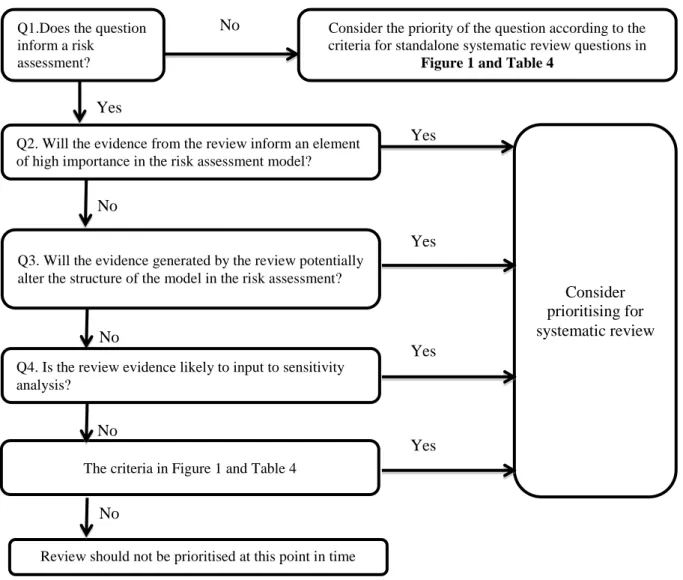
The next step is the prioritisation criteria. Here the Consortium proposes using criteria in Table 4 combined with the criteria in Table 5. The process of combining these is illustrated in Figure 2.
The prioritisation process for systematic review questions arising from a broad policy problem is summarised in a flow chart in Figure 2. As with the prioritisation of standalone review questions described above, the prioritisation process for questions arising from a broad policy problem may be flexible to ensure that the number of review questions prioritised is appropriate for the available resources. The flow chart may also be adapted as a reporting template to ensure transparency in the documentation and reporting of the decisions made concerning the prioritisation of review questions. Table 5: Additional criteria for prioritising systematic reviews when a risk assessment model is available (Van der Sluijs et al, 2005)
Criteria Question in process
Anticipated local effect in the model Will the evidence from the review inform an element of high importance in the risk assessment model?
Anticipated structural effect in the model Will the evidence generated by the review potentially alter the structure of the model in the risk assessment? Impact of parameter in model (sensitivity
analysis)
Is the review evidence likely to input to sensitivity analysis?
As an example of how to apply the prioritisation approach proposed by the Consortium in the situation when a conceptual but not mathematical model is available, we can use an animal health import risk assessment. For such a topic it is easy to imagine there being a conceptual model which would identify all the possible topics for review, i.e., the parameters that will be included in the model.
The conceptual model contains several parameters but we focus on just two - the prevalence of the disease in the country and the sensitivity and specificity of the diagnostic test used to detect the disease. In this situation, the decision maker(s) could use the flow chart in Figure 2 to narrow down
7
EFSA Panels on Biological Hazards (BIOHAZ), on Contaminants in the Food Chain (CONTAM), and on
Animal Health and Welfare (AHAW); Scientific Opinion on the public health hazards to be covered by inspection of meat (poultry). EFSA Journal 2012;10(6):2741. [179 pp.] doi:10.2903/j.efsa.2012.2741. Available online: www.efsa.europa.eu/efsajournal
and prioritise the systematic review topics in a transparent documentable approach. Beginning with an example that only seeks to prioritise either the review of the prevalence in the country of origin or the characteristics of the diagnostic tests. If we imagine that based on the flow chart, the decisions makers answer “yes” for Q1 and Q2 in Figure 2, Q3 will be “no” as a mathematical model does not yet exist. They would then move to the criteria in Table 4 and answer those questions. Perhaps, all are “no” except a “yes” response for Q3 in Table 4 for both topics but only for the diagnostic tests assay is there a “yes” response to Q7 in Table 4, i.e., the amount of information available. That is, it is clear that for the prevalence estimate question there is little or no published data are available but for the question about the diagnostic test method numerous studies are expected. In this situation, the Consortium would expect that the decision maker would prefer to conduct the review on the diagnostic test. Although this example could be interpreted as a “vote” counting approach, the Consortium does not recommend such an approach to defending prioritisation decisions because as illustrated in a prior example, such an approach is not always a workable option. The rationale for the recommendation in this example should be that, all other things being equal, the review the diagnostic assay was selected because the topic had the advantage of having a stronger body of data for a review. The incorrect rationale for the recommendation would that that the prevalence topic received 3 “yes” responses and the diagnostic test received 4 “ yes” responses.
Supporting publications 2012: EN-367 24
The present document has been produced and adopted by the bodies identified above as author(s). This task has been carried out exclusively
Figure 2: Prioritising review questions from a broad policy problem Yes
Q2. Will the evidence from the review inform an element of high importance in the risk assessment model?
Consider prioritising for systematic review
Q1.Does the question inform a risk
assessment?
Yes
No
Q3. Will the evidence generated by the review potentially alter the structure of the model in the risk assessment?
No
Q4. Is the review evidence likely to input to sensitivity analysis?
Yes
The criteria in Figure 1 and Table 4
Yes
Review should not be prioritised at this point in time
Yes
No Consider the priority of the question according to the criteria for standalone systematic review questions in
Figure 1 and Table 4
No
4. Feasibility and Resource Impact Assessment: An approach to adapting the systematic review methodology in cases of limited resources
Although topics may be prioritised, it is also important that EFSA addresses resource factors that limit the feasibility of conducting any systematic review. The availability of resources should be used to judge whether a systematic review will assist with estimating parameters or answering the questions. These resources are: time, staff (availability and expertise); primary evidence; and technical resources. These four resources are not independent (e.g. staff availability may influence the time required for a systematic review). Key technical resources required for a systematic review include bibliographic databases, literature management software and statistical analytical tools. For the purposes of this framework the Consortium assumes that the availability of technical resources within EFSA is not a limiting factor. Therefore we focus on the three remaining resources which will be required: time; staff availability and expertise and primary evidence.
4.1. Time issues: short deadlines and the utility of rapid reviews
According to the Cochrane Collaboration Handbook (2011) a systematic review “attempts to collate all empirical evidence that fits pre-specified eligibility criteria in order to answer a specific research question. It uses explicit, systematic methods that are selected with a view to minimizing bias, thus providing more reliable findings from which conclusions can be drawn and decisions made”. Systematic reviews take time and resources if they are to be properly executed. However, EFSA and other government agencies frequently have to respond to policy makers’ requests for information in a time frame shorter than necessary to complete a full systematic review. In human medicine, systematic review tools to respond to these requests are referred to as rapid reviews. In other fields the terms “rapid evidence reviews” and “pilot reviews” have been used.
For EFSA, rapid reviews may be a useful tool but they should not be viewed as a substitute for a full systematic review. Rapid reviews and systematic reviews should be clearly differentiated. Criteria about what constitutes a rapid review and what shortcuts are taken to ensure that the review is rapid are not standardised. In a study of institutions using rapid reviews to support policy making, a major difference between systematic reviews and rapid reviews was that fewer sources were used when searching the literature to identify relevant studies (Watt et al., 2008a). Searching the grey literature and hand searching were the most commonly omitted steps in rapid reviews compared to systematic reviews.
Rapid reviews also tend to be more restrictive in terms of the type of primary study that would be considered relevant. For example, in a study of 36 rapid reviews, none excluded systematic reviews; 6% excluded randomized controlled trials (RCTs); 17% excluded nonrandomized controlled trials; and 83% excluded case series (Watt et al., 2008a). In contrast, no full systematic review excluded RCTs, only 8% excluded nonrandomized studies, and 31% excluded case series (Watt et al., 2008a). With respect to the outcomes considered, rapid reviews are more likely to restrict the number of outcomes considered, and in health care, the outcomes omitted by rapid reviews have tended to be social and economic rather than clinical outcomes (Watt et al., 2008a).
Rapid reviews are also less likely to include external reviewers or larger stakeholder groups in the review process and this may be a disadvantage. If EFSA would encourage the use of rapid review too frequently, or working groups incorrectly developed the idea that rapid reviews are the solution to all review questions, the in-house workload for EFSA staff (with less involvement of external experts), who would be expected to conduct the rapid reviews, may actually increase.