Journal of Computational Design and Engineering 3 (2016) 349–362
Thermal diffusion and diffusion thermo effects on an unsteady heat and mass
transfer magnetohydrodynamic natural convection Couette
fl
ow using FEM
R. Srinivasa Raju
a, G. Jithender Reddy
b,n, J. Anand Rao
c, M.M. Rashidi
d,e aDepartment of Mathematics, GITAM University, Hyderabad Campus, Rudraram, Medak 502329, Telangana, India b
Department of Mathematics, VNR Vignana Jyothi Institute of Engineering and Technology, Hyderabad 500090, Telangana, India c
Department of Mathematics, Faculty of science, Osmania University, Hyderabad 500007, Telangana, India d
Shanghai Key Lab of Vehicle Aerodynamics and Vehicle Thermal Management Systems, Tongji University, 4800 Cao An Rd., Jiading, Shanghai 201804, China eENN-Tongji Clean Energy Institute of Advanced Studies, Shanghai, China
Received 27 January 2016; received in revised form 17 June 2016; accepted 26 June 2016 Available online 1 July 2016
Abstract
The numerical solutions of unsteady hydromagnetic natural convection Couetteflow of a viscous, incompressible and electrically conducting
fluid between the two vertical parallel plates in the presence of thermal radiation, thermal diffusion and diffusion thermo are obtained here. The fundamental dimensionless governing coupled linear partial differential equations for impulsive movement and uniformly accelerated movement of the plate were solved by an efficient Finite Element Method. Computations were performed for a wide range of the governingflow parameters, viz., Thermal diffusion (Soret) and Diffusion thermo (Dufour) parameters, Magneticfield parameter,Prandtl number, Thermal radiation and Schmidt number. The effects of theseflow parameters on the velocity (u), temperature (θ) and Concentration (ϕ) are shown graphically. Also the effects of these pertinent parameters on the skin-friction, the rate of heat and mass transfer are obtained and discussed numerically through tabular forms. These are in good agreement with earlier reported studies. Analysis indicates that thefluid velocity is an increasing function of Grashof numbers for heat and mass transfer, Soret and Dufour numbers whereas the Magnetic parameter, Thermal radiation parameter, Prandtl number and Schmidt number lead to reduction of the velocity profiles. Also, it is noticed that the rate of heat transfer coefficient and temperature profiles increase with decrease in the thermal radiation parameter and Prandtl number, whereas the reverse effect is observed with increase of Dufour number. Further, the concentration profiles increase with increase in the Soret number whereas reverse effect is seen by increasing the values of the Schmidt number.
&2016 Society of CAD/CAM Engineers. Publishing Servies by Elsevier. This is an open access article under the CC BY-NC-ND license (http://creativecommons.org/licenses/by-nc-nd/4.0/).
Keywords:Heat and Mass transfer; Natural convection; MHD; Couetteflow; Finite Element Method
1. Introduction
The Couette flow in fluid dynamics refers to the laminar
flow of a viscous fluid in the space between the two parallel plates, one of which moves relative to the other. Thisflow is driven by virtue of viscous drag force acting onfluid and the applied pressure gradient is parallel to the plates. Such flow
was named in honor of Maurice Marie Alfred Couette, a professor of Physics at the French University of Angers in the late 19th century. Shear-driven fluid motion is explained in undergraduate physics and engineering courses using Couette
flow. Couette motion is applied application viz. magneto hydrodynamics power generators and pumps, petroleum industry, polymer technology, purification of crude oil and
fluid droplets sprays. This type offlow was analyzed by Singh et al.[1], Gorla et al.[2]and Kearsley et al. [3]; Umavathi et al. [4] studied the generalized plain heat transfer of Couette
flow in a composite channel. The system of non-linear differential equations of a newtonian magnetic lubricant squeezefilmflow with magnetic induction effects were solved www.elsevier.com/locate/jcde
http://dx.doi.org/10.1016/j.jcde.2016.06.003
2288-4300/&2016 Society of CAD/CAM Engineers. Publishing Servies by Elsevier. This is an open access article under the CC BY-NC-ND license (http://creativecommons.org/licenses/by-nc-nd/4.0/).
nCorresponding author at: Department of Mathematics, VNR Vignana
Jyothi Institute of Engineering and Technology, Bachupally, R.R (dist), Hyderabad, 500090, Telangana, India.
E-mail address:[email protected](G. Jithender Reddy). Peer review under responsibility of Society of CAD/CAM Engineers.
by Rashidi et al. [5]using the combination of the differential transform and Padé approximation methods. Freidoonimehr et al.[6]investigated the transient magnetohydrodynamic free laminar convective flow of nano-fluid past a vertical porous and stretched surface under acceleration by considering four different types of water based nano-fluid namely, copper (Cu), copper oxide (CuO), aluminum oxide (Al2O3), and titanium dioxide (TiO2) using a fourth order Runge–Kutta method based shooting technique. Abolbashari et al. [7] found analytical results of the fluid flow, heat and mass transfer and entropy generation for the steady laminar non-Newtonian nano-fluidflow induced by a stretching sheet in the presence of velocity slip and convective surface boundary conditions using Optimal Homotopy Analysis method. Rashidi et al. [8]
performed the second law of thermodynamics analysis of a rotating porous disk in the presence of a magnetic field with
temperature-dependent thermo-physical properties numerically using the fourth-order Runge–Kutta method. Gireesha et al.[9]
studied the heat transfer of Couetteflow with the presence of dusty fluid by the perturbation method. Rajput et al. [10]
analyzed the exact solution of free convection in unsteady MHD Couette flow of a viscous incompressible, electrically conductingfluid between the two vertical parallel plates with the presence of thermal radiation, in the absence of thermal diffusion and diffusion thermo. Recently Das et al. [11,12]
studied the analytical solutions of hydromagnetic Couetteflow problems with the effect of some physical parameters other than Soret and Dufour. Recently Victor et al.[13]studied the
finite element analysis of unsteady MHD radiative natural convection Couette flow between two permeable plates with viscous and joule dissipation in the absence of Soret and Dufour. Seth et al. [14] found the analytic solutions of
Nomenclature
List of Variables
h Distance between two parallel plates (m)
Ho Magnetic field component along y0 axis (Am1)
Cp Specific heat at constant pressure J Kg1K
Cs Concentration susceptibility (m mole1) Gr Grashof number for heat transfer Gc Grashof number for mass transfer g Acceleration of gravity (m s2) M Hartmann number
Pr Prandtl number Sc Schmidt number
R Thermal radiation parameter F Accelerating parameter
D Chemical molecular diffusivity (m2s1) T0 Temperature offluid Kð Þ
T0w Temperature of thefluid near to moving plate Kð Þ T0h Temperature of the fluid near to the stationary
plate Kð Þ
C0 Concentration offluid (mol m3)
C0w Concentration of the fluid near to moving plate (mol m3)
C0h Concentration of the fluid near to the stationary plate (mol m3)
t0 Time inx0,y0coordinate system (s) t Time in dimensionless co-ordinates (s) u0 Velocity component inx0 direction (m s1) u Dimensionless velocity component in x0
direc-tion (m s1)
Nuo Nusselt number at the moving hot plate Nu1 Nusselt number at the stationary plate Sh Sherwood number
Sr Soret number (Thermal Diffusion) Dr Dufour number (Diffusion Thermo)
qr Radiative heatflux
K Chemical reaction offirst order with rate constant x0; y0 Co-ordinate system (m)
x; y Dimensionless coordinates (m) Uo Reference velocity (m s1) Dm Mass diffusivity (m2s1) Tm Meanfluid temperature Kð Þ kT Thermal diffusion ratio k Mean absorption coefficient Greek symbols
β Coefficient of volume expansion for heat transfer (K1)
β Coefficient of volume expansion for mass transfer (m3kg1)
κ Thermal conductivity of thefluid (W m1K1) s Electrical conductivity of thefluid (S m1) ν Kinematic viscosity (m2s1)
θ Non-dimensional temperature Kð Þ
ϕ Concentration of thefluid (mol m3) ρ Density of thefluid (kg m3) α Angle (degrees)
τ Skin-friction (pascal)
μ Viscosity (m2s1) s Stefan–Boltzmann constant Superscript
/
Dimensionless properties Subscripts
h Free stream condition
p Plate
unsteady MHD convective Couetteflow of a viscous, incom-pressible, electrically conducting, and temperature dependent heat absorbing fluid within a rotating vertical channel embedded in a fluid saturated porous medium taking Hall current using Laplace transform technique.
Seth et al. [15] studied unsteady hydromagnetic natural convection flow of a viscous, incompressible, electrically conducting and temperature dependent heat absorbing fluid confined within a parallel plate rotating vertical channel in porous medium with the help of Laplace transform technique. The heat transfer affected due to concentration gradient is called Diffusion-thermo or Dufour effect. On the other hand mass transfer affected due to temperature gradient is called Thermal-diffusion or Soret effect. Alam et al.[16]investigated the Dufour and Soret effects on mixed convectionflow past a vertical porousflat plate in the presence of variable suction. El-Arabawy et al.[17], Rashidi et al.[18–20]and Srinivasa Raju et al.[21]studied unsteady MHD natural convectionflow with varying physical parameters. Chamkha et al.[22]analyzed the combining influence of Soret and Dufour on unsteady heat and mass transfer by MHD mixed convection chemically reacting
flow over on a stretched vertical surface. El-Kabeir et al.[23]
studied the heat and mass transfer by mixed convection from a vertical slender cylinder with chemical reaction and Soret and Dufour effects. Al-Juma et al.[24] studied Soret and Dufour Effects on heat and mass transfer by free convectiveflow of a micropolar fluid about a sphere embedded in porous media. Jagdish [25] studied the thermal-diffusion impact on MHD three dimensional natural convective Couette flow by pertur-bation technique with the presence of chemical reaction and the absence of Diffusion thermo.
Electrically conducting viscous fluid flow between two parallel plates in the presence of a transversely applied magnetic field has several applications in many devices such as magnetohydrodynamic (MHD) power generators, MHD pumps, accelerators, aerodynamics, heating, electrostatic pre-cipitation, polymer technology, petroleum industry, purifi ca-tion of molten metals from non-metallic inclusions and fluid droplets-sprays. The influence of thermal radiation on MHD nanofluid flow between two rotating horizontal plates in the presence of Brownian motion and thermophoresis effects have been studied by Sheikholeslami et al. [26] using the fourth-order Runge–Kutta method. The influence of an external magnetic field on ferro-fluid flow and heat transfer in a semi annulus enclosure with sinusoidal hot wall was investigated by Sheikholeslami and Ganji [27] via Control Volume based Finite Element Method. Sheikholeslami et al.[28]studied the force convection heat transfer in a lid driven semi annulus enclosure in the presence of non-uniform magnetic field and the enclosure is filled with Fe3O4-water nanofluid using the Control volume based finite element method. The effect of magnetic field dependent viscosity on free convection heat transfer of nanofluid in an enclosure was investigated by Sheikholeslami et al. [29] with the help of control volume basedfinite element method. The effect of thermal radiation on Al2O3-water nanofluid flow and heat transfer in an enclosure with a constant flux heating element was studied by
Sheikholeslami et al. [30] via control volume based finite element method. Sheikholeslami et al. [31] applied control volume based finite element method to solve the governing equations of Ferrohydrodynamic and Magnetohydrodynamic effects byfilling the enclosure with ferrofluid by assuming the magnetization of the fluid was varying linearly with tempera-ture and magnetic field intensity. Control volume-basedfinite element method was applied by Sheikholeslami and Rashidi
[32]to Fe3O4-water nanofluid mixed convection heat transfer in a lid-driven semi annulus in the presence of a non-uniform magnetic field. Sheikholeslami et al. [33] studied ferro-fluid
flow and heat transfer in a semi annulus enclosure by considering thermal radiation and constant heatflux boundary condition with the help of control volume basedfinite element method. The behavior of hydrothermal of nano-fluid between two parallel plates was studied by Sheikholeslami [34] using KKL correlation. The characteristics of heat transfer and nanofluid flow between two horizontal parallel plates in a rotating system were investigated by Sheikholeslami et al.[35]
via Runge–Kutta method of fourth order. Sheikholeslami et al.
[36] found computational results of nanofluid flow and heat transfer in a square enclosure containing a rectangular heated body in the presence of four different types of metal and metal-oxide nanoparticles: alumina (Al2O3), copper (Cu), silver (Ag) and titania (TiO2) using the Lattice Boltzmann method. The effect of non-uniform magnetic field on nanofluid forced convection heat transfer in a lid driven semi-annulus was studied by Sheikholeslami et al. [37] in the presence of Brownian motion and thermophoresis effects via Control volume based finite element method. Sheikholeslami and Ellahi [38] studied three dimensional magnetohydrodynamics nanofluid hydrothermal treatment in a cubic cavity heated from below using the Lattice Boltzmann method. Sheikholeslami and Rashidi [39]studied the combined effects of ferrohydro-dynamic and magnetohydroferrohydro-dynamic on ferrofluid flow and heat transfer using the Control volume based finite element method. Sheikholeslami and Abelman [40]studied the effects of magnetic field on nanofluid flow, heat, and mass transfer between two horizontal coaxial cylinders in the presence of viscous dissipation using the fourth-order Runge–Kutta method. The Control Volume based Finite Element Method was applied by Sheikholeslami[41]for solving the governing equations of Ferrofluidflow and heat transfer in the presence of an external variable magneticfield.
A Finite Element Method (abbreviated as FEM) is a numerical technique to obtain an approximate solution to a class of problems governed by elliptic partial differential equations. Such problems are called as boundary value problems as they consist of a partial differential equation and the boundary conditions. It has been applied to a number of physical problems, where the governing differential equations are available. The method essentially consists of assuming the piecewise continuous function for the solution and obtaining the parameters of the functions in a manner that reduces the error in the solution. Sivaiah and Raju[42]studied the effect of Hall current on heat and mass transfer viscous dissipativefluid
Recently Siva Reddy et al. [43] studied influence of thermal diffusion on unsteady MHD natural convective flow past a semi-infinite vertical plate in the presence of viscous dissipa-tion by the Finite Element Method. Anand Rao et al. [44]
considered the effects of chemical reaction with heat absorp-tion on an unsteady MHD free convective fluid flow past a semi-infinite perpendicular plate embedded in a porous med-ium. Anand Rao et al.[45]demonstrated the combined effects of heat and mass transfer on unsteady MHD flow past a vertical oscillatory plate suction velocity using the finite element method. Anand Rao et al. [46]studied transientflow past an impulsively started infinite flat porous plate in a rotating fluid in the presence of magnetic field with Hall current using the finite element technique. The combined effects of heat and mass transfer on unsteady MHD natural convective flow past an infinite vertical plate enclosed by porous medium in the presence of thermal radiation and Hall Current was investigated by Ramana Murthy et al. [47]. Rao et al.[48]found the numerical results of the non-linear partial differential equations of free convective magnetohydrody-namic flow past semi-infinite moving vertical plate with the effects of thermal radiation and viscous dissipation usingfinite element technique. Reddy Sheri and Srinivasa Raju [49]
studied the effect of viscous dissipation on transient free convection flow past an infinite vertical plate through porous medium in the presence of magnetic field using the finite element technique. Srinivasa Raju [50]studied the combined effects of thermal-diffusion and diffusion-thermo on unsteady free convectionfluidflow past an infinite vertical porous plate in the presence of magneticfield and chemical reaction using thefinite element technique. Srinivasa Raju et al.[51]studied the application offinite element method to unsteady MHD free convectionflow past a vertically inclined porous plate includ-ing thermal diffusion and diffusion thermo effects. Srinivasa Raju et al.[52]found both analytical and numerical solutions of unsteady magnetohydrodynamic free convective flow past an exponentially moving vertical plate with heat absorption and chemical reaction.
Therefore the objective of the present paper is to study the thermal diffusion and diffusion thermo effects on an unsteady two-dimensional heat and mass transfer radiative MHD natural convective Couetteflow of a viscous, incompressible, electrically conducting fluid between the two vertical parallel plates with suction, embedded in a porous medium, under the influence of a uniform transverse magnetic field with suitable boundary condi-tions in two cases, impulsive movement and uniformly accelerated movement of the plate . The problem is described by a system of coupled linear partial differential equations, whose exact solution is difficult to obtain, whenever it is possible. Thus, the Finite Element Method is adopted to obtain the solution, which is more economical andflexible from computational point of view. The behaviors of velocity, temperature, concentration, Skin-friction coefficient, Nusselt number and Sherwood numbers has been discussed in detail for variation of thermo physical parameters. The uniqueness (novelty) of this research paper is to study the grid independence of Finite Element Method on unsteady magnetohy-drodynamic natural convection flow of incompressible, viscous
fluid between two parallel plates surrounded by porous medium. In this research world, no authors studied the study of grid independence offinite element method on Couetteflow problems (Fig. 1).
2. Mathematical formulation of the problem
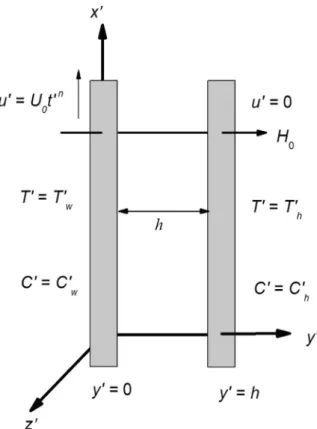
Consider the two-dimensional unsteady natural convective Couette flow of a viscous, electrically conducting fluid past vertical a porous plate with suction, under the influence of a uniform transverse magneticfield, thermal radiation, heat and mass transfer. The following assumptions are listed below: 1. Thex0 axis andy0 axis are taken along the plate in the
vertical upward and normal direction to the plate respectively.
2. Let the plates be separated by a distanceh. Initially, at time t0r0, thefluid and the plates of the channel are assumed to be at rest and at same temperatureT0hand concentrationC0h. When time t040, the plate (at y0¼0) starts moving with time dependent velocity Uot0n(Uo being a constant and n being a non-negative integer) in its own plane and at the same time the plate temperature and concentration is raised toT0wandC0wrespectively while the plate (aty0¼h) is kept
fixed. At the same time t040, the wall at y0¼h is stationary and maintained at a constant temperature T0h and constant concentration C0h.
3. Assumed transverse magnetic field of the uniform strength Ho is to be applied normal to the plate.
4. The hall effect, viscous dissipation and induced magnetic
field are assumed to be negligible because of the magnetic Reynolds number of theflow is considered to be very small. 5. It is assumed that voltage is not applied which implies the
absence of an electricfield.
6. The homogeneous chemical reaction is of first order with rate constantK between the diffusing species and thefluid is neglected.
7. Thefluid has constant thermal conductivity and kinematic viscosity, the Boussinesq approximation has been taken for theflow.
From the above assumptions, the unsteadyflow is governed by the following partial differential equations.
Momentum equation: ∂u0 ∂t0 ¼ν ∂2u0 ∂y02 þgβ T 0T0 h þgβC0C0hsμ 2 eH 2 o ρ ðu0Uot0nÞ ð1Þ Energy equation: ∂T0 ∂t0 ¼ κ ρCp ∂2T0 ∂y02 þ DmkT CsCp ∂2C0 ∂y02 1 ρCp ∂qr ∂y0 ð2Þ
Species diffusion equation: ∂C0 ∂t0 ¼D ∂2C0 ∂y02 þ DmkT Tm ∂2T0 ∂y02 ð3Þ
The corresponding initial and boundary conditions are t0r0:u0¼0; T0¼Th0; C0¼C0h f or 0ry0rh t040: u0¼U ot 0n ; T0¼T0w; C0¼C0w at y0¼0 u0¼0; T0¼T0h; C0¼C0h at y0¼h 9 > > = > > ; ð4Þ The radiative heat flux is simplified by making use of the Rosseland approximation Rajput and Sahu [10]as
qr¼ 4s 3k
∂T04
∂y0 ð5Þ
Following Rajput and Sahu [10], we assume that the differences in temperature within the flow are sufficiently small such thatqr may be expressed as a linear function ofT0. Hence on expandingT04in a Taylor Series aboutT0hup tofirst order approximation, we get
T04ffiT0h4þ4T0T0hTh03¼4T0T0h33T0h4 ð6Þ Using Eqs.(5) and (6)in the last term of Eq.(2), we obtain: ∂qr ∂y0 ¼ 16sT0h3 3k ∂2T0 ∂y02 ð7Þ
Introducing(7)in the Eq.(2), the energy equation becomes:
∂T0 ∂t0 ¼ κ ρCp ∂2T0 ∂y02 þ 16sT0h3 3kρCp ∂2T0 ∂y02 þ DmkT CsCp ∂2C0 ∂y02 ð8Þ
Introducing the following non-dimensional quantities in Eqs. (1),(3)and (8) u¼u′ h; y¼ y′ h; t¼ t′ν h2; θ¼ T′−T′h T′w−T′h; ϕ¼ C′−C′h C′w−C′h; Gr¼gβh Tð ′w−T′hÞ ν ; Gc¼gβ nh C′w−C′ h ð Þ ν ; F¼Uoh2n−1 νn ; M2¼σμ 2 eH2oh2 ρν ; R¼3κk n 4σT′3 h; Pr¼ρνCp κ ; Sc¼Dν; Dr¼ DmkTh2ðC′w−C′hÞ νCsCpðT′w−T′hÞ ; Sr¼DmkTðT′w−T′hÞ νTmðC′w−C′hÞ ;Re −1 x ¼ Uox′ ν 9 > > > > > > > > > > = > > > > > > > > > > ; ð9Þ
Then the Eqs.(1),(3)and (8)reduce to the following non-dimensional form of equations
∂u ∂t ¼ ∂2u ∂y2 þGrθþGcϕM 2ðuFtnÞ ð10Þ ∂θ ∂t ¼ 1 Pr 3Rþ4 3R ∂2θ ∂y2 þDr ∂2ϕ ∂y2 ð11Þ ∂ϕ ∂t ¼ 1 Sc ∂2ϕ ∂y2 þSr ∂2θ ∂y2 ð12Þ
Using Eq.(9), the initial and boundary conditions(4)reduce to tr0:u¼0; θ¼0; ϕ¼0f or0ryr1 t40: u¼Ftn; θ¼1; ϕ¼1at y¼0 u¼0; θ¼0; ϕ¼0at y¼1 9 > > = > > ; ð13Þ
Two cases are considered, tofind the solutions of Eqs.(10),
(11) and (12) subject to the initial and boundary conditions
(13):
1. Impulsive movement of the plate aty0¼0 (i.e.n¼0) and 2. Uniform accelerated movement of the plate at y0¼0 (i.e.
n¼1).
Case (1): Impulsive movement of the plate y0¼0:
Takingn¼0 in Eq.(10), then the Eq.(10)can be written as ∂u
∂t ¼ ∂2u
∂y2 þGrθþGcϕM
and the corresponding boundary conditions(13)reduce to tr0: u¼0; θ¼0; ϕ¼0 f or 0ryr1 t40: u¼F; θ¼1; ϕ¼1 at y¼0 u¼0; θ¼0; ϕ¼0 at y¼1 9 > > = > > ; ð15Þ
Case (2): Uniform accelerated movement of the plate (at y0¼0)
Takingn¼1 in Eq.(10), then the Eq.(10)can be written as ∂u
∂t ¼ ∂2u
∂y2 þGrθþGcϕM
2ðuFtÞ ð16Þ
and the initial and boundary conditions(13)reduce to
tr0: u¼0; θ¼0; ϕ¼0 f or 0ryr1 t40: u¼Ft; θ¼1; ϕ¼1 at y¼0 u¼0; θ¼0; ϕ¼0 at y¼1 9 > > = > > ; ð17Þ
For practical engineering applications and the design of chemical engineering systems, quantities of interest include the following Skin-friction, Nusselt number and Sherwood number which are useful to compute. The skin-friction or the shear stress at the moving plate of the channel in non dimensional form is given by τ¼ τ0w ρuov y0¼0 ¼ ∂u ∂y y¼0 ð18Þ
The rate of heat transfer at the moving hot plate of the channel in non-dimensional form is given by
Nuo¼ x0 ∂T0 ∂y0 y0¼0 T0wT01 )NuoRe 1 x ¼ ∂θ ∂y y¼0 ð19Þ Further the rate of heat transfer on the stationary plate is given by Nu1¼ x0 ∂T0 ∂y0 y0¼h T0wT01 )Nu1Re 1 x ¼ ∂θ ∂y y¼1 ð20Þ The Sherwood number at the moving plate of the channel in non-dimensional form is given by
Sh¼ x0 ∂C0 ∂y0 y0¼0 C0wC01 )ShRe 1 x ¼ ∂ϕ ∂y y¼0 ð21Þ
Where Rex is the Reynold's number. The mathematical modeling of the problem is now completed. Eqs. (11), (12),
(14) and (16) presents a coupled system of linear partial differential equations and these are to be solved with initial and boundary conditions(15)and(17). However,finding the exact solutions are difficult, whenever it is possible. Hence, these equations are solved numerically by thefinite element method.
3. Method of solution by Finite Element Method
3.1. Numerical solutions by Finite Element Method
The Finite Element Method (FEM) is an efficient numerical and computational method to solving a variety of engineering and real world problems. It is recognized by so many researchers, developers and users as one of the most powerful numerical analysis tools ever devised to analyze complex problems of engineering. The simplicity of the method, its accuracy and computability all make it a widely used tool in modeling and design process [53]. The primary feature of FEM ([54–56]) is its ability to describe the geometry of the problem being analyzed with greatflexibility. This is because of the discretization of domain of the problem is performed using highly flexible elements or uniform or non uniform patches that can be easily depicted as complex shapes. The method essentially consists the piecewise continuous function for the solution and obtaining the parameters of the functions in a systematic manner that reduces the error in the solution. The steps are involved in the finite element analysis as follows.
Step 1: Discretization of the domain: The basic concept
of the FEM is to divide the domain or region of the problem into small connected patches, called finite elements. The collection of elements is called the finite element mesh. These finite elements are connected in a non overlapping manner, such that they completely cover the entire space of the problem.
Step 2: Generation of the element equations:
i) A typical element is isolated from the mesh and the variational formulation of the given problem is constructed over the typical element.
ii) Over an element, an approximate solution of the varia-tional problem is supposed, and by substituting this in the system, the element equations are generated.
iii) The element matrix, which is also known as stiffness matrix, is constructed by using the element interpolation functions.
Step 3: Assembly of the element equations:The algebraic
equations so obtained are assembled by imposing the inter element continuity conditions. This yields a large number of algebraic equations known as the global finite element model, which governs the whole domain.
Step 4: Imposition of the boundary conditions: The
physical boundary conditions defined in(15)and in(17)are imposed on the assembled equations.
Step 5: Solution of assembled equations: The assembled
equations so obtained can be solved by any of the numerical techniques, namely, Gauss elimination method, LU decomposition method, and the final matrix equation can be solved by a direct or indirect (iterative) method. For computational purposes, the coordinateyis varied from 0 to ymax ¼ 1 whereymaxrepresents infinityi:e:;external to the momentum, energy and concentration boundary layers. The
whole domain is divided into a set of 100 line segments of equal width 0:1;each element being two-noded.
Variational formulation:The variational formulation
asso-ciated with Eqs. (10)–(12) over a typical two-noded linear elementye; yeþ1is given by
Z yeþ1 ye w1 ∂u ∂t ∂2u ∂y2 Grð Þθ Gcð Þþϕ M2ðuFtnÞ dy¼0 ð22Þ Z yeþ1 ye w2 ∂θ ∂t 1 Pr 3Rþ4 3R ∂2θ ∂y2 Dr ∂ 2ϕ ∂y2 dy¼0 ð23Þ Z yeþ1 ye w3 ∂ϕ ∂t 1 Sc ∂2ϕ ∂y2 Sr ∂ 2θ ∂y2 dy¼0 ð24Þ
where w1;w2 and w3 are arbitrary test functions and may be viewed as the variation in u; θ and ϕ respectively. After reducing the order of integration, we arrive at the following system of equations: Z yeþ1 ye w1 ð Þ ∂u ∂t þ ∂w1 ∂y ∂u ∂y þ M 2 w 1 ð Þuð ÞFð Þw1 tn ðGrÞð Þw1 θðGcÞð Þw1 ϕ dy ð Þw1 ∂u ∂y yeþ1 ye ¼0 ð25Þ Z yeþ1 ye w2 ð Þ ∂θ ∂t þ 1 Pr 3Rþ4 3R ∂w2 ∂y ∂θ ∂y þDr ∂w2 ∂y ∂ϕ ∂y dy w2 Pr ∂θ ∂y þDrðw2Þ ∂ϕ ∂y yeþ1 ye ¼0 ð26Þ Z yeþ1 ye w3 ð Þ ∂ϕ ∂t þ 1 Sc ∂w3 ∂y ∂ϕ ∂y þSr ∂w3 ∂y ∂θ ∂y dy þ w3 Sc ∂ϕ ∂y þSrðw3Þ ∂θ ∂y yeþ1 ye ¼0 ð27Þ
Finite element formulation:
Thefinite element model may be obtained from Eqs.(25)– (27)by substitutingfinite element approximations of the form:
u¼ X 2 j¼1 uejψej; θ¼X 2 j¼1 θe jψ e j; ϕ¼ X2 j¼1 ϕe jψ e j ð28Þ with w1¼w2¼w3¼ψej ði¼1; 2Þ; where u e j ;θ e j and ϕ e jare the velocity, temperature and concentration respectively at the jthnode of typicalethelement y
e; yeþ1
andψe
i are the shape functions for this elementye; yeþ1and are taken as:
ψe 1¼ yeþ1y yeþ1ye and ψe2¼ yye yeþ1ye ; yeryryeþ1 ð29Þ
The finite element model of the equations for eth element thus formed is given by
K11 K12 K13 K21 K22 K23 K31 K32 K33 2 6 4 3 7 5 ue f g θe f g ϕe 2 6 4 3 7 5 þ M11 M12 M13 M21 M22 M23 M31 M32 M33 2 6 4 3 7 5 u0e θ0e ϕ0e 2 6 6 4 3 7 7 5¼ b1e b2e b3e 2 6 6 4 3 7 7 5 ð30Þ where ½Kmn; ½Mmn and f gue ;f gθe ; ϕe ;f gu0e ; θ0e ; ϕ0e andfbmeggðm; n¼1;2;3Þ are the set of matrices of order 22 and 21 respectively and/0 (dash) indicates d
dy. These matrices are defined as follows: K11
ij ¼ R yeþ1 ye ∂ψ e i ∂y ∂ψe j ∂y dyþ M 2 Ryeþ1 ye ψ e i ψej dyFtn Ryeþ1 ye ψ e i dy; K12 ij ¼ Gr Ryeþ1 ye ψ e i ψ e j dy; K13ij ¼ GcRyeþ1 ye ψ e i ψej dy; M 11 ij ¼ Ryeþ1 ye ψ e i ψej dy; M12ij ¼M13ij ¼0; M21ij ¼M23ij ¼0; M31ij ¼Mij32¼0;K21ij ¼0, K31ij ¼0;bi1e¼ ψei ∂∂uy h iyeþ1 ye ; K22 ij ¼ 1 Pr 3Rþ4 3R Ryeþ1 ye ∂ψe i ∂y ∂ψe j ∂y h i dy, K23 ij ¼Du Ryeþ1 ye ∂ψe i ∂y ∂ψe j ∂y h i dy, K33ij ¼ Sc1Ryeþ1 ye ∂ψe i ∂y ∂ψe j ∂y h i dy, M22 ij ¼ Ryeþ1 ye ψ e i ψej dy; -b2ei ¼ ψei Pr 3Rþ4 3R ∂θ ∂y þDr ψ e i ∂∂ϕy h iyeþ1 ye , K32ij ¼SrRyeþ1 ye ∂ψe i ∂y ∂ψe j ∂y h i dy; b3ei ¼ ψei Sc ∂∂ϕy þSr ψ e i ∂∂θy h iyeþ1 ye and M33ij ¼Ryeþ1 ye ψ e i ψ e j dy.
In one-dimensional space, linear element, quadratic element, or element of higher order can be taken. The entire flow domain is divided into 10,000 quadratic elements of equal size. Each element is three-noded, and therefore the whole domain contains 20,001 nodes. At each node, three functions are to be evaluated; hence, after assembly of the element equations, we obtain a system of 80,004 equations which are linear. There-fore, an iterative scheme must be utilized in the solution. After imposing the boundary conditions, a system of equations has been obtained which is solved by the Gauss elimination method while maintaining an accuracy of 0.00001. A conver-gence criterion based on the relative difference between the current and previous iterations is employed. When these differences satisfy the desired accuracy, the solution is
assumed to have been converged and iterative process is terminated. The Gaussian quadrature is implemented for solving the integrations. The code of the algorithm has been executed twice in MATLAB for case-1(Impulsive movement of the plate at y0¼0) and case-2 (Uniform accelerated move-ment of the plate at y0¼0). Excellent convergence was achieved for all the results.
3.2. Study of grid Independence
In general, to study the grid independency/dependency, the mesh size should be varied in order to check the solution at different mesh (grid) sizes and get a range at which there is no variation in the solution. The numerical values of velocity (u), temperature (θ) and concentration (ϕ) for different values of mesh (grid) size are shown in the followingTables 1and2in cases 1 and 2 respectively. From these tables, we observed that, there is no variation in the values of velocity (u), temperature (θ) and concentration (ϕ) for different values of mesh (grid) size. Hence, it is concluded that the results are independent of mesh (grid) size.
4. Validation of numerical code
In order to check on the correctness of the numerical technique used for the solution of the problem considered in the present study, it was authenticated by performing simula-tion for numerical solusimula-tions for the effect of thermal radiasimula-tion on unsteady hydromagnetic natural convection Couetteflow of a viscous incompressible electrically conductingfluid between
Table 1
The numerical values ofu,θandϕfor variation of mesh sizes in case-1 (Impulsive movement of the plate aty0¼0).
Mesh (Grid) Size ¼0.01 Mesh (Grid) Size ¼ 0.001 Mesh (Grid) Size¼ 0.0001
u θ ϕ u θ ϕ u θ ϕ 1.00000000 1.00000000 1.00000000 1.00000000 1.00000000 1.00000000 1.00000000 1.00000000 1.00000000 1.08651090 0.89902312 0.89773613 1.08803701 0.89906317 0.89810765 1.08953726 0.89910150 0.89844418 1.09550333 0.79818755 0.79592192 1.09836984 0.79826182 0.79660136 1.10118830 0.79833299 0.79721648 1.04589057 0.69756669 0.69469154 1.04977882 0.69766647 0.69559056 1.05360270 0.69776201 0.69640404 0.95372635 0.59720975 0.59410459 0.95822471 0.59732425 0.59512049 0.96265012 0.59743387 0.59603935 0.83178550 0.49713823 0.49414903 0.83643776 0.49725571 0.49517557 0.84101623 0.49736822 0.49610355 0.68943900 0.39734516 0.39475036 0.69379240 0.39745423 0.39568830 0.69807816 0.39755863 0.39653575 0.53281915 0.29779714 0.29578733 0.53646672 0.29788768 0.29655373 0.54005873 0.29797438 0.29724586 0.36523178 0.19843891 0.19711107 0.36784673 0.19850309 0.19764587 0.37042242 0.19856453 0.19812867 0.18776050 0.09919950 0.09856443 0.18912001 0.09923241 0.09883454 0.19045928 0.09926394 0.09907831 0.00000000 0.00000000 0.00000000 0.00000000 0.00000000 0.00000000 0.00000000 0.00000000 0.00000000 Table 2
The numerical values ofu,θandϕfor variation of mesh sizes in case-2 (Uniform accelerated movement of the plate aty0¼0).
Mesh (Grid) Size ¼0.01 Mesh (Grid) Size ¼ 0.001 Mesh (Grid) Size¼ 0.0001
u θ ϕ u θ ϕ u θ ϕ 0.00000000 1.00000000 1.00000000 0.00000000 1.00000000 1.00000000 0.00000000 1.00000000 1.00000000 0.25887764 0.89902312 0.89773613 0.25898206 0.89906317 0.89810765 0.25908482 0.89910150 0.89844418 0.43100041 0.79818755 0.79592192 0.43119749 0.79826182 0.79660136 0.43139136 0.79833299 0.79721648 0.52871627 0.69756669 0.69469154 0.52898526 0.69766647 0.69559056 0.52924997 0.69776201 0.69640404 0.56348127 0.59720975 0.59410459 0.56379491 0.59732425 0.59512049 0.56410354 0.59743387 0.59603935 0.54593152 0.49713823 0.49414903 0.54625863 0.49725571 0.49517557 0.54658055 0.49736822 0.49610355 0.48596683 0.39734516 0.39475036 0.48627543 0.39745423 0.39568830 0.48657909 0.39755863 0.39653575 0.39284736 0.29779714 0.29578733 0.39310774 0.29788768 0.29655373 0.39336395 0.29797438 0.29724586 0.27530533 0.19843891 0.19711107 0.27549303 0.19850309 0.19764587 0.27567768 0.19856453 0.19812867 0.14166926 0.09919950 0.09856443 0.14176714 0.09923241 0.09883454 0.14186347 0.09926394 0.09907831 0.00000000 0.00000000 0.00000000 0.00000000 0.00000000 0.00000000 0.00000000 0.00000000 0.00000000 Table 3
Values of Skin-friction for various parameters in case of impulsive movement of the plate.
Pr M2 R t Dr Sr τ Analytical results of Rajput and Sahu[10] 0.71 2.0 1.0 0.02 0 0 3.323170 3.323167 10.0 2.0 1.0 0.02 0 0 2.574285 2.574278 0.71 4.0 1.0 0.02 0 0 3.177202 3.177192 0.71 2.0 2.0 0.02 0 0 3.304121 3.304115 0.71 2.0 1.0 0.04 0 0 1.889310 1.889301 0.71 2.0 1.0 0.02 1 0 4.812012 – 0.71 2.0 1.0 0.02 0 1 4.721561 –
two vertical parallel plates which are reported by Rajput and Sahu [10]. Tables 3–5 show the calculated values for Skin-friction, Rate of heat and mass transfer coefficients for the present solution whenGc ¼ Sr ¼ Dr ¼ 0,Sc-1and the results are published by Rajput and Sahu [10]. Tables 3–5
show a very good concurrence between the results and this lends credibility to the present numerical code.
5. Results and discussion
To study the effects of different flow parameters like magnetic parameterM, thermal radiation parameter R, Prandtl number Pr, Schmidt number Sc, Accelerating parameter F, Soret numberSr, Dufour number Dr and time t on the flow
field, the numerical results of the fluid velocity, temperature, concentration, Skin-friction, Nusselt number and Sherwood number are computed numerically in both the cases viz.
Case (1). Impulsive movement of the plate (at y0¼0) Case (2). Uniform accelerated movement of the plate (at y0¼0)
The temperature and the species concentration of the fluid are coupled to the velocity via the Grashof number for heat and mass transfer numbers as seen in Eqs.(14)and(16)in both the cases (1) and (2). The curves in Figs. 2 and 3 illustrate the effects of Grashof numbers for heat and mass transfer on velocity profiles. The relative effect of the thermal buoyancy force to the viscous hydrodynamic force in the boundary layer
Table 4
Values of Skin-friction for various parameters in case of uniform accelerated movement of the plate.
Pr M R t F Dr Sr τ Analytical results of Rajput and Sahu[10] 0.71 2.0 1.0 0.02 0.5 0 0 0.431103 0.431103 10.0 2.0 1.0 0.02 0.5 0 0 0.580015 0.580015 0.71 4.0 1.0 0.02 0.5 0 0 0.327830 0.327830 0.71 2.0 2.0 0.02 0.5 0 0 0.450175 0.450175 0.71 2.0 1.0 0.04 0.5 0 0 0.302497 0.302497 0.71 2.0 1.0 0.02 0.9 0 0 0.368107 0.368107 0.71 2.0 1.0 0.02 0.5 1 0 0.420381 – 0.71 2.0 1.0 0.02 0.5 0 1 0.401048 – Table 5
Results of Nusselt number for various values of physical parameters. Pr R t Dr Nuo Analytical results of Rajput and Sahu[10] Nu1 Analytical results of Rajput and Sahu[10] 0.71 1.0 0.02 0 2.20065 2.20065 0.098109 0.098098 10.0 1.0 0.02 0 8.25878 8.25889 0.002508 0.002487 0.71 2.0 0.02 0 2.60412 2.60384 0.025352 0.025335 0.71 1.0 0.04 0 1.55681 1.55764 0.464661 0.464655 0.71 1.0 0.02 1 2.56812 – 0.106125 – 0.71 1.0 0.02 5 2.75841 – 0.251917 – 0 1 2 0 0.5 1 u y Gr = 1.0, 2.0, 3.0, 4.0
Impulsive Movement of the plate (Case (1): at n = 0.0) Uniformly accelerated movement of the plate (Case (2): at n = 1.0)
Fig. 2. Velocity profiles for different values ofGr.
0 1 2 0 0.5 1 u y Gc = 1.0, 2.0, 3.0, 4.0
Impulsive Movement of the
plate (Case (1): at n = 0.0)
Uniformly accelerated movement of the plate
(Case (2): at n =1.0)
Fig. 3. Velocity profiles for different values ofGc.
0 1 2 0 0.5 1 u y M = 1.0, 2.0, 3.0, 4.0
Impulsive Movement of the plate (Case (1): at n = 0.0) Uniformly accelerated movement of the plate (Case (2): at n = 1.0)
is the Grashof number for heat transfer. As expected, it was observed that there was an increase in the velocity due to the enhancement of thermal buoyancy force. Also, asGrincreases, the peak values of the velocity increases rapidly near the porous plate and then decays smoothly to free stream velocity. The ratio of the species buoyancy force to the viscous hydrodynamic force is the Grashof number for mass transfer. As expected, thefluid velocity increases and the peak value is more distinctive due to increase in the species buoyancy force. The velocity distribution attains a distinctive maximum value in the vicinity of the plate and then reduces properly to approach the free stream value. It is noticed that the velocity increases with increasing values of the Grashof number for mass transfer. The influence of Magnetic parameter (Hartmann number) on velocity profiles is as shown in the Fig. 4 by keeping other parameters in rest in both the cases (1) and (2). The presence of a magneticfield in an electrically conducting
fluid introduces a force called Lorentz force which acts against theflow if the magneticfield is applied in the normal direction as considered in the present problem. This type of resistive force tends to slow down theflow field. Also, it is observed that the velocity of fluid decreases with increasing magnetic parameter in case of impulsive movement of the plate (i.e. n ¼0 ) and in case of uniformly accelerated movement of the plate (i.e.n ¼1). It is revealed fromFig. 5that an increase in time leads to rise in thefluid velocity in both the cases (1) and (2). It indicates that there is an enhancement influid velocity as time progresses.Figs. 6and7display the effects of Pr (Prandtl number) on the velocity and temperature profiles. The ratio of the viscosity to the thermal diffusivity is the Prandtl number Pr. From these Figs. 6 and 7, it is clear that the velocity and temperature offluid decreases as the value of Prandtl number increases in both the cases (1) and (2). Physically this is possible becausefluids with high Prandtl number have greater viscosity, which make thefluids thick and hence move slowly. The effect of Schmidt number is very important in both velocity and concentrationfields. In both the cases (1) and (2), the effect of the Schmidt number on the velocity and concentration profiles are shown inFigs. 8and9, respectively
0 1 2 0 0.5 1 u y Sc = 0.22, 0.30, 0.60, 0.66
Impulsive Movement of the plate (Case (1): at n = 0.0) Uniformly accelerated movement of the plate (Case (2): at n = 1.0)
Fig. 8. Velocity profiles for different values ofSc.
0 0.5 1 0 0.5 1 θ y Pr = 0.025, 0.71, 7.0, 11.62
Fig. 7. Temperature profiles for different values of Pr. 0 1 2 0 0.5 1 u y Pr = 0.025, 0.71, 7.0, 11.62
Impulsive Movement of the plate (Case (1): at n = 0.0) Uniformly accelerated movement of the plate (Case (2): at n = 1.0)
Fig. 6. Velocity profiles for different values of Pr.
0 0.5 1 1.5 2 0 0.5 1 u y t = 0.1, 0.5, 1.0, 1.5
Impulsive Movement of the plate (Case (1): at n =0.0) Uniformly accelerated movement of the plate (Case (2): at n = 1.0)
for various gases like hydrogen (Sc¼0.22), helium (Sc¼0.30), water vapor (Sc¼0.60) and oxygen (Sc¼0.66). As the Schmidt number increases, the velocity decreases in Fig. 8. This causes the concentration buoyancy effect to decrease yielding a reduction in the fluid velocity. Reductions in the velocity and concentration distributions are accompanied by simultaneous reductions in the velocity and concentration boundary layers. Fig. 9 shows the concentration field due to variation in Schmidt number for the gasses hydrogen, helium, water–vapor and oxygen. It is noticed that the concentration of the fluid decreases as the Schmidt number increases. The concentration falls gradually and progressively for hydrogen in distinction to other gases. Physically, it is true since increase of Sc means decrease of molecular diffusivity, which results in decrease of concentration boundary layer. Hence, the concen-tration of species is smaller for higher values ofSc. The effects of the thermal radiation parameter on the velocity and temperature profiles in the boundary layer are illustrated in
Figs. 10and11respectively in both the cases (1) and (2). The thermal radiation parameter defines the relative contribution of
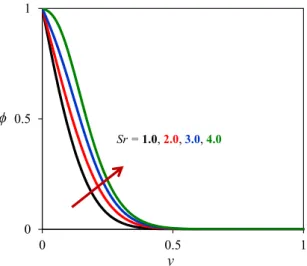
the conduction heat transfer to thermal radiation transfer. It is obvious that an increase in the thermal radiation parameter results in decreasing velocity and temperature within the boundary layer, as well as a decreased thickness of the velocity and temperature boundary layers. This is because the largeR -values correspond to an increased dominance of conduction over radiation thereby decreasing buoyancy force (thus, vertical velocity) and thickness of the thermal and momentum boundary layers. In both the cases (1) and (2), the influence of Dufour number (Dr) for different values on velocity and temperature profiles are plotted inFigs. 12and13respectively. The Dufour number signifies the contribution of the concen-tration gradients to the thermal energy flux in the flow. It is found that an increase in the Dufour number causes a rise in the velocity and temperature throughout the boundary layer as the temperature profiles decay smoothly from the plate to the free stream value. However, a distinct velocity overshoot exists near the plate, and thereafter the profile falls to zero at the edge of the boundary layer.Figs. 14and15depict the velocity and concentration profiles for different values of the Soret number
0 0.5 1 0 0.5 1 y Sc = 0.22, 0.30, 0.60, 0.66 φ
Fig. 9. Concentration profiles for different values ofSc.
0 1 2 0 0.5 1 u y Dr = 1.0, 2.0, 3.0, 4.0
Impulsive Movement of the plate (Case - I: at n = 0.0) Uniformly accelerated movement of the plate (Case - II: at n = 1.0)
Fig. 12. Velocity profiles for different values ofDr. 0 1 2 0 0.5 1 u y R = 1.0, 2.0, 3.0, 4.0
Impulsive Movement of the plate (Case (1): at n = 0.0) Uniformly accelerated movement of the plate (Case (2): at n = 1.0)
Fig. 10. Velocity profiles for different values ofR.
0 0.5 1 0 0.5 1 θ y R = 1.0, 2.0, 3.0, 4.0
(Sr) in both the cases (1) and (2). The Soret number defines the effect of the temperature gradients inducing significant mass diffusion effects. It is noticed that an increase in the Soret number results in an increase in the velocity and concentration within the boundary layer.
Table 3 shows variation of Skin-friction with the effects of Prandtl number, Magnetic parameter, Thermal radiation para-meter, time, Dufour number and Soret number in case of Impulsive movement of the plate. From this table, it is observed that the skin-friction decreases with increasing of magnetic parameter, Prandtl number and radiation parameter and time while decrease with increasing of Dufour and Soret numbers.
Table 4 shows the effects of Prandtl number, Magnetic parameter, Thermal radiation parameter, time, Accelerating parameter, Dufour number and Soret number in case of uniformly accelerated movement of the plate. From this table, it is observed that the skin-friction decreases with increasing of Prandtl number and Radiation parameter while increases with increasing of Magnetic parameter, time, Accelerating parameter, Dufour and Soret numbers.Table 5shows the effect of radiation parameter, Prandtl number, time and Dufour number on the
Nusselt number (the rate of heat transfer) at the moving and stationary plates. We see that the Nusselt number at the moving plate Nuo increases with increasing values of radiation para-meter and Prandtl number while decreases with increasing values of time and Dufour number. The Nusselt number at the stationary plateNu1 is decreasing with increasing values of Radiation parameter and Prandtl number while increasing with increasing values of time and Dufour number.Table 6 shows the effect of Schmidt number on the Sherwood number (the rate of mass transfer). From this table, we see that the Sherwood number is decreasing with increasing values of Schmidt number while increases with increasing of Soret number.
6. Conclusion
The present paper studies the effects of radiation, heat and mass transfer on an unsteady two-dimensional natural con-vective Couetteflow of a viscous, incompressible, electrically conducting fluid between two parallel plates with suction, embedded in a porous medium, under the influence of a uniform transverse magneticfield. The problem is described by a system of coupled linear partial differential equations, and is solved by the finite element method. A parametric study is performed to illustrate the influence of thermo physical parameters on the velocity, temperature and concentration profiles. It has been shown that:
1. In both cases thefluid velocity increases with increasing of Dr,Srand timetwhile decreases with increasing ofM, Pr.
0 0.5 1 0 0.5 1 y Sr = 1.0, 2.0, 3.0, 4.0 φ
Fig. 15. Concentration profiles for different values ofSr.
Table 6
Results of Sherwood Number.
Sc Sr Sh 0.22 0 1.205984 0.66 0 1.065442 0.22 1 1.424313 0.22 5 2.125932 0 1 2 0 0.5 1 u y Sr = 1.0, 2.0, 3.0, 4.0
Impulsive Movement of the plate (Case (1): at n = 0.0) Uniformly accelerated movement of the plate (Case (2): at n = 1.0)
Fig. 14. Velocity profiles for different values ofSr.
0 0.5 1 0 0.5 1 θ y Dr = 1.0, 2.0, 3.0, 4.0
2. The fluid temperature increases with increasing of Dr and timetwhile decreases with increasing of Pr and R. 3. The fluid concentration increases with increasing of Sr
while decreases with increasing ofSc.
4. The skin-friction decreases with increasing ofM, Pr andR and timet while decreases with increasing ofDrand Srin case of impulsive movement of the plate.
5. The skin-friction decreases with increasing of Pr and R while increases with increasing ofM, timet, F, DrandSrin case of uniform accelerated movement of the plate. 6. The rate of heat transferNuo at the moving plate increases with
increasing ofRand Pr while decreases with increasing values of timet andDr.
7. The rate of heat transfer at the stationary plate Nu1 is decreasing with increasing ofRand Pr while increases with increasing of timetand Dr.
8. The rate of mass transfer decreases with increasing of Sc while increases with increasing of Soret numberSr. 9. In order to ascertain the accuracy of the numerical results,
the present results are compared with the previous results of Rajput and Sahu[10]with the absence ofGc,Sc,SrandDr. They are found to be in an excellent agreement.
Acknowledgment
The authors thank the reviewers for their constructive suggestions and comments, which have improved the quality of the article considerably. Also, thefirst and second authors are thankful to Dr. K. Tejaswani, GITAM University for her valuable suggestions, continuous support and encouragement in the preparation of this manuscript.
References
[1]Singh AK. Natural convection in unsteady Couette motion.Def. Sci. J. 1988;38(1)35–41.
[2]Gorla RSR, Bartrand TA. Couetteflow heat loss model for the rotary combustion engine.J. Mech. Eng. Sci., Proc. Inst. Mech. Eng.1996;210: 587–96.
[3]Kearsley AJ. A steady state model of Couetteflow with viscous heating. Int. J. Eng. Tech. Res.1994;32:179–186.
[4]Umavathi JC, Chamkha AJ, Sridhar KSR. Generalized plain Couetteflow and heat transfer in a composite channel.Transp. Porous Media2010;85: 157–69.
[5] Rashidi MM, Freidoonimehr N, Momoniat E, Rostami B. Study of nonlinear MHD tribological squeeze film at generalized magnetic Reynolds numbers using DTM. PLoS ONE 2015;10(8) e0135004http://dx.doi.org/ 10.1371/journal.pone.0135004.
[6]Freidoonimehr Navid, Rashidi Mohammad Mehdi, Mahmud Shohel. Unsteady MHD free convection flow past a porous stretching vertical surface in a nano-fluid.Int. J. Therm. Sci.2015;87:136–45.
[7]Abolbashari Mohammad Hossein, Freidoonimehr Navid, Nazari Foad, Rashidi Mohammad Mehdi. Analytical modeling of entropy generation for Casson nano-fluidflow induced by a stretching surface.Adv. Powder Technol.2015;26(2)542–52.
[8]Rashidi MM, Mahmud S, Freidoonimehr N, Rostami B. Analysis of entropy generation in an MHD flow over a rotating porous disk with variable physical properties.Int. J. Exergy2015;16(4)481–503. [9]Gireesha BJ, Chamkha AJ, Vishalakshi CS, Bagewadi CS. Three
dimensional Couetteflow of a dustyfluid with heat transfer.Appl. Math. Model2012;36:683–701.
[10] Rajput US, Sahu PK. Natural convection in unsteady hydromagnetic Couette flow through a vertical channel in the presence of thermal radiation.Int. J. Appl. Math. Mech2012;8(3)35–56.
[11] Das S, Jana RN, Chamkha AJ. Entropy generation in a rotating Couette
flow with Suction/Injection.Commun. Numer. Anal.2015;1:62–81. [12] Das S, Jana RN, Chamkha AJ. Entropy generation due to unsteady
hydromagnetic Couetteflow and heat transfer with asymmetric convec-tive cooling in a rotating system.J. Math. Model2015;3:107–28. [13] Job Victor M, Gunakala Sreedhara Rao. Finite element analysis of
unsteady radiative MHD natural convection Couette flow between permeable plates with viscous and joule dissipation.Int. J. Pure Appl. Math.2015;99(2)123–43.
[14] Seth GS, Sharma Rohit, Kumbhakar B. Effects Of Hall current on unsteady MHD convective Couetteflow of heat absorbingfluid due to accelerated movement of one of the plates of the channel in a porous medium.J. Porous Media2016;19(1)13–30.
[15] Seth GS, Kumbhakar B, Sharma R. Unsteady hydromagnetic natural convection flow of a heat absorbing fluid within a rotating vertical channel in porous medium with Hall effects.J. Appl. Fluid Mech.2015;8
(4)767–79.
[16] Alam MS, Rahman MM. Dufour and Soret effects on mixed convection
flow past a vertical porous flat plate with variable suction. Nonlinear Anal.: Model Control2006;11(1)3–12.
[17] El-Arabawy Hassan AM. Soret and Dufour effects on natural convection
flow past a vertical surface in a porous medium with variable Surface temperature.J. Math. Stat.2009;5(3)190–8.
[18] Rashidi MM, Hayat T, Erfani E, Mohimanian Pour SA, Hendi Awatif A. Simultaneous effects of partial slip and thermal-diffusion and diffusion-thermo on steady MHD convectiveflow due to a rotating disk.Commun. Nonlinear Sci. Numer. Simul.2011;16(11)4303–17.
[19] Rashidi MM, Rastegari MT, Anwar Bég O. Homotopy analysis of Soret and Dufour effects on free convection non-Newtonianflow in a porous medium with thermal radiationflux.Int. J. Appl. Math. Mech.2013;9(2) 39–68.
[20] Rashidi MM, Hayat T, Erfani E, Mohimanian Pour SA, A-Hendi Awatif. Simultaneous effects of partial slip and thermal-diffusion and diffusion-thermo on steady MHD convectiveflow due to a rotating disk.Commun. Nonlinear Sci. Numer. Simul.2011;16:4303–17.
[21] Srinivasa Raju R, Sudhakar K, Rangamma M. The effects of thermal radiation and heat source on an unsteady MHD free convectionflow past an infinite vertical plate with thermal diffusion and diffusion thermo.J. Inst. Eng. (India): Ser. C2013;94(2)175–86.
[22] Chamkha AJ, EL-Kabeir SM. Unsteady heat and mass transfer by MHD mixed convectionflow over an impulsively stretched vertical surface with chemical reaction and Soret and Dufour effects.Chem. Eng. Commun. 2013;200:1220–36.
[23] El-Kabeir SMM, Chamkha AJ. Heat and mass transfer by mixed convection from a vertical slender cylinder with chemical reaction and Soret and Dufour effects.Heat Transf.-Asian Res.2013;42:618–29. [24] Al-Juma N, Chamkha AJ. Soret and Dufour effects on heat and mass
transfer by free convectiveflow of a micropolar fluid about a sphere embedded in porous media.Int. J. Energy Technol.2014;6(8)1–7. [25] Prakash Jagdish, Balamurugan Kuppareddy Subramanyam, Varma
Sibayala Vijayakumar. Thermo-diffusion and chemical reaction effects on MHD three dimensional free convective Couetteflow.Walailak J. Sci. Tech.2015;12(9)805–30.
[26] Sheikholeslami Mohsen, Ganji Davood Domiri, Javed M Younus, Ellahic R. Effect of thermal radiation on magnetohydrodynamics nanofluidflow and heat transfer by means of two phase model.J. Magn. Magn. Mater. 2015;374(15)36–43.
[27] Sheikholeslami Mohsen, Ganji Davood Domiri. Ferrohydrodynamic and magnetohydrodynamic effects on ferro-fluid flow and convective heat transfer.Energy2014;75:400–10.
[28] Sheikholeslami M, Rashidi MM, Ganji DD. Effect of non-uniform magnetic field on forced convection heat transfer of image-water nanofluid.Comput. Methods Appl. Mech. Eng.2015;294:299–312.
[29] Sheikholeslami M, Rashidi MM, Hayat T, Ganji DD. Free convection of magnetic nanofluid considering MFD viscosity effect. J. Mol. Liq. 2016;218:393–9.
[30] Sheikholeslami M, Hayat T, Alsaedi A. MHD free convection of Al2O3-water nanofluid considering thermal radiation: a numerical study.Int. J. Heat Mass Transf.2016;96:513–24.
[31] Sheikholeslami Mohsen, Vajravelu Kuppalapalle, Rashidi Mohammad Mehdi. Forced convection heat transfer in a semi annulus under the influence of a variable magneticfield.Int. J. Heat Mass Transf.2016;92: 339–48.
[32] Sheikholeslami M, Rashidi MM. Ferrofluid heat transfer treatment in the presence of variable magnetic field. Eur. Phys. J. 2015;130: 115,http://dx.doi.org/10.1140/epjp/i2015-15115-4.
[33] Sheikholeslami Mohsen, Ganji Davood Domiri, Rashidi Mohammad Mehdi. Ferro-fluidflow and heat transfer in a semi annulus enclosure in the presence of magnetic source considering thermal radiation.J. Taiwan Inst. Chem. Eng.2015;47:6–17.
[34] Kandelousi Mohsen Sheikholeslami. KKL correlation for simulation of nanofluidflow and heat transfer in a permeable channel.Phys. Lett. A 2014;387(45)3331–9.
[35] Sheikholeslami Mohsen, Abelman Shirley, Ganji Davood Domiri. Numerical simulation of MHD nanofluidflow and heat transfer consider-ing viscous dissipation.Int. J. Heat Mass Transf.2014;79:212–22. [36] Sheikholeslami M, Ashorynejad HR, Rana P. Lattice Boltzmann
simula-tion of nanofluid heat transfer enhancement and entropy generation.J. Mol. Liq.2016;214:86–95.
[37] Sheikholeslami M, Rashidi MM, Ganji DD. Numerical investigation of magnetic nanofluid forced convective heat transfer in existence of variable magneticfield using two phase model.J. Mol. Liq.2015;212: 117–26.
[38] Sheikholeslami M, Ellahi R. Three dimensional mesoscopic simulation of magneticfield effect on natural convection of nanofluid.Int. J. Heat Mass Transf.2015;89:799–808.
[39] Sheikholeslami Mohsen, Rashidi Mohammad Mehdi. Effect of space dependent magneticfield on free convection of Fe3O4-water nanofluid.J.
Taiwan Inst. Chem. Eng.2015;56:6–15.
[40] Sheikholeslami M, Abelman S. Two-phase simulation of nano-fluidflow and heat transfer in an annulus in the presence of an axial magneticfield. IEEE Trans. Nanotechnol.2015;14(3)561–9.
[41] Kandelousi Mohsen Sheikholeslami. Effect of spatially variable magnetic
field on ferro-fluidflow and heat transfer considering constant heatflux boundary condition.Eur. Phys. J.2014;129:248.
[42] Sivaiah S, Srinivasa Raju R. Finite element solution of heat and mass transferflow with Hall current heat source and viscous dissipation.Appl. Math. Mech.2013;34:559–70.
[43]Sheri Siva Reddy, Srinivasa Raju, Soret R. effect on unsteady MHD free convectiveflow past a semi-infinite vertical plate in the presence viscous dissipation.Int J Comput Methods Eng Sci Mech2015;16(2)132–41. [44]Anand Rao J, Sivaiah S, Srinivasa Raju R. Chemical reaction effects on
an unsteady MHD free convectionfluidflow past a semi-infinite vertical plate embedded in a porous medium with heat absorption.J. Appl. Fluid Mech.2012;5:63–70.
[45]Anand Rao J, Srinivasa Raju R, Sivaiah S. Finite element solution of heat and mass transfer in MHDflow of a viscousfluid past a vertical plate under oscillatory suction velocity.J. Appl. Fluid Mech.2012;5:1–10. [46]Anand Rao J, Srinivasa Raju R, Sivaiah S. Finite element solution of
MHD transientflow past an impulsively started infinite horizontal porous plate in a rotatingfluid with Hall current.J. Appl. Fluid Mech.2012;5: 105–12.
[47]Ramana Murthy MV, Srinivasa Raju R, Anand Rao J. Heat and mass transfer effects on MHD natural convectiveflow past an infinite vertical porous plate with thermal radiation and Hall current.Procedia Eng. J. 2015;127:1330–7.
[48]Rao VS, Babu LA, Raju RS. Finite element analysis of radiation and mass transferflow past semi-infinite moving vertical plate with viscous dissipation.J. Appl. Fluid Mech.2013;6:321–9.
[49]Sheri Siva Reddy, Srinivasa Raju R. Transient MHD free convectiveflow past an infinite vertical plate embedded in a porous medium with viscous dissipation.Meccanica2016;51(5)1057–68.
[50] Srinivasa Raju R. Combined influence of thermal diffusion and diffusion thermo on unsteady hydromagnetic free convectivefluid flow past an infinite vertical porous plate in presence of chemical reaction. J. Inst. Eng. (India): Ser. C2016,http://dx.doi.org/10.1007/s40032-016-0258-5. [51]Srinivasa Raju R, Mahesh Reddy B, Rashidi MM, Gorla RSR. Applica-tion offinite element method to unsteady MHD free convectionflow past a vertically inclined porous plate including thermal diffusion and diffusion thermo effects.J. Porous Media2016. In Press.
[52]Srinivasa Raju R, Jithender Reddy G, Anand Rao J, Rashidi MM, Reddy Gorla Rama Subba. Analytical and numerical study of unsteady MHD free convection flow over an exponentially moving vertical plate with heat absorption.Int. J. Therm. Sci.2016;107:303–15.
[53] Charanjiv Gupta, Sanjay Marwaha, Manpreet Singh Manna, Finite element method as an aid to machine design: a computational tool, in: Excerpt from the Proceedings of the COMSOL Conference, Bangalore, 2009.
[54]Bathe KJ.Finite Element Procedures. New Jersy: Prentice-Hall; 1996. [55]Reddy JN. An Introduction to the Finite Element Method. New York:
McGraw-Hill; 1985.
[56]Zienkiewicz OC.The Finite Element Method in Engineering Science, 2nd edn., New York: McGraw-Hill; 1971.