ISSN: 0884-1233 print/1540-7349 online DOI: 10.1080/08841233.2011.562119
HIV
/
AIDS Course Content in CSWE-Accredited
Social Work Programs: A Survey of Current
Curricular Practices
DIANA ROWAN and JEFFREY SHEARS
Department of Social Work, College of Health and Human Services, The University of North Carolina at Charlotte, North Carolina, USA
The authors surveyed program directors at all bachelor of social work and master of social work programs accredited by the Council on Social Work Education using an online tool that assessed whether and how their respective social work programs are covering content related to HIV/AIDS. Of the 650 program directors, 153 (24%) participated in the survey. Programs reported coverage of HIV/AIDS content in various foundation content areas, including human behavior in the social environment, populations at risk, and social work practice. The authors also surveyed use of various pedagogical methods, and respondents reported the most use of guest speakers, lectures, and readings in delivering HIV/AIDS content. More than 70% of bachelor and master of social work programs reported having at least 1 field placement specific to HIV/AIDS. In addition, the authors evaluated social work textbooks for specific content on social work with HIV/AIDS, and recommendations are made for inclusion of more HIV/AIDS specific content.
KEYWORDS HIV/AIDS content, CSWE-accredited program, ped-agogical method, HIV/AIDS textbook, 2008 competency-based Educational Policy and Accreditation Standards
INTRODUCTION
In 2006, the HIV/AIDS pandemic marked its 25th anniversary. To date, the Centers for Disease Control and Prevention has reported that in the United
Address correspondence to Diana Rowan, Department of Social Work, College of Health and Human Services, The University of North Carolina at Charlotte, Charlotte, NC 28223. E-mail: [email protected]
States 1.2 million people are infected with HIV, including more than 440,000 who have been diagnosed as having AIDS (Centers for Disease Control and Prevention, 2008). New estimates released in 2010 showed increases in both of these numbers, impressing on the profession of social work the reality that currently people who are living with HIV and AIDS are not a shrinking population, but are a group that needs our attention as an at-risk population. The current National Association of Social Workers policy statement on HIV and AIDS calls for advocacy for policy development and practice innovation in the areas of HIV prevention, testing, and in service delivery for work assisting people living with or affected by HIV/AIDS or who are at risk of contracting the virus (National Association of Social Workers, 2006).
In a preliminary review of the literature, there were few social work programs offering electives dedicated to social work practice with people living with HIV or AIDS. In contacting a few colleagues in social work education, it was discovered that their social work programs, which may have previously offered electives addressing HIV/AIDS, had dropped their HIV/AIDS electives years ago because of lack of interest or perceived need. The assumption was that HIV/AIDS content was supposed to be infused into their curricula instead. Their initial impressions created the impetus for the study presented in the article. The purpose of this study was to determine whether and how social work programs accredited by the Council on Social Work Education (CSWE) are covering HIV/AIDS content as it relates to social work in their curricula.
METHODOLOGY
The primary research questions which guided this descriptive study are “Do the Council on Social Work Education–accredited social work pro-grams teach HIV/AIDS–related coursework?” and if so, “How and in the context of what foundation content areas is HIV/AIDS–related coursework covered?”
We selected a mixed-method design to address the questions around how social work programs cover HIV/AIDS–related coursework. A survey was designed to evaluate curricular composition with respect to the 2001 Educational Policy and Accreditation Standards (EPAS) for bachelor of social work (BSW) and master of social work (MSW) programs. These standards require accredited programs to deliver social work curricula addressing eight foundation content areas, including diversity, populations-at-risk and social/economic justice, human behavior in the social environment, social welfare policy and services, social work practice, and field education (CSWE, 2001). In 2008, a new set of Educational Policy and Accreditation Standards was approved, constructed according to a competency-based educational model. The 2008 CSWE Educational Policy and Accreditation Standards used
an outcome performance approach to organize curricula around 10 core competencies. Reflected in these competencies are the eight foundation areas addressed in the 2001 Educational Policy and Accreditation Standards (CSWE, 2008). Because it is reasonable to expect that most of the accredited social work programs deliver their curricula designed around the 2001 stan-dards, the core foundation areas were referred to in the survey language, as presented later.
After we obtained institutional review board approval for research involving human subjects, we generated an online survey using Survey Share software. We compiled a list of e-mail addresses of program coordinators for all CSWE-accredited BSW and MSW social work programs, using data available on the CSWE Web site. We e-mailed all 650 accredited program coordinators an invitation to participate in the anonymous, brief, online sur-vey. After the initial invitation e-mail and two subsequent reminder e-mails, 153 of the 650 program coordinators (23.5%) responded to and completed the survey.
The online survey contained seven questions:
● Do you represent a BSW or MSW program?
● Does your program cover HIV/AIDS–related coursework?
● Approximately how many social work graduates does the program produce per year?
● How does your social work program cover HIV/AIDS content? (choices offered were social work elective course on HIV/AIDS, other social work elective course(s), non–social work elective course(s), social work practice courses, human behavior and social environment courses, social policy courses, course content tied to diversity, and course content tied to popu-lations at risk [using 2001 Educational Policy and Accreditation Standards foundation content areas])
● How do you cover HIV/AIDS–related coursework? (choices offered were lectures, assigned readings, guest speakers, class projects, and other)
● How many field placement sites specializing in HIV/AIDS–related issues do you offer to students?
● An open-ended question asking for any additional information or com-ments on how HIV/AIDS–related content is covered in the social work program was the final question.
RESULTS
Over the course of 30 days, program coordinators responded to and com-pleted the survey. Data from the 153 cases were cleaned and coded for descriptive and inferential analyses. 153 social work programs were repre-sented in the data; 109 BSW programs and 44 MSW programs. Only 2 of
0.0% 20.0% 40.0% 60.0% 1–15 Students 16–31 Students 32 and Above MSW (N=44) BSW (N=109) 30.3 19.5 27.3 26.8 42.4 53.7
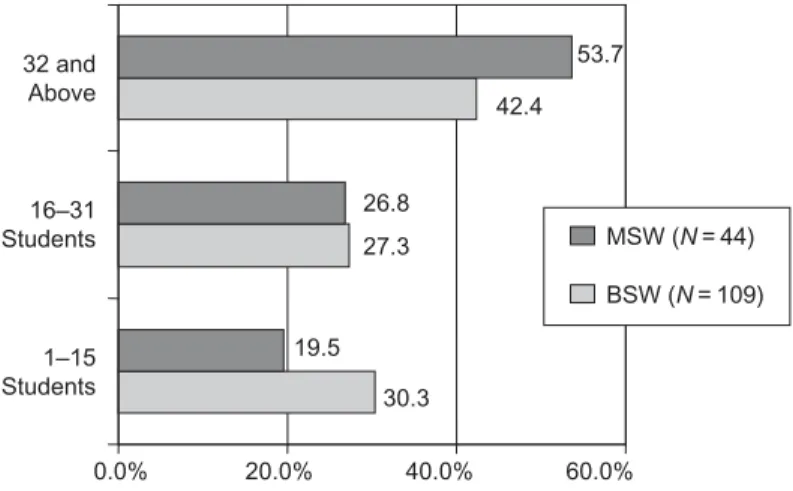
FIGURE 1 Size of Respondent Programs. Note. BSW=bachelor of social work; MSW=master of social work.
the 153 programs reported that they do not cover HIV/AIDS content in any manner.
As depicted in Figure 1, most responding programs had larger programs of more than 32 students graduating per academic year. For responding BSW programs, the range of students graduating per year was between 3 and 450 students (M = 56, SD = 75.88). For responding MSW programs, the range of graduates per year was 8 to 600 students (M =65,SD =96.41).
Figure 2 depicts the results of the question asking the program coordina-tors in what specific courses their programs cover HIV/AIDS–related content. 9.2% (n=10) of responding BSW programs offer an elective on HIV/AIDS; 34.1% (n = 15) of the responding MSW programs offered an AIDS elec-tive. Figure 2 shows that most programs report covering HIV/AIDS–related course content in the foundation areas of social work proactive, human behavior and social environment, social policy, diversity coursework, and content addressing populations-at-risk. Regarding BSW programs, 71.6% of the respondents cover HIV/AIDS content in the context of populations-at-risk. 61% of MSW programs responding cover HIV/AIDS in social work practice coursework. Both types of programs reported high percentages for coverage in Human Behavior and Social Environment courses.
The data relating to the pedagogical methods used to present the HIV/AIDS–related content in social work courses are presented in Figure 3. MSW and BSW programs reported the most reliance on use of assigned readings and lectures to present and teach the information they cover on HIV/AIDS and social work. More than half of MSW and BSW programs also reported reliance on use of guest speakers as well.
Programs were asked how many field placement sites specializing in HIV/AIDS–related issues they offer to students, and 70% of responding BSW
0.0% 20.0% 40.0% 60.0% 80.0% 100.0% SW HIV/AIDS Elective
Other SW Elective Non-SW Elective Social Work Practice Courses HBSE Courses Social Policy Courses Diversity-related Content Populations-at-Risk Content MSW (N=44) BSW (N=109) 71.6 75.2 56.8 56.9 52.3 51.4 45.5 47.7 9.2 34.1 20.2 38.6 9.2 6.8 63.3 61.4
FIGURE 2 Type of Course Covering HIV/AIDS Content.
Note. BSW=bachelor of social work; HBSE=human behavior and social environment; MSW=master of social work; SW=social work.
0.0% 20.0% 40.0% 60.0% 80.0% 100.0% Lectures Readings Guest Speakers Class Projects Other MSW (N=44) BSW (N=109) 22.7 84.4 81.8 74.3 86.4 54.1 38.5 20.2 65.9 43.2
FIGURE 3 Pedagogical Method Used to Teach HIV/AIDS Content. Note. BSW=bachelor of social work; MSW=master of social work.
programs and 75% of MSW programs reported having at least one field placement that specializes in HIV/AIDS care. BSW programs had an average of 1.6 HIV/AIDS placements, and MSW programs had an average of 6.5 HIV/AIDS placements. The data analysis showed that there is a significant correlation between program size and the number of HIV/AIDS placements offers (r = .43, p < .01). These data may imply that MSW programs offer more HIV/AIDS–related placements than BSW programs, but data analysis showed that when controlling for program size, there was no difference between BSW and MSW programs in the number of HIV/AIDS placements offered.
Qualitative Results
The final question on the online survey was open-ended and asked respon-dents for any additional information or comments on how HIV/AIDS content was covered in their programs’ curriculum. These responses were analyzed using the qualitative method of coding responses and examining them for representative themes. The following paragraphs present the results of this analysis, separating the themes into four categories: responses regarding classroom-related content; responses regarding program related content; responses regarding community related content; and critical commentary on how HIV/AIDS content is covered.
QUALITATIVE RESULTS RELATED TO CLASSROOM CONTENT
The following quotations are representative of open-ended responses received regarding how HIV/AIDS is covered in the classroom. Several rep-resentative comments imply that courses and faculty outside of social work are relied upon to deliver AIDS content, such as through public health or sociology courses. Other comments specify what AIDS content is actually covered, such as Ryan White legislation or HIV prevention. Others talk about coupling HIV/AIDS content with related topics such as health care, human sexuality, and drugs and the family. The most common themes identified are covering HIV/AIDS in the context of another course, tying HIV/AIDS to health-related content, and focusing on a specific HIV/AIDS–related topic.
● “(We) integrate HIV content in social work and health care elective”
● “We focus on HIV prevention”
● “All undergraduates take HIV/AIDS course offering through Public Health”
● “They get AIDS content in introductory sociology course”
● “AIDS is covered in an elective on Human Sexuality” ● “We cover Ryan White legislative policy”
● “Required course on Drugs, HIV/AIDS, and the Family”
QUALITATIVE RESULTS RELATED TO PROGRAM CONTENT
The following direct quotes are reflective of comments about how the struc-ture and composition of faculty of the social work programs themselves help to integrate HIV/AIDS–related issues into the curricula. Some reflec-tive comments appear encouraging with respect to substanreflec-tive ways that HIV/AIDS issues are infused into the students’ experience in the respective programs. Respondents reported, for example, faculty involved in research and publishing on HIV/AIDS, actively participating in advocacy and educa-tion groups, and offering students experiential domestic and internaeduca-tional trips where they interface with people living with HIV/AIDS. Other com-ments appear to offer weak examples of infusion of content, such as having a student who works in the field of HIV/AIDS. The most common themes were integration of HIV/AIDS into the program through research and highlighting faculty interface with HIV/AIDS–related issues.
● “We are doing research on HIV as it relates to Hispanic population”
● “Week-long senior trip that has contact with agency/ministry that works with HIV/AIDS issues”
● “[I] participated in [National Association of Social Workers] HIV Spectrum
Training program”
● “Students go on trips focusing on AIDS in Africa”
● “Faculty regularly publish articles on the topic”
● “One adjunct professor is a case manager for HIV/AIDS patients”
● “We have a student who is the director of a major AIDS service organization”
QUALITATIVE RESULTS RELATED TO THE COMMUNITY
We coded a number of comments as relating to how the community sup-ports the program in providing students with knowledge about working with HIV/AIDS clients. The responses varied in the nature and quality of the opportunities offered by the local community. For example, an instance of offering students an opportunity to work with high schoolers around HIV risk is likely an excellent educational opportunity to inform students about work with HIV/AIDS–related issues. However, the presence of a World AIDS Day event in the community is arguably not an adequate substitute for classroom coverage of HIV/AIDS. Representative direct quotations are as follows:
● “Students are exposed to fundraisers, AIDS Awareness Day activities”
● “Students work with . . . high school students on reducing risks of
HIV/AIDS and STDs [sexually transmitted diseases] through urban leadership”
Qualitative results that are critical of HIV/AIDS coverage. Three noteworthy comments were coded as being critical of the coverage of HIV/AIDS in that social work program:
● “I do believe we do an inadequate job of preparing our social workers to deal with AIDS–related issues”
● “Very rural community—The nearest placement site specializing in HIV/AIDS issues would be approximately 11/
2 hours away”
● “Would be nice if there was a decent social work HIV/AIDS text”
The first of the three comments above raises the issue that the survey asks program coordinators about the current state of how their curriculum covers HIV/AIDS–related content but does not ask them whether they feel the coverage is adequate or appropriate. This single respondent admitted dismay over how the program delivered content around this issue. The sec-ond critical comment above related to the potential for limitation in rural areas in finding quality AIDS service organizations to provide supervised field placements for students. The third comment raises the issue that there currently is no recent social work-specific HIV/AIDS text for use by pro-grams who offer HIV/AIDS electives or wish to supplement core texts with an HIV/AIDS and social work specific text. This comment led the researcher to examine popularly used social work texts, to see what information they provide with respect to HIV and AIDS.
TEXTBOOK ANALYSIS
Popular textbooks were grouped by content area and examined for content pertaining to HIV or AIDS. The list of text examined is not meant to be exhaustive, but illustrative. The results of this examination are as follows:
● Human behavior and social environment (micro perspective)
◦ Zastrow and Kirst-Ashman (2007)—ample content: people living with HIV/AIDS as a population-at-risk, lesbian and gay stereotypes
● Human behavior and social environment (macro perspective)
◦ Johnson and Rhodes (2005)—no content
◦ Long and Holle (2007)—Ryan White’s story
◦ Kirst-Ashman (2008)—no content
● Social work practice
◦ Hepworth, Rooney, Rooney, Strom-Gottfried, and Larsen (2006)—no content
◦ Sheafor and Horejsi (2006)—one paragraph related to serving gay population
◦ Boyle, Hull, Mather, Smith, and Farley (2009)—no content
● Social policy
◦ Karger and Stoesz (2008)—ample content: discrimination, healthcare costs, U.S. and worldwide statistics of pandemic, drug abuse, Housing Opportunities for Persons With AIDS, homelessness
◦ Popple and Leighninger (2008)—brief references: permanency planning, substance abuse
◦ DiNitto (2007)—brief references: war on drugs, health disparities, dis-ability benefits, and the text is dedicated to everyone who has known AIDS
A noteworthy observation is that the popular social work texts for practice courses surveyed contained no HIV/AIDS–related content, with the exception of a paragraph on serving the gay population, which may actually enforce the gay stereotype of the HIV positive community. With 63.3% of responding BSW programs and 61.4% of responding MSW programs indicat-ing that they cover HIV/AIDS issues in the context of social work practice coursework, one can question what tools the instructors are using to deliver the content. With social work practice texts not including interventions tar-geted at HIV prevention and case management and care for people living with HIV/AIDS, how might social work practice course instructors be raising and covering the issues?
One social policy text (Karger & Stoesz, 2008) and one human behavior and social environment text (Zastrow & Kirst-Ashman, 2007) provide what the researchers deemed ample content on the issues.
CONCLUSIONS
The results of this survey show that nearly all (98.6%) of the respondent CSWE-accredited social work programs report covering HIV/AIDS content in their coursework. Most of the coverage takes place in the context of courses addressing human behavior and social environment, social work practice, and populations-at-risk. Some programs, primarily MSW, offer elec-tives on HIV/AIDS and social work. Guest speakers, in addition to lectures and assigned readings, appear to be common pedagogical methods for teaching about HIV/AIDS and social work practice. Most responding pro-grams have at least one field placement specializing in HIV/AIDS issues and MSW programs offered an average of more than six placements offering HIV/AIDS–related social work experience.
The currently popular social work textbooks do not appear to pro-vide social work educators adequate tools for teaching about HIV/AIDS. Although more than 60% of BSW and MSW program coordinators reported teaching about HIV/AIDS in social work practice courses, the commonly
used texts do not include readings or case examples of AIDS–related social work practice. Although a few popular texts provide what the researchers deemed ample or adequate content, not all of the available choices in texts do provide information for students. Furthermore, if social work educators wish to supplement core area texts with a supplemental text focusing on HIV/AIDS and social work, there appears to be no current title available, leaving the educator to rely on finding quality current journal articles or other supplementary materials to use in class.
Areas for Further Exploration
This study is limited in that 153 of the 650 CSWE-accredited social work program coordinators elected to voluntarily participate in the on-line survey. Although we surveyed all CSWE-accredited social work program directors, only 23.5% of those program directors elected to participate in the study, after an initial e-mail contact and two reminders. Therefore, conclusions cannot be generalized to all programs, since those programs particularly geared toward or against coverage of HIV/AIDS content may have been more heavily represented. Further study might attempt to study differences, if any, between responding programs and nonresponding programs. Also, it could be that because program directors may not be intimately familiar with the content of the curriculum presented in every instructor’s classroom, their responses to the survey are not completely informed and accurate regarding whether and how HIV/AIDS content is presented.
Other studies could be done addressing what are the most effective pedagogical methods for teaching about HIV/AIDS and social work. For example, is the use of a guest speaker particularly effective at confronting stigma or sparking interest in work with the population of people living with HIV/AIDS? Further study could be conducted to examine how the needs of MSW students may differ from BSW students regarding exposure to HIV/AIDS issues. Are the needs of the two types of social work students different, and if so, how? How can those needs be best addressed in the classroom? Regarding urban versus rural programs, a study could be done to determine whether programs in certain localities experience more challenges in providing quality AIDS–related field placements. Last, further study could be conducted to help inform social work text authors about what types of readings or exercises would be helpful to include for classroom educators as they undertake the task of teaching students about service in social work with the at-risk and growing population of people living with HIV or AIDS.
Implications for Social Work Education
Many social work educators are covering HIV/AIDS–related social work coursework, at least to some degree, in their classrooms, field placements,
and within the context of their program structure. There appears to be a dearth of textbook resources for social work educators to use in delivering that content. Because the population numbers of those infected and affected by HIV and AIDS are on the increase, especially in minority populations, we need more curricular attention paid to the knowledge, values and skills necessary for social work interventions with this at-risk group. With the new 2008 competency-based CSWE Educational Policy and Accreditation Standards, it is likely that social work program textbooks will be undergoing revision to align with the new educational standards. Advocacy for inclusion of more explicit HIV/AIDS–related content in primary and supplemental textbooks for social work education is necessary and appropriate.
Suggested HIV/AIDS–related topics that could be integrated into social work coursework are subsequently presented. These examples are intended to help the reader understand in what specific ways HIV/AIDS–related issues pertain to and are important to social work practice. HIV/AIDS–related top-ics that can be integrated into social work coursework include, but are not limited to the following: HIV prevention and risk reduction approaches, helping clients understand safe/safer sex practices, the HIV/AIDS disease progression, the policies of nationally legislated and funded programs such as the Ryan White Programs, Housing Opportunities for Persons With AIDS, AIDS Drug Assistance Program, grief, loss, and bereavement issues as they relate to HIV/AIDS, psychosocial issues that accompany HIV/AIDS such as loneliness, isolation, stigma, lack of social and family supports, self-esteem and body image challenges, end of life issues including living wills and medical powers of attorney, advocacy for individual clients with HIV/AIDS and for macro-focused policy improvements, addressing ethical challenges such as disclosure of HIV-positive status, medical and community-based case management models for working with clients infected or affected by HIV/AIDS, the history of the pandemic, global implications of the pandemic, and effects on specialized populations and populations most at-risk of being affected by the virus.
A discussion about social work practice with people living with HIV/AIDS would be incomplete without an acknowledgement that the face of AIDS in the U.S. has changed since the inception of the pandemic. Once thought of as a gay White man’s disease, the demographics of HIV/AIDS have shifted significantly. In 1985, heterosexual transmissions of the disease accounted for only 3%, and in 2006 the rate was up to 32% (Centers for Disease Control and Prevention, 2008). The virus continues to have dispro-portionate effects on racial and ethnic minorities. In 2006, the AIDS case rate per 100,000 for Blacks was almost nine times that of Whites. Women repre-sent a growing share of new cases of AIDS, with diagnoses rising from only 8% in 1985 to 27% in 2006 (Centers for Disease Control and Prevention, 2008). Furthermore, men who have sex with men are at a significantly greater risk of infection. Despite the declines in HIV infection rates in men
who have sex with men since the early years, in 2006 they continued to account for 59% of AIDS cases in men (Kaiser Family Foundation, 2008). All of these minority groups are populations that are at risk for discrimina-tion and oppression. Social workers need more, not less, informadiscrimina-tion on all health disparities affecting the groups the profession serves most.
REFERENCES
Boyle, S., Hull, G., Mather, J. H., Smith, L. L., & Farley, O. W. (2009).Direct practice in social work(2nd ed.). Boston, MA: Pearson Allyn & Bacon.
Centers for Disease Control and Prevention. (2008). HIV/AIDS surveillance report, 18. Retrieved from http://www.cdc.gov/hiv/topics/surveillance/index.htm Council on Social Work Education (CSWE). (2001).Educational policy and
accredi-tation standards. Washington, DC: Author.
Council on Social Work Education (CSWE). (2008). Educational policy and accreditation standards. Retrieved from http://www.cswe.org/NR/rdonlyres/ 2A81732E-1776-4175-AC42-65974E96BE66/0/2008EducationalPolicyandAccredi tationStandards.pdf
DiNitto, D. (2007).Social welfare: Politics and public policy (6th ed.). Boston, MA: Pearson Allyn & Bacon.
Hepworth, D., Rooney, R., Rooney, G. D., Strom-Gottfried, K., & Larsen, J. (2006). Direct social work practice: Theory and skills(7th ed.). Belmont, CA: Thomson Brooks/Cole.
Johnson, M., & Rhodes, R. (2005).Human behavior and the larger social environ-ment: A new synthesis. Boston, MA: Pearson Allyn & Bacon.
Kaiser Family Foundation. (2008). HIV/AIDS policy fact sheet. Retrieved from http://www.kff.org
Karger, H. J., & Stoesz, D. (2008). American social welfare policy: A pluralist approach(5th ed.). Boston, MA: Pearson Allyn & Bacon.
Kirst-Ashman, K. (2008).Human behavior communities, organizations, and groups in the macro social environment: An empowerment approach. Belmont, CA: Thomson Brooks/Cole.
Long, D., & Holle, M. (2007). Macro systems in the social environment (2nd ed.). Belmont, CA: Thomson Brooks/Cole.
National Association of Social Workers. (2006). Social work speaks: NASW policy statements, 2006–2009. Washington, DC: Author.
Popple, P. R., & Leighninger, L. (2008). The policy-based profession: An introduc-tion to social welfare policy analysis for social workers (4th ed.). Boston, MA: Pearson Allyn & Bacon.
Sheafor, B. W., & Horejsi, C. R. (2006). Techniques and guidelines for social work practice(7th ed.). Boston, MA: Pearson Allyn & Bacon.
Zastrow, C., & Kirst-Ashman, K. A. (2007). Understanding human behavior in the social environment (7th ed.). Belmont, CA: Thomson Brooks/Cole.