UPCBLAS: A Numerical Library for
Unified Parallel C with
Architecture-Aware Optimizations
Jorge Gonz ´
alez Dom´ınguez
Department of Electronics and Systems
University of A Coru˜
na, Spain
Department of Electronics and Systems
University of A Coru˜
na, Spain
PhD Thesis
UPCBLAS: A Numerical Library
for Unified Parallel C with
Architecture-Aware Optimizations
Jorge Gonz´
alez Dom´ınguez
November 2012
PhD Advisors:
Mar´ıa Jos´e Mart´ın Santamar´ıa Juan Touri˜no Dom´ınguez
Dra. Mar´ıa Jos´e Mart´ın Santamar´ıa Profesora Titular de Universidad Dpto. de Electr´onica y Sistemas Universidad de A Coru˜na
Dr. Juan Touri˜no Dom´ınguez Catedr´atico de Universidad Dpto. de Electr´onica y Sistemas Universidad de A Coru˜na
CERTIFICAN
Que la memoria titulada “UPCBLAS: A Numerical Library for Unified Parallel C with Architecture-Aware Optimizations” ha sido realizada por D. Jorge Gonz´alez Dom´ınguez bajo nuestra direcci´on en el Departamento de Electr´onica y Sistemas de la Universidad de A Coru˜na y concluye la Tesis Doctoral que presenta para optar al grado de Doctor en Ingenier´ıa Inform´atica con la Menci´on de Doctor Internacional.
En A Coru˜na, a 19 de Noviembre de 2012
Fdo.: Mar´ıa Jos´e Mart´ın Santamar´ıa Directora de la Tesis Doctoral
Fdo.: Juan Touri˜no Dom´ınguez Director de la Tesis Doctoral
Fdo.: Jorge Gonz´alez Dom´ınguez Doctorando
Resumen de la Tesis
Introducci´
on
La necesidad de una potencia de c´omputo creciente por parte de aplicaciones de diversos campos de la ciencia y la ingenier´ıa, o incluso del ocio, ha sido la impul-sora de la evoluci´on del computador. La aproximaci´on tradicional para esta evolu-ci´on ha sido la mejora de tecnolog´ıas ya conocidas. Sin embargo, esta aproximaci´on est´a llegando a su l´ımite f´ısico. Una nueva era ha empezado, caracterizada por los procesadores multin´ucleo que habilitan la ejecuci´on de aplicaciones multihilo. La po-pularidad de los sistemas multin´ucleo ha hecho que la programaci´on paralela llegue a ser una tarea de vital importancia para explotar de forma efectiva el hardware y aumentar el rendimiento de las aplicaciones.
La programaci´on paralela se realiza tradicionalmente mediante la utilizaci´on de bibliotecas de paso de mensajes en memoria distribuida o de construcciones de pro-gramaci´on concurrente (barreras, sem´aforos ...) en memoria compartida. Hoy en d´ıa Message Passing Interface (MPI) y Open MultiProcessing (OpenMP) constituyen los est´andares de facto para la programaci´on en arquitecturas de memoria distri-buida y compartida, respectivamente. Recientemente ha surgido un nuevo modelo de programaci´on, el modelo Partitioned Global Address Space (PGAS), que pro-porciona importantes ventajas sobre los modelos tradicionales. En el modelo PGAS todos los hilos comparten un espacio de memoria como en el modelo de memoria compartida. Sin embargo, este espacio de memoria est´a l´ogicamente particionado entre los diferentes hilos como en el modelo de memoria distribuida. Los lengua-jes PGAS consiguen el equilibrio perfecto entre facilidad de uso y explotaci´on de la localidad de los datos. En los ´ultimos a˜nos el modelo PGAS ha estado ganando
vi
popularidad, siendo ejemplos representativos de este modelo los lenguajes Unified Parallel C (UPC), Titanium y Co-Array Fortran (CAF).
UPC es un lenguaje de programaci´on paralela que surge como una extensi´on a la especificaci´on est´andar del lenguaje C y que est´a ganando inter´es y popularidad dentro de la comunidad de High Performance Computing (HPC). UPC fue origi-nalmente dise˜nado para computadores paralelos de gran escala y entornos cl´uster. Sin embargo, su modelo de programaci´on PGAS lo convierte en una excelente op-ci´on para sistemas multin´ucleo, en los cuales la memoria principal es f´ısicamente compartida. Hoy en d´ıa existen compiladores de UPC disponibles para la mayor´ıa de los sistemas paralelos de los principales fabricantes, as´ı como investigaci´on ac-tiva en muchas universidades y centros de investigaci´on en supercomputaci´on. A trav´es de medidas experimentales exhaustivas desarrolladas en trabajos previos, se ha demostrado la viabilidad de UPC frente a otros paradigmas de programaci´on pa-ralela habituales. Adem´as, se ha demostrado tambi´en que los c´odigos UPC pueden conseguir buena escalabilidad en hasta cientos de miles de procesadores siempre que cuenten con el adecuado soporte por parte del compilador y del sistema runtime. Sin embargo, una barrera para una mayor aceptaci´on de UPC por parte de los usuarios es la carencia de bibliotecas de apoyo en este lenguaje para los desarrolladores de algoritmos y aplicaciones.
Las rutinas del conjunto Basic Linear Algebra Subprograms (BLAS) proporcio-nan bloques est´andar para realizar operaciones b´asicas con vectores y matrices. Son utilizadas por cient´ıficos e ingenieros para conseguir buenos rendimientos en arqui-tecturas monoprocesador. Las rutinas SparseBLAS son una versi´on reducida de las BLAS para matrices y vectores dispersos, los cuales introducen patrones de acceso irregulares. Las Parallel Basic Linear Algebra Subprograms (PBLAS) y las Parallel Sparse Basic Linear Algebra Subprograms (PSBLAS) son una implementaci´on de las BLAS y las SparseBLAS, respectivamente, para computaci´on paralela, las cuales han sido desarrolladas para facilitar a los usuarios la programaci´on en arquitecturas de memoria distribuida. Sin embargo, no existen versiones paralelas en UPC.
En la actualidad existe una creciente tendencia a desarrollar c´odigos que tengan en cuenta el sistema en el que est´an siendo ejecutados para realizar optimizaciones de forma autom´atica. Entre las diferentes arquitecturas paralelas, la optimizaci´on de aplicaciones en los clusters de sistemas multin´ucleo presenta un importante desaf´ıo
vii
ya que poseen una arquitectura de memoria h´ıbrida (distribuida/compartida) con latencias de comunicaciones no uniformes. Adem´as, accesos concurrentes a la misma cach´e o al mismo m´odulo de memoria desde distintos n´ucleos pueden conducir a una p´erdida de ancho de banda a memoria.
Esta Tesis Doctoral, “UPCBLAS: A Numerical Library for Unified Parallel C with Architecture-Aware Optimizations”, nace del intento de impulsar la utilizaci´on y expansi´on de los lenguajes PGAS (especialmente de UPC) aportando a los ac-tuales y futuros programadores una biblioteca de computaci´on num´erica paralela, UPCBLAS. La biblioteca contiene un subconjunto de rutinas BLAS (las m´as uti-lizadas por sus usuarios) con una interfaz basada en las caracter´ısticas de UPC y centrada en aumentar la programabilidad de este lenguaje, sin comprometer excesi-vamente por ello el rendimiento. Precisamente con el fin de mejorar el rendimiento de las rutinas num´ericas, esta Tesis Doctoral tambi´en ha llevado al desarrollo de Servet, una herramienta que detecta mediante benchmarks de forma autom´atica un conjunto de par´ametros hardware muy ´utiles para optimizar el rendimiento de los c´odigos paralelos. De hecho, las rutinas de UPCBLAS usar´an autom´aticamente la interfaz proporcionada por Servet para reducir sus tiempos de ejecuci´on. Por ´ ulti-mo, esta Tesis proporciona una evaluaci´on experimental detallada de la biblioteca, as´ı como ejemplos pr´acticos de su uso.
Metodolog´ıa de Trabajo
La metodolog´ıa de trabajo seguida en el desarrollo de la presente Tesis Doctoral ha consistido en:
Definir la lista de tareas a realizar durante la Tesis, teniendo en cuenta los trabajos previos y los recursos disponibles.
Determinar su secuencia u orden de ejecuci´on, ateni´endose a las restricciones que pudiesen existir y al orden m´as favorable.
Establecer su duraci´on y la oportunidad de su desarrollo en un momento de-terminado.
viii
Organizar las acciones o tareas por bloques de cierta entidad que definan etapas.
Definir, para cada etapa, las metas a alcanzar (u objetivos concretos a lograr en tiempo definido), sabiendo que en cada etapa puede haber una o varias metas.
Tareas
De este modo, la lista de tareas (Tn.m), agrupadas en bloques (Bn), desarrolla-das en la presente Tesis han sido:
B1 Estudio del estado del arte relacionado con bibliotecas num´ericas en UPC.
T1.1 B´usqueda de bibliotecas num´ericas desarrolladas con anterioridad para UPC. Se determina que no existen trabajos previos basados en el desa-rrollo de bibliotecas num´ericas en UPC o cualquier otro lenguaje PGAS.
T1.2 Estudio de otros trabajos previos relacionados con computaci´on num´ eri-ca paralela en UPC. Estos trabajos abareri-can principalmente productos de matrices y factorizaciones (LU, Cholesky...). Se recopilan una serie de t´ecnicas de programaci´on que mejoran el rendimiento de los c´odigos es-critos en este lenguaje para su posterior uso en la implementaci´on de la biblioteca.
T1.3 An´alisis de bibliotecas num´ericas paralelas que siguen otro paradigma de programaci´on y estudio de su posible adaptaci´on a los lenguajes PGAS.
B2 Dise˜no e implementaci´on de las rutinas densas.
T2.1 Selecci´on de las funciones a incluir en la parte de computaci´on densa de la biblioteca.
T2.2 Dise˜no de la interfaz de las rutinas y especificaci´on de un m´etodo l´ogico de nomenclatura de las funciones para facilitar su uso a los programadores.
T2.3 Desarrollo de los tipos de datos necesarios en las rutinas, tanto los enu-merados para reflejar distintas opciones del problema (distribuci´on por
ix
filas/columnas, matrices triangulares inferiores/superiores, etc.) como las estructuras para tratar con tipos de datos complejos.
T2.4 Implementaci´on de una primera versi´on de las rutinas num´ericas seleccio-nadas. Durante este proceso se hace especial hincapi´e en incluir t´ecnicas de optimizaci´on cuya eficiencia en c´odigos UPC est´a demostrada en el estado del arte.
T2.5 Confecci´on de un mecanismo de configuraci´on y compilaci´on que sea sen-cillo de utilizar por los usuarios.
T2.6 Testeo de que las rutinas num´ericas incluidas en la biblioteca proporcio-nan los resultados correctos.
B3 Evaluaci´on del rendimiento de la biblioteca y optimizaci´on.
T3.1 Implementaci´on de un conjunto de benchmarks que permitan conocer los speedups y eficiencias de las diferentes rutinas, tanto para escalado fuerte como d´ebil.
T3.2 Ejecuci´on de dichos benchmarks en el supercomputador Finis Terrae, del Centro de Supercomputaci´on de Galicia (CESGA).
T3.3 Estudio de los resultados obtenidos, prestando especial atenci´on a la de-tecci´on de aquellas partes del c´odigo que puedan ser optimizables me-diante un mejor conocimiento de la arquitectura.
T3.4 Desarrollo de Servet, un conjunto de microbenchmarks que obtienen una serie de par´ametros hardware interesantes para la optimizaci´on de pro-gramas paralelos. Esta herramienta debe proporcionar al menos las ca-racter´ısticas hardware que se determinaron en la tarea anterior como necesarias para optimizar las rutinas.
T3.5 Inclusi´on de t´ecnicas de optimizaci´on del rendimiento basadas en los par´ametros hardware proporcionados por Servet.
T3.6 Evaluaci´on de nuevo del rendimiento usando los mismos benchmarks en m´aquinas distintas, para comprobar que las optimizaciones implemen-tadas en la tarea anterior son v´alidas para diferentes arquitecturas y compiladores.
x
T4.1 Determinaci´on de un conjunto de c´odigos num´ericos que pueden imple-mentarse usando UPCBLAS.
T4.2 Implementaci´on de dichos c´odigos paralelos usando las rutinas de la bi-blioteca.
T4.3 An´alisis de la mejora de programabilidad y productividad obtenida gra-cias a UPCBLAS.
T4.4 Detecci´on y posterior inclusi´on de posibles mejoras en el dise˜no de la biblioteca de cara a aumentar la programabilidad.
T4.5 Desarrollo y ejecuci´on de benchmarks que muestren el rendimiento de los c´odigos paralelos implementados con el apoyo de la biblioteca.
B5 Desarrollo de las rutinas dispersas.
T5.1 Dise˜no de la interfaz de las rutinas dispersas, intentando reutilizar, cuan-do sea posible, elementos que han sicuan-do probacuan-dos ´utiles para computaci´on densa.
T5.2 Selecci´on de las rutinas a implementar y los formatos de almacenamiento para matrices dispersas a utilizar.
T5.3 Implementaci´on de dichas rutinas con dichos formatos. De nuevo, se in-tentan incluir las t´ecnicas de optimizaci´on de la parte densa (tareaT2.4)
T5.4 Comprobaci´on de que el resultado de las rutinas dispersas es el correcto mediante la ejecuci´on de tests.
T5.5 Uso de benchmarks para evaluar el rendimiento de las rutinas dispersas.
B6 Determinaci´on de las principales conclusiones y l´ıneas de trabajo futuras.
T6.1 Determinaci´on de las principales conclusiones.
T6.2 Evaluaci´on de las principales l´ıneas de investigaci´on abiertas a ra´ız del trabajo desarrollado.
T6.3 Redacci´on de la memoria final de la Tesis Doctoral.
El trabajo llevado a cabo en estas tareas ha sido recogido en la presente memoria. As´ı, las tareas del primer bloque han sido recogidas en el Cap´ıtulo 1. El segundo
xi
bloque constituye el Cap´ıtulo 2. Las tareas del tercer y cuarto bloque est´an conte-nidas en los Cap´ıtulos 3 y 4. El quinto bloque constituye el Cap´ıtulo 5. Finalmente, el sexto bloque est´a incluido dentro del ´ultimo cap´ıtulo de conclusiones y trabajo futuro.
Metas
Asimismo, la lista de metas (Mn.m) asociadas con cada bloque (Bn) de la Tesis Doctoral han sido:
B1 Estudio del estado del arte relacionado con bibliotecas num´ericas en UPC.
M1.1 Evaluaci´on del estado actual de los trabajos relacionados con compu-taci´on num´erica paralela para lenguajes PGAS.
M1.2 Obtenci´on de aquellas ideas de dise˜no e implementaci´on que puedan ser ´
utiles para el desarrollo de la biblioteca num´erica en UPC.
B2 Dise˜no e implementaci´on de las rutinas densas.
M2.1 Conjunto de rutinas para computaci´on densa que exploten las ventajas del paradigma de programaci´on PGAS en general y de UPC en particular. Esta primera implementaci´on debe estar focalizada en la mejora de la programabilidad y la productividad de los potenciales usuarios.
B3 Evaluaci´on del rendimiento de la biblioteca y optimizaci´on.
M3.1 Herramienta que permita obtener de forma autom´atica ciertos par´ametros hardware v´alidos para optimizar c´odigos paralelos. Esta herramienta debe proporcionar al menos aquellos par´ametros necesarios para optimizar el rendimiento de las rutinas implementadas para M2.1.
M3.2 Mismo conjunto de rutinas que en M2.1 optimizado haciendo uso del conocimiento de las caracter´ısticas hardware proporcionadas por la he-rramienta de M3.1.
M3.3 Conjunto de resultados experimentales para la evaluaci´on del redimiento de las rutinas de M3.2.
xii
B4 Estudio de la utilidad de la biblioteca en un entorno real.
M4.1 C´odigos num´ericos de m´as alto nivel que hagan uso por debajo de la biblioteca deM3.2.
M4.2 Evaluaci´on en t´erminos de aumento de rendimiento, programabilidad y productividad de la biblioteca en dichos c´odigos.
B5 Desarrollo de las rutinas dispersas.
M5.1 Conjunto de rutinas para computaci´on dispersa.
M5.2 Estudio de la adecuaci´on de distintos formatos de almacenamiento para matrices dispersas a la computaci´on num´erica en UPC.
B6 Determinaci´on de las principales conclusiones y l´ıneas de trabajo futuras.
M6.1 Memoria final de la Tesis Doctoral que recoge las principales conclusiones y l´ıneas futuras de investigaci´on.
Medios
Los medios necesarios para realizar esta Tesis Doctoral, siguiendo la metodolog´ıa de trabajo anteriormente descrita, han sido los siguientes:
Material de trabajo y financiaci´on econ´omica proporcionados fundamental-mente por el Grupo de Arquitectura de Computadores de la Universidad de A Coru˜na y el Ministerio de Educaci´on y Ciencia (beca FPU AP2008-01578). Adem´as, esta Tesis se ha financiado a trav´es de los siguientes proyectos de investigaci´on:
• De financiaci´on internacional a trav´es del proyecto “Improving UPC Usa-bility and Performance in Constellation Systems: Implementation/Exten-sion of UPC Libraries”, suscrito con Hewlett-Packard S.L. (HP).
• De financiaci´on estatal (Ministerio de Educaci´on y Ciencia y Ministerio de Ciencia e Innovaci´on) a trav´es de los proyectos TIN2007-67537-C03-02, TIN2010-16735 y TIN2010-12011-E.
xiii
Acceso a material bibliogr´afico, a trav´es de la biblioteca de la Universidad de A Coru˜na.
Acceso a clusters con m´ultiples procesadores/n´ucleos por nodo:
• Supercomputador Finis Terrae (CESGA, 2008-actualidad). 144 nodos con 16 n´ucleos de procesador Intel Itanium2 Montvale a 1.6 GHz in-terconectados mediante InfiniBand, adem´as de contar con un sistema Superdome de memoria compartida con 128 n´ucleos Itanium2 Montvale a 1.6 GHz y 1 TB de RAM.
• Cl´usterPlut´on(Universidad de A Coru˜na, 2009-actualidad). 16 nodos con 16 n´ucleos de procesador Intel Xeon Nehalem a 2.26 GHz interconectados mediante InfiniBand.
• Supercomputador Carver (NERSC, 2010-actualidad). 1120 nodos con 8 n´ucleos de procesador Intel Xeon Nehalem a 2.67 GHz interconectados mediante InfiniBand.
• Supercomputador Hopper (NERSC, 2011-actualidad). 6384 nodos AMD Magny-Cours con 24 n´ucleos a 2.1 GHz interconectados mediante Gemini, una red propietaria de Cray con una estructura de Toro 3D.
• Supercomputador HECToR (EPCC, 2011-actualidad). 2816 nodos con dos procesadores AMD Interlagos de 16 n´ucleos cada uno (32 n´ucleos por nodo) a 2.3 GHz interconectados tambi´en a trav´es de una red Gemini. Una ayuda para una estancia de investigaci´on de 13 semanas en 2011 en el Lawrence Berkeley National Laboratory (LBNL) en Berkeley, Estados Unidos, obtenida en concurrencia competitiva en una convocatoria del Ministerio de Educaci´on y Ciencia. Esta estancia permiti´o desarrollar el bloque de tareas
B4 as´ı como establecer una relaci´on de colaboraci´on con el grupo de trabajo de Berkeley UPC de la Profesora Katherine Yelick, el m´as importante del mundo dedicado a la investigaci´on en el ´ambito del lenguaje UPC. Esta relaci´on permitir´a, por un lado, la distribuci´on de la biblioteca objeto de esta Tesis junto con el compilador Berkeley UPC y, por otro lado, el desarrollo conjunto de trabajos de investigaci´on sobre computaci´on num´erica de altas prestaciones usando UPC.
xiv
Una ayuda para una estancia de investigaci´on de 9 semanas en 2012 en el Edinburgh Parallel Computing Center (EPCC) en Edimburgo, Reino Unido, obtenida mediante concurrencia competitiva en el programa HPC-Europa2. La realizaci´on de esta estancia permiti´o acceder al supercomputadorHECToR
y trabajar con los investigadores de dicho centro para obtener parte de los resultados experimentales de la tareaT.3.6.
Conclusiones
Esta Tesis Doctoral, “UPCBLAS: A Numerical Library for Unified Parallel C with Architecture-Aware Optimizations”, ha permitido el desarrollo de UPCBLAS, una biblioteca num´erica paralela para Unified Parallel C. UPC sigue el paradigma de programaci´on PGAS, el cual, comparado con el paradigma de paso de mensa-jes, permite aumentar la programabilidad sin hipotecar el rendimiento gracias a la explotaci´on de la localidad de datos. Los lenguajes PGAS son una alternativa muy interesante para la programaci´on de sistemas paralelos, especialmente para aquellos con una arquitectura de memoria h´ıbrida como los clusters de sistemas multin´ucleo. Sin embargo, la falta de bibliotecas limita la productividad de los programado-res de lenguajes PGAS. Por ejemplo, el an´alisis del estado del arte revel´o que no exist´ıa absolutamente ninguna biblioteca num´erica paralela para UPC. Por tanto, los programadores que necesitaban, por ejemplo, rutinas de las interfaces BLAS y SparseBLAS, deb´ıan utilizar bibliotecas basadas en el paradigma de paso de men-sajes. Se identific´o que el mayor problema de estas bibliotecas era su complejidad de uso, algo que puede solventarse explotando directamente las cualidades de los lenguajes PGAS en general y de UPC en particular. La biblioteca desarrollada en esta Tesis proporciona funciones para computaci´on num´erica densa y dispersa que, siguiendo el modelo de programaci´on PGAS, facilita considerablemente su uso con respecto a otras bibliotecas dise˜nadas para otros paradigmas de programaci´on.
Pero el objetivo de la biblioteca no consiste simplemente en facilitar la progra-maci´on a sus usuarios sino tambi´en en que obtengan un buen rendimiento. Para ello las rutinas incluyen ciertas t´ecnicas de optimizaci´on. Unas fueron identificadas mediante el estudio del estado del arte y otras fueron desarrolladas ad hoc bas´
ando-xv
se en los par´ametros hardware de la m´aquina donde se ejecutan las rutinas. Para poder implementar estas ´ultimas t´ecnicas se ha creado Servet, una herramienta que, por medio de benchmarks, permite obtener de forma autom´atica los par´ametros hardware necesarios.
El rendimiento de la biblioteca se ha evaluado exhaustivamente y se ha com-parado con otras bibliotecas num´ericas en dos supercomputadores completamente diferentes, no solo por su tama˜no y arquitectura, sino tambi´en por el compilador de UPC empleado. Los resultados experimentales demuestran que la facilidad de uso no implica necesariamente un rendimiento muy inferior al de las bibliotecas basadas en el paradigma de paso de mensajes.
Para concluir, conviene destacar que el uso de los mecanismos del lenguaje UPC para distribuir matrices conlleva un aumento de la programabilidad pero tambi´en limita los tipos de distribuciones que se pueden utilizar a una sola dimensi´on (por filas o por columnas) y con un tama˜no de distribuci´on fijo. Aunque esta biblioteca proporciona un buen rendimiento, probablemente ser´ıa posible mejorarlo mediante el uso de otro tipo de distribuciones con un tama˜no de bloque variable o distribu-ciones de datos 2D, 3D o 2.5D. Sin embargo, siempre habr´a que tener en cuenta que si nuevas extensiones del lenguaje UPC no incluyen estructuras que soporten este tipo de distribuciones, ser´an los propios desarrolladores de bibliotecas quienes deban implementar dichas estructuras con una sintaxis tal que no se aumente la complejidad de uso de dichas bibliotecas.
Principales Contribuciones
Las principales aportaciones de esta Tesis son:
La biblioteca num´erica paralela UPCBLAS [48, 49, 50, 51], que proporciona un subconjunto de rutinas BLAS con una interfaz que explota las caracter´ısti-cas del paradigma PGAS para proporcionar un buen rendimiento mejorando ostensiblemente la programabilidad con respecto a otras bibliotecas num´ericas. Servet, una herramienta que permite obtener de forma autom´atica mediante benchmarks una serie de par´ametros hardware muy ´utiles para optimizar
pro-xvi
gramas paralelos [52, 53], incluyendo una evaluaci´on de su impacto positivo a la hora de optimizar las rutinas num´ericas de UPCBLAS [51].
Un estudio del uso de UPCBLAS para facilitar el desarrollo de algoritmos num´ericos paralelos m´as complejos, haciendo ´enfasis en el rendimiento y la programabilidad [47].
La implementaci´on de un conjunto de rutinas SparseBLAS en UPC, estudiando su comportamiento de acuerdo al formato de almacenamiento de matrices dispersas utilizado [45, 46].
La evaluaci´on en UPC de nuevos y complejos algoritmos que combinan el solapamiento de comunicaci´on y computaci´on junto con la minimizaci´on de comunicaciones para el ´ambito de la computaci´on num´erica de forma que, en el futuro, puedan incorporarse en las rutinas de UPCBLAS [44].
Publications from the Thesis
Journal Papers (3)
J. Gonz´alez-Dom´ınguez, O. Garc´ıa-L´opez, G. L. Taboada, M. J. Mart´ın, and J. Touri˜no. Performance Evaluation of Sparse Matrix Products in UPC. The Journal of Supercomputing, 2012 (In press).
J. Gonz´alez-Dom´ınguez, M. J. Mart´ın, G. L. Taboada, J. Touri˜no, R. Doallo, D. A. Mall´on, and B. Wibecan. UPCBLAS: A Library for Parallel Matrix Computations in Unified Parallel C. Concurrency and Computation: Practice and Experience, 24(14):1645-1667, 2012
J. Gonz´alez-Dom´ınguez, G. L. Taboada, B. B. Fraguela, M. J. Mart´ın, and J. Touri˜no. Automatic Mapping of Parallel Applications on Multicore Architec-tures using the Servet Benchmark Suite. Computers and Electrical Engineer-ing, 32(2):258-269, 2012.
International Conferences (7)
E. Georganas, J. Gonz´alez-Dom´ınguez, E. Solomonik, Y. Zheng, J. Touri˜no, and K. Yelick. Communication Avoiding and Overlapping for Numerical Linear Algebra. In Proc. 24th ACM/IEEE Intl. Conf. for High Performance Computing, Networking, Storage and Analysis (SC’12), Salt Lake City, UT, USA, 2012.
J. Gonz´alez-Dom´ınguez, O. A. Marques, M. J. Mart´ın, G. L. Taboada, and J.
xviii
Touri˜no. Design and Performance Issues of Cholesky and LU Solvers using UPCBLAS. In Proc. 10th IEEE Intl. Symp. on Parallel and Distributed Processing with Applications (ISPA’12), Legan´es, Spain, 2012.
J. Gonz´alez-Dom´ınguez, M. J. Mart´ın, G. L. Taboada, J. Touri˜no, R. Doallo, D. A. Mall´on, and B. Wibecan. A Library for Parallel Numerical Computation in UPC. Poster in Proc. 23rd ACM/IEEE Intl. Conf. for High Performance Computing, Networking, Storage and Analysis (SC’11), Seattle, WA, USA, 2011.
J. Gonz´alez-Dom´ınguez, O. Garc´ıa-L´opez, G. L. Taboada, M. J. Mart´ın, and J. Touri˜no. SparseBLAS Products in UPC: An Evaluation of Storage Formats. In Proc. 11th Intl. Conf. on Computational and Mathematical Methods in Science and Engineering (CMMSE’11), Benidorm, Spain, 2011.
J. Gonz´alez-Dom´ınguez, M. J. Mart´ın, G. L. Taboada, and J. Touri˜no. Dense Triangular Solvers on Multicore Clusters using UPC. InProc. 11th Intl. Conf. on Computational Science (ICCS’11), Singapore, 2011.
J. Gonz´alez-Dom´ınguez, G. L. Taboada, B. B. Fraguela, M. J. Mart´ın, and J. Touri˜no. Servet: A Benchmark Suite for Autotuning on Multicore Clusters. In
Proc. 24th IEEE Intl. Parallel and Distributed Processing Symp. (IPDPS’10), Atlanta, GA, USA, 2010.
J. Gonz´alez-Dom´ınguez, M. J. Mart´ın, G. L. Taboada, J. Touri˜no, R. Doallo, and A. G´omez. A Parallel Numerical Library for UPC. In Proc. 15th Intl. European Conf. on Parallel and Distributed Computing (Euro-Par’09), Delft, The Netherlands, 2009.
National Conferences (2)
J. Gonz´alez-Dom´ınguez, G. L. Taboada, B. B. Fraguela, M. J. Mart´ın, and J. Touri˜no. Servet: Una Suite de Benchmarks para el Soporte del Autotun-ing en Clusters de Sistemas Multin´ucleo. In Actas de las XXI Jornadas de Paralelismo, Valencia, Spain, 2010.
xix
J. Gonz´alez-Dom´ınguez, M. J. Mart´ın, G. L. Taboada, J. Touri˜no, R. Doallo, and A. G´omez. Una Biblioteca Num´erica Paralela para UPC. In Actas de las XX Jornadas de Paralelismo, A Coru˜na, Spain, 2009.
Abstract
The popularity of Partitioned Global Address Space (PGAS) languages has in-creased during the last years thanks to their high programmability and performance through an efficient exploitation of data locality, especially on hierarchical archi-tectures like multicore clusters. This PhD Thesis describes UPCBLAS, a parallel library for numerical computation using the PGAS Unified Parallel C (UPC) lan-guage. The routines are built on top of sequential BLAS and SparseBLAS functions and exploit the particularities of the PGAS paradigm, taking into account data locality in order to achieve a good performance. However, the growing complex-ity in computer system hierarchies due to the increase in the number of cores per processor, levels of cache (some of them shared) and the number of processors per node, as well as the high-speed interconnects, demands the use of new optimiza-tion techniques and libraries that take advantage of their features. For this reason, this Thesis also presents Servet, a suite of benchmarks focused on detecting a set of parameters with high influence on the overall performance of multicore systems. UPCBLAS routines use the hardware parameters provided by Servet to implement optimization techniques that improve their performance. The performance of the library has been experimentally evaluated on several multicore supercomputers and compared to message-passing-based parallel numerical libraries, demonstrating good scalability and efficiency. UPCBLAS has also been used to develop more complex numerical codes in order to demonstrate that it is a good alternative to MPI-based libraries for increasing the productivity of numerical application developers.
A mis padres
A mi hermanita
Acknowledgments
This Thesis is not the result only of my own effort; there are many people involved in this work whose support and dedication I want to acknowledge. First and foremost, I want to acknowledge my PhD advisors Mar´ıa and Juan for the confidence they placed in me, and the support they gave me during all these years. I also want to thank Guillermo because he has been a support and reference for me since the beginning of this PhD Thesis. I cannot forget my other colleagues in the Computer Architecture Group because they made my experience in the lab easier during all these years, especially Sabela, Jose and Raquel.
I gratefully thank my parents, who have always been there for me. I also thank my sister Loreto, my girlfriend Mar´ıa and my friends Jorge, Jaime, Luc´ıa, Carlos, Vero, Bea, Kike, Pablo, Paula, Ra´ul and Dani, who have always believed even more than me in what I was doing, and whose support helped me to overcome the doubts that all PhD students have about if their effort is worthy. Besides, I thank my hockey coaches, teammates and pupils for helping me to entertain my mind out of the development of this Thesis and for understanding my mood swings.
I want to acknowledge Katherine Yelick and Michele Weiland for hosting me during my visits to the LBNL (Lawrence Berkeley National Laboratory) and EPCC (Edinburgh Parallel Computing Center), respectively. I thank Yili Zheng, Osni A. Marques, Evangelos Georganas and Catherine Inglis for their valuable help during those visits. I also thank Enrique Quintana-Ort´ı for all his comments to improve this Thesis and Tom´as Fern´andez Pena and Dami´an ´Alvarez Mall´on for their help in the development of UPCBLAS.
I gratefully thank CESGA (Galicia Supercomputing Center), NERSC (National Energy Research Scientific Computing Center) and EPCC for providing access to the Finis Terrae, Carver, Hopper and HECToR supercomputers.
Last, but not least, I am thankful to the following institutions for funding this work: the Computer Architecture Group and the Department of Electronics and
xxvi
Systems for the human and material support, the University of A Coru˜na for giving me the opportunity of starting a career in academia and for funding my attendance at some conferences, Hewlett Packard S.L. for the project “Improving UPC Usabil-ity and Performance in Constellation Systems: Implementation/Extension of UPC Libraries”, the Pan-European Research Infrastructure for High Performance Com-puting for a grant to make a research visit at EPCC, the Ministry of Education and Science and the former Ministry of Science and Innovation of Spain for the projects TIN2007-67537-C03-02, TIN2010-16735, TIN2010-12011-E and the FPU Grant AP2008-01578.
Que ser valiente no salga tan caro,
que ser cobarde no valga la pena
Contents
Preface 1
1. Background and State of the Art 5
1.1. PGAS Programming Model and Languages . . . 5 1.2. Overview of Unified Parallel C . . . 9 1.3. Parallel Numerical Computation in the Li- terature . . . 12
2. Dense UPCBLAS 15 2.1. UPCBLAS Design . . . 15 2.1.1. BLAS1 Routines . . . 17 2.1.2. BLAS2 Routines . . . 18 2.1.3. BLAS3 Routines . . . 25 2.2. UPCBLAS Implementation . . . 29
3. Servet: Measuring Hardware Parameters 33
3.1. Introduction to the Detection of Hardware Parameters . . . 34 3.2. Cache Size Estimate . . . 36 3.3. Determination of Shared Caches . . . 40 3.4. Memory Access Overhead Characterization . . . 42
xxx CONTENTS
3.5. Determination of Communication Costs . . . 43 3.6. Mapping of Parallel Applications on Multicore Architectures Using
Servet . . . 45 3.7. Use of Servet to Optimize UPCBLAS Routines . . . 49 3.7.1. Efficient Mapping of UPC Threads . . . 50 3.7.2. On-Demand Copies in BLAS3 Routines . . . 51
4. Experimental Evaluation 53
4.1. Experimental Testbeds . . . 54 4.2. Benchmarking of Isolated Routines . . . 55 4.2.1. BLAS1 Routines . . . 56 4.2.2. BLAS2 Routines . . . 59 4.2.3. BLAS3 Routines . . . 69 4.3. Benchmarking of UPCBLAS within More
Complex Routines . . . 78 4.3.1. Cholesky Solver . . . 79 4.3.2. LU Solver . . . 85
5. Sparse Numerical Routines in UPC 91
5.1. State of the Art . . . 91 5.2. Sparse Storage Formats . . . 92 5.3. Design of the UPC Sparse Routines . . . 94 5.3.1. Sparse BLAS1 Routines . . . 95 5.3.2. Sparse BLAS2 and BLAS3 Routines . . . 96 5.3.3. Limitations and Future Directions . . . 97
CONTENTS xxxi
5.4. Implementation of the Sparse Matrix Products . . . 98 5.5. Performance Evaluation of the Sparse Routines . . . 100
6. Conclusions and Future Work 105
References 109
A. UPCBLAS Interface 125
A.1. Enumerated Values . . . 125 A.2. BLAS1 Routines . . . 126 A.2.1. upc blas Tcopy . . . 126 A.2.2. upc blas Tswap . . . 128 A.2.3. upc blas Tscal . . . 129 A.2.4. upc blas Taxpy . . . 130 A.2.5. upc blas Tsdot . . . 131 A.2.6. upc blas Tnrm2 . . . 133 A.2.7. upc blas Tasum . . . 134 A.3. BLAS2 Routines . . . 135 A.3.1. upc blas Tgemv . . . 135 A.3.2. upc blas Tger . . . 139 A.3.3. upc blas Ttrsv . . . 143 A.4. BLAS3 Routines . . . 146 A.4.1. upc blas Tgemm . . . 146 A.4.2. upc blas Ttrsm . . . 150 A.4.3. upc blas Tsyrk . . . 155
xxxii CONTENTS
B. Servet Library Interface 159
B.1. Information about Cache Topology . . . 159 B.1.1. load cache info . . . 159 B.1.2. get cache nlevels . . . 160 B.1.3. get cache size . . . 161 B.1.4. get shared cache group size . . . 161 B.1.5. get shared cache cores . . . 162 B.1.6. release cache info . . . 163 B.2. Information about Shared Memory Overhead . . . 163 B.2.1. load mem over info . . . 163 B.2.2. get mem over nlevels . . . 164 B.2.3. get mem over mag . . . 164 B.2.4. get mem over group size . . . 165 B.2.5. get mem over cores . . . 166 B.2.6. get mem over group mag . . . 166 B.2.7. release mem over info . . . 167 B.3. Information about Communication Costs . . . 168 B.3.1. load comm info . . . 168 B.3.2. get comm intra node nlevels . . . 168 B.3.3. get comm intra node lat . . . 169 B.3.4. get comm inter node lat . . . 169 B.3.5. get comm intra node group size . . . 170 B.3.6. get comm intra node cores . . . 171 B.3.7. get comm min msg size . . . 171
CONTENTS xxxiii
B.3.8. get comm max msg size . . . 172 B.3.9. get comm intra node band . . . 172 B.3.10. get comm inter node band . . . 173 B.3.11. release comm info . . . 174 B.4. Process Mapping . . . 174 B.4.1. get mapping policy . . . 174
List of Tables
2.1. UPCBLAS routines. All the functions follow the naming convention:
upc blas Tblasname, where “T” represents the data type (s=float; d=double; c=single precision complex; z=double precision complex) andblasnameis the name of the routine in the sequential BLAS library 17
3.1. Evolution of the weight values for all cores in 2 nodes of the x86 64 cluster when mapping 4 processes with SERVET MEM PRIOR . . . 48 3.2. Evolution of the weight values for all cores in 2 nodes of the x86 64
cluster when mapping 4 processes with SERVET COMM PRIOR . . . 48
4.1. Summary of the testbeds used for benchmarking . . . 55 4.2. Strong scaling execution times (in milliseconds) of the single precision
dot product (sdot) on Carver . . . 58 4.3. Strong scaling execution times (in milliseconds) of the single precision
dot product (sdot) on HECToR . . . 58 4.4. Strong scaling execution times (in milliseconds) of the single precision
matrix-vector product (sgemv) on Carver . . . 61 4.5. Strong scaling execution times (in milliseconds) of the single precision
matrix-vector product (sgemv) on HECToR . . . 61 4.6. Strong scaling execution times (in milliseconds) of the single precision
outer product (sger) on Carver . . . 65
xxxvi LIST OF TABLES
4.7. Strong scaling execution times (in milliseconds) of the single precision outer product (sger) on HECToR . . . 65 4.8. Strong scaling execution times (in milliseconds) of the single precision
BLAS2 triangular solver (strsv) on Carver . . . 68 4.9. Strong scaling execution times (in milliseconds) of the single precision
BLAS2 triangular solver (strsv) on HECToR . . . 68 4.10. Strong scaling execution times (in seconds) of the single precision
matrix-matrix product (sgemm) on Carver . . . 73 4.11. Strong scaling execution times (in seconds) of the single precision
matrix-matrix product (sgemm) on HECToR . . . 73 4.12. Strong scaling execution times (in seconds) of the single precision
BLAS3 triangular solver (strsm) on Carver . . . 77 4.13. Strong scaling execution times (in seconds) of the single precision
BLAS3 triangular solver (strsm) on HECToR . . . 77 4.14. Weak scaling execution times (in seconds) of the double precision
Cholesky solver on Carver . . . 83 4.15. Weak scaling execution times (in seconds) of the double precision LU
solver on Carver . . . 87 4.16. Weak scaling execution times (in seconds) of the double precision LU
solver with partial pivoting on Carver . . . 89
List of Figures
1.1. Memory model in PGAS languages . . . 7 1.2. Memory model in UPC . . . 10
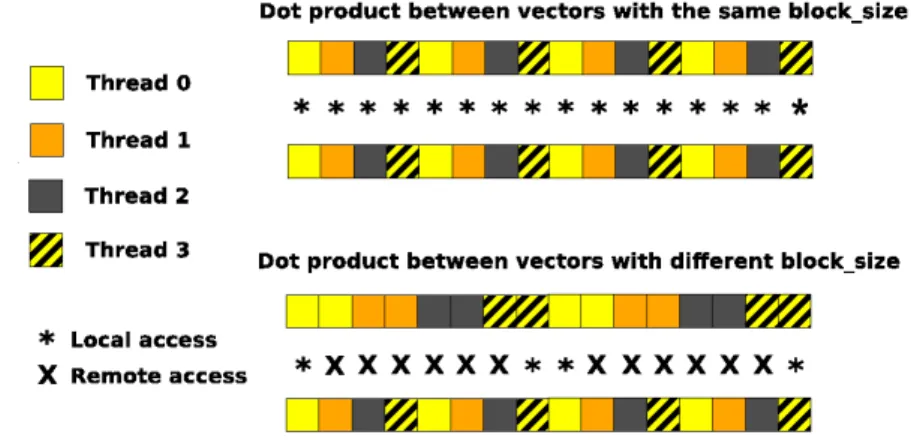
2.1. Remote and local accesses in upc blas sdot according to the block factor of the source vectors . . . 19 2.2. Meaning of the parameters ofupc blas sdotwhen working with
sub-vectors . . . 19 2.3. Meaning of the parameters of upc blas sgemv when working with a
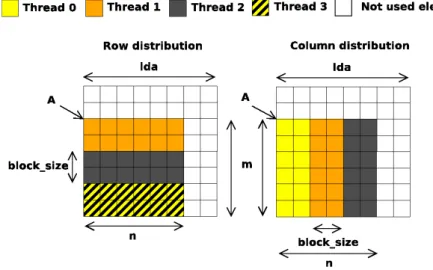
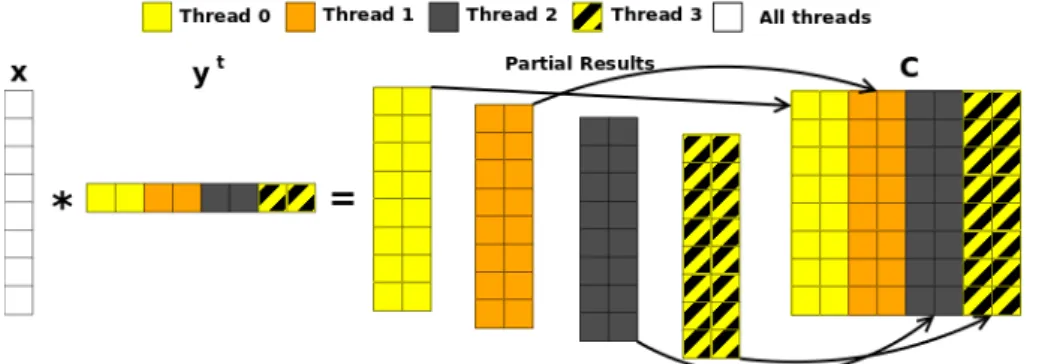
submatrix . . . 20 2.4. Matrix-vector product (Tgemv) using a row distribution for the matrix 22 2.5. Matrix-vector product (Tgemv) using a column distribution for the
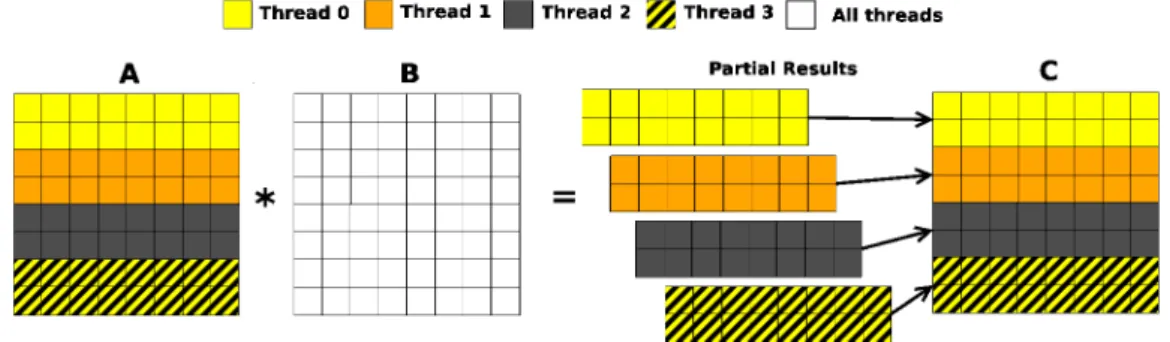
matrix . . . 22 2.6. Outer product (Tger) using a row distribution for the matrix . . . 24 2.7. Outer product (Tger) using a column distribution for the matrix . . . 24 2.8. Matrix distribution for the parallel BLAS2 triangular solver (Ttrsv) . 25 2.9. Matrix-matrix product (Tgemm) using a row distribution for matrixC 27 2.10. Matrix-matrix product (Tgemm) using a column distribution for
ma-trix C . . . 27 2.11. BLAS3 triangular solver (Ttrsm) using a column distribution . . . 29
xxxviii LIST OF FIGURES
3.1. mcalibrator results . . . 38 3.2. Architecture of 2 nodes of the x86 64 cluster . . . 47 3.3. Impact of the Servet mapping policy on NPB performance on the
x86 64 cluster . . . 50 3.4. Example of the information provided by Servet about the
commu-nication bandwidth as a function of the message size on the Carver supercomputer . . . 52
4.1. Strong scaling speedups of the single precision dot product (sdot) . . 57 4.2. Strong scaling speedups of the single precision matrix-vector product
(sgemv) . . . 60 4.3. Weak scaling speedups of the single precision matrix-vector product
(sgemv) . . . 63 4.4. Strong scaling speedups of the single precision outer product (sger) . 64 4.5. Weak scaling speedups of the single precision outer product (sger) . . 66 4.6. Strong scaling speedups of the single precision BLAS2 triangular
solver (strsv) . . . 67 4.7. Weak scaling speedups of the single precision BLAS2 triangular solver
(strsv) . . . 70 4.8. Strong scaling speedups of the single precision matrix-matrix product
(sgemm) . . . 72 4.9. Weak scaling speedups of the single precision matrix-matrix product
(sgemm) . . . 75 4.10. Strong scaling speedups of the single precision BLAS3 triangular
solver (strsm) . . . 76 4.11. Weak scaling speedups of the single precision BLAS3 triangular solver
LIST OF FIGURES xxxix
4.12. Example of input matrix distributed by rows in a block-cyclic way . . 80 4.13. Weak scaling speedups of the double precision Cholesky solver on
Carver . . . 83 4.14. Weak scaling speedups of the double precision LU solver with and
without partial pivoting on Carver . . . 88
5.1. Accesses in the sparse dot product depending on the arrays that are shared . . . 95 5.2. Distribution by rows of the sparse matrix-vector product (COO, CSR,
BSR and SKY with lower triangular matrices) . . . 99 5.3. Distribution by columns of the sparse matrix-vector product (CSC
and SKY with upper triangular matrices) . . . 99 5.4. Distribution by diagonals of the sparse matrix-vector product (DIA) . 99 5.5. Distribution by rows of the sparse matrix-matrix product (COO,
CSR, BSR and SKY with lower triangular matrices) . . . 101 5.6. Distribution by columns of the sparse matrix-matrix product (CSC,
DIA and SKY with upper triangular matrices) . . . 101 5.7. Speedups of the sparse matrix-vector and matrix-matrix products for
List of Algorithms
2.1. Algorithm for the BLAS2 triangular solver (Ttrsv) distributed by rows 25 2.2. Algorithm for the BLAS3 triangular solver (Ttrsm) distributed by rows 28 3.1. mcalibrator algorithm . . . 37 3.2. Probabilistic algorithm to determine the size of physically indexed
caches (L2, L3) based on mcalibrator outputs . . . 39 3.3. Algorithm to detect the cache levels and their sizes . . . 40 3.4. Algorithm to determine the shared caches . . . 41 3.5. Algorithm to characterize memory access overhead . . . 42 3.6. Algorithm to categorize communication costs . . . 44 3.7. Algorithm to provide the best process mapping . . . 46 4.1. Algorithm based on parallelgemm for the Cholesky solver . . . 81 4.2. Algorithm based on parallelsyrk for the Cholesky solver . . . 82 4.3. Algorithm for the LU solver without pivoting . . . 85 4.4. Algorithm for the LU solver with partial pivoting by columns . . . 86
Preface
The Partitioned Global Address Space (PGAS) programming model provides sig-nificant productivity advantages over traditional parallel programming paradigms. In the PGAS model all threads share a global address space, just as in the shared memory model. However, this space is logically partitioned among threads, just as in the distributed memory model. Thus, the data locality exploitation increases per-formance, whereas the shared memory space facilitates the development of parallel codes. As a consequence, the PGAS model has been gaining increasing attention. A number of PGAS languages are now ubiquitous, such as Titanium [109], Co-Array Fortran [22] and Unified Parallel C (UPC) [112].
UPC is an extension of ANSI C for parallel computing that follows the PGAS programming model and can potentially perform at similar levels to those of Mes-sage Passing Interface (MPI), scaling even up to thousands of processors with proper support from the compiler and the runtime system [37, 72]. In addition, the one-sided communications present in languages such as UPC have demonstrated they are able to obtain even better performance than the traditional two-sided commu-nications [5, 7, 79, 80, 95, 96].
Currently, there are commercial and open source UPC compilers, such as Berke-ley UPC [10], GCC UPC [43], Cray UPC or HP UPC [58], for nearly all parallel machines. However, a barrier to a more widespread adoption of UPC is the lack of parallel libraries for UPC developers.
The present PhD Thesis “UPCBLAS: A Numerical Library for Unified Parallel C with Architecture-Aware Optimizations” focuses on developing a parallel numer-ical library that exploits the advantages of the PGAS programming model and, in particular, the UPC language. The distribution of these kinds of libraries can help
2 Preface
to increase the acceptance of this paradigm by programmers of parallel numerical codes.
Currently, there is a trend towards developing codes that can automatically op-timize their performance depending on the machine on which they are executed. Related to this, many optimization techniques have been developed for parallel computing, most of them being focused on improving the communication algo-rithms [38, 39, 98, 108, 127] or using the best mapping policies when assigning processes/threads to cores [13, 14, 19, 57, 74]. There are even approaches to op-timize UPC programs according to the architecture of the system by using hybrid programming models [31, 117].
Among the different parallel architectures, clusters of multicores pose significant challenges, as they present a hybrid distributed and shared memory architecture with non-uniform communication latencies. Furthermore, because of the sharing of memory or even cache among cores, concurrent memory accesses using different threads or processes can decrease the overall memory access throughput.
In order to improve the performance of the UPCBLAS routines on these kinds of systems, this Thesis also tackles the development of Servet, a suite of benchmarks focused on detecting a set of parameters with high influence on the overall perfor-mance of multicore clusters. Servet is able to detect the cache hierarchy, including cache size and which caches are shared by each core, bandwidths and bottlenecks in memory accesses, as well as communication latencies among cores.
Besides performance, ease of use is a key factor in the adoption of the library by numerical application developers. For this reason programmability has been present in all the design decisions of the library.
Finally, all the lessons learned from the implementation of the dense routines were applied to the development of sparse counterparts.
The results of this research work have been published in: [44, 45, 46, 47, 48, 49, 50, 51, 52, 53] (references in Spanish not included). The Thesis is organized into six chapters and two appendices whose contents are summarized as follows:
Chapter 1, Background and State of the Art, is intended to give the reader a clear background about parallel numerical libraries and PGAS languages so
Preface 3
that the development of UPCBLAS can be completely understood. The chap-ter begins with an explanation of the characchap-teristics that all the languages that follow the PGAS programming model share, a presentation of some ex-amples of these kinds of languages and an exposition of their advantages and drawbacks. After that, it continues with a deeper explanation of the UPC language, including the memory model overview and some concepts necessary to understand the design, syntax and implementation of the UPCBLAS rou-tines. The chapter finishes with a revision of the previously available parallel numerical libraries in the state of the art.
Chapter 2,Dense UPCBLAS, presents all the stages of the development of UP-CBLAS: design of the syntax and interface, implementation of the routines and inclusion of optimization techniques. The advantages related to programma-bility and productivity are also enumerated throughout the chapter.
Chapter 3,Servet: Measuring Hardware Parameters, describes Servet, a bench-mark suite that detects some hardware parameters very useful to implement architecture-aware optimization techniques to be included in UPCBLAS. The chapter begins presenting some background that proves the suitability of these kinds of techniques to optimize routines such as the UPCBLAS ones. Then, the benchmarks that determine the cache topology, the memory access bot-tlenecks and the communication layers among cores are described. Finally, the chapter explains the optimization techniques included in the UPCBLAS library that use Servet.
Chapter 4,Experimental Evaluation, provides a performance evaluation of UP-CBLAS. After the description of the two experimental testbeds (the Carver and HECToR supercomputers), execution times and speedups of six represen-tative UPCBLAS routines are shown. Specifically, the dot, matrix-vector, outer and matrix-matrix products and the BLAS2 and BLAS3 triangular solvers. Furthermore, a comparison with MPI-based counterparts is also pro-vided. The chapter also proves the utility of the library to implement more complex numerical libraries by explaining the development of linear solvers of equations through Cholesky and LU factorizations using UPCBLAS routines. The chapter concludes with the evaluation of the performance of these codes on one of the presented testbeds.
4 Preface
Chapter 5, Sparse Numerical Routines in UPC, presents the implementation of the sparse dot, matrix-vector and matrix-matrix products in UPC. The goal of the chapter is to provide a first approach to implement sparse numerical codes using UPC, without sacrificing the productivity and programmability achieved in dense computation. The chapter discusses which aspects of the design and implementation of the dense routines included in UPCBLAS can be reused for sparse computation and which ones must be discarded because of the inherent irregular memory accesses to sparse vectors and matrices in these codes. The chapter also evaluates the suitability of six different sparse storage formats for UPC sparse numerical codes.
Chapter 6, Conclusions and Future Work, summarizes the main contributions of the Thesis and outlines the main research lines that can be derived from this work.
Appendix A, UPCBLAS Interface, shows the syntax of all the UPCBLAS routines, including a description of the parameters and some instructions about how to initialize the shared arrays before calling the routines.
Appendix B,Servet Library Interface, enumerates the routines included in the Servet API, describing their syntax and functionality.
Chapter 1
Background and State of the Art
This chapter presents the background necessary to understand the development of UPCBLAS. On the one hand, it explains the main characteristics of the PGAS programming model and, particularly, UPC. On the other hand, the state of the art related to parallel numerical computations is also analyzed. Although the study of the related literature exposed that there were no parallel numerical libraries for any PGAS language before this Thesis, some good conclusions were obtained from previous works that developed numerical libraries for other parallel programming models or isolated routines for UPC.
The structure of this chapter is as follows: Section 1.1 presents the main char-acteristics, advantages and drawbacks of the PGAS programming model. The most important features of UPC that were taken into account to develop UPCBLAS are described in Section 1.2. Finally, Section 1.3 analyzes several numerical libraries built for other parallel programming models, focusing on determining their strengths and weaknesses. This last section also presents some research works that deal with numerical routines using PGAS languages.
1.1.
PGAS Programming Model and Languages
There are two traditional programming models that have been used for years by parallel programmers. The most commonly used is the message-passing model,
6 Chapter 1. Background and State of the Art
whose de facto standard is the Message Passing Interface (MPI) [75]. This model was initially designed for distributed memory machines, where each process has its own memory not shared by other processes. Programmers must explicitly distribute the data and perform the communications among processes, which is tedious and error-prone and thus decreases programmability. Furthermore, other major criticism of the message-passing model is that both sides have to agree on when messages are being sent and received and thus, typically, all communications have to be known ahead of time. The main strengths of MPI are its flexibility and portability, being able to achieve very good performance in very different systems.
The second traditional parallel approach is the shared memory programming model, where all threads can access the whole memory. The best known API is OpenMP [104], which is much easier to use than message-passing libraries as data are not logically distributed and can be directly accessed by threads without explicitly indicating communications.
In an attempt to improve performance on current architectures that mix shared and distributed memory, several works are based on hybrid MPI+OpenMP codes [64, 89]. However, these hybrid parallel codes are very difficult to program and are not portable, as they are very architecture-dependent and they need some tuning to obtain good performance on different machines. These problems could be overcome with the OpenMP runtime presented in [67] that achieves good performance on clusters, but it has not been proven on large supercomputers yet.
Nowadays, the best approach to increase the programmability in current clusters and supercomputers without compromising performance and portability is the usage of the PGAS paradigm [123], a parallel programming model that combines the advantages of the two traditional ones described above. Figure 1.1 shows the memory model of the PGAS languages where there is a global shared address space exposed to the user which is logically divided among threads, so each thread is associated or presents affinity to a part of the shared memory. The PGAS languages explicitly expose the non-uniform nature of memory access times: operations on local data (i.e. the portion of the address space that a particular processor has affinity to) will be much faster than operations on remote data (i.e. any part of the shared address space that a processor does not have affinity to). The knowledge of the strengths of the PGAS languages has even led some researchers to try to include shared arrays
1.1 PGAS Programming Model and Languages 7
Figure 1.1: Memory model in PGAS languages
into MPI codes [30]. The main advantages of the PGAS programming model are:
The global shared address space facilitates the development of parallel codes, allowing all threads to directly read and write remote data and avoiding the error-prone data movements of the message-passing paradigm.
The accesses to shared memory also allow to develop efficient one-sided com-munications that can outperform the traditional two-sided ones, as a thread can directly read and write on remote memory without the explicit cooperation of the thread on the remote core [7, 24].
Compared to the shared memory paradigm, the performance of the codes can be increased by taking into account data affinity as typically the accesses to remote data will be much more expensive than the accesses to local data. The PGAS languages provide a programming model that can be used across the whole system instead of relying on two distinct programming models that must be melded together, as in the hybrid OpenMP+MPI solution. Thus the PGAS languages aim to deliver the same performance as hybrid approaches but using a uniform programming model.
There are several PGAS languages that are gaining attention apart from UPC, which is the most commonly used and will be further explained in Section 1.2:
Co-Array Fortran (CAF) [22]: It was created as a small set of extensions that, being based on a static collection of asynchronous process images, introduces coarrays to Fortran 95 in order to support the PGAS programming model.
8 Chapter 1. Background and State of the Art
It is included in the Fortran 2008 standard and during the last years several research works were focused on improving and extending it [73, 82, 92]. Its good implementation of the one-sided communications allows Co-Array For-tran to obtain similar or even better performance than MPI depending on the architecture [23, 24, 25, 63].
Titanium [109]: It is essentially a superset of Java 1.4 that provides a global memory space abstraction but maintaining all the expressiveness, usability and safety properties of that object oriented language. Current compilers translate Titanium programs entirely into C, where they are compiled to native binaries by a C compiler and then linked to the Titanium runtime libraries. Thus, no Java Virtual Machine is necessary. The main advantage of this language is its high programmability, as it inherits the programmability of Java [118, 119]. Besides, its performance is not far from MPI for the NAS Parallel Benchmarks [29].
Chapel (Cascade High Productivity Language) [102]: It is a parallel program-ming language developed by Cray as part of the Cray Cascade project, a participant in DARPA’s High Productivity Computing Systems (HPCS) [56]. Chapel was designed from scratch rather than by extending an existing lan-guage. It is an imperative block-structured language, designed to reduce the gap to learn parallel programming for users of sequential C, C++, Fortran, Java, Perl or Matlab [18]. Chapel specifies a locale type that enables users to choose the placement of data and tasks on a target architecture in order to optimize the code thanks to locality. Moreover, Chapel supports global-view data sets (called aggregates) with user-defined implementations, permitting operations on distributed data structures to be expressed in a natural man-ner. The main strength of Chapel is that it provides a spectrum of features at various levels so that code which is less performance-oriented can be written more easily. However, if additional performance is required for a section of code, programmers are able to rewrite it using low-level performance-oriented features until they are able to obtain their target performance, not only on clusters but also on GPUs [97].
X10 [122]: It is another parallel programming language related to the HPCS project, in this case built by IBM as part of the Productive, Easy-to-use,
1.2 Overview of Unified Parallel C 9
Reliable Computing System (PERCS) project. Each computation is divided among a set of places, each of which holds some data and hosts one or more
activities that operate on those data. One of its most interesting novelties is that X10 uses the concept of parent and child relationships for activities to prevent the lock stalemate that can occur when two or more processes wait for each other to finish before they can complete. It also provides a rich array sublanguage. The community of X10 users is quite active, taking advantage of its high programmability [76] and increasing its performance with novel optimizations [3, 91].
Fortress [87]: This is the third language that started being funded by the HPCS project. However, Sun was dropped from the HPCS project in 2006 and Fortress was transformed into an open-source project with an open-source community. Syntactically, it is similar to Scala or Haskell, emulating mathe-matical notation as closely as possible.
1.2.
Overview of Unified Parallel C
This section describes the most important features of the memory model in UPC as they were taken into account to design the interface of the library, determine the most appropriate data distributions among threads and implement the numerical routines. An overview of the different types of pointers present in the language and the mechanisms to access remote data are also included as their behavior is the basis for some of the optimization techniques included in UPCBLAS.
As mentioned previously, all PGAS languages, and thus UPC, expose a global shared address space to the user which is logically divided among threads, so each thread is associated or presents affinity to a part of the shared memory. Moreover, UPC also provides a private memory space per thread for local computations, as shown in Figure 1.2. Therefore, each thread has access to both its private memory and to the whole global space, even the parts that do not present affinity to it. This memory specification combines the advantages of both the shared and distributed programming models. On the one hand, the global shared memory space facilitates the development of parallel codes, allowing all threads to directly read and write
10 Chapter 1. Background and State of the Art
Figure 1.2: Memory model in UPC
remote data without explicitly notifying the owner. On the other hand, the perfor-mance of the codes can be increased by taking into account data affinity. Typically the accesses to remote data will be much more expensive than the accesses to local data (i.e. accesses to private memory and to shared memory with affinity to the thread).
Shared arrays are employed to implicitly distribute data among all threads, as shared arrays are spread across the threads. The syntax to declare a shared
ar-ray A is: shared [BLOCK FACTOR] type A[N], BLOCK FACTOR being the number of
consecutive elements with affinity to the same thread, type the datatype, and N
the array size. This means that the first BLOCK FACTOR elements are associated to thread 0, the next BLOCK FACTORto thread 1, and so on. Thus, the elementi in the array has affinity to the thread b i
BLOCK F ACT ORcmod(T HREADS), T HREADS
being the total number of threads in the UPC execution. There are two additional ways to declare certain shared arrays:
shared type A[N]specifies a cyclic distribution (BLOCK FACTOR = 1).
shared [] type A[N]declares an array with indefinite BLOCK FACTOR, which means that all the elements are stored in the shared memory with affinity to thread 0 (BLOCK FACTOR = N).
As an extension of the C language, UPC provides functionality to access memory through pointers. Due to the two types of memory available in the language, several types of pointers arise:
1.2 Overview of Unified Parallel C 11
Private pointers (from private to private). They are only available for the thread that stores them in its private memory and can reference addresses in the same private memory or in the part of the shared memory with affinity to the owner. Their syntax is the same of standard C pointers: type *p
Private pointers to shared memory (from private to shared). They are only available for the thread that stores them in its private memory, but can have access to any data in the shared space. They contain three fields in order to know their exact position in the shared space: the thread where the data is located, the block that contains the data and the phase (the location of the data within the block). Thus, when performing pointer arithmetic on a pointer-to-shared all three fields will be updated, making the operation slower than private pointer arithmetic. As in shared arrays, the BLOCK FACTOR can be specified: shared [BLOCK FACTOR] type *p
Shared pointers (from shared to shared). They are stored in shared memory (and therefore accessible by all threads) and they can access any data in the shared memory. Their complexity is similar to private pointers to shared memory. They are defined as: shared [BLOCK FACTOR] type *shared p
Shared pointers to private memory (from shared to private). They are stored in shared memory and point to the private space. However, their use is not advisable and they are not available in some compiler implementations.
The most intuitive way for one thread to access remote data is using pointers to shared memory. Nevertheless, UPC also provides functions to move blocks of data between two parts of the memory:
upc memget: One thread copies one block of data from shared memory (with or without affinity) to its private memory.
upc memput: One thread copies one block of data from its private memory to shared memory (with or without affinity).
upc memcpy: One thread copies one block of data from any shared memory
12 Chapter 1. Background and State of the Art
upc memset: Assigns the same value to all the elements of a block of data in shared memory.
The usage of these routines allows UPC programmers to aggregate remote data copies and thus obtain better performance than using several single data copies through pointers to shared. Some compilers also provide versions of these functions that perform asynchronous copies to overlap communication and computation [12]. The return of each of these functions only indicates that the copy has started and a subsequent synchronization on the completion of that operation is required before guaranteeing that all data were copied. Although these asynchronous copies are not included in the standard reference of the language, they are included in the most important UPC compilers (Berkeley UPC, Cray UPC, HP UPC).
1.3.
Parallel Numerical Computation in the
Li-terature
Numerical libraries have been used for decades in order to help programmers to develop their numerical codes easily and with high performance. UPCBLAS provides a relevant subset of the Basic Linear Algebra Subprograms (BLAS) routines [6, 33] implemented for UPC. The BLAS interface was first published in 1979 and it has become a standard as it is widely used by scientists and engineers. The interface was initially developed for Fortran but now there is also a C interface [11]. BLAS routines are divided into three levels:
BLAS 1 level: Scalar-vector and vector-vector operations. BLAS 2 level: Matrix-vector operations.
BLAS 3 level: Matrix-matrix operations.
Although BLAS initially focused on dense and banded operations, nowadays many applications use sparse vectors and matrices. Thus, currently the BLAS li-brary includes the SparseBLAS one [36, 99], which provides computational routines
1.3 Parallel Numerical Computation in the Li- terature 13
for unstructured sparse matrices, that is, matrices that do not present a particular sparsity pattern. Another well-known interface for numerical computation is the Linear Algebra Package (LAPACK) [69], that internally uses the BLAS library to implement more complex numerical routines such as linear solvers or matrix factor-izations. Many vendors have developed their own numerical libraries, such as Intel MKL [62], AMD ACML [2], Cray LibSci, IBM ESSL [103] or HP MLIB [59], that include, among others, their own implementations of the BLAS, SparseBLAS and LAPACK routines very optimized for their architectures. Furthermore, there are in the literature several numerical libraries with support for parallel dense matrix computations based on the message-passing model. Among them, PBLAS [21, 83], a subset of BLAS, and ScaLAPACK [105], a subset of LAPACK, are the most pop-ular. Based on them, Aliaga et al. [1] made an effort to parallelize the open source numerical library GSL [54].
The main drawback of the message-passing-based libraries is that they need an explicit data distribution that increases the effort required to use them. Users are forced to deal with specific structures defined in the library and to work in each process only with the part of the matrices and vectors stored in the local memory. Therefore, users must be aware of the appropriate local indices to use in each process, which increases the complexity of developing parallel codes [68]. In the literature there exist some proposals that try to ease the use of message-passing numerical libraries, such as PyScaLAPACK [34] and Elemental [86]. Following this trend, one of the goals of UPCBLAS is to increase programmability. The PGAS languages in general, and UPC in particular, offer productivity advantages compared to the message-passing model. In [16] the number of lines of code needed by the MPI and the UPC implementations of the NAS Parallel Benchmarks and other kernels are compared. Similar statistical studies with university students are presented in [84] and [101]. These works have demonstrated that the effort needed to solve the same problem is lower in UPC than in MPI. Furthermore, the global address space in UPC allows hiding the complex local index generation for matrices and vectors as well as data movement issues present in the message-passing approaches. The experimental evaluation of the UPCBLAS library will show that simplicity does not significantly impact performance.
14 Chapter 1. Background and State of the Art
Regarding other proposals of PGAS libraries, a parallel numerical library that combines the object-oriented-like features of Fortran 95 with the parallel syntax of Co-Array Fortran was presented in [81]. However, its object-oriented layer leads to use object maps, additional structures to work with distributed matrices and vectors similarly to the message-passing-based libraries, which increases the effort needed to parallelize sequential numerical algorithms. Travinin and Kepner [111] developed pMatlab, a parallel library built on top of MatlabMPI (a set of Matlab scripts that implement a subset of MPI). It works with matrices and vectors distributed by sim-ulating a pure PGAS scenario in order to take advantage of the ease of programming and a higher level of abstraction.
Focusing on numerical computations in UPC, Bell and Nishtala present in [8] a sparse triangular solver in UPC. In [61] Husbands and Yelick undertake the paral-lelization of the LU factorization. However, these works do not take advantage of the ease of use of the global shared memory in UPC as the matrices and vectors are initially distributed in the private memory of the threads, in the same way as in message-passing numerical libraries.
Chapter 2
Dense UPCBLAS
This chapter explains the whole development of the dense routines included in UPCBLAS. It is divided into two parts: Section 2.1 describes in detail all the decisions taken during the design of the different levels of UPCBLAS. It also includes some conclusions that summarize the programmability and productivity advantages of UPCBLAS compared to other parallel numerical routines. Section 2.2 enumerates several optimizations included within the routines to improve their performance.
2.1.
UPCBLAS Design
One of the main reasons to create a library is to facilitate the development of new codes for the target language. Thus, the design stage must be carried out carefully in order to provide functions with an interface easy to use by programmers.
Programmability has been an important factor in all the design decisions of the library. Specifically, UPCBLAS uses shared arrays to represent distributed matrices and vectors, which are implicitly partitioned among threads. Thus, the complex steps of declaring and distributing vectors and matrices required by the MPI-based libraries are avoided.
In general, programs that use parallel numerical libraries must carry out the following steps: 1) create the structures to represent the distributed vectors and matrices; 2) distribute the data of the vectors and matrices into these structures;