University of Cape Town
Dissertation presented for the degree of Master of
Science in Engineering
Gesture Recognition with
Application to Human-Robot
Interaction
Ra’eesah Mangera
February, 2015
University of Cape Town
Department of Electrical Engineering
Supervisors: A/Prof. F. Nicolls (UCT) and
The copyright of this thesis vests in the author. No
quotation from it or information derived from it is to be
published without full acknowledgement of the source.
The thesis is to be used for private study or
non-commercial research purposes only.
Published by the University of Cape Town (UCT) in terms
of the non-exclusive license granted to UCT by the author.
Declaration
I declare that this dissertation and the work presented in it are my own work. I confirm that:
1. This work was done mainly while registered for a MSc at the University of Cape Town.
2. I have not previously, in its entirety or in part, submitted this dissertation for obtaining any qualification.
3. Where I have consulted the published works of others, this is always clearly attributed.
4. I have acknowledged all main sources of help. 5. Parts of this work has been published as:
a) R. Mangera, “Static Gesture Recognition using Features Extracted from Skeletal Data”, Proceedings of the Twenty-Fourth Annual Symposium of the Pattern Recognition Association of South Africa, Aukland Park, South Africa, 2013.
b) R. Mangera, F. Senekal, and F. Nicolls, “Cascading Neural Networks for Upper-body Gesture Recognition”, International Conference on Machine Vision and Machine Learning (MVML), Prague, Czech Republic, 2014.
Signature
Abstract
Gestures are a natural form of communication, often transcending language barriers. Recently, much research has been focused on achieving natural human-machine in-teraction using gestures. This dissertation presents the design of a gestural interface that can be used to control a robot. The system consists of two modes: far-mode and near-mode. In far-mode interaction, upper-body gestures are used to control the motion of a robot. Near-mode interaction uses static hand poses to control a graphical user interface. For upper-body gesture recognition, features are extrac-ted from skeletal data. The extracextrac-ted features consist of joint angles and relative joint positions and are extracted for each frame of the gesture sequence. A novel key-frame selection algorithm is used to align the gesture sequences temporally. A neural network and hidden Markov model are then used to classify the gestures. The framework was tested on three different datasets, the CMU Military dataset of 3 users, 15 gestures and 10 repetitions per gesture, the VisApp2013 dataset with 28 users, 8 gestures and 1 repetition/gesture and a recorded dataset of 15 users, 10 gestures and 3 repetitions per gesture. The system is shown to achieve a recognition rate of 100%across the three different datasets, using the key-frame selection and a neural network for gesture identification. Static hand-gesture recognition is achieved by first retrieving the 24-DOF hand model. The hand is segmented from the image using both depth and colour information. A novel calibration method is then used to automatically obtain the anthropometric measurements of the user’s hand. The k-curvature algorithm, depth-based and parallel border-based methods are used to detect fingertips in the image. An average detection accuracy of 88% is achieved. A neural network and k-means classifier are then used to classify the static hand gestures. The framework was tested on a dataset of 15 users, 12 gestures and 3 repetitions per gesture. A correct classification rate of 75% is achieved using the neural network. It is shown that the proposed system is robust to changes in skin colour and user hand size.
Acknowledgements
First and foremost, all praise is due to Allah, the most merciful, the most gracious. I would like to thank my supervisors Dr Fred Nicolls and Fred Senekal for their guidance, advice and encouragement throughout my MSc studies. I have benefited immensely from their knowledge. Special thanks to Benjamin Rosman for helping with the editing, I really appreciated your discerning eye.
My deepest gratitude to my parents and sister for their unwavering support, motiv-ation and encouragement.
I would also like to thank my colleagues at MIAS and everyone else who volunteered and allowed me to record them for my data set.
Contents
Declaration i Abstract iii Acknowledgments v 1. Introduction 1 1.1. Gestures . . . 1 1.2. Gesture Recognition . . . 2 1.3. Human-Robot Interaction . . . 4 1.4. System Overview . . . 41.5. Contribution of this Dissertation . . . 6
1.6. Dissertation Overview . . . 7
1.7. Summary . . . 8
2. Literature Review 9 2.1. Sensors used for Gestural Interfaces . . . 9
2.1.1. Vision-based Sensors . . . 10
2.2. Gesture Recognition Methodology . . . 11
2.2.1. Feature Extraction . . . 11
2.2.2. Gesture Classification . . . 12
2.3. Gesture Recognition for Human-Robot Interaction . . . 12
2.3.1. Hand Gesture Recognition . . . 13
2.3.2. Body Gesture Recognition . . . 14
2.3.3. Discussion . . . 15
3. Data Acquisition 17 3.1. Publicly Available Datasets . . . 17
3.1.1. Dynamic Gesture Sets . . . 17
3.1.2. Hand Gesture Datasets . . . 19
3.2. Recorded Dataset . . . 19
3.2.1. Gesture Lexicon . . . 20
3.2.2. Recording . . . 22
4. Hand Gesture Feature Extraction 23 4.1. Hand Segmentation . . . 24
4.1.2. Forearm Separation . . . 26
4.1.3. Results . . . 27
4.2. High Level Feature Extraction . . . 31
4.2.1. Hand Model . . . 32 4.2.2. Fingertip Detection . . . 35 4.2.3. Hand Calibration . . . 38 4.2.4. Joint Angles . . . 39 4.2.5. Results . . . 41 4.3. Summary . . . 44
5. Body Gesture Feature Extraction 47 5.1. Data Collection . . . 47
5.2. Joint Angles . . . 48
5.2.1. Joint Angles . . . 48
5.2.2. Relative Joint Positions . . . 49
5.2.3. Combined Feature Vector for upper body Gesture Recognition 51 5.3. Gesture Spotting . . . 51
5.4. Temporal Alignment of Gesture Trajectories . . . 53
5.4.1. Dynamic Time Warping . . . 53
5.4.2. Key-Frame Selection . . . 54
5.4.3. Results . . . 54
5.5. Summary . . . 55
6. Gesture Classification 59 6.1. Body Gesture Classification . . . 59
6.1.1. Neural Networks . . . 59
6.1.2. Hidden Markov Models . . . 62
6.1.3. Results . . . 65
6.2. Hand Gesture Recognition . . . 69
6.2.1. K-means Classification . . . 69
6.2.2. Neural Network for Hand Gesture Recognition . . . 72
6.2.3. Results . . . 72
6.3. Summary . . . 77
7. System Results 79 7.1. System Implementation . . . 79
7.1.1. Viola-Jones Face Detector . . . 79
7.1.2. Close-Far Boundary Detection . . . 80
7.2. Results . . . 80
7.2.1. Hand Gesture Recognition . . . 81
7.2.2. Body Gesture Recognition . . . 83
7.3. Summary . . . 84
8. Conclusion and Future Work 85
8.1. Conclusion . . . 85
8.2. Future Work . . . 86
Bibliography 87 A. Anatomical Terms of Motion 97 A.1. Overview . . . 97 A.2. Flexion-Extension . . . 98 A.3. Abduction-Adduction . . . 98 A.4. Pronation-Supination . . . 98 A.5. Opposition-Reposition . . . 99 B. Ethics Clearance 101 C. Calculating the Intersection of a Circle and Line 105 D. Live Testing Videos 107 D.1. Hand Gesture Recognition . . . 107
List of Figures
1.1. A typical gestural interface for communicating with a robot. . . 2
1.2. The phases in the gesture recognition component of a gestural interface. 3 1.3. System overview for a human robot interaction (HRI) system. . . 5
3.1. Static hand gestures for close HCI in the recorded dataset. . . 20
3.2. Dynamic far-gestures in the recorded dataset. . . 21
4.1. Overview of hand gesture feature extraction. . . 23
4.2. Hand segmentation approach. . . 24
4.3. Segmentation of the forearm from the hand. . . 26
4.4. Dataset used to evaluate segmentation performance. . . 28
4.5. LCE and GCE for different images in the dataset. . . 29
4.6. Comparison of three different segmentation methods. . . 30
4.7. Incorrect classifications using the explicit skin-colour segmentation. . 31
4.8. Skeletal anatomy and model of the hand. . . 32
4.9. Finger angle definitions. . . 33
4.10. Valid fingertip region. . . 34
4.11. Angle definitions of the thumb. . . 35
4.12. Examples of the different states that a finger can occupy. . . 36
4.13. Illustration of the k-curvature algorithm. . . 36
4.14. Tuning the angle thresholdτ. . . 37
4.15. Calculating the initial position of the MCP joint. . . 38
4.16. Method for calibrating the user hand parameters. . . 39
4.17. Geometry of the finger in the sagittal plane. . . 40
4.18. The relationship between R and θ3. . . 41
4.19. Sample ground truth images. . . 41
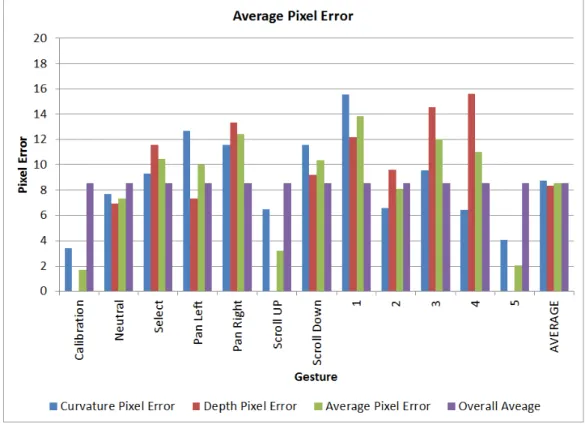
4.20. The percentage of finger tips identified correctly. . . 42
4.21. The average pixel error. . . 43
4.22. Samples of incorrect hand models due to incorrect fingertip detection. 44 4.23. Samples of incorrect hand models due to incorrect segmentation. . . . 44
4.24. Samples of correctly generated hand models. . . 44
5.1. NiTE Skeleton. . . 48
5.2. Joint angles calculated for upper body gesture recognition. . . 49
5.3. Calculation of the elbow angle. . . 50
5.4. Relative position of the hand and elbow with respect to the head. . . 50
5.6. Illustration of the key-frame selection algorithm. . . 55
5.7. logSSE between the average trajectory of each gesture and each ges-ture sample before and after alignment. . . 56
5.8. Alignment between gesture sequences. . . 57
6.1. Basic neural network containing three layers. . . 60
6.2. Neural network structure used to determine the gesture side using feature defined in Section 5.3. . . 62
6.3. Gesture trajectory of seven samples of the “Attention” gesture. . . 63
6.4. Cluster centres for the dynamic gesture dataset. . . 65
6.5. Precision results for the CMU dataset. . . 66
6.6. Recall results for the CMU dataset. . . 67
6.7. Confusion matrices for the CMU Dataset. . . 67
6.8. Comparison of the results obtained by Celebi et al. [28] and those obtained using the presented approach. . . 68
6.9. Comparison of the results obtained if no distinction between the left and right is made and if a distinction is made in the VisApp dataset. 69 6.10. Confusion matrix for the CSIR Gesture Dataset using the 10/20 ANN. 70 6.11. Illustration of determining the number of clusters. . . 71
6.12. Correct classification rate using an ANN as a classifier. . . 73
6.13. Confusion matrices when using an artificial neural network as a clas-sifier for three different feature vectors. . . 74
6.14. Relationship between the pixel error and the classification accuracy. . 75
6.15. Comparison of the classification accuracy using a K-means classifier for three different feature vectors. . . 75
6.16. Confusion matrices for the K-means classifier. . . 76
6.17. Comparison of the precision and recall for a K-means classifier and ANN. . . 76
7.1. Distance boundaries for human-robot interaction. . . 80
7.2. Calibration GUI of the Rock, Paper, Scissors game . . . 82
7.3. Description of the GUI elements for the Rock, Paper, Scissors game. 82 7.4. Misclassification’s in the Rock, Paper, Scissors demo video. . . 83
A.1. The anatomical planes and terminology used to describe motion. . . . 97
A.2. Flexion-Extension. . . 98
A.3. Abduction-Adduction. . . 99
A.4. Pronation-Supination. . . 99
A.5. Opposition of the thumb. . . 99
C.1. Intersection of line and circle. . . 105
List of Tables
3.1. Publicly available dynamic gesture datasets . . . 17
3.2. Publicly available hand pose datasets. . . 19
3.3. Specifications of the Asus Xtion Pro Live Sensor . . . 22
4.1. Ranges of motion of the hand joints. . . 34
5.1. Description of the elements in the feature vector used for upper body gesture recognition. . . 51
7.1. Specifications of the computer used for implementing and testing the gesture recognition system. . . 79
1. Introduction
Scientists predict that within the next 20 to 30 years robots could be a part of our daily lives, assisting humans with various tasks [1]. Already, they can be found vacu-uming homes, mowing the lawn and more recently assisting customers in stores [2]. Therefore, it is essential that the communication between robots and humans, or human-robot interaction (HRI), be as natural as possible. To this end, there has been much research focused on imbuing robots and computers with the ability to understand human gestures. A gestural interface for controlling computers was en-visioned as early as 1980, with researchers at MIT developing a voice and gesture interface to move shapes about a display screen [3].
This chapter introduces the basic terminology and definitions that are used in this work (Sections 1.1 to 1.3), presents an overview of the designed system in Section 1.4, and provides an analysis of the contributions in Section 1.5. An outline of the dissertation is provided in Section 1.6.
1.1. Gestures
A gesture is defined as a bodily action that conveys intent, or a movement that is deliberate or communicative [4]. Gestures can be performed using any part of the body, from the arms, as in a waving gesture, the head, as in a nod, or even the face. Gestures are thought to be one of the most natural forms of communication, particularly in noisy environments or where speech is not possible. There are four main classes of gestures: deictic, iconic, metaphoric, and beat gestures [5]. Deictic
gestures are pointing gestures. They refer to physical locations in space. Iconic
gestures represent the features of an action or event. An example of an iconic gesture is holding your hands together to form a pistol whilst describing shooting something. Gestures that represent concepts with no physical form are metaphoric,
such as the waving of hands to emphasise the complexity of what is being discussed. Various speakers usebeat gestures such as banging a fist on a table top to emphasise points. These categories are not mutually exclusive, and gestures may typically fall into more than one category. Gestures used in gesture interfaces are usually iconic, metaphoric or deictic.
A further classification is made between static and dynamic or temporal gestures. Static gestures occur at a single instance in time and are also known as poses. They
Chapter 1 Introduction
can be captured by a single image. Dynamic or temporal gestures occur over a certain period of time and can be represented by a sequence of images or a video. This work focusses on both dynamic gestures, performed using the upper body, and static hand gestures where most of the information lies in the hand configuration.
1.2. Gesture Recognition
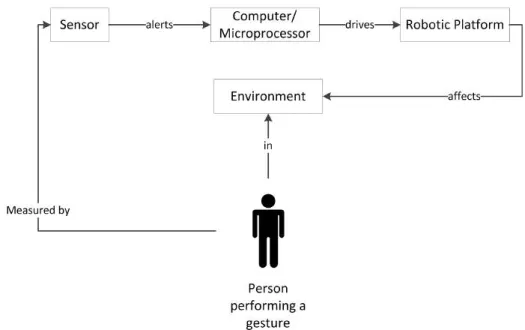
Gesture recognition is one of the core components of what developers refer to as a perceptual computer interface. It is the detection and interpretation of gestures, us-ing a computus-ing device. A typical gestural interface consists of a sensor, comparator and actuator. The sensor measures the environmental state such as light, proximity or motion. The sensor sends the information it receives to a comparator which is usually a computer algorithm. The comparator analyses the information, extracting features that are then used to classify the gesture based on prior knowledge. Based on the class of gesture a specific action is performed by an actuator which operates in the environment. See Figure 1.1 for a depiction of the full system.
Figure 1.1. A typical gestural interface for communicating with a robot.
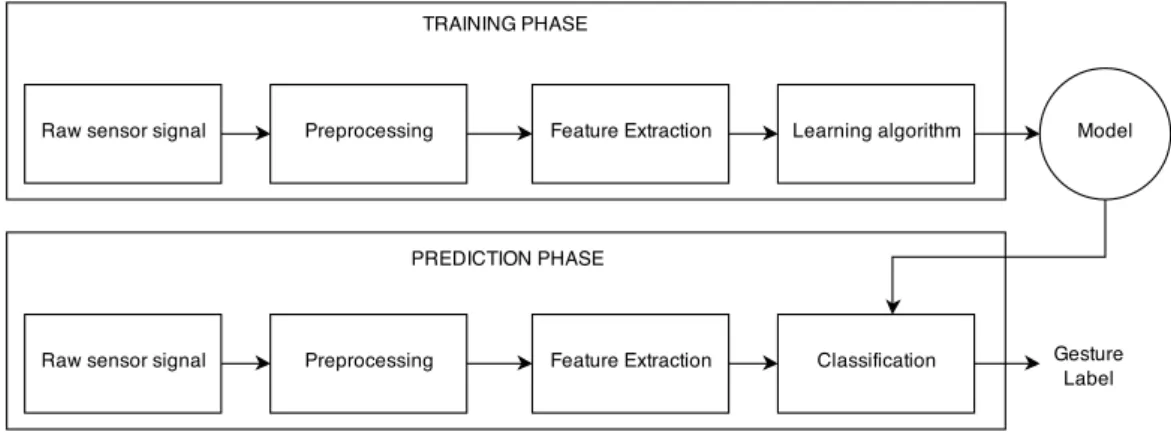
The comparator component of the system can be further split into two phases — a training phase and a prediction phase.
Typically the sensors stream data continuously. Therefore the raw data must be
preprocessed to extract meaningful information, such as the poses or motion of the hands, from the signal. A set of features which uniquely define a gesture are then extracted. This is known asfeature extraction. These features may be the position of body joints, the shape of the hand, or the joint angles. A set of gestures, referred to
1.2 Gesture Recognition
as thegesture lexicon, is defined. The features of these gestures are learnt during the training phaseand used to train a model which is later used for gesture classification. In the prediction phase the real time sensor data is also preprocessed, features are extracted and these are classified based on the trained model. The output of the classifier then dictates what action should be taken. This flow of information is depicted in Figure 1.2.
Figure 1.2. The phases in the gesture recognition component of a gestural interface. According to Wachs et al. [6], the basic requirements for any gesture recognition system are:
1. Responsiveness: the system must be able to recognise gestures almost instant-aneously (a maximum delay of 45 ms) as a slow system is impractical.
2. User adaptability and feedback: the majority of gesture recognition systems have a defined number of gestures which the system is able to identify. These gestures are programmed through an offline classifier algorithm. The challenge is to provide a classifier that is able to generalise a gesture from minimal training samples.
3. Learnability: the gestures used to control the system should be easy to re-member and execute.
4. Accuracy: the system must be able to first detect if the hand or body is within the view, track the hand from frame to frame, and match the gesture to learnt templates (recognition).
5. Intuitiveness: gestures used in the system should be intuitive in order to mimic communication between humans. For example a closed fist with the thumb up could represent “OK”. This is strongly dependent on cultural background and experience.
6. Lexicon size: a lexicon is a dictionary of the gestures used in the system. Ideally increasing the number of signs in the system should affect the perform-ance and accuracy of the system as little as possible.
Chapter 1 Introduction
7. Garment and environment requirements: the system should not require the user to wear additional aids or to be wired to a device, and in terms of back-ground and illumination the environment should not need to be fixed.
8. Reconfigurability: hands are different in size, shape and skin colour, thus the gesture recognition system should be invariant to these variations.
9. Mobility: many systems are dependent on the assumption that the user stands in a fixed position. For many applications this is not a valid assumption. 10. Unintended gestures: the system must be able to distinguish between
inten-tional and uninteninten-tional gestures.
These ten requirements are integral to the development of a robust, reliable and accurate gesture recognition system.
1.3. Human-Robot Interaction
Human-robot interaction (HRI) is the study of communication between robots and humans. It exists at the intersection of the fields of artificial intelligence, computer vision, robotic design, social science, and the humanities. Robots are increasingly becoming involved in more complex tasks and activities, sometimes requiring inter-action with people to complete these tasks. This has given rise to the field of HRI, the study of how to design and implement robotic systems that can interact with a human environment in a safe and efficient manner.
HRI is a challenging field because the system needs to be able to perceive, understand and react to human activity in real time. Challenges include:
• There is a limitation on the size of the gesture recognition system, it must be able to fit on the robot.
• As both the robot and the human are mobile, static backgrounds cannot be used for segmentation and a a fixed camera location cannot be assumed.
• The robot mobility could lead to drastic changes in environmental conditions, such as lighting.
• The system must be able to work in real-time. Ideally, there must not be a perceivable lag between the user performing a gesture and the robot response. These challenges should be taken into consideration when designing a HRI system.
1.4. System Overview
An overview of the system is depicted in Figure 1.3. This diagram shows the integ-ration of the components presented in the subsequent chapters.
There are two main components:
1.4 System Overview
Figure 1.3. System overview for a human robot interaction (HRI) system.
• An upper body gesture recognition system that uses joint angles extracted from the NiTE skeleton as input to a neural network that classifies gestures performed using either the left or right arm.
• A hand gesture recognition system that uses the position of the fingertips to calculate the hand joint angles, which are subsequently used as input to a
k-means classifier that determines the static hand pose.
First, a Viola-Jones face detector is used to determine if a user is looking at the robot. Detection of a frontal face triggers the gesture recognition system. The Viola-Jones face detector is described in Section 7.1.1.
The depth map is then used to calculate the distance between the robot and user. If this distance is greater than a threshold (described in Section 7.1.2) then the upper body gesture recognition is triggered, otherwise hand gesture recognition is
Chapter 1 Introduction
performed. The distance is chosen based on the maximum distance that a user will be able to see the GUI attached to the robot.
If the upper body gesture recognition system is triggered, the velocity of the left and right hands are calculated. These velocities are used as an input to a neural network that is then used to determine the gesturing side, as described in Sec-tions 5.3 and 6.1.1. The relative position and joint angles of the arm are extracted from the user skeleton as they are robust to variations in scale and rotation. These features, described in Chapter 5, are then temporally aligned as described in Sec-tion 5.4. Alignment is necessary to ensure that the most important frames from the gesture sequence are input to a classifier. Two classifiers are compared for up-per body gesture recognition — a neural network presented in Section 6.1.1 and a hidden Markov model presented in Section 6.1.2. These classifiers are chosen based on their ability to model temporal data such as gesture sequences. It is found that the neural network achieves a higher classification compared to the hidden Markov model. Based on the classified upper body gesture, the robot performs an action defined in Figure 3.2.
For hand gesture recognition, the hand is segmented from the image as illustrated in Figure 4.2. The hand segmentation combines depth, colour and hand orientation information improving segmentation performance. The characteristics of fingers, namely the curved fingertips, parallel borders and the fact that tips always occur as depth differences are used to detect fingertips as described in Section 4.2.2. If a fingertip cannot be detected then it is assumed that the finger is closed (fully flexed), and use the joint angles associated with a closed finger. Inverse kinematics presented in Section 4.2.1 are used to calculate the finger joint angles. Joint angles are ideal features as they are rotation and scale invariant implying that they can be used for a broad range of users. The use of hand joint angles fulfils the reconfigurability re-quirement for a successful gesture recognition system. The hand gesture is classified using the classifiers outlined in Section 6.2. Two classifiers are compared— a neural network and a k-means classifier. The performance of the neural network exceeds that of thek-means classifier. The hand gesture is used to control a graphical user interface with actions depicted in Figure 3.1.
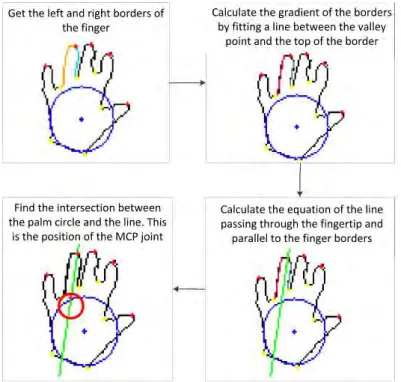
In addition, there is a hand calibration component that automatically calibrates the finger joint lengths. This is needed to initialise the hand model. Hand calibration is illustrated in Figure 4.16.
1.5. Contribution of this Dissertation
This dissertation describes the design of a gestural interface which can be used to interact with a robot, both when it is far away (far mode) and close to the user (near mode). This interaction is achieved by capturing human behaviour using a depth sensor, as follows. First, all users in the camera’s field of view are segmented
1.6 Dissertation Overview
from the image stream. Frontal face detection is then employed to determine if a user is looking directly at the robot. This is used as a trigger gesture, activating the interaction module. Depending on the distance of the user from the robot, either the near mode or the far mode module is invoked.
Far-mode interaction is used to control the movements of the robot, such as turn or go away, and near-mode is used to interact with a display that is attached to the robot. In far-mode interaction, the position of the upper body joints are recorded. A gesture spotting module is used to determine whether a gesture is being performed or not as well as its time boundaries. A neural network is then used to assign a class label to the gesture. In response to this label, the robot performs a particular task. In near-mode interaction the hand is segmented from the image. All fingertips are then identified, including those that are close together or not separated from the palm. The fingertip locations and the palm and wrist position are used to solve the inverse kinematics and estimate the finger joint angles for the hand. These angles are the features utilised by a neural network to classify the static hand gesture. In short, the main contributions of this dissertation are:
• Proposing a complete gestural interface that can be used for both near and far interaction with a mobile robot.
• Successfully detecting dynamic upper body gestures for a variety of users without prescribing which side of the body should be used for the gestures and no additional training and calibration.
• Successfully detecting hand poses by identifying the location of all fingertips. Using inverse kinematics to determine joint angles increases the robustness of the system so a variety of users can use it. In addition, the high-level features can be used to describe a large number of hand poses.
The proposed system is evaluated using both publicly available datasets, as well as a recorded dataset.
1.6. Dissertation Overview
The remainder of the dissertation is organised as follows:
Chapter 2 presents a review of the existing literature in the field of gesture re-cognition with emphasis on gesture rere-cognition for human-robot interaction (HRI). The various approaches employed in each phase of a gesture recognition system are discussed, highlighting the strengths and weaknesses for each method.
Chapter 3 details the acquisition of data used to evaluate the designed system. It contains a full review of existing datasets and a description of the dataset collected for both upper body gestures and hand gestures.
Chapter 1 Introduction
Chapter 4 discusses the features extracted for hand gesture recognition. This in-cludes the strategy used for hand segmentation and the method used to extract hand joint angles from an image. Results for the hand gesture features are presented. Chapter 5 presents the feature extracted for upper body gesture recognition in par-ticular the extraction of joint angles and a novel key-frame selection method used to temporally align gesture sequences. The temporal alignment is quantitatively and qualitatively evaluated and the results of the evaluations are reported.
Chapter 6 discusses the theory of hidden Markov models (HMMs) and artificial neural networks (ANN) that are used for gesture classification. The application of these algorithms to gesture recognition is presented.
Chapter 7 provides an evaluation of the integrated gesture recognition system. The results for the integrated system are presented as well as a summary of the results for each component of the system.
Chapter 8 concludes the dissertation providing a description of possible future work and underlining the main contributions.
1.7. Summary
This chapter introduced the terminology used throughout the dissertation. An over-view of the designed system was provided and the contributions of this work were highlighted. An outline of the dissertation was also provided.
2. Literature Review
Gesture recognition is a growing research area due to its wide range of applications, ranging from medical systems and assistive technologies, entertainment, crisis man-agement, disaster relief, human-robot interaction and many more. Among these areas, the most common application is human computer interaction (HCI). It aims to replace the traditional keyboard and mouse interfaces with a more natural in-terface. A large amount of the research in gesture recognition is dedicated to sign language translation, including recognition of both static alphabets and dynamic word gestures.
This survey is organised as follows. The typical sensors used are presented in Sec-tion 2.1. Feature and classificaSec-tion methods employed are discussed in SecSec-tion 2.2. A review of gesture recognition systems used for HRI can be found in Section 2.3. Dynamic upper body gesture systems and static hand pose systems are examined independently.
2.1. Sensors used for Gestural Interfaces
Two main types of sensors are used for gesture recognition, glove-based sensors and vision-based sensors.
In glove-based systems the user is required to wear a glove fitted with sensors such as accelerometers and flex sensors [7, 8, 9, 10, 11, 12, 13]. These devices directly measure the hand or arm joint angles and spatial positions. The gloves may be wired or wireless. The wired system requires the user to be in close proximity to the computer. Glove-based systems restrict natural gestures as users are required to wear additional aids that may hamper natural movements. These systems also require the glove to be calibrated for each new user, limiting the reconfigurability of the interface. However, they are typically more accurate.
Whilst there are various application specific uses for the glove-based systems, they are not a “natural” method of interacting with a robot. This shortfall has driven a large proportion of gesture recognition research toward vision-based systems. These approaches use single or multiple cameras and more recently depth sensors such as the Microsoft Kinect to capture and interpret gestures. The advantages of vision-based sensors are numerous: they are simple, low cost and do not need to be adjusted for each user. However, they suffer from the limitation that the gesture must be
Chapter 2 Literature Review
performed in the camera’s field of view in order to be detected. In addition, depend-ing on the distance of the user from the camera the hand may only be represented by a few pixels, making it challenging to extract useful features for hand gesture recognition.
2.1.1. Vision-based Sensors
Vision-based sensors use single or multiple cameras and depth sensors such as the Kinect to capture the gesture. Vision-based sensors suffer from the limitation that the gesture must be performed in the camera’s field of view in order to be detected.
2.1.1.1. RGB Camera
Prior to the release of the Microsoft Kinect, vision-based gesture recognition used ordinary colour or greyscale images. These typically focused on static and dynamic hand gestures. Skin colour is used as a cue to segment the hand from the image [14, 15, 16, 17]. However, as there is no depth information available, the majority of these systems require simple, solid backgrounds [18, 19, 14, 20] or that the user wear a coloured or textured wrist band to aid in segmentation [21].
Another method of gesture recognition using colour images, presented by Drake [22] and Davis and Shah. [23], requires that the user wear a glove where each fingertip or hand joint is a different colour, making identification easier.
One of the challenges of using colour as a feature is its sensitivity to illumination changes. This makes robustness difficult to achieve, motivating the use of depth sensors together with the colour images.
2.1.1.2. Depth Sensors
Since the release of the Microsoft Kinect in 2010, much of the gesture recognition work has been based on depth sensors. These sensors provide depth information in addition to the RGB image captured by a traditional camera. The depth information aids in hand segmentation [24, 25, 26, 27] and the OpenNI and NiTE SDKs provide skeleton information [28, 29, 30, 31, 32]. This has made depth sensors ideal for gesture recognition. A thorough review of gesture recognition is provided by Suarez and Murphy [33]. A sensor similar to the Kinect is produced by Asus. This sensor is known as the Asus Xtion Live Pro and has the same operating principle as the Kinect. However it does not require an external power supply.
In 2013, Intel released a depth sensor for HCI known as the Creative Senz3D camera. This sensor is intended for closer range, from 0.01 m to 1 m. It uses time-of-flight to recover depth information from the scene rather than structured light employed by
2.2 Gesture Recognition Methodology
the Asus and first generation Kinect sensors. Given the novelty of the sensor there are few works that use it [34, 35].
The second generation of Kinect sensors that are shipped with the Xbox One, also now use time-of-flight for depth recovery. This sensor was made available to de-velopers in late 2014; therefore there is not much literature available [36]. However, it reportedly has a higher depth resolution and range compared to the first genera-tion Kinect.
Another relatively new gesture device is the Leap Motion sensor. This sensor is also for close-range HCI, and is capable of tracking all fingers with an accuracy of up to a 100th of a millimetre over a range of 1 m. The operating principle is similar to that of the Asus, projecting a distinct IR pattern and using this to recover depth. Several works that use Leap Motion for HCI are presented in the literature [37, 38, 39, 40, 41].
Whilst the earlier generation of depth sensors had several flaws, including low sensor depth resolution and reduced close-range depth recovery for applications where the user is further than 1 m, the Kinect is best for HCI. The ideal system would therefore combine two sensors, one for close interaction and another for far interaction.
2.2. Gesture Recognition Methodology
A Gesture recognition algorithm consists of two phases: a training phase and a pre-diction phase. During both phases features are extracted from the data to reduce the dimensionality of the feature space. Feature extraction is discussed in Section 2.2.1. The extracted features are then used to classify the gesture. Gesture classification methods are presented in Section 2.2.2.
2.2.1. Feature Extraction
Feature extraction refers to the process of extracting discriminative characteristics from an image that can uniquely identify a gesture. There are two main approaches used for feature extraction, appearance-based and model-based.
Appearance-based methods use image features to model the appearance of the hand and arm. For hand gesture recognition, typical features extracted include the shape of the hand [31, 42, 43, 44], the hand area [24] and other less intuitive features such as SURF [45], SIFT [46, 47], Haar-like features [48, 49, 50] and HOG features [51, 52, 53]. The feature space is often reduced using techniques such as PCA [15, 31]. Other higher-level features such as the location of the finger-tips [54, 55, 56] and counting the number of extended fingers [57, 58, 26] can also be used for appearance-based feature extraction. The majority of these approaches can only identify fingertips
Chapter 2 Literature Review
associated with extended fingers and are unable to detect fingertips if they are not on the external contour of the hand.
Model-based approaches rely on recovering the 3D kinematic model of the hand and trying to estimate all the parameters by comparing input images with the 2D appearance of the hand model. The advantage of this approach lies in the fact that many hand gestures can be defined, however these approaches are resource intensive and typically cannot operate at speeds faster than 15 frames per a second [59]. They may also require special hardware such as a GPU (graphical processing unit) [59, 60]. The most common approach to model-based hand pose estimation is to use synthetically generated hand poses to train a classifier and has been adopted by several researchers [61, 62, 63, 64].
2.2.2. Gesture Classification
Pattern recognition is a technique for learning and recognising patterns that exist in a dataset. They are flexible as they can often learn in a changing environment. This is not possible for rule-based systems that can only operate in the situation for which they have been designed. For this reason the majority of gesture recognition systems employ pattern recognition classifiers.
During the training phase, a machine learning algorithm uses training data to infer the structure of the data to enable classification to take place. There are many dif-ferent techniques that can be used for pattern recognition. These include artificial neural networks (ANNs) [46, 65], histogram based features [19], fuzzy clustering al-gorithm [10], hidden Markov models (HMMs) [17, 44], adaboost [46], support vector machines [66, 43], decision trees [67], and dynamic time warping (DTW) [28]. The classification technique selected depends on the amount of training data available, the training and classification time and the ability of the learnt model to generalise any sample. For example, neural networks and HMMs are only suitable when there is a large amount of training data whereas DTW can create a model from just a few samples. In contrast, HMMs can correctly classify gestures even when there is a large intra-class variance. This is not possible with DTW as several templates are then needed.
2.3. Gesture Recognition for Human-Robot
Interaction
The majority of existing systems only allow for robot interaction at either close distances, where the hand shape is used as an input, or further away, where features are extracted from the position of the human body, particularly the upper body. These are termed hand gesture recognition (HGR) and body gesture recognition
2.3 Gesture Recognition for Human-Robot Interaction
(BGR) respectively. The subsequent sections provide a review of these two gestural interfaces. In the field of human robot interactions (HRI) many systems have been developed for robotic control using gestures [68, 69, 70, 71, 72, 73, 74, 75, 65, 46, 76, 77, 78, 79].
What follows is a review of the most recent approaches to using gestures for HRI.
2.3.1. Hand Gesture Recognition
Hand gesture recognition is commonly used to control a computer interface in the near vicinity of the user. The hand is found in the input image and features are extracted, most often based on shape. Below is a review of some recent approaches used for hand gesture recognition.
A video camera is used to capture RGB images by Hasanuzzaman and Ueno [74]. The hand is extracted from the image using skin colour as a feature. Eight static gestures are classified using principal component analysis.
Yin and Xie [68] use skin colour and a restricted coulomb energy (RCE) neural network to segment the hand from an image. They count the number of fingers that are extended and the distance from the arm to train another RCE neural network to classify static hand gestures. For a gesture lexicon of size eight, an accuracy of 95% is achieved.
Thakur [72] define a lexicon of five gestures, the numerals 1 through 5. The sys-tem captures images in real-time using a colour camera. The Y-Cb-Cr colour space is used to isolate the hand from a uniform background using Otsu segmenta-tion [80]. Peak and valley points are identified in the image using the k-curvature algorithm [81]. The numbers of peaks and valleys are used for gesture classification. An accuracy of 95.2% is achieved. This system is limited to a distinct number of gestures (six) and cannot be extended to include more as only the number of fingers is used as a feature.
Trigueiros et al. [73] use depth information to segment the hands from the image. They assume that the hands are the closest object to the camera. The orientation of the hand is then determined using a vector from the mid-point of the hand to the furthest point on the hand contour. The hand orientation is used to control the orientation of a robot whilst it is moving, and the distance between the hand centroid and image determine the robot’s linear velocity.
Van den Bergh et al. [75] use the shape of the hand to control a robot. Rather than extracting high-level features, all intensity values in the depth and colour image within a bounding box around the hand are used. Average neighbourhood margin maximisation (ANMM) is used to reduce the dimensionality of the feature space. A nearest neighbour classifier is used to classify four gestures.
Wang and Wang. [46] extract scale invariant feature transform (SIFT) features from a greyscale hand image. Adaboost is used to classify a total of three gestures—
Chapter 2 Literature Review
palm, fist and six. They achieve an accuracy of approximately 96%. The primary advantage of the system is robustness to viewpoint changes that may occur. Re-cognition accuracy is still high even when the hand is rotated up to 40 degrees. However, the lexicon size is small, and the hands are captured against a uniform background.
Xu et al. [76] present an online dynamic hand gesture recognition system. After segmenting the human body from a depth image, they use the chamfer distance to match a hand template to edges in the image. A skin colour model is then used to refine the hand region. The hand centroid is tracked through several image frames and the orientation and hand location are used for the final feature vector. Hidden Markov models are trained to distinguish between gestures. Two different datasets are used to evaluate system performance, one with six gestures and another with ten gestures. An average accuracy of 98.1% on dataset 1 and 96.1% on dataset 2 is obtained. The gestures are used to control the motion of a SIATRob robot.
Yang et al. [78] use a geometric feature to classify a total of six hand gestures. Skin colour is used to detect the hand in the colour input images. The distance between the hand centre and all points on the hand contour are then extracted. The number of peaks and valleys in this signal are used to classify a gesture. High accuracies of between 95% to 100% are achieved for three different datasets. However, like Thakur [72] the gesture set is limited to six as more gestures cannot be characterised using the defined feature vector as only the number of fingers are counted.
2.3.2. Body Gesture Recognition
Body gesture recognition is typically used to control the motion of a robot. Gestures are used to determine whether the robot should turn left or right, come closer or pick an object up.
Waldherr et al. [65] define a gesture lexicon of four whole body gestures. They also use skin colour to track the person but include shirt colour in their tracking algorithm. An ANN is used to train and classify the gestures. Their system achieved a gesture recognition rate of 97%. This system is not scale invariant and requires the person to be a specified distance from the robot.
Yeasin and Chaudhuri [82] describe a gesture recognition system which uses a video camera to capture temporal gestures and use these to control a robot. The system then finds the temporal signature of the gesture by dividing the gesture into subsets such that for each subset motion is only performed in one direction. The order of the directions determines the gesture performed. Finite state machines are used to classify the gesture. The system was found to perform well on synthetically generated data, but yields poor results for real images as the motion sequence is not as uniform.
Zhao et al. [69] use gestures to call an elderly service robot. Rather than using the
2.3 Gesture Recognition for Human-Robot Interaction
traditional skeleton-based approach for feature extraction they include an octree-based method that operates when skeleton generation fails. The head and hand are segmented from the image, and various geometric properties are extracted. They validate the approach for a number of different situations where the skeleton gener-ation would fail, for example if the user is sitting on a sofa. By fusing the Kinect skeleton and octree approaches, an accuracy of over 95% is achieved for four calling gestures.
Kopanivčáková and Virčíková [83] develop a system to record dynamic gestures and discuss how these can be applied to human-centred robotics. The system captures the Kinect skeleton joints, and DTW is used to recognise gestures. However, the system is not user-independent and training data must be added for new users. Yang et al. [77] estimate the 3D pose of the human body in a stereo camera video sequence. The relative angular position of each joint with respect to the mid-back is used as a feature vector in each frame. These are concatenated over the video sequence to form the full feature vector. A HMM is used for gesture classification. The overall system recognition accuracy is 94.9% for 14 gestures.
2.3.3. Discussion
In summary, few gesture recognition systems are robust enough to meet all the requirements for a real-life HRI system. The most common shortcoming is the inability to adapt to any user and the small lexicon size due to the types of features extracted. This shortcoming is especially true for HGR systems.
Whilst an attempt is made at incorporating domain knowledge into hand gesture re-cognition, the inability of most systems to identify fingertips even when they are not extended reduces the lexicon size. Tracking methods are successful at reconstructing the full 27-DOF hand model. However, they are computationally expensive, requir-ing graphical processrequir-ing units (GPUs), extensive trainrequir-ing sets or are unable to run in real time.
3. Data Acquisition
This chapter provides a brief overview of the publicly available gesture recognition datasets, namely hand pose and body gesture datasets, in Section 3.1. In addition, the recording of the hand pose and dynamic gesture datasets which is for evaluating the designed system in Section 3.2 is described.
3.1. Publicly Available Datasets
There are datasets that have been made available for download allowing authors to compare results with a common benchmark. Section 3.1.1 presents the dynamic gesture sets available and Section 3.1.2 presents the static hand pose datasets avail-able.
3.1.1. Dynamic Gesture Sets
There are a number of publicly available datasets for gesture recognition, captured using a variety of sensors. These are summarised in Table 3.1. The MSRC-Kinect
Table 3.1. Publicly available dynamic gesture datasets
Source Dataset Abbreviation
1 Fothergill et al. [84]
Microsoft Research Cambridge-12 Kinect Gesture
MSRC-Kinect 2 Lin et al. [85] Keck Gesture dataset Keck 3 Guyon et al. [86] ChaLearn dataset 2012 ChaLearn2012 4 Escalera et al. [87] ChaLearn dataset 2014 ChaLearn2014 5 Celebi et al. [28] VisApp2013 Gesture dataset VisApp2013 6 Bernstein et
al. [30]
Cornell Military Gesture Dataset CMU
dataset [84] consists of 12 full-body gestures that relate to gaming, music, and dance. The main purpose of the work was in investigating methods for instructing users for gesture performance. The dataset consists of 30 subjects recorded using a Microsoft Kinect. There are total of 6244 gesture instances, approximately 500 per class. The
Chapter 3 Data Acquisition
dataset provides only the skeleton positions of 20 joints in the human body at a sample rate of 30 Hz with approximately 2 cm accuracy in joint positions. The environmental conditions are not specified. The majority of participants were right handed and male. As this dataset is not restricted to only upper body gestures, it is not used for performance evaluation of the proposed system.
The Keck dataset [85] consists of 14 military signals performed using only the upper body. The dataset was collected using a standard colour VGA camera with a resol-ution of 640×480. The environmental conditions for the training set and test set were different. For the training set the camera remained in a fixed position, and the background is static and uniform. In the test dataset the camera was moving, and the background contains clutter and other moving objects. There are 21 instances of each gesture: nine training and twelve testing. Each gesture was performed seven times by three different participants. This dataset has no depth information avail-able; therefore, it could not be used for testing the proposed system.
The main purpose of the ChaLearn2012 dataset [86] was a competition for one-shot training: the problem of learning from only one training sample. The gesture lexicon is vast, with 86 different gestures covering a wide range of application areas including Italian sign language, diving signals and many more. The gestures are captured using a Kinect camera with a resolution of 240×320, at a low frame rate of just ten frames per second. There was a total of 20 participants, recorded in front of a fixed camera. No information is provided with regard to the background and lighting conditions. Both the RGB and depth data were provided to challenge participants. However, joint positions were not recorded and therefore this dataset could not be used for testing.
The ChaLearn2014 dataset [87] focused on recognising gestures from several in-stances performed by different users. The gesture lexicon consists of 20 Italian cultural signs performed using the upper body. The data is collected using a Kinect sensor and includes the depth map, RGB image and skeleton information for 7754 gesture instances. There are approximately 388 samples per gesture.
The VisApp2013 dataset [28] consists of eight dynamic gestures performed using the upper body. There are four unique gestures, performed using the left and right sides of the body. The skeleton from the Kinect SDK is recorded. The SDK tracks 15 joints in the human body in real time at a frame rate of 30 frames per second (fps). Unlike the majority of datasets the data was recorded using users who were unfamiliar with the system, resulting in a dataset which is noisy in terms of gesture starts, gesture ends, and gesture duration. There are only 28 samples of each gesture, eight samples for training and twenty for testing. This dataset is used to evaluate the performance of the body gesture recognition system.
The CMU dataset [30] consists of fifteen dynamic gestures, namely, “action”, “ad-vance”, “attention”, “charge”, “cover”, “crouch”, “rally”, “shift fire”, “point of entry”, “confused”, “hurry”, “sneak”, “out of action” and “come”. The gestures are performed using the right arm and the skeleton from the NiTE SDK is recorded.
3.2 Recorded Dataset
Three users perform each of the 15 gestures ten times giving a total of 450 gesture instances. The dataset is recorded using a Kinect sensor and the joint positions of the body are saved. This dataset is used to evaluate the performance of the body gesture recognition system.
3.1.2. Hand Gesture Datasets
The majority of publicly available hand gesture sets are recorded using only an ordinary camera. Thus, there is no depth information available. The datasets that have both colour and depth information are summarised in Table 3.2.
Table 3.2. Publicly available hand pose datasets.
Source Dataset Abbreviation
1 Ren at al. [42] NTU Microsoft Kinect Hand Gesture dataset
NTU
2 Tompson et al. [88] NYU Hand Pose dataset NYU 3 Qian et al. [70] Microsoft Research Asia Hand Pose
dataset
MSRA
The NTU dataset [42] contains both colour and corresponding depth from the Kinect sensor. It contains ten gestures from ten subjects with ten repetitions per gesture. Therefore there are one thousand gesture instances. However, no skeleton tracking information is provided and the dataset cannot be used for evaluating the hand gesture algorithms.
The NYU dataset [88] consists of colour and depth images from three different views, one frontal and two side. There are only two users recorded, and rather than defining specific gestures the dataset contains a wide range of hand poses. As there is no ground truth, this dataset is hard to use for effective evaluation.
The MSRA dataset [70] is recorded using an Intel Creative depth camera. This dataset consists of six subjects performing various rapid gestures, with ground truth data for 2400 frames. Rather than a gesture label, the ground truth is the position of the five fingertips and the wrist. However, as there are no gesture labels this dataset cannot be used to evaluate the designed gesture recognition system.
3.2. Recorded Dataset
To evaluate the performance of the gesture recognition system a dataset is recorded. This dataset is particularly important for the hand gestures as none of the publicly available datasets are suitable. Ethics clearance obtained from the CSIR and UCT can be found in Appendix B.
Chapter 3 Data Acquisition
3.2.1. Gesture Lexicon
Two types of gestures will be used for robotic control — far-gestures and near-gestures. Far-gestures are used to control the motion of the robot whilst Near-gestures are used to control the computer interface attached to the robot.
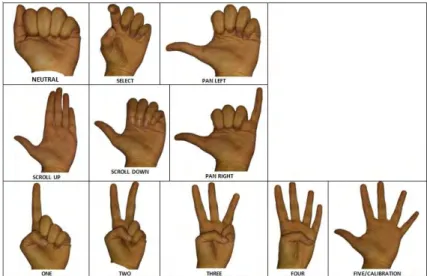
The hand poses are seen in Figure 3.1. The twelve near-gesture actions defined are:
• Calibrate: obtain user finger lengths and calibrate the hand model.
• Mouse: control the position of the mouse on the screen using the user’s hand.
• Select: select the item where the mouse pointer is located.
• Pan Left: move the screen display to the left.
• Pan Right: move the screen display to the right.
• Scroll Up: move the screen display up.
• Scroll Down: move the screen display down.
• Numbers 1–5: used to enter numbers.
Figure 3.1. Static hand gestures for close HCI in the recorded dataset.
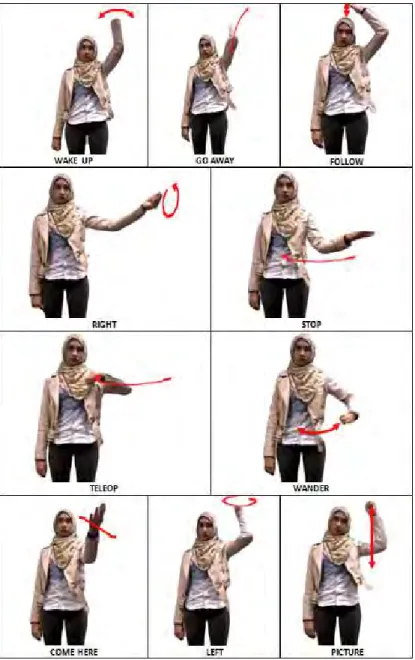
The following ten far-gesture actions are defined. The corresponding gestures can be seen in Figure 3.2:
• Start/ Wake Up: this will wake up the robot. Once this gesture has been performed the robot will await further instructions.
• Stop: stop the robot motion. This gesture should function as a dead man switch/emergency stop in that it overrides all previous commands.
• Come Here: indicate to the robot to come towards the user. The robot will stop at a specified distance from the user.
3.2 Recorded Dataset
• Go Away: instruct the robot to move away from the user.
• Move Left: indicate the robot should move left from its current position.
• Move Right: specify that the robot must move right from its current position.
• Follow Me: indicate that the robot should follow the gesturing subject.
• Take a Picture: command the robot to use the on-board camera to take a picture of the current scene.
• Wander: indicate that the robot should wander around the room.
• Teleop: activate a joystick that can be used to control a robot.
Chapter 3 Data Acquisition
3.2.2. Recording
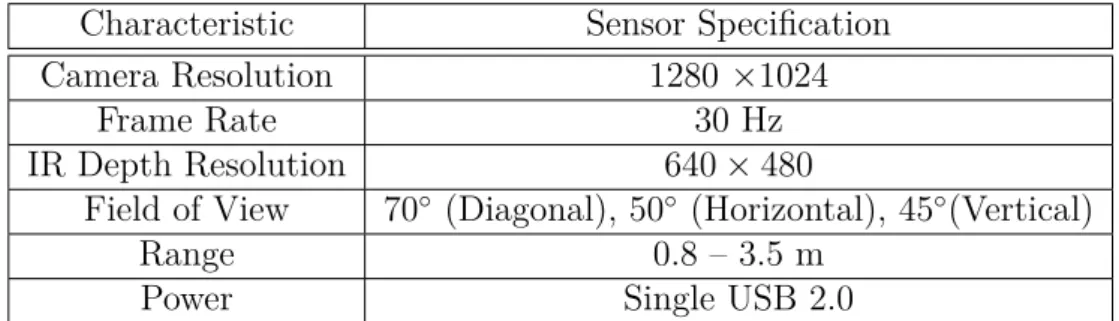
An Asus Xtion Pro Live sensor, which is similar to the Kinect, was used to record the dataset. This sensor does not require external power and has a better near-field range than the Kinect. By emitting a distinct IR pattern and capturing the distortion of its image the sensor can return 3D coordinate information. Note that the distance to the camera plane is returned, rather than the actual distance to the object from the sensor. The specifications of the sensor can be seen in Table 3.3.
Table 3.3. Specifications of the Asus Xtion Pro Live Sensor Characteristic Sensor Specification Camera Resolution 1280 ×1024
Frame Rate 30 Hz
IR Depth Resolution 640×480
Field of View 70◦ (Diagonal), 50◦ (Horizontal), 45◦(Vertical)
Range 0.8 – 3.5 m
Power Single USB 2.0
A total of 15 subjects were recorded in a laboratory environment. For the dynamic far-gestures, participants stood approximately 1.5 m from the sensor and for the static close hand gestures users were seated approximately 0.7 m from the sensor. Subjects were instructed using pre-recorded videos of the gesture that they were asked to replicate.
4. Hand Gesture Feature Extraction
Hand gestures have a broad range of application from sign-language recognition to controlling computer interfaces. Recognising hand gestures is challenging due to the high dimensionality of the problem implying that there is a large number of possible hand configurations. These difficulties make it very hard, if not impossible, to write software by hand to do this, and so pattern recognition approach is adopted. This approach involves solving several problems such as:
• automatic hand detection and segmentation, and
• extracting features that have a large inter-class variation but a small intra-class distribution (i.e. can effectively distinguish between different intra-classes of gestures), and can be used to describe a large subset of gestures.
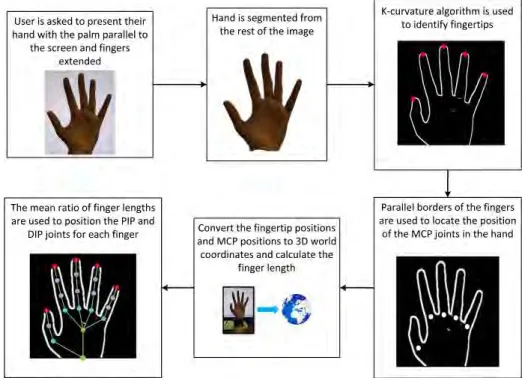
In this chapter, solutions to these problems are proposed. First, the use of depth and colour information for hand segmentation are discussed in Section 4.1. The extraction of high-level features, namely the joint angles for the hand, are presented in Section 4.2. An overview of hand gesture feature extraction is shown in Figure 4.1. The results for hand gesture feature extraction are also presented.
Chapter 4 Hand Gesture Feature Extraction
4.1. Hand Segmentation
The first step is detecting and isolating the hand from the rest of the image. This is a challenging task as the appearance of the hand is not consistent: as people have different skin colours, lighting changes in the environment, and the hand has a high number of degrees of freedom (DOF). Therefore, hand segmentation is often accomplished using skin colour models to account for variations in skin colour and lighting, and depth thresholds to account for the high DOF. The approach taken for hand segmentation is shown in Figure 4.2. The initial position of the hand is obtained from the NiTE skeleton, available from the NiTE SDK [89]. This is used to get the skin colour and hand depth of the user. The colour of all pixels in the image is then compared to the user skin colour to obtain a colour mask. Depth thresholding is employed to get a depth mask. If a pixel is within the correct depth range and matches the user skin colour then it is a hand pixel.
Figure 4.2. Hand segmentation approach.
4.1.1. Skin Detection
Skin segmentation is the process of classifying a pixel as being skin coloured or not. However, the appearance of skin is significantly affected by changes in illumination, and different cameras can produce different colours even for the same individual. Additionally, there is a large variation in the skin tones of people from around the world. Any skin detection algorithm must be robust to these perturbations.
One of the challenges in segmenting the hand from an image is its size compared to the rest of the image. Even at distances as close as half a metre, the total area of the hands is only approximately 10% of the image. Therefore, the hand position from the NiTE SDK is used to extract a region of interest where the hand is expected to be. The size of the ROI is proportional to the distance of the user from the camera, the closer the user, the larger the ROI. All subsequent processing is then applied only on the ROI, decreasing the processing time.
4.1 Hand Segmentation
Researchers often use colour to segment human skin in pictures [26, 90, 44, 14, 32] . The two primary approaches to colour-based skin segmentation are a model-based approach and a deterministic approach. In a model-based approach, skin colour is modelled using pattern recognition techniques, such as Gaussian mixture models and naive Bayesian methods, and for each pixel the probability of it being skin is calculated. The deterministic approach uses explicitly-defined rules to determine whether a pixel is skin or not.
Both of the skin segmentation approaches can operate over a broad range of colour spaces. A full review of the various colour spaces that are commonly used for skin detection are provided in the work presented by de Campos [91].
As the system is required to work for a variety of users of different skin colours, an approach that adapts to each user is proposed. This approach relies on the initial hand position from the NiTE SDK. The colour of this pixel (the initial position of the hand) is compared to the intensity of other pixels in the image to classify if a pixel is skin coloured or not. The LAB colour space is used for colour comparisons as it is perceptually uniform, and a standard metric can be used to measure the similarity between two colours.
Like the majority of colour spaces, the CIE Lab colour space has three channels. The Lchannel for luminance, indicating how light or dark a pixel is, and two colour channels a and b. Unlike other colour spaces, perceived colour differences corres-pond to distances [92]. This implies that the similarity between two colours can be calculated in a way that resembles human colour similarity judgement. Therefore, all pixels in the ROI that are similar to the colour of the initial hand point can be found.
Let the colour of the initial hand position be(Li, ai, bi). To then determine whether a
pixel at position j with colour(Lj, aj, bj)is classified as skin, the Euclidean distance
is calculated and if it is less than a threshold τLab,as shown in Eq. (4.1),
q
(Li−Lj)2+ (ai−aj)2+ (bi−bj)2 < τLab, (4.1)
it is classified as skin. Another method for hand segmentation is depth thresholding. The initial position from the NiTE SDK can also be used to threshold the image based on the distance of the hand from the camera. Let the depth of the initial hand position be di. For any pixel with depth dj it then belongs to the hand if the
absolute difference between the distances is less than a threshold τd, or
|di−dj|< τd. (4.2)
Morphological operators, such as dilation and erosion, are used to fill in holes in the hand contour. These may occur at dark regions in the hand where there are shadows present.
Chapter 4 Hand Gesture Feature Extraction
4.1.2. Forearm Separation
If the user is wearing short sleeves then the forearm is also segmented as part of the hand. To segment only the hand an approach similar to the one presented by Wang and Xu [93] is adopted. This method relies on the following assumptions:
1. The wrist is located on a line tangent to the maximum inscribed circle. 2. The forearm is perpendicular to the wrist line.
3. The wrist point is located on the maximum inscribed circle at the point where the tangent is perpendicular to the forearm orientation.
4. The diameter of the palm is greater than the diameter of the wrist.
These assumptions are depicted in Figure 4.3. The grey area is the maximum inscribed circle. The green point indicates the centre of this circle which corresponds to the centre of the palm. The wrist point, indicated in red, is located at a tangent to the inscribed circle (blue line) perpendicular to the orientation of the forearm.
Figure 4.3. Segmentation of the forearm from the hand.
As noted above, the palm centre is the centre of the maximum inscribed circle. This is the circle with maximum area that fits exactly into a given set of points or contour. The maximum inscribed circle can be found using the distance transform [94]. First determine the distance to the closest pixel with intensity zero for each pixel in the image using the distance transform. The centre point is then given by the point in the hand that maximises the distance to the closest hand boundary.
The orientation is calculated as in Liang et al. [95] where it is assumed that the direction of the forearm corresponds to the eigenvector with the largest eigenvalue of the covariance matrix of the hand contour.
Consider a binary image that contains the hand mask found as described in Sec-tion 4.1.1. Contours are retrieved from the binary image using border following [96]. The covariance matrix of the points on the contour with the largest area is calcu-lated. The covariance matrix is a measure of the correlation between x and y and
4.1 Hand Segmentation
for 2D data, and is calculated as
Σ = " σ(x, x) σ(x, y) σ(x, y) σ(y, y) # . (4.3)
The covariance matrix can also be represented as a function of its eigenvectors and eigenvalues
Σ =V LV−1, (4.4)
where V is a matrix whose columns are the eigenvectors of Σ and L is a diagonal matrix whose non-zero elements are the corresponding eigenvalues. This form of the covariance matrix is obtained using singular value decomposition (SVD). The eigenvectors represent the directions of the variance of data, and the eigenvalues rep-resent the magnitude of the variance in those directions. Therefore, the eigenvector corresponding to the largest eigenvalue represents the direction of greatest variation in the data. This eigenvector corresponds to the orientation of the forearm, as it is assumed that the area of pixels associated with the forearm will be much more than those belonging to the hand.
4.1.3. Results
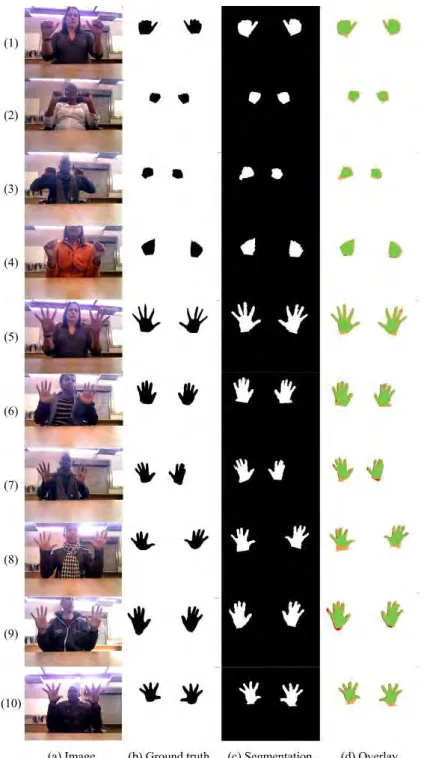
To evaluate the performance of the segmentation scheme, a dataset of 10 images was used. These can be seen in Figure 4.4.
The dataset consists of users with different skin colours and hand sizes to test the robustness of the segmentation algorithm. RGB images, depth images and the NiTE hand position were captured using an Asus Xtion Pro Live sensor. Ground truth, containing only the hands in the image was manually marked to aid in quantitative assessment of the segmentation performance. The global-consistency error (GCE) and local-consistency error are used to evaluate the segmentation performance [97]. For a given pixel pi consider the hand segments S1 and S2 in the two images I1 and I2 that contain that pixel. If one segment is a subset of the other, then the pixel
lies in an area of refinement and the error should be zero. However, if there is no subset relationship then the error should be nonzero. The local refinement error is defined in the work by Martin et al. [97] as
E(S1, S2, pi) =
|U(S1, pi)−U(S2, pi)|
|U(S1, pi)|
, (4.5)
whereU denotes the set of pixels inS1 that contain pixelpi, and|x|is the cardinality
Chapter 4 Hand Gesture Feature Extraction
Figure 4.4. Dataset used to evaluate segmentation performance. (a) Original colour image. (b) Manually segmented ground truth image. Black indicates pixels belonging to the hand. (c) Results of the segmentation algorithm. White indicates pixels belonging to the hand. (d) Ground truth and segmented images overlayed. Green is correct classifications, orange is background pixels classified as skin (SF),
and red is skin pixels classified as background (BF).
4.1 Hand Segmentation
ground truth Eq. (4.5) can be simplified to the following four equations:
E1 = SF NB (4.6) E2 = BF BT +BF (4.7) E3 = BF NS (4.8) E4 = SF SF +ST . (4.9)
The number of background pixels classified as skin is SF, ST is the number of skin
pixels classified as skin, BF is the number of skin pixels classified as background,BT
is the number of true background pixels and NB and NS are the number of
back-ground and skin pixels in the back-ground truth image. The local and global consistency errors are as defined in the work by Martin et al. [97]:
GCE(S1,S2) = 1 nmin ( X i E(S1, S2, pi), X i E(S2, S1, pi) ) (4.10) LCE(S1, S2) = 1 n X i min{E(S1, S2, pi), E(S1, S2, pi)} (4.11)
where n is the total number of pixels.
The error measures for the 10 images in the dataset can be seen in Figure 4.5. The amount of overlap between segmentation’s can be seen in Figure 4.4.
Figure 4.5. LCE and GCE for different images in the dataset.
As expected LCE≤GCE as GCE is a tougher measure of segmentation performance as all local refinements must be in the same direction. Details of these measures can be found in the work by Martin et al. [97]. Note that all the segmentation results have a GCE less than 3% and LCE less than 2%. False positives, or background
Chapter 4 Hand Gesture Feature Extraction
pixels classified as belonging to the hand, contribute the majority of the error due to the larger appearance of the hand in the depth image. In Figure 4.4, for per-sons (6) and (8) the wrist is larger than the palm, resulting in a larger inscribed circle. This error depends on the user’s clothes. A comparison to an explicit skin colour segmentation [90] or segmentation based on depth-based methods is shown in Figure 4.6. The poor performance of the explicit skin colour-based method is due to skin-coloured objects in the environment. The combined method and the depth-based methods perform equally well in terms of both the LCE and GCE per-formance. In addition, the rule is unable to classify all types of skin colours, as illustrated in Figure 4.7. Skin coloured objects in the background are segmented (shown in orange) and the rule is unable to cope with a wide range of skin colours (shown in red). Depth, colour and forearm separation yield the best results.
0 0.02 0.04 0.06 0.08 0.1 0.12 1 2 3 4 5 6 7 8 9 10 Loc al C ons is te nc y Er ror (L C E) Image Number Combine Explicit Skin Depth
(a)LCE performance.
0 0.05 0.1 0.15 0.2 0.25 0.3 0.35 1 2 3 4 5 6 7 8 9 10 G loba l C ons is te nc y Er ror (G C E) Image Number All Explicit Skin Depth (b)GCE performance.
Figure 4.6. Comparison of three different segmentation methods.