Second World Conference on POM and 15th Annual POM Conference, Cancun, Mexico, April 30 - May 3, 2004.
Conference Section: Enterprise Resource Planning
Abstract Number: 002-0295
A FRAMEWORK TO ASSESS ERP IMPLEMENTATION
Luis Ferrario1,3 and Jorge M. Montagna2,3[email protected], [email protected] 1
Red Megatone S.A., Bv. Santa Fe 252 – (2300) Rafaela – Argentina; TE ++54-3492-426798 2
INGAR, Avellaneda 3657 – (3000) Santa Fe – Argentina; TE ++54-342-4534451 3
Facultad Regional Santa Fe – Universidad Tecnológica Nacional Abstract
Several sources point out very high percentages of failures in the implementation of ERP systems. First, in this work, the main difficulties for this task are analyzed and a systematic classification of the fundamental reasons is intended. Taking into account the reasons that lead to failure, a simple and effective mechanism is generated to prevent the main problems that can arise during the project, evaluating systematically in advance complications that usually appear. Thus, the stages of the methodology and the tools to be used can be adjusted to the specific characteristics of the project, considering technical, organizational and economical aspects. Somehow, the described framework allows solving the problems presented by general methodologies. They arise when the same methodology is used for any kind of enterprise, without previously considering its conditions and state to face this type of projects.
1. Introduction
The business environment has changed dramatically. Nowadays, companies face serious challenges: to manage in a competitive environment, to expand markets, to meet more and more specific requirements from customers, etc. This increases pressure on firms to reduce costs along the whole supply chain, shorten production time, increase productivity, reduce stocks, improve service level for customers, among others. This has forced companies to change their way of operating. A significant difference is the tendency towards sharing critical information with suppliers, dealers and customers (Umble et al., 2003; Legris et al., 2003). In the same way, they face complex programs that tend to integrate the fragmented activities that existed in the internal operations of the firms (Teng et al., 1996; Kallio et al., 1999). These are some of the main reasons for justifying the implementation of new information systems, and if the organization integration is intended, the first option is ERP systems.
ERP systems are on-line interactive systems that support most key processes of an organization by using a common data base that stores all the organization’s data (Abdinnour-Helm et al., 2003; Mabert et al., 2003a; Callaway , 1999). These software packs expanded rapidly due to their advantages over the rest of the legacy systems: high integration level, operation on the organization’s business processes, allowance for reducing operative costs, etc. They provide a marked integration of processes through an improved and standardized workflow according to the best practices. All these advantages are not easy to achieve. Implementing these software packs is extremely complex and implies a great challenge for the enterprise (Davenport,
1998; Lozinsky, 1998). It may take many years and may require a lot of money.
This has led to important failure rates in implementations. One source of problems resides in the difference of interests between customer organizations who search for a unique business
solution and ERP sellers who prefer a generic solution to be adjusted to a wide market (Hong and Kim, 2002). In their efforts to have “their business solution”, and taking into account that their business processes constitute their competitive advantage, enterprises invest a lot of money in customizing ERPs, which then brings about many problems in the system updating. “Customizing” the ERP is the process for modifying the source code of the system to adjust it to the enterprise requirements, which differs from parameterizing or configuring the system.
This work presents a systematic classification of sources of failures to identify their origins and to foresee solutions to overcome them. A framework is generated to allow for a priori evaluating the main difficulties of the project so as to focus resources towards the appropriate direction. In general terms, implementation methodologies tend to be general and do not previously take into account the difficulties they will have to face on a particular enterprise. In this case, it is intended to estimate the real complexity of the project.
2. ERP Implementation
Making the ERP system operative poses a series of important challenges for the enterprise and an important demand of human, technical and economical requirements and time consumption. In many cases, the definition that considers when to implement the system is an issue to be discussed (Gottschalk, 1999). It is also a discussion topic when all the value the ERP system can provide for the enterprise has been achieved (Davenport, 1998). It greatly affects the enterprise’s health, and in case of problems, the company processes can be blocked and this may bring about serious drawbacks into the organization (Kumar et al., 2002).
In the last years, many enterprises acquired ERP systems to replace their legacy systems, attainining better integration of their functional areas. According to Umble et al. (2003), ERPs provide two great benefits that cannot be found in the system departments of organizations:
a unified view of the company businesses involving all functions and departments; a data base in which all transactions are entered, registered, processed and monitored.
Unlike legacy systems, ERP systems are not made to meet the organization’s requirements but they have to be parameterized according to the business processes of the organization. It is not an easy task since it brings about a great change in the organization. It is crucial since the organization business processes are modeled to operate on the system. In that way, all the business logics of the company is shaped.
Implementation can be defined as “a decision making activity that turns a conceptual design into an operative reality that can provide value to customers” (Marble , 2003). But, who plays the role of customer in an implementation? Undoubtedly users, and for implementation to provide users with value, all their requirements must be met. Marble (2003) states that top management prioritizes an implementation project only because it is indirectly associated to improving users´ satisfaction. Only when this priority exists in the management of a continuous development and growth, the top management support is valuable for users.
There are various methodologies for implementing an ERP, many of which are developed by suppliers themselves (Al-Mashari and Zairi, 2000b, 2003; Bancroft et al., 1997; Rebstock and Hildebrand, 1999). They include technical, operative, and organizational issues (Abdinnour-Helm et al., 2003; Mabert et al., 2003a, 2003b; Mandal and Gunasekaran, 2003).
We can evaluate the different sources of failures by studying the factors that make an implementation successful. These factors can be divided into three big groups: human/organizational factors, economic factors, and technical factors (Sarker and Lee, 2003). This section is intended to make a systematic classification of those elements that are considered as sources of failure in the ERP implementation taking into account previous works on this subject (Bajaj and Nidumolu, 1998; Gefen , 2002; Hong and Kim, 2002; Jianga and Kleinb, 1999; Kuruppuarachichi et al., 2002; Mabert et al., 2003a, 2003b; Mandal and Gunasekaran, 2003; Sarker and Lee, 2003; Soffer et al., 2003; Somers and Nelson, 2003; Stensrud, 2001; Westerveld, 2003; Umble et al., 2003). The following classification has been obtained:
Human/Organizational Factors: They become more important especially when the level of change of the organization’s business processes is more significant. They include:
• Leadership: It arises from the sponsor group of the project. It selects and directs functional
leaders, supports them in decision-making and provides them capacity for deciding on the main implementation aspects. An important characteristic is the decision-making capacity so as to avoid delays. Lack of leadership inevitably leads to failure (Sarker and Lee, 2003).
• Communication: Everyone in the enterprise must be aware of changes that have been already
made or are to be introduced and the effort required by this project. Communication must be open and honest in order to minimize employees’ resistance against change (Sarker and Lee, 2003). It is one of the hardest and most challenging tasks of an ERP project. There must be a detailed plan including explanations on ERP implementation, details of changes in the company´s business processes, software modules demonstrations, and so forth, so that implementation does not become chaotic (Al-Mashari et al., 2003).
• Organizational culture: Implementing an ERP implies a change in the organization’s business processes that can be radical in most cases. It is convenient to have a culture that enables this kind of changes. The employees’ attitude is vital for the implementation to be successful (Abdinnour-Helm et al, 2003). Also, as a consequence, the firm culture can be affected. If the staff is not properly prepared, there might be refusals, opposition and chaos (Umble et al., 2003).
Cultural aspects related to the country or region in which the company operates should be taken into consideration (Krumbholz and Maiden, 2001). Many organizations are geographically distributed, performing activities in various regions and countries. This is a very important risk factor, since the project may have different characteristics depending on the place. Moreover, it must be taken into account that an ERP includes aspects from the culture of those by whom it has been developed, which are somehow reflected in the way the system operates.
• Implementation team: It must be balanced; i.e. it should include people from every area of
the enterprise and it should be 100% committed to the project. Working in interdisciplinary teams is essential for the project to be successful. In very little integrated vertical organizations, this is not usual and it can be an important risk factor. You must count on people that can make critical decisions anytime and count on all necessary resources (Umble et al., 2003). The participants should be the key users that will be involved in the processes the ERP include (Marble, 2003). They will be the owners of the processes implemented in the ERP. For this reason, they must participate of the project from the very beginning.
• Organizational adjustment: The way in which an ERP system is adjusted to the
organization’s processes is crucial for a successful implementation. Many firms´ processes do not match the tools and structure provided by ERPs (Lozinsky, 1998; Umble et al., 2003). An important criterion for selecting an ERP is its adjustment to the company processes. The main
problem is that suppliers strongly recommend implementing the ERP following their processes so as to reduce customization. They are known as “the best practices” because they have been extracted from successful organizations. On the other hand, there are organizations whose processes cannot be adjusted to the ERP procedures. Mainly, strategic information systems are difficult to customize from the ERP since they correspond to distinct practices from which the enterprise gets competitive advantages (Davenport, 1998). When implementing an ERP system, its adjustment degree to the organization must be well defined because otherwise implementation could be too long and expensive and could not meet the company’s requirements (Hong and Kim, 2002). In many cases, reengineering of key business processes is included, developing new business processes to support the company´s objectives (Al-Mashari and Zairi, 2000a).
• Company size: Organizations have different reasons for implementing an ERP, depending on
their size. Big firms are motivated by strategic needs, and the smallest ones by operative considerations (Mabert et al., 2003b). The number of adopted modules, implementation plans, and the expected results are different. Big companies report great benefits in the financial area, whereas small ones report benefits in manufactures and logistics. In big organizations geographically dispersed, cultural aspects are significant (Krumbholz and Maiden, 2001). They have influence on the degree of customization to be applied: bigger firms have more resources and can even pose the integration of different suppliers (Mabert et al., 2003b).
• Experience in this kind of projects: The required effort is quite big and usually there is no
experience of working with similar previous projects. There are great risks for the project to be out of budget and time. Unfortunately, many business men consider an ERP as a simple software and its implementation as a technological challenge. They do not understand the effect of ERP on the company’s operation.
• Methodology: The lack of a suitable methodology may lead to failure. Most ERP suppliers have their own general methodology, which is not always compatible with the organization it will be applied to. Many times, firms try to adjust the organization itself to the methodology requirements, without considering if it is the most convenient one according to the firm’s culture.
• Satisfaction and use of the system by users: A great effort for implementation is useless if the
final user is not satisfied by the system and does not want to use it. It is essential to integrate users early so that they can become involved in the project and to take their requirements into account (Gefen, 2002; Gelderman, 1998; Hwang and Thorn, 1999).
• Comprehension of strategic objectives: Key people in the company must create a clear
strategic vision of how the company should operate to satisfy customers, enable employees performance and determine interaction with suppliers for the next 3 to 5 years (Davenport, 1998).
Economic Factors: If the needed funds are not available, it is impossible and unfeasible for a project to be continued. Some factors to be taken into consideration are:
• Economic plan: An economic plan is needed to control costs coming from different sources,
mainly focused on licenses, technical resources and human resources costs. The last one are the most significant ones and include consulting, the firm staff expenses, incorporation of specialized technical staff, etc.
• Budget adjustment: If the organization does not respect the settled budget for the project, it
will inevitably fail. It should be taken into account that in this kind of projects there are hidden costs that should be considered in the budget: new computer hardware, databases, consultants,
training and the time employees spend working on the project (Callaway, 1999). These costs strongly depend on the particular characteristics of each company.
Technical Factors: They refer to the organization’s technical capacity for implementing this type of systems. The most important factors to be taken into account are:
• Customization and software testing: Customizing the ERP pack requires highly trained staff.
This usually implies depending on third parties and increasing the project cost. An adequate testing is important to avoid errors at further stages (Sarker and Lee, 2003).
• Staff with technical knowledge: It is necessary to count on people that have an adequate
technical profile to manage the technological change, minimize the impact this might cause, and reduce implementation time.
• IT resources: The bigger the amount of technology to be incorporated, the more expensive
and complicated the implementation project. This technology must be ready and available before the implementation project starts.
• Management of legacy systems: If legacy systems are very assorted and complex, then the
amount of required technical and organizational change is more significant and the risk of the project increases (Al-Mashari et al., 2003).
4. Framework for Analyzing an ERP Implementation
Frameworks allow us to organize and integrate the various elements of a problem in a simple and consistent way assuring the attainment of the pursued outcomes, sticking to a common work discipline. The benefits of counting on this kind of tools exceed the reached objectives. The framework development process and the associated discussion among
participants constitute a fundamental contribution to the project (Boyer et al., 2002; Heeks, 2003).
Before starting the project, it is convenient to bear in mind which are the main difficulties to be overcome and to which extent they can affect the project. For this purpose, and according to the previous analysis, a framework is presented to estimate the difficulty degree and failure probability so as to prepare suitable measures to overcome problems. The main object of this framework is to try to evaluate a priori implementation difficulties so that an adequate methodology can be used, with tools adjusted to each project’s needs. It should be taken into account that not all projects are alike; neither should the same methodologies be used since there are several aspects that make projects different from one another.
Marble (2003) presents a framework to analyze implementation projects, emphasizing the project characteristics. Unlike that work, the framework presented in this work takes into account aspects related to an organization’s position to face an ERP particularities.
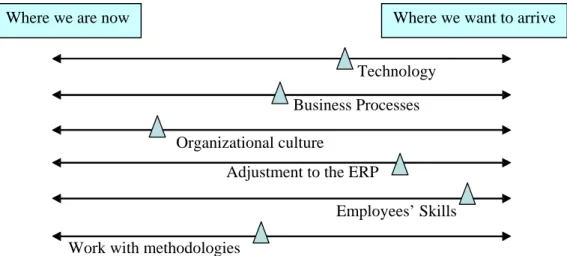
This framework is based on two states: “Where we are now” that measures the
organization’s current reality, and “Where we want to arrive” that estimates the desired situation
when the project ends. Failure probability or project difficulty can be estimated through the gap existing between both states. The greater the gap, the greater the implementation project difficulty. It is intended to see the enterprise’s position to face the project.
For the case of a small gap, the framework would indicate that the project will be probably successfully finished. It also may indicate that the change level is low, which leads to questions such as: In the face of a low change level, is it worthy to undertake an ERP project?, Do legacy systems with some modifications satisfy our expectancies? Do the project goals adequately take advantage of an ERP system capacities?
By using the previously considered factors, an ERP implementation is assumed to be analyzed through six key dimensions, which are considered necessary and enough to analyze the existing gap between the current situation and the designed one (Figure 1):
• Technology: A very expensive technology is needed that sensibly affects the project in its
technical, economical and organizational aspects. A deep analysis can be carried out considering sub-dimensions as hardware, operative system, data base, networks and connectivity and integration with legacy systems. Besides the specific cost, intangible cost must be taken into account. These costs arise when a certain technology is changed (education, training, migration, etc.) and they are not simple to be evaluated. In many cases, these change costs are more significant than technology costs.
• Business Processes: This wide dimension intends to measure the existing distance between current and redesigned processes to be considered as optimal in the firm after the project. The way in which the company’s business processes are carried out should be reviewed. If they are fragmented, without an adequate focus on the customer, with tasks that do not aggregate value, etc., the effort to attain the best practices included in ERPs will be quite significant.
• Organizational Culture: It is necessary for the enterprise to count on an adequate culture, i.e. the right people having a good predisposition to changes and creative and optimistic personality. It also considers inner resistance. Other factors such as experience in similar projects of the company, communication policy, etc. also have a great influence.
• Adjustment to the ERP: It considers correspondence between the organizations’s redesigned business processes and the best practices incorporated into the ERP system. The greater the adjustment, the easier and more economical the implementation. ERPs include practices that have been studied in relation to many enterprises and have been considered as the most suitable
ones. However, in many cases they might not match the company’s objectives. A bigger or smaller adjustment determines the degree of customization. This also impacts on the Organizational Culture, since it affects the way in which people works in an organization.
• Employees’ Skills: This factor considers the current staff profile, skills and knowledge in relation to the requirements for operating with the ERP. It relates their previous work to what they will have to do with the new system. Training of the people involved in the project is also taken into account. It requires people having experience of working in similar projects so as to make implementation faster.
• Work with Methodologies: If the organization is used to working with methodologies and similar experiences have been developed, a better project development can be estimated.
Figure 1 presents a model for evaluating an organization as regards the specified dimensions. In each dimension, triangles slide horizontally from “Where we are now” to “Where we want to arrive”, determining the organization’s position to face the project and defining the dimension’s rating. For example, if the triangle is near “Where we want to arrive”, it means that in that dimension the organization is near the pursued goals and that the required change level or the effort is low. On the other hand, if the triangle is nearer “Where we are now”, it means that great reforms or significant inversions and efforts are needed in that dimension so as to carry out the project. Particular dimensions can be added, depending on the kind of organization where the model is applied.
If these gaps could be reduced, the failure risk in the implementation would be decreased. Many times, these gaps can not be diminished since they correspond to conditions related to the enterprise and to the project. They allow for predicting or estimating the difficulties to be faced in order to determine the appropriate use of the resources and to foresee the project length.
Technology Business Processes Organizational culture
Adjustment to the ERP
Employees’ Skills Work with methodologies
Where we want to arrive Where we are now
Figure 1: Model for Evaluating the Project Gap
5. Methodology for Using the Framework
We present the general steps to follow for using this framework.
Step 1: Evaluation of gaps between the current and the planned situation
For each dimension, an analysis is made to evaluate the existing gap between the current situation of the organization and the desired situation expected after implementing the ERP. Numerical values are assigned to consider distance between both situations, using a 0 to 100 scale for each dimension. For the purpose of guidance, we provide meanings for some values, but any value can be assigned within this range.
• 0 Value: There is no difference between the current situation and the one after ERP implementation.
• 50 Value: There is a degree of mean difference between the current situation and the one after ERP implementation.
• 100 Value: The current situation is very different from the solution proposed with the ERP. A particular dimension can be divided in several sub-dimensions with weights according to their relative importance in the main dimension. For example, Technology can be divided into
five subdimensions: Data Base, Operative System, Conectivity and Networks, Hardware, and Legacy Systems Integration.
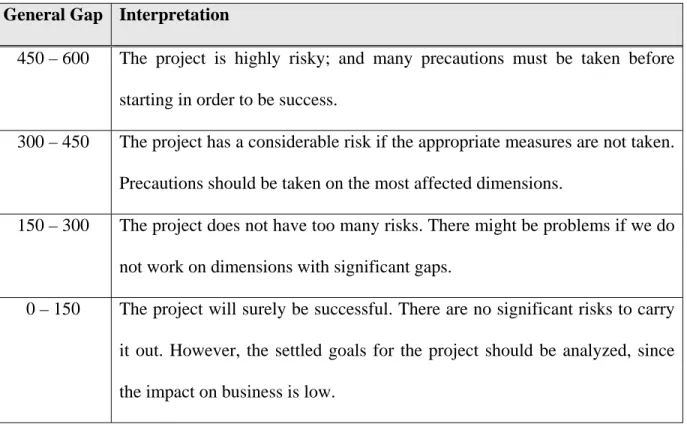
Once all proposed dimensions have been assigned, a global indicator, the general gap, is generated, which estimates the degree of success the ERP implementation project may have. It is obtained from the sum of the gaps of the proposed dimensions in the model. Other alternatives may be generated. For example, each dimension can be assigned a different weight, if its impact is assumed to be different for the project success. Table 1 shows how to interpret results obtained for the General Gap.
General Gap Interpretation
450 – 600 The project is highly risky; and many precautions must be taken before
starting in order to be success.
300 – 450 The project has a considerable risk if the appropriate measures are not taken.
Precautions should be taken on the most affected dimensions.
150 – 300 The project does not have too many risks. There might be problems if we do
not work on dimensions with significant gaps.
0 – 150 The project will surely be successful. There are no significant risks to carry
it out. However, the settled goals for the project should be analyzed, since the impact on business is low.
Table 1: Interpretation of the values obtained for the General Gap
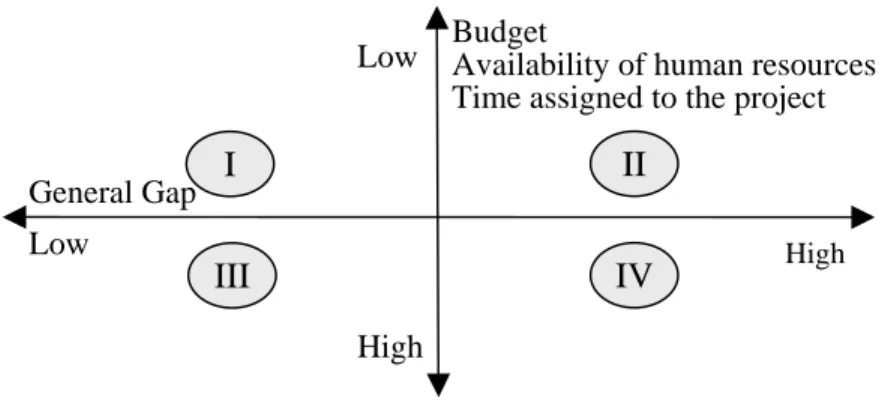
Low BudgetAvailability of human resources Time assigned to the project
High High Low General Gap IV III II I
Figure 2: General Gap of the Project vs Resources
Available resources cannot be analyzed as dimensions with differences between reality and the desired situation. They are important elements when considering if the organization is ready to undertake a project of this kind. Once the general gap is estimated, it must be related to
three key dimensions, Budget, Availability of Human Resources and Time Assigned to the
Project, to determine the probability of the project success. For each dimension, we have to consider suitable measures that allow determining their availability to undertake the project.
Figure 2 shows four quadrants that relate the general gap and the dimensions considered to indicate possible locations of the organization. The meanings of each quadrant are:
• Quadrant I: The project has a low general gap and does not count on enough budget, time or availability of key people to undertake the project. The organization is not in optimal conditions to start implementation but with some adjustments it can go further towards a successful project.
• Quadrant II: The general gap is high and the firm does not count on the resources needed to face implementation. There are great probabilities of failure. The effort to be made in order to lead the organization to achieve a successful project is very significant and quite risky.
• Quadrant III: Organizations with greater possibilities of success. They have a low general gap and the resources are enough. Taking into account the general gap value, available resources should be assigned to analyze the project justification. Taking into account the low level of
change, it is interesting to know if it is really necessary to implement an ERP or if the project objectives have not been well planned according to the ERP potentialities.
• Quadrant IV: Organizations with many difficulties. A great effort is required. However, having available resources may constitute an incentive to try to overcome the existing problems by using a suitable methodology.
The previous analysis has been made taking all resources into consideration simultaneously. It can be very useful to unfold the graph in Figure 2 for each separated resource.
Step 3: Determining actions to be taken to adjust the project
In most cases, the studied organizations will be located over 150 points, for which actions should be taken so as to minimize project risks. One option is to try to reduce gaps, but in many cases this is unfeasible because it attacks project quality and leads to less ambitious goals. In some cases a revision of the gaps of certain dimensions may be necessary. For example, in Technology we can consider questions such as: Is it necessary to buy a new data base? In the Business processes dimension, the redesign proposal should be reviewed.
In other cases, resources availability allows re-adjusting the project conditions. For example, increasing the budget allows for improving availability of trained human resources, and improving the gap in the Employees’ skills dimension at the same time. A low budget may force the project to last longer. Therefore, in many cases the first step consists of iterating over previous stages and evaluating other alternatives and details that help to define and assess alternatives for the ERP implementation. It is an enriching procedure that allows going more deeply into the relationship between the organization’s conditions and the project to be
undertaken. In these iterations, an error could consist of resigning oneself to achieving objectives that are inferior to those originally proposed due to the existing difficulties.
The most important action is to adjust the implementation project steps according to the obtained results; i.e., a realistic chronogram and stages should be defined and a good resources distribution should be made. This requires considering all the stages in the methodology taking into account the available elements. In many cases, this forces the project to have longer stages with a greater level of detail and more sophisticated tools so as to assure the project success. In other cases, the recommendation may be not to change the original methodology course.
6. Example
The framework has been developed in a real case. A company is selecting an ERP supplier. For the purpose of having better grounds to base its decision, the firm decides to undertake this study on the last two candidates. The analysis and the obtained results about both suppliers selected in this phase are briefly described.
The company belongs to the retail industry. It has a head office, three logistic distribution centers and more than 50 branches throughout the country. Among its main areas, we can mention: Finance, Accounting, Human Resources, Sales, Purchases and Logistics. The latte is one of the most critical areas due to the firm expansion and the great number of branches to be supplied. Business dynamics, strong competition, constant changes in the purchase culture of consumers, the current situation of this country and the aggressive expansion of the company in the last years (the number of branches tripled in 3 years), complicate the normal performance of business processes, thus making it difficult to keep them competitive and updated.
Information systems supporting the organization processes are developed “in-house” by the Systems Department, with tools that are not the newest in technology. They have not been updated according to the growth rate developed by the organization. These tools limitations make it difficult to keep business processes integrated and with a great aggregated value. For that reason, the company decided to acquire an ERP, so that they can cover all their areas with high-technology systems. The pursued goals are to achieve a better integration in the firm so as to attain competitive advantages and be able to take advantage of the benefits provided by the Supply Chain Management, which is not possible nowadays with the available technology.
Following the posed methodology, the analysis has been divided into the three steps.
Step 1: Evaluation of gaps between the current and the planned situation
Gaps on the six dimensions have been calculated with a specific methodology for each dimension in order to reach the numerical value of the gap. This work presents a generic analysis. Following, the grounds of the analysis are detailed:
• Technology: the following sub-dimensions and their respective weights have been analyzed:
Data Base (40 %), Operative System (10 %), Integration with Legacy Systems (30 %), Hardware (10 %) and Communications (10 %).
Actual: The company has a robust structure as regards both hardware and networks. All work stations are connected to the firm’s LAN and there are high technology routers and switches. The applications server has an excellent speed and storage capacity. There are also corporative servers for using e-mail and Internet, and other equipment for various operations (backup servers, etc.). There is not a data base driver of the transactional kind. Data are stored in files. Current systems are developed in a third generation language with characters
interphase. The operative system being used is SCO Unix. The information exchange between head office and branches takes place through off-line interphases connected for short periods of time.
Desired: The company intends to connect all branches on line to reduce expenses in communication among the scattered branches. This will also allow the company to know the existing stock in all branches in real time, which is critical for avoiding expensive stock shortages. As regards hardware, it is intended to count on the necessary equipment to run the ERP processes in the right way. It will keep the operative system and a good integration between the ERP and legacy systems is to be reached.
• Business Processes:
Current: The organizational structure is vertical, with clearly marked functional areas and a high fragmentation of activities. There is no process manual.
Desired: Due to the existing difficulties, a re-engineering project of all business processes is being developed (BPR). This BPR is independent of the ERP project. A flatter structure is intended, with emphasis on processes integration of all company areas.
• Organizational Culture:
Current: Due to the constant growth of the company, employees are used to deal with many changes and adapt themselves to them so as to manage daily situations. There is an adequate leadership in the various areas, although with little integration and interaction among them. Due to the lack of an adequate support, the enterprise does not take full advantage of the information, decisions are mainly based on intuition and the staff is not used to using modern decision making tools.
Desired: It is intended to attain an organizational culture that emphasizes working in inter-departmental groups. Employees must perform works with a greater aggregated value for the company and routine processes must be executed automatically by means of information systems. Employees are intended to adjust themselves to the new dynamics of the company, to processes orientation, so as to achieve a better decision making.
• Adjustment to the ERP:
Current: The business processes obtained by the company as a result of the BPR project have been compared to those of the ERP. There are processes in the firm that are not standard, differ from those of their competitors and provide competitive advantage, such as sales and logistics processes. The remaining business processes are standard.
Desired: The greatest number of standard processes is to be reached. They must be adjusted to the ERP, so as to enable its operation on the ERP without losing competitive advantages. This is possible, except in the logistics process, which will adjust to the ERP with some modifications. The sales process cannot be implemented with the ERP. Therefore, the current systems will be kept and an interphase with the ERP will be developed.
• Employees´ skills:
Current: Since the number of professionals in the company is too high, there are human resources with the needed skills to face a project of this kind. There is capacity for adjustment to new ways of working according to the new experience developed in the successive expansions of the company.
Desired: Employees should have capacity for understanding the new form of business developed by the company, which has a greater focus on customers, ability to interact with
other areas, capacity for leadership, ability to make decisions, etc. It is intended to take full advantage of all benefits and possibilities offered by the implemented ERP.
• Work with methodologies:
Current: There is experience in projects of relative magnitude, although they have not been undertaken with suitable methodologies. In general, leaders manage activities and resources, but with little interaction with the remaining members of the project. The specific tools used for developing and tracing the project are scarce.
Desired: it is intended to incorporate specific methodologies to work on projects, which exceeds this project. As a consequence of the new company structure and its expansion and consolidation, this type of activity is considered to be critical for its success.
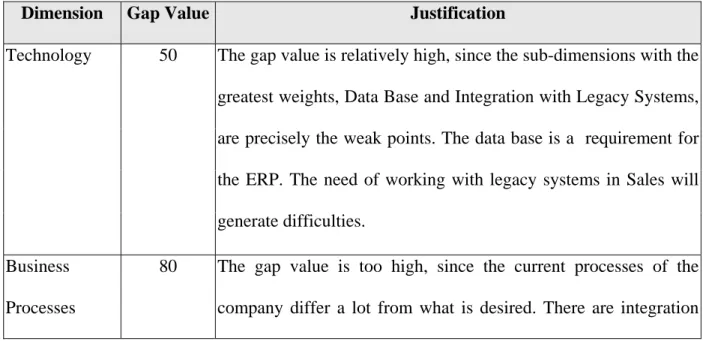
For the purpose of getting the gaps between both states, each analyzed dimension was assigned a value on a 0 – 100 scale, using appropriate measurements. Table 2 shows numerical results and the criterion used to assign the values.
Table 2. Values and justification of gaps for each dimension.
Dimension Gap Value Justification
Technology 50 The gap value is relatively high, since the sub-dimensions with the
greatest weights, Data Base and Integration with Legacy Systems, are precisely the weak points. The data base is a requirement for the ERP. The need of working with legacy systems in Sales will generate difficulties.
Business Processes
80 The gap value is too high, since the current processes of the
problems among areas and a great fragmentation of activities. Organizational
Culture
40 There is a favourable environment for the change management
after the successive expansions of the firm and due to the difficulties in working with the current tools and support. On the other hand, there is little experience in team work and integration among departments in a vertical structure.
Adjustment to the ERP
50 There are various cases. Several processes are standard and are not
different from those of the ERP. The logistics process, instead, which is strategic for the firm due to the market it supplies and the employed way of working, presents important differences against the ERP module, requiring a great adjustment effort. Another strategic process is Sales, which will not be implemented because the ERP module cannot be adjusted to the company’s operating. Employees’
Skills
30 The gap is relatively small because there is a great professionalism
that allows for working with the ERP. There is experience in change management and capacity for adjustment.
Work with methodologies
70 The gap is high because there is no experience and managers are
not used to follow methodologies. There is a strong dependence of their decisions and criteria, which are generally intuitive.
By summing dimensions gaps, a general gap of 315 was obtained. By using the
classification presented in the framework, the company is in the (251 – 400) category, which
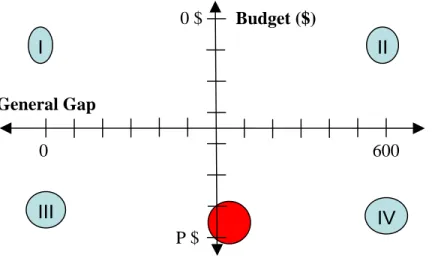
II I III IV Budget ($) General Gap 0 600 P $ 0 $
Figure 3: General Gap vs. Budget
Step 2: Analysis of the general gap of the project in relation to available resources
At this step, the general gap is analyzed in relation to the availability of three critical
resources: budget, human resources and time.
For the budget, the total value of the project was assumed as the top limit (P) in order to evaluate whether it is feasible to undertake it with the firm’s annual budget devoted to investments. As it will be seen later on, budget is related to available time and human resources for the project execution. The firm is in Quadrant IV since it counts on an adequate budget, but the general gap is high. The high budget is derived from the significant valuation the top management holds for the project due to the current drawbacks for running the firm. Under these conditions, some measures can be taken to reduce the general gap and take the company to a better position when starting to work with the project.
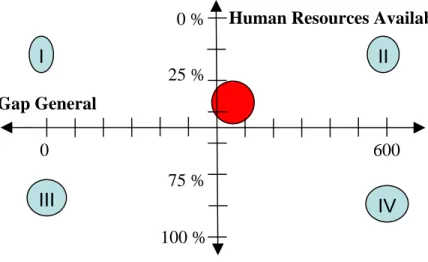
The second analyzed resource was human resources availability. For this measurement, the basis was the man hours estimated to carry out this project. These hours were related to the man hours the company was really willing to commit to the execution. Thus, the percentage of available human resources is obtained. Analyzing results, the firm is in Quadrant II, i.e. it does
II I
III IV
Human Resources Availability
Gap General 75 % 25 % 0 % 100 % 600 0
Figure 4: General Gap vs. Human Resources Availability
not have enough resources to undertake the project, which is a problem that gets worse due to the high general gap. A way of correcting this situation can consist of hiring additional staff.
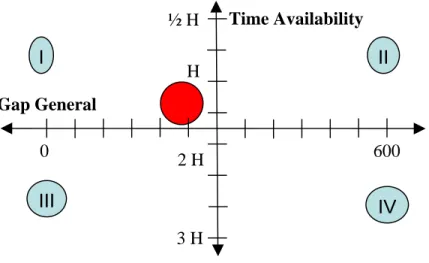
The third analyzed resource is time. It is difficult to define a scale for this resource, but, for this case, the dynamics of this kind of business and the immediate needs of the company have been considered. In this way, we obtain the value corresponding to time horizon H in which the company considers that it is essential for its development to have the project finished. The scale for time ranges between finishing the project in half that time (1/2 H) and doing it in three times
II I III IV Time Availability Gap General 0 600 3 H ½ H 2 H H
that value (3H). This value was contrasted against the time estimated for implementing a project of these characteristics, taking into account the available resources, the methodology to be used and the firm’s situation. Figure 5 shows that the company is in Quadrant II corresponding to a great general gap, with a project execution time that exceeds the one foreseen by the company. Then, some alternative must be generated to facilitate the process development.
Step 3: Determining actions to be taken to adjust the project
Considering results from the two previous steps, it is concluded that under the initially adopted strategy, the ERP implementation in the firm is a risky project. Even though there are no budget difficulties, human resources and time are not in ideal conditions, which gets worse due to the high general gap. The company does not have the necessary human resources to commit them full-time to the project. Moreover, due to its current situation, it needs the project to finish quickly, which seems unfeasible under the current conditions. A number of elements must be improved to attain a successful project. In this third step, it is intended to delve deeply into the analysis and iterate on the previous stages with new options in order to find out how gaps and resources use are affected. Actions that allow overcoming the detected drawbacks are posed.
A first alternative to reduce the project length is using a “big-bang” strategy, which was not initially contemplated, in which all modules are simultaneously implemented. As a consequence, it reduces the project length but it requires the involvement of an important portion of the staff, taking them away from their daily tasks.
Another option to be evaluated is hiring a greater number of specialized consultants for implementation in addition to all-day staff that have already worked with ERPs. With this
reduced, and that of the Organizational Culture can be slightly reduced. Their experience impacts on the employees´ ability and enables their comprehension of the project. The experience of the new staff working in an inter-disciplinary way is expected to be transmitted to the company. This option allows reducing the project length, even though it increases the budget. The relationship between the various elements used in this approach is noted.
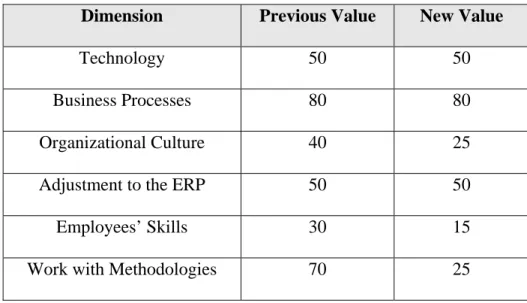
Table 3 shows the gaps values, considering the posed alternatives.
Table 3. Differences between the previous and the current gap Dimension Previous Value New Value
Technology 50 50
Business Processes 80 80
Organizational Culture 40 25
Adjustment to the ERP 50 50
Employees’ Skills 30 15
Work with Methodologies 70 25
The General Gap is 245, changing its category in relation to the first analysis. Now the
company is located in the 150-300 category, which indicates a slight risk of failure, only if
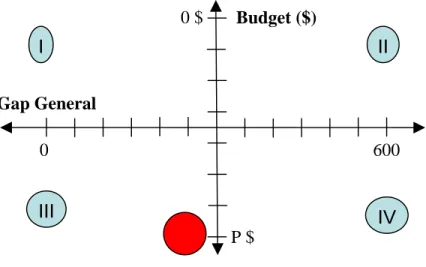
precautions are taken in those dimensions where gaps are high. As regards resources for the project, hiring more consultants and staff will undoubtedly increase the budget devoted to the project, but the general gap has been reduced. Figure 6 shows that the company passed from Quadrant IV to Quadrant III. It is noted that, by company decision, the budget changes demanded by staff incorporation can be met.
II I III IV Budget ($) Gap General 0 600 P $ 0 $
Figure 6: New relationship between General Gap and Budget
Figure 7 shows results for Human Resources Availability after the mentioned changes. It is noted that the situation gets better by incorporating consultants and additional staff. On the other hand, this resource is unfavorably affected by the use of a big-bang methodology to reduce the project length. Considering the reduction in the general gap, the company passes from Quadrant II to Quadrant III, which improves possibilities of project success. Anyway, it is a resource on which we should continue working.
As shown in Figure 8, hiring consultants and additional staff as reduced the implementation time, which diminishes the pressure on managers as regards the demanded short period of time.
II I
III IV
Human Resources Availability
Gap General 75 % 0 % 100 % 600 0 25 %
Taking into account the general gap reduction, the company passes from Quadrant II to Quadrant I. This shows that the application of a big-bang methodology has improved the project profile due to the company’s situation.
As a conclusion, the proposed changes prove to be beneficial and have improved probabilities of project success. The point with greatest difficulties is human resources availability. As regards dimensions, we have to bear in mind the heavy weight business processes have and that is why they have to be carefully handled. In the real case, other alternatives are analyzed, employing a greater level of detail in ach step.
6. Conclusions
ERP implementation presents a high rate of failures. In general, enterprises supplying these systems and the ones that implement them usually count on general methodologies to develop this task. One source of the aforementioned problems may arise from the fact that methodologies are general and cannot be adjusted to the project’s specific characteristics. This adjustment between methodology, the organization and the project characteristics must be done a priori, before starting the first stage. Going back in the project execution, reassigning resources,
II I III IV Time Availability eneral Gap G 0 600 3 H ½ H 2 H H
etc. are mechanisms that probably lead to failure if they are applied during the project development. Therefore, before starting to work, the main problems to be solved should be clearly identified. Bearing this in mind, the contemplated stages and tools must be checked and adjustments should be assessed to overcome implementation difficulties.
A framework is presented. It allows estimating the difficulties of an ERP implementation project. A series of dimensions is analyzed taking into account that they are basic either for success or failure of this kind of projects. They have been derived from a bibliographic review of works on this area and from the authors’ personal experiences. By analyzing the difference between the enterprise’s current situation and the one planned with the ERP, the difficulties in implementing the ERP can be estimated. Then, the values obtained for this gap are matched to the available resources to undertake the project.
Thsi framework allows adjusting the steps to be executed in the ERP implementation. Regardless of the obtained results, the need of carrying out the posed steps, evaluating the elements, and revising relationships between detected gaps and available resources allows those groups that face such problems to exactly measure the constraints they will have to overcome.
References
• Abdinnour-Helm S., M. Lengnick-Hall, C. Lengnick-Hall; Pre-implementation Attitudes
and Organizational Readiness for Implementing an Enterprise Resource Planning System,
European Journal of Operational Research 146, 258-273 (2003).
• Al-Mashari M., M. Zairi; Supply-chain re-engineering using enterprise resource planning
(ERP) systems: an analysis of a SAP R/3 implementation case; International Journal of
• Al-Mashari M., M. Zairi; The Effective Application of SAP R/3: A Proposed Model of
Best Practice, Logistics Information Management 13, 156-166 (2000b).
• Al-Mashari M., Al-Mudimigh A., Zairi M.; Enterprise Resource Planning: A taxonomy
of critical factors, European Journal of Operational Research 146, 352-364 (2003).
• Bajaj A., S. Nidumolu; A Feedback Model to Understand Information System usage,
Information & Management 33, 213-224 (1998).
• Bancroft N. H., H. Seip, A. Sprengel; Implementing SAP R/3; Manning Publications Co.
(1997)
• Boyer K., R. Hallowell, A. Roth.; E-services: Operating Strategy—A Case Study and a
Method for Analyzing Operational Benefits, Journal of Operations Management 20,
175-188 (2002).
• Callaway E.; Enterprise Resource Planning. Integrating Applications and Business
Processes Across the Enterprise, Computer Technology Research Corp (1999).
• Davenport T.; Putting the Enterprise into the Enterprise System, Harvard Business
Review 16 (4), 121-131 (1998).
• Gefen D.; Nurturing Client’s to Encourage Engagement Success During the
Customization of the ERP System, Omega 30, 287-299 (2002).
• Gelderman M.; The Relation Between User Satisfaction, Usage of Information Systems
and Performance, Information & Management 34, 11-18 (1998).
• Gottschalk P.; Implementation Predictors of Strategic Information Systems Plans,
Information & Management 36, 77-91 (1999).
• Heeks R.; Most eGovernment-for-Development Projects Fail: How Can Risks be
• Hong K., Y. Kim; The Critical Success Factor for ERP Implementation: An
Organizational Fit Perspective, Information & Management 40, 25-40 (2002).
• Hwang M., Thorn R.; The effect of user engagement on system success: A
meta-analytical integration of research findings, Information & Mangnt. 35, 229-236 (1999).
• Jianga J., G. Kleinb.; Risks to Different Aspects of System Success, Information &
Management 36, 263-272 (1999).
• Kallio J., Saarinen T., Salo S., Tinnila M., Vepsäläinen A.P.J.; Drivers and tracers of
business process changes; Journal of Strategic Information Systems 8, 125–142 (1999).
• Krumbholz M., Maiden N.; The Implementation of Enterprise Resource Planning
Packages in Different Organisational and National Cultures, Information Systems 26,
185-204 (2001).
• Kumar V., Maheshwari B., Kumar U.; ERP systems implementation: Best practices in
Canadian government organizations, Governm. Informat. Quarterly 19, 147-172 (2002).
• Kuruppuarachichi P., P. Mandal, R. Smith; IT Project Implementation Strategies for
Effective Changes: A Critical Review, Logist. Informat. Managem. 15, 126-137 (2002).
• Legris P., Ingham J., Collerette P., Why do people use information technology? A critical
review of the technology acceptance model, Informat. & Managem. 40, 191-204 (2003).
• Lozinsky S.; Enterprise-Wide Software Solutions. Integration Strategies and Practices;
Addison-Wesley Information Technology Series, Addison-Wesley (1998).
• Mabert V., A. Soni, M. Venkatamaran; Enterprise Resource Planning: Managing
Implementation Process, European Journal of Operat. Research 146, 302-314, (2003a).
• Mabert V., A. Soni, M. Venkatamaran; The Impact of Organization Size on ERP
• Mandal P., A. Gunasekaran; Issues in Implementing ERP: A Case Study, European
Journal of Operational Research 146, 274-283 (2003).
• Marble Robert P.; A system implementation study: management commitment to project
management, Information & Management 41, 111-123 (2003).
• Rebstock M., K. Hildebrand; SAP R/3 Management; Coriolis Technology Press (1999).
• Sarker S., A. Lee; Using a Case Study to Test the Role of Three Key Social Enablers in
ERP Implementation, Information & Management 40, 813-829 (2003).
• Soffer P., B. Golany, D. Dori.; ERP Modeling: A Comprehensive Approach, Information
Systems 28, 673-690 (2003).
• Somers T., K. Nelson; The Impact of the Strategy and Integration Mechanisms on
Enterprise System Value: Empirical Evidence from Manufacturing Firms, European
Journal of Operational Research 146, 315-338 (2003).
• Stensrud E.; Alternative Approaches to Effort Prediction of ERP Projects, Information
and Software Technology 43, 413-423 (2001).
• Teng . J. T. C., Grover V., Fiedler K. D.; Developing Strategic Perspectives on Business
Process Reengineering: From Process Reconfiguration to Organizational Change; Omega
24, 271-294 (1996).
• Umble E., Haft R., Umble M.; Enterprise Resource Planning: Implementation procedures
and critical success factors, European Journal of Operat. Research 146, 241-257 (2003).
• Westerveld E.; The Project Excellence Model: Linking Success Criteria and Critical